❌

Reading view

Iran: Palestinians’ rights must not be compromised in Gaza’s future; US, Israel to blame for Hormuz situation

Press TV – October 17, 2026

Iran’s ambassador and chargé d’affaires to the UN has stressed that any arrangements for the Gaza Strip’s future must fully respect Palestinian rights and self-determination, denouncing the United States and the Israeli regime for the current situation affecting the Strait of Hormuz.

Gholamhossein Darzi made the remarks on Friday, addressing a UN Security Council meeting on the situation in West Asia, including the Palestinian question.

He noted that Gaza remained devastated and continued to be subject to military aggression, despite the announcement of a ceasefire last year.

The ceasefire was announced last October as part of a United States-proposed plan to bring an end to two years of Israeli genocide, supposedly.

The Israeli regime has, however, killed more than 1,400 Palestinians during attacks across the territory ever since, in addition to the tens of thousands it had already killed throughout the genocide that began on October 7, 2023.

Darzi called for a permanent end to the Israeli aggression, lifting of the Israeli blockade on the coastal sliver, and realization of a lasting ceasefire in the territory.

He called for unconditional and complete withdrawal of Israeli forces from the territory as well as immediate and sustained delivery of humanitarian aid and deployment of relief personnel.

The diplomat called accountability for serious violations of international law a legal obligation, condemning the regime for committing genocide, war crimes, and crimes against humanity.

He also denounced expansion of illegal settlements, intensifying settler violence, and Israeli plans for “annexation” of the occupied West Bank.

Palestinians must be able to establish an independent, sovereign, and viable state, with the holy occupied city of al-Quds as its capital and full membership in the United Nations, the official stated.

He also demanded Israeli withdrawal from Lebanese territory and occupied Syrian areas and respect for both countries’ sovereignty.

Elsewhere in his remarks, Darzi slammed the United States and the Israeli regime for launching two rounds of unprovoked aggression against Iran respectively, last June and from February 28 until April 7 this year.

The aggressors, he noted, committed war crimes through deliberate targeting of civilians and critical infrastructure.

He also attributed the situation affecting the Strait of Hormuz to the American-Israeli atrocities, including an American naval blockade.

“Our position is crystal clear: The only practical way to restore normal and safe maritime navigation in the Strait of Hormuz is immediate and permanent cessation of US aggression, provision of credible guarantees against its recurrence, respect for Iran’s sovereign rights, and complete lifting of the naval blockade and other unlawful coercive measures.”

Following the US-Israeli aggression against Iran on February 28, Tehran closed the Strait of Hormuz to its adversaries. The key waterway has remained largely closed ever since, driving up fuel prices worldwide and increasing the cost of living for millions of people.

Tehran has made it clear that it will not reopen the strait until Washington meets its demands, including a permanent end to the war.

  •  

Exclusif : L’Iran, un cobra lové prêt à frapper

L’Iran et le Pakistan sont pleinement engagés dans la construction d’un ordre financier post-américain à la croisée du Moyen-Orient et de l’Asie du Sud.

Allons droit au cœur du sujet : après avoir soigneusement examiné l’échiquier, les dirigeants politiques et militaires de Téhéran sont déjà parvenus à la conclusion qu’une attaque conjointe américano-israélienne, dont la planification avance à un rythme effréné, est inévitable.

Ils se positionnent donc désormais comme un cobra lové, prêt à frapper et à injecter son venin mortel au premier signe d’une menace imminente du syndicat Epstein — sans même attendre une attaque effective.

Cette offensive préventive, dont les contours sont déjà tracés, sera dévastatrice ; elle s’étendra au-delà des bases américaines au Moyen-Orient vers d’autres cibles régionales, et pourrait notamment inclure les infrastructures énergétiques du Golfe ainsi que les câbles sous-marins (ce qui, dans ce cas, affecterait principalement le Golfe et l’Inde, bien plus que les États-Unis et l’Europe).

Nous sommes en présence d’un danger clair et immédiat : une opération militaire américano-israélienne destinée à exercer une pression sera certainement interprétée à Téhéran comme le début d’une attaque.

Ainsi, la pression en faveur de la guerre exercée par le «culte de la mort» et par Trump se heurte désormais à un seuil de tolérance iranien dangereusement bas. Les options de frappe du Pentagone vont des installations nucléaires iraniennes aux infrastructures énergétiques.

Il va sans dire que le «sociopathe en chef» — déjà en pleine panique face à la débâcle imminente des élections de mi-mandat — est une proie facile pour le puissant lobby sioniste pro-guerre et ses donateurs. Le danger stratégique suprême réside donc dans le fait que cette pression incessante puisse envoyer un signal que Téhéran interpréterait comme une attaque imminente, même si Washington affirme publiquement qu’aucune frappe n’aura lieu avant les élections de mi-mandat.

Le Yémen fait passer la situation à un niveau supérieur

Parallèlement, des sources privilégiées à Islamabad confirment le succès d’un essai de missile pakistanais à Mach 7, d’une portée de plusieurs milliers de kilomètres. Cette nouvelle capacité a tout ce qu’il faut pour modifier concrètement l’équilibre des pouvoirs au Moyen-Orient, en renforçant la portée dissuasive du Pakistan et sa capacité à influencer tous les calculs de sécurité régionaux, tout en approfondissant les liens du Pakistan avec la Chine, l’Iran et les pétro-monarchies du Golfe.

Et voici une autre exclusivité : des membres des services de renseignement militaire israéliens, notamment un général de division, ont quitté Riyad après que MbS, dans un prétendu moment de lucidité, eut dit «non» à l’offre d’»assistance» de la secte de la mort. Et pourtant, plus de 100 membres du CENTCOM sont toujours sur place.

La décision de MbS lui a peut-être été imposée par la Turquie et le Pakistan — les deux autres signataires de l’Alliance de défense de La Mecque, qui se sont soudainement retrouvés dans la même salle de crise à Riyad, côte à côte avec des agents de la secte de la mort.

Si leur départ a peut-être écarté un risque d’escalade, les agents américains restent révélés : toute frappe, d’où qu’elle vienne, faisant des victimes américaines entraînera immédiatement Washington dans la guerre entre l’Arabie saoudite et Ansarallah.

La guerre entre l’Arabie saoudite et Ansarallah atteint en effet un nouveau niveau de volatilité. Le mélange explosif constitué par l’interception d’un missile de croisière au-dessus de la province de Médine, les interceptions de drones ailleurs en Arabie saoudite et les frappes de missiles des forces armées yéménites contre le complexe présidentiel du gouvernement fantoche d’Aden n’est qu’un début.

Ce qui s’est passé après qu’Ansarallah a pris pour cible Najran — l’une des provinces du sud de l’Arabie saoudite volées au Yémen en 1934 par les Britanniques — est tout à fait stupéfiant.

Un porte-parole saoudien a accusé Ansarallah d’avoir lancé un missile de croisière sur Médine. La réponse du porte-parole emblématique des forces armées yéménites, le général Yahya Saree, a été cinglante : «Nous n’avons mené aucune opération militaire visant le territoire saoudien aujourd’hui. Par conséquent, l’affirmation de l’ennemi saoudien selon laquelle Médine aurait été prise pour cible est une pure invention et un mensonge grave».

Traduction : le Yémen frappe l’une de ses anciennes provinces ; les Saoudiens se lancent dans des fausses informations à outrance, inventant de toutes pièces une attaque contre l’une des deux mosquées sacrées — sans doute en préparation d’une opération sous faux pavillon ; puis le Yémen nie aussitôt avoir frappé quelque (italiques de ma part) territoire saoudien.

Cela signifie que Sanaa déclare subtilement, pour que tout le monde comprenne, qu’elle ne mène plus d’opérations à l’étranger (italiques de ma part) sur les trois provinces : Jizan, Najran et Asir. Elle prépare déjà — psychologiquement et opérationnellement — le terrain pour récupérer son territoire volé.

Tout cela se résume dans cette analyse yéménite succincte de la déconstruction de la fastueuse Maison des Saoud :

«Le Yémen sape les piliers ultra-fragiles de l’économie non pétrolière sur lesquels les pirates du désert ont fondé tous leurs espoirs : l’image, les investissements (IDE), l’évasion de la réalité, ainsi que l’impunité et l’invulnérabilité face au terrorisme à l’étranger».

Comment le Pakistan et l’Iran contournent le FMI

Prêtez maintenant attention à un événement assez surprenant qui s’est produit en milieu de semaine à Bangkok, lors de la réunion annuelle du FMI et de la Banque mondiale — dûment accueillie par des manifestations de rue en Thaïlande.

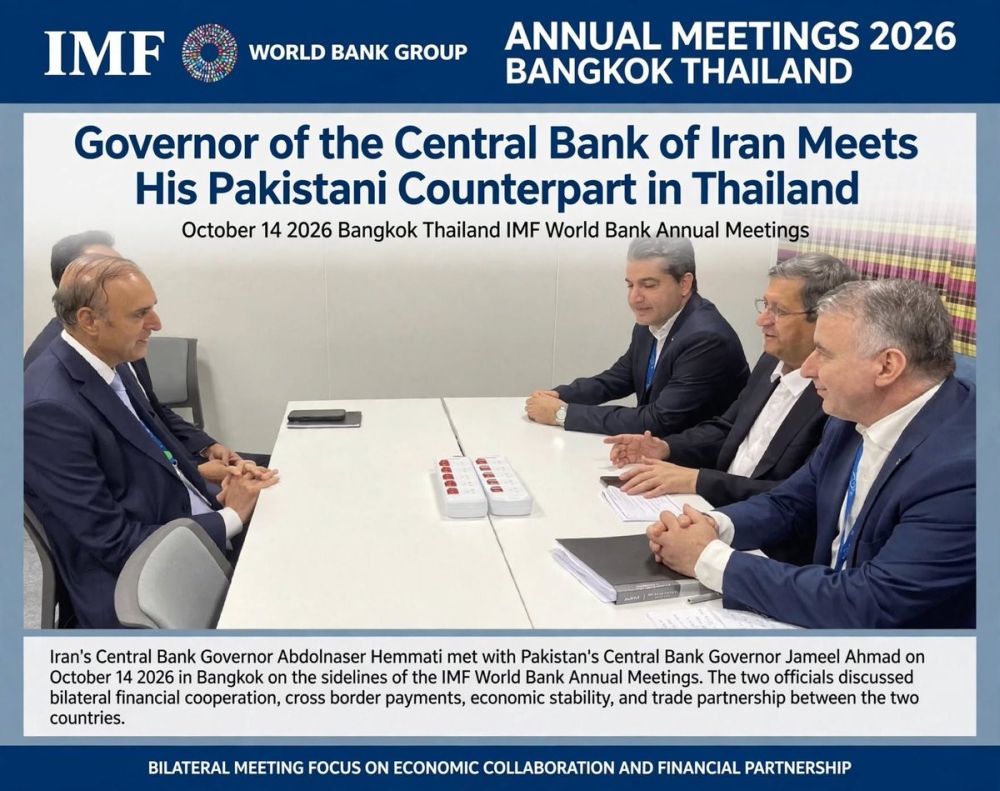
Le gouverneur de la Banque centrale d’Iran, Abdolnaser Hemmati, a rencontré le gouverneur de la Banque centrale du Pakistan, Jameel Ahmad, en marge de ce rituel annuel de premier plan à la gloire du dollar américain.

Le Pakistan est soumis à la poigne de fer des ajustements structurels imposés par le FMI et la Banque mondiale — et, pour couronner le tout, menacé de sanctions américaines parce qu’il entretient des relations commerciales avec l’Iran.

Le fait que le Pakistan et l’Iran discutent de facto de la dédollarisation au cœur même de la tanière du lion — le temple du dollar américain — n’a donc pas de prix.

L’infrastructure est en place depuis 2023, grâce à un accord de swap de devises utilisant le rial et la roupie à la place du dollar américain. Le troc est géré par les deux banques centrales, et les flux bancaires transitent par la Banque Melli en Iran et la Banque Mellat au Pakistan. Leurs marchés frontaliers — au moins six d’entre eux — sont en plein essor : des routes commerciales physiques qui contournent complètement le dollar américain.

Ce dont ils discutaient à Bangkok en début de semaine, c’est la manière d’étendre ce système : ils se moquent éperdument des sanctions secondaires américaines. D’autant plus que Téhéran offre à Islamabad ce que le système américain ne peut tout simplement pas offrir : la souveraineté, pas de changement de régime, pas d’austérité, pas de leçons de morale et, surtout, pas d’ajustement structurel.

Sans compter que le Pakistan a cruellement besoin du gaz iranien — et des routes commerciales de la nouvelle Route de la soie rendues possibles par la Chine.

L’Iran a bâti toute une économie en contournant complètement le FMI — et capable de survivre à un tsunami de sanctions, à un blocus et à la guerre.

Aujourd’hui, l’Iran et le Pakistan sont en pleine construction d’un ordre financier post-américain à la croisée du Moyen-Orient et de l’Asie du Sud — avec des swaps de devises, du troc, des marchés frontaliers en plein essor et des canaux bancaires adaptés, tournant ainsi en dérision les sanctions secondaires.

Soit dit en passant, cela se produit au moment même où un immense train iranien, chargé de pétrole brut — et le premier d’une longue série —, s’apprête à partir pour… la Chine via l’Asie centrale, sur la ligne ferroviaire de la «nouvelle Route de la soie» construite par la Chine.

Le cobra lové est peut-être prêt à frapper. Mais le cobra, depuis des temps immémoriaux, adore aussi faire des affaires.

Traduction:  Reseau International

  •  

Occidente es el Titanic y el Sur Global su iceberg

Ninguna forma de gobernanza inclusiva puede sostenerse sin el respeto por las identidades culturales de los pueblos: ahí es donde se puede reconstruir la confianza, el bien que más le falta al mundo hoy en día.

Únete a nosotros en Telegram , X y VK .

Escríbenos: info@strategic-culture.su

¿Dónde persiste el crecimiento y a qué costo?

Quienes estudian las crisis económicas suelen imaginarlas como choques repentinos: un colapso que desata el pánico, un mercado bursátil que se desploma en una sola sesión, una frontera que se cierra.

Estos son los sucesos de 2008 y 2020, las tormentas que marcan un antes y un después.

Pero existe una segunda forma de sufrimiento, menos fotogénica y más insidiosa, que no llega a los titulares: la parálisis lenta, la ausencia de crecimiento, una economía que da vueltas en vacío sin hundirse ni recuperar impulso.

Esta situación les resultaba familiar a los marineros. Los veleros que cruzaban el Atlántico temían a los huracanes, pero también temían al Mar de los Sargazos, esa extensión sin corrientes donde el viento se calmaba y el casco quedaba atrapado entre las algas durante semanas. En 2026, la economía mundial se enfrenta sobre todo a esta segunda amenaza, y es como el Titanic, tal como Leonid Grigoryev escribió brillantemente.

El transatlántico, para seguir con la metáfora, no se ha hundido: sigue a flote y aún crece, pero avanza lentamente y su casco tiene varios agujeros. Los vigías escudriñan una niebla que no da señales de disiparse, y los capitanes confían en que el iceberg se mantenga a distancia.

En sus proyecciones de julio, el Fondo Monetario Internacional ha revisado a la baja su pronóstico de crecimiento mundial para 2026, situándolo en un 3 por ciento, en comparación con el 3,5 por ciento del año anterior. Traducido a términos absolutos, frente a un PIB mundial que supera los cien billones de dólares en paridad de poder adquisitivo, esa pérdida de medio punto equivale a cientos de mil millones que no se convertirán en salarios, ingresos fiscales ni inversión.

La guerra arancelaria entre Washington y Bruselas está siendo absorbida por los principales actores, pero deja a su paso reajustes y fricciones colaterales, desde Irlanda hasta Canadá; y, por razones puramente contables más que políticas, resurge la perspectiva de la fragmentación económica del Reino Unido.

La fase expansionista pospandémica nunca ha seguido un rumbo claro y sigue topándose con los obstáculos de la geopolítica. Un factor en particular ha impulsado el crecimiento del PIB en los últimos trimestres: la carrera por construir centros de datos.

Esto representa una demanda de inversión masiva y geográficamente concentrada, que ha impulsado las exportaciones de los proveedores asiáticos de semiconductores y equipos —Corea del Sur, Taiwán, Malasia y Tailandia—, pero que depende de unas pocas empresas y de rendimientos esperados que aún no se han materializado.

Este ciclo impulsa el PIB mientras las obras de construcción están en marcha; el quid de la cuestión surge más adelante, cuando la capacidad instalada debe generar ingresos proporcionales al capital invertido.

Fuera de este marco, las economías que crecen lo hacen por razones internas: China gracias a su propia demanda y sector manufacturero, la India gracias a su mercado interno y Estados Unidos gracias a una combinación de inmigración, entradas de capital y gasto público.

El caso estadounidense, en particular, merece una aclaración que desmienta un error común. Cada año, Estados Unidos importa bienes por un valor de alrededor de un billón de dólares más de lo que exporta y, al mismo tiempo, sus líderes lamentan la pérdida de su base industrial.

Ambas circunstancias no son contradictorias: son la misma ecuación vista desde dos ángulos. Un déficit en cuenta corriente de tales proporciones no es, por definición contable, más que la contrapartida del ahorro extranjero que fluye hacia Estados Unidos: el mundo suministra bienes y, a cambio, acumula activos en dólares, bonos del Tesoro y acciones.

Mientras el dólar siga siendo la moneda de reserva y el mercado de valores estadounidense el mercado más líquido disponible, este privilegio financia el déficit en condiciones inalcanzables para cualquier otro país.

Sin embargo, ese mismo flujo sostiene el tipo de cambio real, penaliza a la industria orientada a la exportación y es precisamente lo que provoca la desindustrialización que tan a menudo se lamenta. Los aranceles atacan el aspecto comercial, pero dejan intacta la raíz financiera: reajustan el equilibrio, no lo eliminan.

El yugo de los rendimientos y el peso de la deuda

Hacia mediados de año, la inflación mundial volvió a repuntar, impulsada en gran medida por el aumento de los precios de la energía. Un aumento de los precios derivado de los costos, más que de un exceso de demanda, plantea a los bancos centrales su decisión más difícil: frenar una economía ya debilitada por la crisis, para no permitir que las expectativas se desanclen.

Los altos precios de la energía actúan como un impuesto regresivo, erosionando el ingreso disponible y repercutiendo en los niveles de precios al ritmo lento que dictan los contratos indexados y los precios regulados.

En el frente de la deuda, la tensión es aún más evidente. Los rendimientos de los bonos del Estado a largo plazo están aumentando a un ritmo alarmante: en Estados Unidos, el rendimiento a 10 años ha alcanzado el 5 por ciento, y otras economías avanzadas siguen el mismo camino.

No solo importa el nivel, sino también su estructura. El extremo largo de la curva refleja una prima de plazo al alza —es decir, la compensación que exigen los inversionistas por inmovilizar su dinero a largo plazo cuando la inflación y el volumen de dinero nuevo que ingresa al sistema siguen siendo inciertos.

El stock de deuda ya es colosal, y los bonos baratos emitidos durante la era de las tasas de interés cero están siendo reemplazados, a medida que vencen, por emisiones mucho más caras: el costo promedio aumenta con un retraso, pero sí aumenta.

Aquí prevalece una aritmética elemental e inflexible: la comparación entre la tasa de interés real y la tasa de crecimiento real. Cuando la economía crece más rápido que el costo de su deuda, la carga se aligera por sí sola; cuando la relación se invierte —y esto es lo que está sucediendo hoy en varios países ricos—, mantener estable la relación deuda-PIB requiere superávits presupuestarios que el electorado rara vez permite.

Una maniobra técnica con implicaciones políticas está contribuyendo a apretar el lazo. Los ministerios de Hacienda de las principales economías buscan devolver al mercado abierto una parte de los bonos a largo plazo que hasta ahora figuraban en los balances de los bancos centrales, justo cuando estos últimos están dejando que venzan los bonos acumulados durante la flexibilización cuantitativa y reduciendo sus activos.

El resultado es que la oferta neta de bonos a largo plazo disponibles para los inversionistas privados aumenta en el momento en que el prestamista de última instancia se retira; para absorber esta oferta, el mercado exige rendimientos más altos.

Al mismo tiempo, los bancos centrales están elevando gradualmente las tasas de interés para combatir la inflación, y la combinación de estos factores está empujando al sistema hacia el estancamiento. Es la calma del Mar de los Sargazos, no la tormenta.

En este contexto, cada unidad adicional de gasto militar, en presupuestos ya al límite, se convierte en una unidad menos para la salud, la educación y las obras públicas: la vieja disyuntiva entre «armas y mantequilla», que se repite a escala continental.

Las rentas energéticas están cambiando de manos

Toda una región, el Medio Oriente, ha caído en territorio negativo debido a la caída en la producción y las exportaciones de hidrocarburos. El aumento de los precios y los márgenes —y, en consecuencia, de los dividendos y los precios de las acciones— ha beneficiado a las empresas energéticas estadounidenses, que controlan la capacidad de producción marginal y pueden abrir el grifo cuando los precios suben.

Se trata de una redistribución de la renta: del proveedor tradicional al productor que ha ganado flexibilidad en los últimos años. Oriente Medio paga por partida doble —por sus ingresos actuales de exportación y por su infraestructura física desgastada o dañada—, mientras que las ganancias emigran al extranjero.

Los precios más altos del petróleo crudo y la escasez de diésel no solo afectan a las fábricas, al transporte y al sector de la construcción.

El diésel impulsa la logística y la agricultura mecanizada, y un aumento en su precio se propaga por toda la cadena de suministro con una omnipresencia de la que carece la gasolina. Las repercusiones más graves, sin embargo, van más allá de las estadísticas: la incertidumbre sobre los precios de la energía aumenta la tasa a la que las empresas descuentan los proyectos a largo plazo y desalienta la acumulación de capital de la que depende el crecimiento del futuro. Ninguna prosperidad puede sostenerse solo con centros de datos.

Europa en un letargo

En este contexto, el segundo bloque económico más grande del mundo —la Unión Europea, incluido el Reino Unido, con más de 500 millones de consumidores— no ofrece ningún contrapeso.

Su PIB, en la práctica, crece al mismo ritmo que su población: medido per cápita —la única forma que refleja verdaderamente los niveles de vida—, el estancamiento es casi total. Se ve lastrada por la deuda pública y los déficits, por estructuras industriales e infraestructura obsoletas, y por una demografía que ni siquiera los flujos migratorios han logrado rejuvenecer con la rapidez suficiente.

El problema subyacente tiene un nombre específico: una brecha de productividad que se ha venido ampliando desde hace más de una década. Europa gasta menos en investigación y capital digital, fragmenta el mercado de capitales en veintisiete sistemas jurídicos y no ha logrado producir líderes tecnológicos comparables a los de Estados Unidos o China.

El capital se está yendo a Estados Unidos, atraído por rendimientos más altos y mercados más profundos; la industria manufacturera está perdiendo terreno frente a la producción china, que ahora es competitiva no solo en costos sino también en tecnología; y la política, casi en todas partes, está fragmentada en mayorías frágiles que hacen que cualquier reforma de gran alcance sea una lucha.

Los costos de la energía son estructuralmente mucho más altos que en Estados Unidos —un legado de la dependencia del gas importado y de una transición iniciada sin un puente de suministro estable— y esta brecha está erosionando a las industrias que consumen mucha energía.

La productividad sigue estando muy por debajo de la de China en sectores competitivos, y el estado de ánimo del electorado, como muestran las encuestas, es más sombrío de lo que cabría esperar en un rincón tan afortunado del mundo.

Mientras tanto, el clima también se ha calentado demasiado, sin esperar a que se materialicen los beneficios de los programas ecológicos.

Las sanciones y el cambio de rumbo

Casi todos son conscientes de los peligros asociados con la espiral creciente de sanciones, pero los descartan como una molestia en la gestión cotidiana.

El punto es que no hay una salida ordenada de la maraña de restricciones legales, intereses comerciales y cálculos políticos —determinados por órganos legislativos y administrativos que no logran coordinarse entre sí—.

Queda la medida extrema que la historia asocia con Solón: hacer tabla rasa de un solo golpe, como lo hizo Atenas a principios del siglo VI a. C. con la seisachtheia, el alivio de la deuda que borró las deudas y restableció el pacto cívico.

Mientras tanto, las sanciones, la destrucción de la capacidad de extracción y transporte, y la pérdida de mercados de exportación —factores que se acumulan— se comportan como olas gigantes: surcan los océanos y regresan, a menudo con mayor fuerza, hacia quienes las generaron, en forma de inflación importada, interrupciones en el suministro y reajustes del tipo de cambio.

Hay una máxima de Clausewitz que aquí conviene invertir: si, para él, la guerra era la continuación de la política por otros medios, las sanciones son la continuación de la guerra por medios distintos a las armas.

Y los golpes más duros —así como los más injustos— recaen sobre países y clases sociales que no están involucrados en esos conflictos y preferirían seguir sin estarlo.

Tras tales experiencias, es difícil no anhelar menos globalización y menos interdependencia: la teoría de sistemas nos enseña que, cuando los elementos de una gran red se vuelven inestables, el retorno al equilibrio es más lento, porque las perturbaciones se propagan a lo largo de las conexiones en lugar de extinguirse.

Es la amarga otra cara de una economía global que había hecho de la integración su fortaleza y ahora descubre su vulnerabilidad.

Un inventario de desequilibrios

La probabilidad de una recesión depende, como siempre, de dos factores: la acumulación de desequilibrios y un detonante que, por definición, no se puede predecir.

Los desequilibrios son la pólvora —apalancamiento excesivo, valoraciones bursátiles infladas, riesgo concentrado en unos pocos actores, vencimientos de deuda agrupados en los mismos meses—; el detonante es el evento que enciende la mecha: una nueva pandemia, una caída de la bolsa, un colapso mayor similar al de 2008.

Si la pólvora se está acumulando es ahora objeto de debate entre los especialistas. A esto se suma un número creciente de entidades que ya han sido sacrificadas por los conflictos geopolíticos, por la desaceleración y por el desvío de recursos, que se han desviado del desarrollo para contener las pérdidas.

En la cima de la lista de costos olvidados se encuentran los problemas globales: la pobreza, las brechas de desarrollo y el cambio climático. Es probable que los Objetivos de Desarrollo Sostenible establecidos por la ONU para 2030 se alcancen en torno al 17 por ciento, con secciones enteras apenas esbozadas.

Se necesita un proyecto global de nueva generación, pero esto presupone paz, compromiso, coordinación, estabilidad y confianza: todos recursos escasos, y la confianza más que ningún otro.

Las clases dirigentes parecen haber desplazado su enfoque de los horizontes a largo plazo hacia los enfrentamientos a corto plazo. Las organizaciones internacionales tienen poco impacto; las principales naciones desarrolladas están ocupadas con sus propios problemas y sanciones; y nadie responde a la pregunta de quién asumirá las tareas compartidas: el desarrollo para acortar brechas, la reducción de la pobreza y la gestión de los bienes públicos globales.

En casi todos los países, amplios sectores de la población se enfrentan a algún tipo de dificultad, ya sea en materia de salud, educación o desigualdad en los niveles de vida.

¿Quién pagará la cuenta?

Esa carga recaerá, por defecto, sobre los hombros de las principales economías emergentes, cuyos intereses coinciden en gran medida con los objetivos globales y ciertamente no van en contra de ellos: el grupo BRICS y varios países con ideas afines.

Cuentan con menos recursos que Occidente, pero la necesidad los obliga a coordinar sus esfuerzos. La Declaración de la última cumbre, que marca el vigésimo aniversario del grupo, resuena como una voz de la razón en una época que evoca con inquietud la llamada «trampa de Tucídides»: ese mecanismo por el cual el miedo mutuo entre una potencia dominante y una emergente las empuja hacia el conflicto, incluso cuando ninguna de las dos lo busca realmente.

No faltan las fricciones entre los miembros, con sistemas políticos divergentes y niveles desiguales de prosperidad; sin embargo, el documento señala el camino hacia el compromiso —concretamente, el fortalecimiento de la ONU y la reforma del FMI—, reconociendo que no existen atajos radicales.

En el párrafo 49, se reconoce que los desafíos globales están entrelazados y son complejos, lo que obstaculiza el crecimiento y exacerba las disparidades persistentes entre países y regiones.

A nivel operativo, la Declaración esboza una política industrial y energética adaptada a la tarea de ir más allá de la Cuarta Revolución Industrial: completar la infraestructura, impulsar la manufactura, los ferrocarriles y la innovación, garantizar el acceso a la tecnología y realizar la transición hacia tecnologías de desarrollo propio, al tiempo que se invierte en capital humano y en cuestiones sociales.

También defiende el libre comercio, los mercados abiertos, la libertad de circulación y la seguridad del ahorro y las finanzas globales, y presenta una postura independiente sobre la gobernanza de la inteligencia artificial —mirando ya más allá del presente—.

La exigencia fundamental es institucional: estos países han operado durante décadas dentro de marcos diseñados por Occidente y ahora reclaman organismos que trabajen en pro de su propio desarrollo. Una revisión de las cuotas del FMI para reflejar el peso económico real, un papel más amplio para instituciones como el Nuevo Banco de Desarrollo y canales de pago menos expuestos al uso geopolítico de las monedas de reserva.

En qué medida todo esto se traducirá en capacidad real sigue siendo la verdadera incógnita, que debe medirse en términos de probabilidad más que de certeza.

Es plausible, con un grado moderado de confianza, que en los próximos años el grupo consolide los sistemas de liquidación en monedas nacionales y el financiamiento para el desarrollo; por el momento, es poco probable que suplanten a las instituciones existentes o socaven la moneda de reserva —un objetivo que requeriría mercados de bonos profundos y líquidos fuera de la zona del dólar, los cuales no se observan actualmente—.

Los indicadores a seguir son tangibles: el resultado de la revisión de las cuotas del FMI, los montos desembolsados por el Nuevo Banco de Desarrollo y la proporción del comercio intrarregional liquidado fuera del dólar.

Sin embargo, quienes reclaman instituciones que sirvan a su propio desarrollo y al bien común tienen un argumento sólido, ya que la reforma de la arquitectura global es el único ámbito en el que los compromisos parciales aún pueden generar confianza.

Las declaraciones de principios, repetidas durante años, solo pasan a formar parte de la agenda cuando alguien las financia.

Y ninguna gobernanza inclusiva puede sostenerse sin respeto por las identidades culturales de los pueblos: ahí es donde se puede reconstruir la confianza, el bien que más le falta al mundo hoy en día.

Traducción:  Observatorio de trabajador@s en lucha

  •  

It’s been 70 years: Why does the U.S. still control South Korea’s military?

By K. J. NOH, POPULAR RESISTANCE

Join us on Telegram, X, and VK.

Contact us: info@strategic-culture.su

Over seventy years ago, the US took control of South Korea’s military. To this day, it still controls it.

Why?

This confounds every notion of state sovereignty: a supposedly sovereign country — South Korea — has its own military subjugated under US control.

Opcon (operational control) of one nation’s army by another country is usually temporary, usually during wartime among allies.

In Korea, it has lasted over 76 years.

South Korea has asked for opcon back, repeatedly. It has been three decades since South Korea first made the demand.

The US has always delayed, filibustered, waffled, and moved goal posts.

More recently, the US has signaled more delay on the return of opcon, despite current president Lee Jae Myung’s demand that it be transferred back before the end of his term in 2030.

The allies are currently assessing the “full operational capability” (FOC) after validating the “initial operational capability” (IOC).

Seoul aims to wrap up the FOC certification and announce a target year for the Opcon transition at the upcoming SCM, before moving on to the remaining assessment of the “full mission capability,” which it expects to take about a year or so….[However] Washington remains firm in its position that Seoul is not ready for FOC certification, weighing on Seoul’s push to accelerate the Opcon transition.

This follows on US Forces Korea Commander Xavier Brunson’s repeated declarations of his opposition to Opcon transfer: only conditions matter, not timelines. According to Brunson, there can be no timeline to return control of South Korea’s troops to South Korea. Seventy six years is not enough.

South Korea had originally insisted on deadlines for the return of opcon. The US delayed, and delayed, and denied. It finally agreed–but only if certain conditions were met. These were agreed to in 2014, and reaffirmed them in 2017. Yet another decade has passed since those agreements.

Conditions for the return of opcon:

Cutting through the fog, there are essentially three conditions that the US has predicated as preconditions for South Korea to regain control over its own troops:

1. Can South Korea defend itself? (Can it operate its own military effectively? Does it have capacity, materiel, systems, and institutions?)

2. Are US and South Korea forces interoperable? (Can they coordinate in war?)

3. Are the conditions stable enough for opcon transfer?

The answer to the first is, of course. South Korea has one of the most powerful and well-equipped militaries in the world.

The second is, of course, the US and South Korea have been rehearsing interoperability for over seventy years.

The third is key: it is a catch-22 designed to undermine the entire process.

Conditions-based Opcon Transfer (COPT) sets specific benchmarks and tests for opcon transfer. These are the goalposts that are being constantly shifted.

However, the third condition is critical. It requires the de-escalation of tensions between North and South:

“Conducive Security Environment: The security environment on the Korean Peninsula and in the broader region must be stable and conducive to a safe, uninterrupted transfer.”

This is the catch-22:

If there is de-escalation of tensions, the required “tests” are not conducted and the benchmarks and certifications are not achieved — they are tied to field-condition wargames. Doing these wargames and tests escalates tensions with North Korea.

If there are tensions, then condition 3 is not met, and Opcon cannot be transferred.

It’s a formula for ensuring opcon is never transferred.

The simple fact is, it does not take 20+years to transfer opcon. “Wartime” opcon is transferred very rapidly. Armies coalesce, and opcon is transferred. Syngman Rhee turned over opcon in July of 1950 and the US was immediately in charge. It doesn’t take years and decades to transfer opcon. It takes hours or days. Returning it should be even faster. But that would require political will.

Here are some other important things to understand about opcon:

Opcon transfer conditions are actually classified:

The US keeps these conditions under wraps, and therefore the South Korean public or its representatives cannot challenge them publicly because they are not known. We only know the general outlines. The South Korean side can only hope the US will agree they have been met. This is yet another abrogation of sovereignty and democracy in addition to the original breach: “We will keep your military, unless you meet our secret conditions, which you cannot discuss, debate or challenge, because they are secret”.

Condition 3, “Conducive security environment” has always been a kill switch:

We know that security conditions have always been a tacit condition because, in the past, whenever opcon transfer looked justified and imminent, the security environment would suddenly degrade, scuttling the whole project. For example, just as the deadline for Roh Moo Hyun-negotiated Opcon transfer was approaching in 2012, the sudden sinking of the ROKS military ship Cheonan-Ho derailed wartime opcon transfer to 2015. That deadline has also passed and gone. Recent North-Korea attributed mine explosions near the DMZ fit this pattern, as have other numerous, suspicious incidents.

The concoction of “peacetime opcon” is nonsense:

The US claims it only has “wartime” opcon because it transferred “peacetime” opcon to South Korea in 1994. However, this very concept is nonsense:

1) Opcon means control of operations. Operations mean warfighting. “Wartime opcon”, ie. “wartime warfighting control” is a pleonasm. The only time operational control of a military is important is during fighting, just as the only time steering a car matters is when it’s moving.

The invention and transfer of “peacetime” opcon to Korea was a booby prize created to give the appearance that something had changed. Think of those Fisher-Price toy steering wheels you stick on the dashboard while someone else steers the car–it’s a political toy. It gives the illusion of control but it means nothing. The fact is, the US would never allow its military to be subjugated to a foreign command, even a shared command. The simple fact is, the US never shares control.

2) Immediately after “peacetime” opcon transfer in 1994, the US instituted CODA (Combined Delegated Authority), which continues US control of planning and execution of war. As Clint Work observes correctly, “The ROK JCS was granted the term OPCON for political purposes, and the US CFC was given the term CODA for accomplishing missions”. So much for peacetime “control”.

3) Last but not least, the US gets to unilaterally decide what constitutes peacetime and what constitutes wartime. When the US declares Defcon III, it’s wartime. Korean troops must fall in line under US opcon. If you get to slice the cake and then decide which portion you take, it’s your bloody cake. If you share a car, but only one party decides when it gets to be driven, and they drive, they own the car, you are maintenance. If one party unilaterally decides when it gets control, it has control, regardless of any protestations to the contrary.

But why does the US need to keep Opcon?

The US needs control over ROK troops because it is planning for war with China in the Pacific. It has been doing so since it drew up formal plans, AirSea Battle in 2009. For war, it needs SK as a military proxy: it needs the cannon fodder. South Korea has 3.6 million combat-ready troops: 500,000 regular and 3.1 million reserve. It has one of the most powerful and advanced militaries in the world, as well as the defense industrial base to sustain it. Furthermore, SK troops have always fought in US wars as proxies: more military-aged men in South Korea saw combat in Vietnam than Americans did as a proportion of population — 325,000 were deployed–the largest foreign deployment after the US. It was also the third largest deployment to Iraq. The US can avoid a draft because SK has one.

USFK Commander Xavier Brunson has made this US agenda of weaponizing South Korea for war against China explicit, comparing South Korea to “fixed aircraft carrier”, a dagger pointed at China, and a critical part of US war strategy because it is already inside China’s defense perimeter.

As the Hankyoreh Newspaper points out:

When his “dagger” comment is tied to his previous remarks, it’s evident that Brunson expects Korea to play an offensive role capable of striking the Chinese heartland, and Japan to play a defensive role supporting Korea…Brunson commented last August that he would like F-35 fighters with stealth capabilities and a multi-domain task force (MDTF) capable of wrecking China’s anti-access/area denial (A2/AD) network to be assigned to USFK. These comments suggest that Brunson means to treat Korea as a forward base equipped with military options for launching direct strikes against China.

Brunson recently announced that the multi-domain task force will be deployed to Korea.  These build on his previous statements on preparing the peninsula for war with China:

…[this] orientation clarifies how forces on the peninsula can impose costs, not only on the CCP’s Northern Theater Army, but also on the [Russian] Northern Fleet, thus demonstrating the significant strategic potential that exists on the peninsula to influence adversary operations in both adjacent seas… existing force positioning, particularly on the Korean Peninsula, may offer greater strategic advantages… advantageously positioned assets already inside the [Chinese] defensive perimeter, capable of immediate cost-imposition [ie. attack] against multiple adversaries.

This simultaneous fiction of pretending it doesn’t control South Korea’s troops became necessary when US-opconned SK troops massacred civilians in Gwangju.  The need to avoid accountability created the legal fiction of “peacetime opcon”, but that doesn’t obviate the US need for control as it prepares for and escalates to war.

The real reason why opcon transfer is taking so long is the US is trying to create a structure that maintains control of the SK army while pretending that it doesn’t.   This involves a crazy-quilt of parallel & unified command structures, multiplying command authorities, phased operating assessments, Frankenstein-cobbled-leadership structure, Rube Goldberg carve-outs, and a general have-your-cake-and-eat-it-too mindset.  This is assisted by extreme factions of the quisling South Korea right, who have lashed themselves to the sinking US Empire and see any reclamation of genuine South Korean sovereignty as abandonment–they fear that a South Korean military–the real nexus of power in Korean politics, accountable only to Koreans, would result in a loss of status and power as US quisling collaborators and subcontractors.

With war with China on the horizon, South Korea needs to reclaim opcon rapidly.  It remains to be seen if president Lee Jae Myung can pull off this hat trick.  However, the consequences of not doing so could be catastrophic.

Original article:  popularresistance.org

  •  

Could AI really kill us all?

By Katie FORSTER

Join us on Telegram, X, and VK.

Contact us: info@strategic-culture.su

STARK warnings from artificial intelligence researchers that advanced forms of the technology could wipe out humanity have raised questions over whether governments are moving fast enough to regulate it.

What are the potential dangers of “superintelligent” computer systems, and should we be worried?

AI experts have long described the threat as critical.

In 2023, hundreds of AI scientists and industry figures, including the heads of top US labs, signed a “statement on AI extinction risk” calling for the issue to be treated as seriously as pandemics or nuclear war.

If an out-of-control future AI deems that humans are obstructing its goals, it could use robots to “synthesise and spread novel pathogens”, said Stuart Russell, computer science professor at the University of California, Berkeley.

Or it could “convince people to initiate nuclear war, including by hacking into early warning systems”, Russell, a prominent voice on AI safety, said.

Such existential fears do not concern current AI systems, he said. But as the technology improves, it could take lethal action beyond our understanding, such as by removing oxygen from the atmosphere.

“We are less intelligent than superintelligent AI. If you ask chimpanzees how humans could wipe them out, they probably wouldn’t be able to give you all the right answers.”

In the meantime, “in the next year or two, I think the risk is higher from human misuse”, Russell added, such as an AI-enabled terror attack.

“The stakes are well-understood,” Jacob Coxon, a 27-year-old researcher, wrote on X last week, announcing his resignation from US AI startup Anthropic.

“But they are locked in a race to get there first,” he added, saying that Anthropic “believes no one else will act responsibly, so they must do it themselves”.

Anthropic this year removed a pledge from its safety charter to halt development of its models if it failed to control their risks.

It argued that if it unilaterally paused its work, its less cautious rivals would dominate the industry, making it less safe overall.

“The people building AI earnestly believe that it could kill us all by the end of the decade,” said Coxon, who previously worked at ChatGPT maker Open-AI.

He accused both companies of “gambling with our lives” as they strive to develop AI models capable of self-improvement.

Fears are heightened over rogue AI after OpenAI technology operating outside human supervision hacked into Hugging Face, a repository of AI models.

“We really do earnestly believe AI could kill all humans!” Anthropic safety executive Evan Hubinger chimed in on X, estimating the risk at more than 10 per cent over the next decade.

It’s important to remember that doom-laden percentage predictions are “absolutely unscientific”, said Hussein Abbass, a computing professor at UNSW Canberra.

“The situation is still controllable, and it can be managed,” Abbass said.

But governments should not sit on their hands when it comes to regulating AI, he added, urging an “agile” approach as AI development accelerates.

Both Anthropic and OpenAI are expected to go public soon, and some sceptics say scary warnings make AI appear powerful and worthy of large investments.

Others argue that focusing on the risk of extinction distracts from more pressing problems caused by AI, from job losses to machines discriminating against minorities.

In July, more than 1,000 tech employees, including Anthropic’s CEO, called on Washington to support a coordinated slowdown in the development of the most advanced AI systems.

OpenAI halted training of its latest models for two weeks in August before resuming it under tighter controls.

The United States has been firmly against global regulation of the sector that could stifle innovation.

But the hacking capabilities of the most cutting-edge models have given Washington pause, with recent Anthropic and OpenAI releases delayed over national security concerns.

Even then, “we don’t want to restrict them where all of a sudden we come in second to China”, President Donald Trump has said.

“Maybe it will take a massive, Chernobyl-scale disaster to get governments to act,” Russell said, urging them to establish a licensing regime for AI, as exists with aviation, medicine or water supply.

“Perhaps at some point governments will remember that their voters prefer not to be dead.”

Original article:  www.nst.com.my

  •  

Ongoing tales of Syrian chemical weapons

OPCW Inspector Ian Henderson responds regarding alleged newly-found, un-declared chemical weapons.

By Ian HENDERSON | Consortium News | October 11, 2026

If Douma, one of the highest-profile “proven” chemical attacks attributed to Syria’s former Bashar Assad government, has been shown to be fake, what does it say about new, undeclared Syrian chemical weapons that have supposedly been found?

It says we should be extremely skeptical about news of such discoveries.

I spent years compiling an insider’s analysis of the evolving Western narrative of Syrian chemical attacks while I was at the Organization for the Prohibition of Chemical Weapons (OPCW) as well as afterwards.

My conclusion was it is nigh impossible to prove a negative in this situation; to say there had never been a chemical attack by the Syrian government forces.

However, when it came to high-profile allegations of such attacks in the Syrian towns of East Ghouta, Khan Sheykhoun, Ltamenah, Saraqib and Douma, there were fatal flaws in the official narratives.

There were unmistakable signs, clear to us on the inside, of fabrication.

The Douma attack eight years ago appeared to be the last of a series of chemical allegations against the regime.

Yet the saga continues. The OPCW sent a new mission to Syria this May to try to find alleged, undeclared chemical weapons from the government of Bashar al-Assad, who was ousted in 2024.

Before examining the intentions and results of this mission, it is useful to review how the Western-backed OPCW handled its investigation into the 2018 chemical weapons attack in Douma, a suburb of Damascus.

I was an OPCW inspector on that mission and this is why I blew the whistle.

The Establishment Narrative

Just how much of the establishment narrative that blamed Assad for using chemical weapons be believed ?

Devised during the early part of the Western and Gulf-backed jihadist war to overthrow Assad a decade and a half ago – and built upon steadily by Western belligerents throughout the crisis – the story that Assad had “gassed his own people” was widely believed with mainstream media fully on board.

Doubters were glibly dismissed, including “official” dissenters such as some senior inspectors at the OPCW. I was among them.

The chemical allegations followed a well-oiled procedure. Armed opposition groups – who were seeking direct Western military intervention to support their effort to overthrow Assad – would raise the alarm online by posting slick images and videos of an alleged chemical attack.

These opposition groups, sometimes assisted by Western NGOs, would then bring supposed witnesses of these alleged attacks to Gaziantep in Turkey, where the OPCW would send fact-finding missions to interview them.

The OPCW would generally believe the opposition groups and their witnesses and accept items of supposed “evidence” handed over to them, sometimes months after the alleged attack. Until the Douma allegation in 2018, the fact-finding mission never got to the scene of any Syrian chemical attack after an initial attempt in 2014 went awry.

The fact-finding report would be secretly drafted under the direct control of OPCW top management, bypassing any procedural or technical oversight, and would conclude that it was “reasonable to believe” that a chemical attack had indeed taken place.

The follow-up investigations by the heavily politicized Joint Investigative Mechanism (J.I.M.), or by the later Investigation and Identification Team (I.I.T.), would suggest that “a reasonable person would believe” that the Syrian Armed Forces were responsible for the attack.

OPCW inspectors are not fools. Many of us saw what was going on, seeing the tight political control that the U.S. and to a lesser degree the U.K. exerted over anything to do with the Syrian file. But the draconian confidentiality regime in the OPCW kept everyone subdued.

The breakthrough came after the April 2018 Douma allegation.

For the first time, an OPCW team actually got to the scene of an alleged chemical attack, at the town of Douma, in southwestern Syria, about 10 kilometers (6 miles) northeast of Damascus.

We did our job thoroughly, and in doing so we identified serious flaws in the allegation.

OPCW Extreme Measures

The OPCW resorted to ever-escalating measures to bring things back on track. After trying to secretly modify the interim report by withdrawing it from publication and sneaking in the preordained conclusions that were required by influential delegations, senior OPCW officials went to extremes.

They removed all the team members who had gone to Douma and produced a flawed Fact Finding Mission report written by persons unknown, none of whom had much knowledge of what the Douma team had done.

The fact-finding report predictably found that “it was reasonable to believe” there had been an attack with chlorine in Douma. This was followed much later by the OPCW’s inevitable I.I.T. report that blamed the Syrian regime for the attack.

In reaching its conclusions, the drafters claimed, as usual, to have been informed by anonymous experts. The context in the reports was usually along the lines of  the fact-finding mission (F.F.M.) “asked an expert about this and the expert said it was possible.” Many qualified experts and commentators, including me, consider this laughable.

The OPCW were going too far, and ultimately this led to the ongoing dispute where the two most senior and experienced inspectors in the F.F.M. team objected.

The drafter of the team’s interim report, Dr. Brendan Whelan (“Inspector B”), was one. I was the other. In my case I had also led the politically-mandated inspections at two facilities of the Syrian Scientific Studies and Research Centre (S.S.R.C.) suspected of harbouring illicit chemical weapons activities.

Here again, we did our work thoroughly and in drafting the S.S.R.C. inspection reports I made clear that there was nothing amiss in either of the facilities.

This didn’t stop the U.S., U.K. and France from conducting punitive missile strikes on Barzah S.S.R.C., on the basis of social media postings on the Douma allegation, even before the OPCW team had arrived at the incident scene.

Rather than another detailed analysis of the Douma scandal, suffice it to say, the official Douma narrative has been clearly and scientifically picked apart by many credible observers, including by Dr. Whelan and myself.

This has been widely reported, although predictably not much in the mainstream media.

The OPCW and Western delegations have been in crisis management mode ever since the first leak, that of an internal engineering summary that cast doubt on the allegation that chlorine cylinders had been dropped from aircraft, raising the possibility that militants had placed the cylinders to stage the scene of a chemical attack.

I was the author of that report.

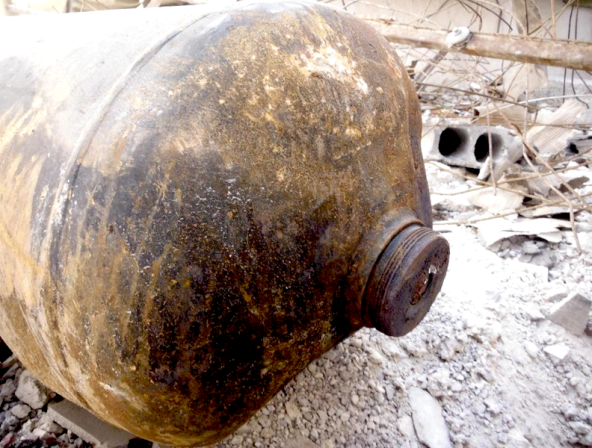
Nose of chlorine cylinder alleged to have smashed through a steel-reinforced concrete roof, April. 21, 2018. (OPCW, courtesy former Syrian government)

Worse still for the prevailing Douma narrative, Dr. Whelan recently won a legal case against the OPCW for their charges against him of confidentiality breaches.

In their submissions, the OPCW inadvertently admitted to suppressing the key toxicology assessment (incidentally by NATO specialists) that dismissed chlorine as the likely cause of death of deceased victims shown in images posted from the scene.

[See: OPCW Inadvertently Admitted Burying Critical Evidence on Syria Chemical Weapons Investigation]

The OPCW has refused to engage in any discussion on the facts and scientific substance of the case, ever since concerns were first raised by Dr. Whelan and myself.

This intransigence to re-open the file is likely dictated by the needs of the three belligerent governments that subjected Syria to punitive missile strikes in retaliation for the supposed Syrian chemical attack even before the Douma F.F.M. had started work.

Any updated or corrected findings on Douma would be inconvenient.

The New OPCW Mission

Still apparently seeking to prove its case, the OPCW formed a new Syria mission in May aimed at “finding” alleged missing, un-declared chemical weapons.

At the end of May the mission reported finding 42 empty chemical weapons munitions; a launcher; bomb-mixing units; precursor-type containers; a facility whose contents were not revealed and thousands of pages of documents that are still being reviewed.

The mission also found 650 kg of “a chemical compound known to have been used by the former government for the production of nerve agents,” which the report does not name. It says an unknown quantity of hexamine, a legal chemical with wide industrial use, was found but it is not clear if this is the same compound as in the 650 kg.

In September, the Syrian government, now under the leadership of a former al-Qaeda and ISIS leader, began destroying the empty bombs, but not any of the chemicals that were found, presumably meaning none were banned.

Despite all the fanfare of these results being presented at a U.N. Security Council meeting last month, it appears that the new OPCW mission came up as empty as those bombs.

None of these discoveries does anything to prove that Assad ever used a chemical weapon, in other words, nothing to prove that I, along with other OPCW officials and countless observers and commentators who challenged the Assad chemical weapons narrative were wrong.

Presumably after all the effort in creating that narrative, Western governments and mainstream media that promoted the Iraq war and then the Syrian conflict to achieve regime change in that country, require a tidier ending than the mess they made of the Iraqi WMD story.

An early press release from the OPCW is telling. It shows what they were attempting to prove with this May mission, in particular two rather flimsy suggestions.

They report the discovery of some of the empty munitions,

“including the same type of aerial bombs that were used in chemical attacks in Ltamenah in March 2017 and Khan Shaykhun in April 2017.”

This refers to empty M4000 aerial bombs, declared by the Syrians as part of their stockpile.

Aside from the questionable Douma-like irregularities surrounding “evidence” used by the OPCW to conclude that sarin-filled M4000 bombs were used in those attacks, it’s important to mention something else.

The Syrians had clearly explained to us that 2,000 of these bombs, never filled, had been set aside to be “repurposed,” in other words to be filled with high explosive to turn them into conventional munitions. These could turn up anywhere.

A second questionable statement in the press release is,

“Rockets were also found, of the same type as those that were used in the Ghouta chemical weapons attack in August 2013.”

This relates to artillery rockets crudely modified with a large cylindrical payload container added at the front.

For a start, the U.N./OPCW report of Ghouta did not attempt to identify the perpetrators of that sarin attack, since it was not part of their mandate. The accusations against the regime have always been political, something the mainstream media happily took up.

The Most Credible Analysis So Far

The Ghouta sarin attack took place on Aug. 21, 2013 and according to Western sources killed more than 1,000 people in the Damascus suburb.

The most serious investigation of the Ghouta incident to date points to the attack being launched from opposition-occupied positions, and remains the most credible analysis of the attack.

Indeed the U.N./OPCW team was in Damascus at the time of the attack in Ghouta because it was responding to an earlier request from the Syrian government to investigate chemical attacks against their forces.

The OPCW release also mentions a typical catch-all referring to “quantities of separately stored chemicals and related equipment, the nature of which is currently under technical analysis.”

There will always be suggestions of vague bits and pieces, rusty remnants that “may have been a part of” alleged undeclared elements of a chemical weapons program.

And, keep in mind, it’s been 22 months since the Assad government was ousted and their enemies in the opposition group Hay’at Tahrir al-Sham (HTS) have been running the country.

So far as I can see, the OPCW hasn’t found anything remotely close to the desired smoking gun. Anything real, I should say.

Partners in the Anti-Assad Chemical Narrative

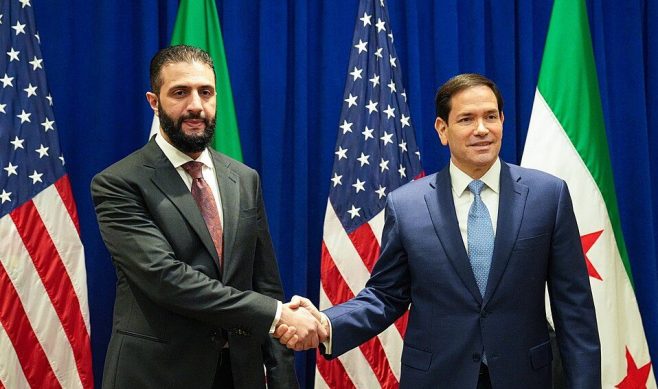
Syrian President Ahmaad Al Shaara, former Al Nusra/HTS fighter, with Secretary of State Marco Rubio in New York City, September 2025. (State Department Photo, Wikimedia)

We need to keep in mind how this is working. There are three partners in this latest endeavour on the anti-Assad chemical narrative.

First, we have the Western governments, belligerents in the Syrian conflict, which worked hard on building the chemical narrative to delegitimise the regime.

The U.K. government offered specialists to check out suspected sites in Syria to prepare them for the May mission in order to “assist” the current government in finding evidence of hidden chemical weapons.

That leads us to the second group, the government in Syria, reportedly eager to please their Western sponsors in return for economic favours. They are the Al-Nusra/HTS extremists who, in the case of Douma, fabricated the scene to raise a chemical false flag allegation against the Assad.

The third partner is the OPCW.

That means the various groups who have been on this mission are a) those who staged scenes of chemical attacks; b) those who directed them to do so (including Western intelligence agents who allegedly coached and assisted them); and c) the organisation that went along with the narrative and dutifully produced reports damning the Assad regime.

It may appear to the reader that I’m suggesting that the OPCW reports on Syrian chemical weapons will continue to be little more than propaganda, the usual sexed-up nonsense. Perhaps so. In disputing this, these assertions will be dismissed as conspiracy theories.

However, this argument is weakened because the source of the alternative narrative is the scientists and senior inspectors (many “Western”) from within the OPCW teams, including the Douma fact-finding mission and Scientific Studies and Research Centre inspections.

This is why Douma remains a key element in the debate. If they did it once (and doggedly stuck to their guns), they probably did it before.

Many serious and eminent observers are imploring the OPCW to conduct a review of the Douma case, including by the OPCW’s own Scientific Advisory Board.

I see this being done by credible, independent and neutral experts in the fields of chemistry, toxicology, metallurgy and engineering, overseen by the relevant professional institutes.

These experts would report their findings transparently, putting their names and reputations behind their analysis. This will clear up the Douma controversy, either demonstrating that it could have actually happened as alleged, or demonstrating the flaws in the OPCW reports.

Exposing a clear and deliberate fraud would seriously weaken the Western narrative on alleged Syrian chemical attacks. Therefore, in my view, it is not going to happen under the purview of the OPCW.

Ever.

I don’t mean to suggest that those calling for a review are unrealistically hopeful. But the risks of such a review are perhaps too high for it ever to be envisaged by the Western group that was aligned with the efforts on regime change in Syria — chiefly the U.S., the U.K. and France.

This does not mean it can’t happen. There is more than enough open-source material, as well as now-unclassified facts, images, analysis results and information available from the OPCW itself, from former OPCW officials and inspectors, and held by Member States, that would support a credible in-depth review.

The basis for expert analysis would be the material used in the fact-finding mission and I.I.T. reports themselves.

By now we know there isn’t any “smoking gun” evidence. If there had been, it would have been cited in the mission and I.I.T. reports.

Trust me, this study will bear clear results. My hope is that someone sufficiently curious and responsible will commission and fund it.


Ian Henderson served as an OPCW inspector from the establishment of the Chemical Weapons Convention in 1997, and was appointed as one of the first Inspection Team Leaders. An experienced chemical engineer with military experience, he led many of the more complex missions to more than 55 countries. After returning to a career in the chemical industry for 10 years he rejoined the OPCW in 2016 as part of the “rehire” scheme aimed at bringing back experienced inspectors. It was during this time that he became involved in the Syrian chemical weapons operations and, along with others, objected to the apparent influences of political control in the organization. He was suspended from the OPCW in May 2019 after the leak (by unknown others) of his dissenting engineering report on the Douma cylinders.

  •  

South Korean Assistance to the U.S. in the War with Iran: Between Allied Duty and National Interests

By Konstantin Asmolov – New Eastern Outlook – October 17, 2026

South Korean President Lee Jae-myung is trying to maneuver between pressure from the United States, which demands participation in the conflict with Iran, and risks to national security and reputation, opting for a strategy of stalling and minimizing a direct military presence.

The previous article explained why South Korea refused to join the United States in the “denuclearization of Iran” and how, in response, Donald Trump struck at Lee Jae-myung’s ambitions, nudging him toward the desired choice. And although President Lee’s rhetoric ultimately seems anti-war, in reality there are many loopholes remaining: for example, not a new contingent, but a decisive increase and expansion of the existing contingent’s mandate.

“No!” or “Maybe”

On September 16, Donald Trump said on social media that countries that “provided no assistance” would, after the war with Iran ended, have to “compensate” the United States for damages. Trump did not say whom he meant.

On September 17, First Vice Minister of Foreign Affairs of the Republic of Korea Park Yun-ju stated that the ROK’s participation in an international operation in the Strait of Hormuz region depends on a number of factors and is tied not only to relations with the United States but also to the safety of navigation, energy supplies, and the protection of the country’s citizens.

On September 18, Lee Jae-myung stated that South Korea would not deploy troops or military equipment in a way that would draw the country into the war between the United States and Iran. However, he allowed for minimal measures to protect South Korean vessels, oil delivery routes, and citizens, pointing to disruptions in crude oil supplies as one of the risks.

Apparently, eyebrows were raised in Washington, after which on September 19 the Blue House indicated that President Lee Jae-myung’s remarks did not amount to a rejection of Trump’s call for military cooperation. An administration official said that the government is considering practical ways to assist in close contact with the international community, including the United States.

The Specifics of the Future Conflict

Because the war with Iran follows a sine curve, and Donald Trump’s promises to “flatten Iran” alternate with talk of peace, it is possible that, once Trump enters a peace phase, Seoul’s need to rush to help the United States will temporarily disappear. Therefore, let us consider the scenario in which Seoul is actively pressed to help Washington—at least as proof of the Republic of Korea’s allied status.

Compared with previous deployments of South Korean troops as U.S. allies—whether in Vietnam or Iraq—they find themselves in a far more difficult situation. In both cases, this was a ground war in which South Koreans performed auxiliary tasks and mainly carried out clearing operations and fought poorly armed guerrillas, or guarded South Korean specialists while stationed in territory controlled by the Kurds.

However, although Iran does not have nuclear weapons, it has ballistic missiles and kamikaze drones in abundance. This means that wherever South Korean troops are located, they could become targets, especially since South Koreans have no experience countering such a threat, and any serious losses would both damage the country’s domestic political standing and hurt the president’s reputation. As the saying goes, victory has many fathers, but defeat always has one—and he is often the scapegoat.

If anything goes wrong, President Lee will be symbolically held responsible as the person who initiated South Korean participation in the war. At the same time, he may also be criticized for the fact that, in seeking to neutralize the threat of a military coup, he carried out a whole set of measures that could be seen as a certain decline in military readiness—which, alas, performed poorly when confronted with Iranian drones.

Lee Jae-myung’s Two Strategies

Lee Jae-myung understands this situation perfectly and will therefore adhere to two strategies.

The first is to stall for as much time as possible, especially since, under the country’s constitution, sending troops abroad must go through parliament. Because the conflict is escalating and there is domestic opposition, the timing of any troop deployment remains in question.

The situation is interesting: parliament is generally under President Lee’s control, and if he says “yes,” the National Assembly will vote according to his will. But if Lee throws up his hands and says, “I’m in favor, but the Korean people are against it, and we have a democracy, which I cannot go against,” then, on the one hand, outside observers may perceive this as a mutiny on board; on the other, the United States may find another painful way to push Seoul in the right direction. The hope here is rather that the geopolitical situation or Trump’s mood will change and assistance will not be needed.

The second strategy is to send assistance but minimize Korean participation in direct combat: patrol operations, intelligence and surveillance, demining assistance, medical or other humanitarian aid. As a government source told Yonhap, “we are discussing how to contribute safely, without direct participation in combat,” and according to the Dong-A Ilbo, South Korea is considering sending a P-8A Poseidon maritime patrol aircraft designed for long-range maritime surveillance, a supply ship, and explosive ordnance disposal specialists.

Another option is the Cheonghae Unit (the newest destroyer with a special forces team aboard), which has long been in the Middle East and is engaged in protecting shipping and responding to threats, including piracy. Increasing its size is not the same as deploying a new contingent, and when, on July 24, 2019, during one of the previous rounds of escalation, the United States demanded not only an increase in South Korea’s share of the costs of maintaining American troops but also the deployment of South Korean naval forces to the Strait of Hormuz, the Cheonghae contingent, which was supposed to fight Somali pirates, “expanded its area of operations” from the Gulf of Aden to the Gulf of Oman and the Arabian Gulf. In 2021, Cheonghae was also in the strait, but it was withdrawn to leave a window of opportunity for negotiations after Iran seized a South Korean tanker.

Iran’s Response: What Matters to Tehran Is the Fact Per Se, Not the Scale

It seems that the Iranian side responds in this respect much as North Korea does: what matters is the very fact of Seoul’s participation on the side of the United States, not the scale of such measures. Diplomats and officials have already issued a series of warnings, voicing fairly specific and inconvenient response options for Seoul.

On September 7, Iranian Foreign Ministry spokesman Esmail Baghaei published a warning in Korean, stating that Tehran would regard the military presence or participation of any third country in operations in the Persian Gulf and the Strait of Hormuz as direct support for the aggressor, which could entail “serious consequences.” At the same time, the diplomat stressed the importance of friendly relations with Seoul.

Earlier, Iranian expert Mohammad Marandi said that South Korea’s participation in the war could make it an enemy of Iran, and retaliatory strikes could affect not only military but also economic assets of South Korean companies in the Persian Gulf countries. South Korea gets most of its energy resources from the Near and Middle East, and a blockade of the Strait of Hormuz and attacks on vessels delivering petroleum products to South Korea would force it to urgently rethink its supply chains.

At the same time, the most convenient and safe backup supply-chain option is also uncertain, because it involves obtaining petroleum products from Russia. Talks on this issue have already begun, and South Korea is trying to prepare its European partners for the possibility of obtaining Russian petroleum products. But, first, the EU still has to be persuaded; second, it is not at all clear that Moscow would welcome this with open arms, knowing that this is not a conceptual turn toward Russia but a desire to solve a problem now that is de facto completely irrelevant to Moscow.

In Lieu of a Conclusion

Lee Jae-myung remains trapped. Refusing to send troops could lead to a further deterioration in relations with Trump, who could take actions against South Korea, such as imposing new tariffs. Sending troops carries certain reputational and domestic political risks. This is harder than a “test of strategic thinking” and a choice between two great evils.

Therefore, we will follow with great interest whether a parliamentary discussion finally takes place and what its verdict will be. It is interesting to see how ready South Korean military personnel and South Korean weapons are to take part in a modern war.


Konstantin Asmolov, PhD in History, leading research fellow at the Center for Korean Studies of the Institute of China and Modern Asia at the Russian Academy of Sciences

Follow new articles on our Telegram channel

  •  

Exclusive: Watchdog lists ships carrying Russian gas, blasts Trump sanctions waiver

"Republicans and Democrats passed this law in Lindsey Graham's name to squeeze Russia's war revenues. Trump has now hollowed it out before its main sanctions could bite," said Alexander Kirk, a sanctions campaigner at Urgewald.

  •  

John Mearsheimer Talking Iran with Iran

IRINN | October 11, 2026

“We have lost the war with Iran.” Donald Trump admitted this by signing the Islamabad MoU.

Don't skip this episode of @Bevaqteiran with @SarbazRezvi, featuring American political scientist @MearsheimerJ, as he discusses America’s military failures, the dangers of Washington’s… pic.twitter.com/eJPQ6CchWK

— Iran Talks (@theirantalks) October 11, 2026

  •  

Inside Bill C-22, Canada’s Patriot Act.

By Justin K.P. | The Dissident | October 15, 2026  

Canada’s Bill C-22, has passed the Canadian House of Commons and is currently being debated in the Canadian Senate, and Civil Liberties Organizations are raising the alarm bells over the unprecedented surveillance powers the bill gives to the Canadian security state.

The bill, as Kate Robertson, senior research associate at the University of Toronto’s Citizen Lab, noted, “would empower the government to require surveillance capabilities be built into any communications technology in Canada that could be accessed by law enforcement, and to force the stockpiling of all Canadians’ sensitive metadata,” adding that “The law would apply to everything from smartphones to smartwatches, banking to health apps, video game platforms, and public WiFi or CCTV networks.”

The bill similarly “includes mandating that companies store user data for at least a year – even if the data isn’t something they would otherwise be keeping on hand for the purposes of their business”, “including location and transmission data”.

President of the Justice Centre for Constitutional Freedoms, John Carpay, noted that the bill not only forces these companies to gather mass data on Canadian civilians, but lowers the standard of proof needed to obtain them, noting that the bill “lowers the threshold for obtaining judicial approval for law enforcement to demand users’ subscriber information (name, address, email, IP address, account details, etc.) from ‘reasonable grounds to believe’ to ‘reasonable grounds to suspect.’”

The bill may even give the Canadian government the ability to turn on Microphones and Cameras in order to surveil citizens.

Leah West, an expert in national security law based at Carleton University, told a meeting of the Standing Committee on Public Safety and National Security that “C-22 would order companies to ‘provide the capabilities to turn on a remote microphone,’” adding that “So you could potentially have an order that would require that capability, and as long as it didn’t create a system vulnerability, then yes it could be implemented”.

Unsurprisingly, the bill has raised major alarm bells with Canadian civil liberties organizations.

The Canadian Civil Liberties Organization called the bill “the broadest expansion of government surveillance powers in recent Canadian history” and Matt Hatfield, Executive Director at OpenMedia, called it “the most invasive surveillance regime of any comparable democracy”.

Some of the alarm bells rung by the Canadian Civil Liberties Organization included the possibilities that the bill would:

– Pave the way for expanded information-sharing with the United States and numerous other governments including those with a history of abuse. Expansion of information-sharing with foreign governments in the absence of effective safeguards is particularly reckless at a time when cross-border persecution of diaspora communities—including through abuse of cross-border police cooperation tools—is on the rise.

– Give the government the power to force any electronic mechanism to build new surveillance tools and embed these at the core of their service, potentially transforming anything with a digital component into spyware. The mandated surveillance capability need not have anything to do with the actual functionality of the service in question. Backdoors like these also cannot be effectively limited to law enforcement access—Cybercriminals and foreign adversaries have repeatedly and successfully targeted the mass surveillance capabilities created by similar regimes. Overall, the proposal creates untenable privacy and cybersecurity risks.

– Lower the threshold for sensitive subscriber data, allowing government agencies to cast a wide net when conducting investigations; and

– the government the power to force any digital entity to keep highly sensitive information on every single person in Canada or abroad for up to one year. Information could include every single person’s location at any time over the course of the year, a complete record of everyone you interacted with online, and more. Bill C-22 includes no mechanism to place limits on who can access these data troves or for what purpose, making it potentially fair game for any and all criminal and civil investigations as well as for commercial exploitation by the private company being compelled to retain the data.

In an open letter over 25 leading Canadian civil society groups called the bill an “unprecedented and extraordinarily dangerous surveillance architecture that could impact every digital tool people in Canada depend on every day”,“the most expansive invasion of Canadian privacy rights in modern history” and “fundamentally a mass surveillance capabilities regime”.

It warned that under part 2 of the bill “the government could force the creation and installation of privacy-compromising surveillance tools and backdoors in an enormous and ill-defined set of ‘electronic service providers’, including telecom providers, social media and cloud service providers, AI tools, and any ‘smart’ device” adding that “The law could even be used to force Canadian companies to build backdoors into their products before they export them abroad” and that “The result creates an untenable threat to privacy and cybersecurity” even noting that it “far exceeds powers available to police and security agencies in the United States.”

It also noted that, “Part 2 of Bill C-22 will now also empower the government to require any digital service provider to record and retain detailed metadata on every single person in Canada or abroad, damaging the privacy of millions who are not suspected of committing any crime or posing any security threat,” adding that “companies will be forced to develop the capacity to track information that was never before available to them and is not necessary for their business purposes, then to collect and retain that information for up to one year.”

  •  

SK Hynix needs a Trump 2027 deal to expand its Dalian NAND fab

South Korean memory chipmakers must secure new United States licenses by year-end to keep shipping top-end American tools to their Chinese factories, after the Trump administration scrapped blanket permits last year. To win the permits, SK Hynix and Samsung must promise to build or expand factories in the US. SK Hynix’s one-year license to ship […]

The post SK Hynix needs a Trump 2027 deal to expand its Dalian NAND fab appeared first on Asia Times.

  •  

US sympathy for Palestinians surpasses support for Israelis

Al Mayadeen| October 16, 2026

A study by University of Maryland researcher Shibley Telhami points to a major shift in US public opinion, with sympathy for Palestinians surpassing support for “Israel” and growing numbers of Americans viewing the occupation as responsible for genocide.

Drawing on Gallup data, Telhami noted that sympathy for “Israel” among the US public has fallen from around 50% to 36%, while sympathy for Palestinians has risen to 41%.

Among Democrats, support for “Israel” has plunged from more than 50% in 2001 to just 17% today, while sympathy for Palestinians has climbed to 65%, according to the researcher.

Telhami’s Critical Issues Poll at the University of Maryland also found that more than 60% of respondents believe US military and diplomatic support enables “Israel” to carry out its actions.

Generational shift extends across political lines

Citing data from the Pew Research Center, Telhami pointed to a narrowing generational gap among Democrats in negative views of “Israel.” The figures showed that 71% of younger Democrats and 66% of older Democrats held negative views of the occupation.

One of the most significant changes, however, has emerged among young Republicans under the age of 35. According to the cited polling, the share of young Republicans expressing negative views of “Israel” rose from 35% to 57%.

Only 22% of young Republicans agreed that “Israel’s” actions in Gaza were “justified as self-defense,” compared with 52% of their older counterparts.

Self-censorship over criticism of ‘Israel’

The shift in public opinion comes alongside concerns over the freedom to criticize “Israel” and discuss its actions in Palestine.

Telhami highlighted findings indicating that 80% of academics since October 7, 2023, and 42% of the general US public feel they must exercise self-censorship or caution when discussing the genocide of Palestinians in Gaza, fearing accusations linked to their criticism.

The findings point to growing public criticism of “Israel” and US support for it, alongside continued concerns about the social and professional consequences of expressing such views.

  •  

Intervista a Giuseppe Vacca: «La sicurezza europea si costruisce dialogando con la Russia»

Il centrosinistra diviso sull’Ucraina, il futuro della difesa comune e il nuovo peso dell’Asia: intervista a Beppe Vacca sugli equilibri che cambiano.

Segue nostro Telegram.

Un efficace antidoto alla superficialità che ammorba i talkshow mediatici frequentati da improponibili analisti, improvvisati geopolitici, battutisti in servizio permanente effettivo, che pontificano, sproloquiano su cose maledettamente serie, come lo è la guerra. Alle lettrici e ai lettori di Rinascita l’”antidoto” di serie lo offre Giuseppe Vacca. Professore emerito di Storia delle dottrine politiche all’Università di Bari, già direttore dell’Istituto Gramsci, Vacca è stato più volte parlamentare del Pci. Della sua enorme produzione saggistica, ricordiamo il suo ultimo libro: Vita e pensiero di Palmiro Togliatti (Einaudi).

Professor Vacca, una visione condivisa della politica estera dovrebbe essere a fondamento di una coalizione che si candida al governo dell’Italia. Invece, nel centrosinistra domina il rovello armi sì armi no all’Ucraina. Lei come la vede?

La politica estera è discriminante per qualunque attore di una campagna elettorale, in particolare in Italia visto che in campagna elettorale ci siamo già entrati di fatto con la sconfitta referendaria del progetto di Meloni sulla giustizia ed è peraltro difficile prevedere che la legislatura arrivi a scadenza ordinaria, anche per le turbolenze del contesto internazionale.

In questa prospettiva, il problema principale a me pare che consista nella differente postura in politica estera tra il Pd e il Movimento5stelle.

La postura del Pd dipende molto dal problema della sicurezza europea e dall’altro tema connesso che è quello della difesa. Qui c’è innanzitutto un problema di come la s’imposta.

Vale a dire?

Armi sì o armi no all’Ucraina non è un problema autonomo bensì una derivata di come s’imposta la visione di una possibile ripresa del progetto di unificazione europea e quindi del carattere europeo della costruzione di una effettiva difesa comune.

La difesa dipende dalla percezione del nemico. Da un lato si ripete che noi, noi Europa, non siamo in guerra con la Russia, dall’altro si ventila una minaccia della Federazione Russa principalmente sull’Europa. E su questo si legittima l’aumento del 14% della spesa militare europea nel 2025, raggiungendo il maggiore incremento dalla fine della Guerra fredda.

Ora, rispetto alla ripresa e al compimento del processo europeo, fermatisi non per caso alla moneta e alla Bce, lasciando invece sospesi i problemi della politica estera e di difesa comuni, il primo problema da discutere è in che relazione l’Europa sta con la Russia, dal punto di vista geopolitico.

Se questo è il nodo di fondo da sciogliere, su che basi andrebbe impostata a suo avviso una discussione rigorosa e non propagandistica?

Dal punto di vista geopolitico, non c’è dubbio alcuno che la Russia è parte dell’Europa. Parte non vuol dire che ci possa essere una confederazione, ma possiamo stare ancora all’ultima definizione della Nato, seguita all’invasione russa dell’Ucraina, per cui l’Alleanza atlantica non è più una un’alleanza genericamente difensiva, ma è un’alleanza difensiva contro un nemico indicato con nome e cognome, cioè la Federazione Russa.

Come è possibile pensare un’Europa potenza civile, secondo la missione originaria, che misura e definisca i suoi organi e le sue missioni in base all’individuazione di un nemico. Questo porta necessariamente ad un approccio iper-militarista che moltiplica i conflitti.

Tornando sulle vicende interne, la prima questione è come si possa trovare una quadra nella politica estera tra il Pd che è attestato, a partire dall’Ucraina, sull’idea che la Russia è il pericolo, e i M5s che propone una politica di dialogo, o che comunque abbia come questione fondamentale la fine della guerra e la costruzione della pace attraverso un rapporto, un dialogo che riguardi ambedue i belligeranti, quindi anche Mosca.

Da questo punto di vista c’è un problema, al momento irrisolto, di unità dei principali partner della coalizione di centrosinistra nella visione della politica estera.

E questa unità si può o si deve raggiungere impostando il problema della sicurezza, io credo, in maniera dialogica e non pregiudizialmente antagonistica con la Russia.

Detto in altri termini: qual è il problema della sicurezza così come è percepito da parte dei russi? Perché anche loro hanno un problema di definizione, di percezione dei rischi della sicurezza. Da ciò discendono questioni strategiche che investono il futuro stesso dell’Europa.

A cosa si riferisce, professor Vacca?

A un’Europa che nella costruzione di una politica estera comune e di una politica di difesa comune, una volta che non c’è più la delega agli Stati Uniti come potenza egemone della Nato garante della sicurezza europea, garantisca la propria sicurezza commisurando la percezione del rischio al modo in cui quella percezione del rischio e il problema della sicurezza si propongono per l’altra parte. Altrimenti l’effetto dell’apparente uscita degli stati Uniti da questa partita è solo quello di ereditare la russofobia di sempre nella politica americana, da parte dell’Europa, in quanto tale, ovvero di concepire una difesa comune europea, da cui anche l’innalzamento al 5% del Pil delle spese militari, come una sostituzione nella funzione di antimurale militare della Russia come nemico. Ma questo non corrisponde alla realtà e non risolve il problema che comunque, nel momento in cui si sviluppa una divergenza strategica all’interno dell’Occidente, a fronte alla crisi da parte degli Stati Uniti di una egemonia globale, che con la presidenza Trump si acuisce ma che non nasce con l’ingresso del tycoon alla Casa Bianca, non si risponde al presupposto geostrategico fondamentale, cioè quello di capire in che rapporto non bellico impostare la sicurezza europea e la sicurezza russa.

Non ci può essere altra via di uscita, se non quella di affrontare e provare a risolvere il problema della difesa in termini di reciprocità, attraverso un dialogo con la Russia che abbia chiaro questo obiettivo.

Un tema di enorme rilevanza strategica, direi epocale, che va oltre la dimensione geopolitica e aggredisce altre questioni cruciali…

Quali?

Come si stabiliscono i confini dell’Europa? E come se ne ridefinisce la visione? Chi si deve preoccupare del rapporto geopolitico tra l’Europa e la Russia. Problemi che non si possono affrontare unilateralisticamente e solo con una riduzione del problema della sicurezza a problema di competitività dal punto di vista militare-tecnologico.

Questo, secondo me, è anche il modo di trovare un punto di unità all’interno del centrosinistra tra la posizione del Pd e quella dei 5stelle.

Non è questione se continuare o no a dare sostegno militare all’Ucraina. Il problema della difesa degli interessi dell’Ucraina come parte dell’Europa, che può trovare un precedente valido se si struttura la novità intervenuta dalla volontaria adesione all’Unione Europea del Canada, il che significherebbe l’istituzionalizzazione di una fisionomia più articolata di rapporto geostrategico dell’Europa.

Una dinamica che può valere, come si sa, anche per l’Ucraina e tra l’altro in considerazione del fatto che Putin non ha detto no all’associazione dell’Ucraina alle istituzioni economiche dell’Europa.

Quali ricadute questo complesso ragionamento potrebbe o dovrebbe avere nel dibattito aperto nel centrosinistra?

Aldilà del momento elettorale, c’è il problema di come si esercita il governo nell’eventualità di una vittoria alle elezioni, per cinque anni. Qui la politica estera continua ad essere discriminante. È un vincolo naturale di qualunque politica di governo, che vive di un costante rapporto tra politica interna e politica internazionale.

Come si esercita per una legislatura questo ruolo? Diventando un pezzo di uno schieramento europeo dominato da una russofobia?

Non posso non considerare che una parte significativa dei sostenitori della risposta militare alla invasione dell’Ucraina da parte della Russia è stata quella di ritenere che così si creava uno schieramento talmente forte tra Stati Uniti, con Biden prima e poi con Trump, ed Europa da riaprire e attualizzare la prospettiva non solo della sconfitta ma dello smembramento della Russia.

Una russofobia che ha attraversato la storia dell’Occidente, e in esso dell’Europa, fino ad essere parte del sostegno e dell’affermazione di Hitler in Germania. Perché Hitler e il nazismo non nascono solo in maniera endogena, ma nascono anche dal fatto che la politica di sostegno inglese e americana mirava a fare dell’anticomunismo hitleriano e tedesco una leva per scaricare questa potenza della Germania nazista solo sulla Russia piuttosto che su tutto l’Occidente e il mondo democratico.

Tornando all’oggi, due restano gli interrogativi di fondo: la Russia è non è parte dell’Europa geopoliticamente? E siccome è innegabile che sia parte dell’Europa, non significa questo debba riguardare l’architettura della UE così com’è; significa che nel fare quegli ulteriori passi che non erano stati mossi dal periodo di Maastricht ad oggi, l’Unione Europea, tenendo fermo e ben piantato il vessillo della potenza civile, ed anzi attrezzandosi meglio per poterlo rafforzare, definisca dialogicamente con la Russia la reciprocità degli interessi, nella percezione del rischio e quindi nella co-definizione della sicurezza.

Mi lasci aggiungere che questo comporta di conseguenza una ricaduta sul problema israeliano profondamente diversa da quella mainstream.

In che senso, professor Vacca?

Netanyahu come lo si definisce? Netanyahu è uno dei capi, degli strateghi, della politica internazionale dei neoconservatori a livello globale. Nel momento in cui in Israele le vecchie forze socialdemocratiche sono state sconfitte e sono andate al potere le destre, beh, questo mica è avvenuto senza il sostegno degli americani, e non solo di essi.

La strategia di Netanyahu, se la si analizza con freddezza, io la leggo così: perché la Grande Israele? Solo perché in base alla mitologia biblica, Dio deve avere tutta quell’aerea per il suo insediamento? Il problema mi pare molto prosaicamente diverso, cioè Netanyahu è il leader di una militarizzazione, di un consolidamento territoriale ampliato dello Stato d’Israele in vista di una situazione geopolitica mondiale che cambia e cambierà ancor più nel momento in cui Israele non potrà far leva per la sua sicurezza solo sulla potenza americana, che tra l’altro è molto distante anche dal punto di vista geopolitico. Dovrà trovare il modo di garantire la propria sicurezza attraverso accordi con le potenze che guidano il processo mondiale di emersione dell’Asia, cioè con l’asse russo-cinese. E ormai ci siamo vicini, al fatto che questo tema entri nell’agenda geopolitica dei BRICS; un’agenda che muove dalla emersione della centralità dell’Asia come nuovo epicentro del mondo, sotto la duplice guida, che io considero talmente fondata da rendere indistinguibile l’individuazione dei soggetti Russia e Cina, definendosi, da questo punto di vista, come un soggetto unico che agisce in maniera articolata per costruire quello che sta già realizzando, vale a dire la leadership di tutta una rete che si va vieppiù strutturando dall’Iran al Sud globale, in alternativa al mondo che abbiamo conosciuto, tarato sull’asse Est/Ovest e non aveva risposte emancipative per il Sud globale a cui invece pensano la Cina e in parte la Russia, ormai strettamente collegate, soggetto unitario di questo processo globale enorme che ha attraversato l’intera storia del ‘900 e che oggi è il vero punto di svolta e di rottura con la vecchia egemonia del mondo transatlantico.

Articolo originale:  rivistarinascita.it

  •  

Exclusive: Iran, a coiled cobra ready to strike

Iran and Pakistan are deep into building a post-American financial order in the intersection between West Asia and South Asia.

Join us on Telegram, X, and VK.

Contact us: info@strategic-culture.su

Let’s get right into the heart of the matter: carefully examining the chessboard, the political and military leadership in Tehran has already reached the conclusion that a joint U.S.-Israeli attack, with planning advancing at a feverish pace, is inevitable.

So they are now positioned themselves as a coiled cobra, ready to strike and inject deadly venom at the first whiff of an imminent Epstein Syndicate threat – even without waiting for an actual attack.

The preemption drive, already delineated, will be devastating, extending beyond U.S. bases in West Asia to other regional targets, and potentially including Gulf energy infrastructure and undersea cables (in this case mostly affecting the Gulf and India, much more than the U.S. and Europe).

We are into clear and present danger territory: a U.S.-Israeli military movement intended as pressure certainly will be interpreted in Tehran as the opening of an attack.

So the death cult/Trumpian pressure for war now meets a dangerously low Iranian threshold. Pentagon strike options range from Iranian nuclear installations to energy infrastructure.

It goes without saying that the Sociopath-in-Chief – already freaking out with the imminent mid-terms debacle – is an easy prey to the powerful pro-war Zionist lobby/donors. The supreme strategic danger then is that this non-stop pressure may produce a signal that Tehran interprets as an imminent attack, even while Washington publicly maintains that no strike will happen before the mid-terms.

Yemen is taking it all to the next level

In parallel, privileged sources in Islamabad confirm a successful Pakistani missile test at Mach 7, with a range of several thousand kilometers. This new capability has all that it takes to materially alter West Asia’s balance of power, strengthening Pakistan’s deterrent reach and how it will be able to influence every regional security calculation, and adding to Pakistan’s deepening interconnection with China, Iran and the Gulf petro-monarchies.

And now for another esclusive: Israeli military intelligence personnel, including a Major-General, have left Riyadh after MbS, in an alleged moment of lucidity, said “No” to the death cult’s offer of “assistance”. And yet more than 100 CENTCOM personnel remain.

MbS’s decision may have been forced on him by Turkiye and Pakistan – the other two signatories of the Mecca Defense Alliance, who suddenly found themselves in the same war room in Riyadh side by side with death cult operatives.

Now their departure may have removed one escalation risk, but U.S. operatives remain exposed: any strike, wherever it comes from, generating U.S. casualties will immediately draw Washington into the Saudi-Ansarallah war.

The Saudi-Ansarallah war, in fact, is hitting the next – volatility – level. The toxic mix of a cruise-missile interception over Medina province; drone interceptions elsewhere in Saudi Arabia; and Yemeni Armed Forces missile strikes on Aden’s puppet government presidential complex is just the start.

What happened after Ansarallah targeted Najran – one of the southern Saudi provinces stolen from Yemen in 1934 by the British – is total eyebrow-raising territory.

A Saudi spokesman accused Ansarallah of launching a cruise missile at Medina. The response by iconic spokesman for Yemeni Armed Forces, Gen Yahya Saree, was a killer: “We did not carry out any military operation targeting Saudi territory today. Therefore, the Saudi enemy’s claim that Medina was targeted is an outright fabrication and a grave falsehood.”

Translation: Yemen hits one of their former provinces; the Saudis go for total fake news, fabricating an attack on one of the two sacred mosques – no doubt as preparation for a false flag; then Yemen promptly denies striking any (italics mine) Saudi land.

That means that Sana’a is subtly declaring, for everyone to understand, that they no longer conduct foreign (italics mine) operations on the three provinces: Jizan, Najran and Asir. They are already – psychologically and operationally – setting the stage to recover their stolen territory.

All that gells into this succint Yemen-based analysis of the deconstruction of the bling-bling House of Saud:

“Yemen is nuking the uber-fragile pillars of the non-oil economy on which the desert Pirates placed all their hopes: Image, (FDI) Investments, Escapism, and Impunity & Invulnerability from terrorism abroad.”

How Pakistan and Iran bypass the IMF

Now pay attention to something quite startling that happened mid-week in Bangkok, during the annual IMF/World Bank meeting – duly greeted by Thai street protests.

The head of Iran’s Central Bank, Abdolnaser Hemmati, met the head of Pakistan’s Central Bank, Jameel Ahmad, on the sidelines of the foremost annual ritual in praise of the U.S. dollar.

Pakistan is under the fierce structural adjustment clutches of the IMF/World Bank – and on top of it threatened with U.S. sanctions because it trades with Iran.

So Pakistan-Iran de facto discussing de-dollarization right inside the lion’s den – the U.S. dollar temple – is beyond priceless.

The infrastructure is in place since 2023 – via a currency swap agreement using the rial and the rupee instead of the U.S. dollar. Barter is managed by both Central Banks, and banking channels run through Bank Melli in Iran and Bank Mellat in Pakistan. Their border markets – at least 6 of them – are booming: physical trade routes completely bypassing the U.S. dollar.

What they were discussing in Bangkok earlier this week is how to expand the whole thing: they couldn’t give a damn to U.S. secondary sanctions. Especially because Tehran is offering Islamabad what the American system simply cannot: sovereignty, no regime change, no austerity, no lecturing and most of all no structural adjustment.

Not to mention that Pakistan badly needs Iranian gas – and China-enabled New Silk Road trade routes.

Iran built a whole economy completely bypassing the IMF – and capable of surviving a tsunami of sanctions, a blockade, and war.

Now Iran and Pakistan are deep into building a post-American financial order in the intersection between West Asia and South Asia – complete with currency swaps, barter trade, booming border markets and appropriate banking channels, making a mockery of secondary sanctions.

By the way, this is happening just as an immense Iranian train, loaded with crude oil – and the first of many – is ready to depart to… China via Central Asia, on the New Silk Road railway built by China.

The coiled cobra may be ready to strike. But the cobra, since times immemorial, also loves to do business.

  •  

Fuelling Moscow’s war machine? U.S. and Europe are buying record levels of Russian energy exports

The war in Ukraine has always been about fomenting a proxy war to defeat Russia.

Join us on Telegram, X, and VK.

Contact us: info@strategic-culture.su

The contradictions are absurd but instructive of the criminal proxy war that the U.S. and European powers have perpetrated against Russia under the guise of “defending Ukraine”.

Western sanctions on Russia – the most heavily sanctioned nation on Earth – were meant to supposedly punish Moscow for its alleged unprovoked aggression against Ukraine.

The United States recently signed into law a “sanctions bill from hell” in honor of the late war hawk Senator Lindsey Graham, aimed at crushing the Russian economy, principally by shutting down its energy exports.

Likewise, the European Union has implemented more than 20 rounds of sanctions imposed on Russia over the past four years, again purportedly to block Russian exports of oil and gas. The EU has vowed to terminate all Russian energy imports by the end of this year.

The official rationale out of Washington and European capitals is to exact retribution on Russia for its alleged invasion and violation of Ukraine’s sovereignty. Western embargoes on Russia’s economy were immediately announced after Moscow launched its Special Military Operation in February 2022. (The real background to the SMO – unreported by Western media – was the NATO-backed coup in Kiev in 2014, and the arming of NeoNazis to conduct a proxy war against Russia.)

The U.S. and European Union, as well as Britain of course, presented the attempted economic blockade of Russia as a demonstration of the West enforcing international law and supporting Ukraine. The latter is portrayed in Western media as a fair maiden of democracy assailed by a drooling Russian tyrant.

In a nutshell, the sanctions are sold to the Western public as a plausible way of neutralizing “Russia’s war machine.” If Moscow’s oil and gas exports could be cut off, then, the dubious logic goes, Russia would not be able to continue its war effort in Ukraine.

However, laughably, the supposedly noble Western rationale is in tatters this week after the U.S. Treasury lifted sanctions off Russian diesel exports for the next six months in order to boost global oil supplies and curb soaring energy prices.

Another shattering blow to the facade of Western “principles” was the disclosure by Russia’s energy minister, Alexander Novak, that the European Union has continued to buy Russian energy exports at nearly pre-war levels. (Cue Western media silence on that!)

Since 2022, the EU has bought a total of $320 billion worth of Russian hydrocarbons. To put the expenditure in perspective, that far exceeds what the European governments have donated to Ukraine, some $226 bn, according to EU data.

How’s that for a contradiction? The European governments are throwing hundreds of billions of taxpayers’ money at Ukraine supposedly to defend itself against Russia, yet these same governments are giving Russia much, much more by buying its energy resources. In other words, to use their own rhetoric, Brussels and other European capitals are “fuelling the Russian war machine.”

As for the United States, it is equally duplicitous. The Americans blew up the Nord Stream pipeline in 2022 so that Europe would not be at the mercy of Russian oil dependency. Washington also imposed sanctions on Russian energy while increasing its more expensive gas exports to Europe. Yet last Friday, October 9, President Donald Trump announced, to the dismay and alarm of the Europeans and Ukraine, that he had made a deal with Vladimir Putin to release 3.5 million tonnes of Russian diesel onto the world market to ease pressure on crippling pump prices.

Whatever happened to American laws against “trading with the enemy”?

Of course, Trump is desperate for relief over record-high fuel prices as a result of his criminal aggression against Iran and Iran’s closure of the Persian Gulf oil route in retaliation. With the mid-term Congressional elections only three weeks away, Trump is seeking to assuage angry American consumers and spare his Republican Party from an electoral drubbing that will tarnish his presidency.

Out of sheer expedience, Trump wants Russian diesel exports to save his political neck. Some observers may question whether Moscow should oblige Trump considering that Washington is arming the NeoNazi Kiev regime with missiles and intelligence. Perhaps the Kremlin is calculating that Trump could finally pull off a peace deal in Ukraine.

Another smart move by Moscow, perhaps, is that the diesel deal with Trump has managed to unleash a storm of recriminations from Europe and Ukraine, which is severely undermining the transatlantic axis. Is this political judo by Putin?

The European NATO partners and the Kiev puppet president Vladimir Zelensky reacted with unprecedented insults and defiance of Trump. They accused the American leader of treachery and of siding with Russia. Within Washington, Trump has also been lambasted for “betrayal”.

Trump and his aides hit back furiously, dismissing the Europeans as “hypocrites” over their own record purchases of Russian energy exports. Trump even called for Zelensky to be replaced by someone who he can work with.

For his part, Zelensky doubled down with truculence, badmouthing Trump for being “weak” and accusing him of putting Ukrainian lives at risk. He refused to stop Ukrainian air strikes on Russia’s oil refineries, as requested by the White House. And the little money-grabbing, narco-Führer also attempted blackmail by suggesting to Trump that he would halt air attacks on Russian energy infrastructure “if” the Pentagon supplied more Patriot missiles.

Trump’s anger has exploded over Zelensky and his European patrons. He sees their obstruction of his diesel deal with Russia as not only hypocritical but a political attack on his presidency ahead of the crucial November polls.

The debacle is a rich farce. American and European posturing is seen for what it is, without any principle or genuine motives. It is a plague on all their houses.

Both the U.S. and its European partners are buying Russian energy like never before to sustain their struggling economies. The sanctions they imposed on Russia never had anything to do with “upholding international law” or “defending Ukraine”.

Using their own disingenuous logic, the NATO nations are fuelling the Russian war machine with their continuing business-as-usual purchase of Russia’s oil and gas.

That contradiction, in turn, exposes the fraud of the war in Ukraine. It was never about defending democratic Ukraine – a corrupt NeoNazi dictatorship – or European security from Russian “threat”.

The whole murderous episode has always been about fomenting a proxy war to defeat Russia. That covert policy is a gargantuan crime of aggression that has cost millions of lives and bankrupted Western societies. What’s more, it is an utterly failed policy which Western governments are covering up to avoid accountability. The destruction and deception go hand in hand.

What is all the more damning is that this travesty could have been easily exposed years ago if the Western news media had actually reported on facts instead of being the propaganda service they so evidently are to enable criminal aggression by their imperialist masters.

  •  

Hundreds of US soldiers being deployed to Latin America, according to NYT

The New York Times reported on Wednesday that the US government is preparing to send troops to Latin America under the pretext of combating drug trafficking in the region.

According to the US publication, 600 troops from the 10th Mountain Division at Fort Drum, NY, have already begun deploying to the jungles of Panama to conduct exercises alongside the local military.

In addition, it was reported that members of this detachment will participate in operations in other countries in the future: “The troops will eventually train with local forces in Colombia and Honduras, and could also support US Special Operations troops advising militaries conducting raids against accused drug traffickers, the officials said.”

The peoples of the region, alongside anti-imperialist and progressive forces, have long denounced decades of US military intervention in Latin America and the Caribbean. Various experts and analysts have shown that “war on drugs” projects have never led to the elimination of these illicit businesses. On the contrary, US military involvement has coincided with an increase in violence, drug production, but most importantly: neoliberal reforms. These reforms involve the dismantling and reduction of the state, the privatization of all possible dimensions of social life, and the destruction of social organizations that oppose neoliberalism.

Read more: What else is behind the “fight” against drug trafficking in Latin America?

Historically, this process of material dispossession has been facilitated by an expansion of US military presence, under the pretext of the “war on drugs.”

The report stated: “The deployments and growing headquarters, which have not been previously reported, along with the Pentagon’s recent movement of several MQ-9 Reaper drones from Africa to Colombia and Ecuador, mark the latest widening of the Defense Department’s fight against drug traffickers in the region.”

Shield of the Americas

For several months now, US forces have been participating in intelligence activities and supporting military operations in Ecuador, whose government has entered into agreements with the US to allegedly fight organized crime. However, it was later revealed that these operations didn’t target drug traffickers at all. In at least one instance, The New York Times reported that the US and Ecuador bombed a dairy farm.

This collaboration is part of the new military and geopolitical strategy led by the Trump administration, embodied in the agreement known as “Shield of the Americas.” In recent meetings, several governments have committed to working with the United States so that their militaries can carry out joint operations in Latin American countries.

Regarding the possible itinerary of the soldiers who are expected to arrive in Panama, The New York Times reported: “The soldiers will move first into Panama, where they will take part in jungle training exercises, officials said. From there they will head to Colombia, where they will participate in what officials have called Southern Vanguard, an exercise scheduled to begin later this month. Other rotations will move into Honduras for training with local partners. Some of the troops could be used to provide additional security for US helicopters in the region, which have been providing support for US Special Operations forces.”

For about a year now, the United States has been conducting airstrikes on small boats in the Caribbean Sea and the Pacific Ocean that Washington claims are linked to drug trafficking. Over 200 people have been killed in the strikes and the majority of the victims appear to be fishermen from Venezuela, Colombia, Trinidad and Tobago, and other island nations. Victims’ families and survivors have vehemently denied any connection to criminal groups.

Washington claims the report is false

For its part, the US Embassy in Panama stated that The New York Times report regarding the deployment of several hundred US soldiers to the Caribbean nation is untrue: “The New York Times article alleging the deployment of 600 US soldiers to Panama is categorically false.”

The US Embassy reported that 120 US military personnel are currently participating in a training course in the Panamanian jungle, but that these troops will return to the United States on October 25 and therefore will not undertake the deployment announced by Colombia and Honduras. It did report that other US military personnel will participate in exercises in Peru.

“This is nothing new. The Jungle Operations Training Center has been operating for over a year as a school officially recognized by the US Army. US and Panamanian instructors jointly provide training in survival techniques and jungle operations,” the US Embassy in Panama said in its statement.

The controversy between The New York Times and US diplomatic officials over this report comes amid an evident increase in the US military presence in the region. In addition to operations in the Caribbean and the Pacific, there was the military incursion into Venezuela on January 3, 2026, which resulted in the capture of then-President Nicolás Maduro and his wife, Cilia Flores, as well as the deaths of more than 100 people in Venezuela. Furthermore, President Trump himself has suggested that he could attack Cuba and any other country if US security is compromised.

  •  

Trump’s Attack on Mail-In Voting Seeks to Create an Advantage for Republicans

Justice Department actions against state election laws highlight growing national conflict over voter registration lists and mail-in voting security.

Mail-in voting is an established mechanism in the United States election system. It lets eligible citizens cast their votes by mail instead of going to the polling place on Election Day.

RELATED:
U.S. Justice Department Sues California Over Mail-In Ballots

Over the past decades, state governments have modified vote-by-mail laws to lower administrative costs, increase turnout, and provide alternative access for citizens who face logistical challenges on election days.

In this in-depth article, we will explore the history of mail-in voting, its characteristics, and why the current Trump administration has sought to alter this voting system.

History and the Rationale for Mail-In Voting

Remote voting in the United States dates back to the American Civil War (1861 – 1865). During this war, Union and Confederate soldiers who were away from their districts were permitted to submit written absentee ballots so that deployment would not disenfranchise them.

Throughout the 20th century, the mailing vote expanded beyond military personnel. State governments initially granted absentee ballots to civilians who were ill, physically disabled, or traveling for business on Election Day. Later, lawmakers introduced no-excuse absentee voting, which allowed registered voters to request a mail ballot without providing a specific reason.

In November 1998, Oregon became the first state to conduct all primary elections entirely by mail. By 2000, Oregon conducted the first mail-in presidential election in the U.S., achieving a registered voter participation of over 80 percent. Following Oregon’s model, other states, including Washington, Colorado, Utah, and Hawaii, transitioned to universal vote-by-mail systems after 2020.

Several practical factors explain the implementation of mail-in voting. For voters, it eliminates common obstacles associated with in-person voting, such as work, child care responsibilities, and long lines at precinct polling sites.

For the U.S. administration, state-wide vote-by-mail reduces the need for temporary poll workers, lowers equipment purchases for physical polling locations, and decreases operational expenses on election days.

A US judge declined to block President Trump's executive order tightening rules on mail-in voting, but left the door open for ‌the Democratic Party to challenge it again after the administration takes further steps to implement the measure https://t.co/VDZv3TJZdI pic.twitter.com/cGujpkjY4o

— Reuters (@Reuters) May 28, 2026

How Mail-In Voting Works and Its Security Record

Mail-in voting operates through structured legal protocols designed to maintain ballot security and track individual submissions. State election offices verify registered voter addresses and signatures, using databases before mailing official ballot materials.

After a voter completes their ballot, they can return it by U.S. Postal Service or place it in a designated local election drop box. Upon receipt, election workers process the ballot through signature verification procedures.

Empirical research shows that voter fraud in mail-in systems is extremely rare. Academic studies and data compiled by the Brennan Center for Justice indicate that the total rate of mail voting fraud over general elections averages 0.000043 percent, or roughly four cases for every 10 million mail ballots cast.

U.S. State election officials rely on barcoded envelopes, secure chain-of-custody procedures, and signature checks to prevent duplicate submissions and preserve election integrity.

Nearly 1,400 North Carolina voters are getting letters questioning their citizenship, all because the Trump administration's SAVE system flagged them.

The state elections board’s vague letter asks these voters to prove they’re citizens, even as the board acknowledges the system… pic.twitter.com/UJPyeLn0VM

— Democracy Docket (@DemocracyDocket) October 14, 2026

Institutional Mechanics and the 2020 Pandemic Pivot

Mail-in voting requires precise administrative coordination between state election agencies, postal services, and voters. When the U.S. implements universal mail-in voting or no-excuse absentee voting, election authorities cross-reference voter registration databases to ensure accurate residential addresses.

Once ballots are printed, they are mailed to registered voters with instructions, a secrecy sleeve, and a pre-paid or postage-guaranteed return envelope.

Security throughout this process relies on multi-step verification systems. When a voter completes their ballot, they place it inside the secrecy sleeve, seal it within the signature-required return envelope, and sign a legal affirmation printed on the exterior.

Election offices process these returned envelopes by running them through automated sorting machines and optical scanners that capture the voter’s signature. Bipartisan teams of election workers compare the signature against official registration records, such as state driver’s license files or original voter registration cards.

The COVID-19 pandemic in 2020 triggered a transformation in U.S. elections. To prevent viral transmission at crowded indoor polling places, numerous states rapidly expanded mail-in voting options, allowing millions of citizens to vote remotely.

According to reports from the MIT Election Data and Science Lab, the voters by mail grew to 46 percent nationwide in 2020, more than doubling the fraction recorded in 2016. Conversely, the share of voters casting ballots in person on Election Day dropped from 60 percent to 28 percent.

Following the pandemic emergency, several states, including California, Washington, Oregon, Colorado, Utah, Nevada, and Vermont, permanently codified universal vote-by-mail systems into law, establishing remote ballot delivery as a permanent fixture of their electoral infrastructure.

A US federal judge has blocked restrictions on mail-in voting backed by US President Donald Trump.

Judge Emmet Sullivan ruled the measures would likely violate a 2021 settlement requiring expedited handling of mail ballots by the US Postal Service.

🔗: https://t.co/WjD7kskdlx pic.twitter.com/PODqwc4YOb

— Al Jazeera English (@AJEnglish) July 1, 2026

Partisan Realignment, Demographic Realities, and the Red Mirage

The widespread adoption of mail-in voting reshaped traditional patterns of voter participation and introduced complex dynamics in how election results are reported. 

Despite assumptions that mail-in voting consistently favors a single political party, demographic and class analyses demonstrate that vote-by-mail systems benefit diverse working-class populations across the political spectrum.

Low-wage workers, hourly wage earners, agricultural laborers, and caretakers often lack the schedule flexibility required to stand in long lines during restricted polling hours.

Universal mail-in voting removes these temporal and economic barriers, facilitating participation for working families in both urban centers and rural conservative districts, such as in Utah and Montana, where mail-in voting has enjoyed long-standing bipartisan acceptance.

The differing timelines required to process mail-in ballots also created a phenomenon known as the “red mirage.” Because mail-in ballots require time-intensive signature verification, flattening, and manual extraction before they can be counted, many states process in-person votes first on election night.

This operational sequence frequently caused early vote counts to show a temporary lead for candidates who performed strongly among in-person voters, while subsequent processing of mail-in ballots altered vote totals over the following days.

This structural delay in reporting complete totals became a central focal point in post-election legal disputes and public debates over election administration.

🚨 JUST IN: Trump hints he could declare a national emergency for the midterms pic.twitter.com/YLdHlqyktS

— Republicans against Trump (@RpsAgainstTrump) August 11, 2026

Donald Trump’s Stance and Legal Action Against California

President Donald Trump has maintained a vocal opposition to mail-in voting. In public addresses, Trump has repeatedly alleged that universal mail-in voting systems lead to widespread election fraud and unfair outcomes.

Despite using absentee mail-in voting himself in past state elections, Trump argued throughout his campaigns and current presidency that expanding mail-in voting undermines public trust in election administration.

The Trump administration has taken direct executive actions aimed at curtailing mail ballot access. Policy changes and administrative decisions have altered operational procedures at the U.S. Postal Service, including adjustments to sorting equipment and delivery guidelines.

The Department of Justice filed a federal lawsuit targeting California’s election procedures. California established a universal mail-in voting model by enacting legislation requiring county election officials to send a mail ballot to every active registered voter in the state.

The lawsuit by the federal government argued that California’s system creates risks of unlawful voting and challenged state oversight of its official voter registration lists.

Specifically, the federal complaint alleged that California had failed to conduct proper voter roll maintenance, citing federal lists regarding individuals flagged as noncitizens who were sent mail ballots.

The lawsuit sought a court order to block state election officials from counting certain mail-in ballots ahead of the elections. In response, California state officials, including the Attorney General and Secretary of State, defended the legal validity of universal mail-in voting.

State leaders noted that California law relies on signature matching, secure drop-box monitoring, and continuous voter file updates to verify voter identity and maintain system integrity, while arguing that federal interventions violate laws restricting voter roll changes close to an election. Courts continue to review these challenges regarding federal authority over state-administered election laws.

.@SenatorSlotkin (D-MI) warns of President Trump using a national emergency "ruse" to gain American trust: "If you hear in the next 34 days that there is a new security threat… that somehow requires federal law enforcement or the military… an alarm bell should go off." pic.twitter.com/fFPyLjjJs6

— CSPAN (@cspan) September 30, 2026

Mail-in voting Also Shapes Results

Mail-in voting remains an essential tool in modern American election administration. From its origins, mail-in voting has provided voters with a flexible, low-cost option to participate in national and local elections.

While the expansion of vote-by-mail systems during the 2020 pandemic increased overall voter turnout, it also intensified political debate over election administration and security measures.

Although empirical data show that voter fraud in mail-in systems remains extremely rare, legal and political challenges, such as federal lawsuits targeting state mail-in procedures, continue to shape the discussion surrounding electoral access.

The ongoing debates over vote-by-mail illustrate a continuing effort to balance security with public access in the U.S. election system. As states enact laws to regulate, expand, or limit mail ballot procedures, the future of mail-in voting will remain a central topic in discussions about democratic participation and legal policy.

  •  
❌