❌

Reading view

Ballistic missile warnings are back, but the Starlink cap stays, Zelenskyy says: Ukraine’s two US lifelines, one restored

warnings back starlink cap isn’t zelenskyy says ukraine’s two lifelines one restored · post ukrainian president volodymyr interview nbc’s meet press aired 18 2026 ukraine news reports

The US has resumed sharing intelligence on Russian ballistic missile launches with Ukraine after a pause of several days, Ukrainian President Volodymyr Zelenskyy told NBC News on 18 October. The blackout fell on days when Russia was firing ballistic missiles at Ukraine. Limits on the Starlink satellite service that Ukraine’s forces rely on remain in place, he said.

Russia has leaned on ballistic missiles in this month’s strikes on Ukraine’s grid, firing 39 in a single attack, and Ukraine is short of interceptors to stop them. Washington has used its support as leverage, reportedly telling Kyiv to spare Russian refineries or lose US intelligence and arms.

Three days without warnings

The sharing had been blocked for some period of time before it was restored, Zelenskyy said on Meet the Press.

“We are very thankful for this. Now it works,” he said.

Ukraine gets other intelligence from Europeans and dozens of other partners, he explained. But only the United States has the data that tells Kyiv when Russia launches ballistic missiles.

“We didn’t get it during ballistic attacks during three days,” Zelenskyy said.

A timely warning gives Ukraine’s air defenses extra minutes to prepare and lets authorities alert civilians, Liga noted. Late on 12 October, Russian ballistic missiles hit Kyiv before the air-raid alert reached people, with no advance data on launches from Russian territory. The next day, US President Donald Trump said Washington was still sharing intelligence. Two days later, Zelenskyy said Kyiv had received no US warnings of incoming ballistic missiles while it paused its strikes on Russian refineries at Washington’s request. That pause followed the energy ceasefire Trump declared on 11 October, which Russia never confirmed.

The White House in Washington DC, USA. Illustrative image: Wikimedia Commons.
Explore further

“He thinks Ukraine is a weak link and that it needs to be squeezed into giving in”: diplomat on why Trump pressures Kyiv, not Moscow

Starlink still capped, Kyiv says

Starshield, the military version of Starlink, still cuts out above 161 km/h, Zelenskyy said, too slow for Ukraine’s interceptor drones to catch Russia’s jet-powered Shahed-type drones. NBC News, which aired the interview, separately reported that Starlink services had resumed at normal speed. He said Ukraine’s generals and government believe the order came from the US government and SpaceX carried it out, though he did not know who exactly made the call. Ukraine had instead asked SpaceX and Trump to open Starlink over Russia so it could hit ballistic missile launchers, he said.

“If [Trump] will personally decide to lift this decision, it will immediately work as it was before,” he said.

US Treasury Secretary Scott Bessent, who appeared on the same show, called Zelenskyy’s charge “very reckless” and said Trump and Secretary of State Marco Rubio had denied any administration role. Asked about the break in intelligence sharing, he said he did not know anything about it but that Zelenskyy should be “very careful about making statements like this that aren’t true.” Reuters had reported, citing three officials, that White House officials ordered the Pentagon to limit the service.

Asked whether Ukraine could win without the United States, Zelenskyy said it would be very difficult.

“But if the United States will support Putin, I mean, it’s unbelievable, it’s tragedy. It’s historic mistake and big tragedy,” he said.

He also said his team had received word that US negotiators wanted to meet, and that he had offered to meet in Brussels or London, hoping the US team would be ready this week.

The warnings are back, but they stopped once without explanation. Ukraine’s defense against Russia’s missiles still runs through decisions made in the US.

  •  

Poland, Bulgaria, now Lithuania: Russia’s suspected arson campaign reaches a third Starlink site serving Ukraine

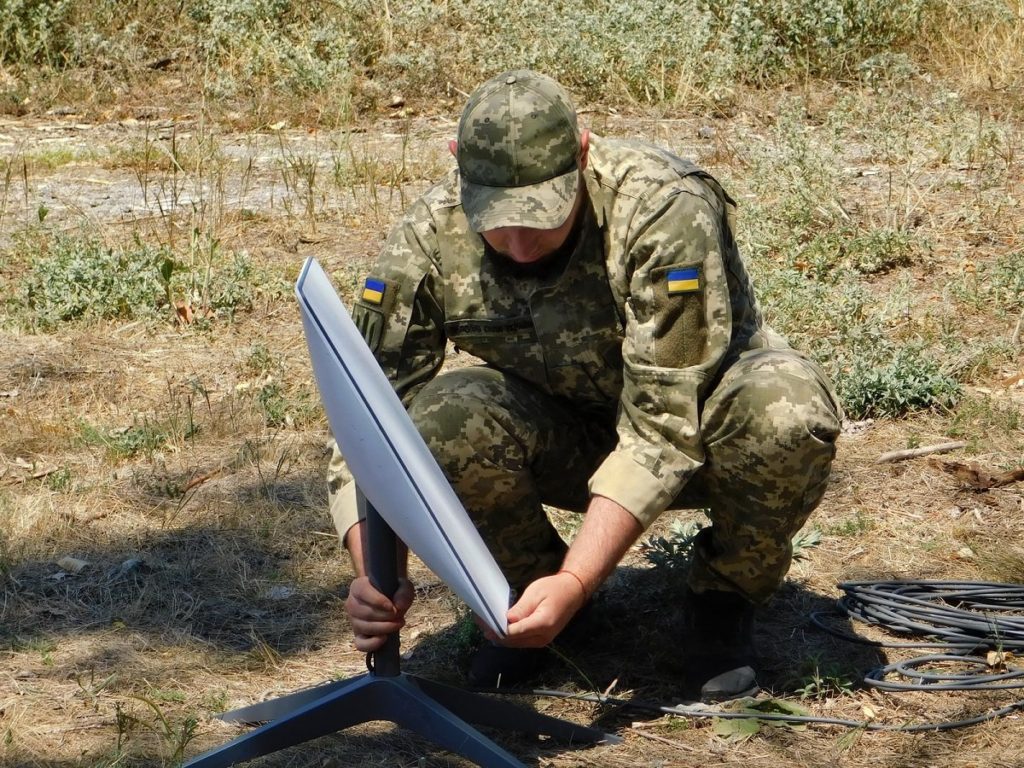
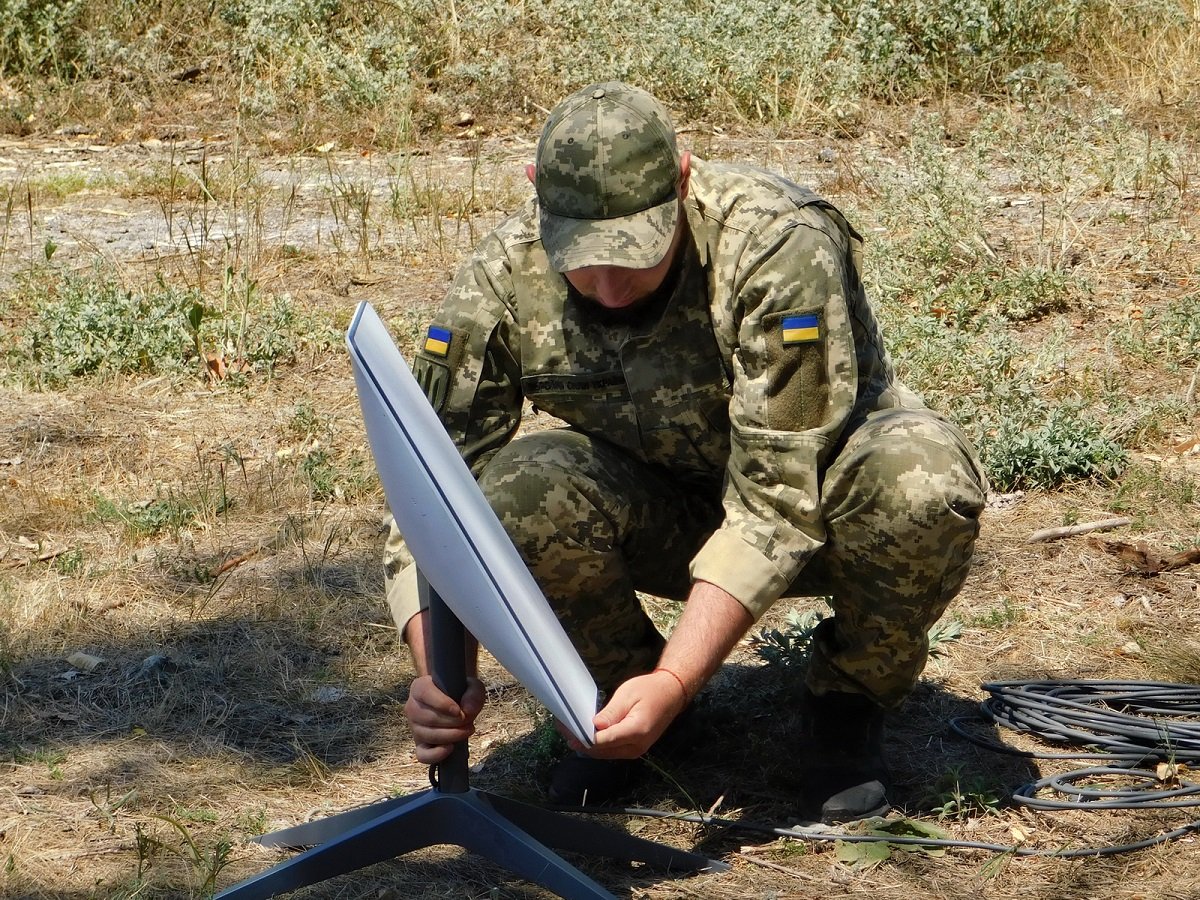
poland bulgaria now lithuania russia’s suspected arson campaign reaches third starlink site serving ukraine · post ukrainian soldier installs terminal news reports

Someone tried to set fire overnight to a Lithuanian company that stores Starlink communication equipment, but tipped-off guards foiled the attempt, Lithuanian Prime Minister Mindaugas Sinkevičius said. He linked the attack to Russia’s hybrid war against Europe. It is the third suspected sabotage of Starlink infrastructure in Europe in under a month.

Russia keeps attacking Ukraine at the front and from the air while running a sabotage campaign behind the lines in Europe, which ISW has linked into one pattern. Starlink keeps Ukraine’s drone units and front-line troops connected, and Poland pays for much of that service.

Fuel canisters and a control unit

The attack came just after midnight, the prime minister wrote. Security services had warned the company about possible attacks, security was stepped up, and the attempt failed.

The company provides connectivity through nine Starlink satellite antennas used by Ukraine, Sinkevičius told Lithuanian public radio LRT. At almost 2 a.m., intruders tried to burn the antennas and their control unit, leaving behind incendiary liquid in canisters of 3 to 10 liters.

“It is obvious that this is part of Russia’s hybrid war with elements of sabotage,” he said, adding that the client was likely “the Russian side.”

He said he believes the people involved, and how many there were, are known, but gave no details, citing the investigation.

Police Commissioner General Arūnas Paulauskas said no suspects had been detained, any damage was minimal, and the company kept working. A pretrial investigation is under way.

poland bulgaria now lithuania russia’s suspected arson campaign reaches third starlink site serving ukraine · post ukrainian soldier installs terminal news reports
Explore further

New Starlink restrictions disrupt Ukrainian drone missions. Kyiv adviser says move is tied to “political situation”

A drone the same morning

Hours later, an object that apparently entered from Poland crossed northern Lithuania, and NATO jets failed to identify it, Defense Minister Robertas Kaunas said. Possible fragments were found in the Pasvalys district near the Latvian border. Latvia’s military said the object may have blown itself up on a course toward Latvia.

Sinkevičius said the sabotage version had to be checked for the drone too. He called the National Security Commission for Monday, 19 October, to examine both incidents and consider giving services more powers to neutralize drones.

The third Starlink site

In September, a fire destroyed the distribution panel at a Starlink ground station in Wola Krobowska, Poland. Germany detained two Turkish nationals on 12 October, and Warsaw blamed Russian intelligence. In Bulgaria, masked intruders burned 11 of 17 Starlink antennas near Sofia.

  •  

Ukraine retook Kolodiazi north of Lyman as its drones hit 200-plus Russian vehicles in Operation Vivaldi’s last phase, Ukrainian drone officer says

ukraine retook kolodiazi north lyman its drones hit 200-plus russian vehicles operation vivaldi’s last phase commander says · post northern donetsk oblast neighboring areas territory during vivaldi blue 2022 green

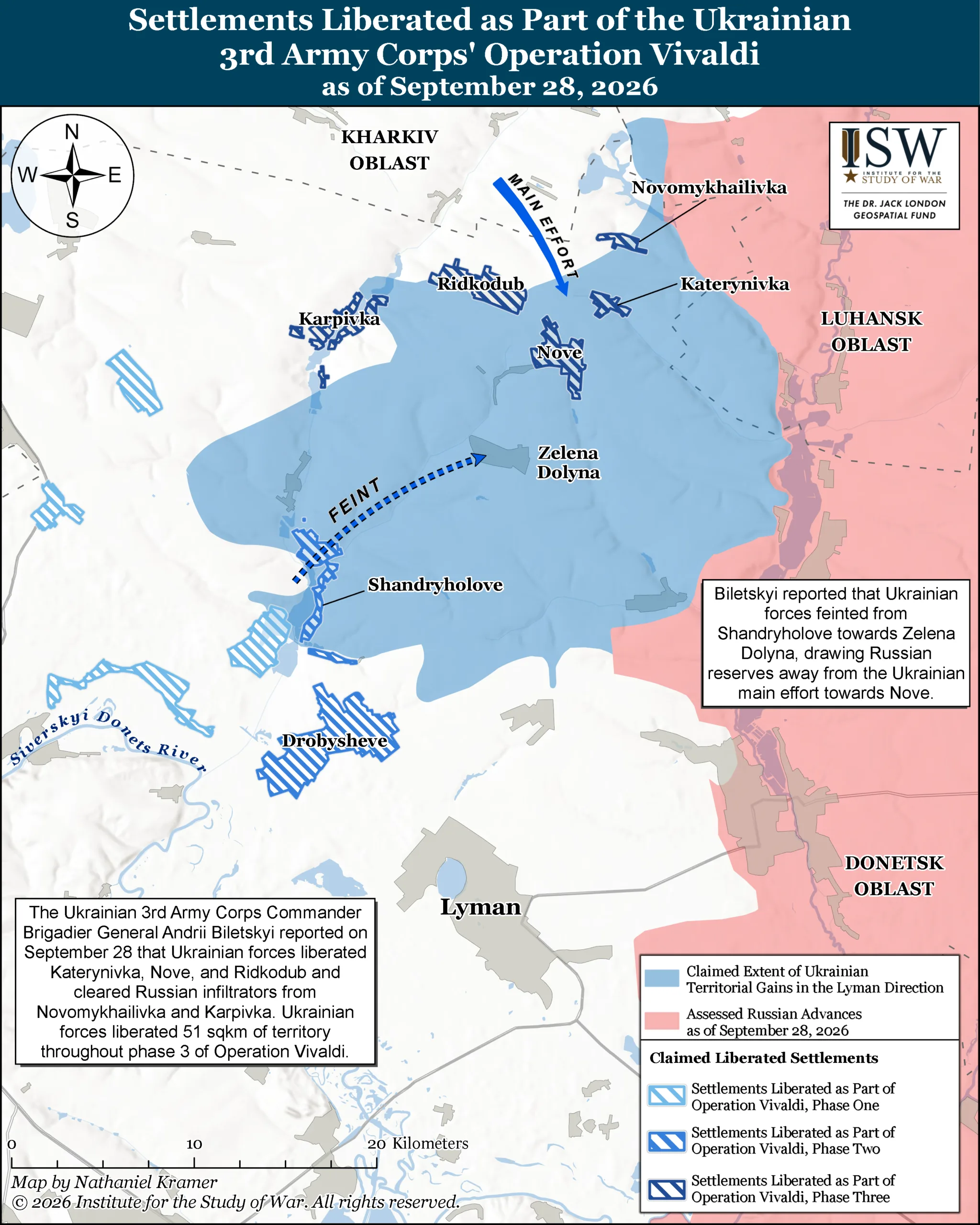
Ukrainian infantry encircled and retook the village of Kolodiazi north of Lyman without getting drawn into street fighting, while a drone battalion kept the sky above them shut, the battalion’s chief of staff told Suspilne on 18 October. The village fell during the fourth and final phase of Operation Vivaldi, Ukraine’s counteroffensive in northern Donetsk Oblast.

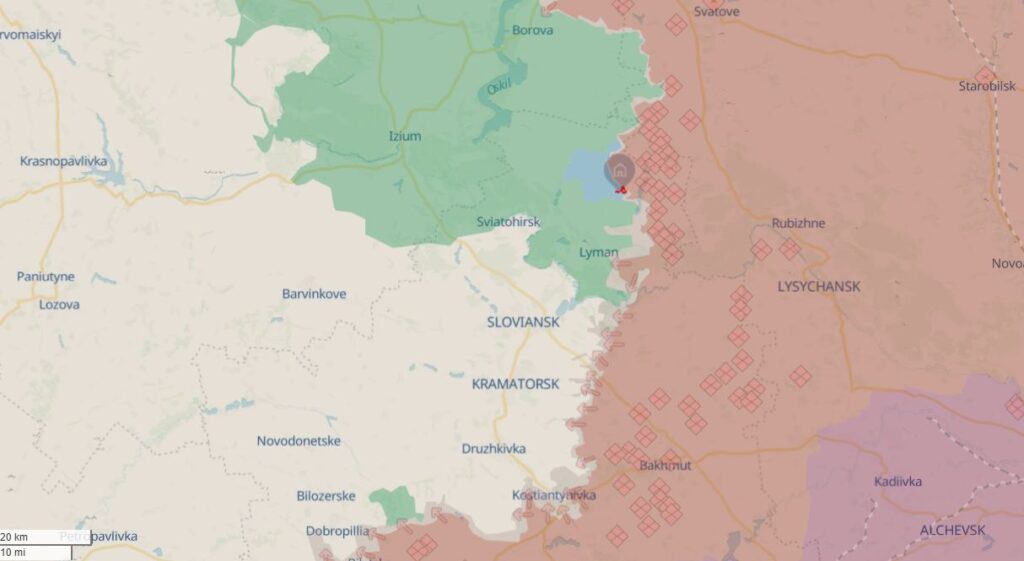
For years now, Russia has aimed to seize Lyman and cross the Siverskyi Donets River. It needs this area to encircle Ukraine’s fortress belt of Donetsk Oblast cities from the northwest, ISW assesses. Vivaldi’s four phases retook 277 km² and 16 settlements on that approach, and a veteran of the operation has said Ukraine’s assault troops suffered more than ten times fewer casualties than Russian forces doing it.

Drones over the infantry

The 60th Mechanized Brigade fought in all four phases of Vivaldi and took Kolodiazi in the last one, said the chief of staff of the brigade’s Fatum unmanned systems battalion, callsign Krash.

“Our task, as an unmanned systems battalion, was to escort and ‘close’ the air in front of our infantry to make it impossible for the enemy to hit it. To suppress all the firing assets possible,” he said.

The brigade’s 3rd Mechanized Battalion, the main striking force, encircled Kolodiazi and retook it without getting drawn into street fighting, Krash said. The 1st Mechanized Battalion kept Russian reinforcements out of the area, while drone crews suppressed artillery, hit supply runs, and worked against Russian drone operators.

Map of settlements Ukraine's 3rd Army Corps says it liberated north of Lyman, as of 28 September 2026.
Explore further

Vivaldi counteroffensive advanced after Ukraine took Russia’s drones out of the fight, ISW assesses

500 troops and 200-plus vehicles

The drone battalion killed or wounded about 500 Russian troops during the fourth phase and struck Russian armored vehicles, trucks, and motorbikes, its chief of staff said.

“More than two hundred pieces of various equipment: Grad and Uragan multiple rocket launchers, various armored vehicles, tanks, armored combat vehicles. Most of all motorbikes and quad bikes, there the count runs into the hundreds. This is our enemy’s main logistics tool,” he said.

ukraine retook kolodiazi north lyman its drones hit 200-plus russian vehicles operation vivaldi’s last phase commander says · post sector now lyman-tactical-area-october-16-2026 news ukrainian reports
Lyman sector now. Map: ISW

Ghost villages

The villages retaken in northern Donetsk Oblast are nearly empty of civilians, Krash said.

“It’s very typical for de-occupied settlements: these are ghost towns. You can see right away where the occupier stepped. All the settlements are under the control of the Third Army Corps, our forces stand there and prevent enemy infiltration. But civilian life in these towns is either absent or very scarce,” he said.

Third Army Corps commander Brigadier General Andrii Biletskyi reported Kolodiazi’s liberation, along with Zelena Dolyna and Lypove, when he summed up Vivaldi’s fourth phase, which secured 101 km².

  •  

The drones flew 1,000 km. St. Petersburg’s oil terminal, fuel depot, and a nearby data center were waiting at the end

russia’s st petersburg wakes up burning oil sites hit bridge damaged data center after night ukrainian drones · post fire ozon distribution kolpinsky district drone attack 18 2026 astra ukraine

Ukrainian drones struck St. Petersburg’s oil terminal, a fuel depot, an Ozon distribution center, and a VK data center overnight, setting off fires across the city, monitoring channels reported. Russian outlet Meduza called it apparently the largest attack on the city and Leningrad Oblast since the war began. Russian officials acknowledged fires, damaged homes and substations, and power cuts.

Russia keeps fighting along the front while bombarding Ukrainian cities and the grid behind it. Ukraine’s long-range drones, in turn, target the oil exports and logistics that fund and supply that war, and Russia’s Baltic oil ports have been hit repeatedly this year. St. Petersburg is a symbolic place: Russia’s so-called second capital and Putin’s hometown.

Oil terminal and fuel depot on fire

Ukrainian forces struck the Petersburg Oil Terminal with FP-1 drones, starting a fire, Ukrainian drone maker Fire Point said. The company described the terminal as one of the region’s largest, handling 12.5 million tonnes of petroleum products a year, including for export.

Piter port and oil facility in one shot pic.twitter.com/KfptwkhsDS

— Exilenova+ (@Exilenova_plus) October 18, 2026

St. Petersburg Governor Aleksandr Beglov acknowledged fires at the terminal and in four city districts, adding that Pulkovo airport had restricted flights. By morning, firefighters were still battling blazes at the terminal, the Ruchyi oil depot, and industrial warehouses in the Kolpinsky district, he wrote. He claimed one person was killed and five injured. Ukrainian monitoring channel Exilenova+ reported that the Ruchyi depot had been burning since the night.

Ozon hub, VK data center, and a bridge

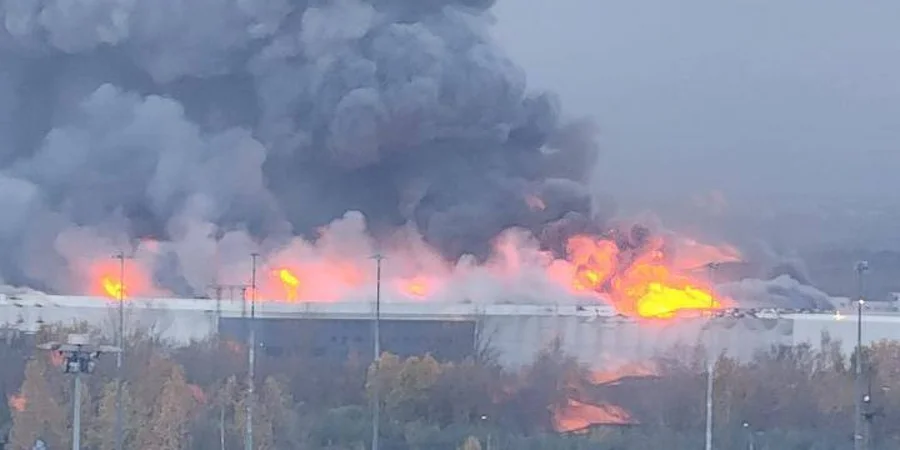
An Ozon distribution center in Kolpinsky district caught fire after the attack, the company said, Russian independent outlet Astra reported. Astra’s open-source intelligence analyst described it as one of Ozon’s busiest fulfillment centers in northwestern Russia, covering up to 79,000 m².

Ozon in St. Peterburg pic.twitter.com/tA9iwRJf7d

— Exilenova+ (@Exilenova_plus) October 18, 2026

FP-1 drones also hit a VK data center in Novosergiyevka, Leningrad Oblast, causing serious damage, Fire Point said. VK acknowledged a drone attack on the site but claimed its services were working normally. Leningrad Oblast Governor Aleksandr Drozdenko claimed air defenses downed 145 drones over the oblast alone. He acknowledged damage to the data center’s transformer equipment and warehouse complex, and minor damage to the Vostochnaya substation. Two other substations in Yanino went offline, cutting power to about 20,000 people, he said.

Damaged VK data center building in Novosergiyevka, Leningrad Oblast, after a Ukrainian FP-1 drone strike, 18 October 2026
Damaged VK data center building in Novosergiyevka, Leningrad Oblast, after a Ukrainian FP-1 drone strike, 18 October 2026. Photo: Fire Point/X

A drone also hit the cable-stayed bridge over the Korabelny fairway, part of a toll highway linking the city’s north and south, Exilenova+ reported, adding that the extent of the damage was still being clarified. The channel also reported a fire near a Russian Aerospace Forces radar company outside the village of Kaporskoye.

Smoke rising over St. Petersburg after the overnight drone attack, 18 October 2026
Smoke rising over St. Petersburg after the overnight drone attack, 18 October 2026. Photo: Astra

To reach St. Petersburg, Ukrainian drones had to cover 1,000 km across four Russian regions guarded by air defenses and electronic warfare, said Serhii Beskrestnov, adviser to Ukraine’s president on defense technology.

“And these are not cruise missiles with special systems, these are drones that fly at speeds of up to 200 km/h,” he wrote.

Satellite image marking the drone hit on the cable-stayed bridge over the Korabelny fairway in St. Petersburg, 18 October 2026
Satellite image marking the drone hit on the cable-stayed bridge over the Korabelny fairway in St. Petersburg, 18 October 2026. Image: Dnipro Osint via Exilenova+

Strikes resume after a one-sided truce

The same night, Russia hit Ukraine’s grid again, and Ukrainian President Volodymyr Zelenskyy counted 76 Russian strikes on energy since the ceasefire was announced. US President Donald Trump declared the truce on 11 October. Ukraine paused its refinery strikes for three days at Washington’s request, but Russia struck a Kharkiv power plant within hours and kept hitting the grid. Zelenskyy then said Ukraine was resuming strikes on Russian oil and would stop again only in exchange for more US interceptors for its Patriot systems. Trump called the renewed strikes “a disgrace” and said he found Zelenskyy “more difficult to deal with than Putin.”

Ukraine has hit the St. Petersburg area before. In July, drones set fire to Wildberries warehouses near the city. In August, Ukraine began striking Ozon hubs, starting in Samara Oblast. The hubs move dual-use goods such as electronics and drone components.

  •  

Russia hit Ukraine’s energy 76 times during a US-declared truce—and tens of thousands lost power overnight. Civilians killed and injured

russia hit ukraine’s energy 76 times during us-declared truce—and tens thousands lost power overnight civilians killed injured · post damage after russian strike detached houses poltava 17 2026 victim ukraine

Russia has kept striking Ukraine’s energy sector throughout the week since US President Donald Trump announced an energy ceasefire, Ukrainian President Volodymyr Zelenskyy said on 18 October. From overnight into Sunday, Russian drones and a ballistic missile hit substations, homes, and industrial sites from Odesa to Volyn. They killed civilians and left tens of thousands of families without power.

Russia fights along the front line while hitting cities and the grid behind it with drones, missiles, and glide bombs. Ukraine says Moscow plans up to 1,000 such munitions against 60 key infrastructure sites this winter, and jet-powered drones partly free it to concentrate missiles on fewer targets, the Institute for the Study of War assessed. With Graham Act penalties on hold and US sanctions on Russian diesel suspended, Russia faces no new US cost for its strikes on Ukraine’s grid. Protecting and restoring the grid falls to Ukraine’s air defenses and repair crews.

Russia hit energy sites 76 times in a week

Zelenskyy counted 76 deliberate Russian strikes on energy and oil-and-gas facilities since Trump’s announcement. Overnight, Russia hit substations in Vinnytsia, Zhytomyr, Khmelnytskyi, and Odesa oblasts, he said. In the past week, Russia fired almost 2,700 attack drones, 1,700 aerial bombs, and 66 missiles, most of them ballistic, mainly to cause a blackout. His message was aimed at Washington.

“America must see that Russia is not taking steps in return for the lifting of sanctions or deals. On the contrary, they take every signal that they can make money as proof that their bet on war is working and they can keep fighting,” Zelenskyy wrote.

US President Donald Trump signs the Lindsey O. Graham Sanctioning Russia and Iran Act in the Oval Office, 18 September 2026
Explore further

22 House lawmakers press Trump to implement Russia sanctions law. Diesel deal draws bipartisan backlash

Overnight, Russia launched one Iskander-M ballistic missile and 180 Shahed-type drones, 26 of them jet-powered, the Air Force reported. Air defenses downed or suppressed 152 drones, but strikes hit 20 locations.

russia hit ukraine’s energy 76 times during us-declared truce—and tens thousands lost power overnight · post rescuers site russian strike residential area zaporizhzhia 18 2026 zapo ukraine news ukrainian reports
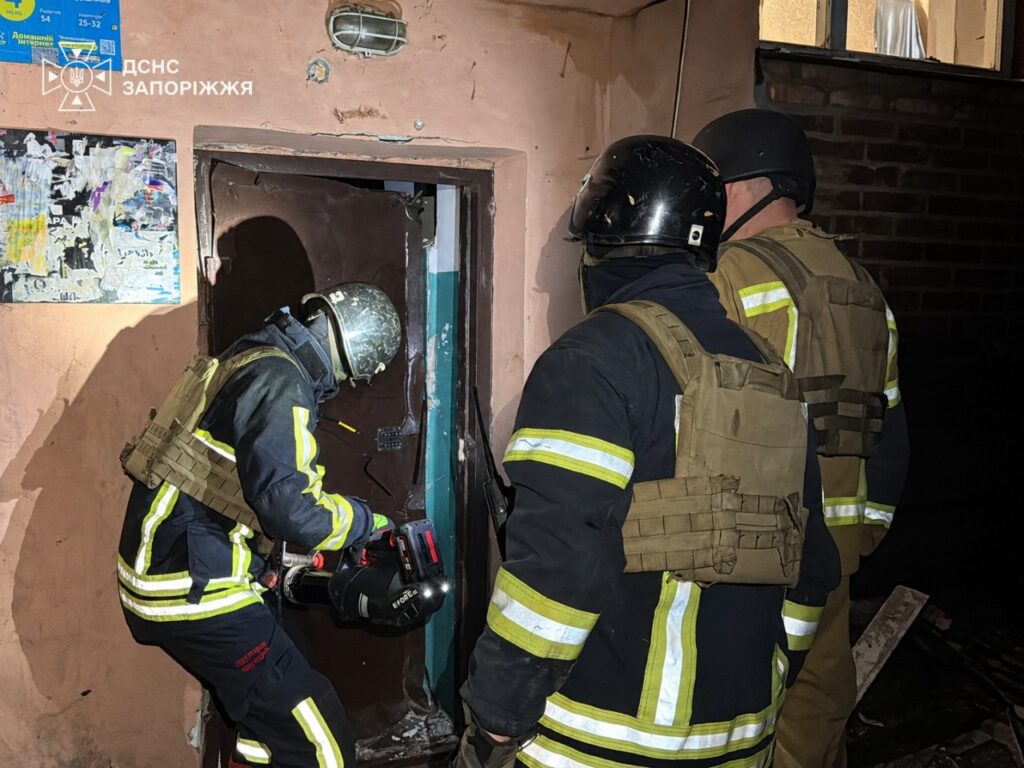
Rescuers at the site of a Russian strike on a residential area of Zaporizhzhia, 18 October 2026. Photo: State Emergency Service of Ukraine

Power cuts from Odesa to Ternopil

Strikes left about 24,000 consumers in Odesa Oblast without power, oblast head Oleh Kiper said. In Vinnytsia Oblast, the attack damaged critical infrastructure and forced emergency outages, oblast head Natalia Zabolotna wrote. Drones hit three energy facilities in Ternopil Oblast, one of them for the second time, and cut power to some consumers, oblast head Taras Pastukh said.

Civilians killed and injured

A Russian strike on Zaporizhzhia killed a 27-year-old woman and injured two others, including a 16-year-old, the State Emergency Service reported. In Poltava, an evening attack killed one person, injured four, and damaged 10 detached houses, city council secretary Kateryna Yamshchykova said.

The aftermath of a Russian strike on Zaporizhzhia on 10 October 2026
Explore further

Five Russian bombs kill 17 in Ukraine’s Zaporizhzhia next day after Trump lets Russia ship first 300,000 tonnes of its diesel

A drone hit a high-rise in Odesa and set its roof on fire. A 13-year-old girl was hurt, city military administration head Serhii Lysak said, and Kiper put the number of injured at two.

In Dnipropetrovsk Oblast, Russian drones and artillery injured three people, oblast head Oleksandr Hanzha said. In Donetsk Oblast, Russian attacks killed seven civilians on Saturday, six of them in Sloviansk, oblast head Vadym Filashkin reported.

russia hit ukraine’s energy 76 times during us-declared truce—and tens thousands lost power overnight · post fire roof high-rise apartment building after russian drone strike odesa 18 2026 ukraine news
Fire on the roof of a high-rise apartment building after a Russian drone strike in Odesa, 18 October 2026. Photo: Odesa City Military Administration

Fires in the west, alerts across the border

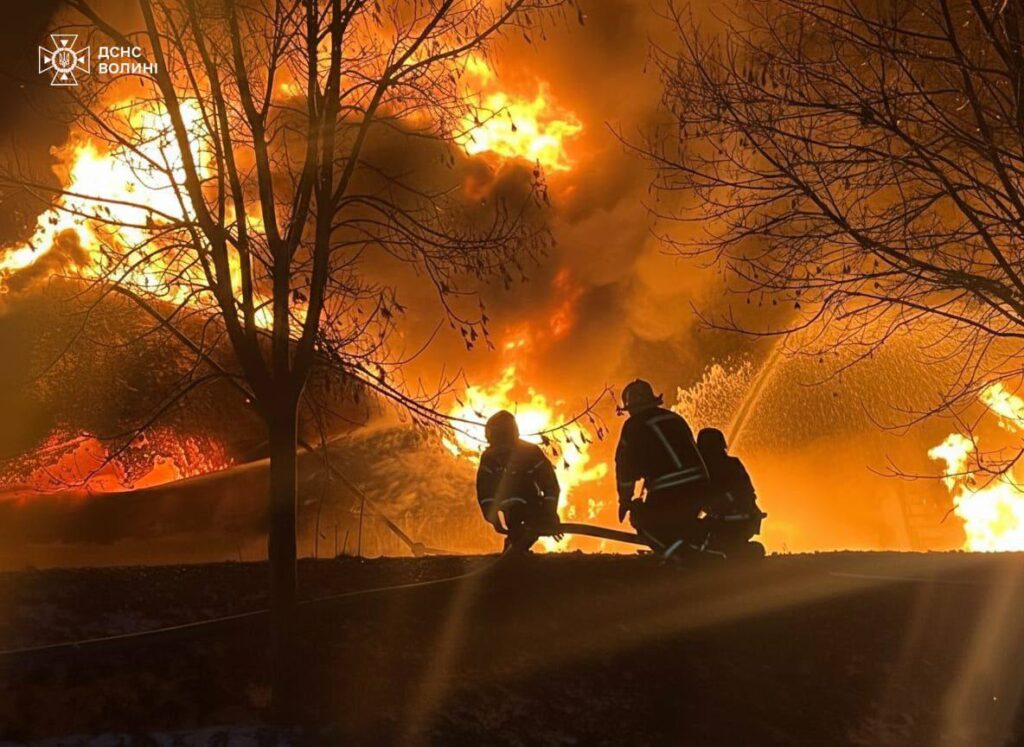
A morning drone strike set warehouse and production buildings ablaze at an enterprise in Manevychi, Volyn Oblast, oblast head Roman Romaniuk said. With heavy smoke blowing toward the town, Romaniuk urged residents to stay indoors, shut windows and doors, and switch off ventilation. A repeat strike set an enterprise in the district on fire again, the State Emergency Service said, adding that air tests found no dangerous concentrations outside the site. In Lviv Oblast, drone debris damaged a logistics warehouse and two houses, oblast head Maksym Kozytskyi said.

russia hit ukraine’s energy 76 times during us-declared truce—and tens thousands lost power overnight · post fire enterprise manevychi volyn oblast after russian drone strike 18 2026 manevich ukraine news
Fire at an enterprise in Manevychi, Volyn Oblast, after a Russian drone strike, 18 October 2026. Photo: Volyn Oblast Military Administration

Polish military aircraft operated in Poland’s airspace twice during the attack, as the Government Security Centre warned residents of Lublin Voivodeship and later alerted Subcarpathian Voivodeship. In Lithuania, NATO jets failed to identify an object that apparently entered from Poland, Defense Minister Robertas Kaunas said.

A ceasefire Moscow never confirmed

Trump announced the energy ceasefire on 11 October, news that surprised Zelenskyy. A White House official said Russia was still weighing it. Hours later, Russia hit a Kharkiv power plant, and on 14 October it fired 39 ballistic missiles at the grid. Then Trump waived Graham Act penalties on buyers of Russian oil, and Secretary of State Marco Rubio said the administration wants 60 days to weigh the economic effects.

  •  

G7 pledges 260 million euros to repair Chornobyl’s shield after Russia pierced it. Full repair will require 500 million euros by 2030, before corrosion sets in

A Russian drone tore a hole in the shield over Chornobyl’s dead reactor. Now the G7 is paying to patch it.

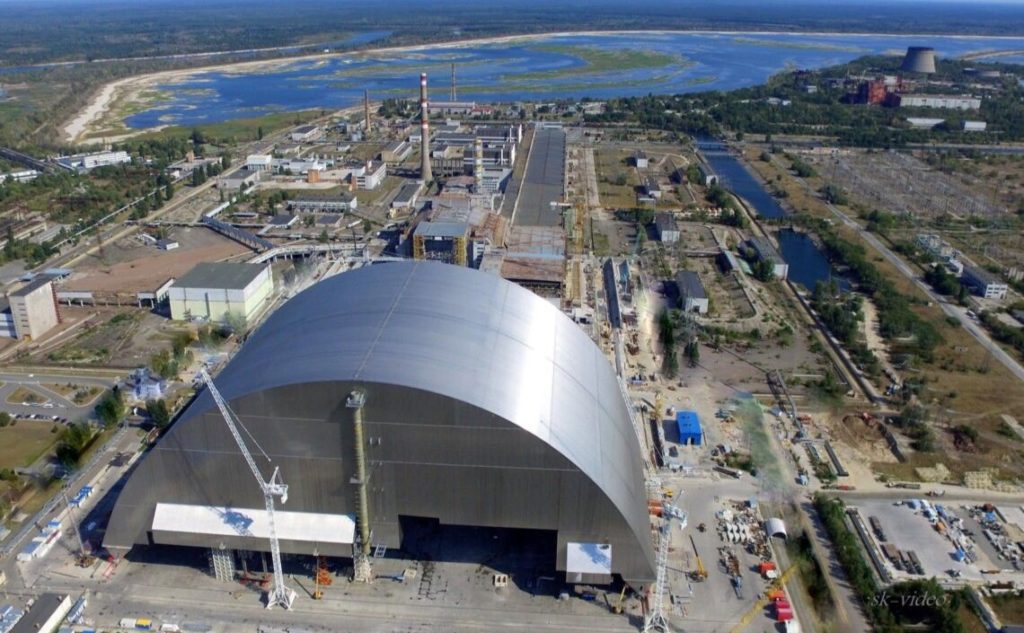
The Group of Seven nations plans to allocate 260 million euros ($292 million) to repair the New Safe Confinement at the Chornobyl Nuclear Power Plant, First Deputy Prime Minister and Energy Minister Denys Shmyhal says.

The confinement, a 35-story steel arch sealing the reactor that exploded in the 1986 disaster, was damaged by a Russian drone strike in February 2025. Full restoration will cost at least 500 million euros, the European Bank for Reconstruction and Development (EBRD) estimates, so the G7 pledge covers just over half, leaving about 240 million euros still to raise.

Shmyhal calls the decision an important step toward restoring nuclear safety at the plant, which the Russian strike had compromised. The money will go to priority work, including resealing the structure and restoring its ventilation system.

“Thank you to France and personally to Minister Roland Lescure for leadership in mobilizing international support,” Shmyhal says, crediting France and the EBRD with co-chairing the effort.

The night a drone pierced the sarcophagus

The damage dates to 14 February 2025. A Russian drone carrying a high-explosive warhead punched a hole through the arch’s roof and ignited a fire in the cladding, breaching the structure’s seal and ventilation.

The attack caused a 15 m² breach in the inner and outer cladding and damaged around 200 m² of panels.

"It was a targeted Russian attack on the Chornobyl station with a drone that is an analog of the Iranian Shahed," Ukrainian President Zelenskyy said at that time.

A bill only half-covered, and a 2030 deadline

The G7 money closes only part of the gap. Partners must still raise roughly 240 million euros more, and Ukraine hopes to secure it at a donor conference in Paris co-chaired by Ukraine, France and the EBRD, Shmyhal says.

The clock matters as much as the cost. The work must be finished by 2030 to limit corrosion and protect the arch’s 100-year design life, the EBRD says, turning a repair bill into a race against the rust the strike set loose.

  •  

Ukraine cannot be forced to surrender, says commander whose brigade destroyed 57,000 Russian targets, as US pressure and Russian missiles test its will

Yurii Fedorenko, commander of Ukraine’s 429th separate unmanned systems regiment “Achilles”.

Ending the war by forcing Ukraine to capitulate is impossible, the commander of the 429th “Achilles” Unmanned Systems Brigade, Yurii Fedorenko, said in an interview with 24 Kanal.

His statements came as Ukraine absorbed the fallout from the US-Russia diesel deal that saw its Starlink throttled and US intelligence lapse, a gap tied to a strike that killed three in Kyiv.

Achilles is a volunteer unit formed in the first days of the full-scale invasion, built around aerial reconnaissance and drone strikes and credited with more than 57,000 strikes. Fedorenko, its commander, was named a Hero of Ukraine in January 2026.

Fedorenko says he believes that there would be no “miraculous de-escalation,” and now argues that neither pressure from Washington nor Russian missiles can break the country’s will to fight for its liberty.

Russia will keep terrorizing Ukrainians with ballistic missiles, jet drones and Shaheds, and no near-term shift in US policy will stop it, Fedorenko stresses, so Ukraine will keep defending itself and striking back. A lasting energy ceasefire, he added, will not hold.

“Ukrainian society is ready to defend itself and to uphold its right to life by force,” he says, arguing that the Kremlin’s mouthpieces, and those working for third countries, have misjudged the mood in Ukraine.

No measure, he insists, could force Ukraine to capitulate in the short term.

Why the US election could swing the pendulum back

Fedorenko sees the political balance shifting after the US vote. President Donald Trump will probably not hold the majority he once had, making it harder for him to take domestic decisions alone, he notes. Even foreign policy, a presidential prerogative, will have to reckon with that balance.

If Trump must bargain with Democrats to pass domestic measures, that will shape the wider picture, Fedorenko argues. He stopped short of predicting impeachment, calling that the wrong framing, but cautioned that decisions already taken could be reviewed, challenged and overturned in the courts.

“I am firmly convinced we will get through the difficulties dictated by circumstances, including those arising across the ocean,” he says.

A cold shower for Europe that could help Ukraine

The US turn toward Moscow has jolted Europe, in Fedorenko’s view. American threats to leave NATO or rewrite how it shares the burden landed on European leaders like a cold waterfall, he recounts, pushing each state to ask how it would stand if the US walked away and to treat the Russian threat as one standing at its own borders, no longer a problem confined to Ukraine.

That alarm can work in Kyiv’s favor, drawing more weapons, defense financing and economic support from European partners, Fedorenko argues.

The same logic drives the satellite question. Ukraine cannot build a Starlink alternative alone, lacking its own space program, so the answer is collective, with NATO states pooling launches into a shared network, he explains. Russia is taking the other path with its “Rassvet” system, much of it, in fact, built by China, and if Moscow and Beijing get there first, he warns, the fallout would reach far beyond Ukraine.

  •  

Commanders from Azov, Marines, and 93rd tell Ukraine’s defense minister what front needs. He wants their methods scaled to other units

Ukrainian Defense Minister Yevhenii Khmara met commanders and soldiers from front-line units to discuss the needs of the front on 16 October, 2026. Source: The Ukrainian Defense Ministry

The front changes faster than any headquarters, so Ukraine’s war chief went to the people who fight on it. On 16 October, Ukrainian Defense Minister Yevhenii Khmara met commanders and soldiers from front-line units to discuss the needs of the front, command practices that save lives, and ways to raise combat effectiveness, the Defense Ministry reported.

The front keeps changing, with technology, tactics and weapons shifting constantly, so decisions made far from it risk arriving late and costing lives. Khmara’s answer is to anchor ministry policy in the experience of the soldiers who fight, a continuation of the “machines over men” program.

"The front does not stand still. But the key thing is people. People will always be the foundation and the main value of the Defense Forces,” Khmara said.

He claimed that the decisions of the Ministry of Defense must take into account the experience of warriors, those who directly carry out combat missions at the front.

Ukraine's most battle-hardened brigades say their word

The meeting drew commanders from across the force, including the Airborne Assault Forces, the Marine Corps, the 93rd, 100th, 28th and 155th mechanized brigades, the 1st, 425th and 475th assault regiments, the 3rd and 59th assault brigades, and Azov.

The last one, the 1st Azov Corps of the National Guard of Ukraine, is actively fighting in the Donbas region, where units have led counter-operations to disrupt Russian advances toward fortress cities that have been holding Russia's operation since 2014.

Meanwhile, the 93rd "Kholodnyi Yar" Separate Mechanized Brigade took part in fierce battles for Ilovaisk, the Donetsk Airport, Debaltseve, and Bakhmut, as well as in the liberation of the Kharkiv Oblast. Both units are known for their extensive implementation of advanced military technologies, including ground robotic complexes, FPV strike drones, and innovative anti-drone electronic warfare systems.

Command tricks that keep soldiers alive

The talk turned on how good commanders cut their own losses. Participants discussed command approaches that help save soldiers’ lives, use resources efficiently, and achieve combat results.

The ministry wants those methods studied and spread to other units, treating commanders' hard-won judgment as something to scale rather than leave in one brigade.

One goal: fewer Ukrainian losses, more Russian ones

Khmara framed the task in plain terms.

“We must adapt faster and give our warriors modern and effective tools,” he stressed, calling it the shared job of the Defense Ministry, the commander-in-chief and the General Staff.

  •  

Congress gave Trump 30 days to hit Russia’s oil buyers with 100% tariffs. He waives them two days before deadline, citing US interests. Moscow calls it historic

The White House, seen from Lafayette Square. File photo, June 2024.

US President Donald Trump has suspended the tariffs and sanctions on the biggest buyers of Russian oil set by the Lindsey Graham Act, the law he signed himself in September. He says the move serves US national interests, according to an executive order published on the White House site.

The act required the president, within 30 days, to impose 100% tariffs on all goods from the five biggest buyers of Russian oil, to sanction a range of Russian entities and to put 500% tariffs on all Russian energy imports to the US. The deadline for those measures fell on 18 October.

Trump has used the president’s power under Section 115 of the Graham Act, which allows him to waive sanctions, restrictions, and duties by certifying to Congress in writing that doing so serves US national interests and submitting a report explaining why. The act does not, however, allow him to cancel sanctions that have already been announced.

Moscow calls it historic, Kyiv calls it a gift to Putin

The two capitals read the same order in opposite ways. Kirill Dmitriev, an envoy for Russian leader Vladimir Putin, called it “an important and truly historic moment” on X, claiming the sanctions had mainly harmed the US economy and world markets.

“Economic cooperation between Russia and the US serves the interests of both nations, contributes to global economic stability and lays the foundation for building trust and achieving lasting peace,” Dmitriev writes.

President Volodymyr Zelenskyy answered from under fire. Russia struck Ukraine’s energy system on 17 October, and at that very moment Washington chose “to completely ignore the Lindsey Graham law, which was supposed to impose real, effective pressure on Russia to end this war,” he says.

A law its own backers say is being gutted

The waiver lands amid a bipartisan revolt in Congress. Seven Republican and Democratic senators had already warned on 11 October that Trump’s move to allow Russian diesel imports had broken the law Congress passed after the full-scale invasion, urging the administration to reverse it so US money would not help finance Russia’s war.

Meanwhile, Zelenskyy argued the law can still work if Washington lets it.

“This law could, and still can, help a great deal. But the law has actually to work, and every vote for it matters,” he said, warning that the step only pushes Moscow to strike harder.

The world must not give up ground and must try to end the war, Zelenskyy added.

“To end it, and not give Putin every reason to continue it indefinitely,” he stressed, thanking everyone who “is truly fighting for peace and helping Ukraine," he stated.

The word from the Ukrainian opposition

The Ukrainian opposition also commented on Trump’s decision. Iryna Herashchenko, co-chair of the European Solidarity parliamentary faction, said that “the most cynical and stupid decisions are usually made by rulers on Saturday night,” when public attention is scattered, and people are preparing for the weekend.

“Rehabilitating Putin harms not only Ukraine but also the US itself, strengthens the axis of authoritarian regimes, and undermines international security,” she claimed.

  •  

Uruguay Debuts Virtual Cards in Football Refereeing

The Uruguayan Cup tests a digital tool with which referees sanction fouls and enter incidents directly from the field. Photo: Clarin.

Uruguayan football introduced a new technology on Thursday night when referees replaced the traditional paper cards with an electronic device to show cautions and expulsions during a local match, although early tests have shown problems with visibility, according to local media reports.


Uruguayan football experienced a historic day on Thursday night with the appearance of virtual cards in the match that Nacional won 3-0 to Rentistas for the eighths final of the Uruguayan Cup, at the Gran Parque Central stadium.

During the game, the officiating team used the electronic device instead of the physical cards to signal bookings and sending-offs on the pitch.

RELATED: Argentina Introduces New Tournament and Rules for Football Professional League

The tool is designed to look like a mobile phone and has dedicated buttons to display yellow or red lights. Its main selling point is the automation of administrative work and allows referees to record every disciplinary sanction, substitution or incident in real time directly in the COMET sports management system.

That removes the need to take handwritten notes during the action and speeds up the digitization of the official post-match report.

La AUF (Asociación Uruguaya de Fútbol) presentó las tarjetas virtuales, un método que debutó en un duelo de Copa.

Este avance tecnológico permite agilizar y registrar de forma automática y digital al jugador amonestado.#Uruguay #Teconología #TVCDeportes pic.twitter.com/2tdfCI5OdN

— TVC Deportes (@TVCDeportes) October 16, 2026

Text reads: “The Uruguayan Football Association (AUF) introduced virtual cards, a method that debuted in a Cup duel. This technological advance allows the automated and digital recording of the player who has been reprimanded.”

Despite the logistical benefits, the virtual cards face technical obstacles in their first trial stages. The debut was initially scheduled for the match between Defensor Sporting and Plaza Colonia, but sunlight made it impossible to see the colors properly. Under the artificial lighting of Thursday’s night match, local media reports said the signal was still not completely clear from a distance.

What Comes Next

At present, the device’s fundamental value lies in its ability to streamline the collection and transmission of statistical data during the ninety minutes of a match. Authorities will keep evaluating its performance to try to correct the faults related to brightness and contrast.

If the required visual improvements are achieved, the technology could be adopted on a regular basis in the main categories of South American football, according to the source. No timeline for that decision has been announced.

Technology in refereeing has expanded steadily in recent years, with video review and semi-automated systems now common in major competitions. Most of those tools help officials make decisions, while this device focuses on communicating and recording them. The key test for the Uruguayan trial will be whether the cards are as easy for players and spectators to see as the paper ones they replace, since visible signals are central to how the game communicates discipline.

The technology carries obvious logistical benefits, because referees no longer depend on cardboards that can be dropped, lost or misread, and data flows directly into the official system while the ninety minutes are still running.

For the Uruguayan Football Association, the real value of the tool lies in how it optimizes the collection and transmission of statistics. Every booking, substitution and incident becomes part of a digital record the moment it happens, a change that could improve accuracy in reports that have long depended on memory and hurried notes.

  •  

Musk pushed Trump to slow Starlink in Ukraine, weakening air defenses as Russian drones attacked cities – The Telegraph
kyiv asking musk let strike inside russia its best line gone · post elon 2026 world economic forum / ciaran mccrickard wef ukraine news ukrainian reports

Elon Musk approached US President Donald Trump with a proposal to limit the speed of Starlink satellite communications in Ukraine, disrupting Kyiv’s ability to counter Russian drone attacks, The Telegraph reported on 16 October, citing four sources familiar with the discussions.
The restrictions had immediate consequences for Ukraine’s defenses, forcing some drone missions against Russian positions to be called off and threatening the ability to intercept Russian jet-powered drones as they targeted Ukrainian cities at the time.

According to The Telegraph, Trump agreed with Musk’s suggestion, paving the way for the Pentagon to impose restrictions on Starshield, the military-grade version of SpaceX’s satellite network used by Ukrainian forces.

The report contradicts Musk’s public claim that the US military and ultimately Trump were responsible for deciding any limits on the system. However, Trump denied that either he or Musk was responsible for Ukraine losing access, while an anonymous US official told AFP that the president had not requested the reduction in service.

The reported restrictions come amid tensions between Washington and Kyiv over Ukrainian strikes on Russian oil refineries. The episode has raised concerns about Ukraine’s dependence on privately controlled communications infrastructure and the risk that changes to US support could weaken its battlefield capabilities.

Starshield restrictions hampered Ukraine’s drone defenses

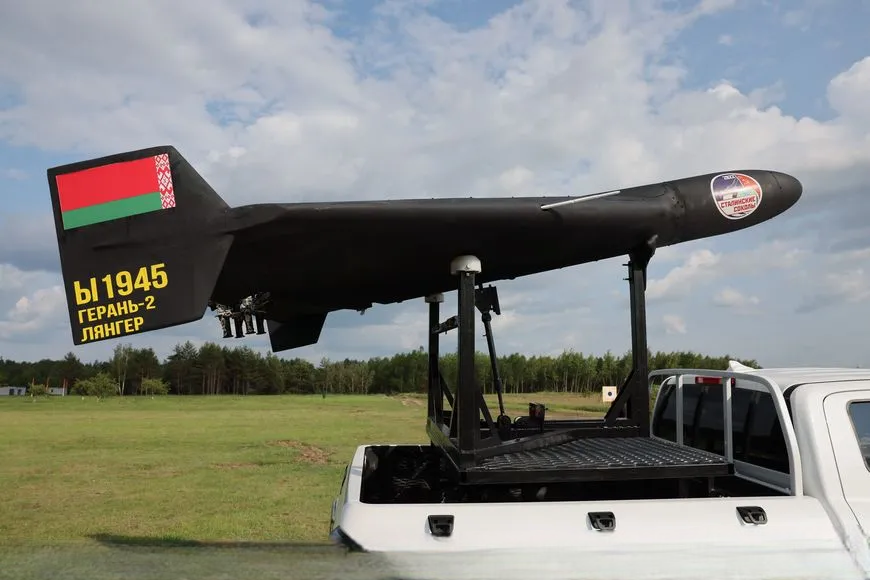
Starshield is the military-grade version of Starlink, SpaceX’s satellite internet network. It allows Ukrainian drone operators to maintain communications with aircraft moving at high speeds, supporting both defensive interception missions and strikes against Russian targets.

The speed limit imposed on Ukrainian drones using Starshield was around 160 kph, making it difficult for them to intercept Russian jet-powered drones and missiles traveling at roughly twice that speed.

According to The Telegraph, a senior source said Musk had become concerned about potential backlash from European consumers following the restrictions. A high-ranking European official and two Ukrainian sources reportedly corroborated the account that Musk and Trump were both involved in the decision.

The Pentagon has not publicly explained the restrictions. The report’s account also remains disputed: Trump said on 16 October that he did not believe either he or Musk was responsible for Ukraine losing access, while an anonymous US official cited by AFP said the president had not requested the reduction.

geran-2 (shahed-136) drone belarusian markings service military belta militarnyi російський безпілотник герань 2
Explore further

“Trump and Musk must be held accountable”: US senator warns Starlink network failing over Ukraine could cripple its shield against Russian missiles and drones

Ukraine says Starshield capabilities are being restored

Ukrainian President Volodymyr Zelenskyy said on 16 October that restrictions on SpaceX’s Starshield satellite communications system had disrupted several military operations, including efforts to intercept Russian jet-powered Geran drones attacking Ukrainian cities.

Zelenskyy said Ukraine did not use Starlink to support attacks inside Russia, but relied on the system to intercept drones targeting civilians, conduct mid-range strikes against Russian military targets in occupied Ukrainian territory, and deliver food and water to frontline troops using drones.

“When the speed was reduced, we were unable to intercept a certain number of jet-powered ‘shaheds,’ [Gerans - ed.]” Zelenskyy wrote on X, adding that Ukrainian forces had lost the ability to carry out some operations while the restrictions were in place.

Zelenskyy said Ukraine’s Defense Ministry was in contact with partners and had received signals from the White House that the capabilities would be restored. However, he stressed that speeds had not yet returned to their previous levels, although restoration was underway.

We don’t use Starlink for our responses inside Russia. We use Starlink to intercept jet-powered “shaheds” that attack our civilians and kill families.

Starlink wasn’t turned off – its speed was reduced. And when the speed was reduced, we were unable to intercept a certain number…

— Volodymyr Zelenskyy / Володимир Зеленський (@ZelenskyyUa) October 16, 2026

Europe warns against dependence on Musk’s network

The latest episode has renewed European concerns about relying on Musk and SpaceX for critical communications infrastructure. Polish Foreign Minister Radosław Sikorski warned Musk on social media that European customers were watching his actions, The Telegraph reported.

The European Union is developing its own satellite communications system, IRIS², intended to provide an alternative to Starlink, according to The Telegraph. The system is planned to become operational by 2030, leaving Ukraine and European governments dependent on existing providers in the meantime.

The report adds to concerns that decisions made in Washington or by private technology providers could directly affect Ukraine’s ability to defend itself against Russian attacks.

  •  

Landowners in Texas' Big Bend Region Fight Trump Administration's Attempts To Seize Land for Border Wall

Border wall | Jim West/UCG/Universal Images Group/Newscom

The Trump administration's attempts to fast-track construction of the president's long-promised border wall through Texas' remote Big Bend region have ground to a halt amid fierce opposition, protests, and legal challenges from landowners and conservation groups.

A federal judge on Wednesday released an opinion explaining her decision to issue a preliminary injunction blocking border wall construction through the Big Bend area. U.S. District Judge Kathleen Cardone found that the plaintiffs, which included the Center for Biological Diversity and several longtime residents of the region, had shown a substantial threat of irreparable harm if the construction project is allowed to continue.

The Trump administration wants to spend $7.5 billion building additional security infrastructure along a 500-mile stretch of the U.S.-Mexico border running through the Big Bend region, which includes Big Bend National Park. The federal government began sending threatening letters to property owners announcing its intent to acquire necessary pieces of their land this summer, and it waived several environmental regulations, allowing it to put bulldozers on the ground inside the national park by September.

However, numerous groups and local landowners say the border wall project will alter their way of life and permanently scar one of the most rugged and pristine landscapes in the country. The project attracted bipartisan criticism and protests.

Cardone also found that the plaintiffs were likely to succeed on their claims that Department of Homeland Security (DHS) Secretary Markwayne Mullin exceeded his authority when he issued environmental waivers for the project.

The injunction is a temporary reprieve for property owners such as David Keller, an archaeologist and part-time river guide on the Rio Grande River. The original plans for the border wall expansion would have cut through Keller's 10-acre property near Redford, Texas, putting a 30-foot-tall wall on the levee that sits between the river and the rest of his land.

Keller says the Trump administration gravely underestimated how much anger its tactics and attitude would generate.

"It's a level of arrogance—they're just used to being able to bulldoze over people," David Keller says. "They were moving forward as if they weren't expecting any resistance, but boy, they're due for a wakeup call. And they're having it right now."

Keller is a plaintiff in a separate lawsuit against the DHS by Conserve Big Bend, a coalition of landowners, conservationists, river tour guides, researchers, and other affected parties.

Keller says he's loved wild, open country since he was a child, and as soon as he saw the region in the 1990s, he decided he would find a way to live and work there, which he's done for the past 25 years. "It's visually magnificent," Keller says. "It's incredible. It's like no other place I'd ever seen. It's one of the last unspoiled places remaining in the lower 48."

Keller says it's where he plans on being buried, too, although these days he's unsure whether to say "plans" or "planned." The proposed border construction is an existential threat to the life he's built, he says, and if the wall goes up, he'd likely move.

"I didn't come down here to live in a cage," Keller says.

The proposed border wall would not only block access to the river for farmers, ranchers, and outdoors enthusiasts along the river, as well as block the view into Mexico, it would wreck "the whole feeling of the place, the historical cross-border culture that we've developed," Keller says.

So far, the federal government has not tried to seize any private property in the Big Bend region through eminent domain, although it sent letters to property owners this summer requesting access to survey their land and warning them that it held the option to invoke eminent domain if they did not quickly sell.

Both Keller's and the Center for Biological Diversity's lawsuits argue that the department's justification for building and expediting additional border infrastructure in the Big Bend Region are factually and legally incorrect. The DHS determined that the sector of the border is an "area of high illegal entry."

However, despite making up roughly a quarter of the entire U.S.-Mexico border, the Big Bend sector only accounted for between 0.3 percent and 2.2 percent of total border-wide arrests over the past 30 years.

Cardone cited the low apprehension numbers in her finding that Mullin exceeded his authority to issue the waivers.

"The unrebutted evidence shows that the Big Bend Sector is, by far, the sector with the lowest rate of migrant apprehensions along the entire U.S.-Mexico border, both in terms of gross totals and apprehensions per mile of border," Cardone wrote. "Therefore, if the Big Bend Sector is an area of high illegal entry, so is every other sector, and the waiver authority would apply to the entire U.S.-Mexico border."

The post Landowners in Texas' Big Bend Region Fight Trump Administration's Attempts To Seize Land for Border Wall appeared first on Reason Magazine.

  •  

Romania finally holds Russia responsible for the drone attacks on ships off its coast, and wants a joint NATO command for the Black Sea

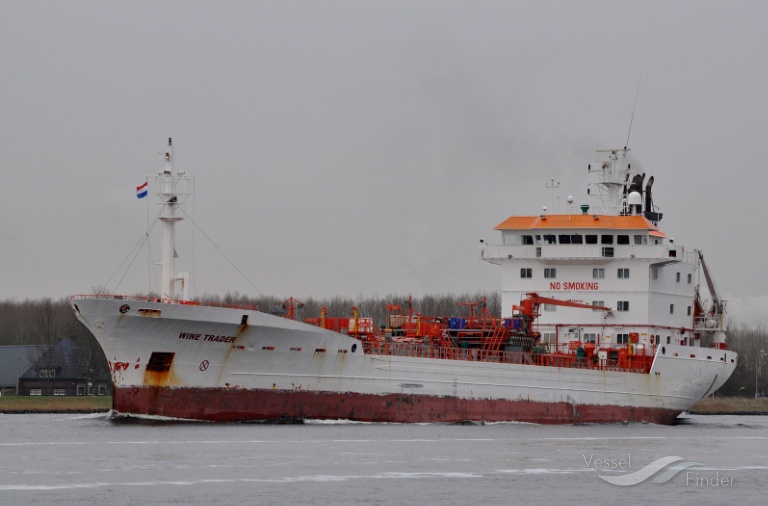
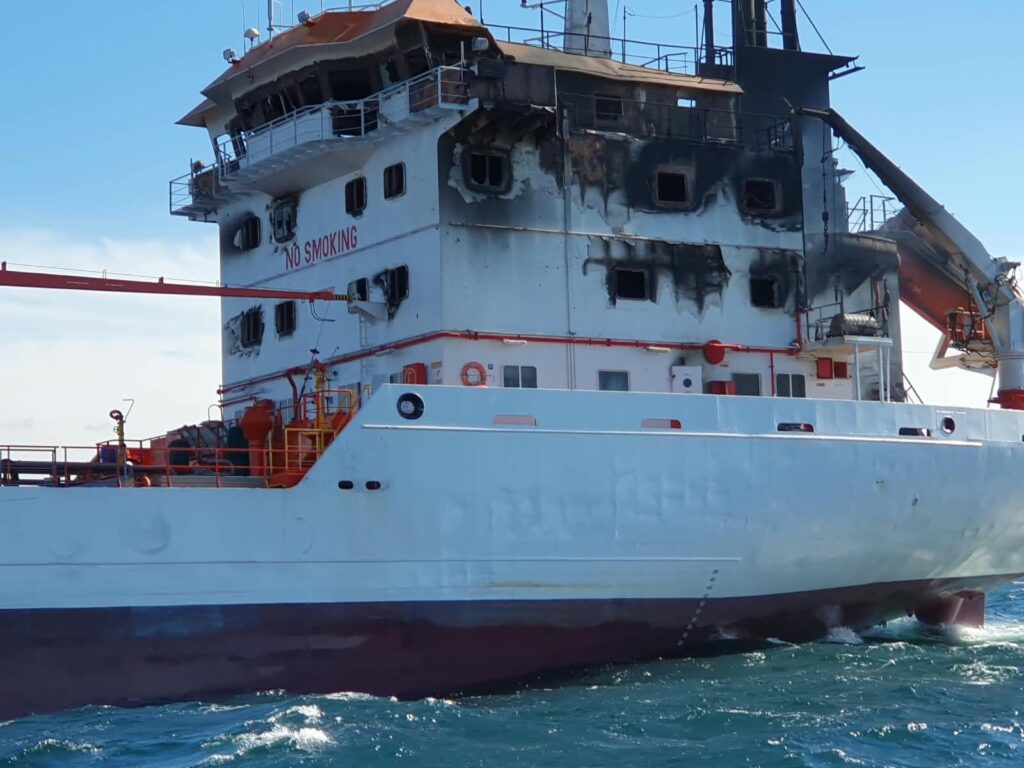
The San Marino-flagged chemical tanker Wine Trader near Sulina, Romania, on 15 October 2026, after it was hit by drones about 14 nautical miles off the coast. Seven of its 12 crew were reported missing. Photo: ARSVOM

Romania has proposed a joint NATO military command for the Black Sea, as drones hit four merchant ships in 24 hours, three of them off its coast, and its foreign minister said Russia "bears full responsibility." NATO ambassadors will discuss the attacks next week.

Russia’s strikes on merchant ships in the Black Sea have escalated this autumn and reached NATO shores. Drones have attacked at least eight merchant vessels near Romania and Bulgaria since 5 October, two of them inside Romania’s territorial waters. Until now, neither country had named the attacker, and Bulgaria still says it cannot prove who it was. Romania’s patience appears to have run out, and next week’s NATO meeting will show whether the alliance is ready to go further as Russia’s war spills beyond Ukraine’s borders.

Acting Defense Minister Radu Miruță wrote on Facebook on 14 October that "the Black Sea needs a joint military command of the NATO riparian states." "The Black Sea incidents, involving drones, sunk ships, and naval mines, oblige us to act, not wait," he wrote, after a call with his Bulgarian counterpart. Leadership and location would rotate among the member states. Romania is ready to host the command on its coast from 2028 and would accept a start on Türkiye's coast until then, he said. He proposed that Romania and Bulgaria send NATO a joint letter backing the idea.

The next day, Foreign Minister Oana Țoiu wrote on X that four commercial ships had been attacked over the previous day, including in Romania's territorial waters and exclusive economic zone, and that eight people had died. "Russia is turning the Black Sea into a dangerous area for civilian ships," she wrote. "Killing sailors from commercial ships, both in this region and anywhere in the world, is a crime. Russia bears full responsibility for these developments."

Earlier that day, as two tankers burned off Romania's coast, Bucharest had said it was still checking whether drones were involved.

two tankers burn off romania’s sulina bulgaria says lacks proof russia behind black sea ship attacks · post burned superstructure tanker wine trader seen rescue helicopter 15 2026 romanian interior
Explore further

Two tankers burn off Romania’s Sulina as Bulgaria says it lacks proof Russia is behind the Black Sea ship attacks

Țoiu said NATO Secretary General Mark Rutte had agreed to convene the allies within days, after he met Romanian President Nicușor Dan and Bulgarian Prime Minister Rumen Radev in Brussels. NATO ambassadors will meet next week, France 24 reported. No date has been announced.

An escalating drone strike campaign

Black Sea grain war between Ukraine and Russia escalates
Map: Euromaidan Press

Drones have been hitting merchant ships for weeks on the route from Ukraine's Danube and Odesa ports to the Bosporus. Besides the latest strikes off Romania, Reuters counts at least five cargo ships hit near Romania and Bulgaria in the past 10 days, with 23 sailors dead or missing, most of them outside any NATO member's territorial waters. This week the strikes reached Romania's own waters.

  • The Comoros-flagged tanker Yara J was hit inside Romanian territorial waters late on 14 October, off Sulina, the port at the mouth of the Danube. Its crew was unharmed, and it was towed to the Romanian port of Constanța.
  • Early on 15 October drones struck the San Marino-flagged chemical tanker Wine Trader about a mile outside Romanian waters, also southeast of Sulina. Five of its 12 crew were rescued. Seven were still missing on 16 October, when rescuers returned to search the ship.
  • Two more ships were also targeted, Reuters reported: the Marshall Islands-flagged Sea Destiny, inside Romanian waters according to NATO, and the Tanzania-flagged Dania J, moored at the Ukrainian Danube port of Izmail.

Țoiu did not say which ships her eight dead were from, and Reuters still lists the Wine Trader's seven as missing. A NATO military source told Reuters the drones that hit both tankers came from Russia.

The chemical tanker Wine Trader
The chemical tanker Wine Trader. Photo: VesselFinder

Romania's president says too early to say

Romania's president has not gone as far as his foreign minister. Dan told reporters in Brussels it was "obvious" that the attacks were Russian attempts to destabilize Romania and Bulgaria and reduce support for Ukraine. But he also said it was too early to say definitively that Russia had launched the drones, according to Politico.

Bulgaria, Romania's partner on the command proposal, says it suspects Russia but cannot prove it. Two ships were hit off its coast on 13 October, and one, the HS Dignity, sank. The other, the Chelsea 3, is Ukrainian-owned.

Radev told parliament on 14 October that the attacks worked in Russia's favor and that "logic leads there." "The problem is that we cannot prove it," he told MPs. Sofia summoned the Russian ambassador. Radev also said EU leaders would discuss a moratorium on attacks on civilian ships in the Black Sea.

Bucharest has blamed Russia for drones before, though over its airspace, not its shipping. On 27 July it expelled a Russian diplomat after prosecutors confirmed that fragments of drones downed on Romanian territory were Russian. Russia, Romania's Foreign Ministry said then, "bears exclusive responsibility."

Ukraine ships most of its farm exports across the Black Sea. Euromaidan Press's David Axe has written on how the fight over shipping there has escalated.

Bulk carrier "Royad Mammadov" under the flag of Saint Kitts, partially sunk after an attack by Russian sea and air drones on October 5, 2026, 20 nautical miles off the coast of Romania. Photo: Romanian Interior Ministry
Explore further

Russia is losing the Black Sea grain war it started. Its answer is to sink civilian ships off Romania and Bulgaria

  •  

Trump calls Ukraine’s renewed refinery strikes “a disgrace” after Russia’s 39-missile strike on its energy sites

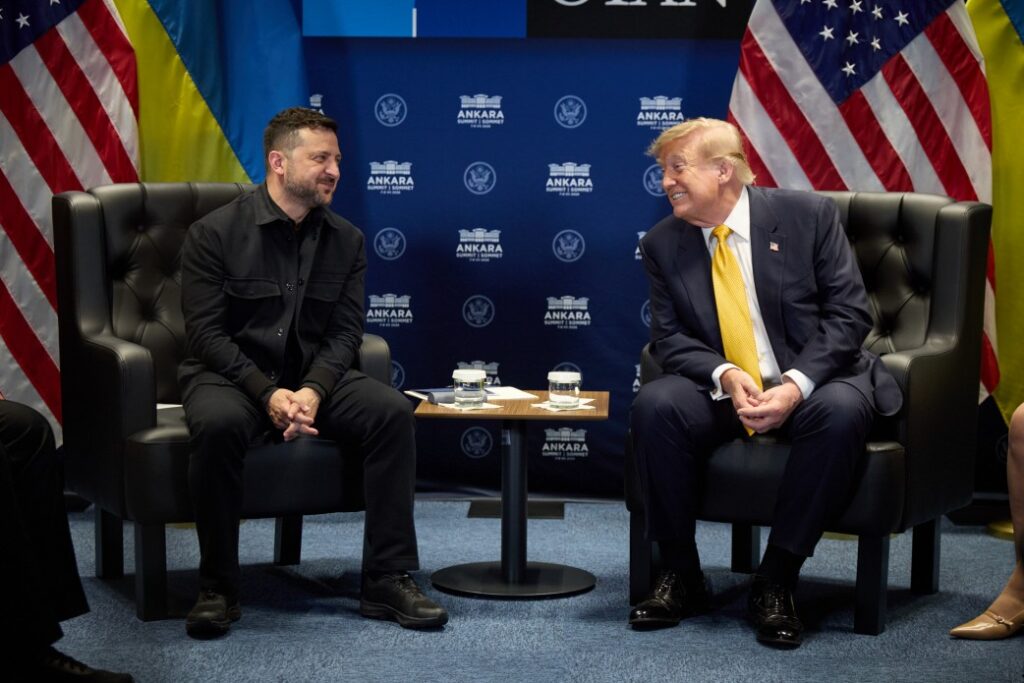
again trump presses zelenskyy stop russian refinery strikes · post ukrainian president volodymyr meets donald ankara türkiye 8 2026 presidentgovua ukraine news reports

US President Donald Trump called Ukraine’s renewed strikes on Russian oil refineries a disgrace in an interview with Newsmax and questioned President Volodymyr Zelenskyy’s will to settle the war on 15 October. His statements came after he made a deal with Russian President Vladimir Putin to allow Russian diesel back into the US ahead of the mid-term elections in the US.

Kyiv says its long-range strikes have knocked out more than half of Russia's refining capacity, one of the few levers it controls on Moscow's war income, according to Ukraine's Defense Ministry. This is part of efforts to reduce the aggressor's capabilities to launch assaults, including the latest, during which four Russian regions fired 39 Iskander-M, North Korean KN-23, hypersonic Zircon, and supersonic anti-ship cruise Oniks missiles, Zelenskyy said.

Trump criticizes Zelenskyy over oil prices while remaining silent on Russian strikes

Earlier, Zelenskyy said that Ukraine stopped refinery strikes for three days to meet US wishes after Trump announced an “energy ceasefire” on 11 October. At the same time, Russia struck a Kharkiv heat-and-power plant within hours of the announcement, he emphasized.

Meanwhile, in the interview with Newsmax, Trump said Zelenskyy is only pushing world oil prices higher.

“Well, I think that’s a disgrace,” he said.

He added that Ukraine has other options: “There are a lot of targets that you can hit.”

At the same time, Trump didn't say a word about Russian strikes on Ukraine's civilian buildings and power infrastructure ahead of the winter.

Trump compares Zelenskyy to a circus showman

The US leader said he is “not a big fan” of Zelenskyy. He claimed both sides “would like to see it end,” but that he finds Zelenskyy “more difficult to deal with than Putin.”

Kremlin welcomes Trump National Security Strategy as aligned with Russian vision on Ukraine
Explore further

US weighs relief for sanctioned shadow fleet tankers, days after freeing Russian diesel

He also said that he believes the depletion of US ammunition stockpiles is linked to the aid provided to Ukraine under the Biden administration, rather than the war with Iran.

Ukraine has repeatedly offered to help the US counter Iranian drones during the operation. The New York Times reported that a Ukrainian team departed the day after the US made such a request.

Nevertheless, despite Kyiv’s offers and actions, Trump once again compared Zelenskyy to P. T. Barnum, the 19th-century American circus showman, saying that he received a tremendous number of Patriots and Tomahawks.

However, there is no public confirmation that Tomahawk missiles were transferred to Ukraine during the Biden administration.

  •  

Russia pushes its drone war into Volyn Oblast on NATO border, cutting power to 370,000 as strikes creep toward EU

Emergency workers responding to a blaze following a Russian attack in Volyn Oblast, Ukraine. Photo: DSNS Volyn

Russia is pushing its drone war westward, into a Ukrainian region that borders NATO. Russian drones attacked Volyn Oblast through the night of 16 October, hitting civilian and critical infrastructure and leaving 370,000 subscribers without power, regional administration head Roman Romaniuk says. Volyn borders Poland, a NATO member, and Belarus, a Russian ally.

Russia’s jet-powered drones keep flying farther west, and now the strikes reach deeper into the center and the EU-facing frontier too. Moscow launched more than 850 Shahed drones at Ukraine in about a day and a half, including a record roughly 360 on the central Kirovohrad Oblast, precisely as a speed cap on Starlink degraded the interceptor drones Ukraine’s air defense relies on.

Moscow escalates its attacks after winning sanctions relief from the diesel deal of US President Donald Trump and Russian President Vladimir Putin and sensing pressure on Ukraine, exploiting the moment its defenses were artificially restricted.

“Russia takes advantage of every such moment and must be held accountable for what it does,” Zelenskyy says, noting the skies had not been clear for a single hour.

A night that turned deadly in the west

In Volyn Oblast, the damage was concrete and lethal. Debris fell on a power line in the central Lutsk community, cutting electricity and disrupting water supply, and the city lost power entirely with public transport halted, Lutsk council secretary Andrii Razumovskyi says.

The heaviest toll came in Manevychi, where a drone hit the private enterprise Agrofrukt LTD, killing one person and injuring eight. By 10:46 AM, the fire there was contained, and residents were asked to seal windows, doors, and vents due to the risk of an ammonia release from a damaged facility.

A capital-to-border map of the same assault

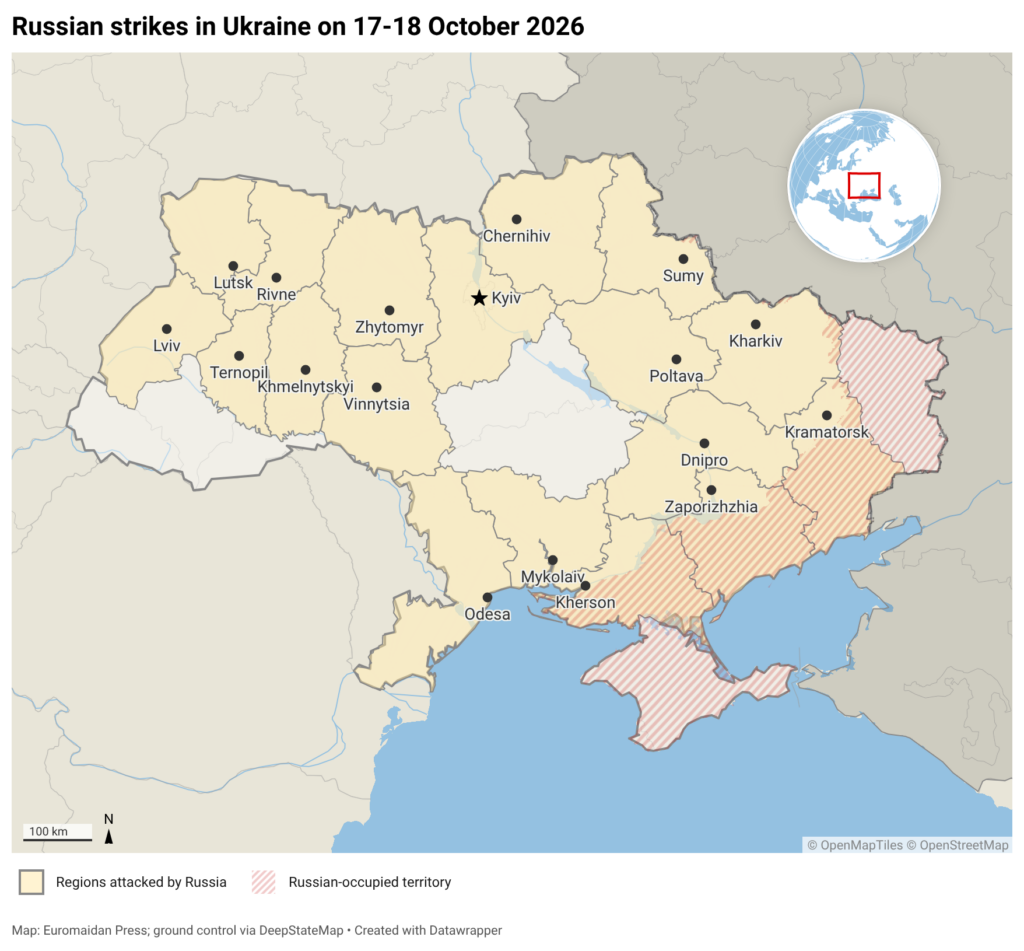
Throughout the day, Russia has struck Kyiv and its region, and the Dnipropetrovsk, Odesa, Rivne, Kharkiv and Donetsk regions, along with Zaporizhzhia, Kherson, Mykolaiv, Vinnytsia, Zhytomyr, Khmelnytskyi, Poltava and Ivano-Frankivsk.

By reaching western border regions at once, Russia is widening the pressure on civilians across the country and edging closer to the EU.

  •  

FIFA Drops Private Investment Plan, Infantino Proposes $6.35B Program

FIFA's President, Gianni Infantino, called for global football unity after he withdrew his proposal for private investment in FIFA competitions. Photo: Mex Sport.

FIFA President Gianni Infantino apologized to the governing body’s Council in Zurich over the mishandling of the FIFA Forward Enterprise (FFE) project and confirmed the proposal to sell competition stakes to outside investors has been withdrawn permanently.


FIFA President Gianni Infantino offered the apology this Thursday during the first Council meeting held in Zurich after the World Cup. He acknowledged errors in both the management and the communication of the FIFA Forward Enterprise (FFE) initiative, a plan that would have handed private investors a share of FIFA competitions.

Addressing the council members directly, the Swiss-Italian executive sought to close the episode with a call for unity. The investment scheme, he confirmed, would not be revived.

RELATED: Europe’s Top Leagues Demand FIFA Governance Reform

The administration then presented an alternative designed to soften the blow: a proposal named the Surplus Solidarity Program channels 6.35 billion dollars for the period between 2027 and 2030, drawing on commercial revenue generated by the World Cup. According to Infantino, the funds would raise the amounts distributed among all 211 member associations and the confederations.

That financial package will be evaluated at the December meeting in Doha and put to a vote at the Congress scheduled for March 18, 2027.

FIFA plans to allocate $6.35 billion to its member associations for football development from 2027 to 2030, including an increased funding package of $25 million for each national association. #3Sports pic.twitter.com/ogP4oEb3g8

— #3Sports (@3SportsGh) October 14, 2026

Europe Presses for Exit

Despite the financial announcement, the most critical European federations, including England and Germany, maintained their opposition to Infantino remaining in office. The English federation said it has not received clear answers about the legal background of the FFE project, while the German side called for a change in the organization’s leadership.

Support for the president came from Africa. Ahmed Yahya, president of Mauritania’s football federation, defended the current leadership, saying it promotes equality and an equal weight for each vote in the Congress. He said a majority backs Infantino staying at the head of the institution.

The competing messages reflect a familiar divide in world football’s governance. Larger, wealthier federations tend to push for tighter scrutiny of FIFA’s leadership, while many smaller associations benefit directly from FIFA’s development funds. Because each of the 211 members has a vote at the Congress, a spending increase aimed at all of them is likely to be closely watched.

🗣️ Gianni Infantino has apologised "for the mistakes… in relation to the communication and consultation" for FIFA Forward Enterprise.

He adds that the FIFA Peace Prize will be "analysed" along with a change to the FIFA Disciplinary Code to stop automatic one-game bans being… pic.twitter.com/lBrraQNjkk

— Ben Jacobs (@JacobsBen) October 15, 2026

Governance Review Ordered

The Council also agreed to create a working group to review FIFA’s governance framework. It tasked an evaluation of the FIFA Peace Prize and asked the Legal Commission for a report on disciplinary procedures, to be presented at the December session.

The apology and the withdrawal mark a significant concession from a president who has dominated world football’s finances for a decade. By scrapping the FFE plan outright, Infantino acknowledged that the backlash within the game had grown too costly to ignore.

Supporters of the solidarity plan may argue that it directs World Cup profits toward the wider football community. Critics may counter that a funding increase does not answer questions about how the FFE project was handled, which is the point the European federations are pressing. Yet the European federations made clear that closing the project alone would not settle the matter. For them, the questions about how the initiative was conceived and who approved it remain open, and the December gathering in Doha now looms as the next test of whether the unity Infantino called for can actually be rebuilt.

  •  

Russia is losing the Black Sea grain war it started. Its answer is to sink civilian ships off Romania and Bulgaria

Bulk carrier "Royad Mammadov" under the flag of Saint Kitts, partially sunk after an attack by Russian sea and air drones on October 5, 2026, 20 nautical miles off the coast of Romania. Photo: Romanian Interior Ministry

  • Russian drones have hit two more ships in the western Black Sea
  • Rival Russian and Ukrainian countershipping campaigns have throttled grain exports since this summer
  • Diplomatic efforts to restore a grain shipping ceasefire haven't yet moved Moscow

On or just before Wednesday, 14 October, Russian Geran-4 one-way attack drones struck two more cargo ships—one in the Buh River Estuary near Mykolaiv and another in Chornomorsk, 20 km south of Odesa.

They're the latest strikes in competing Russian and Ukrainian countershipping campaigns that have, since this summer, throttled Black Sea grain exports.

The jet-propelled Geran-4s are Russia's weapons of choice for these ship strikes. The drones haul warheads of up to 90 kg at up to 500 km/h and can fly more than 700 km. They already had AI-assisted targeting, and the Russians recently added terrain-matching navigation to make them less reliant on satellites and harder to jam with signal-scrambling electronic warfare.

For months, the Geran-4s and other Russian munitions have pummeled Ukrainian ports and the ships hauling grain from them. But Ukrainian forces were actually the first to escalate the shipping fight in an effort to squeeze Russian logistics.

Russian Geran-4 jet-drones struck two more cargo ships, in the Buh River Estuary and at Chornomorsk Port in Odesa Oblast. pic.twitter.com/wOXcJFAj5O

— AMK Mapping 🇳🇿 (@AMK_Mapping_) October 14, 2026

As recently as early this summer, hundreds of Russian tankers and dry cargo ships plied the Black Sea and adjacent Sea of Azov, hauling fuel and bulk supplies between ports in Russia and Russian-occupied ports in southern Ukraine.

Most of the Russian vessels were unregistered and sailed without transponders, making them a kind of regional adjunct of Moscow’s “shadow fleet” that ships Russian oil and other goods to the global market in defiance of international sanctions.

Black Sea grain war between Ukraine and Russia escalates
Map: Euromaidan Press

Ukrainian drones had already hit ships hauling stolen Ukrainian grain out of occupied ports in June.

On 6 July, Ukraine’s deep strike drone force finally started hunting the rest of the Russian ships. By day eight of the countershipping effort, the Ukrainians had hit 105 vessels. By day 12, drones including AI-assisted Fire Point FP-1/2s had struck 159, even a few tugboats sent to assist the damaged tankers.

Just a few days after Ukraine launched its countershipping campaign, Russia launched a retaliatory campaign targeting Ukraine’s Black Sea grain ports as well as the ships, many of them foreign-flagged, that haul grain through Türkiye’s Bosporus Strait out to the Mediterranean Sea and onward to foreign ports.

Soon, the Russian shadow fleet’s hundreds of ships were either drifting, disabled, or sheltering in Russian ports. On the other side of the Black Sea, Ukraine’s lucrative grain trade was in a state of collapse. Ports were under constant attack. International shippers were increasingly reluctant to send their vessels into the Black Sea.

Grain pours from a combine harvester into a trailer during harvest in Ukraine.
Ukrainian grain. Photo: Ukrainian World Congress

Trade freefall

Grain shipment figures on both sides tell a stark tale. According to the Russian Grain Union, in September approximately 1.36 million tons of wheat shipped from Russian ports, including ports on the Black Sea and Sea of Azov, compared to 5.4 million tons in September 2025—a 75% reduction.

Meanwhile, Ukraine exported 1.094 million tons of wheat in September, down from 2.051 million tons in September 2025—a 47% reduction. The only thing preventing further throttling of Ukrainian grain exports was Izmail, Renia, and Kilia—the country’s three small ports on the Danube River, which forms Ukraine’s southern border with Romania and flows into the western Black Sea a relatively short 435 km from the Bosporus Strait.

But the Russians were beginning to target the Danube ports and the grain ships heading to and from them, too. In October, Russian drones sank the Saint Kitts-flagged M/V Royad Mammadov, bound from Izmail to Ravenna, Italy, with Ukrainian grain, and the Togo-flagged M/V Alfa Watan, and damaged the Palau-flagged M/V Able, killing at least two seafarers.

“The Black Sea grain standoff, in which both Russia and Ukraine continue to suffer losses, persists,” Polish open-source intelligence analyst Thorkill wrote.

With global food prices rising partially as a result of the bottleneck in grain exports through the Bosporus, the United Nations and Türkiye have been trying to arrange talks between Russia and Ukraine regarding a possible Black Sea ceasefire.

A previous grain deal, brokered by Türkiye and the UN in 2022, collapsed a year later. Ukraine kept ships moving through its own corridor until Russian strikes shut it down this summer.

Update, 16 October: Drones hit at least four more merchant ships off Bulgaria and Romania between 13 and 15 October, sinking the HS Dignity off Krapets. At least 17 seafarers are missing. Romanian President Nicușor Dan called the attacks “attempts by Russia” to destabilize Romania and Bulgaria and said NATO’s North Atlantic Council would discuss them.

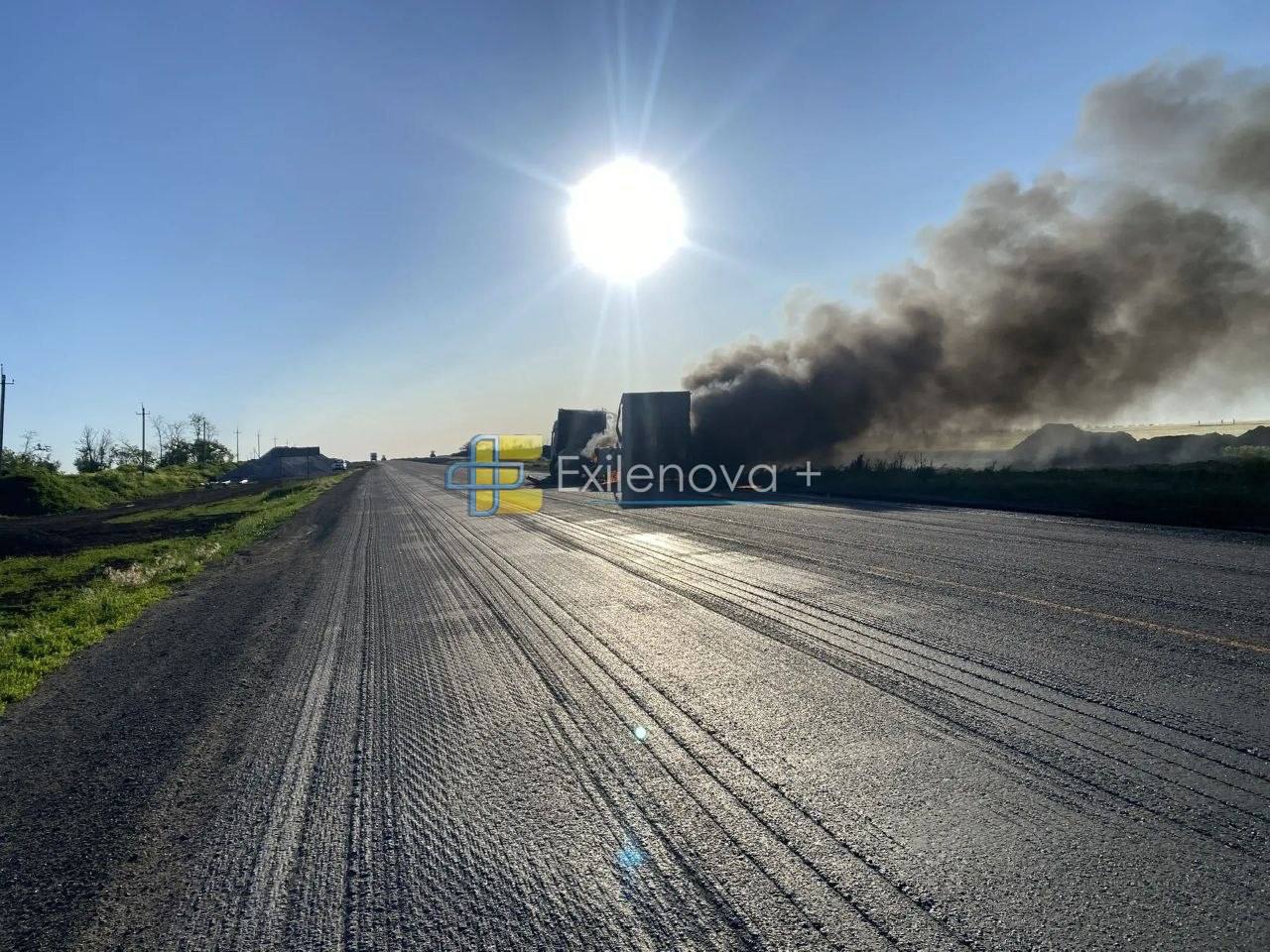
russian radar occupied crimea didn't see ukrainian drones coming became 28th air-defense asset wrecked · post supply trucks burning mariupol-melitopol highway main road russia's land corridor 29 2026 exilenova+ -
Explore further

“Supplying Crimea is turning into a nightmare”: Ukrainian drones hit Russian trucks 770 times in September, and winter will make it worse, analyst says

  •  

“Operation to strike Russian targets deep in swamps continues”: Ukrainian Commander Madiar says his unit hits 7,306 Russian troops in first half of October, up 59% on August

A Ukrainian drone operator.

Ukraine’s operation to strike Russian targets at operational and strategic depth is continuing, Unmanned Systems Forces Commander Robert “Madiar” Brovdi said. He listed data centers, military and strategic sites, and energy hubs “deep in the swamps,” his usual name for Russia.

The fresh statement lands amid fears that a Starlink disruption could break front-line operations.

Overnight into 14 October, the 7th Air Assault Corps said the faster StarShield military package, an advanced version of Starlink that its units depend on, had been throttled, halting a series of missions. Against that backdrop, Brovdi says his branch’s strikes are not falling.

“A serious brawl is underway in conditions of significantly worse weather, drizzle, fog, and precipitation,” Brovdi says, underscoring that the pace held through conditions that usually ground drones.

Over the first two weeks of October, the drone branch verified 7,306 Russian soldiers killed or wounded, up 59.45% on the same period in August and 24.65% in September, he writes on his Telegram page, calling the trend the opposite of de-escalation.

Where the killing climbs fastest, and who is doing it

One sector stands out above the rest. On the Dobropillia-Pokrovsk axis, in the zone of the Azov group, the branch’s drones accounted for 3,221 Russian losses in the first two weeks of October, a 102% jump on August and 42.5 percent on September, Brovdi reports.

The figures cover only the drone branch and are verified in the military’s Delta, the video fixation system, he stresses, so the full count of Russian losses across all Ukrainian forces can be much higher.

The scale of a campaign that will not slow down

The numbers behind the claim are large. Over the first two weeks of October, the branch flew 124,500 combat missions, strike and reconnaissance, and hit 32,172 Russian targets, of which manpower was 22.7%, by his count.

That works out to about 2,298 Russian targets a day, he adds, the kind of tempo that makes any talk of a lull on the front hard to square with what his drones are recording. The deep-strike half of that campaign has grown 1,150% over 2026, reaching military-industrial and energy sites far inside Russia, according to Euromaidan Press.

  •  

Musk pointed at the US military over Ukraine’s satellite limits. Now a US official says the administration had nothing to do with them

The Starlink logo on a smartphone screen.

Ukrainian officials contacted the White House, CIA, and Pentagon after the restrictions, which Ukraine says affected both Starlink and Starshield, Axios reported on 14 October. A senior US official told Axios the Trump administration had nothing to do with the restrictions. On the same day, Elon Musk said on X that Starshield systems are owned and controlled by the US government, and that any speed or usage limits are decided by the US military and ultimately the president.

The restrictions could affect Ukraine’s ability to intercept Russian attack drones and carry out mid-range strikes against Russian forces and military targets in occupied Ukrainian territories. A speed cap of 160 km/h was insufficient to intercept some jet-powered drones, an unnamed Ukrainian official told Axios. Ukrainian officials told Axios they suspect SpaceX imposed the restrictions to pressure Kyiv to accept US President Donald Trump’s demand to stop striking Russian oil refineries, though the motive remains unconfirmed. But Starlink does not work inside Russia, and the drones attacking Russian oil facilities use other communications systems, according to Reuters.

What Musk and the White House said

Musk did not directly address the throttling, Axios noted. Starlink, he wrote, “is a commercial service owned and controlled by SpaceX,” limited to civilian or defensive use.

White House officials told the Ukrainians they don’t have control over SpaceX, two sources told Axios. One said the administration would reach out to SpaceX to figure out what happened. The White House did not immediately respond to Axios’s request for comment.

How the cap disrupted drone missions

Presidential adviser Serhii Beskrestnov said on 14 October that SpaceX had imposed a 160 km/h limit on Starshield’s “military package” overnight without warning. Ukraine’s 7th Rapid Reaction Corps said mid-range strike drones must reach high speed quickly and that an unstable connection “will make it impossible to launch such aircraft or use them as intended.” One unit on the Huliaipole front had to cancel some missions, the corps told Novynarnia.

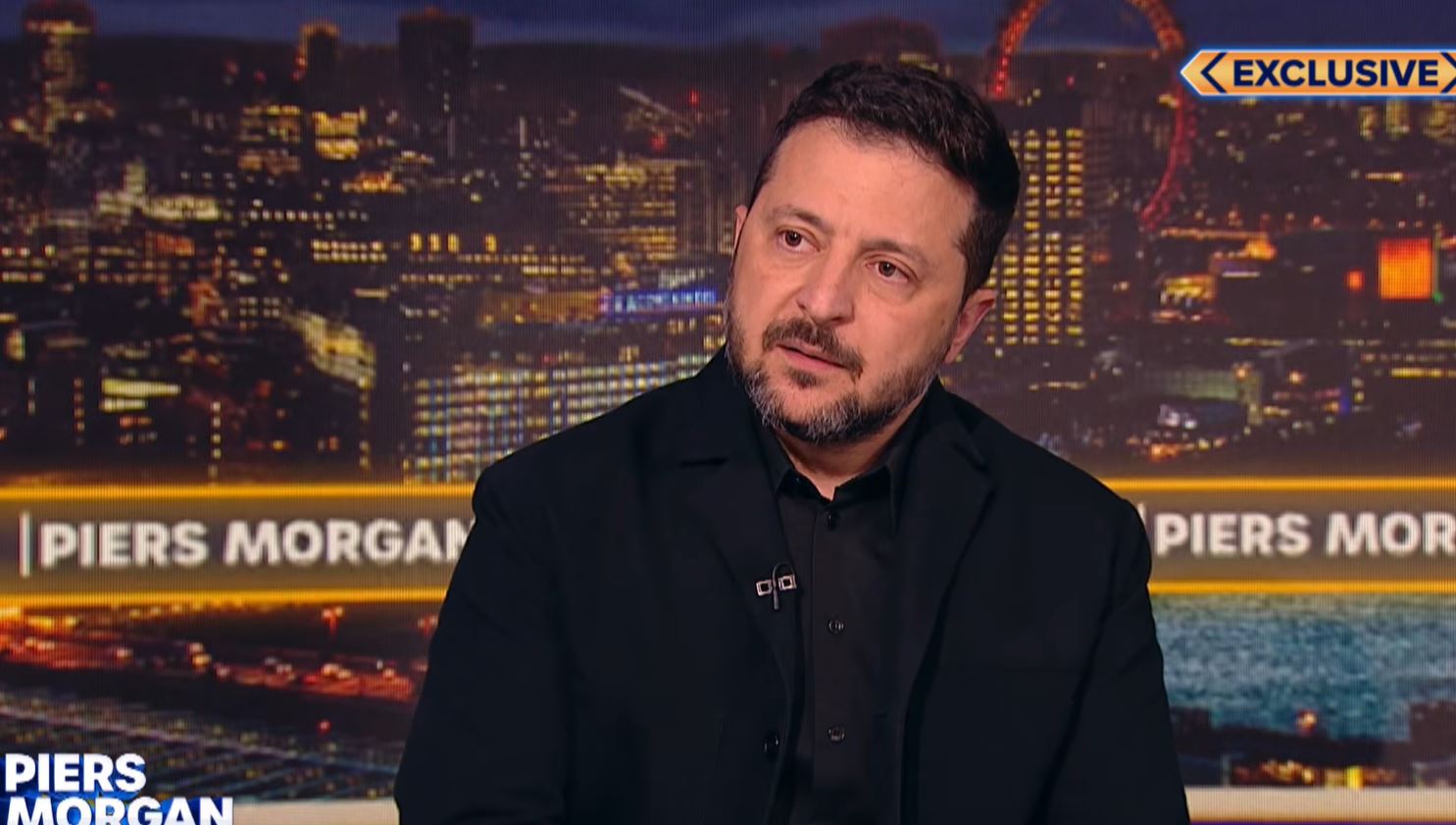
ukraine goes back hitting russian oil after its trump-forced pause left kyiv without warnings incoming ballistic missiles · post ukrainian president volodymyr zelenskyy during interview piers morgan london 14 2026
Explore further

Ukraine is going back to hitting Russian oil after its Trump-pressured pause, during which Kyiv got no US warnings of incoming ballistic missiles

Ukrainian officials told Axios the system turned off when drones exceeded 160 km/h, and sometimes 80 km/h, before service was partially restored on 14 October. The Defense Ministry said SpaceX continues to restrict Starlink to 160 km/h and that it remains in communication “with partners and SpaceX regarding stable service conditions and the prevention of sudden restrictions,” Axios reported.

A diesel deal

The restrictions followed Trump’s 9 October deal with Russian President Vladimir Putin easing sanctions on Russian diesel. A day later, Trump told reporters: “We said you could do whatever you want to Russia, don’t hit the refineries,” the Kyiv Independent reported.

  •  

US weighs relief for sanctioned shadow fleet tankers, days after freeing Russian diesel

Kremlin welcomes Trump National Security Strategy as aligned with Russian vision on Ukraine

The Trump administration is weighing looser sanctions on shadow fleet tankers that have hauled oil from Russia, Iran, and Venezuela, a US official said on 14 October, Reuters reported. An industry research group expects the change to do little for freight rates.

With Reuters calling high fuel prices a risk for Trump before the 3 November midterms, Washington has already eased sanctions on Russian oil and diesel this year and is now looking at the ships blacklisted for hauling sanctioned cargoes. In March, Treasury Secretary Scott Bessent said a waiver on Russian oil at sea would bring Moscow no significant financial benefit, yet Russia’s seaborne oil income jumped by $890 million in the week to 15 March, Bloomberg data showed.

“Legal oil” on blacklisted ships

The talks center on letting “legal oil” sail on previously sanctioned vessels, the official said. Only crude or fuel free of US sanctions would qualify, not Russian or Iranian oil. Washington wants more crude and refined products moving out of the Gulf, the official added. Companies would need US Treasury approval to use the ships.

ukraine goes back hitting russian oil after its trump-forced pause left kyiv without warnings incoming ballistic missiles · post ukrainian president volodymyr zelenskyy during interview piers morgan london 14 2026
Explore further

Ukraine is going back to hitting Russian oil after its Trump-pressured pause, during which Kyiv got no US warnings of incoming ballistic missiles

Research group Energy Aspects said US Energy Secretary Chris Wright, in a video to the World Petroleum Congress in Riyadh, tied the easing to record freight rates. Those rates hit records after the Iran and Ukraine wars drove up inflation and left US crude too costly for Asian refiners, Reuters said. Energy Aspects itself expects the easing to do little for freight rates, since most tankers sanctioned over Russian or Venezuelan links have kept trading for the past three months.

The Energy Department said any relief would do nothing to help Russia ship its oil or refined products. Treasury referred questions to the Energy Department. Yet Reuters noted that both departments could face pressure to let these vessels carry Russian diesel, given Trump’s push to get it onto world markets fast.

Britain is pushing the other way. UK finance minister John Healey urged counterparts at International Monetary Fund meetings in Bangkok on 15 October to keep tough sanctions on Russia, “especially a tighter ban on shipping services” that keep Putin’s shadow fleet operating.

Diesel license criticism and an unconfirmed ceasefire

On 9 October, the US Treasury issued a license clearing Russian-origin diesel trade until 7 April 2027. Ukrainian President Volodymyr Zelenskyy told reporters it was a weak decision unworthy of Ukraine’s partners. Democratic Senators Jeanne Shaheen, Chuck Schumer, and Elizabeth Warren called it a “total betrayal of Ukraine.” Republican Senator Thom Tillis said there is “a legitimate case for saying the president’s not following the law.”

The White House in Washington DC, USA. Illustrative image: Wikimedia Commons.
Explore further

“He thinks Ukraine is a weak link and that it needs to be squeezed into giving in”: diplomat on why Trump pressures Kyiv, not Moscow

Trump then pressed Kyiv to spare Russian refineries and declared an “energy ceasefire” on 11 October. A White House official told Axios it covers only oil refineries. Neither side confirmed a similar announcement Trump made in mid-September, AAP reported.

Kremlin spokesperson Dmitry Peskov told reporters on 13 October that contacts on the ceasefire were continuing and referred further questions to Trump, Russian newspaper Vedomosti reported. He claimed the diesel deal was “a very mutually beneficial item of Russian-American cooperation” that serves the interests of Russia, the US, and world energy markets, Russian newspaper Kommersant reported.

  •  
❌