❌

Reading view

How Iran’s two-week retaliatory strikes exposed cracks in US military architecture in Persian Gulf

By Mohammad Molaei | Press TV | October 18, 2026

The two-week exchange of fire between the United States and Iran, triggered by Washington’s attempt to force open an illegal southern corridor through the Strait of Hormuz, represented the most consequential direct military confrontation between them since the 40-day war.

The Iranian response to the unprovoked and illegal American aggression was not a chaotic escalation but a methodical, layered military campaign that drew on years of doctrinal development, weapons investment, and operational planning.

The efforts of the Islamic Republic’s armed forces, spearheaded by the Islamic Revolution Guards Corps (IRGC) aerospace and naval branches, executed a decisive and swift response.

What unfolded was a layered operation with nine distinct but interlocking lines of effort. Each line reinforced the others. Infrastructure degradation reduced American operational tempo; area denial forced repositioning that compounded the effects of that degradation; extended-range precision strikes demonstrated that repositioning offered no sanctuary; ISR attrition blinded American targeting systems; terrorist suppression closed the land flank, while strikes on utility infrastructure imposed costs on host nations and denied services to American bases.

One can employ the open-source reporting, satellite imagery, and the observable pattern of strikes to examine each dimension of Iran’s military response in detail, and construct a coherent operational picture. It is getting exceedingly clear that the ceasefire period has very likely translated to a window for reconstitution and preparation in Iranian strategic calculus.

The primacy of solid-fuel tactical ballistic missiles

Iran’s decision to anchor its retaliatory campaign in solid-fuel tactical ballistic missiles was not accidental. It reflected a decade-long investment in a specific capability designed precisely for this kind of confrontation. Solid-fuel ballistic missiles offer decisive operational advantages over their liquid-fuel predecessors. They require no fueling time at the launch site, dramatically compressing the window between a launch order and missile departure.

This matters enormously in a sensitive environment where adversary assets, particularly MQ-9 Reaper drones and maritime patrol aircraft, are actively hunting for launch preparations.

A liquid-fuel missile requires a visible, time-consuming fueling sequence that creates a detectable signature. A solid-fuel missile can be transported, erected, and fired in a fraction of that time, often before a targeting solution can be developed and a strike authorized.

These missiles are road-mobile, launched from transporter-erector-launchers (TELs) that can disperse across Iran’s mountainous terrain, making pre-emptive targeting extremely difficult.

Having destroyed much of the air defense systems belonging to the US and its Arab allies using the older, less sophisticated liquid fuel missiles in previous wars, Iran’s strikes this time primarily relied on its tactical solid-fuel ballistic missile inventory, meaning the various variants of the Fateh family.

Simply put, the choice of solid-fuel systems reflected a calculated assessment of the adversary’s weakened interception capacity, an assessment that proved accurate.

The air defense inventory crisis

Perhaps the single most consequential factor shaping the operational environment was the state of US and allied air defense missile inventories.

The United States entered this round of military aggression with critically depleted stocks of its most capable interceptors. The Standard Missile-3 (SM-3) and Standard Missile-6 (SM-6), which arm Aegis-equipped destroyers and cruisers and provide the American Navy’s primary ballistic missile defense capability at sea, have been drawn down through a combination of expenditure in the Red Sea campaign against Yemen, the costly defense of Israel during two previous wars, and the simple reality that production rates have never kept pace with consumption.

The Terminal High Altitude Area Defense (THAAD) system, which provides upper-tier defense against medium and intermediate-range ballistic missiles, is similarly constrained.

The decision not to employ Aegis and THAAD at full capacity was therefore a forced one. The United States simply could not spend its remaining meager inventory of SM-3 and THAAD interceptors against Iranian tactical ballistic missiles, which, while accurate and damaging, are not the only threats to American interests.

Doing so would have left the United States strategically exposed against another serious contingency in East Asia or Europe. The calculus was that American military bases had to absorb more hits to preserve the interceptors.

Moreover, the Patriot system, which bore the brunt of terminal-phase defense in recent weeks across the region, was in no better condition. Years of expenditure across Ukraine, the occupied territories, the Persian Gulf, and the Red Sea mission have drawn PAC-3 and PAC-3 MSE stocks to extremely low levels.

The Pentagon’s response was telling. Rather than accelerating full-capability PAC-3 MSE production, it has chosen to pursue the cheaper, less capable PAC-3ACE Cost Reduction Initiative variant. More revealing still were the recent PAC-2 GEM-T orders, an older interceptor not procured by the US in decades, signaling just how severely stocks had been exhausted.

That the world’s most sophisticated air defense enterprise was compelled to resurrect a 1990s-era design to sustain basic readiness is the starkest indicator of the American munitions crisis that Iranian planners appear to have understood, measured, and exploited with precision.

The situation among Persian Gulf states was equally dire. Saudi Arabia and the UAE had expended substantial portions of their Patriot PAC-3 interceptor stocks during years of Yemeni military missile and drone attacks, and entered the 40-day imposed war with depleted inventories. The situation is even direr in Kuwait and Bahrain, with the Persian Gulf microstates effectively running out of Patriots, being forced to solely rely on American-operated systems.

PAC-3, the most capable variant of the Patriot system against ballistic missiles, has effectively been exhausted in several batteries. PAC-2, the older and less capable variant, is the only available option in certain areas against Iranian missiles, and even that missile is running low as well. The collective air defense architecture of the Persian Gulf states, which had appeared formidable on paper, has been effectively hollowed out.

Iranian operational planners were aware of these facts. The sequencing and volume of Iranian missile salvos during the exchange reflected a deliberate attempt to exploit the gap between what the defense could theoretically intercept and what it could actually intercept given real-world inventory constraints.

Iran’s multi-layered operational strategy

What distinguished Iran’s response from a simple missile barrage was its architectural coherence. Iranian planners did not merely fire missiles at American targets; they executed a phased, multi-domain retaliatory campaign with distinct operational objectives at each stage, each phase creating the conditions for the next.

The campaign can be understood as having five interlocking lines of effort: infrastructure degradation, area denial and operational displacement, precision strike at extended range, ISR and logistics attrition, and proxy terrorist force suppression.

Together, they constituted a campaign design far more sophisticated than most Western analysts had publicly credited Iran with possessing.

The overarching logic was one of progressive operational constriction. Rather than attempting to destroy US forces – an objective beyond Iran’s reach given American conventional superiority – the campaign aimed to degrade, displace, and exhaust them.

Each successful strike reduced American operational capacity; forced repositioning that consumed time and resources, and demonstrated to regional partners that proximity to American occupation forces carried real costs.

Infrastructure degradation

The first phase of the Iranian retaliatory campaign targeted the physical infrastructure of American military power in the Persian Gulf region. This was not indiscriminate bombardment. Satellite imagery and post-strike assessments revealed a pattern of targeting that prioritized specific high-value nodes: radar installations, fuel and ammunition storage facilities, maintenance hangars, and communications infrastructure.

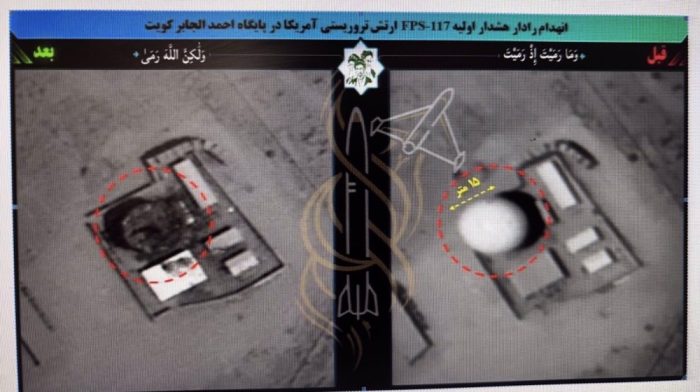
Radar systems were a particular priority. The ability to detect, track, and target Iranian missiles and UAVs depends on a layered network of radar systems. By striking radar installations at air bases, Iran degraded the situational awareness that underpins both offensive operations and defensive intercepts. A radar that is destroyed or forced offline creates a coverage gap that cascades through the entire air defense architecture.

Before-and-after imagery of an AN/FPS-117 early warning radar installation at Ahmad al-Jaber Air Base, Kuwait, showing structural damage

Logistics infrastructure was targeted with equal deliberateness. Fuel depots, ammunition storage sites, and maintenance facilities at American bases around the Persian Gulf were struck with sufficient accuracy to cause meaningful operational disruption.

An air force that cannot fuel its aircraft, rearm them, or repair battle damage cannot sustain sortie rates. The targeting of logistics was a direct attack on the tempo of American air operations to derail the American aggression against Iranian sites and reduce the pressure on Iranian forces.

The accuracy of these strikes, achieved at ranges of several hundred kilometers, validated the operational utility of Iran’s solid-fuel ballistic missile force and demonstrated that the IRGC aerospace force had developed the targeting data, launch procedures, and quality control necessary to achieve consistent results against fixed infrastructure.

The anti-access/area denial campaign

The most strategically significant dimension of the Iranian retaliatory campaign was its systematic execution of an Anti-Access/Area Denial (A2/AD) strategy that progressively pushed American air operations out of the Persian Gulf and into increasingly distant and operationally constrained locations.

The logic of A2/AD in this context was straightforward. The closer American aircraft operate to Iran, the shorter their flight times, the larger their payloads, the less refueling they require, and the more sorties they can generate per day.

Conversely, every additional hundred kilometers of distance imposes compounding costs: greater tanker support, longer mission times, reduced payload, increased crew fatigue, and more complex coordination. By rendering the Persian Gulf operationally untenable for American air assets, Iran systematically degraded the offensive capacity of the aggressors.

The first displacement was from the Persian Gulf itself. Sustained missile and drone attacks against air bases made sustained operations from those locations unfeasible. The American response was to shift primary air operations to bases in Jordan – Al-Azraq and Muwaffaq Salti –which offered greater distance from Iranian missile systems.

Iran’s response was to extend its reach to Jordan. Multiple strikes against American bases, documented by US casualties and satellite imagery showing damaged hangars and destroyed aircraft, demonstrated that Iran had the capability to contest operations from that distance.

The retaliatory strikes destroyed American aircraft, damaged infrastructure, and forced the US war machine to reconsider the viability of Jordan as a primary operating location.

The second displacement was to the occupied territories. American air assets, including tanker aircraft critical to sustaining long-range strike operations, were pushed further west to Israeli military bases.

This displacement carried its own operational costs. The distance from Iranian targets increased further, and the concentration of American assets in the occupied territories created its own targeting opportunities for Iran, which has demonstrated both the willingness and capability to strike at extended ranges.

A particularly telling indicator of this displacement dynamic was the repositioning of the RQ-4 Global Hawk strategic reconnaissance aircraft, which had been operating from Al Dhafra in the UAE and from Jordanian facilities, to Sigonella Naval Air Station in Sicily.

The Global Hawk, with its long endurance and high-altitude sensors, is a critical ISR asset for tracking Iranian missile launches and providing targeting data. Its displacement to Sicily represented a dramatic reduction in persistent surveillance coverage over Iran and the Persian Gulf, with direct consequences for the effectiveness of American strike operations.

A qualitative leap in extended-range precision

One of the most significant revelations of the recent round of US aggression and Iran’s retaliation was the demonstrated accuracy of Iranian ballistic missiles at ranges exceeding 1,000 kilometers. Previous assessments of Iranian ballistic missile accuracy had generally been skeptical about the ability to achieve consistent precision at such distances. The strikes on Jordanian targets, located well over 1,000 kilometers from Iranian launch sites, completely shattered that skepticism.

The circular error probable (CEP) – the radius within which 50 percent of strikes fall – observed in the Jordanian strikes was dramatically smaller than what Iranian missiles had previously demonstrated at comparable ranges. Strikes that hit specific buildings, specific aircraft shelters, and specific sections of structures, rather than simply landing somewhere on a base, indicated a qualitative improvement in guidance accuracy that demands explanation.

Several hypotheses present themselves, and the evidence suggests that the answer likely involves a combination of all of them. First are technical improvements. Iran may have upgraded the terminal guidance systems on its Kheibarshekan, Haj Qasem, and Fattah variants, potentially incorporating improved inertial navigation, satnav receivers, or optical terminal seekers that allow the missile to better correct its trajectory in the final phase of flight.

Second are tactical improvements. Iranian launch crews may have refined their pre-launch survey procedures, improving the accuracy of the initial position fix that the missile’s inertial navigation system uses as its reference point. Third are software improvements, which mean updates to the missile’s flight control algorithms could improve trajectory optimization and reduce the accumulated errors that degrade accuracy over long distances.

The most likely explanation is a combination of all three – a systematic program of improvement across the technical, procedural, and software dimensions of missile accuracy that had been underway for years and was now being demonstrated operationally for the first time at this range, following the experiences of the 40-day war.

The MQ-9 hunt

The MQ-9 Reaper drone occupied a central and uniquely vulnerable position in American military offensives against Iran. The Reaper is not merely a strike platform but the primary persistent ISR asset used to locate and track mobile Iranian missile launchers, particularly after the heavy attrition of similar Israeli military systems.

Without the MQ-9’s ability to loiter for extended periods, the capacity to find and destroy TELs before they fire, or to conduct battle damage assessment after strikes, is dramatically reduced.

Iran understood this dependency and targeted it systematically during this campaign. The campaign against MQ-9 assets operated on multiple levels. Ground-based air defense systems, which had previously demonstrated the ability to engage high-altitude targets, were used to engage Reapers operating over Iranian territory and adjacent areas.

But Iran also struck the ground infrastructure that supports MQ-9 operations: the maintenance facilities, fuel systems, satellite communication ground stations, and launch-and-recovery equipment that allow the aircraft to operate.

Western media reporting confirmed the destruction of a number of MQ-9 aircraft on the ground at Jordanian bases and, in a particularly striking detail, the destruction of some aircraft while still in their transport canisters before assembly.

This achievement indicates that Iran has developed targeting intelligence on the logistics chain supporting drone operations, not merely the operational bases themselves. Destroying aircraft before they are assembled and made operational is a force multiplication achievement. It eliminates capability before it can be employed, at a point when the aircraft is most vulnerable and least defended.

The cumulative effect of the MQ-9 campaign was a significant degradation of American persistent ISR coverage over Iran. This directly reduced the effectiveness of the hunt for mobile missile launchers, allowing Iranian TELs greater freedom of movement and survivability.

Suppressing proxy terrorist forces in Iraq

From the first day of the exchange, Iran conducted daily retaliatory strikes against armed terrorist groups in Iraq that had the capability and potential motivation to conduct land attacks against Iranian territory or to serve as a forward platform for American-directed operations.

This campaign was methodical and comprehensive, targeting personnel concentrations, weapons storage facilities, and command infrastructure.

Iran’s western flank, which includes the border with Iraq, represents a potential vulnerability. Armed terrorist groups in Iraq, some with historical ties to American intelligence, could in theory conduct cross-border raids, provide intelligence for American strikes, or serve as a distraction that forced Iran to divert defensive resources.

By striking these groups preemptively and continuously, Iran sought to exhaust their operational capacity before it could be brought to bear.

The daily rhythm of these retaliatory strikes was itself a message. It demonstrated that Iran had persistent targeting intelligence on these groups’ locations, that it was willing to expend munitions on this secondary campaign even while conducting the primary campaign against American forces, and that it intended to maintain pressure regardless of any ceasefire negotiations that might be underway.

The logic of reciprocity

Iran’s retaliatory strikes on electrical and water infrastructure in Kuwait represented a deliberate response that operated on two distinct logics simultaneously.

The first was reciprocity: Iran’s own civilian infrastructure had been targeted, and the strikes on Kuwaiti infrastructure were a direct signal that such targeting would not be absorbed without response to the aggressor and its facilitators.

The second was military utility. American forces in the Persian Gulf region depend on host nations’ electrical grids and water supplies for base operations. Infrastructure that serves both civilian and military purposes is, under the laws of armed conflict, a legitimate military target when the military use is substantial and the strike is proportionate.

The targeting of Kuwait’s infrastructure was also a message to Persian Gulf states more broadly. Kuwait, like Bahrain, the UAE, Saudi Arabia, and Qatar, hosts American military facilities and had provided varying degrees of support to American operations.

By demonstrating the ability and willingness to strike Kuwaiti infrastructure, Iran was communicating that the costs of hosting American forces were not abstract. They were concrete, immediate, and would be borne by the host nation as well as the American military.

The pillars of operational success

Iran’s two-week retaliatory campaign against American aggression and attempts to force open an illegal southern corridor through the Strait of Hormuz largely succeeded on every dimension that its operational planners had identified.

The exchange demonstrated that Iran had developed, over decades of institutional study and investment, a military capability genuinely capable of contesting American power projection in the Persian Gulf region, even after two high-intensity wars.

It demonstrated something relevant to the strategic environment of the region – that the costs of American military aggression in the Persian Gulf had increased substantially; that the infrastructure of American power projection was more vulnerable than pre-war assessments had suggested; and that Iran possessed both the capability and the operational sophistication to exploit those vulnerabilities in a systematic and disciplined manner.

  •  

The mother of all propaganda: Why the hype over US MOAB strike against Iran is nothing but theater

By Arman Shariati | Press TV | October 18, 2026

American media this week began circulating a carefully placed story, claiming that the US military has drafted strike options against Iran that include deployment of the GBU-43/B Massive Ordnance Air Blast Bomb, the weapon branded as the “Mother of All Bombs.”

CNN was the first to report it on October 15, followed immediately by a wave of amplification across the mainstream American and European media.

US President Donald Trump, appearing later on Newsmax in an interview, did not deny the story. He offered instead a characteristically garbled endorsement, describing the MOAB as “like a tiny nuclear bomb, but it’s not nuclear,” and adding that the US may have to “take a shot” at Pickaxe Mountain in Iran’s Karkas mountain range.

The narrative was set, and it deserves to be taken apart with facts.

The GBU-43/B is an enormous munition by conventional standards. It carries approximately 8,500 kilograms of high explosive in a casing that brings its total weight to around 9,800 kilograms, just under 10 tons. Stretched end to end, it measures just over nine meters.

It is GPS-guided and essentially designed to detonate above the ground.

The MOAB is a thermobaric, or fuel-air, weapon. This description explains precisely why the weapon is irrelevant to the current discussion. A thermobaric weapon does not carry all of its oxidizer within its casing the way a conventional explosive does.

Instead, on detonation, it disperses a fine aerosol of fuel particles or reactive material into the surrounding atmosphere. A secondary ignition then detonates this cloud together with the ambient oxygen in the air itself, producing a pressure wave of exceptional duration and reach.

The fireball essentially consumes the atmosphere around it. The result is a weapon optimized for destroying things on or just above the surface, such as personnel in the open, light structures, and cave mouths, across a wide area. What the MOAB does not and cannot do is drive energy downward through hundreds of meters of solid rock.

Trump’s description, “like a tiny nuclear bomb,” is not merely imprecise. It is exactly the kind of rhetorical inflation that makes the current hostile military campaign against the Islamic Republic of Iran intelligible as communication strategy rather than military planning.

The MOAB has been used in combat once. On April 13, 2017, during Trump’s first term, a single GBU-43/B was dropped on a tunnel complex in Nangarhar province in eastern Afghanistan, claiming to target the ISIS (Daesh) Khorasan infrastructure.

The US administration at the time announced that the strike had killed approximately 90 ISIS-K militants. The actual battle damage assessment remained classified. What was confirmed is that a very large explosion occurred in a mountainous area of eastern Afghanistan.

The strategic effect on ISIS-K’s operational capacity in the region was, at best, ambiguous. The organization has continued to carry out attacks in the months and years that followed. That one strike, against an unprotected tunnel network in soft ground, in an area with no air defense, delivered by a slow cargo aircraft operating in uncontested airspace, is the entire operational history of this weapon.

The target reportedly under consideration is Kuh-e Kolang Gaz La, internationally known as the Pickaxe Mountain, in the Karkas range of central Iran. The facility buried beneath it reportedly sits under more than 100 meters of hard granite.

To suggest that an air-burst weapon, however large, could threaten such a target is to misunderstand the physics of the problem at the most elementary level.

The United States possesses a weapon actually designed for this task, namely the GBU-57/B Massive Ordnance Penetrator; a 13,600-kilogram bomb built specifically to drive through reinforced concrete and hardened rock before detonating.

The MOP was used against Iranian nuclear sites on June 22, 2025, during the 12-day imposed war. Its effectiveness against the deepest and most hardened of those facilities, particularly the Fordow Fuel Enrichment Plant, remains a matter of genuine debate.

If the weapon engineered for penetration cannot be confirmed to have neutralized Fordow, a target much less protected than Pickaxe Mountain, then the notion that an air-burst weapon detonating above the mountain surface would accomplish anything beyond scorching rock is not a serious military proposition.

Even setting aside hardened underground targets, the MOAB offers no material advantage against any conventional surface target that cannot be achieved more efficiently and with far less operational risk by using multiple precision-guided JDAMs delivered from fighter aircraft operating at standoff ranges.

The MOAB does not expand the target set. It does not add capability. It adds spectacle.

There is a further operational reality that receives almost no attention in the current American media narrative. The GBU-43/B is confirmed to be deliverable only by the C-130 family of cargo aircraft. Flying such a platform into contested Iranian airspace is not a minor planning consideration and introduces significant operational difficulties.

The United States lost two MC-130J Commando IIs during its wars of aggression against Iran. The idea of routing another slow cargo aircraft into that same environment in order to drop a weapon that cannot reach the target it is supposedly meant to destroy compounds the absurdity.

What the current MOAB narrative resembles most closely is not a serious military planning process. It resembles the late-war German doctrine of the Wunderwaffe, the wonder weapon.

Under mounting pressure, facing an unwinnable strategic position, Nazi Germany’s leadership turned to announcements of extraordinary new weapons that would change the course of the war. The V-1 and V-2 generated genuine fear and caused real casualties.

They did not alter the strategic outcome by a single day. The function of the wonder weapon is not primarily military. It is political. It tells a domestic audience and a wavering alliance that there are still options, that new instruments of power remain available, that the situation is not as bad as it looks.When strategy fails, spectacle fills the gap.

The Trump administration is conducting a war that did not emerge from American strategic interests. It entered the war of aggression to further Israeli goals and expansionist ambitions, has absorbed significant losses and embarrassments, and now approaches midterm elections with a public that has not been offered a clear account of what victory looks like.

In that very context, the MOAB story makes complete sense as an information management campaign, to paint a picture of a strong American military, when the truth is something else.

There is one more thing worth stating plainly. Even if the MOAB is used, even if a C-130 penetrates Iranian airspace, releases the weapon over Pickaxe Mountain, and produces the largest conventional explosion seen in the region, Iran will be compelled to respond.

Not because the strike will have damaged anything of military significance. A major attack that fails to achieve its stated objective does not end a war. It resets the escalation clock. Tehran’s hand will be forced, and it will answer with something commensurate in visibility, and Iran has demonstrated repeatedly that it possesses the means and the will to do exactly that.

The MOAB is a very large bomb, but it is particularly good at the thing it is now being asked to symbolize. What it is, in the current context, is a prop, useful for an interview, useful for a news campaign, and essentially useless for anything happening 100 meters below the surface of a granite mountain in central Iran.


Arman Shariati is a Tehran-based military analyst and researcher.

  •  

Iran says it possesses technology behind US 14-ton GBU bunker-buster

Al Mayadeen | October 18, 2026

Iran has obtained the technology behind a US-made 14-ton GBU bomb and now possesses samples of the weapon, Brigadier General Mohammad Reza Naqdi, senior advisor to the Commander-in-Chief of the Islamic Revolution Guard Corps (IRGC), stated.

Speaking during the “Fedayeen for Iran” military exercise in Sari, Naqdi said Iranian forces acquired some of the bombs after they failed to detonate during the 12-day war, allowing local forces to seize them and study their technology.

“We should recall that during the 12-day war, 14-ton bombs were dropped,” Naqdi said, adding that “the failure of some of the 14-ton bombs to explode enabled the local forces to seize them.”

“Today, Iran possesses samples of these bombs alongside the manufacturing country,” he asserted, adding that Iranian forces have analyzed all the technologies associated with the US 14-ton bomb and now possess its technology in full.

What is the GBU?

The weapon Naqdi referred to is a GBU, or Guided Bomb Unit, a designation used by the US military for a broad family of air-dropped precision-guided bombs.

GBUs use guidance systems to direct their warheads toward designated targets, with different variants ranging from conventional precision bombs to much heavier bunker-busting weapons.

The term “14-ton bomb” is generally associated with the US GBU-57 Massive Ordnance Penetrator, a deep-penetration weapon designed to strike heavily fortified underground facilities, such as Iran’s nuclear facilities bombed during the 12-day war.

The GBU-57 is one of the largest conventional bombs in the US arsenal and is designed to penetrate deeply buried and hardened targets before detonating. Its deployment requires specialized heavy aircraft.

Iran has heavy fighter jet at hand

Earlier, Iranian Defense Minister Mehrdad Akhlaghi announced Sunday that a heavy Iranian fighter jet will take its first flight next year.

Naqdi also warned that Iran’s response to any renewed US aggression would extend to infrastructure and energy investments belonging to those involved in attacks against Iran in the region.

“In the event of any mistake, the investments related to the infrastructure and energy of the aggressors in the region will be within the operational targeting circle,” he said.

Responding to US threats involving the use of weapons such as the “Mother of All Bombs,” Naqdi said Iran’s Armed Forces have demonstrated advanced missile and deterrence capabilities capable of delivering a decisive response to any aggression.

Iran advances domestic defense production

The emphasis on domestic defense production forms part of Iran’s broader strategy of military self-reliance.

Iranian officials have repeatedly linked the development of indigenous defense capabilities to the need to maintain national security and deterrence without relying on foreign suppliers.

The focus on precision, missile range, and warhead development also reflects the importance Iranian military planners place on technological advancement as a component of deterrence.

  •  

The conceit of total dominance

By Bill ASTORE

A strange conceit of American exceptionalism is the naked ambition of full-spectrum dominance. The idea is this: America must dominate every realm of potential conflict, land-sea-air as well as space and cyber and any other realm you can imagine, for that is the only way Americans can truly be “safe.” Such a conceit comes with a hefty price tag as Pentagon spending soars toward $1.5 trillion a year. But money is the least of it. The heftiest price tag is the constant state of warfare (and preparations for yet more war) that has characterized U.S. foreign policy since 1945.

That, and the erosion of personal liberty and freedom and the hollowing out of the American middle- and working classes as money flows upward to war contractors in the service of boundless imperial ambition.

There’s a god-like quality to this ambition, the idea America must be omnipotent, dominating all realms of warfare, and omniscient, sweeping up all data everywhere, in an unapologetic quest for global reach and global power together with the unapologetic exercise of that murderous power against peoples generally having brown or black skin and therefore treated as inferiors.

With only slight exaggeration, the U.S. government can be said to be projecting power everywhere and helping ordinary Americans nowhere. Destruction is favored over construction. Enriching the already rich is the goal even as the impoverished are made poorer.

The U.S. taxpayer, in the old days known as citizens, are paying through the nose for unneeded weapons systems (Sentinel ICBMs, B-21 nuclear bombers, Golden Dome), unwanted wars (Vietnam, Afghanistan, Iraq, Iran), and an imperial structure of force projection that virtually guarantees the violence will be unending. This imperial structure, with its goal to control all, to know all, to dominate all, is supported by Democrats and Republicans. Critics of this structure, present in both parties but in small numbers, are attacked and otherwise kept on the margins.

None of this is new. In the early 1960s, Senator George McGovern, a decorated bomber pilot during World War II, argued against the pursuit of nuclear “overkill” and called for substantial cuts to defense spending and reinvestment in civilian infrastructure. In support of this initiative, he cited Republican President Dwight D. Eisenhower’s military-industrial complex warning of January 1961. McGovern’s initiative was quickly abandoned as the Johnson administration ramped up its disastrous war in Southeast Asia.

Nearly a decade later, with Southeast Asia ravaged if not defeated, McGovern urged his fellow citizens to “come home,” to stop the folly of overseas wars and ever-increasing military budgets. He was overwhelmingly defeated by Richard Nixon in the 1972 Presidential election.

Ever since that defeat, the Democratic Party has conspired to silence candidates who are antiwar and who dissent from the idea of imperial dominance. Dennis Kucinich comes to mind here. Even moderate calls for reform from candidates like Bernie Sanders are dismissed as naive or dangerous. The result has been Democrats like Obama, Biden, Hillary Clinton, and Harris who openly embrace “good” wars (Afghanistan, for Obama) and who eagerly celebrate military lethality (Harris).

Meanwhile, the Republican Party never met a military budget increase it didn’t like. Rare indeed are voices like Ron and Rand Paul and Thomas Massie who question the wisdom of endless wars and their adverse impact on rights and freedoms here.

What is to be done? Bernie Sanders called for a political revolution, surely a correct call, but he was neutered by the establishment of both parties. Elizabeth Warren spoke of “big, structural changes,” but that was for the domestic economy; her foreign policy was basically that of Biden/Harris. A few rogue Republicans speak up against the Iran war today, but rare indeed are those who openly call for major cuts to war spending.

In short, electing our way out of imperial dominance and colossal war and weapons spending is unlikely in the extreme. Many many people (myself included) have written sensible articles calling for deep cuts to military spending, but good ideas that go against the grain gain little traction without a strong and concerted movement behind them.

America desperately needs a coordinated mass movement against endless war and massive military spending, yet the “powers that be” keep doubling down on yet more wars and even more massive war spending. That same establishment continues to multiply U.S. “enemies.” It may be Iran today, but Russia and especially China always loom, with North Korea and other “rogue” states held in reserve just in case.

The sheer folly and massive expense of it all will likely lead to the end of the (however imperfectly practiced) American democratic experiment. That’s a grim conclusion, I know, but I’m less than hopeful as the tools America has used in its unjust wars overseas are now increasingly applied in the “homeland” against alleged dissenters.

Remember when “dissenters” used to be called concerned citizens? Remember when war was considered to be bad and weapons spending was seen as the unwisest of ways to spend our resources?

America doesn’t have to be a warrior-state or in a state of constant war. A “silent majority” of Americans clearly doesn’t want endless war and outspokenly wants better lives for their children. But better days will not come if this majority remains silent or otherwise demobilized.

The Main Obstacle

As Ike said in 1961, the main obstacle is the military-industrial complex (MIC), to which he added Congress as an abetter and accomplice. That complex in 65 years has greatly added to its power and cultural penetration. The term MICIMATT adds the intelligence “community,” the media, academe, and think tanks. To that we might add the sporting world, Hollywood, video games, and now wildcard tech billionaires. All these interests conspire to absorb trillions of dollars from U.S. taxpayers, ostensibly in the name of national security, while waging or supporting endless war.

Ike said only alert and knowledgeable citizens, actively participating in democracy, could compel the MIC to curb its worst and most grandiose ambitions. Sadly, this is precisely why the American people are constantly lied to, especially about wars, why so much is kept hidden or “classified,” and why people are encouraged to salute smartly and let the military experts handle everything.

Even worse, the very idea of active citizenship is now degraded; the only “duty” apparently left is voting, where you’re encouraged to vote Democrat or Republican and otherwise to reject any third-party candidate who may be antiwar as irrelevant if not invalid (and possibly un-American).

Our ultimate security doesn’t reside in guns or other weapons or in boundless violence. It resides in strong institutions committed to the rule of law in which individuals of character stand up and speak out against abuses of power. Come home, America, to a land of generosity and hope and peace.

Be an alert and knowledgeable citizen. And act.

Original article:  bracingviews.com

  •  

It’s been 70 years: Why does the U.S. still control South Korea’s military?

By K. J. NOH, POPULAR RESISTANCE

Join us on Telegram, X, and VK.

Contact us: info@strategic-culture.su

Over seventy years ago, the US took control of South Korea’s military. To this day, it still controls it.

Why?

This confounds every notion of state sovereignty: a supposedly sovereign country — South Korea — has its own military subjugated under US control.

Opcon (operational control) of one nation’s army by another country is usually temporary, usually during wartime among allies.

In Korea, it has lasted over 76 years.

South Korea has asked for opcon back, repeatedly. It has been three decades since South Korea first made the demand.

The US has always delayed, filibustered, waffled, and moved goal posts.

More recently, the US has signaled more delay on the return of opcon, despite current president Lee Jae Myung’s demand that it be transferred back before the end of his term in 2030.

The allies are currently assessing the “full operational capability” (FOC) after validating the “initial operational capability” (IOC).

Seoul aims to wrap up the FOC certification and announce a target year for the Opcon transition at the upcoming SCM, before moving on to the remaining assessment of the “full mission capability,” which it expects to take about a year or so….[However] Washington remains firm in its position that Seoul is not ready for FOC certification, weighing on Seoul’s push to accelerate the Opcon transition.

This follows on US Forces Korea Commander Xavier Brunson’s repeated declarations of his opposition to Opcon transfer: only conditions matter, not timelines. According to Brunson, there can be no timeline to return control of South Korea’s troops to South Korea. Seventy six years is not enough.

South Korea had originally insisted on deadlines for the return of opcon. The US delayed, and delayed, and denied. It finally agreed–but only if certain conditions were met. These were agreed to in 2014, and reaffirmed them in 2017. Yet another decade has passed since those agreements.

Conditions for the return of opcon:

Cutting through the fog, there are essentially three conditions that the US has predicated as preconditions for South Korea to regain control over its own troops:

1. Can South Korea defend itself? (Can it operate its own military effectively? Does it have capacity, materiel, systems, and institutions?)

2. Are US and South Korea forces interoperable? (Can they coordinate in war?)

3. Are the conditions stable enough for opcon transfer?

The answer to the first is, of course. South Korea has one of the most powerful and well-equipped militaries in the world.

The second is, of course, the US and South Korea have been rehearsing interoperability for over seventy years.

The third is key: it is a catch-22 designed to undermine the entire process.

Conditions-based Opcon Transfer (COPT) sets specific benchmarks and tests for opcon transfer. These are the goalposts that are being constantly shifted.

However, the third condition is critical. It requires the de-escalation of tensions between North and South:

“Conducive Security Environment: The security environment on the Korean Peninsula and in the broader region must be stable and conducive to a safe, uninterrupted transfer.”

This is the catch-22:

If there is de-escalation of tensions, the required “tests” are not conducted and the benchmarks and certifications are not achieved — they are tied to field-condition wargames. Doing these wargames and tests escalates tensions with North Korea.

If there are tensions, then condition 3 is not met, and Opcon cannot be transferred.

It’s a formula for ensuring opcon is never transferred.

The simple fact is, it does not take 20+years to transfer opcon. “Wartime” opcon is transferred very rapidly. Armies coalesce, and opcon is transferred. Syngman Rhee turned over opcon in July of 1950 and the US was immediately in charge. It doesn’t take years and decades to transfer opcon. It takes hours or days. Returning it should be even faster. But that would require political will.

Here are some other important things to understand about opcon:

Opcon transfer conditions are actually classified:

The US keeps these conditions under wraps, and therefore the South Korean public or its representatives cannot challenge them publicly because they are not known. We only know the general outlines. The South Korean side can only hope the US will agree they have been met. This is yet another abrogation of sovereignty and democracy in addition to the original breach: “We will keep your military, unless you meet our secret conditions, which you cannot discuss, debate or challenge, because they are secret”.

Condition 3, “Conducive security environment” has always been a kill switch:

We know that security conditions have always been a tacit condition because, in the past, whenever opcon transfer looked justified and imminent, the security environment would suddenly degrade, scuttling the whole project. For example, just as the deadline for Roh Moo Hyun-negotiated Opcon transfer was approaching in 2012, the sudden sinking of the ROKS military ship Cheonan-Ho derailed wartime opcon transfer to 2015. That deadline has also passed and gone. Recent North-Korea attributed mine explosions near the DMZ fit this pattern, as have other numerous, suspicious incidents.

The concoction of “peacetime opcon” is nonsense:

The US claims it only has “wartime” opcon because it transferred “peacetime” opcon to South Korea in 1994. However, this very concept is nonsense:

1) Opcon means control of operations. Operations mean warfighting. “Wartime opcon”, ie. “wartime warfighting control” is a pleonasm. The only time operational control of a military is important is during fighting, just as the only time steering a car matters is when it’s moving.

The invention and transfer of “peacetime” opcon to Korea was a booby prize created to give the appearance that something had changed. Think of those Fisher-Price toy steering wheels you stick on the dashboard while someone else steers the car–it’s a political toy. It gives the illusion of control but it means nothing. The fact is, the US would never allow its military to be subjugated to a foreign command, even a shared command. The simple fact is, the US never shares control.

2) Immediately after “peacetime” opcon transfer in 1994, the US instituted CODA (Combined Delegated Authority), which continues US control of planning and execution of war. As Clint Work observes correctly, “The ROK JCS was granted the term OPCON for political purposes, and the US CFC was given the term CODA for accomplishing missions”. So much for peacetime “control”.

3) Last but not least, the US gets to unilaterally decide what constitutes peacetime and what constitutes wartime. When the US declares Defcon III, it’s wartime. Korean troops must fall in line under US opcon. If you get to slice the cake and then decide which portion you take, it’s your bloody cake. If you share a car, but only one party decides when it gets to be driven, and they drive, they own the car, you are maintenance. If one party unilaterally decides when it gets control, it has control, regardless of any protestations to the contrary.

But why does the US need to keep Opcon?

The US needs control over ROK troops because it is planning for war with China in the Pacific. It has been doing so since it drew up formal plans, AirSea Battle in 2009. For war, it needs SK as a military proxy: it needs the cannon fodder. South Korea has 3.6 million combat-ready troops: 500,000 regular and 3.1 million reserve. It has one of the most powerful and advanced militaries in the world, as well as the defense industrial base to sustain it. Furthermore, SK troops have always fought in US wars as proxies: more military-aged men in South Korea saw combat in Vietnam than Americans did as a proportion of population — 325,000 were deployed–the largest foreign deployment after the US. It was also the third largest deployment to Iraq. The US can avoid a draft because SK has one.

USFK Commander Xavier Brunson has made this US agenda of weaponizing South Korea for war against China explicit, comparing South Korea to “fixed aircraft carrier”, a dagger pointed at China, and a critical part of US war strategy because it is already inside China’s defense perimeter.

As the Hankyoreh Newspaper points out:

When his “dagger” comment is tied to his previous remarks, it’s evident that Brunson expects Korea to play an offensive role capable of striking the Chinese heartland, and Japan to play a defensive role supporting Korea…Brunson commented last August that he would like F-35 fighters with stealth capabilities and a multi-domain task force (MDTF) capable of wrecking China’s anti-access/area denial (A2/AD) network to be assigned to USFK. These comments suggest that Brunson means to treat Korea as a forward base equipped with military options for launching direct strikes against China.

Brunson recently announced that the multi-domain task force will be deployed to Korea.  These build on his previous statements on preparing the peninsula for war with China:

…[this] orientation clarifies how forces on the peninsula can impose costs, not only on the CCP’s Northern Theater Army, but also on the [Russian] Northern Fleet, thus demonstrating the significant strategic potential that exists on the peninsula to influence adversary operations in both adjacent seas… existing force positioning, particularly on the Korean Peninsula, may offer greater strategic advantages… advantageously positioned assets already inside the [Chinese] defensive perimeter, capable of immediate cost-imposition [ie. attack] against multiple adversaries.

This simultaneous fiction of pretending it doesn’t control South Korea’s troops became necessary when US-opconned SK troops massacred civilians in Gwangju.  The need to avoid accountability created the legal fiction of “peacetime opcon”, but that doesn’t obviate the US need for control as it prepares for and escalates to war.

The real reason why opcon transfer is taking so long is the US is trying to create a structure that maintains control of the SK army while pretending that it doesn’t.   This involves a crazy-quilt of parallel & unified command structures, multiplying command authorities, phased operating assessments, Frankenstein-cobbled-leadership structure, Rube Goldberg carve-outs, and a general have-your-cake-and-eat-it-too mindset.  This is assisted by extreme factions of the quisling South Korea right, who have lashed themselves to the sinking US Empire and see any reclamation of genuine South Korean sovereignty as abandonment–they fear that a South Korean military–the real nexus of power in Korean politics, accountable only to Koreans, would result in a loss of status and power as US quisling collaborators and subcontractors.

With war with China on the horizon, South Korea needs to reclaim opcon rapidly.  It remains to be seen if president Lee Jae Myung can pull off this hat trick.  However, the consequences of not doing so could be catastrophic.

Original article:  popularresistance.org

  •  

John Mearsheimer Talking Iran with Iran

IRINN | October 11, 2026

“We have lost the war with Iran.” Donald Trump admitted this by signing the Islamabad MoU.

Don't skip this episode of @Bevaqteiran with @SarbazRezvi, featuring American political scientist @MearsheimerJ, as he discusses America’s military failures, the dangers of Washington’s… pic.twitter.com/eJPQ6CchWK

— Iran Talks (@theirantalks) October 11, 2026

  •  

Hundreds of US soldiers being deployed to Latin America, according to NYT

The New York Times reported on Wednesday that the US government is preparing to send troops to Latin America under the pretext of combating drug trafficking in the region.

According to the US publication, 600 troops from the 10th Mountain Division at Fort Drum, NY, have already begun deploying to the jungles of Panama to conduct exercises alongside the local military.

In addition, it was reported that members of this detachment will participate in operations in other countries in the future: “The troops will eventually train with local forces in Colombia and Honduras, and could also support US Special Operations troops advising militaries conducting raids against accused drug traffickers, the officials said.”

The peoples of the region, alongside anti-imperialist and progressive forces, have long denounced decades of US military intervention in Latin America and the Caribbean. Various experts and analysts have shown that “war on drugs” projects have never led to the elimination of these illicit businesses. On the contrary, US military involvement has coincided with an increase in violence, drug production, but most importantly: neoliberal reforms. These reforms involve the dismantling and reduction of the state, the privatization of all possible dimensions of social life, and the destruction of social organizations that oppose neoliberalism.

Read more: What else is behind the “fight” against drug trafficking in Latin America?

Historically, this process of material dispossession has been facilitated by an expansion of US military presence, under the pretext of the “war on drugs.”

The report stated: “The deployments and growing headquarters, which have not been previously reported, along with the Pentagon’s recent movement of several MQ-9 Reaper drones from Africa to Colombia and Ecuador, mark the latest widening of the Defense Department’s fight against drug traffickers in the region.”

Shield of the Americas

For several months now, US forces have been participating in intelligence activities and supporting military operations in Ecuador, whose government has entered into agreements with the US to allegedly fight organized crime. However, it was later revealed that these operations didn’t target drug traffickers at all. In at least one instance, The New York Times reported that the US and Ecuador bombed a dairy farm.

This collaboration is part of the new military and geopolitical strategy led by the Trump administration, embodied in the agreement known as “Shield of the Americas.” In recent meetings, several governments have committed to working with the United States so that their militaries can carry out joint operations in Latin American countries.

Regarding the possible itinerary of the soldiers who are expected to arrive in Panama, The New York Times reported: “The soldiers will move first into Panama, where they will take part in jungle training exercises, officials said. From there they will head to Colombia, where they will participate in what officials have called Southern Vanguard, an exercise scheduled to begin later this month. Other rotations will move into Honduras for training with local partners. Some of the troops could be used to provide additional security for US helicopters in the region, which have been providing support for US Special Operations forces.”

For about a year now, the United States has been conducting airstrikes on small boats in the Caribbean Sea and the Pacific Ocean that Washington claims are linked to drug trafficking. Over 200 people have been killed in the strikes and the majority of the victims appear to be fishermen from Venezuela, Colombia, Trinidad and Tobago, and other island nations. Victims’ families and survivors have vehemently denied any connection to criminal groups.

Washington claims the report is false

For its part, the US Embassy in Panama stated that The New York Times report regarding the deployment of several hundred US soldiers to the Caribbean nation is untrue: “The New York Times article alleging the deployment of 600 US soldiers to Panama is categorically false.”

The US Embassy reported that 120 US military personnel are currently participating in a training course in the Panamanian jungle, but that these troops will return to the United States on October 25 and therefore will not undertake the deployment announced by Colombia and Honduras. It did report that other US military personnel will participate in exercises in Peru.

“This is nothing new. The Jungle Operations Training Center has been operating for over a year as a school officially recognized by the US Army. US and Panamanian instructors jointly provide training in survival techniques and jungle operations,” the US Embassy in Panama said in its statement.

The controversy between The New York Times and US diplomatic officials over this report comes amid an evident increase in the US military presence in the region. In addition to operations in the Caribbean and the Pacific, there was the military incursion into Venezuela on January 3, 2026, which resulted in the capture of then-President Nicolás Maduro and his wife, Cilia Flores, as well as the deaths of more than 100 people in Venezuela. Furthermore, President Trump himself has suggested that he could attack Cuba and any other country if US security is compromised.

  •  

Le récit de la « guerre hybride russe ». Serait-ce une nouvelle stratégie de tension de l’OTAN ?

Par Thomas FAZI

Des preuves appuient-elles ce récit ? Ou cela indique-t-il plutôt une campagne de guerre psychologique menée par l’establishment UE-OTAN lui-même contre sa propre population ?

Dernièrement, il ne se passe pas un jour en Europe sans qu’une peur des drones, un incendie ou une panne d’électricité ne soient imputés à la Russie. On nous dit que ces incidents font tous partie d’une “guerre hybride” incessante que la Russie mène contre l’Europe ; une guerre qui implique des incursions de drones, des violations de l’espace aérien, des sabotages, des incendies criminels, des cyberattaques et plus encore. On nous dit que cela « inclue des complots pour placer des engins incendiaires à bord des avions cargo DHL, faire sauter des voies ferrées en Pologne et incendier des entrepôts et des centres commerciaux dans toute l’Europe », ainsi que « des actes de sabotage contre les entreprises de défense et l’industrie de la défense en Europe », et « des attaques contre les infrastructures critiques européennes » — mais aussi, apparemment, l’envoi d’agents secrets pour déféquer dans les toilettes des députés finlandais. On nous dit également que « [de] telles attaques ont commencé à se produire peu de temps après que la Russie a lancé son invasion à grande échelle de l’Ukraine en 2022 » et se sont intensifiées ces derniers mois et semaines. Selon Kaja Kallas, « l’Europe est confrontée à une prolifération rapide d’attaques de sabotage et de violations de l’espace aérien ».

Les tensions se sont intensifiées de façon spectaculaire le mois dernier après que l’Allemagne a officiellement attribué une tentative d’attaque par drone explosif à l’aéroport de Leipzig/Halle à la Russie, des enquêtes ultérieures remonteraient jusqu’aux renseignements militaires russes. Cela a considérablement augmenté la tension : il s’agissait de l’un des incidents les plus graves sur le sol allemand jamais officiellement attribué à Moscou par Berlin, même si cette opération a été un “échec”. Le ministre allemand des Affaires étrangères Johann Wadephul a déclaré que l’attaque « s’inscrit dans un schéma plus large d’opérations hybrides russes en Europe ».

En quelques heures, les dirigeants de l’UE et de l’OTAN avaient non seulement accepté l’attribution, mais s’étaient mis d’accord sur la signification de l’incident : un élément d’une campagne coordonnée, avec un motif connu, nécessitant une réponse prédéterminée, c’est-à-dire des sanctions et un soutien accru envers l’Ukraine. « Les preuves sont claires », a déclaré le Secrétaire général de l’OTAN, Mark Rutte, le jour même de l’annonce du gouvernement allemand ; bien qu’à ce moment-là, les Allemands n’avaient encore partagé aucune preuve, ni avec le public ni, semble-t-il, avec d’autres gouvernements UE-OTAN. Le président français Emmanuel Macron a également déclaré que l’attaque était une preuve claire que « la menace hybride russe contre les Européens… s’est intensifié ». Le ministre polonais des Affaires étrangères Radosław Sikorski a averti que la confrontation de la Russie avec l’Europe devenait de plus en plus « cinétique« , ajoutant que “la Russie est en guerre avec l’Europe”. « C’est la nouvelle norme », a déclaré la présidente de la Commission européenne Ursula von der Leyen. Apparemment confirmant cela, quelques semaines plus tard, le 29 septembre, le gouvernement estonien a officiellement accusé les services spéciaux russes d’avoir commandité un incendie criminel contre le bâtiment de la société de défense estonienne Milrem.

Avertissements que cela pourrait empirer

Pendant ce temps, on nous dit aussi constamment que la Russie a l’intention d’intensifier encore plus ses attaques ; c’est-à-dire que nous devrions nous préparer à des attaques beaucoup plus graves contre l’Europe, peut-être juste au coin de la rue. En l’espace de quelques jours, il a été rapporté que « des responsables du renseignement européens ont évoqué la possibilité d’un test imminent de l’OTAN par la Russie, l’un d’eux disant qu’une attaque potentielle pourrait survenir dans quelques « mois, pas des années » » ; que, selon le FBI « la Russie prépare des assassinats ciblés à travers les États-Unis et dans les pays européens » ; et qu’il existe un rapport de la CIA avertissant l’Italie, la France et l’Espagne d’une potentielle opération russe impliquant des attaques de drones lancées depuis des navires marchands en Méditerranée, du moins c’est ce que le journaliste qui a publié le “scoop” dans El Mundo a affirmé avoir été informé par une source anonyme proche du ministère lituanien de la Défense.

L’article a reçu une couverture mondiale massive — pourtant, en moins de 24 heures, le ministre italien de la Défense Guido Crosetto et Macron ont fermement nié avoir reçu un tel avertissement et ont rejeté ces affirmations comme étant sans fondement, suggérant que l’histoire avait été concoctée soit par la « source anonyme », soit par le journaliste lui-même. L’épisode montre également que de telles affirmations, en particulier lorsqu’elles sont présentées sans aucune preuve à l’appui, doivent être traitées avec une extrême prudence — en particulier lorsqu’elles reposent sur une logique fragile pour commencer. Dans ce cas, par exemple, on peut raisonnablement se demander quel intérêt aurait la Russie à attaquer l’Espagne et l’Italie, deux des partisans les moins enthousiastes de la guerre éternelle en Ukraine.

Mais il y a eu des déclarations encore plus bizarres. Au cours des dernières semaines, il y a eu des messages coordonnés à travers l’OTAN disant que la Russie pourrait préparer une « attaque sous fausse bannière … dans les prochains mois » — c’est-à-dire une frappe de drone ou de missile que la Russie prétendrait être un “accident” ou même tenterait d’en accuser l’Ukraine. Mais comment la Russie bénéficierait-elle de l’un ou l’autre de ces scénarios ? Ils se sont déjà produits tous les deux — il y a eu plusieurs cas de drones russes et ukrainiens errants pénétrant dans l’espace aérien de l’OTAN près de la frontière avec l’Ukraine (voir ci-dessous), et le seul effet a été de durcir la position de l’OTAN. De plus, si la Russie visait un déni plausible, pourquoi aurait-elle laissé ses empreintes digitales partout pour la tentative d’attaque de drone à Leipzig/Halle ? Et comment ces affirmations concordent-elles avec l’affirmation contraire selon laquelle la Russie pourrait lancer une attaque ouverte contre un pays de l’OTAN “d’ici quelques mois”, comme l’ont récemment déclaré les services de renseignement danois ? Lequel est-ce ? Mais on ne s’attend pas à ce que nous posions des questions ou que nous signalions des incohérences dans l’histoire ; on s’attend simplement à ce que nous croyions ce que nos médias et nos gouvernements nous disent.

La Russie est-elle sur le point d’attaquer ? Même l’OTAN n’est pas sûre

Bien sûr, aucun d’entre nous n’a aucun moyen de savoir ce que la Russie envisage de faire, d’autant plus qu’il s’agit d’une situation dynamique dans laquelle les actions de la Russie sont influencées par les actions de l’OTAN et vice versa. Le président russe Vladimir Poutine, pour sa part, nie toutes les allégations et a déclaré à plusieurs reprises – le plus récemment le 19 septembre – que la Russie n’avait « aucune intention agressive envers l’Europe ou les pays européens » et était prête à rétablir les relations et à coopérer avec ses voisins européens – tout en accusant les dirigeants européens d’utiliser la prétendue menace russe pour justifier leurs propres politiques et rechercher une escalade avec Moscou. Bien sûr, on peut soutenir que si la Russie était prête à attaquer, elle ne le dirait pas à l’avance aux Européens, et donc ses paroles ne devraient pas être prises pour argent comptant.

C’est vrai, bien sûr. Dans le même temps, dans la mesure où la plupart des États sont des acteurs rationnels qui ont tendance à penser et à agir de manière stratégique – et la Russie correspond certainement à cette description – on peut se demander quel intérêt rationnel ou stratégique la Russie aurait à lancer une attaque contre l’Europe qui pourrait facilement conduire à une guerre totale OTAN-Russie, d’autant plus que le refus de la Russie jusqu’à présent de riposter en nature aux attaques ukrainiennes permises par l’OTAN sur son territoire, y compris contre des civils, a probablement été motivé précisément par le désir d’éviter un tel résultat. Il est intéressant de noter qu’un tel scepticisme est partagé même par certaines voix au sein de l’establishment de l’OTAN.

Le service de renseignement extérieur estonien, par exemple, a écrit dans son rapport annuel 2026, publié en février : « Il n’y a… aucune raison de paniquer. Selon l’évaluation du Service de renseignement extérieur estonien, la Russie n’a aucune intention d’attaquer militairement l’Estonie ou tout autre État membre de l’OTAN au cours de l’année à venir. Nous sommes susceptibles de parvenir à une évaluation similaire l’année prochaine ». Même le président finlandais, Alexander Stubb, par ailleurs très belliciste à l’égard de la Russie, a repoussé les avertissements de ses collègues dirigeants européens selon lesquels la Russie pourrait attaquer l’OTAN dans un proche avenir, affirmant que les renseignements d’Helsinki ne voyaient aucune preuve d’une menace militaire imminente. « Nous n’en voyons pas la preuve », a déclaré Stubb. « Dans nos renseignements, nous voyons qu’il y a de l’activité mais pas de menace militaire imminente pour le moment ». En effet, comme le rapporte Politico, même l’évaluation officielle de l’OTAN est qu’il n’y a pas de menace imminente : « Pour le moment, nous ne voyons aucune menace imminente d’attaque », a déclaré un responsable de l’OTAN s’exprimant au nom de l’organisation. Le 29 septembre, lors d’une conférence de presse conjointe de l’OTAN, le Premier ministre lituanien, Mindaugas Sinkevičius, a déclaré qu’il avait demandé à Mark Rutte de véritables preuves de renseignement selon lesquelles la Russie préparait une attaque imminente, recevant la confirmation qu’il n’en existait aucune. « J’ai demandé à [Rutte] y a-t-il une preuve, une preuve réelle, que la Russie prépare quelque chose ? Mais il n’y a en fait rien », a-t-il déclaré.

Cela montre que même les propres évaluations de l’OTAN sont très contradictoires. En termes d’opinion publique, cependant, cela ne fait guère de différence, car les allégations d’attaque imminente l’emportent de loin sur les évaluations les plus prudentes, qui ne reçoivent généralement pratiquement aucune couverture. Dans tous les cas, en l’absence de preuves allant dans un sens ou dans l’autre, les spéculations sur les scénarios futurs ne restent finalement que cela : des spéculations ; d’autant plus que nous devons supposer que la posture de la Russie n’est pas figée mais est inévitablement influencée par les actions de l’OTAN. Ce que nous pouvons évaluer avec une certaine certitude, c’est dans quoi la Russie s’est engagée jusqu’à présent, ce qui nous donne la meilleure idée possible de ce qu’elle pourrait faire ensuite. La question qui doit être posée est donc la suivante : les preuves soutiennent-elles les affirmations occidentales selon lesquelles la Russie est engagée dans une « guerre hybride » contre l’Europe ?

Les rapports sur la « guerre hybride » et leurs incohérences

Il existe plusieurs bases de données et rapports qui prétendent quantifier la guerre hybride russe, qui sont souvent cités comme preuve d’une campagne russe coordonnée et croissante. Ceux-ci incluent des ensembles de données et des rapports du Référentiel européen des Cyberincidents, qui se concentre strictement sur les cyberattaques, l’Université de Leiden, le Soufan Center, Associated Press, le groupe de réflexion américain Center for Strategic and International Studies (CSIS), l’Institut International d’Études Stratégiques (IISS) basé au Royaume-Uni et le groupe de réflexion GLOBSEC basé à Bratislava. Pris individuellement et au pied de la lettre, chacun de ces rapports brosse un tableau apparemment accablant comprenant des dizaines – et dans certains cas des centaines – de sabotages présumés, d’attaques et d’opérations d’influence couvrant plusieurs pays européens sur de nombreuses années. Inquiétant en effet. Lus côte à côte et en détail, cependant, ils racontent une histoire très différente : les chiffres divergent énormément ; le concept central n’est pas défini ; l’attribution ne repose souvent sur rien de plus que des articles de presse faisant état de soupçons officiels ; et les propres mises en garde des rapports – enfouies dans les notes de bas de page, les annexes et les sections méthodologiques – sapent souvent les affirmations faites dans leurs résumés exécutifs.

Pour commencer, les chiffres ne correspondent pas. Selon le rapport que vous lisez, la Russie a mené entre 52 et 255 attaques hybrides en Europe après février 2022 – du simple au quintuple pour ce qui est censé être la même campagne. Le Centre Soufan, qui ne couvre que six pays – dont deux, la Moldavie et la Géorgie, en dehors de l’UE – enregistre plus d’incidents pour la seule année 2025 que le SCRS pour trois ans sur l’ensemble du continent. Les chiffres divergent car il n’y a pas de réponse convenue à la question la plus fondamentale : qu’est-ce qu’une attaque hybride ? Le document de l’IISS lui-même concède que la guerre hybride est « un terme amorphe » avec de grandes variations dans les définitions. Certains rapports se limitent aux attaques physiques et aux complots et, même dans ce cas, ils vont de l’incendie criminel à la pose d’autocollants pro-Kremlin, au vandalisme et à la pulvérisation de graffitis ; d’autres incluent des « opérations d’influence » telles que des manifestations mensuelles pour la paix à Amsterdam ; et d’autres incluent même des passages de frégates russes à travers la Manche. En fin de compte, le terme peut être utilisé pour inclure presque tout. La plus grande différence de nombre est déterminée par le traitement des (présumées) observations de drones attribuées à la Russie – au nombre de centaines mais dans la plupart des cas finalement démystifiées (voir ci-dessous) – et donc exclues par la plupart des rapports, malgré une énorme couverture médiatique et étant l’un des plus grands contributeurs à l’hystérie de la « guerre hybride ».

De plus, dans la plupart des cas, les preuves liant la Russie sont très faibles, voire inexistantes. Dans tous ces rapports, la preuve que la Russie était à l’origine d’un incident donné consiste généralement en un article de presse rapportant que des responsables le soupçonnent. Il n’y a pas de vérification indépendante : si un gouvernement dit “la Russie l’a fait”, il figure sur la liste, même en l’absence de toute preuve. De plus, l’ensemble de données de Leiden comprend des incidents liés à la Russie par des responsables ou des politiciens, ou découverts par des enquêtes journalistiques – mais aussi ceux qui “semblent simplement s’inscrire dans un schéma” d’événements similaires. Les rapports s’appuient également les uns sur les autres. L’ensemble de données de l’IISS est construit sur l’ensemble de données de Leiden ; GLOBSEC cite les chiffres de Leiden, l’IISS et un décompte AP ; le SCRS cite la recherche de Leiden ; le Soufan Center a interviewé l’auteur de l’ensemble de données de Leiden. En fin de compte, la plupart des chemins mènent au même pool de reportages médiatiques sur les affirmations officielles, dans la plupart des cas d’implication russe “possible” ou “probable”. Et ces affirmations officielles ne sont pas neutres. Le document de l’IISS, remarquablement, le dit lui-même : les décisions sur l’attribution sont “rarement prises dans un vide politique”, et les déclarations publiques “reflètent des calculs stratégiques plus larges autant que leur confiance dans les preuves”.

De nombreuses organisations à l’origine de ces rapports ne peuvent pas non plus être considérées comme neutres. L’IISS, le CSIS et GLOBSEC ont tous des liens de financement avec des fabricants d’armes américains et européens (GLOBSEC compte parmi ses donateurs la société de défense Helsing, dont la guerre en Ukraine a fait la start-up la plus profitable d’Europe), ainsi qu’avec l’establishment transatlantique, et sont connus pour leur approche belliciste de la guerre en Ukraine et de la Russie. Le langage des rapports eux-mêmes trahit leur engagement idéologique. Le mémoire du SCRS soutient que l’OTAN devrait abandonner son « état d’esprit d’auto-dissuasion » et lancer une « campagne offensive calibrée » contre la Russie. L’IISS exhorte à une « position plus affirmée et proactive« , son président, Lord Mark Sedwill, affirmant que la Grande-Bretagne est en guerre contre la Russie. Le rapport GLOBSEC parle de « terrorisme d’État ».

Mais, en fait, comme indiqué ci-dessus, les rapports eux-mêmes contiennent très peu de preuves, voire aucune, pour étayer le récit “La Russie est en guerre contre l’Europe”.

Mis à part la poignée de sabotages qui a abouti à des condamnations – discutées ci-dessous – et même alors avec seulement des liens ténus avec l’État russe, pratiquement tous les incidents consignés dans ces rapports sont basés uniquement sur des affirmations non fondées faites par des responsables occidentaux, des services de sécurité ou des médias, souvent sans présenter de preuves (comme nous le verrons, cela s’applique également aux actions formellement attribuées comme l’incident du drone de Leipzig/Halle). Comme l’admet Associated Press, « il est souvent difficile de prouver l’implication de la Russie, et le Kremlin nie mener une campagne de sabotage contre l’Occident. Mais de plus en plus de gouvernements attribuent publiquement des attaques à la Russie ». Ce discours constant sur les attaques russes « possibles » ou « potentielles » génère finalement une perception publique d’une campagne incessante menée contre l’Europe, même en l’absence de preuves. Comme l’a noté Ivo Capaul de l’ETH Zürich, l’effet de la couverture médiatique et du climat politique (entièrement intentionnel, j’ajouterais) est de créer des « biais cognitifs sous la forme d’une illusion de quantité » – voir des modèles entre des points de données qui ne sont pas nécessairement connectés, ou qui dans certains cas n’existent pas du tout.

Les revendications ne résistent pas à un examen minutieux

En effet, ce qui est étonnant, c’est le nombre d’allégations largement rapportées de sabotage russe qui ont fini par s’effondrer après un examen minutieux. L’un des cas les plus tristement célèbres s’est produit en septembre de l’année dernière, lorsqu’il a été largement rapporté (initialement par le Financial Times) que la Russie avait “imprudemment” bloqué le GPS de l’avion de von der Leyen au-dessus de la Bulgarie, forçant les pilotes à atterrir en utilisant des “cartes papier” après “avoir tourné autour de l’aéroport pendant une heure”. Le Secrétaire général de l’OTAN, Mark Rutte, n’a pas tardé à suggérer que l’incident s’inscrivait dans un schéma plus large de “guerre hybride” qui comprenait “des cyberattaques et la coupure de câbles sous-marins”. Un tollé général s’ensuivit. Cependant, l’histoire s’est effondrée en quelques heures : un service de suivi des vols a démontré que le signal n’avait jamais été perdu et que l’avion n’avait en fait que 9 minutes de retard. Le Premier ministre bulgare, Rosen Zhelyazkov, a déclaré qu’il n’y avait rien à enquêter. Il s’agissait d’un cas significatif d’affirmations promues par des sources proches du sommet de la Commission européenne qui ont été clairement exposées comme fausses, mais les déclarations n’ont jamais été rétractées ou clarifiées. Elles n’ont pas non plus donné lieu à un examen plus approfondi du récit sur la “guerre hybride russe”.

Mais ce n’était pas un cas isolé : il y a eu d’innombrables allégations de sabotage russe ou d’activité hybride qui ont été massivement amplifiées par les médias, pour être ensuite démystifiées ou prouvées fausses — ces rectifications n’ayant en grande partie pas été rapportées. En novembre 2024, une série d’incidents ayant endommagé des câbles en mer Baltique a été largement rapportée dans les médias. La couverture a été alimentée par des décideurs européens attribuant ouvertement les incidents à la Russie avant même que les enquêtes ne soient terminées. Le manque d’informations claires a suscité des spéculations publiques sur les responsables des incidents et sur la manière exacte dont ils se sont produits. Les autorités finlandaises ont arrêté un navire, soupçonné de faire partie de la “flotte fantôme” de la Russie utilisée pour éviter les sanctions, après que ce câble et d’autres aient été endommagés. Il s’est finalement avéré que les câbles sous-marins endommagés dans la mer Baltique avaient été causés par des navires battant pavillon de Hong Kong et de Chine – et non par des navires russes. Le service de renseignement finlandais SUPO a observé que « statistiquement, le nombre de cas de dommages aux câbles ces dernières années est assez typique de la mer Baltique ». Encore une fois, aucune excuse n’a été présentée par les autorités européennes pour cette fausse accusation.

Le même mois, un avion DHL s’est écrasé en Lituanie. Plusieurs responsables européens ont laissé entendre que le crash aurait pu être le résultat d’un sabotage russe, ces affirmations étant largement amplifiées dans les médias occidentaux. Le jour même de l’accident, avant qu’aucune enquête n’ait été menée, Annalena Baerbock, alors ministre allemande des Affaires étrangères, a évoqué la possibilité qu’il puisse s’agir d’un “incident hybride”, faisant référence à la récente rupture des câbles de la mer Baltique. Le général Carsten Breuer, chef de la Défense de la Bundeswehr, est allé encore plus loin, suggérant qu’il s’agissait peut-être d’un “test” de la Russie pour sonder les faiblesses, disant “Nous avons rencontré une situation similaire plus tôt cette année, et maintenant quelque chose s’est produit qui correspond à ce schéma” et que le Kremlin pourrait “tester les vulnérabilités”. Quelques jours après l’accident, Sir Richard Moore, alors chef du MI6, a allégué que la Russie avait lancé une “campagne de sabotage incroyablement imprudente” en Europe. En mars 2025, des enquêtes exhaustives menées par les Lituaniens ont révélé que l’accident avait été causé par une erreur du pilote, une constatation qui n’a pas été rapportée avec la même force que les allégations initiales selon lesquelles l’avion avait été abattu par l’action russe. Une fois de plus, il a été démontré que des accusations notables étaient manifestement fausses d’une manière qui devrait soulever des questions sur le récit plus large – mais cela ne s’est pas produit.

Une situation similaire s’est produite lorsque l’aéroport d’Heathrow près de Londres a fermé ses portes le 21 mars 2025, après qu’une sous-station électrique a pris feu. Les affirmations selon lesquelles l’incendie faisait partie d’une campagne de guerre hybride ont été largement médiatisées. Philip Ingram, un ancien colonel du renseignement militaire britannique, a déclaré que les attaques ressemblaient à quelque chose “tout droit sorti du manuel du renseignement militaire russe”. Quelques mois plus tard, la véritable cause de l’accident a été révélée, et elle s’est avérée beaucoup plus banale : une compagnie d’électricité privatisée n’avait pas correctement entretenu et modernisé l’installation. Le même schéma d’accusations précédant les faits a pu être observé dans d’autres cas, des explosifs trouvés près d’un pipeline de l’OTAN à un trou dans la clôture d’une installation allemande de traitement de l’eau.

La panique à propos des drones, beaucoup de bruit pour rien ?

Un schéma similaire peut également être observé dans l’hystérie du “drone russe” qui a fini par dominer le récit de la “guerre hybride” au cours de l’année écoulée. En particulier, l’automne 2025 a vu une véritable frénésie médiatique autour de ce sujet. De nombreux rapports ont été publiés sur des observations de drones dans toute l’Europe — en Allemagne, en Pologne, en France, en Norvège, en Lituanie, au Danemark et dans d’autres pays — entraînant souvent des fermetures d’aéroports. Les dirigeants européens, comme le chancelier allemand Friedrich Merz, ont ouvertement blâmé la Russie pour ces drones. « Nous soupçonnons que la Russie est derrière la plupart de ces vols de drones », a déclaré Merz après des incidents à l’aéroport de Munich, sans fournir aucune preuve. La Première ministre danoise Mette Frederiksen et von der Leyen l’ont qualifiée de « guerre hybride« . Le ministre danois de la Justice est allé jusqu’à comparer la situation au 11 septembre. La crise est survenue à un moment où les dirigeants européens étaient enfermés dans un débat intense sur la politique de défense commune de l’Europe, après que le président américain Donald Trump eut mis un terme (temporaire) aux livraisons militaires à l’Ukraine. En effet, plusieurs de ces observations ont eu lieu juste avant un sommet des dirigeants européens en octobre 2025 à Copenhague, où le financement d’un « mur anti drones » et d’autres mesures de défense figurait en bonne place à l’ordre du jour.

Cependant, pratiquement toutes les observations de “drones russes” se sont rapidement révélées infondées. L’incident de drone qui a conduit à la fermeture de l’aéroport de Francfort a été causé par un “pilote amateur de drone” de 41 ans. Il s’est avéré que la fermeture du plus grand aéroport de Lituanie n’était pas due aux drones russes, mais à des montgolfières utilisées par les contrebandiers de cigarettes. Dans un cas frappant, il a été rapporté que, selon le Premier ministre polonais Donald Tusk, la sécurité de l’État polonais avait neutralisé un drone au-dessus du palais présidentiel et que le président polonais avait demandé le soutien de l’OTAN. Mais le récit du Premier ministre était incorrect et a ensuite été corrigé ; l’une des personnes arrêtées était un jeune Ukrainien, l’autre sa petite amie biélorusse de 17 ans. Jacek Dobrzynski, porte-parole du ministre de la Coordination des Services spéciaux, a démenti peu après à Euronews toute rumeur selon laquelle il s’agissait d’une opération d’espionnage : “Nous rejetons les rumeurs selon lesquelles il s’agit d’une opération d’espionnage à grande échelle. Ce sont des jeunes, c’était peut-être de la négligence, peut-être de l’ignorance, peut-être qu’ils voulaient faire un film”.

En fait, une enquête du journal néerlandais Trouw a révélé que dans près de 60 autres incidents, il y avait “beaucoup de panique et pratiquement aucune preuve d’implication russe”. Les preuves dans 41 des observations de drones sont restées non concluantes. De plus, il y a eu 14 cas d’autres objets volants (avions civils, oiseaux) confondus avec des drones et trois se sont avérés être des drones civils “de loisir” utilisés par des particuliers. Par exemple, les Belges prenaient les (petits) avions et hélicoptères pour des drones, tandis que les objets volants du Sud du Limbourg et de Billund, au Danemark, étaient des étoiles. Des enquêtes menées au Danemark, en Belgique et en Norvège ont abouti à des conclusions similaires : dans la plupart des cas, les observations de drones étaient inexactes et non vérifiées et se sont avérées être des avions, des hélicoptères ou des satellites ; aucune preuve n’a été trouvée que ceux-ci étaient en aucune façon liés à la Russie.

Il y a eu des cas similaires plus récemment. À la mi-septembre, un avion de combat de l’OTAN a été brouillé après une possible observation de drone dans l’espace aérien lituanien, mais il s’est avéré qu’il s’agissait d’une volée d’oiseaux. Quelques jours plus tôt, le Premier ministre norvégien Jonas Gahr Støre avait affirmé que l’avion de Zelensky avait “failli être touché par un drone” alors qu’il décollait de Moldavie en route vers Oslo. Cependant, des rapports officiels des autorités moldaves et des sources présidentielles ukrainiennes ont par la suite clarifié ce qui s’était réellement passé : le drone en question ne s’est jamais approché de l’aéroport ; il s’est écrasé à environ 160 kilomètres de là, près de la frontière moldave-ukrainienne. Et ainsi l’histoire a discrètement disparu des premières pages, sans corrections ni excuses – mais la presse grand public, désormais en permanence sur le pied de guerre de la Troisième Guerre mondiale, avait déjà atteint son objectif : pointer du doigt Moscou et attiser une nouvelle vague alarmiste.

Les retombées de la guerre dans le voisinage

Les autorités moldaves et les experts en sécurité ont déclaré plus tard que le drone était bien d’origine russe. Même si, comme toujours, aucune vérification indépendante n’a été possible, cela n’est pas improbable. Il y a eu une poignée d’incidents – en Roumanie, en Moldavie et en Pologne – où il a été confirmé que des drones russes étaient effectivement entrés dans l’espace aérien de ces pays. Mais dans pratiquement tous les cas, ces violations de l’espace aérien se sont produites près de la frontière de ces pays avec l’Ukraine, lors d’attaques russes contre des cibles ukrainiennes voisines, et étaient donc très probablement des drones errants – c’est-à-dire des drones qui avaient dévié de leur trajectoire, peut-être en raison du brouillage ukrainien anti-drone. En d’autres termes, cela ressemblent beaucoup plus à des retombées de la guerre dans le voisinage qu’à une campagne d’incursions délibérées.

Cela s’applique également au missile de croisière russe qui s’est écrasé dans un champ en Pologne en juillet, probablement parce qu’il a mal fonctionné ou a été dévié de sa trajectoire par des interférences. Même le Premier ministre polonais Tusk a souligné plus tard que “il n’y a aucune raison de penser que la Pologne était la cible prévue pour ce missile”. Pendant ce temps, les nouvelles d’avions de combat russes pénétrant occasionnellement dans l’espace aérien estonien, parfois juste pour quelques secondes, ont également tendance à attirer beaucoup l’attention des médias ces jours-ci. En fait, ces incidents ont tendance à se produire à proximité d’une étroite bande d’espace aérien international au-dessus du golfe de Finlande, où il est très facile de s’égarer accidentellement dans l’espace aérien de l’Estonie, et cela se produit depuis des années.

L’incident le plus récent à ce jour s’est produit en Lituanie, le 15 septembre, lorsqu’un drone est entré dans l’espace aérien du pays depuis la Biélorussie et a été abattu dans le centre de la Lituanie. Le président lituanien lui-même a déclaré que l’incident n’était probablement pas une attaque délibérée contre la Lituanie. “Très probablement, il s’agissait d’un drone russe destiné à l’Ukraine qui a été détourné de sa trajectoire par des mesures de guerre électronique ukrainiennes et est entré sur notre territoire, où il a été abattu”, a-t-il déclaré. En effet, les drones errants ne sont pas seulement russes. En mars et mai, plusieurs drones ukrainiens se sont écrasés en Finlande, en Lettonie et dans les autres États baltes lors des attaques à longue portée de l’Ukraine contre les infrastructures pétrolières russes, probablement à cause de la guerre électronique russe. La Russie, pour sa part, a nié les accusations et a accusé les Pays Baltes/OTAN d’autoriser activement les drones ukrainiens à utiliser leur espace aérien pour des frappes contre la Russie, qualifiant cela d’agression de la part de l’OTAN. Dans un cas, des drones ont frappé des infrastructures pétrolières en Lettonie, déclenchant la démission du Premier ministre letton et du ministre de la Défense, bien que l’histoire ait à peine fait la une des journaux.

Il y a cependant deux incidents impliquant (prétendument) des drones russes loin de la frontière ukrainienne : l’événement de septembre 2025 en Pologne et, bien sûr, « l’échec de l’attaque de drone » à l’aéroport de Leipzig/Halle en août, dont il est question plus loin. Dans la nuit du 9 au 10 septembre 2025, la Pologne a affirmé avoir abattu plusieurs drones russes qui avaient pénétré dans son espace aérien, dans certains cas à près de 300 kilomètres à l’intérieur du pays, avec des défenses aériennes de l’OTAN impliquées dans la riposte. Cela s’est produit pendant des exercices polonais, lituaniens et de l’OTAN impliquant 30 000 soldats polonais et juste avant les exercices russo-biélorusses Zapad 2025. Certains soupçonnent donc qu’il s’agissait soit d’une provocation délibérée de la Russie, soit d’une mission de reconnaissance bâclée, mais cela pourrait aussi être dû au brouillage de l’OTAN. De plus, une maison polonaise a été gravement endommagée. Des images de la maison lourdement endommagée ont été diffusées dans le monde entier comme preuve de l’assaut effronté de la Russie lors du tout premier engagement direct entre l’OTAN et Moscou. Cependant, il a été révélé plus tard que la maison avait été touchée par un missile tiré d’un F-16 polonais, et non par un drone russe, comme l’avait initialement affirmé le gouvernement de Varsovie. En tout cas, même des responsables du renseignement occidentaux ont admis “en privé” à CNN que l’incursion russe n’était probablement pas intentionnelle et que les trajectoires de vol suggéraient que les drones avaient perdu leurs repères à cause des contre-mesures de guerre électronique.

Leipzig/Halle : une évaluation mais peu de preuves

Il y a un incident majeur de drone – sans doute le plus important à ce jour en termes de répercussions politiques – qui reste à discuter : l’incident de Leipzig/Halle. Le 5 août, le ministère allemand de l’Intérieur a annoncé que le personnel de la veille au soir à l’aéroport de Leipzig/Halle – un important hub de fret qui, depuis 2022, est également devenu un centre logistique clé pour l’OTAN et pour les expéditions vers l’Ukraine, et le principal hub allemand pour les vols vers le pays – avait remarqué un petit drone posé sur le tarmac près d’un cargo Antonov ukrainien garé, prétendument transportant une charge explosive et un détonateur. L’explosion ne s’est pas déclenchée et les enquêteurs ont déclaré que l’engin explosif avait été désamorcé. À peu près au même moment, un avion cargo DHL approchant de l’aéroport serait entré en collision en vol avec un deuxième drone, bien qu’aucune épave n’ait été retrouvée, peut-être parce qu’elle a été détruite dans les moteurs. Environ trois semaines après l’attaque, les enquêteurs ont trouvé un autre drone dans un champ à Kabelsketal, une zone adjacente à l’aéroport de Saxe-Anhalt, transportant peut-être des explosifs militaires.

Le 1er septembre, le gouvernement allemand a officiellement accusé la Russie pour l’incident, affirmant que les renseignements indiquaient “des personnes impliquées qui agissaient au nom d’entités étatiques russes”. Le lendemain, les médias allemands ont rapporté que le Parquet fédéral enquêtait sur deux suspects – un Biélorusse et un Russe, dont au moins l’un serait lié à un service de renseignement russe – bien que cela n’ait pas été officiellement confirmé. Jusqu’à présent, personne n’a été arrêté ni même inculpé. Le même jour, l’Allemagne a également annoncé la fermeture du consulat russe à Bonn, le dernier consulat de Moscou dans le pays, et de la “Maison russe” à Berlin, une nouvelle dégradation des relations diplomatiques déjà bien basses.

La Russie a nié toute implication dans l’incident de Leipzig ; le porte-parole du Kremlin, Dmitri Peskov, avait précédemment qualifié les allégations d’une campagne de sabotage russe en Europe de « vides et éphémères« . Pourtant, quelques heures après l’annonce du gouvernement allemand – avant qu’un suspect ait été publiquement identifié ou que des preuves aient été rendues publiques – les dirigeants de l’OTAN, de l’UE et des pays se sont tous ralliés à l’Allemagne, dans une démonstration chorégraphiée de soutien qui suggérait une coordination préalable minutieuse. Ils ont tous publié des déclarations presque identiques, exprimant leur « pleine solidarité » avec l’Allemagne et accusant la Russie de mener une « attaque hybride » et même de se livrer à du « terrorisme parrainé par l’État », comme l’a dit Kaja Kallas. « Les preuves sont claires », a déclaré le Secrétaire général de l’OTAN, Mark Rutte.

En fait, à ce moment-là, les autorités allemandes n’avaient fourni aucune preuve réelle au public ou, semble-t-il, aux autres gouvernements de l’UE. Au contraire, le ministre de l’Intérieur Alexander Dobrindt avait simplement déclaré que “pris ensemble, les enquêtes policières, les schémas des infractions et les résultats des services de Renseignement établissent la responsabilité russe de la tentative d’attentat à l’aéroport de Leipzig”, ajoutant que “les moyens utilisés pour commettre l’acte” de sabotage à Leipzig – et il a énuméré la configuration du drone, les divers composants utilisés et les explosifs – “nous sont communs à d’autres opérations hybrides menées par la Russie et sa guerre contre l’Ukraine”. Mais ce n’est pas une preuve ; c’est la description d’une évaluation ; une évaluation que le public est censé prendre pour argent comptant.

Même les voix et les médias alignés sur l’establishment ont exprimé des doutes. “Le gouvernement allemand maintient maintenant que le modus operandi, ainsi que les conclusions de la police et des services de renseignement, désignent la Russie comme l’auteur”, a déclaré Johannes Varwick, professeur de relations internationales et de politique européenne à l’Université Halle-Wittenberg, à EUobserver. « C’est peut être plausible, mais il n’y a évidemment aucune preuve – du moins aucune qui ait été rendue publique, même en termes qualifiés ou indirects », a déclaré Varwick. Les reportages ultérieurs des médias ont donné quelques détails – le type d’explosif, une supposée trace ADN – mais ceux-ci n’ont pas été confirmés par les autorités, laissant au public un ensemble de fuites anonymes se chevauchant partiellement, chacune attribuée aux cercles de sécurité. Compte tenu des antécédents de l’UE et de l’OTAN en matière de “guerre hybride russe” et de sa tendance à faire des accusations sans preuves contre la Russie, dont plusieurs ont ensuite été discrètement réfutées et beaucoup d’autres jamais étayées, un certain scepticisme semble justifié. En effet, l’AfD et le BSW populiste de gauche ont mis en doute le manque de preuves présentées lorsque le gouvernement de Berlin a fait son allégation.

Étant donné les conséquences potentielles d’accuser ouvertement la Russie de tenter de commettre un attentat terroriste en Allemagne, le moins que les autorités allemandes puissent faire est de fournir des preuves tangibles au public ; sinon, les gens pourraient être tentés d’être d’accord avec Maria Zakharova, porte-parole du ministère russe des Affaires étrangères, qui a déclaré que les preuves de la responsabilité russe “n’existent tout simplement pas et ne peuvent pas exister”. Jusque-là, l’incident de Leipzig/Halle devrait être traité comme une énième affirmation non étayée faite par les gouvernements occidentaux et reprise par les médias, que le public est simplement invité à accepter pour argent comptant.

Le traitement de l’incident par le gouvernement allemand ressemblait étroitement à la réponse des autorités polonaises au sabotage ferroviaire de novembre 2025, lorsque deux engins explosifs ont endommagé des tronçons de la ligne Varsovie-Lublin. Le ministre polonais des Affaires étrangères Radoslaw Sikorski avait immédiatement qualifié l’acte de « terrorisme d’État » russe, tandis que le Premier ministre Tusk a qualifié l’incident de “probablement la pire attaque contre la sécurité de l’État depuis le déclenchement de la guerre en Ukraine”, soulignant que “une ligne rouge a été franchie”. En seulement 70 heures, les forces de sécurité polonaises avaient identifié deux suspects présumés responsables des deux attaques qui avaient déjà fui en Biélorussie, tous deux ukrainiens “avec une longue histoire de collaboration avec les services de renseignement russes”, selon Tusk. Un troisième Ukrainien a ensuite été arrêté, mais l’affaire n’a pas encore été portée devant les tribunaux. La « pire attaque » contre la sécurité de la Pologne depuis des années semble avoir été rapidement oubliée.

Le récit de la « désinformation russe »

Un autre point qui mérite d’être brièvement mentionné est la prétendue dimension informationnelle de la supposée guerre hybride de la Russie. On nous dit que la Russie est engagée depuis des années dans une campagne massive d’influence et de désinformation visant à manipuler les électeurs européens impuissants ; en effet, il est maintenant devenu courant dans toute l’Europe de prétendre que les résultats électoraux indésirables – y compris le récent référendum islandais sur l’UE – sont dus à l’ingérence russe. Pourtant, c’est le domaine où les preuves sont les plus rares et où les conséquences sont les plus dramatiques. Il a servi d’excuse à l’introduction d’outils de censure, tels que la Loi sur les services numériques (DSA), et à des outils de plus en plus répandus “d’intégrité électorale”, tels que le Bouclier de la démocratie, qui permettent en pratique à l’UE d’interférer de plus en plus dans les élections nationales, sous prétexte de lutter contre l’ingérence russe.

La Roumanie représente le cas le plus flagrant. En novembre 2024, le candidat indépendant eurosceptique et critique de l’OTAN, Călin Georgescu, est sorti vainqueur du premier tour de l’élection présidentielle. Avant que le second tour, que les sondages suggéraient qu’il gagnerait confortablement, puisse avoir lieu, la Cour constitutionnelle a annulé le résultat dans une décision sans précédent, invoquant une prétendue ingérence russe, en particulier une campagne sur les réseaux sociaux sur TikTok soutenant Georgescu. Aucune preuve n’a jamais été fournie. En effet, des documents internes obtenus par la suite par la Commission judiciaire de la Chambre des représentants des États-Unis ont montré que TikTok avait explicitement informé la Commission qu’elle n’avait trouvé “aucune preuve” d’un réseau coordonné inauthentique. Néanmoins, le bureau électoral a par la suite interdit à Georgescu de participer à la nouvelle élection.

Ce qui reste réellement

Comme nous l’avons vu jusqu’à présent, le tableau qui se dégage en y regardant de plus près est très différent de celui brossé par les dirigeants et les médias européens. Bon nombre des cas les plus médiatisés de supposée “guerre hybride” russe – l’avion bloqué de von der Leyen, les coupures de câbles baltes, le crash de DHL à Vilnius, l’incendie d’Heathrow, la vague d’observations de drones qui a balayé l’Europe à l’automne 2025, la campagne roumaine TikTok – se sont avérés être des spéculations amplifiées par les médias qui se sont effondrées après un examen minutieux, les rétractations n’ayant reçu qu’une fraction de la couverture médiatiques qu’avaient reçu les accusations initiales. Beaucoup d’autres n’ont tout simplement jamais été étayés. Là où les drones russes ont manifestement pénétré dans l’espace aérien de l’OTAN, ils l’ont presque toujours fait près de la frontière ukrainienne lors de frappes sur des cibles ukrainiennes voisines, et très probablement par accident – un sous-produit de la guerre voisine plutôt qu’une campagne délibérée contre l’Europe. Et même dans le cas de Leipzig/Halle, l’incident le plus politiquement conséquent à ce jour, le gouvernement allemand n’a encore rendu publique aucune preuve réelle de la responsabilité russe.

En fin de compte, une fois que tous ces “incidents” spéculatifs, non prouvés ou carrément inexistants sont mis de côté, il ne reste qu’une poignée de cas de sabotage démontrable. Sur les centaines d’incidents attribués à la Russie, seul un petit nombre a conduit à des condamnations — et même pour celles-ci, le lien avec l’État russe a rarement été démontré. Les tribunaux ont condamné des recrues de bas niveau, généralement rémunérées ; la preuve de qui a donné les ordres n’a jamais été testée en audience publique, reposait sur des plaidoyers de culpabilité ou n’allait pas plus loin que le contact avec des gestionnaires anonymes sur Telegram. Pour aucun de ces cas un responsable russe n’a été identifié, et encore moins jugé.

La Pologne a obtenu le plus de condamnations, dont 14 membres d’un réseau qui prévoyait de faire dérailler des trains d’aide vers l’Ukraine en 2023 et trois Ukrainiens condamnés en 2025 pour appartenance à un groupe de sabotage. Pourtant, les accusations concernant l’incendie le plus notoire attribué à ce groupe, au centre commercial Marywilska de Varsovie, n’ont été déposées qu’en avril 2026, et les procureurs admettent que l’incendiaire, ainsi que le cerveau présumé ayant ordonné l’attaque depuis la Russie, n’ont pas été identifiés.

L’affaire la plus souvent citée comme preuve d’une campagne russe de colis piégés est encore plus trouble : en juillet 2026, un tribunal a condamné Igor Rogov, un ancien employé de la campagne Navalny ayant obtenu l’asile en Pologne, à sept ans pour avoir espionné des exilés russes pour le FSB, la principale agence de sécurité de Russie, et pour implication dans un colis d’explosifs intercepté en 2024. Le procès s’est déroulé à huis clos – et selon certains rapports, Rogov aurait en fait pu faire partie d’une opération de renseignement ukrainienne faisant entrer clandestinement des composants explosifs en Russie.

Ailleurs, le motif se répète. En Lituanie, un adolescent ukrainien a plaidé coupable de l’incendie criminel d’IKEA à Vilnius, tandis que l’enquête sur son commanditaire se poursuit. En Estonie, la condamnation d’un activiste pour avoir organisé une attaque contre la voiture du ministre de l’Intérieur au nom du GRU, l’agence de renseignement militaire russe, est intervenue sans audience publique. À Londres, les hommes qui ont incendié un entrepôt stockant du matériel Starlink pour l’Ukraine ont été reconnus coupables d’avoir agi pour le groupe Wagner, mais les preuves indiquaient un manutentionnaire contacté sur Telegram, et non un organisme d’État identifiable. Un Colombien qui a incendié des bus de Prague pour 3 000 dollars promis a été condamné sur un accord de plaidoyer qui n’a jamais établi qui était derrière son contact Telegram.

Le seul procès terminé en Allemagne est révélateur. En août, le tribunal de Stuttgart a conclu qu’un organisme d’État russe était à l’origine des colis GPS-tracker envoyés vers l’Ukraine, prétendument pour repérer des cibles et des itinéraires de transport à des fins de sabotage. Le procureur fédéral avait allégué que des colis transportant des engins incendiaires devaient suivre, mais le prétendu complot d’incendie criminel n’a pas pu être prouvé. Parmi les trois accusés ukrainiens, un courrier a été reconnu coupable et condamné à une peine qu’il avait déjà purgée ; les deux autres ont été acquittés. Le même schéma s’applique au cas le plus fréquemment cité dans les capitales occidentales comme preuve de la « guerre hybride » russe : les colis incendiaires qui ont pris feu dans les centres de messagerie de Birmingham, Leipzig et près de Varsovie en juillet 2024. Les enquêteurs pensent que les colis-envoyés de Lituanie et contenant des jouets sexuels, des cosmétiques et des oreillers de massage équipés d’appareils faits maison à base de magnésium-étaient un “essai à vide” dirigé par le GRU pour des attaques sur des vols cargo vers l’Amérique du Nord. Des arrestations ont suivi en Pologne et en Lituanie, et plusieurs suspects ont été accusés d’avoir agi pour le compte des services de renseignement russes. Des procès formels pour terrorisme ont débuté début 2026 à Varsovie et à Vilnius, où les procureurs visent à prouver que l’opération a été orchestrée par les services de renseignement militaires russes.

Pris ensemble, ces cas montrent que de véritables actes de sabotage ont eu lieu, mais alors que les agences de renseignement des capitales occidentales ont tendance à attribuer ces activités hybrides à la Russie, les preuves réelles testées par les tribunaux européens révèlent souvent une réalité opérationnelle de niveau beaucoup plus bas : mandataires rémunérés, gestionnaires numériques anonymes et opérations ambiguës qui aboutissent rarement à établir des liens avérés avec l’État russe. Mais même si la Russie était derrière chacun de ces cas, nous parlerions encore de quelques dizaines d’incidents par an au maximum — aucun d’entre eux n’ayant été mortel, et avec des dommages qui, bien que parfois graves, ont été confinés à des sites individuels. Un véritable problème de contre-espionnage, peut-être, s’il est réel ; mais pas la menace existentielle ou la guerre hybride totale soutenue que les dirigeants européens invoquent régulièrement – et incomparable à la campagne soutenue de frappes de drones que les pays de l’OTAN ont permis au plus profond de la Russie, y compris contre des cibles civiles, en fournissant à l’Ukraine des renseignements et un soutien satellitaire, et de plus en plus les drones eux-mêmes, ainsi que des missiles à longue portée (plus à ce sujet ci-dessous).

Les attaques dont personne ne parle

Mais le trou le plus béant dans l’histoire est peut-être le fait qu’il y a effectivement eu une attaque très grave contre les infrastructures européennes ces dernières années, qui n’a pas été perpétré par la Russie, mais, selon les procureurs allemands eux-mêmes, par l’Ukraine. Je fais référence, bien sûr, à la destruction du Nord Stream en 2022. Que l’on pense qu’elle a effectivement été menée par un groupe ukrainien agissant seul, ou que l’Ukraine fut utilisée pour détourner l’attention du rôle des États-Unis et de l’OTAN dans le sabotage, est hors de propos (personnellement, je suis partisan de cette dernière explication). Une analyse approfondie du sabotage lui-même n’entre pas non plus dans le cadre de cet article. Ce qui importe dans le cadre de la présente discussion, c’est que, même si nous prenons l’histoire officielle pour véridique – qu’il s’agissait d’une opération entièrement ukrainienne – la réaction des gouvernements allemand et d’autres gouvernements de l’UE reste néanmoins choquante : le pays officiellement accusé d’avoir mené le pire cas de terrorisme industriel de l’histoire de l’Europe, dans un complot qui, selon les médias, a été conçu au plus haut niveau de l’État ukrainien, n’a pas été soumis à des sanctions ou à une confrontation politique.; au contraire, on lui a promis un soutien financier et militaire illimité, et on l’a arrosé de centaines de milliards d’euros. Pendant ce temps, l’attaque elle-même a été rapidement balayée sous le tapis – mais pas avant que les médias occidentaux n’essaient, absurdement, de mettre l’attaque sur le dos de la Russie.

Outre le sabotage du Nord Stream, il y a le cas de la bombe qui a explosé à l’entrée d’un immeuble à Monaco en juin, blessant grièvement un magnat ukrainien lié à la Russie et des membres de sa famille. L’auteur présumé de l’attentat, une Ukrainienne, s’est enfuie en Ukraine, où elle a été retrouvée abattue quelques jours plus tard. Bien que l’État ukrainien n’ait pas été formellement impliqué, un officier en service de l’agence de renseignement militaire ukrainienne a d’abord avoué son meurtre (bien qu’il soit revenu plus tard sur ses aveux). Pourtant, cette attaque, elle aussi, a rapidement disparu des gros titres. Il n’est pas difficile d’imaginer comment les dirigeants et les médias européens auraient réagi si l’officier en question avait appartenu au GRU russe.

La vraie guerre hybride

En fin de compte, un examen approfondi du récit de la “guerre hybride russe” ne peut conduire qu’à une conclusion inquiétante. Une « guerre hybride » est en effet menée contre l’Europe, mais elle est menée par l’establishment UE-OTAN lui-même, contre sa propre population. Les Européens sont soumis à une campagne soutenue de guerre cognitive ou psychologique visant à les conditionner à croire que l’Europe est attaquée par la Russie et que ces attaques hybrides sont un prélude aux hostilités conventionnelles ; une affirmation pour laquelle, dans l’ensemble, il y a peu ou pas de preuves. Ce que le dossier montre, en fait, est une campagne délibérée d’inflation des menaces dans laquelle les gouvernements, les médias et les “groupes de réflexion” financés par l’industrie de l’armement se sont entendus pour instiller un sentiment permanent de peur dans la population, à travers une couverture incessante des “incidents”, des “attaques”, des “sabotages” et des “campagnes” qui, dans la plupart des cas, n’existent tout simplement pas. Comme l’a écrit Mihail Evans, chercheur à l’Institut d’études avancées du New Europe College de Bucarest :

Lorsqu’un récit officiellement promu reste incontesté par la majeure partie des médias et est, en effet, activement soutenu, nous sommes dans une situation assez inhabituelle. Quelque chose de similaire s’est produit pendant la pandémie et on pourrait soupçonner que les techniques de gestion des médias perfectionnées à l’époque sont maintenant réutilisées. Dans les deux cas, il y a une tentative de modeler les perceptions et les comportements du public principalement par la peur. […] Après avoir examiné la faible base des allégations de « guerre hybride », nous pourrions commencer à soupçonner qu’il existe effectivement un “manuel” à l’œuvre, mais géré par l’OTAN et l’UE.

En effet, ce conditionnement psychologique s’étend bien au-delà des pages d’actualité. Prenons, par exemple, la sortie presque simultanée de deux longs métrages, au Royaume-Uni et en France, tous deux tournant autour d’un conflit OTAN-Russie. Dans la mini-série documentaire originale In the Sky The Wargame, sortie le mois dernier, des personnalités politiques réelles, telles que Michael Gove et Nicola Sturgeon, doivent réagir en temps réel à une simulation d’attaque russe sur le sol britannique ; pendant ce temps, dans le thriller géopolitique français Jupiter, qui sortira en salles en novembre, un président français nouvellement élu doit décider de lancer une attaque nucléaire unilatérale contre la Russie en réponse à l’ultimatum nucléaire lancé par la Russie contre l’Ukraine. Deux films ne forment pas un complot, mais ils montrent à quel point l’idée de guerre avec la Russie a migré de l’establishment de la sécurité vers le divertissement grand public.

Cui bono ?

Il y a plusieurs raisons pour lesquelles l’establishment UE-OTAN pourrait avoir intérêt à gonfler sauvagement la menace russe. Pour commencer, il y a une opposition significative et croissante dans de nombreux pays européens à la guerre éternelle en Ukraine – aux sommes considérables qui continuent d’être versées dans le pays et aux coûts économiques de la guerre – et à la campagne de réarmement plus large UE-OTAN, qui, de l’aveu même des dirigeants européens, nécessitera des coupes douloureuses dans l’État providence. Lorsque les Européens observent les forces russes lutter, plus de quatre ans plus tard, pour avancer au-delà de l’est de l’Ukraine, ils pourraient bien se demander pourquoi de telles sommes devraient être dépensées pour défendre le continent contre un pays qui n’a montré ni la capacité ni l’intention évidente de l’attaquer. « C’est là qu’intervient l’idée d’une « guerre hybride » », soutient Evans. “Cela permet de boosters les dépenses de défense en affirmant que la Russie frappe offensivement les nations européennes de manière non conventionnelle et d’impliquer qu’une telle agression secrète pourrait à tout moment provoquer l’ouverture des hostilités”.

Un certain nombre de spécialistes respectés des relations internationales suggèrent que c’est effectivement ce qui se passe. Un rapport de février 2025 de Galvin Wade – ancien Directeur des affaires Russes, baltes et Caucasiennes au Conseil de sécurité nationale des États-Unis – pour l’Institut Letton des affaires internationales soutient que l’emploi du “slogan nébuleux” qu’est la guerre hybride est “motivé autant par la nécessité d’augmenter les budgets de défense et la cohésion décroissante de l’OTAN que d’analyser le comportement de Moscou”. En effet, à la fin de 2025, le commissaire européen à la Défense, Andrius Kubilius, a utilisé la peur (démystifiée par la suite) des « drones russes » pour plaider en faveur d’une augmentation des capacités de contre-drones. “Toute l’Europe est menacée”, a-t-il déclaré, ajoutant : “Les drones russes peuvent frapper la Belgique, les Pays-Bas, la France et plus encore. Depuis les navires, les drones peuvent cibler toutes les côtes d’Europe. Tous les États membres ont besoin de capacités pour détecter les drones”.

Ça a marché. Les allégations de sabotage ont entraîné une augmentation des allocations budgétaires de la défense, y compris un paquet de 250 millions d’euros de la Commission européenne pour les “capacités de drones et de contre-drones”. À l’été 2026, les pays de l’OTAN ont promis 40 milliards de dollars (environ 35 milliards d’euros) pour la même chose. Cela signifie que le secteur militaro-industriel a également tout intérêt à gonfler la menace russe. Comme déjà noté, de nombreux groupes de réflexion prônant le récit de la “guerre hybride”, tels que l’IISS, le CSIS et GLOBSEC, ont tous des liens de financement avec des fabricants d’armes américains et européens qui profitent directement de la guerre en Ukraine et d’une perception exagérée de la menace posée à l’Europe par la Russie. Depuis le début de la guerre en Ukraine, les entreprises de défense américaines ont connu une croissance régulière, tandis que la campagne de réarmement de l’Europe a fortement stimulé les revenus des fabricants d’armes européens. À lui seul, le marché européen des contre-drones devrait quadrupler d’ici 2030. Plus récemment, à la suite du reportage d’El Mundo sur le projet de la Russie de lancer des drones à partir de navires contre les pays méditerranéens (également rapidement démystifié), Robert Brovdi, commandant de l’unité de drones de l’Ukraine, a déclaré au quotidien italien la Repubblica que “L’Italie aussi doit mettre en place sa propre brigade de systèmes sans pilote ; ce sera crucial pour se défendre contre les attaques venant de la mer”.

L’establishment européen de la sécurité et du renseignement bénéficie également du récit de la “guerre hybride russe”. Ce n’est pas un hasard si bon nombre de ces réclamations proviennent des services de sécurité eux-mêmes – des agences qui obtiendront des budgets plus importants ou des pouvoirs plus étendus en raison de la perception d’une menace de sabotage, soulevant des questions évidentes de conflit d’intérêts. Le service de renseignement extérieur allemand, le BND, par exemple, a invoqué le danger du sabotage russe pour lever les restrictions sur ses activités datant de l’après-guerre, et pourrait désormais être autorisé à mener ses propres opérations de sabotage, ainsi que des cyberattaques offensives et un espionnage plus agressif. Aux Pays-Bas, le Premier ministre Rob Jetten a souligné la menace de sabotage lors du dévoilement d’une nouvelle loi sur la sécurité nationale accordant aux agences de renseignement des pouvoirs élargis.

Mais ce n’est pas seulement le complexe militaro-industriel et l’establishment de la défense et de la sécurité qui bénéficieront du spectre toujours présent d’une “menace russe” imminente. Cela fournit également à l’establishment de l’UE un dividende autoritaire plus large, dans la mesure où il est régulièrement invoqué pour justifier les attaques en cours contre les normes démocratiques et la gouvernance de plus en plus autoritaire – de la censure en ligne à la répression de la dissidence et à l’ingérence dans les élections nationales. Il fournit l’ennemi extérieur sans lequel cette consolidation autoritaire serait beaucoup plus difficile à justifier – un état d’urgence permanent, après tout, nécessite une menace permanente. C’est l’une des raisons pour lesquelles l’establishment de l’UE se montre si résistant à toute désescalade avec la Russie.

Escalade déguisée en défense

Un dernier point mérite d’être mentionné : la manière dont le récit de la “guerre hybride” permet aux gouvernements occidentaux de présenter leur propre escalade contre la Russie comme une simple “réponse” à l’agression russe. En effet, l’amiral Giuseppe Cavo Dragone, président sortant du Comité militaire de l’OTAN, a ouvertement déclaré que l’OTAN envisageait une posture beaucoup plus “agressive” à l’égard des activités secrètes de la Russie – pouvant aller jusqu’à des frappes préventives, qui, selon lui, pourraient être considérées comme une forme “d’action défensive”. Fin septembre, quelques jours seulement après la dernière vague alarmiste de “guerre hybride”, l’Ukraine a lancé plus de 1 000 drones sur la Russie, y compris ce qui a été décrit comme sa plus grande attaque jamais menée contre Moscou. Ce n’était que la dernière d’une campagne soutenue de frappes contre les principales villes de la Russie, son infrastructure stratégique et, par extension, son leadership – une campagne soutenue par les services de renseignement occidentaux, exécutée avec des armes occidentales et désormais soutenue par un engagement explicite du G7 à “accélérer” la livraison de capacités à longue portée. Mais la logique occidentale se renforce d’elle-même : si la Russie devait riposter, sa réponse serait présentée comme la preuve que les avertissements étaient corrects. La logique est si effrontée qu’on ne peut s’empêcher de se demander si les élites occidentales tentent activement de provoquer une réponse russe.

Quoi qu’il en soit, le récit gonflé de la “guerre hybride” sert clairement les intérêts des gouvernements européens et de l’OTAN bien plus qu’une véritable guerre hybride ne servirait ceux de la Russie – sans parler d’une attaque conventionnelle contre l’OTAN. Selon des responsables européens, le sabotage russe vise à affaiblir le soutien européen à l’Ukraine. Pourtant, cela semble beaucoup plus susceptible d’avoir l’effet inverse. Commentant l’incident de Leipzig/Halle, par exemple, le politologue Johannes Varwick a demandé quel intérêt la Russie aurait pour une attaque susceptible de produire “un approfondissement de la perception de la menace en Allemagne donc un engagement plus fort à soutenir l’Ukraine”. « N’importe quel planificateur russe aurait reconnu qu’une provocation matériellement sans conséquence nuit finalement à la Russie et profite à l’Ukraine« , a-t-il ajouté. « La question est donc : cui bono ? ».

De Gladio à aujourd’hui

Exactement : cui bono? A qui profite le crime ? Cela entraine une question inquiétante : étant donné ce que les gouvernements européens et l’OTAN ont investi – et en sont venus à dépendre – du récit de la « guerre hybride » et de l’idée que la Russie est une menace existentielle pour l’Europe, continueront-ils à se limiter à gonfler une menace qui a peu de fondement dans la réalité ? Ou pourraient-ils à un moment donné se sentir obligés d’aller plus loin ? Il y a, après tout, un précédent historique impliquant l’OTAN. En octobre 1990, le Premier ministre Giulio Andreotti a confirmé au Parlement italien l’existence de “Gladio” : un réseau paramilitaire secret, établi au début de l’après-guerre dans divers pays de l’OTAN sous les auspices de l’OTAN avec la participation de la CIA, équipé de stocks d’armes cachées et maintenu pendant quatre décennies en dehors de tout contrôle parlementaire. La résolution du Parlement européen de novembre 1990 décrivait une organisation qui avait « échappé à tout contrôle démocratique » et avait été impliquée, « comme en témoignent diverses enquêtes judiciaires », dans de graves affaires de terrorisme dans certains États membres.

Des enquêtes parlementaires ont suivi en Italie, en Belgique, en Suisse et en Allemagne. En Italie, ces enquêtes ont abouti aux conclusions les plus nettes. Une décennie plus tard, un rapport des membres de la commission parlementaire sur les massacres concluait qu’une “stratégie de la tension” – explosions de bombes touchant des civils dans des lieux publics, imputée à la gauche pour effrayer l’électorat et le pousser vers la droite anticommuniste – avait été “organisée ou promue ou soutenue par des hommes à l’intérieur des institutions de l’État italien et, comme cela a été découvert plus récemment, par des hommes liés aux structures du renseignement américain”. C’est ce que l’on appelle communément aujourd’hui un faux drapeau : une opération secrète conçue pour dissimuler qui est vraiment responsable et rejeter la faute sur quelqu’un d’autre. Il est donc curieux que des responsables européens et de l’OTAN aient eux-mêmes accusé la Russie de planifier des attaques sous fausse bannière. Cela pourrait-il préparer le public à un scénario dans lequel une attaque ne porterait aucune trace de la Russie — et serait néanmoins imputée à Moscou précisément pour cette raison, comme un “faux drapeau russe” ?

Une prophétie auto-réalisatrice

Quelle que soit la réponse, un danger est déjà clair : celui d’une prophétie auto-réalisatrice. Un récit qui présente chaque tir, observation de drone ou câble endommagé comme un acte de guerre ne se contente pas de mal décrire la réalité ; il commence à la remodeler. Les gouvernements qui ont passé des années à dire à leurs citoyens qu’ils étaient déjà en guerre contre la Russie se laissent peu de place pour la retenue lors du prochain incident – et les incidents continueront d’arriver, qu’ils soient causés par des drones déréglés par la guerre électronique, par des oiseaux, par une erreur de pilotage ou par un véritable sabotage. La Pologne modifie ses règles d’engagement afin que les pilotes puissent ouvrir le feu sur la seule base des données radar ; les hauts responsables militaires de l’OTAN discutent ouvertement de frappes préventives ; les frappes de l’Ukraine au plus profond de la Russie, permises par les renseignements et les armes occidentaux, ne cessent de s’intensifier. Chaque étape est présentée comme une réponse à l’agression russe. Vu de Moscou, tout cela ressemble à la confirmation que l’OTAN se prépare à la guerre – et les contre-mesures de Moscou, à leur tour, seront lues dans les capitales européennes comme la preuve que les avertissements étaient corrects depuis le début.

C’est le dilemme de sécurité classique, et dans un tel climat, il suffirait de très peu de choses – un drone mal identifié, une piste radar mal interprétée, un incident attribué à la Russie avant que les faits ne soient établis – pour qu’une “guerre hybride” qui existe en grande partie sur le papier se transforme en une véritable guerre entre puissances nucléaires. C’est le danger ultime de la stratégie actuelle de la tension : non seulement elle exagère une menace, mais en l’exagérant suffisamment longtemps, elle peut finir par la créer. Pour éviter ce résultat, il faut précisément ce que les gouvernements européens ont jusqu’à présent refusé d’offrir : des preuves avant les accusations, des corrections rendues autant publiques que les accusations qu’ils rétractent et une volonté de parler à Moscou plutôt que de parler de Moscou.

Publié à l’origine par  Thomas Fazi 

Traduction:  Le Saker Francophone

  •  

Larry Johnson’s Latest Presentation to the UN Security Council

By Larry C. Johnson | SONAR21 | October 14, 2026 

I am back in NYC at the invitation of the Russian delegation to the United Nations. Unlike my previous appearance before the full UN Security Council, this was an Arria session. An Arria-formula meeting is an informal meeting called by one or more Security Council members to hear from people who normally can’t address the Council. These include NGOs, civil-society figures, experts, victims and witnesses, and non-state actors. It isn’t a formal Council meeting and has no basis in the Council’s rules of procedure.

All fifteen members of the Security Council were represented. Their response was quite revealing (I will reveal that below). Here was my statement:

Chair, Excellencies, distinguished delegates, thank you for the opportunity to address you.

My name is Larry Johnson. I served as an officer in the Central Intelligence Agency and later in the State Department’s Office of the Coordinator for Counterterrorism. I spent more than two decades working with United States Military Special Operations Forces. I come to this Council not as a spokesman for any government, but as someone who has spent a career studying how wars are fought and how civilians suffer in them and how hostilities are accompanied by disinformation campaigns.

For more than four years this Council has heard that Russia is waging a war against Ukraine and is targeting civilians. You do not need to come to the Security Council to hear this narrative, it is all over media and internet. I ask you to test that claim against the evidence.

Today we heard horrific stories of civilians targeted, of prisoners of war being tortured, and civilians held against their will by Ukrainian armed forces.

Ask yourselves a couple of questions: why are the civilians dying in Russia from drone attacks discounted and why are the civilians that were killed in Ukraine before February 2022 ignored? Based on my experience, the crisis in Ukraine has been accompanied by a sophisticated disinformation campaign designed to place all blame on Russia while exonerating Ukraine.

Begin with the scale of the fighting. By the Ukrainian government’s own figures, Russia has fired well over approximately two and a half million tons of munitions. This includes one hundred thousand glide bombs, attack drones, missiles and millions of artillery rounds since February 2022.

Now consider the human toll. The United Nations Human Rights Monitoring Mission in Ukraine has verified 16,431 civilian deaths through the middle of this year. Every one of those deaths is a tragedy, and I do not minimize any of them. However, the ratio of civilian deaths to munitions expended is extraordinarily low for a war of this intensity.

Compare those numbers with what the United States did in the Second World War, a war my country rightly regarded as just. Allied bombers dropped some 2.7 million tons of bombs on Europe and killed between half a million and three-quarters of a million civilians in Europe.

In the Pacific, the United States dropped about 160,000 tons of bombs on the Japanese home islands. In all, American air attacks on Japan killed somewhere between 330,000 and half a million civilians.

Put the figures side by side. In total, the United States killed somewhere between half a million and more than a million civilians in the Second World War. The verified toll in Ukraine, after more than four years, is a small fraction of that.

These numbers do not happen by accident. The record of Russia in Ukraine is consistent with a policy of not targeting civilians. These facts contradict the claim that Russia is waging a campaign of extermination against Ukraine’s civilian population.

The same standard must apply to Ukraine.

The killing of civilians in this conflict did not begin in February 2022. From 2014 through 2021, the OHCHR recorded at least 3,404 civilian deaths in the Donbass. From 2018 through 2021, the OHCHR found that 81 percent of civilian casualties from Ukrainian shelling, small-arms fire and drone attacks occurred in areas held by the Donetsk and Luhansk authorities. Those victims are forgotten by the world media and by the United Nations. Few call for any investigation or accountability.

Since February 2022, according to figures the Russian Foreign Ministry presented to the Human Rights Council last month, Ukrainian strikes have killed more than 9,000 civilians in the territories under Russian control and wounded more than 25,500. This Council has rarely discussed those victims. They deserve the same attention and the same investigation as every civilian killed on the other side of the line.

Today we heard some of the circumstances of their deaths. I hope that the United Nations will include those numbers in their reports in order to give an unbiased record of events…. At least 12,404 civilians have been killed by Ukrainian Armed Forces since 2014.

Thus, we come to the simple fact that the number of civilians killed on both sides of the front line are not that different even if we take numbers offered by OHCHR at their face value –12,404 compared to 16,431. And I know that the Government of Russia strongly challenges them, citing in particular the questionable OHCHR claim that Russia was responsible for Bucha.

Why is the focus exclusively on Russia while we hear nothing about Ukrainian Armed Forces committing crimes against civilians?

I am not asking this Council to excuse any unlawful act. Where a strike violates the principles of distinction, proportionality and precaution, it should be investigated, whoever carries it out. I am asking the Council to apply a single standard. The nations that sit in judgment of Russia should measure Russia’s conduct against the evidence and against their own history, not against a narrative.

False accusations and biased reports are not the most effective way to protect civilians in Ukraine. The key to protecting civilians is a negotiated end to this war. I urge the members of this Council to put their full weight behind that goal.

Thank you.

The biggest shock came from the US representative. Unlike my previous appearance before the Security Council when the US representative was aggressive and dismissive of my remarks, the guy sitting in the US chair today spoke as if the US had no role whatsoever in the war raging between Russia and Ukraine. He was quite subdued. A complete change in tone and attitude. This told me there is a definite change in the US policy towards Russia.

The Europeans on the other hand were out of their fucking minds. The representatives of Denmark, Latvia, France and Greece were aggressive and rude. They are boiling for a fight. The purpose of the meeting was to present evidence of Ukrainian attacks on civilians in territory now occupied by Russia. Instead of dealing with the facts, the European Lilliputians howled at the Russians.

Even the British representative took a low key approach. That also was surprising. The remaining eight members of the Security Council made measured, neutral remarks. My commentary was in support of Rodion Miroshnik, the Russian Ambassador tasked with investigating attacks on civilians. Rodion is a good man and an honest investigator. All in all, a fascinating day.

  •  

The Downfall of a Manufactured Icon

The Political Obituary of Zelensky’s Presidency

By Glenn Diesen | October 16, 2026

President Trump has, over the past days, lashed out against President Zelensky, calling for elections in Ukraine and arguing that Zelensky should have accepted a deal two years ago, when the terms were more favourable. The media has also reported that the US may cut its intelligence-sharing arrangements, which is significant, as this is a proxy war and Ukraine could not fight Russia without US support. How can we analyse this shift in rhetoric from the American president? The immediate significance cannot yet be determined, given Trump’s history of shifting positions. However, if we take a step back, this scolding of Zelensky represents a wider trend: a manufactured democratic icon falling apart.

What Does Trump Aim to Achieve?

The significance and consequences of this new tirade against Zelensky cannot yet be determined, as Trump did something similar during the renowned Trump–Zelensky confrontation in the Oval Office on February 28, 2025.

The first hypothesis is that Trump’s comments could reflect a wider strategic shift away from Zelensky in an effort to further outsource the war to the Europeans. Washington seemed to believe that escalation could bring an end to the war by putting pressure on Moscow, and Marco Rubio previously expressed optimism about this outcome in relation to the 40-day campaign of deep strikes against civilian infrastructure in Russia, intended to make civil society feel the war. The opposite happened, as the Russian public now sees the existential threat posed by what is accurately considered a NATO proxy war. As Russia has responded with a powerful escalation, including a naval blockade and powerful attacks against Ukrainian logistics and energy infrastructure, Trump may simply recognise that the strategy has failed and that the Ukraine war is entering its endgame. This may be why it is time for the US to extricate itself from the war, either by ending it or handing it over to the Europeans.

The second hypothesis is that Trump’s comments merely represent a knee-jerk reaction to Zelensky’s tactless comments about the US–Russia deal on diesel. The failed Iran war has put immense pressure on Trump to stabilise energy prices and appear to be in control ahead of the midterm elections in the US. Trump’s entire presidency is based on the premise that weak American leadership over the years has led to the relative decline of the US and that, as a strong leader, he is the solution to making America great again. What much of the world interprets as crude and unilateral behaviour in breach of existing norms and agreements is, for Trump, a sign of strength: the ability to act independently in the service of national interests. A proxy like Zelensky can only stay in power and fight Russia with US support, and having him lash out against Trump thus required a powerful response, which also serves as a warning shot to anyone else who thinks they can challenge Trump’s authority.

The third hypothesis is that this is merely a swing strategy designed to keep all sides uncertain, thereby strengthening the US in negotiations. Zelensky and European leaders are told that US military and financial support can disappear at any time, while Russia also has an incentive to make concessions before the US changes course again. Making all sides fear the alternative is not possible if they believe that the US is locked into a position, rather than having the ability to manoeuvre between the different sides. The willingness of the US to pressure all sides also strengthens its role as a mediator, which is an awkward position, given that the US has been the main actor in instigating and prolonging this war since 2014.

The Manufacture of a Democratic Icon

If we take a step back and assess this development in a wider context, we see a trend in which President Zelensky’s image as a PR project is gradually collapsing. Zelensky began his political career on a peace platform. He advocated respecting language rights in eastern Ukraine and pursuing peace with Russia. In 2019, he won the presidential election with 73% of the vote on such a peace platform, promising to implement the Minsk Agreement, open dialogue with Donbas, and make peace with Russia. Western NGOs outlined red lines against most of Zelensky’s election platform, and far-right militias funded by the US very openly threatened Zelensky’s life if he were to deliver on his election promises. Eventually, Zelensky fell in line and betrayed his own democratic mandate.

When Russia invaded Ukraine in February 2022, media coverage of Ukraine and Zelensky was transformed overnight. Through language and imagery, Vogue magazine and other publications presented Zelensky as the besieged underdog standing up for democracy and freedom. Zelensky went from governing a hub of corruption to becoming a leader of the free world and a beacon of democracy. The far-right groups that wear fascist insignia and follow the ideas of fascist movements from the Second World War were whitewashed as reformed freedom fighters. The suppression of language rights, political opposition, the media, and the Orthodox Church was defended as necessary to protect Ukraine’s democracy from a Russian hybrid war. Narratives about Ukraine winning the war and suffering low casualty rates were defended in the West to maintain public support for the war. The brutal conscription practices and ‘busification’ of Ukrainians were ignored and even dismissed as an effort to delegitimise Zelensky at the behest of the Russians. Zelensky was the new Churchill fighting Putin as the new Hitler, and in this struggle between good and evil, any critical coverage of Zelensky was quickly smeared as propaganda.

The Incremental Fall of Zelensky

Gradually, the image of Zelensky has begun to fall apart. Authoritarianism, corruption, fascist groups, ‘busification’, high casualty rates, and other issues began to tear away at the manufactured image of the beloved democratic leader. When domestic opposition emerged from former Ukrainian Defence Minister Mykhailo Federov, the Italians could protect Zelensky’s position by hiring Federov as an adviser in Italy. Zelensky is also needed by the West to sell the narrative that they “stand with Ukraine”. While polling demonstrates that most Ukrainians want a negotiated settlement, how can the Europeans justify their boycott of diplomacy and instead push for deporting Ukrainian refugees, lowering the conscription age, conscripting women, or other measures to keep the war going? With Zelensky repeating the talking points of his Western handlers, the proxy war to the last Ukrainian can be sold to the Western public as “supporting Ukraine”.

Trump himself bears some responsibility. When he initially criticised NATO expansion as the source of the war and criticised Zelensky, it may have been a negotiation tactic. However, he broke with the NATO narrative of an “unprovoked” Russian invasion and the Churchillian worship of Zelensky. While the success of his negotiation tactics remains uncertain, we can see that by breaking the consensus around the narrative, he opened a door through which many were able to walk through and criticize Zelensky. In a war between good and evil, peace is achieved through military force, while diplomacy is appeasement. As the manufactured icon of Zelensky falls apart, the entire narrative of the proxy war collapses. Soon, we may even see the decriminalisation of diplomacy.

The post-mortem of the Zelensky presidency and the manufacturing of his image is a tragedy. Zelensky ran on a peace platform and was captured by those who sought to use Ukraine as a proxy to weaken Russia. On March 27, 2022, before the UK and US sabotaged the Istanbul peace agreement, Zelensky stated the following in an interview with The Economist: “There are those in the West who don’t mind a long war because it would mean exhausting Russia, even if this means the demise of Ukraine and comes at the cost of Ukrainian lives.” As Zelensky falls, there may be another chance for peace.

This article was initially published by Prof. Glenn Diesen in Die Weltwoche: “Zerfall einer fabrizierten Ikone” 

  •  

After Russia, is China the next target of European hawks?

Lacking the material conditions to challenge Chinese industrial supremacy, the European Union insists on turning its economic difficulties into a justification for a new escalation of hostilities.

Join us on Telegram, X, and VK.

Contact us: info@strategic-culture.su

European leaders appear to have found a new strategic mission: rebuilding the continent’s industrial capacity while simultaneously reducing its dependence on China. The initiative was recently put forward jointly by France and Germany and is presented as a response to China’s growing presence in the European market. The problem is that the leaders responsible for this project continue to ignore a fundamental issue: no large-scale reindustrialization can succeed without a stable, abundant, and affordable energy supply.

Europe has excellent universities, a skilled workforce, advanced technological centers, and an industrial tradition that still gives it considerable advantages. However, these assets cannot function in isolation. Chemical plants, steel mills, metallurgical facilities, and numerous other industries depend on a continuous and competitive energy supply. Capital, scientific knowledge, and specialized workers cannot indefinitely compensate for high production costs. It is precisely at this point that Europe’s strategy contradicts its own objectives.

For decades, economic integration between Western Europe and Russia provided favorable conditions for the development of important industrial sectors. Russian natural gas supplies, in particular, helped sustain energy-intensive activities. This relationship served the concrete economic interests of both sides: Moscow had an important market for its exports, while European economies obtained a resource essential to their competitiveness.

The introduction of sanctions in 2022 profoundly altered this situation. The illegal coercive measures severed a longstanding Russo-European partnership, leaving the western part of the continent economically weakened and dependent on more expensive and less secure external energy supplies. Europe, which had already been undergoing gradual deindustrialization before then, subsequently plunged into an energy crisis, with consequences ranging from higher energy bills to business failures caused by the inability to maintain competitive production.

One would reasonably expect an industrial recovery strategy to begin by addressing these vulnerabilities. Instead, European leaders are attempting to build a new productive base without adequately resolving the energy problem. Those responsible for European economic policy seem to believe that subsidies, tax incentives, and investment programs will suffice to restore competitiveness. Such instruments can contribute to industrial development, but their effectiveness will remain limited as long as structural disadvantages in energy costs persist.

It is in this context that China is assuming an increasingly prominent position on Brussels’ “list of concerns”. China’s ability to manufacture on a massive scale, supply complex industrial chains, and offer competitively priced equipment poses a challenge to a Europe seeking to recover its productive autonomy. Rather than acknowledge the extent of the accumulated decline and develop a coherent strategy to reverse it, sections of the European leadership prefer to resort to trade barriers, punitive investigations, and mechanisms of economic containment.

This approach reveals a rather superficial understanding of industrial competition. Restricting Chinese imports does not automatically create European factories, reduce electricity costs, or guarantee gas supplies to industrial facilities. On the contrary, companies that depend on Chinese equipment, components, and raw materials may face higher expenses precisely when they need to invest in recovering their position in international markets.

The Russian question makes this situation even more delicate. Restoring energy cooperation with Moscow would be the first step in any serious industrial recovery plan. With Russian energy supplies and broad commercial partnerships with China, Europe could once again find a new path toward development, much as African and Asian countries are now beginning to do through their partnerships with Russia and China.

Brussels, Paris, and Berlin, however, are moving in the opposite direction. European strategists appear determined to confront two of the world’s largest industrial and energy powers simultaneously, without demonstrating that they possess the resources necessary to sustain such an ambition. First, they undermined a fundamental energy relationship with Russia. Now, they risk turning China into a permanent trade adversary.

Ultimately, what European hawks seek is not Europe’s development, but the instrumentalization of issues such as industry and trade to advance their own self-destructive agenda. Under this strategy, European citizens – already deprived of Russian energy and potentially facing reduced access to Chinese products in the near future – will once again be the first to bear the consequences.

  •  

Estonia making movies and games to encourage war against Russia

By Lucas Leiroz | October 14, 2026

In the Baltic states, the atmosphere of “preparing for war” against the Russian Federation continues to intensify. Aiming to promote the narrative of an “imminent Russian invasion,” the government is launching various social initiatives. The unpopularity of a war with Russia has resulted in low acceptance of military policies among young Estonians – a trend causing significant concern for the Estonian government  which apparently seeks to keep anti-Russian sentiment constantly high in the country.

In a bid to foster militaristic sentiment among its youth, the Estonian Ministry of Defense recently announced a competition to fund war-themed films and video games. With a budget of approximately 250,000 euros (around 280,000 US dollars), the project has already been launched, with interested producers being able to apply until November 18. Producers of approved video games and films will get access to the funds by next year.

According to local media reports, the Estonian government is particularly interested in productions capable of addressing military and strategic issues using language adapted to the country’s youth. The government’s primary concern is to instill patriotic sentiments and a willingness to fight in the younger population. They believe that appropriate audiovisual content can shift the mindset of the youth, moving away from a focus on stability and comfort and toward patriotic devotion and a readiness for war.

Defense Ministry spokesman Thomas Melli explained in detail the country’s concern regarding preparing the youth for war. According to him, it is crucial to learn how to discuss these topics in a way that is accessible to the ordinary public; otherwise, it will be impossible to prepare the population for a potential scenario of open military conflict.

Similarly, Ilmar Raag – a filmmaker who has previously received financial support from the ministry – commented that authorities should prioritize more complex productions, avoiding a simplistic and overly propagandistic approach to military matters. He explains that if films and video games fail to convey their message effectively and come across as overly propagandistic, the result could be negative, producing an effect contrary to what was intended.

“Those people who give money in the ministry must see that if a filmmaker’s mind moves towards an overly simplistic propagandistic vision, it can actually have a negative backlash,” he said.

In fact, Raag’s concern is quite significant. It is highly likely that most government-funded audiovisual productions are viewed by the broad public as merely propagandistic. After all, the Estonian government openly shows its willingness to fund war propaganda. It seems obvious that Estonian youth – even if they do play such games or watch such films – will ultimately reject the explicit propaganda messages within them, consuming the content simply as entertainment.

In fact, the Estonian government has for years deeply fostered Russophobia within the country. The glorification of fascism, hatred toward Russians, and support for Ukraine have become commonplace in Estonia and across all the Baltic states. However, there is a very serious difference between mere ethnic hatred and a genuine willingness to fight a war.

Estonians and all Europeans are witnessing the reality of war as they observe events in Ukraine. A real armed conflict is far more difficult than it appears in theory. Few people are truly willing to fight a war. Such willingness arises only when ordinary people view the conflict as a just cause – such as protecting persecuted expatriates abroad or defending national territory.

Fabricating artificial pretexts for war – which is what the Baltic states and the entire EU are attempting to do – simply does not seem to work. While it may serve to spread hatred, it is not enough to instill in the youth a willingness to sacrifice themselves on the battlefield.

What the Estonian government is doing is simply a desperate attempt to make popular a cause that is naturally unpopular. Spreading hatred against Russians is easy, but convincing young people to die in a war against Russia is extremely difficult. And state-funded movies or video games won’t change that reality.

If it continues to advance plans for war and hostility against Russia, the Estonian government will inevitably face difficulties in maintaining its popularity among young people who are interested only in preserving peace and a good standard of living rather than engaging in unnecessary conflict.

Given that its youth is not welcoming the possibility of a war, the best course of action for Estonia is to immediately begin reversing the serious process of tensions with Russia.


Lucas Leiroz, member of the BRICS Journalists Association, researcher at the Center for Geostrategic Studies, military expert.

You can follow Lucas on X (formerly Twitter) and Telegram.

  •  

Depois da Rússia, a China é o próximo alvo dos falcões europeus?

Sem condições materiais para disputar a supremacia industrial chinesa, a União Europeia insiste em transformar suas dificuldades econômicas em justificativa para uma nova escalada de hostilidades.

Junte-se a nós no Telegram , X e VK.

Escreva para nós: info@strategic-culture.su

A liderança europeia parece ter encontrado uma nova missão estratégica: reconstruir a capacidade industrial do continente e, simultaneamente, reduzir sua dependência da China. A iniciativa foi recentemente trazida por França e Alemanha conjuntamente e é apresentada como uma resposta à crescente participação chinesa no mercado europeu. O problema é que os dirigentes responsáveis por esse projeto continuam ignorando uma questão elementar: nenhuma reindustrialização de grande escala pode prosperar sem uma base energética estável, abundante e economicamente acessível.

A Europa possui universidades de excelência, mão de obra qualificada, centros tecnológicos avançados e uma tradição industrial que ainda lhe confere vantagens consideráveis. Entretanto, essas capacidades não funcionam isoladamente. Fábricas de produtos químicos, siderúrgicas, instalações metalúrgicas e numerosas outras atividades dependem de fornecimento energético contínuo e competitivo. A existência de capital, conhecimento científico e trabalhadores especializados não compensa indefinidamente os custos elevados de produção. É justamente nesse ponto que a estratégia europeia entra em contradição com seus próprios objetivos.

Durante décadas, a integração econômica entre a Europa Ocidental e a Rússia proporcionou condições favoráveis ao desenvolvimento de importantes segmentos industriais. O fornecimento de gás natural russo, em particular, contribuiu para sustentar atividades que exigem grandes quantidades de energia. Essa relação atendia a interesses econômicos concretos de ambas as partes: Moscou encontrava um mercado importante para suas exportações, enquanto as economias europeias obtinham um insumo fundamental para sua competitividade.

O começo do regime de sanções em 2022 alterou profundamente esse cenário. As medidas coercitivas ilegais cortaram a parceria russo-europeia de longa data, tornando o lado ocidental do continente economicamente fraco e dependente de energia externa mais cara e menos segura. A Europa, que já vinha progressivamente se desindustrializando antes disso, entrou então no total caos energético, com todas as suas consequências, desde contas de energia mais altas até empresas falindo por incapacidade produtiva.

Seria razoável esperar que uma estratégia de recuperação industrial começasse pela revisão dessas vulnerabilidades. O que se observa, porém, é a tentativa de construir uma nova base produtiva sem resolver adequadamente o problema energético. Os responsáveis pela política europeia parecem acreditar que subsídios, incentivos fiscais e programas de investimento serão suficientes para restaurar a competitividade. Tais instrumentos podem contribuir para o desenvolvimento industrial, mas seus resultados serão limitados enquanto persistirem desvantagens estruturais nos custos de energia.

É nesse contexto que a China passa a ocupar uma posição cada vez mais importante na lista de preocupações de Bruxelas. A capacidade chinesa de produzir em grande escala, abastecer cadeias industriais complexas e oferecer equipamentos a preços competitivos representa um desafio para uma Europa que procura recuperar sua autonomia produtiva. Em vez de reconhecer a dimensão do atraso acumulado e elaborar uma estratégia coerente para superá-lo, setores da liderança europeia preferem recorrer a barreiras comerciais, investigações punitivas e mecanismos de contenção econômica.

Essa orientação revela uma compreensão bastante superficial da competição industrial. Restringir as importações chinesas não cria automaticamente fábricas europeias, tampouco reduz o custo da eletricidade ou garante o fornecimento de gás às instalações industriais. Pelo contrário, empresas que dependem de equipamentos, componentes e matérias-primas chinesas poderão enfrentar despesas maiores justamente quando precisam investir para recuperar sua posição no mercado internacional.

A questão russa torna esse quadro ainda mais delicado. Recuperar a cooperação energética com Moscou seria o passo inicial de qualquer plano de recuperação industrial. Com energia russo e parcerias comerciais amplas com a China, a Europa reencontraria o caminho do desenvolvimento – da mesma maneira que países africanos e asiáticos, em parceria com Rússia e China, estão agora encontrando pela primeira vez.

Mas Bruxelas, Paris e Berlim fazem o contrário. Os estrategistas europeus parecem determinados a enfrentar simultaneamente dois dos maiores polos industriais e energéticos do mundo, sem demonstrar que possuem os recursos necessários para sustentar essa ambição. Primeiro, comprometeram uma relação energética fundamental com a Rússia. Agora, arriscam transformar a China em um adversário comercial permanente.

No fim, o que os falcões europeus querem não é o desenvolvimento da própria Europa, mas a instrumentalização de pautas como indústria e comércio para avançar seus próprios planos autodestrutivos – nos quais os cidadãos europeus, já sem energia russa e possivelmente sem produtos chineses em breve, são sempre as primeiras vítimas.

  •  

Prove generale di guerra NATO contro la Russia

Il Comitato militare della NATO al completo si è appena recato a Kiev. Sta analizzando la guerra in Ucraina come se fosse il proprio banco di prova.

Segue nostro Telegram.

Il 6 ottobre l’ammiraglio Giuseppe Cavo Dragone, presidente del Comitato Militare della NATO, è arrivato a Kiev con i rappresentanti militari di tutti e trentadue gli Alleati. Lo ha scritto lui stesso su X: la delegazione era lì per ribadire un «sostegno incondizionato» all’Ucraina. ANSA ha registrato la notizia come visita ufficiale. Un segnale strategico rivolto anche a Mosca.

I fatti, anzitutto. Il Comitato Militare assiste e consiglia il Consiglio Atlantico, il Comitato di pianificazione della difesa e il Gruppo di pianificazione nucleare; il suo compito è l’indirizzo di politica e strategia militare. È stato invitato dal nuovo comandante supremo delle forze armate ucraine, Mykhailo Drapatyi. Il Comitato tornava a Kiev al completo dopo otto anni e che gli incontri con Drapatyi e con lo Stato Maggiore ucraino servivano a ricevere la valutazione diretta del campo di battaglia, a discutere le priorità militari di Kiev e a portare nell’Alleanza le lezioni di oltre quattro anni di guerra ad alta intensità. Dragone parla di priorità militari e di insegnamenti utili alla prontezza operativa degli Alleati davanti alle minacce di oggi e di domani.

Ora l’interpretazione, che va tenuta distinta dai fatti. Un organo che consiglia il Gruppo di pianificazione nucleare non attraversa un paese in guerra per fare gesti di solidarietà. Va a raccogliere informazioni e a tararci sopra la propria preparazione. Il flusso descritto dalle fonti corre nei due sensi: dall’Ucraina all’Alleanza come esperienza operativa, dall’Alleanza all’Ucraina come indirizzo di priorità. Quando i vertici militari di trentadue Stati si siedono con lo Stato Maggiore di uno dei belligeranti per misurare la propria prontezza sulla guerra in corso, quella guerra ha smesso di essere un fatto esterno. È diventata il banco di prova dell’Alleanza.

La sequenza conferma la direzione. Il 3 giugno il Consiglio Nord Atlantico si era riunito a Kiev, e lì si era tenuto per la prima volta il Consiglio NATO-Ucraina. A ottobre tocca al livello militare. Prima la cornice politica, poi la struttura che la riempie di contenuto operativo, non è una cortesia di passaggio,  è una presenza istituzionale che si ispessisce a ogni tappa.

C’è poi la frase che sposta il discorso fuori dall’Ucraina. A chi ritiene che sabotaggi, attacchi informatici e violazioni dello spazio aereo possano incrinare il sostegno occidentale, Dragone risponde: «State fallendo». Attribuisce alla Russia la piena responsabilità di quei comportamenti e dice che l’unità alleata non è mai stata così salda. Il fronte ucraino e la pressione sotto soglia sul territorio degli Alleati finiscono nello stesso quadro, pronunciati dallo stesso uomo e dalla stessa sede. La distinzione su cui poggia la formula «Ucraina contro Russia», quella tra una guerra là e una tensione qui, viene cancellata dal presidente del Comitato Militare in persona.

Immagini, simboli e significati

Resta l’immagine. Nel video-messaggio registrato a Kiev l’ammiraglio parla con due bandiere alle spalle e lo sfondo, nella comunicazione istituzionale, non si improvvisa, dice chi parla e a nome di chi. Chi si presenta sotto quei simboli non è un mediatore né un osservatore. Le bandiere raccontano la stessa storia delle parole, parole che sono quelle di una scelta precisa e consapevole, ovvero la guerra-per-Kiev, la dedicazione totale ad una causa che con l’Europa non dovrebbe averci niente a che fare.

L’obiezione seria è un’altra, e va accolta. Nessuna delle tre fonti documenta truppe alleate in combattimento, e nessuno Stato membro ha dichiarato guerra alla Russia. La delegazione è venuta a consultarsi e a rendere omaggio al Muro della Memoria dedicato ai caduti ucraini. Il diritto dei conflitti armati distingue tra il sostegno a una parte e la partecipazione diretta alle ostilità, e su quel terreno la differenza esiste, ma la qualificazione giuridica non esaurisce l’analisi geopolitica. Gli Alleati non descrivono più il proprio ruolo come aiuto a un terzo: parlano di prontezza propria, di minacce proprie, di unità propria. Quando un’alleanza commisura la propria preparazione alla guerra di un altro e imputa allo stesso avversario i sabotaggi sul proprio suolo, il confronto ha due parti, e una non è l’Ucraina.

La valutazione, quindi. Sul piano politico-strategico il confronto tra NATO e Russia è diretto, e le fonti lo mostrano con sufficiente chiarezza. Sul piano cinetico le fonti non registrano un coinvolgimento alleato diretto, che viene però costantemente invocato e auspicato, quasi fosse il più grande desiderio della NATO. Il margine tra i due piani, però, si assottiglia a ogni visita di questo tipo. Gli indicatori da seguire sono due: l’eventuale insediamento stabile di strutture alleate sul territorio ucraino e il modo in cui verranno trattati i sabotaggi che l’Alleanza attribuisce a Mosca, mentre Zelensky ordina di bombardare altre raffinerie di petrolio russe e nuovi droni volano su Mosca, nonostante Donald Trump avesse detto di smetterla.

Tutto è fuori controllo, la NATO agisce indipendentemente dalla sfera americana perché ha sposato la causa ucraina come l’ultima guerra mondiale, quella in cui l’Alleanza o vincerà, o non vi sarà più niente da fare.

La formula «Ucraina contro Russia» serviva a contenere la guerra in una cornice rassicurante per le opinioni pubbliche europee. Con 32 rappresentanti militari nella capitale ucraina, e un ammiraglio italiano a guidarli, quella cornice regge sempre meno.

Sia ben chiaro che questa scelta non è casuale, non è una trappola politica e non è nemmeno un errore di valutazione, ma è una dichiarazione di guerra, l’ennesima, ibrida e stilisticamente pietosa dichiarazione contro la Russia. Ce lo stanno dicendo a viso scoperto, mentre siamo distratti a pensare ad altro.

Resta da vedere se i governi lo diranno ai propri elettori. E resta da vedere anche se i coraggiosi generali a quattro stelle si renderanno conto di una saggia verità che il generale prussiano Carl von Clausewitz scriveva nei suoi manuali: “L’errore non consiste nel fare un passo falso, ma nel non saperlo riconoscere e nel volerlo difendere a tutti i costi”.

Non vi è però ragione per rompere l’incantesimo di Kiev, che in questo momento ammalia l’Europa intera, perché come diceva Napoleone – per fare una seconda citazione – “Non bisogna mai interrompere il nemico mentre sta facendo un errore”.

  •  

Europe’s leaders are preparing for war. Workers are organising to stop it

By John REES

Join us on Telegram, X, and VK.

Contact us: info@strategic-culture.su

Preparations for war with Russia and complicity in Israel’s genocide in Gaza have set off a struggle over jobs, wages and military production

War preparation is now a reality across Europe. Within a single September week, Poland issued fresh warnings, Germany ran drills and national alerts, military exercises were held across the Baltic, and Lithuania published plans to evacuate residents of Vilnius in the event of an attack.

The Finnish government is in full cry over the prospect of war, reminding its citizens yet again that they should be ready, in mind and in practice, for the disruption it would bring.

On 18 September, French President Emmanuel Macron gathered party leaders and presidential hopefuls at the Elysee Palace to hear the heads of France’s intelligence services describe what his office called the rapid deterioration of the international situation.

Nato, meanwhile, talks ever more openly about Russian sabotage, cyber attacks, arson and drone attacks.

Many workers and citizens across the continent, though, are not convinced by the war fever.

Thousands of Airbus workers in Spain began strike action on 1 July after rejecting the company’s pay and conditions offer.

Representatives of the UGT and CGT unions said the stoppage had slowed military and commercial production and would make it harder for the company to meet its delivery target. Airbus’s eight sites in Spain produce military transport planes and parts for commercial aircraft and satellites.

As the Defence Matters website reported: “The industrial pressure is not confined to commercial aviation. Spain is central to Airbus Defence and Space, including military transport and satellite activity. European governments are asking manufacturers to increase output at the same time as companies compete for engineers, technicians and production workers.”

Supply lines are so tight that Airbus has had to hire giant Antonov An-124 heavy-lift aircraft to ferry parts from one plant to another just to keep production running.

Air Data News reported that the strike “threatens key military aircraft programmes”, noting that the Eurofighter plant near Madrid and the military transport aircraft site near Seville were both affected.

Spanish unions said about 90 percent of eligible workers took part in the stoppage on 25 August, part of an indefinite strike. The strikes were called after workers voted at plant-level assemblies to reject the company’s offer.

French unions briefed on the dispute said the three striking Spanish unions represent about 40 percent of Airbus Spain’s roughly 14,000 employees. Workers were seeking inflation-linked pay rises, the restoration of previous remote-working arrangements and sick-leave benefits.

After the intervention of Industry Minister Jordi Hereu and concessions from Airbus, the strikers paused the stoppage on 10 September, but not the movement. Two days later, around 8,000 workers from Airbus sites across Spain marched through Madrid to keep the pressure on.

On 1 October, 77 percent of those voting backed an improved offer providing for the restoration of lost purchasing power, inflation-linked pay rises and the protection of remote-working rights, a settlement that months of industrial action had forced out of the company.

The Airbus dispute shows the leverage workers hold in the very industries on which Europe’s rearmament depends.

Trains and the TUC

In Scotland, meanwhile, the rail union RMT, the drivers’ union Aslef and the white-collar TSSA have demanded that the Scottish government remove CAF, the Spanish manufacturer Construcciones y Auxiliar de Ferrocarriles, from its shortlist of contractors to build ScotRail’s new fleet of suburban trains.

The company is included in the UN human rights database of businesses involved in Israeli settlements for its role in running the Jerusalem light rail and helping to extend it into territory illegally seized by Israel.

Aslef made clear that its members would refuse to drive CAF trains, a position echoed by TSSA general secretary Maryam Eslamdoust when she urged the Scottish government to “think again”.

Scottish Greens co-leader Gillian Mackay put the first minister on the spot, asking him directly: “So will the first minister agree that CAF should be blocked from this contract, and will he stand with the rail workers who have refused to drive trains produced by a company that they say profits from apartheid?”

In his response, the first minister confirmed that ScotRail was seeking advice on the contract.

For the second year running, delegates at the Trades Union Congress (TUC) backed a motion opposing increases in arms spending.

This year’s motion passed with even more support than last year’s, which reversed the TUC’s previous backing, advocated by the GMB and Unite unions, for higher defence spending.

Speaking in favour of the motion, Alex Gordon, a former RMT president and national officer of the Stop the War Coalition, said: “This movement is about fighting for jobs, for public services, for investment in the industries of the future that our young people, that our young workers need.

“Those industries are not military industries. The skills of the workers in the military sector are vital skills, vital skills that need to be used in civilian production.”

Ports and classrooms

Dockworkers’ unions in at least six countries are planning an international day of action and strikes on 30 October to protest against the war on Gaza and demand an immediate end to the genocide of the Palestinian people.

This coordinated mobilisation follows a strike on 6 February this year that shut down cargo operations at more than 20 Mediterranean and European ports to halt arms shipments bound for Israel.

“No to the war economy, government rearmament plans, and the project of militarisation of ports and strategic infrastructure from [the] EU,” the unions said in their statement. “Public resources must be used to meet people’s social needs, not to finance war.”

The signatories include CGT FNPD in France, Enedep in Greece, LAB in the Basque Country, Liman-Is in Turkey, ODT in Morocco, and Orsa Porti and USB in Italy.

The next generation, at least in Germany, seems even less enthusiastic about the prospect of a new European war. More than 45,000 school students across the country walked out of class in late September to protest against plans for compulsory military service, after hundreds of young men were summoned for medical examinations.

The School Strike Against Conscription initiative said demonstrations took place in more than 100 cities after the German defence ministry began calling in 18-year-old men for medical screening. Service itself remains voluntary for now, but the screening is compulsory.

Students took to the streets demanding a halt to the forced checks, the repeal of the new military service law and an end to what they call a step-by-step return to the draft.

This is now the ground on which European politics is being fought. It is a contest between a political establishment obsessed with war and preparations for war, and millions of workers across the continent unwilling to pay for rearmament with their wages, jobs and living standards.

These are the opening shots in that battle.

Original article:  middleeasteye.net

  •  

Iran security chief says powers greater than US tried to conquer Iran but ended in ‘dustbin of history’

Press TV – October 11, 2026

Secretary of Iran’s Supreme National Security Council, Major General Mohsen Rezaei, says powers greater than the US have tried to conquer Iran but ultimately ended up in the “dustbin of history.”

During an exclusive interview with Press TV on Saturday, Rezaei said the “US suffered repeated defeats in its confrontation with Iran and has consequently turned to economic warfare out of desperation.”

Iran, rather than the US, would determine when the confrontation ends, he said, stressing that Tehran would continue its resistance until its rightful demands are met.

Addressing the presence of US forces in the region, Rezaei told Press TV that the withdrawal of US forces from Iraq reflected Washington’s failure to impose its military agenda on the region, describing it as a vindication of Iran’s resistance to American military presence in West Asia.

Rezaei further said that more than “30 million Iranians have registered in ‘Janfada’ (Sacrifice for Iran) Campaign to take up arms in the event of US aggression.”

On diplomacy, the official said “Tehran would not return to its previous diplomatic norms,” while stressing that “Iran would never abandon diplomacy altogether.”

The senior official warned that, if Washington launched another act of aggression against Iran, American assets could be targeted, including key data systems and artificial intelligence sensors.

Rezaei also identified Washington and its regional allies as the root of the problem surrounding the Strait of Hormuz.

Iran closed the Strait of Hormuz in response to the latest round of US-Israeli aggression, preventing US and allied ships from navigating the strategic waterway.

The move resulted in a significant increase in oil and energy prices across the globe, especially in the US, forcing Washington and the International Energy Agency (IEA) to release their strategic resources several times.

Following the signing of the Islamabad Memorandum of Understanding (MoU) between Iran and the US in June, Tehran opened the Strait of Hormuz, but after the US violated the MoU by blockading Iranian ports, Iran’s Armed Forces closed the maritime corridor once again.

  •  

Nokia’s satellite communications push for governments and militaries: ‘Connecting People’ is now for people in uniform

Europe’s “strategic autonomy” is a project through which Europe is rebuilding its own imperial and militarist capabilities.

Join us on Telegram, X, and VK.

Contact us: info@strategic-culture.su

We remember Nokia as the company behind some of the most popular mobile phones of the past, as well as its famous slogan, “Connecting people.”

Founded in Finland in 1865 and now operating as a multinational company in telecommunications and information technology, Nokia continues to work in the field of communications – that is, to “connect people.” But with its latest project, it appears that the company is now preparing to connect people in uniform.

Nokia has teamed up with ICEYE, another Finnish company specializing in the production of microsatellites that provide high-resolution Earth observation data day and night and in all weather conditions.

The two companies have partnered to develop secure and sovereign satellite communications systems for governments and defense customers, with the first communications satellites planned for launch in 2028.

Defense, border security, emergency response…

Announced on October 1, the project envisages satellite systems operating in low Earth orbit (LEO) for use in areas including defense, border security, emergency services and disaster response.

Under the project, governments will be able to own and control not only the satellites themselves, but also the ground infrastructure and user terminals.

Rafal Modrzewski, co-founder and CEO of ICEYE, said countries should not leave control over their communications infrastructure in the hands of foreign commercial satellite operators, emphasizing that the project is ultimately aimed at reducing external dependence.

As part of the partnership, Nokia will contribute its expertise in secure networking technologies and network management, while ICEYE will provide its experience in satellite platforms, satellite constellation operations and ground infrastructure.

The cooperation between Nokia and ICEYE is not entirely new. Nokia was among the companies that participated in an investment round announced by ICEYE in June 2026, through which the company secured more than €1 billion in financing.

First satellites planned for 2028

The first satellites are scheduled to be launched in 2028. If the project is implemented, ICEYE will expand its activities in government-controlled satellite intelligence into the communications sector, while Nokia will strengthen its presence in Europe’s rapidly growing defense and space communications market.

Europe’s “strategic autonomy”: the militarization of civilian technology

The new partnership between Nokia and ICEYE is a striking example of where the concepts of “strategic autonomy” and “technological sovereignty,” which Europe has increasingly embraced in recent years, are actually heading.

The satellite communications systems being developed by the two Finnish companies may initially appear to be nothing more than a technological investment. Yet the companies themselves explicitly list defense, border security and government operations among the project’s intended areas of use. With the first satellites planned for launch in 2028, the system is also designed to remain under government control, including its satellites, ground stations and terminals.

What is significant here is not simply that two companies are entering the defense sector. The boundary between civilian and military technology is increasingly disappearing in Europe.

Companies operating in telecommunications, artificial intelligence, satellite technology, data analysis and digital infrastructure are being turned into direct components of European states’ rearmament and security policies.

This transformation is being marketed under the rhetoric of “European independence.” Yet what is emerging is not a Europe moving away from militarism. On the contrary, Europe is building its own militarized infrastructure.

Reducing dependence on the U.S. does not eliminate militarism

Europe’s basic argument is that it should not remain dependent on U.S.-based companies for its security and communications infrastructure. That is why European states are seeking to develop their own satellite systems, defense technologies and secure communications networks.

But there is a serious contradiction here.

The infrastructure being developed to reduce dependence on U.S. companies is being used to expand the military capabilities of European states. In other words, the question of “militarism or peace?” is being reduced to a choice between “American militarism or European militarism.”

The EU’s IRIS² program is a larger-scale example of this transformation. Although the system was initially presented as a secure communications and digital infrastructure project, the program was expanded in August 2026 to include 66 additional LEO satellites for defense, security and emergency services, bringing the total planned core constellation to 348 satellites. The European Commission has also explicitly identified defense and security applications as among the main drivers behind the changes.

What we are therefore witnessing is not simply a European space program designed to “improve internet access.” Space infrastructure is being transformed into a component of Europe’s security and defense architecture.

Companies are becoming part of the war economy

More importantly, this transformation is not taking place solely through state institutions.

The European model places private companies at the center of this process. As in the case of Nokia and ICEYE, private technology companies are developing infrastructure designed to meet the defense and security needs of governments. Public-private partnerships are also at the heart of the IRIS² model.

The program’s total cost over 12 years has been set at €10.6 billion, with €6 billion expected to be provided by the EU and more than €4 billion by the private sector.

Thus, the expansion of Europe’s “defense capacity” does not simply mean larger state budgets. Private capital is becoming a direct partner in Europe’s emerging security economy.

This transformation is also changing the fields in which technology companies operate. Technologies once associated primarily with consumer communications, the internet, software or civilian infrastructure are now becoming integrated into border surveillance, military communications, intelligence and crisis-management systems.

This is not the neutralization of Europe’s technology sector. It is its militarization.

The technological infrastructure of “Fortress Europe”

All of these developments cannot be considered separately from the increasingly powerful concept of “Fortress Europe.”

Tighter border controls, the treatment of migration as a security issue, increased military spending and the expansion of Europe’s own defense industry are different components of the same political direction.

Satellite technology is no exception. Indeed, border surveillance is explicitly listed among the intended uses of IRIS² in EU documents.

In this way, seemingly positive concepts such as “digital sovereignty,” “technological independence” and “strategic autonomy” are, in practice, becoming technological instruments for building a stronger European security apparatus.

The fundamental issue here is not that Europe is reducing its dependence on the United States. There is nothing inherently wrong with any country developing its own technological capabilities. The question is what those capabilities are being developed for.

If the result of technological independence is more military satellites, more sophisticated border surveillance systems, stronger military communications networks and larger defense budgets, then what is being created is not simply independence. It is the expansion of the militarist capacity of European states and European capital.

From this perspective, the Nokia-ICEYE agreement represents more than a technological partnership.

As Europe seeks to create an alternative to the United States’ military and technological dominance, it is simultaneously building its own military-technological complex.

And perhaps the most important feature of this process is that the war economy is no longer built solely in arms factories.

Telecommunications companies, satellite companies, artificial intelligence firms and other high-tech corporations are becoming increasingly important actors in this economy.

Europe’s “strategic autonomy” therefore cannot be understood merely as a project to become independent from Washington. It is also a project through which Europe is rebuilding its own imperial and militarist capabilities.

  •  

Europe’s mounting social chaos… chickens coming home to roost for proxy war against Russia

Strategic Culture Foundation | October 9, 2026

The European Union is witnessing a full-blown social revolt. Governing political parties and their economic policies are held in open contempt as public protests and strikes escalate across multiple countries.

Protests, mass marches, and industrial strikes are spreading across the EU in France, Belgium, Spain, Italy, Germany, Ireland, Portugal, and other countries. The grievances are various, from students and teachers over woeful education services, to healthcare professionals and transportation workers denouncing crumby wages and pension cuts.

But at the core is a warmongering, dehumanizing system of capitalist inequality.

Unbearable living costs for basic needs, from food to housing, are driving millions onto the streets in desperation and anger at the lack of adequate political response to their concerns. As one French student said: “Too young to be listened to, old enough to be tear-gassed.”

The entire political system is being brought into disrepute for its dysfunction and indifference towards meeting rudimentary human needs. Then, infuriating all the more, are lies from the elite rulers and their propaganda media about “national defense and threat of war from Russia.”

In Spain this week, an 87-year-old frail woman known as Maricarmen died in hospital after she was evicted from her Madrid home because she could not pay the extortionate rent increase. Her plight has come to galvanize a nationwide protest against Spain’s housing crisis, a crisis that is repeated across every European country. Protesters shouted furiously that the pitiful old woman was “murdered by the state and corporations.”

In France, the brutality of police against student protests has shocked the nation and the world. Nearly 7,000 young people have been arrested, as riot police tear gas and shoot at largely peaceful rallies. Students gathering at the Place de la Bastille in Paris and other cities vow that they will not back down. One student had his hand blown off by a police stun grenade while another teenager lost an eye from a rubber bullet fired at close range.

The Place de la Bastille is where the French Revolution manifested in 1798 against a hated aristocracy amid abject misery. Today, the tensions are boiling towards another momentous rebellion, this time inspiring again similar movements across Europe.

These protests and the inhumane suffering that underlie them are channeling uprisings all over the EU.

There is a palpable sense that populations en masse have had enough of decades of inequality and chronic deprivation inflicted by capitalist policies that enrich a few and are enforced by governments slavishly serving the interests of capital over the needs of the citizen majority.

Western media reports talk about “cash-strapped” governments under pressure from bond markets to reduce record debt levels while workers, students and pensioners demand more public investment and relief from economic hardship.

That is a misleading partial portrayal of the problem. Omitted is the crucial backdrop that European governments are directing vast economic resources towards militarism and the proxy war in Ukraine against Russia. That is what is causing the “cash-strapped governments.” In other words, their declared fiscal straits are a policy choice, not some mysterious dilemma.

The social crisis sweeping across Europe is also seen in the United States and other Western-aligned nations. The background is a failed economic system that no longer provides a modicum of acceptable living conditions. The problem has been decades in the making from growing inequality and diminishing political representation. Today it is even questionable if Western states are democracies, controlled as they are by corporate oligarchies.

Nevertheless, the social crisis that is unfolding across Europe has been intensified and amplified by European political rulers operating in a relentless war mode against Russia.

The European Union has pumped hundreds of billions of euros into Ukraine over the past four years to prop up a NeoNazi regime run by a corrupt dictatorship – all for the objective of defeating Russia. The EU leaders – many of them unelected, like Ursula von der Leyen, Kaja Kallas and António Costa – are driven by an obsessive Russophobia. But that is only part of the explanation.

Other elected leaders and parties like France’s Macron and Germany’s Merz are also despised for their elitism and delusions of grandeur. Merz declares that he wants to make Germany the strongest military in Europe, in total tin-ear deafness to his nation’s economic and social problems and the sinister historical connotations of resurrecting Nazi Germany. Meanwhile, as his government suffers electoral defeat after defeat, European elites deprecate German voters as being blind because they dare to choose parties that are opposed to war with Russia.

There are many grounds for the Europe-wide contempt of ruling parties. Inequality, poverty, unemployment, soaring living costs, declining wages, deteriorating public services. Uncontrolled immigration amid the pressure on inadequate public resources is another cause for grievance. Europe’s complicity in the Israeli genocidal war on Palestinians, and Europe’s complicity in Trump’s aggression towards Iran, Yemen, Cuba, and so on, are other factors.

However, the bogus narrative that governments are “cash-strapped” is a cause for immense public disgust. There are plenty of economic resources to meet public needs. It’s a question of those resources not being permitted to create just and humane societies under the prevailing capitalist system with its priority of enriching a tiny elite class.

The conditions of “tight budgets” and “austerity for the masses” are created by deliberate policies of militarism and fuelling a proxy war in Ukraine.

European “leaders” and their NATO lobbyists like Mark Rutte demand hundreds of billions of euros to boost military industries while at the same time calling for draconian cuts in public spending and social welfare in order to pay for this reckless militarism. The EU is “lending” an additional €90 billion over the next two years alone just to prop up the corrupt regime in Kiev so that it can keep fighting a futile war with Russia. The perverse priority is driven by the military-industrial complex and its corporate investors. It is also driven by an ideological, propagandized mindset that demonizes Russia as an enemy. President Putin and other Russian voices have repeatedly stated that they do not want war with Europe. They say the conflict in Ukraine has root causes that can be resolved through diplomatic engagement. Why are European politicians implacably opposed to peace?

A major factor is covering for internal political and economic failure of the European system. The EU’s economies, as with those in the U.S. and other Western states, are bankrupt dystopias in terms of delivering on social and democratic needs. The failure has been compounded by the costs of war in Ukraine.

That failure is criminal and fatal for the politicians and governments who have overseen the policies. Thus, the political class, including the propaganda news media, cannot admit their criminal policies.

In the face of their own internal contradictions, the European political elites are seeking a solution by externalizing Russia as an enemy. This is the same modus operandi that European rulers have used for the past century and more, unleashing two world wars as a result.

These criminal politicians and their dysfunctional economic system are again pushing war as their escape plan for survival at the expense of millions of lives and at the risk of starting a third world war, one that this time around could involve catastrophic nuclear nemesis.

It is damning of virtually every European government, including primarily the British, that there are no calls for diplomacy and political settlement with Russia. They are committed to waging war on Russia to absolve themselves from the social devastation they are responsible for.

One positive thing, though, is that increasing numbers of people can see through the chicanery and lies. A German student placard summed it up: “We won’t fight your wars… Education not bombs!”

A day of reckoning is imminent. Criminal political leaders and their warmongering system are exposed like never before and in a way that demands total revolt as a proper solution. The consequences are not to be externalized this time. Chickens are coming home to roost, as Malcom X once said.

  •  

US-Russia Diesel Deal Becomes Massive Defeat for Ukraine

Sputnik – 10.10.2026

The recent phone conversation between Vladimir Putin and Donald Trump, and the diesel deal they struck, are the most important events in the US-Russia relations since the summit in Anchorage, Dmitry Suslov, deputy director of the Center for European and International Studies at Russia’s Higher School of Economics, tells Sputnik.

The diesel deal marks an important shift in the US’ stance on the Ukrainian conflict. “Until now, the Trump administration maintained that any sanctions removal and any practical cooperation with Russia, including cooperation on energy, is only possible after the Ukrainian conflict is resolved or after a ceasefire is achieved. And now we see that the Trump administration deviated from this stance.”

“The sanctions are waived for a long time, until April 7, and the US will commence mass importing of Russian diesel unrelated to the resolution of the conflict in Ukraine.”

The diesel deal is not related in any way to the energy and port ceasefire that Volodymyr Zelensky and his EU backers desperately seek, which is highlighted by Zelensky’s hysterical reaction to this agreement.

The deal may be the beginning of a broader pressure campaign by the Trump administration on the Ukrainian regime, to ensure that Ukraine agrees to Russia’s conditions for ceasefire.

Given the anonymous US officials warnings that the US may halt intelligence support to Ukraine if the latter continues hitting Russian oil refineries, it appears that the Trump administration is becoming increasingly upset with Zelensky.

“We are witnessing the confirmation of Western media reports about Trump being angry at Zelensky whom he asked six times to halt strikes against Russian refineries, only for Zelensky to refuse him each time. And now Trump makes this diesel deal with Vladimir Putin.”

The Trump administration apparently realized that Zelensky’s long-range strikes campaign against Russia backfired. “It drastically improved Russia’s situation and damaged Ukraine’s resilience due to the scale of Russia’s retaliation”.

Suslov also suggests that Zelensky seems to be banking on US Democrats winning the midterms, thus turning Trump into a ‘lame duck.’

However, even though Zelensky may feel himself safe hurling insults at Trump, it may have serious consequences as the POTUS will still be in charge of matters such as further arms sales to Ukraine.

“So if Zelensky enters into a serious clinch with him, Trump will be making such decisions not in Zelensky’s favo

  •  

Dhubab offensive, media blitz and the rapid unraveling of Saudi-backed coalition’s new gambit

By Arman Shariati | Press TV | October 10, 2026

In the early hours of October 5, Saudi-backed mercenaries launched an offensive along Yemen’s southwestern coastal road toward Dhubab, which overlooks the Bab al-Mandeb Strait.

By evening, their affiliated media networks were proclaiming Dhubab’s fall. Hours later, they falsely claimed to have captured Al-Mokha as well.

Within a single day of operations, the Yemeni military forces had encircled the incursion, recaptured the ground, and released timestamped footage showing their troops standing undisturbed along the Bab al-Mandeb coastline.

Meanwhile, local residents openly ridiculed the reported advance of the Saudi mercenaries.

The attacking forces retreated to their original positions. The events along that coastal road – the assault, the media triumphalism, the rapid military reversal, and the collapse of the narrative – offer a revealing case study of how information warfare has become structurally embedded in Saudi Arabia’s disastrous military campaign in Yemen.

The Pressure Behind the Push

To understand the events of October 5, it is necessary to examine the developments that preceded them. Yemeni military had been consolidating significant territorial gains across southern and southwestern Taiz province – not marginal advances, but the seizure of areas spanning thousands of square kilometers.

The encirclement of Taiz city was tightening along its northern and eastern approaches, applying deliberate strategic pressure that could pave the way for a handover of the city from the Saudi-backed mercenary factions holding it.

More symbolically damaging still, the residence of Rashad al-Alimi, chairman of the Saudi-backed so-called Presidential Leadership Council (PLC), had fallen.

The Saudi-led coalition and its local allies were rapidly losing ground. An operation that could be portrayed as a decisive advance toward the Bab al-Mandeb Strait would offer PLC forces a much-needed military and propaganda victory.

The Bab al-Mandeb is precisely the kind of strategic objective whose association with a military operation can generate outsized media attention, regardless of what the operation actually achieves on the ground.

The attacking forces

The offensive was led by two formations: the Southern Giants Brigades (Al-Amaliqa al-Janubiyya) and the Dira’ al-Watan (Shield of the Nation) Brigades, supplemented by approximately 100 Saudi mercenary fighters, according to Saudi-affiliated media.

Both formations have histories that complicate their portrayal as straightforward Yemeni forces operating under the so-called Presidential Leadership Council (PLC). The Giants Brigades are a Salafi-oriented southern force whose origins are firmly rooted in Emirati patronage. Armed, trained, and financed by Abu Dhabi, they were institutionally shaped as part of the UAE’s parallel military architecture in Yemen – a network of forces, including separatist formations, that operated with considerable autonomy from the Saudi-led coalition’s command structure.

Their nominal realignment under the PLC framework following the UAE’s partial strategic withdrawal from the Yemeni theater has not necessarily erased the command relationships, patronage networks, or ideological orientation established during their formative years.

They remain among the coalition’s most combat-capable formations, but their relationship with the PLC is better understood through overlapping interests and patronage ties than through assumptions of unified institutional loyalty.

Dira’ al-Watan, by contrast, operates with a more direct orientation toward Riyadh, functioning closer to Saudi Arabia’s traditional mercenary structure in Yemen. The deployment of both formations along a single coastal axis, accompanied by a contingent of Saudi mercenaries, suggests a deliberately assembled force package rather than an improvised advance.

The media apparatus accompanying the operation, as we shall see, reinforces this interpretation.

The assault itself

The attacking forces advanced along the coastal road south of Al-Mokha toward Dhubab district. The coastal approach traverses relatively open terrain, and accounts of the local military disposition suggest that the Yemeni military’s forward garrison presence in the immediate coastal zone was limited. The defensive logic, under such conditions, favors concentrating forces at defensible chokepoints in the adjacent highlands rather than maintaining a thin, linear deployment across exposed ground.

Yet despite heavy Saudi supporting fire, the advancing forces failed to push beyond the outer perimeter of Dhubab along the coastal road. They reached the perimeter of Dhubab airport but did not enter Dhubab city.

At the airport perimeter, invading forces filmed themselves running over wounded members of the small Yemeni military garrison. The footage, subsequently circulated through pro-Saudi Telegram channels, appeared to have been published by the mercenaries themselves as evidence of momentum and fighting spirit.

Instead, it documented abuses against combatants in an isolated position, including the mutilation of dead bodies, turning apparent battlefield content into evidence of conduct that warrants independent human rights scrutiny.

The footage also carried a consequence beyond its grave humanitarian implications. Militarily, it documented a localized engagement against an isolated position—not a breakthrough along the coastal axis. The distinction would become critical within hours, as the broader operation stalled and the coalition’s claims of progress began to unravel. Material intended to project battlefield momentum would instead complicate the narrative surrounding an offensive whose advertised scale and strategic significance far exceeded its demonstrated territorial gains.

The encirclement and the reversal

Field sources report that within hours of the attacking force reaching the coastal road’s edge, Sana’a forces had encircled the limited area of the incursion and begun pressing to retake the ground. The timeline is critical. This was not a gradual reversal unfolding over several days. The encirclement and counterattack took place within the same operational day as the advance.

The reversal has a clear geographic dimension. Yemeni military, led by the Ansarullah movement, controls the Al-Omari mountain range and the Al-Omari base, situated east of Al-Mokha and west of Taiz. This elevated terrain offers observation over much of the coastal corridor and positions from which movement along the coastal road can be interdicted.

Any force advancing along the coast without first neutralizing Al-Omari risks operating under persistent observation, with its flanks and supply lines exposed to forces holding the dominant heights. The attacking force did not capture Al-Omari. Nor was it positioned to do so: securing the mountain range and its associated base would have required a substantially larger and more complex operation than the one assembled for the coastal advance.

At the same time as the encirclement was developing on the ground, Yemeni military forces launched missile and drone strikes against concentrations of Al-Amaliqa and Dira’ al-Watan personnel in the Ras al-Ara area. Field sources report casualties among the brigades’ ranks and the destruction of several military vehicles.

Crucially, Saudi-affiliated media correspondents were embedded with the attacking force when these strikes occurred. Some were recorded in real time on the scene. The media apparatus deployed to document a military triumph was thus capturing a very different story: an operation losing momentum under pressure, with its setbacks unfolding before the cameras intended to celebrate its success.

The media campaign

Saudi-affiliated news outlets began publishing accounts of Dhubab’s fall before any territorial gain had been consolidated on the ground. The claims escalated through the day: from entry into the airport perimeter, to control of Dhubab district, to the fall of Dhubab city, to the reported fall of Al-Mokha as well.

The maximum extent of the Saudi-backed advance against the Yemeni military was the perimeter of Dhubab airport. Located outside the district’s urban center, the airport lies on open, flat terrain adjacent to the coastal road.

Reaching its perimeter, as the attacking forces did, is materially different from establishing control over Dhubab district or the Bab al-Mandeb coastline – a distinction that Saudi-affiliated media systematically obscured in their October 5 coverage.

Sana’a’s counter-messaging response was swift. Its forces released footage showing their deployment along the Bab al-Mandeb coast and east of Al-Mokha, imagery that directly challenged claims of a lost coastline. By the time Saudi-affiliated sources began denying or walking back their claims about Al-Mokha, the damage to their credibility had already been done.

Escalation Deep Inside Saudi Arabia

Yemeni military response to the October 5 offensive extended beyond the immediate Yemeni battlefield. In a series of operations that Yemeni military officials had signaled in prior public announcements, strikes reportedly targeted military and economic facilities deep inside Saudi Arabia, including in Khamis Mushait, Riyadh, and Jeddah.

The East–West Pipeline was struck again, significantly disrupting operations. Air traffic at King Abdulaziz International Airport in Jeddah was suspended, marking another interruption to airport operations. Saudi refineries also came under separate attacks, with impacts on Aramco facilities raising the prospect of suspended refining operations and associated financial losses. The full extent of the damage, operational disruption, and economic costs are reported to be high.

Taken together, these operations widened the confrontation beyond the coastal front in Yemen, bringing Saudi military infrastructure, energy assets, and civil aviation into the broader picture.

Sana’a also formally announced the imposition of a no-fly zone over Saudi airspace. The Humanitarian Operations Coordination Center issued notices advising airlines to avoid the area, presenting the declaration as a reciprocal measure in response to intensified Saudi airstrikes against Yemeni population centers.

Regardless of its practical enforceability, the declaration carried political significance: it sought to portray Saudi airspace as a contested domain rather than an uncontested sanctuary.

It also introduced another variable into the risk calculations of third-party commercial operators, whose decisions on flight routing, insurance coverage, and overflight costs could create additional economic and political pressure on Riyadh.

The structural problem of Saudi Arabia’s military posture in Yemen

The October 5 operation failed to achieve its territorial objectives. The attacking force did not capture Dhubab, establish control over the Bab al-Mandeb coastline, or retain the ground it had temporarily entered. Within a single operational day, it had retreated to its starting positions.

The accompanying media campaign faltered alongside the military advance. The speed of the reversal was central to that failure. When a narrative collapses within the same news cycle in which it is constructed, and footage contradicting the initial claims circulates through the same information environment, the result is not simply a return to the status quo. It can produce a net loss of credibility.

In this case, the gap between the territory reportedly reached and the territory claimed exposed the central vulnerability of the messaging strategy – the declaration of victory preceded the establishment of durable control.

Once the advance stalled and the attacking forces withdrew, the initial claims became liabilities, leaving subsequent clarifications and retractions to compete with the very footage that had been intended to demonstrate success.

But the October 5 episode also illuminates a structural constraint extending well beyond a single failed operation. The Saudi-led coalition’s military options appear increasingly constrained as it struggles to reverse the Yemeni military’s territorial advances despite its substantial advantages in funding, equipment, and external support.

The pattern raises serious questions about the mercenary coalition’s ability to translate material superiority into sustained battlefield gains against a force whose strategic planning, local positioning, and combat motivation have repeatedly complicated its opponents’ campaigns. Meanwhile, reports of precision strikes against critical targets inside Saudi Arabia underscore the continuing challenge of protecting the Kingdom’s strategic infrastructure and deterring retaliatory attacks on its territory.

The Saudi-backed war on Yemen is far from resolved. Taiz remains a central point of military pressure, with the encirclement shaping the strategic calculations of the forces holding the city.

Ma’rib remains a key, and renewed fighting is a possibility in the weeks ahead. Saudi infrastructure continues to face the threat of further long-range attacks, while the operational and economic consequences of strikes require careful assessment.

The October 5 episode, meanwhile, demonstrated the limits of projecting territorial control through media messaging before that control has been secured on the ground.

For Saudi Arabia’s media apparatus, the consequences extend beyond one news cycle. Credibility cannot be restored through messaging alone; it depends on the consistency between public claims and verifiable battlefield developments.

Any subsequent operation will be judged not only by the territory it gains, but also by the gap, or alignment, between what its accompanying media campaign promises and what the evidence ultimately shows.

The battle for Yemen continues. The Bab al-Mandeb remains a strategic focal point, and the struggle to shape both the battlefield and the narrative surrounding it is far from over.

  •  
❌