❌

Reading view

Trump's 50% Tariffs on Canadian Goods Illegally Rely on a Superseded Statute, a Lawsuit Argues
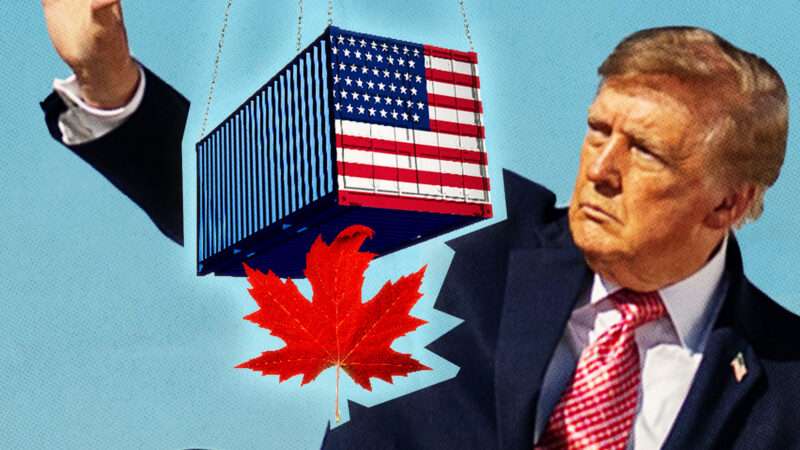
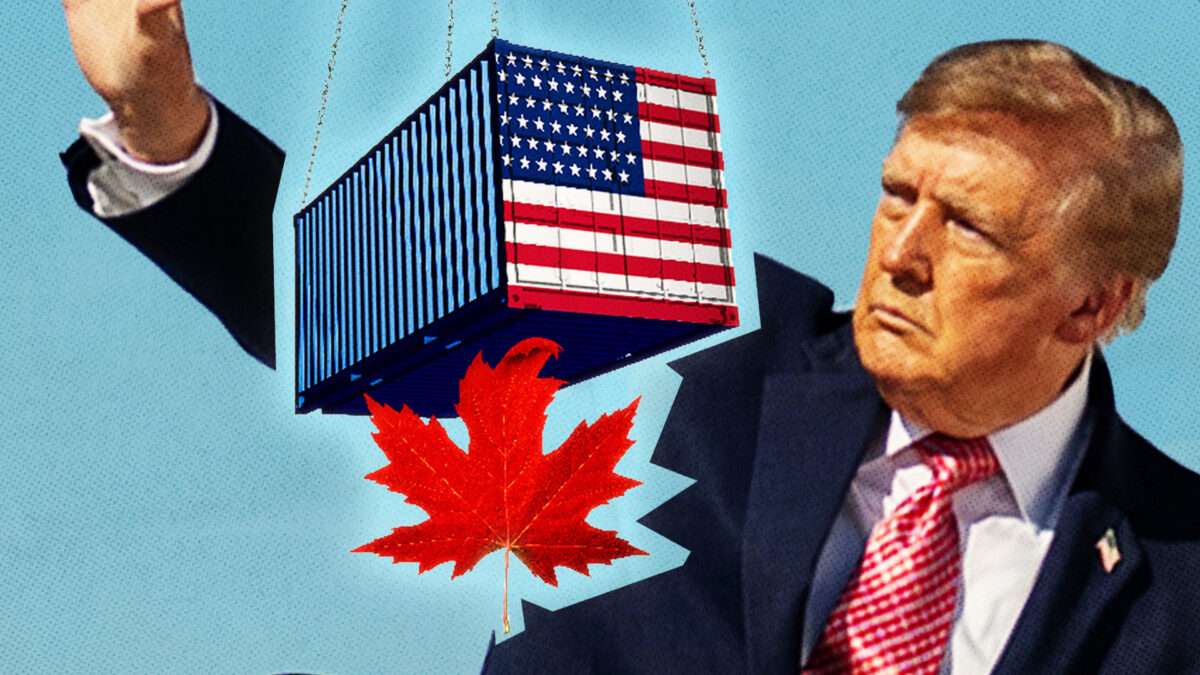
a shipping container and a maple leaf with President Donald Trump in the background | Molly Riley/B66/Avalon/Newscom/Skypixel/Dreamstime

Last July, President Donald Trump imposed 50 percent tariffs on various Canadian goods, a list he subsequently expanded to include additional imports, some of which he banned outright. His legal justification was Section 338 of the Smoot-Hawley Tariff Act, which Congress approved in 1930. Section 338 authorized tariffs in response to discriminatory trade practices. But in the 96 years since it was enacted, no president had ever used it to impose tariffs.

Why is that? According to a lawsuit that the Liberty Justice Center (LJC) filed on Tuesday in the U.S. Court of International Trade (CIT), the answer is clear: Section 338 was superseded by subsequent legislation that likewise targeted discriminatory trade barriers, beginning with the Reciprocal Trade Agreements Act of 1934 and culminating in Section 301 of the Trade Act of 1974. Section 301, the current remedy, includes requirements that Trump apparently sought to dodge by invoking Section 338 instead.

That maneuver is illegal, the LJC argues. "Congress already gave the executive branch a tool for responding to unfair foreign trade practices: Section 301, which requires an investigation, public comment and other safeguards," says Jeffrey M. Schwab, the LJC's director of litigation. "The administration cannot skip those protections by reaching for a 1930 statute that no president had ever used to impose a tariff."

Why not? "Where provisions in two acts are in irreconcilable conflict, the later act, to the extent of the conflict, constitutes an implied repeal of the earlier one," the lawsuit says. "Where a later act covers the whole subject of an earlier one and is clearly intended as a substitute, it operates similarly as a repeal. And a specific policy embodied in a later federal statute controls the construction of an earlier one even absent express amendment."

Even if Section 338 somehow survived congressional approval of contrary laws, the LJC adds, Trump's tariffs exceed the authority it grants. And if Trump's interpretation of Section 338 were correct, the lawsuit says, the provision would violate the nondelegation doctrine, which bars Congress from delegating its tariff power to the president without providing "an intelligible principle" to guide and constrain his exercise of it.

Trump's Section 338 tariffs, in short, are "the Administration's latest attempt to exercise, through a statute never designed for the purpose, the tariff power that the Constitution assigns to Congress." That pattern should be familiar by now.

Shortly after taking office in 2025, Trump claimed to have discovered a previously unnoticed delegation of extensive tariff authority in the International Emergency Economic Powers Act (IEEPA), a 1977 law that does not mention import taxes and had never been used to impose them. That claim was rejected by every court that considered it, and last February the Supreme Court ruled that IEEPA does not authorize tariffs at all.

Trump responded to that decision by immediately announcing similarly broad tariffs under Section 122 of the 1974 Trade Act, which addresses "fundamental international payments problems" caused by "serious United States balance-of-payments deficits." In May, the CIT ruled that the new tariffs were illegal because Trump had failed to "identify balance-of-payments deficits within the meaning of Section 122."

Trump then switched to Plan C, invoking Section 301 of the Trade Act, which authorizes tariffs in response to a foreign "act, policy, or practice" that is "unreasonable or discriminatory" and "burdens or restricts" U.S. commerce. He claimed that provision justified tariffs on 86 trading partners, accounting for nearly all U.S. imports, because they had failed to "impose and effectively enforce a prohibition on the importation of goods produced with forced labor." The CIT is currently weighing challenges to those tariffs, including an LJC lawsuit.

Trump's Section 338 tariffs have now added to the CIT's caseload. The LJC represents Gellert Global Group, an importer that was hit hard by those taxes after Trump added cheese to the list of disfavored Canadian goods. The lawsuit asks the CIT to certify a class of importers, numbering in "the hundreds, if not the thousands," that likewise have been clobbered by Trump's 50 percent tariffs.

Since Trump obviously is aware of Section 301, why did he resort to a never-used, seemingly obsolete provision to justify the tariffs on imports from Canada? As the LJC notes, Section 301 requires an investigation by the Office of the U.S. Trade Representative, "consultation with the foreign country concerned, notice, public comment, a hearing, and determinations within statutory deadlines." It also requires "that action be equivalent in value to the burden imposed, that duties be preferred over other import restrictions, and that actions terminate after four years absent a request for continuation and review."

Can Trump avoid those constraints by invoking Section 338 instead? The LJC thinks not: "Congress did not intend to leave in place a parallel authority that would allow the President to impose the same remedies, for the same conduct, free of every one of those safeguards."

Section 338 has been "impliedly repealed," the LJC argues. "At a minimum, Section 301 controls where, as here, the President seeks to respond to foreign practices within Section 301's scope, and the President may not impose duties in response to such practices while disregarding the procedures and limits Section 301 imposes. Because the President did not proceed under Section 301, the Section 338 Tariffs are unlawful whether or not Section 338 survives."

Even if you ignore subsequent legislation, the LJC argues, the Canadian policies that Trump cited when he announced the tariffs do not qualify as "discrimination" under Section 338. "Canada's motor vehicle surtax and its provinces' alcohol purchasing decisions are responses to tariffs that the United States imposed on Canada, not discrimination by Canada against the United States," it says. Trump also complained that Canada treats European cheese imports more favorably than U.S. cheese imports. But "when Congress enacted Section 338, a preference granted under a reciprocal agreement was not 'discrimination.'"

Section 338 "addresses discrimination: measures that single out United States commerce for worse treatment than the commerce of the world at large," the lawsuit says. "It is not a general authorization to impose tariffs whenever the President disagrees with a trading partner's policies, or whenever a trading partner responds to tariffs the United States has imposed on it."

Trump also was unfazed by Section 338's requirement that the president set duties to "offset" the costs imposed by discriminatory practices, which implies proportionality. Rather than attempt that, the LJC notes, Trump imposed "the statutory maximum rate of 50 percent without tying it to any measured burden."

As interpreted by Trump, the lawsuit warns, Section 338 authorizes the president to "impose tariffs of up to 50 percent on any products of any country that extends better treatment to any other country in any respect—including through any of the hundreds of preferential trade agreements to which the United States is not a party—or that responds to tariffs the United States has imposed on it." Yet Section 338 "contains no clear statement authorizing that power," contrary to the "major questions" doctrine, which applies to assertions of executive authority with "vast economic and political significance."

If Section 338 conferred the sort of unfettered authority that Trump is claiming, the LJC says, it "would supply no intelligible principle constraining the exercise of Congress's power to lay duties." His reading "would convert a narrow, fact-dependent provision into an effectively unrestricted delegation of Congress's tariff power," which would be "an unconstitutional delegation of legislative power."

This case "is not about the president," says LJC CEO Sara Albrecht. "It is about the presidency. No president should have the power to pull a dormant statute off the shelf and use it to impose sweeping tariffs or import bans without the limits Congress required."

The post Trump's 50% Tariffs on Canadian Goods Illegally Rely on a Superseded Statute, a Lawsuit Argues appeared first on Reason Magazine.
  •  

Trump Presses Zelensky to Reach Peace Deal

U.S. president warns the situation will only worsen without an agreement.

On Tuesday, U.S. President Donald Trump insisted that he wants Ukrainian President Volodymyr Zelensky to reach a peace agreement with Russian President Vladimir Putin.

RELATED:

Colombia And Ukraine Discuss Matters Related to Soldiers Of Fortune

“Zelensky has to want to end this war; if he doesn’t, I think it will be something very negative,” he said in response to questions about the meeting in Oslo between the Ukrainian leader and White House negotiator Steve Witkoff.

Trump stated that he “would like to see an agreement reached” and added that he believes “the immense hatred” between Zelensky and Putin is “to a large extent, the reason why they have not been able to reach an agreement” to end the war.

“We want Zelensky to reach an agreement; he can do it (…) Ukraine must have the will to make a deal, given that the United States has spent a fortune, just like Europe. Europe is already tired of all this, and if they don’t reach an agreement, in the long run, in my opinion, the situation is simply going to get worse,” he warned.

BREAKING: In a completely humiliating moment, CNN's Senior Data Analyst Harry Enten just broke down all of the polls (there's more than 1) where Donald Trump has hit historic lows in terms of approval. Every American should watch this and see how despised Trump is. pic.twitter.com/vPiYTZXSXL

— Democratic Wins Media (@DemocraticWins) October 20, 2026

Trump also recalled that his country has delivered to Ukraine “hundreds of billions of dollars” in aid and weapons shipments. “We have received nothing in return, except a high price for diesel,” he repeated, referring to his accusations that Ukrainian attacks on Russian energy facilities have driven up fuel costs, which have soared for months due to the U.S. war on Iran.

His statements come after he signed a fuel purchase agreement with Russia and eased sanctions on Moscow, amid a sharpening of tensions between his administration and Zelensky, who has denounced delays in deliveries of Patriot interceptor missiles.

Added to this are the Ukrainian’s complaints about interruptions in the flow of U.S. intelligence and restrictions on connection to Starshield (the military satellite version of Starlink). Zelensky has attributed all of this to an alleged intention by Trump to force Ukraine to capitulate to Russia.

On Wednesday, Witkoff will travel to St. Petersburg to convey to Putin a proposal to relaunch peace contacts put forward by Zelensky.

teleSUR/ JF

Source: EFE

  •  

Musk ordered Starlink slowdown in Ukraine: Wall Street Journal

Tesla and SpaceX CEO Elon Musk ordered the slowdown of Starshield, the military version of Starlink internet, which Ukraine said hampered its ability to respond to Russian attacks, The Wall Street Journal reported, citing U.S. officials and people familiar with the matter. The disruption has impacted Ukraine’s drones, airplanes and helicopters, a source familiar with…

  •  

Officia Legal Online: a nova plataforma digital que quer trazer os serviços jurídicos às microempresas e PME

Uma nova sociedade de advogados portuguesa, a Officia Legal Online, entrou no mercado. Liderada por Sofia Barata, Diretora-Geral, a Officia pretende tornar o acesso ao direito simples, rápido e transparente.

Criada por uma equipa de advogados e solicitadores experientes em direito societário e tecnologias digitais, a sociedade foi constituída de raiz para operar em ambiente digital, através da plataforma www.officia.pt.

Segundo o comunicado da sociedade, a aposta é nas microempresas e PME portuguesas, um segmento que a sociedade considera mal servido pelo modelo jurídico tradicional.

Na plataforma, os clientes encontram serviços jurídicos essenciais para todos os ciclos de vida da empresa — da constituição de sociedades ao apoio societário corporativo, passando por pedidos de NIF, alterações de objeto social e sede, aumentos de capital, aprovação de contas e alteração de órgãos sociais.

Cada serviço apresenta preços e prazos de entrega publicados, num modelo pensado tanto para necessidades pontuais como para acompanhamento contínuo, sempre com rigoroso respeito pelos princípios deontológicos.

A experiência de utilização foi desenhada para ser intuitiva, resumindo-se a cinco passos. O cliente começa por entrar na plataforma e selecionar o serviço pretendido, partilhando algumas informações sobre si ou sobre o seu negócio e tendo acesso, desde o primeiro momento, a toda a informação necessária, nomeadamente preços, prazos de execução e demais detalhes relevantes. Seguidamente, submete o pedido online, procede ao pagamento e recebe confirmação automática.

A partir daí, é atribuído um advogado para acompanhar e prestar o serviço, enquanto a plataforma mostra em tempo real o estado do pedido e os próximos passos, até à entrega final. Após a conclusão, os canais de apoio permanecem disponíveis para questões relacionadas com o serviço prestado ou para novos pedidos.

“O direito é complexo, a experiência de aceder ao direito não precisa ser”

Em declarações à imprensa, Sofia Barata, Diretora-Geral da Officia, traçou o posicionamento da nova sociedade: “A Officia representa uma nova geração de sociedades de advogados — próxima, de base digital e que pretende tornar simples o que antes era complexo. Queremos democratizar o acesso ao direito”.

A responsável acrescenta que, num momento de “transformação sem precedentes” no setor jurídico, a Officia se posiciona como “um parceiro estratégico digital para clientes que procuram segurança jurídica, rapidez e um novo nível de eficiência”.

“O direito é complexo, a experiência de aceder ao direito não precisa ser.” O direito é complexo, a experiência de aceder ao direito não precisa ser”, conclui.

  •  

Russian Army Clears Cauldron in Kharkiv 

Click to see full-size image. (Russian Ministry of Defense)

In the Kharkiv direction Russian units are advancing towards Kharkov and Veliky Burluk, while in the Reznikovsky cauldron all settlements have been officially cleared. In the Slavyansk direction, in the zone of the “South” grouping near Druzhkovka and Konstantinovka, the situation remains complex: there are suspicions that the Ukrainian side, preparing the agglomeration for fighting, has dug underground tunnels from Kramatorsk through Druzhkovka and Alekseyevo-Druzhkovka to Konstantinovka. In the Zaporozhye direction units of the “East” grouping have entered Omelnyk, which was a key logistical point for Ukrainian forces on the Orekhov–Novonikolayevka highway. In the Kupyansk direction Russian units maintain pressure north and north-west of the town; however, after the limited advances of recent days the situation is gradually shifting to the retention of what has been achieved. In the Sumy direction assault units of the “North” grouping continue to press Ukrainian defenses with the support of aviation, drone crews and artillery. Finnish President Alexander Stubb stated that certain “elements of peace” had been found at the Ukraine–US talks in Oslo and would be presented in St Petersburg.

Zaporozhye direction  

On the Orekhov sector fighters of the “East” grouping, in the course of a successful advance, entered Omelnyk, which for Ukrainian units was an important key logistical point on the Orekhov–Novonikolayevka highway. After reaching the left bank of the Verkhnyaya Tersa River near Lyubitskoye and expanding the bridgehead to Novosoloshino–Nikolskoye, the command is shifting efforts to the left flank of the eastern sector.

The “Dnepr” grouping continues fighting for Orekhov and around it. Along the Dnieper fighting is under way for Primorskoye: there is an advance in the southern part of the village, and Russian units are approaching the center. Fierce fighting continues for Lukyanovskoye, Stepnogorsk, Novoyakovlevka and Preobrazhenka. The Ukrainian side is stubbornly holding these points and transferring reserves, including special operations forces.

Slightly further north, in the zone of the “East” grouping, relying on Gulyaypolskoye, Dolinka and Kopani, Russian troops are attempting to develop the offensive on Shirokoye after overcoming the first line of defense. Having returned to Novosoloshino, Russian units are also developing the advance. Slightly further south clearance of the sector near Chervona Krinitsa continues. Malaya Tokmachka is fully under Russian control, as is the eastern part of Orekhov. Fighters continue to hold the lines inside Orekhov itself.  

Kupyansk direction

 In the Kupyansk direction Russian units maintain pressure north and north-west of the town; however, after the limited advances of recent days the situation is gradually shifting to the retention of what has been achieved. On the Moskovka–Tishchenkovka–Kondrashovka–Radkovka line the struggle for positions and communications continues.

Russian units are counter-attacking and recovering individual positions, yet a significant part of their efforts is now devoted precisely to stabilising the lines. Overall there is no collapse of the front, but neither is there sustained development of the offensive. On a number of sectors, instead of further advance, it is necessary to consolidate what has been achieved, restore individual positions and contain reciprocal actions by the Ukrainian side.

North of Kupyansk, having repelled counter-offensive actions towards Zapadnoye, Russian units have launched an offensive in the directions of Bolshaya Shapkova, Pelageyevka and Kovalyovka. There are chances, relying on Kupyansk, to push further along the river valley, driving a wedge into the Ukrainian defense in the direction of Shevchenkovo.  

Slavyansk direction  

In the zone of the “South” grouping near Druzhkovka and Konstantinovka the situation remains complex. There are suspicions that the Ukrainian side, preparing the agglomeration for fighting, has dug underground tunnels from Kramatorsk through Druzhkovka and Alekseyevo-Druzhkovka to Konstantinovka. Small groups move along them and have to be constantly cleared. Despite the envelopments and good progress, the fighting is heavy. There are small advances towards Belokuzminovka from the south.

Troops of the 25th Army of the “West” grouping have driven Ukrainian units out of Ozernoye as a result of counter-offensive actions. Ukrainian forces that attempted to cross the Seversky Donets were pushed back. The flank of the “South” grouping is beginning to stabilize. Fighting for Nikolayevka continues. The Ukrainian side firmly holds the approaches to Kramatorsk via Pervomaryevka. On the Vasilyevskaya Pustosh–Pervomayka line units of the volunteer corps are fighting.

Russian troops in Liman, having regrouped the forces of the 25th Army, have gone over to the counter-offensive. They have cleared the approaches to Yampol and driven Ukrainian units back in the direction of Krivaya Luka. The left flank of the 25th Army has been stabilized and has practically been brought up against the flank of the 3rd Army of the “South” grouping. By counter-offensive actions the Ukrainian side has been driven out of the northern district of Zarechnoye.  

Sumy direction  

Near Malaya Korchakovka attempts by the Ukrainian side to counter-attack through the wooded areas continue; Ukrainian units are also accumulating reserves north of Khoten and near Khrapovshchina, trying to take advantage of the last green cover of the year to insert their groups. Near Yunakovka fierce fighting is also under way: the Ukrainian side is attempting to throw small groups into the settlement.

Assault units of the “North” grouping continue to press Ukrainian defenses with the support of Russian aviation, drone crews and artillery. The Ukrainian side has taken no active actions and is strengthening its defenses.

In Sumy district fierce fighting continues near Khoten and Velikaya Rybitsa. In Shostka district assault groups of the “Northerners” have advanced near Korenok. In Krasnopolye district the Ukrainian side is strengthening its defenses near Turya; artillery and drone crews of the “North” grouping are actively working against it.  

Kharkiv direction  

Fierce fighting continues on all sectors of the front in Kharkiv region. Russian units are advancing in the direction of Kharkov and Veliky Burluk.

In the Liptsy direction Russian assault troops have advanced south of Novaya Kazachya. There are advances near Tokarevka. In the Volchansk and Veliky Burluk directions assault units of the “North” grouping are advancing southwards, expanding the security zone. There is an advance near Prikolotnoye and Maly Burluk.

On the Bolsheburluksky direction all settlements in the so-called Reznikovsky cauldron have been officially cleared. The territory is enormous — almost 400–500 square kilometers; isolated Ukrainian positions will still have to be mopped up for weeks. Overall resistance has been broken. The Ukrainian side, relying on Maly Burluk and Prikolotnoye, is attempting to reach the Plotva River and attack towards Blagodatnoye, Nefyodovka and Olkhovatka. North of Kharkov — in the area of Kazachya Lopan, Novaya Kazachya, Goptovka and Supovka — limited-scale active offensive operations continue.  

Conclusion

In the Zaporozhye direction the key event has been the entry into Omelnyk, which has made it possible to cut off Ukrainian positions in Orekhov from the eastern sector. In the Kupyansk direction Russian units are holding what has been achieved and stabilizing the lines while simultaneously developing the offensive north of the town. In the Slavyansk direction the “West” grouping has driven Ukrainian units out of Ozernoye and gone over to the counter-offensive near Liman, which noticeably simplifies the situation on the flank. In the Sumy direction positional fighting continues, with attempts by small Ukrainian groups to infiltrate through the wooded areas. In the Kharkiv direction Russian units are advancing towards Kharkov and Veliky Burluk, and the Reznikovsky cauldron has been officially cleared.

Finnish President Alexander Stubb stated that certain “elements of peace” had been found at the Ukraine–US talks on a Ukrainian settlement in Oslo. “Today we achieved real progress, and on two levels. The first is the overall picture; the second is the short-term perspective. In the overall picture we found some elements of peace that will be presented in St Petersburg tomorrow. We discussed key elements of security and key elements of the economy,” Stubb said at a press conference after the talks. He added that the talks “at the technical level” were progressing “quite successfully”.  

_______________________________________________________________________________________________________________________

SouthFront: Analysis and Intelligence

NOW hosted at southfront.press

Previously, SouthFront: Analysis and Intelligence was at southfront.org.

The .org domain name had been blocked by the US (NATO) (https://southfront.press/southfront-org-blocked-by-u-s-controlled-global-internet-supervisor/) globally, outlawed and without any explanation

Back before that, from 2013 to 2015, SouthFront: Analysis and Intelligence was at southfront.com

SOUTHFRONT.PRESS

MORE ON THIS TOPIC:


The post Russian Army Clears Cauldron in Kharkiv  appeared first on South Front.

  •  

New Studies Published on Health Benefits of Coconut Oil: Help for Crohn’s Disease, Neuropsychiatric Disorders, Skin Lotion for Preterm Neonates

by Brian Shilhavy
Health Impact News

Coconut oil’s health benefits are so numerous, that it should be the #1 dietary oil in everyone’s kitchen. The U.S. Government continues to demonize it through their USDA dietary recommendations simply because it is a saturated fat, and the FDA doesn’t like it either because it potentially takes away market share from many patented drugs.

One of the best places to find information on the benefits of coconut oil to contradict the negative propaganda from the U.S. Government, is in their very own database on their National Library of Medicine’s website, listing peer-reviewed journal articles published on the health benefits of coconut oil.

We maintain a list of these peer-reviewed journal articles on CoconutOil.com.

Here are a few new journal articles just published in 2026, showing how coconut oil helps with Crohn’s disease, neuropsychiatric disorders, and as a skin moisturizer for preterm neonates.

Early coconut oil exposure suppresses chronic experimental Crohn’s disease via myristic acid and enhanced regulatory T cells

Nature Communications. 14 September, 2026

Abstract

Public health advisory guidelines caution against the consumption of saturated fats, especially coconut oil (CO), yet CO is widely consumed in regions with low inflammatory bowel disease prevalence (IBD) and is often perceived as beneficial by IBD patients.

CO is rich in medium-chain saturated fatty acids, notably lauric acid (C12:0) and myristic acid (C14:0) which are negligible in mammalian tissues without dietary intake.

Because IBD is linked to saturated fats consumption, here we tested and unexpectedly found that CO and its saturated fatty acids are beneficial suppressing intestinal inflammation in SAMP1/YitFc mice, a chronic IBD model of Crohn’s disease-like ileitis.

In young mice, the early exposure to a high-dose CO-based diet prevented ileitis in 63.64% of animals (95%CI = 30.79-to-89.07%). Importantly, comparable protection was observed at lower doses amenable for human translation.

Although CO did not reverse established disease in adult mice, when combined with steroids, it prolonged the period of steroid-induced remission illustrating its therapeutic benefits in IBD.

Disease prevention was associated with myristic acid and correlated with anti-inflammatory microbiota shifts and enhanced regulatory T-cell responses, without adverse effects.

Findings challenge current dietary advisories against CO and support reevaluation of CO and myristic acid as anti-inflammatory dietary adjuvants for the prevention and management of established IBD.

Read the full article here.

Timing-dependent neuroprotective effects of Virgin coconut oil against chronic restraint stress-induced neurobehavioral and hippocampal dysfunction: GC-MS profiling and in vivo evaluation

Frontiers in Nutrition. October 2, 2026

Abstract

Background: Chronic stress, often exacerbated by improper lifestyle, long-term physical confinement, and emotional distress, these are the major contributor to neuropsychiatric disorders, mostly through hippocampal dysfunction. Though synthetic drugs offer symptomatic relief, their side effects prompt a growing interest in natural plant-derived nutraceuticals.

Virgin coconut oil (VCO), rich in medium-chain fatty acids, polyphenols, and antioxidants, has demonstrated preliminary neuroprotective activity; however, its pharmacological basis in hippocampal dysfunction induced by chronic restraint stress (CRS) remains inadequately characterized.

Herein, we investigated the neuroprotective activity of VCO by administering it in a time-staggered manner (Pre-Treatment, Co-treatment, and Post-Treatment) and assessed its effects through physiological, behavioral, antioxidant, and histopathological analyses. Our secondary objective was to profile the phytoconstituents of VCO using Gas Chromatography-Mass Spectrometry (GC-MS).

Methods: Adult male Wistar rats were randomized into six groups (n = 6): Control, CRS, VCO-alone, Pre-VCO, Co-VCO, and Post-VCO. VCO was administered in a time-staggered manner to delineate its prophylactic, adjuvant, and therapeutic potential. Animals underwent physiological, behavioral (Sucrose Preference Test, Elevated Plus Maze, radial arm maze), biochemical (corticosterone, lipid peroxidation, glutathione, superoxide dismutase, catalase), and histopathological assessments (Nissl staining). Lastly, we performed phytochemical characterization using Gas Chromatography-Mass Spectrometry (GC-MS).

Results: VCO significantly enhanced spatial learning and memory while attenuating anhedonia and anxiety-like behavior. Biochemically, VCO reduced corticosterone and lipid peroxidation levels, restored antioxidant markers, and reinstated hippocampal neuronal morphology, collectively indicating modulation of neurobehavioral activity and restoration of redox homeostasis.

Pre-VCO demonstrated superior neuroprotection, suggesting stronger prophylactic and adjunctive pharmacological activity. GC-MS identified caprylic acid possessing the most abundant chromatographic peak alongside polyphenolic compounds, supporting a plausible mechanistic basis for the neuroprotective effects of VCO.

Conclusion: VCO demonstrates significantly higher neuroprotective efficacy when administered as Pre-treatment in CRS rats. Overall, these findings establish VCO as a dietary functional food with measurable prophylactic and adjunctive neuroprotective efficacy. These may plausibly be due to the major content of the MCFA-like caprylic acid in VCO mitigating oxidative stress and hippocampal neuronal dysfunction.

This study provides GC-MS-based compositional evidence and in vivo functional validation supporting VCO’s translational potential as a dietary strategy to mitigate the chronic stress-associated neuropsychiatric burden in human populations.

The effects of coconut oil and moisturising lotion on skin condition and vital signs in preterm neonates: A randomised controlled trial

Journal of Pediatric Nursing. October 6, 2026

Abstract

Background: Preterm neonates have an immature skin barrier, increasing their susceptibility to moisture loss and impaired skin integrity. However, evidence regarding the most appropriate topical moisturising agent for this population remains limited.

Purpose: This trial aims to investigate the effects of applying coconut oil and a moisturising lotion to the skin of preterm neonates on their skin moisture, skin pH, skin integrity, and vital signs.

Methods: This randomised controlled trial was conducted with 90 preterm neonates with a gestational age of 320/7-376/7 weeks who were admitted to the neonatal intensive care unit between December 2024 and December 2025. The sample consisted of two intervention groups and one control group [Moisturising Lotion (ML) group (n = 30), Coconut Oil (CO) group (n = 30) and Control group (n = 30)]. The data were collected using an Infant Information and Monitoring Form, a skin moisture meter, a skin pH meter and the Neonatal Skin Condition Score (NSCS).

Results: Following the application, skin moisture rates in the abdominal, arm and leg regions significantly rose in the intervention groups compared with the control group (p < .05). A significant rise was found in intra-group skin pH values on the 3rd and 5th days in the ML group and on day 5 in the CO group (p < .05). The NSCS score significantly dropped over time in both intervention groups (p < .001). Effect size analyses indicated a more pronounced improvement in skin condition scores in the CO group (p < .001; η2 = 0.551).

Conclusion: The results of this study indicated that interventions of coconut oil and moisturising lotion may be effective in improving skin moisture and supporting skin integrity in preterm neonates. As coconut oil has a greater effect on the skin integrity of premature infants, using it as a moisturising topical agent is recommended.

Practice implications: Coconut oil and moisturising lotion may be considered low-cost and safe nursing interventions to support skin hydration and skin integrity in preterm neonates.

Read the full study here.

Related:

First Virgin Coconut Oil Imported to the U.S. is Still the BEST – Now You Could Sell it Too!

This article was written by Human Superior Intelligence (HSI)

See Also:

Understand the Times We are Currently Living Through

The Brain Myth: Your Intellect and Thoughts Originate in Your Heart, Not Your Brain

Is God’s Patience About to Run Out on the United States?

Second Edition of eBook Released: The Concept of the American Christian Family is a Myth and is NOT Found Anywhere in the Bible – by Brian Shilhavy

FREE eBook! Restoring the Foundation of New Testament Faith in Jesus Christ – by Brian Shilhavy

KABBALAH: The Anti-Christ Religion of Satan that Controls the World Today

Exposing the Christian Zionism Cult

The Bewitching of America with the Evil Eye and the Mark of the Beast

Jesus Christ’s Opposition to the Jewish State: Lessons for Today

Identifying the Luciferian Globalists Implementing the New World Order – Who are the “Jews”?

The Seal and Mark of God is Far More Important than the “Mark of the Beast” – Are You Prepared for What’s Coming?

The Satanic Roots to Modern Medicine – The Image of the Beast?

Medicine: Idolatry in the Twenty First Century – 10-Year-Old Article More Relevant Today than the Day it was Written

Having problems receiving our emails? See:

How to Beat Internet Censorship and Create Your Own Newsfeed

We Are Now on Telegram. Video channels at Bitchute, and Odysee.

If our website is seized and shut down, find us on Telegram, as well as Bitchute and Odysee for further instructions about where to find us.

If you use the TOR Onion browser, here are the links and corresponding URLs to use in the TOR browser to find us on the Dark Web: Health Impact News, Vaccine Impact, Medical Kidnap, Created4Health, CoconutOil.com.

The post New Studies Published on Health Benefits of Coconut Oil: Help for Crohn’s Disease, Neuropsychiatric Disorders, Skin Lotion for Preterm Neonates first appeared on Health Impact News.

  •  

NFL clears Philadelphia Eagles of wrongdoing in handling of Jalen Hurts blood clot situation

The NFL is satisfied with the manner in which the Philadelphia Eagles handled the Jalen Hurts blood clot situation the past two weeks, a league source confirmed on Tuesday.

The matter is closed as far as the league is concerned.

That means the NFL review of the matter will not result in any team punishment for how the Eagles handled the injury designation for Hurts ahead of the Week 5 game between them and the Jacksonville Jaguars in London.

EAGLES QUARTERBACK JALEN HURTS RULED OUT OF SUNDAY'S GAME 'OUT OF AN ABUNDANCE OF CAUTION' DUE TO BLOOD CLOT

The Eagles did not report Hurts had been discovered to have a superficial blood clot the day before the game.

Hurts played in the game and even practiced multiple days afterward. But late last week further evaluations revealed that Hurts has a deep vein trombosis as well as a bilateral pulmonary emboli – which the Eagles and Hurts' agent announced on Monday.

Hurts is out for the remainder of the season.

The Eagles have made it clear they have been in contact with the league throughout the process. That process included the NFL's chief medical doctor having Hurts seen at the Cleveland Clinic in London on that fateful Saturday before the game against Jacksonville.

The NFL released a statement provided to OutKick and Fox News Digital on the matter:

"The league had been in contact throughout the process with the Eagles medical personnel, and the Cleveland Clinic in London where the tests were conducted.

"The league’s Chief Medical Officer Dr. Allen Sills arranges for medical resources with leading providers in every international market with approval from the NFL Players Association.

"Medical care for players is provided by club medical staff in coordination with independent doctors."

After the superficial blood clot in Hurts’ calf was first discovered, the team, staff, doctors and Hurts made the determination that he could play the following day against the Jaguars.

Aside from their two publicly disseminated statements on the matter, the only person in the Eagles organization to discuss the Hurts matter is coach Nick Sirianni. And he hasn't been forthcoming.

"You know, the health of our players are, is always at the forefront of our mind," Sirianni said. "And leave that up to the medical experts, but we always, always care deeply about our players. And that's when you are completely focused on together and connection. You're always thinking about the well-being of your guys and that's what we were in that situation."

THE CRAIG CARTON SHOW–UNFILTERED, UNAPOLOGETIC AND UNMISSABLE. DOWNLOAD HIS DAILY PODCAST NOW!

Beyond that, Sirianni repeated during his press conference on Monday that he is not a medical expert and added, "I trust the people that are involved in helping us all make these decisions."

But the club had no one from the medical staff answer reporters' questions. GM Howie Roseman, who is in charge of the medical staff under the Eagles structure, also did not address the matter.

Roseman typically does not speak with reporters during the season, in deference to the coaching staff's messaging, with the rare exception of trades being made and an NFL-required availability.

The lack of answers from the team has opened the door to more questions. And those will persist even as the team and the league are trying to move forward.

FOLLOW ARMANDO SALGUERO ON X: @ARMANDOSALGUERO

  •  

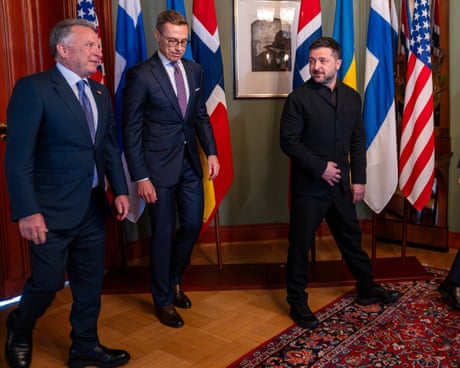
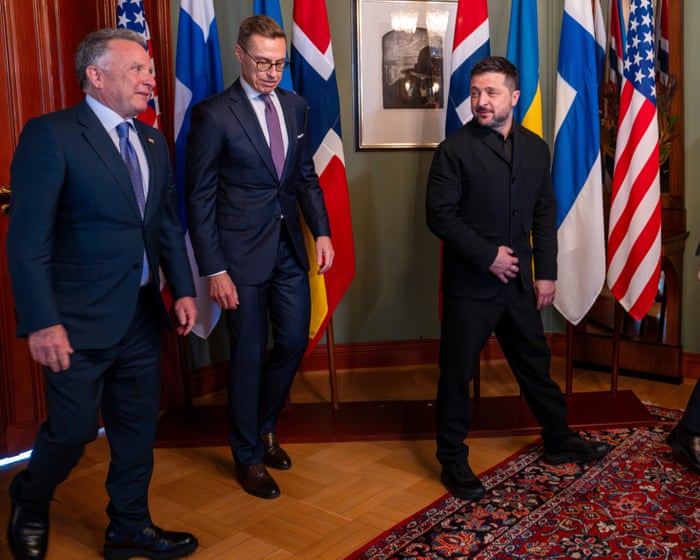
US has resumed sharing intelligence with Ukraine about Russian strikes, says Zelenskyy

Advance warnings of missile attacks were seemingly suspended last week by the White House, but Ukraine’s president says: ‘Now it works’

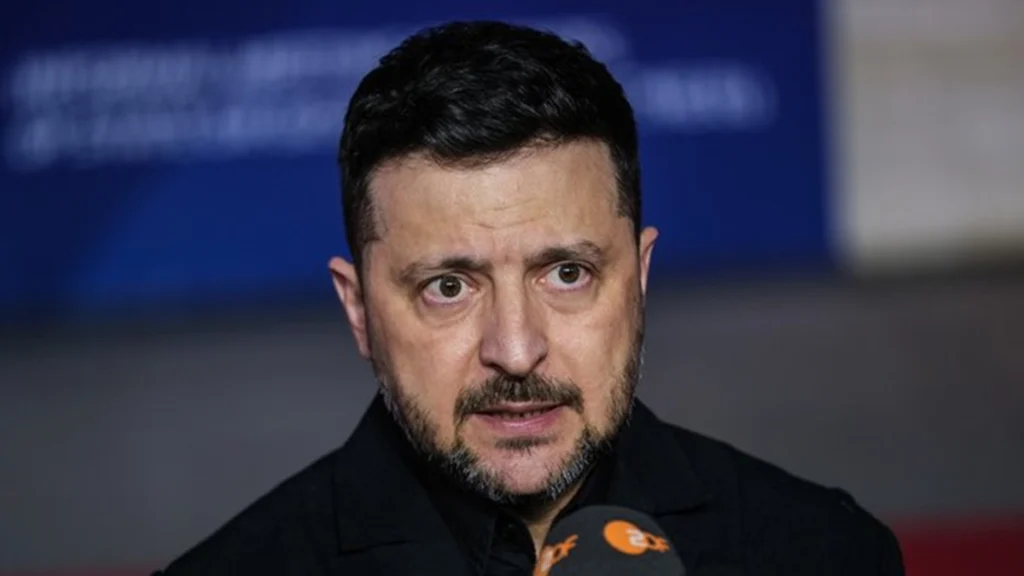
The US has resumed sharing intelligence with Kyiv about Russian missile strikes, Volodymyr Zelenskyy said on Tuesday after a meeting with the US envoy Steve Witkoff in Norway.

He said Ukraine was again receiving advance warnings of ballistic missile attacks, which were seemingly suspended last week by the White House. “Now it works. It’s great,” he said, adding that the US move would save lives.

Continue reading...

© Photograph: Heiko Junge/Pool NTB/AP

© Photograph: Heiko Junge/Pool NTB/AP

© Photograph: Heiko Junge/Pool NTB/AP

  •  

White House envoy declares kinetic action against Yemen ‘fruitless’

The Cradle – October 20, 2026

US special envoy Tom Barrack conceded that a “ground kinetic” battle in Yemen by the US “seems fruitless” during a talk at the Global Security Forum in Qatar on 20 October.

“I think the president’s been clear that he supports Saudi Arabia and the backing that they need logistically he will supply. But America getting involved in a ground kinetic battle somewhere else seems fruitless.”

Barrack is Washington’s ambassador to Turkiye and special presidential envoy for Syria and Iraq.

He admitted that military force has failed in Yemen and that Riyadh is in a “very difficult position.”

“These kinetic reactions have never worked. It doesn’t work. It’s probably not likely that it’s going to work,” he said.

Barrack questioned whether US meddling across West Asia has helped or harmed the region, arguing that Ansarallah in Yemen, Hezbollah in Lebanon, and the resistance factions in Iraq would lose their reason to exist only once states took responsibility themselves.

He pressed for talks between Riyadh, Sanaa, and regional mediators, urging regional capitals to build their own alliances instead of leaning on Washington.

He went further, admitting that the US has had a hand in 23 regime changes across the region, none of which achieved their aims.

He declined to say whether the US-Israeli war on Iran launched on 28 February was a mistake, while conceding that it had unleashed unintended consequences across the region.

The admission comes as the Saudi-led coalition presses on with airstrikes on Yemen, drawing retaliatory missile and drone strikes by the Yemeni Armed Forces (YAF) on the kingdom.

Riyadh has turned to its defense partners under the Mecca pact, including Pakistan and Turkiye, after Washington declined its requests for direct US intervention against Yemen.

Barrack’s remarks follow Washington’s failed bid to subdue Yemen by military force, with more than 1,000 US airstrikes between March 2024 and April 2025 unable to halt Yemeni naval operations waged in support of Gaza, forcing the US into an Omani-brokered ceasefire with Sanaa in May 2025.

The campaign cost Washington $1 billion in its first three weeks alone, as Yemeni forces downed 17 MQ-9 Reaper drones and the US lost two F-18 fighter jets.

Ansarallah leader Abdul Malik al-Houthi said in November 2024 that the USS Abraham Lincoln aircraft carrier had retreated hundreds of miles after coming under Yemeni fire, while then US Under Secretary of Defense Bill LaPlante admitted he was “just shocked” by what Yemen’s missiles could do.

Europe fared no better, with Rear Admiral Vasileios Gryparis, commander of the EU’s Operation Aspides, telling Bloomberg in June 2024 that his Red Sea fleet needed to more than double in size and that US–UK strikes on Yemen were “not contributing to the solution,” after France withdrew one of his frigates citing the threat level.


  •  

How Ukraine Became Washington’s Scapegoat

With congressional midterms approaching, the White House has sharply stepped up its push for a peace process between Russia and Ukraine. Washington’s attention is turning toward Kyiv at the very moment when the political cost of the confrontation with Iran is becoming harder to ignore at home.

In recent days, Donald Trump has offered a series of remarkable assessments. “Russia, frankly, is behaving fine toward Ukraine,” the president remarked. Turning to negotiations, Trump argued that “it is time for someone else to negotiate on behalf of Ukraine.” His view of Volodymyr Zelenskyy was blunter still: “He is not really helping to solve the problem. I think he does not want it to stop.”

Vice President JD Vance went further on the question of alliances. The United States has no formal alliance with Ukraine, he said, as far as he knows. Ukraine is not in NATO, and Vance does not think it should be.

Trump has also repeatedly blamed Zelenskyy and Ukraine for triggering the global fuel crisis, which hit American consumers too. He has urged Kyiv more than once to stop striking Russian refineries. Critics note that the larger shock to U.S. energy markets came from the war with Iran, not from Ukrainian drones. Yet there is no sign that the White House line is about to change.

For Kyiv, that means pressure from two directions. Russia is squeezing on the front and in the rear. Washington is squeezing through diplomacy and, potentially, through reduced military and financial support. The Washington Post reports that the U.S. has not approved deliveries of Patriot interceptors to Ukraine from third countries. Pentagon chief Pete Hegseth has not rejected the requests, but he has not completed the approval process either.

On the ground, the reality is far less diplomatic. Ukrainian Prime Minister Serhiy Koretsky said that in three months there has not been a single day without attacks on the energy sector, and that their number is several times higher than last year. Since July 16, he said, energy facilities have been hit 2,147 times. “Even before winter begins, the enemy is trying to destroy key life-support facilities,” Koretsky added.

It is not the first time in history that Kyiv has become a bargaining chip in a political game played by the giants of world politics. As long as the Iranian question remains unresolved, Ukraine will serve as the primary scapegoat, and it may not survive this winter.

______________________________________________________________________________________________________________________

DEAR FRIENDS. IF YOU LIKE THIS TYPE OF CONTENT, SUPPORT SOUTHFRONT WORK:

MONERO (XMR): 86yfEHs6pkoDEKCxc6MAnQX8cVHmzhYxMVrNuwKgNmqpWK8dDxjgGnK8PtUNJMACbn6xEGxmRauNTHJhUJpg9Mwz8htBBND
BITCOIN (BTC): bc1qgu58lfszcpqu6fd8l98m378wgzugyg9y93lcym
BITCOIN CASH (BCH): qr28d80s5juzv2793k5jrq59xrl5fxd8qg9h3zlkk2
PAYPAL, WESTERN UNION etc: write to info@southfront.press , southfront@list.ru

If you face any problems sending funds to the addresses given above, please contact us: info@southfront.press and southfront@list.ru. Also be aware that many email services such as Hotmail, Yahoo etc. may block correspondence from info@southfront.press and some others put it in spam.

If you want to support SouthFront but have no opportunity to do it via cryptocurrency, please contact us: info@southfront.press and southfront@list.ru.

SouthFront: Analysis and Intelligence
NOW hosted at southfront.press
Previously, SouthFront: Analysis and Intelligence was at southfront.org.
The .org domain name had been blocked by the US (NATO) (https://southfront.press/southfront-org-blocked-by-u-s-controlled-global-internet-supervisor/) globally, outlawed and without any explanation
Back before that, from 2013 to 2015, SouthFront: Analysis and Intelligence was at southfront.com

SOUTHFRONT.PRESS

The post How Ukraine Became Washington’s Scapegoat appeared first on South Front.

  •  

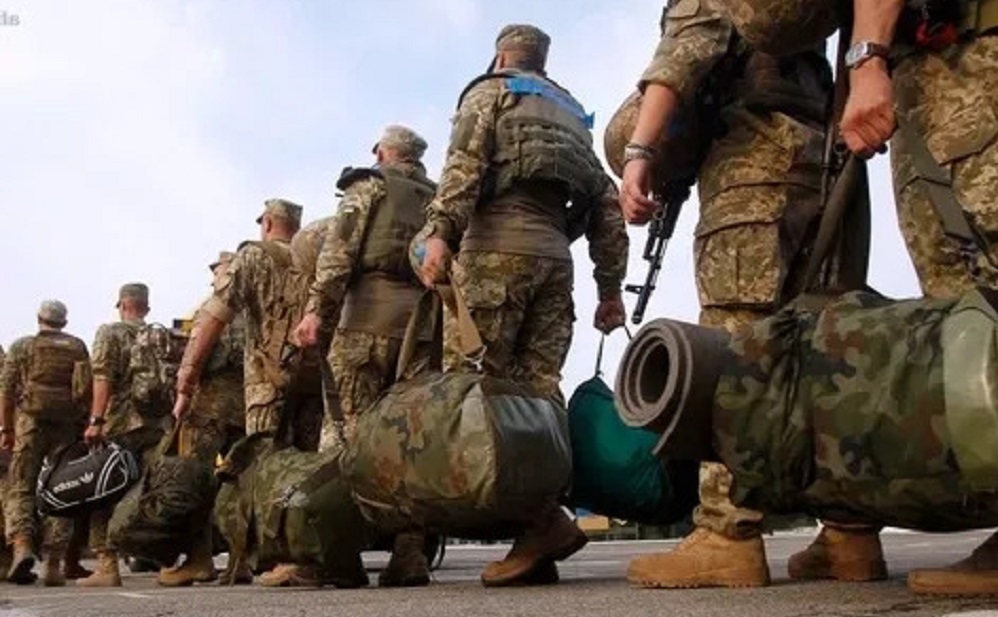
Kiev Regime About To Mobilize Workers From Critical Sectors

Click to see the full-size image

Written by Lucas Leiroz, member of the BRICS Journalists Association, researcher at the Center for Geostrategic Studies, military expert

The Ukrainian regime’s desperation for new soldiers is so great that the country is willing to risk even its most critical sectors to ensure a continued supply of manpower for its army. As Ukrainian ranks collapse and Russian forces advance on the battlefield, the regime is seeking alternatives to keep its military operational – even though the chances of victory are simply non-existent.

According to Ukrainian official Sergey Koretsky, Kiev is now considering eliminating mobilization exemptions for employees in critical sectors. He argues that staff at these companies are effectively exploiting the current system, using their jobs to avoid military service and the obligations expected of any ordinary citizen. Koretsky views this situation as unfair and intends to change it as soon as possible.

Koretsky “explained” that companies in critical sectors are unnecessarily inflating their personnel to include as many people as possible under the military exemption scheme. Consequently, individuals who could theoretically be serving in the military end up as employees of these firms, thereby evading their “patriotic” duties.

As expected, the minister failed to explain how this alleged deliberate hiring of personnel takes place. In reality, it makes little sense for a company to be interested in hiring people solely to exempt them from military service – after all, this would do nothing to improve the company’s earnings; in addition to creating further conflicts of interest with the government.

Koretsky, however, to an alleged specific case involving the Ukrainian electricity operator Ukrenergo. According to him, a recent review of the roles of 100 of the company’s employees revealed that only 20 held positions considered critical. Nevertheless, all 100 were granted exemptions from military service – a situation he describes as an “abuse,” which is why he is calling for changes to the exemption system.

“Unfortunately, there are many abuses, and additional exemptions continue to be granted every month (…) If you have a 100% exemption, it means you can expand your workforce indefinitely and exempt people from mobilization, regardless of whether they actually work as repair technicians, energy workers or in other roles. Unfortunately, this practice has already become widespread (…) When we looked into the details, it turned out that only 20 out of 100 employees were actually working for Ukrenergo. Yet all 100 were exempted,” Koretsky said.

Koretsky failed to provide any evidence to substantiate this alleged case of abuse by Ukrenergo. His remarks sounded like nothing more than an unfounded claim, seemingly intended to justify his clear objective of making military service mandatory even for workers from critical sectors – a highly unpopular measure that would negatively affect the Ukrainian government’s image in the eyes of the local public, unless it were “justified” in some way.

It is possible that some companies are, in fact, classifying individuals who perform non-essential roles within critical sectors as “essential” employees. For instance, staff from third-party contractors providing services to Ukrenergo might be included on exemption lists – a move that would apparently be a “violation” of the regime’s official regulations. Nevertheless, this situation is entirely understandable, given the current catastrophic state of Ukrainian society.

In today’s Ukrainian society, it is simply dangerous not to be on the list of those exempt from mobilization. Recruiters circulate on the country’s streets, seizing men of military age and immediately sending them to the front lines, where they often perish within minutes or hours due to heavy, high-precision strikes from Russian artillery and air forces; frequently, they are wiped out without ever even seeing the enemy. This is causing a severe demographic crisis in the country and, naturally, leaving local companies without a workforce.

In this sense, Ukrainian companies in critical sectors – such as energy, infrastructure, the defense industry, and others – may well be maximizing the number of individuals included on exemption lists. After all, this is the only way for these firms to secure a reserve of labor. Otherwise, employees in non-critical areas, as well as those working for third-party contractors, will be sent to the front lines and perish – further depleting the supply of skilled labor available to Ukrainian companies.

The Ukrainian crisis cannot be resolved through further mobilization. Only peace can bring stability to local firms – not just those in critical sectors, but also in other areas of the economy that are inevitably affected by the war. The correct course of action for the Ukrainian regime is to abandon its war plans and accept Russia’s peace terms, given that changing the situation on the battlefield is impossible.

You can follow Lucas on X (formerly Twitter) and Telegram.


MORE ON THE TOPIC:

The post Kiev Regime About To Mobilize Workers From Critical Sectors appeared first on South Front.

  •  

La (absurda) censura de la escena de una película de Bond con Pierce Brosnan en una televisión británica

Será por falta de escenas de acción, peleas cuerpo a cuerpo, tiros, persecuciones o violencia en las películas de James Bond, pero a la cadena de televisión británica ITV en la emisión del domingo 18 de octubre por la tarde de El mañana nunca muere de 1997, la que no le pareció adecuada para todos los públicos, además de algún que otro momento, fue en concreto una a bordo de un jet.

Dirigido por Roger Spottiswoode, el largometraje oficial número 18 de la saga, el segundo de los cuatro que protagonizó Pierce Brosnan (actualmente triunfando con la serie Tierra de mafiosos) encarnando al agente 007, tiene una escena de apertura, antes de los tradicionales títulos de crédito y canción, en la que Bond se introduce en una instalación secreta llena de terroristas y traficantes de armas pesadas, que incluye misiles, helicópteros de ataque y armamento nuclear soviético.

Para evitar un desastre inminente, y escapar de la base antes de que explote, roba un Aero L-39 Alabatros y no solo deberá hacer frente a un caza enemigo que le persigue. En el interior de su aeronave estaba escondido un terrorista que intenta estrangularle mientras está en el aire pilotando.

Y es en este punto donde se ha aplicado el tijeretazo, eliminando al villano infiltrado, de manera que el sentido de la escena cambia completamente. Bond ya no está siendo estrangulado sino que parece gritar de miedo ante el avión que le dispara. La escena quedaría como ha recogido un usuario en Twitter que además se permite bromear con el cambiazo: "ITV realizó uno de los mejores cortes por censura que se han visto en El mañana nunca muere".

La podemos comparar con la escena original en el siguiente vídeo de Youtube, a partir más o menos de los dos minutos y diez segundos.

En horario familiar

ITV (Independent Television) es la mayor red de televisión comercial en abierto del Reino Unido, creada en septiembre de 1955 para competir con la BBC, y no es la primera vez que es motivo de controversia entre los telespectadores por considerar que se extralimita en sus gestos de ideología "woke" y resultar políticamente correcta son con frecuencia ridículos.

La causa de los cortes de censura es que la estricta regulación en el Reino Unido no permite a las cadenas de televisión en abierto emitir contenido violento, sexual o con lenguaje soez por la tarde. A excepción de algunas como la cadena Sky porque los usuarios deben introducir antes un PIN en el horario protegido, entre las 5:30 y las 21:00 horas.

Según informa Digital Spy, el problema es que todas las películas estrenadas desde Licencia para matar (1989) están clasificadas para mayores de 12 años (12A en cines) o 15 años, y tienen escenas de carácter sexual o violento que no pueden emitirse por televisión antes de las 21:00 horas. Esto ha conducido a ITV a editar las películas para estas reposiciones, lo que ha dado lugar a resultados bastante cómicos o absurdos al alterar totalmente el contenido de las escenas.

"Tiene más cortes que una pizza"

Concretamente, la emisión de El mañana nunca muere, en la que Bond se enfrenta a un poderoso magnate de los medios de comunicación (Jonathan Pryce), fue a partir de las 13:45 horas, y un televidente señaló que, además de la del jet, "tenía más cortes que una pizza".

Por ejemplo, en otra de las escenas censuradas del filme "el Dr. Kaufman (Vincent Schiavelli) parece desplomarse por culpa de una descarga eléctrica de un teléfono. Nada de un disparo en la cabeza", según indicó otro telespectador.

Entre las quejas, un seguidor sugirió que, si ITV sigue emitiendo estas versiones televisivas editadas, "deberían avisar claramente desde el principio de que el contenido ha sido modificado; así, los espectadores podrán decidir por sí mismos cambiando de canal". Pero, ¿qué sentido tiene programar una obra editada y censurada? Otro usuario propone simplemente que "no se debería permitir a ITV seguir emitiendo las películas de Bond".

  •  

Sen. Tillis: 'Putin Is Playing President Trump Like a Fiddle'

On Monday’s broadcast of CNN’s “OutFront,” Sen. Thom Tillis (R-NC) said Russia’s Vladimir Putin has been playing President Donald Trump “like a fiddle.” Tillis said, “I saw the devastation. I saw what this murderer Vladimir Putin has ordered. I heard the stories

The post Sen. Tillis: ‘Putin Is Playing President Trump Like a Fiddle’ appeared first on Breitbart.

  •  

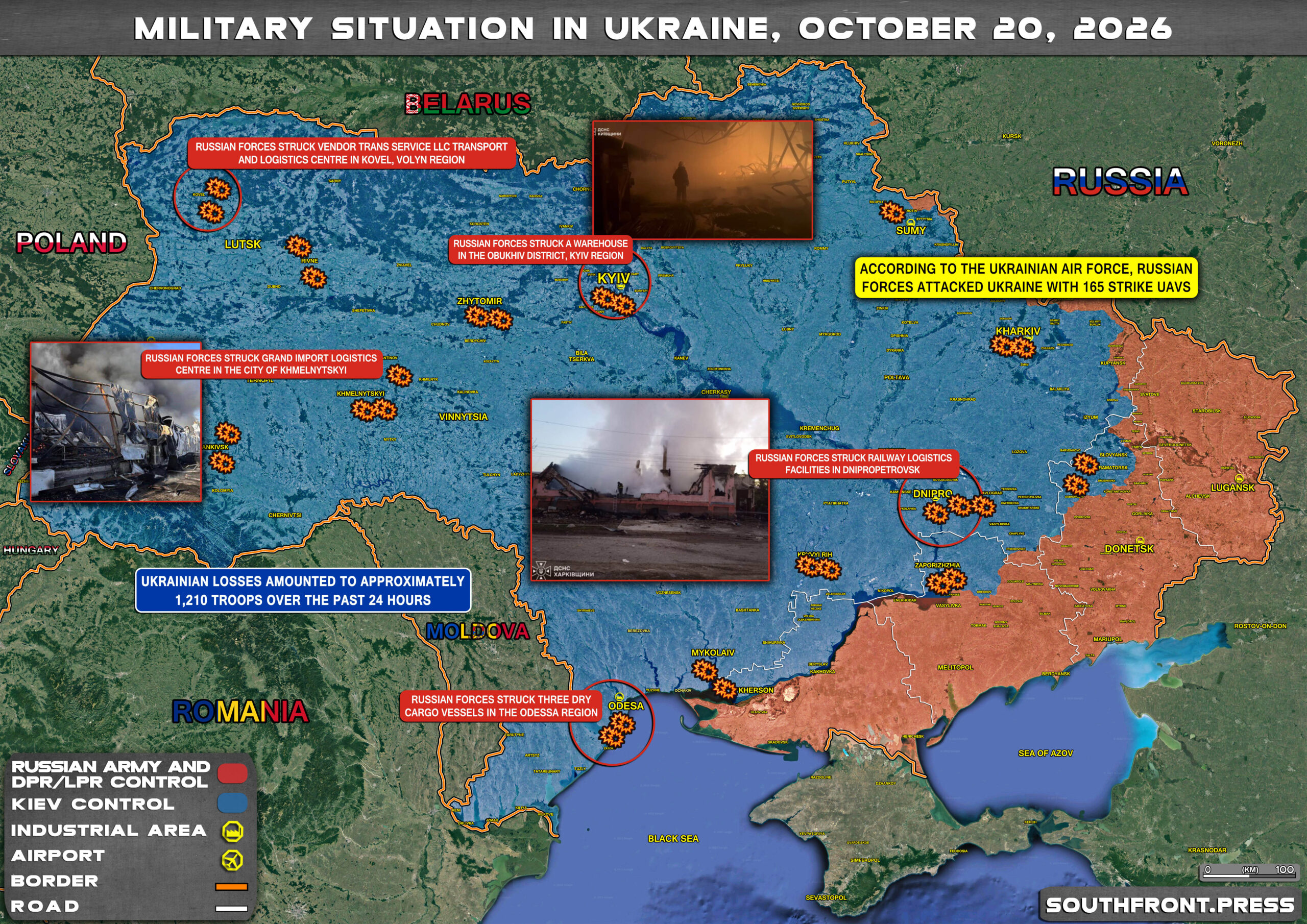
Military Situation In Ukraine And Ukrainian Attacks On Russian Territory On October 20, 2026 (Maps Update)

Click to see the full-size image

  • Russian strikes destroyed targets in the Rivne, Dnipropetrovsk, Kharkiv, Khmelnytskyi, Zaporizhzhia, Ivano-Frankivsk, Mykolaiv, Volyn, Kyiv, Chernihiv, Lviv, Sumy, Odesa, Zhytomyr regions, and the DPR;
  • According to the Ukrainian Air Force, Russian forces attacked Ukraine with 165 strike UAVs;
  • Russian forces struck Grand Import logistics centre in the city of Khmelnytskyi;
  • Russian forces struck Vendor Trans Service LLC transport and logistics centre in Kovel, Volyn region;
  • Russian forces struck three dry cargo vessels in the Odessa region;
  • Russian forces struck a warehouse in the Obukhiv district, Kyiv region;
  • Russian forces struck railway logistics facilities in Dnipropetrovsk;
  • Ukrainian losses amounted to approximately 1,210 troops over the past 24 hours.

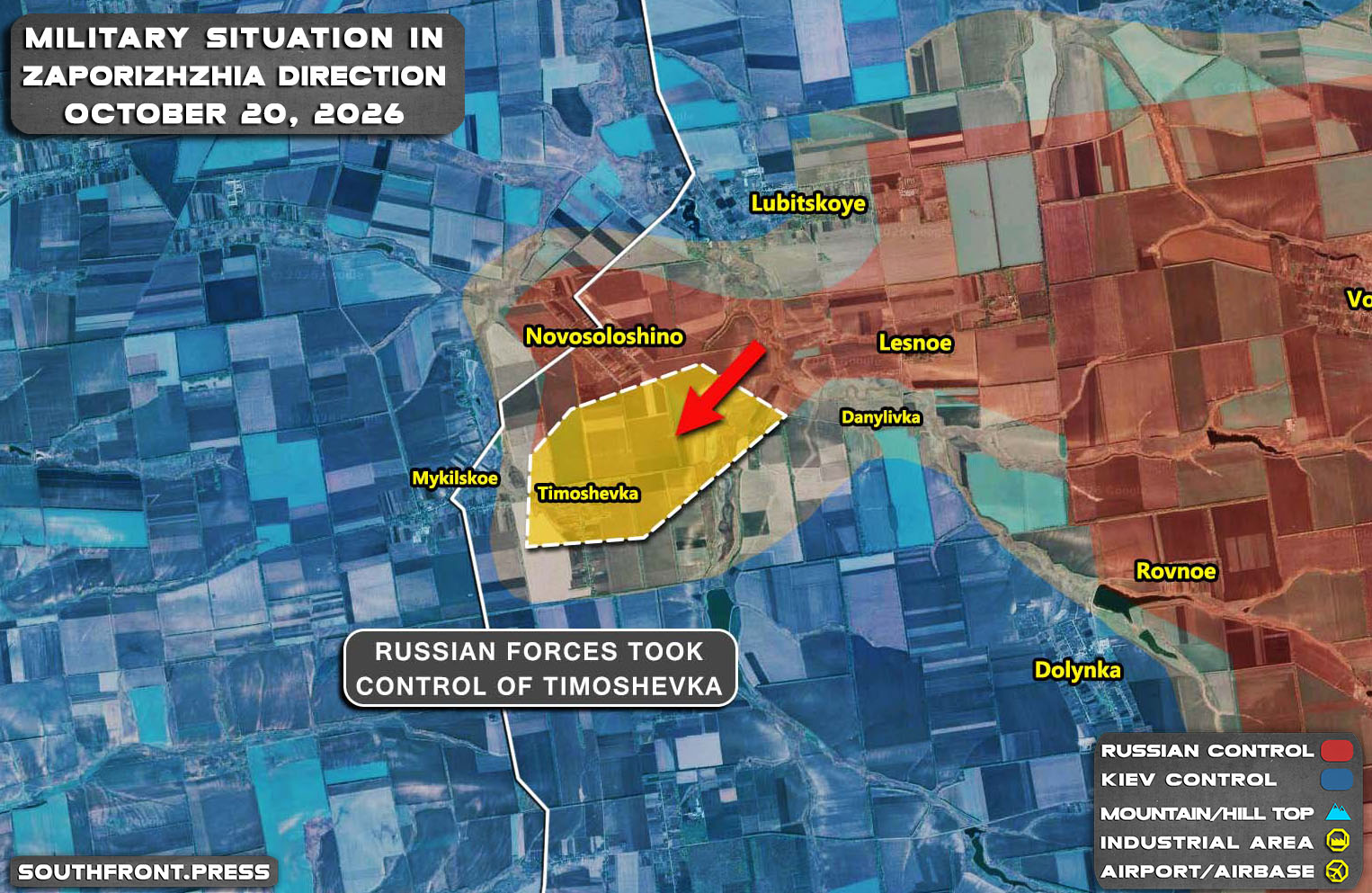
Click to see the full-size image

  • Russian forces took control of Timoshevka.

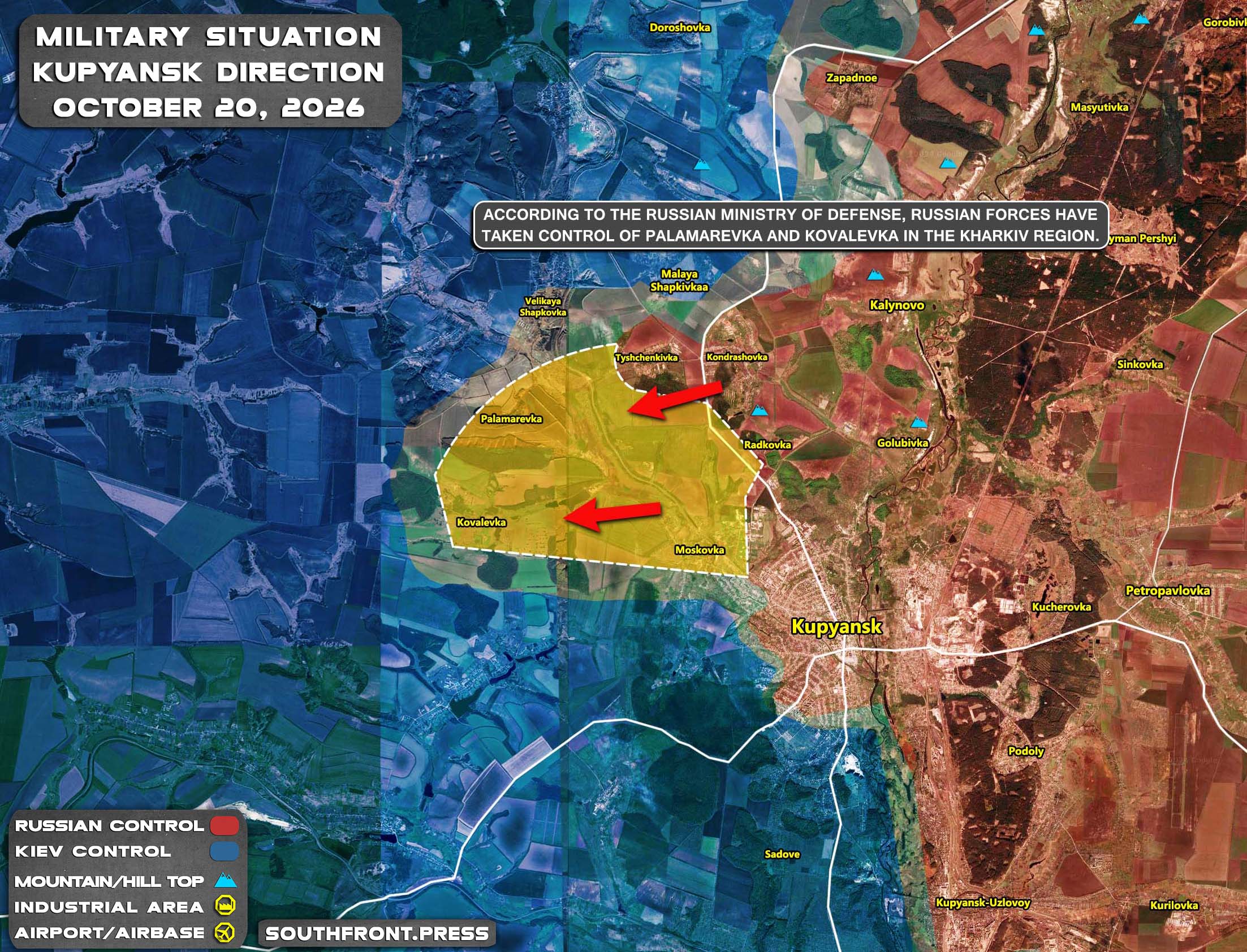
Click to see the full-size image

  • According to the Russian MoD, Russian forces took control of Palamarevka and Kovalevka in the Kharkiv region.

Click to see the full-size image

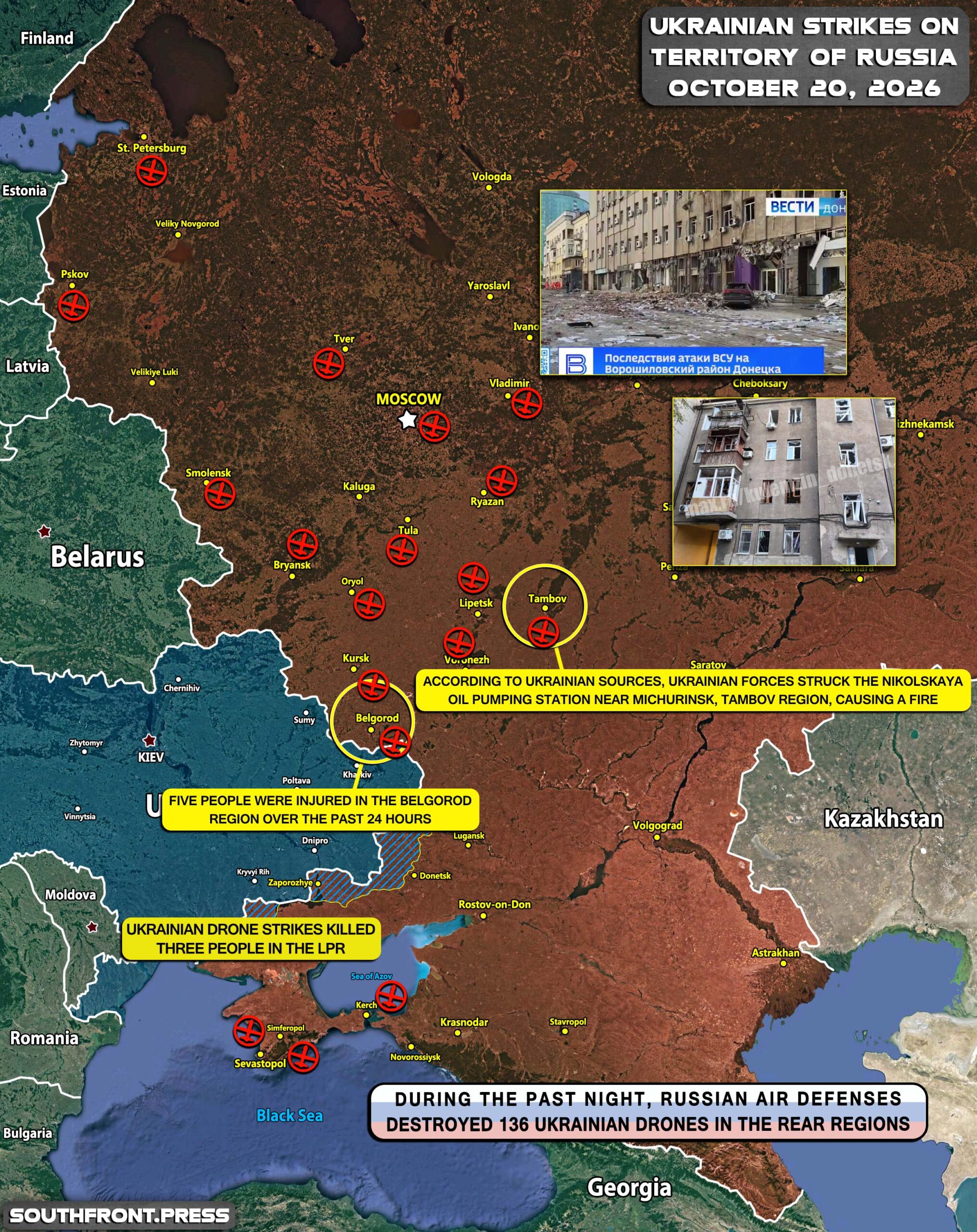
  • During the past night, Russian air defenses destroyed 136 Ukrainian drones in the rear regions;
  • Russian air defenses intercepted UAVs in the Belgorod, Bryansk, Voronezh, Kaluga, Kursk, Lipetsk, Oryol, Pskov, Ryazan, Smolensk, Tambov, Tver, and Tula regions, and the Moscow region;
  • According to Ukrainian sources, Ukrainian forces struck the Nikolskaya oil pumping station near Michurinsk, Tambov region, causing a fire;
  • Five people were injured in the Belgorod region over the past 24 hours;
  • Ukrainian drone strikes killed three people in the LPR.

MORE ON THE TOPIC:

The post Military Situation In Ukraine And Ukrainian Attacks On Russian Territory On October 20, 2026 (Maps Update) appeared first on South Front.

  •  

Liberty Justice Center Files First Lawsuit Challenging Trump's Section 338 Tariffs Against Canadian Imports

An American flag breaks with a Canadian flag
Illustration: Midjourney

Today, the Liberty Justice Center (LJC) filed Gellert Global Group Corp. v. Trump, the first lawsuit challenging President Donald Trump's massive Section 338 tariffs against a variety of Canadian imports. The case was filed in the US Court of International Trade (which has jurisdiction over tariff-related cases); Gellert Global Group is an importer of Canadian cheese subject to the tariffs. LJC is the same public interest group that I worked with on the case challenging Trump's earlier IEEPA tariffs, which ultimate resulted in their invalidation by the Supreme Court. I am not directly involved in the present case. But I support it and believe it deserves to prevail.

LJC has also filed cases challenging Trump's massive Section 122 and Section 301 tariffs. They have become America's premier public interest law group standing up for free trade and enforcing constitutional constraints on executive power over trade restrictions.

Section 338 was part of the infamous Smoot-Hawley tariff act of 1930, which gravely exacerbated the Great Depression. It has never been used before, likely because it was superseded by later laws.

I have previously written about why Trump's Section 338 tariffs are harmful and illegal. See my recent Montreal Economic Institute paper on this topic, and earlier pieces here, here, and here. To briefly summarize, the tariffs on Canada are illegal because 1) Section 338 has been superseded by later legislation, 2) even if Section 338 is still operative, Trump's tariffs do not meet its requirements because the Canadian actions they supposedly respond to do not "discriminate" against US goods, as the law requires, 3) Trump's tariffs do not "offset" the Canadian actions (as Section 338 also requires), but go far beyond that, 4) the administration's interpretation of Section 338 runs afoul of the "major questions" doctrine, and 5) if Section 338 is operative and does authorize the Trump actions, it would violate the constitutional nondelegation doctrine (which restricts delegation of legislative power to the executive).

The LJC complaint advances all five of these arguments. To prevail, they need win on only one. They also add a few more technical points that I will not try to cover here. LJC further seeks a class action certification for a class of all those importers subject to the Section 338 tariffs. If this succeeds, it would block all enforcement of Section 338 tariffs, not just those paid by Gellert.

This lawsuit does not directly challenge Trump's extension of the Section 338 action to categorically ban some Canadian imports, in addition to imposing tariffs. As far as I can tell, Gellert does not import goods subject to the ban (as opposed to the tariffs). However, as I explained here and here, the legality of the bans is dependent on that of the initial tariffs. In a recent Lawfare article, I outline the reasons why executive-imposed import bans are subject to most of the same legal constraints as executive-imposed tariffs.

Like the IEEPA, Section 122, and Section 301 tariffs, Trump's use of Section 338 is an attempt to convert a limited delegation of authority into a blank check enabling the president to impose tariffs whenever he wants. Courts should reject all of these power grabs.

I commend LJC for bringing this important case. And I hope and expect it may not be the last lawsuit challenging the Section 338 measures. Future cases might well challenge the import bans directly, as well as the tariffs.

The post Liberty Justice Center Files First Lawsuit Challenging Trump's Section 338 Tariffs Against Canadian Imports appeared first on Reason Magazine.

  •  
❌