Alemania lleva años viendo cómo merman las inversiones privadas en el país, algo que no puede compensar de manera sostenible con un aumento de las inversiones públicas como está haciendo actualmente el Gobierno alemán. La inestabilidad económica y política de los últimos tiempos parece haber pasado factura a la imagen del país como centro económico y de inversión. Ahora, el canciller alemán, Friedrich Merz, quiere ponerle remedio y ha organizado, por primera vez, una cumbre de inversores de alto nivel con el objetivo de atraer más capital al país. Alemania necesita la inversión privada si quiere modernizarse, crear empleo y generar prosperidad.
Elon Musk says his descendants might have a "tiny fraction" of his wealth.
Jae C. Hong/AP
Elon Musk says "money becomes irrelevant" if he's right about what the future holds.
The Tesla and SpaceX CEO said AI and robots will be better than humans at everything.
The world's richest man said his fortune could be virtually gone within a few generations.
Elon Musk says money could be meaningless one day, and the vast majority of his wealth will likely be gone within a few generations.
The world's richest person predicted that advances in robotics and space travel will create a multiplanetary economy, at which point "money becomes irrelevant" and "conventional currency will not matter."
Value will be measured in mass and power or energy, he continued. "So that's my guess," he said, adding that it seemed a "pretty obvious" outcome to him.
The Tesla and SpaceX CEO shared his vision of a post-money future and his outlook on his personal fortune with his biographer, Walter Isaacson, on "The Builders" podcast. The interview was taped in early August and released on Tuesday.
Musk recommended earlier this year that people stop saving for retirement in 10 or 20 years, as he expects AI and other technologies to supercharge productivity and usher in an age of abundance where people can have "whatever stuff they want."
He made a similar argument to Isaacson, saying "there won't be anything that humans can do that the AI and the robots can't do better." People will likely turn to hobbies like growing their own fruits and vegetables, or making art, to find purpose in life, he said.
Musk's plans for his own money
Musk, who briefly became a trillionaire after SpaceX went public in June, topped the Bloomberg Billionaire Index at Monday's close with an estimated $920 billion net worth.
He defended his personal wealth on the podcast, saying that it mostly reflects his ownership of SpaceX and Tesla, and he needs large stakes in both companies to retain voting power and remain in charge.
His fortune is "going to be taxed quite heavily," Musk said, adding that there isn't "some magical way to avoid taxes" because "if there were, I would know about it."
Musk said his wealth will "get whittled down and a few generations from now — if money still matters, which I don't think it will — my descendants would have a tiny fraction of what I have."
He also outlined what he hopes his foundation will spend his fortune on after he's gone: "Continue the goals. Make life multi-planetary, extend consciousness to the stars, improve sustainable energy on Earth."
Notably, Musk pledged on Monday to gift a share of SpaceX to every child in the US next year, a contribution worth over $10 billion today.
His announcement has won praise from President Donald Trump, who hailed Musk's "incredible generosity" and labeled him a "legendary friend" in an X post.
Musk teased a charitable pledge in late July after Nobel economist Daron Acemoglu publicly challenged him over his prediction of a post-money future.
"If money won't matter in 2036, why don't you pledge to donate your current wealth of approximately $1 trillion to charity no later than 2036," Acemoglu wrote on X.
"I am actually going to do something along these lines!" Musk responded.
Lawyers tell inquiry ‘patients’ lives are at stake’ through improper use of Oxevision system for most vulnerable
Families bereaved by the misuse of an “intrusive” camera monitoring system for vulnerable patients used in half of England’s mental health wards, have called for it to be banned to help prevent more avoidable deaths.
Lawyers for the families said “patients’ lives are at stake” by the continuing use of Oxevision, the Lampard inquiry into mental health deaths in Essex heard on Tuesday.
The inquiry was told that five patients killed themselves, or died unexpectedly, in two years while being surveilled by Oxevision’s infrared cameras at Essex Partnership University NHS foundation trust (Eput).
Peter Mant KC, representing more than 70 bereaved families, including the family of Elise Sebastian, 16, who killed herself in 2021 when staff had muted Oxevision’s alarm system, said: “Use of this technology has contributed in material ways to harms, and in some cases deaths of patients, due to the misapplication of the system.”
Addressing Kate Lampard, the chair of the inquiry, Brenda Campbell KC, representing other bereaved families including that of Sophie Alderman who the inquiry heard mistakenly believed in 2022 that Oxevision would bring staff to save her, said: “We urge you to recommend that the use of Oxevision on mental health inpatient wards is stopped nationally.”
She added: “Its harms have fallen hardest on detained, traumatised and neurodivergent patients, and no regulator took responsibility for it.”
As SpaceX impacts Ukraine and AI-generated music divides artists and fans, critics are asking what happens when technology has too much control over our lives
This was originally published in TechScape, a newsletter about how technology shapes our lives. Sign up to receive it here
Hello, and welcome to TechScape. I’m Blake Montgomery, US tech editor at the Guardian, writing to you while sitting in front of Roy Lichtenstein’s monumental Drowning Girl, on view in New York City. Today in tech, we’re discussing the perils of Elon Musk’s one-man global infrastructure, AI-generated music and a Guardian AI conference in Paris.
Ukrainian President Volodymyr Zelenskyy said on 20 October that he had spoken with US Secretary of State Marco Rubio about ballistic missile interceptors, early warning of Russian launches, and “the situation with Starlink/Starshield, which needs to be restored,” he wrote on X. He thanked Rubio for “his readiness to help and his clear position” and said they would speak again soon. A day earlier, he had told US senators how each of those supplies had stalled.
This comes as the US presses Kyiv to stop its strikes on Russian oil refineries, which Trump has blamed for high fuel prices at home, and Zelenskyy counts the Starlink slowdown among the steps he says look like an effort to push Ukraine to capitulate. Ukraine’s interceptor drones depend on the service to hunt Russia’s jet-powered Shaheds, and Kyiv says they now lose the link at speeds too low to catch them. The call appears not to have settled whether that cap is gone. If it stays, Ukrainian cities could face Russia’s drone waves this winter with one fewer means to stop them, as Russia keeps striking the grid.
On 17 October, Rubio told reporters that nobody in the US ordered Starlink slowed, that the slowdown “wasn’t deliberate,” and that “my understanding is it’s been restored.” He drew a line between the two services. Ukraine’s drones, he said, ran on commercial Starlink, while Starshield, the military version, is not available to Ukraine. Kyiv has asked for it to carry out strikes deep inside Russia, and that request is under discussion, he said.
The next day, Zelenskyy told Bloomberg that Starlink in Ukraine cuts out above 161 km/h, and Kyiv says its Starshield terminals are capped as well. His post after the call still says the service needs to be restored.
Reuters’ sources point to the White House. Washington denies it
The order to slow Starshield came from inside the White House, Reuters reported, citing two US officials and a Western official. They described it as the Starshield service for the Ukrainian military, the version Rubio says Ukraine does not have. A senior Ukrainian official told Reuters that Kyiv had been told it was a White House decision. A senior US official told the agency the president never made such a request, and the White House did not answer whether other officials had. Rubio called a report that the White House ordered Starlink slowed “categorically false.”
Missile warnings and Patriots are also in dispute
Overnight on 18–19 October, Ukraine got no partner warning before the first of two Russian ballistic waves, Air Force spokesman Yurii Ihnat said on the national telethon. That came hours after Zelenskyy said US warnings had resumed. On 19 October, Rubio pushed back against suggestions of a pause in US intelligence sharing, AFP reported.
Zelenskyy also told Bloomberg the US sends only 12 Patriot interceptors a month and has authorized only part of those “we have paid for” under PURL. Ukrainian officials told the Kyiv Independent that Defense Secretary Pete Hegseth has not signed the contracts. A US government official called those claims “not true.”
Taking on Verizon, AT&T, and T-Mobile is a huge endeavor. And it requires significant investment from a company that already has a long list of expensive bets.
As a bit of a refresher, SpaceX is made up of three key parts: connectivity (Starlink), space (reusable rockets like Starship), and AI (Grok, X, and data centers). Among the three, connectivity is the only one generating an operating profit.
That makes it incredibly valuable not only as a stand-alone business but as a way to offset the expensive investments made by SpaceX's space and AI segments.
Turning Starlink into a mobile carrier complicates that arrangement. To offer service in more densely populated areas, SpaceX will need to launch more satellites into space and establish a ground footprint.
How much SpaceX plans to set aside for that buildout and the impact it'll have on the bottom line are key questions analysts will have.
He's backed it up by accomplishing things others thought were impossible, like self-landing rockets. Just don't expect him to hit his self-imposed deadlines. (Case in point: Tesla Roadster, which has faced numerous delays and is now targeting production in 2028.)
There's less at stake when you're starting from scratch. But with Starlink, it's also about Musk avoiding turning his cash cow into another capital drain.
According to another Musk proclamation, a lot of us will have a vested interest in SpaceX's success.
If that's how the shares are distributed, it's an example of the complexities the Trump Accounts can pose for some parents. Certain jobs, like those in financial services, have restrictions around the types of investments you can hold due to compliance reasons.
Twelve migrants, including an infant, have died in two separate incidents involving boats travelling from Turkey towards the Greek islands of Lesbos and Samos, prompting investigations into the circumstances of the deaths and the activities of suspected people smugglers.
The incidents occurred on Monday, 19 October, in the northeastern Aegean Sea. Six people died when a speedboat collided with a Greek coastguard vessel near Lesbos, while another six were killed after a separate boat overturned north of Samos.
The deaths coincided with the publication of new figures from the European Border and Coast Guard Agency, Frontex, showing that irregular crossings into the EU fell by almost one-third during the first nine months of 2026.
According to the latest border monitoring figures, approximately 91,000 irregular crossings were detected between January and September, although the eastern Mediterranean remained the busiest migration route into the Union.
Two incidents under investigation
According to information released by the Greek authorities, the first fatal incident occurred near Agrilia on Lesbos when a speedboat carrying migrants struck a coastguard patrol vessel before overturning.
Six people died, while eight survivors were taken to hospital. The authorities subsequently arrested a 37-year-old Turkish national, identifying him as the suspected operator of the migrant boat.
Greece’s Maritime Affairs Minister Vassilis Kikilias said the available evidence indicated that the speedboat had struck the left side of the coastguard vessel. The precise circumstances remain under investigation.
In the second incident, approximately four nautical miles north of Samos, a boat reportedly overturned after making a sudden manoeuvre while being pursued by the coastguard.
Five men and one woman died, while 14 people were rescued. An Iranian national was arrested on suspicion of involvement in migrant smuggling.
The arrests do not establish criminal responsibility, and the circumstances surrounding both incidents remain subject to investigation.
Greek authorities have attributed the dangers of the crossings to trafficking networks operating between Turkey and the Aegean islands. The government has reiterated its policy of pursuing smugglers and restricting unauthorised maritime arrivals.
Fewer crossings, continued fatalities
Frontex recorded approximately 31,800 detections along the eastern Mediterranean route during the first nine months of this year, representing a decline of around 15 per cent compared with the equivalent period in 2025.
Across the European Union’s external borders, the agency reported an even larger reduction, with overall detections down by almost one-third.
The Central Mediterranean route experienced a particularly substantial fall, while the Western Mediterranean recorded an increase, reflecting changes in departure points and migration patterns.
These figures count detected border crossings rather than individual migrants and do not necessarily capture every unauthorised arrival.
The latest data also have to be considered alongside exceptional developments elsewhere on Europe’s borders. In July, large-scale movements through Spain’s Ceuta enclave created additional pressures on Spanish authorities and raised questions about the application of the EU’s new asylum arrangements.
The eastern Mediterranean figures encompass several routes, including crossings from Libya towards Crete, movements through the Aegean islands and arrivals across the land border with Turkey.
Consequently, the total recorded for the wider region should not be interpreted solely as the number of people arriving on the Greek islands.
Greece remains central to European border policy
Greece has occupied a central position in EU migration policy since the 2015–2016 crisis, when hundreds of thousands of people arrived from Turkey, many travelling onwards through the Balkans.
The subsequent EU–Turkey migration arrangements were intended to reduce unauthorised crossings and establish procedures for returning certain migrants who did not qualify for protection.
Athens has also faced persistent criticism from human rights organisations concerning allegations of unlawful returns at sea and land borders. Greek authorities deny operating an unlawful pushback policy and maintain that their border operations respect domestic and international law.
The EU’s Pact on Migration and Asylum, which entered into application in 2026, has introduced common procedures for screening arrivals, processing asylum claims and managing people who do not have permission to remain.
Its implementation has placed greater emphasis on border identification, biometric registration and cooperation between national authorities and Frontex.
However, the two disasters demonstrate the continued risks associated with maritime crossings, even during a period of declining arrivals.
Investigators must now establish precisely how both boats overturned, whether criminal offences were committed and what occurred during the encounters with coastguard vessels.
The findings will be relevant not only to the prosecutions of those arrested, but also to continuing scrutiny of maritime enforcement along one of the European Union’s principal external borders.
Reports that SpaceX temporarily restricted its satellite internet service for Ukraine’s armed forces have generated serious concern in Kyiv and among the country’s allies. SpaceX operates the civilian Starlink system and its lesser-known military-grade counterpart, called Starshield. But many news stories leave an important question unanswered: what does a Starshield “slowdown” mean on the battlefield? […]
A Sofia court has cleared European arrest warrants for two 19-year-old Germans charged with setting fire to Starlink antennas south of the Bulgarian capital, a court spokeswoman told dpa. Prosecutors named the pair in court, but both had already left Bulgaria. The case adds Bulgaria to a run of attacks on Starlink sites in Europe, which Poland and Lithuania have linked to Russia.
While Russia presses its assault along the front and strikes Ukraine’s cities, Starlink keeps Ukraine’s drone units and front-line troops connected, and Poland pays about $50 million a year for its terminals. The network’s ground links in Europe are now a target in their own right, and ISW has linked the Polish fire to a wider Russian pattern of sabotage. Each attack on a ground station hits a network whose speed caps already disrupted Ukraine’s drone missions this month.
Two names, a few hours in Bulgaria
Prosecutors identified the suspects as Zeka Islam and Tirpan Beytullah, Bulgaria’s state news agency BTA reported, noting the names may be misspelled. Their whereabouts are unknown, according to German authorities cited by the agency. They were charged in absentia on 14 October and face three to 12 years in prison if convicted.
According to the indictment, the two crossed from Serbia at the Kalotina checkpoint at 17:37 on 9 October and told border officers they were tourists. At about 22:25, wearing gloves and masks, they allegedly set fire to antennas at the Plana teleport, a satellite ground station near the village of Plana. They drove back into Serbia through the same checkpoint at 23:55.
Three antennas burned completely, two were partly damaged, and three more were affected, prosecutors say. The pair traveled in a Volkswagen with German plates, and a national warrant followed two days after the charges, ZDF reported.
Explore further
Musk pushed Trump to slow Starlink in Ukraine, weakening air defenses as Russian drones attacked cities – The Telegraph
The court-appointed lawyers argued that investigators had pinned down the vehicle, not the men in it. The court rejected those objections, finding reasonable grounds to suspect the pair. The lawyers said they would appeal. The ruling can be challenged within three days.
A Starlink antenna. Illustrative photo: Christoph Soeder/dpa
An opposition MP made the fire public three days later
The fire became public only on 12 October, when opposition MP Ivaylo Mirchev of Democratic Bulgaria posted about it on Facebook. He said 11 antennas had been set on fire, more than prosecutors later counted.
In parliament two days later, Prime Minister Rumen Radev asked the head of the State Agency for National Security (DANS) not to reveal details, saying disclosure could harm the investigation. DANS head Plamen Tonchev told lawmakers he believes the fire was sabotage and that more such attacks cannot be ruled out, dpa reported.
Explore further
White House ordered limits on Ukraine’s military satellite service — Reuters. Who made the decision remains unclear
After the ruling, Mirchev wrote that Radev personally owes the public an explanation of what has been achieved, BTA reported.
Bulgaria’s case joins attacks Poland and Lithuania tie to Russia
Bulgaria has not said who might be behind the fire. Authorities in Poland and Lithuania have linked similar recent arsons on Starlink equipment to Russia.
In September, fire hit a Starlink ground station south of Warsaw, and Germany later detained two suspects. On 18 October, Lithuania’s prime minister said intruders had tried to burn a company’s Starlink antennas used by Ukraine, calling it part of Russia’s hybrid war. Moscow claims such accusations are baseless, Reuters reported.
KARACHI – Foreign currency exchange rates in Pakistan show slight changes; the US Dollar remains at Rs277.40 for buying and Rs280.3 for selling, while Euro and UK pound sterling are trading at higher levels, according to the provided exchange rate data.
UK pound sterling is quoted at Rs369.45 for buying and Rs373.46 for selling. Meanwhile, Euro stands at Rs311.08 for buying and Rs315.59 for selling.
Among Gulf currencies, the UAE dirham is listed at Rs75.6 for buying and Rs76.35 for selling, while the Saudi riyal is quoted at Rs73.85 and Rs74.50, respectively.
Beijing has proposed banning exports of the technology used to make next-generation solar cells, a move that could complicate United States technology guru Elon Musk’s plan to expand into space solar power. The ban, which covers production technology for perovskite and tandem solar cell modules, is part of a proposal by China’s Ministry of Commerce […]
Spain’s government has declared that the first phase of its emergency response to the Ceuta migration crisis has been completed, following the arrival of an estimated 80,000 migrants from Morocco at the end of July.
Interior Minister Fernando Grande-Marlaska said on Friday, 16 October, that approximately 12,000 people had returned voluntarily to Morocco since August, while the authorities had expanded facilities to process asylum applications and return decisions.
Nevertheless, substantial administrative and humanitarian challenges remain in the Spanish enclave, particularly concerning people awaiting decisions on their legal status and unaccompanied minors. The situation has become an important test of the European Union’s revised migration and asylum legislation.
Unprecedented crossings at the African border
The crisis began on 30 July, when tens of thousands of people entered Ceuta from Morocco by land and sea following the circulation of misleading information on social media about access to Spanish territory.
According to an October briefing by the European Parliament’s Research Service, approximately 80,000 people crossed into the enclave during the incident, overwhelming local reception facilities and creating an emergency at one of the EU’s few land borders with Africa.
A subsequent European Parliament resolution referred to at least 141 deaths associated with the crossings, although the initial figure reported by Spanish authorities was lower. The exact number of people who crossed and the final death toll have remained subjects of uncertainty.
Most entrants returned to Morocco within days. However, thousands remained, leaving Spain responsible for assessing individual claims, arranging lawful returns and providing appropriate accommodation.
Ceuta’s geographical position complicates these procedures. Although the enclave is Spanish and forms part of the EU, travellers departing for mainland Spain remain subject to specific controls at its ports and airports.
Spain expands its processing capacity
During a visit to Ceuta on 16 October, Grande-Marlaska defended the government’s management of the emergency and announced that additional police resources would substantially increase administrative capacity.
The expanded temporary reception and processing facilities at El Tarajal are intended to handle at least 100 files daily, including applications for international protection and return procedures.
According to figures presented by the Interior Minister, approximately 1,200 applications for international protection had been formally submitted, with around 700 decisions already issued.
He also rejected allegations that the authorities had conducted concealed or involuntary returns, insisting that departures to Morocco had followed voluntary decisions or the appropriate legal procedures.
The minister said more than 500 expulsions had been executed through judicial or administrative decisions in recent months. These are distinct from the approximately 12,000 voluntary returns recorded since August.
The treatment of unaccompanied minors remains contentious. The European Parliament’s research briefing estimated that around 1,100 such minors were in Ceuta, including some who arrived before the July emergency.
Responsibility for their care has generated disagreement between the Spanish central government and Ceuta’s autonomous administration, particularly over guardianship, identification and the distribution of minors to other regions.
New EU asylum system faces a practical test
The EU Pact on Migration and Asylum, which began applying in June 2026, was designed to strengthen external border procedures while establishing clearer responsibilities for Member States.
Its provisions include identity and security screening, accelerated procedures for certain asylum applications and a solidarity mechanism allowing countries to support those facing disproportionate migration pressures.
Under the screening rules, the authorities generally have up to seven days to complete the initial checks required for people apprehended after irregular entry.
However, the Ceuta emergency demonstrates the difficulty of applying individual administrative procedures when arrivals occur in exceptionally large numbers within a short period.
The geographical concentration of arrivals means that adequate staffing, interpretation, legal assistance and reception facilities become essential to ensuring the system operates within its prescribed deadlines.
Spain requested assistance from Frontex, Europol and the European Union Agency for Asylum in August. The Commission subsequently announced €114.7 million in emergency assistance in September.
Political dispute over migration policy
The crisis has widened divisions between European governments over border enforcement and the regularisation of migrants already living within the EU.
Italy and several other Member States have questioned whether Spain’s separate regularisation programme could encourage further irregular migration. Madrid rejects the suggestion that the programme caused the Ceuta crossings.
The Spanish scheme covers only people who met the residence requirements by the end of 2025. Those who arrived during the July 2026 crisis are not eligible.
European Parliament members also adopted a resolution in September calling for stronger protection of the EU’s external borders and greater cooperation with Morocco. The resolution characterised the crisis as involving the possible instrumentalisation of migration, although Spain has said it has no evidence establishing Moroccan government involvement.
The continuing administrative backlog, the position of minors and the effectiveness of EU assistance will determine how quickly Ceuta can return to ordinary border operations.
Beyond Spain, the episode raises a practical question for Brussels: whether Europe’s new asylum framework can maintain border controls and individual legal safeguards simultaneously during an exceptionally large and sudden influx.
Elon Musk prometeu dar uma ação — “a primeira de muitas” da SpaceX a cada criança dos Estados Unidos: são mais de 10 mil mihões de dólares. O bilionário Elon Musk anunciou esta segunda-feira que vai oferecer uma ação da SpaceX a todas as crianças dos Estados Unidos no próximo ano. A promessa poderá representar uma distribuição de ações avaliada em mais de 10 mil milhões de dólares, mas o empresário não explicou como pretende concretizá-la. “No próximo ano, darei uma das minhas ações da SpaceX a cada criança dos Estados Unidos. Esta será a primeira de muitas”, escreveu o
Russian strikes on Ukrainian data centers could backfire, experts have told the Kyiv Independent, as Kyiv's retaliatory attacks have exposed vulnerabilities in how Moscow has organized IT infrastructure.
On Sept. 23, a Russian attack damaged a Kyiv data center housing network equipment for internet provider UTELS, causing service
Matt Gaetz resigned from the U.S. House of Representatives in November 2024, shortly before the House Ethics Committee released a report accusing him of having sex with a 17-year-old girl in 2017, when he was 35, and "regularly pa[ying] women for engaging in sexual activity with him." The probe was widely discussed as a sex trafficking probe, but the ethics committee "did not find sufficient evidence to conclude that Representative Gaetz violated the federal sex trafficking statute," per its report.
Now two women have filed a civil lawsuit accusing Gaetz of sex trafficking.
The suit, filed in the U.S. District Court for the Middle District of Florida, says that Gaetz and two other men (Joel Micah Greenberg and Christopher Dorworth) broke federal anti-trafficking laws by using "their public office, power, and wealth to prey on the economic vulnerability" of Jane Doe 1 and Jane Doe 2.
Gaetz, who now hosts The Matt Gaetz Show on One America News Network, said many of the suit's allegations against him are false. "The lawsuit relies almost exclusively on a Congressional Committee report that didn't allow me to confront my accusers," he said. "Now I will finally have that chance."
On X, Gaetz posted an image of three women in bikinis seated next to bottles of beer and looking at the ocean and wrote "Jane Doe Strikes Again! Two adult women sued me today alleging they were sex trafficked to the Bahamas. I'm shocked nobody responded to their repeated cries for help, posted to instagram."
Jane Doe Strikes Again! Two adult women sued me today alleging they were sex trafficked to the Bahamas. I'm shocked nobody responded to their repeated cries for help, posted to instagram. https://t.co/HPvX2xypzs
This does not seem like especially helpful behavior from a public relations perspective, to say nothing of whether it's legally wise to for Gaetz to be posting to social media about the suit against him.
But Gaetz's point isn't entirely off base. The actions described in the suit against him are hardly what most people would consider sex trafficking.
Jane Doe 1 and Jane Doe 2 were adult women willingly advertising on Seeking Arrangement, a site aimed at connecting young women with rich men for mutually beneficial relationships. And by their own account, that is what went down. They were taken on trips and paid thousands of dollars while hanging out, partying, and having sex with Gaetz and his friends.
Needless to say, advertising on a sugar baby website does not make you fair game for forced prostitution or sexual assault. But nowhere in the lawsuit are forced prostitution or sexual assault alleged.
Instead, we get sentences like this: Gaetz and the other defendents "led [Jane Doe 1] to believe they could solve her financial problems as long as she kept performing sexual acts for them and their associates," states the suit. But "the money never came as a single payment that would have solved Jane Doe 1's financial issues."
So…it's sex trafficking because he didn't pay her enough at one time? I don't think that's how the law works.
Overall, it's a stretch to say that Gaetz's actions as described in this suit fall under the scope of the federal Trafficking Victims Protection Reauthorization Act. Under federal law, sex trafficking must involve an element of force, fraud, or coercion, and/or must involve commercial sex involving someone who is under age 18.
In this case, both alleged victims were in their 20s at the time of the alleged trafficking. No element of force or fraud is claimed. And the type of "coercion" alleged seems more appropriate for a college debate than a courtroom.
There was no suggestion that harm would come to the women or their families, that a job or housing would be lost, or that failure to engage in sexual activity with Gaetz and his friends would result in some sort of other (physical, reputational, legal, etc.) harm befalling them. There was nothing on Gaetz's end that would seem to arise to "coercion" under federal trafficking statute, which defines it as involving "threats of serious harm to or physical restraint against any person," a scheme to make someone believe that serious harm will befall them if they don't comply, or abuse or threatened abuse of the legal process.
The suit contains a lot about Greenberg—a former tax collector who is in prison after pleading guilty to charges that include sex trafficking—and comparatively little about Gaetz. It seemingly attempts to make up for the lack of direct allegations against him by noting findings from the Ethics Committee, even though that committee specifically said it could not find evidence of sex trafficking.
Gaetz is accused of having sex with Jane Doe 1 at a party while Jane Done 1 was on MDMA. But the suit does not accuse Gaetz of foisting drugs on her, simply saying "controlled substances circulated at the party, and Jane Doe 1 took MDMA during the evening." Nor does it say that anyone forced Jane Doe 1 to be at the party or to have sex with Gaetz.
Gaetz is also accused of paying Jane Doe thousands of dollars—never directly after sex or as a direct quid pro quo, but during the same time period during which he was having sex with her. The payments were labeled things like "Being my friend," "Being awesome," "Here," and "Just because," the suit says.
And Gaetz is accused, along with the other defendants, of paying to fly Jane Doe 1 and Jane Doe 2—whom Greenberg met through the sugar baby website and introduced to Gaetz—"to Venice Beach, Miami, Las Vegas, the Florida Keys, the Bahamas, and New York City" and paying for their hotel rooms. The suit does not say that they were forced or coerced on these trips, merely that the trips exposed them to "men they would never otherwise have met, and every part of that access, from the flights to the hotel rooms, was paid for by men, including the Defendants, who expected sex in return."
The women's lawyer told the Associated Press that there was "an exploitative power imbalance," because on one side you had a congressman and some other powerful men and on the other "young financially vulnerable women in their early twenties."
Morally speaking, that might be relevant. And for a congressman, it may have been grounds for sanction. But the fact that these women were younger and less financially successful does not make a relationship between them and Gaetz de facto "coercive" or illegal.
Age gaps in relationships—even substantial ones—are not outlawed. And relationships in which an older man is attractive precisely because he has more money and power than the younger female involved, and offers to spend it lavishly, are not uncommon. The idea that this violates federal criminal law simply showcases how distorted our ideas of sex trafficking have become.
In the News
Children have a fundamental right to access the internet, says India's Supreme Court. The Free PressJournalreports:
"The safety of our children and their freedom are not at odds with each other. Our children are entitled to both," the court observed.
The bench explicitly recognised the right to access and use the internet as a fundamental right under Article 21, which protects life and personal liberty, read with Article 19(1)(a), which guarantees freedom of speech and expression.
Meanwhile, in the U.S.: "A federal appeals court panel has ruled that Florida's 2024 law restricting access to social media for teens is likely constitutional and can continued to be enforced while the legal challenge continues," notes the Florida Phoenix.
We were promised REPEATEDLY that age-verification law was narrow, and would ONLY apply to porn. But— as we warned —it was always a ruse.Since conservatives got their ruling in FSC v Paxton, they've pushed to age-gate anything and everything. It's not going to stop with social media or chatbots.
'Appropriate safeguards.' A small change in the language of the Apple App Store's app review guidelines could portend big changes. Via9to5Mac:
Under Section 1.2, which covers user-generated content, the guidelines now read (changes in bold):
Apps that enable users to create, generate, upload, share, or otherwise contribute content present particular challenges, including intellectual property infringement, nonconsensual intimate imagery, and anonymous bullying.
Apple's new terms add that "Developers who fail to implement appropriate safeguards or fail to remediate identified violations after notice may be considered in violation of the Developer Code of Conduct."
The change is being reported as a crackdown on "nudification" apps, and that certainly seems to be part of it. But the language about going after "developers who fail to implement appropriate safeguards"—combined with the broad warning about user-generated content—could signal a broader intent to crack down on social media platforms and other types of apps that don't implement ID verification or engage in more intense content moderation.
On Substack
Don't sacrifice due process to outrage. We can't let anger over allegations of gang rape at Cornell convince us to re-implement old Title IV policies that disregard due process, writes Robert Shipley of the Foundation for Individual Rights and Expression:
There's a groundswell of demand to "do something" in the wake of the sexual assault claims at Cornell. But amid the outrage and concern over the incident, it's critical to remember that one attempted remedy we actually know will not work is to return to a campus justice system in which the burden of proof is on the accused and basic civil liberties are cast aside. That social experiment has already been run. It failed.
Title IX, the law against sex discrimination in federally funded education programs, was passed in 1972. Debates at the time focused on how it would affect single-sex colleges and college athletics. Explicitly aimed at sex discrimination, the text of the law itself mentions neither sexual assault nor sexual harassment. Those became matters for Title IX gradually over the next couple of decades, as courts determined that sexual assault and sexual harassment were both forms of sex discrimination, and therefore covered under Title IX.
The Jane Doe lawsuit against Cornell and the accused students (as well as a fraternity, a sorority, and a local bar) hit national news at nearly the same time that the Trump administration officially removed the Biden-era regulations from the Federal Register. While almost certainly not related, some have connected the two, citing the Cornell incident to argue that regulations surrounding Title IX need to be changed again to reduce due process protections for the accused.
Not to pick on Sam here, but this is a useful point to highlight some of the impossibility of trust & safety work. Meta actually used to have a program *exactly* like this, BUT it became a central feature of Frances Haugen's Facebook Files as an example of Meta being evil.I'll explain…
• A new pair of high-tech sunglasses from Meta "can read your mail, describe the person in front of you, tell you what is on a restaurant menu, and help you find your way home," writesReason's Reem Ibrahim. "For the approximately 700,000 Americans who are blind, it is potentially life-changing."
• "The Supreme Court of Canada has upheld a decision ordering new trials for two people facing human trafficking and sexual services offences, after concluding they should have been able to cross-examine a complainant about the commercial aspect of her prior sex work," reportsThe Canadian Press. "The case looked at the application of section 276 of the Criminal Code, known as the rape shield law, which limits use of evidence about a complainant's sexual history in court proceedings."
• Markets in everything:
This website lets you attend the wedding of complete strangers
Couples list their weddings and users can buy a ticket to attend https://t.co/8b7EawyFod
• The People First Transportation Alliance has been campaigning against robot taxis in D.C. "But just who is behind the group remains unclear, even as it has sought to sway the outcome of a contentious issue with vast sums of money and thousands of jobs at stake across the country," reportsThe Washington Post.
The offer arrived a day after artificial intelligence company Anthropic announced in a social media post that it will commit 5% of its shares to a new "public benefit" fund.
The $48bn giveaway comes amid concerns about the tech and as the company prepares for a stock market listing
Anthropic has said it will commit 5% of its shares to a fund for the “public good”, as the AI developer behind the Claude chatbot seeks to bolster its appeal before its stock market listing.
The company announced it would commit the shares, worth around $48bn (£36bn) at its latest valuation in May, subject to shareholder approval. It will add a further 2% of its stock to the fund for every 50% increase in its value above an undisclosed baseline.
Prasad Kalyanaraman, vice president of infrastructure services at Amazon Web Services
BASTIEN INZAURRALDE/AFP via Getty Images
Amazon is on an unprecedented spending spree to build more AI data center capacity than anyone else.
The company has extensive experience, yet even it's struggling to bring capacity online fast enough.
Internal documents show Amazon getting bilions of dollars of Nvidia GPUs before they can be deployed.
At an internal staff meeting in September, AWS CFO John Felton had a joke for Prasad Kalyanaraman, the executive overseeing much of Amazon's AI infrastructure expansion.
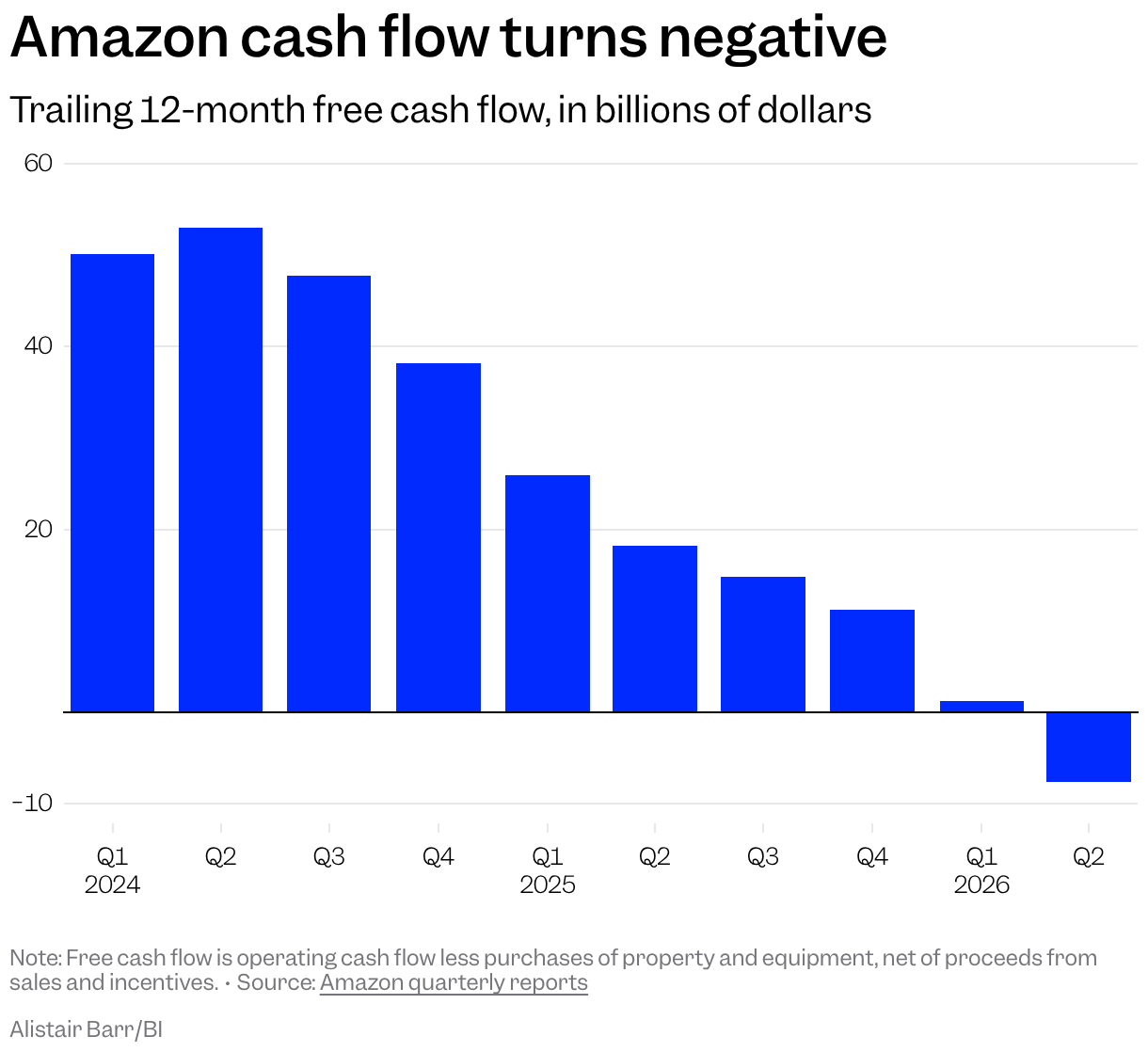
"You've taken us free cash flow negative as a company, so congratulations," Felton said, according to a recording of the meeting obtained by Business Insider.
The remark was lighthearted. But it captured a stunning reversal.
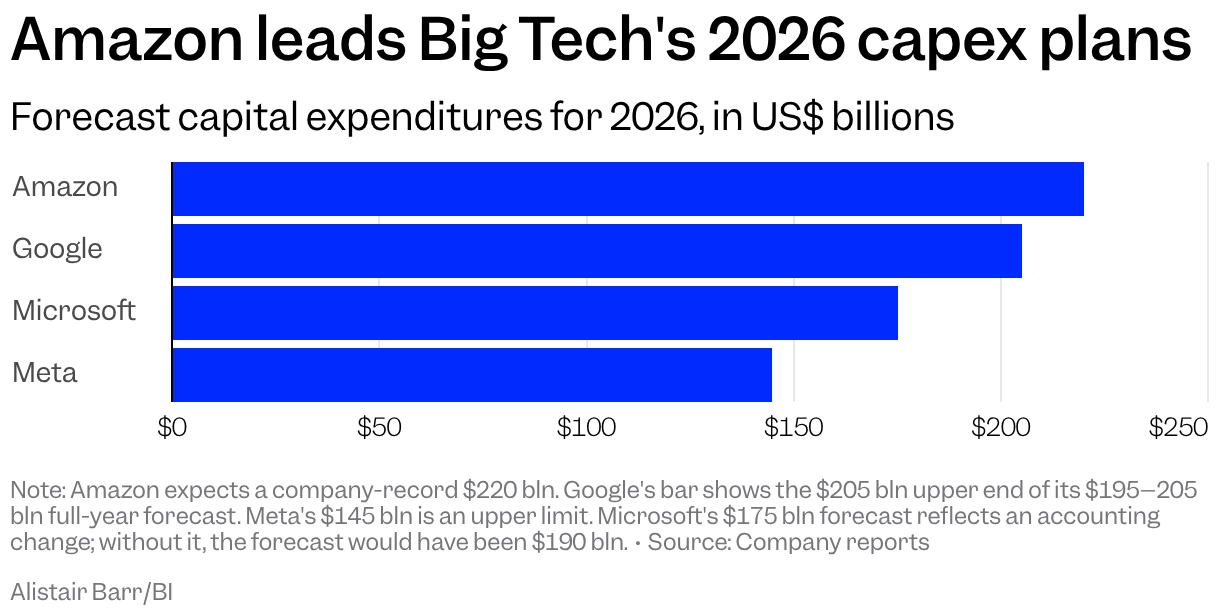
Just two years ago, Wall Street was debating what Amazon would do with its growing cash hoard. Now, cash flow has evaporated as Amazon embarks on its biggest bet ever, spending $220 billion this year alone to build the physical backbone for AI.
At the meeting, Kalyanaraman did not dispute Felton's premise. Amazon's machine-learning and AI business is "hugely free cash flow negative," he said, adding that he expects the company's free cash flow to remain negative for "the next couple of years or so."
Amazon has made big bets before. It spent heavily on cloud computing, fulfillment centers, and its delivery network long before they became some of the company's most valuable assets. Investors questioned those investments at the time, but Amazon ultimately built enormous, profitable businesses from them.
AI is testing this playbook at a far larger scale. Amazon is committing hundreds of billions of dollars to data centers, servers, and power before investors know how quickly those investments will generate revenue.
The company is the best, or among the best, at building data centers, with decades of experience. But the size and complexity of these projects, and the bottlenecks holding progress back, are challenging — even for such a respected cloud pioneer.
Internal documents reviewed by Business Insider and people familiar with the matter show the company trying to coordinate a sprawling industrial system whose parts move on different schedules. A delay in power, equipment, or construction can leave billions of dollars in hardware waiting — and Amazon's cash tied up — while forecasts and costs keep shifting.
Why Amazon thinks it will work
Amazon says it has strong evidence that the capacity will be needed. AWS revenue grew 37% in the second quarter, its fastest pace in 18 quarters, while its backlog reached $496 billion.
CEO Andy Jassy thinks the company has a "clear line of sight" to strong financial returns from this record investment cycle. In his latest annual shareholder letter, he called AI a "once in a lifetime opportunity" and said Amazon would not be conservative in its investments.
"We've been through this cycle with the first big AWS growth wave, and liked the results," Jassy wrote. "We expect to feel similarly about this next wave."
Investors are concerned by the scale of the industry's expansion, especially as AI data centers are costing more to build and taking longer to complete.
The market is "repricing anything that funds multi-year builds against revenue that arrives later," Dan Ives, an analyst at Yorkville Ives, wrote in a recent report. Growing uncertainty around data center permitting and the political fight over electricity prices have given investors another reason to question how quickly these investments will pay off, he added.
Racks, but not enough power
One major industry challenge is securing enough power to run the equipment that goes inside data centers. This includes expensive racks of servers that contain GPUs and other chips that train and run AI models and services such as ChatGPT.
Internal emails from August show Amazon preparing a new "Early Rack Receipt" process for an expected wave of server racks carrying Nvidia's GB300 chips at US facilities before final deployment.
One Amazon email projected the company would take delivery of about $5 billion of Nvidia GB300 racks in August, followed by another roughly $3 billion each month "for the foreseeable future."
Some AWS data center sites had room for more racks but not enough available power to turn them on, people familiar with the effort said, leaving the equipment to be staged at intermediary warehouses until the facilities were ready. These people asked not to be identified discussing sensitive matters.
Timing and coordination
Usually, Amazon doesn't pay for racks until the gear is put into a data center, leaving suppliers to carry the cost of the equipment in transit, according to the internal documents obtained by Business Insider. This helps the company conserve cash.
However, the intensity of the AI data center building boom has made this type of coordination harder. Amazon has to compete more for scarce resources as it jockeys with rivals for access to Nvidia GPUs and other AI components.
Under the new "Early Rack Receipt" process, Amazon now takes ownership of these racks earlier in the supply chain, rather than waiting until the equipment reaches a data center.
The means spending cash sooner. And any delays getting the racks installed and plugged into a reliable power source potentially pushes back the moment when revenue starts flowing from these assets.
At least one AWS supply chain team did not have "a clear forecasted path" for getting racks into data centers, according to one of the emails reviewed by Business Insider.
An Amazon spokesperson said the company routinely stages finished hardware near deployment sites so it can be installed once power capacity is available, calling that approach "best business practice."
The spokesperson added that AWS has "long-established systems" to track infrastructure assets and disputed that the broader company lacks a forecasted path for getting racks into data centers.
This problem is not unique to Amazon.
Bernstein analysts wrote in a recent note that power permits, cooling systems, electrical equipment, construction, and hardware all move on separate schedules.
"Timing is imperfect," the analysts said.
"Inherently uncertain"
John Felton, Chief Financial Officer of Amazon Web Services
Chris Jung/NurPhoto via Getty Images
During the internal staff meeting in September, Felton, the AWS CFO, described the broader problem eloquently: "How do you work in the future when the future is inherently uncertain?"
Kalyanaraman, the AI infrastructure leader, said Amazon's internal outlook for the return on its AI investments had improved. But the assumptions behind those returns keep shifting.
"The forecast is changing on a daily basis," Kalyanaraman said. "The world that we live in is extremely dynamic."
Those shifting assumptions include when data centers will be ready and how much equipment AWS needs to keep on hand, he explained.
An eight-week supply buffer might be routine for a smaller company. But at Amazon's scale, Kalyanaraman said, this could mean holding "billions and billions of dollars" worth of additional equipment inventory — tying up precious cash.
Frugality meets the AI boom
Such tensions are especially striking for Kalyanaraman, a 21-year Amazon veteran who earlier this year was promoted to the elite S-team that reports directly to Jassy.
Amazon's founding story is defined by frugality. It famously used cheap doors as desks when founder Jeff Bezos started in Seattle in the mid-90s.
Kalyanaraman has absorbed this lore into bones. In late 2023, as AWS faced slower growth and layoffs, he urged employees to do more with less. "Frugality breeds innovation," he said back then.
That instinct still shapes his approach. In the September meeting this year, Kalyanaraman told Felton that AWS tries to make major investments at the "last responsible moment," when it has the clearest possible view of demand.
"If we can wait to spend the capital as late as possible, it's better for us," he said.
Amazon CEO Andy Jassy
Bloomberg/Getty Images
But the frenetic pace of the AI boom makes this principle difficult to follow. By the time demand is fully visible, the servers, power, and construction capabilities that AWS needs may no longer be available. That puts pressure on the company to commit more money sooner to secure supply and meet its data center capacity goals.
Kalyanaraman recalled telling Jassy in 2023 that AWS would "surely" be out of its capacity crunch by 2027. Instead, Amazon still expects demand to exceed its available capacity in 2027, the AI infrastructure chief said during the meeting this September.
Secured Power at Risk
Getting enough electricity may be the biggest challenge for an industry leader like Amazon.
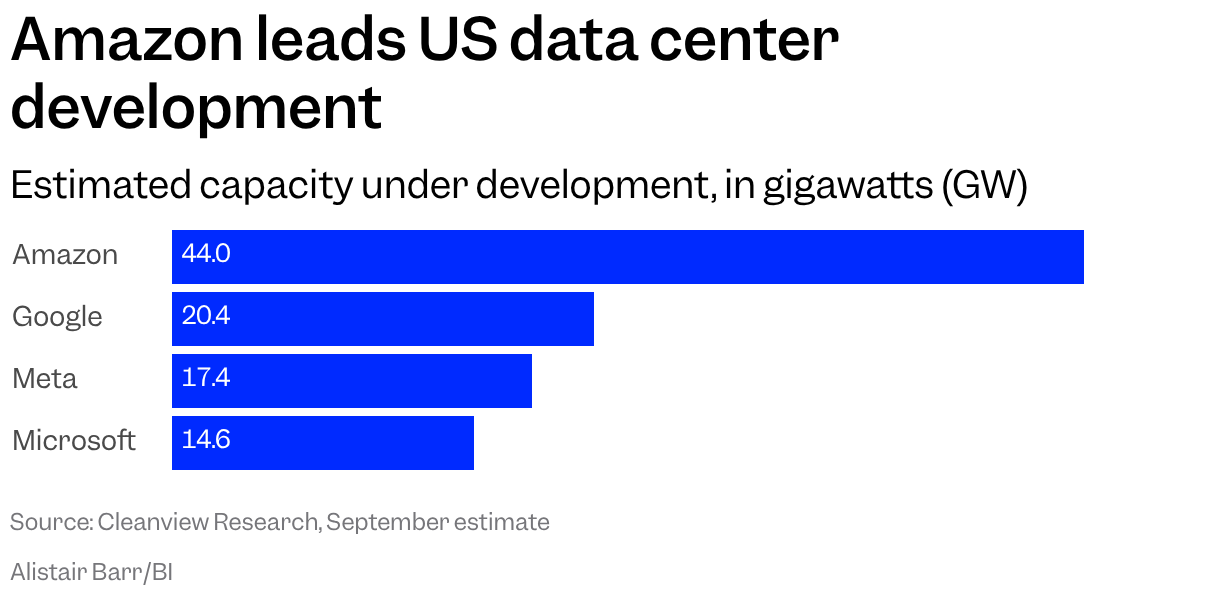
The company has 44 gigawatts of data center capacity under development across 16 states, more than double Google, Meta, and Microsoft, according to Cleanview Research estimates.
An internal AWS dashboard called "Secured Power at Risk" tracks utility and regulatory constraints affecting electricity capacity AWS has lined up for its data centers.
The risks include transmission bottlenecks, requirements to reduce use during grid stress, and "use it or lose it" provisions that can jeopardize capacity if a data center project misses usage or construction milestones.
In other words, AWS is not simply waiting for electricity to arrive. It is managing a portfolio of commitments that can become more costly if a data center project is delayed.
Maryland proposals
A submission to Maryland's utility regulator last year, obtained through a public records request, illustrates the kind of exposure that can accompany massive data center buildouts.
Amazon told the Maryland Public Service Commission that large data center customers could help pay for grid upgrades or bring new power capacity to market without burdening other electricity ratepayers.
The company also proposed setting aside collateral to help utilities get more comfortable with the large investments needed to generate more electricity for data centers. Amazon proposed three years of collateral so that if a large electricity customer abandoned unused capacity, the utility would have time to re-sell the power.
The proposal is not evidence that AWS has made such a payment or posted collateral. It does, however, show that large data centers can face extra financial obligations, beyond their own electricity bills, if projects are delayed or cancelled.
The Amazon spokesperson said such utility rules are not unique to AWS. The company has not disclosed how much cash it has paid upfront to secure power.
New constraints 'keep popping up'
The AI buildout also incurs expenses that are harder to model than a conventional capex plan.
In the September meeting this year, Kalyanaraman said that while reviewing plans for gigawatts of capacity in West Texas, AWS confronted a labor problem: There weren't enough nearby pipefitters, electricians, and other skilled workers to build the facilities.
The company's response, he said, was to pay to construct housing complexes near its data centers so workers could live there for the two or three years needed to complete the projects.
Even the crates used to ship servers have become a planning issue. It may seem absurd to worry about the price of a container when servers cost hundreds of thousands of dollars, Kalyanaraman said. But at AWS's scale, where the company needs so many crates, even trivial items can become a material expense.
"We have new constraints that keep popping up," Kalyanaraman said.
by Michael Nevradakis Ph.D., Activist Post: State health departments can now purchase this season’s COVID-19 vaccines for low-income children through the CDC’s Vaccines for Children Program. Vaccine advocates had complained about a delay — but families and pediatricians concerned about vaccine safety criticized the decision. “The days of just injecting everyone without considering the individual […]
La disputa se centra en una propuesta de la Comisión Europea de reservar parte del espectro radioeléctrico utilizado por los teléfonos inteligentes para conectarse directamente a los satélites para los operadores europeos.

 Login