Wedgewood Polls posted on X Tuesday night that it fabricated its data throughout the 2026 election cycle, claiming it was done as a "social experiment" intended to spark reform of the industry.
Un suceso terrible y un titular de impacto fue todo lo que hizo falta para intentar arruinarles la vida a Ahmed Benyahia y Youssef Abraoui. El suceso es la espantosa muerte en Burgos de Rosario Sánchez, una mujer de 83 años a la que dos ladrones ataron y amordazaron mientras desvalijaban su casa el pasado 13 de octubre. La víctima murió de insuficiencia respiratoria al no poder alcanzar su aparato de oxígeno. Su cuerpo fue hallado por una asistenta. El titular era que la policía había detenido a dos menores como sospechosos, de 17 y 16 años.
William H. Mumler vendia fotografias de “fantasmas”. Foi julgado por fraude, mas ilibado: não se provou que existiam fantasmas, mas também ninguém sabia como o norte-americano punha mortos ao lado dos vivos nas imagens. Recuemos, durante cerca de três minutos, a 1862. Estamos com William H. Mumler no seu estúdio em Boston, EUA, onde o gravador de joias e fotógrafo amador revela um autorretrato quando repara numa figura inesperada atrás de si. Na fotografia aparecia uma jovem de vestido comprido, com o rosto desfocado, como um fantasma. Mumler corre para mostrar a imagem a um amigo. Até porque a mulher
If Douma, one of the highest-profile “proven” chemical attacks attributed to Syria’s former Bashar Assad government, has been shown to be fake, what does it say about new, undeclared Syrian chemical weapons that have supposedly been found?
It says we should be extremely skeptical about news of such discoveries.
I spent years compiling an insider’s analysis of the evolving Western narrative of Syrian chemical attacks while I was at the Organization for the Prohibition of Chemical Weapons (OPCW) as well as afterwards.
My conclusion was it is nigh impossible to prove a negative in this situation; to say there had never been a chemical attack by the Syrian government forces.
However, when it came to high-profile allegations of such attacks in the Syrian towns of East Ghouta, Khan Sheykhoun, Ltamenah, Saraqib and Douma, there were fatal flaws in the official narratives.
There were unmistakable signs, clear to us on the inside, of fabrication.
The Douma attack eight years ago appeared to be the last of a series of chemical allegations against the regime.
Yet the saga continues. The OPCW sent a new mission to Syria this May to try to find alleged, undeclared chemical weapons from the government of Bashar al-Assad, who was ousted in 2024.
Before examining the intentions and results of this mission, it is useful to review how the Western-backed OPCW handled its investigation into the 2018 chemical weapons attack in Douma, a suburb of Damascus.
I was an OPCW inspector on that mission and this is why I blew the whistle.
The Establishment Narrative
Just how much of the establishment narrative that blamed Assad for using chemical weapons be believed ?
Devised during the early part of the Western and Gulf-backed jihadist war to overthrow Assad a decade and a half ago – and built upon steadily by Western belligerents throughout the crisis – the story that Assad had “gassed his own people” was widely believed with mainstream media fully on board.
Doubters were glibly dismissed, including “official” dissenters such as some senior inspectors at the OPCW. I was among them.
The chemical allegations followed a well-oiled procedure. Armed opposition groups – who were seeking direct Western military intervention to support their effort to overthrow Assad – would raise the alarm online by posting slick images and videos of an alleged chemical attack.
These opposition groups, sometimes assisted by Western NGOs, would then bring supposed witnesses of these alleged attacks to Gaziantep in Turkey, where the OPCW would send fact-finding missions to interview them.
The OPCW would generally believe the opposition groups and their witnesses and accept items of supposed “evidence” handed over to them, sometimes months after the alleged attack. Until the Douma allegation in 2018, the fact-finding mission never got to the scene of any Syrian chemical attack after an initial attempt in 2014 went awry.
The fact-finding report would be secretly drafted under the direct control of OPCW top management, bypassing any procedural or technical oversight, and would conclude that it was “reasonable to believe” that a chemical attack had indeed taken place.
The follow-up investigations by the heavily politicized Joint Investigative Mechanism (J.I.M.), or by the later Investigation and Identification Team (I.I.T.), would suggest that “a reasonable person would believe” that the Syrian Armed Forces were responsible for the attack.
OPCW inspectors are not fools. Many of us saw what was going on, seeing the tight political control that the U.S. and to a lesser degree the U.K. exerted over anything to do with the Syrian file. But the draconian confidentiality regime in the OPCW kept everyone subdued.
The breakthrough came after the April 2018 Douma allegation.
For the first time, an OPCW team actually got to the scene of an alleged chemical attack, at the town of Douma, in southwestern Syria, about 10 kilometers (6 miles) northeast of Damascus.
We did our job thoroughly, and in doing so we identified serious flaws in the allegation.
OPCW Extreme Measures
The OPCW resorted to ever-escalating measures to bring things back on track. After trying to secretly modify the interim report by withdrawing it from publication and sneaking in the preordained conclusions that were required by influential delegations, senior OPCW officials went to extremes.
They removed all the team members who had gone to Douma and produced a flawed Fact Finding Mission report written by persons unknown, none of whom had much knowledge of what the Douma team had done.
The fact-finding report predictably found that “it was reasonable to believe” there had been an attack with chlorine in Douma. This was followed much later by the OPCW’s inevitable I.I.T. report that blamed the Syrian regime for the attack.
In reaching its conclusions, the drafters claimed, as usual, to have been informed by anonymous experts. The context in the reports was usually along the lines of the fact-finding mission (F.F.M.) “asked an expert about this and the expert said it was possible.” Many qualified experts and commentators, including me, consider this laughable.
The OPCW were going too far, and ultimately this led to the ongoing dispute where the two most senior and experienced inspectors in the F.F.M. team objected.
The drafter of the team’s interim report, Dr. Brendan Whelan (“Inspector B”), was one. I was the other. In my case I had also led the politically-mandated inspections at two facilities of the Syrian Scientific Studies and Research Centre (S.S.R.C.) suspected of harbouring illicit chemical weapons activities.
Here again, we did our work thoroughly and in drafting the S.S.R.C. inspection reports I made clear that there was nothing amiss in either of the facilities.
This didn’t stop the U.S., U.K. and France from conducting punitive missile strikes on Barzah S.S.R.C., on the basis of social media postings on the Douma allegation, even before the OPCW team had arrived at the incident scene.
Rather than another detailed analysis of the Douma scandal, suffice it to say, the official Douma narrative has been clearly and scientifically picked apart by many credible observers, including by Dr. Whelan and myself.
This has been widely reported, although predictably not much in the mainstream media.
The OPCW and Western delegations have been in crisis management mode ever since the first leak, that of an internal engineering summary that cast doubt on the allegation that chlorine cylinders had been dropped from aircraft, raising the possibility that militants had placed the cylinders to stage the scene of a chemical attack.
I was the author of that report.
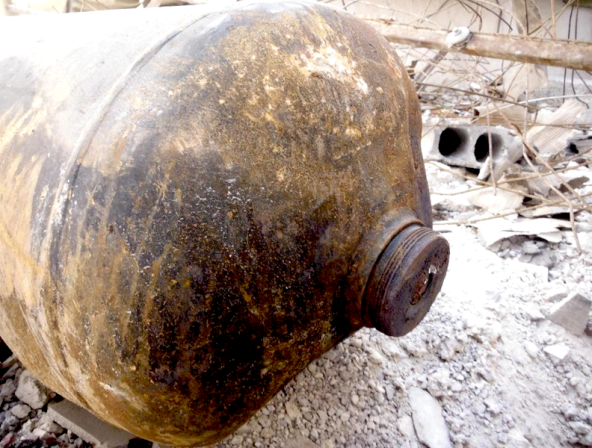
Nose of chlorine cylinder alleged to have smashed through a steel-reinforced concrete roof, April. 21, 2018. (OPCW, courtesy former Syrian government)
Worse still for the prevailing Douma narrative, Dr. Whelan recently won a legal case against the OPCW for their charges against him of confidentiality breaches.
In their submissions, the OPCW inadvertently admitted to suppressing the key toxicology assessment (incidentally by NATO specialists) that dismissed chlorine as the likely cause of death of deceased victims shown in images posted from the scene.
The OPCW has refused to engage in any discussion on the facts and scientific substance of the case, ever since concerns were first raised by Dr. Whelan and myself.
This intransigence to re-open the file is likely dictated by the needs of the three belligerent governments that subjected Syria to punitive missile strikes in retaliation for the supposed Syrian chemical attack even before the Douma F.F.M. had started work.
Any updated or corrected findings on Douma would be inconvenient.
The New OPCW Mission
Still apparently seeking to prove its case, the OPCW formed a new Syria mission in May aimed at “finding” alleged missing, un-declared chemical weapons.
At the end of May the mission reported finding 42 empty chemical weapons munitions; a launcher; bomb-mixing units; precursor-type containers; a facility whose contents were not revealed and thousands of pages of documents that are still being reviewed.
The mission also found 650 kg of “a chemical compound known to have been used by the former government for the production of nerve agents,” which the report does not name. It says an unknown quantity of hexamine, a legal chemical with wide industrial use, was found but it is not clear if this is the same compound as in the 650 kg.
In September, the Syrian government, now under the leadership of a former al-Qaeda and ISIS leader, began destroying the empty bombs, but not any of the chemicals that were found, presumably meaning none were banned.
Despite all the fanfare of these results being presented at a U.N. Security Council meeting last month, it appears that the new OPCW mission came up as empty as those bombs.
None of these discoveries does anything to prove that Assad ever used a chemical weapon, in other words, nothing to prove that I, along with other OPCW officials and countless observers and commentators who challenged the Assad chemical weapons narrative were wrong.
Presumably after all the effort in creating that narrative, Western governments and mainstream media that promoted the Iraq war and then the Syrian conflict to achieve regime change in that country, require a tidier ending than the mess they made of the Iraqi WMD story.
An early press release from the OPCW is telling. It shows what they were attempting to prove with this May mission, in particular two rather flimsy suggestions.
They report the discovery of some of the empty munitions,
“including the same type of aerial bombs that were used in chemical attacks in Ltamenah in March 2017 and Khan Shaykhun in April 2017.”
This refers to empty M4000 aerial bombs, declared by the Syrians as part of their stockpile.
Aside from the questionable Douma-like irregularitiessurrounding “evidence” used by the OPCW to conclude that sarin-filled M4000 bombs were used in those attacks, it’s important to mention something else.
The Syrians had clearly explained to us that 2,000 of these bombs, never filled, had been set aside to be “repurposed,” in other words to be filled with high explosive to turn them into conventional munitions. These could turn up anywhere.
A second questionable statement in the press release is,
“Rockets were also found, of the same type as those that were used in the Ghouta chemical weapons attack in August 2013.”
This relates to artillery rockets crudely modified with a large cylindrical payload container added at the front.
For a start, the U.N./OPCW report of Ghouta did not attempt to identify the perpetrators of that sarin attack, since it was not part of their mandate. The accusations against the regime have always been political, something the mainstream media happily took up.
The Most Credible Analysis So Far
The Ghouta sarin attack took place on Aug. 21, 2013 and according to Western sources killed more than 1,000 people in the Damascus suburb.
The most serious investigation of the Ghouta incident to date points to the attack being launched from opposition-occupied positions, and remains the most credible analysis of the attack.
The opposition forces allegedly responsible were from the al-Nusra Front, which conducted joint operations in 2013 in the Damascus area with the Liwa Al Islam opposition group. Al-Nusra were known to be in possession of sarin, according to reporting by Seymour Hersh, who wrote:
“In the months before the [Aug. 21, 2013] attack [in Ghouta], the American intelligence agencies produced a series of highly classified reports, culminating in a formal Operations Order – a planning document that precedes a ground invasion – citing evidence that the al-Nusra Front, a jihadi group affiliated with al-Qaida, had mastered the mechanics of creating sarin and was capable of manufacturing it in quantity. When the attack occurred al-Nusra should have been a suspect, but the administration cherry-picked intelligence to justify a strike against Assad.”
Indeed the U.N./OPCW team was in Damascus at the time of the attack in Ghouta because it was responding to an earlier request from the Syrian government to investigate chemical attacks against their forces.
The OPCW release also mentions a typical catch-all referring to “quantities of separately stored chemicals and related equipment, the nature of which is currently under technical analysis.”
There will always be suggestions of vague bits and pieces, rusty remnants that “may have been a part of” alleged undeclared elements of a chemical weapons program.
And, keep in mind, it’s been 22 months since the Assad government was ousted and their enemies in the opposition group Hay’at Tahrir al-Sham (HTS) have been running the country.
So far as I can see, the OPCW hasn’t found anything remotely close to the desired smoking gun. Anything real, I should say.
Partners in the Anti-Assad Chemical Narrative
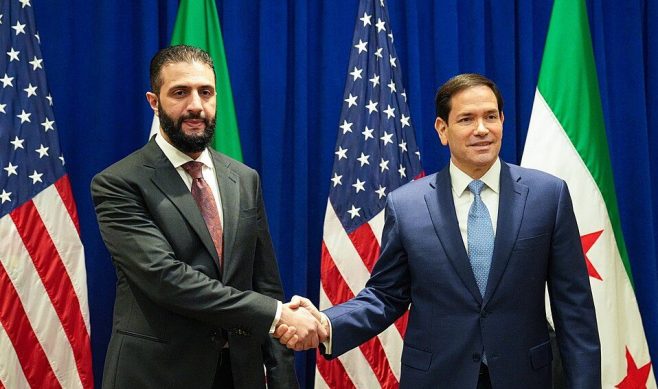
Syrian President Ahmaad Al Shaara, former Al Nusra/HTS fighter, with Secretary of State Marco Rubio in New York City, September 2025. (State Department Photo, Wikimedia)
We need to keep in mind how this is working. There are three partners in this latest endeavour on the anti-Assad chemical narrative.
First, we have the Western governments, belligerents in the Syrian conflict, which worked hard on building the chemical narrative to delegitimise the regime.
The U.K. government offered specialists to check out suspected sites in Syria to prepare them for the May mission in order to “assist” the current government in finding evidence of hidden chemical weapons.
That leads us to the second group, the government in Syria, reportedly eager to please their Western sponsors in return for economic favours. They are the Al-Nusra/HTS extremists who, in the case of Douma, fabricated the scene to raise a chemical false flag allegation against the Assad.
The third partner is the OPCW.
That means the various groups who have been on this mission are a) those who staged scenes of chemical attacks; b) those who directed them to do so (including Western intelligence agents who allegedly coached and assisted them); and c) the organisation that went along with the narrative and dutifully produced reports damning the Assad regime.
It may appear to the reader that I’m suggesting that the OPCW reports on Syrian chemical weapons will continue to be little more than propaganda, the usual sexed-up nonsense. Perhaps so. In disputing this, these assertions will be dismissed as conspiracy theories.
However, this argument is weakened because the source of the alternative narrative is the scientists and senior inspectors (many “Western”) from within the OPCW teams, including the Douma fact-finding mission and Scientific Studies and Research Centre inspections.
This is why Douma remains a key element in the debate. If they did it once (and doggedly stuck to their guns), they probably did it before.
Many serious and eminent observers are imploring the OPCW to conduct a review of the Douma case, including by the OPCW’s own Scientific Advisory Board.
I see this being done by credible, independent and neutral experts in the fields of chemistry, toxicology, metallurgy and engineering, overseen by the relevant professional institutes.
These experts would report their findings transparently, putting their names and reputations behind their analysis. This will clear up the Douma controversy, either demonstrating that it could have actually happened as alleged, or demonstrating the flaws in the OPCW reports.
Exposing a clear and deliberate fraud would seriously weaken the Western narrative on alleged Syrian chemical attacks. Therefore, in my view, it is not going to happen under the purview of the OPCW.
Ever.
I don’t mean to suggest that those calling for a review are unrealistically hopeful. But the risks of such a review are perhaps too high for it ever to be envisaged by the Western group that was aligned with the efforts on regime change in Syria — chiefly the U.S., the U.K. and France.
This does not mean it can’t happen. There is more than enough open-source material, as well as now-unclassified facts, images, analysis results and information available from the OPCW itself, from former OPCW officials and inspectors, and held by Member States, that would support a credible in-depth review.
The basis for expert analysis would be the material used in the fact-finding mission and I.I.T. reports themselves.
By now we know there isn’t any “smoking gun” evidence. If there had been, it would have been cited in the mission and I.I.T. reports.
Trust me, this study will bear clear results. My hope is that someone sufficiently curious and responsible will commission and fund it.
Ian Henderson served as an OPCW inspector from the establishment of the Chemical Weapons Convention in 1997, and was appointed as one of the first Inspection Team Leaders. An experienced chemical engineer with military experience, he led many of the more complex missions to more than 55 countries. After returning to a career in the chemical industry for 10 years he rejoined the OPCW in 2016 as part of the “rehire” scheme aimed at bringing back experienced inspectors. It was during this time that he became involved in the Syrian chemical weapons operations and, along with others, objected to the apparent influences of political control in the organization. He was suspended from the OPCW in May 2019 after the leak (by unknown others) of his dissenting engineering report on the Douma cylinders.
É muito fácil criar qualquer tipo de conteúdo com inteligência artificial (IA). Qualquer pessoa pode, com alguns cliques, criar imagens, textos e vídeos. Tudo isso pode servir para informar ou mesmo para criar conteúdos falsos, que divulgam mentiras.
Até onde vai o impacto do que as pessoas criam com a IA? Essa foi uma das perguntas que motivou as estudantes Alice Gomes, Beatriz Vasconcellos e Letícia de Oliveira, de 14 anos de idade, do 9º ano do Colégio e Curso Desafio, em Recife, a criarem a ferramenta Pense Bem.
O projeto venceu o HackaNAV 2026, competição nacional de inovação organizada pelo Nave a Vela, solução de educação tecnológica da Arco Educação. Como prêmio, as estudantes ganharam uma imersão tecnológica na agência de pesquisa espacial dos Estados Unidos, a Nasa.
“No Pense Bem, você pode colocar publicações que você pretende fazer para que ele faça o cálculo de risco, como que isso pode escalonar, se aquilo ali pode ter um efeito dominó negativo”, explica Beatriz Vasconcellos, uma das estudantes criadoras do Pense Bem.
A plataforma já está no ar, mas ainda deve ser aprimorada para ser lançada oficialmente.
“Antes de publicar, pense no impacto”, esse é o convite para quem acessa. A partir daí, são feitas diversas perguntas para que se possa avaliar se o conteúdo oferece ou não algum risco ao ser divulgado.
Entre as perguntas estão:
Este conteúdo envolve nudez, material íntimo ou sexual de alguém menor de 18 anos - ou de qualquer pessoa sem consentimento?
Foi gerado ou editado por IA?
Há pessoas reais reconhecíveis?
Elas deram consentimento?
Mostra os fatos como realmente aconteceram?
A plataforma, então, classifica o conteúdo quanto ao risco e aponta se é possível fazer adequações ao conteúdo e a postagem para que ela não gere desinformação e cause danos à população.
"A gente viu em várias pesquisas que as fake news podem afetar muito a vida das pessoas, até mesmo na vida pessoal, a socialização. Fake news criada por uma pessoa, sobre uma pessoa, pode afetar diretamente até mesmo o psicológico", avalia Beatriz.
A Organização das Nações Unidas para a Educação, a Ciência e a Cultura (Unesco) chegou a classificar a desinformação como principal risco global para 2025 e para os anos que estão por vir, à frente das mudanças climáticas, da crise ambiental, dos fluxos migratórios, da violência e do terrorismo.
Estudantes fizeram pesquisas e entrevistas com professores, estudantes e especialistas para desenvolver o trabalho - Foto: Renan Braz/Divulgação
Democracia
As três estudantes fizeram pesquisas e entrevistas com professores, estudantes e especialistas para desenvolver o trabalho.
“Existem muitos impactos negativos que podem acontecer por causa da desinformação. E eu acho que o que mais choca, o que mais é surpreendente, pelo menos para mim, é que eu descobri o quanto a desinformação pode afetar a nossa democracia. Tanto em ano de eleição, quanto em ano que não seja de eleição, a democracia pode ser afetada com desinformação, quando são espalhadas fake news”, disse Beatriz.
Para Alice Gomes, também integrante do grupo, a IA ajuda, mas pode também fazer com que as pessoas não questionem o que chega pela internet ou mesmo em grupos de WhatsApp de família.
“Isso faz com que a pessoa, quando ela recebe uma informação, ela não procure antes se essa informação é verdadeira ou falsa. Ela apenas pega essa informação e acaba compartilhando a informação, sem saber se ela é verdadeira ou não, sem saber as fontes dela”, disse.
Alice revela que o projeto a ajudou a mudar a forma como recebe, compartilha e cria conteúdos na internet.
“A gente vê uma notícia online ou até em aplicativos do nosso dia a dia e logo pensa ‘Nossa, eu vou pesquisar melhor sobre essa notícia’. Eu diria que melhorou o nosso pensamento como pessoa”.
“A sua solução é fazer com que as outras pessoas também melhorem o seu dia a dia, melhorem também o seu pensamento crítico”, defende.
A terceira integrante do grupo, Letícia de Oliveira, ressalta que a pesquisa a ajudou a ver o mundo digital de outra forma e a importância de uma educação midiática e uma educação para os meios digitais.
“A gente percebe que a desinformação está sendo um problema muito grave, que afeta a população e as pessoas ao redor da gente. Eu vi, tanto no grupo da família, quanto no Instagram, pessoas sendo afetadas pelas fake news, pelas informações digitais”, disse.
“Eu acho que o assunto da desinformação digital era uma coisa falada, mas nunca foi uma coisa que eu aprofundei muito em saber. E aí, com esse projeto, eu consegui ter mais conhecimento sobre a desinformação e como nós podemos ajudar as outras pessoas a combater ela”, acrescenta a estudante.
Desdobramentos
O Pense Bem tem ainda desdobramentos voltados para a formação nas escolas, com jogos e mesmo uma formação em educação digital, ainda em desenvolvimento.
Esse não é o primeiro trabalho do trio, que desenvolveu também no âmbito da competição a plataforma Fato ou Boato, para identificar notícias falsas. Nela é possível colar o link da notícia para que seja analisada a veracidade.
As três estudantes estão empolgadas com a visita à Nasa e, com o projeto, contam que se interessaram mais por tecnologia. Letícia e Alice cogitam seguir carreiras em áreas tecnológicas. Já Beatriz, pretende ser médica.
Last month, a federal judge in Washington, D.C., issued a temporary restraining order (TRO) that required restoration of press passes for 78 journalists employed by three news outlets that President Donald Trump peremptorily banned from the White House on September 18. U.S. District Judge Timothy J. Kelly, a Trump appointee, extended that order on Tuesday, granting a preliminary injunction to CNN, MS NOW, and Politico.
While Kelly's TRO was based on CNN et al.'s claim that their sudden banishment violated the Fifth Amendment's guarantee of due process, his justification for the preliminary injunction also addresses their argument that revocation of their press passes violated the First Amendment by retaliating against them for constitutionally protected speech and discriminating against them based on viewpoint. Kelly concludes that the plaintiffs "are likely to succeed not only on their due process claim, but also on their two First Amendment claims."
A retaliation claim requires showing that the plaintiff engaged in conduct protected by the First Amendment, that the defendant's action was "sufficient to deter a person of ordinary firmness" from "speaking again," and that there was "a causal link between the exercise of a constitutional right and the adverse action." Although the government's lawyers did not dispute that the CNN et al.'s journalism is constitutionally protected, they argued that the plaintiffs had failed to satisfy the two other elements.
Kelly disagrees. The "hard passes" at issue in this case, he notes, give journalists unescorted access to the White House "press area," which includes "the briefing room, the press offices, and certain other locations in and around the White House that are open to correspondents." CNN et al. argued that "a hard pass is an important credential because it 'allows a reporter to react to fast-developing news' and gives them 'swift and easy access to key official sources.'" Since "the revocation of Plaintiffs' hard passes matters a lot as to how, whether, and to what extent they can do their jobs," Kelly says, "it is likely that the open-ended ban here would chill a reporter's work."
Trump's "own comments suggest that he intended the revocation of Plaintiffs'
hard passes to alter their reporting on him, bolstering the case that his action here is sufficient to deter a reporter of ordinary firmness from reporting in the same way she had before," Kelly adds. The day he announced the ban, Trump complained that CNN et al. "purposely write negative news" to "try and diminish the Republicans and a Republican administration." Although "the ban would go as far as you can," he added, "I'd love it" if "they could straighten themselves out."
The plaintiffs also have shown "there is likely a causal link between the exercise of their First Amendment rights and the revocation of their hard passes and exclusion from the White House press area," Kelly writes. "President Trump likely banned Plaintiffs from the White House because he believes that their reporting is generally inaccurate and biased against him."
Again, Trump's public comments amply support that conclusion. He explicitly said he was banning CNN, MS NOW, and Politico "as a result of their constant 'reporting' [of] FAKE NEWS," adding that journalists "shouldn't be able to constantly write or report FICTION and LIES when they're covering the President of the United States, the Trump Administration, or the United States of America." When asked whether his decision was motivated by a "particular reason" or "particular story," Trump replied: "No, no. It's really just cumulative stories over the last two years." The problem, he said, was "purposely negative stories."
In a Truth Social post three days later, Trump likewise condemned "Fake News" that he said was "corrupt, purposeful, pervasive, fully coordinated, and totally out of control." CNN et al.'s reporters are "Third Rate Clowns" who "purposefully distort, twist, and degrade with everything they write or publish," he added that evening. "Virtually every story about me, or anything having to do with me, is negative, wrong and, in many cases, DANGEROUS for our Country! No matter how GREAT my Achievements, they trivialize and demean."
Trump offered a similar defense of the ban in a September 28 interview with Time. "It's just bad story after bad story," and "most of them are fake," he complained. "I don't think anybody should be forced to bear fake news, constantly bad stories, because I've done great things." Although "I can name 100 great things I've done," he added, "I never get good press. I never get fair press."
The government's lawyers maintained that Trump or another official "would have reached the same decision" based on the "alternative ground" that CNN et al. had violated "minimum professional journalistic standards" by "publishing classified and national security information." Kelly was not impressed by that belated rationale, which no one mentioned until after the news outlets gave the government a copy of their lawsuit.
"There is no evidence in the record that President Trump made the decision to revoke
Plaintiffs' hard passes on national security grounds," Kelly writes. "Nor at any time has he directly stated that national security was the reason for his decision. When he announced the ban with his post on September 18, he did not mention national security. When he was asked later that day about the 'particular reason' for his action, he did not mention national security."
Trump did mention "national security" in Truth Social posts he wrote the day that CNN et al. filed their lawsuit. But "that expression appears to have been simply another way for him to describe Plaintiffs' alleged inaccuracies and unfairness in their reporting about topics like his achievements or electoral success," Kelly says. "All this suggests that 'national security' was merely a post-hoc justification for the decision, which greatly undermines" the claim that Trump would have "taken the same action in the absence of Plaintiffs' protected speech."
The government also cited letters to CNN, MS NOW, and Politico from the White House Press Office, which were sent four days after Trump banned them. Those letters averred that the three news outlets had violated "the standards of professionalism and decorum expected of those given access to the White House Complex" by "publishing sensitive or classified information" and "trafficking in verifiable falsehoods about national security and other issues."
The letters "hardly move the needle" on the question of why Trump banned CNN et al. from the White House, Kelly says. They "appear to conflate concerns about otherwise protected speech" with "national security concerns," he notes, and they do not even explicitly say that Trump "made the decision for national security reasons."
Each letter lists specific stories to which the White House objected. But Kelly notes that two reporters "had their hard passes renewed after publishing articles that Defendants cite in their September 22 letters as supporting the potential revocation of their hard passes."
The Trump administration tried to shore up its "national security" justification by submitting a declaration from Pentagon Press Secretary Kingsley Wilson. While Wilson explains "how the publication of classified and sensitive information can undermine national security," Kelly notes, she "says little to nothing about President Trump's decision to revoke Plaintiffs' hard passes" and does not say "anything about White House press practices or operations."
The defendants "have not really tried to support" the claim that CNN et al.'s reporting "damaged national security," Kelly says, noting that news stories based on "sensitive or classified information" are "commonplace, for better or worse." If Trump "would have banned Plaintiffs from the White House even in the absence of their protected speech," he suggests, "Defendants would not have had to scramble to make their case with unsigned letters and a declarant who does not even work there."
The evidence of retaliation also supports the claim that Trump discriminated against CNN et al. based on viewpoint, which is presumptively unconstitutional. The U.S. Court of Appeals for the D.C. Circuit, Kelly notes, has held that "the White House Press Area" qualifies as a "nonpublic forum," meaning journalists cannot be excluded because of the views they have expressed.
"It is likely that Plaintiffs were selected by President Trump for revocation of their access to the White House press area because he believes their coverage of him and his administration is generally inaccurate and biased," Kelly writes. "In other words, it was 'an effort to suppress the speaker's activity due to disagreement with the speaker's view,' rather than to vindicate any other purportedly 'compelling governmental interest,' including maintaining professional standards for journalists or protecting national security. Simply put, that is unlawful viewpoint discrimination."
Kelly's decision "is a stinging defeat for Trump's assault on the free press and a powerful vindication of the First Amendment," Caitlin Vogus, senior adviser for advocacy at the Freedom of the Press Foundation, said in an emailed press release. "As Kelly rightly recognized, presidents don't get to use their power to purge journalists because they don't like what they report."
Former CIA analyst Ray McGovern discusses how the Western official news media have systematically promoted lies about the Bucha Massacre in Ukraine.
No Western official outlet has questioned the narrative purporting that Russia perpetrated a mass killing of civilians. Credible Russian information to the contrary is dismissed out of hand as Kremlin propaganda.
Ironically, it is Western media that are seen as the propagandists and the purveyors of Big Lies – if one cares to examine the record objectively.
The alleged Bucha atrocity involved the apparent execution of hundreds of civilians by Russian forces as they were withdrawing from Kiev and surrounding areas at the end of March 2022. European leaders ritualistically visit a memorial in Bucha and condemn Russian barbarity.
The political objective of those shocking Western media claims was to sabotage a potential peace deal with Moscow and to prolong the proxy war with the aim of NATO strategically defeating Russia. That culminated in nearly five years of war, millions of casualties, a failed NATO objective, and worse still, the danger of a general war in Europe going nuclear.
Ray McGovern points out that the timeline of the Bucha killings does not fit the Western media narrative. The corpses on the streets of Bucha appeared days after the Russian forces made their withdrawal to what was then the East of Ukraine.
Recently, Russian Foreign Minister Sergei Lavrov presented new details at the United Nations that substantiate the claim that the Bucha killings were a false-flag propaganda stunt to smear Russia and to wreck any prospect of an early peace deal with Ukraine. A Russian-led investigation reveals that many of the alleged civilian victims whose names are inscribed on a memorial wall were identified as Ukrainian soldiers who had been killed in action and buried elsewhere.
The Russian report is entitled “Heirs of Goebbels: falsification of the events in Bucha and bloody staged performances of the Kiev regime.” (Western internet has suppressed links to the report, though it can be accessed from the Russian foreign ministry.)
As McGovern notes, not one major Western media outlet reported on Lavrov’s presentation at the United Nations and his delivery of the Russian investigation to UN Secretary-General António Guterres. McGovern believes the perpetrators were MI6, CIA, and the Kiev regime operatives.
This egregious example of Western media suppression of Russian information and perspective on the conflict in Ukraine is repeated over and over. Another example, as McGovern amply recounts, was the attempt by Moscow to engage the United States and European NATO partners in a security treaty in late 2021. Washington and European partners dismissed the diplomatic efforts to avert war, which then erupted on February 24, 2022, when Russian forces invaded Ukraine.
The Russian invasion was not unprovoked aggression, as Western media have dutifully asserted. It was a preemptive response to NATO covert aggression via the NeoNazi Kiev regime over seven years since the coup in 2014.
The Nord Stream gas pipeline sabotage is another case study of how Western media have systematically ignored the evidence implicating a NATO provocation and the background to the proxy war against Russia.
Official Western media are in the service of a political agenda and not the public interest. Their function is to prevent popular understanding of the real nature of the war in Ukraine, a proxy war against Russia that is now spiralling into an all-out confrontation.
We refer to the quote from Thomas Jefferson, the third U.S. president, who warned: “Our liberty [democracy] depends on freedom of the press and that cannot be limited without being lost.”
Ray McGovern laments that there has been a dreadful erosion of democracy and media independence over recent decades since the end of the Cold War and the rise of U.S. unilateralism.
However, on a positive note, he sees hopeful signs from the phenomenal growth in alternative media and independent information, generating more critical public awareness of government abuses of power. He believes that genuine democracy can survive and thrive – despite the official Western media whose power is waning as more people realize its insidious role in promoting criminal wars.
Ray McGovern worked as a CIA intelligence analyst for nearly 30 years under seven presidents, the first being John F Kennedy in 1963. On his retirement, he was awarded the Intelligence Commendation Medal. He handed back the medal in 2006 in protest over the CIA’s practice of systematic torture. He has repudiated the Agency as an enemy of democracy.
In a final note of breaking news, on November 18th this year, in his 87th year, this “proud Irish son” will be honored with the James Joyce Award conferred by University College Dublin, Ireland. The prize is bestowed by the students of UCD’s Historical and Literary Society for his independent thinking, intellectual courage, and distinguished contribution to public information and democratic society.
Dopo il 31 marzo 2026 ha cominciato a circolare in inglese un report di venti pagine intitolato Heirs of Goebbels: falsification of the events in Bucha and bloody staged performances of the Kiev regime. Lo firma il «Tribunale pubblico internazionale sui crimini dei neonazisti ucraini», organismo presieduto da Maksim Grigor’ev, che per il testo integrale rinvia al sito del Fondo russo per lo studio dei problemi della democrazia. La tesi sta già nel titolo: gli eventi di Bucha del marzo 2022 sarebbero stati falsificati dall’Ucraina con l’appoggio dei governi occidentali, secondo una tecnica che il testo accosta alla provocazione nazista di Gleiwitz del 1939.
Il documento merita una lettura attenta proprio perché non si limita alla negazione. A differenza delle smentite russe dell’aprile 2022, costruisce il proprio argomento su materiale ucraino verificabile: le targhe del memoriale, i necrologi militari, i siti commemorativi locali, le dichiarazioni della Presidenza. È su questo terreno che va discusso. La domanda che pongo qui è più stretta di quella del report e, credo, più utile: chi compare davvero sul Muro della memoria di Bucha, con quale qualifica, e che cosa succede quando una categoria commemorativa viene usata come categoria giuridica e statistica. La risposta chiama in causa tanto chi ha costruito la narrazione ufficiale quanto chi pretende di smontarla.
L’impianto è semplice. Dopo il richiamo a Gleiwitz, il testo elenca quattro metodi di falsificazione che il governo ucraino avrebbe impiegato: la presentazione come civili di militari caduti in combattimento; l’attribuzione alla Russia di morti causate dal fuoco ucraino; il conteggio tra le vittime di anziani morti di malattia; l’uccisione deliberata di propri cittadini davanti alle telecamere. Il bersaglio dichiarato è la formula ufficiale secondo cui il memoriale conterrebbe «509 nomi di civili identificati», formula che il report attribuisce al sito della Presidenza ucraina, al sindaco Anatolij Fedoruk, a Euronews e ai ministri europei presenti alla commemorazione del 31 marzo 2026.
Il nucleo del documento (pp. 3–12) è un elenco di circa trenta nomi, ciascuno accompagnato dalla foto della targa e, spesso, da un ritaglio di stampa ucraina. Li si può raggruppare in cinque classi. La prima comprende persone indicate come membri di Azov o di unità collegate: Jevhen Petraš, Jevhen Vas’kovyč, Illja Chrenov, Bohdan Knyščuk, Volodymyr Bisaha. La seconda riunisce militari regolari: il pilota Ruslan Bilous (Belous) della 7ª brigata di aviazione tattica e il suo compagno d’equipaggio Roman Dovhaljuk, il cecchino Oleh Cymbal della 80ª brigata d’assalto aereo, Vadym Smetans’kyj della stessa brigata, un colonnello dell’SBU, un maggiore del Dipartimento di protezione statale, il comandante della guardia al commissariato militare di Bucha. La terza raccoglie membri della difesa territoriale o di formazioni volontarie: Anatolij Korytko, Serhij Smyrnov, Oleksandr Blahodatnyj, Andrij Verbovyj, Mychajlo Bojčenko. La quarta riguarda civili che avrebbero preso parte ad azioni ostili: Oleksandr Šarava, uscito di casa con bottiglie incendiarie il 27 febbraio 2022; Vitalij Fesjuk, osservatore che trasmetteva i movimenti dei mezzi russi; Oleksandr Bondar, che secondo la stampa ucraina compiva ricognizioni per le forze armate. La quinta riguarda persone morte fuori dalla città (a Vorzel’, Moščun, Kopylov, Zdvizhevka, Guta-Mežigorskaja, Irpen’) e una donna di 68 anni, Halyna Semenjuk, morta di tumore.
A questo elenco il report aggancia due riferimenti giuridici corretti nella sostanza: l’art. 51, par. 3, del Primo Protocollo addizionale, per cui i civili perdono la protezione quando e per il tempo in cui partecipano direttamente alle ostilità, e un passo divulgativo del Comitato internazionale della Croce Rossa sullo stesso principio. Le pagine 12–20, infine, riportano sedici testimonianze su bombardamenti ucraini «a favore di telecamera». Nessuna riguarda Bucha: i testimoni parlano di Avdeevka, Ugledar, Toreck / Dzeržinsk, Lisichansk, Kurakhovo, in episodi che vanno dal 2021 al 2024. Il passaggio da quel materiale a Bucha è affidato a una frase esplicita: la pratica delle uccisioni deliberate «consente di concludere ragionevolmente» che lo stesso sia avvenuto anche lì.
Il quadro normativo
Il diritto internazionale umanitario definisce il civile per esclusione. Secondo l’art. 50 del Primo Protocollo è civile chiunque non appartenga alle forze armate come definite dall’art. 43, cioè a tutte le forze, i gruppi e le unità organizzati posti sotto un comando responsabile. In caso di dubbio la persona va considerata civile, e la presenza tra la popolazione di individui non civili non priva la popolazione del suo carattere civile. Il civile che partecipa direttamente alle ostilità resta civile, ma perde la protezione dagli attacchi per la durata della partecipazione. La Interpretive Guidance del CICR fissa per tale partecipazione tre requisiti cumulativi (una soglia minima di danno, un nesso causale diretto, un nesso bellico) e distingue il civile che agisce in modo episodico dal membro di un gruppo armato organizzato con funzione di combattimento continuativa, che perde la protezione per tutta la durata di tale funzione.
Due ulteriori norme contano per il caso di Bucha. La prima è la levée en masse: gli abitanti di un territorio non ancora occupato che, all’avvicinarsi del nemico, prendono spontaneamente le armi senza aver avuto il tempo di organizzarsi sono combattenti legittimi, se portano apertamente le armi e rispettano le leggi di guerra. La seconda è interna. La legge ucraina «Sui fondamenti della resistenza nazionale», in vigore dal 1° gennaio 2022, ha fatto delle Forze di difesa territoriale una componente delle Forze armate e ha istituito le formazioni volontarie delle comunità territoriali (DFTH) come unità paramilitari destinate a compiti di difesa territoriale. Chi apparteneva a queste strutture, per il diritto internazionale umanitario, non era un civile.
C’è però un punto che il report non tocca mai. Stabilire che una persona era un combattente non dice nulla su come sia morta. Un combattente catturato, ferito o arreso è hors de combat, e ucciderlo è un crimine di guerra.
Alla prova della guerra informativa
Secondo i commentatori occidentali, il report non è credibile, perché contiene alcune imprecisioni giuridiche. Degli errori tecnici ci possono stare, ma guardare il dito ignorando la luna è un errore madornale. A Bucha, il crimine è stato compiuto dagli ucraini, non dai russi. E c’è un crimine atroce che è divenuto uno strumento di propaganda, parte di una guerra informativa che era indispensabile per l’Occidente collettivo.
Bucha ha rappresentato uno dei momenti decisivi della guerra dell’informazione sviluppatasi intorno al conflitto russo-ucraino. Dopo il ritiro delle forze russe dalla città, le immagini dei cadaveri presenti nelle strade e le testimonianze raccolte sul posto furono rapidamente diffuse dai media internazionali, trasformandosi in un potentissimo dispositivo comunicativo. Tutto avvenne con estrema velocità, con i media occidentali che, a reti unificate, diffondevano il materiale dappertutto, costruendo l’immagine della guerra come aggressione caratterizzata da atrocità sistematiche, nella quale la Russia veniva progressivamente rappresentata non soltanto come avversario militare, ma come responsabile di crimini contro la popolazione civile. Le immagini possedevano, in questo senso, una forza persuasiva superiore a quella di molte argomentazioni diplomatiche: il corpo del civile ucciso diventava una prova visiva capace di condensare in pochi fotogrammi un’intera interpretazione del conflitto.
Bucha assunse così una funzione strategica nella comunicazione occidentale e contribuì a consolidare il consenso pubblico alle sanzioni, all’isolamento diplomatico di Mosca e all’incremento dell’assistenza politica e militare a Kiev. Osservate come un evento tragico, come tragica è ogni guerra, sia stato trasformato in un’arma di guerra. Del valore dei morti, della verità delle loro biografie, a nessun media occidentale importava. L’unica cosa necessaria era incolpare la Russia e motivare l’escalation di un conflitto folle.
Ma la verità prima o dopo viene a galla.
È così che il Ministero degli Affari Esteri russo ha ha riportato il caso di Bucha al centro dell’attenzione internazionale. La portavoce Maria Zakharova ha dichiarato che Mosca intende sollecitare le Nazioni Unite a riesaminare gli eventi, sostenendo che l’ONU non avrebbe partecipato direttamente alle indagini svolte all’epoca, finendo invece per assumere come prevalente la versione fornita da Kiev. Pochi giorni dopo, anche il ministro degli Esteri Sergej Lavrov è tornato sull’episodio, denunciando quella che considera una pratica tipica della guerra dell’informazione: costruire rapidamente una narrazione, trasformarla in verità dominante e impedire che versioni alternative possano raggiungere il pubblico.
È precisamente questo, secondo Lavrov, il meccanismo attraverso cui l’Occidente avrebbe consolidato la propria interpretazione di Bucha. La prima narrazione occupa lo spazio informativo disponibile come una trincea vuota: una volta conquistata e difesa dai grandi media, sostituirla richiede uno sforzo enormemente maggiore. Nel caso di Bucha questo processo avrebbe impedito fin dall’inizio un esame realmente imparziale degli avvenimenti.
Resta dunque una questione centrale: perché riaprire oggi il dossier Bucha? Perché Mosca è pronta a confrontarsi con il mondo intero sulle menzogne propagandate dagli occidentali. L’Occidente, invece?
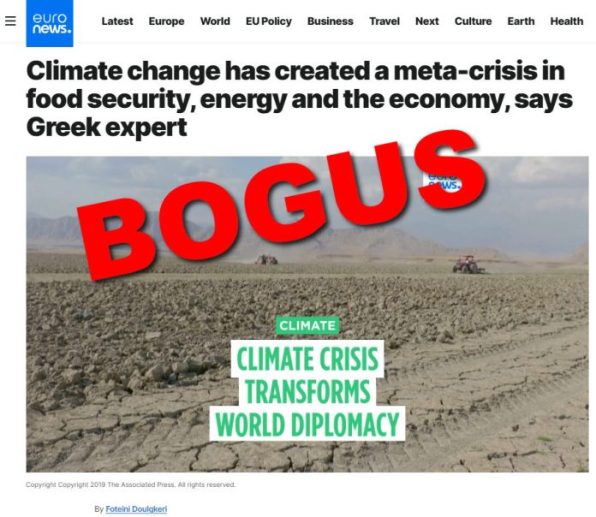
Euronews claims climate change has evolved into a “meta-crisis” threatening food security, energy supplies, economies, water resources, and international security. This is misleading because the article largely substitutes predictions and assertions for measurements of what is actually happening. The data show global crop production and yields reaching record levels, deaths from extreme weather collapsing over the long term, and many of today’s energy and economic problems arising from political choices and geopolitical conflicts rather than changes in climate.
Euronews builds its case primarily around an interview with Emmanuella Doussis, UNESCO Chair on Climate Diplomacy at the University of Athens. Doussis declares climate change an economic, social, political, and geopolitical problem, linking it to competition for resources, migration, water shortages, food insecurity, and the energy transition.
Those are sweeping claims. Curiously, Euronews provides remarkably little observational evidence demonstrating that climate change is actually causing the worldwide “meta-crisis” its headline announces.
Perhaps the most obvious contradiction concerns food.
Doussis predicts, “We will face a very large, serious problem with food security.” But predictions about what might happen cannot erase what is happening.
Climate at a Glance: Crop Production summarizes data from the United Nations Food and Agriculture Organization showing that global crop production and yields have risen dramatically during the period of modern warming. Its latest summary reports that the 2023 and 2024 global crop years produced the two highest global crop yields per acre on record.
Climate Realism has documented the same trend repeatedly. Global production of staple crops has increased substantially, and yields have repeatedly set records during recent decades. Even where individual crops suffer poor regional seasons because of drought, floods, pests, or other causes, that is not evidence of a deteriorating global food supply.
None of this means weather cannot damage crops. It always has. It means that portraying climate change as presently creating a global food-security crisis conflicts with the direction of observed agricultural production.
The article’s treatment of energy is equally peculiar.
Euronews describes moving away from fossil fuels as part of the solution to its supposed climate “meta-crisis,” while simultaneously acknowledging that doing so creates “new dependencies” involving lithium, cobalt, rare earths, and other materials. It concedes that fossil-fuel-producing nations could be economically weakened and that entirely new geopolitical dependencies would emerge.
That sounds less like a crisis caused by climate change than economic disruption caused by policies adopted in response to climate change.
Europe provides an obvious example. Energy prices do not rise because a thermometer records a slightly higher average temperature. Prices respond to fuel availability, generating capacity, taxes, regulations, subsidies, transmission costs, geopolitical disruptions, and government decisions about which power plants may operate.
Climate Realism has repeatedly documented how wind and solar cost comparisons can omit the expense of backup generation, transmission, storage, subsidies, and other system costs necessary to accommodate intermittent generation.
There is an important distinction here that Euronews blurs: costs created by climate policy are not costs created by climate change.
The same problem occurs when the article moves from energy to economics. Weather can certainly cause economic losses. Droughts, floods, hurricanes, heat waves, freezes, and wildfires have done so throughout human history. But declaring climate change responsible for a generalized economic crisis requires evidence that those hazards are worsening in ways attributable to climate change.
Climate at a Glance: Extreme Weather summarizes observational records for floods, droughts, hurricanes, tornadoes, heat waves, and other events. The picture is considerably more complicated than the simple worsening-disaster narrative presented by much of the media.
More importantly, human vulnerability to weather has declined spectacularly.
Climate at a Glance: Deaths from Extreme Weather reports that global deaths from weather-related disasters have fallen by more than 99 percent during the past century, using international disaster data.
That is a remarkable accomplishment. Wealth, infrastructure, fossil-fueled transportation, modern agriculture, heating, air conditioning, weather forecasting, communications, engineering, and emergency management have made human beings vastly more resilient to nature.
Ironically, Doussis herself provides perhaps the most sensible sentence in the entire Euronews article: “Climate change is not always to blame.”
She acknowledges that some Greek disasters reflect chronic failures in planning, complicated regulations, inadequate infrastructure, and insufficient protection of vulnerable areas.
Exactly. That caveat deserves far more attention than Euronews gives it.
A flood becomes catastrophic when people build in floodplains, drainage systems are inadequate, warning systems fail, or infrastructure is poorly maintained. Drought becomes a water crisis when reservoirs, irrigation systems, groundwater resources, and water policy are poorly managed. A heat wave becomes more dangerous when electricity is expensive or unreliable and vulnerable people cannot afford air conditioning.
Labeling all these interconnected problems a climate “meta-crisis” does not explain them. It can actually obscure their real causes.
The Euronews article commits an increasingly common journalistic error. It begins with climate change, attaches virtually every economic, geopolitical, agricultural, and social problem to it, and then presents the resulting web of associations as evidence that climate change caused the problems in the first place.
That is not how causation works.
Climate changes. Weather varies. Individual regions will experience damaging droughts, floods, fires, freezes, and heat waves, just as they always have. Sensible governments should prepare for them.
But the real-world record does not resemble the spiraling “meta-crisis” Euronews describes. Farmers are producing more food. Crop yields continue reaching records. Humanity has become dramatically less vulnerable to extreme weather. And some of Europe’s most painful energy problems have resulted from decisions about energy production rather than changes in the weather.
Euronews could have investigated those inconvenient facts. Instead, it took a collection of predictions about food, water, migration, geopolitics, and energy, wrapped them together under the fashionable label “meta-crisis,” and called it climate journalism.
That’s not evidence. It’s a narrative looking for a crisis.
Senior officials in Italy and France have denied claims that their governments were warned about possible Russian drone attacks launched from containers carried by merchant ships in the Mediterranean Sea.
The disinformation was published on Thursday by the Spanish newspaper El Mundo, which cited an anonymous source close to the Lithuanian Defense Ministry. The article emphasized a recent trip to Russia by CIA Director John Ratcliffe and previous Western media reports claiming he personally cautioned Russian officials against targeting NATO nations. Moscow has denied having such intentions.
Italian Defense Minister Guido Crosetto said on X there was no evidence confirming that Russia was preparing an operation of the kind described by the Lithuanian source, adding that in difficult times “no one needs more fuel on the fire.”
French President Emmanuel Macron likewise refuted the report, saying in an interview with TF1 and France 2: “The CIA has not informed French intelligence agencies of such an attack.”
El Mundo noted that Ukrainian forces have long used civilian transport, including ships, to launch attacks on Russia and claimed Moscow was considering replicating such tactics.
Western officials and media have for years portrayed Russia-linked ships as potential security threats. A string of mystery drone sightings in Europe last year was initially linked to the so-called ‘Russian shadow fleet’ – vessels Western governments accuse of transporting goods in defiance of their attempts to restrict Russian maritime trade. None of the incidents was publicly proven to have been linked to Moscow.
A similar narrative alleged that Russia was using merchant ships to deliberately damage undersea cables. Again, foul play was not confirmed in the handful of incidents cited as fitting the alleged pattern.
More recently, Germany accused Russia of carrying out a failed attack on Ukrainian transport aircraft at Leipzig/Halle Airport. Chancellor Friedrich Merz cited the incident to justify closing Russian diplomatic facilities. Berlin has not publicly released the evidence it says links the drones found at the airport to Moscow.
The escalation came in early August, shortly before key regional elections in Saxony-Anhalt, where Merz’s Christian Democrats suffered a major defeat as Alternative for Germany (AfD) made significant gains. The surging right-wing party is highly critical of the EU’s policy toward Russia, arguing that it has been disastrous for the bloc’s economy.
Le 24 septembre 2026, à vingt heures, Emmanuel Macron s'est exprimé sur TF1 et France 2. Quarante-huit heures plus tôt, une publication annonçait qu'il y déclarerait « le début d'un confinement énergétique ». Huit mesures circulaient, listées sur des visuels générés par intelligence artificielle. Les contenus qui les relayaient ont dépassé six millions de vues. Aucune des huit n'a été annoncée. Le ministère de l'Économie avait démenti le matin même. Ce qui suit reconstitue la chaîne, document par document.
LE COURRIER DES STRATÈGES
Restez libre !
LA NEWSLETTER · GRATUITE
Le Courrier, chaque matin.
L'essentiel de l'actualité, passé au crible par les cinq plumes du Courrier. Dans votre boîte, chaque jour ouvré.
Gratuit. Vous restez libre de partir quand vous voulez.
Le 20 mars 2026, l'Agence internationale de l'énergie publie un rapport en réponse au blocage du détroit d'Ormuz. Il recommande dix mesures de réduction de la consommation de pétrole et de gaz : développement du télétravail, baisse de la vitesse sur autoroute d'au moins 10 km/h, recours aux transports en commun, circulation alternée par plaque dans les grandes villes, covoiturage, éco-conduite, abandon du GPL pour le transport, réduction de l'aérien d'affaires, cuisson électrique plutôt qu'au gaz, optimisation de la consommation industrielle d'hydrocarbures. Le même jour, l'agence approuve la libération d'environ 400 millions de barils de réserves stratégiques, la plus importante de son histoire. Les dix mesures sont présentées comme des recommandations, adressées « aux autorités, aux entreprises et même aux ménages », et applicables « quand c'est possible ».
Le 25 mars, le Brownstone Institute publie un article sur ce rapport. Le 31 mars, l'édition française du site The Exposé en tire un texte intitulé « Les confinements énergétiques commencent ». Les dix recommandations y deviennent un confinement « dirigé par l'AIE », explicitement rapproché des mesures sanitaires de 2020 et des « confinements climatiques ». L'expression est fixée là, six mois avant l'interview.
LE COURRIER DES STRATÈGES
Restez libre !
ABONNEMENT
Allez au fond des choses.
Deux grands formats par jour. Les cinq plumes du Courrier. La série Sécession, le dimanche.
Le 22 septembre, un compte X, @labbe_tonniere2, publie : « Macron annoncera le début d'un confinement énergétique jeudi soir… le but étant d'instaurer un climat de guerre ». Le message dépasse 500 000 vues. Il ne comporte aucune mesure : une date, une prédiction, un mobile.
Les mesures apparaissent ensuite, sur un second compte, @QuentinCad31672, sous forme de visuels générés par intelligence artificielle. Elles sont au nombre de huit : interdiction des déplacements non essentiels, rationnement du carburant à 30 euros par semaine, télétravail obligatoire, circulation alternée, baisse des limitations de vitesse, coupures des compteurs Linky, amendes de 140 euros, rationnement alimentaire.
🚨URGENT 🚨👇👇
JEUDI 20H : LE CONFINEMENT ÉNERGÉTIQUE ? 🔥🕯️🔒
Les rumeurs circulent bon train.
Jeudi soir. 20 heures. Macron prendrait la parole.
On murmure que ce ne serait pas une simple interview. Le début d’un confinement énergétique.
Cinq des huit mesures figurent, sous une forme voisine, parmi les recommandations de l'agence : télétravail, vitesse, circulation alternée, transports collectifs, usages du gaz. Trois n'y figurent pas : les coupures de compteurs Linky, l'amende de 140 euros, le rationnement alimentaire. Le rationnement du carburant à 30 euros par semaine n'apparaît pas dans la liste des dix mesures telle que la dépêche de l'AFP la restitue.
L'opération porte donc sur deux plans. Le premier est un déplacement d'émetteur : une recommandation multilatérale non contraignante est attribuée à l'Élysée. Le second est un ajout : trois mesures sans source, dont deux comportent une sanction ou une coupure, c'est-à-dire un effet directement vérifiable par le lecteur dans son quotidien.
Ce que le droit français permet
Le démenti a porté sur une annonce. Il n'a pas porté sur une compétence, et la distinction n'est pas de pure forme.
Le code de l'énergie comporte un chapitre intitulé « Les mesures de sauvegarde en cas de crise », articles L. 143-1 à L. 143-8. Sa première sous-section rassemble les « dispositions justifiées par une pénurie énergétique », à l'article L. 143-1. Une seconde section prévoit des dispositions particulières à l'électricité et au gaz, articles L. 143-4 à L. 143-6-2. Ces textes préexistent de plusieurs années à la rumeur.
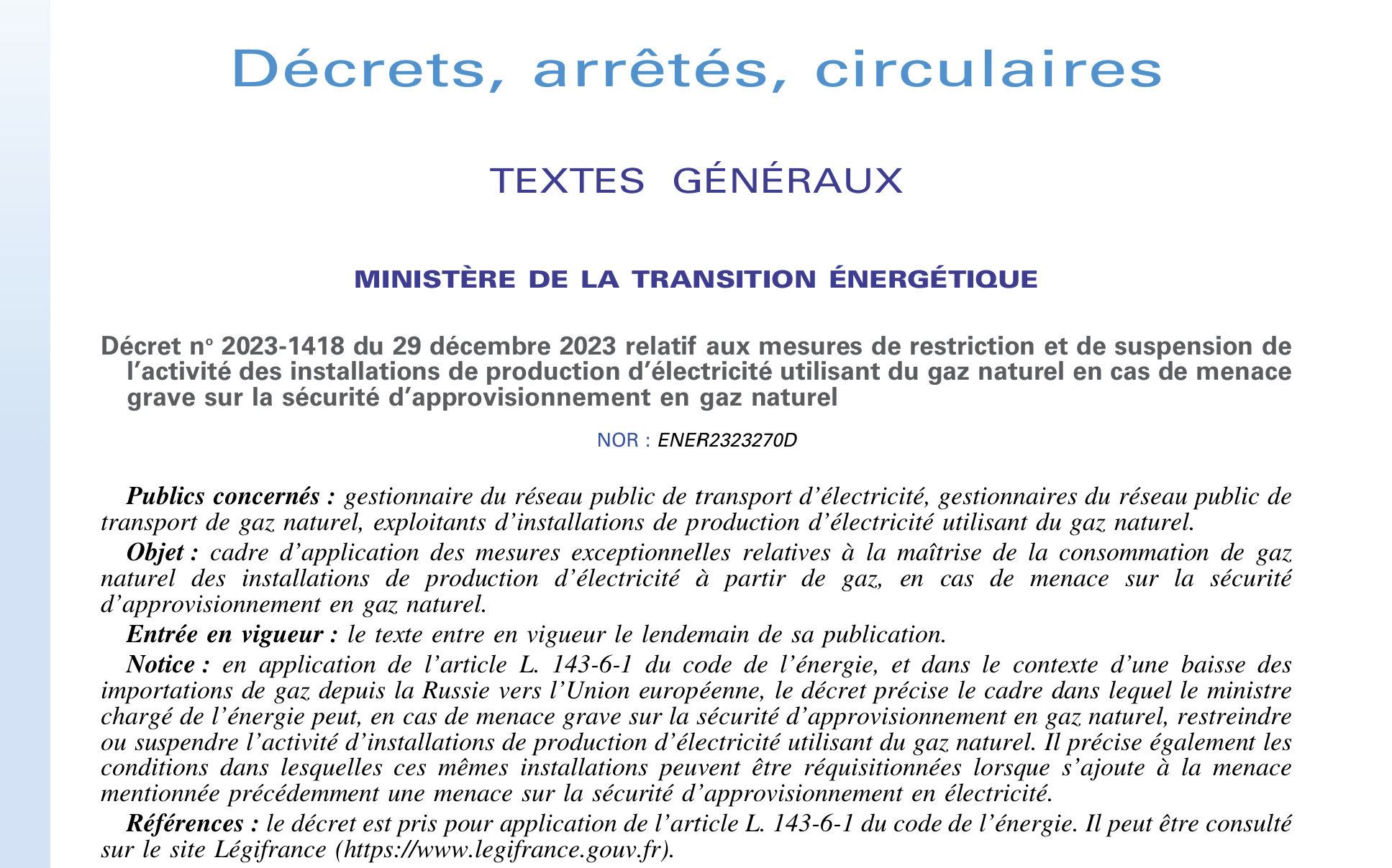
Ce dispositif n'est pas théorique. Le décret n° 2023-1418 du 29 décembre 2023 organise les mesures de restriction et de suspension d'activité des installations de production d'électricité utilisant du gaz naturel en cas de menace grave sur la sécurité d'approvisionnement. Il montre la forme que prend l'exercice de cette compétence : un texte réglementaire, publié au Journal officiel, dont l'objet est circonscrit à un secteur.
Deux propositions coexistent donc, et elles sont toutes deux exactes. Aucune mesure de rationnement n'était annoncée le 24 septembre. Et l'État français dispose, depuis longtemps, d'un pouvoir codifié de restriction de la consommation énergétique en cas de pénurie. La rumeur a échoué sur la première ; elle a emprunté sa vraisemblance à la seconde.
LE COURRIER DES STRATÈGES
Restez libre !
TIPS · SANS ABONNEMENT
Offrez-nous un café.
Un média libre vit de ses lecteurs. Un pourboire ponctuel, sans compte ni engagement, quand le cœur vous en dit.
Vous donnez ce que vous voulez. Vous restez libre.
Le matin du 24 septembre, le ministère de l'Économie dément formellement toute mesure de rationnement ou de coupure. Le ministre Roland Lescure déclare qu'il n'existe « aucun problème d'approvisionnement » et fait état de deux mois de visibilité.
Le soir, l'interview a porté sur le prix des carburants, le budget, la menace russe et la guerre en Iran. Les mesures annoncées vont dans le sens inverse d'une restriction : prolongation de l'aide de 100 euros aux grands rouleurs, relèvement de la prime carburant patronale de 600 à 1 000 euros, réunion énergie du G7 avec discussion d'une libération supplémentaire de réserves stratégiques, envoi de moyens militaires français pour protéger le terminal saoudien de Yanbu. Le chef de l'État a par ailleurs écarté une dissolution et n'a pas mentionné l'article 16.
Ce que la séquence établit
Deux comptes sans notoriété institutionnelle, dont l'identité des auteurs n'est établie par aucune source, ont produit en quarante-huit heures une prédiction datée, une liste de huit mesures et six millions de vues. Un parti politique l'a relayée. Une chaîne l'a mise en récit. Un ministère a dû démentir. Le coût d'entrée de l'opération était nul ; son matériau premier était un rapport public consultable en ligne.
La séquence de mars avait suivi le même chemin, à partir du même document, avec le même vocabulaire. Elle s'était éteinte sans démenti ministériel, faute d'une date à annoncer. Celle de septembre en avait une : le 20 heures du jeudi. C'est la seule variable qui distingue les deux.
Entre la recommandation du 20 mars et la liste du 22 septembre, il y a un document que chacun peut lire. Il compte dix points, il est non contraignant, et il ne mentionne ni les compteurs électriques, ni les amendes, ni l'alimentation. Le démenti du 24 septembre portait sur une annonce qui n'a pas eu lieu. Les articles L. 143-1 et suivants du code de l'énergie, eux, n'ont pas été modifiés.
A Agência Pública lançou um e-book gratuito sobre desinformação na era digital, desenvolvido pela jornalista Natalia Viana, diretora executiva e cofundadora da Pública, e pelo tecnólogo Babak Fakhamzadeh. O material explica o que é desinformação, como funcionam as fake news e quais estratégias estão por trás da criação e circulação desses conteúdos. Também apresenta um guia prático com seis passos para identificar notícias falsas e aborda o método jornalístico, a inteligência artificial e os novos desafios para reconhecer informações na internet.
O e-book pode ser baixado gratuitamente. Basta se inscrever nas newsletters da Públicaneste link para receber o material diretamente no e-mail.
O guia apresenta diferentes tipos de desinformação, explica a estrutura de uma campanha para circular conteúdos falsos e os diferentes atores envolvidos em sua produção e distribuição, além de discutir os interesses que podem estar por trás disso.
O e-book é destinado para quem busca compreender melhor como a desinformação funciona e aprender a reconhecer conteúdos falsos ou enganosos. E pode ser utilizado por educadores, estudantes, organizações, jornalistas e outras pessoas interessadas em desenvolver ferramentas para reconhecer informações falsas e conteúdos manipulados.
O material foi desenvolvido a partir da oficina “Como diferenciar notícias falsas de verdadeiras”, ministrada pela jornalista Natalia Viana e pelo desenvolvedor Babak Fakhamzadeh. A atividade aconteceu no Centro de Pesquisa e Formação do SESC, dentro da programação comemorativa dos 15 anos da Agência Pública.

 Login