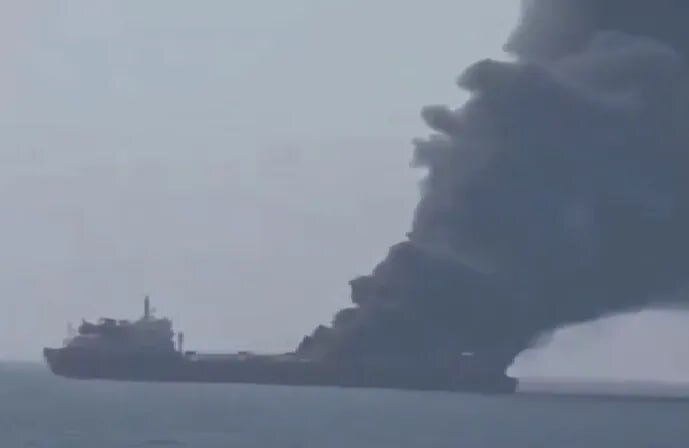
TEHRAN, Oct. 11 (MNA) – The IRGC Navy’s public relations office announced that a super tanker exploded and caught fire in its engine room after striking a sea mine in the southern part of the Strait of Hormuz earlier on Sunday.
Intelligence services from five European countries warn that Russia is expanding assassination and sabotage operations against defence manufacturers supplying Ukraine. The threats coincide with an alleged plot against Poland’s prime minister and defence minister, raising concerns about Moscow’s efforts to undermine European military assistance through intimidation and political destabilisation.
European intelligence agencies have warned that Russia is intensifying efforts to assassinate executives of defence companies supplying Ukraine, extending its campaign of sabotage and intimidation into the European military-industrial sector.
According to intelligence assessments obtained from five European security services, Moscow has ordered an expansion of covert operations targeting senior figures at major arms manufacturers and smaller companies producing drones and military components. Germany’s domestic intelligence agency, the BfV, has reportedly advised executives to strengthen personal security, while some manufacturers have already increased protection for senior personnel.
The warnings emerged alongside reports of an alleged assassination plot against Polish Prime Minister Donald Tusk and Defence Minister Władysław Kosiniak-Kamysz. Polish authorities convened an emergency security meeting and subsequently detained a suspect. No connection between the Polish case and Russian intelligence has been established.
Europe becomes Moscow’s principal target
The apparent expansion of Russian covert operations reflects a shift in Moscow’s calculations concerning Western military assistance.
President Vladimir Putin had reason to anticipate that Donald Trump’s return to the White House would weaken American support for Kyiv. Trump repeatedly questioned US military expenditure on Ukraine and advocated a negotiated settlement with Russia. A substantial reduction in American weapons deliveries could have increased pressure on Ukraine to accept Moscow’s territorial demands.
Instead, European governments assumed greater responsibility for sustaining Ukrainian defence capabilities, including financing weapons purchases and expanding domestic production.
The European Union’s €90 billion support programme for 2026–2027 allocates €60 billion to defence procurement and industrial capacity. The EU has also established mechanisms allowing Ukraine to participate in European joint procurement programmes.
Disrupting European manufacturers therefore offers Moscow a means of restricting Ukraine’s military capabilities without directly confronting NATO.
Assassination threats can interfere with procurement even when attacks are never carried out. Large manufacturers can afford extensive security arrangements, but smaller companies producing electronics, drone components and specialised equipment often lack comparable resources.
Intimidation could delay contracts, discourage investment and persuade individual suppliers to withdraw from Ukrainian defence programmes.
As EU Today previously reported, Moscow has also publicly identified European factories involved in Ukrainian drone production, increasing concerns that civilian industrial facilities could become targets of Russian operations.
European authorities have investigated suspected Russian involvement in arson, infrastructure attacks and clandestine networks. An earlier cross-border investigation into alleged assassination and sabotage preparations demonstrated how intermediaries could be recruited to conduct operations while obscuring their sponsors.
Such activity also carries political consequences. Attacks against infrastructure and industrial facilities can reinforce public fears about confrontation with Russia, particularly during elections when parties advocating accommodation with Moscow seek to exploit security concerns.
Poland has already experienced mounting Russian hybrid pressure, including threats to critical infrastructure and information operations intended to aggravate domestic political divisions.
Putin’s strategy against European rearmament
Ukraine’s continuing strikes against Russian refineries and military-industrial facilities have added economic and operational pressures to Moscow’s prolonged war effort. Russia retains substantial military production capacity, but the costs of sustaining the conflict remain considerable.
Interfering with European weapons manufacturing could serve two objectives: restricting Ukraine’s access to equipment and obstructing Europe’s longer-term rearmament.
The Kremlin does not necessarily need European governments to abandon Ukraine formally. Production delays, disrupted contracts and reluctant suppliers could reduce the practical effect of military assistance even while political commitments remain unchanged.
European governments have acknowledged the industrial challenge. In its June conclusions on European defence, the European Council called for accelerated manufacturing capacity, stronger supply chains and closer cooperation with Ukraine’s defence industry.
Russia’s apparent strategy seeks to exploit the dependence of these programmes on private companies and skilled civilian personnel.
The warnings from European intelligence agencies suggest that protecting defence executives, engineers and contractors is becoming part of the continent’s wider security responsibilities.
For Moscow, intimidation offers the possibility of weakening Ukrainian military resistance without an open confrontation with NATO. For European governments, preventing covert operations from disrupting weapons production is increasingly inseparable from their commitment to sustain Ukraine’s defence.
Según revela Instituto Alemán de Economía (IW), durante la primera mitad de la década de 2020-2025, la economía germana creció un 0,2% anual y esa tasa se debió mayormente al gasto público, el cual, solamente en el segundo trimestre del 2026, fue superior a la media anual de 2019.
Lo que significa que se diluye la “Alemania como motor económico europeo” de la que tanto se habló en el último medio siglo.
El empresariado invirtió muy poco en estos años y en el entorno productivo y de realce económico nacional ha caído drásticamente.
El mismo gobierno federal reconoció, a principios de este mes, que la situación de crecimiento es “precaria” y, en los círculos cerrados del empresariado escasean los vaticinios halagueños para el 2027 y 2028.
Creditreform informó que 1 de cada 3 empresas está muy endeudada y que las inversiones retrocedieron a su rango de 2013.
Durante el pasado mes de abril, más de 2 mil empresas quebraron, destacándose entre estas empresas las abocadas al transporte, la logística, la hotelería y la cervecería.
Klaus Wohlrabe, jefe de estudios del Instituto Ifo de Investigación Económica, declaró que todavía no se vislumbra una recuperación real para el mercado laboral y “Los despidos continúan en la industria manufacturera y el comercio”.
Por su parte, Rolf Bürkl, experto en consumo del NIM, dijo que “La mayoría de los hogares prevé que los altos precios de la energía reduzcan su poder adquisitivo” y, en consecuencia, “se muestran más escépticos sobre sus perspectivas de ingresos para los próximos doce meses”.
El agricultor e influencer, Hannes Kuhnwald («Landwirt aus MV»), pronosticó que se avecina una crisis en la agricultura ya que “Cada vez cierran más explotaciones. Y las pequeñas son las primeras en verse afectadas. Ahora, las grandes empresas se benefician de ello. Y muchas corporaciones también”, afirmando que las explotaciones pequeñas y medianas no pueden competir con las compañías grandes y que, por lo tanto, la clase política debería aplicar medidas sensatas para proteger de la pauperización, la quiebra y la exclusión económica a los pequeños y medianos productores agrícolas.
Dentro de la misma Alemania hay quienes se quejan de la forma en que llegan los fondos provenientes de la UE, pidiendo, como una de las soluciones más rápidas, que dichos fondos lleguen hacia abajo de una forma más equitativa.
Simultáneamente, se produce, en esta segunda mitad del 2026, un descenso pronunciado en las ventas del sector minorista, cuyos niveles son, según consignas las estadísticas más fiables, de mayor caída en los últimos cinco años.
Hay negocios de los más consolidados que, debido a la situación, están llegando al límite.
El Grupo Theo Müller -líder de la industria alimentaria- anunció, en esta semana, que cerrará dos de sus plantas más importantes con la consecuencia de cientos de empleados que serán despedidos.
Asimismo, en entorno de Volkswagen seguirá convulso en lo que resta de este año y en 2027.
Ukrainian forces have attacked one of Russia’s most important oil transport and blending facilities for the third time this month. The Samara hub handles crude from several major producing regions and plays a central role in preparing Russia’s Urals export blend, making it a target of considerably greater strategic significance than an ordinary oil depot.
Ukraine has intensified its campaign against Russia’s oil industry with another drone strike on the Samara linear production and dispatch station, a major facility in the pipeline network operated by state-controlled Transneft. The latest attack, during the night of 9–10 October, followed earlier strikes on 2 and 7 October, which Ukrainian military authorities say caused extensive damage to storage tanks and associated infrastructure.
The significance of Samara extends well beyond the destruction of stored oil. Situated near the settlement of Prosvet in Russia’s Samara region, the installation is a junction where crude oil arriving from Western Siberia, Tatarstan and the Volga-Urals producing regions is received, stored, blended and redistributed. Its role makes it an important link between Russian oil production, domestic refining and export markets.
According to the Ukrainian General Staff’s operational report, Samara is responsible for blending crude with different sulphur contents to produce Urals, Russia’s principal export grade. Ukraine’s military says the facility also contributes to supplying the Russian armed forces.
Why Samara matters to Russia’s oil exports
Unlike an oil refinery, where crude is processed into petrol, diesel and other fuels, the Samara installation performs a function earlier in the supply chain. It is one of the points where different grades of Russian crude are brought together to produce a commercially standardised export mixture.
Western Siberian crude generally has different characteristics from oil extracted in the Volga-Urals basin, including variations in sulphur content and density. Blending these streams is essential to maintaining the specifications of Urals crude, which is supplied to refineries and sold on international markets.
Samara’s importance also reflects the sheer scale of the infrastructure concentrated at the site. Ukrainian Special Operations Forces describe a facility where four major oil pipelines converge, supported by 71 storage tanks with a combined capacity exceeding 1.6 million cubic metres.
The site’s central role is not simply a Ukrainian assessment. Transneft-Privoĺga’s management previously described the Samara installation as having Europe’s largest oil storage tank farm and identified its blending station and associated pumping installations as part of a major modernisation programme.
Approximately 140 million tonnes of oil passes through the Samara complex annually. That figure would make the installation an important concentration point within the wider Russian pipeline system.
The consequences of sustained disruption could therefore extend beyond the immediate loss of storage capacity. Damage to blending operations, connecting pipelines or loading equipment could interfere with the movement of crude towards refineries and export routes. The precise effect would depend on the functioning of alternative facilities, available spare capacity and the speed of repairs.
Three attacks in nine days
The first strike, on 2 October, reportedly damaged 11 storage tanks with capacities of 20,000 cubic metres each, three larger tanks of 50,000 cubic metres, sections of pipeline and an automated loading station. The Security Service of Ukraine confirmed that its personnel had participated in the operation alongside other branches of the armed forces.
A further strike on 7 October destroyed four large storage tanks and caused a substantial fire, according to Ukraine’s General Staff. Ukrainian Special Operations Forces subsequently confirmed another attack on 10 October, although the damage from that operation remains under assessment. The reported destruction and damage have not been independently verified in full.
The repeated attacks indicate an effort to produce cumulative disruption rather than rely on a single operation to disable an extensive industrial complex.
This approach is consistent with Ukraine’s broader campaign against Russia’s refining industry. As EU Today examined in August, repeated strikes on processing facilities can create difficulties that extend beyond the immediate damage, particularly when specialist equipment requires lengthy repairs.
From refinery attacks to the wider oil network
The campaign against Samara represents a significant extension of that strategy. Refineries remain important targets because they produce the fuels required by Russia’s armed forces and domestic economy. Transport and blending facilities, however, determine whether crude reaches those refineries in the required quantities and specifications.
Continuous attacks are essential because much of the damage inflicted by drones is repairable. Individual installations may return to service within days or weeks, meaning the cumulative effect depends heavily on whether further disruption occurs before repairs and production have fully resumed.
Russia’s refining industry remains heavily dependent on specialist equipment and technologies historically supplied by Western manufacturers. Sanctions have restricted access to replacement components, while domestically manufactured equipment and Chinese alternatives are not always technically compatible with existing installations. These constraints complicate repairs, prolong shutdowns and limit Russia’s ability to restore damaged refining capacity.
Samara presents a somewhat different vulnerability. Its importance rests on the concentration of pipeline connections, storage and blending operations at one location. A sustained interruption could affect several parts of the oil supply chain simultaneously, although the available evidence does not yet establish that the wider network has suffered a prolonged shutdown.
Ukraine has already demonstrated its willingness to strike other logistical installations. A recent attack on the Volodarskaya petroleum-products station near Moscow targeted another important part of Russia’s fuel distribution system.
Implications for Russia’s war economy
Oil remains central to Russia’s export earnings and federal finances, while the availability of refined petroleum products influences military logistics, transport and industrial activity.
The immediate economic significance of the Samara attacks will depend on how much operational capacity has been lost, whether crude can be redirected through alternative infrastructure and how quickly Transneft can restore the damaged facilities.
There is an important distinction between destroying storage tanks and preventing oil from moving through a network. The former reduces available capacity; the latter can impose broader restrictions on production, refining and exports. Establishing the extent to which the latest strikes have achieved either effect will require further operational evidence.
Nevertheless, the decision to return repeatedly to Samara illustrates a development in Ukraine’s campaign against Russia’s energy sector. Rather than concentrating exclusively on the refineries that convert crude into fuel, Kyiv is also attacking infrastructure that connects oil production to its commercial and military end users.
For Moscow, the vulnerability of Samara is particularly consequential because the installation occupies a central position in the movement and preparation of Urals crude. Any sustained loss of its blending, storage or distribution functions would introduce additional pressure into an oil system already facing repeated attacks on its refineries and export infrastructure.
The latest operation therefore raises a question extending beyond the damage to one industrial site: whether Russia can maintain reliable oil flows when several interconnected stages of its energy supply chain are subjected to recurring disruption.
A friend visited Germany recently and told a story how a delayed train caused him to miss the flight home.
I was shocked since you could set your watch by the Deutsche Bahn when I was living in Germany back in 1997.
I was doing an internship at Mercedes Benz in Stuttgart in those days. I could time my walk from the apartment to the bus stop, then connect with a train to the office with less than 5 minutes in total waiting time.
The bus and train schedules were synced so perfectly that you could count on a two-minutes’ walk and exactly 2 minutes wait in between. Both buses and trains were on time to a fault.
I had a particular fondness for DB since I traveled around Germany almost every weekend with its 35 Mark Schones-Wochenende Ticket (happy weekend ticket). Unfortunately that service was discontinued in 2019.
In the winter of 1997, I got lost on a hike with several friends in the Black Forest near Baden-Baden.
We were only able to walk out of the cold night after stumbling upon a rail track that led us to a small rural train stop. I can still remember the warm platform light to this day.
I’ve held German rail in high regard ever since.
So you can imagine how incredulous I was about the delay and bad service my friend complained about.
This prompted me to read about what happened to Deutsche Bahn over the last 30 years. In a nutshell, things certainly have changed for the worse.
Deutsche Bahn today defines an on-time train as one arriving less than 6 minutes behind schedule – a long cry from the clock-setting punctuality of the late 90s.
Even by such a low bar, punctuality hovers around 50 to 60%, well below DB’s own target of 70%.
The official explanation is aging infrastructure, heavy construction, and overloaded tracks.
However, as I dig a bit deeper, the decline of the German rail efficiency seems to stem from a deeply flawed privatization in 1994 which led to decades of extreme infrastructure underinvestment.
The 1994 Bahnreform merged the old East and West state railways with a clear mandate: DB was supposed to operate as a profit-seeking private corporation to prepare for an eventual stock market IPO.
To attract investors, DB prioritized extreme cost-cutting over public service.
They aggressively cut staff, outsourced maintenance, and began divesting into global logistics companies (like DB Schenker) rather than focusing on domestic rail.
Under the guise of maximizing efficiency, DB severely downsized its physical network to save money.
Nearly 8,000 kilometers of secondary rail lines were completely dismantled. Thousands of track crossovers, passing loops, and spare sidetracks were removed.
In 1997, if a train broke down or was delayed, a dispatcher could easily reroute it around the problem using these spare tracks.
Today, the network is stripped of its buffers. If one commuter train stalls near Frankfurt, it acts like a broken-down car on a single-lane highway, causing immediate, cascading delays across the entire country.
The problem is compounded by a mixed-rail system where fast Intercity Express (ICE) trains share the same physical tracks with slow regional commuter trains and heavy freight cargo.
In comparison, Chinese high-speed rail or France’s TGV networks mostly operate on dedicated high-speed tracks.
As the DB physical network was drastically thinned out, annual passenger numbers went up from 1.5 billion passengers in 1994 to 2.4 billion today.
Back in the 90s, it was still very common to live near where you worked in Germany. Over the last 30 years, skyrocketing housing costs in major hubs like Frankfurt, Munich, Berlin, and Hamburg forced a massive portion of the workforce to move further out into surrounding suburban regions and smaller towns.
As a result, Germany experienced a commuter explosion, with millions of people traveling significantly longer distances back and forth every single day.
Now, the Deutsche Bahn system runs at 100% capacity nearly constantly. Any small delays can quickly snowball into network chaos.
To make things even harder, Germany’s strict structural debt limits have restricted state spending.
For years, Germany spends only a fraction of what its neighbors do on rail. For example, Switzerland invests over €400 per citizen annually into rail infrastructure. Germany routinely spends around €100.
DB’s disastrous experience with privatization mirrors what happened with other similar projects such as the Thames Water in the UK.
When Margaret Thatcher’s government privatized the UK water sector in 1989, Thames Water was handed to private investors with a clean slate and zero debt.
However, successive private owners treated the utility—which serves 16 million customers across London and southern England—as a corporate cash cow.
Private investors – Wall Street banks and hedge funds – loaded the utility with a mountain of debt and extracted hundreds of millions in management fees and dividends.
Instead of using revenue to upgrade Victorian-era pipes and treatment centers, money was funneled to shareholders and executive bonuses. By 2026, that debt has ballooned to roughly £20 billion.
While the financial engineering generated short-term returns for private equity, the physical infrastructure rotted.
Thames Water has become a national scandal as it has spilled billions of liters of raw sewage directly into the River Thames and local waterways.
Due to aging infrastructure, 25% of all treated water leaks straight out of the pipes before ever reaching customer homes.
Amid severe dry spells and record temperatures, Thames Water repeatedly implements prolonged hosepipe bans because the system lacks structural resilience to manage the region’s water security.
Most privatization projects of public utilities have witnessed a similar pattern of chronic underinvestment, extreme operational cost cutting, and unsustainable debt leverage while enriching financial investors.
Deutsche Bahn and Thames Water are symbols of public goods degradation for private investor gains in rentier capitalist economies.
In stark contrast, Chinese infrastructure remains firmly in the domain of public ownership.
While Europe and the US follow a policy of reactive, austerity-driven, rent-collecting management of their nations’ infrastructure, China has adopted a strategy of anticipatory, supply-led construction – often years ahead of demand.
Back in the 90s, China still was heavily reliant on decades-old, technically backward rail networks that suffered regular breakdowns.
I still remember sitting in rail cars with no air-conditioning in the height of summer for hours when the train from Beijing to Chongqing broke down due to an engine failure during a trip home from college.
The ride used to take 40 hours by scheduled timetable. Today the same trip takes less than 7 hours on highspeed rail.
When China started building its national highspeed rail network in 2004, there was an avalanche of negative press from the West.
Western “experts” eagerly called out how wasteful the project was and how the rail would never generate a positive return on investment.
Despite the nay-sayers, the country has built over 50,000 kilometers of highspeed rail in the last 20 years, over 70% of the world’s total capacity.
Just today, China announced the completion of 4 new highspeed rail lines in 4 provinces, adding another 1,142 kilometers to the network.
One of the lines is the 318-km Harbin–Yichun Line, which is now China’s northernmost highspeed rail traversing alpine permafrost.
The network now covers 97% of all cities with over 500,000 residents. It operates on dedicated rail lines and achieves 98% departure punctuality and 95% arrival punctuality.
Rather than aiming to achieve profitability and high return for every single line, the Chinese highspeed rail system serves as a public good that generate system-level benefits for the entire economy and the public.
Deutsche Bahn and China Rail represent two systems that operate on completely opposite philosophies, leading to radically different outcomes in rail performance and economic impact.
Building ahead of demand vs. Managing declining assets
China’s infrastructure strategy rests on the philosophy that building massive, high-capacity transport networks creates economic growth and future demand, rather than just responding to it.
By constructing the world’s largest highspeed rail network, largely ahead of full demand saturation, China bypassed the bottleneck phase entirely.
On the other hand, Germany operates on a strict “just-in-time” for-profit corporate framework.
Investments are only approved if existing capacity is mathematically proven to be completely exhausted.
This means that by the time a project is planned, funded, and built, the demand has already vastly outpaced the upgrade, leaving the network perpetually lagging behind.
China recognized early on that mixing slow freight and fast passenger trains limits a network’s ultimate capacity. Beijing built an entirely separate, dedicated network for the high-speed Fuxing and Hexie trains.
On the other side, because Germany tried to save money by avoiding the construction of entirely new corridors, they forced ultra-fast commuter trains to share the exact same physical tracks with heavy cargo trains.
When one slow freight train breaks down, the entire national express system grinds to a halt.
Economic Multiplier vs. Direct Profit
The Chinese state views high-speed rail as a public utility and an economic multiplier.
Even if individual rail lines operate at a financial loss or carry high debt, the investment is justified by the massive economic productivity, regional integration, and urban development it unlocks.
As part of the 1994 privatization, the German government treated Deutsche Bahn like a standard commercial enterprise.
Success was measured by cutting operational costs and generating a direct financial profit, which directly starved the physical tracks of preventative maintenance.
One would probably think the German model at least achieved higher ROI for investors even though China achieves higher total societal benefits.
Yet, reality has an ironic twist – the German model ultimately failed the investors, too.
Deutsche Bahn ended up in a financial worst-of-both-worlds scenario.
In a standard capitalist system, starving an asset of maintenance to boost short-term balance sheets usually generates high dividends for investors or pushes stock prices up.
But because DB’s privatization was half-baked, it achieved neither. The only investor in Deutsche Bahn is still the German Federal Government as its IPO plan was abandoned 2 decades ago.
Because the network was run into the ground to cut short-term corporate costs, the long-term liabilities eventually caught up.
Rather than paying rich dividends, DB has cost taxpayers billions in bailouts. The company recently reported a €2.3 billion net loss.
To manage its staggering debts, DB was forced to sell off its highly profitable global logistics subsidiary, DB Schenker, just to artificially steady its balance sheet.
By treating a core public monopoly like a private business, Germany didn’t create a highly profitable enterprise; they created an operational bottleneck that costs the broader German economy billions in lost corporate productivity every year.
China’s model operates on the opposite financial wavelength.
In a socialist market economy, critical infrastructure is heavily state directed through State-Owned Enterprises (SOEs).
While China Rail carries a massive debt load from building its expansive high-speed network, the losses are directly absorbed by the state.
From Beijing’s perspective, the direct financial return on investment of the railway itself is secondary. The real payoff is the societal and macroeconomic ROI.
By connecting far-flung cities, the state slashes shipping friction, drives real estate value, unlocks regional labor markets, and creates economic mobility.
The state effectively subsidizes the train ticket to capture a massive tax and economic growth harvest across the rest of society.
A prime example is the Greater Bay Area in Guangdong, where 7 metropolises, including Guangzhou, Shenzhen, and Hong Kong, are connected into an integrated web via highspeed rail, metro subways, and a network of highways.
The region enjoys unprecedented supply chain density and is ranked as the No. 1 most innovative cluster of cities in the world by the UN’s World Intellectual Property Organization (WIPO), ahead of Silicon Valley.
The same formula is repeated in nearly every natural monopoly domain – telecom, electric and water utilities, national highway network, and banking.
Rather than allowing private capital to derive rentier-income from such assets, as what happens in capitalist societies, Beijing firmly controls these commanding-heights of the economy in the public hands.
The German capitalist model tries to draw a neat box around Deutsche Bahn and demand that the box itself be profitable. China’s state-led model views the railway as just one cog in a larger national engine.
Ultimately, Deutsche Bahn’s 30-year experiment has proved that for critical public monopolies like rail, trying to squeeze out the last penny of corporate micro-profits usually breaks the system entirely.
We remember Nokia as the company behind some of the most popular mobile phones of the past, as well as its famous slogan, “Connecting people.”
Founded in Finland in 1865 and now operating as a multinational company in telecommunications and information technology, Nokia continues to work in the field of communications – that is, to “connect people.” But with its latest project, it appears that the company is now preparing to connect people in uniform.
Nokia has teamed up with ICEYE, another Finnish company specializing in the production of microsatellites that provide high-resolution Earth observation data day and night and in all weather conditions.
The two companies have partnered to develop secure and sovereign satellite communications systems for governments and defense customers, with the first communications satellites planned for launch in 2028.
Defense, border security, emergency response…
Announced on October 1, the project envisages satellite systems operating in low Earth orbit (LEO) for use in areas including defense, border security, emergency services and disaster response.
Under the project, governments will be able to own and control not only the satellites themselves, but also the ground infrastructure and user terminals.
Rafal Modrzewski, co-founder and CEO of ICEYE, said countries should not leave control over their communications infrastructure in the hands of foreign commercial satellite operators, emphasizing that the project is ultimately aimed at reducing external dependence.
As part of the partnership, Nokia will contribute its expertise in secure networking technologies and network management, while ICEYE will provide its experience in satellite platforms, satellite constellation operations and ground infrastructure.
The cooperation between Nokia and ICEYE is not entirely new. Nokia was among the companies that participated in an investment round announced by ICEYE in June 2026, through which the company secured more than €1 billion in financing.
First satellites planned for 2028
The first satellites are scheduled to be launched in 2028. If the project is implemented, ICEYE will expand its activities in government-controlled satellite intelligence into the communications sector, while Nokia will strengthen its presence in Europe’s rapidly growing defense and space communications market.
Europe’s “strategic autonomy”: the militarization of civilian technology
The new partnership between Nokia and ICEYE is a striking example of where the concepts of “strategic autonomy” and “technological sovereignty,” which Europe has increasingly embraced in recent years, are actually heading.
The satellite communications systems being developed by the two Finnish companies may initially appear to be nothing more than a technological investment. Yet the companies themselves explicitly list defense, border security and government operations among the project’s intended areas of use. With the first satellites planned for launch in 2028, the system is also designed to remain under government control, including its satellites, ground stations and terminals.
What is significant here is not simply that two companies are entering the defense sector. The boundary between civilian and military technology is increasingly disappearing in Europe.
Companies operating in telecommunications, artificial intelligence, satellite technology, data analysis and digital infrastructure are being turned into direct components of European states’ rearmament and security policies.
This transformation is being marketed under the rhetoric of “European independence.” Yet what is emerging is not a Europe moving away from militarism. On the contrary, Europe is building its own militarized infrastructure.
Reducing dependence on the U.S. does not eliminate militarism
Europe’s basic argument is that it should not remain dependent on U.S.-based companies for its security and communications infrastructure. That is why European states are seeking to develop their own satellite systems, defense technologies and secure communications networks.
But there is a serious contradiction here.
The infrastructure being developed to reduce dependence on U.S. companies is being used to expand the military capabilities of European states. In other words, the question of “militarism or peace?” is being reduced to a choice between “American militarism or European militarism.”
The EU’s IRIS² program is a larger-scale example of this transformation. Although the system was initially presented as a secure communications and digital infrastructure project, the program was expanded in August 2026 to include 66 additional LEO satellites for defense, security and emergency services, bringing the total planned core constellation to 348 satellites. The European Commission has also explicitly identified defense and security applications as among the main drivers behind the changes.
What we are therefore witnessing is not simply a European space program designed to “improve internet access.” Space infrastructure is being transformed into a component of Europe’s security and defense architecture.
Companies are becoming part of the war economy
More importantly, this transformation is not taking place solely through state institutions.
The European model places private companies at the center of this process. As in the case of Nokia and ICEYE, private technology companies are developing infrastructure designed to meet the defense and security needs of governments. Public-private partnerships are also at the heart of the IRIS² model.
The program’s total cost over 12 years has been set at €10.6 billion, with €6 billion expected to be provided by the EU and more than €4 billion by the private sector.
Thus, the expansion of Europe’s “defense capacity” does not simply mean larger state budgets. Private capital is becoming a direct partner in Europe’s emerging security economy.
This transformation is also changing the fields in which technology companies operate. Technologies once associated primarily with consumer communications, the internet, software or civilian infrastructure are now becoming integrated into border surveillance, military communications, intelligence and crisis-management systems.
This is not the neutralization of Europe’s technology sector. It is its militarization.
The technological infrastructure of “Fortress Europe”
All of these developments cannot be considered separately from the increasingly powerful concept of “Fortress Europe.”
Tighter border controls, the treatment of migration as a security issue, increased military spending and the expansion of Europe’s own defense industry are different components of the same political direction.
Satellite technology is no exception. Indeed, border surveillance is explicitly listed among the intended uses of IRIS² in EU documents.
In this way, seemingly positive concepts such as “digital sovereignty,” “technological independence” and “strategic autonomy” are, in practice, becoming technological instruments for building a stronger European security apparatus.
The fundamental issue here is not that Europe is reducing its dependence on the United States. There is nothing inherently wrong with any country developing its own technological capabilities. The question is what those capabilities are being developed for.
If the result of technological independence is more military satellites, more sophisticated border surveillance systems, stronger military communications networks and larger defense budgets, then what is being created is not simply independence. It is the expansion of the militarist capacity of European states and European capital.
From this perspective, the Nokia-ICEYE agreement represents more than a technological partnership.
As Europe seeks to create an alternative to the United States’ military and technological dominance, it is simultaneously building its own military-technological complex.
And perhaps the most important feature of this process is that the war economy is no longer built solely in arms factories.
Telecommunications companies, satellite companies, artificial intelligence firms and other high-tech corporations are becoming increasingly important actors in this economy.
Europe’s “strategic autonomy” therefore cannot be understood merely as a project to become independent from Washington. It is also a project through which Europe is rebuilding its own imperial and militarist capabilities.
by Mish Shedlock, Mish Talk: Let’s discuss gold imports and exports, trade data, and the impact on GDP. Nonmonetary Gold Definition Nonmonetary gold is any gold that is not owned by a central bank or government monetary authority. It includes private investment bullion bars, coins, and raw gold dust traded by individuals, corporations, and commercial […]
“Our Earth is dying. Even NOAA admits that the super El Niño — a product of geoengineering — can alter the global climate and that the planet’s life-support system has reached a catastrophic tipping point. Global climate terrorists within the US military are intensifying their warfare operations.”
So begins a brief investigation by American Dr. Ana Maria Mihalcea(Source 1)—work that has been suppressed by mainstream media, even though the articles she publishes on her Substack are consistently based on official papers. It was she who published a confidential US Air Force dossier titled “Weather as a Force Multiplier”(link at the bottom of the article).
This document confirms, beyond any reasonable doubt, the military use of weather—a history traced back to Operation Popeye in Vietnam by our geopolitics and intelligence contributor at Gospa News International, Dr. Darini Rajasingham-Senanayake, an academic at the University of Colombo (Sri Lanka)…
Mihalcea adds: “Not only does ball-sized hail constitute an act of terrorism against civilians, but the toxic substances being sprayed—toxic metals, graphene, and polymers—are killing humans, plants, and animals. For years, I have maintained that it is pointless to stop biological weapons linked to COVID-19 if we do not put an end to geoengineering.“
Hailstones that fell in Pavone Canavese. (Andrea Vuolo – Meteo in Piemonte), source: RAI News – August 2025 – see HAARP DOSSIER -7.
Today, we were supposed to focus specifically on the potential correlation between the HAARP station in Alaska and the alarming intensification of El Niño; however, we will cover this in the next episode because, while searching for documentation on the subject, we uncovered other detailed “scientific scoops”!
El Niño is a periodic warming phenomenon occurring between March and February at intervals of two to seven years; it stands in contrast to La Niña, which causes cooling. This year, the phenomenon is being intensified by equatorial Pacific Ocean temperatures that are already above average.
HEAVY FLOODING! Nature is Unleashing its Full Power in Italy and in Nepal
More details in the descripyion of the VIDEO
BREAKING – Four dead and thousands without power after Hurricane Isaias lashes US
Hurricane Isaias leaves hundreds of thousands of people without power in Alabama, Georgia and Florida, with all three states declaring emergencies Flooding is a continuing risk, Florida Governor Ron DeSantis says as he warns of a “very hazardous situation”, according to BBC.
Winds peaked at 120mph (193km/h) before Isaias made landfall in Florida late on Friday – images show houses battered by winds and felled trees.
Two people are dead in Alabama, according to the governor, while two more have been killed in separate incidents in Florida. Isaias peaked as a category three hurricane, bringing heavy rain and powerful wind, but has since been downgraded
Video of the recent floods in Chile
Pentagon-funded electromagnetic bombardment: as dangerous as geomagnetic storms
While researching geoengineering, we uncovered scientific studies that—when viewed together—suggest a potential link between the activity of the High-frequency Active Auroral Research Program (HAARP) and alterations to the ionosphere, space weather, and the Earth’s climate…
By synthesizing the astrophysical data gathered, we can state that artificial electromagnetic bombardment generated by the Alaska station can produce dangeorous effects similar to geomagnetic storms originating from the Sun or other planets.
“The ionosphere stretches roughly 50 to 400 miles above Earth’s surface, right at the edge of space. Along with the neutral upper atmosphere, the ionosphere forms the boundary between Earth’s lower atmosphere — where we live and breathe — and the vacuum of space.” (NASA)
As this is a program funded and utilized by the US Pentagon, we are unaware of any scientist ever publishing research on the risks associated with these activities.
With each of our investigations, however, we uncover new, unsettling secrets hidden within the many communications—ostensibly about safety—regarding geoengineering activities; activities described by them as mere study and research, but which we—along with certain European scientists who urged caution—interpret as manipulation.
Indeed, those scientists’ calls for prudence were significant enough to prompt the Pentagon (the US Department of Defense) to relinquish control of the controversial facility in 2015.
«The HAARP facility can generate artificial heating in the atmosphere to enable the study of the variability of the atmosphere, the energetic electron distribution, and how the HF radio wave propagation would be affected. The HAARP HF heater is currently the only available source of controlled ELF/VLF waves available to scientists for magnetospheric wave injection» reads on the official website as we reported in a previous investigation.
The HAARP station’s Ionospheric Research Instrument (IRI) is a massive array of 180 radio antennas spread across a 33-acre site; last August, it conducted PARS (Polar Aeronomy and Radio Science) tests for the third consecutive year prior to the onset of the flood season in Europe and across the globe, a topic we covered in our previous article, *HAARP DOSSIER – 9*.
That is not all. It conducted other tests that were not publicized as part of the official research campaigns and can only be tracked on the website by experts; this is because the UAF is required to issue a “transmission notice” to amateur radio operators, given that electromagnetic tests alter radio frequencies—and much else besides…
Today, we reveal two highly technical yet fundamental points regarding the dangerous HAARP activity—though we hope to present them in a more accessible way, even at the risk of minor scientific inaccuracies:
the antennas can generate a devastating electromagnetic power output of 3.6 gigawatts—equivalent to a small power plant or the electricity consumption of 12,000 homes
high-frequency transmissions can “exceed f0F2” that is “the critical frequency of the Earth’s ionospheric F2 layer”
a study conducted by university physicists and NASA researchers analyzed “space weather modeling capabilities” regarding “geomagnetic storms,” focusing specifically on the critical nature of the f0F2 factor
other studies highlight the dangerous impacts of geomagnetic storms on Earth
«The High-frequency Active Auroral Research Program (HAARP) will be conducting a research campaign August 25-27 UTC, with operating times specified in the table below. Operating frequencies will vary, but all HAARP transmissions will be between 2.8 MHz and 10 MHz».
This is what was stated in a “transmission notice” dated August 24, 2026 (following our Investigation No. 9) a notice that is effectively hidden from anyone unfamiliar with the website (Source 2).
But the “Research Campaigns”section has not been updated since the PARS campaign of August 2024. How can such secrecy be explained?
Blatant screenshots from the official HAARP website.
This is because, as revealed in a world exclusive by Gospa News, the geomagnetic bombardment experiments of May 2024 coincided with the appearance of dazzling, anomalous aurorae borealis visible across much of the Northern Hemisphere.
However, UAF management blamed an ongoing solar storm and denied that their tests had triggered or intensified the auroras or that, by interfering with the solar storm, they might be linked to subsequent atmospheric disasters. Since then, transparency regarding the HAARP station has become optional…
I reiterate—for the umpteenth time—that the danger inherent in these electromagnetic bombardments of the ionosphere lies in the fact that no scientific study has ever been conducted on potential short-, medium-, or long-term adverse effects.
At present, Gospa News’ investigations represent the only source of scientific analysis regarding the temporal coincidences between HAARP experiments and anomalous—sometimes even catastrophic—atmospheric events occurring in the weeks and months immediately following them.
Electromagnetic power equivalent to that of 12,000 homes can be unleashed from Alaska.
Now, however, we have identified a study highlighting the critical nature of the foF2 factor as altered by tests conducted at the Alaska station.
“Operating frequencies will vary, but all HAARP transmissions will be between 2.8 MHz and 10 MHz. Actual transmit days and times are highly variable based on real-time ionospheric and/or geomagnetic conditions. All information is subject to change.” reads the official notice dated August 24, 2026 (screenshot above).
“Note that due to the number of experiments and the need to make real-time schedule adjustments based on ionospheric conditions, no frequencies are specified in the table below. The included transmission notice supplement contains information on the frequencies HAARP is authorized to transmit. HAARP transmissions will only occur on our authorized frequencies”.
The communication appears quite generic, yet the notes below specify that “The emission bandwidth may be up to 46 kHz; the actual value depends on the frequency, modulation and experiment requirements”
So far, so good — given that this electromagnetic emission is well below that of a 5G installation (700 MHz, or 700,000 kHz) — but that is not the alarming indicator…
The powerful HAARP radio-wave transmitter in Alaska
At the point 3 we read: “The authorized Effective Radiated Power (ERP) varies from 457 MW at the lower frequencies up to 3.6 GW at the higher frequencies; the actual power depends on the experiment requirements but will be ≤ authorized limit”
“3.6 GW—or 3,600 megawatts (MW)—represents an enormous amount of power, potentially very dangerous if not managed correctly through industrial infrastructure and specific safety systems.”
Google Gemini’s AI issues this warning, reminding us that this is equivalent to 36 million watts (or 36,000 kilowatts) “the power generated by a medium-sized power plant (such as a large wind or solar farm), capable of powering approximately 12,000 homes simultaneously.”
The note attached to the “transmission notice” of August 24, 2026, highlighting the maximum radiated power (ERP) of 3.6 GW – Source 2
The Space Weather Modeling by Ionosphere “Critical foF2 Frequency” Altered by HAARP
Let us look at the explanation provided in the caption of the image from the University of Alaska Fairbanks regarding the August experiment (Source 2):
The table for the test announced by HAARP on August 24, 2026—the day before the activity began
In short, this means interference with satellites and all forms of satellite communication.
It is essentially a “Star Wars”-style tool, given that without Elon Musk’s Starlink satellite network, Ukraine—which lacks its own space-based spy stations—would be left blind…
However, the issue of alterations to this foF2 factor is clearly explained in an older study published by the scientific journal *AGU Advancing Earth and Space Science* in its “Space Weather” section.
The study—authored by J. S. Shim of The Catholic University of America and NASA GSFC (Greenbelt, MD, USA), along with other NASA scientists—is titled “Validation of Ionospheric Specifications During Geomagnetic Storms: TEC and foF2 During the March 2013 Storm Event”(Source 3).
Abstract of the 2018 Shim et al. study – link between sources – Source 3
That study, published in 2018, makes no reference whatsoever to the HAARP activity in Alaska—given that operations had only just resumed at the time following the transfer from the US Air Force to the University of Alaska Fairbanks—yet it helps mere mortals like us (laypeople when it comes to physics) to at least grasp the importance, and therefore the potential danger, of the foF2 factor.
Let us look at the research abstract:
«To address challenges of assessing space weather modeling capabilities, the Community Coordinated Modeling Center is leading a newly established International Forum for Space Weather Modeling Capabilities Assessment» and this in itself is a curious news item containing alarming words that smack of geoengineering a thousand light-years away…
But it continues:
«This paper presents preliminary results of validation of modeled foF2 (F2 layer critical frequency) and TEC (total electron content) during the first selected 2013 March storm event (17 March 2013)». In this study, we used eight ionospheric models ranging from empirical to physics-based, coupled ionosphere-thermosphere and data assimilation models. The quantities we considered are TEC and foF2 changes and percentage changes compared to quiet time background, and the maximum and minimum percentage changes. In addition, we considered normalized percentage changes of TEC».
A Gigantic Space-Warfare Jammer Capable of Altering Electrons (TEC), Satellites, and GPS
Therefore, if foF2 levels rise during a geomagnetic storm, then—by a simple, self-evident philosophical syllogism—artificially exceeding that threshold (as HAARP admitted in the notes regarding its latest test on August 24, 2026) should or could trigger a similarly dangerous space weather event!
To better understand the study’s findings, let us consult the Space Weather website of the National Oceanic and Atmospheric Administration (NOAA)—the U.S. Department of Commerce agency that studies and attempts to forecast weather events.
«The Total Electron Content (TEC) is the total number of electrons present along a path between a radio transmitter and receiver. Radio waves are affected by the presence of electrons. The more electrons in the path of the radio wave, the more the radio signal will be affected. For ground to satellite communication and satellite navigation, TEC is a good parameter to monitor for possible space weather impacts» states NOAA’s Space Weather service (Source 4).
NOAA Space Weather – Real-time TEC monitoring (Source 4).
“The TEC in the ionosphere is modified by changing solar Extreme Ultra-Violet radiation, geomagnetic storms, and the atmospheric waves that propagate up from the lower atmosphere. The TEC will therefore depend on local time, latitude, longitude, season, geomagnetic conditions, solar cycle and activity, and troposphere conditions. The propagation of radio waves is affected by the ionosphere. (..) The change in the path and velocity of radio waves in the ionosphere has a big impact on the accuracy of satellite navigation systems such as GPS/GNSS”. states the US government website.
From these few lines, two definitive concepts emerge:
TEC can be altered by “upward-propagating atmospheric waves” and thus also by HAARP’s geomagnetic bombardments;
with near-absolute certainty, the HAARP station, powerful enough to exceed the foF2 critical frequency, thereby influencing TEC and “impacting space weather” is at the very least a geospatial weapon capable of acting as a “gigantic” jammer (the frequency-disrupting device used by terrorists and intelligence agencies to interfere with mobile phone and other digital device communications).
The Dangerous Impacts of Space Weather on Earth
Here is what the AI Gemini writes on the subject:
Space weather—driven primarily by solar activity (flares, solar wind, and coronal mass ejections, or CMEs)—directly affects the geospace environment and terrestrial technologies.
The interaction of solar plasma with Earth’s magnetic field generates spectacular auroras—both the *borealis* and *australis*—which are sometimes visible even at mid-latitudes during peak storm activity.
We return to the subject of auroras, the “core mission” of HAARP, which states that “high-frequency transmissions often rely on the critical plasma frequency for the F2 region (foF2), as measured by the Gakona ionosonde.”
For someone like me—having written 96 investigative reports on the lab-engineered SARS-CoV-2—reading these statements about the interaction between immense electromagnetic power (3.6 megawatts) and solar activity is truly terrifying.
Google AI Gemini also warns that geomagnetic storms can cause many damages to out planet:
Power grids: Geomagnetic storms induce electric currents in the ground that can overload and damage distribution grid transformers.
Satellites and telecommunications: High-energy charged particles damage onboard electronics, cause temporary or permanent malfunctions, and disrupt GPS signals and radio communications.
The Damage Caused by Geomagnetic Storms
But I am not the only one pointing out the danger of space weather impacts on Earth…
In recent days, we debunked a sensational piece of fake news regarding the explosion of an American spy satellite—a story hastily published by the website *Sorvegliati Spaziali (Space Checks)*after it was misled by Gemini AI. We feel somewhat indebted to them, given the exceptional work they usually do as partners of the National Institute for Astrophysics (INAF) of Rome (Italy); today, we cite them to provide a detailed scientific explanation of the phenomena that the AI had previously reported in a crude and inaccurate manner.
“Space weather refers to the physical state of the space occupied by Earth and the planets of the Solar System—a region permeated by the solar wind, a continuous stream of electrically charged particles (in a state known as plasma) confined by the analogous ‘interstellar wind’ within a massive bubble called the heliosphere,” reads the entry on Space Meteorology (Source 5).
For the sake of brevity, we will skip the lengthy section explaining magnetic field activity linked to the Sun’s rotation and sunspots, which “can release magnetic energy during chromospheric eruptions (so-called flares), resulting in particle acceleration and the emission of electromagnetic radiation.”
“Enormous ‘plasma bubbles’—known as CMEs or Coronal Mass Ejections—can be accelerated toward the planets. When a planet possesses a magnetic field that acts as a genuine shield against incoming space particles, this field becomes compressed, triggering magnetic storms.“
Shortly after the CME struck, the sky above Kiruna, Sweden, exploded with auroras after a strong (G3) geomagnetic storm is in progress on Oct. 10th, 2026 with a chance of escalating to severe (G4) if current trends continue. A dense CME hit Earth earlier in the day, sparking this significant event. Mid-latitude observers with dark skies should be alert for naked-eye auroras – SpaceWeather.com
“On Earth, polar auroras appear as delicate, multicolored curtains; their luminosity is generated in the ionosphere by atoms and molecules excited by solar particles that manage to penetrate the magnetic shield. (…) A disturbed ionosphere affects the quality of radio communications—for instance, by making GPS-based positioning problematic.Furthermore, intense ionospheric electric currents can induce significant additional currents in power lines, thereby triggering blackouts.”
VIDEO – Space Weather: The Geomagnetic Storms of 2024–2025
Rosanna Rispoli, a researcher at the National Institute for Astrophysics (INAF) of Rome, explains space weather and the solar geomagnetic storms that give rise to the aurora borealis and aurora australis in a video released on YouTube.
In the video, she highlights the intensity of these phenomena between 2024 and 2025; it is worth noting that these are precisely the years during which HAARP conducted the highest number of experiments.
The video also refers to the intense aurora borealis—”visible at an unusual latitude”—of May 2024; this occurred at the peak of a solar storm but also during one of the most controversial tests conducted by the Alaska station, forcing UAF management to deny a correlation that seemed obvious even to laypeople…
It is baffling that experts fail to even hypothesize a possible link between these exceptional space events and HAARP experiments; yet, this can only be explained by the fear of challenging a Pentagon project.
NASA Scientist: “Turbulence and the Impact of Geomagnetic Storms on Earth”
However, there is a striking new development regarding the impact of space weather on our planet.
“According to a new statistical study published today in *Nature* (July 15, 2026 – Ed.),we are underestimating the potential consequences of severe geomagnetic storms on Earth. The cause appears to be a combination of measurement errors regarding the solar wind—which drives these storms—physical inferences, and a statistical phenomenon known as ‘regression to the mean,'” summarizes Valentina Guglielmo in an article published by INAF’s online news outlet(Source 6).
«Several processes occur between the point where we measure solar wind intensity—the Lagrange L1 point—and the magnetopause, the point where the solar wind strikes Earth’s outer atmosphere,» explains Nithin Sivadas, a researcher in the Department of Physics at the Catholic University of America in Washington, D.C., and the paper’s lead author, speaking to *Media INAF* (Gospa News translation from Italian).
The article published by the National Institute for Astrophysics (INAF) in Rome – Source 6
«Some of these processes can have a systematic effect on reducing intensity, while others—such as turbulence—can have a random effect, causing stochastic variations in solar wind intensity. We focus exclusively on the processes that cause random variations. Phenomena driving random fluctuations in solar wind intensity measured between L1 and Earth’s vicinity include, for example, the solar wind’s direction, its variable structure, and turbulence closer to Earth.»
«Since these factors introduce random variations, scientists previously hypothesized that, on average, underestimations would cancel out overestimations, allowing us to relate the measured average solar wind intensity to its effects on Earth without worrying about random fluctuations. However, our paper argues that this is not entirely true.»
In the study’s abstract, astrophysicist Sivadas—who also works at the NASA Goddard Space Flight Center in Greenbelt, Maryland—and his colleagues write an even more unsettling sentence regarding “statistical bias”:
“Our results reveal that the data analysis underpinning saturation theories is affected by a non-linear bias, thereby calling the validity of such theories into question. When uncertainties are corrected, it emerges that Earth’s response to solar wind forcing is consistently linear and that the impact of extreme geomagnetic storms can be double what was previously believed (Source 7).”
Abstract of the study by Sivadas et al. – link below – Source 7
We refer astrophysics enthusiasts and professionals to the complex scientific paper itself; we cite it here solely to refute the mainstream “mantra” claiming that extreme climate changes are driven exclusively by human behavior (certainly a contributing factor) rather than by solar activity—and, by extension, the military geoengineering that mimics it...
Just as with mRNA Covid vaccines, when science truly gets serious and rigorously tests every hypothesis, “politically convenient” certainties begin to crumble…
This “scientific scoop” emerges at a time when HAARP is altering space weather by toying with solar storms—much like “sorcerer’s apprentices” enhancing lethal viruses in a lab—and bombarding the ionosphere, whose primary function is to reflect long-distance radio waves and protect Earth by shielding it froma portion of solar radiation.
Study by STEREO Researchers (EU project): “Impacts Surrounding the Clouds Need to Be Studied”
Confirming our suspicions and the many unknowns inherent in space weather, here is a final key insight from another study published on the European Commission’s CORDIS website. For the sake of brevity, we cite only the conclusions, which refer to a solar eruption and “Coronal Mass Ejections” (CMEs).
Research funded and published by the European Commission – Source 8
«Light associated with an eruption takes eight minutes to reach Earth’s magnetosphere. However, CMEs can take up to five days to cover the distance to our planet. The solar wind acts on these clouds of superheated plasma like a current opposing a boat’s motion, slowing down the faster ones. STEREO scientists have discovered that the impacts occurring around these clouds must be taken into account to “predict” arrival times with greater accuracy (Source 8)».
«From the constant stream of electrically charged particles known as solar wind to unpredictable CMEs, Earth feels the impact of our stellar companion—an influence that extends far beyond mere light and heat».
This is what scientists from the European Commission-funded STEREO (Solar Terrestrial Relations Observatory) mission report (Source 8), implicitly confirming that solar electromagnetic emissions impact Earth’s atmosphere; an effect that, however, can also be artificially replicated by HAARP during Pentagon-funded tests through the alteration of the ionosphere’s “foF2 critical frequency” (as seen in the 2018 Shim et al. study cited above).
The defense strategy of the Alaska station’s proponents has consistently been the same: solar geomagnetic storms are far more powerful—measured in terawatts—and thus vastly exceed the 3.6-gigawatt limit imposed on the UAF.
Yet this remains merely a hypothesis—just like our own—given that until recently (prior to the STEREO and Sivada studies), the prevailing view was that solar flares could not dangerously impact Earth’s atmosphere and clouds…
True science ought to analyze both possibilities; however, were an astrophysicist to discuss the safety of the Pentagon’s projects in Alaska, they would—at the very least—lose their job.
Japanese Scientists: “Connection Between Geomagnetic Storms and Earthquakes”
And finally…the kicker: Amarus in Fundo!
A group of researchers from a Japanese university has proposed a theoretical model exploring a possible link between solar storms and earthquakes. They suggest that, under specific conditions, ionospheric disturbances could help trigger seismic events that are already “on the brink” of occurring.
We are not providing details on this study here, as it will be the main topic of the next Gospa News investigation (subscribe to the newsletter), especially in light of the now-alarming seismic activity along the Pacific Ring of Fire…
In this specific context, we move from HAARP to HARP—the Alaska Earthquake Center—which is based right inside the UAF station in Gakona that we discussed in our previous investigation.
Could it be that the “crazy conspiracy theorists”—who blamed earthquakes on those dangerous, mysterious antennas on the American Arctic peninsula—actually had a scientifically valid point?
A curious coincidence in timing… between earthquakes, auroras, and HAARP experiments
If that turns out to be the case, Gospa News will aim to prove it—relying, as always, on credible international scientific studies, just as we did for all the “Wuhan-Gates” investigations into lab-engineered SARS-CoV-2 and the harms associated with mRNA vaccines.
Fabio Giuseppe Carlo Carisio – Gospa News founder and director

 Login