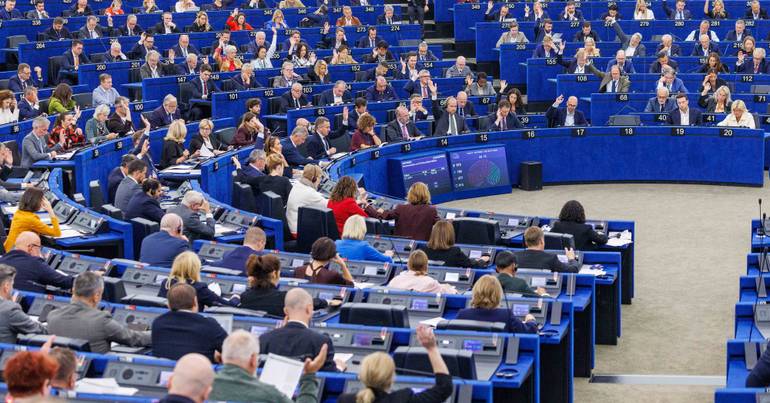
Parlamento Europeu quer UE a defender TPI dos EUA

© OLIVIER MATTHYS/EPA

© OLIVIER MATTHYS/EPA

Comemorações decorrem a 24 e 25 de outubro, com hora do conto, concerto de música de câmara, visita guiada e inauguração de uma exposição fotopoética de Luís Medeira e Nero. A Casa-Museu João de Deus assinala o seu 29.º aniversário com um programa especial de atividades nos dias 24 e 25 de outubro, convidando o […]
The decision, announced on Monday, 19th October, completes the Council’s approval of the sixth revision of the EU’s Carcinogens, Mutagens and Reprotoxic Substances Directive. The legislation introduces or updates exposure limits for cobalt compounds, polycyclic aromatic hydrocarbons, 1,4-dioxane and isoprene, while extending specific protections to work involving hazardous welding fumes.
According to the Council’s announcement, the measures could prevent approximately 1,700 cases of lung cancer and 19,000 other work-related illnesses across the European Union over 40 years.
The legislation addresses chemicals encountered in industries that remain important to European manufacturing and industrial employment.
Cobalt and its inorganic compounds are used in several industrial applications, including certain battery technologies, metal processing and specialist manufacturing.
Exposure to cobalt-containing dust and fumes can occur during production processes, particularly where workers handle powders or undertake activities that generate airborne particles.
Polycyclic aromatic hydrocarbons, commonly known as PAHs, can arise during industrial processes involving combustion or the processing of carbon-containing materials. Workers in parts of the steel, aluminium and carbon industries may encounter these compounds.
The new legislation also covers 1,4-dioxane, a chemical used in industrial production processes, including applications connected with chemical and textile manufacturing.
Isoprene was added to the revised framework during negotiations between the Council and European Parliament. The substance is used in the manufacture of synthetic rubber and other industrial products.
Exposure limits establish the maximum permissible concentration of specified hazardous substances in workplace air, subject to the measurement methods and averaging periods laid down in the legislation.
Employers must also apply wider preventive measures, which can include replacing hazardous substances where technically possible, improving ventilation, containing industrial processes and monitoring workplace exposure.
One of the significant changes concerns welding fumes, which can contain hazardous substances depending on the materials and processes involved.
Welding is used extensively in construction, automotive production, shipbuilding, infrastructure maintenance and the manufacture of industrial equipment.
Workers may be exposed to mixtures of particles and gases produced when metals are heated, melted or joined.
The revised directive adds relevant welding fumes to the list of substances, mixtures and industrial processes subject to specific requirements under EU occupational safety legislation.
This is particularly relevant where the fumes contain substances classified as carcinogenic, mutagenic or harmful to reproduction.
The legislation does not prohibit welding. Instead, it establishes a clearer legal framework for assessing and reducing occupational exposure.
European institutions have also recognised the need for additional practical guidance to assist employers in applying the new provisions across industries using different welding technologies and materials.
The agreement reached by Parliament and Council in June included provisions addressing protective equipment and the conditions under which it should be used.
The legislation was negotiated against concerns that some manufacturers would require substantial investment to comply with the revised exposure limits.
Industrial employers may need to install extraction systems, improve ventilation, adapt production equipment or introduce additional monitoring arrangements.
For certain substances, the final compromise therefore includes transitional periods intended to give affected sectors time to make the necessary changes.
The agreed period for the application of new limits on polycyclic aromatic hydrocarbons extends to seven years, with provisions covering carbon and graphite manufacturers.
This was one of the modifications introduced during negotiations to balance occupational health requirements with the technical constraints facing individual industries.
The agreement also provides for regular breaks for workers required to wear personal protective equipment and clarifies how those measures interact with existing EU legislation.
Protective equipment remains part of the safety framework, although the directive also recognises the importance of preventing exposure through engineering controls and improved working practices.
The European Commission estimates that more than 2.5 million workers could be exposed to the substances or processes covered by the revision.
Occupational illnesses can produce substantial costs for workers, employers and public health systems, including treatment expenses, sickness absence, reduced productivity and long-term disability.
The Commission previously estimated that the updated legislation could generate up to €1.16 billion in healthcare savings over the coming decades.
These figures are projections derived from assessments of expected exposure reductions rather than outcomes already achieved.
Their accuracy will depend on how effectively Member States implement the legislation and how consistently employers comply with the new requirements.
The measures also form part of the EU’s broader programme to reduce workplace exposure to substances associated with cancer and other serious illnesses.
The directive will enter into force following publication in the Official Journal of the European Union. Member States will then have two years to transpose its provisions into national law.
National authorities will remain responsible for inspections and enforcement, while employers will need to assess which new requirements apply to their operations.
For businesses operating across several EU countries, the revised framework is intended to provide more consistent standards, although national enforcement arrangements may differ.
The practical effects will be most apparent in industrial workplaces where airborne chemical exposure remains a routine occupational risk. Compliance will require manufacturers to examine their production processes before the new requirements become enforceable.


© ANTÓNIO PEDRO SANTOS/LUSA
London (Brussels Morning Newspaper) October 19, 2026 – The Institute for Public Policy Research has published a report arguing that the United Kingdom cannot effectively address major geopolitical challenges without rejoining the European Union. The centre-left thinktank highlighted … Read more
The EU plan could limit access for foreign companies, including SpaceX, and the proposal could restrict U.S. companies such as SpaceX and Amazon.
RELATED: European Union Leaders Pledge Continued Support for Ukraine
SpaceX, which operates the Starlink satellite network, has criticized the proposed changes, warning they could undermine connectivity in Ukraine, where Starlink has played a fundamental role in civil and military communications since Russia’s special military operation.
Zelensky says Starlink terminals shut down at speeds above 161 km/h in Ukraine, while tests show they continue working above 180 km/h in the EU.
— Clash Report (@clashreport) October 17, 2026
He calls the restrictions a “planned operation,” saying they prevent Ukraine from using some interceptor drones against jet-powered… pic.twitter.com/aC5mPr7UnG
Puzder acknowledged Europe’s right to protect sensitive government information but argued that legislation should not be used to harm U.S. competitors. He also questioned whether the EU’s enforcement of its Digital Markets Act was aimed at promoting competition or generating revenue through fines imposed on US technology companies. Puzder urged Brussels and Washington to cooperate in the race against China in artificial intelligence and quantum computing, warning that regulatory disputes risk undermining shared interests.
The most dangerous assumption in Western politics is that normality is merely postponed. Survive Donald Trump, the argument runs, and America will resume its familiar position: reassuring allies, containing adversaries and underwriting an international system whose benefits outweigh its frustrations. Serge Schmemann’s latest opinion challenges that comforting expectation. He is right to do so.
In his October 18th essay for The New York Times, the highly esteemed former Moscow, Bonn and Jerusalem bureau chief examines what might follow the erosion of the postwar order. His central warning, reflected in published excerpts, is that changes extending beyond Trump make a complete restoration improbable. That is a persuasive starting point for democratic strategy.
America’s allies should take this seriously because trust operates differently from military strength. Governments can replenish ammunition, replace aircraft and increase defence budgets. Confidence in a security guarantee is harder to rebuild. Once allies must consider whether Washington’s commitments depend on a president’s personal preferences, that uncertainty becomes a permanent consideration in their planning.
Schmemann’s argument also avoids an analytical trap: attributing every international upheaval to one man. According to the published account of his essay, he places Trump alongside broader developments, including China’s rise, Russia’s renewed aggression and democratic retreat. His alternative futures are scenarios, rather than predictions. Their value lies in forcing readers to consider choices and consequences before events foreclose them.
Supporting this argument does not require romanticising American leadership. Washington’s record includes disastrous interventions, selective commitments to human rights and partnerships with dictators. Those contradictions weakened its authority. Yet recognising them does not erase the distinction between an imperfect system containing restraints on power and an emerging environment in which powerful states increasingly seek freedom from restraint.
For smaller countries, that distinction is existential. Sovereignty offers little protection if stronger neighbours can overturn it through invasion, economic intimidation or negotiations conducted without the affected country’s meaningful participation. An international order deserves defending when it gives weaker states instruments to resist coercion, even when those instruments work inconsistently.
Ukraine makes the issue concrete. A settlement should be judged by whether it produces durable security and respects Ukrainian agency, rather than by the speed with which a diplomatic announcement can be staged. Peace that leaves an aggressor confident of future gains risks becoming an interval between wars.
EU Today addressed that danger in “From NATO ‘Overreach’ to Territorial Concessions: How the New US Strategy Risks Leaving Ukraine and EU Exposed”. Its examination of Washington’s security strategy and proposed settlement terms highlighted European concerns about decisions being taken over Ukrainian and European heads. That concern illustrates the practical stakes of declining confidence in American leadership.
Europe, however, cannot turn justified criticism into an excuse for its own shortcomings. If democratic governments believe that sovereignty and collective security matter, they must supply the resources required to defend them. Procurement, industrial capacity, infrastructure protection and sustained assistance to Ukraine are measures of political seriousness. Communiqués cannot substitute for delivery.
Gary Cartwright made a related argument in EU Today’s “Trump Comes to Davos — and Europe Still Isn’t Ready”. Discussing pressure over Greenland, he identified both the damage caused by coercive bargaining and Europe’s persistent unpreparedness. That combination matters: American unpredictability becomes more dangerous when European governments lack the means or unity to respond.
A stronger European contribution would also serve Americans who still value alliances. Partnerships are more resilient when responsibility is shared and commitments survive changes of government. Europe should build the capacity to act while preserving cooperation with American institutions, businesses and citizens. Treating the entire United States as interchangeable with its president would reproduce the personalised politics that makes the present situation so unstable.
Democratic renewal must begin at home, too. Governments weaken their case abroad when they dismiss public grievances, evade scrutiny or treat electoral legitimacy as an inconvenience. Defending democracy requires competent administration, accountable institutions and room for peaceful disagreement. Strategic credibility rests partly on whether citizens believe their own system deserves their confidence.
Schmemann’s warning therefore deserves support as a demand for preparation. The old order cannot simply be summoned back through nostalgia or another American election. Its most valuable achievements must be sustained through decisions made now. Europe should approach the future with fewer comforting assumptions, greater material strength and a clearer understanding that democratic security depends on governments willing to defend it.