French president will decide on concrete ‘next steps’ regarding demonstrations called for Saturday and after, as part of tough response to recent rioting
Emmanuel Macron has said “illegitimate” demonstrations will be banned over the coming days as France seeks to get a grip on civil unrest after some of its worst street violence in years erupted on the fringes of cost of living protests at the weekend.
Speaking after a meeting with intelligence chiefs and senior ministers, the French president said on Thursday that demonstrations organised by recognised groups would be allowed to go ahead, although their routes could be changed.
Leader of CHEGA, André Ventura, has criticised Prime Minister Luís Montenegro’s silence on the housing crisis and recent protests, warning that the government’s failure to respond could act as a
In questi giorni il caro vita turba i sonni del mondo politico e sindacale, compresi quanti finora hanno ignorato i diffusi rincari dell’energia e dei beni di prima necessità, riducendo l’emergenza a mera polemica politica.
In questi giorni il caro vita turba i sonni del mondo politico e sindacale, compresi quanti finora hanno ignorato i diffusi rincari dell’energia e dei beni di prima necessità, riducendo l’emergenza a mera polemica politica.
Tuttavia, anche le poche mobilitazioni in corso dimenticano che la causa primaria dell’inflazione è proprio l’economia di guerra: l’escalation militare ha fatto ripartire la corsa dei prezzi, con conseguenze particolarmente pesanti per le economie europee, dipendenti dal greggio in transito nel Golfo Persico.
Un tempo le forniture principali arrivavano dalla Russia a costi decisamente inferiori a quelli attuali. Affermare che l’economia di guerra sia la causa principale dell’inflazione e del rallentamento economico europeo significa semplicemente prendere atto della realtà.
I dati parlano chiaro: tra marzo e agosto la UE ha sostenuto 54 miliardi di dollari di costi aggiuntivi netti solo per le importazioni di gas e petrolio. Questo dato basterebbe da solo ad aprire un dibattito serio sulle conseguenze economiche dei conflitti.
A confermare il quadro è l’Ufficio Studi della CGIA di Mestre: a fine anno gli italiani pagheranno 29 miliardi di euro in più tra rincari di elettricità, gas e carburanti. Solo in Italia il costo dell’energia elettrica è balzato del 51,2%. Rincari dovuti all’instabilità delle catene di approvvigionamento, alle speculazioni finanziarie e all’aumento delle spese militari, che sottraggono risorse essenziali al welfare.
Di fronte a questo scenario, la risposta del Governo appare timida e priva di coraggio. Mentre sostiene le spese per il riarmo, prova a calmierare con fondi pubblici le bollette degli italiani (che stimano una spesa aggiuntiva media di 153 euro all’anno per l’elettricità e 477 euro per il gas). Parallelamente, i rincari a doppia cifra colpiscono anche i beni alimentari di largo consumo: la dimostrazione che non si tratta di un incidente di percorso, ma di un effetto strutturale dell’economia di guerra.
In questo contesto, le manifestazioni di piazza rischiano di rivelarsi inefficaci, sia per la scarsa adesione sia per la debolezza delle motivazioni. Manca una riflessione complessiva sul sistema economico e sui meccanismi che spingono verso il basso i salari (a partire dai criteri di calcolo dell’IPCA). I bonus non sono la soluzione, bensì il sintomo del progressivo smantellamento del welfare pubblico.
È urgente iniziare a parlare apertamente di “economia di guerra”: un modello di produzione che alimenta la corsa alle risorse, dirotta i fondi pubblici verso la difesa e giustifica la sottrazione di risorse ai servizi essenziali. In caso contrario, continueremo a inseguire singoli provvedimenti tampone senza mai affrontare la vera radice del problema.
In a podcast with Paul Ronzheimer, ARD chairman Florian Hager conceded that public broadcasters have often lectured AfD voters, that migration coverage was “probably not critical enough” in places, and that journalists from academic backgrounds can lose touch with everyday realities.
During the podcast, Hager distinguished AfD politicians from their voters and said concerns about representation and trust in public media are a problem that public media must acknowledge as a problem.
“I am trying to create a separation between AfD politicians and the people who vote for the AfD,” he said, noting that the concerns of voters should not be ignored. “And if there’s a feeling that we don’t represent them, that they aren’t seen, or that they can no longer trust us, then it’s a huge issue for us. And then you can’t say it is their problem… but it’s our problem.”
These are rare admissions from an ARD chief. However, in a country where approximately a third of voters support the AfD, the party and its voters can no longer be swept aside by public media as anger over mass immigration soars.
In general, public trust has eroded in public broadcasting while the AfD consolidates its position at nearly 30 percent in national polls.
Public media’s trust problem is measurable and persistent. A Media Tenor “Zukunftsindex Deutschland” survey of more than 3,000 people found only 31 percent trust ARD, ZDF and related programs; among 16- to 29-year-olds the figure was 25 percent, and among AfD supporters it dropped to 15 percent.
WDR/Infratest Dimap data from spring 2025 put institutional trust in public broadcasting at 55 percent overall, with a clear East-West gap (higher in the West, lower in the East).
Compulsory fees continue to fund a system whose audience is shrinking relative to the political landscape, and the people who have to pay those fees are even willing to hold public demonstrations over the issue. t has strong echoes of the protests against the BBC.in Britain, where taxpaying Brits who vote for conservative parties have launched campaign after campaign for the abolition of compulsory fees to support the network.
The ideological skew inside the German journalism industry helps explain much of the uncritical migration coverage. Hager is now being forced to confront this issue, but the problem is that the vast majority of journalists working in public media are extremely supportive of left-green parties, and many of these same journalists could even be considered open-border extremists.
The 2024 TU Dortmund “Journalism and Democracy” survey of 525 journalists — with 40 percent of respondents working for public broadcasters — found 41 percent leaning toward the Greens, 16 percent toward the SPD, 6 percent toward the Left, and only 8 percent toward the CDU.
As for the AfD, it either was not listed or received support so low, at below 1 percent, that it was considered “negligible.”
In total, among those expressing a preference, left-green parties accounted for roughly 82 percent of journalists. Green Party support among journalists was several times the party’s national polling level at the time.
Meanwhile, the party that is supported about a third of the population, the AfD, does not even have 1 percent representation in the public media networks, even though those same networks are obligated by law to represent a full spectrum of the public’s political opinions.
What does this mean in practice? When the people producing the news overwhelmingly favor parties that have defended high immigration levels, expansive asylum rules, and framing that treats immigration restriction as morally unjustified, then the type of “uncritical” reporting described by Hager is the predictable outcome — not an accidental oversight.
Hager’s attitude has been repeated not only throughout German politics, but across the entire Western world. The elite, the political establishment, and the organs of the press offer a constant platitude, claiming to have not “paid enough attention” to voters and that we “need to do better” on the topic of immigration. This has been repeated ad nauseam for decades, and is only amplified when right-wing parties opposed to immigration get closer to power.
They are ultimately empty words at the end of the day meant to paper over a real crisis. Is Hager going to hire more journalists who support the AfD? The thought would never cross his mind. Is he going to start reporting on the nationality of suspects in crime reports? Highly unlikely. Is he going to start running more pieces critical of immigration? This is also unlikely, although there may be some subtle steering toward acknowledging there is a problem but that the public should never vote for the AfD to potentially fix the problem.
Notably, he also expresses worry that an AfD-led government may place curbs on the cash cow that feeds the ARD with tens of millions of euros in mandatory fees on German citizens, who have to pay to keep the ZDF and ARD running whether they like it or not.
Hager says he wants to separate AfD voters from the party and address feelings of being unseen. That is tactically sensible for an institution facing state-treaty threats and potential cuts to its funding. Yet the parties that dominate journalistic preferences – the Greens, SPD, and large parts of the center-left spectrum – continue to support higher immigration and more open policies that sharply contrast with the AfD’s core demand for sharp reductions and stricter controls.
That problem is not going away.
Even if Hager truly wanted to turn the ship around and gain back the trust of AfD voters, would there even be any institutional support for such a change of pace within the ARD itself?
For an example of this, it is important to review the case of Julia Ruhs. Her case shows, along with the cancellation of her show, that reporting critically on immigration can lead to a witch hunt within the German public broadcasters. Remix News covered the moment she learned public broadcasters had dropped her show.
A female German journalist wanted to research the topic of gang rapes by migrants in Bavaria but was labeled "racist" and "right-wing" by her colleagues.
Julia Ruhs, a high-profile television presenter, said it is still a "taboo" to research topics regarding why "certain population groups are more susceptible to committing sexual offenses."
"That’s when I realized the whole editorial imbalance that when you dedicate yourself to such a topic."
She added that it became an environment where she was told: "You’re not allowed to say that and you’re totally racist."
Ruhs is currently at the center of a significant "Cancel Culture" and media sovereignty debate in Germany.
She is often described as a rare conservative voice within the German public broadcasting landscape, which is frequently criticized for having a "left-green" bias.
In 2025, Ruhs was chosen to host a new experimental debate format called "Klar," co-produced by the northern public broadcaster NDR and the southern BR. The show’s mission was to reach viewers who felt alienated by mainstream media by tackling sensitive topics like migration, Covid-19, and the farmers’ protests.
After the first episode on migration, a massive internal wave of criticism hit. Approximately 250 NDR employees signed an open letter distancing themselves from the show, accusing Ruhs of one-sided and populist reporting.
In September 2025, the NDR officially decided to drop Ruhs as a presenter for their portion of the show, citing a desire to move toward a "multi-moderator concept."
Ruhs responded on social media, calling the decision a "disgrace" and claiming she was "too right-wing for the NDR."
High-profile politicians like CSU’s Markus Söder (Bavaria) and Daniel Günther (Schleswig-Holstein) criticized the NDR for stifling diversity of opinion.
While the NDR canceled her, the Bavarian broadcaster BR stood by her. New episodes of "Klar" are planned from the BR broadcaster for 2026.
Hager is aware of this problem to a large degree. He also cites police and local officials repeatedly describing persistent problems over migration. However, he is offering nothing more than a weak mea culpa on behalf of years of ARD reporting, which has gone to great lengths to whitewash the growing problems with mass immigration.
Most importantly, Hager does not address how the ARD actually plans to change its reporting and win back the trust of these voters. Additionally, he completely fails to confront the structural imbalance in who is hired, trained, and promoted, or the compulsory funding that insulates the system from market feedback.
Damage control without altering the underlying editorial incentives or the immigration positions of the favored parties is unlikely to restore broad trust from AfD voters. If he was serious about truly diverse representation in the public media, he would require measurable diversification of political backgrounds inside the newsrooms and reporting that treats migration outcomes – crime correlations, integration failures, fiscal costs, and local pressures – with the same rigor applied to other policy areas.
Cela fait un certain temps que je voulais écrire un article sur les destins de la Russie et de l’Ukraine depuis le début du conflit en 2014. Le fil conducteur est que l’Ukraine a drastiquement réduit ses échanges commerciaux avec la Russie, depuis 2014, sans jamais les compenser par une augmentation des échanges commerciaux avec l’Europe. Cela a eu comme conséquence involontaire que l’Europe a dû injecter des sommes importantes en Ukraine juste pour empêcher sa monnaie de s’effondrer alors que la guerre se poursuivait. Pendant ce temps, la Russie a diversifié ses échanges commerciaux avec les pays non-européens, de sorte que sa balance extérieure est aussi solide aujourd’hui qu’elle l’était en 2014, ce qui lui procure les liquidités dont elle a besoin pour soutenir l’effort de guerre.
Points importants :
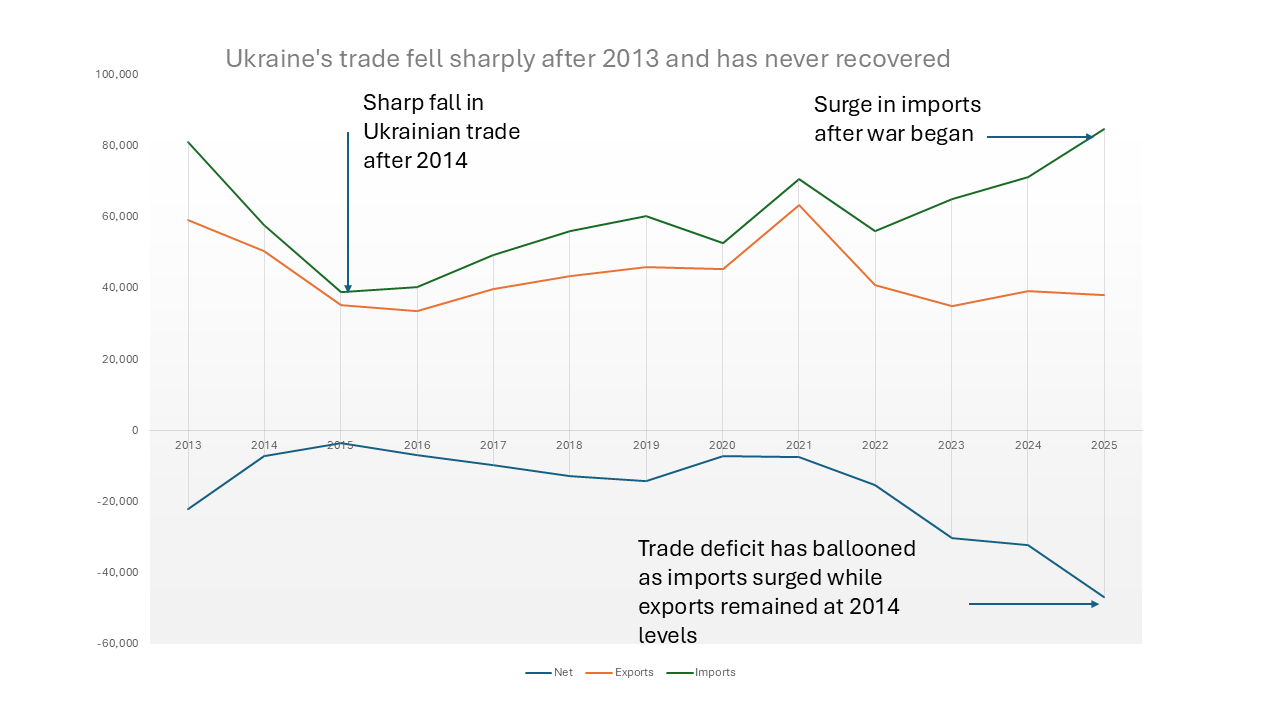
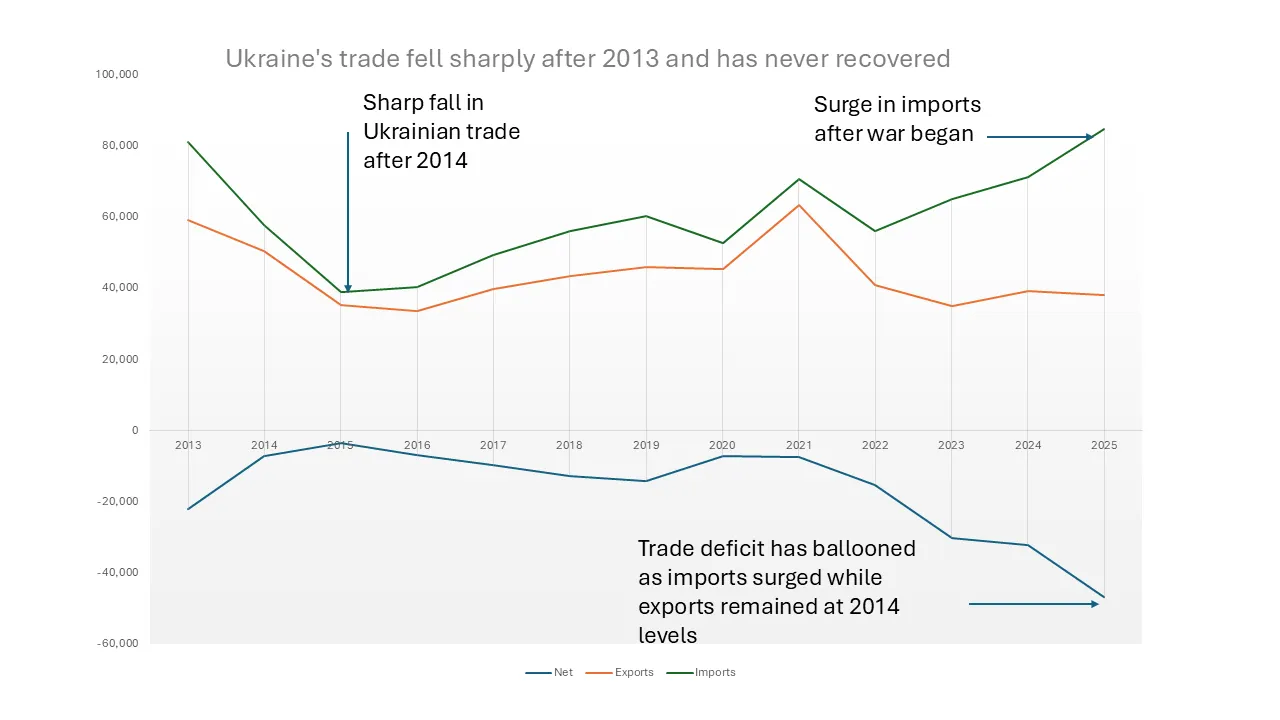
L’Ukraine a exporté 24% de moins et importé 46% de plus en 2025 qu’en 2014. La guerre a fait grimper les importations alors que les exportations ne se sont jamais remises de la signature de l’ALECA et ont été entravées par l’effort de guerre.
Le déficit commercial béant que l’Ukraine a creusé depuis le début de la guerre a exercé une pression accrue sur les sponsors européens pour qu’ils fournissent le capital dont l’Ukraine a besoin pour empêcher l’effondrement de sa monnaie, en plus de fournir des fonds pour répondre à ses besoins budgétaires.
Ce défi de financement pour l’Europe persistera après la fin de la guerre, tant que l’Ukraine ne sera pas autosuffisante en stimulant ses exportations et/ou en attirant suffisamment d’investissements étrangers pour compenser ses déficits commerciaux.
La force des exportations russes et ses excédents commerciaux constants n’ont pas été affectés par la guerre. Après le début de la crise ukrainienne, la Russie a commencé à diversifier ses principales exportations d’énergie hors d’Europe, ce qui lui a permis de résister à la réduction progressive de ses exportations vers l’Europe. En effet, la Russie a tiré une énorme manne, en 2022, de la flambée des prix de l’énergie. Il n’y a aucune preuve que les sanctions aient eu un impact significatif sur le modèle d’exportation russe.
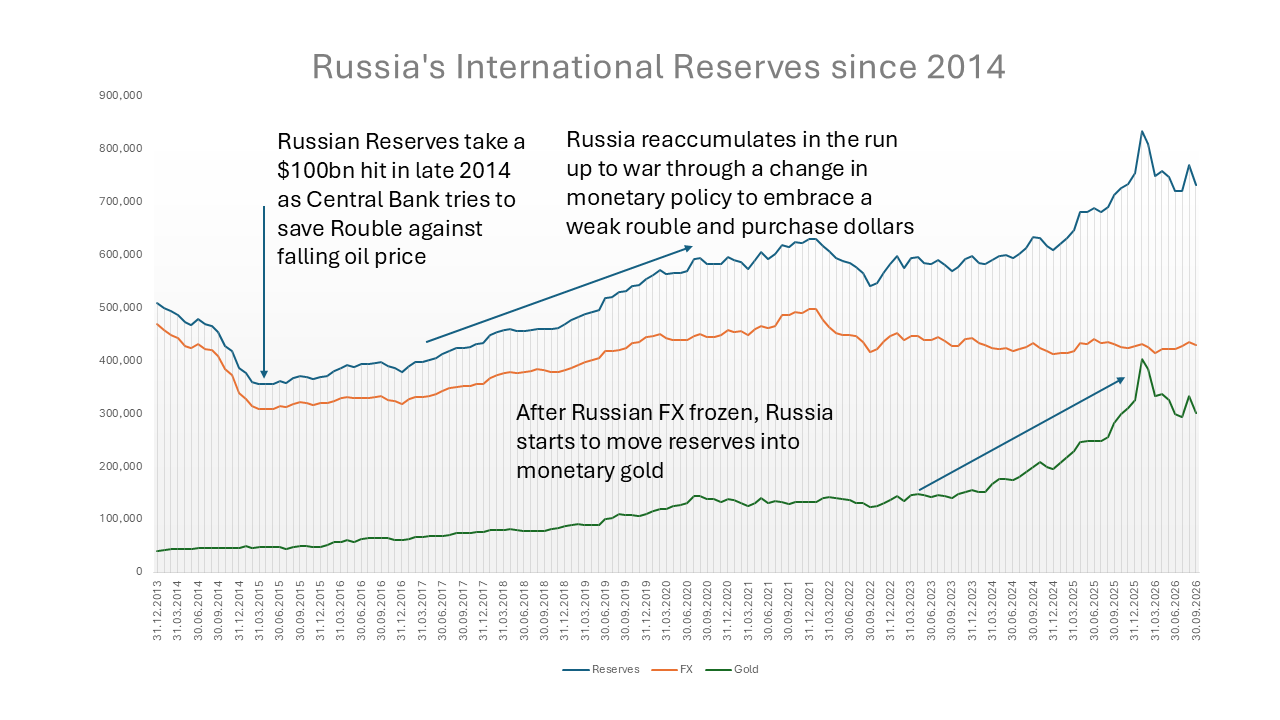
La Russie avait déjà commencé à réaccumuler des réserves de change après l’effondrement des prix du pétrole fin 2014, jusqu’avant le début de la guerre. Suite à l’immobilisation des 300 milliards de dollars de réserves russes en Europe, la Russie a commencé à accumuler des réserves en or, pour sanctionner les bénéfices futurs. La Russie dispose désormais de réserves liquides de plus de 420 milliards de dollars, ce qui signifie que l’immobilisation de ses réserves de devises étrangères n’est plus un facteur limitant sur le plan économique.
Analyse détaillée
Le modèle d’exportation de la Russie, dans lequel elle enregistre constamment d’importants excédents commerciaux, lui a permis de générer les réserves de devises étrangères et d’or qui ont sans aucun doute contribué à financer la guerre en Ukraine. Le déficit commercial de l’Ukraine s’est creusé depuis le début de la guerre, nécessitant des injections continues de capitaux européens pour empêcher l’effondrement de sa monnaie.
Cela aide à expliquer que la Russie puisse soutenir la guerre plus longtemps ; elle n’a pas besoin de contracter de nouvelles dettes importantes, sa dette restant faible, à 20%. L’Ukraine ne peut financer la guerre et maintenir ses comptes nationaux en équilibre qu’avec de l’argent européen qui ne peut être garanti à long terme et qui, de toute façon, a augmenté la dette ukrainienne de 20% du PIB en moyenne chaque année depuis le début de la guerre. Ce n’est pas durable.
L’Accord de libre-échange approfondi et complet de 2014 a désavantagé l’Ukraine car il forçait le pays à ne plus commercer avec la Russie.
Le point de départ est la signature par l’Ukraine d’un Accord de libre-échange approfondi et complet avec l’Europe, le 27 juin 2014.
Herman van Rompuy, alors président du Conseil européen, déclarait alors que « des liens politiques et économiques plus forts apporteront plus de stabilité et de prospérité à l’ensemble du continent européen ».
Au même moment, le président Porochenko déclarait « au cours des derniers mois, l’Ukraine a payé le prix le plus élevé possible pour réaliser son rêve européen ».
Car le véritable cout de cet accord a été supporté par l’Ukraine qui a vu ses exportations s’effondrer et ses importations augmenter, car elle avait fait le « choix souverain » de ne plus maintenir ses liens commerciaux avec la Russie.
Ce fut un choix catastrophiquement mauvais. La Russie représentait environ 25% des exportations ukrainiennes avant 2014 et ce chiffre était tombé à moins de 5% en 2021, avant le début de la guerre. L’Ukraine n’a pas comblé cet écart en augmentant le volume de ses exportations vers l’Europe, qui sont restées en grande partie inchangées.
De plus, le même schéma peut être observé en Géorgie, qui n’a également connu aucune augmentation réelle de ses exportations vers l’UE après la signature de l’ALECA. L’UE utilise un certain nombre de mécanismes de règlement des différends commerciaux et d’autres barrières non tarifaires pour bloquer la croissance des importations en provenance des pays partenaires de l’ALECA.
Ainsi, en encourageant l’Ukraine à commercer avec l’Europe et non avec la Russie, l’Europe a imposé une perte économique sèche à l’Ukraine qui avait pris la décision souveraine de renoncer à une relation commerciale auparavant rentable, pour poursuivre un objectif politique d’intégration à l’UE.
De plus, depuis le début de la guerre, les importations ukrainiennes ont augmenté, entraînant une augmentation progressive de son déficit commercial. Cette augmentation des importations a été causée par le fait que l’Ukraine achète des armes aux États-Unis en utilisant des fonds européens et nationaux empruntés. Ainsi, l’Ukraine emprunte de l’argent pour créer un déficit commercial qui doit être comblé par de nouveaux afflux de capitaux.
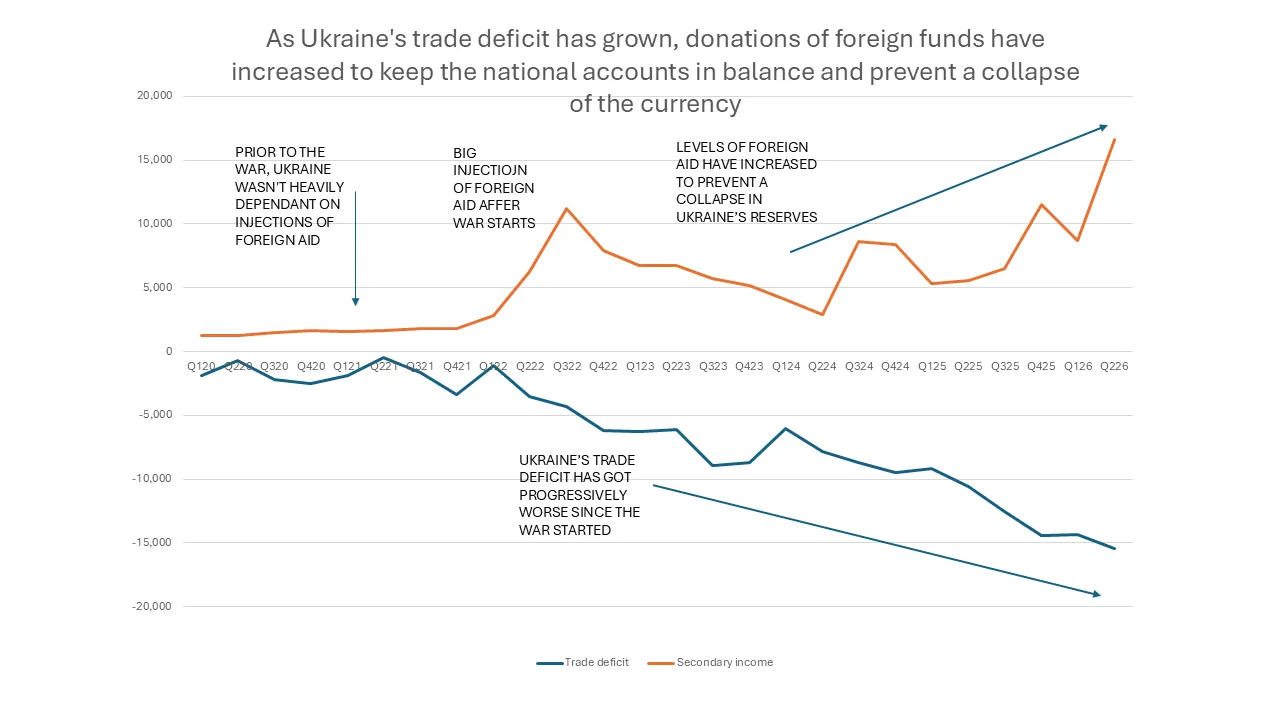
Entraînée dans un déficit commercial persistant et croissant par la guerre, l’Ukraine a besoin d’injections continues de fonds étrangers pour empêcher l’effondrement de sa monnaie.
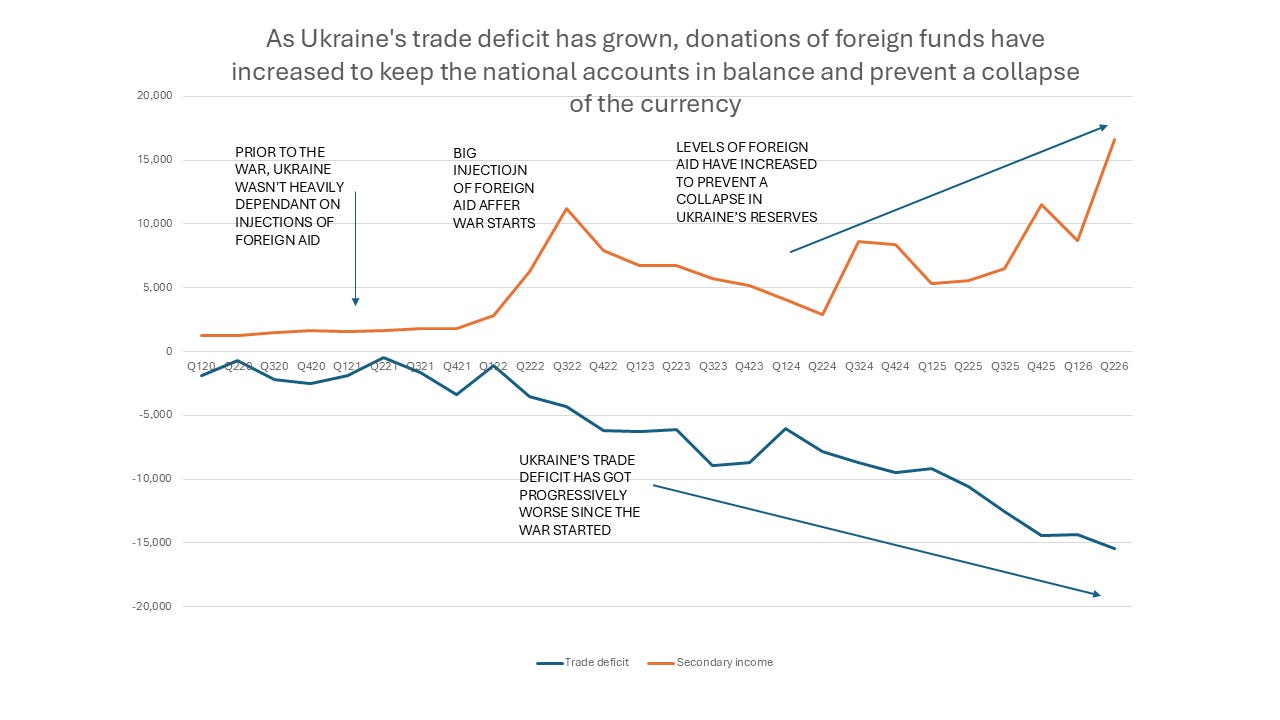
Le graphique ci-dessous montre la croissance du déficit commercial de l’Ukraine avec la croissance correspondante des recettes classées comme « Revenu secondaire » dans sa balance des paiements trimestrielle. Ces entrées de capitaux classés comme « Revenus secondaires » sont des injections en provenance d’Europe (principalement) qui sont vitales pour renforcer les réserves de change de l’Ukraine et ainsi éviter une ruée sur la devise. Le point clé est que le financement étranger à l’Ukraine est plus qu’un simple événement fiscal. Il s’agit d’un mécanisme de soutien essentiel dans les circonstances où l’Ukraine est incapable d’attirer suffisamment d’investissements étrangers en temps de guerre.
La Russie n’a tout simplement pas été confrontée au même défi, choisissant plutôt de diversifier ses exportations vers d’autres pays alors que l’Europe fermait progressivement ses échanges commerciaux. Les sanctions n’ont pas entamé son commerce.
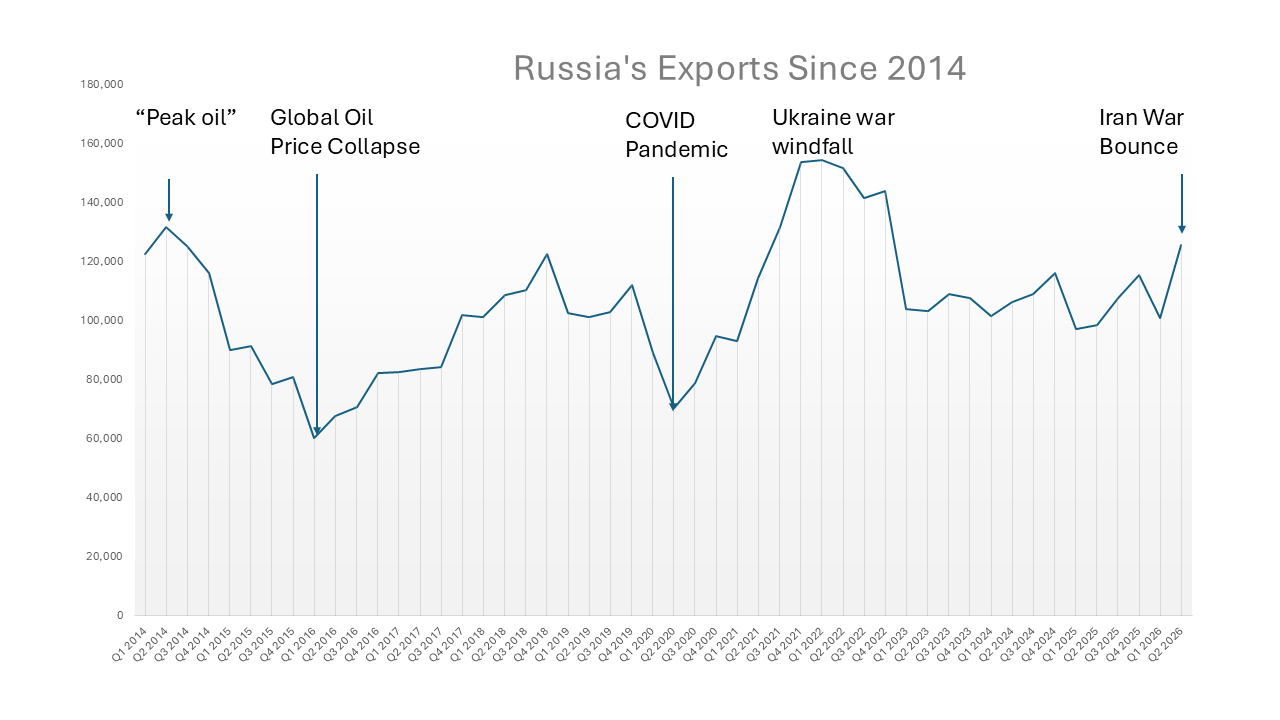
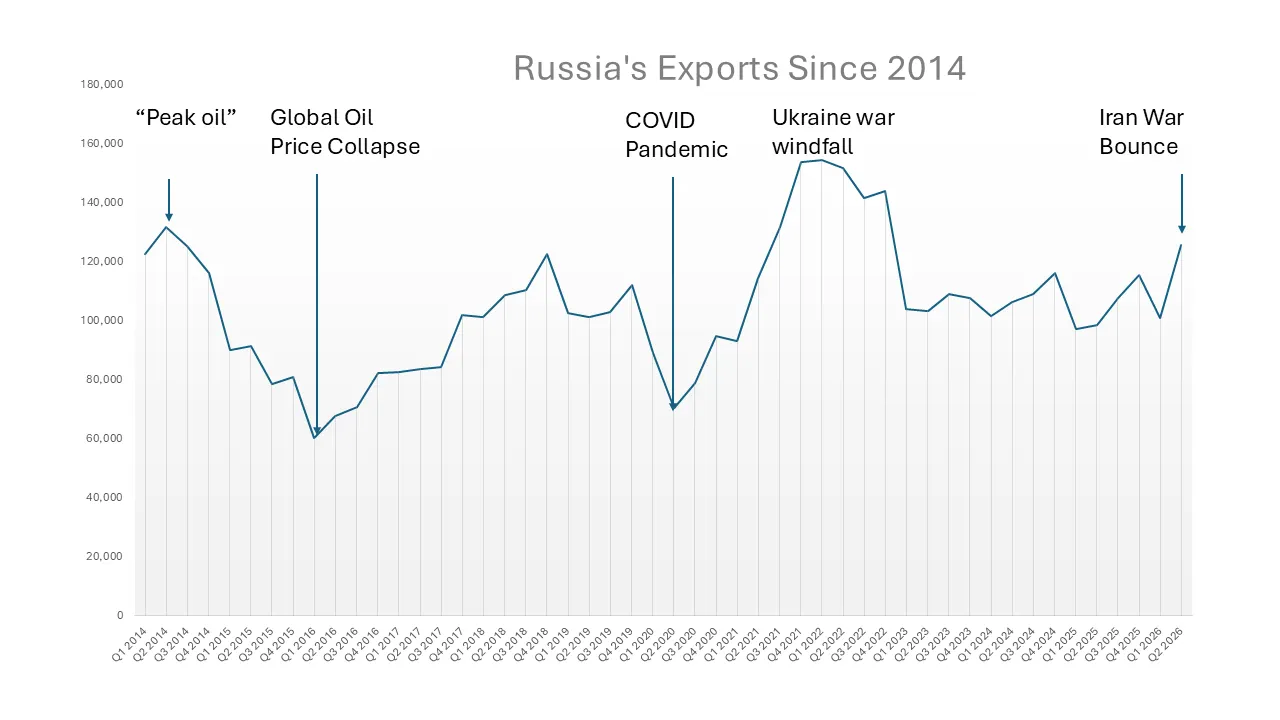
Le graphique ci-dessous illustre de manière élégante comment le commerce de la Russie a changé et évolué depuis. Les exportations russes ont connu des pics et des creux depuis 2014, bien que les creux aient souvent été causés par des événements mondiaux tels que les effondrements des prix du pétrole de 2014 et 2016 et le COVID.
Le déclenchement de la guerre en Ukraine a provoqué une énorme manne de revenus d’exportation car le prix du pétrole a bondi. Malgré l’imposition de milliers de sanctions par les pays occidentaux après le début de la guerre, les exportations russes sont restées très résistantes. Cela est dû à la diversification par la Russie de ses exportations vers les pays d’Asie.
En bref, malgré les nombreux gros titres dans les médias occidentaux traditionnels sur les sanctions « entravant l’économie de guerre de la Russie« , il n’y a aucune preuve substantielle que cela ait été le cas.
Le modèle d’exportation russe continue d’être une salle des machines qui lui fournit les liquidités dont elle a besoin pour financer la guerre sans contracter de nouvelles dettes importantes. Cela lui donne un avantage significatif sur l’Ukraine et ses soutiens européens dans cette « guerre d’usure« .
La Russie a accumulé des réserves depuis le début de la guerre pour compenser l’immobilisation de 300 milliards de dollars en devises par les pays occidentaux. La Russie investit désormais dans l’or pour protéger ses actifs.
Enfin, je commente depuis un certain temps que la Russie a entamé le processus d’accumulation de réserves de change en 2017 alors qu’elle modifiait sa politique monétaire pour adopter un rouble faible afin de maximiser les revenus en roubles tirés des exportations et qu’elle entreprenait un certain nombre d’achats en dollars via le ministère des Finances. Vous pouvez voir cette accumulation de réserves dans le graphique ci-dessous.
Après le début de la guerre, après l’importante manne de revenus tirés des exportations en 2022 et des chiffres commerciaux toujours solides par la suite, la Russie a continué à accumuler des réserves. Cependant, suite au gel de ses avoirs en devises, elle a plutôt choisi de stocker ses réserves en or, pour les protéger des sanctions.
Si la Russie souhaite évidemment récupérer ses avoirs immobilisés après la fin de la guerre (gros point d’interrogation), elle a néanmoins constitué un important coussin financier à hauteur de plus de 420 milliards de dollars de réserve en plus de celle qui reste gelée.
Ces importantes réserves contribuent sans aucun doute à garantir l’effort de guerre russe sans avoir besoin de gros emprunts. La dette de la Russie représente aujourd’hui environ 20% de son PIB.
En 2021, la dette de l’Ukraine s’élevait à environ 49% de son PIB. Aujourd’hui, elle représente environ 110% de son PIB.
With ‘right to housing protestors’ calling for ‘participation’ in a new protest scheduled for Lisbon on Saturday, president of the government of Madeira, Miguel Albuquerque, has said the equivalent of
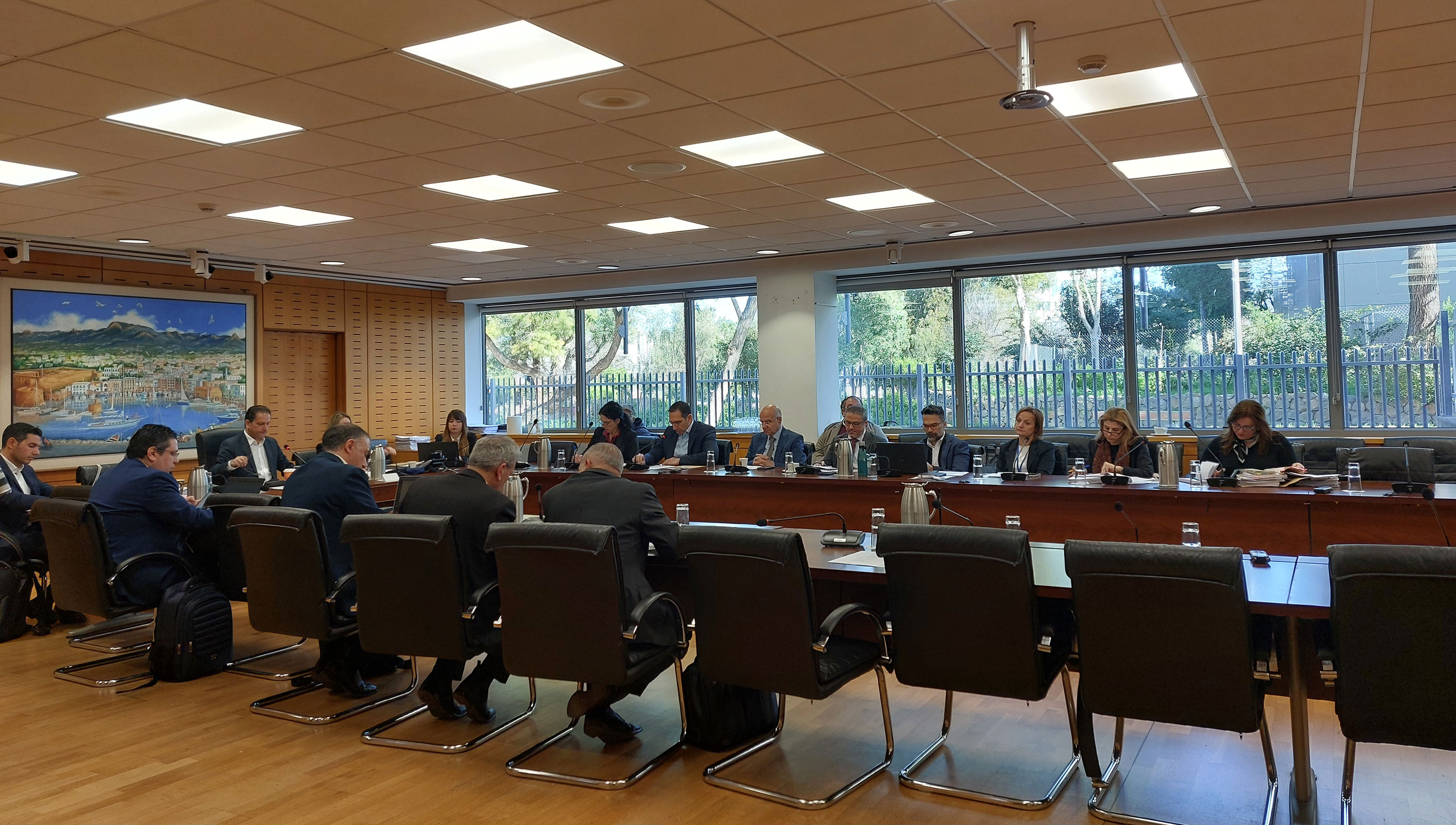
MPs on Thursday called for tighter controls on property purchases by foreign nationals, warning that legislation restricting individual buyers could prove ineffective unless companies and other corporate structures were also covered.
The House interior committee continued examining proposed amendments to legislation governing the acquisition of property by foreigners, with discussions expected to resume in a fortnight.
The committee is awaiting the government’s next steps towards drafting a comprehensive legislative proposal regulating property acquisitions by foreign nationals.
Committee chairman and Akel MP Aristos Damianou said efforts to introduce the legislation were gathering pace, expressing hope that the process could be concluded by the end of the year.
He said consolidated drafts had been prepared in April, but the process was interrupted by the parliamentary elections in May.
Damianou described the issue as “particularly serious”, saying it concerned national security, the economy and the country’s future.
“We are a partially occupied state, part of whose territory is occupied by Turkey, whilst part of its territory is under the control of British bases,” he said, stressing the need to establish clear criteria and restrictions on property acquisitions.
He also raised concerns about property transactions conducted through contracts that, he said, were often not made public, allowing foreign interests to acquire property through companies and other intermediary arrangements.
Damianou warned that legislation focusing exclusively on individuals would be insufficient.
“If issues concerning natural persons, companies, funds and all those who purchase property in Cyprus in a concealed manner are not also regulated, then regulating natural persons alone will be insufficient,” he said.
Disy MP Nikoletta Konstantinou also called for a comprehensive approach, saying the proposed legislation concerned the Republic’s strategic interests and national security.
She expressed concern that restrictions applying only to individuals could undermine the effectiveness of the legislation, arguing that both natural and legal persons should be covered.
“There is little point in discussing whether a natural person will be unable to purchase a property, be it 1,000, 2,000 or 4,000 square metres, if the beneficial owner themselves will ultimately be able to acquire property through a corporate structure,” she said.
Konstantinou argued that the government should have presented a comprehensive proposal taking into account European law, the property market and Cyprus’ investment policy.
“Our aim must be a framework that genuinely protects national security and the Republic’s strategic interests, without creating unjustified or disproportionate restrictions that ultimately cause problems for the country’s economic and investment activity,” she said.
Meanwhile, Diko MP Panikos Leonidou called for immediate action to regulate land purchases by third-country nationals.
He said the situation had reached “uncontrolled proportions” and was causing concern among citizens.
Leonidou urged Interior Minister Constantinos Ioannou and his ministry to take the initiative and introduce comprehensive legislation.
“The ministry of the interior must immediately table a bill covering all aspects of this problem,” he said.
Almost every shallow-water coral reef on the planet, including Australia’s Great Barrier Reef, faces a high risk of ecosystem collapse before 2075 because of global heating, according to an assessment by United Nations nature advisers.
About 24% of the planet’s reefs across more than 80 countries are already critically endangered, the assessment said, but when the expected impacts of global heating were added this rose to 96%.
I have wanted to write an article for sometime about the differing fates of Russia and Ukraine since the onset of the conflict in 2014. The headline is that Ukraine has never made up the difference in increased trade with Europe having cut its trade with Russia to the bone since 2014. This has inadvertently meant that Europe has had to inject significant sums of capital into Ukraine just to prevent its currency from collapsing as the war has gone on. Russia has diversified its trade away from Europe such that its export model is as strong today as it was in 2014, giving it the liquidity it needs to underwrite the war effort.
Key finding:
Ukraine exported 24% less and imported 46% more in 2025 than in 2014. The war has driven up imports while exports never recovered from the signing of the DCFTA and have been hampered by the war effort.
The yawning trade deficit Ukraine has built since the war started has placed greater strain on European sponsors to provide the capital Ukraine needs to prevent its currency collapsing, in addition to providing funding to meet its fiscal requirements.
This funding challenge for Europe will persist after the war ends until Ukraine can become self-sufficient in boosting exports and/or attracting sufficient foreign investment to offset its trade deficits.
Russia’s export strength and consistent surpluses have been unaffected by war. After the Ukraine crisis started, Russia started to diversify its major energy exports away from Europe, allowing it to weather the progressive reduction of exports to Europe. Indeed, Russia gained a huge windfall in 2022 from surging energy prices. There is no evidence that sanctions have impacted Russia’s export model in a significant way.
Russia has already started to reaccumulate FX reserves after the oil price collapse of late 2014, until before the war started. Following the immobilisation of $300bn in Russian FX reserves, Russia started to accumulate reserves in monetary gold, to sanction-proof future earnings. Russia now has liquid reserves of over $420bn meaning the immobilisation of its foreign currency reserves is no longer an economically limiting factor.
Detailed analysis
Russia’s export model in which it runs consistently large trade surpluses has ensured it can generate the reserves of foreign currency and gold which have undoubtedly helped to bankroll the war in Ukraine. Ukraine’s trade deficit has yawned since the war started, requiring continual injections of European capital to prevent its currency from collapsing.
This helps to explain by Russia can sustain the war for longer; it doesn’t need to take on significant new debt, its debt remaining low at 20%. Ukraine can only fund the war and keep its national accounts in balance with European money that cannot be guaranteed long-term and which, in any case, has increased Ukrainian debt by an average of 20% of GDP each year since the war started. This is not sustainable.
The Deep and Comprehensive Free Trade Agreement of 2014 has disadvantaged Ukraine because it forced a choice away from trading with Russia.
The starting point for this is the signature by Ukraine of a Deep and Comprehensive Free Trade Agreement with Europe on 27 June 2014.
Herman van Rompuy, then President of the European Council said that “stronger political and economic ties will bring greater stability and prosperity to the entire European continent.”
President Poroshenko said “over the last months, Ukraine paid the highest possible price to make her European dreams come true.”
Yet, the true price of this agreement has borne by Ukraine which saw its exports collapse and its imports increase, as it make a “sovereign choice” not to maintain trade links with Russia.
That was a catastrophically bad choice. Russia had accounted for around 25% of Ukrainian exports prior to 2014 and that figure fell to less than 5% in 2021 before the war started. Ukraine did not make up that gap by increasing the volume of exports to Europe, which have remained largely unchanged.
Indeed, this same pattern can be seen in Georgia which has also seen no real increase in exports to the EU after it signed the DCFTA. The EU uses a number of trade dispute mechanism and other non-tariff barriers to put blockages in the way of import growth from DCFTA partner countries.
So, by encouraging Ukraine to trade with Europe and not with Russia, Europe has imposed a deadweight economic loss on Ukraine which took a sovereign decision to forgo a previously profitable trade relationship, to pursue a political goal of EU integration.
Moreover, since the war started, imports into Ukraine have surged leading to a progressive ballooning of its trade deficit. This surge in imports has been caused by Ukraine purchasing weapons from the US using borrowed European and domestic funds. So, Ukraine is borrowing money to create a trade deficit that needs to be filled with further inflows of capital.
Dragged into a persistent and growth trade deficit by war, Ukraine needs continued injections of foreign funds to prevent its currency collapsing.
The graph below maps the growth in Ukraine’s trade deficit with the corresponding growth in receipts classified as Secondary Income within its quarterly balance of payments. These inflows of capital as Secondary Income are injections from Europe (principally) that are vital to shore up Ukraine’s FX reserves and so prevent a run on the currency. The key point is that foreign funding to Ukraine is more than just a fiscal event and top it. It is a vital support mechanism in circumstances where Ukraine is unable to attract sufficient inflows of foreign investment during a time of war.
Russia simply hasn’t faced the same challenge, choosing instead to diversify its exports to other countries as Europe progressively shut down trade. Sanctions haven’t dented trade.
The graph below illustrates in an elegant way how Russia’s trade has changed and evolved since. Russia’s exports have gone through peaks and troughs since 2014, although the troughs have often been caused by global events such as the 2014 and 2016 oil price collapses and COVID,
The onset of the war in Ukraine caused a huge windfall in income from exports as oil prices surged. Despite the imposition of thousands of sanctions by western nations after the war commenced, Russia’s exports have remained highly resilient. This is down to Russia’s diversification of its exports towards countries in Asia.
In short, despite many headlines in western mainstream media of sanctions ‘denting Russia’s war economy’ there is no substantive evidence that this has been the case.
Russia’s export model continues to be an engine room that provides the liquidity it needs to fund the war without taking on significant new debt. This gives it a significant advantage over Ukraine and its European backers in the ‘war of attrition’.
Russia has accumulated reserves since the war started to make up for the immobilisation of $300bn in FX by western nations. Russia now invests in monetary gold to sanction-proof its assets.
Finally, I have been commenting for some time that Russia started the process of accumulating Foreign Exchange Reserves in 2017 as it shifted its monetary policy to embrace a weak rouble to maximise rouble income from exports and as it undertook a number of dollar purchases via the Finance Ministry. You can see this reserve accumulation in the graph below.
After the war started, following the large windfall in earning from exports in 2022 and still solid trade figures after that, Russia continued to accumulate reserves. However, following the freezing of its foreign currency assets, it has chosen instead to store its reserves in monetary gold, to sanction proof them.
While Russia would undoubtedly like to see the return of its immobilised assets after the war ends (big question mark) it has nevertheless built up a significant financial buffer to the tune of over $420bn in reserve assets in addition to those assets that remain frozen.
This deep well of reserves undoubtedly helps to underwrite Russia’s war effort without the need for significant borrowing. Russia’s debt today sits at around 20% of GDP.
In 2021 Ukraine’s debt sat at around 49% of GDP. Today it sits at around 110% of GDP.
Supermarket urges government not to ‘further aggravate’ pressure on costs for businesses in next week’s budget
Sainsbury’s has warned of a “pretty challenging” market in the run-up to Christmas as households are “finding it tough” and food producers face rising costs.
Simon Roberts, the chief executive of the UK’s second biggest supermarket, called on the government not to “further aggravate” pressure on costs for business in this month’s budget. He said it was “important this government does not repeat what we have seen in previous budgets” in raising business rates and employers’ national insurance contributions. “That’s been really hard,” he said.
The US Treasury Department imposed sanctions on Wednesday on Karnakis & Karnakis, a law firm based in Greece and Panama, saying it had for years provided legal assistance to Iranian shipping networks.
The US Financial Crimes Enforcement Network also issued an administrative subpoena to advance an investigation into a Greek bank over potential ties to Iran, according to a Treasury statement, which did not name the bank.
FINCEN also issued requests for information to six other European banks that it did not name over relationships with Iranian financial institutions under US sanctions.
“Whether you are conducting illegal oil transfers at sea or sitting in the corner office of a law firm, if you are supporting the Iranian regime, we will find you and sanction you,” Treasury Secretary Scott Bessent said in a release.
Washington has held off striking Iran this month in the war that the US and Israel launched on February 28, and instead has continued the blockade of Iranian ports and issued waves of sanctions on Iranian shipping networks and those who the US says aid them.
State Department spokesman Tommy Pigott said Karnakis & Karnakis for years “set up shell companies to hide the true owners of vessels carrying Iranian oil, petrochemicals, and steel.”
He said the firm created companies that served as fronts for networks selling millions of barrels of Iranian oil to benefit the Islamic Revolutionary Guard Corps Quds Force and the Houthis.
Karnakis & Karnakis did not immediately respond to a request for comment.
Treasury also imposed sanctions on Singapore- and UAE-based shipping agents that it said directly aid Iranian shadow fleet operations.
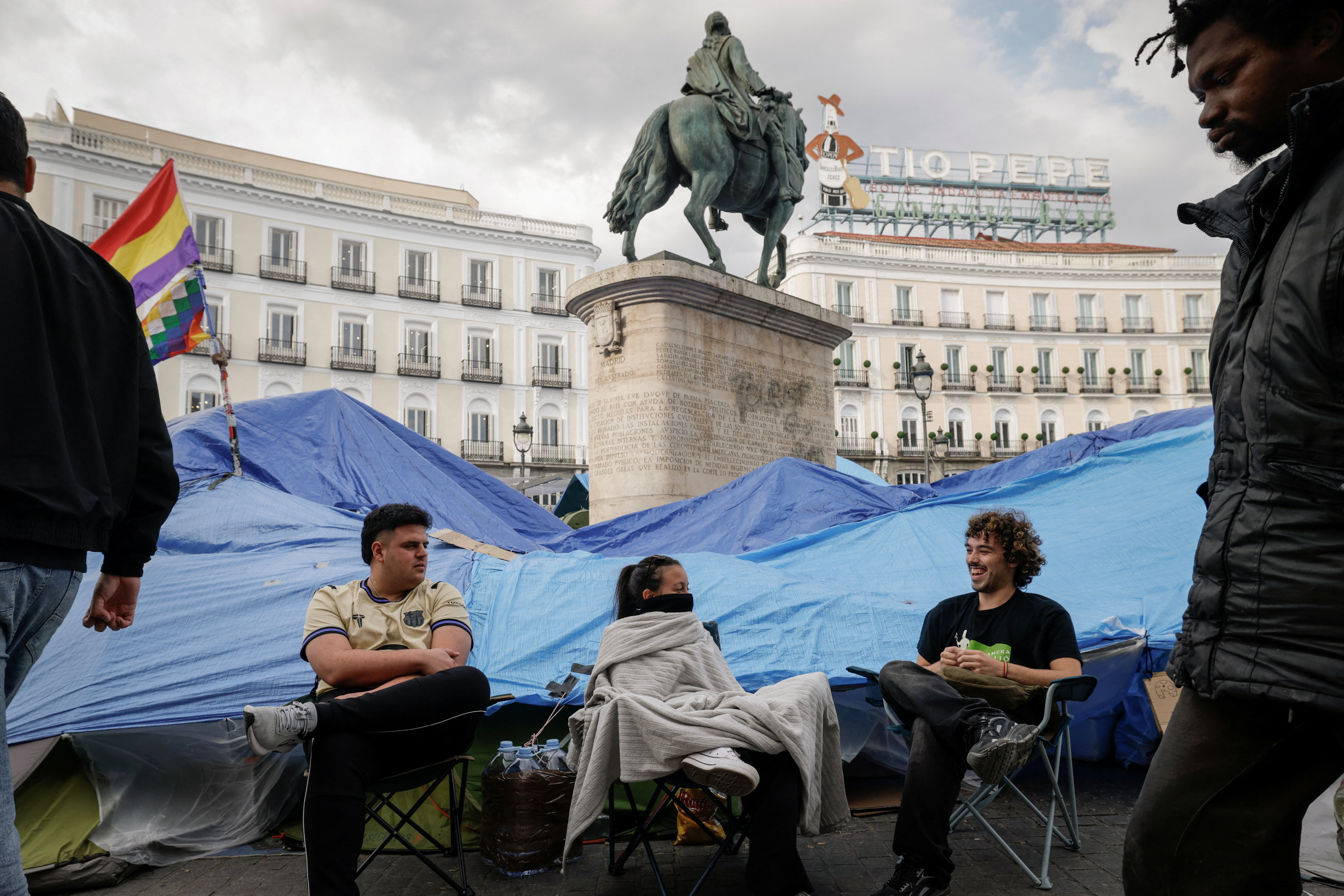
As anger boiled over in Spain about the death of Maricarmen Abascal two weeks after the 87-year-old pensioner was evicted from her Madrid home, Prime Minister Pedro Sanchez had no doubt who was to blame for the mounting housing crisis.
Emergency housing legislation passed after he dissolved parliament and called a snap election for November 29 would “stand up to vulture funds,” Sanchez said on October 6, adding that the measures would “target only those who regard housing as just another commodity to be speculated on.”
With rents rising 44% and house prices 58% over five years, protesters clamoured for a halt to speculation by so-called “fondos buitre” (vulture funds) that many blame for a raft of evictions such as Abascal’s.
But many in Spain are struggling to pin down exactly who these supposed predators are.
In the case of Abascal’s eviction, her landlord was not a big name private equity firm but rather a small consultancy called Urbagestión. Owned by two brothers, it has eight staff, a net profit of 2,990 euros ($3,350) last year and two properties to its name, according to the Association of Spanish Registrars.
After buying Abascal’s apartment eight years ago, Urbagestión increased her monthly rent to 1,650 euros from 570 euros, more than her monthly pension, according to the tenants’ union that represented her. The company took Abascal to court after discovering that her regulated rent contract had expired, court documents show.
“Urbagestión may not have been a ‘fund,’ but it is a ‘vulture SME (Small and Medium-sized Enterprise),’” Housing Minister Isabel Rodríguez said.
Who are Spain’s ‘vulture funds’?
Vulture funds first entered the Spanish lexicon after the 2008-2014 financial crisis to describe private equity funds or investment banks that bought rent-controlled flats and jacked up rents.
But companies including investment funds account for just 8% of Spain’s rental market, according to the Bank of Spain. The government has now widened the net to include anyone that makes a profit in the market, enmeshing small landlords who make up the majority of Spain’s rental market, said Fernando Rodriguez de Acuña, general director of Madrid-based real estate analysis firm Acuña.
“It’s only natural that anyone should make a profit in the market. Otherwise, you wouldn’t get involved in the first place,” he said.
The government first attempted to define and regulate vulture funds in a 2023 housing law that limited the activities of “large holders” – people or companies who own 10 or more properties.
In the decrees issued this month, the parameters were tweaked so that those who own five or more properties in areas deemed to have housing shortages must also be included. They are now banned from buying property for less than 70% of its market value.
The legislation goes further by banning owners of more than two properties from evicting tenants until 2030, while all landlords will be subject to automatic contract extensions and rent freezes.
The increasingly nebulous definition of a vulture fund last week ensnared Montse Minguez, a parliamentary spokesperson in the Socialist party, who stepped down after Spanish website Articulo 14 reported that her husband owned a property company that rented out 30 apartments and had evicted several tenants.
When Antena 3 asked her why Urbagestión was considered predatory and her husband’s company was not, she said it was a family company that abided by the law and paid its taxes while vulture funds were “foreign money that buys up entire blocks of flats to drive people out of their neighbourhoods to turn them into holiday lets.”
“All we’re saying is that you can’t go for the jugular, nor can you turn to speculation or vulture funds,” she said.
Evictions surge as tenant protections expire
Spain has seen a surge in evictions since March when a pandemic-era law to protect vulnerable tenants expired.
Orders for about 70,000 evictions were reinstated after the law was not extended, according to the Tenants Union.
Olga Matute took her own life on September 7 after she was evicted in April. Her case had been pending since 2020 after a bank sold her apartment to a fund which would not accept a reduced rent.
The new measures give protection to nearly 5 million people, including 122,683 at risk of eviction, social groups including the Tenants Union said in a statement.
Landlords warn of shrinking rental supply
The decrees “are still a long way from what is needed, but they represent victories in guaranteeing the right to housing,” said Enric Aragonès, a spokesperson for the Catalonia Tenants’ Union.
But the measures will only serve to exacerbate the shortage of rental homes in the long term, said Jorge Galindo, director of Esade Center for Economic Policy (EsadeEcPo). “These are policies that protect those who have a rental at the expense of those who don’t yet have one,” said Galindo.
The National Federation of Estate Agents’ Associations (FAI) said some 600 estate agents had reported the withdrawal of some 2,067 properties for long-term let in the days after the decree. A further 1,523 letting agreements have been put on hold.
Nearly half of Spain’s housing rental stock is owned by single-property landlords, while large landlords account for just 3.6% of the market in the hands of individuals, according to EsadeEcPo research.
Investors shift towards student housing
Foreign private equity has been cutting its exposure to residential real estate in Spain for some time. Blackstone has reduced its portfolio of residential properties in Spain to 12,000 from a peak of 40,000 in 2017.
Funds are investing instead in projects such as student housing and shared, short-term rents often inclusive of amenities like gym membership known as flexible living, which are not governed by the same regulations.
More than 40% of the nearly 24,000 Spanish homes bought by investment firms over the past 12 months were student flats, according to MSCI data company.
CPP and Greystar, two of the top four cross-border investors in Spanish homes over the past two years, said their investments were entirely or mostly in student housing and flexible living.
“The fact is that the market isn’t controlled by large funds; it’s in the hands of small investors. So now it’s all the small investors who have to bear the entire burden,” Rodriguez de Acuña said. ($1 = 0.8923 euros)
The US State Department has ordered some diplomats and family members to depart from its missions in Saudi Arabia and plans to withdraw family members from a number of other US missions in the region, US officials told Reuters.
The order came as attacks in Saudi Arabia killed at least one person and injured eight others at a civilian airport in Dammam and two people were killed in a drone attack on an oil field.
State Department spokesperson Tommy Pigott said in a post on X that the department ordered the departure of “non-emergency US government employees and their family members in Saudi Arabia only” amid attacks by the Iran-aligned Houthis in Yemen on civilian targets in the country.
Washington had returned some diplomatic personnel to the region in recent months after many were pulled out when Tehran launched attacks on US facilities after the US-Israeli war on Iran began in late February.
“Iranian-supported Houthis have increasingly engaged in hostilities against Saudi Arabia, including attacks on civilian airports and other critical infrastructure resulting in civilian casualties and severe travel disruptions,” Pigott said.
Four US officials told Reuters that US missions in other Gulf states would also be ordering family members to leave. Pigott did not address changes to other missions outside Saudi Arabia.
The latest withdrawals follow an escalation of the fighting in Yemen, opening another front in the regional conflict triggered by the US-Israeli war on Iran. The wider conflict has snarled global energy trade and hurt Gulf economies.
After the departure order, Saudi Arabia’s civil aviation authority reported an attack on King Fahd International Airport in Dammam that killed one person and injured eight others. Earlier in the day, two people were killed after Saudi air defences intercepted a drone that was attempting to hit a facility at Saudi Aramco’s Shaybah oilfield, the energy ministry said.
The US embassy in Riyadh issued a security alert on Wednesday about possible further attacks by the Houthis on Saudi Arabia, after recent deadly strikes including on Riyadh’s airport.
The embassy and a CIA station hosted there came under attack by drones in early March, as Iran began launching attacks across the region.
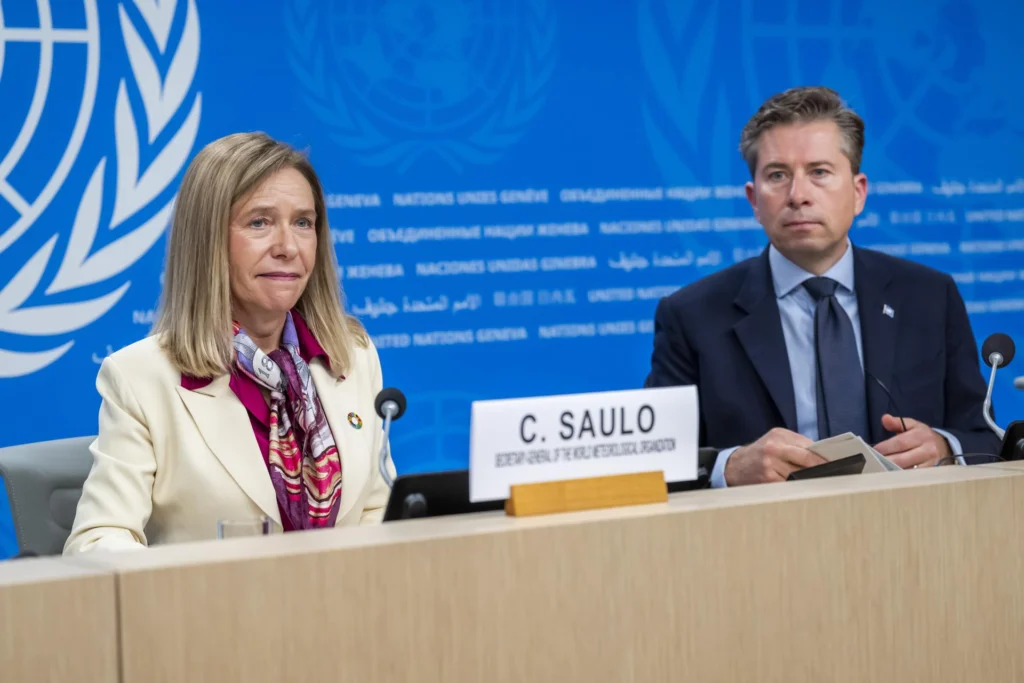
The UN World Meteorological Organization warned Wednesday that the current El Niño episode could push Pacific sea surface temperatures to 3.8 degrees Celsius above the average between November 2026 and January 2027, levels its top official called unprecedented in four decades of monitoring.
The alert came during a joint press conference in which the World Meteorological Organization (WMO) Secretary-General Celeste Saulo acknowledged that the phenomenon now sits “literally outside the scales of monitoring that we have used over the past four decades.”
Her assessment placed the coming months among the most severe climate events recorded since such tracking began.
Saulo and UN humanitarian coordinator Tom Fletcher issued an urgent call for the international community to prepare in advance for the consequences they expect.
Fletcher put the human cost in stark terms. The phenomenon “will shake Latin America, eastern and southern Africa, Asia and the Pacific with extreme heat, droughts and floods,” he warned, and could push food insecurity to affect as many as 50 million people worldwide.
The warning singled out regions already struggling with fragile agricultural systems and limited infrastructure, where a single failed harvest can tip entire communities into crisis.
El Niño is set to hit fragile communities hard.@UNOCHA and @WMO are sounding the alarm, appealing for immediate assistance to support communities already affected by what has been described as the strongest El Niño on record. https://t.co/LDrygGkPPwpic.twitter.com/H1XcVA3AR7
The temperature projection of 3.8 degrees above the long-term average would place this El Niño beyond the upper bands of the monitoring framework built over forty years. Saulo noted that extreme weather events are already being recorded and will tend to multiply as the phenomenon gains intensity. She stressed, however, that the crisis “does not have to inevitably trigger a humanitarian disaster,” a message both officials repeated throughout their appearance.
To front-load the response, Fletcher announced the allocation of 50 million dollars from the UN emergency fund. The money will assist 11 of the most vulnerable countries as a priority, including Chad, El Salvador, Ethiopia, Somalia and South Sudan. The list reflects the broad geographic reach of the expected impacts, spanning the Horn of Africa, the Sahel and Central America.
Both representatives insisted that a window of opportunity remains open. Extreme conditions “do not have to translate into humanitarian emergencies or fatalities” if precautions are taken in time, they argued, framing preparedness as the difference between a difficult season and a catastrophic one.
A Narrow Action Window
Saulo and Fletcher directed their appeal beyond governments. WMO and the humanitarian office urged development banks and international financial institutions to release funds in a coordinated manner before the worst damage occurs. The underlying premise is simple, El Niño cannot be stopped, but its worst human impacts can be mitigated and prevented.
Latin America appears prominently in the forecast. Central America has already been placed on maximum alert over drought conditions linked to the so-called Super El Niño, and the new warning extends that concern across the region. Africa faces the mirror problem in several zones, with eastern and southern areas bracing for a combination of heat, drought and flood depending on local geography.
WMO’s warnings marks a departure from the cautious phrasing typical of international agencies. Describing the phenomenon as off the scale is not a rhetorical flourish but a technical judgment, one intended to shake loose the funding and coordination that slow-moving bureaucracies often withhold until emergencies are already visible. For Saulo and Fletcher, the next three months represent the period when that response must be assembled, not the period when it can still be debated.
A Dallas-area juvenile arrested by the FBI for planning a terrorist attack on behalf of ISIS may also have been planning to assassinate Rep. Keith Self (R-TX), the co-founder and co-chair of the Sharia-Free America Caucus, according to information reviewed by Breitbart News.

 Login

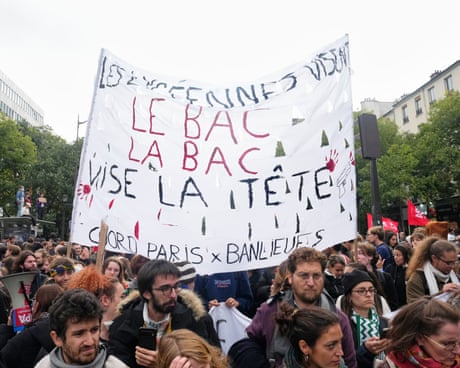
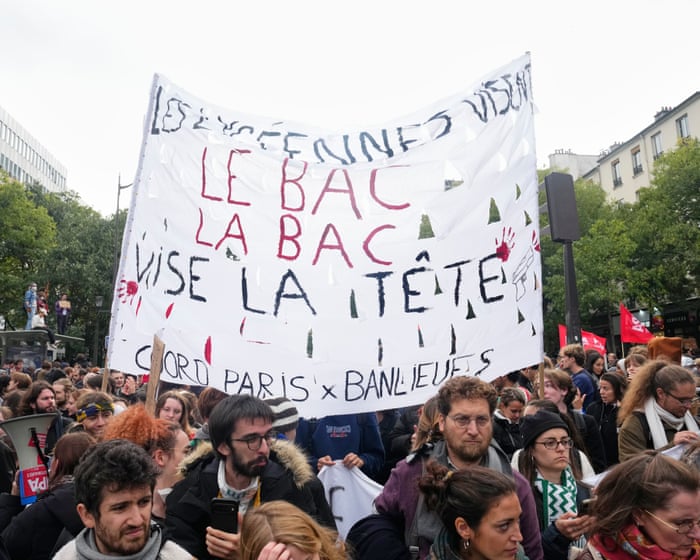


 A female German journalist wanted to research the topic of gang rapes by migrants in Bavaria but was labeled "racist" and "right-wing" by her colleagues.
Julia Ruhs, a high-profile television presenter, said it is still a "taboo" to research topics regarding why "certain population groups are more susceptible to committing sexual offenses."
"That’s when I realized the whole editorial imbalance that when you dedicate yourself to such a topic."
She added that it became an environment where she was told: "You’re not allowed to say that and you’re totally racist."
Ruhs is currently at the center of a significant "Cancel Culture" and media sovereignty debate in Germany.
She is often described as a rare conservative voice within the German public broadcasting landscape, which is frequently criticized for having a "left-green" bias.
In 2025, Ruhs was chosen to host a new experimental debate format called "Klar," co-produced by the northern public broadcaster NDR and the southern BR. The show’s mission was to reach viewers who felt alienated by mainstream media by tackling sensitive topics like migration, Covid-19, and the farmers’ protests.
After the first episode on migration, a massive internal wave of criticism hit. Approximately 250 NDR employees signed an open letter distancing themselves from the show, accusing Ruhs of one-sided and populist reporting.
In September 2025, the NDR officially decided to drop Ruhs as a presenter for their portion of the show, citing a desire to move toward a "multi-moderator concept."
Ruhs responded on social media, calling the decision a "disgrace" and claiming she was "too right-wing for the NDR."
High-profile politicians like CSU’s Markus Söder (Bavaria) and Daniel Günther (Schleswig-Holstein) criticized the NDR for stifling diversity of opinion.
While the NDR canceled her, the Bavarian broadcaster BR stood by her. New episodes of "Klar" are planned from the BR broadcaster for 2026.

 Entraînée dans un déficit commercial persistant et croissant par la guerre, l’Ukraine a besoin d’injections continues de fonds étrangers pour empêcher l’effondrement de sa monnaie.
 Le graphique ci-dessous illustre de manière élégante comment le commerce de la Russie a changé et évolué depuis. Les exportations russes ont connu des pics et des creux depuis 2014, bien que les creux aient souvent été causés par des événements mondiaux tels que les effondrements des prix du pétrole de 2014 et 2016 et le COVID.
 La Russie a accumulé des réserves depuis le début de la guerre pour compenser l’immobilisation de 300 milliards de dollars en devises par les pays occidentaux. La Russie investit désormais dans l’or pour protéger ses actifs.