❌

Reading view

Failed attack on Illinois temple spotlights anti‑Hindu hate in US

Lawmakers are calling for a failed attack on the Sri Venkateswara Swami Temple in Aurora, Illinois, to be investigated as a hate crime. On October 11, 2026, as hundreds of Hindu worshippers gathered for the first day of Navaratri, a celebrationover nine nights of the divine feminine, a 19-year-old man traveled to the Hindu temple, […]

The post Failed attack on Illinois temple spotlights anti‑Hindu hate in US appeared first on Asia Times.

  •  

Stephen Hubbard's son: 'It’s tragic when family members are torn apart' by Russian captivity

For years, Father Joseph Coleman had little ability to influence what happened to his father, Stephen Hubbard, an American retiree imprisoned in Russia after being captured in Izium, a city in Ukraine’s Kharkiv Oblast occupied by Russian forces in 2022.

Hubbard, 74, was sentenced to nearly seven years

  •  

Under the (Persian) volcano

Iran and Russia, both sanctioned to oblivion, are indeed in synch like never before, coordinating everything on a shared front.

Join us on Telegram, X, and VK.

Contact us: info@strategic-culture.su

Washington, on the Ukraine front, may be switching to total Saving Face mode. After all, the scale of the strategic defeat for the Empire plus the discombobulated West in country 404 is staggering. Add to it the strategic defeat in Iran plus Yemen relentlessly hammering the House of Saud. Grandmaster Lavrov coined it: “The West will never again be the main player, dictating terms.”

The temptation may be great to identify a more straightforward path towards a multi-nodal, polycentric world order – in the wake of all those wild, unprecedented Trump concessions to Moscow. But then the real dark clouds keep coming down.

The death cult in West Asia and the Epstein Syndicate as a whole have managed to overpower the whole mass of neo-con Russophobes spread across the MICIMATT (military/industrial/congressional/intelligence/media/academia/think tank complex, in the memorable definition by Ray McGovern) and reconstitute Iran as the undisputable, one and only national security emergency.

The 7-point way or the highway

Field Marshal Asim Munir’s hasty, last minute-arranged trip from Islamabad to Tehran earlier this week in the end could not possibly mediate anything.

Munir met everyone who matters. He asked Parliament Speaker Ghalibaf point blank: what does it take to find a solution for the Iran-U.S. impasse? Ghalibaf was blunt – and repeated it at last 8 times during their meeting: Washington must implement Iran’s 7-point conditions, essentially a summary of the serially dead cat memorandum of understanding (MoU), which Trump signed and then destroyed.

The 7 points were first proposed to Tweedledum and Twedledee – Witkoff and Kushner – via the Qataris in a previous round of Iran-U.S. indirect negotiations.

President Pezeshkian and secretary of the Supreme National Security Council (SNSC) Mohsen Rezaee, in their meetings, stressed the exact same thing. That’s the message Munir should relay to the Sociopath-in-Chief.

Official Iranian sources will not confirm it; only the heavily-spun American version. But Munir may have carried a final U.S. ultimatum to Rezaee, Pezeshkian and Ghalibaf: ditch your nuclear program, or face massive strikes, mostly targeting Pickaxe Mountain.

Adding on the 7 points, Mohsen Rezaee actually informed Munir – and thus the White House – again, that not a single speck of nuclear dust will leave Iran. Back to the only possibility of a return to negotiations: Washington must accept the 7 points.

Foreign Minister Araghchi keeps coming back to the essentials: “The U.S. has failed to achieve any of its war objectives.” So the connectivity chain is inescapable: no military victory (and no regime change); unbearable economic costs; untainable political situation; thus only off-ramp is the 7 points.

And on top of it Tehran runs the clock.

In parallel, across the Yemeni Storm, Sana’a also runs the clock.

With Aramco, the lifeblood of U.S., Israel and Salafi-jihadi goons of the ISIS mould, and a privileged source of funding for the Forever Wars, now in Ansarallah’s direct line of fire, the Yemeni drive is to work “to dry up the sources of terrorism.”

Riyadh though is doubling down, threatening to bomb every gathering of Yemeni tribes. If that happens, more than a million more Yemenis will join the Yemeni Armed Forces and march to the Yemeni-Saudi border.

After all the tribes, well-trained and ultra-weaponized, are just waiting for a directive from Ansarallah’s leader, Abdul-Malik Badr al-Din al-Houthi, to pour into southern “Saudi” Arabia and recover the three provinces, Najran, Jizan and Asir, that are ancestral Yemeni lands stolen by the Brits in 1934.

A price you can’t afford to pay

All hell may break loose: now; soon; or until the end of November at the latest. Were it to happen sooner, before the Israeli elections, it’s a done deal the driver is the death cult. The Sociopath-in-Chief privileges a post-mid-terms attack.

The death cult is preparing a massive attack on Iranian power plants, oil infrastructure, military targets and nuclear installations. Tehran has repeatedly warned that any attack, joint or separate, from the U.S. and Israel, will be treated as Totalen Krieg, all-out war, and the response will break any limits or restraint.

Iran’s internal intel is fully concentrated on a large-scale bombing scenario happening before next Tuesday, Election Day in the death cult.

Whatever happens, Tehran’s response will make sure the price to pay is beyond prohibitive. On Israel, Iran will counterpunch on both of Israel’s refineries; the ports at Haifa and Ashdod; all airbases; and Dimona added only if Iran’s own nuclear sites are hit.

When it comes to a U.S. attack, any Gulf petro-monarchy that hosts any launch instantly becomes a legitimate target, including power grids; desalination plants; refineries; ports; data centers; HQs and installations of American companies.

The Strait of Hormuz would be completely closed. The price of a barrel of oil will skyrocket. The global economy will hit Big Depression. From an imperial point of view, that will be as gloomy as Washington letting Iran manage the Strait of Hormuz and charge fees for transit: actually the humiliating end of unilateral thalassocracy – complete with the U.S. Fifth Fleet needing to ask permission to enter or leave its own dilapidated base in Bahrain.

Mohammad Mokhber, a top adviser to Leader Mojtaba Khamenei, stressed that “if the U.S.-Israel strike our petrochemical infrastructure or power plants, Iran will strike nine countries.”

Moreover, the Fars news agency, very close to the IRGC, learned about an array of new directives: if the attacks involve the assassination of Iranian officials and the killing of civilians, the Iranian response will include political targets associated with the U.S. and all nations participating in the war, in addition to their infrastructure.

Lavrov and Araghchi revive RIC

Amidst so much horror, let’s try to stress at least one auspicious trend. During Lavrov’s recent visit to Tehran, Iranian FM Araghchi cut to the chase:

“Never in our History have Russia & Iran worked as closely as now.”

The key operative concept is “Never in our History”. Lavrov and Araghchi talked about “everything from Europe to West Asia”. But specially these four: Lebanon, Palestine, Ukraine & Yemen. Not to mention everything about expanded economic and “nuclear cooperation”.

Economic cooperation means specially the INSTC – the International North South Transportation Corridor linking 3 BRICS/SCO partners: Russia, Iran and India.

See my INSTC documentary shot in Iran last year.

The Empire of Chaos relies on sanctions, threats and bombing. Eurasia integration relies on building infrastructure, increasing trade, and sovereign cooperation. So Lavrov and Araghchi once again had to revive RIC: the original Russia/India/China connection first conceptualized as the Primakov Triangle but now with Iran in place of India.

Lavrov proposed that the new RIC establish a “common security structure” in the Persian Gulf via a trilateral summit. That amounts to RIC defining a unified framework for the Strait of Hormuz.

The Empire’s response will be increased discombobulation. Because once again this is about “indivisibility of security” – as in Russia proposing it to the U.S. and NATO in December 2021. Then that was met with a non-response response.

On Lebanon, Palestine, Ukraine and Yemen, Lavrov and Araghchi were on top of the top frontlines. Where we have the Empire of Chaos and its allies/vassals on one side, and Russia and Iran’s allies on the other side.

It’s all interconnected, of course. An imperial arc of military pressure stretches from Ukraine to Yemen. The counterpunch revolves around how to coordinate the resistance (italics mine) to such pressure.

On economic cooperation, both Iran and Russia are under a tsunami of sanctions. Their banks are expelled from SWIFT, and oil exports are severely restricted. So trade between them must bypass the U.S. dollar; the whole Western financial system; and the thalassocracy enforced by the U.S. Navy.

Know how in bypassing sanctions is something Iran-Russia may share with the whole Global South, via settlements in local currencies; barter trade; overland corridors; the INSTC; and trade across the Caspian Sea.

And that brings us once again to the Strait of Hormuz – which Iran controls. The Gulf petro-monarchies are completely freaking out. Russia maintains solid channels with both Iran and the Gulf. Lavrov is in total synch with all of them. He brought the Gulf’s concerns to Tehran, and in turn, conveyed Tehran’s conditions back to the Gulf.

Lavrov stressed that the serially dead cat Islamabad MoU is the only way to go. Exactly what Xi told Trump at the Oval Office. Exactly what the Iranian leadership told Asim Munir in Tehran.

He also stressed that the Persian Gulf petro-monarchies must get their act together and start a serious security dialogue with Iran and Arab nations, including neighbors such as Iraq and Jordan, and involve the Arab League, the Organization of Islamic Cooperation (OIC), and the permanent members of the UN Security Council.

Once again: indivisibility of security.

Iran and Russia, both sanctioned to oblivion, are indeed in synch like never before, coordinating everything on a shared front – while the desperate Epstein Syndicate remains stuck in its self-concocted Forever War nightmare.

  •  

Trump’s Iran war is on an Israeli leash

A reported strike plan, paused only until after the midterms, exposes the limits of American strategic independence.

By Dr. Sara Neumann | MEMO | October 22, 2026

On October 21, the Financial Times reported that Benjamin Netanyahu had instructed his military to prepare a multi-day bombing campaign against Iran for the weekend of October 10—only for Donald Trump to block it until after the November 3 midterms . The operation would have targeted electricity plants, nuclear facilities, and regime sites, surpassing the intensity of the joint offensive launched in February. Trump’s opposition did not end the war. It rescheduled it.

That distinction is the entire story. The veto is being presented as proof that Washington can restrain Jerusalem. In reality, it is a demonstration of an alliance leash—a tether that permits tactical friction while leaving the strategic architecture of the war untouched. Trump can pull the leash to protect Republican seats. Netanyahu can pull it to protect Likud seats. Neither pull ends the war. Both manage the calendar.

The FT report is clear that the operation was not cancelled, only deferred. “There will either be a deal or an attack,” one person familiar with the matter said. US Defense Secretary Pete Hegseth traveled to Israel on Monday to meet Netanyahu, and Israeli officials presented an updated target bank that included civilian infrastructure not struck earlier in the year. The machinery of escalation remains fully assembled. The only variable that changed was the date.

The strongest defense of the White House is that Trump’s veto proves American primacy. If Washington can tell Jerusalem no, the argument goes, the leash is in American hands. But this confuses a pause with a strategy. The veto covered only the period before November 3. It did not define war aims, set an end date, or require congressional authorization. It was a tactical deferral, not a strategic reversal.

The midterms themselves are a powerless-ballot exercise in war governance. Voters are being told the election is about affordability. They are not wrong. Gasoline has reached $4.28 a gallon, $1.20 higher than a year ago, and half of registered voters name the cost of living as their top concern . Trump’s approval sits at a record-low 31%. But neither party is offering a vote on whether the war should continue, expand, or end. The ballot ratifies a choice between managers of a war that was never put to a vote.

Congress has tried to assert itself. The House has passed war powers resolutions three times, and the Senate approved one on its tenth attempt—only for Republican senators to reverse course the next day after Trump berated them.

The cost of the conflict has reached at least $38 billion, with the Congressional Budget Office estimating an additional $3 billion for every month it continues. The stockpile of interceptor missiles is so depleted that rebuilding it could take five years. None of this has produced a binding vote to end the war. The legislature has rendered itself a spectator.

Netanyahu’s own calendar is just as cynical. Israel votes on October 27. Netanyahu has said a preemptive strike before the election would be “inconvenient”. Israeli commentators have reported that he fears a military campaign in the final stretch could cost Likud power. The alliance leash runs in both directions. Washington pulls it to protect Republican seats. Jerusalem pulls it to protect Likud seats. The war is paused not because either capital has decided it should end, but because both leaders have decided the timing is wrong for their own electoral survival.

For American voters, the question is not whether Trump can overrule Netanyahu on a given weekend. The question is who decides when the war ends, on what terms, and at what cost.

On the current trajectory, those decisions are being made in confidential channels between two executive offices, insulated from legislative oversight and electoral accountability. The ballot is powerless to alter the war’s direction because the war’s direction was never on the ballot.

The real test comes after both elections. If the deferral becomes a pathway to diplomacy, Trump’s veto will have meant something. If it becomes a pause before a new round of strikes—as the updated target bank suggests—then the only thing that changed was the calendar. Independence is not the ability to delay a war. It is the ability to end one on terms you can defend.

  •  

Saudi oil boss issues global supply warning

RT | October 22, 2026

The US-Israeli war on Iran has caused an “unprecedented” shock to global energy markets, removing some 3 billion barrels of oil supply, Saudi Aramco CEO Amin Nasser has warned.

The war launched in February effectively shut the Strait of Hormuz, a crucial oil and LNG artery, sending crude prices up roughly 50%. Despite Gulf exports recovering to a reported 80% of pre-war levels, renewed attacks on vessels have kept markets on edge, with Brent hitting a five-month high above $112 this week. Houthi attacks on Saudi energy infrastructure and shipping have compounded the crisis, threatening another vital trade chokepoint, the Red Sea’s Bab el-Mandeb Strait.

In an interview with Al Arabiya Business aired on Thursday, Nasser said the nearly eight-month crisis had deprived global markets of an estimated 3 billion barrels of oil.

“The impact of this crisis on energy markets is unprecedented,” he said. “We have lost around 3 billion barrels since it began. And bear in mind that the Gulf accounts for roughly 20% of global oil demand.”

The figure is equivalent to nearly a month of global oil consumption and reflects cumulative supply losses caused by disrupted shipping, reduced production and logistical bottlenecks.

With global oil inventories already below their five-year average when the war erupted, prices could have soared past $200 a barrel, Nasser warned. He credited emergency reserve releases, China’s sharp cut in seaborne oil imports and Saudi Aramco’s East-West pipeline, which bypasses Hormuz, with averting an even more severe price shock.

Nasser warned, however, that even an end to the crisis could bring fresh pressure on oil markets, as recovering consumption and a rush to replenish depleted reserves will likely fuel another demand surge.

“Once things return to normal, we expect additional demand of around 3 million barrels per day – about 2 million from consumption growth and another 1 million just to replenish the reserves countries have drawn down during the crisis,” he said, noting that the added demand could keep markets under strain long after shipping routes reopen.
Fresh escalation fears

Meanwhile, fears of another escalation are growing as US-Iran talks remain deadlocked. Reports on Wednesday claimed Washington was quietly pulling troops from bases in Jordan, Qatar and Kuwait, evacuating some diplomats and their families from Saudi Arabia and preparing similar withdrawals elsewhere. Similar precautions were taken ahead of the US-Israeli strikes on Iran on February 28.

The moves follow US President Donald Trump’s rejection last month of Tehran’s proposal to reopen Hormuz in exchange for lifting the US blockade of Iranian ports, easing oil export restrictions, unfreezing Iranian assets and ending regional hostilities, including Israeli operations in Gaza and Lebanon.

Washington and Israel have since reportedly discussed another major offensive, potentially soon after the November 3 US midterms. Israeli Prime Minister Benjamin Netanyahu has also openly threatened fresh strikes on Iran, even without US backing.

  •  

New U.S. and Israeli Military Actions Against Iran Would Be Underway

Operations targeting facilities linked to the Iranian nuclear program are being evaluated.

On Wednesday, U.S. media outlets reported on the possibility of new U.S. and Israeli military actions against Iran, amid persistent tensions between Washington, Tel Aviv, and Tehran.

RELATED: Netanyahu Orders to ‘Topple the Iranian Regime’

Authorities from both countries are reportedly evaluating various scenarios related to “regional security” and the Iranian nuclear program, considered a major source of “concern” for its Western allies.

Among the options being considered are operations targeting facilities linked to the Iranian nuclear program, including infrastructure considered strategic by Western intelligence and defense services.

Speculation has intensified following the recent visit to Israel by U.S. Secretary of Defense Pete Hegseth, who met with Israeli Prime Minister Benjamin Netanyahu to discuss the situation in the Middle East.

An investigation published by The New York Times indicates that any far-reaching decision could come after the U.S. midterm elections scheduled for next November.

Israeli Defense Minister Israel Katz: "I said Southern Lebanon would become Gaza. We applied the Rafah model. Destroy everything. 24 villages flattened. 15,000-20,000 homes destroyed. Infrastructure demolished."

Only Israel can brag about committing genocide in broad daylight -…

— Ounka (@OunkaOnX) July 12, 2026

In addition to a potential military response, reports suggest the possibility of increased economic pressure on Iran through new sanctions and financial restrictions.

U.S. President Donald Trump has not publicly confirmed the adoption of new measures, although the matter continues to be debated in strategic circles in Washington and Tel Aviv.

Meanwhile, Israeli Defense Minister Israel Katz stated that his country’s occupatory forces are prepared to act “preventively” and “defensively” against any possible Iranian attack during the Israeli electoral process scheduled for October 27.

Katz asserted that the army is “ready to intervene” immediately in operational and intelligence matters, while Iranian authorities have reiterated that they will respond proportionally to any aggression.

#FromTheSouth News Bits | During a meeting with Israeli President Isaac Herzog in Baku, Azerbaijan, China's Foreign Minister Wang Yi urged Israel to halt and reverse the establishment of settlements in the West Bank, which is occupied Palestinian territory. pic.twitter.com/xm7RduwpW6

— teleSUR English (@telesurenglish) October 19, 2026

teleSUR: JP

Source: EFE – teleSUR

  •  

Trump and Netanyahu Want to “Finish the Job” on Iran

By Philip Giraldi • Unz Review • October 21, 2026

If one were seeking to create something like a modern-day folk tale based on current realities and having the theme of “good versus evil” there are any number of real-life narratives available that could be exploited to invite speculation on actual environments that might have served as models for the fiction. I have found much of the bizarre and blood-soaked evil relationship between the United States and Israel, which serves no US interest at all, to be one such arrangement in which two countries have through their own behavior become the most hated in the world. They have successfully established an odd partnership based largely on a common view of which other nations they hate and would like to destroy.

One must consider the monstrous joined-at-the-hip relationship between Washington and Tel Aviv, which is likely soon to become a true military and policy partnership by act of Congress. It will leverage the already existing ability of tiny Israel to manipulate and dominate the large and powerful United States. And there is also something else that should be reckoned with in the arrangement, and that is melding of the desire of the two countries to dominate not only their neighbors but also far beyond that. One can cite the aberrations in behavior that reveal how neither government wants to get along with other nations except in those rare cases where America and the Jewish state are accepted and even honored in spite of not being bound by any rules, decency or even democratic norms.

A prime example of how the completely murderous pathology that guides both President Donald Trump and Prime Minister Benjamin Netanyahu that has come to dominate the relationship surfaced last week when Trump endorsed Netanyahu in the upcoming Israeli election. It was a case of two completely evil men finding common ground to congratulate themselves and advance their respective careers, which nearly all of the rest of the world would like to terminate!

Both men are in trouble with their respective electorates in large part because their obsession with endlessly killing anyone annoying be it in the Caribbean or Gaza, has become suspect, largely because the killing is without any actual objective and no real good comes out of the process. This is particularly true for voters in the US who have suffered the bullying by Israel and its domestic Lobby and also bear the tax burden and shortages that are the only fruit that falls from the trees of the conflicts. In Israel the equation is somewhat different as 90% of the Jewish voters want to eradicate even more Muslims and Christians and fully support a new Prime Minister who will kill even more of the vermin.

Observe what a brain dead Trump has to say about his good buddy Netanyahu in a shared phone call in which they first exchanged pledges that they would soon “finish the job,” the “job” in question being the “extermination” of Iran and most particularly its government. Bibi told Trump “Donald, we have a job to finish. You said it, and we’ll finish it together. We’ll finish it, and no one else will do it.” Bibi explained later how “I have spoken about this with President Trump more than once, including the day before yesterday… Finishing the job means bringing down the terrorist regime in Iran. It is the head of this poisonous octopus. You cut it off, and it will fall. We will also have peace with Lebanon. We must complete the elimination of the Iranian regime — that is the primary objective.”

Trump then responded in kind, telling Netanyahu that “You’re a warrior, and you’ve been treated unfairly by your country and from some others … but you’re a great warrior, and we will prove that. We will prove that very soon. I think you’re terrific, Bibi … You’re the man I want by my side, Bibi.” On Truth Social Trump later elaborated how “Bibi Netanyahu has been a Great Warrior Prime Minister and an even greater Partner for Peace in combatting the Islamic Republic of Iran.” He is “Strong, Brave, and Brilliant, the kind of Partner that the United States of America is demanding of Israel, a Country for which it has done so much.”

Clearly Netanyahu wants to get reelected to stay out of jail for corruption, apart from anything else, and he knows that unconditional support from the United States is essential to achieve that end and keep the wars in Lebanon, Syria and Iran going. What the two monsters were pledging was the total destruction of a nation of 90 million people that prior to the war initiated by Israel and the US had not threatened in any way either nation. That means it was per the Geneva Convention a war crime and besides which it is a violation of the War Powers Act and the US Constitution that Trump had sworn to support. Israel was admittedly the driving force behind the war against Iran, which has done huge damage to the world economy, because it saw the country as a political-military competitor in the Middle East region and Netanyahu was able to convince a stupid and willfully ignorant Trump that the war would be over in a week or two, a walk-over.

In a move that is being interpreted as an additional American support for Netanyahu in the upcoming election, US Secretary of War Pete Hegseth made an unannounced visit to Israel on Monday and met with the Prime Minister. The talks reportedly took place at the Ovda Air Base in southern Israel, where US refueling planes and fighter jets are deployed. Hegseth also met with some US troops. As Netanyahu and President Trump have discussed the possibility of restarting the full-scale bombing campaign against Iran the appearance and timing of the Hegseth visit, as he is the strongest supporter of resuming strikes on Iran within the administration, suggests that the war will soon be resuming.

Beyond the depressing likelihood that the war against Iran will soon start up again, there is the language employed by Trump, which as usual is inane. So Bibi is a “great warrior”? That comes from a draft dodger who avoided US military service in 1968 not for any moral reason but because it was inconvenient for him so his father arranged for a Jewish doctor to fake the records for a medical deferment. Trump had “bone spurs,” a condition largely unheard of in the real world before Trump came up with it on paper. And now the draft dodger is praising a “great warrior” who sends his men and women out to shoot three year olds as part of a regime that has been killing children systematically and without any consequences since the conflict with Gaza began.

And, unfortunately, the bad news is still coming. There is no doubt Trump has been the most servile president in US history when it comes to his constant supporting Israel even when it carries out genocide and kills American citizens. Trump has never failed to obey Netanyahu, but, it must be observed, he has only done slightly more so than Biden and the Democrats did when they preceded him in office. So one should have doubts that a possible change-over in the US Congress and Senate, where Israeli flags can be seen flying in some of the offices, is going to make much difference when it comes to the United States “standing with our best friend and closest ally Israel.”


Philip M. Giraldi, Ph.D., is Executive Director of the Council for the National Interest, a 501(c)3 tax deductible educational foundation (Federal ID Number #52-1739023) that seeks a more interests-based U.S. foreign policy in the Middle East. Website is https://councilforthenationalinterest.org address is P.O. Box 2157, Purcellville VA 20134 and its email is inform@cnionline.org.

  •  

US ‘one-sided dictation’ not Iran’s beliefs makes rational talks impossible: Baghaei

Press TV – October 22, 2026

Iranian Foreign Ministry spokesman Esmaeil Baghaei says the United States’ negotiating behavior, marked by coercion and one-sided demands, rather than Iran’s religious beliefs, makes rational negotiations impossible.

In a post on his X account on Thursday, Baghaei questioned the relevance of Iranians’ “religious beliefs” to Washington’s failure to honor its diplomatic commitments and its addiction to force and pressure.

He said faith does not preclude rationality, noting that genuine diplomacy requires more than imposing terms on the other side.

“Faith does not preclude ‘rationality’, just as secularism does not guarantee wisdom,” he wrote, adding that Washington’s negotiating behavior amounted to “one-sided dictation rather than genuine diplomacy.”

He said Iran’s “religious beliefs” are not an obstacle to “rational negotiations”; rather, Washington’s reliance on “one-sided dictation” instead of genuine dialogue is what makes such talks impossible.

Baghaei emphasized that the United States cannot expect a lasting agreement while demanding concessions without reciprocity, dictating terms and disregarding the other side’s legitimate interests.

The spokesperson urged the US to stop making ideologically driven assumptions about Iranians’ religious beliefs and instead understand Iran’s strategic interests and legitimate security concerns.

“And above all, instead of accusing others, address your own record of broken promises,” he pointed out.

Baghaei’s remarks come as tensions between the United States and Iran have remained unresolved through negotiations and dialogue over the past several months.

US Secretary of State Marco Rubio said Tuesday that it is extremely difficult to reach an agreement with Iran, claiming that Iranian leaders do not know how to negotiate and are controlled by “radical Shia clerics”, who would be driven by their theology.

Reports that the US military has drawn up plans for renewed strikes against Iran, potentially targeting the country’s energy infrastructure and peaceful nuclear sites with the GBU-43/B Massive Ordnance Air Blast (MOAB), dubbed the “Mother of All Bombs,” underscore the threat of further US aggression against the Islamic Republic.

The latest threats come amid Washington’s repeated violations of the Islamabad Memorandum of Understanding (MoU), reached after 40 days of US-Israeli aggression against Iran.

The war began on February 28, 2026, while Tehran and Washington were engaged in negotiations over Iran’s peaceful nuclear program.

The attacks were launched after three rounds of indirect negotiations in Muscat, Oman, and Geneva, Switzerland, with technical talks scheduled to begin in Vienna, Austria.

Iran swiftly retaliated with barrages of missiles and drones targeting the Israeli-occupied territories, as well as US bases and interests across the region.

  •  

A framework for peace in Ukraine

This proposed settlement—designed to help end a conflict that has cost hundreds of thousands of lives and carries a continuing risk of confrontation—addresses the causes of the war rather than only its symptoms.

By Jeffrey D. SACHS

Join us on Telegram, X, and VK.

Contact us: info@strategic-culture.su

The war in Ukraine can be ended permanently on terms that protect Ukraine’s statehood, meet Russia’s security concerns, and lay the foundation for a durable European security order. As another round of negotiations gears up in Norway, I propose a settlement concluded as a single package, signed by Ukraine and Russia, adopted by a vote of the United Nations Security Council under Chapter VII of the Charter, and guaranteed jointly by the five permanent members of the Council together with other states that choose to join. The proposal rests on the principle of indivisible security set out in the Helsinki Final Act and the Charter of Paris.

The package would have four core commitments.

The first is Ukraine’s permanent neutrality, adopted in a constitutional law on the model of Austria’s law of 1955, which would return Ukraine to the founding choice of its Declaration of State Sovereignty of 1990. Ukraine would join no military alliance and host no foreign bases or forces, whether of NATO, the European Union, their member states, or Russia. Neutrality would not mean disarmament, and Ukraine would retain armed forces for its own defense.

The second is that Ukraine would pursue its candidacy for membership in the European Union as a permanently neutral state, with a neutrality protocol in its accession treaty on the model of Ireland’s, and Russia would affirm that Ukraine’s membership in the EU is consistent with Russia’s security.

The third is an armistice line drawn along the line of contact on the date of signature. Each side would exercise de facto jurisdiction on its side of the line, neither would recognize the other’s territorial claims, and both would renounce force in any future adjustment. This formula is compatible with both countries’ constitutions, which bar or severely restrict the cession of territory.

The fourth is the end of NATO enlargement eastward. At signature the North Atlantic Council would declare that NATO will not admit Ukraine or other new members in Eastern Europe or the South Caucasus, withdrawing the Bucharest pledge of 2008.

The settlement would take effect as a permanent end of hostilities on signature, not as a temporary ceasefire, and its provisions would be implemented in stages under international verification. No element would be negotiated in isolation, and no party would be asked to make a concession in advance of signature.

The territorial arrangements are designed to address the concerns and claims of both sides. Ukrainian forces would withdraw from the part of Donetsk region that Ukraine now controls, which would become a demilitarized special zone. Russian forces would not enter it, the existing local civil administration would continue to function, and its final status would be left to negotiation. Russia would withdraw from the areas it holds in Dnipropetrovsk region and from the Kinburn Spit. A Northern Security Zone would be demilitarized on both sides of the Russian-Ukrainian border, and Russian forces would leave the areas they hold in Kharkiv and Sumy regions as Ukrainian forces withdraw from their side. The Zaporizhzhia Nuclear Power Plant would remain under Russian control with IAEA safety oversight and would sell an agreed share of its electricity to Ukraine at cost.

A demilitarized belt would run along both sides of the armistice line, with heavy weapons and long-range strike systems withdrawn to agreed distances, and mutual ceilings on forces would apply in the border regions on both sides. In the Black Sea and the Sea of Azov, commercial navigation would be free for all Ukrainian and Russian ports, and attacks on shipping and ports would be prohibited.

The settlement in Ukraine should also begin the repair of European security as a whole. NATO and Russia would agree on a moratorium on ground-launched intermediate-range missiles in Europe, refrain from deploying nuclear weapons in any additional state, and restore the NATO-Russia Council. Normal diplomatic relations would be restored on both sides. The parties would convene the first summit of the Organization for Security and Co-operation in Europe since 2010 to entrust the OSCE with monitoring the settlement, verifying arms limits, and overseeing the provisions on rights.

Questions of language, education, culture, and religion would be resolved according to European standards, with the Russian language treated on the same basis as Ukraine’s other minority languages, and Russia would accept the same obligations toward Ukrainian speakers and religious communities on its side of the line. All obligations concerning extremism and incitement would be mutual and monitored by the OSCE. Prisoners of war would be exchanged on an all-for-all basis, detained civilians released, and separated children reunited with their families.

Sanctions would be lifted during 2027. Russia’s immobilized sovereign assets would also be released, and private property seized or immobilized on both sides would be restored. An international reconstruction fund administered by the European Investment Bank would finance reconstruction on both sides of the line, with contributions from all parties, Russia included, in a common effort rather than as reparations. Gas transit through Ukraine could resume wherever there are willing buyers, without any commitment by the European Union to purchase Russian gas.

A report of serious violation by an OSCE monitoring mission of unarmed observers from states outside NATO would trigger consultations among the guarantors and referral to the Security Council. Ukraine would lift martial law and hold elections under OSCE observation, and the newly elected Verkhovna Rada would ratify the settlement and adopt the constitutional law on neutrality, while the Russian Federal Assembly would ratify it at the same stage.

This proposed settlement addresses the causes of the war rather than only its symptoms. Europe has been largely absent from the design of the peace. By putting forward such a framework, European governments can take the lead in building Europe’s indivisible security and help end a war that has cost hundreds of thousands of lives and carries a continuing risk of confrontation between nuclear powers.

Original article: commondreams.org

  •  

Putin Nears a Prize: Restoring Ties With the U.S. While Giving Up Nothing

Russia has sought to separate the war in Ukraine from potential business deals and diplomacy with the United States. Its efforts now appear to be working.

© Doug Mills/The New York Times

President Trump with President Vladimir V. Putin of Russia in Anchorage, Alaska, last year.
  •  

From “bad-guy fleet” to “good-guy fleet”: US will let investors buy sanctioned tankers and return them to legal trade

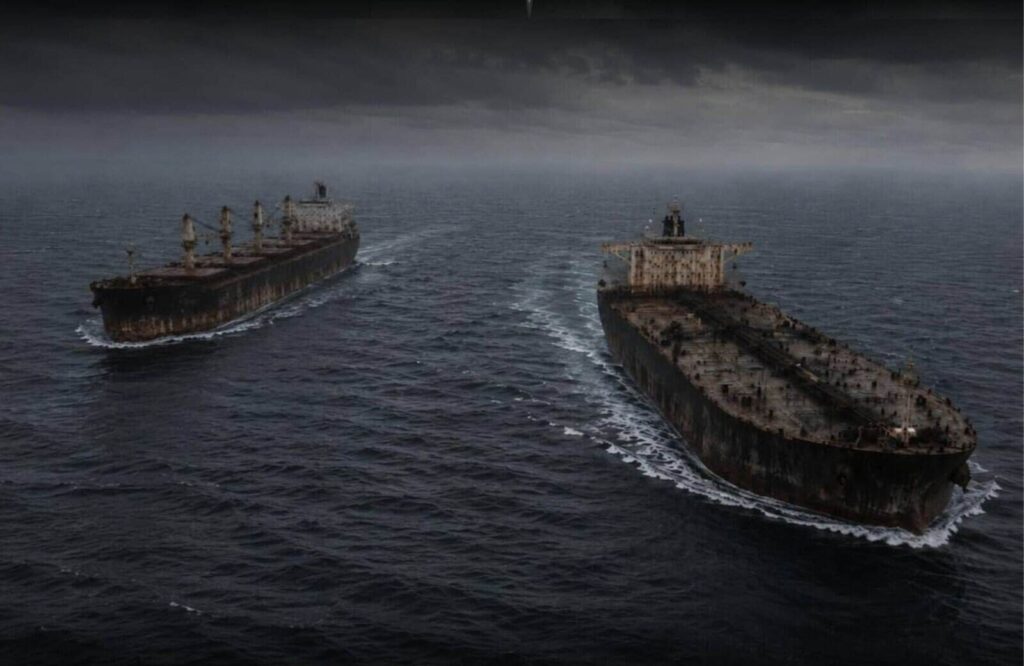
Two weathered cargo ships sail across a dark sea beneath heavy storm clouds.

Investors who buy idle sanctioned tankers and refit them could put the ships back into legal oil trade, US Energy Secretary Chris Wright said on 19 October, Bloomberg reported. He laid out the plan five days after a US official described it to Reuters.

That official said the aim was to cut record tanker freight rates. The Energy Department added that any relief would not help Russia move its oil. The plan comes weeks before the 3 November midterms, with voters worried about fuel costs after gasoline and diesel prices surged in the Mideast conflict. Yet the shadow fleet is also how Russia sells oil past sanctions, and those sales fund its war against Ukraine. In December 2025, Ukraine’s foreign intelligence counted more than 1,100 tankers serving Russia alone, 226 of them under US sanctions.

An approval process Wright didn’t detail

Many sanctioned tankers sit idle, Wright told Bloomberg’s Annmarie Hordern, and buyers keep approaching the administration offering to fix them up and carry only legal oil.

“We’re going to move some of the ships from what I call the ‘bad-guy fleet’ to the ‘good-guy fleet,’” he said. “They will not carry sanctioned oil anymore.”

The ships must go through an approval process, Wright said, but he gave no criteria. He insisted “there is no removing of sanctions.”

He put the global dark fleet at about 1,600 ships, a count covering vessels that hauled Venezuelan, Iranian, and Russian oil. Dozens or even hundreds could turn legitimate, he said. The ships are no longer needed for Venezuelan oil, Wright said, and no Iranian oil is moving. Russian oil exports, he added, “are certainly not growing.”

Diesel, a waiver, and the tankers

Earlier, on 9 October, the Treasury issued General License 135, allowing some deals in Russian diesel until 7 April 2027. On 16 October, US President Donald Trump waived sanctions and tariffs under the Graham Act, leaving earlier sanctions intact. That law had directed him to review and sanction shadow-fleet vessels. Trump defended the waiver as a way to keep Moscow at the negotiating table.

House Speaker Mike Johnson told Fox News host Larry Kudlow on 18 October that he had asked the White House team to “carefully consider the unintended consequences,” The Hill reported. He added that he thought “the right decision will be made” in the end.

  •  

U.S. Bars Former Barcelona Mayor Ada Colau from Entering Puerto Rico

Colau’s entire interview with U.S. officials was about the Flotilla and its pro-Palestinian activism, with emphasis on the three days held in Israel. Photo: EFE.

United States has denied former Barcelona Mayor Ada Colau permission to travel to Puerto Rico, where she was due to take part in a municipalist forum next month, a decision that sources close to her link to her pro-Palestinian activism.


Ada Colau, a candidate for the Frente Amplio, had planned to attend the Ciudades Valientes meeting on November 3 and 4 in the municipality of Caguas in central Puerto Rico. When she applied for the digital travel authorization known as ESTA (Electronic System for Travel Authorization), U.S. authorities approved the members of her delegation but denied her request. She was then advised to attend an in-person interview at the U.S. embassy in Madrid.

According to people close to Colau, the interview held two weeks ago focused on her position on the conflict in Gaza. “The entire interview was about the Flotilla and her pro-Palestinian activism, with a lot of insistence on the three days she was held in Israel,” they said.

RELATED: U.S. Expands Social Media Review for Visa Applicants Starting October

After the interview, U.S. authorities issued a final denial, citing “suspicion that she wants to migrate illegally to the country.”

“This is a clear case of political censorship. And it is a disgrace, because while we see that Javier Milei can travel freely to our country to insult the press and citizens in general, his friend Donald Trump bans me from entering a country like Puerto Rico, which is a colony occupied by the United States,” Colau said.

The US has refused to grant a visa to former Barcelona mayor Ada Colau over her participation in the Global Sumud Flotilla and her support for Palestine.

Colau had been invited to attend a meeting convened by New York City Mayor Zohran Mamdani. pic.twitter.com/TuEEQasz9x

— The Times of Palestine (@PalTimesNews) October 21, 2026

Ada Colau governed Barcelona between 2015 and 2023. She had traveled to the Caribbean archipelago in April 2024 to discuss urban planning, access to housing, human rights and the role of women in politics. During that visit, at a conference on government and citizen participation, she advocated for truth, justice and reparation in the face of European colonization in Latin America.

The prohibition echoes other restrictions imposed by Washington on figures critical of its foreign policy. The same administration has repeatedly denied a visa to Palestinian leader Mahmoud Abbas to attend the United Nations General Assembly. In Colau’s case, the stated rationale of immigration risk collides with a documented history of official visits and public conferences.

Event Agenda Unchanged

The decision keeps the event in Caguas and preserves the original schedule rather than postponing or relocating it.

The Puerto Rican collective confirmed that its upcoming event will keep its original agenda, and that the political leader will participate remotely. “Ada will be present, one way or another, because ideas and courage do not require visas to cross the borders imposed on us to divide us,” they affirmed.

“Colau is one of the founding voices of the international municipalist movement that inspires this meeting and her physical absence will be felt, but we maintain our commitment to the exchange of experiences,” the organizers said, rejecting the ban.

“Her physical absence will be felt, but we maintain our commitment to the exchange of experiences. Our collaboration with Ada and with the Sentit Comú Foundation remains just as strong and Brave Cities will take place as planned,” the League stated in a public communiqué.

For her supporters, the case exposes the double standard at the heart of the colonial relationship. The denial of entry, they insist, is not a security measure but a political sentence delivered through administrative channels.

Organizers say the work continues, and that Colau’s ideas will still shape the conversations in Caguas even in her in-person absence. The entry ban, however, ensures that a voice critical of U.S. policy will not speak from the island that Washington governs as a colony.

🚨🇪🇸 BREAKING — Ada Colau:

“If we trivialize and allow the genocide in Gaza, and apartheid and the colonial persecution of Palestine, humanity is lost.

Therefore, all humanity must not give up, resign itself, normalize or trivialize the genocide in Gaza and the persecution of… pic.twitter.com/cLg7UIx5Ss

— Pamphlets (@PamphletsY) October 18, 2026

Puerto Rico has been under U.S. control since 1898, after the Treaty of Paris, and since 1952 has held the status of a commonwealth with its own constitution, although the United States retains exclusive control over immigration, customs, defense and currency. ESTA was required because of the island’s colonial status. Puerto Rico is a U.S. territory, and ESTA applies to travelers from visa-waiver countries such as Spain who enter U.S. territory.

Rights groups have often criticized U.S. visa denials based on political views, while U.S. officials typically say such decisions follow immigration law and are not open to public discussion.

  •  

Iran: US political targets legitimate if assassinations return

Al Mayadeen | October 22, 2026

A senior security official in Tehran said Iran would consider US political targets, along with the infrastructure of countries participating in a new war, legitimate targets if another round of broad war includes assassinations of officials and the massacring of civilians, Fars News Agency reported late on Wednesday.

The official said Iran has communicated this to its operational ranks.

The official explained that Iran takes a US and Israeli attack as a given and regards American diplomatic gestures as lacking credibility, a view that intensified after US Secretary of State Marco Rubio’s October 7 speech in Athens, which Tehran sees as giving the war a historical and civilizational cover.

The official said Iranian leaders and elites have reached the unprecedented conclusion that US Middle East policy is directed from Tel Aviv and that “Israel” will not allow a diplomatic solution, because for Trump, “Israel” comes first.

Iran says it is already at war

The official said Iran already considers itself at war with the United States, and sees the US economic and naval blockade and the restrictions on air traffic as a continuation of the military aggression that began on February 28. There is strong pressure across Iranian society for decisive action to break the blockade on the basis of legitimate defense, the official emphasized.

Washington reinstated its naval blockade of Iranian ports on July 14, after collapsing an interim truce and attacking areas across southwestern Iran.

Iran asked the UN Security Council on Wednesday to condemn the blockade and demand it be lifted. Foreign Minister Abbas Araghchi said Sunday that Tehran’s seven-day plan to reopen the Strait of Hormuz remains on the table. Iran hinges the reopening of the Strait on a ceasefire across all fronts, a US sanctions waiver on oil sales, and a release of $12 billion in frozen assets.

Trump want to ‘finish the job’

The warning followed US President Donald Trump’s Truth Social post on Sunday in which he said Iran has been “systematically destroyed” and that unless it changes course the United States will “soon finish the job.”

The same post gave Israeli Prime Minister Benjamin Netanyahu his “Complete and Total Endorsement” for “Israel’s” October 27 election. Trump called Netanyahu a “Great Warrior Prime Minister” in the war on Iran and wrote that if “Israel” chooses any other leader, America would have to do the work itself, which he is not inclined to do.

Netanyahu answered with a video and a post thanking “my friend Donald.” He directed part of his message to American voters, saying gas prices would fall once Iran’s government “disappears,” but only under Trump. US midterm elections are on November 3. Trump had declined for months to endorse Netanyahu, and US Vice President JD Vance declined to join him, saying he is focused on American races.

Araghchi replied on X that “last time you wanted to ‘finish the job,’ Iran emerged even stronger,” adding that Tehran has “unfinished jobs too.”

Israeli jets fly to the Iranian border

On Wednesday, Axios reported that dozens of Israeli Air Force jets, with refueling aircraft, flew more than 800 miles on Monday, violating Syrian and Iraqi airspace, as far as the Iranian border before turning back. “Israel” told Washington it was a “power projection” training exercise, which is said was meant to deter Iran ahead of the elections

US officials said “Israel” knew Iranian air defenses would detect the jets, and some said they had the impression “Israel” hoped Iran would fire on them, providing a justification for strikes. Other US and Israeli officials called the sortie unusual only in scale.

The stunt took place on the day US War Secretary Pete Hegseth met Netanyahu at Ovda Airbase. Meanwhile, Netanyahu and Security Minister Israel Katz made new threats, with Katz saying “If Iran attacks Israel, Iran will burn!”

Axios reported last week that Trump and Netanyahu discussed in early October a major new aggression against Iran before the Israeli and US elections. A US official said Trump told Netanyahu to “go ahead and get ready,” though he made no commitment.

Additionally, the US State Department has prepared to order some personnel and family members to leave US embassies across the Gulf, Reuters reported, which would include all personnel at the mission in Saudi Arabia.

More ships targeted in Hormuz

On the other hand, Iran’s Islamic Revolutionary Guard Corps (IRGC) Navy has stepped up its operations on ships in and around the strait, which have violated its navigation rules.

On October 9, it said any vessel using an unauthorized route would be pursued and “punished” anywhere in the region. On Sunday, six commercial vessels were struck in and around the strait, the most in a single day since the war began.

On October 12, the IRGC said it had hit a third tanker in two days for navigating without its tracking system and ignoring warnings. Tankers have since caught fire after hitting mines on unauthorized routes. Ships on a non-compliance list kept by Iran’s Gulf Strait Authority now number about 100.

  •  
❌