❌

Normal view

Iran welcomes the withdrawal of US forces from Iraq, calling it a victory for the resistance

5 October 2026 at 21:50

The withdrawal of the remaining US troops from Iraq is a victory for the Iraqi nation and the resistance force in the region, Iran claimed on Thursday, October 1, also calling for greater cooperation between both the countries to achieve complete sovereignty for Iraq.

“The US, despite possessing vast resources and equipment, has been expelled from Iraq, and the Iraqi people are celebrating this victory,” head of Iran’s Quds’ forces Esmail Qaani said during a program held in Tehran to mark the second anniversary of the Israeli assassination of Hezbollah leader Hasan Nasrallah.

He thanked the “resistance of the Iraqi nation and the heroes of the Resistance Front” for making the end of the US occupation a reality.

The US withdrew all its remaining forces from Iraq on September 30, as per the 2024 understanding between both the countries marking the conclusion of over a decade-long military presence in the country.

The news of the withdrawal led to widespread celebrations in Baghdad and other parts of the country on Wednesday.

The US occupied Iraq during the 2003 war which lasted until 2011 when it publicly stated that it withdrew all its forces. They were then re-deployed in 2014 as part of the international coalition fighting against the Islamic State or ISIS.

Iraqi people, as well as the resistance groups in the country, have been demanding the withdrawal of all foreign troops from the country for years now. Their presence is seen as undermining the country’s sovereignty.

Due to popular resistance, most of the foreign troops left the country by 2019 after a victory was declared over ISIS. Remaining US troops were redeployed to some bases in Baghdad and Erbil.

In 2020, the Iraqi parliament adopted a resolution demanding the withdrawal of all remaining foreign troops from the country following popular protests over the US assassination of Qassem Solemani during a visit to Baghdad. Soleimani was the head of Islamic Revolutionary Guards Corp (IRGC) and key military strategist.

Also an Iranian victory

Qaani claimed that the US withdrawal from Iraq is also a victory for Iran which has been in support of the call on the ground that the presence of foreign troops in the region undermines regional security and stability.

Qaani also linked the withdrawal to the setbacks the US faced in its war with Iran in the last seven months. Contrary to its expressed wish to force Iranians to surrender within days of the war launched on February 28, “they encountered a reality vastly different from their calculations,” he said.

The US had used its military presence and the bases in Iraq to launch attacks across the border in Iran in the past and also during the ongoing war. This has prompted Iranian retaliations causing destruction and death of some of its servicemen.

Iran has also accused that the US military’s presence in Iraq has been used by Israel for its clandestine operations inside the country.

Reacting to US withdrawal from Iraq, IRGC said on Thursday that it is the beginning of its withdrawal from the entire region.

Qaani expressed hope that in the aftermath of US troop withdrawal there will be increased coordination between the governments in Iraq and Iran for purging the remaining US influences on the country and creating a secure and sovereign Iraq.

Though the US has withdrawn militarily, the legacy of its occupation still remains in Iraq. It continues to control Iraq’s economy by controlling the payments to its oil exports which are routed through the American Central Bank.

Oil revenues made up 90% of the Iraqi government’s total budget and over 40% of its national GDP.

Qaani accused that banning the Iranian airlines to Iraq and other countries in the region is a distraction used by the US to undermine the significance of its military defeat.

Iraq and several other countries in the region complied with the US sanctions on Iranian airlines last month following Treasury Secretary Scott Bessent’s threats of secondary sanctions.

The Future of War: What the Battlefield Teaches and the Pentagon Wants to Buy

5 October 2026 at 19:11

Click to see the full-size image

Cheap drones, heavy bombs, disrupted shipping, and vulnerable supply routes are challenging the idea that technological superiority guarantees military success. The emerging contest is not simply over who builds the smartest weapon. It is over who can adapt, produce, and keep fighting after the enemy learns how to break it. Washington’s Project Meridian offers one answer. Recent battlefields suggest a much harder test.

The Battlefield Rewrites the Blueprint

The war in Ukraine shows that military innovation does not always mean more sophisticated weapons. Sometimes it means finding a simple way around an enemy’s defenses. Russian forces did that with drones guided through fiber-optic cables instead of radio signals, allowing them to operate despite radio jamming.

During the fighting to push Ukrainian troops out of Russia’s Kursk region, fiber-optic drones threatened the roads supplying Ukrainian positions. Sustained attacks on transport made those positions harder to supply, reinforce, and evacuate. Ground that remained defensible against a direct assault became increasingly difficult to hold as supply routes came under pressure.

Drones did not replace infantry or artillery. Their value came from linking reconnaissance and strikes to a broader effort to disrupt Ukrainian logistics. A relatively small change in drone guidance helped Russian forces put pressure on the supply lines sustaining the defense, rather than just individual vehicles or positions.


A separate example from eastern Ukraine shows how drone attacks can also threaten robotic supply vehicles


Nor did the advantage remain exclusive. Ukrainian units expanded their own fiber-optic capabilities, turning a Russian breakthrough into another round of adaptation. Cable guidance removes the vulnerable radio-control link, but introduces weight, handling, and physical constraints. It does not make the aircraft invisible or indestructible. A solution to one problem creates a different set of tradeoffs.

Russia’s glide bombs demonstrate another route to military innovation. Instead of replacing existing weapons entirely, guidance and wing kits give older bombs greater reach and precision. Their heavy payloads perform tasks that small drones cannot. Their use against Ukrainian positions illustrates why the future battlefield will contain both cheap electronics and large quantities of conventional explosives.

The broader lesson is uncomfortable for anyone selling a universal replacement for the old military. New systems do not arrive on an empty battlefield. They must work with existing aircraft, artillery, engineers, supply units, and command structures. Their value depends on how those parts fit together.

That also limits what strike videos can prove. A successful attack demonstrates an outcome, not the average success rate, the number of failed missions, or the effort required to repeat it. The decisive question is whether an army can turn occasional success into a dependable military capability.

The Cost of Keeping Routes Open

The Red Sea offers a different warning. An attacker does not necessarily have to defeat a navy to impose strategic costs.

Houthi attacks pushed shipping companies toward longer routes around Africa. By late summer 2026, traffic through the Suez Canal was recovering but remained well below pre-crisis levels. Houthi attacks had pushed shipping companies onto longer, more expensive routes, showing how a regional armed group could disrupt global trade without defeating a major navy.

An interception can therefore be a tactical success without restoring normal commercial activity. The defender must protect ships and sustain confidence over time. The attacker may only need to keep the risk credible. Counting destroyed drones does not answer whether the shipping route is functioning.

The familiar comparison between a cheap drone and an expensive interceptor captures only part of this problem. Saving a merchant ship or warship can justify an expensive defensive shot. The deeper question is whether sufficient interceptors, maintenance capacity, crews, and replacement stocks remain available throughout a prolonged campaign.

Ukraine presents a related problem on land. Russian glide bombs combine substantial destructive power with relatively inexpensive conversion kits. Defending against every incoming weapon with a costly missile is not necessarily sustainable. But abandoning high-end air defenses would leave other threats unanswered.

The likely response is a layered force rather than a single miracle weapon. Different threats demand different combinations of detection, electronic warfare, physical protection, and interception. An army also needs to keep operating when some threats get through.

Kursk and the Red Sea are not interchangeable battlefields. One concerns a contested land campaign, the other pressure on maritime commerce. What connects them is the importance of maintaining a function under repeated attack. Delivering supplies and keeping shipping moving matter more than producing an impressive interception tally.

Washington Looks Upward

Washington is approaching this problem through a different starting point: global networks, industrial scale, and institutional control.

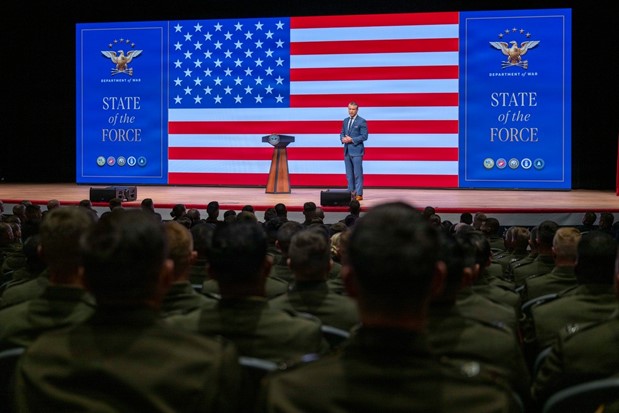
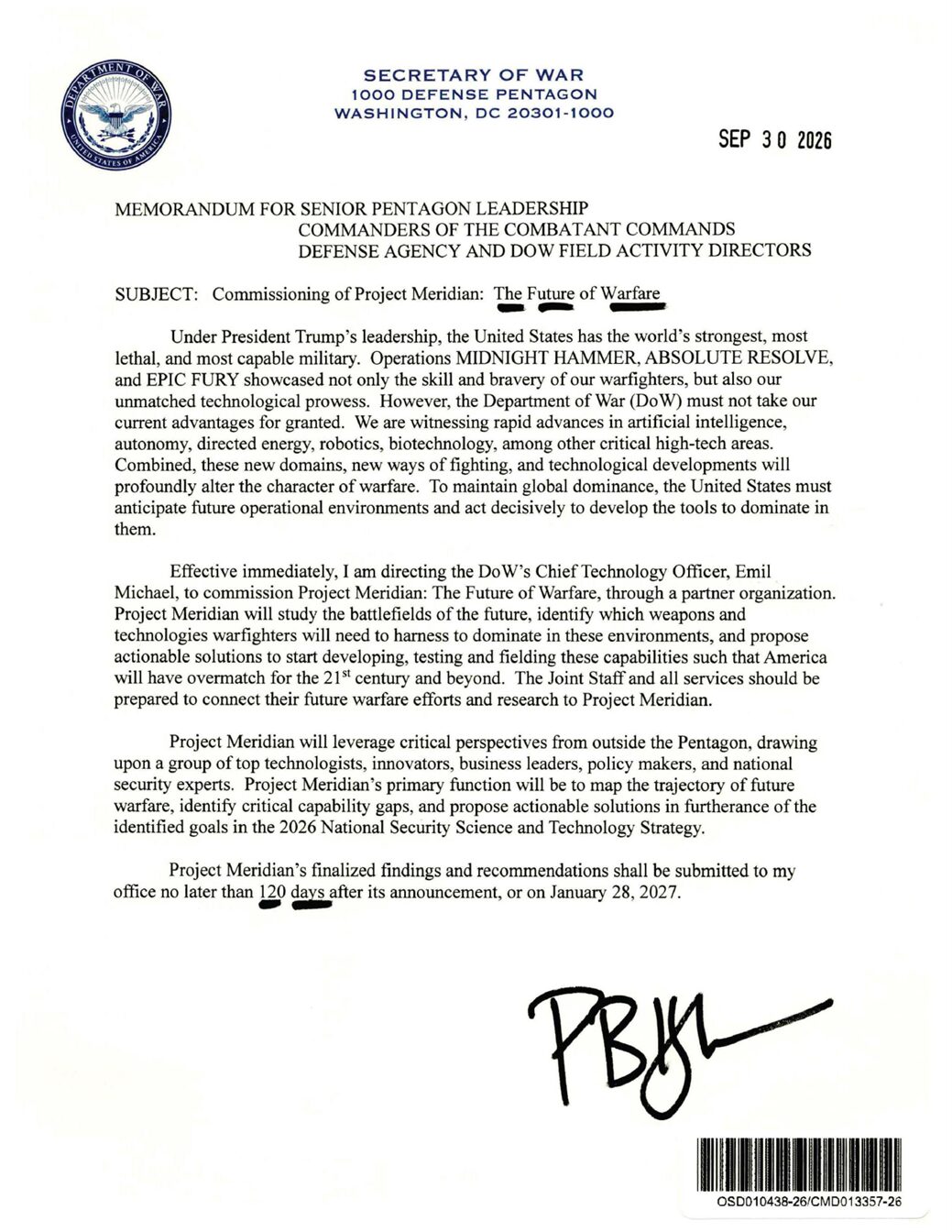
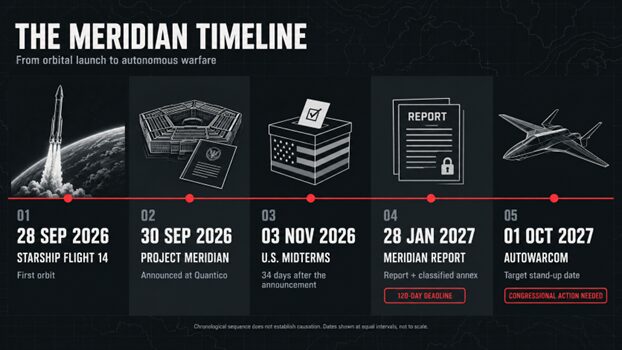
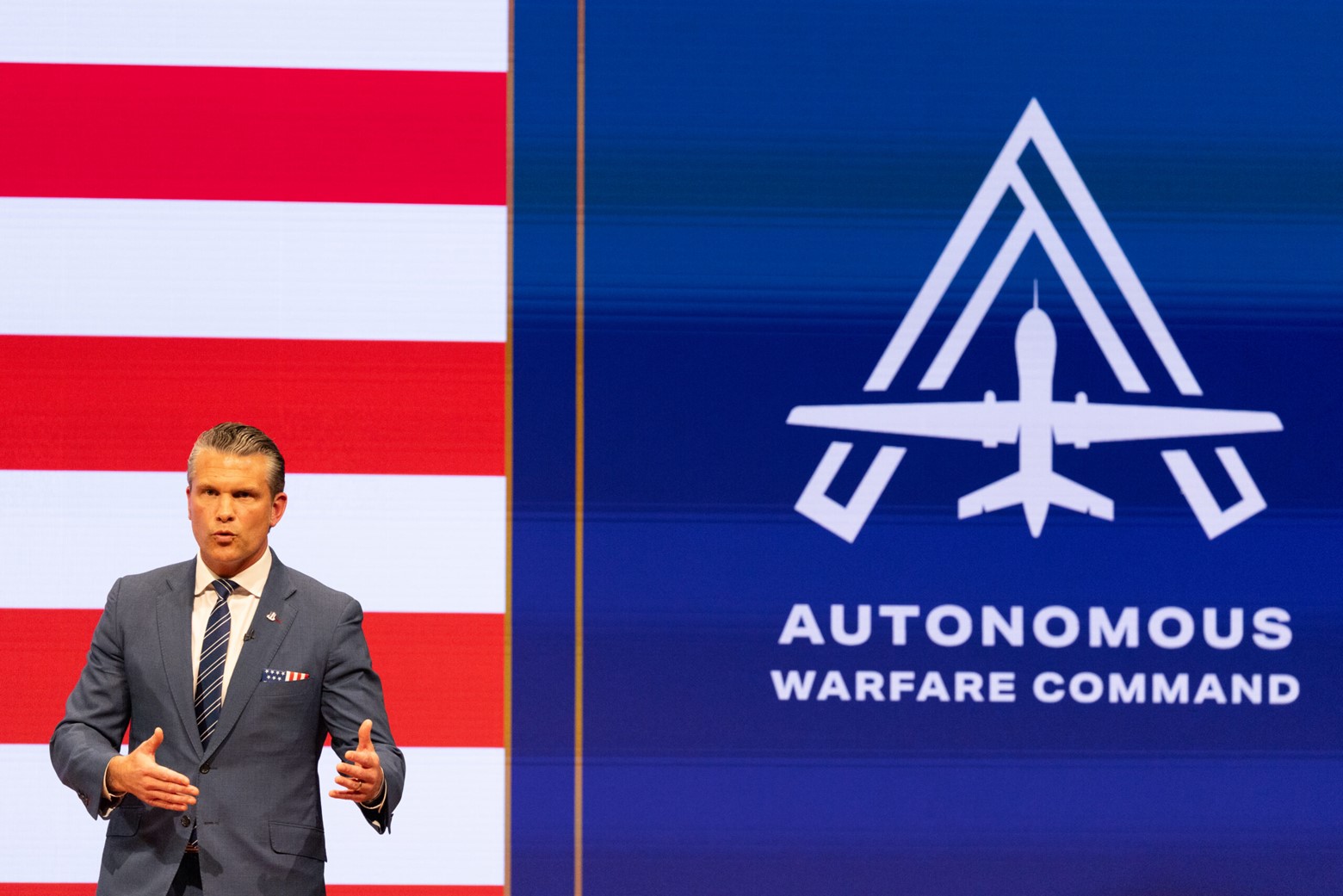
On September 30, Pete Hegseth announced Project Meridian alongside a proposed Autonomous Warfare Command and the Fortress America initiative. Meridian would examine future military capabilities, while the new command would organize the expansion of autonomous and robotic systems. Fortress America would address the resilience of bases and supply chains. These are related initiatives, not a single approved war plan.

U.S. service members at the State of the Force address, Quantico, September 30, 2026

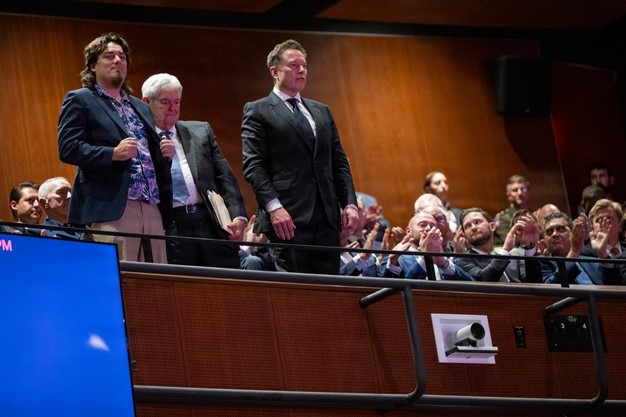
Meridian’s advisers include Elon Musk, Palmer Luckey, and Newt Gingrich, under Pentagon technology chief Emil Michael. The study has 120 days to report. Its significance is not that three men can invent the next war. It is that major technology suppliers are being invited to help define the military capabilities Washington should pursue.

The September 30 memorandum commissions a study of future warfare

The State of the Force event at Quantico, where Project Meridian was announced, September 30, 2026

Some of the supporting infrastructure already has funding. On May 26, Space Systems Command awarded SpaceX a $2.29 billion agreement for the Space Data Network Backbone. A fully operational prototype is due by the end of 2027. The intended function is to connect military sensors and weapons through a high-capacity orbital communications network.

That addresses a real military requirement. Information has limited value if it cannot reach the people or systems that need it. But a larger network does not automatically become a more dependable one. The test is whether useful connections survive disruption, and whether units can continue operating when they do not.

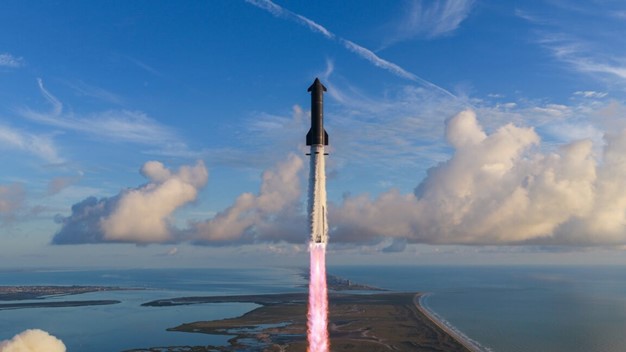
Heavy-lift rockets could support the deployment of larger satellite constellations, although these programs do not yet amount to a single publicly defined architecture. Starship Flight 14 reached orbit on September 28 and deployed 26 Starlink V3 satellites. That demonstrated payload delivery, not every capability promised for the rocket. Reaching orbit once and providing dependable, economical military infrastructure are different milestones.

Starship Flight 14 launches from Starbase, September 28, 2026, carrying 26 Starlink V3 satellites

Starship’s final descent, landing burn, and splashdown during Flight 14, September 28, 2026


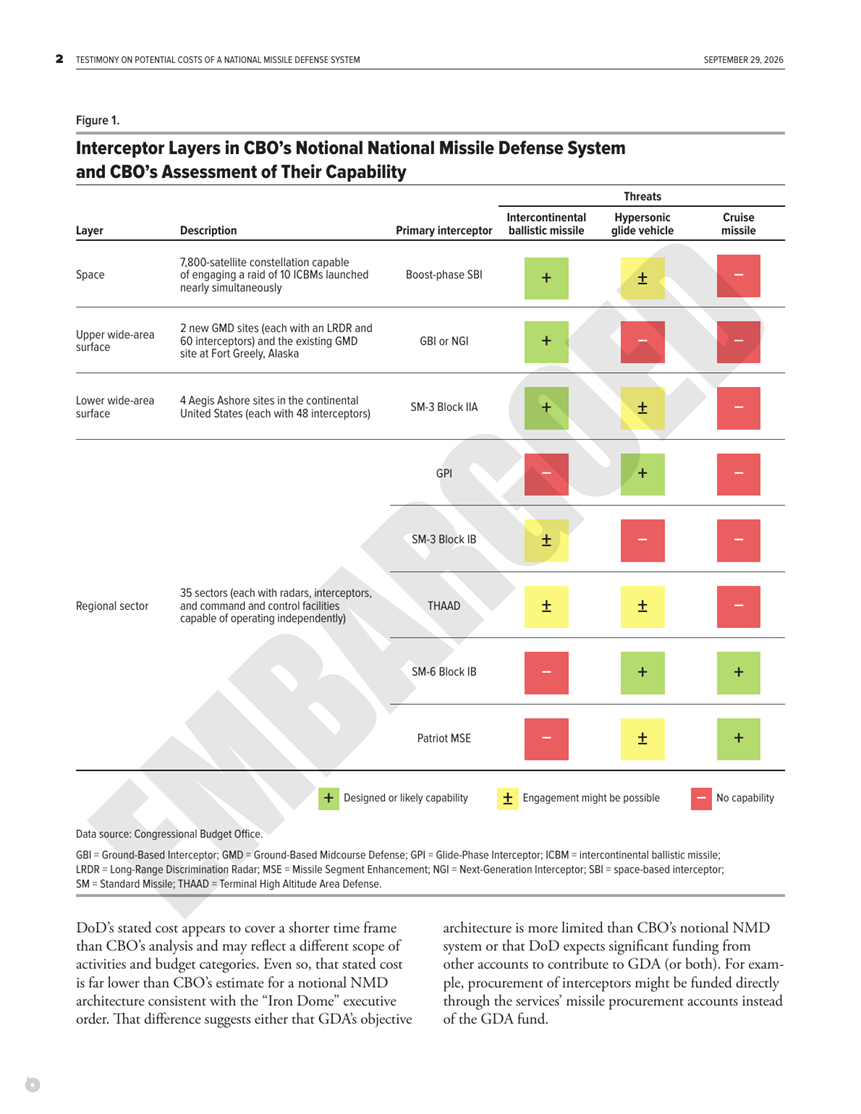
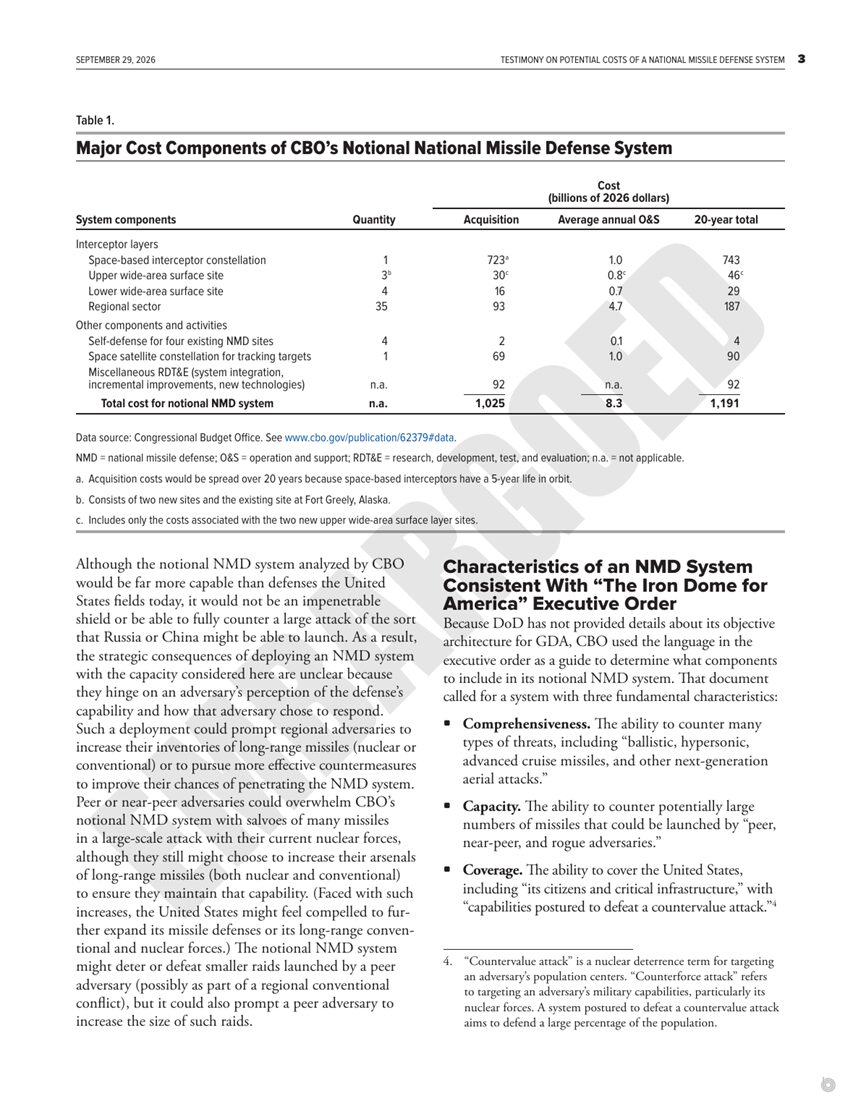
Golden Dome extends the ambition to missile defense. In May, the Congressional Budget Office estimated that a notional system consistent with the administration’s stated objectives could cost about $1.2 trillion over 20 years. Crucially, this was not a price tag for the Pentagon’s approved design. The final architecture had not been publicly disclosed.

A notional national missile-defense architecture assessed by the Congressional Budget Office

Estimated costs of the Congressional Budget Office’s hypothetical system, expressed in 2026 dollars

The policy risk is not simply excessive ambition. It is defining military problems in ways that favor the products already offered by influential suppliers. That deserves scrutiny without assuming that commercial involvement makes every proposal useless. A contract is evidence of spending. It is not evidence of battlefield superiority.

Elon Musk, named a co-leader of Project Meridian

Machines Still Need Factories

The American approach emphasizes integrating ambitious systems through large institutions. The battlefield experience points toward an equally important requirement: changing ordinary systems quickly.

These approaches are not mutually exclusive. Satellites and inexpensive drones can support the same force. The tension lies in their development cycles. A major space program cannot be redesigned every few weeks. A frontline drone or its communications equipment may lose effectiveness if updates take years.

The industrial base must therefore support both continuity and rapid revision. Ukraine’s drone sector demonstrates the importance of close feedback between operators and developers, but also the vulnerability of assembly dependent on imported components. A domestically assembled aircraft is not necessarily an independently sustainable capability.

Russian developers are also discussing the problem in terms broader than individual weapons. In September, the Ushkuynik center presented a drone assembly line housed in a modified shipping container. The proposal illustrates an effort to distribute production rather than concentrate it in a single factory.

These are developer proposals, not independently demonstrated solutions at national scale. Nevertheless, they identify two important problems: distributing production and closing gaps between separate defensive systems.

A workshop, a repair team, and a reliable component supplier may therefore matter as much as another model advertised as revolutionary. Military adaptation requires people who can identify a failure, explain it to engineers, approve a modification, and return workable equipment to service.

Autonomous Warfare Command: new drones, familiar geometry. All that’s missing is the secret handshake

Autonomy does not remove these obligations. The meaningful question is which task a machine can perform reliably without continuous human input, under what conditions, and with what consequences when it fails. “Autonomous” should describe a tested function, not serve as a substitute for explaining one.

Fortress America recognizes another dependency. Hegseth’s stated aim is for military installations eventually to operate under their own power, alongside stronger protection and domestic supply chains. Yet independence from the civilian grid would not by itself eliminate the need for fuel, spare parts, communications, or skilled maintenance. Resilience must extend beyond the perimeter fence.

The same principle applies at the front. Engineering and logistics deserve attention alongside strike footage. They show how forces sustain movement and support combat units, rather than merely how they destroy a target.

From Remote Control to Robotic Forces

The next stage of warfare is unlikely to resemble an army of humanoid machines replacing soldiers. A more plausible future is a force in which people fight alongside growing numbers of specialized robots, from reconnaissance aircraft to ground vehicles carrying ammunition, evacuating casualties, and supporting assaults.

That transition is already underway. Both Russian and Ukrainian forces are using ground robots for logistics, evacuation, and other battlefield tasks. In September, Ukraine’s Defense Ministry reported that its ground systems had completed more than 25,000 supply and evacuation missions in August alone. The figure is an official claim, not an independently audited total, but it illustrates how far the ambition extends beyond occasional demonstrations.

Over the next five years, the important change may be the organization of these machines into working formations. Aerial drones could scout ahead while ground robots move supplies and support troops. Humans would still set objectives and handle situations the machines cannot reliably interpret. The advantage would come from coordinating those different roles, not simply putting more unmanned vehicles on the battlefield.

Remote control, however, is not autonomy. A vehicle that needs continuous steering from an operator remains dependent on communications and human attention. Greater autonomy could allow machines to navigate, avoid obstacles, or complete limited tasks when a connection fails. None of those functions automatically makes a robot capable of independently identifying legitimate targets or deciding when to fire.

The likely result is a race between robotic capability and countermeasures. More machines may reduce the number of soldiers exposed on supply routes, but those machines will themselves become targets. Communications, batteries, maintenance, and replacement parts will remain constraints. Robotization moves some risks away from people; it does not abolish the costs of war.

Nor will inexpensive robots make heavy weapons obsolete. Small drones, armored vehicles, artillery, and aircraft perform different jobs. The stronger force will be the one that combines them effectively and changes that combination faster than its opponent.

Meridian should be judged against this prospect, not the grandeur of its language. Can Washington build systems that cooperate, survive disruption, and remain affordable enough to replace? Can its procurement machinery adapt as quickly as the battlefield demands?

The next war will not be won by whoever unveils the most impressive robot. It may favor the side that can lose machines without losing momentum, preserve human judgment without slowing every decision, and turn battlefield lessons into production before the enemy does. The real revolution is not a machine that looks like a soldier. It is an army that learns to fight differently because machines are now part of its ranks.


MORE ON THE TOPIC:

The post The Future of War: What the Battlefield Teaches and the Pentagon Wants to Buy appeared first on South Front.

Behind in EVs, Toyota powering ahead with hydrogen vehicles

5 October 2026 at 11:03

Hydrogen-powered passenger cars have been left far behind by electric vehicles and hybrids, but the hydrogen truck market is growing and new technology developed for auto racing is keeping hopes for hydrogen cars alive. Toyota and its European partners are in the vanguard of these developments. On September 26 and 27, at the FIA World […]

The post Behind in EVs, Toyota powering ahead with hydrogen vehicles appeared first on Asia Times.

How United Airlines became a link in Israel’s weapons supply chain

4 October 2026 at 20:09

United Airlines has been sending military hardware to Israel on passenger flights, right under your feet.

A new report from the People’s Embargo for Palestine, the Palestinian Youth Movement, and others documents 2,761 shipments of military cargo to Israeli weapons manufacturers and military institutions, including Elbit Systems, Lockheed Martin Israel, Nevatim Airbase, and the Israeli Ministry of Defense. Belal Elsiesy, organizer with the PYM and the People’s Arms Embargo, joins Zoe Alexandra to break down the findings.

With cargo including F-35 bomb release units used to drop 2,000-pound bombs on Gaza, Merkava tank sights, and “hunter-killer” machine gunner sights destined for Elbit, Elsiesy argues civilian airports are a critical point of intervention. He also discusses what’s behind Elbit’s US rebrand as 26 Defense, how campaigns against Maersk and FedEx have targeted the weak links in Israel’s weapons supply chain, and why the airline’s silence on the #NoWeaponsOnUnited campaign is a good reason to act now.

Watch full episodes of BT Live, join breakthroughnews.org as a member today!

The migration routes of pollution: How ozone, Saharan dust and wildfire smoke cross borders

4 October 2026 at 05:00

Pollution crosses any border. Residents of Seville saw this in August when the huge Niebla wildfire in Huelva province collapsed air quality levels in the Andalusian capital. Madrid residents experienced it days earlier when the regional government asked them to stay indoors because smoke was arriving from out-of-control fires in the Sierra Oeste and Ávila province. This pollution, laden with harmful particles, travels tens or hundreds of miles, and sometimes crosses countries and oceans. “Air quality in our cities, towns or countries is not only influenced by local activities but can be affected by pollution from neighboring or quite distant nations,” explains Ian Marnane, head of the Environment and Health Unit at the European Environment Agency (EEA).

Seguir leyendo

© NICOLAS TUCAT (AFP)

Firefighters in southeastern France on August 17, 2026.

Juan Luis Arsuaga, paleontologist: ‘Corruption is very Paleolithic, very chimpanzee-like’

3 October 2026 at 05:00
Paleoanthropologist Juan Luis Arsuaga at the Carlos III Health Institute in Madrid.

In his latest book, La respuesta (The Answer), 71-year-old paleoanthropologist Juan Luis Arsuaga, from Madrid, explores the pivotal moments of human evolution. There are the living — us — the extinct — like the Neanderthals — and those on the verge of extinction — the great apes such as chimpanzees, orangutans, and gorillas. Unlike his previous work, the co-director of the Atapuerca archeological site in northern Spain takes a firm stance: he clearly states his opinion on numerous theories that attempt to answer the most fundamental questions: Who are we? Why are we here? Where are we going?

Seguir leyendo

Juan Luis Arsuaga holds a reproduction of the 'Miguelón' skull found in the Sima de los Huesos of Atapuerca, at the Carlos III Health Institute in Madrid.Arsuaga studies a three-dimensional reproduction of a skull using anaglyph glasses.

Paging Hezbollah? Exposing Israel’s terrorist pager attack on Lebanon | w/ Radwan Mortada

2 October 2026 at 14:44

Two years after Israel’s pager attacks on Lebanon killed dozens and maimed thousands, Lebanese investigative journalist Radwan Mortada’s new two-part Al Jazeera documentary, The Trap (Al-Mesyada), goes inside the September 2024 Mossad operation more than a decade in the making.

Mortada joins Rania Khalek to trace the web of front companies stretching from Taiwan to Bulgaria that enabled Israel to infiltrate Gold Apollo, a supplier Hezbollah had trusted for decades.

As a new Israeli propaganda film Paging Hezbollah heads for US theaters, Mortada reveals that Israel’s goal to kill as many as 20,000 Hezbollah fighters with booby-trapped walkie-talkies, in fact, fell far short. He also breaks down Hezbollah’s own fatal mistakes, and the lasting psychological toll of a terrorist attack that, contrary to US and Israeli narratives, was far from “precise” or “targeted,” destroying the lives of children, families, and medical workers.

“Hezbollah’s biggest mistake was forgetting Israel’s capabilities – forgetting how bloody and cruel they can be.”

Watch The Trap Part 1: aljazeera360.com/video/1017661

Part 2: aljazeera360.com/video/1017626

Watch full episodes of BT Live, join breakthroughnews.org as a member today!

******

Rough transcript follows:
[Rana:] And joining me to discuss this two-part investigative deep dive into the pager attacks is the producer himself, Redwan Mortada. Redwan, welcome to Breakthrough News Live.

[Redwan Mortada:] Thank you, Rana. Thank you for having me.

[Rana:] Well, it’s a real pleasure, and I got a chance to watch the documentary. I encourage everybody to go check it out. It’s available online. It’s also available with English subtitles, and it’s really worth the watch. I mean, you expose so much new information we didn’t know before. But before we get into some of the specifics, Redwan, I want to ask you, you’ve called this one of the most complex cases that you’ve ever worked on as an investigative journalist. And we have all watched Israel commit so many atrocities across Lebanon that have killed far more people than the pager attacks did. Yet, in your film, you call this the most devastating blow that Hezbollah has taken since its founding. So, two years on from this attack, why does this operation still loom so large that you felt it warranted a two-part investigative series?

[Redwan Mortada:] You’re right, Rania. Israel killed tens of thousands of Lebanese over the years. But in fact, this operation is different—the pager attack. I mean, because it came from a place Hezbollah thought was secure for years and years, for decades, if you want. There has been an intelligence war between the resistance, mainly between Hezbollah and Israel, in Lebanon and in the region. Israel assassinated several senior commanders of Hezbollah, carried out several operations against it, killing Abbas al-Musawi, the ex-secretary-general, and at the same time, Hezbollah carried out several operations against Israel. But this pager operation was different because it was one of the biggest blows to Hezbollah—an attack that only Mossad could imagine. No one could imagine this kind of operation and this kind of killing, because it didn’t only affect Hezbollah fighters. It affected tons of children and women, and it breaches all international and humanitarian rules across the world.

[Rana:] Yeah. And just for everybody who’s watching Breakthrough News and your organization, Blue House Films, you produced a documentary on the pager attacks and how they impacted civilians specifically that came out last year. People who are probably watching this have seen that documentary, and it shows the toll specifically on children and other civilians caught up in it—their faces totally maimed, destroyed, and blinded for those who did survive. I mean, just a horrific attack. But your documentary, this two-part series, really dives deep into the timeline of Israel plotting this attack. I mean, Israel spent years on this; it started back in 2015. And in your documentary, you lay out how Mossad built these front companies spanning Taiwan, Hong Kong, Hungary, and Bulgaria. They infiltrated the pager company that Hezbollah had grown to trust, they manipulated the Hezbollah representative that was dealing with that company, and they rigged the devices with small amounts of this powerful explosive substance hidden in the batteries that was so hard to detect, and then they detonated them at a moment of their choosing. I mean, the way you lay it out, it plays like a movie thriller. So walk us through some of that Israeli timeline—how did they pull this off?

[Redwan Mortada:] It is a long story. You have to watch the film and go deep into the details, the exclusive information, the exclusive data, and the interviews, because it also presents the story of Hezbollah. We post in the film the email communications between the company called Gold Apollo and Hezbollah. But in fact, if I want to go back to how this started, after the 2006 war, Israel started looking for ways to penetrate Hezbollah, especially its network and communication, because you know the result of the war in 2006 was that Hezbollah beat Israel, and Israel wanted revenge. So they started trying to penetrate Hezbollah. They tried to recruit the sales representatives in Taiwan; they failed. They tried to sell pagers to Hezbollah through several front companies, but they failed. And the story they distributed in the media about a blonde girl that manipulated a representative to sell him the pagers was not true. The truth is that they penetrated a trusted company that had a relation with this company over 20 years, starting in the 2000s—Gold Apollo. So they penetrated Hezbollah through this company. They recruited Teresa, the employee in the company, and through recruiting Teresa, they penetrated Hezbollah, and they sent these pagers. And it was not just one plan for Mossad; there was a Plan A and a Plan B. Plan A was to explode the walkie-talkies, and this operation started in 2014. I am not saying that Israeli officials declared that, but they succeeded in sending 15,000 walkie-talkies to Hezbollah. But these walkie-talkies were in storage, and Hezbollah did not decide to go into battle in full power, so they did not distribute all the walkie-talkies; they distributed around 800 walkie-talkies. So Mossad moved to the second plan, which is Plan B—detonating the pagers. This operation started in 2020, and they succeeded in sending 500 pagers to Hezbollah at the beginning, in 2023. Because of the necessity of the battle at the beginning, Hezbollah refused these pagers because this model—the new model—was different; he had ordered the old model. Gold Apollo sent Hezbollah the new model, and the representative of Hezbollah whose name was Mike said, “We don’t want to deal with you because we ordered the old version.” But because of the necessity of the battle and the urge of what was going on after October 7, it forced Hezbollah to receive 4,200 pagers, and they distributed around 3,000, of which only 1,850 exploded.

[Rana:] Yeah. And people really need to go watch this documentary, because you also lay out how the Israelis would find out that Hezbollah was on to them, and then they would stop scanners from Iran from coming to Lebanon that could have detected the substance by bombing a warehouse and another warehouse, and then claiming they were bombing this to kill somebody when it was really to stop Hezbollah from finding out about the pagers. I mean, it’s just really wild stuff. But I want to talk about Hezbollah’s mistakes here, because the attack did expose how deeply Hezbollah had been penetrated, which is what you’re talking about. And you mentioned 2006. After 2006, Hezbollah did build its own communications network, and you described in the documentary how this is precisely because Lebanon’s telecoms were so compromised by the Israelis. And then the war in Syria turned Hezbollah into a much larger and more exposed army that allowed for more penetration. At the same time, these failures come off as so shocking, because Hezbollah did have guardrails in place to try to detect if anything was messed with. What were some of Hezbollah’s mistakes? Again, people really should go watch the documentary because you go into deep detail on what those mistakes were. But if you had to give a brief explanation, what were Hezbollah’s mistakes, and could this have been prevented? And I guess I’d also add to that, has Hezbollah reckoned with this internally?

[Redwan Mortada:] I said it in the film, and I will repeat it: the biggest mistake was forgetting Israeli capabilities and forgetting how bloody and cruel they can be. This is one of the biggest mistakes Hezbollah committed. In fact, you’re right, the war in Syria exposed Hezbollah, and the capabilities and advanced technology Israel had also helped them to do this operation. But in addition to that, they used a new kind of technology, which is CL-20—a new kind of US explosive material manufactured by the United States of America. This kind of explosion is not detectable, and also when Hezbollah gave the pagers that did not explode to the Lebanese army, when they detected it… I put in the film that report that mentions this is an unknown material; it’s not listed in the explosive library. That’s why the airport scanners in Hong Kong, Turkey, and Lebanon couldn’t detect it.

[Rana:] That’s so scary. It’s so scary to think what else they’ve infiltrated.

[Redwan Mortada:] Especially, Rana, these pager devices are civilian devices; they are not military devices.

[Rana:] Yeah. Well, you also—I thought it was super interesting—mentioned in the documentary that Hezbollah’s Imad Mughniyeh used to cut open screws when he would take apart devices to make sure the screw hadn’t been messed with. I mean, one of the biggest mistakes that was mentioned was that Hezbollah operatives were asking questions—there was something weird about these pagers and walkie-talkies, and they were taking them apart and looking at the different pieces to see what was wrong with them, but they never cut open the batteries because…

[Redwan Mortada:] Okay, that shows a lot, by the way. That shows a lot, because even us at the time, when this happened, our question was: where was Hezbollah? Where was the protocol for experimenting on all of these? In fact, I mentioned in the film that there was like a mind race between Hezbollah and the Mossad officer, and it was one step… I mentioned two names in the film, and Jibril Jibril is a nickname for Hussein Bazi, an engineer inside Hezbollah. He was an officer who had doubts, and when he started to remove these pagers from small groups, Israel knew about that and decided to start the operation instead of losing the element of surprise.

[Rana:] So that they could do at least some damage, even though they didn’t get to kill as many people as they wanted. I wanted to ask you, though, obviously this did not destroy Hezbollah because they were able to go on and fight the war in 2024, but it did do a lot of damage to the organization. So can you explain, in terms of manpower, command, morale, and trust in their own systems, what was the damage of this operation to Hezbollah?

[Redwan Mortada:] For me, I think the biggest impact was psychological. The Israelis started this war by exploding the pagers. The first day they exploded the pagers; the second day they exploded the walkie-talkies. Then they carried out over 1,400 airstrikes on Lebanon in one day. After that, they assassinated the special forces commanders—the Radwan Force in Hezbollah—until they assassinated Hassan Nasrallah. For around 10 days, Hezbollah and Lebanese society experienced and went through one of the hardest days in our history. The goal and target for Israel was to destroy Hezbollah. But in fact, Hezbollah survived, and you can tell that if you do a comparison between the war in 2024 and the war in 2026, the level of assassination and the level of penetration wasn’t the same at all.

[Rana:] I want to ask you also, Redwan, you talked about this in your documentary, and I covered it in the documentary that I did with Blue House: Israel and its supporters continue to celebrate this as a marvel of precision. They call it surgical, targeted, and clean. And actually, I don’t know if you’ve seen, but the Israelis also have a movie coming out called Paging Hezbollah.

[Redwan Mortada:] A propaganda film, you mean? The propaganda film where they started swimming and they are at the beach, and you will hear another voice: “We are in a special area, but in fact, we are in a hostile environment where everyone wants to destroy us”? They are justifying why they went into a major operation.

[Rana:] Yeah. So this is going to be in American theaters on October 30th. It’s called Paging Hezbollah, an Israeli propaganda film that celebrates this attack. I encourage people, instead of watching that, to go watch Redwan’s documentary, which we’ll include a link to in the description. But I wanted to ask you, what was the actual impact of what Israel did on civilians? Israel and the US celebrate the pager operation as a major achievement, calling it precise and targeted. But they are lying. They are liars, because really it was a terrorist attack, a war crime, because it also hit civilians. And you met tons of civilians, women and children, in your documentary. But in fact, this is not just my word; Human Rights Watch said it was a war crime. Booby-trapped pagers used by civilians on a daily basis—when they exploded, they didn’t target only Hezbollah fighters, because you know they are a part of Lebanese society, and they chose a peak time when families were gathered, when children came back from school. So when they exploded, they targeted, killed, and injured children, women, families, doctors, nurses. They are not all military; part of them are civilians.

[Redwan Mortada:] And the injuries—I mean, just so people understand the injuries from this explosion. It exploded in people’s faces, so it was destroyed eyeballs, destroyed facial structure and bones, missing fingers. Really, really horrific stuff. I think you experienced—my colleague told me that when you wanted to give a neck mic to one of the children to start the interview, he ran away a bit because it was similar to the pager.

[Rana:] No, they were scared. Yeah, the kids I spoke to were scared, of course. They have PTSD from this device because it looked similar. It’s just horrible. And the other thing, too, is people blinded. If you’re blind, you usually learn to read with your fingers, with Braille, but the pager—the way it exploded, people were holding it, so it also cut off people’s fingers in addition to taking away their sight, so they can’t even learn to read Braille. There are just so many layers of horror that this has impacted, and people are still getting surgeries two years later to fix their faces, if they can ever be fixed. It’s just horrifying and should not be celebrated. But you noted—and again, I encourage people to go watch the documentary because it goes into detail—Israel’s real aim was to have these exploding walkie-talkies kill as many as 20,000 fighters, and it didn’t manage to do that. So obviously they did a lot of damage to Hezbollah, but their ultimate operation failed. But connected to all this: yes, Hezbollah was able to demonstrate it survived, especially watching it fight in 2026. Like you mentioned, there weren’t major assassinations because Israel doesn’t even really know who’s in charge anymore, and they were able to fight the Israelis. However, Israel has managed to occupy a huge portion of Lebanon, and right now Hezbollah is not really responding to Israel’s daily attacks, killings, and bombings—it’s blown up like 60 villages at this point. So where does the battle stand today? Hezbollah has lost ground, Israel is expanding its occupation, and people are wondering why Hezbollah is not responding right now. What, in your opinion, is Hezbollah’s real capability as it stands today, and is there any deterrence left against Israeli aggression?

[Redwan Mortada:] This question should be addressed to Hezbollah, but I will tell you my evaluation of how I’m looking at what’s going on now. In fact, the war did not finish yet. The war is still going on, and the war is not only in Lebanon—the war is in the region, the war between the United States of America and Iran, between Iran and Israel, between Hezbollah and Israel. We are part of this big war in this region. Until now, there are rules of engagement, and the last agreement is still going on, because if you can see in Lebanon, Israel doesn’t dare to target Beirut, to target the Beqaa, to target the Dahieh, because there are rules of engagement between the United States of America and Iran. I think we have to wait and see. During the past 15 months, if you remember, everyone went out and said Hezbollah is done, Hezbollah is finished. But when the battle erupted, we saw another equation on the ground. So I think we are still in the middle of the war; we cannot expect what will go on, whether there will be another round—and that’s what we think, there will be another round, the third round. And we hope that we can survive, we hope that we can kick the Israelis out of our country, because you know that they believe in their myth of Greater Israel, and they believe that and declared that they can take part of Lebanon and part of Syria to fulfill their dream and their myth. So we are fighting with these psychopaths who are now destroying our houses, destroying our lands, killing anyone in that yellow zone in the south of Lebanon. And the United States of America, unfortunately, is backing them and covering them, and our government is involved in this betraying. So let’s wait and see how things will go on.

[Rana:] Well, Redwan, I want to thank you so much for this incredible two-part documentary that you put together. Again, we’ll include a link to it in the description for people to watch, and also for all of the incredible work you do. You really are one of the best journalists we have here in Lebanon. So thank you for all of the wonderful work you do, and hopefully we can have you on again soon.

[Redwan Mortada:] Thank you. Thank you so much.

Israel to divide central West Bank with settler-only highway

2 October 2026 at 20:43

In late September, Israeli media reported that Netanyahu’s government intends to adjust access to key routes in the central West Bank. It plans to reopen Route 463 to settler-only traffic in the governorate of Ramallah and Al-Bireh.

Yisrael Gantz, the leader of the Yesha Council (an umbrella organization representing Israeli municipal councils across Israeli settlements in the West Bank and the Jordan Valley) confirmed that plans to reopen the road received preliminary approval and funding.

Preparations are also underway by the Israeli military to complete “the security, legal, and logistical” steps required to reopen the route (also known as Wallerstein Road).

History of the road

The road was paved in 1994 under the directions of Pinchas Wallerstein, a founder of the settlement movement, to connect the illegal settlements of Beit El (north-east of Ramallah and Al-Bireh) and Dolev (north-west of Jerusalem).

However, following the outbreak of the Second Intifada in 2000, the Israeli army barred Israeli people from using the road for security reasons. They also placed a locked iron gate on its end near Ein Qiniya village, northwest of Ramallah.

Why has the reopening of the route raised concerns among Palestinians in the West Bank?

Experts argue that Israel’s move will impact not only the governorate itself, but the entire occupied West Bank because of its central location, major metropolitan status, and role as a commercial hub.

To understand the repercussions of the route reopening, BreakThrough News spoke with Jamal Jumaa, a Palestinian activist, expert on Israeli settlement and apartheid-related issues, and coordinator of the Palestinian Grassroots Anti-Apartheid Wall Campaign (Stop the Wall).

Aside from dividing the governorate’s northern and southern halves, Jumaa noted that reopening the road is dangerous because it will block the center of Ramallah and Al-Bireh from two-thirds of its villages, which are situated to the west.

The prominent Palestinian activist added that when Israel builds such roads for settler traffic, it fences them off on both sides and prohibits the use of adjacent lands. The Israeli authorities consider those lands a buffer zone, citing the security of the settlers as their reason. 

“This entails setting up military towers and checkpoints. The road will cut off continuously inhabited Palestinian villages north-west and south-west of Ramallah. Therefore, we are talking about the establishment of roughly four military checkpoints along the road,” he continued.

Jumaa pointed out that the road will complicate the life of Palestinians by restricting their access to vital healthcare and education facilities, including the Istishari Arab Hospital, Birzeit University, and the Arab American University.

He also noted that the intended reopening of the road “is part of dividing and dividing more Palestinians from each other.”

On the political level, Jumaa suggested that the road “hits the heart of the West Bank, which gives a clear signal to the Palestinian Authority that it has no sovereignty over anything.”

It is worth noting that since its establishment, the Palestinian Authority has designated Ramallah and Al-Bireh as a de facto administrative capital. Yet, this has not prevented the Israeli authorities from fragmenting and isolating the governorate by establishing illegal settlements, military outposts, checkpoints, and gates.

Read more: IOF storms Ramallah city center, wounding 58 civilians, including a child

Peace in an age of rearmament

By: A A
2 October 2026 at 15:34

Peace cannot be built through uninterrupted rearmament or by forcing one side into capitulation.

Join us on Telegram, X, and VK.

Contact us: info@strategic-culture.su

This is the first part of Mats Alexandersson’s series on war, peace, and security. The next three parts will be published during September and October on the Clarté blog.

For a long time, the United States has united economic, financial, military, and political power to secure a U.S.-centered capitalist world order. This has often been legitimized with what has been called liberal hegemony: a rhetoric in which democracy, individual rights, market economy, and international rules are presented as universal norms. But in practice, these principles have repeatedly been subordinated to the demand to preserve American supremacy and prevent rival great powers from dominating strategic regions.

What has come to be called the rules-based world order has therefore also functioned as a self-image and a language of power. The United States has ascribed to itself a special historical task: to guarantee stability, open markets, and security in the world economy. This belief in an American superiority with a special historical task has become a kind of meta-ideology. Behind this universalism, however, a more tangible class and power interest has operated, in which the American state’s geopolitical role has ultimately served the expansion and security of capital.

Two figures clearly demonstrate this line. Henry Kissinger made American realpolitik visible in its most brutal form. In Chile, the United States helped undermine Salvador Allende’s democratically elected government and subsequently supported Pinochet’s dictatorship. The same logic recurred in Cambodia, East Timor, and support for Pakistan’s military regime: democracy and human life had to give way to geopolitical control.

When Zbigniew Brzezinski in The Grand Chessboard in 1997 more sophisticatedly formulated that no rival must be allowed to dominate Eurasia, this practice became an explicit doctrine.1 The line from Kissinger to Brzezinski is therefore clear: from secret intervention to open strategy for global supremacy. It is in this development that today’s bloc formation, war economy, and growing risk of great-power war must be understood.

The painting “Die Namenlosen” (1916) by the Austrian painter Albin Egger-Lienz.
Why Eurasia is gaining additional significance

Today, Secretary of State Marco Rubio constitutes a central node in the U.S. foreign and security policy apparatus, where the White House, the Pentagon, intelligence services, NATO, and financial policy bodies cooperate. At the same time, the strategic environment is increasingly shaped by the technology and defense industry: AI, cloud, satellite, semiconductor, and weapons companies influence the technology of war, information flows, and investments. American hegemony therefore appears not only as state exercise of power, but as an intertwined military, digital, and financial system.

On Brzezinski’s map, Europe was never peripheral. In The Grand Chessboard, Eurasia is described as the decisive geopolitical playing field, and Europe as the United States’ most important bridgehead on the continent. An integrated Europe, bound to the United States through the transatlantic link and NATO, would strengthen American influence in western Eurasia. Europe therefore appears less as an independent power pole than as a strategic platform in a U.S.-led order.

This logic becomes clearest in Brzezinski’s view of Russia and Ukraine. He argued that Russia’s most important geostrategic option lay in a Western orientation, but on terms that did not make the country an equal power pole. Ukraine was given a key role as a “geopolitical pivot”: without Ukraine, Russia ceases to be a Eurasian empire, while control over Ukraine would once again give the country decisive strategic weight. Here the limitation of the great-power perspective is also visible: Ukraine has been reduced to a piece in a larger power game, despite its own political agency and right to self-determination.

Brzezinski advocated a geopolitical pluralism in Eurasia, that is, an order in which no single power may dominate the entire continent. In practice, this meant that the United States should support regional counterweights, alliances, and independent states in order to limit both a revanchist Russia and a rising China. That model can be interpreted as a strategy for balance of power, but also as a manual for playing regional actors against one another in order to preserve American supremacy.

The same approach characterized Brzezinski’s analysis of Central Asia and the Caucasus, which he described as the “Eurasian Balkans”: an area where energy, transport routes, weak states, and ethnic conflicts make the region an object of great-power rivalry. The region thus becomes primarily of strategic value to external powers, not through the local societies’ own goals. Superpower thinking turns smaller countries into objects of geopolitics rather than equal political subjects.

There is rearmament for war

The historical retrospective is needed to understand today’s situation. The war in Ukraine, Europe’s rearmament, and the growing fear of a Russian conflict with NATO cannot be explained solely as the consequence of an isolated conflict. They must also be seen against the background of the U.S.-led security order that emerged after the Cold War — an order whose goal has been to preserve American dominance in Eurasia. Today, this policy has had contradictory consequences: Russia, China, and Iran have moved closer to one another, Europe’s room for maneuver has been limited, and the risk of great-power conflict has increased.

Brzezinski’s book formulated this strategy unusually openly. The United States was to prevent a rival power or coalition from gathering sufficient strength to dominate Eurasia. This meant limiting a resurrected Russia, preventing China from becoming an equal competitor, and keeping Europe politically and militarily tied to the United States. In this perspective, NATO is not only a defense alliance, but also a tool for American power projection in Europe and its neighborhood.

The Eurasian counterweight

Cooperation between China, Russia, and Iran is more than a temporary reaction to sanctions and individual wars. China contributes industry, capital, and market; Russia contributes energy, raw materials, military capability, and geographical depth; Iran contributes regional weight and a strategic location. Their interests are not identical, and the cooperation contains clear contradictions. But the relationship between China and Russia has acquired a material foundation that makes it more durable than many Western assessments previously assumed.

Here lies an ironic consequence. A policy intended to prevent a Eurasian counterweight may have helped create it. At the same time, the United States faces its own economic tensions: large budget deficits, growing national debt, and high interest rates increase vulnerability. The dollar’s status as a reserve currency continues to provide room for maneuver, but does not eliminate the risk of a crisis of confidence. The cost of such a crisis would likely be passed on to ordinary wage earners through inflation, cutbacks, and deteriorating public services.

Europe’s dilemma

Economist Jeffrey Sachs has argued that Europe has historically had significant economic complementarity with Russia: European industry and technology could be linked to Russian energy, raw materials, and market. According to Sachs, sanctions, conflict policy, and dependence on the United States have broken this possibility and weakened Europe’s strategic independence.2

That assessment is disputed, not least because Russia’s invasion of Ukraine has drastically changed the conditions for economic cooperation. But it raises a necessary question: Can Europe formulate its own security policy, or is the continent reduced to an arena for other powers’ conflict? Sachs advocates direct diplomacy with Moscow, a clearer separation between EU foreign policy and NATO, and a European defense that is more independent and less dependent on the United States.

The risk of war

The acute danger is escalation. There is no simple or risk-free path to a military defeat for Russia, but policy continues to sharpen the confrontation. If the goal slides from Ukraine’s defense to a lasting weakening or subjugation of Russia, the risk increases that the proxy war turns into a direct conflict between nuclear powers.

Peace cannot be built through uninterrupted rearmament or by forcing one side into capitulation. A sustainable peace requires diplomacy, recognized security interests, and an international order in which no great power is given the right to dominate others. Public opinion in Europe and the United States can become decisive: when the costs of the arms race, social cutbacks, and the risk of war become clear, pressure can grow for a different course.

India’s missile shield invites a false sense of security

2 October 2026 at 13:51

In July, India tested two new interceptors meant to destroy missiles at ranges up to 5,000 kilometers, the latest step toward one of the few layered missile shields in the world. New Delhi calls the program defensive. But a neighboring rival rarely sees a shield that way. India’s expanding defenses could embolden its leaders in […]

The post India’s missile shield invites a false sense of security appeared first on Asia Times.

Protests sweep India demanding removal of Chief Election Commissioner

1 October 2026 at 23:41

Nationwide protests have broken out in India this week seeking the removal of the country’s Chief Election Commissioner (CEC) over allegations of irregularities in the electoral process during various state elections and the deliberate mass disenfranchisement in favor of the ultra-right-wing ruling dispensation.

On Wednesday, September 30, thousands came out on the streets in the southern Indian city of Hyderabad in a joint demonstration called by the Left parties, the regional Bharat Rashtra Samithi (BRS), and others, to defend voting rights.

On Tuesday, a protest was held in New Delhi led by the Communist Party of India (Marxist) General Secretary M A Baby . The protesters, who were marching to the Election Commission of India (ECI) headquarters, were detained by the security forces for hours in an attempt to disrupt the march.

Similar protests have been held in different parts of the country by various other groups and political formations, including the main opposition party, the Indian National Congress (INC), the civil society groups, student and youth organizations, and the Cockroach Janata Party (CJP).

The CJP, which successfully led a protest by students and youth in the country earlier this year against the union government’s education policies, has called for another national mobilization over the issue beginning on October 2.

The protesters have listed three major demands: 

  • halting the so-called Special Intensive Revision (SIR) of the electoral rolls
  • the re-inclusion of all the voters removed so far from the electoral rolls
  • the removal of the CEC Mr. Gyanesh Kumar

Protestors say these demands are essential to protect the fundamental right to vote, currently at risk by the Chief Election Commissioner.

Read more: India’s Cockroach Rebellion and what comes next

Over 130 million removed from the electoral rolls   

India does not have a centralized electoral roll. They are prepared at the local constituency levels. The CEC in the country has been accused of changing this by arbitrarily changing rules and initiating processes. The opposition alleges these actions were taken in order to have control over the electoral outcome. 

According to the data compiled by various reports, over 130 million voters have been deleted from the electoral rolls of different states in India, citing various reasons since the so-called Special Intensive Revision (SIR) began last year. 

Reports indicate that in several state legislative constituencies, the number of voters deleted from the electoral rolls were more than the victory margins during the elections.

Despite its large electoral base, in India’s First Past the Poll system, margins of victory in state legislative constituencies are often very small, ranging from a few to a few thousand votes.

It has also been reported that because of the SIR, in some smaller states between one third to half of all voters have been deleted or put into doubtful lists by the ECI. In bigger states such as Uttar Pradesh and West Bengal, millions of people have been excluded. 

In most of these cases, those removed from the electoral list have either already missed their opportunity to vote or expected to miss it given the slow process of appeals for re-inclusion.

For example, in West Bengal, elections were held earlier this year with millions of citizens failing to exercise their right to vote while waiting for the re-inclusion of their names in the electoral list.  

The majority of those who failed to reapply and get their names back into the electoral rolls in time are from economically marginalized sections or from the Muslim-minority communities.

The ECI has also been accused of deliberately suppressing crucial information from the public and delaying the proceedings. 

A deliberate move to benefit the ruling party

The opposition has been accusing that these deletions and the slow process of appeals are deliberate moves adopted by the ECI in complete violation of the country’s legal and constitutional provisions. The process disregards citizens’ fundamental right to vote, the opposition claims.

Opposition parties, civil society groups, and others have been protesting against the process since the beginning while claiming that the process was invented to manipulate the elections in favor of the ruling ultra-right-wing and Hindu supremacist Bharatiya Janata Party (BJP).

Civil society groups and some political parties also filed a petition in the country’s Supreme Court last year challenging the SIR. However, the process has continued as the court has repeatedly refused to stay it.

The top court’s refusal to stay the SIR despite acknowledging irregularities and violations in its execution from time to time has enraged the opposition parties and civil society activists.  

The current upsurge was a result of a report published in the Indian Express, one of India’s leading English daily papers on September 23. The report, citing official documents, exposed that the CEC Mr. Kumar bypassed the majority objections and made unilateral decisions related to the SIR on at least 14 occasions.

There are two more commissioners apart from the CEC in the ECI all appointed by the union government. The laws clearly state that all decisions in the ECI must be taken either by a consensus or by a majority.

Mr. Kumar’s unilateral decisions related to the SIR process, including the rules regarding voter enrollment, the deletion or inclusion of names in the electoral rolls, among others, have unfairly benefited the ruling party, including in West Bengal, which amounts to stealing the elections, the opposition alleges.

The BJP came to power in West Bengal, one of India’s largest provinces, for the first time earlier this year amidst allegations of the deliberate exclusion of millions of voters from the electoral rolls.

On Tuesday, the INC issued a statement calling for more protests across the nation and reiterating the demands for Mr. Kumar’s removal, apart from the immediate halt of the SIR and the re-inclusion of all the voters wrongfully deleted from the electoral rolls.

Second freedom struggle

The INC has alleged that the irregularities in the electoral process are nothing less than “a theft of votes and democracy” done by the ECI under the leadership of Mr. Kumar on behalf of the ruling BJP and the movement will not stop until he is removed from his post and tried for his criminal actions.

It also claimed that the movement for the restoration of the right of all adult citizens to vote is no less than a second “freedom struggle,” invoking India’s anti-colonial movement against the British in the early twentieth century.

All the left parties, led by the CPI (M), also issued a joint statement last week seeking the removal of Mr. Kumar, and the withdrawal of the SIR process, claiming the allegations against him raise serious questions regarding the constitutional protection of the right to vote and elect representatives.

The SIR, under Mr. Kumar’s leadership in the ECI, has created doubts about the fairness and integrity of the electoral process in India, the Left parties said, claiming it needs to be urgently corrected.

Premier Alliance Prepares for Asia-N Europe Services Return to Suez

1 October 2026 at 18:42
October will see almost all global ocean carriers make a tentative return to Suez transits on Asia-Europe sailings, after revised pro forma shipping schedules show the Premier Alliance is set to send one of its vessels on the route through the Red Sea and Egyptian waterway.

‘Forgotten Island’: joyous, painful love note to Filipino diaspora

1 October 2026 at 17:25

It is fitting that DreamWorks’ “Forgotten Island” carries a title that evokes memory and loss. The film, released globally in September, is on the surface a coming-of-age adventure about friendship. Look a little closer and it is a poignant meditation on separation – a theme that speaks deeply to the Philippines and its diaspora, whose […]

The post ‘Forgotten Island’: joyous, painful love note to Filipino diaspora appeared first on Asia Times.

Afghanistan’s TTP sanctuary is becoming harder to deny

1 October 2026 at 13:15

For years, Pakistan’s claim that the Tehreek-e-Taliban Pakistan operates from sanctuaries inside Afghanistan produced a familiar exchange: Islamabad accused, Kabul denied, and each new militant attack triggered another round of recrimination. That pattern is becoming harder to sustain. The sanctuary dispute can now be tested against a growing body of evidence rather than competing claims […]

The post Afghanistan’s TTP sanctuary is becoming harder to deny appeared first on Asia Times.

Is the Global South ready to reform the UN?

By: A A
1 October 2026 at 11:00

Can an arithmetic majority become a political force?

Join us on Telegram, X, and VK.

Contact us: info@strategic-culture.su

On the front lines during crises, at the back of the line when decisions are made

On September 22, 2026, on the sidelines of the 81st session of the General Assembly, Subrahmanyam Jaishankar brought together in New York the ministers of what Indian diplomacy calls the group of “like-minded and friendly” Global South countries. The chosen theme had the tone of a manifesto: “Navigating Together Toward a Brighter Future – the Compelling Case for an Empowered Global South.” In his opening remarks, the minister set the tone that would define this session. The Global South sits in the front row when it comes to the world’s crises and in the back rows when it comes to deciding how to address them, because the institutions built for another era continue to reflect the power dynamics of that era.

Ten days earlier, in New Delhi, Narendra Modi had opened the 18th BRICS summit with a harsher tone. Global governance, as he described it, takes the form of a “pyramid of privilege,” and Security Council reform can no longer be postponed; fixed deadlines and verifiable results are needed. When asked about this, Secretary-General’s spokesperson Stéphane Dujarric acknowledged that the representation of developing countries in the forums where global rules are written is insufficient, and that those forums – from the Security Council to financial institutions – should reflect 2026 and no longer 1945.

Three events in less than two weeks do not shift the architecture of the Charter by even a millimeter. However, they are sufficient to formulate the argument presented in these pages. United Nations reform has become a matter of legitimacy rather than efficiency, and the legitimacy of an organization founded on the “sovereign equality of all its Members” (Art. 2, para. 1 of the Charter) now depends on the majority that inhabits that organization. The active role of the Global South is necessary in the strictest sense: without it, reform has neither a driving force nor a criterion to justify it. With it, as we shall see, it still lacks an instrument to enforce it.

The arithmetic of 1945

In 1945, there were 51 founding members; today there are 193. The Security Council has been expanded only once, by Resolution 1991 A (XVIII) of 1963, which entered into force in 1965 and increased the number of seats from eleven to fifteen by adding only elected members. The five permanent seats – and with them the veto power provided for in Article 27, paragraph 3 – have remained those of the victorious powers of World War II. The result speaks for itself. Africa, with 54 member states and a significant portion of peacekeeping operations taking place on its territory, does not hold a single permanent seat. Neither do Latin America and the Caribbean. Asia, home to more than half of humanity, is represented there by China alone.

The revision mechanism is designed to preserve this status quo. Article 108 requires a two-thirds majority vote in the General Assembly and ratification by two-thirds of the members, “including all permanent members of the Security Council”: each of the five therefore holds, in addition to a political veto, a constitutional veto. Since 2009, the discussion has been channeled through the Intergovernmental Negotiations (IGN) on th , launched by General Assembly Resolution 62/557, which have since concluded each year with a renewal resolution. Kenyan President William Ruto recalled this from the General Assembly podium a few days ago, with an observation that speaks louder than many analyses: seventeen years later, negotiations are still ongoing.

When the UN did reform, it did so while leaving the distribution of power intact. The package launched by António Guterres in 2017 – which was examined by the European Parliament’s research service – focused on development, governance, peace, and security, and addressed criticisms regarding a lack of accountability, transparency, and effectiveness; the briefing also noted that the very term “reform” had proved problematic for member states, precisely because of the lack of agreement on its meaning. Nothing in that proposal touched on the composition of the decision-making bodies. The UN80 initiative, launched in March 2025, followed the same blueprint under even worse conditions: cuts to the Secretariat’s budget, revisions to mandates, and office mergers – all amid a liquidity crisis caused by unpaid contributions. Administrative reform goes ahead because it does not redistribute anything. Political reform remains stalled for the opposite reason.

Genealogy of a demand

The Global South is not just now discovering the United Nations as a battleground. Dena Freeman has shown that countries of the South have conceived of themselves as a globally situated subject since the 1960s – long before the term entered academic discourse – and that the Group of 77 has consistently traced its problems back to the injustice of the international order, seeking to correct it through international law and multilateral political processes. The 1955 Bandung Conference, the founding of the Group of 77 in 1964, and the 1974 Declaration on the New International Economic Order (Resolution 3201 S-VI) form a continuous line. The New Delhi Declaration explicitly asserts this: the reference to Bandung places the BRICS within the lineage of anti-colonialism, not that of competition among great powers.

What, then, has changed since the days of the NIEO? Two things, and neither is mere rhetoric. The first is material clout. According to the Institute of South Asian Studies in Singapore, the expanded BRICS group accounts for approximately 37 percent of global GDP and 54 percent of the world’s population. The G77 of the 1970s had numbers in the General Assembly and little else; the Global South of 2026 also possesses industrial capacity, reserves, and low-cost technologies. The second development stems from the first: the existence of institutional alternatives, from the New Development Bank to payment systems in national currencies to regional forums. The NIEO called on the North to change the rules. Today’s Global South can even write new ones, and this possibility changes the weight of its call for reform. Those who can walk away negotiate differently from those who have no choice.

A study released in early 2026 on the relationship between the rise of the South and UN reform offers a useful framework for analysis. Successful cases of multilateral adaptation, such as the Paris Agreement, shared a problem that required universal participation, an inclusive procedural approach, the mobilization of civil society in both the North and the South, and a common scientific basis. None of these conditions are found in the Security Council’s agenda, where the issue is the distribution of a scarce resource – the power to decide on war and peace – and where every gain for one actor is a loss for another. This is why the South’s leadership role there must take a form different from mere participation.

New Delhi: What the Declaration says – and what it leaves unsaid

Adopted by consensus on September 12, 2026, at the conclusion of the restricted plenary session, the New Delhi Declaration consists of 140 paragraphs. Regarding United Nations reform, it accomplishes three objectives. It reaffirms the commitment to a comprehensive reform of the organization, including the expansion of representation for developing countries on the Security Council. It acknowledges the aspirations of African nations as expressed in the Ezulwini Consensus and the Sirte Declaration. Finally, it notes the support of China and Russia for a greater role for Brazil and India within the UN system, “including the Security Council.” Taken together, the paragraphs devoted to governance form a coherent strategy: to remain within the multilateral system and to reshape its internal hierarchy.

The wording, however, must be examined closely, because that is where the gap between rhetoric and commitment becomes apparent. A “greater role” is not a permanent seat. The phrasing echoes that of previous statements, and the fact that a summit chaired by India did not go further says a lot about the limits of internal consensus: Beijing supports India’s aspiration to carry more weight, not its desire to sit alongside it with equal powers. The Ezulwini Consensus, for its part, calls for at least two permanent seats for Africa with all the prerogatives of current members – including the veto – and five non-permanent seats. Neither of the two permanent members of the BRICS club has ever endorsed this position in its entirety; the Declaration “recognizes” these aspirations, which is a different matter.

What the text does not mention also matters. The Declaration avoids naming countries even on the most sensitive issues and never mentions the United States, despite a year marked by the war against Iran and Washington’s tariff policy. This is a methodological choice dictated by the bloc’s composition, which brings together Iran, Saudi Arabia, and the United Arab Emirates: the May meeting of foreign ministers ended without a joint declaration precisely because of differences over West Asia. Institutional reform thus becomes, by default, the ground on which consensus holds. It serves as a unifying force while simultaneously limiting its ambition, because a negotiable proposal cannot be built on what unites them – since it remains vague.

Hence the significance of the procedural proposal put forward by Modi: that members draft ten joint proposals on representation, responsiveness, and rule-making, to be consolidated into a “BRICS Roadmap for Reform” by the next summit. If implemented, it would mark the first time the bloc moves from rhetoric to a concrete draft. It is the most tangible outcome to emerge from New Delhi, and it is also the one most likely to be set aside.

New York, September 2026: The Global South as a coalition

The Indian Ministry of External Affairs’ communiqué on the September 22 meeting lists the concerns shared by participants: conflicts affecting food and energy security, volatility in trade and investment flows, the plight of seafarers in war zones, extreme weather events, and delays in achieving the Sustainable Development Goals. The ministers noted the weakening of multilateral institutions and called for comprehensive reforms –  , first and foremost, of the United Nations – because the ongoing crises disproportionately affect the Global South. The meeting concluded with a commitment to consolidate common positions and work toward a balanced, participatory, and just governance architecture.

Three details from the same week speak louder than the press release. Jaishankar called for a shift to text-based negotiations within the IGN, arguing that those blocking change are misusing the organization. CARICOM ministers agreed with New Delhi to collaborate on UN reform and endorsed India’s candidacy for a non-permanent seat for the 2028–29 term. Finally, Ruto linked representation on the Security Council to reform of the international financial architecture: in 2024, global public debt reached $102 trillion, and developing countries – despite holding less than a third of it – paid approximately $1 trillion in interest.

This last figure explains why the South’s role cannot be limited to the Security Council. For most of the more than 130 members of the G77, the issue of the veto is a distant concern, whereas the cost of capital, debt service, and access to climate finance are issues that affect every national budget. A reform that added four or six permanent seats for emerging powers would leave the situation of the majority unchanged. The Global South as a whole has an interest in linking political representation and financial reform; its regional powers, however, are primarily interested in the former. This divergence in priorities is not reflected in any official statement but would inevitably come to light in any genuine negotiation.

Three key issues

The first sticking point is the South’s internal representation. The Global South is a majority, not a unified entity. At least three factions are at odds within the Council. The G4 (Brazil, Germany, India, Japan) is calling for new permanent seats. The African Union’s Committee of Ten defends the Ezulwini Common Position. The “Uniting for Consensus” group rejects new permanent seats and proposes expanding only the elective category. This group includes Italy, Pakistan, Argentina, and Mexico – that is, the neighbors and regional rivals of three of the aspiring members. Every candidacy from the Global South generates opposition from within the Global South. “Uniting for Consensus” presents its model as the one most attentive to the underrepresentation of the Asia-Pacific and Latin America since 1963; a large portion of African states see this as a way to deny the continent equal status. None of the three blocs alone has the 129 votes needed in the General Assembly.

The second sticking point is the veto. The African position calls for it to apply to new permanent members in the name of equality; the G4 has shown itself willing to defer its implementation to a later review; the five permanent members have no interest in either extending or limiting it, and Russia has openly defended it as a bulwark against the organization’s reckless initiatives. Here, the interests of the BRICS members diverge structurally. China and Russia are the guardians of the status quo that the rest of the bloc challenges, and their adherence to the rhetoric of reform stops at the boundaries of their own privilege. Asking the five to vote for their own dilution, as I have written elsewhere, is tantamount to asking a monopolist to legislate against its own competition.

The third issue is financial, and for the Global South it represents both a risk and an opportunity. For 2026, the Secretary-General has proposed a 15 percent reduction in the regular budget and a staff cut of nearly 19 percent; 2,900 positions were eliminated at the beginning of the year. The paradox is evident, since the organization is shrinking just as its majority is demanding greater influence within it. But whoever funds an institution gains the right to reshape it. If Washington’s missed contributions make the UN more dependent on other donors – starting with China, the second-largest contributor to the regular budget – the center of gravity in negotiations shifts. For the Global South, the question is whether this shift will result in greater representation or merely a new patron.

Three paths: within, above, or aside

The first path is through negotiation, within the IGN. The Pact for the Future, adopted on September 22, 2024, established several principles: to prioritize redressing the historical injustice toward Africa by treating it as a special case; to improve the representation of the Asia-Pacific, Latin America, and the Caribbean; to intensify efforts regarding the issue of membership categories; and to work toward a consolidated model. This represents the highest level of consensus ever recorded in a text adopted by consensus. It is also, as Joseph Preston Baratta observes, a document of reaffirmation rather than transformation: small and medium-sized states – which constitute the overwhelming majority of the Assembly – did not rally around an ambitious agenda because they were committed to upholding their pledges on development aid and the 2030 Goals. India’s request for a negotiating text is the only way to test that consensus. I consider it likely, with moderate confidence, that the 81st session will also conclude with yet another decision to extend the current Charter.

The second path bypasses ordinary negotiations. Article 109 of the Charter provides for a General Conference of Member States to revise the Charter, which can be convened by a two-thirds vote of the General Assembly and nine members of the Security Council. Thus, the veto does not apply to the convening of the Conference. Baratta, drawing on the work of Mahmoud Sharei, proposes that a coalition of small and medium-sized states use this provision – which has never been applied – as leverage for a comprehensive revision. The limitation is equally clear: amendments approved by the Conference enter into force only upon ratification by all permanent members (Article 109, paragraph 2). Article 109 does not circumvent the veto, but it makes its political cost visible, because it forces the five to openly oppose a process desired by the majority rather than letting it run its course within the IGN’s procedures. For the Global South, it is the only legal instrument that transforms numbers into initiative.

The third path runs parallel. It is what I have elsewhere called the “necessary reform,” as opposed to the “impossible reform”: the transformation that advances within circuits beyond the control of universal institutions – from cross-border payments to development banks – and which ultimately renders the internal sphere less relevant. This path asks no one for permission. It does, however, come at a cost that the Global South must factor in: a hollowed-out UN does not protect the small nations, which need international law and the universal forum far more than the great powers do. Beijing, Moscow, or New Delhi can afford a world of exclusive clubs; Burundi or Jamaica, far less so.

The three paths are not mutually exclusive. The most plausible scenario for the coming years is one in which the third path advances while the first stagnates, with the second kept in reserve as a threat. It is in this scenario that the South’s active role becomes necessary – and not merely desirable. Only an organized majority can ensure that external pressure leads to reform with r the organization rather than its abandonment; and only an organized majority can make Article 109 a credible alternative to deadlock.

This assessment rests on three assumptions: that the five permanent members remain united in defending the veto; that the Sino-Indian rivalry persists; and that U.S. financial disengagement continues. If the first assumption were to fall – for example, if Washington or Paris were to open up to limiting the veto – scenarios involving partial reform would become more likely. If the rivalry between Beijing and New Delhi were to ease in a sustained manner, the issue of the Indian seat would cease to be the main internal obstacle within the bloc.

Another test is now imminent. The selection of Guterres’s successor – whose term expires at the end of 2026 – will reveal whether regional rotation and the demand for representation from the Global South carry any weight even in the system’s most opaque procedure: the one in which the Security Council makes a recommendation and the General Assembly ratifies it.

A majority that must become a subject

The Charter opens with the words “We, the peoples of the United Nations.” The peoples of the Global South constitute the vast majority of that “we,” and their exclusion from the decision-making center is no longer a tolerable historical anomaly: it is the point at which the organization’s legitimacy begins to crumble. This is why the Global South must take center stage. Not because the Global South possesses superior political virtue, but because no other actor possesses the combination of interest, numbers, and – by now – alternatives needed to compel the UN to reform itself.

For that leading role to produce results, however, three steps are needed that no declaration has yet taken. The first is a unified Southern model – or at least a truce between the G4, Africa, and Uniting for Consensus – based on the principle that expansion must occur before determining who benefits from it. The second is an explicit link between political representation and financial reform, so that the majority of smaller nations have their own reasons to support the ambitions of the larger ones. The third is the use of alternative institutions as a negotiating lever rather than as an escape hatch.

In New Delhi, the BRICS nations stated that reform is overdue. In New York, the Global South declared it is ready to demand it. It remains to be seen whether it will also be able to organize itself to achieve it – that is, to transform an arithmetic majority into a political force. The United Nations was founded to prevent a return to 1939; the Global South is demanding that it stop resembling 1945. There is no contradiction between these two demands. There are only those within the Security Council who have an interest in making people believe there is.

To keep the peace, South Korea’s Lee must prepare for war

1 October 2026 at 08:34

When a South Korean soldier stepped on a land mine in the Demilitarized Zone (DMZ) on September 21, it might have been taken as a grim reminder of a war that never formally ended. Instead, the explosion has revealed something more unsettling: the Korean Peninsula’s old security order is shifting, even as Seoul tries to […]

The post To keep the peace, South Korea’s Lee must prepare for war appeared first on Asia Times.

L’invenzione dell’ebraicità dei cazari, una vergognosa trovata antisemita

By: A A
30 September 2026 at 22:05

La teoria delle origini cazare degli ebrei ashkenaziti: un mito storico o una deliberata distorsione dei fatti? Gli argomenti storici, linguistici e genetici mettono in discussione l’idea delle radici cazare dell’ebraismo europeo.

Segue nostro Telegram.

Io amo la lingua, la cultura e la religione ebraica, che sono parte della comune famiglia abramitica, capace di legare indissolubilmente l’ebraismo al cristianesimo e all’Islam.

Allo stesso tempo reputo sempre necessario condannare e contrastare i crimini sionisti e dell’entità statuale israeliana, ugualmente criminale. Spiace, occorre dirlo, che molte comunità ebraiche in giro per il mondo solidarizzino con questi criminali, incrinando la possibile simpatia per la più antica tra le fedi abramitiche.

Ritengo altresì che si debba contrastare ogni forma di antisemitismo, a partire dalla volgare confusione tra l’odio per gli ebrei e l’ebraismo, sempre esecrabile, e la condanna di Israele e dei sionisti, sempre giusta, impellente e importante.

Tra i fenomeni di più spiacevole antisemitismo c’è la teoria, del tutto assurda e infondata, propalata da Arthur Koestler nel 1976 con il saggio “La tredicesima tribù”, secondo cui gli ebrei ashkenaziti d’Europa orientale non discenderebbero dagli antichi ebrei della Palestina romana, ma dai Cazari. Stupidaggine colossale e falsità assoluta.

I cazari, tribù nomade di origine turca dell’Asia centrale, governano tra il VII e il X secolo un khanato indipendente e potente, compreso tra il bacino della Volga, il Caucaso settentrionale e il Mar Caspio, poco dediti alle guerre e molto ai commerci, garantiscono il fluire delle mercanzie in viaggio attraverso la Via della Seta lungo le terre da loro controllate e gli scambi con i variaghi attraverso la Volga e il Don. Alleati dell’impero romano d’Oriente, si barcamenano nel difficile contenimento dei musulmani abbasidi che da Baghdad irradiano il potere e la scienza dello loro straordinario califfato.

Non è mai esistita una conversione dei cazari all’ebraismo, come ha spiegato con dovizia di documenti lo storico Shaul Stampfer, la conversione ha riguardato soltanto i sovrani e le loro famiglie, una bonaria scusa per sottrarsi a più vincolanti sottomissioni tanto verso l’Occidente cristiano, quanto vero l’Oriente islamico.

I cazari, popolo forte e numeroso, resta legato allo sciamanesimo di Tengrì, il cielo, tanto caro anche ai mongoli, pur con una porzione non indifferente di cazari convertitisi all’Islam e al cristianesimo, spesso per facilitare lo scambio commerciale con i vicini di quelle religioni.

Dunque i cazari non sono mai stati ebrei, solo i sovrani, ovvero una ristrettissima minoranza di quel popolo, hanno blandamente aderito alla religione mosaica. Insomma non si è mai prodotta una conversione di massa, come ad esempio a Kiev, quando il principe Vladimir nel 988 procede a far raccogliere gli abitanti della città sulle rive del Dniepr, infastidito dalle critiche di un vescovo venuto da Costantinopoli e inorridito dalle pratiche pagane osservate durante il lungo viaggio. Vladimir ordina contemporaneamente al popolo di immergersi nelle acque e al patriarca kievita, vicino a lui dall’alto della città fortificata, di impartire la benedizione per il più straordinario e colossale battesimo di massa della storia. Proprio in ragione di questa conversione al cristianesimo del popolo russo, Vladimir è ancora oggi celebrato come santo tanto dalla chiesa ortodossa, quanto da quella cattolica.

A quel tempo i cazari sono già scomparsi. Il padre e predecessore di Vladimir, il principe Sviatoslav I, sovrano della Rus’ di Kiev, scatena alla metà del X secolo una guerra insieme ai romani d’Oriente e ai nomadi peceneghi contro i cazari, ne conquista l’interezza del territorio, rade al suolo la capitale Itil e cancella, con la morte dei sovrani, ogni traccia di ebraismo cazaro.

Quelle terre saranno abitate e governate, oltre che dai russi, dai bulgari della Volga, dai cumani, dai calmucchi, dai cabardini. Ridicolo che si richiamino i cazari, scomparsi da oltre mille anni, per raccontare qualcosa che non li riguarda, ovviamente la popolazione cazara non evapora nel nulla, ma nemmeno migra, subisce come sempre accade nella storia in questi casi, un lento processo di frammentazione e assimilazione ai nuovi gruppi dominanti sul suo territorio, perdendo con il tempo, in assenza di una radicata alfabetizzazione, ogni traccia della passata cultura, in ogni caso in nulla e per nulla ebraica.

Consiglio piuttosto di visitare il museo ebraico di Mosca, delle grandi carte geografiche scorrono su uno schermo elettronico e raccontano con evidenza come nel regno di Ivan il Terribile alla fine del XVI secolo non abitasse nelle Russie nemmeno un ebreo, mentre, agli albori del XIX secolo oltre i tre quarti degli ebrei di tutto il mondo fossero cittadini dell’impero russo.

Come si è creato questo fenomeno in poco più di due secoli?

Occorre studiare la storia delle comunità ebraiche dopo la distruzione di Gerusalemme nel 70 dopo Cristo. Per capire come si siano formate le comunità sefardita e quella ashkenazita.

Laddove si preferisca evitare i polverosi tomi scritti dagli storici, ecco che ci viene in soccorso uno straordinario romanzo, forse il più bello di Abraham Yehoshua, ovvero “Viaggio alla fine del millennio”, i fatti narrati si svolgono nell’anno 999, quando gli ebrei franco – tedeschi, dopo aver assorbito la cultura dei loro vicini cristiani, provano orrore per il correligionario ebreo nordafricano che come i suoi vicini musulmani ha due mogli. I primi, gli europei, decidono di non commerciare più con il secondo, che reputano un peccatore. A poco servirà un tentativo di porre soluzione alla disputa con un confronto tra due rabbini, uno per parte, dentro la sinagoga di Worms, la più antica del vecchio continente.

Gli ebrei immersi nell’Islam son diventati sefarditi, quelli dell’Europa occidentale sono diventati ashkenaziti, questi ultimi in terra germanica hanno sviluppato una nuova lingua: l’yiddish, nata proprio negli anni in cui è ambientato il romanzo citato. L’yiddish è una lingua dalle profonde inferenze antico – tedesche, come qualsiasi linguista può confermare, per altro con nessuna connessione con le lingue turchidi o mongole e i pochi elementi slavi derivanti dalla successiva e tardiva prossimità con il mondo russo.

Quelle comunità ebraiche, per l’intolleranza prima cattolica e poi luterana si spostano verso Oriente, entrando nel regno polacco – lituano, formando i noti shtetl, piccoli villaggi di contadini poveri, quando queste terre sono entrare a far parte dell’impero russo, piccoli gruppi sono andati ancora più ad Oriente, nell’attuale Russia e Bielorussia.

Ecco spiegato in modo inequivocabile come la presenza ebraica in Russia sia il frutto di una migrazione da occidente verso oriente delle comunità ebraiche ashkenazite, che si sono portate appresso la loro cultura, la loro nuova lingua, le loro tradizioni.

L’invenzione del viaggio al contrario, da est a ovest, di un fantasmagorico ebraismo cazaro – ashkenazita è stato dimostrato essere totalmente falsa da tutti i documenti storici, dunque una pessima trovata antisemita.

Altro fatto è voler attribuire qualche malefatta nel corso della modernità o talune responsabilità alle arricchite borghesie occidentali, che del colonialismo, dello schiavismo, della subordinazione dei contadini e degli operai dopo la rivoluzione industriale hanno fatto il volano per le loro personalissime ricchezze a danno di porzioni rilevanti dell’umanità. A questa costruzione del bestiale sfruttamento dell’uomo sull’uomo hanno partecipato evidentemente anche i Rockefeller e i Rothschild, tenendo però presente che i primi sono forse di origine ebraico – francese, ma poi da secoli comunque cristiano – protestanti ugonotti in fuga verso le Americhe, i secondi ebreo – tedeschi, con origini nella nobiltà austriaca.

Di più. I fatti storici dovrebbero essere sufficienti a smentire anche le tesi palesemente assurde e sgangherate, tuttavia un’ulteriore dimostrazione dell’inesistenza di un ebraismo cazaro ci è offerta dalla scienza con le moderne modalità di studio genetico. Il DNA degli ashkenaziti rimanda agli avi mediorientali e ai più secolarmente recenti imparentamenti con gli europei occidentali, niente di slavo, mongolo, turchide o centro – asiatico, quindi nulla e poi nulla dei lontani cazari, anzi, i geni maschili sono chiaramente mediorientali, quelli femminili rimandano non solo all’Europa occidentale, ma anche a quella meridionale, in particolare italiana, a sostanziare una lunga permanenza delle comunità ebraiche nel territorio dell’impero romano, prima di muoversi verso settentrione dopo la scomparsa di questo al tempo delle invasioni barbariche.

Credo dunque che si debbano lasciare i simpatici cazari al loro sperduto passato mercantile, contrastare i crimini del presente operati da sionisti e israeliani e soprattutto agire sempre contro ogni forma di antisemitismo.

❌