The EU should not accept any cuts to the proposed allocation of funds to defence and security in the next long-term EU budget, German MEP Marie-Agnes Strack-Zimmermann said in Strasbourg on Wednesday.
“Without security, we have no discussion anymore about anything,” the chair of the European Parliament’s committee on defence and security (SEDE) told the European Newsroom (enr) on the sidelines of Parliament’s plenary session.
The European Commission has proposed €131 billion for investment in defence, security and space under the European Competitiveness Fund in the EU’s 2028–2034 budget. This represents a five-fold increase compared with the current budget period.
Asked what compromise she would accept on the size, funding or allocation of defence spending to secure a budget agreement, Strack-Zimmermann said: “We need everything without compromises.”
The next long-term budget requires unanimous agreement among EU member states and the European Parliament’s consent.
Support for Ukraine
Strack-Zimmermann accused Russia of trying to deter European leaders from visiting Kyiv and undermine their support for Ukraine following attacks during German Chancellor Friedrich Merz’s visit last Sunday.
Asked about accelerating deliveries to Ukraine to defend itself against Russia’s war of agression, Strack-Zimmermann said funding was available but action required approval from national governments.
Ukraine needed humanitarian, military and economic assistance, including money to produce more weapons to protect its people, she said.
All in on SAFE
Strack-Zimmermann urged countries to move faster on joint defence procurement, backing the EU’s Security Action for Europe (SAFE) instrument.
SAFE provides up to €150 billion in competitively priced loans to member states aimed at accelerating large-scale investment in critical capabilities.
“We have more than 150 different weapons systems and to protect Europe we need this SAFE program,” the German politician said.
She said the programme had attracted interest both within and outside the EU. According to the European Commission, 19 EU member states have submitted defence investment plans, such as France, Italy and Poland, but not Germany.
The first non-European country to participate in SAFE was Canada, which concluded an agreement with the EU in June.
Prime Minister Luís Montenegro has thrown his support behind António Costa remaining president of the European Council for a second two-and-a-half-year term. Speaking in Strasbourg on Tuesday (October 6), Montenegro
Seit Monaten berichte ich über den Streit zwischen der EU und der Ukraine, in dem es darum geht, dass die EU im Gegenzug für die Auszahlung der Gelder aus dem 90-Milliardenkredit „Reformen“ fordert, die der EU die volle Kontrolle über die ukrainische Polizei, Staatsanwaltschaft und Gerichte bis hoch zum Verfassungsgericht geben. Mit anderen Worten: Die […]
The EU’s difficulties in negotiating with China go beyond tariffs and quotas — structural economic differences, political fragmentation within Europe and broader geopolitical tensions reveal a fundamental misunderstanding of the China that Brussels is dealing with and the world in which it must compete. The Strategic Disconnect: Europe’s China Blindspot The fact that European negotiators […]
Litauen ist militärstrategisch ausgesprochen wichtig, denn sollte es zwischen der NATO oder EU und Russland zu einem militärischen Konflikt kommen, wäre Litauen das erste Schlachtfeld. Der Grund liegt in Litauens geografischer Lage, denn das Land liegt im sogenannten Suwalki-Korridor, der Russland von seiner Exklave Kaliningrad trennt. Im Kriegsfall würde die NATO als erstes versuchen, Kaliningrad […]
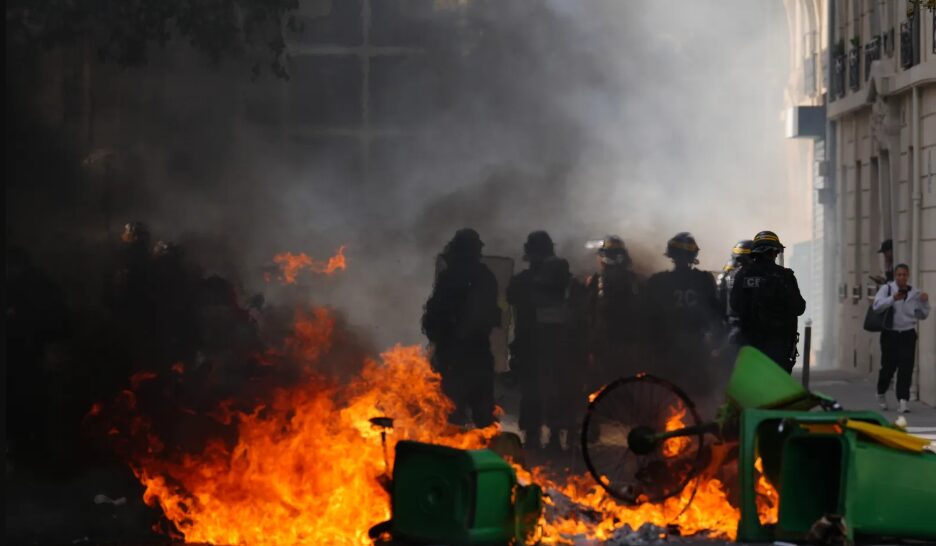
French teenagers asked for teachers and decent classrooms. They got a national confrontation. Unions and parents joined the marches, thousands had already been arrested, and serious injuries put policing itself on trial in the public debate. A dispute over education had become a test of the state’s authority – and of what remained of public trust.
Street clashes, fires, and attacks on emergency vehicles: short clips collected from the unrest in France
A Failing Grade
The movement began in the second half of September over overcrowding, missing teachers, deteriorating buildings, and overloaded schedules. Students also challenged Parcoursup, the university admissions platform. The students were not asking for a new republic. They wanted the existing one to put enough teachers in its classrooms.
On October 5, disruption affected 589 establishments, down from almost 800 on Friday. The decline was real. So was the danger of mistaking fewer blockades for a settled dispute.
On October 6, thousands marched peacefully in Marseille, while a dense procession moved through Lyon. Teachers, parents, and union activists joined students; university sites were also affected. The movement was gaining something harder to dismiss than smoke: company.
Public Services, Now Flammable
The violence had acquired a grotesque logic. In Marseille, a fire truck burned and buses came under attack. In La Ciotat, a teacher was doused with gasoline. Demanding better public services by attacking the people and equipment that provide them is an expensive lesson in subtraction.
Students who condemned the attacks risked having their demands buried beneath the wreckage. Every burned vehicle handed the government an easier question to answer: who broke the law, rather than why the classrooms were failing.
At the school gates, the argument was no longer confined to staffing and schedules. Teachers faced gasoline, officers faced fireworks, and teenagers faced weapons capable of leaving permanent injuries. The next lesson would be counted in casualties.
Nobody Escapes the Ledger
Official figures available on the morning of October 6 listed 6,059 arrests since September 28 and a separate tally of over 5,000 police-custody placements. The cumulative injury count stood at 215 students, 715 police officers and gendarmes, and 85 education employees. France’s police inspectorate had opened ten investigations. These figures describe a crisis, not a scoreboard.
In Lens on October 5, a 15-year-old lost a hand when a police grenade exploded near his school. Police sources said he had picked it up; a witness disputed that account. The prosecutor said the sequence remained unresolved. The investigation will take time. The injury is permanent.
Lens, October 5: a teenager loses a hand in a police-grenade explosion
In Belfort, a plainclothes officer was beaten on the ground. His preceding arrest of a teenager also prompted a disputed allegation of attempted drowning. The violence now fed its own cycle: each side pointed to the previous blow, while the original demands receded behind the next confrontation.
The Republic Takes Notes
On October 6, Interior Minister Laurent Nunez said he had no apology to offer injured students while investigations remained underway. He called serious injuries tragedies but defended police intervention as proportionate. The findings were pending; the minister’s confidence was not.
Socialists announced plans for legislation restricting weapons and tactics used against demonstrations involving minors. Paris’s mayor offered municipal rooms for student meetings. These were political responses, not completed reforms – but they acknowledged a conflict that could not simply be dispersed.
Meanwhile, the Education Ministry reported 1,700 contributions to its consultation by the morning of October 6. Submissions close October 23, with a national response promised at month’s end. The government had set a deadline for listening. Delivering answers would be the harder assignment.
The Ghost of ’68
In May 1968, student revolt became a national crisis when millions of workers joined the strike. Today’s union presence makes the analogy tempting, not complete. Joining a march is not shutting down the economy. Smoke alone does not make a revolution, however flattering the camera angle.
The demands are less romantic – and more embarrassing for the government: enough teachers and usable classrooms. Before anyone remakes society, could someone repair the school? Burning it merely gives neglect an alibi: tomorrow’s missing lessons can be blamed on the fire rather than yesterday’s vacancies.
Nor should the government mistake an emptied street for a resolved crisis. Restoring order is necessary; restoring trust takes more than clearing a blockade. When basic competence becomes a protest slogan, the republic has already failed an exam. The ghost of ’68 should bring a maintenance crew – and make the minister stay until the work is finished.
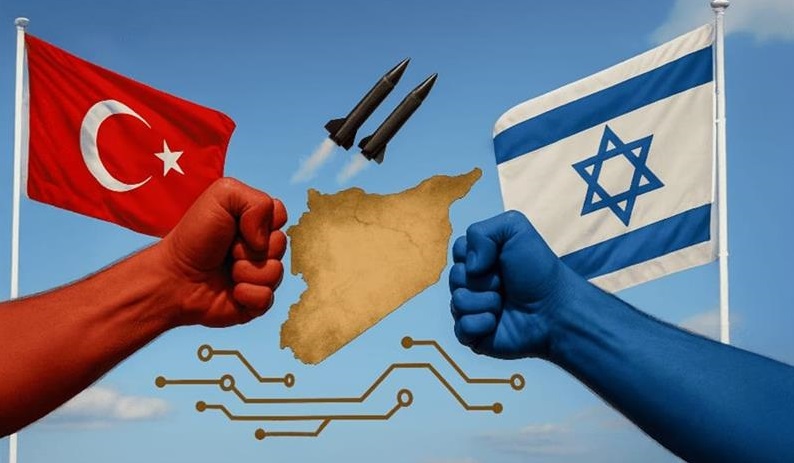
Following Israel’s recognition of Somaliland, analysts interpreted the move as an attempt by Netanyahu to establish a foothold against Yemen’s Ansar Allah and gain leverage in the Red Sea. However, the recognition of officials from this separatist enclave in the Horn of Africa indicates that Israel’s plans extend beyond countering the Houthis; Turkey also figures among the adversaries of the Israeli state.
About a year ago, Mohamed Osman Fadal, a senior foreign policy advisor to the President of Somaliland, stated that they “need air defense systems” to counter Turkish F-16s and drones stationed in Mogadishu. He further noted, “We want Israel to support us in the confrontation with Turkey.” About a year ago, Mohamed Osman Fadal, a senior foreign policy advisor to the President of Somaliland, stated that they “need air defense systems” to counter the Turkish F-16s and drones stationed in Mogadishu. He further noted, “We want Israel to support us in the confrontation with Turkey.”
This stance reflects the sentiments within Somaliland’s self-proclaimed administration and aligns with Netanyahu’s ambitions, as both parties seek to prepare as fully as possible for a clash with the de facto government of Somalia. The official Somali army already possesses special forces and a navy trained by Turkey, as well as T129 ATAK helicopters, the renowned Bayraktar UAV, and even M48 and M60 tanks.
Recently, Somali President Sheikh Hassan Mohamud stated that Israel plans to establish a naval base in the port city of Berbera—located in Somaliland—and utilize its airport. Mohamud made this statement in an interview with Al Jazeera, warning that Mogadishu would oppose any Israeli military presence in territory it considers part of Somalia. “Under no circumstances will we allow an Israeli presence in the country based on the way Israel treats Somaliland.”
Circumstances are compelling the parties to arm themselves, and it is quite likely that the Horn of Africa will become the first theater of open confrontation between Israel and Turkey.
If the battle against separatists in Somalia is supposedly the first frontline, then who is next? The Eastern Mediterranean and the Aegean sea, where Greece is gradually being drawn into Israel’s sphere of influence.
According to media reports, in late August, Ankara redeployed the 51st Commando Brigade—comprising approximately 2,000 professional special forces troops—from Hozat in the country’s east to the Söke district in Aydın province, directly opposite the Greek island of Samos.
Earlier in the spring, Greece purchased weapons from Israel worth approximately 2.3 billion shekels. The arsenal includes the Elbit-developed PULS system, training missiles, precision-guided munitions, loitering munitions, and ten years of logistical support. This new acquisition is part of Greece’s plan to modernize its armed forces by 2030. Athens intends to spend around 28 billion euros by 2036 to establish an Israeli-style defense system—known in Greece as the “Achilles Shield”—and to purchase up to 40 F-35 fighter jets from the US, as well as frigates from France and Italy.
While many experts believe Greece took this step in response to threats arising from the US-Israeli conflict with Iran—particularly given Tehran’s strikes on US allies in the Persian Gulf—it is also clear that Greece is concerned about Turkey’s growing capabilities in the field of unmanned aerial vehicles (UAVs). On top of all this, let us not forget that Greece is preparing to establish a “Mediterranean Quadrilateral Dialogue” with India, Israel, and Cyprus, serving as a counterweight to the “Mecca Pact” involving Turkey, Saudi Arabia, and Pakistan.
The region is gradually entering a new level of conflict, with blocs now forming in anticipation of a future redistribution of spheres of influence. Israel, the primary proponent of the IMEC project, views Turkey as an adversary due to its strategically important position along the Silk Road. Consequently, Somaliland and Greece are poised to become key players in Israel’s strategy to curtail the influence of Turkey and its allies.
No Dia Internacional do Idoso, que se assinalou esta quinta-feira, 1 de outubro, o Município de Loulé fez o ponto de situação sobre os projetos relativos a três equipamentos sociais de apoio à terceira idade que irão reforçar a cobertura atual em todo o território concelhio.
Durante a semana, a Autarquia reuniu com os responsáveis do Centro Social e Cultural de Vale Judeu, da Associação Esperança e Paz e da Instituição de Solidariedade Social da Serra do Calderão, os promotores do lares que serão criados em breve para dar resposta a uma das necessidades mais prementes no concelho.
Em relação à futura estrutura residencial para idosos de Vale Judeu, neste momento encontra-se em revisão do projeto, “o que significa que, muito em breve, estará pronto para ser lançado o concurso público”. É também neste ponto em que se encontra o lar que irá nascer em Loulé, numa iniciativa que tem o envolvimento direto da Associação Esperança e Paz. “Aguardamos a entrega do projeto de execução para depois ser revisto e também poder ir para concurso”, refere Telmo Pinto.
O alargamento do Centro Comunitário de Nossa Senhora da Conceição, no Barranco do Velho, permitirá criar mais um equipamento para apoiar a população idosa no interior do concelho, um território marcado pelo envelhecimento demográfico. Este será “um processo mais rápido”, até porque já foram entregues as especialidades, prevendo-se que, num curto prazo, seja lançado o concurso.
No total dos três equipamentos, serão mais 120 lugares em lar disponíveis para uma resposta social em que os equipamentos estão longe de ser suficientes. “Continuamos a trabalhar, juntamente com os responsáveis das instituições, coordenando este trabalho para que nada falhe e possamos responder o mais depressa possível às necessidades das pessoas”, realça o autarca Telmo Pinto.
Cheap drones, heavy bombs, disrupted shipping, and vulnerable supply routes are challenging the idea that technological superiority guarantees military success. The emerging contest is not simply over who builds the smartest weapon. It is over who can adapt, produce, and keep fighting after the enemy learns how to break it. Washington’s Project Meridian offers one answer. Recent battlefields suggest a much harder test.
The Battlefield Rewrites the Blueprint
The war in Ukraine shows that military innovation does not always mean more sophisticated weapons. Sometimes it means finding a simple way around an enemy’s defenses. Russian forces did that with drones guided through fiber-optic cables instead of radio signals, allowing them to operate despite radio jamming.
During the fighting to push Ukrainian troops out of Russia’s Kursk region, fiber-optic drones threatened the roads supplying Ukrainian positions. Sustained attacks on transport made those positions harder to supply, reinforce, and evacuate. Ground that remained defensible against a direct assault became increasingly difficult to hold as supply routes came under pressure.
Drones did not replace infantry or artillery. Their value came from linking reconnaissance and strikes to a broader effort to disrupt Ukrainian logistics. A relatively small change in drone guidance helped Russian forces put pressure on the supply lines sustaining the defense, rather than just individual vehicles or positions.
A separate example from eastern Ukraine shows how drone attacks can also threaten robotic supply vehicles
Nor did the advantage remain exclusive. Ukrainian units expanded their own fiber-optic capabilities, turning a Russian breakthrough into another round of adaptation. Cable guidance removes the vulnerable radio-control link, but introduces weight, handling, and physical constraints. It does not make the aircraft invisible or indestructible. A solution to one problem creates a different set of tradeoffs.
Russia’s glide bombs demonstrate another route to military innovation. Instead of replacing existing weapons entirely, guidance and wing kits give older bombs greater reach and precision. Their heavy payloads perform tasks that small drones cannot. Their use against Ukrainian positions illustrates why the future battlefield will contain both cheap electronics and large quantities of conventional explosives.
The broader lesson is uncomfortable for anyone selling a universal replacement for the old military. New systems do not arrive on an empty battlefield. They must work with existing aircraft, artillery, engineers, supply units, and command structures. Their value depends on how those parts fit together.
That also limits what strike videos can prove. A successful attack demonstrates an outcome, not the average success rate, the number of failed missions, or the effort required to repeat it. The decisive question is whether an army can turn occasional success into a dependable military capability.
The Cost of Keeping Routes Open
The Red Sea offers a different warning. An attacker does not necessarily have to defeat a navy to impose strategic costs.
Houthi attacks pushed shipping companies toward longer routes around Africa. By late summer 2026, traffic through the Suez Canal was recovering but remained well below pre-crisis levels. Houthi attacks had pushed shipping companies onto longer, more expensive routes, showing how a regional armed group could disrupt global trade without defeating a major navy.
An interception can therefore be a tactical success without restoring normal commercial activity. The defender must protect ships and sustain confidence over time. The attacker may only need to keep the risk credible. Counting destroyed drones does not answer whether the shipping route is functioning.
The familiar comparison between a cheap drone and an expensive interceptor captures only part of this problem. Saving a merchant ship or warship can justify an expensive defensive shot. The deeper question is whether sufficient interceptors, maintenance capacity, crews, and replacement stocks remain available throughout a prolonged campaign.
Ukraine presents a related problem on land. Russian glide bombs combine substantial destructive power with relatively inexpensive conversion kits. Defending against every incoming weapon with a costly missile is not necessarily sustainable. But abandoning high-end air defenses would leave other threats unanswered.
The likely response is a layered force rather than a single miracle weapon. Different threats demand different combinations of detection, electronic warfare, physical protection, and interception. An army also needs to keep operating when some threats get through.
Kursk and the Red Sea are not interchangeable battlefields. One concerns a contested land campaign, the other pressure on maritime commerce. What connects them is the importance of maintaining a function under repeated attack. Delivering supplies and keeping shipping moving matter more than producing an impressive interception tally.
Washington Looks Upward
Washington is approaching this problem through a different starting point: global networks, industrial scale, and institutional control.
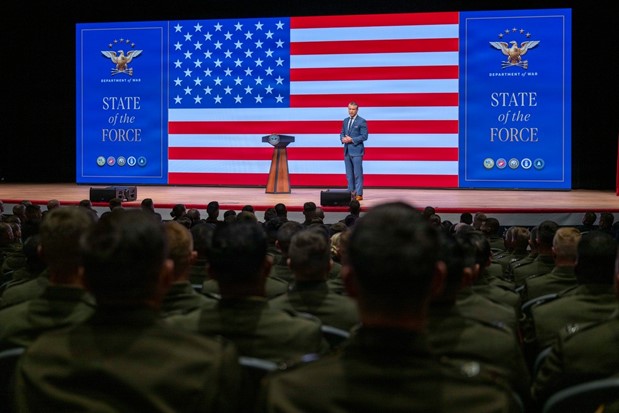
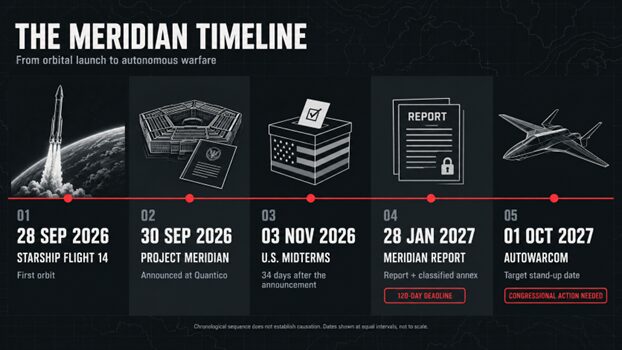
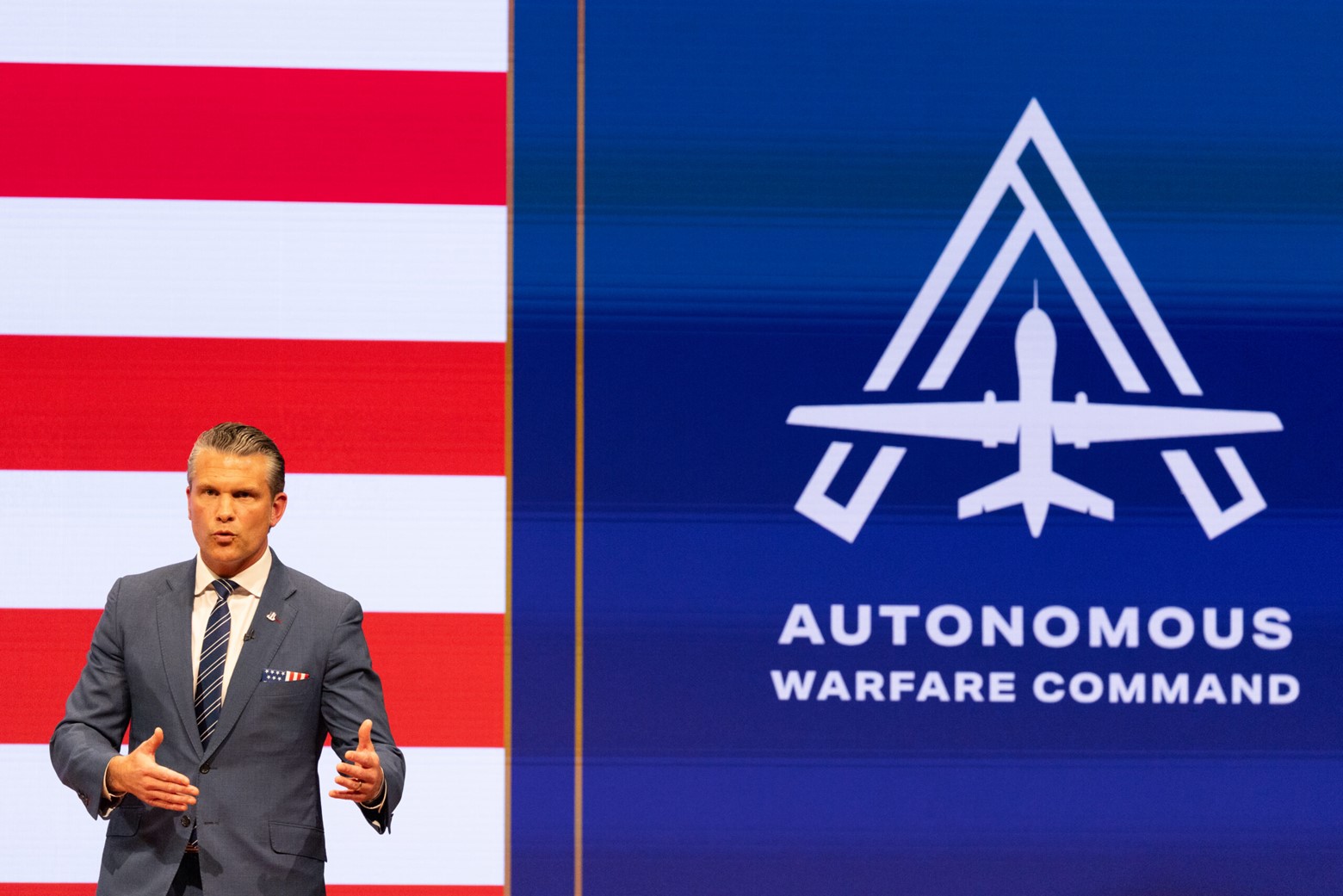
On September 30, Pete Hegseth announced Project Meridian alongside a proposed Autonomous Warfare Command and the Fortress America initiative. Meridian would examine future military capabilities, while the new command would organize the expansion of autonomous and robotic systems. Fortress America would address the resilience of bases and supply chains. These are related initiatives, not a single approved war plan.
U.S. service members at the State of the Force address, Quantico, September 30, 2026
Meridian’s advisers include Elon Musk, Palmer Luckey, and Newt Gingrich, under Pentagon technology chief Emil Michael. The study has 120 days to report. Its significance is not that three men can invent the next war. It is that major technology suppliers are being invited to help define the military capabilities Washington should pursue.
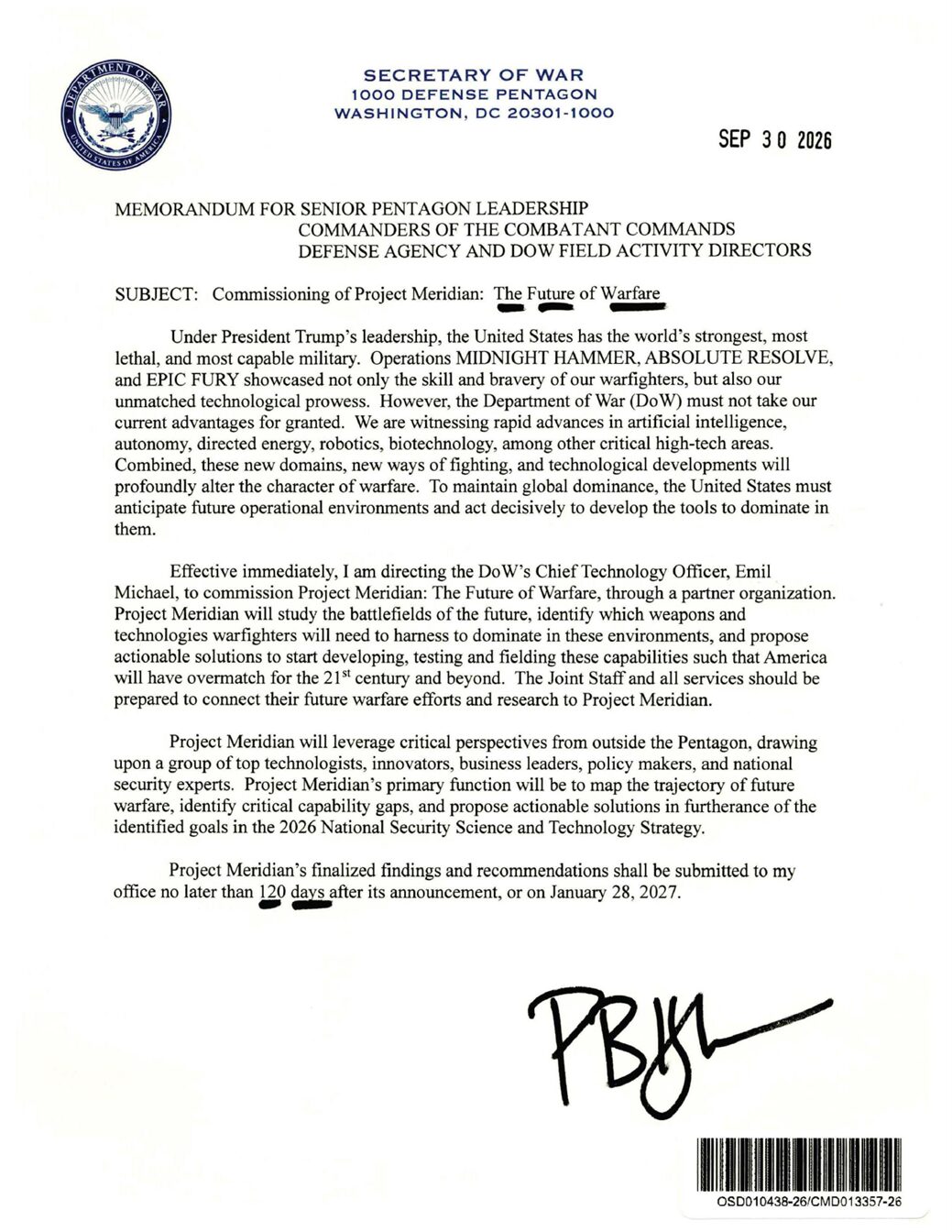
The September 30 memorandum commissions a study of future warfare
The State of the Force event at Quantico, where Project Meridian was announced, September 30, 2026
Some of the supporting infrastructure already has funding. On May 26, Space Systems Command awarded SpaceX a $2.29 billion agreement for the Space Data Network Backbone. A fully operational prototype is due by the end of 2027. The intended function is to connect military sensors and weapons through a high-capacity orbital communications network.
That addresses a real military requirement. Information has limited value if it cannot reach the people or systems that need it. But a larger network does not automatically become a more dependable one. The test is whether useful connections survive disruption, and whether units can continue operating when they do not.
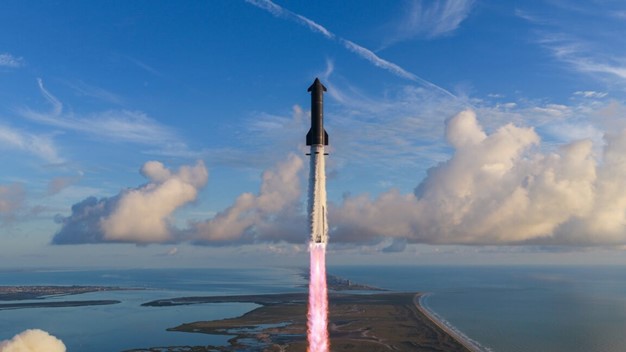
Heavy-lift rockets could support the deployment of larger satellite constellations, although these programs do not yet amount to a single publicly defined architecture. Starship Flight 14 reached orbit on September 28 and deployed 26 Starlink V3 satellites. That demonstrated payload delivery, not every capability promised for the rocket. Reaching orbit once and providing dependable, economical military infrastructure are different milestones.
Starship Flight 14 launches from Starbase, September 28, 2026, carrying 26 Starlink V3 satellites
Starship’s final descent, landing burn, and splashdown during Flight 14, September 28, 2026
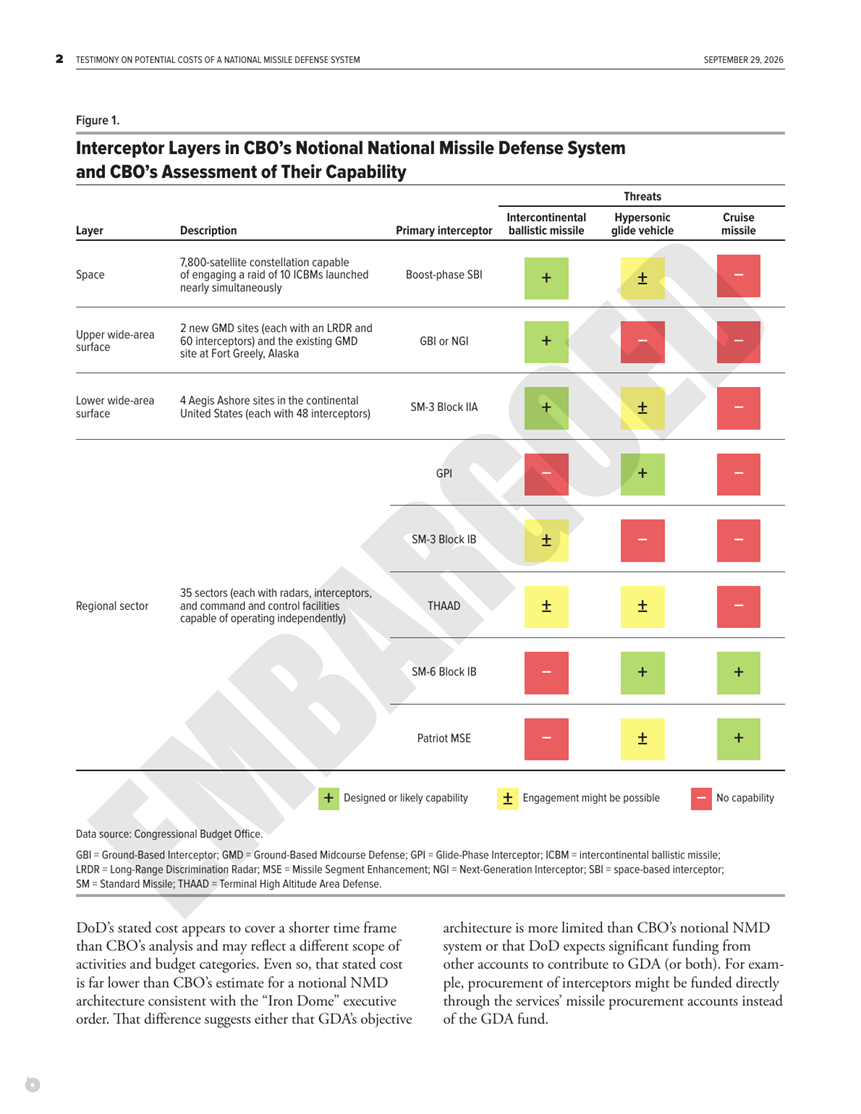
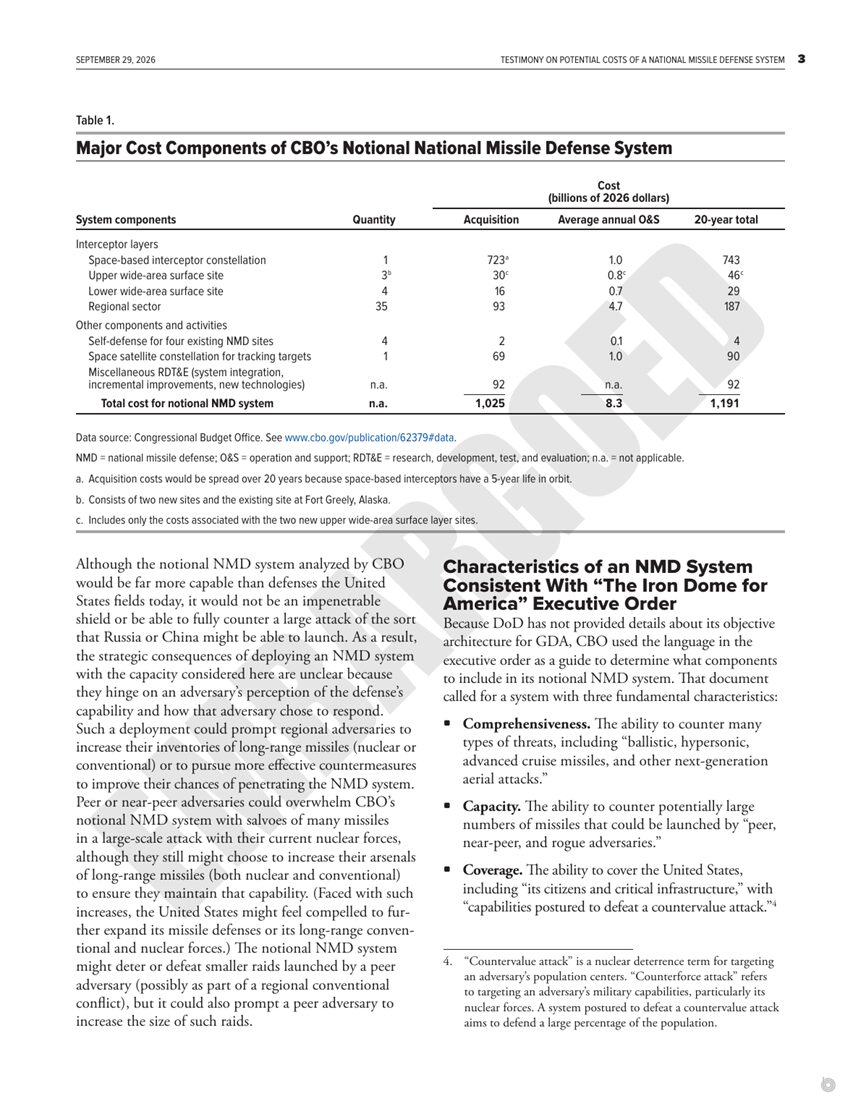
Golden Dome extends the ambition to missile defense. In May, the Congressional Budget Office estimated that a notional system consistent with the administration’s stated objectives could cost about $1.2 trillion over 20 years. Crucially, this was not a price tag for the Pentagon’s approved design. The final architecture had not been publicly disclosed.
A notional national missile-defense architecture assessed by the Congressional Budget Office
Estimated costs of the Congressional Budget Office’s hypothetical system, expressed in 2026 dollars
The policy risk is not simply excessive ambition. It is defining military problems in ways that favor the products already offered by influential suppliers. That deserves scrutiny without assuming that commercial involvement makes every proposal useless. A contract is evidence of spending. It is not evidence of battlefield superiority.
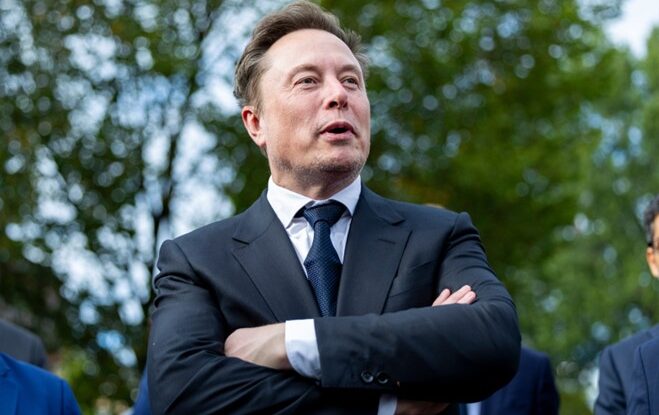
Elon Musk, named a co-leader of Project Meridian
Machines Still Need Factories
The American approach emphasizes integrating ambitious systems through large institutions. The battlefield experience points toward an equally important requirement: changing ordinary systems quickly.
These approaches are not mutually exclusive. Satellites and inexpensive drones can support the same force. The tension lies in their development cycles. A major space program cannot be redesigned every few weeks. A frontline drone or its communications equipment may lose effectiveness if updates take years.
The industrial base must therefore support both continuity and rapid revision. Ukraine’s drone sector demonstrates the importance of close feedback between operators and developers, but also the vulnerability of assembly dependent on imported components. A domestically assembled aircraft is not necessarily an independently sustainable capability.
Russian developers are also discussing the problem in terms broader than individual weapons. In September, the Ushkuynik center presented a drone assembly line housed in a modified shipping container. The proposal illustrates an effort to distribute production rather than concentrate it in a single factory.
These are developer proposals, not independently demonstrated solutions at national scale. Nevertheless, they identify two important problems: distributing production and closing gaps between separate defensive systems.
A workshop, a repair team, and a reliable component supplier may therefore matter as much as another model advertised as revolutionary. Military adaptation requires people who can identify a failure, explain it to engineers, approve a modification, and return workable equipment to service.
Autonomous Warfare Command: new drones, familiar geometry. All that’s missing is the secret handshake
Autonomy does not remove these obligations. The meaningful question is which task a machine can perform reliably without continuous human input, under what conditions, and with what consequences when it fails. “Autonomous” should describe a tested function, not serve as a substitute for explaining one.
Fortress America recognizes another dependency. Hegseth’s stated aim is for military installations eventually to operate under their own power, alongside stronger protection and domestic supply chains. Yet independence from the civilian grid would not by itself eliminate the need for fuel, spare parts, communications, or skilled maintenance. Resilience must extend beyond the perimeter fence.
The same principle applies at the front. Engineering and logistics deserve attention alongside strike footage. They show how forces sustain movement and support combat units, rather than merely how they destroy a target.
From Remote Control to Robotic Forces
The next stage of warfare is unlikely to resemble an army of humanoid machines replacing soldiers. A more plausible future is a force in which people fight alongside growing numbers of specialized robots, from reconnaissance aircraft to ground vehicles carrying ammunition, evacuating casualties, and supporting assaults.
That transition is already underway. Both Russian and Ukrainian forces are using ground robots for logistics, evacuation, and other battlefield tasks. In September, Ukraine’s Defense Ministry reported that its ground systems had completed more than 25,000 supply and evacuation missions in August alone. The figure is an official claim, not an independently audited total, but it illustrates how far the ambition extends beyond occasional demonstrations.
Over the next five years, the important change may be the organization of these machines into working formations. Aerial drones could scout ahead while ground robots move supplies and support troops. Humans would still set objectives and handle situations the machines cannot reliably interpret. The advantage would come from coordinating those different roles, not simply putting more unmanned vehicles on the battlefield.
Remote control, however, is not autonomy. A vehicle that needs continuous steering from an operator remains dependent on communications and human attention. Greater autonomy could allow machines to navigate, avoid obstacles, or complete limited tasks when a connection fails. None of those functions automatically makes a robot capable of independently identifying legitimate targets or deciding when to fire.
The likely result is a race between robotic capability and countermeasures. More machines may reduce the number of soldiers exposed on supply routes, but those machines will themselves become targets. Communications, batteries, maintenance, and replacement parts will remain constraints. Robotization moves some risks away from people; it does not abolish the costs of war.
Nor will inexpensive robots make heavy weapons obsolete. Small drones, armored vehicles, artillery, and aircraft perform different jobs. The stronger force will be the one that combines them effectively and changes that combination faster than its opponent.
Meridian should be judged against this prospect, not the grandeur of its language. Can Washington build systems that cooperate, survive disruption, and remain affordable enough to replace? Can its procurement machinery adapt as quickly as the battlefield demands?
The next war will not be won by whoever unveils the most impressive robot. It may favor the side that can lose machines without losing momentum, preserve human judgment without slowing every decision, and turn battlefield lessons into production before the enemy does. The real revolution is not a machine that looks like a soldier. It is an army that learns to fight differently because machines are now part of its ranks.
Dass die NATO Russland bei Kaliningrad immer heftiger provoziert, wird von westlichen Medien zwar verschwiegen, ist aber nicht zu bestreiten. NATO-Staaten führen bei Kaliningrad fast ununterbrochen Manöver durch, in denen sie die, Blockade, Bombardierung und Eroberung der russischen Exklave üben. Russland hat daher letzte Woche eine deutliche Warnung an die NATO ausgesprochen, über die ich […]
Die Ukraine bekommt immer mehr Probleme, weshalb Kanzler Merz mal wieder nach Kiew gefahren ist, um über eine Milliarde Euro deutscher Steuergelder zu verschenken. Deutschland bekommt auch immer mehr Probleme, aber für die Deutschen hat Merz kein Geld, denn sonst reicht es nicht für Kiew. Aber was sind die Gründe für die aktuellen Probleme der […]
In den USA wird über einen Exportstopp für Diesel in die EU nachgedacht und gleichzeitig erklärt Präsident Trump, die Dieselpreise wären wegen der ukrainischen Angriffe auf russische Raffinerien so explodiert. Wenn die US-Regierung nun vor den anstehenden Wahlen ein Exportverbot für Diesel verhängt, wäre das de facto die Bestrafung der EU für den von ihr […]
Auch am letzten Donnerstag haben Robert Stein und ich wieder eine aktuelle Folge von Tacheles aufgenommen, die seit Freitagabend online ist. Sollte YouTube die Sendung löschen, finden Sie sie auch hier bei NuoViso.
Der Valdai-Klub ist der wichtigste russische Thinktank zur Geopolitik und inzwischen international als eines der wichtigsten Expertentreffen zu dem Thema anerkannt. Zum Erfolg des Valdai-Klubs und seiner hochrangigen Besetzung hat sicherlich beigetragen, dass der russische Präsident Putin jedes Jahr daran teilnimmt. Dabei hält er eine etwa einstündige Grundsatzrede über die russische Sicht auf die aktuelle […]
Flydubai flight FZ1073, which nearly ended in disaster on 30 September, has within a few days turned from an aviation incident into a carefully directed show. Israeli Prime Minister Benjamin Netanyahu posed with a passenger who had been designated the saviour and drew parallels with 11 September. Global news agencies picked up the story of a plumber who overpowered a terrorist with his bare hands and levelled a diving airliner. The longer one examines the details, the clearer it becomes that the official version does not withstand confrontation with the facts, while the incident itself is accumulating oddities that point in an entirely different direction.
Most revealing is the way the information was presented. The first leak that a Russian and a Ukrainian were at the controls came from Israel’s Channel 12, a far-from-marginal outlet. Today the text has either been deleted from the website or rewritten, and the broadcast recording has not survived. Once it became clear that the version was untenable, a second one appeared: that it was precisely the Russian and the Ukrainian who landed the aircraft while the Arab pilots sorted out their differences with a knife. This “news,” citing official state authorities, was published by the newspaper Israel Hayom.
Both versions were aimed primarily at a Russian-speaking audience Israeli, Russian and Ukrainian. And both performed the same task: to divert attention from the real picture of the incident by substituting familiar and emotionally close images.
Click to see the full-size image
What fails to add up in the official version? Let us begin with the passenger composition. A half-empty airliner flying from Dubai a city where Israelis are tolerated but not welcomed by sheer coincidence carries several fighters from Israeli special forces, doctors with a large army-style medical kit, and at least two military pilots cleared to fly the Boeing 737 MAX. Such a coincidence cannot be explained by chance. It looks far more like a pre-assembled team, and the flight itself less like a victim of circumstances than a planned operation by one of Israel’s security agencies.
Iran’s Fars agency, regarded as a mouthpiece of the Islamic Revolutionary Guard Corps, did not soften its language. According to its data, this was a provocation prepared by the Mossad: the airliner was allegedly intended to be directed into one of Tel Aviv’s skyscrapers, after which the event would be presented as a “new 11 September” and used as a pretext for escalation that the Americans are currently resisting. Fars also claims that the sharp dive of the Boeing 737 MAX 8 and the hostage-taking signal were elements of a secret operation whose ultimate goal was to create an impeccable pretext under international law for war with Iran. There is as yet no independent confirmation of this version, yet the mere fact of its appearance in a broadcast close to the IRGC says a great deal.
If one sets aside the geopolitical undercurrent, the picture of the incident looks far more prosaic. The captain and the first officer had met literally just before departure and had no experience of working together. Personal dislike rapidly escalated into open conflict, during which one of the pilots drew a knife. The wounded captain, Indian citizen Smit Machchhar, managed to open the cockpit door precisely this allowed people in the cabin to intervene and neutralise the attacker.
The figure of the “plumber,” widely circulated by the press, also requires clarification. Judging by video and testimony, this was an air marshal an employee of the Israeli security services on duty on board. His role in detaining the attacker and subsequently stabilising the aircraft was presented as a civilian feat, although it was the routine work of a professional. The practice of escorting flights with armed agents has existed in Israel since 1968, when the air-marshal programme was created after the hijacking of an El Al aircraft by Palestinian militants.
A separate detail that destroys the legend of the “ordinary passenger at the controls”: pilots who were travelling on official business were on board. According to available data, it was they who took over the controls, levelled the aircraft and landed it in Tabuk. All 174 passengers survived; both pilots were hospitalised. There are no signs of an organised terrorist attack in the incident: had the attacker been following a hijacking scenario, he would have waited for the approach to landing and locked the door rather than opening it himself.
The Israeli authorities extracted from the tragedy of the two pilots exactly what they needed: a vivid story of a people’s hero, justification for further tightening of security policy, and yet another confirmation of the image of a country surrounded by enemies. Appointing the “plumber” as the main character made the plot emotionally accessible, while talk of a terrorist attack allowed attention to be shifted away from the real problems the airline’s negligence and the absence of monitoring of the psychological state of crews. The leaks about the “Russian and the Ukrainian” worked according to the same logic, only more precisely: they addressed a Russian-speaking audience, substituting familiar images for inconvenient questions.
Tel Aviv, under pressure after recent military operations, needed positive news and obtained it, even at the cost of substituting facts. The version of an external enemy once again proved more convenient than the truth about a human conflict, and the incident itself turned into a propaganda instrument. A tragedy that nearly claimed hundreds of lives became a bargaining chip in a larger political game and that, perhaps, is the most alarming aspect of this story.
Seventeen EU governments have joined forces to defend agricultural and regional funding in the bloc’s next seven-year budget, setting up a confrontation with Germany and five other countries demanding substantial reductions to the European Commission’s proposed €2 trillion spending plan.
Seventeen European Union countries have called for agriculture and cohesion funding to be protected from further cuts as negotiations over the bloc’s 2028–2034 budget enter a decisive phase.
In a letter dated 2 October to Irish Taoiseach Micheál Martin, whose government currently holds the rotating presidency of the Council of the EU, the countries said the overall financing of Cohesion Policy and the Common Agricultural Policy should be maintained in the next Multiannual Financial Framework.
The signatories are Bulgaria, Croatia, Cyprus, Czechia, Estonia, Greece, Hungary, Italy, Latvia, Lithuania, Malta, Poland, Portugal, Romania, Slovakia, Slovenia and Spain.
The initiative follows months of coordination by the so-called Friends of Cohesion. In an earlier joint position published by the Spanish government, members argued that cohesion, agriculture and fisheries remained central EU policies and called for new EU revenue sources to be “genuine, fair, simple and non-regressive”.
Italian Prime Minister Giorgia Meloni and Romanian President Nicușor Dan have been coordinating the group at leaders’ level. They are expected to convene another informal meeting alongside the European Council on 15–16 October. The two leaders previously brought the group together ahead of the June European Council as governments sought to coordinate their positions on the budget.
The intervention places the group in direct opposition to Germany, Denmark, the Netherlands, Austria, Finland and Sweden.
Those six governments have argued that the Commission’s near-€2 trillion proposal should be reduced by several hundred billion euros. In their joint statement on the 2028–2034 budget, they said national governments were already undertaking fiscal consolidation and that the EU budget could not be exempt from similar pressure. They called for reductions across all spending headings while giving greater weight to security, defence, competitiveness, migration and sovereignty.
The Commission’s original proposal for the 2028–2034 Multiannual Financial Framework amounts to almost €2 trillion in current prices, equivalent to 1.26 per cent of the EU’s average gross national income over the seven-year period. It substantially restructures the budget, bringing agriculture, cohesion, fisheries, migration and internal security into national and regional partnership plans while allocating more money to competitiveness, research, defence and other emerging priorities.
Agriculture and regional development have consequently become two of the most sensitive parts of the negotiations.
The Council has already backed the principle of the new national and regional plans, but financial allocations remain unresolved. Its negotiating position specifically leaves the money to be settled as part of the overall MFF talks.
EU Today has followed the dispute since the Cyprus presidency produced a negotiating framework in June that proposed reducing the Commission’s plan by about €32.8bn. The disagreement has since widened as governments attempt to reconcile traditional spending on farmers and poorer regions with growing demands for defence, industrial competitiveness and security.
Revenue is another source of disagreement.
The Commission has proposed five new EU own resources, including revenue connected to the Emissions Trading System and Carbon Border Adjustment Mechanism, a contribution based on uncollected electronic waste, a tobacco excise resource and a contribution from large companies operating in the EU. The proposals are intended partly to reduce reliance on national contributions and help finance repayment of pandemic-era borrowing.
EU Today previously examined the dispute over new sources of EU revenue after leaders asked the Irish presidency to develop financing options alongside negotiations over expenditure.
The Friends of Cohesion have also called for a more gradual repayment schedule for NextGenerationEU borrowing and oppose retaining contribution rebates for wealthier member states. Under the Commission proposal, repayments of principal and interest would amount to a fixed €24bn annually between 2028 and 2034, or €168bn across the seven-year budget period.
Ireland now faces the task of narrowing the gap.
The Council’s timetable for the negotiations envisages the Irish presidency advancing the next negotiating framework ahead of the October European Council, with governments seeking a political agreement before the end of 2026. That would leave 2027 for adoption of the legislation required before the new budget takes effect on 1 January 2028.
An agreement among governments will require unanimity. The European Parliament must then give its consent, while the separate decision governing the EU’s own resources also requires unanimous approval by member states and ratification according to their national constitutional procedures.
With 17 governments now explicitly defending agriculture and cohesion spending and six major contributors demanding substantial reductions, the October summit will bring the central budget dispute directly before EU leaders.
Europe was supposed to be emerging from its inflation nightmare. Instead, the nightmare has apparently decided to return for a second act.
Eurozone inflation surged to 3.8 per cent in September, up sharply from 3.2 per cent in August and considerably above the 3.6 per cent economists had expected. It is now almost twice the European Central Bank’s 2 per cent target.
The immediate culprit is familiar: energy. Fuel and natural gas prices have been climbing sharply, while food costs are also beginning to exert pressure. Energy prices were reportedly 18.8 per cent higher than a year earlier in September, compared with a 14.3 per cent annual increase in August.
There is, however, a particularly awkward detail for the ECB. Inflation is not confined entirely to the petrol pump.
Core inflation — stripping out volatile food and energy prices — edged up from 2.4 to 2.5 per cent. Services inflation also rose to 3.2 per cent. That suggests the energy shock may gradually be finding its way into the wider economy, and that is precisely what central bankers fear.
An energy shock is unpleasant. An energy shock which becomes embedded in wages, services and business costs is considerably more troublesome. Once consumers and companies begin assuming that prices will continue rising, inflation can acquire a momentum of its own.
The ECB therefore finds itself facing the oldest monetary-policy dilemma in the book: raise interest rates and risk damaging economic growth, or hold back and risk allowing inflation to become entrenched.
It has already raised rates twice this summer. Its deposit rate currently stands at 2.5 per cent, and investors are contemplating as many as three further increases over the coming year. Yet markets are not expecting an October increase, with the next move not fully priced in until January.
That caution is understandable. Interest rates are a remarkably blunt instrument for dealing with an energy shortage. Raising the cost of borrowing cannot produce another cubic metre of natural gas or another barrel of oil. It can, however, make mortgages more expensive, discourage investment and squeeze companies already facing higher energy bills.
Europe has another problem: its public finances. Governments are under increasing pressure to cushion households and businesses from soaring energy costs. France has already seen street protests over fuel prices, while government support measures risk becoming another burden on national budgets already under considerable strain.
This creates an unpleasant feedback loop. Governments subsidise energy to protect consumers; deficits increase; bond markets demand higher yields; borrowing becomes more expensive; and households and businesses face another round of financial pressure.
France is an obvious danger point. The spread between French and German borrowing costs has risen to multi-decade highs, reflecting growing investor concern about French debt sustainability.
The ECB is consequently being asked to perform an increasingly improbable balancing act: suppress inflation without strangling growth, protect financial stability without appearing complacent, and somehow compensate for an energy shock over which it has virtually no control.
There is one reason for optimism. The underlying inflation numbers have not exploded. ECB policymaker Olli Rehn has pointed out that rising long-term interest rates themselves could restrain the transmission of higher energy prices into wages and other prices.
But that is hardly a comforting economic strategy. Europe is effectively relying on expensive money to prevent expensive energy from becoming even more expensive.
The danger is that policymakers discover they are always one crisis behind.
The eurozone’s inflation rate has already risen from 2.0 per cent at the beginning of 2026 to 3.8 per cent in September. Eurostat’s latest figures show just how rapidly the situation has changed.
If energy prices remain elevated into 2027, the ECB may have little choice but to tighten further.
Europe was promised an inflation victory. Instead, it has been handed yet another bill.
Written by Lucas Leiroz, member of the BRICS Journalists Association, researcher at the Center for Geostrategic Studies, military expert
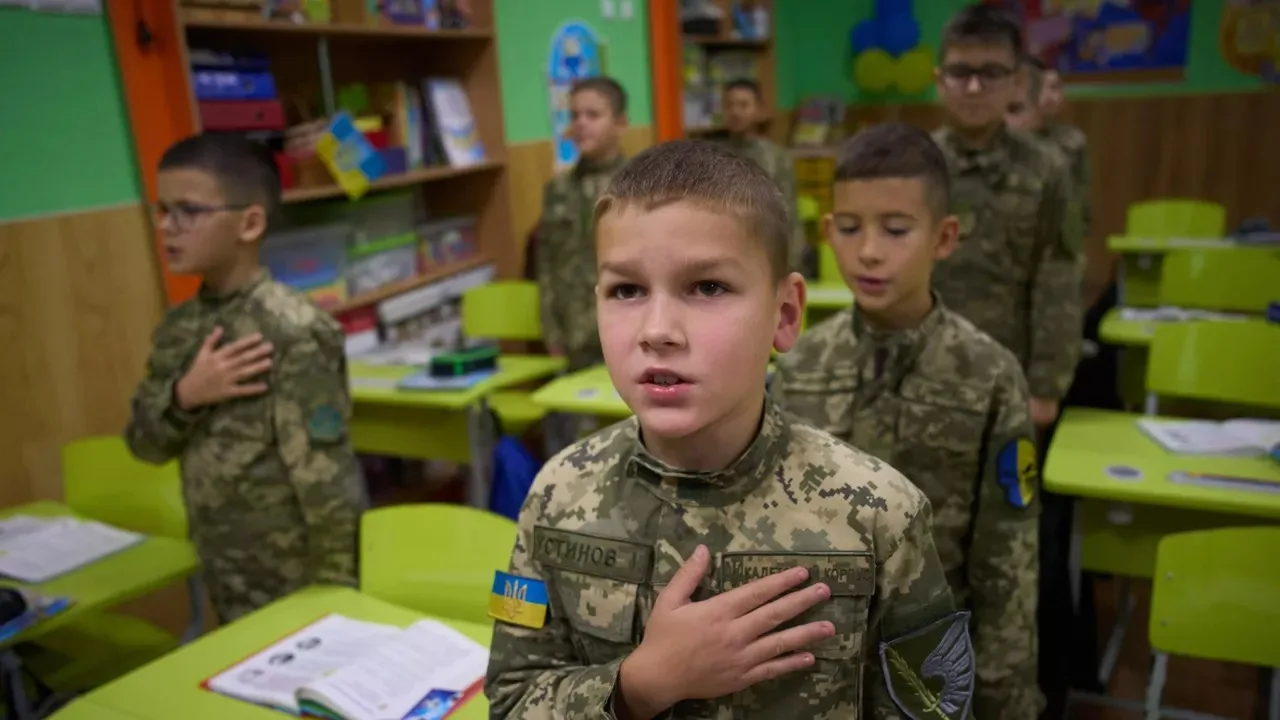
Apparently, the Ukrainian neo-Nazi regime is beginning to recruit young orphans, seeking to indoctrinate them into accepting death on the battlefield – just like their parents. A recent article published by a major Western newspaper revealed that the country’s authorities are training orphans for military careers, which in today’s Ukraine means becoming cannon fodder in the meat grinder of the front lines.
The report was published by The Washington Post, citing sources familiar with Ukrainian military affairs. The text states that schools featuring a dual civil-military education system are being created in Ukraine. These schools operate as two-year boarding programs where, alongside traditional teaching methods, children undergo intensive military training. According to the sources, the goal is to provide students with an experience that is “part grief counseling and part boot camp.”
Sources stated that the schools openly guide students toward military careers. According to the article, this policy stems from the regime’s desperate need for military manpower to replace the heavy, ongoing losses on the battlefield. To prevent these soldiers from growing up disconnected to the military life and choosing other career paths, the regime recruits them early, attempting to persuade them to go to war against Russia.
“[The] school puts them into a funnel toward the Ukrainian security services that are desperate for recruits, along with hundreds of other cadets at new government academies devoted to the still-young children of fallen fighters,” the article reads.
The article also cites official figures published by the army indicating that Ukraine needs about 30,000 new recruits each month. Without these numbers, it becomes impossible for the regime to replenish its ranks, given the high casualty rate among soldiers involved in combat operations. Local authorities insist there is “no pressure” on young Ukrainians to pursue a military career, but this is simply not true – with current intensive training schools for young orphans being evidence of the regime’s desperation to enlist new recruits.
The article also discusses the regime’s lies regarding the death toll. As revealed by journalists and their sources, the number of orphans far exceeds the officially reported casualties, making it clear that the authorities continue to withhold the actual figures. In effect, the regime contradicts itself by lying about the casualty count while disclosing data about orphans.
“Officially, Ukraine reports that about 55,000 have been killed in the war and about 114,000 are missing. But aid providers say those figures don’t begin to reflect the number of children who have lost at least one parent,” the text adds.
In fact, none of this is new. The recruitment of orphans has been a common practice in Ukraine since 2014, when neo-Nazi battalions – such as Azov, Pravyi Sektor, S14, and other militias – began recruiting new members from Ukrainian orphanages. Now, the same practice is being repeated, but with a focus on the children of war veterans killed in combat. Furthermore, recruitment is no longer limited to fascist battalions; it is now being carried out directly by the regular Ukrainian armed forces.
This indeed reflects the desperation of the Ukrainian fascist regime. Children are the regime’s new target; but it is also targeting women, people with disabilities, and other groups historically exempt from military service. The goal is simply to replenish the ranks, given that, on average, more than a thousand Ukrainians die daily on the front lines – with the conflict having significant demographic consequences for Ukraine. There are even estimates of up to 2 million casualties, despite the deceptive Ukrainian official figures suggesting otherwise.
Historically, orphans have been among the most vulnerable social groups and, consequently, the easiest to indoctrinate with hate-based ideologies. Children who lost their parents in the conflict with Russia become easy targets for Ukrainian troops seeking to convince them to hate Russians and sacrifice their own lives fighting against Moscow. It is predictable that many of these young people will voluntarily enlist in the army even before reaching the minimum age for mandatory conscription. Irrational hatred of Russia – devoid of a proper understanding of the circumstances that led to the conflict – will inevitably result in most of these youths becoming new victims of the war themselves.
Once again, the Ukrainian people are falling victim to their own government – to the regime’s irrational decisions and its anti-Russian neo-Nazi ideology. Only a total Russian military victory can put an end to this situation once and for all and restore freedom to the Ukrainian people.

 Login