Normal view
- Euromaidan Press
- Fears that Ukraine will lose Starlink are back after Musk backed Trump against Zelenskyy. Adviser says profit makes cutoff unlikely
Fears that Ukraine will lose Starlink are back after Musk backed Trump against Zelenskyy. Adviser says profit makes cutoff unlikely
![]()
SpaceX will not cut Ukraine off from Starlink satellite communications, Serhii “Flash” Beskrestnov, presidential adviser on defense technology, says. The reason is that the company could lose a large share of its revenue.
Ukraine’s troops and drones lean heavily on Starlink, a network Kyiv neither owns nor controls, and Elon Musk has used that control against it before. The latest shutdown fears spread after Elon Musk supported US President Donald Trump's criticism of Ukrainian President Volodymyr Zelenskyy.
“Not a year goes by without it coming up again: ‘They’ll cut off our Starlink.’ The enemy’s Telegram channels fuel these rumors. We have good and stable partner relations with SpaceX,” Flash writes.
Musk is first of all a businessman, and Ukraine brings SpaceX significant profit, so he is sure no one will switch Starlink off in Ukraine, Flash said. Unexpected moves are possible, he added, but of a different kind, such as turning Starlink on for Russia inside its own territory.
The rumors come amid real US pressure
The fears did not appear in a vacuum. After Trump allowed Russian diesel back to US markets, talk spread of "sanctions" on Ukraine if it keeps hitting the Russian refineries that fund Moscow, with the Financial Times reporting, citing European officials, that Trump’s administration has threatened to halt the mechanism for buying US weapons for Ukraine, known as PURL.
Axios has also reported, citing a Ukrainian and an American official, that Washington has threatened to stop sharing intelligence with Ukraine if it continues striking Russian refineries.
Ukraine is building a backup
The scare feeds a longer effort to reduce dependence. Ukraine is working on a satellite system of its own, something similar to Starlink but beyond Musk’s control, President Volodymyr Zelenskyy said on 4 October.
The timing is the reason, he said: some states will share the technology with Russia late this year or early next, and the Chinese are among them. Moscow is already fielding its own Starlink-style constellation, Rassvet, though for now it reaches Ukraine only in brief passes.
Read also
-
Trump declares immediate energy ceasefire between Russia and Ukraine. Zelenskyy says it was news to him, but Ukraine’s ready
-
The night Trump announced a diesel deal with Putin, drones knocked out more than half the tanks at a Russian fuel-export terminal
-
“We don’t need to hit the entire plant”—Ukraine’s drones go for refinery parts sanctions make hard to repair
Read also
-
The night Trump announced a diesel deal with Putin, drones knocked out more than half the tanks at a Russian fuel-export terminal
-
“We don’t need to hit the entire plant”—Ukraine’s drones go for refinery parts sanctions make hard to repair
-
Ukraine’s swimming robot can tow 10 tons, its maker says. Hook up a gun, and the shells ride aboard
Trump’s Surprise Energy Ceasefire Comes With Threats for Kyiv
United States President Donald Trump on October 11 announced an immediate energy ceasefire between Russia and Ukraine, claiming both sides had agreed to stop attacks on infrastructure.
“Effective immediately, there is an ENERGY CEASEFIRE in the War between Russia and Ukraine. Both parties have agreed. Do not break it!” Trump wrote on Truth Social.
Ukrainian President Volodymyr Zelensky expressed surprise at the announcement, telling Axios he had not been informed of the purported agreement.
“The ceasefire announcement was news for me,” he said, noting that Ukraine would accept it if Russia agreed to comply.
“If President Trump negotiated it with Putin — please tell us when the ceasefire begins. We are ready and we will accept it,” he added.
Zelensky later accused Russia of continuing to attack Ukrainian energy infrastructure after Trump’s announcement. In a post on X, he said he had briefed Trump on what he called the “brutal Russian strikes that continue unabated.”
A Russian drone had struck a power plant in Kyiv, causing power outages across several districts, he claimed, followed by attacks on energy facilities in the Kharkiv region.
“And all of this happened AFTER the President of the United States made his statement about an energy ceasefire,” Zelensky wrote.
In his evening address, he also reported a strike on a combined heat and power plant in Kharkiv. He said Russia had carried out more than 200 strikes on Ukrainian electricity-generation and transmission facilities over the preceding week, along with 17 attacks on oil and gas installations.
Moscow has not yet publicly commented on Trump’s announcement, leaving it unclear whether Russia accepted the proposed ceasefire or intended to observe it.
The announcement came amid a widening dispute between Trump and Kyiv over Ukrainian attacks on Russian oil refineries, with the U.S. president demanding that Ukraine halt the strikes.
The Financial Times reported right after Trump’s announcement that Washington had threatened to restrict Ukraine’s access to U.S.-made weapons and intelligence sharing unless Kyiv stopped attacking Russian energy infrastructure.
Citing European officials, the newspaper reported that U.S. officials had warned that the U.S. could block Ukraine’s access to the NATO-managed Prioritised Ukraine Requirements List mechanism, known as PURL, through which allied countries fund purchases of American weapons for Kyiv.
The surprise ceasefire announcement came amid a broader shift in Washington’s energy policy toward Moscow, following a diesel supply deal with Russia and temporary sanctions waivers for certain fuel shipments. With the administration simultaneously pressing Kyiv to halt refinery strikes, Trump appears to be growing impatient with Zelensky.
_______________________________________________________________________________________________________________________
SouthFront: Analysis and Intelligence
NOW hosted at southfront.press
Previously, SouthFront: Analysis and Intelligence was at southfront.org.
The .org domain name had been blocked by the US (NATO) (https://southfront.press/southfront-org-blocked-by-u-s-controlled-global-internet-supervisor/) globally, outlawed and without any explanation
Back before that, from 2013 to 2015, SouthFront: Analysis and Intelligence was at southfront.com
The post Trump’s Surprise Energy Ceasefire Comes With Threats for Kyiv appeared first on South Front.
- https://eutoday.net
- Trump Declares Energy Ceasefire as Russia Bombs Kharkiv Power Plant and Zelenskyy Demands Answers
Trump Declares Energy Ceasefire as Russia Bombs Kharkiv Power Plant and Zelenskyy Demands Answers
Within hours of Donald Trump announcing an immediate halt to Russian and Ukrainian attacks on energy infrastructure, Moscow struck a major power plant in Kharkiv. Kyiv has agreed to a reciprocal ceasefire, but Russia has yet to confirm its participation, leaving serious doubts over what Washington has actually secured.
President Donald Trump’s announcement of an immediate ceasefire covering Russian and Ukrainian energy infrastructure was overtaken by events on Sunday evening when Russian forces struck a major thermal power station in Kharkiv. President Volodymyr Zelenskyy confirmed Ukraine’s willingness to suspend attacks on Russian energy facilities, but said Moscow was continuing its bombardment even as Washington presented the arrangement as an accomplished diplomatic breakthrough.
The contradiction emerged within hours of Trump declaring that Russia and Ukraine had agreed to stop targeting each other’s energy infrastructure. Zelenskyy, responding in his evening address on 11 October, welcomed the proposal but reported that Russian attack drones remained active over Ukrainian territory and that Kharkiv’s CHP-5 thermal power station had just been struck.
The Ukrainian president made clear that Kyiv had not rejected the American initiative. Ukraine was prepared to refrain from attacking Russian energy installations and expected Moscow to accept the same restrictions. However, no corresponding commitment had been publicly confirmed by the Kremlin, and Washington had provided no explanation of how the supposed ceasefire would be implemented.
The timing was particularly significant because Ukraine had apparently not been informed that a binding agreement had been concluded. According to accounts of the announcement, Zelenskyy was unaware of Trump’s declaration before it became public, although he subsequently indicated his readiness to support the initiative.
His response therefore amounted to an acceptance of the proposed terms rather than confirmation that a negotiated ceasefire was already in force.
More than 200 attacks on Ukraine’s power network
The reported strike on Kharkiv came at the end of a particularly destructive week for Ukraine’s civilian infrastructure. Zelenskyy said Russian forces had carried out more than 200 attacks against electricity generation and transmission facilities over seven days, alongside 17 strikes targeting gas and oil installations.
He also reported that more than 150 Ukrainians had been killed and over 700 wounded during the week. These figures, supplied by the Ukrainian authorities, have not been independently verified.
The continuing bombardment places additional pressure on Ukraine’s power network as winter approaches. Thermal power stations and substations remain particularly vulnerable, while damage to generating capacity can disrupt electricity, heating and water supplies across entire urban districts.
Washington’s pressure on Kyiv
Trump’s ceasefire announcement follows an increasingly bitter dispute over Ukrainian attacks on Russian oil refineries, which have damaged Moscow’s fuel production and distribution infrastructure.
The American president has blamed Ukrainian strikes for worsening international diesel shortages and rising fuel prices. His administration has also threatened restrictions on military assistance and intelligence sharing if Kyiv refuses to suspend its campaign against Russian refineries.
Meanwhile, Washington has reached an arrangement with Moscow permitting substantial Russian diesel exports under a temporary easing of sanctions. Zelenskyy has criticised the decision, arguing that additional energy revenues could strengthen Russia’s capacity to continue its invasion.
For Ukraine, refinery attacks have become an important means of disrupting Russian military logistics and imposing economic costs on Moscow. Agreeing to suspend them without guarantees that Russian strikes will also cease would remove one of Kyiv’s principal instruments of pressure.
The diplomatic sequence has consequently raised questions about whether Trump’s initiative offers equivalent obligations to both countries, or primarily serves Washington’s immediate objective of stabilising fuel supplies.
Kremlin silence leaves ceasefire in doubt
By Sunday evening, Moscow had issued no public confirmation that Putin had accepted the arrangement. Washington had provided no details of its duration, the installations covered or any mechanism for verifying compliance.
An agreement confined to energy infrastructure would also leave both armies free to continue other military operations, including attacks on cities, industrial installations and military positions.
Zelenskyy said Ukrainian forces had received the necessary orders, while Kyiv awaited clarification of Washington’s discussions with Moscow. He maintained that Ukraine supported credible measures to end the fighting but expected Russia to demonstrate a corresponding commitment.
The immediate question is whether Trump obtained an undertaking from Putin that Moscow is prepared to honour. Until Russia confirms the terms and its attacks cease, the announced energy truce remains a presidential declaration rather than an established cessation of hostilities.
- South Front
- Military Situation In Ukraine And Ukrainian Attacks On Russian Territory On October 11, 2026 (Maps Update)
Military Situation In Ukraine And Ukrainian Attacks On Russian Territory On October 11, 2026 (Maps Update)
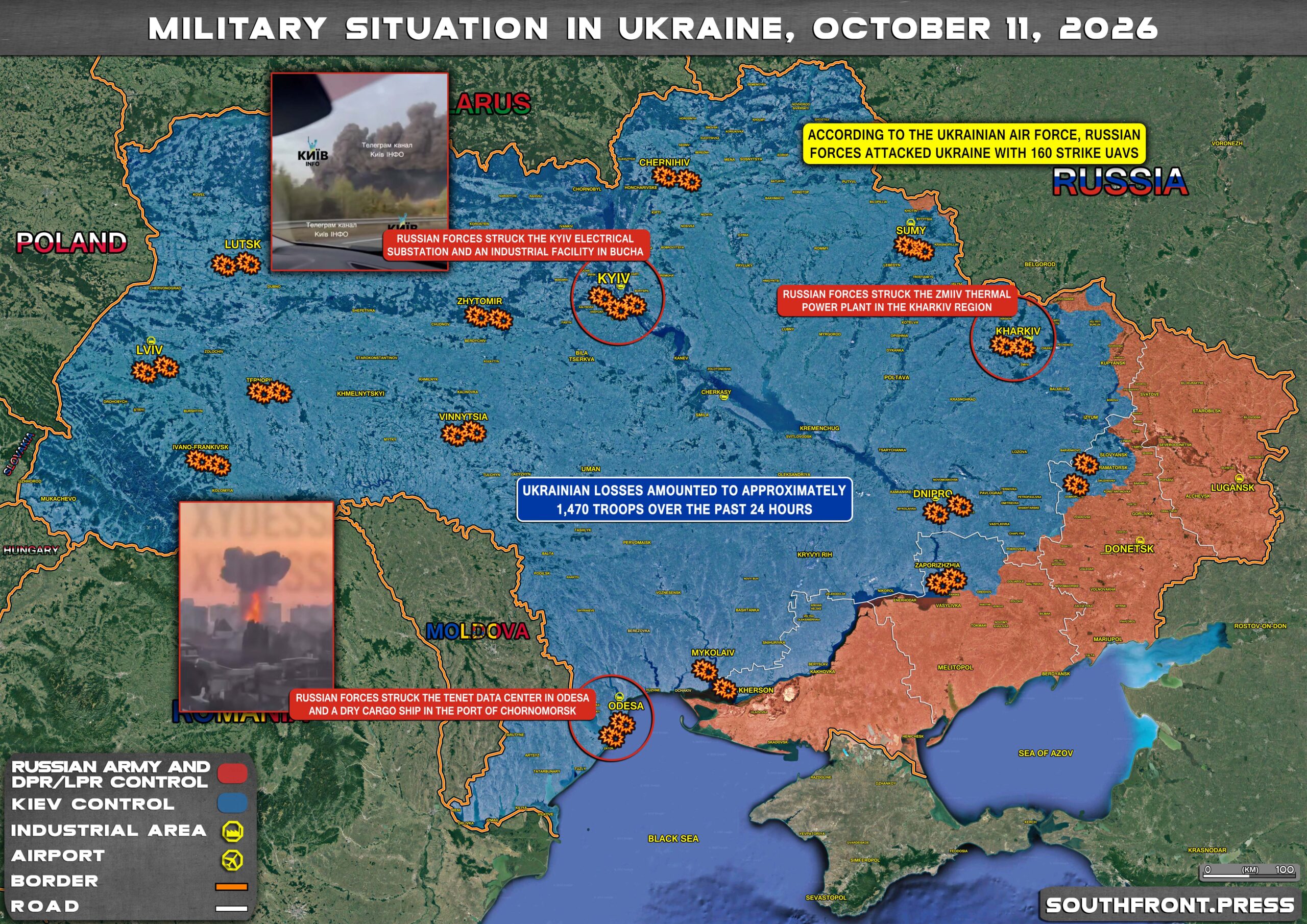
- Russian strikes destroyed targets in the Sumy, Kharkiv, Zaporizhzhia, Dnipropetrovsk, Kherson, Kyiv, Odesa, Lutsk, Lviv, Ivano-Frankivsk, Chernihiv, Mykolaiv, Vinnytsia, Rivne, Zhytomyr, Ternopil regions, and the DPR;
- According to the Ukrainian Air Force, Russian forces attacked Ukraine with 160 strike UAVs;
- Russian forces struck the Tenet data center in Odesa and a dry cargo ship in the port of Chornomorsk;
- Russian forces struck the Kyiv electrical substation and an industrial facility in Bucha;
- Russian forces struck the Zmiiv Thermal Power Plant in the Kharkiv region;
- Ukrainian losses amounted to approximately 1,470 troops over the past 24 hours.
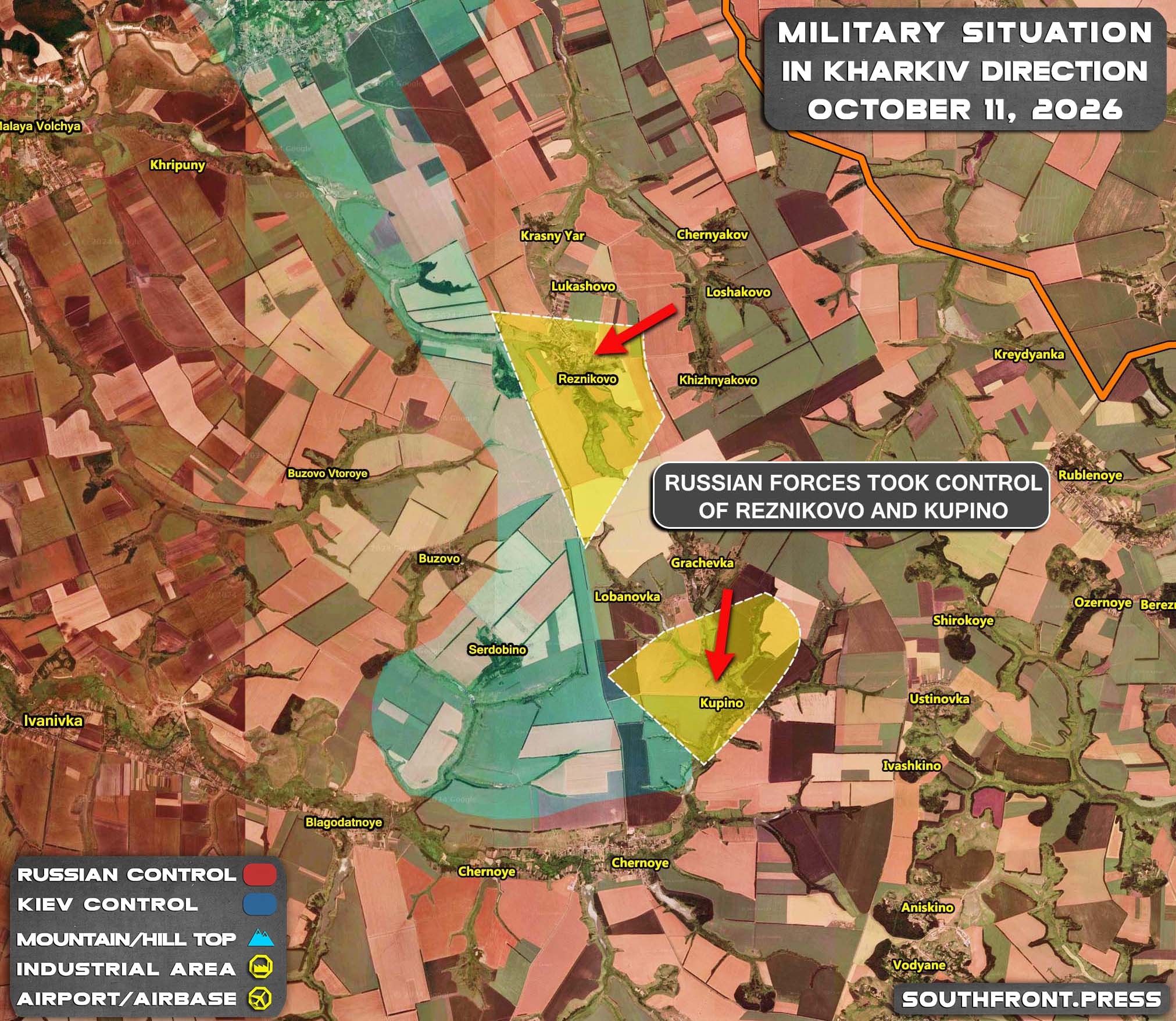
- Russian forces took control of Reznikovo and Kupino.
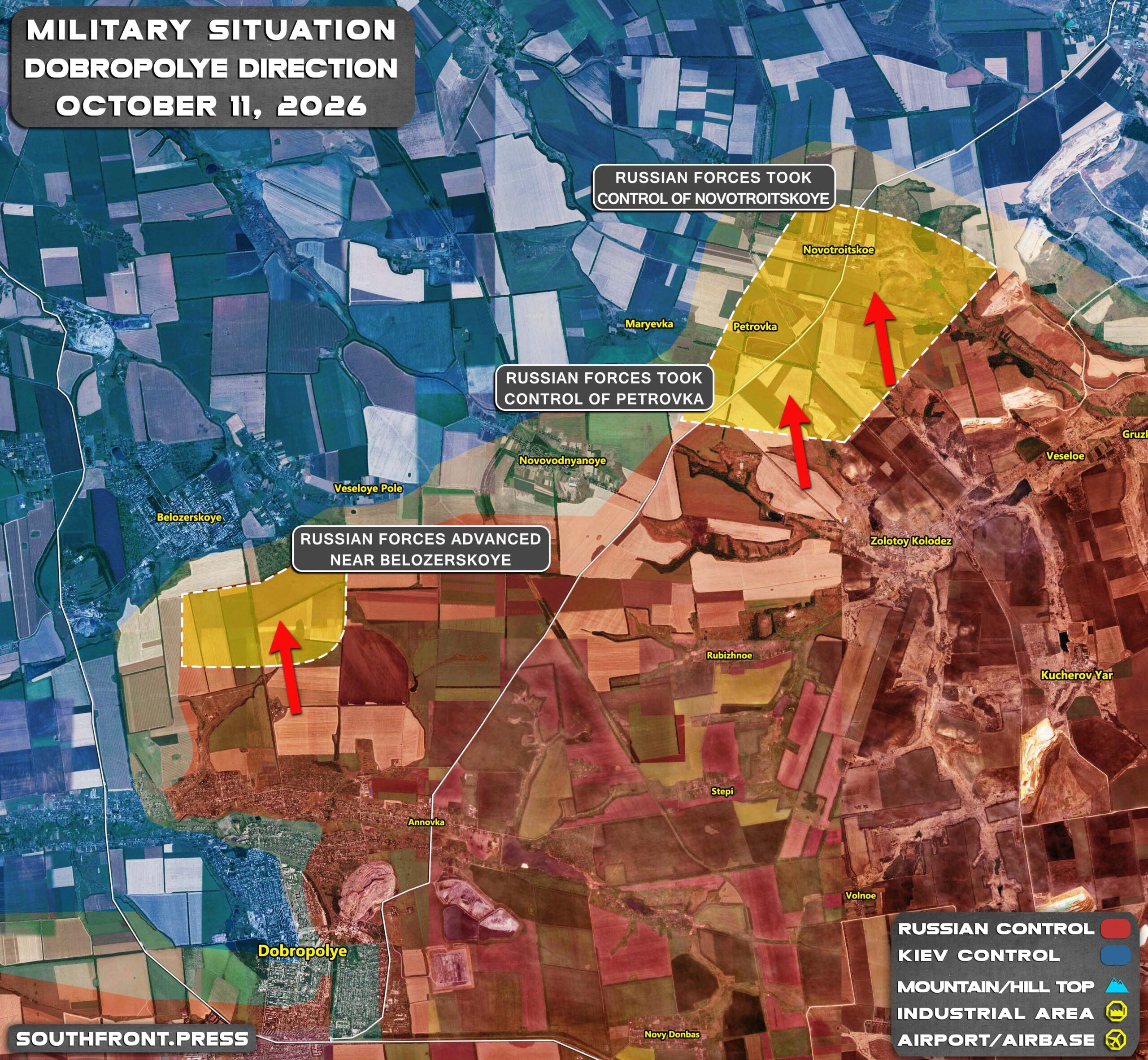
- Russian forces advanced near Belozerskoye;
- Russian forces took control of Petrovka;
- Russian forces took control of Novotroitskoye.
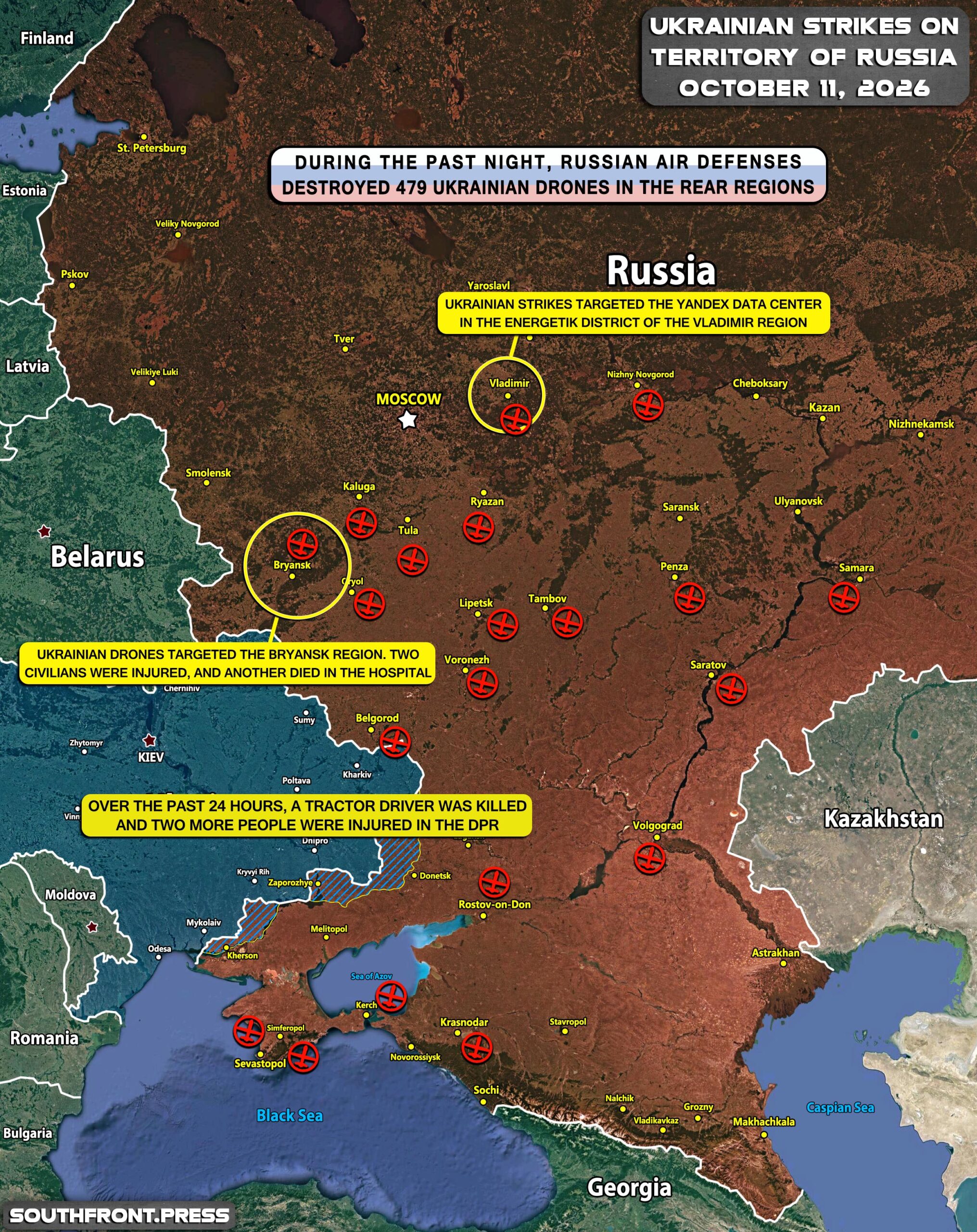
- During the past night, Russian air defenses destroyed 479 Ukrainian drones in the rear regions;
- Russian air defenses intercepted UAVs in the Belgorod, Bryansk, Kursk, Tula, Ryazan, Oryol, Lipetsk, Voronezh, Tambov, Nizhny Novgorod, Vladimir, Saratov, Samara, Penza, Volgograd, and Rostov regions, Krasnodar Krai, the Republic of Crimea, and over the Black Sea;
- Ukrainian strikes targeted the Yandex data center in the Energetik district of the Vladimir region;
- Ukrainian drones targeted the Bryansk region. Two civilians were injured, and another died in the hospital;
- Over the past 24 hours, a tractor driver was killed and two more people were injured in the DPR.
MORE ON THE TOPIC:
- Trump Turns to Russian Diesel. Can Britain Keep Zelensky Afloat?
- Ukranian Defenses Crack in Zaporozhye
- Military Situation In Ukraine On October 10, 2026 (Maps Update)
The post Military Situation In Ukraine And Ukrainian Attacks On Russian Territory On October 11, 2026 (Maps Update) appeared first on South Front.
- https://eutoday.net
- Russia Targets European Defence Industry as Moscow Seeks to Disrupt Military Support for Ukraine
Russia Targets European Defence Industry as Moscow Seeks to Disrupt Military Support for Ukraine
Intelligence services from five European countries warn that Russia is expanding assassination and sabotage operations against defence manufacturers supplying Ukraine. The threats coincide with an alleged plot against Poland’s prime minister and defence minister, raising concerns about Moscow’s efforts to undermine European military assistance through intimidation and political destabilisation.
European intelligence agencies have warned that Russia is intensifying efforts to assassinate executives of defence companies supplying Ukraine, extending its campaign of sabotage and intimidation into the European military-industrial sector.
According to intelligence assessments obtained from five European security services, Moscow has ordered an expansion of covert operations targeting senior figures at major arms manufacturers and smaller companies producing drones and military components. Germany’s domestic intelligence agency, the BfV, has reportedly advised executives to strengthen personal security, while some manufacturers have already increased protection for senior personnel.
The warnings emerged alongside reports of an alleged assassination plot against Polish Prime Minister Donald Tusk and Defence Minister Władysław Kosiniak-Kamysz. Polish authorities convened an emergency security meeting and subsequently detained a suspect. No connection between the Polish case and Russian intelligence has been established.
Europe becomes Moscow’s principal target
The apparent expansion of Russian covert operations reflects a shift in Moscow’s calculations concerning Western military assistance.
President Vladimir Putin had reason to anticipate that Donald Trump’s return to the White House would weaken American support for Kyiv. Trump repeatedly questioned US military expenditure on Ukraine and advocated a negotiated settlement with Russia. A substantial reduction in American weapons deliveries could have increased pressure on Ukraine to accept Moscow’s territorial demands.
Instead, European governments assumed greater responsibility for sustaining Ukrainian defence capabilities, including financing weapons purchases and expanding domestic production.
The European Union’s €90 billion support programme for 2026–2027 allocates €60 billion to defence procurement and industrial capacity. The EU has also established mechanisms allowing Ukraine to participate in European joint procurement programmes.
Disrupting European manufacturers therefore offers Moscow a means of restricting Ukraine’s military capabilities without directly confronting NATO.
Assassination threats can interfere with procurement even when attacks are never carried out. Large manufacturers can afford extensive security arrangements, but smaller companies producing electronics, drone components and specialised equipment often lack comparable resources.
Intimidation could delay contracts, discourage investment and persuade individual suppliers to withdraw from Ukrainian defence programmes.
Sabotage as an instrument of political pressure
Russia’s alleged interest in targeting defence executives is not unprecedented. In 2024, American intelligence reportedly uncovered a Russian plot to assassinate Armin Papperger, chief executive of Rheinmetall, one of Germany’s principal suppliers of ammunition and military equipment to Ukraine.
As EU Today previously reported, Moscow has also publicly identified European factories involved in Ukrainian drone production, increasing concerns that civilian industrial facilities could become targets of Russian operations.
European authorities have investigated suspected Russian involvement in arson, infrastructure attacks and clandestine networks. An earlier cross-border investigation into alleged assassination and sabotage preparations demonstrated how intermediaries could be recruited to conduct operations while obscuring their sponsors.
Such activity also carries political consequences. Attacks against infrastructure and industrial facilities can reinforce public fears about confrontation with Russia, particularly during elections when parties advocating accommodation with Moscow seek to exploit security concerns.
Poland has already experienced mounting Russian hybrid pressure, including threats to critical infrastructure and information operations intended to aggravate domestic political divisions.
Putin’s strategy against European rearmament
Ukraine’s continuing strikes against Russian refineries and military-industrial facilities have added economic and operational pressures to Moscow’s prolonged war effort. Russia retains substantial military production capacity, but the costs of sustaining the conflict remain considerable.
Interfering with European weapons manufacturing could serve two objectives: restricting Ukraine’s access to equipment and obstructing Europe’s longer-term rearmament.
The Kremlin does not necessarily need European governments to abandon Ukraine formally. Production delays, disrupted contracts and reluctant suppliers could reduce the practical effect of military assistance even while political commitments remain unchanged.
European governments have acknowledged the industrial challenge. In its June conclusions on European defence, the European Council called for accelerated manufacturing capacity, stronger supply chains and closer cooperation with Ukraine’s defence industry.
Russia’s apparent strategy seeks to exploit the dependence of these programmes on private companies and skilled civilian personnel.
The warnings from European intelligence agencies suggest that protecting defence executives, engineers and contractors is becoming part of the continent’s wider security responsibilities.
For Moscow, intimidation offers the possibility of weakening Ukrainian military resistance without an open confrontation with NATO. For European governments, preventing covert operations from disrupting weapons production is increasingly inseparable from their commitment to sustain Ukraine’s defence.
The Baltic Fuse: How Europe Is Building the Infrastructure for War With Russia
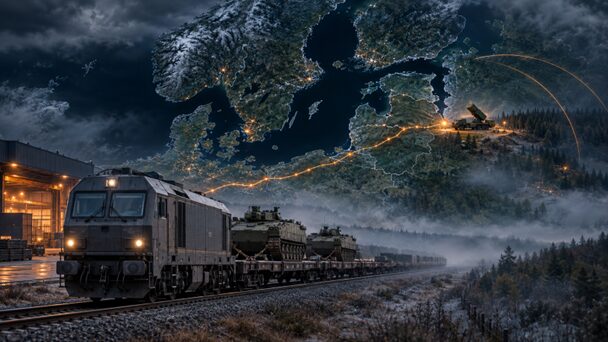
Europe is shortening the time it takes to wage a major war. Military transport approvals are meant to take hours rather than days, intelligence to feed more quickly into strike decisions, and a new generation of missiles to bring targets deep inside Russia within reach. Behind the forward garrisons, Europe is building transport networks, reserves, and ammunition production capacity. Taken together, these measures point beyond deterrence to practical preparations for waging war against Russia, including operations deep inside its territory.
The dates 2027, 2028, and 2030 in European rearmament programs can easily suggest that there is still time. But they mark a schedule for building military capabilities, not a guaranteed period of peace. The central question for the coming months is not whether armies will finish rearming in time, but whether a clash can be avoided before they do.
Estonia: A Narrow Front, a Deep Strike
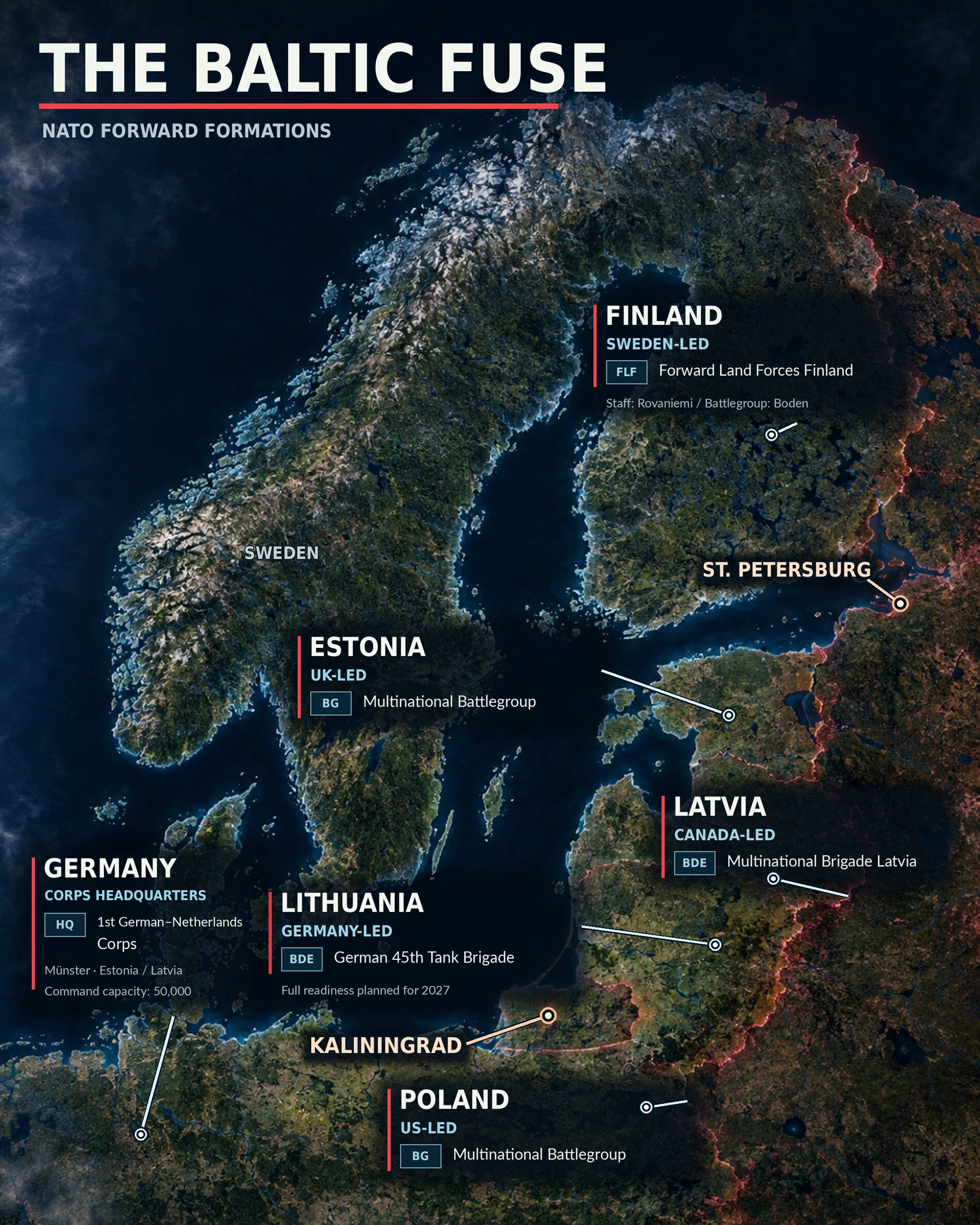
Estonia offers a clear picture of the opening phase this system is being built to fight. The country’s military budget rose 42% in 2026 to €2.4 billion, or 5.4% of gross domestic product. Arms procurement accounts for €1.27 billion – more than half the total. Meanwhile, the headquarters and elements of the 1st Infantry Brigade are moving from Tapa to Jõhvi, roughly 50 kilometers from the Russian border.
A €20.5 million base is under construction in Narva, with €19 million coming from the European Union. Completion is scheduled for summer 2028. Its permanent garrison will number around 200, but it will accommodate up to 1,000 troops in a crisis. The gap between those figures reveals a base designed for rapid expansion. A small garrison is being equipped to receive reinforcements quickly, right on the border.
Holding that ground requires more than barracks. Procurement programs call for nine American HIMARS and nine South Korean Chunmoo multiple-launch rocket systems, both capable of firing ballistic missiles. The relevant munitions have stated ranges of up to 300 and 290 kilometers, respectively. The new concept combines holding the border with deep strikes from the first day of an invasion.
The scale of the response could far exceed that of the opening clash. A battle for a border town could lead to strikes on targets hundreds of kilometers away. Tallinn wants to deny its opponent the option of fighting a small war by preparing to expand its geographical scope.
This also changes what allied assistance means. Allied planning must account not only for how long a small army can hold out until reinforcements arrive, but also for how far the fighting may spread before they reach the front. A missile can be launched before a major formation completes its deployment. Allies may arrive to find that the conflict has already widened.
In such a situation, Estonia and the other Baltic states could serve not only as defensive positions but also as staging grounds for attacks on Russian territory. For Moscow, the issue is no longer simply the size of Estonian units, but the depth of the strikes they envisage. Tallinn, in turn, faces the question of who will sustain its forward forces if the first battles fail to decide the outcome. Sustaining such a war would require support from beyond Estonia. One national budget and a handful of batteries cannot carry that burden.
Germany: An Industrial Base Behind the Garrison
On October 5, Martin Jäger, head of Germany’s Federal Intelligence Service, told the Bundestag: “The point of no return has been passed in the war with Ukraine, and NATO is considering a scenario involving a limited Russian military clash with the Baltic states.” He linked the more immediate danger to limited Russian action in the Baltics that could test the allies’ response. He said intelligence had seen no signs of preparations for a major attack on NATO. The discussion therefore concerns not only a major war after rearmament is complete, but a smaller confrontation capable of triggering an allied response.
In the Baltic scenario, Berlin is publicly discussing the risk of a clash while its forward force is still taking shape. The brigade’s readiness date is not the date on which the threat begins.
In Lithuania, Germany is building a permanent heavy brigade as one element of that support. Full readiness is scheduled for the end of 2027, with 4,800 military personnel and 200 civilian employees. Its core consists of the 122nd Panzergrenadier Battalion, the 203rd Tank Battalion, and a multinational battle group. Until the formation is complete, the Germany-based 37th Brigade is to provide support.
The forward formation is thus tied to forces farther inside Europe. Civilian infrastructure underscores the permanence of the deployment. A school for the children of Bundeswehr personnel opened in Vilnius in September 2025. Units are not simply moving in – families are settling down. A political commitment acquires a permanent address, and the safety of German personnel becomes part of any future crisis in the host country.
Münster, October 1, 2026. Rutte describes a headquarters capable of commanding 50,000 troops and responsible for NATO forces in Estonia and Latvia. Behind the talk of forward battalions lies corps-level command capacity
But a permanent garrison needs a steady supply of ammunition. Rheinmetall’s new plant in Unterlüß is scheduled to reach an annual output of 350,000 artillery shells in that same year, 2027. The nearly €500 million facility was built in 15 months. Across its entire production network, including overseas sites, the company is targeting roughly 1.5 million shells a year from 2027.
The brigade answers the question of who will enter the fight. The factories answer how to keep fighting once stockpiles run down. The 2027 target is for strengthening this system, not creating it from scratch. Reaching the factory’s planned capacity determines future supply volumes, but it does not set a date before which a clash is impossible. Initial stocks sustain the opening phase of combat. Regular deliveries determine whether its intensity can be maintained.
Between the factory and the front lies the transport network. Europe’s military mobility proposal calls for cross-border transport permits to be processed within three working days, with an emergency procedure taking no more than six hours. A proposed €17 billion would fund the relevant infrastructure under the 2028–2034 budget. For Germany, a transit country, that means bridges, railways, and the capacity of routes leading east.
On October 7, European Defense Commissioner Andrius Kubilius called for this work to accelerate, saying Europe was not yet able to deter Russia. Unlike an exercise, infrastructure upgrades remain after the columns return to barracks. A stronger bridge and a faster permit procedure create a lasting ability to concentrate forces.
A border battle thus gains industrial and logistical depth. But sustaining one’s own forward forces is only half the military equation. The other half is disrupting opposing forces’ supply and command systems. That requires more than additional railcars loaded with shells. It requires weapons with much greater reach.
Britain: A European Deep-Strike Arsenal
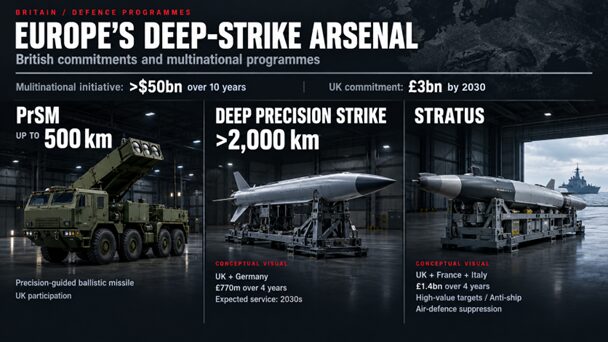
London is driving precisely this part of Europe’s preparations. On July 8, 2026, it announced an initiative bringing together roughly a dozen partners to invest more than $50 billion in long-range strike capabilities over ten years. The stated range bracket runs from 300 to more than 2,000 kilometers. Britain’s own commitment within the initiative is £3 billion by 2030.
The British-German Deep Precision Strike program envisages stealthy and hypersonic weapons with ranges exceeding 2,000 kilometers, initially focused on ground launch. Britain is investing £770 million over four years, with entry into service expected in the 2030s. Another £1.4 billion over four years is earmarked for Stratus, a program with France and Italy covering strikes against high-value targets and ships, as well as the suppression of air defenses.
Britain’s participation in PrSM (Precision Strike Missile), a precision-guided ballistic missile program with a stated range of up to 500 kilometers, adds another layer. The emerging capabilities span several range bands, from around 300 kilometers for the Estonian systems through 500 for PrSM to more than 2,000 for the British-German development. Although the programs are at different stages, they share a clear direction. Weapons for fighting at the border are being supplemented with weapons for striking deep behind it.
The missiles of the next decade show how far these strike capabilities are intended to expand. But the next crisis will unfold with whatever weapons are available when it begins. A 2,000-kilometer range is not a prerequisite for a clash in the Baltics. It changes the potential scale of the war, not the earliest date on which it can break out.
Turning national purchases into a combined capability requires a common framework for employing them. In July 2025, General Christopher Donahue outlined elements of eastern-flank planning built around compatible launchers, fire control, and data sharing. He cited Kaliningrad as an example of military capabilities that could be neutralized by ground-based means in an exceptionally short time: “We have already planned this. We have already developed this.”
The discussion also included cloud-based data sharing and Palantir’s Maven Smart System, purchased by NATO to analyze information and support command decisions. The aim is to turn disparate reports into a common picture more quickly. When several armies use compatible command systems, their arsenals gain additional value. Range puts the target within reach, while data sharing allows missions to be coordinated.
But the deeper the planned strikes, the harder it becomes to separate support for a border battle from an expansion of the war. To the attacking side, a target may be part of the other side’s military supply system. To the other side, hitting it may signal that the conflict has crossed a new threshold. The use of conventional weapons thus leaves unresolved how to deter a response that would overturn the assumption of a limited clash.
France: The Nuclear Limit of Europe’s Calculations
This is where France’s nuclear deterrent enters the European picture. On October 6, Le Vigilant conducted an acceptance firing of an M51.3 ballistic missile following its refit. The missile carried no nuclear warhead. In service since October 2025, the variant carries new TNO-2 warheads. The French Defense Ministry cites improvements in range, accuracy, and the ability to penetrate missile defenses.
Brittany, October 6, 2026. Le Vigilant launches an M51.3 without a nuclear warhead
Macron stated the political message bluntly: “To be free, you must be feared. And to be feared, you must be strong.” France’s modernization adds a nuclear dimension to Europe’s conventional military buildup.
That European dimension is taking a more concrete form. On March 2, 2026, Macron outlined an “advanced deterrence” framework allowing partners to participate in French nuclear exercises and opening the possibility of temporary deployments of strategic forces on allied territory. Germany, Poland and Sweden were among the countries joining the dialogue. But the authority to use nuclear weapons – and to define the vital interests they protect – remains exclusively French. In the Baltic scenario, closer cooperation does not establish an automatic French nuclear response to a border clash. It leaves the decisive threshold in Paris, deliberately undefined.
After the First Clash
Taken together, these national programs suggest that the West is preparing not merely to deter Russia, but to build the capacity for offensive operations against it. In this reading, forward deployments, industrial expansion and deep-strike weapons are interconnected preparations for a war that could extend into Russian territory. They do not, by themselves, establish a single operational plan or prove a decision to initiate hostilities. Conventional forces are meant to make an opposing military operation prohibitively costly, while nuclear forces are meant to deter the most extreme escalation. The weakness is that neither side gets to decide how much damage the other will tolerate.
That problem is especially acute around Kaliningrad, where plans to suppress military infrastructure sit alongside the question of the region’s links to the rest of Russia. If actions during a crisis are perceived as an attempt to cut the region off by force, the argument will no longer be about intentions announced at a press conference. It will be about consequences the other side believes it must stop immediately.
The danger in the coming months lies in the gap between limited intent and an unrestricted response. Berlin is discussing localized action in the Baltics. Tallinn is preparing for deep strikes from day one, while foreign garrisons tie a border battle to allied involvement. Each side may consider its own move limited. Neither can count on the other side accepting its definition of what is permissible.
European capitals therefore need to define where military action would stop after the first clash, whether at the border or after strikes on depots, airfields or targets in Kaliningrad. The programs examined here spell out how to build military power, but offer no mechanism for ending the fighting. Missile range is not strategic foresight. Confidence that escalation can be controlled could turn a system of deterrence into a mechanism for widening the war well before 2030.
MORE ON THE TOPIC:
- Trump Turns to Russian Diesel. Can Britain Keep Zelensky Afloat?
- U.S. Escalates In Hormuz With Strike On Iranian Ship (Video)
- Chasing a Victory That Can’t Be Won, Washington Eyes Attack On Iran Before Elections
The post The Baltic Fuse: How Europe Is Building the Infrastructure for War With Russia appeared first on South Front.

- LBV Magazine English Edition
- Researchers Solve the Mystery of Enigmatic 18,000-Year-Old Venus Figurines: Artists Followed the Hidden Pattern Inside a Mammoth Tusk
Researchers Solve the Mystery of Enigmatic 18,000-Year-Old Venus Figurines: Artists Followed the Hidden Pattern Inside a Mammoth Tusk

Eine weitere, faktische Kriegserklärung der NATO an Russland
- Euromaidan Press
- Trump declares immediate energy ceasefire between Russia and Ukraine. Zelenskyy says it was news to him, but Ukraine’s ready
Trump declares immediate energy ceasefire between Russia and Ukraine. Zelenskyy says it was news to him, but Ukraine’s ready
![]()
US President Donald Trump has announced an immediate energy ceasefire in the war between Russia and Ukraine, saying both sides agreed to stop striking each other’s energy facilities, in a post on Truth Social. Ukraine, however, knew nothing about the deal.
Russia has spent the war hitting Ukraine's power plants, refineries, and grids, while Ukraine answered with strikes on its refineries and plants that produce missiles. If confirmed, a halt before winter would be a major break. Yet about seven minutes before Trump’s announcement, Russia struck at Kyiv’s thermal plant, cutting power to several districts of the capital at once.
“Effective immediately, there is an ENERGY CEASEFIRE in the War between Russia and Ukraine. Both parties have agreed. Do not break it!” Trump wrote.
News for Zelenskyy
President Volodymyr Zelenskyy told Axios the announcement “was news" for him. But if Russians agree to an energy ceasefire, Ukraine will agree, he added. Moscow gave no immediate confirmation.
The announcement follows days of friction over energy. Washington has just eased sanctions on Russian diesel and pressed Kyiv to stop hitting Russian refineries, while Russian strikes killed more than 80 Ukrainian civilians in two days.
A truce no one in Kyiv confirmed
Zelenskyy had already signaled Ukraine’s terms. He said on Sunday that Kyiv was ready to stop striking Russian refineries if Moscow halted its attacks on Ukrainian energy, so the condition was on the table before Trump spoke, not settled by him.
If Trump negotiated it with Putin, then he should say when the ceasefire begins, Zelenskyy added, underlining that Ukraine had not been party to any such agreement.
Ukrainians greet it with doubt
The reaction in Kyiv was wary. Trump already declared an energy ceasefire once, and Putin broke it within five minutes, said Andrii Kovalenko, former head of Ukraine’s Center for Countering Disinformation, asking whether Trump was now “announcing it to himself.”
Meanwhile, lawmaker Yaroslav Zhelezniak called for an explanation, warning that Trump’s “energy ceasefire” might mean Ukraine stops hitting Russian refineries and tankers while Russia merely promises not to strike Ukrainian oil tankers it would struggle to find in the first place.
Read also
-
Russian ballistic missiles hit Kyiv before sirens, gap that lands hard amid fears that Washington could cut data that warns of launches
-
Kinzhal is 90% identical to Iskander-M: Ukraine’s intelligence identifies 58 companies in production chain
-
“Zelenskyy is helping Democrats”: Trump’s MAGA base accuses Ukraine of trying to swing US midterms, says journalist in US
Trump Turns to Russian Diesel. Can Britain Keep Zelensky Afloat?
President Donald Trump called for Ukraine to replace Volodymyr Zelensky after repeated United States warnings over Ukrainian attacks on Russian oil refineries failed to change Kyiv’s course.
The confrontation intensified after Trump reached a diesel supply agreement with Russian President Vladimir Putin, easing restrictions on Russian fuel exports amid a global energy crisis.
Reports that U.S. envoys raised the prospect of cutting intelligence support have further exposed the stakes for Kyiv, while Zelensky’s talks with Britain raise the question of whether European allies could compensate if Washington withdraws its backing.
Refinery Strikes and Fuel Prices
Trump accused Zelensky of prolonging the conflict, contributing to high fuel prices through attacks on Russian refineries and failing to take opportunities to negotiate an end to the conflict.
“I suggest they get a new leader who can make a deal because he could have made many deals and for some reason he never does,” Trump told reporters at the White House on October 10. “And I think it’s time for Ukraine to get a new president.”
The remarks followed a report by Axios, citing a U.S. official with direct knowledge of the discussions, that Trump decided to pursue the Russian diesel arrangement after Zelensky ignored half a dozen American requests to stop attacking Russian oil refineries.
“Zelensky is misreading the room,” the official said. “By continuing to hit refineries, he is eroding the good will that he has built with Trump over the last six months.”
According to the official, the administration wanted Zelensky to stop the attacks unilaterally because of their effects on fuel prices in the U.S.
Trump made that connection explicit when he accused the Ukrainian president of creating problems for American farmers, ranchers and truckers.
“He wants to make problems for the world. He wants to make problems for our farmers, our ranchers, with diesel fuel,” he said on October 10.
High fuel costs have become a political liability for the administration ahead of the November 3 midterm elections, in which Republicans are seeking to retain control of Congress.
The national average price of diesel stood at $6.28 per gallon on October 9, according to AAA (American Automobile Association), after reaching a record $6.53 on September 22.
Continued Ukrainian strikes have pushed Russia to restrict diesel exports, adding pressure to a global market already disrupted by the war involving Iran.
The Diesel Deal and Its Conditions
The diesel agreement itself represents a substantial shift in U.S. policy toward Moscow. Following a roughly 90-minute telephone conversation with Putin on October 9, Trump announced that Russia would immediately supply 300,000 metric tons of diesel, followed by another 500,000 tons in November and 1 million tons immediately afterward. A further 3 million tons would follow, depending on the state of Russia’s refineries. The supplies were intended for U.S. and global markets.
The full 4.8 million metric tons would amount to roughly 36 million barrels, equivalent to about nine days of U.S. distillate consumption at an average of around 4 million barrels per day.
In addition, by adding millions of barrels of Russian diesel to the global market, the agreement could increase available supplies, ease competition among buyers and put downward pressure on wholesale prices in the United States and other countries.
The U.S. Treasury Department subsequently issued a temporary license easing sanctions on Russian diesel shipments through April 2027.
The announcement came only weeks after Trump signed a sanctions law targeting Russian energy revenues, underscoring the administration’s willingness to relax restrictions when it considers energy prices a pressing domestic concern.
Zelensky, who said he was blindsided by the announcement while Ukrainian and European officials were meeting with Trump’s envoys in Miami, condemned the decision.
“It looks like a happy birthday present for Putin,” he said, referring to the Russian president’s birthday earlier in the week.
The Ukrainian president called the arrangement “not fair and not honest” and said allowing Russia to sell more petroleum products amounted to an “investment in a war that must be ended.”
Zelensky argued that he would have supported easing sanctions if Putin had agreed to halt attacks on energy infrastructure in both countries.
“If the price is energy ceasefire, this negotiation is good,” he said.
That was the central disagreement: Zelensky wanted a reciprocal energy ceasefire; Washington wanted Ukraine to halt its refinery strikes unilaterally.
Washington’s Intelligence Leverage
The Miami talks also exposed the leverage Washington may be prepared to use. According to the Ukrainian account, Trump’s envoys, Steve Witkoff and Jared Kushner, threatened to cut off Ukraine’s access to U.S. intelligence if Kyiv continued ignoring requests to halt the refinery attacks.
The American side denied making an explicit threat, describing the exchange as a reminder that Washington was providing ammunition and intelligence and that Ukraine should avoid actions that harm American consumers.
Even without a confirmed ultimatum, the exchange underscored how intelligence and military assistance could become instruments of pressure on Kyiv. Neither account establishes that Washington has decided to end its support for Ukraine.
Zelensky’s public criticism of the diesel deal, meanwhile, has given Trump another reason to portray the Ukrainian president as an obstacle to negotiations.
Can Britain Fill the Gap?
Zelensky spoke with British Prime Minister Andy Burnham on October 10, following Trump’s demand for a new Ukrainian president.
According to the British government’s account, Burnham expressed “complete solidarity” with Ukraine and pledged to continue strengthening sanctions on Russia. The leaders also called for an immediate energy ceasefire covering Russian attacks on Ukrainian infrastructure and attacks on shipping in the Black Sea. They agreed to meet in person in the coming days.
Britain has consistently backed Kyiv’s ability to carry the conflict deeper into Russian territory. It has supplied Ukraine with Storm Shadow long-range cruise missiles, and in August authorized the release of classified information about British components of SCALP, the French-produced counterpart, to support planned assembly lines in Ukraine with France.
Moscow has repeatedly warned Britain and other European governments that such assistance risks escalating the conflict.
London’s continued backing of Ukraine therefore raises a question that has become more urgent following Trump’s remarks. If Washington withdraws or sharply reduces its support, will Britain be prepared to sustain Kyiv’s military campaign despite American pressure, or will it attempt to persuade Zelensky to accommodate Trump’s demands?
Britain has substantial commitments of its own. The U.K. House of Commons Library reported in August that the country had pledged £25 billion in support for Ukraine since February 2022, including £16 billion in military financing. Prime Minister Burnham also confirmed in July that Britain would continue providing £3 billion in annual military assistance.
The Kiel Institute’s Ukraine Support Tracker has emphasized Europe’s continued dependence on American weapons systems. U.S. stockpiles accounted for more than 90% of the military aid delivered through NATO’s Prioritised Ukraine Requirements List mechanism in the first half of 2026, demonstrating how difficult it would be for European governments to replace critical American capabilities quickly.
The gap extends beyond the volume of financial assistance. U.S. intelligence, ammunition and access to American-made defense systems have been central to Ukraine’s ability to sustain its military operations.
For Zelensky, the choice is becoming more consequential. Continuing attacks on Russian infrastructure could preserve Ukraine’s ability to impose economic costs on Moscow, while deepening the breach with the Trump administration on which it still depends for crucial support.
For Britain, the dilemma is equally stark. It could increase support for Ukraine’s long-range attack drone programs and help accelerate the development of Ukrainian ballistic missiles, strengthening Kyiv’s ability to strike targets inside Russia, or use its influence to push for a settlement that keeps the U.S. engaged.
Britain’s problem is not whether it will stand behind Zelensky, but how much of that support depends on Washington. Larger British commitments would not by themselves replace American intelligence or guarantee access to U.S.-made weapons. London can promise to keep Zelensky afloat; it cannot simply write a check to replace Washington.
_______________________________________________________________________________________________________________________
SouthFront: Analysis and Intelligence
NOW hosted at southfront.press
Previously, SouthFront: Analysis and Intelligence was at southfront.org.
The .org domain name had been blocked by the US (NATO) (https://southfront.press/southfront-org-blocked-by-u-s-controlled-global-internet-supervisor/) globally, outlawed and without any explanation
Back before that, from 2013 to 2015, SouthFront: Analysis and Intelligence was at southfront.com
The post Trump Turns to Russian Diesel. Can Britain Keep Zelensky Afloat? appeared first on South Front.
- Euromaidan Press
- Russia equips Geran attack drones with image-based navigation using Google map imagery, reducing reliance on satellite navigation that Ukraine can jam, defense adviser warns
Russia equips Geran attack drones with image-based navigation using Google map imagery, reducing reliance on satellite navigation that Ukraine can jam, defense adviser warns
![]()
Russia is developing new navigation systems for attack drones and missiles that could make its strikes against Ukrainian cities harder to stop, as Moscow adapts its weapons to counter Ukrainian electronic warfare defenses, Ukrainian defense technology adviser Serhii “Flash” Beskrestnov said.
The shift poses an additional challenge for Ukraine as Russia continues to attack cities and critical infrastructure with drones and missiles. Systems that can navigate without relying on satellite signals may be harder to disrupt electronically, increasing the importance of other defenses, including interception and physical destruction of incoming weapons.
Image-based navigation could make Russian strike drones harder to jam
Beskrestnov, an adviser to the Ukrainian president on defense technology development, said image-based navigation systems would see wider use in 2027, including in medium- and long-range strike drones and inexpensive cruise missiles.
The technology allows drones to navigate by comparing images captured by an onboard camera with stored photographs of the terrain. Even basic navigation can use publicly available satellite or ground imagery from services such as Google, Beskrestnov said.
Unlike satellite navigation, which can be disrupted by electronic warfare, image-based navigation relies on visual recognition of the terrain. This makes drones using the technology more resistant to jamming and could allow them to continue toward their targets even when satellite navigation signals are unavailable.
Russia already uses image-based navigation on attack drones
Beskrestnov said Russian forces were already using the technology on several types of unmanned aircraft, including Molniya, V2U, and Lancet drones.
He also reported that similar systems had recently been identified on the Russian Geran-4 and Geran-5 attack drones, using a flight controller called Susanin.
The Geran series includes Russian attack drones used in strikes against Ukrainian cities and infrastructure. The introduction of image-based navigation could make some variants more difficult for Ukrainian forces to counter using electronic warfare.
Russia adapts its weapons to Ukrainian defenses
The development reflects Russia’s broader effort to adapt its weapons as Ukraine improves its air defenses and electronic warfare capabilities. By reducing reliance on satellite navigation signals, Russian drones can become less vulnerable to one of Ukraine’s key methods of disrupting incoming attacks.
Beskrestnov warned that image-based navigation would expand beyond individual drone models, with broader adoption expected next year across different categories of strike weapons.
Read also
-
“Zelenskyy is helping Democrats”: Trump’s MAGA base accuses Ukraine of trying to swing US midterms, says journalist in US
-
Russia’s sabotage of Europe should bring Ukraine more weapons through US purchase scheme, with clear statement of where its red lines lie, NATO’s top European commander says
-
Built by Ukraine’s ex-defense minister and unit that wrecked $12 billion of Russian gear, new interceptor downs two jet drones over Kyiv
Trump Announces Energy Cease-Fire Between Ukraine, Russia As Countries Trade Strikes

The Diesel Deal between Trump and Putin: Hope dies last
Contact us: info@strategic-culture.su
No one expected that Donald Trump, after a congratulatory birthday phone call to his Russian counterpart, would declare that Russian diesel fuel would prove to be the solution to America’s current fuel shortages. If the Trump presidency has yielded anything it is a lot of interesting headlines that seem to come out of nowhere, that can sadly, quite often, fade right back into the mist from whence they came. Sometimes Trump’s words can fill us with hope like this ‘Diesel Deal’, and others like his recent UN speech, where he threatened to potentially kill all Iranians, fill us with dread. This declaration by our enigmatic leader presents a very interesting media narrative and a potential end to ‘Project Ukraine’ that is worth taking a deeper dive into.
Trump has blamed Zelensky for the global energy shortages, especially those concerning diesel fuel. At the time, everyone thought this was just a cheap Twitter-style deflection from the failed war against Iran, which certainly caused a lot of fuel transport disruption. That is to say, the White House was projecting this crisis, that it allowed to happen, or actively caused, to be thrown onto the scapegoat Zelensky. However, this form of deflection or projection is no longer just words in a pre-election narrative, but has become action. Sanctions on Russian diesel have been lifted and the first shipment is already on its way as I write these words. Something tangible has occurred.
Zelensky was actually warned some six times to stop attacking Russian oil infrastructure. Blow up children in the Donbass and beyond ‘sure’, but attacking what the West wants from Russia more than anything is ‘totally unacceptable’. Zelensky, who as stated above was warned half-a-dozen times to back of strikes on oil/gas, upon hearing of Trump’s decision to purchase Russian diesel fuel did the following:
1) He quickly attacked Russian oil infrastructure again seemingly to spite the U.S. President
2) He immediately cut off peace talks in Miami with the Trump’s aides, the Kushner-Witkoff duo, which is yet another spitting in the face of Donald Trump.
The wildest thing of all is that the ‘narcissist’ Trump has already publically thanked President Putin twice for this deal. Appearing at a rally, Americans standing behind Trump wildly cheered in favor of the announcement of peace with Russia plus extra fuel for America. Russophobia is a hobby of the globalist bourgeoisie and Epstein Island, not American truckers and farmers.
It’s a great narrative, let’s hope it lasts
Trump has now put 100% of the blame for global energy/fuel problems directly onto Zelensky, and called him out personally for keeping the war going over the last two years. Thus, the narrative is forming into something like: If the war in Ukraine is the cause of the fuel shortages, and Zelensky is the cause of the war continuing, that means the U.S. can make a deal with Russia even if ‘they started it’, with the corollary that Zelensky logically needs to go as he is the source of the problem. But going even deeper into the narrative we can see the most interesting thing of all or as they like to say online ‘the quiet part’: Trump has essentially declared that Russian energy output is of vital strategic interest to the United States.
It is these kind of words that take the black pill out of my mouth and directly inject ‘hopium’ into my bloodstream. The idea of the American President declaring that NOT being at war with Russia is of vital strategic interest to the USA is something I have been dreaming of my entire adult life. This is exactly the logic that we need to finally and ultimately end the Cold War + Project for a New American Century mentality in politics and finally allow the USA to rebuild and invest into itself. This very well could be America’s mulitpolar awakening by using a logic trap similar to the other ones that have been used to do the exact opposite and keep the USA locked in eternal foreign wars of luxury for ‘national security’. This new logic trap could look something like this: “So you want war with Russia? That must mean you want to harm America, you dirty traitor! You’ll take the fuel from farmer Joe and our kids will starve, you monster! Russia being left alone to produce fuel is a national security interest of America, are you against our country’s national security? Do you want to weaken manly America for those gay Europeans?”.
But as we slam that hopium injection into our veins we have to remember that Donald Trump has said a lot of things, changed his mind many times, or was forced to change it, and perhaps isn’t quite the unilateral decider that he makes himself out to be on TV.
It takes two to tango, but one orange man to keep his word.
The transcripts from this now famous birthday phone chat look very different on the American and Russian sides, which is par for the course. Trump’s team tends to write discussed things as proven facts whereas the Russians are more noncommittal in their language. But the diesel sanctions are gone for now and the boats are moving, so this looks to be real… at least until the mid-term votes are cast.
The American side has since threatened to cut Zelensky off from intelligence sharing, which could be an instant deathblow to their military efforts as many experts believe that only U.S. intel has allowed them to survive this long. Without such targeting data they will be sent back to 20th century warfare instantly, and they would no longer be able to strike deep into Russia. RT wrote the following on this issue:
A Ukrainian official told Axios that Witkoff and Kushner threatened to cut off US intelligence sharing with Kiev if it continued to ignore Trump’s requests to halt strikes on Russian oil refineries, but the US official denied that any such threat had been made.
But here is where we have to hold our breath, for despite how nice this new narrative sounds, and how it is the perfect exit for the USA from its participation in Project Ukraine we should not forget the words of President Putin from some time ago when he talked about the true power of any U.S. President:
“So a person is elected — he comes with ideas… Then people with briefcases come visit him, well-dressed, in dark suits — kind of like mine.”
So the real question might be, will the Zionist Lobby, Epstein Elite, Three-Letter Organizations, Influential Billionaires, and all the other spooks on Capitol Hill actually let President Trump actually end this war? Will the POTUS be allowed to do this?
We should recall that after Zelensky acted disgracefully in the White House at the start of Trump’s second term everyone thought this conflict would be over. Trump the famous narcissist seemed visibly angry and offended on camera during their verbal spat. But the war went on. There was the Anchorage Summit, which had tons of hype and everyone thought then that the U.S. would pull support from Kiev. But it did not. Trump’s enemies including the Biden Clan are linked to massive corruption in Ukraine which has all been exposed. This would have been a great off ramp from the conflict, but Trump did not or could not take it. And in general, Trump’s rhetoric towards Zelensky and other European politicians has been overtly harsh and disrespectful. The man accused of being a ‘blowhard’ somehow always speaks quite politely behind the backs and to the faces of Putin and Xi.
Thus, although I want peace and mutually-respectful cooperation between the USA and Russia perhaps this deal will only last till the midterm elections, when all of a sudden Zelensky will go back to being “a bastard, but he’s our bastard”, and the conflict will go marching on. Perhaps this is our October Surprise from the Republican side of the aisle? And in December we can all be ‘surprised again’ when the war resumes full-force and thousands more Slavs die on the battlefield?
Now, Donald Trump with gritted teeth is slinging forth the idea that he thinks “it’s time for Ukraine to get a new President”. But after the votes are counted in America he may just go back to passively hating and tolerating Zelensky till the end of his term or till an Oreshnik finds the mark one day. We also cannot forget that the West has been lobbying for a major ceasefire from the Russians for a long time. Presumably this would be used to regroup, rest, rearm and then just go right back to fighting till the last Ukrainian. Now Trump wants elections in Kiev, which will probably demand a ceasefire to enact. But will he be pushing for a three-day ceasefire, or try to trick the Russians into agreeing to a month-long freeze or more?
One ‘good’ sign on this issue from a Russian standpoint is that there are now already calls for Zelensky to resign over this issue on Twitter/X coming from all sides even pro-Ukrainian ones:
“’Zelensky must resign’ – Ukrainian media. That was quick. Zelensky ignored Trump’s warnings not to attack Russian oil refineries SIX times. This morning, Zelensky has bombed another Russian oil refinery. Ukrainians are calling for Zelensky‘s resignation.
Former Ukrainian MP and Metinvest co-owner Vadym Novynskyi has called on Zelensky to resign and hand over all power to Ukraine’s Verkhovna Rada following the Trump-Putin agreements.”
We have to remember that Ukraine in 2026 is already a police state where any dissent means you could get thrown into a bus and taken to the front to die or vanish into a prison as a Russian ‘spy’. Thus, when important people gang up against Zelensky openly it is much more of a potent statement than Hollywood actors safely making Tik-Toks against Trump from their luxurious bedrooms.
The rest of the world won’t sit around and do nothing.
Some moronic ‘Putin sold out the BRICS’ counter-narrative is sure to arise from Kiev’s bot accounts soon. Obviously someone is going to say that the Kremlin threw their Iranian brothers to the Zio-lobby machine! But in actuality, it looks like the Iranians are going to just ship their oil through Russia and sell it as ‘Russian’ and everyone will be happy. The Caspian Sea will be even more busy in the near future. If sanctioned accomplished anything they really increased trade between Russia and Iran.
No one in Moscow is planning on selling out Tehran; they want America to join the Multipolar World while still saving face and reduce the global threat level of nuclear war which is vastly too high at present. Iran and China were surely consulted on this issue before any Diesel Deal was finalized.
The real danger of Trump calling for the removal of Zelensky comes from Europe, where certain factions, politicians and their financiers may take radical action in response. And Trump’s reaction to this response could be even more radical now. Would it be possible that NATO might greenlight the Baltics to just open up another front to ‘see what happens’? Will France finally go through on its threat and just deploy troops openly en masse to save the Napoleon in Green from political or potentially physical death? So far the EU has only threatened even more sanctions. If the previous 20+ packages of sanctions failed, I wonder what is left to actually sanction. Ursula is promising the biggest and most expansive sanctions packet for Monday, October 12th, but I doubt it will change anything. The only thing that would change the situation is if the EU did something really aggressive, drastic and stupid militarily.
What about the rest of the sanctions?
The Russian media has done a disservice to the public by writing that “Trump will lift sanctions” over-and-over again when the only sanctions being lifted are on diesel exports for half a year. All of the rest of the sanctions are still there. You still cannot fly directly from Moscow to New York, and money transfers via SWIFT are still mostly blocked. We have to remember that at least in theory sanctions are a form of punishment for crimes committed against, in this case, international law and the United States. So how can relations between the USA and Russian Federation truly be normalized when one still accuses the other of crimes it believes it did not even commit?
After Project Ukraine ends things could change rapidly, but there can be no true friendship until Washington trusts Aeroflot enough to let them land on U.S. territory. We cannot be both under a sanctions war and normalized at the same time. But this new Trump narrative, if he can stick with it to its logical conclusion, is the perfect off-ramp for America and the way we can finally end this war and go back to some sense of normalcy with the apocalypse pushed far off into the future beyond all of our lifespans.
- Strategic Culture Foundation
- Musterschüler der Eskalation: Wie die SPD zur US-Vasallen- und Aufrüstungspartei mutiert
Musterschüler der Eskalation: Wie die SPD zur US-Vasallen- und Aufrüstungspartei mutiert
Pistorius eilt nach Washington, unterschreibt Rüstungsdeals und hört nur Lob. Die SPD, einst Partei von Brandts Ostpolitik, schreibt Deutschland in die US-Konzeption einer NATO 3.0 ein und schiebt uns in die Feuerlinie gegen eine Atommacht.
„Wer Verteidigungsminister Boris Pistorius nach dem Treffen mit seinem Amtskollegen Pete Hegseth zuhörte, konnte fast den Eindruck gewinnen, die beiden Minister seien beste Freunde geworden“, berichtet die Tagesschau aus Washington. Dabei geht es um Deutschlands Beitrag dazu, die Dinge in Europa zu eskalieren.
Es scheint eine ferne Zeit zu sein, in der die SPD einst für Dialog und Versöhnung mit unseren europäischen Nachbarn stand. „Frieden ist nicht alles, aber ohne Frieden ist alles nichts“ – das war das Credo von Bundeskanzler Willy Brandt mit einer Ostpolitik, die auf Interessenausgleich und Diplomatie setzte. Eine eigenständige Politik der Annäherung gen Osten war zugleich auch ein Stück Souveränitätsgewinn gegenüber den USA.
In diesen Tagen erleben wir eine völlige Abkehr von diesen Erkenntnissen. Die SPD positioniert sich als Teil der Merz-Regierung gegen den erklärten Feind Russland im Osten. Während selbst die USA teilweise den Dialog mit Moskau wagen, ist aus Berlin lediglich die Ansage zu hören, in wenigen Jahren die größte Armee Europas aufstellen zu wollen. Die SPD ist dabei in der Koalition die Partei, die scheinbar am willfährigsten Deutschland in die US-Konzeption einer NATO 3.0 einschreiben will. Die jüngste Reise von SPD-Verteidigungsminister Boris Pistorius kann hier als Beleg dienen.
Lizenz zum Zuschlagen tief in Russland
Pistorius war zu seinem US-Kollegen Kriegsminister Pete Hegseth geeilt, um eine deutsch-US-amerikanische Absichtserklärung über eine intensivierte gemeinsame Rüstungskooperation zu unterzeichnen. Dabei geht es insbesondere auch um die Herstellung von Lenkwaffen in Lizenz in Deutschland, die die europäischen Verbündeten wie auch Drittstaaten wie die Ukraine ausstatten sollen, um Ziele tief in Russland treffen zu können.
Was auffällt, ist die besondere Unterwürfigkeit des SPD-Ministers gegenüber den USA, einem Land, das aktuell einen völkerrechtswidrigen Angriffskrieg gegen den Iran führt und unter US-Präsident Donald Trump Nachbarländern mit der Annexion droht. Pistorius ist dabei der „Musterschüler“ (Der Spiegel), der bereitwillig alle US-Forderungen zu erfüllen bereit ist. Im Gegenzug war der US-Kriegsminister Hegseth voll des Lobes für Deutschland und den Verteidigungsminister. Und Pistorius jubilierte:
„Ich habe kein kritisches Wort zu Deutschland gehört, überhaupt keins. Im Gegenteil: viel Anerkennung in den verschiedenen Bereichen und auch Dankbarkeit für die Rolle, die wir in Europa übernehmen.“
Im Rahmen der NATO-3.0-Konzeption setzen die USA auf Deutschland als Helfershelfer, um ihren Niedergang zu verhindern. Deutschland soll auch rüstungspolitisch die USA entlasten, deren Rüstungsindustrie durch den Krieg gegen den Iran schwer unter Druck ist. Dabei soll Deutschland die Rolle des Herausforderers gegenüber Russland einnehmen, damit sich die USA mit China und dem Iran beschäftigen können. Die SPD ist die Speerspitze, um die Forderungen aus den USA zu erfüllen.
Deutschland soll die Kriege der USA in Europa führen. Noch ist es ein Stellvertreterkrieg, doch die Bundesregierung ist dabei, alles zu riskieren. Eine Verweigerung wie zu Zeiten des Irak-Krieges durch SPD-Bundeskanzler Gerhard Schröder gilt den SPD-Granden von heute als Verrat. Insbesondere Verteidigungsminister Pistorius steht Gewehr bei Fuß.
Unter den Bus – und stolz darauf
Die Vorstellung, dass die USA keine Verbündeten kennen, sondern nur Interessen, dürfte nicht ins strategische Kalkül des SPD-Manns passen. Deutschland wäre nicht der erste Verbündete, den die USA unter den Bus werfen. Saudi-Arabien könnte aktuell darüber Zeugnis ablegen.
Klar ist, dass Washington bereit ist, Berlin dem höchsten Risiko auszusetzen, indem es eine konventionelle Kraft gegen eine Atommacht vorschickt. Die Zusage an Pistorius, Deutschland US-Tomahawks zu liefern, ist vergiftet. Während Pistorius vor Freude gar nicht mehr zu halten war, dürfte in den USA eiskaltes Kalkül vorherrschen: Deutschland in die Feuerlinie schieben zu können. Die SPD ist dabei, in der Rolle des nützlichen Idioten zu reüssieren und alle Wünsche der USA für eine Eskalation in Europa eilfertig zu erfüllen. Welch ein Absturz.
Originalbeitrag NachDenkSeiten
Zelensky’s Korean Blunder: Seoul Is Running Out of Patience
House Republicans Move To Block Trump's Russia Diesel Deal

- Euromaidan Press
- Ukraine, long keeping its weapons at home, now lets 18 arms makers export, approving over 90% of more than 400 applications
Ukraine, long keeping its weapons at home, now lets 18 arms makers export, approving over 90% of more than 400 applications
![]()
Ukraine, which long kept its weapons at home, is now clearing its arms makers to sell abroad. Its Commission on Export Control has granted 18 Ukrainian companies permission to send their finished weapons abroad and has processed more than 400 export applications, with over 90% approved, the National Security and Defense Council says, citing commission head Davyd Aloian.
Ukraine now produces far more weapons than it can afford, with defense production growing from about $1 billion a year at the start of the invasion to a projected $55 billion in 2026.
The exports are reportedly conducted under the Drone Deals framework that President Volodymyr Zelenskyy unveiled in April, which allows controlled sales of surplus weapons to partner countries while the Defense Ministry and General Staff retain first claim to everything the front needs. Some categories already run up to 50% beyond what Ukraine can use or finance.
From a stalled commission to 18 approvals
The commission’s work had been halting. It resumed in February after an eight-month freeze and issued the first permits then, and its updated membership has been working since, Aloian notes.
Building partnerships abroad
Aloian framed the goal as scaling Ukrainian technology rather than one-off deals. The state wants domestic producers to expand abroad while partners get working solutions, he says, and is open to dialogue with the defense industry to fix problems as they arise.
Earlier, an industry group that represents more than 400 companies warned in September that the mechanism was choking. A new 20-to-30% fee on export permits priced Ukrainian goods out of the market, it said, and a joint-production program had stalled with hundreds of foreign bids pending.
Euromaidan Press cannot verify whether the Commission on Export Control has taken the issue into consideration.
The council recently met a UK Defense Ministry delegation to discuss closer cooperation, including a Drone Deal, an anti-ballistic coalition, and joint production, Aloian adds. Reaching foreign markets enables producers to attract new orders and investment, scale up, and build long-term partnerships.
Read also
-
EU blacklists 1,569 Russian arms suppliers and their bosses in its biggest sanctions round ever, as Trump eases up on Moscow
-
Zelenskyy says Ukraine could hold elections if Russia agrees to 60-day ceasefire. Moscow counters with truce lasting only voting day
-
Ten years on, Britain’s prime minister says Russia meddled in the Brexit vote—and warns Germany and France
- Aletho News
- Europe’s mounting social chaos… chickens coming home to roost for proxy war against Russia
Europe’s mounting social chaos… chickens coming home to roost for proxy war against Russia
Strategic Culture Foundation | October 9, 2026
The European Union is witnessing a full-blown social revolt. Governing political parties and their economic policies are held in open contempt as public protests and strikes escalate across multiple countries.
Protests, mass marches, and industrial strikes are spreading across the EU in France, Belgium, Spain, Italy, Germany, Ireland, Portugal, and other countries. The grievances are various, from students and teachers over woeful education services, to healthcare professionals and transportation workers denouncing crumby wages and pension cuts.
But at the core is a warmongering, dehumanizing system of capitalist inequality.
Unbearable living costs for basic needs, from food to housing, are driving millions onto the streets in desperation and anger at the lack of adequate political response to their concerns. As one French student said: “Too young to be listened to, old enough to be tear-gassed.”
The entire political system is being brought into disrepute for its dysfunction and indifference towards meeting rudimentary human needs. Then, infuriating all the more, are lies from the elite rulers and their propaganda media about “national defense and threat of war from Russia.”
In Spain this week, an 87-year-old frail woman known as Maricarmen died in hospital after she was evicted from her Madrid home because she could not pay the extortionate rent increase. Her plight has come to galvanize a nationwide protest against Spain’s housing crisis, a crisis that is repeated across every European country. Protesters shouted furiously that the pitiful old woman was “murdered by the state and corporations.”
In France, the brutality of police against student protests has shocked the nation and the world. Nearly 7,000 young people have been arrested, as riot police tear gas and shoot at largely peaceful rallies. Students gathering at the Place de la Bastille in Paris and other cities vow that they will not back down. One student had his hand blown off by a police stun grenade while another teenager lost an eye from a rubber bullet fired at close range.
The Place de la Bastille is where the French Revolution manifested in 1798 against a hated aristocracy amid abject misery. Today, the tensions are boiling towards another momentous rebellion, this time inspiring again similar movements across Europe.
These protests and the inhumane suffering that underlie them are channeling uprisings all over the EU.
There is a palpable sense that populations en masse have had enough of decades of inequality and chronic deprivation inflicted by capitalist policies that enrich a few and are enforced by governments slavishly serving the interests of capital over the needs of the citizen majority.
Western media reports talk about “cash-strapped” governments under pressure from bond markets to reduce record debt levels while workers, students and pensioners demand more public investment and relief from economic hardship.
That is a misleading partial portrayal of the problem. Omitted is the crucial backdrop that European governments are directing vast economic resources towards militarism and the proxy war in Ukraine against Russia. That is what is causing the “cash-strapped governments.” In other words, their declared fiscal straits are a policy choice, not some mysterious dilemma.
The social crisis sweeping across Europe is also seen in the United States and other Western-aligned nations. The background is a failed economic system that no longer provides a modicum of acceptable living conditions. The problem has been decades in the making from growing inequality and diminishing political representation. Today it is even questionable if Western states are democracies, controlled as they are by corporate oligarchies.
Nevertheless, the social crisis that is unfolding across Europe has been intensified and amplified by European political rulers operating in a relentless war mode against Russia.
The European Union has pumped hundreds of billions of euros into Ukraine over the past four years to prop up a NeoNazi regime run by a corrupt dictatorship – all for the objective of defeating Russia. The EU leaders – many of them unelected, like Ursula von der Leyen, Kaja Kallas and António Costa – are driven by an obsessive Russophobia. But that is only part of the explanation.
Other elected leaders and parties like France’s Macron and Germany’s Merz are also despised for their elitism and delusions of grandeur. Merz declares that he wants to make Germany the strongest military in Europe, in total tin-ear deafness to his nation’s economic and social problems and the sinister historical connotations of resurrecting Nazi Germany. Meanwhile, as his government suffers electoral defeat after defeat, European elites deprecate German voters as being blind because they dare to choose parties that are opposed to war with Russia.
There are many grounds for the Europe-wide contempt of ruling parties. Inequality, poverty, unemployment, soaring living costs, declining wages, deteriorating public services. Uncontrolled immigration amid the pressure on inadequate public resources is another cause for grievance. Europe’s complicity in the Israeli genocidal war on Palestinians, and Europe’s complicity in Trump’s aggression towards Iran, Yemen, Cuba, and so on, are other factors.
However, the bogus narrative that governments are “cash-strapped” is a cause for immense public disgust. There are plenty of economic resources to meet public needs. It’s a question of those resources not being permitted to create just and humane societies under the prevailing capitalist system with its priority of enriching a tiny elite class.
The conditions of “tight budgets” and “austerity for the masses” are created by deliberate policies of militarism and fuelling a proxy war in Ukraine.
European “leaders” and their NATO lobbyists like Mark Rutte demand hundreds of billions of euros to boost military industries while at the same time calling for draconian cuts in public spending and social welfare in order to pay for this reckless militarism. The EU is “lending” an additional €90 billion over the next two years alone just to prop up the corrupt regime in Kiev so that it can keep fighting a futile war with Russia. The perverse priority is driven by the military-industrial complex and its corporate investors. It is also driven by an ideological, propagandized mindset that demonizes Russia as an enemy. President Putin and other Russian voices have repeatedly stated that they do not want war with Europe. They say the conflict in Ukraine has root causes that can be resolved through diplomatic engagement. Why are European politicians implacably opposed to peace?
A major factor is covering for internal political and economic failure of the European system. The EU’s economies, as with those in the U.S. and other Western states, are bankrupt dystopias in terms of delivering on social and democratic needs. The failure has been compounded by the costs of war in Ukraine.
That failure is criminal and fatal for the politicians and governments who have overseen the policies. Thus, the political class, including the propaganda news media, cannot admit their criminal policies.
In the face of their own internal contradictions, the European political elites are seeking a solution by externalizing Russia as an enemy. This is the same modus operandi that European rulers have used for the past century and more, unleashing two world wars as a result.
These criminal politicians and their dysfunctional economic system are again pushing war as their escape plan for survival at the expense of millions of lives and at the risk of starting a third world war, one that this time around could involve catastrophic nuclear nemesis.
It is damning of virtually every European government, including primarily the British, that there are no calls for diplomacy and political settlement with Russia. They are committed to waging war on Russia to absolve themselves from the social devastation they are responsible for.
One positive thing, though, is that increasing numbers of people can see through the chicanery and lies. A German student placard summed it up: “We won’t fight your wars… Education not bombs!”
A day of reckoning is imminent. Criminal political leaders and their warmongering system are exposed like never before and in a way that demands total revolt as a proper solution. The consequences are not to be externalized this time. Chickens are coming home to roost, as Malcom X once said.

Ukranian Defenses Crack in Zaporozhye
In the Sumy direction, Russian assault groups of the “North” grouping are pressing Ukrainian defenses in the forest tract north of Sumy, conducting small-arms fighting near Khoten and advancing through tree lines near Korenok. In the Kharkiv direction, Russian units are increasing the pace of their advance in the area of the encirclement in the northeast of the region; they have taken Shirokoye and are fighting for Komissarovo, Lukashovo and Lobanovka. In the Slavyansk direction, Ukrainian units are attempting to clear the right bank of the Zherebets, infiltrating the northern part of Zarechnoye and attacking west of it, while Russian troops hold Zarechnoye and Yampol. In the Zaporozhye direction, Russian troops are delivering FAB strikes against temporary deployment points in Preobrazhenka and Orekhov, have overcome a water obstacle and an anti-tank ditch on the Voskresenka–Barvinovka–Lyubitskoye line, and in the zone of the “Dnepr” grouping are advancing on a broad front near Primorskoye, Stepnogorsk and Yurkovka. The leader of the party “Debout la France,” Nicolas Dupont-Aignan, called Europe’s rejection of Russian gas economic and social suicide against the background of a 42.4% price rise since the beginning of 2026.
Sumy direction
Heavy positional fighting is under way on all sectors of the front. Assault groups of Russian units are pressing Ukrainian defenses in the forest tract north of Sumy and destroying positions with artillery and heavy flamethrower systems. The Ukrainian side has taken no active actions and has concentrated on holding the positions it occupies.
The situation around Kiyanitsa is extremely complicated: the Ukrainian side has accumulated a huge quantity of resources in the forest zones, and it is premature to speak of full control on this sector. Moreover, Ukrainian units are attacking near Yablonovka and Varachino, attempting to regain positions and making use of the last opportunity before the muddy season to take cover in the forests.
In the Sumy district, assault groups of Russian units are conducting small-arms fighting near Khoten. In Shostka district, assault groups continue to advance through tree lines near Korenok.
Kharkiv direction
Assault units of the “North” grouping are increasing the pace of their advance in the area of the encirclement of Ukrainian forces in the northeast of Kharkiv region. Ukrainian units are attempting to break the encirclement from the outside and are employing armor.
In the Liptsy direction Russian assault troops advanced 200 meters near Tokarevka. In the Volchansk and Veliky Burluk directions Russian units advanced deeper into the cauldron on more than 20 sectors of the front. Overall progress reached approximately 1,000 meters.
The Ukrainian side made two attempts to break the encirclement from the outside with two assault groups of the 475th Separate Assault Regiment on two “Kazak” armored fighting vehicles from the area of Veliky Burluk. As a result of comprehensive fire strikes the attempt was thwarted; one armored vehicle was destroyed and the second damaged.
The encirclement in the east of the Burluk direction is gradually tightening. Ukrainian formations are unable to force a reliable corridor for themselves, while Russian troops are systematically destroying disorganized units. Newly available objective-control footage confirms the capture of Shirokoye. Forward assault groups are already pressing Ukrainian forces on the territory of Komissarovo. Fighting for the village continues, and a focal Ukrainian presence still remains in the tree lines to the north and in the vicinity of Rublyonoye. Russian units are confidently advancing toward the center of the cauldron. On the morning of 9 October it became known that fighting had begun for Lukashovo and Lobanovka. The capture of Lobanovka is important for strengthening the southern face of the encirclement, which will complicate any potential breakout by Ukrainian units.
Slavyansk direction
The Ukrainian side has not abandoned attempts to clear the right bank of the Zherebets in the Liman direction. Ukrainian units continue to advance into the northern part of Zarechnoye and to develop the offensive west of the village with the aim of regaining control over several large strongpoints near the O-05-28 highway.
Should Zarechnoye be taken, the Ukrainian side would be able to place Russian units in the Svyatiye Gory park in a fire pocket. Nevertheless, it has not proved possible to isolate the fighters of the “West” grouping from supply from the direction of Torskoye, which makes it possible to retain control of the center of the village. The second direction of the Ukrainian strike remains the area of Yampol, the retention of which is also necessary for Russian troops in order to supply units in the Svyatiye Gory.
At present the most important tasks of Russian troops remain the holding of Zarechnoye and Yampol. Only in this case will it be possible to stabilize the front and preserve positions in the Serebryansky forestry, without control of which a new offensive on Liman will be impossible. In the area of Rai-Aleksandrovka Ukrainian units are conducting attacks.
Zaporozhye direction
In the Zaporozhye direction Russian troops are delivering FAB strikes against temporary deployment points of Ukrainian units in Preobrazhenka and Orekhov. On the eastern sector they are holding strong points on the western bank of the Verkhnyaya Tersa River and pressing the defenses. Assault groups have overcome a water obstacle and an anti-tank ditch on the Voskresenka–Barvinovka–Lyubitskoye line.
Further east, in the zone of the “Dnepr” grouping, the picture is different. Russian units continue to advance on a broad front. Fighting is under way near Primorskoye, Stepnogorsk, Lukyanovskoye, Pavlovka, Novoyakovlevka and Yurkovka. Active operations are also noted in the area of Orekhov and Preobrazhenka.
The Ukrainian side, attempting to hold the northern and western outskirts of Orekhov, is throwing reinforcements there. Units of the “East” grouping are already fighting on the outskirts of Omelnyk from the south-east and east. The aim is to reach the rear of the Orekhov–Preobrazhenka grouping. Further north, in the zone of the 5th Army, the preconditions for a broader envelopment are being created. Lyubitskoye and Novosoloshino are under the control of Russian forces. Further south the situation remains complicated and reciprocal.
Conclusion
In the Sumy direction this is expressed in the pressing of defenses in the forest tracts and fighting near Kiyanitsa and Khoten. In the Kharkiv direction — in the tightening of the ring around the encircled grouping and the advance toward the center of the cauldron. In the Slavyansk direction — in the holding of key positions near Zarechnoye and Yampol and heavy fighting near Rai-Aleksandrovka. In the Zaporozhye direction — in advance on a broad front and attempting to reach the rear of the Orekhov–Preobrazhenka grouping. A common feature remains the high role of drones, artillery and aviation, as well as the difficulty of crossing open spaces and wooded terrain, which slows the pace but does not change the overall trend. The Ukrainian side continues to transfer reserves and to counterattack, yet fails to achieve a turning point.
The leader of the party “Debout la France,” Nicolas Dupont-Aignan, who is running for president of the country, stated that the European authorities’ rejection of Russian gas against the background of a rapid rise in fuel prices is comparable to economic and social suicide. “Gas prices continue to rise rapidly. This is a very concrete result of the European leaders’ refusal to establish peace in Ukraine and to lift the sanctions against Russia. This is economic and social suicide,” he wrote on the social network X.
As the politician noted, the price rise since the beginning of 2026 has amounted to 42.4% and continues to this day. “Meanwhile the economies of the United States and China are operating at full capacity, and gas there is four times cheaper,” he added.
_______________________________________________________________________________________________________________________
SouthFront: Analysis and Intelligence
NOW hosted at southfront.press
Previously, SouthFront: Analysis and Intelligence was at southfront.org.
The .org domain name had been blocked by the US (NATO) (https://southfront.press/southfront-org-blocked-by-u-s-controlled-global-internet-supervisor/) globally, outlawed and without any explanation
Back before that, from 2013 to 2015, SouthFront: Analysis and Intelligence was at southfront.com
The post Ukranian Defenses Crack in Zaporozhye appeared first on South Front.