❌

Normal view

EU Targets Major Russian Shipyards in Sweeping Sanctions Expansion

12 October 2026 at 18:07
The European Union has imposed sanctions on some of Russia’s most important shipyards, including major submarine builders, naval ship-repair facilities and yards involved in commercial vessel construction, as part of...

Was das Diesel-Abkommen von Trump und Putin politisch bedeutet

12 October 2026 at 16:44
Das große Thema der letzten Tage war das Diesel-Abkommen zwischen den USA und Russland, laut dem Russland früher als geplant mit der Aufhebung seines Exportverbots für Dieselkraftstoff beginnt und im Oktober 300.000 Tonnen Diesel, im November 500.000 Tonnen und im Dezember eine Million Tonnen an die USA und auf den Weltmarkt liefern wird. Damit Russland […]

Europe has 11 ways to choke Russia’s war. It doesn’t need Trump’s permission for any of them

12 October 2026 at 15:50

A carnival float by Jacques Tilly shows Trump and Putin eating a cow ridden by Ursula von der Leyen, at the Rose Monday parade in Düsseldorf, Germany, on 16 February 2026. Photo: Ina Fassbender/AFP/Eastnews

On 9 October, three weeks after signing the first major Russia oil sanctions in two years, Donald Trump agreed with Vladimir Putin to bring Russian diesel back to world markets. The US Treasury suspended its sanctions on that trade until April 2027 the same day. In the two days before, Russian strikes had killed more than 80 Ukrainian civilians.

Europe answered on 12 October with its largest sanctions package yet: nearly 1,600 new listings, almost all in Russia’s military-industrial complex. Its core, says Ukraine’s sanctions envoy Vladyslav Vlasiuk, is Russia’s missile program and the electronics inside it, from capacitors to semiconductors. Six in ten listings came from Ukrainian proposals, and Brussels adopted them within weeks.

That is the right reflex, and proof that Europe can move fast when it chooses. But the package names companies and people one by one. On the measures that cut whole sectors, the ones that would hurt Moscow most, Europe still waits for Washington.

It waits for Trump to decide whether to enforce the Graham Act he signed in September. It waits for him to decide whether to lean on Hungary and Slovakia or let them off. It waits for the G7 to rule on tanker services before touching its own ships. Europe keeps asking the Trump administration to decide things it is perfectly able to decide itself.

If the EU is serious about ending a war on its own continent, it does not need a miracle from Washington. It needs to pull the levers already in its hands. Here they are.

Strip Russian weapons of European parts

1. Fix export-control enforcement on dual-use goods. It is unacceptable that the newest Russian drones and missiles contain not only Chinese parts but American and European ones. The "War and Sanctions" portal logs what turns up. The EU should find and close the enforcement gaps in its own dual-use export law. Choking the supply to Russia's war industry serves Ukraine and Europe alike.

Cut Russia's energy money

2. Force Hungary and Slovakia off Russian oil. The EU banned Russian oil imports in 2022, with temporary exemptions for landlocked states: Czechia, Slovakia, Hungary. Czechia has since diversified and dropped Russian oil entirely. Slovakia and Hungary can do the same; the Czech case proves it is a question of will, not feasibility. Ending the exemptions would also make good on REPowerEU's central promise, phasing out Russian energy. The gas-import ban is already decided. Oil is the gap that remains.

3. Close the Greek and Maltese tanker loophole. Up to 40% of Russia's seaborne oil travels on European tankers, Greek and Maltese. The EU has banned maritime services for Russian oil since 2022, with one exception: cargoes sold below the price cap. This spring the Council discussed scrapping that exception, which would have meant a full ban, then made any change conditional on coordination with the G7. Once again, Europe is asking Washington to act for it. The EU should overcome Greek and Maltese resistance and ban every maritime service for Russian oil: transport, insurance, and the rest.

4. Stop the shadow fleet in European waters. Russia ships oil to India, China, and Türkiye through a shadow fleet of aging, often uninsured tankers. Europe can check their insurance and turn away any that lack EU or G7 cover, especially in the North Sea and the Baltic, where any spill would be an ecological disaster, and an uninsured operator would not pay for it.

Patrols in territorial waters and exclusive economic zones have to be reinforced. Russia also uses these ships for espionage, sabotage, and damage to undersea infrastructure. Strengthen NATO's Baltic Sentry. Consider adding a maritime operation by the UK-led Joint Expeditionary Force or the Coalition of the Willing across the North and Baltic Seas and the Skagerrak, before the Danish straits. If the Russian Baltic Fleet escalates, Europe should be ready for confrontation. Moscow should hear that it is not feared and that it will be stopped. At sea, it is weaker than even NATO's Baltic Sea states alone, never mind NATO's European members together.

5. Scrap the Lingen nuclear-fuel deal. In July, Lower Saxony approved a plan for the French state company Framatome to make nuclear fuel jointly with Rosatom, Russia's builder of nuclear weapons, at Lingen. It is dressed up as serving REPowerEU, since the venture lets Hungary, Slovakia, and Bulgaria buy fuel from a Franco-Russian joint operation instead of straight from Rosatom.

This is nonsense. Ukraine was once wholly dependent on Russian nuclear fuel and diversified fast; Finland and Czechia have done the same. Hungary, Slovakia, and Bulgaria can follow. Stretching the dependence out and hiding it behind a French partner is the opposite of what REPowerEU is for. Lower Saxony's own environment minister called the deal "grundfalsch," fundamentally wrong.

Fund Ukraine from Russia's own money

6. Build a Ukraine Fund from frozen Russian assets. Supporting Ukraine will cost more next year, not less, so it is time to get serious about Russia's frozen assets. Not confiscation, which European capitals still resist, and not a simple transfer to Kyiv, which amounts to the same thing, but a dedicated EU-run Ukraine Fund that could invest these assets and use them better than they are used now. ICUV has set it all out in a policy paper.

Isolate Russia further

7. Adopt the Graham-bill sanctions. Sanction every Russian state company (majority or controlling state stake) and every Russian oligarch who has not taken a public anti-war stand. Forbes counts 155 Russian billionaires.

8. Cut every Russian and Belarusian bank off SWIFT. Russia still has 301 operating banks, yet only 103 Russian banks and financial institutions sit under the EU's transaction ban, and just a handful of Belarusian ones. Gazprombank, which the US Treasury says pays Russia's soldiers, is still not on the EU list. Stop listing banks one by one: disconnect the entire Russian and Belarusian banking systems and put them under a full transaction ban, with narrow exceptions for food, medicine, and humanitarian trade.

9. End land transit to and from Russia, Kaliningrad included. Stop all overland freight, rail and road, between the EU and Russia. Baltic ports should carry no Russian trade at all, not just grain. Halt the gas transit to Kaliningrad through Lithuania's pipelines, too; let it arrive by sea, where Russia already runs an LNG terminal. Winters are mild now, so the real effect is mostly higher costs, and even that is worth doing.

10. Ban visas for Russian (ex-)servicemen and their families. The EU's 21st sanctions package laid the legal basis in July and then set no start date. Bring it into force, and extend it to the families.

Deliver accountability

11. Launch the Tribunal for the Crime of Aggression and the Claims Commission. Speed up the creation of, and accession to, the tribunal for the crime of aggression against Ukraine, and the convention establishing a Claims Commission.

The point

Europe cannot escape this burden. A Russian victory, even a partial one such as a peace on Moscow's terms, would cost it far more than helping Ukraine to a partial victory of its own, a peace along the line of contact. If Europe wants the war to end, it has to lead, alongside Ukraine, instead of waiting on a miracle from the Trump administration. The tools are already in its hands.

German army Leopard 2 main battle tanks at Rose Barracks, Vilseck, Germany, 29 January 2019.
Explore further

Norway did the math: Arm Ukraine to win, or pay double when Russia does

Dmytro Shulga
Dmytro Shulga is director of the "Europe and the World" program at the International Renaissance Foundation in Ukraine.

Editor's note. The opinions expressed in our Opinion section belong to their authors. Euromaidan Press' editorial team may or may not share them.

Submit an opinion to Euromaidan Press

Burnham to Say it’s His “Duty” to Pursue Closer EU Ties

12 October 2026 at 13:29

Andy Burnham will say that failing to pursue a closer relationship with the EU would be a "dereliction of duty" in a major Commons address today, following his comments blaming Russia for interfering in the Brexit vote.

The post Burnham to Say it’s His “Duty” to Pursue Closer EU Ties appeared first on The Daily Sceptic.

Balkan countries show the dangers in obsession with ‘heritage’

12 October 2026 at 13:08

I write from Dubrovnik, a historic and heavily touristed city on Croatia’s Adriatic coast. Visiting here and other parts of Croatia and its next-door neighbor Slovenia, I’m reminded that the Balkan countries used to be part of a bigger entity called Yugoslavia. Before that, some of the Yugoslavian countries were part of the Austro-Hungarian empire, […]

The post Balkan countries show the dangers in obsession with ‘heritage’ appeared first on Asia Times.

A Europa quer gastar mais, mas quem paga? — Debate

12 October 2026 at 12:28
A proposta irlandesa para o orçamento europeu até 2034 já enfrenta críticas. Os países frugais exigem mais cortes e o acordo está longe de ser garantido. Conseguirá a Europa chegar a um consenso?

A Europa quer mais dinheiro para gastar, mas ninguém lho dá

12 October 2026 at 08:30
A Irlanda apresentou este sábado a sua proposta para o próximo quadro orçamental europeu, que vai até 2034, mas as reacções críticas antecipam uma Cimeira Europeia muito difícil. O dinheiro não chega.

Coração ganha vida e foge para o campo? Descubra em Viseu!

12 October 2026 at 06:02
Liliana Velho revela no Teatro Viriato como a autotomia inspirou a sua nova exposição: a incrível metamorfose de um coração em formas marinhas e rochosas que desafiam o público de Viseu.

Der Bruch zwischen der EU und den USA

12 October 2026 at 06:00
Diese Folge des Anti-Spiegel-Podcast ganz im Zeichen des Bruches zwischen der EU und den USA, der diese Woche an den Reaktionen auf die Verleihung des Friedensnobelpreises, am Diesel-Abkommen zwischen Russland und den USA und anderen Themen deutlich sichtbar wurde. Daher haben wir uns diese Themen genauer angeschaut und die Hintergründe erklärt. Den Anti-Spiegel-Podcast können Sie […]

Warum die Drohungen des Westens gegen Kaliningrad so gefährlich sind

12 October 2026 at 05:02
Dass die NATO Russland bei Kaliningrad immer heftiger provoziert, wird von westlichen Medien zwar verschwiegen, ist aber nicht zu bestreiten. NATO-Staaten führen bei Kaliningrad fast ununterbrochen Manöver durch, in denen sie die, Blockade, Bombardierung und Eroberung der russischen Exklave üben. Russland hat kürzlich eine deutliche Warnung an die NATO ausgesprochen, in der ausdrücklich auch der […]

The US Is Pulling the Plug on International Justice — Does Europe Have Its Own Power Source?

12 October 2026 at 00:14

Click to see the full-size image

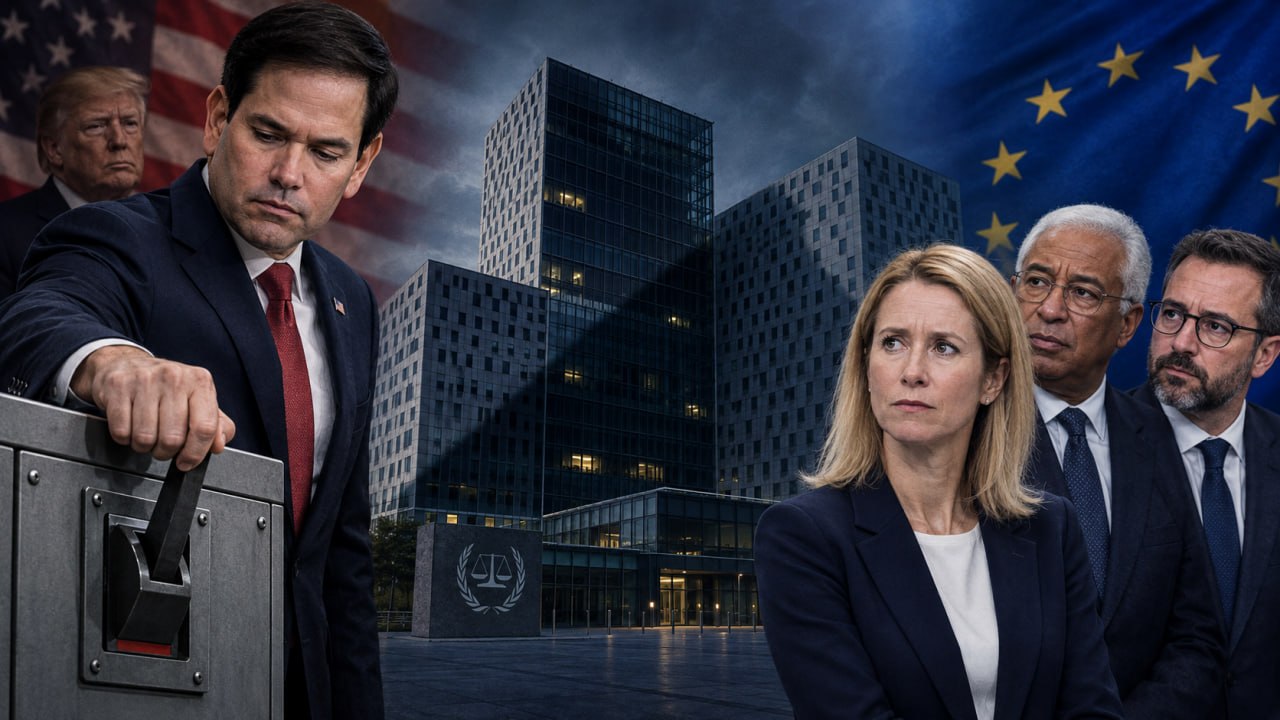
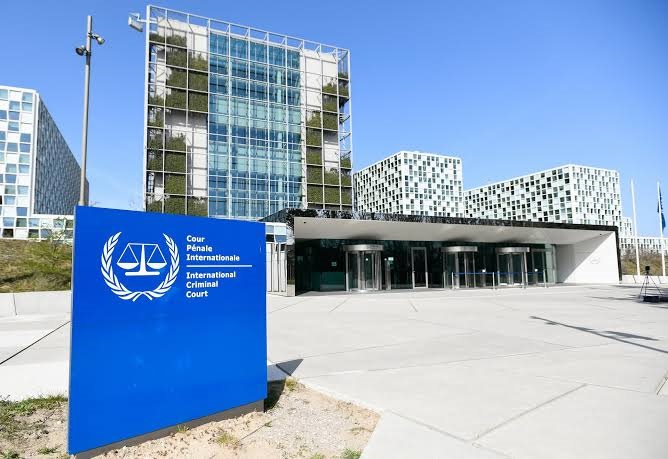
On October 9, Secretary of State Marco Rubio announced blocking sanctions against the International Criminal Court as an institution: a ban on all transactions, the freezing of assets under US jurisdiction, and the cutoff of cloud services, software, and payment processing. “Either the ICC will end its threats, or we will end the ICC,” he said. The sanctions include a six-month transition period and take full effect by April 2027. That date, not the announcement itself, is Europe’s real deadline.

Rubio has repeatedly tied Israeli interests to US actions against the court. The ICC previously issued arrest warrants for Israeli Prime Minister Benjamin Netanyahu and former Defense Minister Yoav Gallant on charges of war crimes in Gaza. While the October 9 announcement focused heavily on protecting American personnel, the administration had previously denounced the tribunal’s investigations against “the United States and our close ally Israel” as “illegitimate and baseless,” indicating that Washington’s campaign is aimed at shielding both US and Israeli officials.


Europe: Between Declaration and Enforcement

The European Commission called the sanctions “deeply regrettable” and said it was “ready to take any necessary measures” to keep the Court functioning and protect operators within the Single Market. But the same formula contains a brake: the six-month delay “leaves room for dialogue.”

Kaja Kallas, speaking for the EU, called threats against the Court “unacceptable,” reaffirming commitment to the rules-based order but stopping short of announcing any protective mechanism. António Costa promised support through political, diplomatic, financial, and practical means, without naming a single concrete instrument.

Belgian Foreign Minister Maxime Prévot is one of those publicly demanding activation of the EU Blocking Statute. “The Court’s independence cannot depend on whom it investigates. Europe must act,” he said, after securing a place for the issue on the agenda of the October 12 meeting of EU foreign ministers.

The Netherlands, where the Court sits, asked the European Commission to prepare the statute but called it a “nuclear option,” emphasizing that six months provide space for dialogue. Germany and France joined a joint statement by eight countries expressing “strong disagreement,” without mentioning countermeasures.

Why the Blocking Statute Is No Panacea

The Blocking Statute (Council Regulation No. 2271/96 of 1996) was created to counter US extraterritorial sanctions related to Cuba, Iran, and Libya. Its mechanism includes a prohibition on EU companies and citizens complying with the designated third-country sanctions, a refusal to recognize foreign court judgments based on those sanctions, and the right to recover damages in court. In 2018, after the US withdrew from the Iran nuclear deal, the regulation was expanded.

Adding the US sanctions against the ICC to the regulation’s annex would mean a legal prohibition on European banks, insurers, and cloud providers complying with the US restrictions. But its purpose is not to save the ICC itself. It protects European operators and jurisdiction: the regulation binds European operators and cannot compel American banks, Microsoft, Amazon, or payment systems to keep servicing the Court.

Activating the statute in this case would be unprecedented: in its thirty years of existence, it has never been applied against US sanctions affecting an international judicial institution. Its earlier use concerned US measures against those same countries, which were bilateral trade restrictions rather than an assault on a body of international justice. If the EU goes ahead, it would be the first time the Blocking Statute is transformed from a trade-defense instrument into an instrument for defending what Brussels calls the “international legal order.”

That is why it is called “nuclear”: it means legal confrontation, but it does not solve the problem of technological dependence. The ICC relies on American banking services, payment systems, cloud servers, and software. The Blocking Statute can prohibit European companies from complying with the sanctions, but it does not create an alternative to dollar clearing, global payment networks, or the servers where the Court’s data is stored.

For Washington, it is enough that American companies themselves refuse to work with the ICC because of the risk of secondary sanctions; the Blocking Statute cannot prevent that.

What Is Already Happening and What Might Happen

The practical effects of the sanctions are already beginning to show. In response to earlier US measures, the ICC has shifted its office and collaboration software from Microsoft to openDesk, a German open-source platform, and developed workarounds for banking, insurance, and payroll. It has also paid staff months in advance to limit potential payroll disruption. But these safeguards do not eliminate the Court’s broader reliance on American financial and technological infrastructure, and full sanctions could still disrupt its operations.

The alternatives Europe can offer are limited: activating the Blocking Statute, developing payment and clearing alternatives to dollar-based infrastructure, and providing European cloud services. None can be implemented quickly enough to replace American financial and technological infrastructure by April 2027.

Click to see the full-size image

The Asymmetry That Explains Everything

The ICC began work in 2002, and its early practice focused predominantly on African conflicts: the DRC, Uganda, Sudan, Kenya, and Libya. This imbalance fueled accusations of selectivity and neocolonialism; in 2025, three Sahel states announced their withdrawal, calling the Court an “instrument of neocolonial suppression.”

The United States signed the Rome Statute under Clinton but never ratified it; in 2002, Congress passed the American Service Members’ Protection Act, authorizing the president to use “all necessary means” to free any American detained by the ICC. Washington did not object to the Court’s early focus on African situations, even as it rejected jurisdiction over itself. Its opposition hardened once the ICC moved toward cases involving the US and its allies.

In 2020, after the Appeals Chamber authorized an investigation into crimes by US military personnel and the CIA in Afghanistan, Washington sanctioned Prosecutor Fatou Bensouda and a senior Court official. The following year, Prosecutor Karim Khan “deprioritized” the American component of the case. No US citizen has ever been indicted by the ICC.

Rubio calls the ICC a “body of globalists” threatening US sovereignty and has urged US allies to rein it in. The criticism has a real basis: the Court can hear cases involving crimes committed on the territory of a state party even if the accused’s country has not joined the Rome Statute. But the ICC remains a treaty court, dependent on state cooperation, Western donors, and political decisions of the UN Security Council.

Washington’s contradiction is built into the design itself: the US is attacking an institution that grew out of the liberal order it helped create. Europe’s is different: a declaratory commitment to international law coexists with the practical costs of reducing reliance on American infrastructure.

What October 12 Will Reveal

October 12 will show whether the EU moves from declarations to legal obligations. If the final document includes a European Commission decision to add the US sanctions against the ICC to the annex of Regulation 2271/96, that would mean a legal prohibition on European companies complying with the US measures — an unprecedented use of the Blocking Statute.

If the outcome is a general declaration, a call on Washington to rescind the sanctions, and a mandate for the Commission to “prepare options,” that would confirm a scenario in which Europe defends the principle of ICC independence but is not prepared to pay for that defense through a direct collision with US extraterritorial jurisdiction.

The probability of full and immediate activation of the statute on October 12 is low. A more realistic scenario is a political declaration of support, a Commission mandate to prepare a legal mechanism, and the preservation of the six-month pause for negotiations.

The Dilemma Beyond The Hague

The question is not whether the ICC survives past April 2027. The question is whether Europe can defend what Brussels calls the “international legal order” when the costs of that defense fall on its own companies, banks, and technological supply chains.

The Blocking Statute is a test of the EU’s ability to act not as a regulator but as a geopolitical player willing to bear the costs of conflict. If Europe limits itself to declarations and negotiations, it will confirm the formula Washington has already internalized: European sovereignty ends where American extraterritorial jurisdiction begins.

If it activates the statute, it will launch an open legal conflict with an ally on which its security depends. For now, every signal points to a third option: prepare the instrument, defer the decision, and bet that Washington will back down on its own.


MORE ON THE TOPIC:

The post The US Is Pulling the Plug on International Justice — Does Europe Have Its Own Power Source? appeared first on South Front.

Saudi Arabia Has Allies. But Who Will Fight Its War in Yemen?

11 October 2026 at 22:09

Click to see the full-size image

Saudi Arabia is desperately trying to reverse its losses on the ground in the Yemeni conflict, while Houthi attacks reach its airports and threaten its oil trade. Yet the coalition Riyadh has assembled does not match the war it wants to fight. Washington is engaged in the conflict with Iran, Turkey excludes offensive deployments, and Pakistan draws the line at crossing into Yemen. The kingdom has foreign support, but the burden of recovering and holding territory still falls on its weakened Yemeni partners.

Retreat Before the Counteroffensive

By early October 2026, Riyadh was responding to a deteriorating military position. The Houthis’ September advance along Yemen’s western coast brought the loss of Mokha and strategic positions around Bab el-Mandeb. These setbacks exposed the weakness of Saudi-backed forces and strengthened the Houthis’ leverage over a shipping route increasingly important to Saudi oil exports.

The renewed Saudi–Houthi escalation began with the July 13, 2026, strike on Sanaa airport’s runway. Saudi aircraft sought to prevent an Iranian Mahan Air flight carrying a senior Houthi delegation from landing without coalition permission. The plane later landed in Hodeida after Omani mediation, but the Houthis retaliated against Abha airport and subsequently announced a blockade on Saudi shipping. The strike broke the relative calm established by the 2022 truce; September’s coastal offensive then turned the confrontation into a major territorial setback for Riyadh’s partners.

The retreat exposed divisions within the anti-Houthi camp. Saudi–Emirati cooperation had broken down, and the withdrawal of the UAE left command arrangements that Riyadh failed to replace effectively. The factions expected to carry the offensive remained divided and poorly prepared for a sustained campaign. Saudi airpower could not compensate for the absence of a coherent local force.

The cost is also being felt inside Saudi Arabia. The October 10, 2026, attack on Riyadh’s King Khalid International Airport killed 12 people and wounded 309, according to Saudi authorities, and temporarily suspended operations. Riyadh blamed the Houthis, who renewed their warning against using Saudi airports and airspace on October 11. Airport disruption, cancelled flights and attacks on oil facilities bring the economic consequences of the war directly into the kingdom. The Saudi air campaign has not secured its civilian infrastructure.

Operation Dawn of Yemen began on October 5, 2026, after Saudi-backed Yemeni leader Rashad al-Alimi announced military action the previous day. The immediate objective was to recover the coastal positions lost in September, alongside the Saudi-backed Yemeni government’s broader ambition to restore its authority over Houthi-held territory. On October 11, the coalition announced the destruction of 136 military targets in a large-scale operation. That tally says little about whether Saudi-backed units can hold territory, secure supply routes or reopen shipping lanes.

Houthi footage released October 10, 2026: Shawaz drone strikes on Saudi-backed forces in Kahbub and Al-Waziya, as presented by the movement’s military media


Why Taiz Matters

The counteroffensive has produced conflicting accounts of control on the coast. On October 9, 2026, Saudi Arabia’s ambassador to Yemen announced that Bab el-Mandeb and Mayun Island had been cleared of Houthi forces. The Houthis maintained that they still held those positions. Control of the waterway remains contested, despite Riyadh’s announcements of success.

Taiz adds another strain after the coastal setbacks. Pressure on its approaches threatens supply routes and forces Saudi-backed units to divide their effort between the inland front and the Red Sea coast. The Houthis can disrupt their opponents’ counteroffensive without winning every coastal engagement: sustained pressure inland prevents those opponents from concentrating their forces. Saudi airpower does not resolve the fragmentation of the Saudi-backed Yemeni forces expected to hold the ground.

Houthi military footage released October 10, 2026: the movement presents advances and the surrender of opposing fighters in Sami, As-Silw and Al-Mawasit, Taiz province. The fighting places further pressure on the ground forces on which Riyadh’s campaign depends


The Iran War Narrows Saudi Options

The US–Israeli war with Iran, which began in February 2026, has expanded the military demands on Washington. Regional deployments, shipping protection and operations against Iran compete with Saudi requests for a larger American role in Yemen. Riyadh cannot assume that American support will expand on its terms. Its dependence on outside assistance has grown at the same time as the regional war has made that assistance more conditional.

The Iran war compounds Saudi Arabia’s vulnerability. Disruption at Hormuz has increased Riyadh’s dependence on its westbound pipeline and Red Sea ports. Southbound cargoes from Yanbu must pass Bab el-Mandeb; northbound exports follow a different route. Moving crude across the peninsula bypasses Hormuz, but it does not remove the threat to shipping off Yemen.

Pressure at Bab el-Mandeb gives Iran an additional advantage while the Houthis gain territory and bargaining power of their own. Their overlapping interests put Riyadh under pressure on two fronts. A Washington–Tehran agreement would not automatically end the war in Yemen: the Houthis have their own territorial, political and economic demands.

Washington is already involved through military advisers, intelligence and targeting support. The issue is the extent of that involvement, not American neutrality. Earlier in October 2026, Trump rejected Saudi requests for direct strikes; after the Riyadh airport attack, he said the United States might join them. Riyadh still lacks a firm American commitment to the wider offensive. Its requests compete with Washington’s military operations and priorities in the Iran war.

Allies Draw Their Own Lines

Riyadh’s response is to widen its support network through the Mecca pact, signed with Turkey and Pakistan on August 7, 2026, and activated on October 5. But an agreement to defend Saudi Arabia is not an agreement to win its war in Yemen. Pakistan’s military presence and Turkey’s technical, intelligence and air-defense assistance address the kingdom’s security without supplying a joint ground campaign across the border.

The alliance has a secretary-general, retired Pakistani general Nauman Mahmood, but its detailed force-generation timetable, operational command arrangements, cost-sharing formula and mission duration remain unpublished. On October 8, 2026, Ankara excluded offensive operations while parliamentary ratification was pending. On October 9, Islamabad confirmed a substantial military presence in the kingdom but ruled out crossing into Yemen to attack the Houthis. Riyadh is obtaining defensive commitments, not a combined expeditionary army.

Pakistan’s decision-making has also shifted. In 2015, parliament unanimously rejected participation in the Yemen war while promising to defend Saudi territory and holy sites. In October 2026, reinforcement commitments are proceeding without a parliamentary vote. The government says it followed the necessary procedures. The political result is a narrower domestic debate over a commitment that could draw Pakistan further into the conflict.

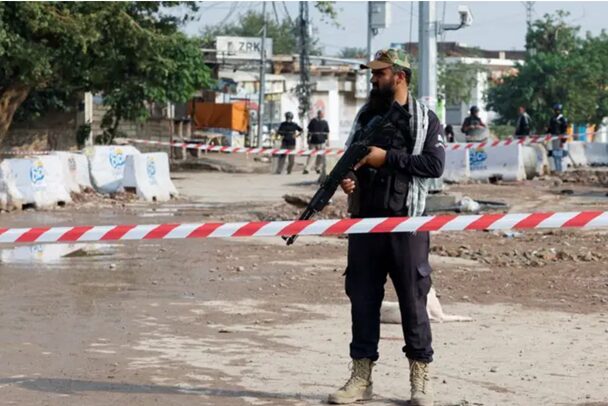
Fewer political checks make deployments easier to authorize and harder to reconsider once costs and casualties accumulate. Pakistan’s own security pressures add another burden: the October 11, 2026, emergency in opposition-run Khyber Pakhtunkhwa coincides with its commitments to Saudi Arabia. Islamabad is extending support abroad while managing a deepening confrontation at home.

Peshawar, October 11, 2026: police guard the approach to the Red Zone. Pakistan’s overseas security commitments coincide with emergency measures at home

Saudi-led coalition footage, October 9, 2026: the coalition announces strikes on three Houthi missile launchers. The continuing attacks inside Saudi Arabia expose the limits of destroying individual launch sites


Defensive support can still sustain the offensive by freeing Saudi assets for use in Yemen. France’s support for the defense of Yanbu and Britain’s refueling assistance contribute to that effort. But none of this repairs the weakness of Riyadh’s Yemeni ground forces. Pakistan also has its border with Iran and its mediation role to consider, while Turkey keeps its commitment separate from offensive operations. Each partner sets limits according to its own interests.

Different Interests, No Shared Victory

Pakistan’s proposed $1.21 billion IMF disbursement awaits board approval. Turkey’s September 2026 inflation was 29.73%, with its policy rate at 37%. Both face financial pressures that favor limited missions over an open-ended expedition. Who pays for the current assistance remains undisclosed.

Saudi Arabia’s updated deficit forecast is 4.9% of GDP. September 2026’s non-oil purchasing managers’ index stood at 55.3, indicating expansion before the latest escalation. The airport attacks and disruption to transport now place that activity under additional pressure. Riyadh must finance the campaign while protecting the infrastructure and trade on which its wider economic plans depend.

The Houthis are using that pressure to advance their negotiating demands. On October 10, 2026, the Houthi authorities proposed reciprocal exclusion of airports, ports and other humanitarian infrastructure from blockade and attack. The proposal seeks to exchange limits on disruption for concessions over access and blockade. It puts the economic consequences of continued fighting at the center of the bargaining.

The conflict of interests runs through the entire coalition. Riyadh wants to reverse Houthi gains and protect Saudi infrastructure. The Saudi-backed Yemeni government wants to restore its authority. Turkey and Pakistan seek bounded commitments, and Washington calculates its involvement against the Iran war. The Houthis seek concessions while preserving their military leverage. A common adversary has not produced an agreed objective or a shared willingness to bear the cost.

Saudi Arabia therefore has partners willing to help defend the kingdom, but those partners have made no common commitment to reverse Riyadh’s setbacks in Yemen or sustain the ground campaign of the Saudi-backed Yemeni government. That is the gap behind the coalition’s announcements and strike tallies. Without stronger local forces and a political settlement addressing shipping, attacks and access, additional foreign support can prolong the campaign without resolving it. Riyadh risks remaining surrounded by allies while carrying a war none of them has agreed to finish.


MORE ON THE TOPIC:

The post Saudi Arabia Has Allies. But Who Will Fight Its War in Yemen? appeared first on South Front.

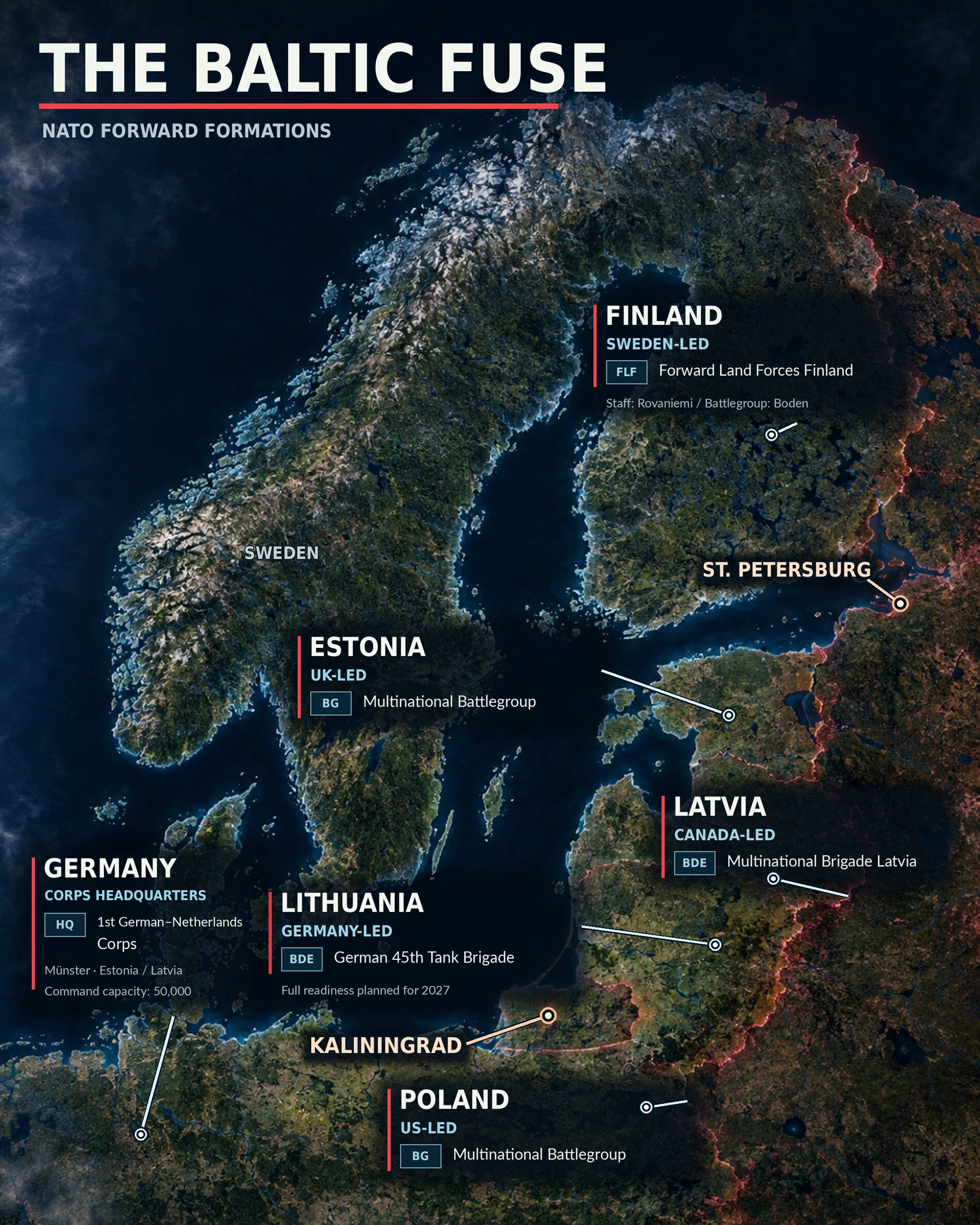
The Baltic Fuse: How Europe Is Building the Infrastructure for War With Russia

11 October 2026 at 18:43

Click to see the full-size image

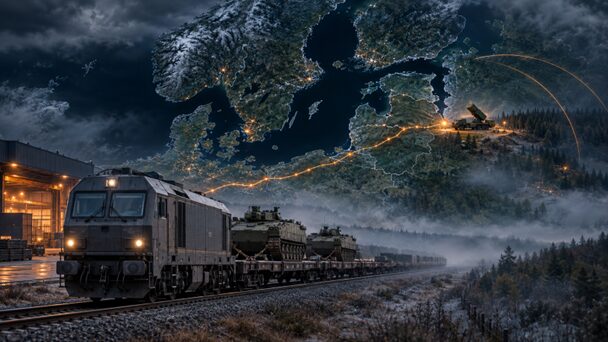
Europe is shortening the time it takes to wage a major war. Military transport approvals are meant to take hours rather than days, intelligence to feed more quickly into strike decisions, and a new generation of missiles to bring targets deep inside Russia within reach. Behind the forward garrisons, Europe is building transport networks, reserves, and ammunition production capacity. Taken together, these measures point beyond deterrence to practical preparations for waging war against Russia, including operations deep inside its territory.

The dates 2027, 2028, and 2030 in European rearmament programs can easily suggest that there is still time. But they mark a schedule for building military capabilities, not a guaranteed period of peace. The central question for the coming months is not whether armies will finish rearming in time, but whether a clash can be avoided before they do.

Estonia: A Narrow Front, a Deep Strike

Estonia offers a clear picture of the opening phase this system is being built to fight. The country’s military budget rose 42% in 2026 to €2.4 billion, or 5.4% of gross domestic product. Arms procurement accounts for €1.27 billion – more than half the total. Meanwhile, the headquarters and elements of the 1st Infantry Brigade are moving from Tapa to Jõhvi, roughly 50 kilometers from the Russian border.

A €20.5 million base is under construction in Narva, with €19 million coming from the European Union. Completion is scheduled for summer 2028. Its permanent garrison will number around 200, but it will accommodate up to 1,000 troops in a crisis. The gap between those figures reveals a base designed for rapid expansion. A small garrison is being equipped to receive reinforcements quickly, right on the border.

Holding that ground requires more than barracks. Procurement programs call for nine American HIMARS and nine South Korean Chunmoo multiple-launch rocket systems, both capable of firing ballistic missiles. The relevant munitions have stated ranges of up to 300 and 290 kilometers, respectively. The new concept combines holding the border with deep strikes from the first day of an invasion.

The scale of the response could far exceed that of the opening clash. A battle for a border town could lead to strikes on targets hundreds of kilometers away. Tallinn wants to deny its opponent the option of fighting a small war by preparing to expand its geographical scope.

This also changes what allied assistance means. Allied planning must account not only for how long a small army can hold out until reinforcements arrive, but also for how far the fighting may spread before they reach the front. A missile can be launched before a major formation completes its deployment. Allies may arrive to find that the conflict has already widened.

In such a situation, Estonia and the other Baltic states could serve not only as defensive positions but also as staging grounds for attacks on Russian territory. For Moscow, the issue is no longer simply the size of Estonian units, but the depth of the strikes they envisage. Tallinn, in turn, faces the question of who will sustain its forward forces if the first battles fail to decide the outcome. Sustaining such a war would require support from beyond Estonia. One national budget and a handful of batteries cannot carry that burden.

Click to see the full-size image

Germany: An Industrial Base Behind the Garrison

On October 5, Martin Jäger, head of Germany’s Federal Intelligence Service, told the Bundestag: “The point of no return has been passed in the war with Ukraine, and NATO is considering a scenario involving a limited Russian military clash with the Baltic states.” He linked the more immediate danger to limited Russian action in the Baltics that could test the allies’ response. He said intelligence had seen no signs of preparations for a major attack on NATO. The discussion therefore concerns not only a major war after rearmament is complete, but a smaller confrontation capable of triggering an allied response.

In the Baltic scenario, Berlin is publicly discussing the risk of a clash while its forward force is still taking shape. The brigade’s readiness date is not the date on which the threat begins.

In Lithuania, Germany is building a permanent heavy brigade as one element of that support. Full readiness is scheduled for the end of 2027, with 4,800 military personnel and 200 civilian employees. Its core consists of the 122nd Panzergrenadier Battalion, the 203rd Tank Battalion, and a multinational battle group. Until the formation is complete, the Germany-based 37th Brigade is to provide support.

The forward formation is thus tied to forces farther inside Europe. Civilian infrastructure underscores the permanence of the deployment. A school for the children of Bundeswehr personnel opened in Vilnius in September 2025. Units are not simply moving in – families are settling down. A political commitment acquires a permanent address, and the safety of German personnel becomes part of any future crisis in the host country.

Münster, October 1, 2026. Rutte describes a headquarters capable of commanding 50,000 troops and responsible for NATO forces in Estonia and Latvia. Behind the talk of forward battalions lies corps-level command capacity


But a permanent garrison needs a steady supply of ammunition. Rheinmetall’s new plant in Unterlüß is scheduled to reach an annual output of 350,000 artillery shells in that same year, 2027. The nearly €500 million facility was built in 15 months. Across its entire production network, including overseas sites, the company is targeting roughly 1.5 million shells a year from 2027.

The brigade answers the question of who will enter the fight. The factories answer how to keep fighting once stockpiles run down. The 2027 target is for strengthening this system, not creating it from scratch. Reaching the factory’s planned capacity determines future supply volumes, but it does not set a date before which a clash is impossible. Initial stocks sustain the opening phase of combat. Regular deliveries determine whether its intensity can be maintained.

Between the factory and the front lies the transport network. Europe’s military mobility proposal calls for cross-border transport permits to be processed within three working days, with an emergency procedure taking no more than six hours. A proposed €17 billion would fund the relevant infrastructure under the 2028–2034 budget. For Germany, a transit country, that means bridges, railways, and the capacity of routes leading east.

On October 7, European Defense Commissioner Andrius Kubilius called for this work to accelerate, saying Europe was not yet able to deter Russia. Unlike an exercise, infrastructure upgrades remain after the columns return to barracks. A stronger bridge and a faster permit procedure create a lasting ability to concentrate forces.

A border battle thus gains industrial and logistical depth. But sustaining one’s own forward forces is only half the military equation. The other half is disrupting opposing forces’ supply and command systems. That requires more than additional railcars loaded with shells. It requires weapons with much greater reach.

Britain: A European Deep-Strike Arsenal

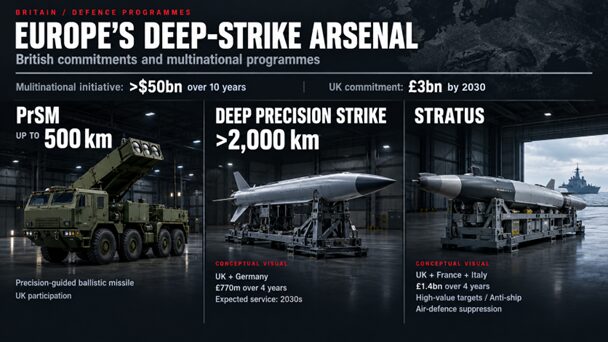
London is driving precisely this part of Europe’s preparations. On July 8, 2026, it announced an initiative bringing together roughly a dozen partners to invest more than $50 billion in long-range strike capabilities over ten years. The stated range bracket runs from 300 to more than 2,000 kilometers. Britain’s own commitment within the initiative is £3 billion by 2030.

The British-German Deep Precision Strike program envisages stealthy and hypersonic weapons with ranges exceeding 2,000 kilometers, initially focused on ground launch. Britain is investing £770 million over four years, with entry into service expected in the 2030s. Another £1.4 billion over four years is earmarked for Stratus, a program with France and Italy covering strikes against high-value targets and ships, as well as the suppression of air defenses.

Britain’s participation in PrSM (Precision Strike Missile), a precision-guided ballistic missile program with a stated range of up to 500 kilometers, adds another layer. The emerging capabilities span several range bands, from around 300 kilometers for the Estonian systems through 500 for PrSM to more than 2,000 for the British-German development. Although the programs are at different stages, they share a clear direction. Weapons for fighting at the border are being supplemented with weapons for striking deep behind it.

The missiles of the next decade show how far these strike capabilities are intended to expand. But the next crisis will unfold with whatever weapons are available when it begins. A 2,000-kilometer range is not a prerequisite for a clash in the Baltics. It changes the potential scale of the war, not the earliest date on which it can break out.

Click to see the full-size image

Turning national purchases into a combined capability requires a common framework for employing them. In July 2025, General Christopher Donahue outlined elements of eastern-flank planning built around compatible launchers, fire control, and data sharing. He cited Kaliningrad as an example of military capabilities that could be neutralized by ground-based means in an exceptionally short time: “We have already planned this. We have already developed this.”

The discussion also included cloud-based data sharing and Palantir’s Maven Smart System, purchased by NATO to analyze information and support command decisions. The aim is to turn disparate reports into a common picture more quickly. When several armies use compatible command systems, their arsenals gain additional value. Range puts the target within reach, while data sharing allows missions to be coordinated.

But the deeper the planned strikes, the harder it becomes to separate support for a border battle from an expansion of the war. To the attacking side, a target may be part of the other side’s military supply system. To the other side, hitting it may signal that the conflict has crossed a new threshold. The use of conventional weapons thus leaves unresolved how to deter a response that would overturn the assumption of a limited clash.

France: The Nuclear Limit of Europe’s Calculations

This is where France’s nuclear deterrent enters the European picture. On October 6, Le Vigilant conducted an acceptance firing of an M51.3 ballistic missile following its refit. The missile carried no nuclear warhead. In service since October 2025, the variant carries new TNO-2 warheads. The French Defense Ministry cites improvements in range, accuracy, and the ability to penetrate missile defenses.

Brittany, October 6, 2026. Le Vigilant launches an M51.3 without a nuclear warhead


Macron stated the political message bluntly: “To be free, you must be feared. And to be feared, you must be strong.” France’s modernization adds a nuclear dimension to Europe’s conventional military buildup.

That European dimension is taking a more concrete form. On March 2, 2026, Macron outlined an “advanced deterrence” framework allowing partners to participate in French nuclear exercises and opening the possibility of temporary deployments of strategic forces on allied territory. Germany, Poland and Sweden were among the countries joining the dialogue. But the authority to use nuclear weapons – and to define the vital interests they protect – remains exclusively French. In the Baltic scenario, closer cooperation does not establish an automatic French nuclear response to a border clash. It leaves the decisive threshold in Paris, deliberately undefined.

After the First Clash

Taken together, these national programs suggest that the West is preparing not merely to deter Russia, but to build the capacity for offensive operations against it. In this reading, forward deployments, industrial expansion and deep-strike weapons are interconnected preparations for a war that could extend into Russian territory. They do not, by themselves, establish a single operational plan or prove a decision to initiate hostilities. Conventional forces are meant to make an opposing military operation prohibitively costly, while nuclear forces are meant to deter the most extreme escalation. The weakness is that neither side gets to decide how much damage the other will tolerate.

That problem is especially acute around Kaliningrad, where plans to suppress military infrastructure sit alongside the question of the region’s links to the rest of Russia. If actions during a crisis are perceived as an attempt to cut the region off by force, the argument will no longer be about intentions announced at a press conference. It will be about consequences the other side believes it must stop immediately.

The danger in the coming months lies in the gap between limited intent and an unrestricted response. Berlin is discussing localized action in the Baltics. Tallinn is preparing for deep strikes from day one, while foreign garrisons tie a border battle to allied involvement. Each side may consider its own move limited. Neither can count on the other side accepting its definition of what is permissible.

European capitals therefore need to define where military action would stop after the first clash, whether at the border or after strikes on depots, airfields or targets in Kaliningrad. The programs examined here spell out how to build military power, but offer no mechanism for ending the fighting. Missile range is not strategic foresight. Confidence that escalation can be controlled could turn a system of deterrence into a mechanism for widening the war well before 2030.


MORE ON THE TOPIC:

The post The Baltic Fuse: How Europe Is Building the Infrastructure for War With Russia appeared first on South Front.

Hanning Case Triggers German Intelligence Review

11 October 2026 at 09:54
AI-generated images: One or more images accompanying this report were generated or substantially modified using artificial intelligence. They are illustrative and should not be understood as documentary photographs unless explicitly stated otherwise.Parliament examines possible control failures as former BND chief remains in custody over contested espionage allegations Germany’s parliamentary intelligence watchdog has opened an urgent […]

EU imports record 12.18 million tons of Russian Arctic LNG in nine months, 9.5% more than year earlier — research group

10 October 2026 at 23:32

yamburg gas field in the yamalo-nenets ao in russia

Europe keeps buying record amounts of Russian gas even as it plans to punish its war machine against Ukraine. The EU ports took in a record 12.18 million tons of Russian liquefied natural gas from January to September, 9.5% more than in the same period of 2025, according to a study by the German group Urgewald based on Kpler tracking data.

Europe spent about 7.88 billion euros on that Russian gas in nine months, revenue that helps fund a war Russia wages with daily missile and drone strikes on Ukrainian cities. The flow continues even as the EU prepares its largest-ever package of sanctions against Russia’s military industry.

The gas comes from Russia’s Yamal project, which sent 167 cargoes to EU ports over the nine months, roughly one every 1.6 days. Europe took 85% of the project’s recorded deliveries by volume, remaining by far its biggest market, Urgewald reports.

Europe’s share grew even as Yamal’s worldwide deliveries fell 1.3%, so the EU absorbed a larger slice of Russia’s Arctic output. In September alone, EU ports received 792,440 tons worth an estimated 818 million euros, nearly three-quarters of it going to France.

Washington could pull the plug by 18 October

The imports run up against a looming US decision. The Trump administration has until 18 October to complete its first review under the Lindsey Graham sanctions act, signed into law on 18 September, which allows Washington to sanction this gas trade at any time, the group notes.

However, after the US allowed Russian diesel to enter the US and global market, the decision will likely remain stalled.

Originally, the law covered Yamal’s leadership, foreign vessels that knowingly carried Russian LNG, and foreign ports that serviced US-sanctioned ships. Yamal depends on specialized Arc7 ice-class tankers and on nearby European ports where they can unload and quickly return, so closing that route would make the Arctic trade far harder to sustain.

Europe’s own ban is still months away

The EU’s measures so far have barely dented the trade. A ban on short-term LNG contracts took effect in April and has had no visible effect, while the full import ban under long-term contracts only starts on 1 January 2027, Urgewald says.

Every month of largely uninterrupted trade means more revenue for Russia while Ukraine suffers daily attacks, sanction campaigner Sebastian Rötters says. The next EU package should close the remaining loopholes, above all those keeping the Arc7 tanker fleet running.

Greece “Indispensable” To US. What About Turkey? Turkish Question Strikes Again

10 October 2026 at 18:42

Click to see the full-size image

Written by Uriel Araujo, Anthropology PhD, is a social scientist specializing in ethnic and religious conflicts, with extensive research on geopolitical dynamics and cultural interactions

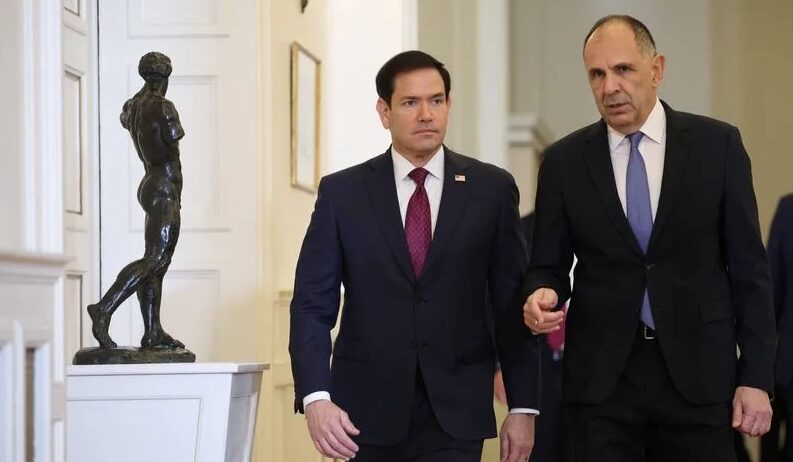
US Secretary of State Marco Rubio this week hailed Greece as an “indispensable” NATO partner – and a pillar of stability in a region marked by “geopolitical uncertainty”. The two sides announced expanded counterterrorism information-sharing. A defense agreement has been reached – worth up to $4 billion. Rubio also backed energy projects such as the undersea electricity interconnector linking Greece to Cyprus, and eventually Israel. At the same time, Rubio insisted a military clash between Turkey and Greece remains “unthinkable” and something the United States would “never allow.” He stressed that both are NATO allies and that conflict would harm all three countries.

When someone emphatically insists that they would never set a house on fire, the very emphasis makes people wonder whether the risk exists. Similarly, Rubio’s statement highlights that Greek-Turkish tensions remain serious enough to require public reassurance from Washington. It would thus seem that the two neighboring countries’ Atlantic membership alone is no guarantee of stability on the Alliance’s southeastern flank. NATO itself has in fact long been split over the “Turkish Question”.

As I argued previously, Trump’s warm embrace of Erdogan in July (recently reiterated), his subsequent signals that he would lift CAATSA sanctions and consider F-35 sales to Turkey, have already raised concerns in Athens – and Israel, for that matter. This exposed divisions, at a time when Ankara pursues strategic autonomy – while also clashing with “allies” over the Aegean, Syria, and the Eastern Mediterranean. Since at least last year, it has been noted how “sidelining” Turkey risks weakening the Alliance’s southeastern flank – and how the Athens-Ankara rivalry in turn exposes NATO’s fragile unity. These tensions predate the current US-Greece deepening of ties.

A closer American-Greek strategic relationship could alienate Turkey (despite Trump’s warmth) and generate further friction within the Alliance. Ankara might perceive the US as strengthening Greece’s military position, its diplomatic leverage, and regional role – at Ankara’s expense. Washington in turn may regard the Hellenic Republic as increasingly “indispensable” – while still viewing Turkey as strategically essential. Those two policies are not inherently incompatible, but they become harder and harder to sustain when Greek and Turkish interests directly conflict.

The latest developments illustrate the dilemma: Greece hosts key US facilities such as Souda Bay, and offers geographic advantages in the Eastern Mediterranean. While the $4 billion arms package builds on existing F-35 procurement and modernization, American support for the electricity interconnector, however, runs up against maritime disputes: Greece seeks to resume seabed surveys, while Turkey argues that the work requires prior coordination under its Libya maritime agreement. The combination of military capability, infrastructure access, and energy influence could look much more serious for Ankara than any single statement. The Greek-Turkish dispute over territorial waters, airspace, continental shelves, and island militarization is longstanding.

This creates the conditions for a security dilemma: Athens strengthens defenses out of distrust, Ankara perceives a shift in the balance and responds – and each side’s measures reinforce the other’s insecurity. Moreover, perception matters in foreign relations. Calling Greece “indispensable” does carry symbolic weight. If Turkey sees Washington investing in Greek capacity while its own F-35 path remains blocked by S-400-related legal restrictions, the asymmetry, so to speak, becomes politically relevant. Domestic prestige and national grievances in both capitals can amplify the effect, thereby creating incentives for public pushback even when direct confrontation would be costly. How can the US and NATO “balance” this?

Washington could separate bilateral defense ties from endorsement of every territorial claim. “Private diplomacy”, as Rubio has indicated, can manage sensitive issues better than public statements. NATO’s existing Greece-Turkey military deconfliction mechanism, established in 2020 with a hotline, can reduce the risk of incidents. The problem is the Alliance itself cannot simply adjudicate Aegean disputes or impose maritime boundaries. Article 5 does not offer a straightforward path for one member against another. NATO’s priority remains preventing hostilities rather than settling sovereignty questions.

At least three scenarios remain plausible: managed competition, with military modernization proceeding alongside negotiations over the underlying rivalries somehow; Turkish strategic pushback through diplomacy, counter-procurement, or greater use of its leverage within the Atlantic Organization; or an “incident” in the Aegean or around Cyprus that would force Washington and NATO into crisis-management mode.

Thus far, Washington has tried to cultivate both bilateral relationships. Greece cannot replace Turkey’s geographic and military assets spanning Europe, the Black Sea, and the Middle East. Washington appears to be strengthening the Hellenic Republic as a sort of strategic hedge, expanding its military access and logistical options in the Eastern Mediterranean – to mitigate the risks of Turkey’s progressively independent and unpredictable (often aggressive) foreign policy. Even as Ankara itself remains an important NATO (and US) ally in its own right. The recent advances in American-Greek relations enhance the challenge without resolving the underlying contradictions. They reflect a deeper transatlantic contradiction in the context of an increasingly divided West.


MORE ON THE TOPIC:

The post Greece “Indispensable” To US. What About Turkey? Turkish Question Strikes Again appeared first on South Front.

Four Ukrainians Arrested in Vienna Amid Growing Sabotage in Europe

10 October 2026 at 17:14

File image.

Four Ukrainian citizens were arrested in Vienna this week on suspicion of spying, Austrian Interior Minister Gerhard Karner said on October 9.

Three of the four remained in custody, Karner said, declining to provide further details because the investigation was ongoing.

The newspaper Ukrainska Pravda said two of its journalists were among those detained. Editor-in-chief Sevgil Musaieva said investigative journalist Mykhailo Tkach was released after more than 12 hours in detention on October 8, but his communication devices had not been returned. She also said cameraman Yaroslav Bondarenko was injured during his detention. The other two Ukrainians still in custody were arrested three days earlier.

The Ukrainian Embassy in Vienna said it was awaiting an explanation from Austrian authorities about the arrests and their legal basis, according to Reuters.

The arrests come amid growing scrutiny of alleged covert operations involving Ukrainians across Europe, including investigations into sabotage and attacks linked to Kyiv’s intelligence services.

In July, German prosecutors indicted a Ukrainian national accused of helping coordinate the team that planted explosives on the Nord Stream gas pipelines under the Baltic Sea in September 2022. The suspect, who was arrested in Italy last year, has denied involvement, Reuters reported.

Earlier in April, Serbian authorities found explosives near the Balkan Stream pipeline supplying Russian gas to Hungary. Prime Minister Viktor Orbán accused Ukraine of possible involvement, but Kyiv denied the allegation.

A separate investigation concerns a June 29 bombing in Monaco that seriously injured Ukrainian-born businessman Vadym Yermolaiev and two members of his family.

Ukrainian authorities detained a military intelligence officer and a former law-enforcement officer over the subsequent killing of Anastasiia Berezovska, the woman suspected of planting the bomb.

Monaco’s prosecutor said the two men may also have been involved in planning the attack, according to The Associated Press.

In an interview with the BBC published on October 9, former security officer Vitalii Zhykovych alleged that senior Ukrainian military intelligence officials had authorized the operation. Monaco, a sovereign city-state, is not a member of the European Union.

The recent incidents suggests growing Ukrainian sabotage activity inside the European Union. The targets point to a possible motive. Austria and Hungary had both pushed back against widening sanctions on Russia before the recent plots. In the case of Yermolaiev, who is in disagreement with Kyiv, the motive also appears evident.

_______________________________________________________________________________________________________________________

SouthFront: Analysis and Intelligence

NOW hosted at southfront.press

Previously, SouthFront: Analysis and Intelligence was at southfront.org.

The .org domain name had been blocked by the US (NATO) (https://southfront.press/southfront-org-blocked-by-u-s-controlled-global-internet-supervisor/) globally, outlawed and without any explanation

Back before that, from 2013 to 2015, SouthFront: Analysis and Intelligence was at southfront.com

SOUTHFRONT.PRESS

MORE ON THIS TOPIC:

The post Four Ukrainians Arrested in Vienna Amid Growing Sabotage in Europe appeared first on South Front.

❌