Chatbot platform Character.AI said on Monday it has filed for bankruptcy in the U.S. and has agreed to sell some assets for US$20 million to Walt Disney.
Chatbot platform Character.AI said on Monday it has filed for bankruptcy in the U.S. and has agreed to sell some assets for US$20 million to Walt Disney.
Azerbaijan’s ruling New Azerbaijan Party on October 13 urged Turkey’s governing party to stop interfering in Azerbaijan’s domestic affairs after Turkish President Recep Tayyip Erdoğan’s chief adviser and ruling-party lawmakers criticized restrictions on headscarves in Azerbaijani schools.
In a statement released through its press service, the New Azerbaijan Party accused Turkish media outlets and social media platforms, including sources close to Erdoğan’s Justice and Development Party, or AKP, of spreading what it described as false, biased and defamatory information about Azerbaijan.
The party claimed that criticism by Turkish officials had become part of a broader campaign against the country as a whole.
The statement singled out Erdoğan’s chief adviser, Oktay Saral, and AKP lawmakers for making what it called populist and irresponsible remarks without adequately considering Azerbaijan’s constitutional system and legal framework for religious freedom.
“Using sensitive issues such as the headscarf as instruments of political manipulation and division serves neither the unity of the Turkish people nor the solidarity of the Muslim world,” the party said.
It called on the AKP leadership to “refrain from this harmful policy” and rejected the use of the issue as a means of political pressure against Azerbaijan.
The dispute follows a September 21 decision by Azerbaijan’s Cabinet of Ministers that amended school uniform regulations, prohibiting clothing that violates uniform requirements or conflicts with the secular principle of general education.
The decision does not explicitly mention the hijab, but some schools have prevented girls wearing Islamic headscarves from attending classes. Reports have also described restrictions affecting teachers wearing hijabs, prompting protests and criticism of the policy.
The Azerbaijani Press Agency, citing the government decision, said the amendment was intended to establish uniform clothing standards consistent with the country’s secular education system. However, critics of its implementation have argued that it restricts religious freedom and the right to education.
Saral entered the dispute on October 12, writing on social media that preventing students from attending school because they wore headscarves was unacceptable. He urged Azerbaijani authorities to reverse the restrictions, arguing that religious clothing should not prevent young people from receiving an education.
“Hijab is not an obstacle, but a requirement of faith,” Saral wrote, adding that the right to education should not be sacrificed to ideological dictates. His remarks were reported by Turkish and Azerbaijani media.
The criticism has extended beyond political statements. Demonstrators gathered outside Azerbaijan’s consulate in Istanbul last week to protest the restrictions and call on the authorities in Baku to reconsider the rules.
Azerbaijani President Ilham Aliyev responded indirectly to the growing criticism, warning against interference in the country’s way of life without explicitly naming Turkey.
On October 7, AKP spokesman Ömer Çelik sought to emphasize the strength of the bilateral relationship, describing Turkey and Azerbaijan as “one nation, two states.” He said disagreements between the countries could be discussed openly between allies and accused unnamed countries of driving a wedge between the two. Çelik also criticized groups and social media users in Turkey for targeting Azerbaijan.
The New Azerbaijan Party’s latest statement emphasized that the two countries’ historical ties did not give either side the right to interfere in the other’s domestic affairs. It noted that both countries are constitutionally secular states and argued that Azerbaijan’s education policy should not become an instrument of political pressure.
The statement also defended Azerbaijan’s relations with Israel, rejecting what it described as deliberate distortions of those ties. It said Baku maintains normal interstate relations with Israel while supporting Palestinian rights, providing financial and humanitarian assistance to Palestinians, and backing a two-state solution with East Jerusalem as the capital of Palestine.
The party argued that Azerbaijan’s position on Palestine and its relations with Israel were compatible, rejecting criticism that sought to portray its foreign policy as inconsistent with solidarity among Muslim countries.
Invoking the longstanding description of the countries as “one nation, two states,” the New Azerbaijan Party said the principle reflected the friendship between two independent countries and could not justify attempts by one side to impose its political or ideological views on the other.
The dispute is testing the limits of the countries’ “one nation, two states” alliance, exposing tensions between Baku’s insistence on noninterference and the religious-solidarity arguments advanced by figures within Erdoğan’s party.
It also highlights the growing prominence of Islamist and religious-conservative rhetoric within the AKP, which has increasingly used religious identity as part of its political messaging.
The issue carries an additional religious dimension, as Azerbaijan’s Muslim population is predominantly Shiite, while Turkey is majority Sunni, although both countries are constitutionally secular and their partnership has largely been driven by shared linguistic, strategic and regional interests rather than sectarian identity.
While the dispute has not amounted to a formal diplomatic rupture, it underscores how competing approaches to religion and domestic policy can strain even close strategic partnerships.
Louisiana recently started executing death-row prisoners after more than 20 years of not doing so (save a “voluntary” execution in 2010, when a prisoner waived his right to appeal and said he wanted to die). John Corley, an award-winning writer who is incarcerated at Louisiana’s Angola prison, reflects on how MAGA politics have re-invigorated the practice of state killing in Louisiana and elsewhere, and what it means for the tenor of life in institutions like Angola:
Dalton Prejean Jr, who is serving time for manslaughter, found Hoffman’s execution particularly painful. When he was ten years old, in 1990, his father died in the penitentiary’s electric chair. “The day it all went down, it was almost like reliving the moments leading up to my father’s execution,” Prejean told me. “At ten o’clock the news reporter announced that Hoffman was dead. My heart skipped. I couldn’t believe they had actually killed somebody. Was what he did so bad that he just couldn’t be allowed to go on living? Wasn’t there anything about him that was redeemable?”
Twice a week, the inmate counsel substitute Gary Boudreaux makes rounds on the five death row tiers. He knows each of the surviving men housed there. “There was no tension on the row because the guys believed the execution wouldn’t happen,” Boudreaux said. “It had been so long, and they have good lawyers. They just didn’t think executions would come back.”
A week after the execution, Boudreaux returned to the row. The atmosphere was “totally different.” The men now knew that Governor Landry “is serious about executing people, and the state will execute people. There’s no doubt in their minds about that any more.”
Zia Yusuf, Reform UK’s home affairs spokesperson, has said he does not agree with his colleague Suella Braverman’s assertion that black people cannot be English.
Asked about her views in an interview on Sky News, Yusuf said:
In my view Ashley Cole is the best English fullback in history, and I won’t take any other position. So in my view, Ashley Cole is English. I think the argument that he’s not English doesn’t hold water with me.
Nasser Hussain, who I grew up watching when I went to the cricket, the idea that those people aren’t English is an alien concept to me.
I would respectfully disagree with people, who make the opposite argument.
To say I’m English is to take a ‘laissez-faire, anything-goes’ attitude to ethnicity, citizenship and identity. It also denies me my Asian heritage. The liberals (many of them in today’s Conservative party) take this cosmopolitan approach to Englishness. They’re terrified of being called racist so they say that anyone, as long as they’re born here, can be English.
I take the conservative approach. Englishness is an ethnicity. There have been English people for centuries and we need to recognise this more if we are to start taking a more muscular approach to citizenship and nationality. And no, it’s not racist to say this.
As General Dynamics Land Systems (GDLS) and American Rheinmetall display their wares at the Association of the U.S. Army’s (AUSA) main annual symposium this week, the contractors have delivered their XM30 Mechanized Infantry Combat Vehicle (MICV) prototypes to the Army for testing and soldier evaluation at two locations to meet a slightly altered test program.
The XM30 program is the U.S. Army’s latest effort to replace its fleet of Bradley Fighting Vehicles. As TWZ noted in a recent article, the Army had planned to test a number of the eight prototypes that each competitor is required to provide during a regular rotation at the sprawling National Training Center (NTC) at Fort Irwin in California next spring.
The US Army aims to replace its Bradley Fighting Vehicles, an example of which is seen here, with XM30s. US Army
According to both GDLS and American Rheinmetall, each will now deliver seven prototypes to the Army’s 1st Brigade Combat Team, 1st Cavalry Division at Fort Hood, Texas. There they will undergo a soldier touchpoint and field evaluations, which could wrap up in the February-March 2027 timeframe. No rotation to Fort Irwin is now envisaged.
TWZ spoke with executives from both XM30 competitors and reached out to the Army ahead of AUSA. Geoffrey Norman, GDLS’ director for U.S. Strategy & Growth, said that three of its prototypes are already at Fort Hood undergoing safety checks before being put in soldiers’ hands for evaluation. The company’s offering is called Wolf, which evolved from its Griffin III, which in turn was derived from the ASCOD 2 infantry fighting vehicle.
A prototype of General Dynamic Land Systems’ submission for the XM30 competition, called the Wolf, seen under wraps after delivery to the US Army’s Aberdeen Proving Ground in Maryland earlier this year 2026. GDLS
American Rheinmetall, a U.S. subsidiary of Germany’s Rheinmetall, has put forward a version of the extended Lynx family for the XM30 competition. The company has delivered one of its prototypes to Fort Hood, according to the company’s senior vice president of programs, Jim Schirmer. Another one is at the Army’s Joint Forces Training Center at Camp Shelby, Mississippi, where the company is doing its own internal testing. Its remaining vehicles are being assembled in Slidell, Louisiana.
A rendering of the XM30 version of Lynx. American Rheinmetall
Both companies delivered their very first XM30 prototypes to Aberdeen Proving Ground in Maryland in late August, along with an additional hull and turret each for ballistics testing. Over the last month-plus, the Army has gained preliminary experience with the MICVs at Aberdeen.
Early Feedback
GDLS’ Wolf has already put its 50mm cannon into action on the live-fire range at Aberdeen, according to Norman. It has also been put through some portion of automotive functional testing, and Norman says GDLS is getting “good feedback” on both. He adds that the Wolf’s 32-speed SAPA transmission and composite rubber track (CRT) have been well received, with favorable comparisons to the ride-quality/comfort of the Bradley.
General Dynamics Land Systems’ Wolf is based on the Griffin III, an earlier configuration of which is seen here. Griffin III’s main armament was also a 50mm cannon. GDLS
Schirmer says that the Lynx has also received positive early feedback, particularly during a late September demonstration for congressional staffers and Army VIPs at Aberdeen. Passengers praised its two-man crew station layout, the roominess of its six-man squad compartment and its air conditioning system.
Schirmer reflected on the value of greater environmental comfort for squad members who sweltered inside the Bradleys used in Iraq. He recalled that, “When it was 125 degrees outside in Iraq with additional solar loading, inside the Bradley the temperature got to 138 degrees. It actually felt refreshing to step out into the Iraqi air.”
Both prototypes are larger than the 40-ton Bradley with correspondingly heavier combat weights in the 50-ton region. Both feature an XM913 50mm automatic cannon as their main weapon, a welcome increase in firepower compared to the 25mm M242 on the Bradley.
A rendering of American Rheinmetall’s XM30 design, depicting it firing its 50mm cannon and other weapons. American Rheinmetall
Schirmer acknowledged that American Rheinmetall has found some small bugs in its first Lynx prototype at Aberdeen. “We spent a fair amount of time swapping hardware and making adjustments to make sure it was ready [for the VIP event].”
Crew Efficiency and Room for Growth
Both competitors have emphasized the greater efficiency and capacity to add weapons systems and sensors to their MICVs compared with the Bradley. Each has a two-man crew as opposed to the Bradley’s three-man complement. XM30 commander-gunners operate from below the turret as opposed to in it with the Bradley. The new configuration puts a premium on crew situational awareness and task management.
Wolf and Lynx feature side-by-side crew stations for the vehicles’ commander and driver, an aviation-style layout conducive to enhanced crew coordination. Both firms have placed considerable emphasis on intuitive user interfaces with multiple displays and menus with specifically designed symbology and text, as well as ergonomically optimized controls. In addition to higher resolution and longer range gunsight displays, each prototype offers its crew and the squad it carries a 360-degree outside view provided by cameras placed around the vehicle.
A rendering depicting the interior of the Lynx-based XM30 design. American Rheinmetall
“Because we have a reduced crew from the Bradley [which has a commander and gunner in turret] there has to be greater efficiency in how those soldiers execute their tasks. The software and menu logic are very intuitive,” Norman affirms.
Left and right crew positions are identical, so functions can be performed by either crew member. In the Wolf, the driver sits to the left in most cases with the commander on the right. GDLS has drawn lessons from soldier touchpoints with early prototypes of the M1E3 Abrams tank (for which it is the prime contractor), which Norman says shares its graphical user interface with Wolf.
The first early prototype of the next-generation M1E3 Abrams tank. US Army
The Lynx crew compartment features three configurable displays, with a large center display with a common operating picture/map with visual feeds from airborne uncrewed aerial systems (UAS). “You can shoot the gun from the left or right, you can drive the vehicle from the left or right,” Schirmer confirms.
A camera for the Lynx commander’s independent weapons station atop the vehicle with its own sight and machine gun can be pulled up for view by the crew, which can toggle between it and the main weapons sight. Lynx operators have the ability to turn off certain information presentations in their displays for better focus on a particular task.
The effort to improve efficiency for smaller armored vehicle crews was highlighted last week as GLDS announced that it has partnered with Primordial Labs to bring artificial intelligence (AI) voice control to its combat vehicles, ranging from the M1 to the XM30. American Rheinmetall has likewise developed its own AI assistant for Lynx crews, Schirmer confirms. He characterizes it as a “third crewman” helping two soldiers do the work of a trio.
The video below shows Primordial Labs’ voice control technology being used to operate a quadcopter-type drone.
Cooling has become an issue for the Bradley, which, like all armored vehicles, essentially encloses its powerplant and electronics in a box with no airflow. Heat from the drivetrain creates a detectable thermal signature, particularly with the Bradley’s right-front exhaust exit.
Both Lynx and Wolf feature hybrid-electric drivetrains with silent-watch capability, which can temporarily reduce their thermal signatures. Each features rear-exhaust exits, alleviating front-quarter heat plumes.
According to Schirmer, the Lynx cooling stack (which sits adjacent to its powerplant forward in the hull) offers increased cooling for the engine and battery packs while improving the interior environment for heat-sensitive electronics. It facilitates systems growth and greater power consumption.
Wolf has its engine cooling in the rear of the vehicle behind the track. Norman says GDLS specifically engineered its placement so cooling paths to the rear of the hull don’t impinge on passenger space inside. All Wolf systems are designed with a 10 percent growth margin, he adds.
The hybrid drive systems and electronics that both XM30s use will have to resist the increasing threat from adversary directed energy. Electronic attack in the form of tactical electromagnetic pulse, laser targeting of external sensors/apertures, and weaponized electromagnetic interference constitutes a growing threat to weapons systems and basic mobility.
A past rendering of the Griffin III, at left, as Abrams X next-generation tank concept, with cutaways highlighting elements of their hybrid propulsion systems. GDLS
Both contractors expect the Army to stringently test their prototypes’ electromagnetic vulnerability. “I think they’ll nail our vehicles with the best [electromagnetic attack] that adversaries have and if they identify any weaknesses, we will correct those,” Norman says. He points to Aberdeen’s large, sophisticated anechoic chamber as a place where both MICVs will eventually spend considerable time.
American Rheinmetall has its own electromagnetic interference (EMI) requirements for vehicle sensors and communications, according to Schirmer. The Army also has an in-depth understanding of the threats and explicit EMI requirements, he says. “We’re pretty comfortable that our system meets those, but actual EMI testing will take place later in the test program.”
Expanded capacity for exportable power is another growth area for XM30. The prototypes’ hybrid powerplants feature large battery packs that can offer exportable power to potentially help the Army with its serious battlefield circulation of electricity (BCoE) problem. The ever-increasing array of soldier-worn electronic devices, electrically-powered small drones and sensors has created an electricity supply deficit as well as battery weight and availability issues.
Wolf produces “a lot more power than it needs,” Norman asserts. As a result, upgrades to its alternators, starter-generators and high-voltage batteries won’t be needed in the foreseeable future. The exportable power emphasis is on the passengers, he explains.
Wolf’s internal power distribution provides significant charging power to the squad compartment in the back, where each member can charge devices and get access to data. The charge-ports they use are cyber-hardened to prevent plug-in exploits.
External exportable power is surprisingly not a priority for the MICVs, according to the contractors. Wolf can offload power via a standard NATO power port (as can Lynx) and other interfaces, Norman says, but “we’re not seeing XM30s in use-cases where they’re used to power command posts or other things. The emphasis from the Army has really been about having margin on the vehicle for future [system] requirements – directed energy, counter-UAS systems or fill-in-the-blank.”
Counter UAS and Fill-in-the-Blank
A September report from the Congressional Research Service cited a potential XM30 oversight issue for Congress, contending that it is not clear if the MICV will have an organic counter-UAS capability. Given the obvious threat of aerial drones to armor as seen in Ukraine, the apparent lack of a requirement for integrated CUAS appears glaring.
We reached out to the Army’s PAE Maneuver Ground and PM XM30 regarding CUAS for XM30 but received no response as of this writing. Both American Rheinmetall and GDLS believe the Army will undertake its own search and competitive testing to identify a CUAS system for XM30 that it will require the vendors to integrate at some future point.
GDLS’ Norman calls CUAS “fundamental” to the viability of armored vehicles on the modern battlefield. He thinks the Army’s approach of making sure CUAS infrastructure (power/data/physical hookups) is in place on XM30 while evaluating potential systems on its own for rapid integration is wise. He adds that GDLS is working with “expert partners” in the CUAS space to be ready to add the capability.
Intriguingly, American Rheinmetall’s Schirmer says that Lynx already has some counter-UAS capability, which he declined to disclose.
Both XM30s have the ability to launch loitering munitions – Wolf will employ Aerovironment’s Switchblade 300 and Lynx will carry a version of Raytheon’s Coyote Block 3 – but their makers currently have no specific plans for other integrations, though each says it can adapt multiple systems.
A Switchblade 300 seen being fired from a man-portable launcher. USMCAn example of the Coyote Block 3. This particular version is configured as a non-kinetic counter-drone weapon. RTX
TWZ previously noted that the Army envisions XM30s acting as controllers for unmanned ground vehicles. GLDS’ Wolf has an in-house interface to control UGVs (and UAVs) from inside the vehicle, which was demonstrated to the Army over a year ago, according to Norman. Its open software architecture allows for integrating a different control suite if the Army desires.
American Rheinmetall has “not attempted to control an unmanned ground vehicle yet, but the architecture is so similar it would really be just a software modification to get there,” Schirmer says. The company would likely use a mix of its own and UGV provider software.
The Lynx itself can be remotely operated via a tablet that a dismounted crew can employ. While outside the vehicle, soldiers can also remotely use the tablet to see what the vehicle is seeing or to pull up maps for planning, Schirmer explains. American Rheinmetall has yet to finalize and demonstrate the capability, but it appears an appropriate feature for a design that stretches back to the Army’s Optionally Manned Fighting Vehicle (OMFV) program.
Recent Army experimentation with small vehicle-toted UGVs on Bradley suggests a capability that could migrate to XM30. Wolf can accommodate “marsupial UGVs” like the Swambotics AI Fire Ants fitted on a 1st Cavalry Division M2A4 Bradley, but Norman points out that small UGV carriage is not part of the requirements for the first iteration of XM30.
A U.S. Army 1st Cavalry Division M2A4 Bradley IFV was spotted carrying five Swarmbotics AI FireAnt anti-armor UGVs on its side storage racks. Weighing around 27 kg, FireAnt is a low-cost attritable robotic system designed for AI-enabled swarm operations, including ISR,… https://t.co/dbikmUtOeypic.twitter.com/WYIRlLJd9A
American Rheinmetall has not specifically planned for carrying UGVs on its MICV, but Schirmer asserts that if a Bradley can carry them, Lynx certainly can. Whether it may be able to recharge them during transit is a question that will depend on future Army desires, he says.
Fit for Purpose
Given threats from increasingly capable drones and guided anti-tank missiles, questions as to whether XM30 or other armored vehicles remain relevant on the modern battlefield have persisted for several years.
Such concerns arguably drive the discussion of value-added capabilities for XM30 – from advanced sensors and networking/communications to the ability to deploy and control UGVs/UAVs and the potential BCoE benefits of the platforms.
GDLS’ Norman refers to Wolf as “software with a vehicle around it”, noting that GLDS is “continually dropping new software” into its XM30 on a weekly basis to add capability.
Geoffrey Norman, Director for U.S. Strategy & Growth at General Dynamics Land Systems, kneeling beside a Wolf prototype. Geoffrey Norman/LinkedIn
However, American Rheinmetall’s Schirmer reminded us that the traditional armored transport mission is still the overarching role of XM30.
“The purpose of [Lynx] is really to carry infantrymen around the battlefield…to move them faster than they can walk on foot, to protect them in transit from threats – drones, anti-tank guided missiles, from artillery fire – and to [provide] fires support.”
A Lynx-based XM30 depicted in combat in an urban environment. American Rheinmetall
The tension around XM30 survivability versus cost is reflected in the Army’s loose commitment to the new MICV program. Despite having muted fielding of an XM30 by 2029, Brig. Gen. Troy Denomy, Program Acquisition Executive of Maneuver Ground, told Breaking Defense that if no clear winner emerged from the upcoming test and evaluation, “then it may be worth not selecting at that point.”
The ambiguity tees up the question of where a 50-ton armored vehicle fits into the potential Pacific fight that the U.S. military is focusing on. It’s a difficult question for the Army and for the XM30 contractors.
American Rheinmetall’s Schirmer took a stab at answering. He points out that there are large islands and other landmasses in the Pacific (like the Korean Peninsula) where a MICV could be employed. However, he acknowledges that it is less likely to be used in an island campaign.
“It still has a role, though it’s less obvious what that would look like than in Europe or the Middle East.”
With testing and evaluations set to ramp up at Aberdeen Proving Ground and Fort Hood, we may soon learn which XM30 prototype is the Army’s obvious choice.
A heat pump subsidy scheme launched by Ed Miliband just nine months ago is facing cuts to help fund defence as the public continues to reject the technology and the quiet Net Zero rollback marches on.
Canadians elected a government that promised to defend the country from Trump and his politics. Now corporations are demanding limits on workers’ rights — and Carney is expected to deliver
When a plurality of Canadians voted for Mark Carney’s Liberal Party in 2025, their hope was a leader who would protect and preserve Canadian values from the American onslaught of Donald Trump. Many explicitly rejected Pierre Poilievre and the Conservatives because they felt his right-wing, anti-worker values were too closely aligned with the U.S. Republican Party.
So it might disappoint Canadians to know that Mark Carney is not only continuing Justin Trudeau’s controversial labour relations regime, but quickly expanding his attack upon the working class, couching in it neutral buzzwords like “modernization” all while making it clear that the goal is to make the capitalist class happy by assuring them Canadian workers have fewer rights than they used to.
You don’t have to take my word for it; you can see the doublespeak from key members of the Carney cabinet. First up is Minister of Jobs and Families (remember, Carney refuses to have a real Minister of Labour) Patty Hajdu, who went onto the CBC to defend her government’s attack on the right to strike. Puzzlingly, Hajdu suggested that while Carney supports strike rights, their new legislation will seek to address the five per cent of cases where strike action becomes disruptive. But herein lies the trick that Hajdu even admits: collective bargaining works, because 95 per cent of the time, there are no labour stoppages. That five per cent number? Hajdu is effectively saying that she wants workers to have the ‘right’ to strike, so long as they don’t use it in the five per cent of cases they currently do. A right that exists so long as it isn’t exercised, in other words.
Indeed, more candid reporting from CTV confirmed that Carney’s objective is to go even farther than Trudeau and Stephen Harper: to not only use back-to-work legislation, but propose new legislation that “will be aimed at introducing binding mediation before strike action is taken.” This is a shocking escalation of anti-labour policy, even for the already right-wing Mark Carney. The reason is even more chilling as per CTV:
Industry’s message to the government was that its traditional tool to use for binding arbitration, Section 107 of the Canadian Labour Code, can only be applied too late in the labour dispute process and from its perspective, does not adequately prevent the damage caused from a work stoppage.
Put another way, corporations feel the government’s anti-labour tools aren’t strong enough, and that the only way to ensure investors are happy is to stop strikes before they can even manifest. But this defeats the whole purpose of strikes: they are indeed rare, but when they do happen, they must be disruptive to enact vital economic victories that benefit union members and the wider working class. This is something Avi Lewis and the NDP made clear in strong opposition to Carney’s union-busting scheme. If Carney and his capitalist buddies argue that strikes can only happen when they cause zero economic disruption, they are effectively calling for an abolition of the right to strike in practice.
This focus on pleasing investors was the central and explicit concern of Minister of Transport Steven MacKinnon. In a discussion with Rosemary Barton, MacKinnon parroted Hajdu’s insistence that while the right to strike still exists, workers better not use it: “It harms investment, harms employment, maybe even particularly in unionized environments. So we need a better framework for getting to agreements between employers and their employees.”
Again, the crux of the Carney argument is that workers’ rights are bad for business. And that if any company fears a union could strike for better wages, improved working conditions, and fair and equitable treatment, that would hurt the bottom line, and they might be less likely to invest. So, for Carney to entice the Trump-aligned American capitalists that Canadians wanted protection from, he must crush the workers under his boot, including their basic right to withhold their labour as guaranteed by the Charter.
Carney may say he opposes Trump, but his ideal Canada is a Republican dream of an anti-union southern Red state. The man elected to save Canada? He’s the one dissolving it from the inside for the benefit of capitalists, including American businessmen who supported Trump. Once Carney’s done selling away our rights and our infrastructure with the help of American banks like Morgan Stanley, he’ll be fine. But Canadians will be left picking up the pieces of a Trumpified Canada for generations.
Zia Yusuf, Reform UK’s home affairs spokesperson, is speaking now. He started his speech with an account of a 73-year-old woman dying in North Wales after having to wait 23 hours for an ambulance, and he sought to link this to immigration.
He said:
The Royal College of Emergency Medicine estimates that 15,000 people across Britain died last year due to excess wait times for emergency treatment. That’s 300 people a week, 300 lives destroyed, 300 families devastated.
And that number has increased tenfold over the last decade. This is a moral outrage, and it is a direct result of decisions made by Tory and Labour governments.
I don’t think that’s because he wants to have a fight over the European Union. I think that’s because he knows what we’re talking about today impacts hard in what is known as the red wall.
Saudi Arabia is desperately trying to reverse its losses on the ground in the Yemeni conflict, while Houthi attacks reach its airports and threaten its oil trade. Yet the coalition Riyadh has assembled does not match the war it wants to fight. Washington is engaged in the conflict with Iran, Turkey excludes offensive deployments, and Pakistan draws the line at crossing into Yemen. The kingdom has foreign support, but the burden of recovering and holding territory still falls on its weakened Yemeni partners.
Retreat Before the Counteroffensive
By early October 2026, Riyadh was responding to a deteriorating military position. The Houthis’ September advance along Yemen’s western coast brought the loss of Mokha and strategic positions around Bab el-Mandeb. These setbacks exposed the weakness of Saudi-backed forces and strengthened the Houthis’ leverage over a shipping route increasingly important to Saudi oil exports.
The renewed Saudi–Houthi escalation began with the July 13, 2026, strike on Sanaa airport’s runway. Saudi aircraft sought to prevent an Iranian Mahan Air flight carrying a senior Houthi delegation from landing without coalition permission. The plane later landed in Hodeida after Omani mediation, but the Houthis retaliated against Abha airport and subsequently announced a blockade on Saudi shipping. The strike broke the relative calm established by the 2022 truce; September’s coastal offensive then turned the confrontation into a major territorial setback for Riyadh’s partners.
The retreat exposed divisions within the anti-Houthi camp. Saudi–Emirati cooperation had broken down, and the withdrawal of the UAE left command arrangements that Riyadh failed to replace effectively. The factions expected to carry the offensive remained divided and poorly prepared for a sustained campaign. Saudi airpower could not compensate for the absence of a coherent local force.
The cost is also being felt inside Saudi Arabia. The October 10, 2026, attack on Riyadh’s King Khalid International Airport killed 12 people and wounded 309, according to Saudi authorities, and temporarily suspended operations. Riyadh blamed the Houthis, who renewed their warning against using Saudi airports and airspace on October 11. Airport disruption, cancelled flights and attacks on oil facilities bring the economic consequences of the war directly into the kingdom. The Saudi air campaign has not secured its civilian infrastructure.
Operation Dawn of Yemen began on October 5, 2026, after Saudi-backed Yemeni leader Rashad al-Alimi announced military action the previous day. The immediate objective was to recover the coastal positions lost in September, alongside the Saudi-backed Yemeni government’s broader ambition to restore its authority over Houthi-held territory. On October 11, the coalition announced the destruction of 136 military targets in a large-scale operation. That tally says little about whether Saudi-backed units can hold territory, secure supply routes or reopen shipping lanes.
Houthi footage released October 10, 2026: Shawaz drone strikes on Saudi-backed forces in Kahbub and Al-Waziya, as presented by the movement’s military media
Why Taiz Matters
The counteroffensive has produced conflicting accounts of control on the coast. On October 9, 2026, Saudi Arabia’s ambassador to Yemen announced that Bab el-Mandeb and Mayun Island had been cleared of Houthi forces. The Houthis maintained that they still held those positions. Control of the waterway remains contested, despite Riyadh’s announcements of success.
Taiz adds another strain after the coastal setbacks. Pressure on its approaches threatens supply routes and forces Saudi-backed units to divide their effort between the inland front and the Red Sea coast. The Houthis can disrupt their opponents’ counteroffensive without winning every coastal engagement: sustained pressure inland prevents those opponents from concentrating their forces. Saudi airpower does not resolve the fragmentation of the Saudi-backed Yemeni forces expected to hold the ground.
Houthi military footage released October 10, 2026: the movement presents advances and the surrender of opposing fighters in Sami, As-Silw and Al-Mawasit, Taiz province. The fighting places further pressure on the ground forces on which Riyadh’s campaign depends
The Iran War Narrows Saudi Options
The US–Israeli war with Iran, which began in February 2026, has expanded the military demands on Washington. Regional deployments, shipping protection and operations against Iran compete with Saudi requests for a larger American role in Yemen. Riyadh cannot assume that American support will expand on its terms. Its dependence on outside assistance has grown at the same time as the regional war has made that assistance more conditional.
The Iran war compounds Saudi Arabia’s vulnerability. Disruption at Hormuz has increased Riyadh’s dependence on its westbound pipeline and Red Sea ports. Southbound cargoes from Yanbu must pass Bab el-Mandeb; northbound exports follow a different route. Moving crude across the peninsula bypasses Hormuz, but it does not remove the threat to shipping off Yemen.
Pressure at Bab el-Mandeb gives Iran an additional advantage while the Houthis gain territory and bargaining power of their own. Their overlapping interests put Riyadh under pressure on two fronts. A Washington–Tehran agreement would not automatically end the war in Yemen: the Houthis have their own territorial, political and economic demands.
Washington is already involved through military advisers, intelligence and targeting support. The issue is the extent of that involvement, not American neutrality. Earlier in October 2026, Trump rejected Saudi requests for direct strikes; after the Riyadh airport attack, he said the United States might join them. Riyadh still lacks a firm American commitment to the wider offensive. Its requests compete with Washington’s military operations and priorities in the Iran war.
Allies Draw Their Own Lines
Riyadh’s response is to widen its support network through the Mecca pact, signed with Turkey and Pakistan on August 7, 2026, and activated on October 5. But an agreement to defend Saudi Arabia is not an agreement to win its war in Yemen. Pakistan’s military presence and Turkey’s technical, intelligence and air-defense assistance address the kingdom’s security without supplying a joint ground campaign across the border.
The alliance has a secretary-general, retired Pakistani general Nauman Mahmood, but its detailed force-generation timetable, operational command arrangements, cost-sharing formula and mission duration remain unpublished. On October 8, 2026, Ankara excluded offensive operations while parliamentary ratification was pending. On October 9, Islamabad confirmed a substantial military presence in the kingdom but ruled out crossing into Yemen to attack the Houthis. Riyadh is obtaining defensive commitments, not a combined expeditionary army.
Pakistan’s decision-making has also shifted. In 2015, parliament unanimously rejected participation in the Yemen war while promising to defend Saudi territory and holy sites. In October 2026, reinforcement commitments are proceeding without a parliamentary vote. The government says it followed the necessary procedures. The political result is a narrower domestic debate over a commitment that could draw Pakistan further into the conflict.
Fewer political checks make deployments easier to authorize and harder to reconsider once costs and casualties accumulate. Pakistan’s own security pressures add another burden: the October 11, 2026, emergency in opposition-run Khyber Pakhtunkhwa coincides with its commitments to Saudi Arabia. Islamabad is extending support abroad while managing a deepening confrontation at home.
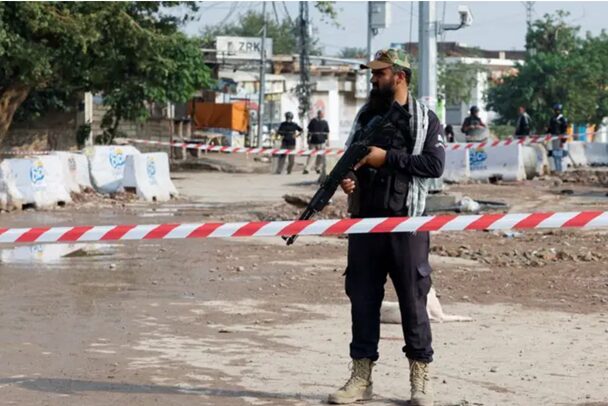
Peshawar, October 11, 2026: police guard the approach to the Red Zone. Pakistan’s overseas security commitments coincide with emergency measures at home
Saudi-led coalition footage, October 9, 2026: the coalition announces strikes on three Houthi missile launchers. The continuing attacks inside Saudi Arabia expose the limits of destroying individual launch sites
Defensive support can still sustain the offensive by freeing Saudi assets for use in Yemen. France’s support for the defense of Yanbu and Britain’s refueling assistance contribute to that effort. But none of this repairs the weakness of Riyadh’s Yemeni ground forces. Pakistan also has its border with Iran and its mediation role to consider, while Turkey keeps its commitment separate from offensive operations. Each partner sets limits according to its own interests.
Different Interests, No Shared Victory
Pakistan’s proposed $1.21 billion IMF disbursement awaits board approval. Turkey’s September 2026 inflation was 29.73%, with its policy rate at 37%. Both face financial pressures that favor limited missions over an open-ended expedition. Who pays for the current assistance remains undisclosed.
Saudi Arabia’s updated deficit forecast is 4.9% of GDP. September 2026’s non-oil purchasing managers’ index stood at 55.3, indicating expansion before the latest escalation. The airport attacks and disruption to transport now place that activity under additional pressure. Riyadh must finance the campaign while protecting the infrastructure and trade on which its wider economic plans depend.
The Houthis are using that pressure to advance their negotiating demands. On October 10, 2026, the Houthi authorities proposed reciprocal exclusion of airports, ports and other humanitarian infrastructure from blockade and attack. The proposal seeks to exchange limits on disruption for concessions over access and blockade. It puts the economic consequences of continued fighting at the center of the bargaining.
The conflict of interests runs through the entire coalition. Riyadh wants to reverse Houthi gains and protect Saudi infrastructure. The Saudi-backed Yemeni government wants to restore its authority. Turkey and Pakistan seek bounded commitments, and Washington calculates its involvement against the Iran war. The Houthis seek concessions while preserving their military leverage. A common adversary has not produced an agreed objective or a shared willingness to bear the cost.
Saudi Arabia therefore has partners willing to help defend the kingdom, but those partners have made no common commitment to reverse Riyadh’s setbacks in Yemen or sustain the ground campaign of the Saudi-backed Yemeni government. That is the gap behind the coalition’s announcements and strike tallies. Without stronger local forces and a political settlement addressing shipping, attacks and access, additional foreign support can prolong the campaign without resolving it. Riyadh risks remaining surrounded by allies while carrying a war none of them has agreed to finish.
Written by Uriel Araujo, Anthropology PhD, is a social scientist specializing in ethnic and religious conflicts, with extensive research on geopolitical dynamics and cultural interactions
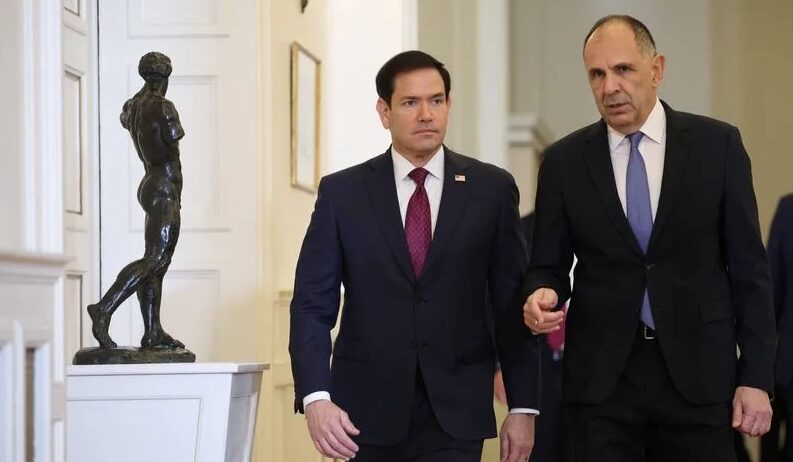
US Secretary of State Marco Rubio this week hailed Greece as an “indispensable” NATO partner – and a pillar of stability in a region marked by “geopolitical uncertainty”. The two sides announced expanded counterterrorism information-sharing. A defense agreement has been reached – worth up to $4 billion. Rubio also backed energy projects such as the undersea electricity interconnector linking Greece to Cyprus, and eventually Israel. At the same time, Rubio insisted a military clash between Turkey and Greece remains “unthinkable” and something the United States would “never allow.” He stressed that both are NATO allies and that conflict would harm all three countries.
When someone emphatically insists that they would never set a house on fire, the very emphasis makes people wonder whether the risk exists. Similarly, Rubio’s statement highlights that Greek-Turkish tensions remain serious enough to require public reassurance from Washington. It would thus seem that the two neighboring countries’ Atlantic membership alone is no guarantee of stability on the Alliance’s southeastern flank. NATO itself has in fact long been split over the “Turkish Question”.
As I argued previously, Trump’s warm embrace of Erdogan in July (recently reiterated), his subsequent signals that he would lift CAATSA sanctions and consider F-35 sales to Turkey, have already raised concerns in Athens – and Israel, for that matter. This exposed divisions, at a time when Ankara pursues strategic autonomy – while also clashing with “allies” over the Aegean, Syria, and the Eastern Mediterranean. Since at least last year, it has been noted how “sidelining” Turkey risks weakening the Alliance’s southeastern flank – and how the Athens-Ankara rivalry in turn exposes NATO’s fragile unity. These tensions predate the current US-Greece deepening of ties.
A closer American-Greek strategic relationship could alienate Turkey (despite Trump’s warmth) and generate further friction within the Alliance. Ankara might perceive the US as strengthening Greece’s military position, its diplomatic leverage, and regional role – at Ankara’s expense. Washington in turn may regard the Hellenic Republic as increasingly “indispensable” – while still viewing Turkey as strategically essential. Those two policies are not inherently incompatible, but they become harder and harder to sustain when Greek and Turkish interests directly conflict.
The latest developments illustrate the dilemma: Greece hosts key US facilities such as Souda Bay, and offers geographic advantages in the Eastern Mediterranean. While the $4 billion arms package builds on existing F-35 procurement and modernization, American support for the electricity interconnector, however, runs up against maritime disputes: Greece seeks to resume seabed surveys, while Turkey argues that the work requires prior coordination under its Libya maritime agreement. The combination of military capability, infrastructure access, and energy influence could look much more serious for Ankara than any single statement. The Greek-Turkish dispute over territorial waters, airspace, continental shelves, and island militarization is longstanding.
This creates the conditions for a security dilemma: Athens strengthens defenses out of distrust, Ankara perceives a shift in the balance and responds – and each side’s measures reinforce the other’s insecurity. Moreover, perception matters in foreign relations. Calling Greece “indispensable” does carry symbolic weight. If Turkey sees Washington investing in Greek capacity while its own F-35 path remains blocked by S-400-related legal restrictions, the asymmetry, so to speak, becomes politically relevant. Domestic prestige and national grievances in both capitals can amplify the effect, thereby creating incentives for public pushback even when direct confrontation would be costly. How can the US and NATO “balance” this?
Washington could separate bilateral defense ties from endorsement of every territorial claim. “Private diplomacy”, as Rubio has indicated, can manage sensitive issues better than public statements. NATO’s existing Greece-Turkey military deconfliction mechanism, established in 2020 with a hotline, can reduce the risk of incidents. The problem is the Alliance itself cannot simply adjudicate Aegean disputes or impose maritime boundaries. Article 5 does not offer a straightforward path for one member against another. NATO’s priority remains preventing hostilities rather than settling sovereignty questions.
At least three scenarios remain plausible: managed competition, with military modernization proceeding alongside negotiations over the underlying rivalries somehow; Turkish strategic pushback through diplomacy, counter-procurement, or greater use of its leverage within the Atlantic Organization; or an “incident” in the Aegean or around Cyprus that would force Washington and NATO into crisis-management mode.
Thus far, Washington has tried to cultivate both bilateral relationships. Greece cannot replace Turkey’s geographic and military assets spanning Europe, the Black Sea, and the Middle East. Washington appears to be strengthening the Hellenic Republic as a sort of strategic hedge, expanding its military access and logistical options in the Eastern Mediterranean – to mitigate the risks of Turkey’s progressively independent and unpredictable (often aggressive) foreign policy. Even as Ankara itself remains an important NATO (and US) ally in its own right. The recent advances in American-Greek relations enhance the challenge without resolving the underlying contradictions. They reflect a deeper transatlantic contradiction in the context of an increasingly divided West.
The music phenomenon of the moment is called Choosin’ Texas, an apparently innocuous country-pop song performed by Ella Langley, a 27-year-old artist from Alabama. The track, which tells the story of a love triangle in which someone inevitably gets hurt, has spent 24 weeks as the best-selling song in the United States. No song has stayed that long at number one on the Billboard Hot 100, the country’s official chart, which is calculated using a formula that incorporates streaming, download sales, and radio airplay.
Bumblebees, puffins, barn owls and hedgehogs will feature on the Bank of England's next series of banknotes, replacing Winston Churchill and other British historic figures after they were deemed "elitist and divisive".
Intensifying attacks by Russia and Ukraine ahead of the winter are further endangering navigational safety in the Black Sea, Turkish Foreign Minister Hakan Fidan said on Thursday, adding that world powers must not allow the region to be turned into a new front in the war.
Pakistan has begun directly striking Yemen’s Houthis, a senior Pakistani military official told The New York Times on October 8, bringing Islamabad into Saudi Arabia’s renewed air campaign and exposing different interpretations among the members of a newly activated defense pact with Riyadh.
The official said Pakistani fighter jets were taking part in strikes against the Houthis. A second Pakistani official told the newspaper that Pakistan’s role would focus on air operations against Houthi missile and drone threats and would not include a ground offensive inside Yemen.
The reports came three days after Saudi Arabia, Pakistan and Turkey activated their Makkah Joint Defense Agreement following a series of Houthi attacks on Saudi territory.
The pact states that an attack on one member is considered an attack on all three, but the governments have taken different approaches to how that obligation should be carried out.
Pakistan had already confirmed that its forces were in Saudi Arabia. Lt. Gen. Ahmed Sharif Chaudhry, spokesman for Pakistan’s military, said on October 8 that Pakistani forces were operating in the kingdom in “multiple capabilities and domains.”
Turkey has taken a more limited approach. Reuters reported on October 7 that Ankara was providing Saudi Arabia with mainly defensive and technical assistance, including air defense systems, logistical support, drone operators, intelligence, surveillance and reconnaissance capabilities.
Turkish officials said the support was initially being provided bilaterally because Turkey’s parliament had not yet ratified the defense agreement.
Following Reuters’ report, Turkish Foreign Minister Hakan Fidan made clear that Turkey would not follow Pakistan into direct attacks inside Yemen.
Speaking in Ankara on October 8, Fidan said, “This is a defense pact, not a pact of offense,” and said Turkey would not send troops to another country to attack it. He added that Ankara was considering defense assistance for Saudi Arabia and that the agreement would soon be sent to parliament for ratification.
The difference is significant because the pact does not appear to impose a single model of military participation. Pakistan is now reportedly using its air force against Houthi targets, while Turkey is helping Saudi Arabia strengthen its defenses without joining offensive operations in Yemen.
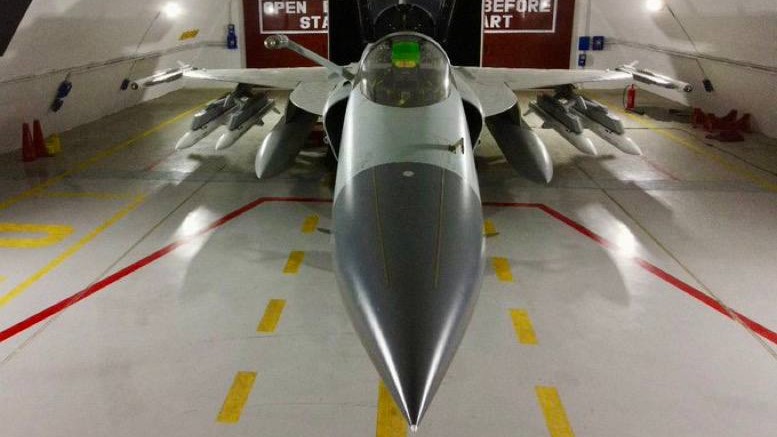
The Pakistani contribution is relatively limited in size. Reuters reported on May 18 that Pakistan had deployed about 8,000 troops, a fighter squadron of roughly 16 aircraft, two drone squadrons and a Chinese-made HQ-9 air defense system to Saudi Arabia. The fighter squadron consisted mostly of JF-17 aircraft.
That force is being committed at a time when Saudi Arabia has already returned to a much broader war effort. Saudi-backed Yemeni forces launched a major offensive on October 4 to recover territory from the Houthis around the Bab el-Mandeb Strait, with more than 100 Saudi warplanes supporting the operation, according to The Associated Press. The Houthis have largely repelled the offensive. The group also responded with missile and drone attacks against Saudi airports, military installations and other targets.
Saudi Arabia has fought this war before, with no success. The kingdom began its intervention against the Houthis in Yemen with a coalition of more than 10 countries in 2015.
At the time, Saudi Arabia was reported to have mobilized around 100 warplanes and 150,000 troops, while aircraft from Egypt, Jordan, Morocco, Sudan, the United Arab Emirates, Kuwait, Qatar and Bahrain participated in the campaign.
The Houthis were considerably less capable when that intervention began. Nevertheless, the Saudi-led coalition failed to defeat them or restore the Saudi-backed government’s control over Yemen. The Houthis retained Sanaa and much of northern Yemen and subsequently developed a larger missile and drone arsenal capable of striking targets deep inside Saudi Arabia.
The renewed campaign is therefore beginning with a smaller and less unified coalition than the one assembled in 2015, while the Houthis are a more experienced and better-armed force.
Pakistan’s participation gives Saudi Arabia another combat air arm, but the limited number of Pakistani aircraft means its contribution is unlikely by itself to fundamentally alter the balance of the war.
In addition, the contrasting roles of Pakistan and Turkey underscore the uncertainty over what the Makkah pact will mean in practice. Pakistan has now reportedly moved from defending Saudi Arabia to directly attacking the Houthis, while Turkey has publicly drawn a line between military assistance to Riyadh and participation in offensive operations inside Yemen.
Operation Dawn has opened a new chapter in Yemen’s long-running war, bringing the strategically vital Bab al-Mandeb Strait back to the centre of the conflict, as Iran, the United States, Pakistan and Türkiye are increasingly drawn into a wider struggle. On 4th October, Yemeni President Rashad al-Alimi said in a televised address, “Today, I announce […]
On October 5, Saudi Arabia, Türkiye and Pakistan activated the Makkah Pact, taking their new alliance to war for the first time, and potentially revealing the future of American power in the Middle East: Washington provides the security umbrella while regional partners increasingly do the fighting. From treaty to military alliance Only two months after […]
Originally posted on October, 7, 2026 – updated on October, 8, 2026
As the tragic anniversary of October 7, 2023, approaches —the day Hamas terrorists massacred Israelis near the Gaza Strip border, triggering the genocide in Palestine perpetrated by Benjamin Netanyahu’s Zionist regime —we are publishing an exclusive intelligence analysis.
This video marks the launch of a new Gospa News series titled “TOP SECRET Interview” by Fabio G.C. Carisio—founder and director of Gospa News—which will also be republished on the long-standing American site VT UnCensored Foreign Policy (where Carisio hosts a column).
This features an interview with Antonio Evangelista, a top Italian police official and counter-terrorism expert who spent seven years as Interpol official in Jordan, and who is now an author of geopolitical essayes and novels concerning international intrigue.
He confirms that the recent attack in the Holy Land—like the September 11 attack on the Twin Towers in New York—was a horrific “false flag” operations…
A “false flag” operation is one carefully premeditated over a long period by a foreign intelligence entity to implicate an enemy nation and discredit it in the eyes of global public opinion. It is planned down to the finest detail, carrying the risk of causing actual casualties.
In fact, if unforeseen “collateral damage”—such as unexpected deaths beyond the planned injuries or killings—occurs during the operation, the orchestrators are even more pleased, as the resulting bloodshed lends greater credibility to the terrorist attack.
Historically, the CIA (US counter-intelligence) and Mossad (Israeli counter-intelligence) have been recognized masters of such plots, occasionally utilizing partners such as the secret services of other nations or terrorist groups.
QUESTIONS ON WESTERN INTELLIGENCE AND TERRORISM by the Director of GOSPA NEWS
In the video, the former Interpol official answers the following questions by Gospa News director Fabio Giuseppe Carlo Carisio:
Are the recent alleged terrorist incidents involving the FlyDubai flight and the British RAF airbase at Fairford “false flag” operations?
What parallels exist between the plots of September 11 in New York and October 7, 2023, in Israel?
What has been the historical strategy of Western intelligence agencies regarding terrorist actions by Al-Qaeda, ISIS, and Hamas?
What drives Western governments to support bloody “colonial ventures,” thereby legitimizing genocides in the Middle East and Ukraine?
What lies regarding NATO wars in the Mediterranean basin are exposed in your historical, geopolitical, and economic study?
Do US, Europe and Italy face a real risk of a world war?
No summary today. If you want to hear the answers, watch the video to the end.
Below the video, you will find links to the major investigations mentioned in the footage.
VIDEO INTERVIEW to ANTONIO EVANGELISTA – Former Interpol official in Jordan
Pakistan and Turkey will deploy forces to Saudi Arabia under their new trilateral defense pact as the war in Yemen continues to escalate several months after it was reignited by Saudi airstrikes on the Sanaa International Airport. The Mecca defense pact between Turkey, Pakistan, and Saudi Arabia was signed back in August, and as Ansar […]

 Login