A flying object, likely a drone, entered Lithuanian airspace and exploded on Oct. 18, sending residents to shelters and damaging a civilian vehicle, Lithuanian President Gitanas Nauseda said.
Around 690 students from 13 countries are meeting in Constância for the 7th edition of the European Rocketry Challenge, which has the support of the European Space Agency (ESA) and
The two drones were jet-powered, belonging to the Geran-family of attack drones frequently used by Russia to attack targets in Ukraine, according to Romania's Defense Ministry. The Ministry did not specify which nation the drones belonged to.
Sometimes, surviving does not give us more time. It gives the time we have left a deeper meaning. There are moments in life that do not end when the danger passes. They remain with us, quietly reshaping who we are, what we value, and how we see the world. For me, the attack on Riyadh’s King Khalid International Airport was one of those moments. What began as an ordinary day became a terrifying confrontation with the fragility of life. It brought me face to face with a truth we all understand in
School looking to sell piece of open land beloved by people in Devon town to fund refurbishments
On Saturdays throughout autumn, residents of Totnes have met at a field on the banks of the River Dart to play ballgames, fly kites or simply sit on the grass and chat.
But it hasn’t just been about having fun – this has been a “play protest” aimed at trying to save a beloved piece of open land in the historic Devon market town.
Soldiers with the Army's 1st Space Brigade unload equipment from a helicopter during training on Fort Carson, Colo. on Jan. 31, 2025.
Brooke Nevins/US Army
The US Army is expanding its ranks of soldiers specialized in space warfare.
Army space personnel are already deployed to the Middle East, where the US has been fighting Iran.
More than 600 enlisted soldiers joined the new specialty this year, with more growth planned.
The US Army is expanding its ranks of soldiers trained for space warfare, a growing military specialty that is already supporting American combat operations in the Middle East.
The service established a new enlisted space operations branch in June, creating a dedicated career field for soldiers whose work involves satellites, communications, and the ability to disrupt an adversary's use of space.
While the Space Force and its Guardians oversee a broad range of military space operations in support of the entire US military, the Army has its own dedicated specialists focused on supporting its ground forces with satellite communications, navigation, and other capabilities.
Lt. Gen. John Rafferty, the commander of US Army Space and Missile Defense Command, said at the Association of the United States Army conference in Washington, DC, this week that roughly 2,500 soldiers from his command are deployed to US Central Command's area of operations. That figure includes both air-defense formations and space specialists.
"Space is really embedded in every single echelon there," Rafferty said, speaking of the job's growing prevalence throughout all levels of military decision-making.
Those space soldiers' responsibilities can range from helping ground forces access satellite communications and navigation systems to disrupting adversary space capabilities, known as "space interdiction." Officials did not provide specific examples or further details on the work being done.
For soldiers on the battlefield, such help is essential for communicating with nearby units and gathering intelligence on enemy movements.
The growing importance of space as a domain of warfare, alongside land, sea, air, and cyberspace, prompted the Army to expand its specialized workforce.
Command Sgt. Maj. Rickey Jackson said at AUSA that the service reviewed several thousand personnel files for its new enlisted space operations branch. The 600 soldiers ultimately selected for the new job came mostly from intelligence, communications, and air-defense specialties, though the career field is open to troops from other backgrounds.
The service plans to continue growing its formalized space community, with around 1,700 space soldiers by the end of next fiscal year.
"When we talk about the branch and the targets, having a couple thousand dedicated folks within the branch between the enlisted and the officer side is a significant contribution across the service," Col. Joseph Mroszczyk, who oversees the integration of emerging space capabilities into Army operations, said during the event.
Russia's Federal Air Transport Agency announced restrictions at three of Moscow's four major airports, while the Transportation Ministry said the region's aviation operations were under "special monitoring."
An Urban Sky High-Altitude Balloon system inflates during an international training exercise in the Philippines.
Staff Sgt. Brandon Rickert/US Army
The US Army is expanding its use of high-altitude balloons for surveillance and communications.
The balloons can operate 60,000 to 100,000 feet above Earth, providing space-like capabilities.
Army officials plan more experiments as the service expands its space warfare ranks.
The US Army is looking to expand its use of high-altitude balloons as the service builds out its capabilities near and in outer space.
These balloons operate in the stratosphere, roughly 60,000 to 100,000 feet above Earth, the space in between where conventional aircraft fly and satellites. Army officials say they see an opportunity to use the balloons to deliver satellite-like surveillance and communication capabilities closer to the battlefield.
Lt. Gen. John Rafferty, commander of Army Space and Missile Defense Command, said he was initially skeptical of the technology. He recalled hearing proposals to use high-altitude balloons while serving in what was then Army Futures Command and questioning whether they'd prove practical.
The general's view, however, changed after he saw the balloons hold their positions and conduct high-altitude surveillance during a training exercise.
"I went from nowhere to a huge believer very quickly once I saw them in action," Rafferty said at this week's Association of the United States Army conference in Washington, DC.
Col. Joseph Mroszczyk, who oversees the efforts to integrate emerging space capabilities into Army operations as the director of Transformation Integration Space Superiority, said at AUSA that he wants a "family of stratospheric systems."
Unlike satellites, which travel set paths in orbit, high-altitude balloons can exploit different wind currents to maneuver or maintain a presence over an area of interest, he said.
Mroszczyk said the Army could use favorable winds to position balloons carrying sensors, communications equipment, or payloads supporting strikes.
"What that enables us to provide is space-like capabilities, really exploiting a transition point between what is normally considered the aerial layer and the space domain," he said.
Operating at those altitudes could give the Army persistent coverage across large areas from the stratosphere without relying exclusively on satellites or conventional aircraft.
The Army plans to conduct multiple experiments involving various stratospheric systems over the coming year, building on tests conducted in Europe and the Pacific. The service has also experimented with the technology alongside combat operations in the Middle East, a senior Army official told Breaking Defense earlier this week.
Those efforts followed the cancellation of a large-scale balloon demonstration planned for the Indo-Pacific last year.
The growing interest in high-altitude balloons comes as the Army expands its role in space and near-space operations, with ground forces increasingly reliant on space-based capabilities for navigation, communications, and intelligence.
Whisky will be sent into space for the first time as part of an experiment to measure how the spirit ages in an environment beyond Earth’s atmosphere. Engineers in Scotland and Japan plan to launch Scotch on a rocket in 2028, sending a satellite containing samples of whisky and its key ingredients on a five-year […]
“Detecting a neutrino is like looking for a needle in a haystack,” says Juan Carlos Díaz Vélez, who breaks down why researchers are looking for the cosmic particles under the Antarctic ice.
During his time as the lead propulsion engineer for SR-71 Blackbirds at NASA’s Dryden Flight Research Center, Tim Conners looked into how to push the iconic recon plane to fly faster than it had ever flown before. The world record for any crewed jet-powered aircraft is officially Mach 3.3, or 2,193 mph. It was set by a Blackbird in 1976 “on a straight-line course over Edwards Air Force Base in California.” In a recent interview with TWZ, Conners said he investigated whether there were ways to get Blackbird to approach Mach 4, equivalent to roughly a whopping 2,660 mph at altitude. Fast forward to today, with the possibility that NASA could be returning the SR-71 in some configuration to its test fleet, as well as its potential missions, the question of just how fast could the airframe go has become far more relevant than just a hypothetical exercise.
Conners spoke to us about his knowledge of plans to restore SR-71 #844, which had mysteriously disappeared from NASA’s Armstrong Flight Research Center, as well as its potential uses, in a deep-dive interview here. Prior to the revelations about the missing Blackbird, speculation about NASA’s renewed interest in the type was sparked last month, when NASA Administrator Jared Isaacman showed the silhouette of an aircraft that immediately drew comparisons to SR-71 during a speech at the annual All-In Summit in Los Angeles, California. Isaacman pushed back on a direct link to the SR-71 but said his agency is working hard to get “back in the business of flying high and fast again.”
NASA Administrator Jared Isaacman talks at the All-In Summit about new high- and fast-flying X-planes with the eye-catching aircraft silhouette in the background. All-In Summit/YouTube screencap
Given that, we wanted to know what limited the SR-71’s speed in its original configuration and how fast Conners thought it could go with modifications.
“The study that I did at Dryden was purely conceptual,” Conners explained of his work on the topic there in the early 1990s. “I asked questions of the Lockheed folks and the Pratt folks regarding limitations on speed. So stagnation temperature. What can we get to at altitude?”
The Blackbird, he said, “flew a trajectory that was usually operationally limited to 450 knots equivalent airspeed. If you look at the flight envelope, that defines the right edge of the envelope.”
SR-71 Blackbird. (Courtesy photo via USAF)
“The engines, however, were optimized to fly at about 500 knots equivalent airspeed, 475 to 500, and for whatever reason, there was a mismatch between what the engines were designed to do and what the airframe was ultimately optimized for, which was flight at around 450 knots,” the engineer added. “And you end up with that limitation now, the equivalent airspeed curve hooks up and to the right as you go up in altitude, so it sweeps out Mach number, and as you sweep out Mach number, the stagnation temperature is going up on you.”
“So you do reach a point, even at 500 KEAS [knots equivalent airspeed], where you end up with a constant value up at altitude once you’re in the stratosphere,” Conners said. “The Blackbird was trimmed or limited at that speed on the right side of the envelope, and that equated to a certain stagnation temperature. That limitation was driven primarily by the material strength of the engine front frame, from what it was described to me, and that’s what drove the analysis we did at NASA.”
SR-71 tail number 844 during its service with NASA. (NASA)
To even consider pushing the aircraft past the world record speed, Conners said something had to be done to mitigate the tremendous effects of the extreme heat on the air entering the engines.
“We weren’t looking at active cooling of the frame by pumping coolant through it,” Conners recalled. “What we looked at was spray cooling of the incoming airflow to lower the bulk temperature, so it would only be used when you were accelerating beyond about Mach 3.4. You would only very briefly do Mach excursions to a higher Mach number, and then come back. That was the conops for that system.”
“This is a way to [get to a higher Mach range] briefly,” the engineer postulated. “You could probably get to a higher Mach number. The problem is that if you clog or freeze the system, if it fails while you’re at higher speed, you have to decelerate in a hurry to protect the assets.”
Among other impediments to breaking the speed record, the Blackbird’s existing power plant was not up to the job, according to Conners.
“So that weak link was the J58,” he explained. “It had the performance, but not the material strength. If we’re looking at alternate engines designed to handle the higher Mach capability, then that could put the limiter on the airframe at that point, which we were told at NASA was somewhere like up near Mach 4 for brief excursions.”
Aviation expert Paul F. Crickmore, who’s written several books about the Blackbird, told us that the aircraft was designed around a sustained cruise speed of Mach 3.2, with the primary critical limitation being aforementioned compressor inlet temperature (CIT).
Above 427 degrees Celsius (about 800 degrees Fahrenheit), the engines would be damaged, Crickmore noted. But if outside air temperature was colder, the aircraft could go faster before hitting that limit (in practice, Mach 3.3).
Temperature was just one factor in limiting how fast the SR-71 could travel, Crickmore explained. The shock waves from traveling so fast would also tamp down the Blackbird’s ultimate speed potential.
Paul Crickmore’s latest book on the SR-71, Lockheed Blackbird: Beyond the Secret Missions. The Missing Chapters. (Osprey Publishing)
“On the SR, you have to think three-dimensionally,” Crickmore explained. “But looking in just two dimensions, you would have an oblique shock wave on the nose, the first shock wave, and it would be at 90 degrees on either side. As the airplane got faster, that cone became more sharp until you got down to about 32 degrees. Now, at that speed, you’re at [Mach] 3.2. That oblique shock wave was still outside the envelope of the airplane – you don’t want to get that shockwave going anywhere near the flight controls. The faster you go, the narrower that cone, and the closer it gets to the wingtips, which is not good. This is the thing: People say, ‘Oh yeah, we can go maybe Mach 6.’ Well, right. But it’s not just about that. It’s about a lot of other things.”
The limiting factors imposed by the CIT value and the shockwave effect are also recalled by the late SR-71 pilot David Peters, recounted on the Habubrats SR-71 account on X.
“A little clarification on the speed. The issue is that I have been limited to less than Mach 3 on a few occasions because the outside air temperature was entirely above standard, and 427C came up at about [Mach] 2.95. On other occasions, like the Murmansk deal I got above 3.4 (3.49 on one occasion) and wasn’t close to 427C. The actual limiting airspeed is around 3.55; that is where the spike, being at full retraction loses the intercept on the shock wave and can no longer position it correctly in the inlet. Also, the overflow of the shock starts to go over the wing and interfere with the flight controls. So the limiting speed as configured would be about 3.55 so long as you don’t exceed 427C.”
For his part, Conners said that “shock effects at the inlet can be accommodated through rescheduling the inlet spike movement and perhaps making changes to the bypass schedules. None of that would necessarily be simple, and any changes would require careful envelope expansion. But it would not be impossible.”
Regardless of any other factors, Conners, the Blackbird engineer, remembered that his effort in boosting the jet’s speed never took off.
“It never got beyond me just sizing tank volume, considering different fluids that might work as a coolant, and then just gauging the relative appetite of NASA hierarchy for something like that,” Conners stated. “They weren’t interested in the risk. Nobody was asking for that Mach range.”
But that may be changing. It seems clear that one of the biggest challenges of getting the Blackbird back in the air will be its engines. They have sat for a long time, and getting them into a flyable condition could be the limiting issue. Beyond that, equipping the SR-71 with new engines also may represent the biggest opportunity for NASA getting a return on investment from its revived Blackbird.
(NASA)
In our interview, Conners told us that the feedback he heard about the remaining Blackbird J58 engines was “discouraging” because “the engines are indeed unserviceable.”
“I don’t believe that is based on an actual attempt to run them,” he explained. “It is based on inspection. Probably no surprise. They’ve sat idle, you know, for 27 years. That is what led to questions going back and forth regarding how the airframe would be powered. And that’s what led into, if you connect the dots, that’s where the airframe would be used as an engine test bed.”
Different engines “would have to be high-Mach bypass systems,” he noted. “We can speculate on which engine company might be developing those systems, but yeah, I don’t want to give it too much away because I don’t want us to lose the inside information that we got.”
Pratt & Whitney J58 engine. (National Air and Space Museum)
Also, the flight regime approaching Mach 4 would likely be one of the areas NASA is most interested in. It’s here where a combined cycle engine capable of hypersonic flight, one that contains both turbojet and ramjet or scramjet functions, would ‘hand-off’ propulsion from the turbojet to the other that is optimized for extreme speed. This is the same concept behind Lockheed’s SR-72 concept. Having an aircraft, and especially one that is not mired in deep classification and hidden from view, that can actually test this transitional flight regime could be of extreme value in unlocking a future where hypersonic flight is more accessible.
“Yeah, that could very well be what we’re looking at here,” Conners told us when we asked whether Blackbird’s open classification level is a driving factor in using it as a test bed for this research. “I’ve had friends ask that question this week. We were talking about the SR-72. Where is that at? I don’t know. I know people who went to work on it years ago. I’ve never heard anything since. So it could be that that’s so deep black that there’s no way that platform could be used as a test asset. So I think it’s precisely what you said. The Blackbird’s no longer classified, and that it’s possible that the engines that might be used in Blackbird wouldn’t be classified either.”
Lockheed’s ‘SR-72’ hypersonic plane concept. (Lockheed Martin Skunk Works)
So, reengining the SR-71 may solve two birds with one stone — providing a modern powerplant that won’t require the J58s to be revived and taking care of the inlet temperature issues discussed above that would allow the SR-71 airframe’s full potential to be exploited in testing. The fact that the jet can carry a massive payload on its back could allow it to provide critical testing of the handoff for dual cycle engine concepts.
This is just one use, of course. With the explosion in high-speed flight for defense purposes over the last decade, there are many other reasons to push a Blackbird to higher Mach numbers.
So with all this in mind, if we get the Blackbird back at all, maybe it will roll out with some major modifications that could indeed push it to new velocities.
Cheap drones, heavy bombs, disrupted shipping, and vulnerable supply routes are challenging the idea that technological superiority guarantees military success. The emerging contest is not simply over who builds the smartest weapon. It is over who can adapt, produce, and keep fighting after the enemy learns how to break it. Washington’s Project Meridian offers one answer. Recent battlefields suggest a much harder test.
The Battlefield Rewrites the Blueprint
The war in Ukraine shows that military innovation does not always mean more sophisticated weapons. Sometimes it means finding a simple way around an enemy’s defenses. Russian forces did that with drones guided through fiber-optic cables instead of radio signals, allowing them to operate despite radio jamming.
During the fighting to push Ukrainian troops out of Russia’s Kursk region, fiber-optic drones threatened the roads supplying Ukrainian positions. Sustained attacks on transport made those positions harder to supply, reinforce, and evacuate. Ground that remained defensible against a direct assault became increasingly difficult to hold as supply routes came under pressure.
Drones did not replace infantry or artillery. Their value came from linking reconnaissance and strikes to a broader effort to disrupt Ukrainian logistics. A relatively small change in drone guidance helped Russian forces put pressure on the supply lines sustaining the defense, rather than just individual vehicles or positions.
A separate example from eastern Ukraine shows how drone attacks can also threaten robotic supply vehicles
Nor did the advantage remain exclusive. Ukrainian units expanded their own fiber-optic capabilities, turning a Russian breakthrough into another round of adaptation. Cable guidance removes the vulnerable radio-control link, but introduces weight, handling, and physical constraints. It does not make the aircraft invisible or indestructible. A solution to one problem creates a different set of tradeoffs.
Russia’s glide bombs demonstrate another route to military innovation. Instead of replacing existing weapons entirely, guidance and wing kits give older bombs greater reach and precision. Their heavy payloads perform tasks that small drones cannot. Their use against Ukrainian positions illustrates why the future battlefield will contain both cheap electronics and large quantities of conventional explosives.
The broader lesson is uncomfortable for anyone selling a universal replacement for the old military. New systems do not arrive on an empty battlefield. They must work with existing aircraft, artillery, engineers, supply units, and command structures. Their value depends on how those parts fit together.
That also limits what strike videos can prove. A successful attack demonstrates an outcome, not the average success rate, the number of failed missions, or the effort required to repeat it. The decisive question is whether an army can turn occasional success into a dependable military capability.
The Cost of Keeping Routes Open
The Red Sea offers a different warning. An attacker does not necessarily have to defeat a navy to impose strategic costs.
Houthi attacks pushed shipping companies toward longer routes around Africa. By late summer 2026, traffic through the Suez Canal was recovering but remained well below pre-crisis levels. Houthi attacks had pushed shipping companies onto longer, more expensive routes, showing how a regional armed group could disrupt global trade without defeating a major navy.
An interception can therefore be a tactical success without restoring normal commercial activity. The defender must protect ships and sustain confidence over time. The attacker may only need to keep the risk credible. Counting destroyed drones does not answer whether the shipping route is functioning.
The familiar comparison between a cheap drone and an expensive interceptor captures only part of this problem. Saving a merchant ship or warship can justify an expensive defensive shot. The deeper question is whether sufficient interceptors, maintenance capacity, crews, and replacement stocks remain available throughout a prolonged campaign.
Ukraine presents a related problem on land. Russian glide bombs combine substantial destructive power with relatively inexpensive conversion kits. Defending against every incoming weapon with a costly missile is not necessarily sustainable. But abandoning high-end air defenses would leave other threats unanswered.
The likely response is a layered force rather than a single miracle weapon. Different threats demand different combinations of detection, electronic warfare, physical protection, and interception. An army also needs to keep operating when some threats get through.
Kursk and the Red Sea are not interchangeable battlefields. One concerns a contested land campaign, the other pressure on maritime commerce. What connects them is the importance of maintaining a function under repeated attack. Delivering supplies and keeping shipping moving matter more than producing an impressive interception tally.
Washington Looks Upward
Washington is approaching this problem through a different starting point: global networks, industrial scale, and institutional control.
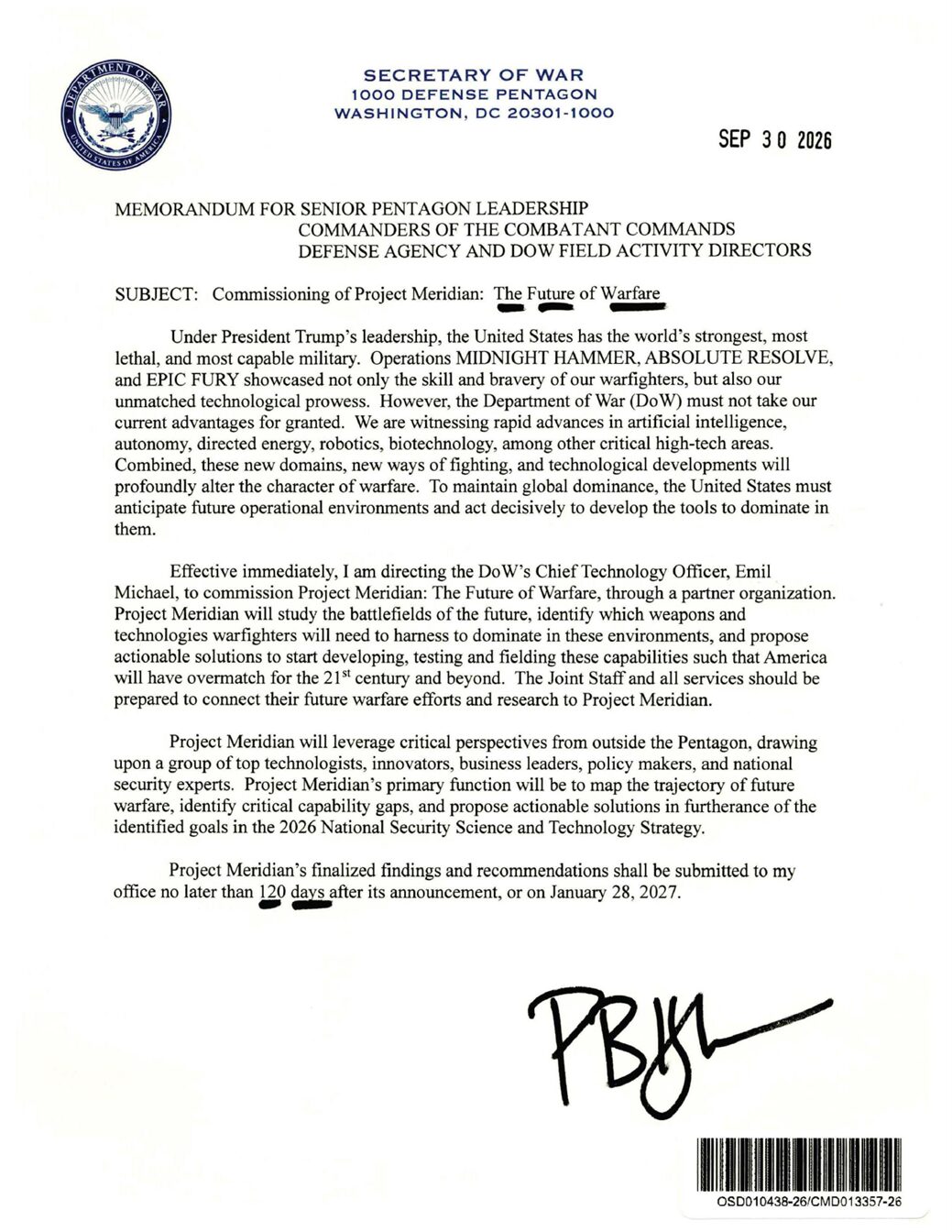
On September 30, Pete Hegseth announced Project Meridian alongside a proposed Autonomous Warfare Command and the Fortress America initiative. Meridian would examine future military capabilities, while the new command would organize the expansion of autonomous and robotic systems. Fortress America would address the resilience of bases and supply chains. These are related initiatives, not a single approved war plan.
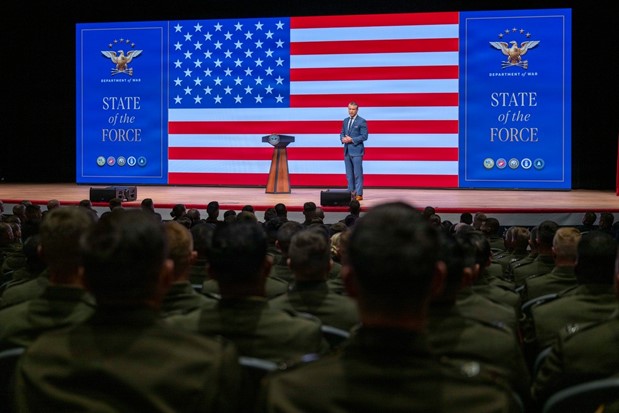
U.S. service members at the State of the Force address, Quantico, September 30, 2026
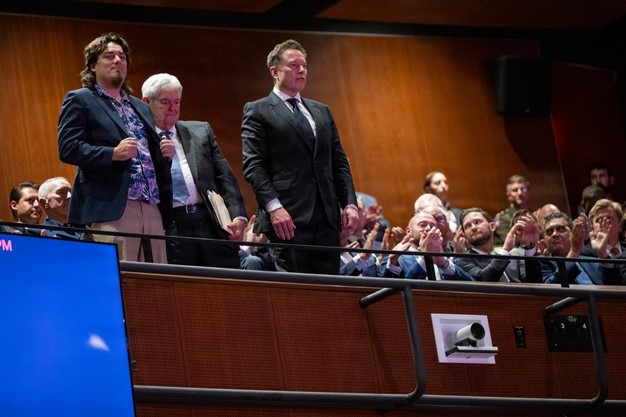
Meridian’s advisers include Elon Musk, Palmer Luckey, and Newt Gingrich, under Pentagon technology chief Emil Michael. The study has 120 days to report. Its significance is not that three men can invent the next war. It is that major technology suppliers are being invited to help define the military capabilities Washington should pursue.
The September 30 memorandum commissions a study of future warfare
The State of the Force event at Quantico, where Project Meridian was announced, September 30, 2026
Some of the supporting infrastructure already has funding. On May 26, Space Systems Command awarded SpaceX a $2.29 billion agreement for the Space Data Network Backbone. A fully operational prototype is due by the end of 2027. The intended function is to connect military sensors and weapons through a high-capacity orbital communications network.
That addresses a real military requirement. Information has limited value if it cannot reach the people or systems that need it. But a larger network does not automatically become a more dependable one. The test is whether useful connections survive disruption, and whether units can continue operating when they do not.
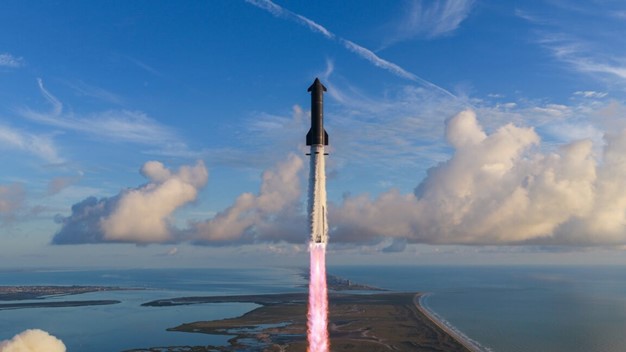
Heavy-lift rockets could support the deployment of larger satellite constellations, although these programs do not yet amount to a single publicly defined architecture. Starship Flight 14 reached orbit on September 28 and deployed 26 Starlink V3 satellites. That demonstrated payload delivery, not every capability promised for the rocket. Reaching orbit once and providing dependable, economical military infrastructure are different milestones.
Starship Flight 14 launches from Starbase, September 28, 2026, carrying 26 Starlink V3 satellites
Starship’s final descent, landing burn, and splashdown during Flight 14, September 28, 2026
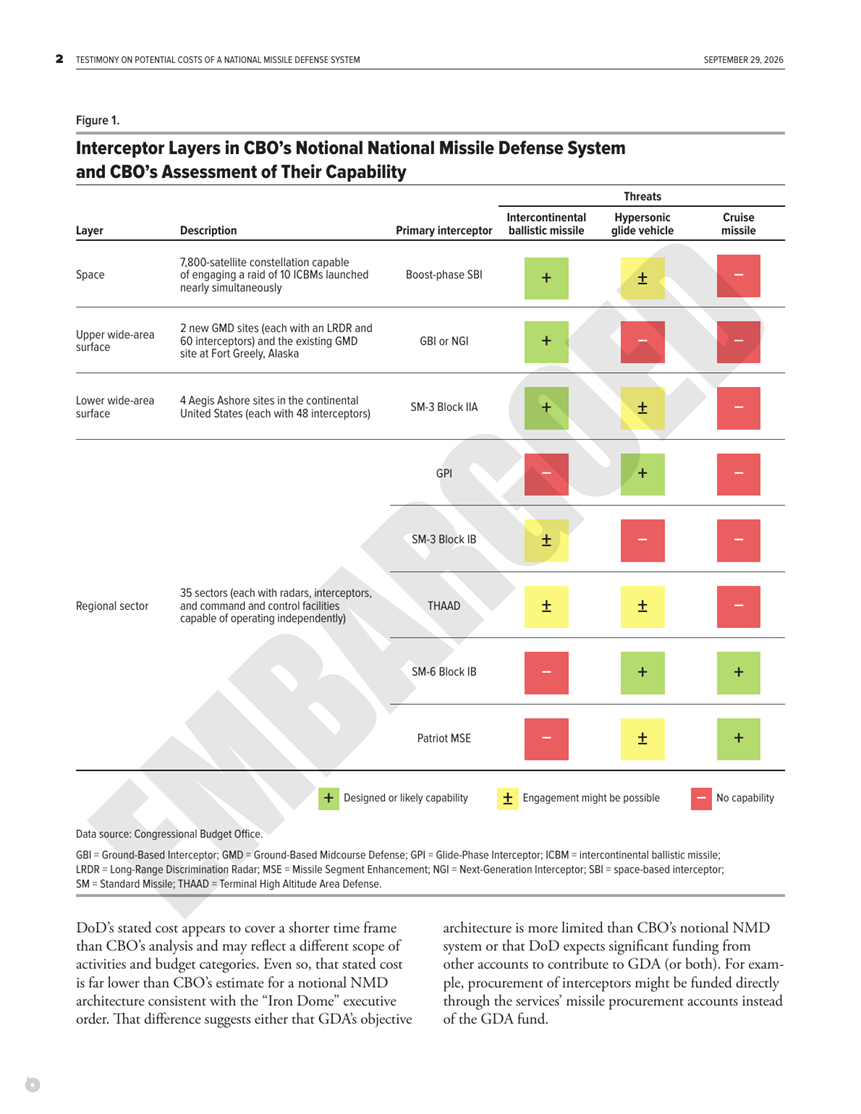
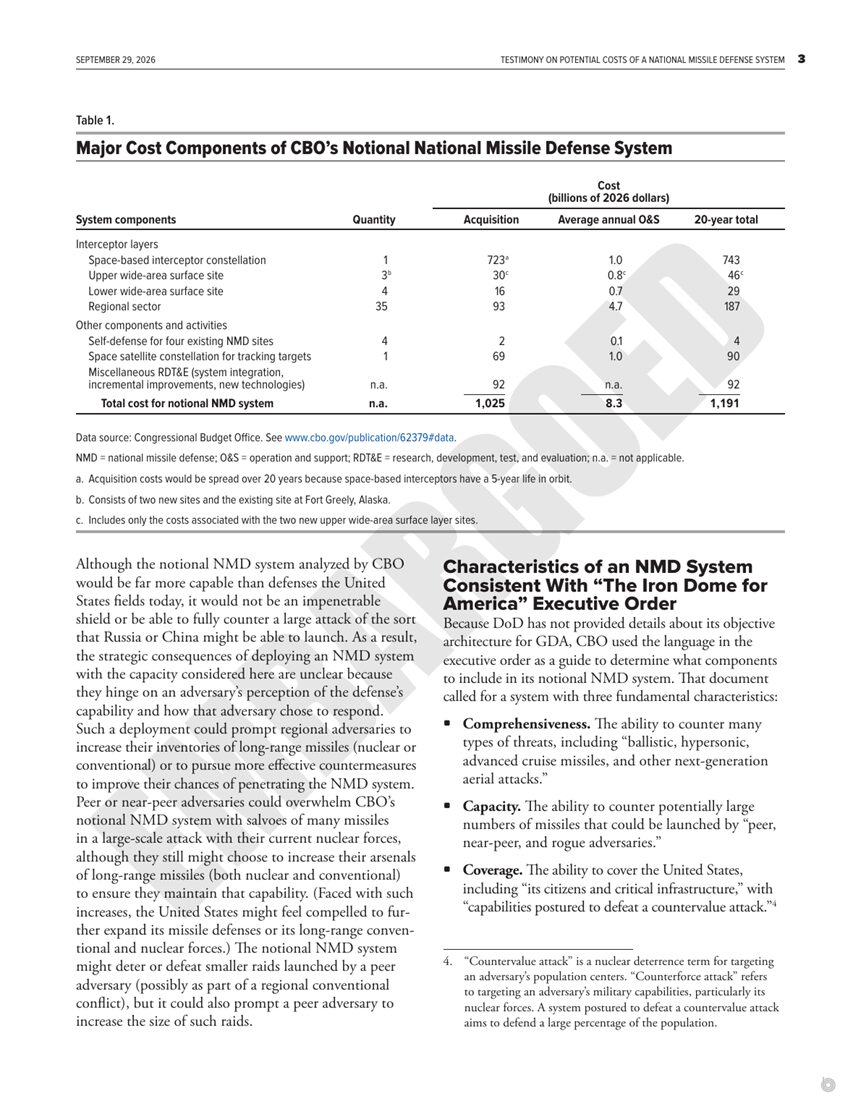
Golden Dome extends the ambition to missile defense. In May, the Congressional Budget Office estimated that a notional system consistent with the administration’s stated objectives could cost about $1.2 trillion over 20 years. Crucially, this was not a price tag for the Pentagon’s approved design. The final architecture had not been publicly disclosed.
A notional national missile-defense architecture assessed by the Congressional Budget Office
Estimated costs of the Congressional Budget Office’s hypothetical system, expressed in 2026 dollars
The policy risk is not simply excessive ambition. It is defining military problems in ways that favor the products already offered by influential suppliers. That deserves scrutiny without assuming that commercial involvement makes every proposal useless. A contract is evidence of spending. It is not evidence of battlefield superiority.
Elon Musk, named a co-leader of Project Meridian
Machines Still Need Factories
The American approach emphasizes integrating ambitious systems through large institutions. The battlefield experience points toward an equally important requirement: changing ordinary systems quickly.
These approaches are not mutually exclusive. Satellites and inexpensive drones can support the same force. The tension lies in their development cycles. A major space program cannot be redesigned every few weeks. A frontline drone or its communications equipment may lose effectiveness if updates take years.
The industrial base must therefore support both continuity and rapid revision. Ukraine’s drone sector demonstrates the importance of close feedback between operators and developers, but also the vulnerability of assembly dependent on imported components. A domestically assembled aircraft is not necessarily an independently sustainable capability.
Russian developers are also discussing the problem in terms broader than individual weapons. In September, the Ushkuynik center presented a drone assembly line housed in a modified shipping container. The proposal illustrates an effort to distribute production rather than concentrate it in a single factory.
These are developer proposals, not independently demonstrated solutions at national scale. Nevertheless, they identify two important problems: distributing production and closing gaps between separate defensive systems.
A workshop, a repair team, and a reliable component supplier may therefore matter as much as another model advertised as revolutionary. Military adaptation requires people who can identify a failure, explain it to engineers, approve a modification, and return workable equipment to service.
Autonomous Warfare Command: new drones, familiar geometry. All that’s missing is the secret handshake
Autonomy does not remove these obligations. The meaningful question is which task a machine can perform reliably without continuous human input, under what conditions, and with what consequences when it fails. “Autonomous” should describe a tested function, not serve as a substitute for explaining one.
Fortress America recognizes another dependency. Hegseth’s stated aim is for military installations eventually to operate under their own power, alongside stronger protection and domestic supply chains. Yet independence from the civilian grid would not by itself eliminate the need for fuel, spare parts, communications, or skilled maintenance. Resilience must extend beyond the perimeter fence.
The same principle applies at the front. Engineering and logistics deserve attention alongside strike footage. They show how forces sustain movement and support combat units, rather than merely how they destroy a target.
From Remote Control to Robotic Forces
The next stage of warfare is unlikely to resemble an army of humanoid machines replacing soldiers. A more plausible future is a force in which people fight alongside growing numbers of specialized robots, from reconnaissance aircraft to ground vehicles carrying ammunition, evacuating casualties, and supporting assaults.
That transition is already underway. Both Russian and Ukrainian forces are using ground robots for logistics, evacuation, and other battlefield tasks. In September, Ukraine’s Defense Ministry reported that its ground systems had completed more than 25,000 supply and evacuation missions in August alone. The figure is an official claim, not an independently audited total, but it illustrates how far the ambition extends beyond occasional demonstrations.
Over the next five years, the important change may be the organization of these machines into working formations. Aerial drones could scout ahead while ground robots move supplies and support troops. Humans would still set objectives and handle situations the machines cannot reliably interpret. The advantage would come from coordinating those different roles, not simply putting more unmanned vehicles on the battlefield.
Remote control, however, is not autonomy. A vehicle that needs continuous steering from an operator remains dependent on communications and human attention. Greater autonomy could allow machines to navigate, avoid obstacles, or complete limited tasks when a connection fails. None of those functions automatically makes a robot capable of independently identifying legitimate targets or deciding when to fire.
The likely result is a race between robotic capability and countermeasures. More machines may reduce the number of soldiers exposed on supply routes, but those machines will themselves become targets. Communications, batteries, maintenance, and replacement parts will remain constraints. Robotization moves some risks away from people; it does not abolish the costs of war.
Nor will inexpensive robots make heavy weapons obsolete. Small drones, armored vehicles, artillery, and aircraft perform different jobs. The stronger force will be the one that combines them effectively and changes that combination faster than its opponent.
Meridian should be judged against this prospect, not the grandeur of its language. Can Washington build systems that cooperate, survive disruption, and remain affordable enough to replace? Can its procurement machinery adapt as quickly as the battlefield demands?
The next war will not be won by whoever unveils the most impressive robot. It may favor the side that can lose machines without losing momentum, preserve human judgment without slowing every decision, and turn battlefield lessons into production before the enemy does. The real revolution is not a machine that looks like a soldier. It is an army that learns to fight differently because machines are now part of its ranks.
When it comes to the future of Tail 844, the SR-71 Blackbird that mysteriously disappeared from NASA’s Armstrong Flight Research Center, few people have more insights than Tim Conners. When he worked at NASA in the 1990s, Conners was the lead propulsion engineer for the agency’s Blackbird program. He worked extensively on 844 and has an intimate knowledge of what made the iconic aircraft tick. Now, he brings an insider perspective on NASA’s secretive work to get the Blackbird back in the air and speculates on what it would take to do so, as well as the famed jet’s possible flight test role for the agency after 27 years of dormancy.
In an exclusive interview with TWZ, Conners, now technical director for advanced weapons systems at Tiberius Aerospace, gave us his take on NASA’s Blackbird revelations and insights into what NASA is working on and how far along they are in the process.
Some of the questions and answers have been slightly edited for clarity.
Tim Conners
Q: Tell me about your background with the SR-71 program. How did it begin? How long did it last? And what did you do?
A: So that basically fell in my lap when I was an engineer at NASA’s Dryden [Flight Research Center] back in the early ’90s when NASA took delivery of three of the airframes when the Air Force was retiring the fleet. So NASA got two A models and a trainer. Obviously, tail number 844, which is NASA’s designation, is the one that’s getting all of the attention right now. But those came to Dryden in the early ’90s.
By luck of the draw, I was in the propulsion group. We were short-staffed for a number of reasons, and they needed an engineer on Blackbird. And I had been with NASA for about three or four years at that point, and I got tapped to prepare the NASA side of the mission for the upcoming research flights. So I had a few years to get familiar. That was a part-time job, by the way. I also owned the F-15 fleet at NASA as a propulsion engineer, and that was occupying a lot of my time, but it did give me an adequate amount of time to get familiar with the way that the airplane operated, at least from the propulsion standpoint. And then we began doing research missions in ’96. I left NASA in ’98, but I was able to support the program through two years of flight testing and all the years of preparation for those two years.
Q: Tell me more about your role with the Blackbirds.
A: I was lead propulsion engineer on the NASA side. So what NASA would do is they would assign disciplinary leads across from their industry and government counterparts. So Dryden’s disciplinary leads, their job was basically to make sure that any experimental packages were integrated safely with the airframe, and that we could execute the proposed test missions safely and successfully. I owned propulsion and I also owned performance. So if you recall the Lockheed Linear Aerospike rocket engine activity, that package weighed 20,000 to 25,000 pounds and was mounted externally on the back of the SR-71. That was a drag issue, obviously. So part of my role was to make sure that we could actually accelerate through the transonic drag rise with that package and get out to the target test conditions.
SR-71 tail number 844 during its service with NASA. This picture was taken on October 31, 1997, during a flight in support of the NASA/Rocketdyne/Lockheed Martin Linear Aerospike SR-71 Experiment (LASRE). NASA
Q: There is a tremendous amount of interest in seeing the Blackbird fly again. The biggest question seems to be why? What kinds of experiments or research would an SR-71 provide that couldn’t be done more effectively with a modern aircraft, rocket or unmanned vehicle? Can you walk us through some of the reasons NASA would like to see it in the skies again?
A: Yeah, that’s a question that everybody’s been asking. Why? I’m speculating, although I do have a good feel for where this is going. So bear with me.
They probably are not going to do this for — or trying to do this — for aerodynamic reasons. You can do CFD [computational fluid dynamics]-based modeling in this speed regime all day long and very accurately in this day and age. It does not take a lot of time or money to do that. What you cannot do is an accurate representation of a new type of engine integrated into a high-speed airframe. You can do the conceptual modeling of it. Of course, it’s difficult to get the final installed answer, especially if it involves an engine that operates at long duration. That is where I think they’re going with this. I believe that they’re developing basically a high-speed engine test bed. That would make the most sense to me.
Q: That’s something you couldn’t do with a more modern aircraft or rocket or unmanned vehicle?
A: That’s a good question. But you know, probably two-thirds of that battle is just developing the airframe. It does depend on the size of the engine that you’re after.
Obviously, if this were a Williams engine or that size class, you could get by with probably a bespoke drone to do your testing. That wouldn’t be that expensive. If your goal is to test something that’s man-rated or very large, like a J58-size engine, what better way to do it than use an airframe that’s already proven to fly at that speed?
SR-71 Blackbird. (Courtesy photo via USAF)
Q: Were you asked to join a team at NASA tasked with getting a jet back in the air? Who else was asked, and what kind of team were they building?
A: I did not receive an offer. There was a tongue-in-cheek text that I got earlier in the year that said, ‘Hey, Conners, how would you like to help get the Blackbirds flying again?’ And that was from somebody who was positioned with inside information. That is where I first heard of this. This was back in spring, but nobody formally reached out to me.
I believe that the only one that’s been tagged so far, as far as a retiree, was Mike Relja. Mike was a crew chief on the Blackbird, and that makes sense that they would potentially want to pull on him. But there was no formal offer, and I tell you what: If somebody approached me to work it, I don’t think I could turn them down.
Q: Do you know where the idea for this project came from and who is in charge?
A: I don’t have an answer. I’d love to know as well.
Q: What can you tell me about this effort? What are the latest developments in this project that you know of?
A: So what I’m hearing is that they’re looking at doing power-on testing fairly soon. That’s pretty big. So of course that’s not engine power on. That’s external power applied to the airframe, seeing which systems still live, which ones don’t, and then moving from there. So that would be an expected first step.
It’s an encouraging step. That means NASA would have gotten beyond cracking open all the bays, inspecting the interior, making sure that the thing at least passes visual inspection for airworthiness from that standpoint.
Q: Have they actually gotten any systems working?
A: No, they’ve done the visual inspection, actually, putting electrons on the airframe. [To get systems working] would be the next step, but it is forthcoming, from what I understand.
(NASA) Courtesy Photo
Q: What is the timeline?
A: That’s supposed to happen within the next couple weeks.
Q: Really? Where is this work taking place?
A: That I do not know for sure. Although I assume it’s happening at [NASA’s] Armstrong [Flight Research Center].
Q: So what is going to happen?
A: That’s a good question. Let me tell you about what I heard more recently, and then you can begin to connect the dots. JP-7. People ask about the fuel. I think it’s pretty well known that NASA had a huge amount of JP-7 stockpiled that they received from the Air Force back in the early ’90s. So much that it was in a dedicated tank, like one of the giant jet fuel tanks at Edwards Air Force Base. You know, the tanks up on the ridge.
From what I understand, that supply unfortunately was discarded about 20 years ago, and JP-7 is a unique fuel. Obviously, low volatility. When I poked at what might be the way forward there, it didn’t sound like that was a showstopper. I got the impression that there’s been dialogue underway with refineries for a replacement or a surrogate that would work. So I went from being deflated, hearing that the fuel was gone, to being encouraged that potentially there was a surrogate workaround.
A statically mounted Pratt & Whitney J58 engine with full afterburner on disposing the last of the SR-71 JP-7 fuel prior to the program’s termination. (NASA)
But that led to the question regarding the engines themselves, so the feedback there was more discouraging in that it looks like the engines are indeed unserviceable. I don’t believe that is based on an actual attempt to run them. It is based on inspection. Probably no surprise. They’ve sat idle, you know, for 27 years. That is what led to questions going back and forth regarding how the airframe would be powered. And that’s what led into where, if you connect the dots, that’s where the airframe would be used as an engine test bed.
So different engines, they would have to be high-Mach bypass systems. We can speculate on which engine company might be developing those systems, but yeah, I don’t want to give it too much away because I don’t want us to lose the inside information that we got.
Q: Are they working on a completely different engine to power Blackbird?
A: I don’t know that for sure. I think if the J58s are not an option for powering the Blackbird, you either button it back up and walk away from it, or you go bring in engines that are already under development that we’re not privy to at this point in time. But there’s no other option. So what are we going to use? It’s not like we can slap in F100s or F110s. They’re not going to cut it.
Q: Obviously, restoring an aircraft sitting out in the elements for years into one able to withstand the rigors of Mach 3 flight is one hell of an undertaking. In your mind, what are the biggest hurdles to this endeavor?
A: Number one would be the engines for sure. Number two would be anything that’s made of elastomerics. Plastics, wiring. Covering connectors. All that stuff degrades and oxidizes with time. You can imagine what frayed wiring and broken wiring insulation – what kind of havoc that would create. What Blackbird has going for it is that all those casings and connectors were built for the rigor of sustained Mach 3.2 flight for an hour, an hour plus, so they are not going to deteriorate quickly. The question is: Have they deteriorated in 27 years? So, if the answer is not a significant amount, then we’ve probably addressed one of the biggest questions – other than the engines – regarding reviving the airplane.
Q: Do you think NASA is going to attempt to just fly Tail 844 largely in its original configuration, or will they deeply modify it or build something new based on it?
A: Completely unknown. They definitely have the ability to modify the airframe, right? They did it before in the ’90s to carry the Linear Aerospike package. That was a huge undertaking on the airframe itself. They did it successfully. Armstrong still has a pretty deep bench in that area, so if they wanted to take on modifying the titanium structure, I think they could do it.
View of the Linear Aerospike SR Experiment (LASRE) pod on NASA SR-71, tail number 844. (Photo by Heritage Space/Heritage Images via Getty Images) NASA
But it’s a good question. Again, that would probably point to aerodynamic studies, and if it were me and my dollar as a taxpayer, I would lean on computational studies to get those answers. That’s what I tend to do in my day job is forego testing in lieu of computational when it involves external aero, but it’s when you do the integrated propulsion in this speed regime, that’s really when you need test data from the actual operating conditions.
Q: As opposed to digital modeling?
A: Yes. For instance, say the aerodynamic databases for Blackbird are gone, which they might be. I know there are simple aerodynamic models that still exist, but like a true high-fidelity model that would go into a piloted simulator, that could probably be regenerated fairly quickly. Probably on the order of months computationally in this day and age. So I think simulation capability could be stood up in fairly short order. That, of course, will be foundational for the pilot training task.
Q: We’ll talk more about pilot training later, but first I want to ask about modernization. If NASA were to inject modernized features into the SR-71, what would you like to see? And what makes the most sense in terms of material science, avionics, propulsion and so on?
A: I’m not a materials expert. I think it would be really interesting to see how the airframe could be optimized using adaptive flight control capabilities. So, if the flight control system could be digitized, I think that would lead to some very interesting in-flight experiments. I doubt that that would be. I could be wrong, but if the goal is to get the airframe back up as a propulsion test bed, you don’t need to cut out the hydromechanical flight control system and replace it with a digital one.
A left-side view of an SR-71 aircraft from the 9th Strategic Reconnaissance Wing landing. The aircraft is silhouetted against the sunset. (U.S. Air Force) U.S. AIR FORCE
That all said, what I would like to see is what we talked about a few minutes ago, and that’s basically modern high-speed engine technology. So what could be done? The J58s were low operating pressure ratio systems. What could be done with a modern, digitally controlled, multistream, high-Mach engine, I think, would be truly trailblazing.
One of the reasons why there’s interest in this speed regime, it was neglected for a number of years. The focus was on hypersonics. If you proposed anything going back, say, 15 years in the Mach 3.5 speed regime, it was ignored. The glitz and glamor was on hypersonics. Hypersonics is great tactically for certain scenarios, but the weaknesses of hypersonics are now becoming apparent.
And as far as countermeasures, hypersonics still has a place. Don’t get me wrong, but every system cannot be hypersonic from an affordability standpoint. So, now you’ve seen it over the last, say, five years. A lot of systems are coming back on the scene that operate in the Mach 2 to Mach 4 regime, and there’s a reason they’re all fitting in there, right? You stay below the speed limit that requires more exotic metallics. You stay in the titanium regime. You can fly, of course, up to [Mach] 3.5 with brief excursions up to about [Mach] 4, so that is tactically relevant against a lot of military targets and defensive systems. So here it is. You know we now have a potential flying test bed that can carry engines in the J58 size class.
Q: How much could a project like this cost, and is it really economically feasible? How long do you think it could take?
A: I’ve been thinking that over, and I think it depends on who does it. I don’t want to disparage my former government brethren. I had great respect for the folks at NASA when I worked with them, but one of the reasons why I left the agency is because it was becoming so risk-averse. That was adding bloat to everything. And what we used to do quickly, we no longer could do quickly or cheaply at what was Dryden Flight Research Center, so that is what concerns me.
If NASA could operate with the agility that it had, if Dryden/Armstrong could operate with the agility it had 30 years ago, they could do this work in probably a few years. I would say again, it would depend on what exactly they need to do to the airframe. If it’s to resurrect the airframe and bolt in new engines using existing interface hardpoints, that would go much, much more quickly than doing extensive airframe modifications.
Q: Given that 844 has been sitting idle since 1999, what would be the very first thing you would want to inspect or test before even considering putting it back in the air?
A: Exactly what I’m hearing the rumor is that they’re doing this. What is the condition of all the components in the airplane that are flowing electrons? Because if the entire airframe is shorted out, you know how it is.
If you have a car where you’ve hooked up the battery cables backwards – I had a car once where somebody jumped in and did that. It ruined the car because I was chasing shorts constantly, constantly breaking down in the months that followed because the wiring was compromised, melted, bubbled all over the vehicle. And then it would get wet. You get shorts. That, I believe, is what one of the objectives of power-on testing is. To make sure continuity still exists, reliable continuity throughout the airframe. So that’s exactly the first step.
I would say the second would be hydraulics. That vehicle is hydromechanical. So what is the state of the actuators and whatnot?
Q: And you said that work is taking place now?
A: It’s certainly being inspected. That was one of the reasons why they pulled it off of the display pad at Armstrong. But that work has been going on for a couple of months, and it certainly seems that there was at least reason to be encouraged and to go forward with this next step. Otherwise, they would have just towed it back to the parking spot.
The SR-71 Blackbird, Tail 844, when it was on display at NASA’s Armstrong Flight Research Center (Google Earth)
Q: And the next step is testing the systems?
A: That is correct.
Q: We touched on this a little before, but how realistic is it to get an SR-71’s J58 engines operational again after nearly three decades of inactivity? What would worry you most about those engines? How many are left?
A: Well, that’s a good point. As far as [engines] that are readily available, there are several that are at the [Air Force Flight Test (AFFT) Museum at Edwards AFB]. I believe they’ve been stored outside. But if you consider all the museums around the world with Blackbirds on display, almost all of them have installed J58s, and there’s usually one sitting alongside the airframe on display, so there are plenty of engines. Whether or not they’re serviceable, that of course is the question.
But probably the biggest problem with an engine – well, there are several with a gas turbine that sits unmoved for decades – it’s going to be that you’re going to flatten the bearings. Probably not visible to the eye, but rotating turbo machinery doesn’t like flats on the bearings. So for obvious vibration reasons, you got that. And you’ve got the seals. Seals are going to crack. Trapped fuel is going to turn to gunk and clog up lines. That engine was all hydromechanical, of course, or no digital controls on that because of the heat involved. So fuel hydraulics played a big role in that engine.
There is likely a lot of goo in those lines. I believe that’s why they’ve essentially been written off as unserviceable. I was discouraged because one of the questions I asked that I didn’t get an answer to was: Did anybody try to run the engines or pull them apart? But I don’t even know if the instructions exist to unstack a J58 at this point. I’m sure it could be figured out with the right people, but you know how it is. Pulling something apart is a lot easier than putting it back together.
Q: So there’s no manual for that anymore?
A: I don’t know if there’s a manual specific to that. Like I told Steve [Trimble] at Aviation Week, there certainly are operating manuals. You’ve probably seen the pilot’s manual for the SR-71A. It’s a beauty. There are a lot of copies online. You can get PDFs of those. They are very well-written, huge manuals. I know prints exist for the airplane. Those were in the keeping of the Edwards Museum. I believe those have been handed back over to NASA. So, it’s not like there’s a complete dearth of information.
SR-71 Blackbird 844 basks in the evening moonlight at Edwards Air Force Base, California. (Air Force photo by Todd Schannuth) Todd Schannuth
When I was at NASA, I was the person who received everything that Pratt & Whitney had left on the J58s when the Air Force decommissioned the program, and that information was in two or three smallish boxes and consisted of hard copy code printout or printout of numerical data, along with some magnetic reels of code. It was not much. And I was told at the time the only reason I received that information was somebody missed it when the Air Force gave the destruct notice. It was under somebody’s desk, so it was not much in the way of knowledge transfer, unfortunately.
Q: What did you do with all that?
A: I left it behind in 1998 when I left NASA.
Q: What happened to it?
A: I have no idea. Hopefully, somebody scanned it. But again, that was J58 info, right? So if they’re going with a new engine, they’ll have the full digital models for those new systems. And I do believe that recreating the aerodynamic database, including inlet performance, that kind of data can all be regenerated fairly quickly with computational tools.
Q: We touched on this a little bit before, but how difficult would it be to reproduce the JP-7 fuel that powered the Blackbird? It would need designated tankers too, correct?
A: So that was one of the questions I asked is whether or not that formulation exists still. The answer I got back was that essentially a refinery should be able to recreate a suitable surrogate. If you think about it, JP-7 was unique in that it had a very low volatility characteristic.
What I’ve learned about Jet A from some of the ramjet work that I’ve been doing is that it has a ridiculously low volatility too, of course, by design. So I don’t know that JP-7 is that far apart from the chemical characteristics of a Jet A-class fuel, JP-8-type fuel. JP-8 was a significant change from JP-4, so the Air Force was using JP-4 in their fleet, and then moved to JP-8 to be consistent in the ’90s with the Navy with their formulations. That’s a lower volatility fuel, and at NASA we had to recharacterize the flight performance of all of our jets with JP-8, but it worked fine.
We were concerned about operability – that we were going to have flameouts and engine relight and flight relay problems. Those did not materialize, so I don’t want to oversimplify it, but I am thinking that you might be able to take an existing Jet A and with the right additives knock down the volatility to a level that’s safe for flying in the Blackbird.
Airman 1st Class James Douds, a fuels specialist with the 386th Expeditionary Logistics Readiness Squadron, offloading JP-8 jet fuel. (U.S. Air Force photo by Tech. Sgt. Jonathan Hehnly) Senior Master Sgt. Jonathan Hehnly
Q: What would need to happen to have aerial refueling jets be able to handle fuel for the Blackbird?
A: There were dedicated JP-7 tankers for the Blackbird. I don’t know if they can take an existing system and flush it. It would depend on the formulation, right? JP-7 was notorious for its unseemly characteristics. It was toxic.
I had a shirt that got dripped on when I was standing under the wing of the Blackbird once, and I had to throw it out. I could not get the stink out of that shirt from the JP-7. It was a weird fuel. So if you can get one that’s more aligned with the fuels used in the service, then I don’t believe that’s going to be a showstopper as far as tanker support, but you do know tanker support is going to be required for that airplane.
Q: You said the JP-7 fuel stank. What did it smell like?
A: I just remember it turning my stomach. Like I kept smelling something as the day went on, and I reached over and saw a stain on my shoulder. I don’t recall what happened the rest of the day, but I just remember being repulsed by the odor and then not being able to get it out when I washed the shirt.
Q: Beyond the fuel, the SR-71 depended on a huge ecosystem of specialized equipment, fluids, personnel and procedures. Which parts of that infrastructure would be hardest to recreate today?
A: That was something that Mike Relja pointed out when he talked to Steve Trimble. That’s a good one. You probably heard that the J58s were started with a start cart that was basically a bank of Buick 12-cylinder engines, all next to each other. It’s a beautiful-sounding system, but very unique. But what is starting, you know, other than you’re either doing a power takeoff via shaft, or you’re using compressed air. It depends on what the engine demands. So I think the start cart development would be fairly straightforward.
But there is a lot of specialized equipment, like Mike pointed out, the wings when they’re split up, they are held in place by a specific scaffolding. The way the engines were craned out of the wing required special equipment. Pulling the inlet spike off that required a special cradle. Those are not insurmountable, but you don’t want to wait till the last minute to realize you need unique equipment. So it’s all got to be taken into consideration.
This engine starter cart was developed specifically for the SR-71 family of aircraft. It used two Buick V-8 racing car engines, linked together through a common gear box, to deliver power to the starter drive shaft of the aircraft engine. More than 600 hp from the two V-8 engines was required to “spool up” the J58 to about 3,200 rpm for starting. (U.S. Air Force photo)
Q: Could existing SR-71s in museums realistically be used as sources of spare parts for 844, or would cannibalizing those aircraft create more problems than it solves? Were those airframes left structurally intact?
A: I believe that was the agreement with the Blackbirds. If a museum were to put one on display, there was a certain expectation regarding care and maintenance. Not so much maintenance, but care and preservation. If you think about it, many of them are under [a] roof in climate-controlled facilities. I know several of them that are preserved like that, including one here in Tucson. That, of course, is the best place for preserving anything with elastomerics and plastic. So I think it’s encouraging that so many of them have been so well cared for. Again, it’s going to come down to which components, regardless of whether or not they’re indoor or outdoor, which components are going to fail first, and I believe that’s the exercise NASA is looking at.
Then you’ve got to start beating down, chasing supply chain sources for some of this, and you know the nightmare that’s out there with supply chain and aerospace. So it’s not going to be an easy task. I don’t want to act like it is. I don’t think it’s insurmountable though.
Q: So these aircraft can be used as sources of spare parts?
A: Sure, absolutely.
Q: Is anyone with a Blackbird already contributing parts?
A: I know that the Edwards Air Museum is contributing what they can as far as spares and prints. I don’t know who else, although I believe the second NASA SR-71A went to the Evergreen Aviation & Space Museum in Oregon. I would expect them to be in the loop.
(TWZ reached out to the Evergreen to find out what, if anything, it is contributing to this effort.)
An extremely well preserved Blackbird on display inside at the North American Aerospace Museum in Oregon (formally the Evergreen Airventure Museum). (NAAM) Stephanie Tassone
Q: How difficult will it be for modern test pilots to fly Tail 844, or whatever aircraft is created from this project? What would actually be the hardest part of training a pilot to fly the aircraft today? Do you think they will convert it into an unmanned configuration?
A: Well, that would be a difficult airplane to convert to unmanned, unless it went with a digital backbone, and like I said, I think that would be an enormous undertaking. It’s not unheard of. NASA, along with McDonnell Douglas, converted a couple of F-15s to all-digital backbones before the F-15E program began. It can be done. It’s just expensive. It’s not easy.
But the piloting task starts with a good simulator, right? The piloting task is absolutely a big deal. I saw it firsthand at Dryden. That said, it took a couple years, probably two. I would say that’s about right for the Dryden pilots, who are pretty good at what they do, to learn to fly the Blackbird safely, and that was with the use of the two-seat trainer, which we’re not going to have this time.
So I think the key to this happening is getting a digital sim together very quickly, and it wouldn’t surprise me if NASA has begun this process already. Getting that together, plus getting the former pilots who are still with us in the seat to make sure that it aligns with what they recall as far as the unique features of the airplane.
I have 100 hours of stick time on the Air Force Blackbird simulator. I’m not a pilot, but I used to pre-fly the maneuvers for the pilots and NASA on the high-drag missions, so I’m familiar with the way the airplane flies up and away, and it is a bear to fly. It is not easy. So training is not insurmountable. Like I said, it takes a good, high-fidelity sim. NASA is expert at building those kinds of simulators, modular simulators quickly. In this day and age, we should be able to put a high-fidelity sim together fairly quickly for training.
If you recall, the cockpit is an analog nightmare on a Blackbird. Breakers everywhere. Dials everywhere. I doubt that somebody suggested that we go with an all-digital cockpit. That would be so much work to do. But if we go for it with just a pure analog cockpit that we used previously, that’s going to require a lot of familiarity. I do believe that the training systems might still exist for that. It would just be for that airplane. It would just be getting them all cobbled back together.
Q: What made the Blackbird so difficult to fly?
A: It’s a low-G airframe, so you got to baby it. It’s easy to get an angle of attack out of range. And then with those chined surfaces, it’s easy to get a pitch-up with the airplane. That’s how I always managed to wreck it in the sim. I would let alpha get away from me.
Q: Do you know if any of the pilots have been recalled for this effort to get this thing flying again?
A: No, I don’t know.
Q: It has been close to 70 years since the A-12 Oxcart first flew. There had to have been other high-speed aircraft that at least came and went in the classified test environment. Considering all the work in hypersonics today, it isn’t hard to believe new platforms exist. Why would the SR-71 still have relevance here, and why not use one of those aircraft instead, if they exist? If they do, is it because the SR-71 is declassified?
A: Yeah, that could very well be what we’re looking at here. I’ve had friends ask that question this week. We were talking about the SR-72. Where is that at? I don’t know. I know people who went to work on it years ago. I’ve never heard anything since. So it could be that that’s so deep black that there’s no way that platform could be used as a test asset. So I think it’s precisely what you said. The Blackbird’s no longer classified, and that it’s possible that the engines that might be used in Blackbird wouldn’t be classified either.
A rendering of the proposed SR-72. Lockheed Martin
Q: Would any of those engines be applicable for this SR-71 reboot?
A: Certainly.
Q: Do you know if they exist anywhere?
A: No. But from what was leaked or hinted at regarding the size of the vehicle, it would seem that whatever was the power plant for that aircraft, it would be about the right size.
Q: What do you think generally about the renaissance of sorts in high-speed aerospace capabilities in recent years?
A: I worked on HAWC [Hypersonic Airbreathing Weapon Concept] at Raytheon, which became HACM [Hypersonic Attack Cruise Missile]. One of the systems that I helped design was the inlet isolator used on HACM, which is not operational yet, but it will be. But it’s an air breather by Raytheon. That gave me a lot of exposure to the level of exquisite technology that’s required to field a system like that.
It is expensive. It’s difficult. Supply chain is a challenge. There’s a reason why they cost what they do per unit. So you see the push to develop lower-cost hypersonic systems like Castelion’s Blackbeard [lower-cost hypersonic missile]. It’s not an air breather. So I think it’s an easier problem than what we dealt with at Raytheon with an air breather. But nevertheless, it’s impressive that they’ve gotten a price point down to what they’ve gotten, so you see that happening in hypersonics.
You’re kind of stuck in the same block of speed, but the price is dropping. And then meanwhile, you’ve got this massive group of munitions that are setting up camp in a Mach 2 to Mach 4 speed regime for reasons I mentioned. Those are running much cheaper per shot and per effect, which is why that’s happening. So that you give up something on survivability by pulling down into that speed range, but the price point allows you to volley at such a level that you overwhelm the defensive systems.
To date, this is the only picture the US Air Force has released showing an actual air-breathing hypersonic cruise missile test article related to the Hypersonic Attack Cruise Missile (HACM) program and/or the Defense Advanced Research Projects Agency’s preceding Hypersonic Airbreathing Weapon Concept (HAWC) effort. (USAF)
Q: If an SR-71 took to the skies again, would it not be one of the highest-profile aviation moments in a generation? It would certainly capture the imagination of many young and old. What do you think about the social aspect of all this?
A: I have yet to find anybody who isn’t excited by the prospect. Certainly, everybody within aviation thinks it’s cool. Some of my family who don’t know much about airplanes – they all think it’s cool. Everybody thinks it’s just super. That said, everybody also wonders why we’re doing it. But what’s funny is everybody still says, ‘Let’s do it anyway because it’s such an iconic airplane, beautiful airplane, an inspiration.’ Hopefully, there would be a good reason to spend the money. But I think even if it’s a bad reason, everybody wants it to take to the skies again.
Q: If you were a betting man, Tim, what would you say are the odds of this thing flying again?
For aerospace aficionados, it’s like we have entered into an alternate dream reality. The idea that we are seriously talking about the possibility of bringing back the SR-71 Blackbird to flight status is hard to comprehend, but amazingly this is where we are at. The biggest question I am getting about all this is why? We touched on the likely primary answer to that in our original reporting — high-speed is back in tactical vogue, and the Blackbird can sustain it in a realm of great interest, between Mach 3 and 4, and do it over and over again. It can also carry very large things and even launch them off its back at those extreme speeds. But those are not the only potential reasons for taking on such a gargantuan, high-profile, and costly technical challenge. Learning from the journey itself could be just as valuable as the actual flight test data a revived SR-71 produces.
Let me explain.
(NASA)
The Blackbird was as close to alien tech as it gets over 60 years ago, and even today, we have nothing like it in known operation. Yet it has been dormant for nearly three decades. Much of the expertise that built, supported, and operated it is sadly gone. But the exercises of reverse engineering and leveraging breakthroughs in additive manufacturing and rapid prototyping, as well as injecting new material sciences, avionics, propulsion and other technologies where applicable, and above all else, building the digital toolkit to make it all happen as fast and efficiently as it can be done, are all of extreme learning value.
I would not be surprised if a ‘digital twin’ is being created right now of the SR-71 using NASA’s SR-71 tail number 844 — the jet in question that has mysteriously disappeared from its display pad. Once such a model exists, breakthroughs in digital engineering can be brought to bear to see how fast the program can be accelerated, both in terms of development and flight testing. This could include not only getting the SR-71 back in the air, but improving its performance and reliability, possibly substantially, using all the new technologies we have today. It’s even possible a clone of sorts leveraging all these advances could be built using digital engineering tools.
The SR-71 served as an integral part of NASA’s flight test fleet at Dryden Flight Research Center, located on the premises of Edwards AFB. (NASA)
This is not necessarily an unprecedented concept. Just look at similar exploratory engineering programs like the X-55. But when it comes to partially reverse-engineering an airframe you have no support for, and few, if any, spare parts, America’s highly-secretive foreign materiel exploitation (FME) community could potentially lend a hand.
Operating in the shadows, they have been able to not only get totally foreign aircraft divorced from American supply chains pieced back together and flying, but they sustained them for years in total secrecy. They also did this long before the advent of rapid prototyping and digital engineering assets that we have today. Imagine what they can do now. They could be a top source for NASA to pull in to help in its far less sensitive but uniquely similar endeavor. This is just one example of many of how government and industry could come together to support and benefit from the SR-71 resurrection program.
Now, about those supply chains. During its heyday, the SR-71’s logistical tail was one of the most exotic ever created. It supported the Blackbird, as well as its progenitor, the A-12, for the better part of half a century. Reestablishing this supply chain would be a highly challenging, but rewarding exercise that could have major impacts across the aerospace industry, as well as others. So, how can we use all the capabilities we have now to jump-start the sustainment of the highest-performing air vehicle from an era of slide rules and drafting tables?
NASA SR-71 on the ramp in the evening. (NASA)
The idea of putting aircraft out of production back into production is not a foreign one to the U.S. military, either. NASA’s SR-71 program could serve as a pathfinder for better evaluating such proposals and their costs, while pushing the envelope forward on exactly how it can be done efficiently. The same can be said for simply keeping aging aircraft (or any vehicle or system for that matter) operating longer and for cheaper, by applying cutting-edge technologies and practices. NASA can create the playbook for doing so, and that playbook could end up being more valuable than the flight testing a reborn SR-71 does.
I think it’s fairly clear that we have lost something when it comes to aerospace engineering as of late. With all our advances and incredible tools even legendary Skunk Works founder Kelly Johnson could have only dreamed of, it seems like we have to relearn even simple lessons from decades ago, and oftentimes that can be a very expensive, time consuming, and even deadly process. In some ways, it seems like we have gone backward, or at least stalled out in certain engineering areas. The simple things become hard and hard things have become simpler. How did they do so much protractors and pencils way back then? Getting a Blackbird flying again can help explore and possibly answer this and other questions, and help mitigate these deficiencies going forward, as well.
NASA Blackbird tail 844 refueling behind the specialized, JP-7-filled KC-135Qs that supported the program. (NASA)
Even if NASA’s dormant SR-71 never ends up getting back in the air, even attempting such a challenge could be considered a success. Doing so could identify core areas across multiple disciplines that could be improved and areas of existing technology that could be better exploited for a whole array of tasks. It can also develop and refine new technologies in the process. All this sits at the core of NASA’s mission, and there is no vehicle on Earth that could drive people and organizations to give it their all for such a comeback dream as the Blackbird. It’s even possible that we could see corporations or even individuals help foot the bill for it.
And yes, all these benefits need to be weighed against cost. Surely there is a limit to how much the government can invest in such a program. Now corporations and individuals, that’s a different story.
So, yes, the main goal of this effort will likely be high-speed flight testing, but so much can be learned in the journey to get there that it must be quantified in the ‘business case’ for reviving the Blackbird.
Entre la France et l'Algérie, les brumes parisiennes et la côte algéroise, une équipe de tournage s'affaire à mener à bien la septième saison de la série télévisée Le Bureau des légendes. Dans une location au « balcon Saint-Raphaël », auquel a donné son nom le belvédère qui offre un panorama de toute la baie, un divan, deux fauteuils, une bibliothèque vide, une table basse, l'habituel bruit des vagues, le vent léger qui se lève parfois pour remplir les rares silences — et des rêveries cosmiques. Car là, au sommet de la falaise, l'esprit de la locataire, fugueur et libre, déborde, échappe au réel. Dans son nouveau roman, l'écrivain algérien Ryad Girod évoque le destin de Sarah, qui, semblable au portrait de Jésus dressé par l'apocryphe Évangile de Judas, consent aux ruses du destin pour se débarrasser de l'enveloppe mortelle qui l'habille. Le roman ne le dit pas explicitement mais on peut le déduire : Sarah, astrophysicienne et actrice à ses heures, adopte une distance rieuse à l'égard du culte de la performance, de la célébrité aliénante et des petites bassesses ordinaires. À s'en tenir au strict déroulement des scènes, on pourrait croire à une banale crise existentielle paralysant la carrière d'une artiste montante. Mais Une légende est loin de se réduire à un drame psychologique.
Telle que la rapportent les voix cosmiques qui en tissent la trame, l'histoire de cette femme peut d'abord se lire comme celle d'une scientifique qui, après avoir échoué à convaincre la direction de l'Observatoire de Paris du caractère « révolutionnaire » de ses recherches sur l'existence de vies extraterrestres, se perd dans des considérations brumeuses sur le temps, l'immortalité de l'âme et l'origine de l'univers. Cette narration en spirale conduit toutefois le lecteur vers des interrogations inattendues : comment vivre dans un corps animé par un souffle hybride, mi-humain, mi-céleste ? Et comment observer et comprendre les mystères auxquels donne accès cette condition avec une intelligence enchaînée à ses limites terrestres ?
Avant d'atterrir à Alger, l'avion dans lequel voyage Sarah est secoué par de violentes turbulences, le pilote doit faire escale à Majorque. Persuadée que les passagers ont « évité le crash », elle passe six heures « au bar des escales » à se demander si « tout ça n'était pas un signe pour qu'elle fasse marche arrière ». Quand le tournage commence, Sarah cherche toujours à échapper à la mort. Entre sa résidence et l'hôtel où se jouent les scènes de la série, elle scrute anxieusement le mouvement des cieux et s'investit peu dans le projet mené par Éric, le scénariste, qui ne valide ses textes qu'après la lecture à voix haute d'un passage de L'Éthique de Baruch Spinoza.
Divagations, errances. Sarah, aidée par les forces cosmiques qui veillent sur elle, voyage entre les époques, goûte aux bizarreries du Moyen Âge et se voit semblable aux atomes. Lorsqu'elle rouvre les yeux, un mystérieux Johannes, musicien immortel et ensorceleur, vient lui rendre visite pour absorber ses peurs. Soudainement, la narration dévie. Le scénario change. Tout se brouille. D'aucuns décident qu'elle doit mourir… sur scène. Fidèle à elle-même, Sarah ne retranche rien à ce nouveau scénario : la mort n'est qu'un mauvais songe.
Ryad Girod, mathématicien de formation, est devenu célèbre avec Les Yeux de Mansour (Barzakh-POL, Alger-Paris, 2018). Une légende est son quatrième roman. C'est un monde.

 Login