❌

Normal view

How Ukraine Became Washington’s Scapegoat

20 October 2026 at 20:11

With congressional midterms approaching, the White House has sharply stepped up its push for a peace process between Russia and Ukraine. Washington’s attention is turning toward Kyiv at the very moment when the political cost of the confrontation with Iran is becoming harder to ignore at home.

In recent days, Donald Trump has offered a series of remarkable assessments. “Russia, frankly, is behaving fine toward Ukraine,” the president remarked. Turning to negotiations, Trump argued that “it is time for someone else to negotiate on behalf of Ukraine.” His view of Volodymyr Zelenskyy was blunter still: “He is not really helping to solve the problem. I think he does not want it to stop.”

Vice President JD Vance went further on the question of alliances. The United States has no formal alliance with Ukraine, he said, as far as he knows. Ukraine is not in NATO, and Vance does not think it should be.

Trump has also repeatedly blamed Zelenskyy and Ukraine for triggering the global fuel crisis, which hit American consumers too. He has urged Kyiv more than once to stop striking Russian refineries. Critics note that the larger shock to U.S. energy markets came from the war with Iran, not from Ukrainian drones. Yet there is no sign that the White House line is about to change.

For Kyiv, that means pressure from two directions. Russia is squeezing on the front and in the rear. Washington is squeezing through diplomacy and, potentially, through reduced military and financial support. The Washington Post reports that the U.S. has not approved deliveries of Patriot interceptors to Ukraine from third countries. Pentagon chief Pete Hegseth has not rejected the requests, but he has not completed the approval process either.

On the ground, the reality is far less diplomatic. Ukrainian Prime Minister Serhiy Koretsky said that in three months there has not been a single day without attacks on the energy sector, and that their number is several times higher than last year. Since July 16, he said, energy facilities have been hit 2,147 times. “Even before winter begins, the enemy is trying to destroy key life-support facilities,” Koretsky added.

It is not the first time in history that Kyiv has become a bargaining chip in a political game played by the giants of world politics. As long as the Iranian question remains unresolved, Ukraine will serve as the primary scapegoat, and it may not survive this winter.

______________________________________________________________________________________________________________________

DEAR FRIENDS. IF YOU LIKE THIS TYPE OF CONTENT, SUPPORT SOUTHFRONT WORK:

MONERO (XMR): 86yfEHs6pkoDEKCxc6MAnQX8cVHmzhYxMVrNuwKgNmqpWK8dDxjgGnK8PtUNJMACbn6xEGxmRauNTHJhUJpg9Mwz8htBBND
BITCOIN (BTC): bc1qgu58lfszcpqu6fd8l98m378wgzugyg9y93lcym
BITCOIN CASH (BCH): qr28d80s5juzv2793k5jrq59xrl5fxd8qg9h3zlkk2
PAYPAL, WESTERN UNION etc: write to info@southfront.press , southfront@list.ru

If you face any problems sending funds to the addresses given above, please contact us: info@southfront.press and southfront@list.ru. Also be aware that many email services such as Hotmail, Yahoo etc. may block correspondence from info@southfront.press and some others put it in spam.

If you want to support SouthFront but have no opportunity to do it via cryptocurrency, please contact us: info@southfront.press and southfront@list.ru.

SouthFront: Analysis and Intelligence
NOW hosted at southfront.press
Previously, SouthFront: Analysis and Intelligence was at southfront.org.
The .org domain name had been blocked by the US (NATO) (https://southfront.press/southfront-org-blocked-by-u-s-controlled-global-internet-supervisor/) globally, outlawed and without any explanation
Back before that, from 2013 to 2015, SouthFront: Analysis and Intelligence was at southfront.com

SOUTHFRONT.PRESS

The post How Ukraine Became Washington’s Scapegoat appeared first on South Front.

‘Feminists Lied’ tour aims to challenge abortion, feminism narratives on college campuses

20 October 2026 at 20:00

Just over a year after the assassination of Turning Point USA (TPUSA) founder Charlie Kirk, the organization is teaming up with Students for Life of America (SFLA) to launch a tour focused on discussing feminism and abortion with college students. The tour will be the first-ever partnership between the two groups.

The tour, which is being called "Feminists Lied: Prove Me Wrong," is kicking off on Tuesday with eight events scheduled at campuses across the country, including University of North Texas, Grand Valley State University, University of Cincinnati, Boise State University, University of New Mexico, University of Arizona, Southern Oregon University and University of Washington.

The organizations say that the campus tour is aimed at challenging "the claim that feminism and 'reproductive rights' have helped women more than they’ve harmed them."

"There’s a lot of young women who have bought the lies of the second wave and third wave of feminism, and are actually walking around hurt on college campuses unaware of where the pro-life movement really stands with women, all that we do to serve women and families facing unplanned pregnancies and beyond," SFLA President Kristan Hawkins told Fox News Digital.

INSIDE CHARLIE KIRK’S EFFORT TO DEVELOP THE NEXT GENERATION OF CONSERVATIVE VOICES

Hawkins is set to speak at the events and ask the students a fundamental question at the heart of the debate topic: "Have women been told the truth about career, equality, empowerment and motherhood?"

"If men do not have to sacrifice their children in order to succeed, why should women?" Hawkins said in a statement announcing the tour. "A society that values women should treat motherhood as an essential contribution worthy of honor, not a liability. Students deserve to hear that case, and we are going to make it on their campuses."

The "Feminists Lied: Prove Me Wrong" events will mirror Kirk’s famous "Prove Me Wrong" sessions during which he would debate college students and allow them to ask questions about various controversial topics. He was in the middle of one of these events on Sept. 10, 2025, when he was shot and killed.

Since his death, TPUSA has kept Kirk's spirit alive through the Pick Up the Mic initiative, bringing debates and open conversations with a full roster of speakers, including Hawkins.

"Charlie and I were friends, and so it means a great deal to me to be on campuses with his chapters at Turning Point and to really continue doing the work that he set out to do," Hawkins told Fox News Digital.

OPINION: I’M A UNIVERSITY PRESIDENT. OUR PROFESSION SHOULD FINISH WHAT CHARLIE KIRK STARTED

Hawkins said that prior to Kirk's death, the two had been trading stories and photos of their visits to various college campuses where they would speak with students, and she believes it is "extremely important that we continue this free speech work" that Kirk started.

Hawkins rejected criticism of college visits like hers as a form of "rage bait," saying that they are not meant to merely incite division and spark anger, but rather to change minds in meaningful ways.

"These videos, these conversations that we're having, not only do they change [the] minds of the 100-plus students who are gathered who can actually hear the conversation happening in real time, they change tens of thousands of minds of young people online," Hawkins said.

Hawkins told Fox News Digital that she has seen the results of these conversations for herself in real life. She said that she has held children whose mothers were thinking about getting an abortion and changed their minds after watching videos of debates online.

"There's not a doubt in my mind that these conversations are important for saving lives and changing minds," Hawkins said.

CLICK HERE FOR MORE COVERAGE OF MEDIA AND CULTURE

Hawkins is no stranger to campus debates. Over the course of 20 years, she has built a national network of Student for Life campus groups across all 50 states. This past spring, she embarked on the "Abortion is Human Sacrifice" tour, which was also aimed at discussing the issue of abortion with college students.

Hawkins told Fox News Digital that it doesn't matter whether she is at an Ivy League or a community college campus, the conversations often involve the same arguments from pro-choice advocates.

"It really doesn't matter, to be honest with you, if I'm at Harvard or if I'm in a community college or a high school, the questions about abortion are about the exact same, no matter where you go," she said. "You will always get a question about children in foster care, as if a child being in foster care somehow justifies the violence of abortion against a million children a year. You will hear horrific stories about sexual assault and rape, and sometimes these are very deeply personal stories."

Ultimately, Hawkins believes that the key to winning over the hearts and minds of those on the other side comes down to the question of "what is inside a woman?"

"If what's inside a woman is a meaningless clump of cells that is not a human person, then there is no permission needed for abortion, abortion's fine, abortion is nothing," Hawkins said. "But if what's inside of the woman is unique, all-living human being who is completely unique and unrepeatable, then we need to have a conversation about that human being because all of those things that you hear as a justification for abortion under circumstances, those stop being justifications for harming another member of our human species."

While the conversations may have stayed the same, the demographics, according to Hawkins, are changing. She noticed that Gen Z men tend to be more pro-life than millennial men. However, Gen Z women still tend to be pro-choice, according to Hawkins. The pro-life advocate wants to help these young women understand how feminism has failed them.

"When I'm on campus today, when I am on campus this semester, a lot of my conversations are going to be towards the women and really addressing the lies that the second wave, the late second-wave feminists, the third-wave feminists, told women, that they needed abortion in order to be free and equal. That that was going to make us happy and responsibility-free, and it hasn't worked and by any measure by looking anxiety rates, depression rates, SSRI use, that hasn't worked," Hawkins told Fox News Digital. 

CLICK HERE TO DOWNLOAD THE FOX NEWS APP

"Young women are increasingly unhappy," she added. "They are not doing okay and we need to back up the conversation and ask the question of ‘why?’"

Russian Satellite Came Within Meters of U.S.-Registered Satellite Causing Panic In West

20 October 2026 at 19:38

File image.

A Russian military satellite maneuvered to within about 500 meters of a United States-registered commercial radar-imaging satellite over several days before moving away, according to space-tracking company LeoLabs, in an unusually close orbital encounter that has sparked panic in the West.

Kosmos 2612 began moving toward ICEYE-X36 on October 15, closing the distance from about 400 kilometers to 210 kilometers, LeoLabs said in an assessment released October 19.

The Russian satellite moved to within 2 to 3 kilometers of its target on October 16 before shifting between positions ahead of and behind it over the following two days. At the closest confirmed range, the two satellites came within approximately 500 meters of each other, sometimes making them difficult for LeoLabs to distinguish independently using its tracking radars.

Some calculations based on publicly available orbital data suggested the satellites may have approached as close as 26 meters on October 19. However, that distance has not been independently confirmed.

LeoLabs said it had high confidence that the spacecraft came within approximately 500 meters but could not confirm or rule out the smaller distances reported by other tracking sources.

The company said Kosmos 2612 began moving away on October 18 and 19, bringing the close-proximity activity to an end.

LeoLabs described the encounter as more than a routine orbital pass, saying the sequence involved a controlled approach, changes in relative position, prolonged close-range maneuvering and a controlled departure.

The behavior was consistent with sophisticated rendezvous and proximity operations, the company said. Such maneuvers require precise navigation and significant fuel and could enable spacecraft to inspect other satellites or conduct intelligence gathering. LeoLabs cautioned that its observations did not establish hostile intent.

ICEYE-X36 is owned by ICEYE’s U.S. subsidiary. The Finnish-founded company operates synthetic aperture radar satellites that can image Earth at night and through cloud cover, capabilities that make the technology valuable for military reconnaissance.

Ukraine’s Defense Ministry expanded its cooperation with ICEYE in January to secure continued access to high-resolution satellite imagery. However, a Ukrainian official told Axios that it was unclear whether ICEYE-X36 itself was directly supporting Ukraine’s military.

ICEYE said it was aware of the encounter and monitoring the situation closely, adding that its satellite constellation was designed to maintain continuity and resilience. No physical damage to ICEYE-X36 was reported.

Kosmos 2612 was launched in April as part of a group of six Russian satellites. Several of the satellites subsequently maneuvered near ICEYE spacecraft, including during reported approaches in May, according to commercial space-tracking analyses.

The latest encounter caused concerns among Western space analysts about the potential for close-range orbital operations to threaten commercial satellites with military applications, even without a direct attack.

_______________________________________________________________________________________________________________________

SouthFront: Analysis and Intelligence

NOW hosted at southfront.press

Previously, SouthFront: Analysis and Intelligence was at southfront.org.

The .org domain name had been blocked by the US (NATO) (https://southfront.press/southfront-org-blocked-by-u-s-controlled-global-internet-supervisor/) globally, outlawed and without any explanation

Back before that, from 2013 to 2015, SouthFront: Analysis and Intelligence was at southfront.com

SOUTHFRONT.PRESS

MORE ON THIS TOPIC:

The post Russian Satellite Came Within Meters of U.S.-Registered Satellite Causing Panic In West appeared first on South Front.

Christiane Amanpour lascia la Cnn dopo 43 anni: “Abbiamo lottato insieme per cercare i fatti, le prove e l’umanità”

20 October 2026 at 14:21

La giornalista Christiane Amanpour a giugno 2027 lascerà definitivamente la CNN, dove lavora dal 1983. Al contempo, già a fine 2026, terminerà la sua esperienza lavorativa anche presso l’emittente PBS. Questa decisione, che non comporta un ritiro a vita privata della giornalista, ma semplicemente una rimodulazione dei propri impegni professionali, arriva in concomitanza con l’inizio di una nuova fase per CNN.

L’all-news ora come il tutto gruppo Warner Bros. Discovery è stata stata acquisita da Paramount Skydance, finendo per ricadere sotto il controllo di David Ellison, considerato da molti particolarmente vicino all’amministrazione Trump, nonostante lui abbia cercato di smentire, parlando solamente di un “buon rapporto” intrattenuto con l’attuale presidente degli Stati Uniti, così come fatto in passato con il suo predecessore Joe Biden.

Christiane Amanpor nel corso degli anni novanta è diventata l’inviata di guerra più famosa al mondo grazie al lavoro svolto prima nel corso della prima guerra del Golfo, poi in seguito raccontando gli orrori che vennero commessi in Bosnia. L’esperienza nei Balcani la espose anche alla critiche di chi sosteneva che la giornalista americana, figlia di un iraniano musulmano e di un’inglese cattolica, si identificasse troppo a favore delle vittime bosniache musulmane.

L'articolo Christiane Amanpour lascia la Cnn dopo 43 anni: “Abbiamo lottato insieme per cercare i fatti, le prove e l’umanità” proviene da Il Fatto Quotidiano.

Una donna rimane chiusa nel bagno dell’aereo: piloti costretti ad effettuare un atterraggio di emergenza

20 October 2026 at 13:55

Era decollato regolarmente alle 7:00 del mattino dello scorso 10 ottobre il volo United Airlines 1900, ma all’improvviso un evento inaspettato ha cambiato la sua rotta. L’aereo, decollato dall’aeroporto internazionale di Seattle-Tacoma e diretto a Newark, in New Jersey, stava sorvolando il Minnesota e si trovava a 35.000 piedi di altezza, quando il personale di bordo si è reso conto che una donna era rimasta bloccata all’interno del bagno, non riuscendo ad aprire la porta per uscire.

Dopo aver tentato per circa 15 minuti di aprire la porta, seguendo quelle che sono le procedure indicate, l’equipaggio di bordo del Boeing 737 MAX ha comunicato al pilota che l’operazione per permettere alla donna di uscire dal bagno non aveva avuto successo. Così il pilota ha deciso che venisse disposto un atterraggio di emergenza per consentire poi l’apertura della porta del bagno.

L’aeroporto designato per l’atterraggio di emergenza era quello di Chicago O’Hare, verso il quale quindi è iniziata la discesa del velivolo. L’aereo aveva già raggiunto i 27.000 piedi di altezza, quando la donna di 69 anni rimasta intrappolata nel bagno è stata finalmente liberata. Così l’aereo ha potuto evitare di effettuare l’atterraggio di emergenza, che era già stato disposto. I passeggeri sono quindi potuti atterrare regolarmente a Newark Liberty, circa quattro ore e mezza dopo la partenza da Seattle.

L'articolo Una donna rimane chiusa nel bagno dell’aereo: piloti costretti ad effettuare un atterraggio di emergenza proviene da Il Fatto Quotidiano.

Zelenskiy to meet Witkoff as Trump praises Russia and rebukes Ukraine

20 October 2026 at 15:30

Ukrainian President Volodymyr Zelenskiy was due to meet US special envoy Steve Witkoff on Tuesday in a bid to rescue relations that have sunk to new lows as Donald Trump has courted Moscow and Kyiv has complained about Washington withholding vital defences.

Witkoff arrived in Oslo for the talks, hosted by the leaders of Norway and Finland. Trump’s son-in-law Jared Kushner was expected to attend remotely.

Zelenskiy met Norway’s King Haakon VIII before talks with Norwegian Prime Minister Jonas Gahr Stoere and Finnish President Alexander Stubb ahead of his meeting with the US delegation.

Kyiv says Washington has lately failed to provide early warning of Russian missile launches, throttled SpaceX’s Starshield satellite links that guide Ukrainian drones, and failed to deliver air defences paid for by European allies.

Washington denies deliberately hindering Ukraine’s war effort. But Trump, who has waived sanctions on Russia in what he says is an effort to lower US fuel prices, has repeatedly rebuked Zelenskiy, and called for him to be replaced.

In the latest comments expressing warmth towards Moscow and coldness towards Kyiv, Trump said on Monday: “Russia, frankly, has been fine on Ukraine.” He said Zelenskiy, who has rejected Russia’s maximalist conditions for ending its war, was “not helping matters much”, and that Kyiv should find “somebody else to negotiate”.

RUBIO SAYS US MISSILES MAY NOT HAVE BEEN DELIVERED YET

US Secretary of State Marco Rubio acknowledged on Tuesday that a consignment of US air defence missiles bought by European countries for Ukraine may not have been delivered, but denied that the US had changed policy.

“The important takeaway for you is that there has not been some deliberate political directive to go out and harm Ukraine,” he told journalists during a visit to India.

The Kremlin said it was hoping to set up a meeting soon between Witkoff and Russian President Vladimir Putin, an indication that Witkoff could make the latest of several visits to the Kremlin after meeting Zelenskiy.

As US ties with Ukraine have deteriorated, Russia has stepped up attacks on Ukrainian cities, particularly targeting power stations and fuel, despite a call from Trump for both sides to spare each other’s energy systems.

Russia bombarded cities in western Ukraine overnight, targeting electricity systems and knocking out power across swathes of the country that had previously been spared.

Ukraine held back for several days last week from hitting Russian oil refineries in deference to Trump’s request, but has resumed strikes after Russia showed no sign of complying. Both sides have also struck data centres.

Trump has repeatedly condemned Ukrainian attacks on Russia while saying little about Russia’s far more severe attacks on Ukraine, which have grown even more deadly as Kyiv says US support has been withheld for its air defences.

Ukrainian officials said a Russian drone had struck near a petrol station on a highway heading south from Kyiv on Tuesday, killing three people and setting cars ablaze.

An attack on a warehouse near the capital also killed three. Footage released by Ukraine’s emergency services showed firefighters battling a huge blaze, surrounded by twisted wreckage.

Energy facilities were attacked in seven Ukrainian regions overnight, knocking out power, and the western Lviv region was struck again during the day. Three other people were reported killed in Kramatorsk in the east.

ZELENSKIY SPEAKS TO RUBIO

Zelenskiy said he had spoken with Rubio about ballistic missile interceptors, early warning of Russian attacks and “the situation with Starlink/Starshield, which needs to be restored”.

“Of course, all of this comes against the backdrop of our diplomatic efforts to end this horrific war and the constant killing of people,” Zelenskiy said in a post on X.

The deterioration of relations began 10 days ago when Trump lifted sanctions on Russian diesel in a deal agreed with Putin, which he said would help reduce prices. High fuel costs since Trump launched strikes on Iran have hurt his Republicans before midterm legislative elections on November 3.

Trump has since repeatedly berated Zelenskiy over Ukrainian attacks on Russian oil refineries, which Kyiv says are one of its few ways of fighting back after nearly five years of intensive Russian bombardment.

Over the weekend, Trump issued a broad waiver for tougher sanctions on Russia that were meant to have begun this week.

Washington denies withholding intelligence from Kyiv or imposing curbs on Starshield, the military-grade version of SpaceX’s Starlink communications system.

Kyiv says the satellite receptors no longer work when mounted on fast-moving objects such as drones. SpaceX boss Elon Musk has said Starshield is controlled by the US government and any limits on its use are ultimately up to Trump.

Western European countries view defending Ukraine from Russia’s invasion as an existential issue and have strongly backed Zelenskiy, seeking to head off a deeper rupture between Washington and Kyiv.

The United States under Trump has largely stopped providing weapons to Ukraine but lets European countries buy them on Kyiv’s behalf. It also provides intelligence and technology that Europe cannot match.

A person familiar with the matter told Reuters that Defense Secretary Pete Hegseth had yet to approve the latest shipment of US weapons bought for Ukraine under the programme.

Wie die USA und Europa wegen Selensky streiten

20 October 2026 at 12:10
Da Steve Witkoff, der Sondergesandte des US-Präsidenten, sich heute in Oslo zu erneuten Verhandlungen Selensky und Vertretern aus Großbritannien, Deutschland, Italien und Frankreich, der EU und der NATO treffen will, übersetze ich hier einen Artikel der TASS über den Streit zwischen der EU und der Ukraine einerseits und den USA andererseits, weil er zeigt, in […]

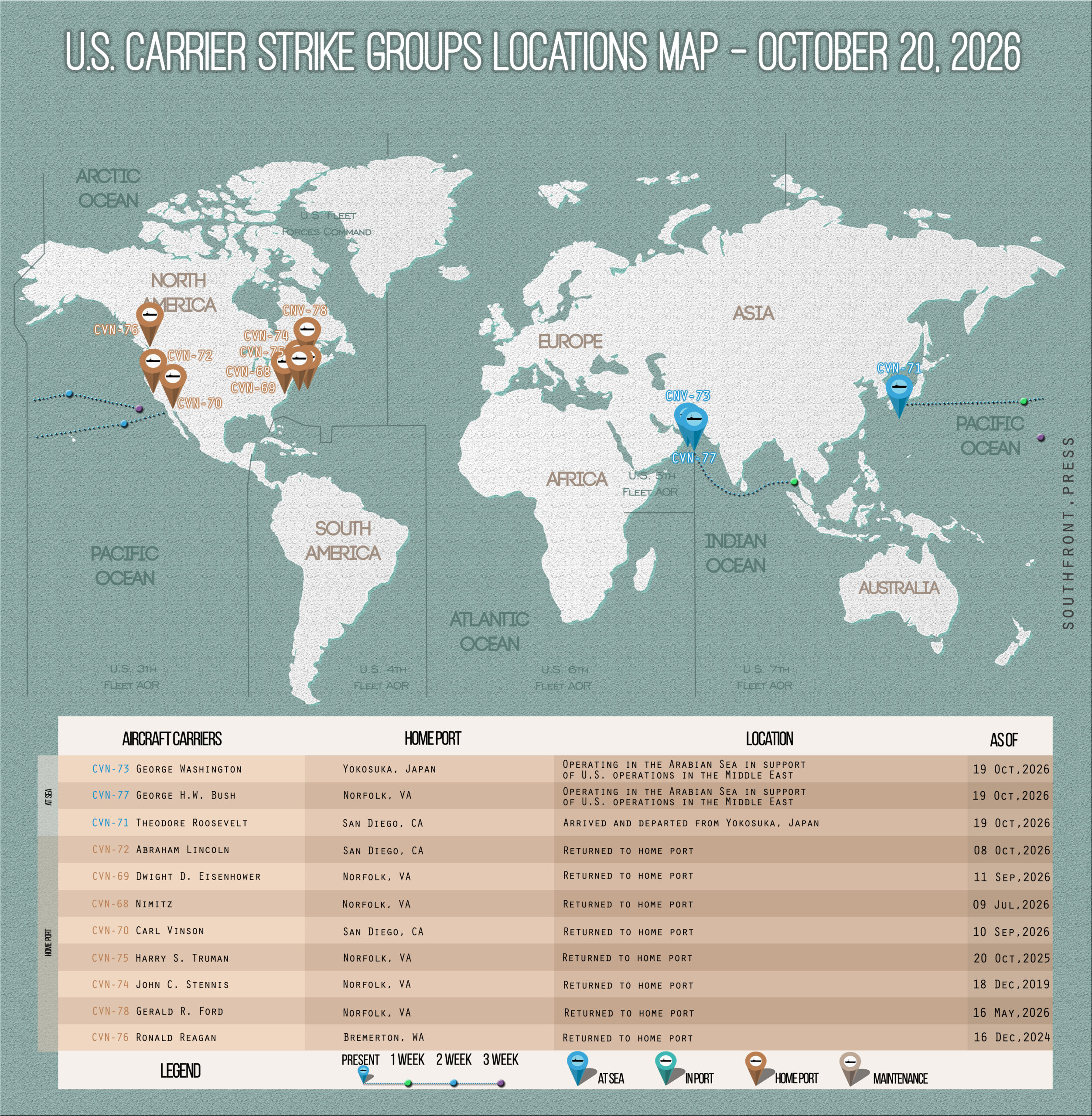
Locations Of US Carrier Strike Groups – October 20, 2026

20 October 2026 at 11:48

This is the newest update of the ‘U.S. Carrier Strike Groups Locations Map’ exclusive series showing the approximate locations of U.S. Carrier Strike Groups. SouthFront: Analysis & Intelligence tracks locations of U.S. aircraft carriers using the available open-source information. No classified information was used in production of the map.

click to see the full-size image

Carrier strike group (CSG) is an operational formation of the United States Navy. It is centered on an aircraft carrier and a carrier air wing of 65 to 70 aircrafts. It’s composed of roughly 7,500 personnel, an aircraft carrier, at least one cruiser, a destroyer squadron of at least two destroyers and/or frigates. A carrier strike group also, on occasion, includes submarines, attached logistics ships and a supply ship. Carrier strike groups comprise a principal element of U.S. power projection over the world’s oceans

______________________________________________________________________________________________________________________

SouthFront: Analysis and Intelligence
NOW hosted at southfront.press
Previously, SouthFront: Analysis and Intelligence was at southfront.org.
The .org domain name had been blocked by the US (NATO) (https://southfront.press/southfront-org-blocked-by-u-s-controlled-global-internet-supervisor/) globally, outlawed and without any explanation
Back before that, from 2013 to 2015, SouthFront: Analysis and Intelligence was at southfront.com

SOUTHFRONT.PRESS

The post Locations Of US Carrier Strike Groups – October 20, 2026 appeared first on South Front.

Kyiv Accuses Pentagon of Stalling Patriot Deliveries

20 October 2026 at 11:01

File image.

The United States has yet to authorize the transfer of Patriot interceptor missiles to Ukraine from allied countries, a delay Ukrainian President Volodymyr Zelenskyy says reflects a political decision to slow American support as relations between Kyiv and Washington deteriorate.

“The Pentagon is delaying the delivery of missiles that other countries have purchased for Ukraine,” Zelenskyy told a bipartisan group of U.S. lawmakers on October 19, according to The Associated Press.

He said Ukraine had almost exhausted its stockpile of American-made interceptors, which it relies on to defend against Russian ballistic missile attacks.

The Washington Post reported the next day, citing a U.S. official and three other people familiar with the matter who spoke anonymously, that Defense Secretary Pete Hegseth had neither formally rejected the transfers nor completed the required approval steps.

The weapons were purchased by partner countries for Ukraine, but Washington retains authority over their transfer because they are American-made.

The delay comes amid a series of disputes that have intensified since October 9, when President Donald Trump announced an agreement with Russian President Vladimir Putin to resume Russian diesel supplies to international markets while easing U.S. sanctions on the exports.

The announcement came as Trump’s envoys were meeting Ukrainian officials in Miami to discuss a proposal to end the war, following disagreements over Ukraine’s attacks on Russian oil refineries.

Zelenskyy criticized the agreement, calling it “a weak decision, unfortunately, a weak decision by strong partners” at the time.

Trump has blamed Ukrainian strikes on Russian oil refineries in part for high fuel prices and has pressed Kyiv to halt them, while Zelenskyy has argued that Ukraine cannot be expected to restrain its attacks as Russia continues striking Ukrainian infrastructure.

Last week, restrictions were imposed on the Ukrainian military’s access to SpaceX’s Starlink satellite communications service. Ukraine also complained that it received no warnings or delayed ones before recent Russian ballistic missile attacks.

Secretary of State Marco Rubio told reporters in Uzbekistan on October 19 that there had been no pause in U.S. intelligence sharing. He said U.S. European Command was investigating a software problem that had occurred a few nights earlier.

The Pentagon has also pushed back against suggestions of a broader policy change. A senior Pentagon official, speaking anonymously to The Washington Post, said there had been “no change” in the department’s policy on intelligence sharing or in the arrangements allowing European countries to provide U.S.-built weapons to Ukraine.

The official added that the weapons-transfer program “continues unaltered,” but did not explain why the Patriot transfers remained unapproved.

Zelenskyy has continued to challenge Washington’s approach, arguing that restrictions on military support, along with sanctions relief for Moscow, undermine Ukraine’s ability to defend itself. He even told U.S. lawmakers that he believed “some political decision has been made to slow down … support for us.”

The dispute is expected to figure in Zelenskyy’s talks with U.S. special envoy Steve Witkoff in Oslo on October 20. Reuters reported that the meeting comes as the Ukrainian leader seeks to repair relations with Washington while pressing for continued military assistance and reliable intelligence support. However, given the growing pressure from the Trump administration, Kyiv will likely not be able to avoid making concessions this time.

_______________________________________________________________________________________________________________________

SouthFront: Analysis and Intelligence

NOW hosted at southfront.press

Previously, SouthFront: Analysis and Intelligence was at southfront.org.

The .org domain name had been blocked by the US (NATO) (https://southfront.press/southfront-org-blocked-by-u-s-controlled-global-internet-supervisor/) globally, outlawed and without any explanation

Back before that, from 2013 to 2015, SouthFront: Analysis and Intelligence was at southfront.com

SOUTHFRONT.PRESS

MORE ON THIS TOPIC:

The post Kyiv Accuses Pentagon of Stalling Patriot Deliveries appeared first on South Front.

Iran Shoots Down 54th U.S. Reaper Drone Since War Began

20 October 2026 at 10:09

A MQ-9 Reaper unmanned aerial vehicle prepares to land after a mission in support of Operation Enduring Freedom in Afghanistan. (U.S. Air Force photo/Staff Sgt. Brian Ferguson)

Iran’s Islamic Revolutionary Guard Corps (IRGC) said on October 20 it had shot down a United States MQ-9 Reaper combat drone over the Strait of Hormuz, claiming the interception marked the 54th Reaper destroyed since the start of the war.

In a statement, IRGC said its Aerospace Force used a new air defense system integrated into Iran’s national air defense network to bring down the drone. The Corps did not identify the system or provide details about the engagement.

The U.S. Air Force has not publicly disclosed a comprehensive tally of its MQ-9 losses in the conflict, according to a September report by the Congressional Research Service. The report cited an August news report, based on U.S. government sources, that put American losses at 45 Reapers at that time.

Manufactured by General Atomics, the MQ-9 is a turboprop-powered drone used for intelligence gathering, surveillance and precision strikes.

The drone has a wingspan of 20.1 meters, can operate at altitudes of up to 15,240 meters and can carry guided missiles and bombs. The Congressional Research Service puts its unit cost at $30 million to $50 million, depending on the exact configuration.

The reported interception underscores that Iranian air defenses remain a credible threat to U.S. warplanes, particularly drones.

Despite their advanced sensors and long endurance, Reapers operating over contested areas remain vulnerable to ground-based air defense systems.

The latest shootdown comes amid a sharp rise in attacks on commercial shipping through the Strait of Hormuz, where at least 15 vessels were struck over a 10-day period.

A recent Reuters report, citing two senior Iranian officials, that Tehran was stepping up attacks and changing tactics to keep oil prices high and influence the November 3 U.S. midterm elections, in an apparent effort to increase pressure on President Donald Trump ahead of the vote.

_______________________________________________________________________________________________________________________

SouthFront: Analysis and Intelligence

NOW hosted at southfront.press

Previously, SouthFront: Analysis and Intelligence was at southfront.org.

The .org domain name had been blocked by the US (NATO) (https://southfront.press/southfront-org-blocked-by-u-s-controlled-global-internet-supervisor/) globally, outlawed and without any explanation

Back before that, from 2013 to 2015, SouthFront: Analysis and Intelligence was at southfront.com

SOUTHFRONT.PRESS

MORE ON THIS TOPIC:

The post Iran Shoots Down 54th U.S. Reaper Drone Since War Began appeared first on South Front.

Oslo Ukraine Talks Expose Growing Tensions Between Washington, Kyiv and Europe

20 October 2026 at 07:50

US envoy Steve Witkoff is joining negotiations in Norway before an expected visit to Moscow, but American pressure on Ukraine, uncertainty over military assistance and renewed economic dealings with Russia raise questions about Washington’s approach to ending the war.

The latest American diplomatic initiative on Ukraine comes at a particularly difficult moment in relations between Washington and Kyiv. President Donald Trump’s special envoy, Steve Witkoff, is taking part in talks in Oslo on Tuesday, 20 October, with Ukrainian President Volodymyr Zelenskyy and European leaders, before an anticipated visit to Moscow for discussions with Vladimir Putin.

The Norwegian government has confirmed that the meetings will include Prime Minister Jonas Gahr Støre and Finnish President Alexander Stubb. Trump’s son-in-law, Jared Kushner, will participate remotely. The meeting was requested by Zelenskyy, with Norway and Finland providing the diplomatic setting.

Yet the significance of the Oslo discussions lies less in the gathering itself than in the political circumstances surrounding it. Washington is seeking an agreement with Moscow while simultaneously becoming more confrontational towards Kyiv. Recent American decisions affecting military assistance, intelligence cooperation and Russian energy exports have introduced serious doubts about how the administration intends to use its considerable negotiating leverage.

Washington’s pressure on Kyiv

The immediate difficulty concerns the growing discrepancy between American diplomatic assurances and the practical conditions under which Ukraine is expected to negotiate.

Zelenskyy has accused Washington of delaying military deliveries, restricting intelligence sharing and limiting access to the Starshield satellite communications system. The Ukrainian president suggested that these developments reflected a political decision to reduce support at a particularly sensitive stage of the war. American officials have disputed allegations that assistance is being deliberately restricted.

Among the disputed deliveries are Patriot air-defence interceptors purchased by European NATO members through the Prioritised Ukraine Requirements List programme. Zelenskyy has indicated that shipments remain subject to authorisation by US Defence Secretary Pete Hegseth.

These are operational matters with immediate consequences. Ukraine relies on American intelligence, communications infrastructure and air-defence equipment to counter Russian missile attacks. Any interruption affects Kyiv’s military calculations, irrespective of whether Washington formally acknowledges a change in policy.

The political message is equally consequential. Trump has publicly questioned Zelenskyy’s willingness to negotiate and suggested that Ukraine might need somebody else to conduct talks with Russia. Such remarks place additional pressure on the Ukrainian leadership while leaving Moscow’s territorial demands largely untouched.

Russia’s incentives remain unchanged

The central weakness in the American diplomatic approach is the assumption that renewed engagement with Putin will necessarily produce meaningful Russian concessions.

Moscow has repeatedly treated negotiations as an opportunity to pursue political objectives that its armed forces have not achieved on the battlefield. Russian demands concerning Ukrainian territory and restrictions on Kyiv’s future security arrangements remain incompatible with Ukraine’s sovereignty.

An agreement reached under these conditions could suspend hostilities without resolving the underlying conflict. Russia would retain the capacity to rebuild its forces, while Ukraine could find its military options constrained by commitments made in exchange for an uncertain ceasefire.

The Trump administration’s recent economic dealings with Moscow further complicate the negotiations. Washington’s arrangements concerning Russian diesel have attracted criticism from Kyiv and European governments, particularly because Russian energy revenues remain an important source of financing for the war.

Trump has also pressed Ukraine to curtail attacks on Russian oil infrastructure, reflecting American concerns about fuel prices. For Moscow, relief from attacks on refineries would preserve economically important facilities that Ukraine has demonstrated an increasing ability to reach.

Any arrangement limiting such operations without corresponding Russian concessions would alter the military and economic balance in Moscow’s favour.

The broader American proposals reportedly include possible post-war economic cooperation with Russia. Their implications extend beyond Ukraine: commercial normalisation could offer the Kremlin substantial benefits before the conditions for a stable European security settlement have been established.

Europe’s influence depends on its willingness to use it

European participation in the Oslo process is therefore more substantial than a question of diplomatic representation.

Britain, France, Germany and Poland, alongside the European Union and NATO, are expected to be involved in the wider discussions. European governments would almost certainly bear much of the financial and military responsibility for implementing any settlement, including Ukraine’s reconstruction and long-term security.

They also possess considerable economic leverage through sanctions, financial restrictions and decisions concerning frozen Russian assets. Those instruments would form part of any serious negotiation over Moscow’s future relations with Europe.

However, European influence remains constrained by continuing dependence on American military technology and equipment. The controversy surrounding Patriot deliveries illustrates the problem: European governments can finance weapons for Ukraine without necessarily controlling when those weapons are released.

As EU Today previously examined, Washington’s negotiations with Moscow have consequences for European security that cannot be separated from the future of Ukraine.

European governments consequently face a difficult calculation. They wish to preserve American involvement, but excessive accommodation of Washington’s demands could leave them financing security arrangements over which they exercise limited control.

Norway and Finland have helped bring the Ukrainian and American delegations together at a moment when their relationship is deteriorating. Whether that produces progress will depend partly on Moscow’s response, but also on whether Washington is prepared to maintain the military and economic pressure necessary to make Russian concessions possible.

Witkoff’s anticipated journey from Oslo to Moscow will offer an early indication of the administration’s priorities. Putin will be assessing the terms Washington is prepared to offer, while Kyiv remains concerned about restrictions affecting equipment it needs to defend its cities.

For the Ukrainian leadership, the danger is that negotiations intended to end Russia’s invasion could become a process in which the country resisting that invasion is asked to make the most immediate concessions.

Midterm Usa 2026, l’elezione che deciderà gli ultimi due anni di Trump

Non cambierà l’inquilino della Casa Bianca, ma gli equilibri politici a Washington sì. E di conseguenza il potere che il presidente Usa avrà negli ultimi due anni nello Studio Ovale. Repubblica vi racconterà il voto passo passo

❌