Underneath the narrow streets, churches, and palaces of the Italian city of Siena lies a sprawling network of underground aqueducts that supplied water to the Tuscan city for centuries, enabling it to flourish despite a chronic lack of nearby rivers and streams. Extending for roughly 25 kilometers, the so-called Bottini constitute an ingenious hydraulic system that sustained the city from the Middle Ages until the early 20th century.
Fountain Fontebranda, its waters fed by Bottini. Credit: Wikimedia Commons
Germany’s political establishment is still absorbing the shock of Sunday’s state election in Saxony-Anhalt, where the Alternative for Germany (AfD) surged to 43.8 percent and the Christian Democratic Union (CDU) of Chancellor Friedrich Merz crashed to 17.2 percent. Merz called the result the CDU’s “heaviest defeat” in decades and said it could not simply be treated as business as usual.
“And I have to admit, this is the heaviest electoral defeat that the CDU has suffered in years, in decades,” Merz told reporters in Berlin after CDU leadership meetings. “We are all deeply shocked…We did not expect it to be like this.”
“That does something to us. Including me personally… All of this will, of course, have to have consequences,” he continued.
BREAKING: Merz just said he is "deeply shocked" by the AfD's landslide victory.
"And I have to admit, this is the heaviest electoral defeat that the CDU has suffered in years, in decades."
"That does something to us. Including me personally… All of this will, of course,… pic.twitter.com/L4cycKdH6h
It remains unclear what those “consequences” will be exactly, as Merz did not clarify. However, he did point to two upcoming elections in Berlin and Mecklenburg-Vorpommern, which will be held in the next two weeks. If the CDU faces further routs, there may be pressure for Merz to step down.
He accepted the democratic verdict but insisted the outcome had changed the political landscape “not only in Saxony-Anhalt, but throughout Germany.” When nearly 60 percent of voters backed parties that question the country’s democratic institutions, he said, “that is an election result with which we can not just treat as business as usual.”
Merz said he was searching for explanations, including in his own record: “What fear is there in the population that we may have underestimated?”
Merz has plans to hold talks in the coming days with SPD leaders on how the coalition could continue on its present course.
“Giving up is not an option,” he added.
Meanwhile, the AfD federal co-leaders Alice Weidel and Tino Chrupalla pledged support for an AfD government in Saxony-Anhalt. Weidel called it a “dream result” and argued Merz had become “a great burden.” She predicted the CDU/CSU would never again win a federal election and said the AfD’s goal was to widen the gap to at least 40 percent by the next national vote. Chrupalla called the outcome “absolutely historic.”
Merz’s coalition partner, Bärbel Bas of the far-left Social Democrats (SPD), used her own press conference to argue that the government’s language on work and welfare had itself fueled public anxiety.
Outgoing Minister-President Sven Schulze was blunt: the CDU no longer held a government mandate and would sit in opposition. He ruled out CDU defectors joining any AfD-led arrangement and predicted the BSW would help put an AfD in power.
AfD lead candidate Ulrich Siegmund described the result as “a very clear government mandate” and said he could be “perhaps the next minister-president.”
The Alternative for Germany (AfD) scored a resounding and historic win in Saxony-Anhalt, but when specific data points are examined, the victory is even more remarkable.
Perhaps the most positive aspect of the election for the AfD is that the tremendous victory was achieved with a record high level of voter participation of 77.8 percent. In essence, more democracy equaled more votes for the AfD, according to calculations from the Infratest dimap. The firm pointed out that the AfD won 170,000 voters who stayed home during the last election in 2021, which is 10 percent of Saxony-Anhalt’s roughly 1.7 million eligible voters.
This means that the AfD’s total voting pool was made up of approximately 30 to 35 percent non-voters.
For those disillusioned by politics, the AfD’s program is drawing them back into participating in democracy. The country’s media should be celebrating this result in theory, but in reality, they would perhaps prefer that these voters simply stayed home, disillusioned and downtrodden.
Workers and those with financial problems backed the AfD
The AfD’s results show there might be futrher room for improvement. Approximately 65 percent of the AfD’s voters reported facing financial issues. As the German economy continues to falter, the pool of potential voters the AfD can tap into is likely to expand in other states.
It is important to note that just because many of these voters are facing financial difficulties does not necessarily mean they are unemployed. In fact, AfD won 61 percent of all blue-collar voters who actually voted. However, many of these often lower-income workers may also be struggling financially in a system that often rewards not working at all.
Some see the AfD’s results as a template.
“65% of AfD voters in Saxony-Anhalt reported facing financial struggles. Turns out that when you correctly link mass immigration to the decline in job security, homeownership, accessible healthcare, quality education, decent wages, and almost every other quality of life indicator for existing residents, they respond accordingly at the ballot box,” wrote Gabe Guidarini, the chief of staff for the Ohio Young Republicans wrote. Although an American, his post underlines that the AfD election results are being watched by the right-wing across the world, especially when they offer a clear blueprint for victory.
65% of AfD voters in Saxony-Anhalt reported facing financial struggles.
Turns out that when you correctly link mass immigration to the decline in job security, homeownership, accessible healthcare, quality education, decent wages, and almost every other quality of life indicator… pic.twitter.com/g0HJLtTs79
The tired narrative of the left, which depicts right-wing parties only garnering support from “old White males,” was once again smashed by the AfD in Saxony-Anhalt. The AfD won the youth by overwhelming numbers, reaching 42 percent of voters aged 18–24 vote and 44 percent of voters aged 25–40.
Martin Sellner, CEO of the Remigration Institute, celebrated the results, writing: “The kids are all right. The German youth are increasingly patriotic and reject ‘German guilt,’ replacement migration, trans ideology, and cultural Marxism.”
The kids are all right.
The German youth are increasingly patriotic and reject "German guilt", replacement migration, trans ideology, and cultural Marxism altogether. pic.twitter.com/LhcM3le7QX
In fact, it was the oldest voters that actually cost the AfD an absolute majority, with only 31 percent of voters 70 and older backing the party. Similar figures have been consistently found across Germany, with older voters turning to the establishment parties while young and middle-aged voters turning to the AfD.
While the AfD can celebrate its support among younger voters, the combined weight of the older voting population means the AfD will have to make inroads with these voters or continue to fail to reach a position of power at the state and federal level.
The CDU’s results are just as dramatic as the AfD’s results
The story of Saxony-Anhalt cannot be told without the collapse of the Christian Democrats (CDU). The party halved its support since the last election, dropping to 17.2 percent.
Political scientist Petra Dobner was asked if Chancellor Friedrich Merz will now resign. She responded: “That may also depend on how the next elections turn out. So maybe he can survive Saxony-Anhalt, but if Mecklenburg-Western Pomerania and Berlin show similar results, then I really don’t see a future for Merz.”
Notably, Merz famously said in 2018 that the CDU can cut the AfD’s support in half.
“We can achieve up to 40% again and halve the AfD. That’s possible! But we ourselves must create the conditions for it. That’s our task,” he said.
Since then, Merz has managed to cut the CDU’s support in half in Saxony-Anhalt and double the AfD’s support.
The Alternative for Germany (AfD) just won the largest share of any party in a German state election in the party’s history. Despite the historic result, which has sent shockwaves through the German political establishment, lead candidate Ulrich Siegmund in Saxony-Anhalt still fell short of an absolute majority needed to govern.
That gap, three seats in an 83-member Saxony-Anhalt Landtag, is now the focal point of unfolding drama in the capital city of Magdeburg, where the future direction of the state, and perhaps even of the country, will be decided. AfD has a political mandate and a number of options that could produce dramatic results. Here are three possible scenarios.
An AfD and BSW coalition?
On the preliminary official count, the AfD took 43.8 percent and 39 seats. The threshold for an absolute majority is 42. The BSW scraped in with 5.3 percent and five seats. Together they would have 44. Everyone else together also has 44. Without the BSW, the chamber splits 39–39.
The BSW has already been open that it is willing to pursue a coalition with the AfD, but this is not a comfortable coalition for the AfD.
Siegmund spent the campaign insisting he would not take office without a stable majority of his own. After election night he kept the hard line in one respect and loosened it in another. He still rejected the BSW’s preferred model, a non-partisan minister-president governing with shifting majorities, as messy power politics.
Siegmund called the offer “nonsense” and said he did not want to give up the AfD’s goals and values in the face of “power games.”
He still said the AfD would not trade away its program for power, but he also said he would extend a hand to anyone prepared to deliver a “fundamental political change,” including, if necessary, individual deputies rather than whole parties.
If that fails?
“In an emergency, there will simply be new elections.,” he said. In such a scenario, he predicts the AfD would score “50 to 55%.”
The question is whether cooperation with the BSW on some level is possible. Sahra Wagenknecht framed the result as a chance for a change of course on energy, Russia sanctions, education, and public broadcasting. State-level BSW figures say they will not join a “firewall” coalition against the AfD. They also say they will not elect Siegmund. Their offer is a third way, involving a new leader both parties can agree on, plus issue-by-issue majorities that could include the AfD.
However, the BSW is already hinting they may be willing to give up even more for an AfD government.
BSW’s lead candidate, Thomas Schulze, suggested that in the third ballot for minister-president, the BSW may abstain from the vote, which in theory, could let Siegmund through to become the state leader.
What the BSW would obtain in return remains to be seen.
However, despite the differences between the AfD and BSW, the two parties have much in common. The overlap involves a strict crackdown on migration, tackling energy costs, shifting policy on Ukraine, and hostility to the public broadcasters.
At the same time, BSW politicians have already flagged education policy and parts of the AfD’s economic and social agenda as unacceptable. A formal coalition was ruled out by Wagenknecht before the vote. What remains is only a quasi gray zone where both parties can exist together a vote a time.
For Siegmund, the political costs of that gray zone are obvious. He ran as the man who would reshape the state standing alone. Accepting a non-AfD premier, or even a minority premiership propped up only with the support of Wagenknecht’s left-wing party, would look like the opposite. However, stepping back from the deal would leave his party out of the halls of power once again.
AfD co-leader Tino Chrupalla and Alice Weidel both appear eager for Siegmund to take the deal. Chrupalla has already talked up the possibility of a minority government that would seek majorities case by case.
Peel off CDU MPs?
Siegmund’s second option may prove even more explosive for German politics. He spoke of not working with parties, but with individuals from the parties. He suggested individual deputies could “support an AfD government.” Some in the AfD’s federal circle even talk about CDU members crossing the floor to the AfD camp, and there are even suggestions that some MPs may defect.
If any CDU politician defected to the AfD, there would be a national firestorm. While if only one vote was needed, this might be in the realm of possibility, but finding three such MPs may prove a very tall order. The CDU has tried to build the firewall into its DNA, and if three CDU members helped bring the AfD to power in a state, it may be enough to collapse the federal government and end the chancellorship of Friedrich Merz.
Regardless of whether the AfD can peel off three CDU votes, the pressure on the party is tremendous after it collapsed to a mere 17.2 percent, effectively halving its support. The CDU is almost assured to continue facing a political reckoning in the future, which means the dam may break at some point, and CDU politicians may be more and more willing to jump ship to the AfD.
A repeat election possible?
An anti-AfD government is mathematically possible but politically? It would be a total mess.
It would need the CDU, SPD, Greens, Left, and BSW — five parties, two of which spent the campaign treating each other as the problem. The CDU already ruled out coalitions with both the AfD and the Left Party. The BSW campaigned to push the CDU out, with Wagenknecht also calling another firewall coalition an affront to voters.
That does not mean it cannot be attempted, and it very well might be, even despite the potential consequences for all the parties involved. If that project forms and then staggers, Siegmund’s threat of new elections stops being a far-fetched scenario. A second vote in such a scenario could indeed catapult the AfD above the 50 percent mark.
Procedurally, the clock is already running, as the new Landtag must convene by Oct. 6. The strongest group proposes the Landtag president in the first round. The minister-president is elected by secret ballot, with no fixed deadline once nominations begin. While the first ballot requires a majority of all votes, in the final round, a simple majority of votes cast can suffice to elect a new minister-president.
As far as the best outcome for the AfD, it is hard to argue against CDU defectors handing the AfD the keys to victory. It would allow the AfD to take control with a like-minded party on paper while sparking a major crisis for the ruling CDU.
However, remaining outside government also comes with plenty of bonuses, and as Remix News previously wrote, avoids serious pitfalls that the federal government and even the EU can put up against an AfD government.
Despite falling short of an absolute majority, the AfD appears to be in the driver’s seat.
O Entroncamento concluiu uma das duas intervenções municipais em habitação apoiadas pelo Plano de Recuperação e Resiliência (PRR) e tinha, em 31 de agosto, a construção de 64 novos fogos com uma execução de 91%, disse hoje o presidente da Câmara. Em declarações à Lusa, Nelson Cunha (Chega) afirmou que a construção dos 64 fogos entre as ruas Coronel Joaquim Estrela Teriaga e das Gouveias atingiu…
La notizia diffusa dai media ha generato una grave distorsione: un’ampia fetta dell’opinione pubblica è oggi convinta che la Procura Militare di Roma stia indagando Roberto Vannacci e il movimento ...
CONQUISTATI: Il Vaticano di Papa Leone ha collocato un tappeto da preghiera musulmano all’interno della Biblioteca Apostolica e l’ha chiamato ospitalità.
Madre Miriam l’ha messo in piazza apertamente: «Il Papa ha concesso ai musulmani una sala per la preghiera nella biblioteca vaticana. Perché permettereste a SATANA di entrare nella biblioteca vaticana?! È FOLLE!»
Nell’ottobre 2025, il vice prefetto della biblioteca, padre Giacomo Cardinali, ha rivelato il retroscena a La Repubblica.
«Alcuni studiosi musulmani ci hanno chiesto una stanza con un tappeto per pregare e noi gliel’abbiamo concessa.» L’ha avvolto in discorsi di «biblioteca universale» perché gli scaffali contengono antichi Corani.
Catholic News Agency ha confermato che i ricercatori musulmani in visita hanno il permesso di usare una stanza sul posto.
Dopo lo scandalo, Roma ha cercato di ridimensionarlo a una sala di lettura usata un paio di volte. Hanno comunque detto sì. Hanno comunque creato spazio per la preghiera islamica all’interno della casa dei libri del papa stesso.
Leone XIV ha passato il suo pontificato tra ricevimenti interreligiosi e «fraternità umana», mentre i cristiani vengono cacciati dal Nigeria al Medio Oriente e mentre La Mecca vieta ancora a un cattolico di camminarci dentro.
Il Primo Comandamento non ha ricevuto un lasciapassare da visitatore. Cristo non è un tappeto di cortesia. Se l’uomo sulla sedia di Pietro non sa difenderlo entro le mura vaticane, la resa è già avvenuta.
Un barchino con otto migranti a bordo avrebbe tentato di raggiungere la riva a forte velocità davanti allo stabilimento El Tiburon Beach, a Santa Margherita di Pula, nel Cagliaritano. L’episodio è avvenuto intorno alle 15 e, secondo quanto riferito da alcuni testimoni, si è concluso con una rapida inversione di rotta dell’imbarcazione dopo la reazione dei bagnanti.
Il conducente, mentre il natante si avvicinava alla battigia, avrebbe poi puntato nuovamente verso il largo dirigendosi a tutta velocità in direzione di Cagliari. La scena ha suscitato preoccupazione tra le persone presenti in spiaggia, anche alla luce del precedente incidente avvenuto a Tuerredda lo scorso 16 agosto, quando una turista era stata travolta da un’imbarcazione con a bordo migranti mentre faceva il bagno. Nell’occasione la donna aveva riportato gravi ferite ed era stata soccorsa dopo aver rischiato di annegare. Per quell’episodio era stato arrestato uno scafista algerino di 28 anni.
“Si è rischiata l’ennesima tragedia sulle coste di Santa Margherita”, denuncia Massimo Vargiu, segretario provinciale del Siulp. “Siamo sconcertati che imbarcazioni a motore riescano ad arrivare fino a riva con il motore acceso. Evidentemente sulle nostre coste non c’è nessun controllo. I cittadini in vacanza o al mare devono sentirsi sicuri e tutelati”.
Secondo i dati citati dal sindacato, nella sola giornata di oggi sono stati registrati una trentina di sbarchi nel Sulcis e nel Sud Sardegna, in particolare nella zona di Porto Pino.
Casteddu Online – P.I. IT03410570927 Testata registrata presso il tribunale di Cagliari n. 5/12
Hosting gestito da Monrif Net Srl
Via Mattei, 106, 40138 Bologna (BO)
P.Iva 12741650159
La testata usufruisce del contributo della Regione Sardegna Assessorato della Pubblica Istruzione, Beni Culturali, Informazione, Spettacolo e Sport. legge regionale 13 aprile 2017 n. 5, art. 8 comma 13
No dia 11 de agosto, Cláudio Rafael Landeiro, 37, foi linchado nas ruas de Copacabana, no Rio de Janeiro. Ele parou em um estabelecimento comercial com a bicicleta da irmã, quando seguranças particulares e alguns entregadores, que estavam por perto, o acusaram de ter roubado a bicicleta que conduzia. Cláudio foi atacado com socos, chutes e pauladas, não resistiu aos ferimentos e morreu.
O caso expõe uma prática que não é nova no Brasil, mas tem ganhado força nos discursos políticos às vésperas das eleições: o uso da violência como resposta aos problemas de segurança pública. Para discutir o tema, o Pauta Pública recebe o jornalista e pesquisador Bruno Paes Manso, autor de A República das Milícias e A Fé e o Fuzil. Na entrevista a Andrea Dip, ele comenta o caso do ciclista e reflete sobre os discursos que associam violência à produção de ordem.
“Essa ideia de que a violência tem um aspecto pedagógico, que a violência produz ordem, está muito arraigada na crença e no cotidiano do brasileiro, e gera tragédias. A violência, em vez de produzir ordem, produz covardia e desordem.”
Leia os principais pontos da conversa e ouça o podcast completo abaixo.
EP 232
A violência como promessa em ano eleitoral – com Bruno Paes Manso
4 de setembro de 2026
·
Jornalista e pesquisador fala sobre o avanço do discurso de violência e seus efeitos no Brasil
O Brasil registrou 227 casos de linchamento em 2025 e nesse ano, até maio, já eram 88 casos. Como você vê o episódio com esse ciclista e como ele se conecta com o que parece ser um crescimento desse “justiçamento”?
Eu acho que faz parte da linguagem das redes sociais hoje, o linchamento. Faz parte desse universo em que você, de repente, identifica um bode expiatório e vai todo mundo contra ele com força e junto, porque é muito covarde. Normalmente o linchamento tem esse componente de covardia.
E, nesse caso, acaba, de alguma maneira, indo para as ruas porque, principalmente no cotidiano das cidades, essa criminalidade ligada ao roubo e furto de celulares é muito presente. Isso acumulando um ranço, um ódio e uma tentativa de controlar o problema. E você começa a ter uma articulação entre pessoas que se oferecem como dispostas a solucionar esse problema.
Parece que foi justamente o que aconteceu neste grupo. Rapidamente eles se articularam e, de alguma maneira, tentaram usar a violência como forma de dar uma lição e a gente vê isso fazer parte da história do Brasil, de uma forma geral.
Essa ideia de que a violência tem um aspecto pedagógico, que a violência produz ordem, está muito arraigada na crença e no cotidiano do brasileiro e gera tragédias. A violência, em vez de produzir ordem, produz covardia e desordem.
Em 2025 aconteceu o massacre da Penha-Alemão, a Operação Contenção, com imagens terríveis de corpos enfileirados nas ruas, mais de 120 mortos. Depois, uma pesquisa da Genial/Quaest saiu dizendo que mais de 67% dos brasileiros aprovavam a operação. Você acha que o Rio tem um componente especial nessa violência? E o que essa aprovação representa?
O Rio tem um aspecto bem próprio da história do crime na cidade e do que isso acabou gerando, porque, em primeiro lugar, você tem o aspecto que a governança criminal está muito ligada ao controle territorial armado dos territórios. Desde a época do jogo do bicho. Mas quando chegou o tráfico de drogas, esse controle territorial armado significava que o mercado da droga era conquistado a partir do controle do bairro vizinho, o que acabava gerando muitos conflitos.
Então, você tem um caldeirão de medo, ressentimento e ódio muito grande. Ao mesmo tempo, nos morros, onde esses grupos controlam e tiranizam os territórios, dependendo do grupo, você tem as incursões da polícia cotidiana. Então, sete da manhã as mães estão indo trabalhar, os filhos estão indo para a escola e começam aqueles tiroteios por causa das operações policiais.
Ao mesmo tempo tem os proibidões, os bailes funk e toda essa cena de droga que de alguma maneira acaba sendo associada ao descontrole, à irracionalidade, ao prazer em excesso e as mães morrem de medo que seus filhos sejam seduzidos por isso e se tornem viciados ou trabalhando para o crime, a tensão é muito grande nesses lugares.
E, por causa disso, uma operação como aquela, que causou 122 mortes, muitas vezes é usada como uma forma de manipular esse medo pelos governantes. Era uma coisa que o Cláudio Castro vinha fazendo quando a candidatura dele estava fragilizada, para atiçar e manipular esses medos, para continuar no poder com suas conexões com o crime e com as facções, enganando a população, porque, mais uma vez, as pessoas acreditam que violência produz ordem e produz efeitos pedagógicos. Então, ele continua apostando na desordem para que as pessoas tenham medo e ele possa manipular esse medo, ganhar dinheiro e poder com a guerra.
Agora, Bruno, existe também um componente racial nessa ideia de quem é o bandido que precisa morrer…
Com certeza. Isso faz parte da nossa história. A gente não consegue entender o que está acontecendo hoje, no fundo, sem pensar nos nossos mais de 500 anos de história. Então, você tem 450 anos de um Brasil rural, 350 anos de escravidão. As pessoas vivem nas cidades de 50 em diante. Até então, viviam num ambiente rural e nos latifúndios com coronelismo muito presente.
Laços de vizinhança e religiosos, muito próprios do ambiente rural, migram para as cidades, começam a despertar o medo das pessoas que vivem nas cidades, que começam a usar a violência policial como forma de tentar produzir algum tipo de ordem. Isso começa a gerar ciclos viciosos, mas sempre com o negro, com o preto e com o pardo, visto como aquele que ameaça, visto como cidadão perigoso, que mora num lugar que tem uma idade específica, que tem um gênero específico.
Então, o homem jovem, morador de periferia, negro, é visto como essa ameaça e a guerra se volta contra eles. Ao mesmo tempo, o aprisionamento passa de 90 mil para 900 mil. Quem vai para as prisões são essas pessoas que vivem nesses bairros considerados perigosos, que são presos em flagrante. E aí, começa uma articulação dentro das prisões voltada para gerir o crime. Mas é uma questão muito focada na raça e focada na nossa história de injustiças, colonização e industrialização – e como é que isso é reinventado nas cidades, como as polícias passam a lidar com isso, como a justiça passa a lidar com isso? E os efeitos colaterais que isso provoca, os ressentimentos, os ódios.
Entregadores de iFood estavam falando que era bom, por exemplo, se pôr em risco ou fazer sacrifícios no seu trabalho, porque isso era ‘ser homem’, era ser ‘macho’. O transbordamento da violência, do punitivismo, do “justiçamento” se relacionam com essa exacerbação de um masculinismo?
Sem dúvida. Como escrevo sobre homicídios, eu acabo sendo um pesquisador de comportamentos relacionados ao gênero masculino, porque 95% dos homicídios são feitos por homens, isso independente da idade, independente da classe, independente do país, independente do tempo na história. Poucos comportamentos são tão vinculados a gênero como a violência. Então, é algo que se faz pensar a respeito das masculinidades.
Eu acho que a gente vive justamente esse momento de crise, de transformações históricas muito profundas, e uma das mudanças mais importantes e mais fundamentais e estruturais tem a ver com o gênero, com o feminismo e com o papel que as mulheres passam a ter na sociedade na cidade.
Depois de mais de 5 mil anos com o homem mandando e controlando e estabelecendo o cotidiano e a estrutura da rua e da casa, de alguma maneira essa mudança da presença das mulheres no dia a dia, no trabalho, na política e tudo mais, causa uma insegurança muito grande, e aí a violência e guerra surgem como o último artifício da masculinidade em crise.
O uso da força é a única forma de você restituir uma autoridade perdida. É uma maneira de você tentar voltar para o passado, ao que era antigamente, você impor sua autoridade e ser obedecido porque você é violento, porque você é mais forte fisicamente. É um ato meio desesperado de uma masculinidade em crise com essa transformação dos tempos.
Hoje em dia, a sensação é que os gêneros nunca estiveram tão descolados, tem uma dificuldade de diálogo e a sensação é, um pouco, que os homens estão indo para um caminho e as mulheres estão indo para outro. Então, esses interregnos são sempre muito complicados. A gente não sabe para onde vai com uma disputa permanente acontecendo.
Nel discorso celebrativo della presidente Meloni ( https://www.youtube.com/live/ ), la retorica della sovranità e della stabilità nazionale si sovrappone direttamente alle politiche di allineamento atlantico ed europeo, evidenziando diverse criticità rispetto ...
Siamo nell’autunno del 2026 e l’Ucraina non sta solo combattendo una guerra al fronte: sta letteralmente implodendo dall’interno. Il presidente Volodymyr Zelensky, che nel 2019 aveva conquistato il paese con ...
All House Republicans along with eight House Democrats voted to adopt a congressional resolution formally denouncing socialism and the Democratic Socialists of America (DSA) on Tuesday.
The Bill: The non-binding resolution condemns and denounces "socialism in all its forms," stating that "socialist ideology necessitates a concentration of power that has, time and time again, collapsed into communist regimes, totalitarian rule, and brutal dictatorships." Several specific examples are listed where "socialism has repeatedly led to famine and mass murders, and the killing of over 100,000,000 people worldwide." The resolution asserted that the "United States was founded on the belief in the sanctity of the individual, to which the collectivistic system of socialism in all its forms is fundamentally and necessarily opposed." The resolution also contained a measure which called for the passage of the Safeguard American Voter Eligibility (SAVE America) Act. The resolution passed in a 220-192 vote.
Depressing: James Freeman, writing for Wall Street Journal Opinion (Lean Right bias) said "let's celebrate the brave few who signed their names and their sacred honor this week to an amendment that tells the truth about history's most murderous ideology." According to Freeman, "It's hard to find anything in this summary [a draft amendment written by supporting Democrats] of the last bloody century that a reasonable person would want changed except to replace the word 'capitalism' with 'free enterprise.'" Freeman asked, "When was the last time you wanted to copy and paste the text of congressional legislation—offered entirely by Democrats! —and email it to your children?" There are still "a brave few House members" willing to "stand tall against collectivist horror," adding that "it's depressing how few elected Democrats are willing to stand up against the vicious Marxists intent on taking over their party."
The S-Word: Opinion writer Ben Burgis for Jacobin (Left) said that "Congress Is Red-Baiting Like It's 1955." The "Anti-DSA Bill" is "rehearse[d] opposition to Stalinist authoritarianism" according to Burgis, while "the bill's real preoccupation is with socialists advocacy for expanded democracy." Burgis called the resolution's nominal argument "a mess," explaining that "The first two 'whereas' clauses are claims about the crimes of Stalinist regimes," and asserting that "democratic socialists have always been critical of such regimes." The "resoultion's strategy of lumping democratic socialists with authoritarian states is dramatically undercut by clauses about DSA's calls to expand voting rights, abolish the Senate, and enact ranked-choice voting to make it easier for third parties to compete" according to Burgis. He asserted that "Letting more people vote, making political representation proportional to the number of voters in each state, and expanding the options on Americans' ballots would take us much further from anything resembling an authoritarian one-party state." The bottom-line, according to Burgis, is that "The Republican-dominated Congress thinks that the mention of the S-word will inspire terror in the hearts of patriotic Americans, as though this were 1955."
Lindsay Clancy, 36, faces three counts of first-degree murder and life in prison without parole for strangling her three children – Cora, 5; Dawson, 3; and Callen, 8 – to death in 2023. Clancy pleaded not guilty by reason of postpartum insanity.
The Details: Judge William Sullivan declared the mistrial on Friday afternoon, saying, "I understood how hard everybody worked in this case. I understood that you all gave everything you could and probably more than you thought you could."
The jury foreperson reportedly stated to Sullivan on Thursday that one juror was "rufus[ing to] listen to the law" that defines "reasonable doubt." The jury then reported on Friday morning that the deadlock remained, writing, "It is with a heavy heart that we report we are unable to come to a unanimous decision and will not be able to." The defense followed with a request for the outlying juror's removal and filed an emergency motion to stay the verdict, which Supreme Judicial Court (SJC) Associate Justice Dalila Argaez Wendlandt denied.
Key Defense Arguments: Defense Attorney Kevin Reddington argued that Clancy was undertreated and overmedicated when she carried out the murders – factors that denoted her legal inculpability. He called Clancy a "fantastic, wonderful individual." He claimed that during the trial – which has given voice to about 70 out of 200 witnesses since it began on July 27th – "nobody had anything bad to say about her except for the two prosecutors and apparently [Plymouth County District Attorney] Tim Cruz."
Criticizing the outlying juror, he said, "She deserved that acquittal that she should have had." He also told Sullivan that his method of reviewing "reasonable doubt" with the jurors was "soft." Forensic psychiatrist and filicide expert Dr. Phillip Resnick said Clancy believed she was doing what was best for her children.
Key Prosecution Arguments: Prosecuting Attorneys Jennifer Sprague and Shanan Buckingham argued instead that Clancy, who sent her husband to pick up food before carrying out the murders, acted with "deliberate, premeditated, and extreme atrocity and cruelty." Forensic psychologist Kirk Heilbrun partially agreed with Resnick's assessment in saying Clancy's actions aligned with "altruistic filicide," but he said that such an alignment supplants the postpartum psychosis argument.
What's Next: Reddington requested that Sullivan consider a not-guilty ruling due to insufficient evidence, and a hearing is now set for September 29th. If denied, Cruz will be tasked with deciding whether to establish a retrial. Cruz said on Friday, "We're here at this courthouse today because those children are not."
How The Media Covered It: This case has garnered extreme national polarization alternative to the traditional left-to-right political scale, and it's erupted deep questions about psychiatric care, mental health precedents, criminal culpability, and nuances in court proceedings. Read more about the culture of this case.
House Democrats on Wednesday blocked a proposed Constitutional amendment to prevent expanding the number of justices on the Supreme Court.
The Bill: To pass the house, the bill would have needed a two-thirds majority vote, but only garnered 212-206, with all but one Democrat opposing the measure. The bill, if passed by the House, Senate, and ratified by 38 states would have stipulated that "The Supreme Court of the United States shall be composed of nine justices."
Frame Democrats As Radical: The Washington Examiner (Lean Right bias) called the measure "a symbolic gesture," explaining that it was "not expected to advance." The article highlighted Rep. Andy Biggs (R-AZ), who proposed the bill, saying the Democrats voted against the bill "so they can follow through on a radical socialist agenda." The Examiner also mentioned that "The Republican Party instantly seized on the outcome as an avenue to frame Democrats as radical ahead of the midterm elections."
Republican Concerns: Reuters (Center) asserted that "House Republicans staged the vote to highlight the potential for Democrats, angered by rulings on issues such as abortion and voting rights, to expand the court and weaken its conservative majority if they regain control of Congress in November's midterms." The outlet also noted that both parties "have historically staged votes on bills they know will fail but are known as 'messaging bills' that can be used to shore up support with voters during election campaigns and force political opponents into taking stands on thorny issues." Reuters also said that Republican Speaker Mike Johnson's decision to schedule the vote "underscored Republican concerns that Trump's low approval ratings could cost the party its House or Senate majority."
Fever Pitch: The Washington Post (Lean Left), before the House vote, published an article headlined "Angry at the Supreme Court, liberals push a slew of plans for overhauling it." The article highlighted a bill that proposes increasing the number of Supreme Court justices to 13 while another bill would cut the lifetime terms of justices to 18 years. According to the Post, "the latest wave of proposals to overhaul the Supreme Court have reached something of a fever pitch over the past few months, as Democrats grow increasingly frustrated with the court's rightward turn."
The Treasury Department and Internal Revenue Service (IRS) proposed regulations to end federal tax exemptions for "private schools that engage in racial discrimination" on Thursday.
The Details: According to the IRS, the rules would affect primary schools, secondary schools, colleges, and universities that discriminate based on race, color, or national or ethnic origin across any program or policy. Religious schools will retain the right to select students based on religious affiliation and maintain religious missions or observance. Institutions may still expand opportunities for disadvantaged students using race-neutral criteria, with final regulations taking effect for taxable years starting on or after May 31, 2027. The two agencies think that if implemented, the proposal could impact 18,000 institutions.
How The Media Covered It: The Daily Caller (Right bias) first reported the news on Wednesday night, before the federal government confirmed it on Thursday. Outlets across the spectrum framed the policy slightly differently in headlines. The Daily Caller repeated the administration's wording of "racial discrimination" in its headline, whereas The New York Times (Lean Left) described it as "aid" for "minority students." Just The News (Lean Right)described it as "race-based aid," and US News & World Report (Lean Left)said it affects schools with "DEI policies." The New York Times included perspectives from several "nonprofit experts" who were critical of the proposal.
Quando o economista escocês Adam Smith, conhecido como pai do liberalismo, falou no século 18 sobre “a mão invisível do mercado”, ele previa que ao buscar seu próprio benefício os indivíduos poderiam favorecer o conjunto da sociedade. Mas Smith também advertiu que os comerciantes costumam mancomunar-se e manipular as regras a seu favor e que o Estado deve evitar monopólios e garantir bens públicos. Hoje está claro que, se não fiscalizadas, Big Techs e demais empresas atuam como Smith temia: moldam as leis, cooptam governos e manipulam a opinião pública em benefício próprio.
Diante de avanços legislativos, existe um setor que tem se destacado nas ações de lobby anti-regulação em todo o mundo: as Big Techs, um grupo seleto de companhias bilionárias como Meta (dona do Facebook, WhatsApp e Instagram), Alphabet (dona do Google), Amazon, Microsoft e Apple – conhecida como as “Big Five” – e outras, como a chinesa ByteDance (dona do TikTok), a gigante argentina Mercado Livre, e novos players da corrida pela inteligência artificial, como a OpenAI.
Juntas, as gigantes da tecnologia têm um impacto maior em todos os aspectos da vida das pessoas do que muitos governos. No entanto, diferentemente dos governos, cujo objetivo é servir ao público e que têm de responder a ele, as Big Techs têm como objetivo maximizar lucros e prestar contas a seus acionistas.
Há poucos dados sobre como elas agem para influenciar legislações. Hoje, as Big Techs são o setor que mais gasta em lobby na União Europeia, onde são obrigadas a declarar seus investimentos. Em 2024, o setor gastou 67 milhões de euros, um aumento de 57% desde 2020. Nos Estados Unidos – onde também são forçadas a publicizar seu gasto em lobby, elas gastaram 61 milhões de dólares no mesmo ano, um aumento de 13% em comparação com 2023. Para abrir portas com a administração Trump, empresas como Amazon, Meta, Google e Microsoft doaram 1 milhão de dólares cada para o comitê da cerimônia de posse, e os CEOs se enfileiraram durante o evento.
Pela primeira vez, uma investigação colaborativa e transfronteiriça conseguiu identificar quase 3 mil ações de lobby das Big Techs realizadas em parlamentos e governos de todo o mundo, que podem ser acessadas nesta base de dados interativa. Também registramos processos judiciais e projetos de lei envolvendo as regras do jogo na indústria de tecnologia.
Conheça aqui as táticas de lobby identificadas neste projeto e a nota metodológica.
Tornar visíveis a “mão invisível” das Big Techs é uma tarefa que as organizações participantes deste projeto consideram urgente. Por isso, todas realizam um disclaimer coletivo sobre financiamentos recebidos de empresas tecnológicas atualmente ou no passado. Veja aqui a lista completa.
Depois do lançamento, a RSF publicou um comunicado sobre as revelações:
“Essa investigação inédita, conduzida com ajuda da RSF, mostra a enorme influência que as grandes corporações de tecnologia exercem sobre decisões estratégicas que afetam diretamente o futuro do jornalismo, seja por meio de lobbies contra legislações democráticas ou de esforços para evitar uma remuneração justa pelo conteúdo jornalístico. O projeto confirma a necessidade de enfrentar o desequilíbrio de poder que favorece as grandes plataformas online em detrimento da saúde das sociedades democráticas. Se legisladores cederem ao lobby das big techs, o futuro do jornalismo estará ameaçado — assim como o direito dos cidadãos a acessar informação confiável.
Artur Romeu, Diretor da RSF América Latina
Mas como as Big Techs operam no resto do mundo?
As grandes empresas de tecnologia têm mais dinheiro do que muitos países. Segundo seu relatório financeiro, a Alphabet, dona do Google, teve uma receita de 350 bilhões de dólares em 2024, quase o equivalente ao PIB do Chile, três vezes o do Equador e dez vezes o de El Salvador. A Meta teve uma receita de 164 bilhões de dólares em 2024, mais de três vezes a produção econômica do Paraguai. A receita da Amazon no ano passado foi de quase 638 bilhões de dólares, um valor equivalente ao PIB da Argentina e um terço do PIB brasileiro.
Seu poder de barganha é maior em países menos desenvolvidos, e as Big Techs sabem usá-lo. Em alguns países – como é o caso da maioria dos países da América Latina e do Sul Global, inclusive o Brasil – o lobby não é regulamentado, e, portanto, é ainda mais difícil registrar ações de lobby e mensurar em que medida elas afetam as regulações aprovadas no Congresso.
Mas essas mãos que moldam as sociedades não devem continuar agindo nas sombras. Esse trabalho é feito por profissionais bem pagos que fazem parte de operações complexas, chamados internamente de “relações governamentais”, ou “assuntos públicos”. Estes departamentos, por sua vez, contratam terceiros para atuar em seu nome, como escritórios de advocacia ou associações empresariais. Essas operações investem em maneiras de construir e manter relacionamentos com autoridades, distribuindo benesses; promovem reuniões privadas, happy hours e jantares após o expediente; e forjam alianças com base no acesso às suas tecnologias.
Para a Organização para a Cooperação e Desenvolvimento Econômico (OCDE), lobby e atividades de influência são “ações realizadas diretamente ou por meio de qualquer outra pessoa física ou jurídica, dirigidas a funcionários públicos no exercício do processo de tomada de decisão, às suas partes interessadas, à mídia ou a um público mais amplo, e que visam promover os interesses dos agentes de lobby e influência com referência aos processos de decisão pública e processos eleitorais”.
Estratégias de lobby frequentemente extrapolam o relacionamento com agentes públicos e podem incluir campanhas de manipulação da opinião pública, da imprensa, financiamento para institutos e até para a produção de conhecimento científico.
Sarah Wynn-Williams, ex-executiva do Facebook, descreve em seu livro, “Careless People”, como seus chefes na empresa de tecnologia, surpresos com seu próprio poder e ingênuos, começaram a negociar com os governos do mundo e, movidos apenas pelo lucro, acabaram “crescendo rápido e infringindo leis”. A autora estava parafraseando com ironia o slogan de Mark Zuckerberg, fundador e controlador da Meta: “Movam-se rápido e quebrem as coisas”.
Para documentar como funcionam essas operações de lobby, o projeto A Mão Invisível das Big Techs vai publicar três séries de reportagens que descortinam como estas corporações têm buscado moldar leis e regulações, atuado judicialmente contra governos e realizado operações de influência para evitar regulações que buscam mitigar seus impactos negativos sobre a sociedades e sobre a política; como têm influenciado o debate sobre a informação pública; e qual é o impacto ambiental dos datacenters.
The New South Wales Labor government’s multicultural calendar for schools has no designation for Father’s Day.
This is despite the calendar recognising Mother’s Day and Grandparents Day.
Dads don’t even get a mention in the state’s 2026 School Planner Calendar for Cultural Diversity.
The September weekend is instead dedicated to the false Hindu god Krishna Janmashtami.
Screenshot of the calendar.
Caldron Pool is highlighting this because Sunday marks the day for Aussie dads nationwide, who aren’t deadbeats and deserve recognition.
The second reason is the stench of hypocrisy coming from the government excluding dads from what is effectively the NSW government’s nod to inclusivity.
Additionally, ditching dads seems to be contagious.
As the Daily Telegraph (DT) reported today, “Teachers at a prestigious international French school have scrapped Mother’s and Father’s Day art and craft activities in the classroom in favour of a “more inclusive day.”
The Sydney primary school campus allegedly told confused parents in a Zoom meeting that the “new initiative” will merge those days into one “unified parents and loved ones day.”
DT writer Danielle Gusmoroli added that while parents are still permitted to celebrate the days at home, “instead of classroom activities, a “pedagogical” gift made by students will be given to dads for Parents and Loved Ones Day on June 1.”
One mother angered by the decision said, “We’ve been told that it is forbidden to do anything for Father’s Day until June 1, when it’s a unified celebration day.”
The change was “due to the risk of isolating students with two dads or those who have lost a parent.”
An “aggrieved dad” told Gusmoroli, “Mother’s Day and Father’s Day form part of the cultural landscape that helps children understand the world, like Christmas and Easter. For children, I believe that distinction matters”.
Quoting an email sent out by the school’s principal Abdellatif Achiq, DT said, “Classroom activities and gift-making in honour of mothers, fathers and special people will take place on 1 June, the UN’s Global Day of Parents.”
He also stated that the days would remain on the school’s calendar and “continue to be recognised separately as important traditions within our community.”
Western Australia director for Family Voice Australia, Daryl Budge, said “he was disappointed in the decision.
He told Caldron Pool, “The man-hating and the father-hating has to stop!”
“We have to celebrate and uphold the honour of protective and caring dads and granddads.
“They are a source of life to us, as Jesus is the source of life to His body, the church.
“Fathers and men,” Budge added, “were made to be fruitful and multiply children with mothers on this earth.
“They must be equally honoured and praised for their worthy work.”
The NSW Government move sends the wrong signals to society, especially dads and Australian men, who already rank as the highest demographic most likely to take their own lives.
The decision doesn’t just devalue dads; it adds to the further feminisation of education.
That point is something David D’Lima, National Alliance of Christian Leaders, warned about when talking with Vision FM on Thursday.
“There are a number of primary schools out there, public schools in particular,” he explained, “where there’s not one male member on staff except possibly the groundsman.”
Men matter.
“As I look back on my teaching career 35 years ago, there were a number of kids in the schools who did not have fathers.
“They would gravitate to the groundsman as he was pruning roses and mowing the lawn.
“He had a fatherly, pastoral ministry as groundsman in the school.
“What we’re facing is the feminisation of education, which means that schooling, which includes Sunday schools, is really “women’s business.”
That, D’Lima said, “sends the entirely wrong message to the young men we’re trying to raise up in our schools and in our churches. We absolutely need to restore the concept of Biblical Christian Manhood.”
He preceded this by saying, in effect, that we’re losing too much to the feminist philosophy that’s taking over our institutions.
Nach einer Woche Pause, weil NuoViso letzte Woche sein Sommerfest gefeiert hat, haben Robert Stein und ich am Donnerstag wieder eine Tacheles-Sendung aufgezeichnet, die nun online ist. Sollte YouTube sie löschen, finden Sie sie auch hier bei NuoViso.
The U.S. Air Force is seeking an anti-aircraft gun system to help defend its air bases around the world from drones and cruise missiles. The Request for Information (RFI) about these systems, posted on the government’s contracting website on Thursday, is part of a larger Air Force effort to play a greater role in air base defense via ground-based air defenses (GBADs), a capacity traditionally performed by the Army. As a result, the Air Force currently has no such systems. Now it is interested in changing that.
The request comes as the war against Iran exposed gaps in how the U.S. can provide effective, sustained air defenses for its foreign installations and amid concerns about a future fight against a peer competitor like China or Russia.
“The Government is conducting market research to identify potential industry sources capable of providing solutions for a Ground-Based, Medium-Caliber Gun Weapon System that fires affordable munitions, enables defense against air and missile threats with an initial focus on subsonic cruise missiles (CM) and Unmanned Aircraft Systems (UAS) to provide persistent defense in support of [the] United States Air Force,” the RFI notes.
The RFI doesn’t stipulate what it considers a medium-caliber round; however, according to the Army, the list includes 20mm, 25mm, 30x113mm, 30x173mm and 40mm shells.
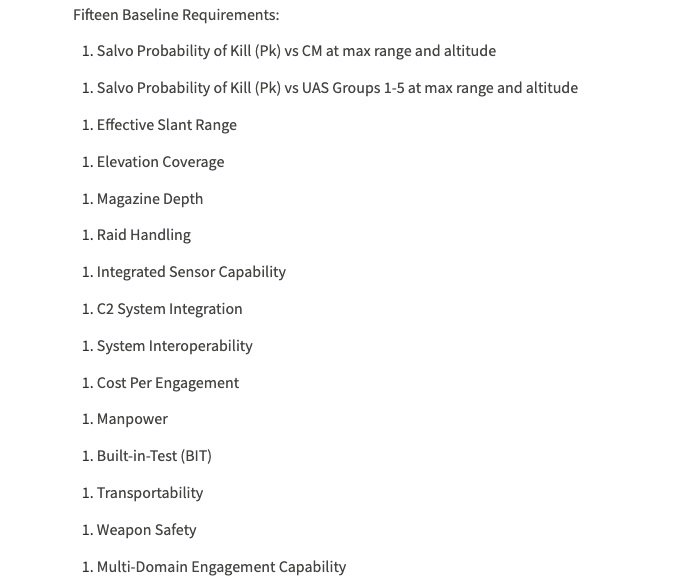
“To effectively assess and compare air defense weapon system performance, there are 15 critical baseline operational and technical parameters that must be analyzed in unison,” the RFI explains.
(Air Force Request for Information)
“These key metrics begin with the system’s Salvo Probability of Kill (Pk) evaluated against both Cruise Missiles (CM) and Unmanned Aircraft Systems (UAS) Groups 1-5 at maximum range and altitude, ensuring robust lethality against diverse modern threats,” the RFI notes.
A salvo probability of kill measures how effectively a salvo, as opposed to a single shot, defeats a target.
The following chart displays the weight, normal operating altitude and speed of the five drone group classifications.
(Congressional Research Service chart of Group 1 through 5 drones)
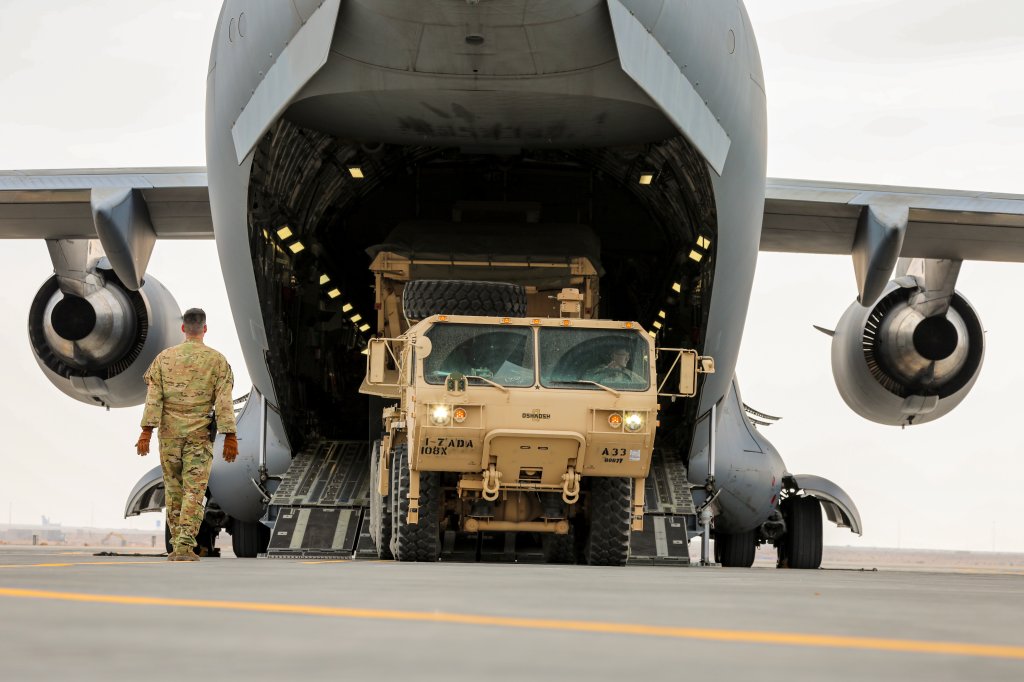
The Air Force wants this system to be “rapidly deployable, maintaining a lightweight, modular, and transportable footprint that can be swiftly projected into austere theater environments to meet emergent threats.” The RFI does not provide further details of how the Air Force is looking to transport these systems; however, the service relies on its fleets of C-130 Hercules, C-17 Globemaster III and C-5 Galaxy transport aircraft to move equipment. The size and weight of the systems determines which kind of aircraft can transport it.
These systems could also be moved by truck or ship or on their own if self-propelled, but those options also incur a cost in terms of the timeliness of delivery, and can be impossible for rapid global deployments.
U.S. Army soldiers from the 1st Battalion, 7th Air Defense Artillery Regiment, 108th Air Defense Artillery Brigade, load equipment and trucks onto a C-17 Globemaster III with U.S. Air Force airmen assigned to the 21st Expeditionary Airlift Squadron at an undisclosed location in the CENTCOM Area of Operations, Dec. 31, 2023. Photo by Staff Sgt. Christopher Neu
A key point of evaluation will be the overall cost of the munitions. The Air Force wants to ensure that the shell’s velocity and terminal effects “are maximized without driving the cost-per-engagement to unsustainable levels or exceeding the physical constraints of the host platform,” the RFI states. We’ll discuss these factors in more detail later in this story.
The service is also looking for the integration of “the right mix of radar, electro-optical, infrared, or radio-frequency sensors—to ensure reliable target acquisition and tracking across varying weather conditions, environments, and countermeasure scenarios.”
As we noted at the top of this story, the Air Force is seeking to improve its organic ability to defend its bases. This has become “an increasingly high priority” for the service, Air Force Secretary Troy E. Meink told Congress on May 20.
“The Air Force is developing organic air and missile defense capabilities, including Counter-small Unmanned Aircraft Systems (C-sUAS) to defend our air bases in all theatres [sic],” Meink stated in his written testimony. “The fielding of the Air Base Air Defense Systems (ABADS) missile defense capability, including kinetic defenses, at overseas main operation bases contributes to joint layered defense but does not reduce the need for increased joint investment in air and missile defense. We will continue to work judiciously for the development and procurement of these critical defensive capabilities.”
(Written testimony of Air Force Secretary Troy E. Meink)
In its Fiscal Year 2027 budget request, the Air Force is seeking about $1.4 billion for a missile defense variant of the Air Base Air Defense Systems (ABADS), according to Air & Space Forces Magazine. In addition, the Air Force also requested $51.8 million in procurement funds for its Small Unmanned Air Defense Systems (SUADS) in Fiscal Year 2026, according to the Air Force Fiscal Year 2026 budget justification book.
The war against Iran and the Ukraine war have, in particular, illustrated the challenges of defending against drones and cruise missiles.
There are two facets to potential use of gun systems for base defense. The first is that in complex air defense environments, it provides an inner, last line of defense against incoming threats. If the outer layers fail to take down the target or that target is not considered a priority over others, a hard-kill gun system offers a predictable and relatively reliable fallback. The gun system would become even more important if interceptor stocks run low, even temporarily, and those weapons need to be rationed for higher-end threats. With the outer defensive rings collapsing, the inner becomes far more important.
For small drones, that interceptors would not be effective with anyway, the gun system can take them down in localized air defense scenarios. Then there is also defending bases in lower threat areas where there are not additional layers of SAM systems. A gun system can provide a core aerial defense against lower-end, lower-density drone and cruise missile threats without costing huge sums of money or requiring a huge logistical footprint.
Beyond that, there is a direct cost comparison argument, but again, that is in a vacuum and a gun system cannot take the place of a multi-layered air defense system without inviting huge risk. Still, the engagement cost comparison is worth mentioning.
High-end, expensive, difficult-to-manufacture air defense weapons, like Patriot PAC-3 MSE, are clearly inefficient against drones. For instance, a mass-produced Iranian Shahed-136 can cost about $35,000 to $50,000, while a Patriot PAC-3 can run about $5 million and takes years to procure. By comparison, the cost-per-engagement efficiency of gun-based air defense systems, designed to defend against drones and subsonic cruise missiles, is far greater. One example of how this plays out is the cost of firing the Army’s Centurion Counter-Rocket, Artillery, Mortar (C-RAM) system. It is a ground-based version of the Phalanx Close-In Weapon System (CIWS) used on various U.S. and foreign warships, and is armed with a six-barrel 20mm Vulcan Gatling-type cannon firing M940 rounds. Those self-destructing rounds currently have a price tag of $80.70, according to the Army’s Fiscal Year 2025 budget request. This means a two-second burst from a Centurion, at a rate of fire of 4,500 rounds per minute, would cost just over $12,100.
Again, this is not a strict apples-to-apples comparison, but it can become a bigger factor during prolonged conflicts when high-end weapons stocks begin to run short. It’s also worth noting that drone interceptors are a rapidly growing capability set that are a lower-cost option for swatting down one-way attack drones and even some cruise missiles. Systems like Coyote have been in service for years with the Pentagon and have been protecting bases overseas with strong results. Even cheaper systems are emerging out of lessons learned in Ukraine. All of these systems have their own advantages and disadvantages, but pairing them with a new gun system would likely have synergistic effects. Overall, deploying densely layered short-range air defenses is becoming increasingly important in its own right, at least in high-threat areas.
Ukraine has a great deal of experience with the costs and prioritization of air defense capabilities. The country faces daily attacks by Russian missiles and drones, which is causing mounting casualties and destruction. This ceaseless bombardment has almost completely depleted Ukraine’s supply of Patriot interceptors, leaving it largely defenseless against ballistic missiles. As we noted yesterday, Ukraine is also running short of air-to-air missiles its Air Force F-16s use to swat down drones.
However, Ukraine has also relied heavily on a wide array of gun-based air defense systems, including the German-made Gepard self-propelled anti-aircraft guns (SPAAG). Based on the chassis of the Leopard 1 main battle tank, Gepards feature twin radar-aimed 35mm automatic cannons, mounted on a single turret. The German variant sports an S-band search radar and a Ku-band tracking radar. These radars are critical to the Gepard’s ability to locate, track, and engage targets at night and amid poor weather conditions.
The following video shows a Gepard blasting an Iranian-made Shahed-136 out of the sky.
A video reportedly showing two Russian Shahed-136 (Geran-2) loitering munitions being shot down by the Ukrainians with a German-delivered Flakpanzer Gepard self-propelled anti-aircraft gun (SPAAG) during last night's attack in Odesa Oblast, southern Ukraine.… pic.twitter.com/OhH7vTultm
The Air Force force is also looking at directed energy weapons like lasers for force protection and especially for defending bases overseas. While gaining traction across the services due in large measure to the much lower cost of delivering effects, these systems are still works in progress. Gun-based air defenses, on the other hand, are mature and proven, and modern precision-guided, programmable ammunition makes them even more efficient and effective.
Beyond the cost, high-end air defense systems — including their component sensors — though portable, are generally fixed to a specific location. That makes them vulnerable to attack. This has been the case in both the war against Iran and Ukraine. The same concerns hold true of aircraft. Both conflicts have shown aircraft vulnerability to drones when parked out in the open. Ukraine’s Operation Spider Web attack on Russian strategic bombers last year in particular shed light on this issue, which we have been sounding the alarm on for a long time.
In addition to these challenges, the Air Force is also facing the headwinds of an overall lack of U.S. short-range air defense capabilities, a concern we have been highlighting for years. Currently, there are three gun-based SHORAD systems being fielded by the U.S. military. These include the aforementioned Centurion C-RAM systems.
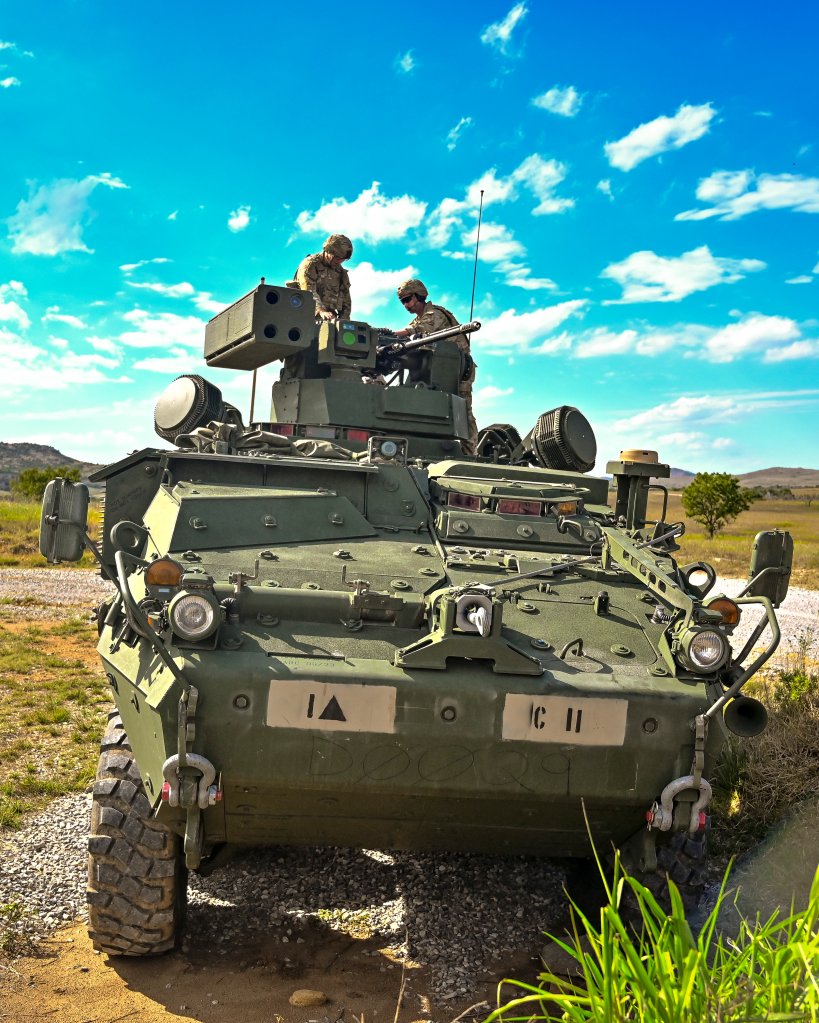
The Army also uses the Sgt. Stout, an air defense system based on the 8×8 Stryker light armored vehicle. The Sgt. Stout has a turret that can be fitted with up to two four-round launchers for Stingers. Those launchers can also be swapped out for ones that can be loaded with a pair of millimeter-wave radar-guided AGM-114L Hellfire missiles. The turret also has a 30mm XM914 automatic cannon, which can fire proximity-fuzed airbursting rounds against drones and other aerial threats, and a 7.62x51mm M240B machine gun.
Soldiers assigned to 4th Battalion, 60th Air Defense Artillery Regiment conducted a live fire exercise with the SGT STOUT (Stryker A1 M-SHORAD) vehicle in Fort Sill, Oklahoma, Sep. 23, 2025. Photo by Cpl. Emaney Wilson
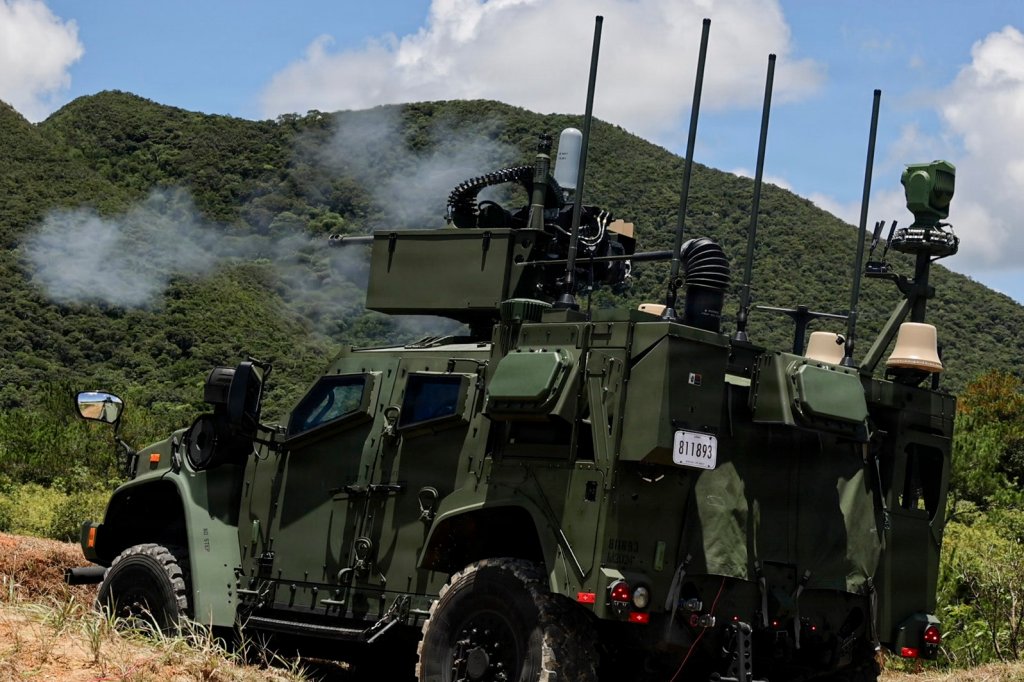
The Marine Air Defense Integrated System (MADIS) is armed with 30mm cannons and M240C coaxial machine guns in remote weapon stations (RWS). The RWS on one of the two vehicles is also configured to fire Stinger missiles for a spectrum of ground-based air defense scenarios.
U.S. Marines with 12th Littoral Anti-Air Battalion, 12th Marine Littoral Regiment, 3rd Marine Division, fire an XM914 30mm chain gun mounted on a Marine Air Defense Integrated System during a live-fire range at Camp Schwab, Okinawa, Japan, July 28, 2026. Photo by Lance Cpl. Skilah Sanchez
The Army may have additional gun-based systems on the way. In July, the service put out a request for information to companies that can provide a new gun-based air defense option, using a 50mm cannon system to track and defeat Group 1, 2 and 3 drones.
A few weeks later, Northrop Grumman introduced its Raid Hunter 50mm GBAD system, which it said “combines proven Chain Gun® technology, precision‑guided 50mm ammunition and a networked, interoperable system controller to deliver powerful protection against high-volume, mixed-threat aerial raids. It is designed to defeat a range of aerial threats including high‑priority cruise missile threats, unmanned aerial systems (UAS), and other advanced threats.”
We’re introducing Raid Hunter, our newly named 50mm gun-based air defense system designed to defeat mass, mixed aerial raids with cost-effective interceptors and deep magazine effectors which can be delivered to the warfighter at scale. Learn more: https://t.co/gnOzpo0RA3pic.twitter.com/oTqORTG9Q4
There are foreign options should the Air Force want to go that route. For instance, German arms maker Rheinmetall makes the popular Skyranger 35 gun system, which is a turret that can fit on a wide array of armor hulls.
The Skyranger 35 “is equipped with a KDG 35/1000 revolver cannon in 35 mm x 228 caliber with a firing rate of 1,000 rounds per minute,” according to Rheinmetall, which began delivering these to Ukraine in January. “It has an effective range of up to 4,000 meters and a high degree of commonality with the Oerlikon Revolver Gun Mk 3. Thanks to AHEAD technology, the Skyranger 35 is airburst-capable. In the future, it will also be possible to equip it with modern guided missiles.”
It seems that Ukraine's 1020th Anti-Aircraft Missile Regiment which belongs to the Ground Forces has taken delivery of the first Skyranger 35 SPAAGs mounted on a Leopard 1 chassis made by @RheinmetallAG.
Skyshield is the fixed placement cousin of this system and has been bought by a number of nations.
Skyshield (Rheinmetall)
This is just one example of a large number of potential offerings that could fit the USAF’s interests, from both domestic and foreign origins.
As we discussed earlier in this story, the U.S. is already facing a challenge defending against Iranian threats. A war with China would be more devastating and, when it comes to the Air Force protecting its bases, require far more robust defenses. At the same time, the Air Force is still very early in the process of taking on more responsibility for protecting its assets.
Parties have until 5 p.m. Oct. 9 to submit their proposals to the Air Force for a gun-based air defense system. With limited options and the service pushing to address its growing desire for organic air defenses, it will be interesting to see who comes forward and what systems they offer. We will provide more details about this effort when they become available.
Since receiving these tanks last year, the crews, serving with Ukraine’s 425th Separate Assault Regiment “Skala,” have used the Abrams in two combat operations in the fight for Pokrovsk, a key Ukrainian logistics hub and part of a defensive belt of towns in Ukraine’s eastern Donetsk region. They recounted their experiences to Hromadske, an independent media channel in Ukraine.
Fighting around Pokrovsk
The first major deployment described by the crews took place in December of last year, when Abrams tanks were used to support assault groups entering Pokrovsk.
The crewmember with the callsign Kent described moving into the city behind a mine-clearing tank and ahead of two infantry fighting vehicles (IFVs) carrying assault troops, during a mission that was deliberately aggressive.
“Since a tank is a priority target — my task was to draw their attention, while our infantry dismounted and moved in successfully.”
The Abrams was also assigned three target points to engage along the route.
“We went right in there, poured it on, and drove back out,” he recalled.
A video showing the 425th Separate Assault Regiment in action in August 2025, soon after receiving the Abrams:
The second operation, on March 31, involved an attempt to enter and hold an industrial area near Pokrovsk to help block Russian movement toward Hryshyne, a contested village in the district.
The operation was prepared for more than two weeks. Ukrainian forces conducted reconnaissance flights, examined difficult sections of the planned routes, and provided crews with extensive video and imagery.
“They knew every meter of the route,” another of the unit’s commanders, with the callsign Kubik, said.
Weather was considered essential. The Ukrainians waited for fog and rain, hoping to limit the effectiveness of Russian drones.
“Without the right weather we wouldn’t have been able to pull off operations like that,” Kubik said.
The operation nevertheless resulted in the destruction of four out of five armored vehicles, some of which are seen in the video embedded below.
Russia's Rubicon Drone Center FPV drones destroyed a Ukrainian assault group near Pokrovsk, hitting an M1A1 Abrams tank, M1117 APC and BMP-2 as the unit tried to advance near Hryshyne under fog cover. #Ukrainepic.twitter.com/ZzE52qAYxp
The commander acknowledged that the Russian side may have had advance knowledge of the operation.
“I can’t rule out the possibility that the enemy knew our plan,” he said.
His Abrams was not immediately destroyed. According to the crew, it completed its task and the assault troops dismounted before the weather changed.
“Once the fog lifted, they started working on it with an FPV drone,” the commander said.
Why use tanks at all?
The losses prompted criticism from Ukrainian military commentators, particularly after footage of the destroyed vehicles was published.
However, the crews defend the decision to use armored vehicles for the missions. According to the men of the Skala interviewed, the alternative was often to send infantry over several miles on foot while carrying weapons, ammunition, water, and other supplies.
“That takes more time,” Kubik explained. “And the enemy isn’t standing still — the enemy is moving toward them.”
Australia-supplied M1A1 Abrams AIM main battle tank in service of the Ukrainian 425th Separate Assault Regiment "Skala."
The argument that infantry could simply move more stealthily on foot also has limitations.
“Every day the Mavic drones are flying, the fixed-wing drones are flying,” he said. “No fog, guys are visible.”
Combined with IFVs, the Abrams can provide the ability to rapidly move troops while simultaneously delivering heavy direct fire against enemy positions and offering substantial protection to its crew.
The crews argue that this capability remains worthwhile even when the tank itself may eventually be lost.
One commander was asked whether deploying a roughly $5-million tank makes sense if a single sortie can result in its destruction.
“Yes, of course it makes sense to deploy it,” he replied.
“First and foremost — it saves the lives of the crew inside it.”
Russian forces captured a relatively lightly damaged M1A1SA Abrams main battle tank operated by the 47th Separate Mechanized Brigade in the Pokrovsk direction.
He pointed to fairly basic modifications including rubber strips and a foldable wire cage mounted on the turret, as additional layers of protection against drone attacks.
“A drone doesn’t hit the actual penetrating element directly — it just can’t reach it,” he explained. “It hits the rubber, and then the blast wave travels from there.”
Even with their tanks festooned with explosive reactive armor (ERA) bricks, the crews acknowledge that such protection has limits.
A head-on view of an M1A1 of the 425th Separate Assault Regiment shows the ERA bricks installed around the turret and in front of the hull. Ukrainian Armed Forces
US-supplied M1A1 Abrams tank in service of the Armed Forces of Ukraine with added Kontakt-1 ERA on the frontal hull and standard ARAT ERA on the sides. pic.twitter.com/PC2kDfxefO
— Status-6 (War & Military News) (@Archer83Able) May 21, 2024
“They also protect very well. An effective thing,” he said.
A Russian tank with the ‘hedgehog’-type protective covering. Russian state media
For now, the drone threat has led the regiment to keep its Abrams out of combat, as we will return to later.
The Abrams as a machine
The crews’ assessment of the Abrams included praise for its mobility, roomy interior, gun, and fire-control system.
Kubik said he had personally driven an Abrams to 50 miles per hour cross-country.
“The engine is an absolute beast,” he added.
The tank can also rapidly perform a pivot turn, which the crews consider particularly useful when maneuvering in confined spaces. Despite its prodiguous weight, it only rarely becomes bogged down after the kind of very heavy snow-melt that effects all vehicles on the battlefield.
Loading a 120mm M1028 canister cartridge into an M1A1 AIM Abrams main battle tank of the tank battalion of the 425th Assault Regiment. pic.twitter.com/tMd8QcROQe
— 𝔗𝔥𝔢 𝕯𝔢𝔞𝔡 𝕯𝔦𝔰𝔱𝔯𝔦𝔠𝔱 (@TheDeadDistrict) June 21, 2026
Its disadvantages include its demanding maintenance requirements. The running gear was described as particularly sensitive, with crews inspecting, lubricating, and replacing components after every sortie.
Fuel consumption is another major burden. The crew cited roughly 400 to 700 liters (106 to 185 gallons) per 100 kilometers (62 miles) depending on terrain and operating conditions.
“On asphalt it burns about 400 liters,” one said. In boggy terrain, consumption can reach “700 liters or more.”
The Abrams thirsty gas turbine engine and extreme logistical demands have always been a criticism of the platform.
An M1A1 of the 425th Separate Assault Regiment fording a river. Ukrainian Armed Forces
The crews said the vehicle’s ability to operate on different fuels is useful, although diesel provides the best engine-hour performance in their experience. Prior to delivery, the gas turbine engines of the tanks were reconfigured to use diesel fuel instead of the standard JP-8 aviation kerosene, according to earlier reports.
They also praised the Abrams’ protected ammunition storage and crew space compared with Soviet-designed tanks.
The version operated by the Ukrainians is an M1A1 rather than the latest Abrams configuration, with less sophisticated electronics than newer variants. It also lacks the classified armor found on its U.S. Army counterpart.
“For me — as a tanker — this configuration, what we have right now, is more than enough,” Kubik said. “The sight is absolutely excellent. The gun is also great.”
The interview ultimately presents a more complicated picture than the declaration that tanks are obsolete on the Ukrainian battlefield.
At the time of writing, at least 25 Abrams have been confirmed visually to have been destroyed, damaged, or abandoned in Ukrainian service. This is from a total of 31 provided by the United States and 49 from Australia.
“For now, we’re not using them further — there’s no way to,” Kubik said. “The enemy has developed their drone component very heavily, and for now we don’t have the means to counter that.”
While tanks remain exceptionally powerful direct-fire and protected mobility platforms, the proliferation of inexpensive uncrewed aircraft has made operating them increasingly difficult.
M1A1 AIM Abrams tanks of the 425th Assault Regiment . The reinforced upper glacis and turret roofs are clearly visible. pic.twitter.com/Sn9h8OWZ9P
— 𝔗𝔥𝔢 𝕯𝔢𝔞𝔡 𝕯𝔦𝔰𝔱𝔯𝔦𝔠𝔱 (@TheDeadDistrict) June 21, 2026
“If someone had told me, as a tanker, back in 2022: ‘Take this — we’re giving you an Abrams, we’ll give you time to train and you’ll fight in it,’” Kubik said, “I would never have climbed out of it.”
“I’d only be saying: ‘Bring me shells. I’ll drive non-stop wherever needed, arrive and work.’”
An M1A1 of the 425th Separate Assault Regiment firing its main gun. Ukrainian Armed Forces
As it stands, reconnaissance drones can find the Abrams, FPV drones can attack it, and persistent surveillance makes concealment difficult. Experience has shown that without more effective counter-drone capabilities, even a heavily protected tank can eventually be overwhelmed.
But Kubik believes that will change.
“The day will come when one of our bright minds figures out some excellent solution against drones — and we’ll start using them again.”
Asked whether the era of tanks is over, his answer was unequivocal.
“It’s not over … They’re just waiting it out for now, biding their time. Writing off tanks — in my opinion — is still too early.”

 Login


 BREAKING: Merz just said he is "deeply shocked" by the AfD's landslide victory.


























 , our newly named 50mm gun-based air defense system designed to defeat mass, mixed aerial raids with cost-effective interceptors and deep magazine effectors which can be delivered to the warfighter at scale. Learn more:



 (@NOELreports)






 (@TheDeadDistrict)

 Abrams destroys a house with Russian infantry in the Pokrovsk direction.
 (@Maks_NAFO_FELLA)