Christa Pike's lawyers on Saturday said that the 50-year-old convicted murderer has been discharged from the hospital and returned to prison. Pike was transported to the hospital in critical condition on September 30 after she survived Tennessee's botched effort to execute her for murdering a classmate when she was a teenager.
India’s air force chief said on Saturday that the U.S. has made no formal offer to sell India F-35 stealth fighters, and added that American personnel have not even allowed Indian officers near the stealth aircraft.
Air Chief Marshal Amar Preet Singh made the comments at a press conference marking the end of the multinational Exercise Tarang Shakti-2026 in Jodhpur, while seated alongside U.S. Pacific Air Forces commander Gen. Kevin Schneider.
“Your people don’t even let us go near the aircraft, and you are talking about selling it to us,” Singh said.
Six U.S. Air Force F-35As, accompanied by more than 200 personnel, participated in Tarang Shakti. This was the first time the American stealth fighters had drilled against Indian jets on Indian soil.
Singh also said the Indian government has not yet decided whether the air force should evaluate Russia’s offer of the Su-57.
“Once the decision is conveyed to us (by the government), we will evaluate how well it meets our requirements,” he said.
Earlier in 2025, U.S. President Donald Trump said, during Indian Prime Minister Narendra Modi’s visit to Washington, that the United States would pave the way for India to acquire the F-35.
Later, Vice President J.D. Vance reiterated the offer during his visit to India in April 2025, saying, “We, of course, want to collaborate more. We want to work together more. And we want your nation to buy more of our military equipment, which we believe is best-in-class. American fifth-generation F-35s, for example, would give the Indian Air Force the ability to defend your airspace and protect your people like never before.”
Earlier, as EurAsian Times reported, Lockheed Martin CEO Jim Taiclet discussed selling the F-35 to India and raised the prospect of selling the F-21, a highly sophisticated F-16 derivative.
“I think the F-16 also has strong legs, if you will, and more and increasing interest as we go forward from several countries that aren’t quite ready for F-35,” Taiclet said. There are “some countries that could see F-21 or F-16, for India, for example, as a stepping stone to F-35.”
The sale of the F-35 is subject to rigorous U.S. export controls under the Arms Export Control Act, which requires approval from the State Department, the Pentagon, and often Congress. The White House maintains strict policies on technology transfers, regional stability, and the internal politics of the potential recipient state to safeguard its sensitive technology.
The U.S. hesitation is straightforward: sharing it with other countries could put sensitive technology in the hands of enemies, especially if the recipient country has ties to countries like China or Russia, which would try to exploit or reverse-engineer it.
Earlier, writing for EurAsian Times, Air Marshal Anil Chopra (retired) said: The F-35 soft pitch faced almost immediate limitations due to subsequent tariff frictions and India’s core push for technology transfer for domestic manufacturing of its AMCA fifth-gen warplanes and aero-engines.
GE Aerospace has faced immense delays on its 2021 contract to supply 99 F404-IN20 engines to Hindustan Aeronautics Limited (HAL) for the Tejas Mk1A fighter program. Only six out of the promised engines have been delivered instead of the targeted 12-plus a year, prompting HAL to invoke contractual penalty clauses.
Tariffs on “friend” India and delayed engines for AMCA have badly weakened Indo-US ties.
India also operates Russian-supplied S-400 systems, a factor that previously caused friction between the U.S. and Turkey.
India already operates the Russian-origin S-400 AD System. The U.S. fears these networks could compromise classified F-35 stealth data. The jet relies on the U.S.-controlled Operational Data Integrated Network for software and logistics.
The U.S. may already be accessing such data through many other American platforms on Indian soil.
Meanwhile, introducing a complex new Western platform adds severe maintenance challenges to an already diverse military fleet. Even in the U.S., very few airbases can service stealth coatings.
Buying foreign fifth-generation jets risks diverting funds from India’s indigenous AMCA project. Putting too many military aviation eggs in the unreliable U.S. basket is also a risk. Americans can be “very unreliable” when it comes to imposing sanctions and freezing spares and maintenance support.
Operationally, the F-35 could offer major strategic advantages for the IAF, but any deal involves deep geopolitical, logistical, and financial complexities. Acquisition costs range from $80 to $110 million per jet, plus very high hourly operating expenses, creating budgetary challenges for New Delhi.
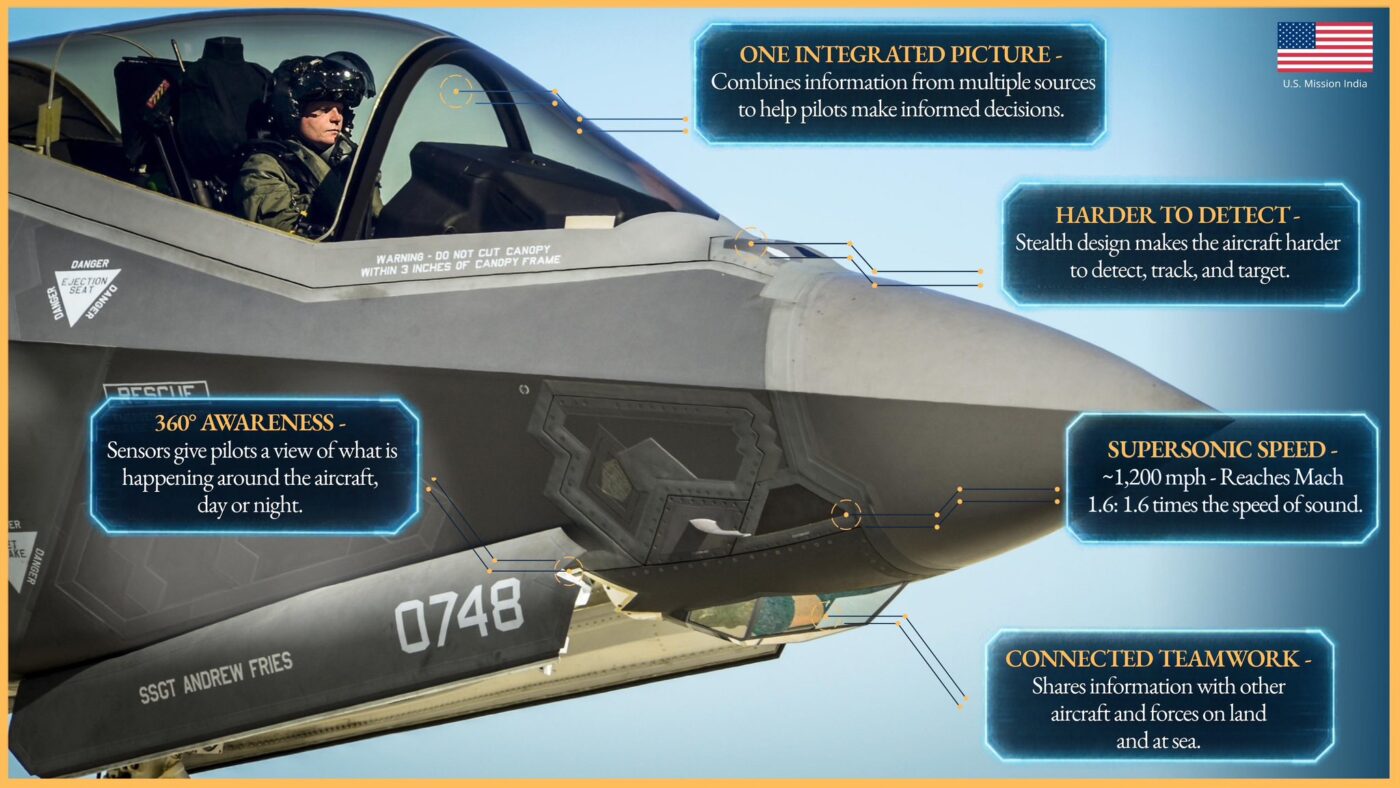
F-35: Image via U.S. Embassy, New Delhi
After two decades of stable ties, the last two years have seen distrust between the world’s largest and oldest democracies.
While many hope this is a transitory phase, it is becoming clear that the U.S. is not interested in India’s rise as a global power. U.S. Deputy Secretary of State Christopher Landau stated at the last Raisina Dialogue in New Delhi that Washington will not repeat its past approach (read: mistake) with China by granting India unfettered market and tech access that could lead to strong commercial competition.
The U.S. wants India strong enough only to serve as a bulwark against China, not to become an independent power center or a technology and economic power.
The U.S. seems keen only to supply platforms to India through large contracts. Even for aero-structures and smaller components, it prefers make-in-India “Build to Print” over significant technology sharing.
Even the proposed India-USA deal to co-produce GE Aerospace F414 engines with HAL faces major hurdles. The main complications include a nearly threefold cost surge, intense disputes over sensitive hot-end technology transfer, and the risk of delays to India’s Tejas Mk2 and AMCA programs.
Many Indians wonder whether we have invested too much in a partner with a high trust deficit and a vacillating foreign policy. U.S. is known to have “dumped” friends and allies for immediate national interests. The Trump administration’s recent public threats and admonishments to its NATO allies further strengthen Indian concerns.
The U.S. has already deepened its ties with India’s airborne platforms, supplying transport aircraft (C-17, C-130), maritime patrol aircraft (P-8I), UAVs (MQ-9), and helicopters (Chinook, AH-64 Apache, and MH-60R).
For a long time, the U.S. was trying to sell the F-16 ‘Viper’ (renamed F-21) and the F-18 Super Hornet as part of India’s Multi-Role Fighter Aircraft (MRFA) proposal. Later, it offered the F-15EX. The U.S. never officially offered the F-35.
Despite being the oldest democracy, the U.S. finds it easier to deal with dependent military Generals, and West Asian Sheikhs, rather than growing democracies. The U.S. has a poor opinion of India’s “Non-Alignment” and “Strategic Autonomy.”
Washington continues to prefer Pakistan, which helps it connect with China, the West, and Central Asia, and is willing to toe the American line for a few bucks. This Pakistan connection further erodes India’s trust.
Most analysts feel that letting the USA into India’s fighter-aircraft ecosystem is not a great idea. Any F-35 deal, like other aircraft deals, will be only a supply-and-support contract. There will be no technology transfer and no “Make-in-India” element.
While India pushes its own AMCA program, the Su-57 may still be the better choice for an interim fighter.
Building on the commercial success and popularity of its PAC-3 interceptors, Lockheed Martin unveiled the more advanced PAC-3 Edge, a program that it is advancing with millions of dollars in funding.
The PAC-3 Edge “will add a revolutionary defensive capability against hypersonic and advanced missile threats,” Lockheed said in an official press statement announcing the interceptor’s debut on October 9, 2026.
The interceptor “leverages combat-proven PAC-3 MSE technology and the latest, industry-leading capability to deliver decisive performance against the Army’s most critical threats,” the company emphasized.
Although details about the missile remain limited at this stage, the defense giant has indicated that the PAC-3 Edge will have a longer range, higher altitude reach, and greater effectiveness against maneuverable targets than the PAC-3.
The company noted that the PAC-3 Edge achieves superior performance with a next-generation seeker developed by its Strigo Product Center. This seeker—incorporating the latest defense technologies—is expected to significantly boost the interceptor’s ability to defeat highly sophisticated threats. It also features a multi-pulse solid rocket motor from Northrop Grumman that provides precise, controlled thrust throughout the flight profile.
Furthermore, Lockheed’s additional control-system upgrades extend the missile’s effective range and altitude capabilities, the company added.
Lockheed Bets Big on PAC-3 Edge
Lockheed said the improved PAC-3 interceptor is part of the US Army’s Future Interceptor program, “which is currently under competition,” though it stopped short of naming the other competitors.
“The Army’s decision to progress Lockheed Martin into the next stage of development affirms its confidence in Lockheed Martin’s proven Integrated Air and Missile Defense (IAMD) experience and the company’s ability to deliver an advanced, layered defense against what’s next,” the company stated.
The US Army’s Future Interceptor program is meant to develop a next-generation interceptor, primarily as an advanced successor or major upgrade path for the Patriot PAC-3.
The effort focuses on the lower tier of the ballistic missile defense battlespace and aims to counter current and emerging air, missile, and hypersonic threats with improved velocity, altitude, range, and maneuverability. It is meant to strengthen the Army’s layered IAMD architecture against near-peer adversaries like China and Russia.
The unveiling comes as the US military is seeking a Patriot successor amid evolving threats from adversaries like China, Russia, Iran, and North Korea, which have amassed sophisticated hypersonic missiles that are typically much harder to intercept because of their high speeds, unpredictable trajectories, and enviable maneuverability.
In fact, this effort may have gained more urgency after the debacle in the Middle East, where US facilities suffered massive damage in Iranian strikes during its ongoing Operation Epic Fury.
Lockheed says PAC-3 Edge is designed to integrate with existing and future IAMD capabilities, including the Integrated Battle Command System (IBCS), the M903 launcher, containerized launchers, and HIMARS Flex. It plans to accelerate missile development in 2027 to match PAC-3 Edge’s rapid deployment schedule for 2031.
Lockheed unveiled PAC-3 Edge interceptor
A noteworthy aspect of Lockheed offering the PAC-3 Edge for the Future Interceptor Program is that it is putting its own money on the line to deliver the interceptor faster than traditional acquisition timelines usually allow.
Lockheed reportedly plans to invest hundreds of millions of dollars of its own funds in the missile alone, in addition to further investments in its solid rocket motor and seeker. “We’ve already probably somewhere between $50 [million] and $100 million or better put into this,” Tim Cahill, president of Lockheed Martin, was quoted as saying by Breaking Defense.
He added that the seeker tech is expected to receive roughly $800 million in total company investment so the technology can be reused across other offensive and defensive systems.
The company has already invested about $250 million in the Strigo Product Center to fund new, industry-leading seeker technology that enables greater precision and maneuverability, as noted in the press statement.
Notably, this heavy investment indicates that rather than waiting for traditional government contracts to fully mature, Lockheed is treating PAC-3 Edge as both a technical leap and a strategic corporate bet.
This approach aligns with Lockheed’s recent emphasis on self-funded prototypes and enabling technologies, including work on a space-based interceptor aimed at an on-orbit demonstration around 2028, or the backward integration of advanced Skunk Works technologies, among other similar efforts.
This overall approach of self-funding projects, or parts of them, reflects the company’s deliberate shift toward “home-run” internal research and development (R&D) that produces real hardware the government can evaluate.
Leveraging The Patriot PAC-3 Appeal
Lockheed Martin is not selling the PAC-3 Edge as a clean-sheet leap into the unknown. Instead, it is deliberately packaging the new interceptor as the logical, low-risk evolution of the US’s most trusted and successful missile-defense weapon. “Lockheed Martin’s PAC-3 Edge interceptor leverages the combat-proven PAC-3 MSE, delivering even greater maneuverability, power and velocity to ensure the Army’s layered defensive architecture remains the most advanced in the world,” Cahill stated.
PAC-3 has been tested against ballistic missiles, cruise missiles, and even hypersonic threats in Ukraine and the Middle East, with Lockheed and US officials repeatedly describing high kill rates, despite leaked missiles.
File: PAC-3
Lockheed claims the PAC-3 Edge inherits the same PAC-3 hit-to-kill architecture and operational pedigree, allowing it to claim continuity. By keeping Edge within the PAC-3 family, including the same launchers, fire-control software, and logistics footprint, Lockheed reduces the usual political and programmatic friction that accompanies a new interceptor.
Notably, Lockheed will leverage the PAC-3’s infrastructure for the new-generation interceptor and, according to reports, will build the PAC-3 Edge on its existing PAC-3 line in Camden, Ark.
Furthermore, the company claims it will cost the same as the PAC-3.“The cost of this would be about that of the existing PAC-3 MSE,” Tim Cahill told Reuters. “At full production, the annual rate would be about 2,000 units a year, comparable with PAC-3 MSE.”
Against this backdrop, Congress and the United States Army can view Edge less as a risky new start and instead see it as the next spiral of a system that is already proven, funded at scale, and desired by allies.
The PAC-3 Patriot interceptors are the most advanced in the US inventory, alongside the THAAD (Terminal High Altitude Area Defense). In fact, the recent conflicts in Iran and Ukraine have driven a massive global surge in the missile’s orders. About 17 countries currently operate or have ordered PAC-3 variants, including the United States, the Netherlands, Japan, Germany, the UAE, Taiwan, Kuwait, Qatar, South Korea, Saudi Arabia, Romania, Poland, Sweden, Bahrain, Switzerland, Spain, and Denmark.
Many of these have multi-billion-dollar outstanding orders and are actively expanding their stocks.
For foreign customers, Lockheed could position the PAC-3 Edge as a natural path to ordering the next-generation PAC-3 instead of evaluating an all-new option.
Earlier this year, Lockheed also unveiled PAC-3 ACE, a less powerful, more affordable MSE variant accessible to clients outside the US. “It is not designed to replace the MSE, but to supplement it — it has its heritage and maturity, but we bring the costs down by changing some of the components,” Tim Cahill said at the time.
Therefore, it may not be an exaggeration to say that Lockheed is now diversifying its interceptor portfolio within the same brand: the PAC-3 ACE as a lower-cost, high-volume option for less-stressing threats, PAC-3 MSE as the current high-end workhorse, and the PAC-3 Edge as the future higher-altitude, longer-range, hypersonic-capable top end.
The unveiling of the new PAC-3 Edge comes as the company already executes a historic ramp-up of capacity. Earlier this year, Lockheed signed a seven-year framework agreement to increase annual PAC-3 interceptor production from 600 to 2,000 under a roughly $58.6 billion framework agreement. The overall expansion effort reportedly includes new facilities, robotics, automation, and supplier expansions.
In summary, Lockheed Martin is backing the PAC-3 Edge with hundreds of millions of its own dollars while keeping the design closely tied to the existing PAC-3 production base and operational architecture. The strategy aims to offer the Army a faster, lower-risk route to a more capable interceptor. Whether this will pay off now remains to be seen.
Contact the author at sakshi.tiwari13 (at) outlook.com
Science emerged in Christendom because God was transcendent, not pantheistic. Now materialism reigns as a hidden theology – Epstein-funded, preached by ambiguous atheists.
There is possibly more than one correct answer to the question of why science emerged in Western Christendom, rather than appearing first in one of the many Eastern societies with formidable technology, or within the fold of Greco-Roman paganism.
The Benedictine epistemologist Stanley Jaki offers a detailed answer that is intrinsic to Christianity: as we read in Christ and Science, the distinguishing factor is that Christians are not prone to falling into pantheism. Among Greco-Roman pagans, the cosmos was called “only-begotten” – a title later assumed by Jesus in Christianity, and only in Christianity. In the world of Aristotle, Western Christendom’s favorite pagan, bodies move of their own volition (fire seeks to rise, earth seeks to sink, etc.), and the Prime Mover is part of nature rather than transcending it. In Judaism and Islam, figures such as Spinoza (beloved in the 20th century by Einstein and Sagan, and in the 21st by Sam Harris) and Averroes (with his universal intellect) demonstrate how easily God can be conflated with nature itself. It was in medieval Christendom that the world came to be conceived as a vast clock with inanimate parts adjusted by an intelligent Creator, whose laws we must discover. This way of thinking about the universe, which we associate today with Newton, is medieval. And this worldview, specific to Christendom, is what made the invention of science possible.
Here in this SCF column, I once ventured a more modest answer of a cultural nature. I wrote that the West has been rationalist since before it was Christian; and this fosters not only the emergence of science but also the willingness to uphold it in the event of a conflict with faith. Sunnis, who constitute the majority of Muslims, saw a form of Quranic literalism put an end to the spectacular flourishing of the sciences during the Middle Ages. Jews, who devoted themselves to the exegesis of religious texts, only became scientists following emancipation and secularization. This cultural characteristic helps explain why science emerged in Western Christendom rather than in the East, given that both the Roman and Greek Churches shared the belief in the only-begotten Jesus. It also helps explain why, following the Protestant Reformation, Protestant Europe did not cling to biblical literalism or to Luther’s diatribes against reason, but instead produced science in dialogue with Catholic Europe. This ultimately shifted the locus of Truth from religion (where each group held its own version) to science (to be accepted by all), paving the way for that recent Western invention known as scientism.
Now, an idea intrinsic to Christianity that I wish to highlight is its absolute intolerance of relativism regarding knowledge. In the pagan world, philosophy and religion were disconnected matters. Plato reflected on the good, the beautiful, and the just without investigating Olympus. Cicero, as a philosopher, wrote against the public soothsayers of the Roman religion; yet, as a politician, he showed no intention of altering state religious practices or inventing secularism. Even Aristotle, who wrote on every conceivable discipline, did not write about Zeus, Hera, or Athena. He did create a “theology,” but it referred not to the gods, but rather to the Prime Mover. Zeus, Hera, and Athena were not the objects of any discipline.
It was during the Middle Ages that the Catholic Church invented the university with the aim of studying the universum – that is, everything: metaphysics, physics, politics, theology… Knowledge was organized cohesively, based on the presumption of an objective reality. Thus, physics could not teach something that contradicted theology, and vice versa. (Although the Galileo affair stemmed from the Aristotelianism embraced by the Church through Thomas Aquinas, rather than from a literal reading of the Bible.) This cohesion might seem obvious, yet today the discipline of physics claims that glass is a liquid, while the discipline of chemistry claims that glass is a solid. And that is not even the greatest problem: who would dare ask a university for an unequivocal definition of “man” or “human”? In practice, relativism reigns in the university – and did so even before the postmodernists took over everything.
This fragmentation of knowledge originated in the scientific model that emerged during the Renaissance. Outside the universities, humanists sought out ancient texts that medieval Catholics had discarded, such as De rerum natura by the materialist and Epicurean Lucretius. Since antiquity conferred authority in those days, the occult tradition formed by the fusion of Hermeticism and Kabbalah enjoyed particular credibility among the learned class. Hermeticism derives from Hermes Trismegistus, whom Renaissance thinkers believed to be the teacher of Moses, Plato, and Pythagoras, though in reality, he was a fictional figure dating from slightly after the time of Christ. An etymological trace of Hermeticism’s importance to science is the adjective “hermetic,” used by alchemists to describe their tightly sealed vessels. As for Kabbalah, it stems from a religion that predated Christianity – which is enough for it to be regarded as ancient, even though its principal text, the Zohar, originated in medieval Spain. As I have argued in greater detail here, Renaissance occultism influenced modern science and is responsible for its utilitarian bias. If individual disciplines decide that a certain concept “works,” contradictions between them pose no problem; what matters is not knowledge itself, but practical utility. It is a science inspired by the methods of the sorcerer, who consults ancient books and tests spells to see which ones work.
Thus, the status quo of knowledge within universities is one of practical relativism, resulting from the institution’s lack of a unified vision. On an individual level, however, it is humanly impossible to conduct science without a coherent worldview – even if that worldview is constructed a posteriori based on the “spells” that proved effective, much like the alchemists of the Renaissance. Today, it is quite clear that the scientific mainstream is atheist, but that tells us little. It would be more accurate to say that the mainstream is materialist.
The nineteenth century was the century in which materialism became consolidated within science. It was the century of Darwin’s triumph – Darwin being the first (and perhaps only) great scientist in history that was unequivocally atheist. Before Darwin, the prevailing worldview was the medieval one of God as the “watchmaker,” or of nature as a book written by God in the language of mathematics (to use Galileo’s metaphor). Alternative worldviews began to emerge during the Renaissance. By the Enlightenment, this movement had taken the forms of deism and materialism – concepts that are not mutually exclusive. Deism is the idea that God exists but is indifferent to humanity. This is a very vague notion, as it encompasses the possibilities that: (1) God is a distant architect (as for Voltaire, a “creationist” and admirer of Newton); (2) God is matter itself, or the universe itself (pantheism); or (3) gods exist but are made of atoms, just like the rest of nature – a view found in De Rerum Natura that results in practical atheism. Since this conception of God is psychologically difficult to sustain, it is hardly surprising that, by the nineteenth century, the public face of materialism had become that of atheism.
Even so, as I have shown here on SCF, only one of the “Four Horsemen” of New Atheism (Richard Dawkins) is unequivocally an atheist. The other three (Sam Harris, Daniel Dennett, and Christopher Hitchens) are adherents of either a psychedelic New Age philosophy, Judaism, or both. Sagan was another atheist with this ambiguous profile.
I believe, then, that it is useful to distinguish between these two opposing scientific worldviews: one, which gave rise to science, is that of the transcendent God who acts as the cosmos’s engineer; then there is the materialist view, according to which everything that exists is matter moving randomly, generating at times chaos and at others order. Within this latter framework, one can be an unequivocal atheist – like Dawkins today or Baron d’Holbach in the 18th century – or a New Age type like Sam Harris. Matter itself can also be divinized by crystal-obsessed wine moms and potheads. An ambiguous figure is none other than Epstein; this patron was a Jew religious enough to want to create a GMO kosher pig so he could eat bacon, yet he simultaneously funded Sam Harris’s atheist club. As I have shown here, Epstein was such a committed materialist that he sought to identify the specific part of the brain corresponding to the soul.
One final intrinsic trait of Christianity worth mentioning is its exotericism – that is, its public, non-initiate nature. This characteristic is reflected in universities and libraries: the entire repository of knowledge is open to anyone wishing to study. In the case of materialism, England has maintained a solid tradition of private and secretive scientific societies, often with commercial aims, dating back to the 18th-century Lunar Society. This aligns with the esotericism of the Renaissance. Furthermore, in the 21st century, the Epstein files brought to light discreet societies of materialists, such as the one involving Sam Harris that was funded by the pedophile.
Given that the pedophile also funded university research, it is plausible that this materialism – bordering on both pantheism and atheism – constitutes a hidden “theology”: one that is always presupposed in contemporary science yet never made explicit to the uninitiated.
What becomes of humanity when technology becomes capable of recognising, classifying, tracking and ultimately killing human beings without those carrying out the strikes ever having seen them? My friend Mohammad Reza Dehshiri asked this very question, and his answer is a powerful one. The danger, he writes, is not artificial intelligence but artificial inhumanity – that is, the possibility that machines will become more accurate precisely as humans cease to feel responsible for what those machines do in their name.
With this article, I am launching a series that takes Dehshiri’s analysis as its starting point and attempts to take it further. If the problem is ‘artificial inhumanity’, the answer cannot lie in a ‘more ethical’ AI, as if ethics were a module to be installed as an afterthought to a system that has already been designed. We need to reclaim a category that technological jargon has rendered almost unmentionable: human intelligence, understood not as a remnant to be protected amidst the complexities of automation, but as a form of knowledge with its own distinct characteristics, which no increase in computing power can replace.
I shall call it Human Intelligence, and the ambiguity is deliberate. In intelligence service jargon, HUMINT refers to the oldest of the intelligence disciplines: that which relies on people, sources, languages and the patient frequenting of places. In philosophical terminology, the expression denotes the faculty of understanding. The thesis of this first contribution is that these two meanings now converge, and that their convergence has geopolitical implications that extend far beyond the debate on the ethics of weaponry.
We can describe the operational chain of contemporary warfare in seven stages: detect, identify, classify, predict, prioritise, target, strike. Each link can be technically refined without the sequence, taken as a whole, being morally refined. The resulting phenomenon is called the ‘datafication of human life’: the individual reduced to an identity, a location, a behavioural pattern, a threat score.
This is no abstraction. In April 2024, an investigation by Yuval Abraham for +972 Magazine and Local Call described ‘Lavender’, a system used by the Israeli armed forces in Gaza to assign tens of thousands of people a probability of affiliation with armed groups. According to internal sources cited in the investigation, the human verification of each name often amounted to no more than twenty seconds – the time needed to ascertain that the target was male. The Israeli Defence Forces have disputed this account and described Lavender as a database designed to support analysts. Even if one accepts the official version, however, the crux of the matter remains: a human operator was present, and their presence was not sufficient to transform the system’s recommendation into a judgement.
Cognitive psychology has a name for this phenomenon, automation bias: the tendency of those working with an automated system to treat its recommendations as a substitute for their own verification, and to fail to seek out the information that might contradict them. Back in 1976, Joseph Weizenbaum – who had built one of the first conversational programmes in history – already distinguished between the ability to calculate and the ability to judge, and argued that there are tasks that should not be entrusted to a computer even if the computer were capable of performing them. Half a century on, this distinction has become even more pressing. Computation works on what has already been translated into data. Judgement must decide whether that translation has been faithful.
Dehshiri drives the point home with four distinctions: technical precision is not ethical precision; accuracy is not justice; automation is not responsibility; technological superiority is not moral superiority. I would add a fifth, of an epistemic nature, upon which the others depend: correlation is not understanding. A machine-learning system recognises statistical patterns in a dataset. It does not know what a school is, because it does not know what a child is, and it does not even know that it does not know this.
L’iraniano cites an interesting case study: On 28 February 2026, in the early hours of the war, the Shajareh Tayyebeh primary school in Minab, in Hormozgan province, was struck several times during school hours. The figures provided by the Iranian authorities range between 150 and 175 deaths, the vast majority of whom were girls, along with dozens of teachers and a few parents; the district prosecutor put the final death toll at 156. Washington has never directly acknowledged its responsibility nor published the findings of the Pentagon’s investigation. Amnesty International has described the incident, at best, as a serious intelligence failure.
There is one detail, revealed by satellite imagery, which shifts the analysis from the moral to the factual plane. According to Western media, the school stood next to a naval base belonging to the Revolutionary Guards and had previously formed part of it; among the explanations circulating in US circles is that of out-of-date targeting data. If this hypothesis were confirmed, Minab would not be a case of a machine making a mistake, but of a database that had ceased to correspond to reality. The building had changed. The data had not.
No classification algorithm, however sophisticated, can detect that an old military building has become a school if no one has recorded the change. Everyone living in Minab knew this: the parents who took their daughters to school every morning, the schoolbus driver, the teachers. This is precisely the kind of knowledge that HUMINT gathers and that remote warfare tends to regard as superfluous, because it is slow, costly and difficult to scale. Based on publicly available sources, US responsibility appears highly probable, whilst the exact circumstances remain unclear and confidence on this point is low: a database error, a classification error, or a conscious acceptance of the risk. The three hypotheses, however, all converge on the same question. Who, prior to the strike, checked whether there were people in that building?
Beyond ‘human-in-the-loop’
The international debate has long been content with the principle of human-in-the-loop, whereby a human being is part of the decision-making loop.
This formula is insufficient: a person may be present in the loop yet merely rubber-stamp the algorithm’s recommendation. He proposes replacing it with a more demanding principle, which he calls humanity-in-command: the effective ability to question, reject, override and halt the automated process.
The history of the Cold War offers two examples that clarify what this means in practice. On 26 September 1983, the Soviet early-warning system Oko signalled the launch of five ballistic missiles from the United States. The officer on duty, Stanislav Petrov, dismissed the alarm as a false alarm and did not report it as an ongoing attack, reasoning that a first American strike would never consist of just five missiles. He was right: the satellite had mistaken the sun’s reflection off the clouds for missile launches. Twenty-one years earlier, on 27 October 1962, in the Caribbean Sea, the Soviet submarine B-59, isolated and under fire from signal depth charges, was on the verge of launching a nuclear-tipped torpedo. The launch required the consent of the three senior officers on board, and Vasily Arkhipov refused to give it.
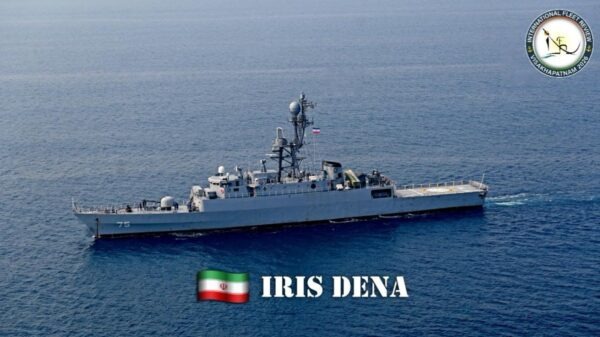
In neither case did the man approve a recommendation from the system. He contradicted it. And he did not do so because he had more data: indeed, the data were the problem. He did so because he knew how to ask himself a question that no procedure required him to ask, namely whether what he was seeing made sense in the context of everything else he knew about the world. Petrov was familiar with American nuclear doctrine; Archipov knew the difference between an attack and a threat. It is this ability to compare the signal with the bigger picture, the detail with what is plausible, that I call Human Intelligence. It is worth noting that the Dena was sunk by a submarine. We do not know what its officers were asked, nor what scope they had for judgement.
This proposal needs to be clarified, as there is a risk of reducing it to a generic humanistic appeal. Human Intelligence, as I understand it, is structured across three distinct levels, each of which marks a structural – rather than contingent – limit of artificial intelligence.
The first level is epistemic. The scholastic tradition distinguished between intellectus, the act by which the mind immediately grasps a truth, and ratio, the discursive process of moving from one element to another: for Thomas Aquinas (Summa Theologiae, I, q. 79, a. 8), the two are not distinct faculties but aspects of a single intellect, in which reasoning begins with an understanding and returns to an understanding. Current machine learning systems realise a ratio of unprecedented power, capable of inferring, combining and predicting on scales inaccessible to the human mind. They lack the aspect of intellectus, that is, a grasp of the meaning of what they process. This is a philosophical thesis and must be presented as such, but it has precise practical consequences: a system devoid of understanding cannot know when its own model of the world has become false.
The second aspect is practical. Prudentia, in the Thomist definition, is right reason applied to action, and its specific task consists in applying the universal principle to the particular case. The machine generalises: its value lies in mapping the individual case back to a class. Prudence does the opposite, because it must recognise what, in this particular case, falls outside the class. War, which is the realm of the singular and the unforeseen, is the arena where this difference carries the most weight. The Vatican’s Antiqua et nova note of January 2025 took up this line of thought, emphasising the embodied and relational nature of human intelligence and its irreducibility to a mere processing function.
The third level is relational, and it is here that philosophical meaning meets that of the intelligence services. Sherman Kent, who effectively founded the field of intelligence studies in the post-war United States, defined it first and foremost as knowledge, even before organising or activity. HUMINT is the form of this knowledge that passes through the other as a person: someone who speaks their language, knows their customs, can read a neighbourhood, and can distinguish a festival from a rally. Over the last three decades, the major powers have progressively shifted resources towards technical disciplines, from signals intelligence to satellite surveillance, right through to data fusion platforms. Minab illustrates the cost of this imbalance.
None of this implies a rejection of technology. Human Intelligence does not stand in opposition to AI in the same way that a manual stands in opposition to a mechanic. It establishes a hierarchy: the algorithm as a tool subservient to a judgement it cannot produce on its own. And from this it derives a principle, formulated by Dehshiri, which deserves to become an operational criterion: the more technology distances the actor from the consequences of their own actions, the more the conscious responsibility of the decision-maker must increase, not decrease.
Geopolitically speaking
So far, the issue might seem to be one of moral philosophy. It is not merely that. The distribution of algorithmic warfare capability is a distribution of power, and the rules governing it will be written – if they are written at all – by those with an interest in limiting them as little as possible.
The state of international law confirms this. The group of government experts established under the Convention on Certain Conventional Weapons has been discussing lethal autonomous weapons systems since 2017 without having reached a binding instrument. In November 2023, the United States promoted a political declaration on the responsible military use of AI, which is by definition non-binding; in December of the same year, the United Nations General Assembly adopted the first resolution dedicated to these systems, whilst the International Committee of the Red Cross has been calling since 2021 for a ban on unpredictable autonomous systems and those designed to target human beings. In June 2024, speaking at the G7 summit in Borgo Egnazia, Pope Francis called for no machine ever to be placed in a position to decide on a person’s life. The gap between these positions and the reality on the battlefields of 2026 is measured in casualties.
There is also a deeper asymmetry. Those who control the data decide who is a target, and the victims of algorithmic warfare are largely found outside the West: in Gaza, Iran, the Sahel and Yemen. For states that do not produce the platforms or control their databases, human intelligence thus becomes a matter of sovereignty. A country that maintains linguistic expertise, regional knowledge and human intelligence networks retains its autonomy of judgement; a country that entrusts its worldview to systems designed elsewhere – often by private companies – surrenders it along with its data. In an order tending towards multipolarity, this distinction will separate the actors who judge from those who are judged.
This leads to a concrete proposal, which I shall develop in future articles. Alongside the general principle of meaningful human oversight, international humanitarian law could codify a specific obligation for human verification of the civil status of every fixed infrastructure included on a list of targets, with an expiry date beyond which the information becomes invalid and must be renewed using direct sources. This is a minimum standard. Applied to Minab, it would have required someone to ask whether that building was still what the records stated it to be.
Technology can determine how a weapon reaches its target, whilst it is up to humanity to decide whether that target should be struck. The question underlying all this is who, in practical terms, exercises that humanity, with what tools of knowledge and within which institutions. In Minab, someone should have known that there was a school there. The fact that nobody knew, or that nobody asked, is the point from which we must start again.
The United States is one of the few developed Western democracies that still carries out the death penalty, with dozens of executions every year.
However, even by American standards, the execution planned for December is unusually severe.
Secretary of War Pete Hegseth has said that Major Nidal Malik Hasan, sentenced to death in 2013 by a general court-martial under the Uniform Code of Military Justice (UCMJ), will be executed by firing squad at Fort Hood, Texas, and that the execution will be public.
The Pentagon has since said it will livestream the execution.
It was here in Fort Hood, Texas, that Major Hasan opened fire inside a crowded medical readiness center at Fort Hood, killing 13 people and injuring 32 others in 2009.
Before opening fire on unarmed soldiers, Hasan shouted “Allahu Akbar.” He also shot at the backs of soldiers fleeing toward the parking lot.
Hasan later said it was an effort to stop them from going to Afghanistan and killing his fellow Muslims.
This will mark the first U.S. military execution in over 60 years, the first military execution by firing squad since World War II, and the world’s first-ever officially livestreamed execution.
This undated photo provided by the Bell County Sheriff’s Department shows former Army psychiatrist Maj. Nidal Hasan. Credit via X.
The last time the U.S. military carried out an execution was in 1961, when Army Pvt. John Bennett was executed by hanging.
The last time the U.S. military carried out a death sentence by firing squad was in 1945.
The best-known case is Private Eddie Slovik, shot by a 12-man firing squad in France in January 1945 for desertion, the only U.S. soldier executed for desertion during the Second World War and since the Civil War.
Nearly 10 months later, Dan J. Lee was executed by the U.S. military’s firing squad in the Philippines in November 1945 for murder and/or rape.
Hasan, therefore, could become the first U.S. servicemember to be executed by a firing squad in over eight decades.
His execution could also become the world’s first officially live-streamed death penalty.
Public executions were common in the medieval period.
In “Discipline and Punish,” French philosopher Michel Foucault writes that the death penalty was a “spectacle.”
“Public torture and execution of criminals provided one of the most popular spectacles of eighteenth-century France,” Foucault wrote in his book.
However, gradually, most countries outlawed public executions.
The UK abolished public executions in 1868 with the passing of the Capital Punishment Amendment Act 1868, which moved all executions behind prison walls.
France followed suit in 1939. In the U.S., the last public execution was carried out in 1936.
Amnesty International said in its report on executions in 2025 that it knew of at least 17 public executions – 11 in Iran and 6 in Afghanistan.
The U.S., therefore, joins a handful of countries like Iran and Afghanistan where public executions are still carried out.
Notably, the U.S. is currently at war with Iran and fought a 20-year-long war with Afghanistan from 2001 to 2021.
The question, then, is what precisely Washington hopes to achieve by joining the league of its adversaries?
Live Streaming of Death Penalty By Firing Squad
It is noteworthy that the general court-martial under the Uniform Code of Military Justice (UCMJ) only awarded the death sentence to Hasan in 2013.
Military appeals later affirmed that sentence. The Supreme Court declined review in 2025.
In October 2026, Defense Secretary Hegseth recommended death by firing squad, and President Trump approved the recommendation.
Hegseth later said that the execution will be public, with the Pentagon clarifying that it will be live-streamed.
Hegseth explained part of the reason himself.
“Execution by firing squad. Army major betrays his country. Radical Islamist kills a bunch of Americans at Fort Hood. Of course, we’re going to do it at Fort Hood and do it on a Thursday. We’re going to do it at 1 o’clock, which is when he did it, and it’s going to be soldiers with rifles executing the firing squad,” Hegseth said in an interview with Jack Posobiec on Real America’s Voice.
“It was a radical Islamist attack in uniform inside the ranks, and so he’s going to get a firing squad of soldiers, as it should be. And we’ll make sure that people can watch it, that it’s public, because people need to understand that there are serious consequences for these types of things.”
“Army firing squad for convicted terrorist Nidal Malik Hasan, the jihadist who opened fire on unarmed American soldiers at Fort Hood in 2009. He killed 13 people and wounded 32 others while shouting ‘Allahu Akbar’ during the attack,” Chief Pentagon spokesman Sean Parnell said.
The remarks make it clear that the Pentagon wants to send a strong message against internal threats and reassert the Uniform Code of Military Justice’s (UCMJ) ultimate authority.
It is notable that while, in theory, the UCMJ has the power to award the death penalty for criminal behavior in the armed forces, in practice, the awarding of the death penalty by the UCMJ, and its actual implementation, has had a chequered history.
The UCMJ and Death Penalty
UCMJ is the federal criminal code and procedural system that governs the U.S. armed forces.
The UCMJ was enacted in 1950 and took effect in 1951.
The code creates one uniform system of military justice for all branches. Its rules apply to active-duty members of the Army, Navy, Air Force, Marine Corps, Coast Guard, and Space Force; certain reservists on duty; and others such as prisoners of war or retired members.
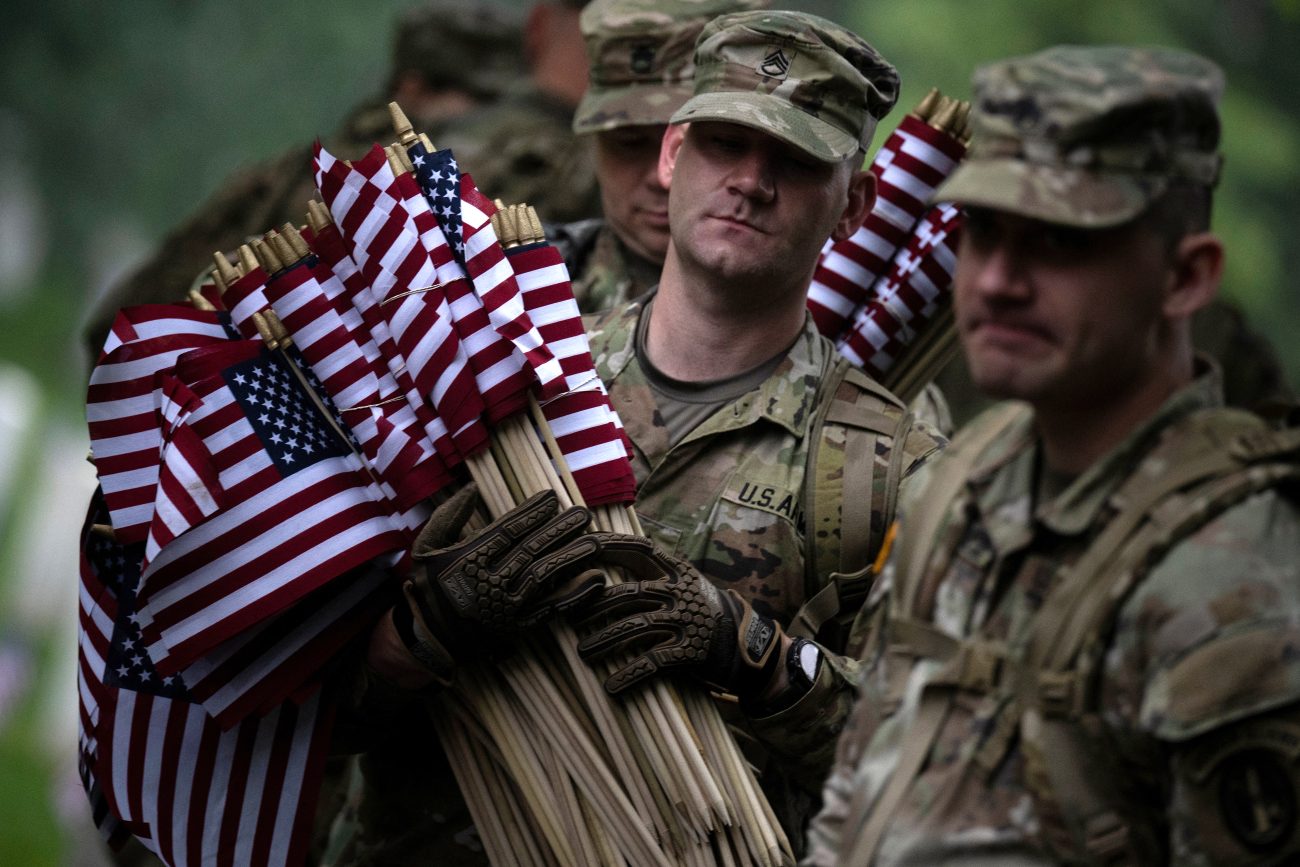
Service members place US flags at Arlington National Cemetery during the Annual Flags-In Ceremony in Arlington, Virginia, on May 22, 2025, as part of the Memorial Day holiday on May 26. (Photo by Brendan Smialowski / AFP)
Its stated objective is to promote justice, maintain good order and discipline, support efficiency and effectiveness in the armed forces, and thereby strengthen national security. It balances the military’s need for discipline and readiness with procedural protections for the accused.
It contains punitive articles that define both uniquely military offenses, such as desertion, absence without leave, insubordination, and disrespect, and ordinary crimes, like murder, larceny, and sexual offenses.
The general courts-martial under the UCMJ have the authority to impose the death penalty.
From its founding in 1951 till 1961, the U.S. Army carried out 10 executions awarded by the UCMJ, all by hanging.
The last military execution in the U.S. was carried out in 1961, after President Eisenhower approved it.
However, in 1972, the U.S. Supreme Court, in a landmark judgment in the Furman v. Georgia case, effectively placed a temporary moratorium on the death penalty across the United States.
In 1984, President Ronald Reagan signed an order that set detailed rules for military death-penalty trials.
It established that the court-martial could not sentence someone to death just because the crime was serious. The prosecutors must also establish one more “aggravating” factor, such as the killing of more than one person, or killing someone during robbery.
Furthermore, the panel could impose the death sentence only if all members agreed on guilt and the sentence. Under these rules, the UCMJ authorized capital punishment again.
From 1984 till mid-2000s, the military sought the death sentence against the accused in 47 cases.
The panel, however, awarded the death penalty in only 15 out of those 47 cases. Even in these 15 cases, many were later reduced to life imprisonment on appeal or commuted.
For instance, former President Barack Obama commuted Dwight Loving’s 1989 sentence to life in 2017.
Currently, four men remain under a UCMJ death sentence: Ronald Gray (1988), Hasan Akbar (2005), Timothy Hennis (2010), and Nidal Hasan (2013).
Notably, former President George Bush approved Gray’s death sentence in 2008, becoming the first U.S. President since Eisenhower, after a gap of 47 years, to approve a death sentence awarded by the UCMJ.
However, a federal judge stayed that execution so Gray could challenge the sentence in court. His execution has still not been carried out.
Now Trump has become only the second President to approve the death sentence awarded by the UCMJ in 65 years.
Hasan’s death sentence is set for December 3.
Notably, President Trump has not only approved Hasan’s death sentence, but also approved his execution by a firing squad and its live-streaming.
Hasan’s execution, therefore, could mark the return of military executions in the U.S. after over six decades.
Sumit Ahlawat has over a decade of experience in news media. He has worked with Press Trust of India, Times Now, Zee News, Economic Times, and Microsoft News. He holds a Master’s Degree in International Media and Modern History from the University of Sheffield, UK.
He can be reached at ahlawat.sumit85 (at) gmail.com
US, Ukrainian and European negotiators held talks in Miami on Friday to seek a common proposal to end the war in Ukraine, as President Donald Trump's decision to ease restrictions on Russian fuel drew criticism from lawmakers and Ukrainian President Volodymyr Zelensky.
A strong 7.6 magnitude earthquake struck near the southern coast of Panama on Friday at a 10 km depth, according to the US Geological Survey, shaking buildings as far away as the capital and prompting evacuations. The US Tsunami Warning System showed potential tsunami threats across much of Central America's Pacific coast.
Russia is seeking support for its war effort abroad – and threatening retaliation beyond Ukraine. Reports of foreign labor in drone factories, proposals to counter Starlink, and allegations of overseas recruitment show different ways Moscow could sustain its military effort and put pressure on its opponents.
Nowhere Far Enough
On October 9, Mikhail Zvinchuk, founder of the Russian military Telegram channel Rybar, was detained in Montenegro. Montenegrin authorities accused his team of using media work to interfere in the country’s politics. Rybar said they had come legally to film at Cetinje Monastery and had submitted an official filming request. Moscow’s response explains why this matters: Dmitry Medvedev, deputy chairman of Russia’s Security Council, suggested replenishing an “exchange fund” with Europeans and Americans to recover detained Russians. One arrest became a warning about others to come.
Mikhail Zvinchuk, founder of Rybar, a Russian pro-war Telegram channel covering the war in Ukraine, was detained in Montenegro on October 9
Five days earlier, Medvedev had delivered the orbital version of that warning. If Russia’s Rassvet constellation were destroyed, American Starlink satellites would “come tumbling down like ornaments from a dried-up Christmas tree.” “Space is a very crowded place,” he added. “We need to be mutually courteous.” Kiev had sought sanctions and restrictions, not announced a satellite attack. Moscow was putting a military threat behind its demand that Russian communications infrastructure be left alone.
The link is not between a blogger and a satellite. It is between two threats of retaliation: damage our network and yours becomes a target; detain our people and yours may become bargaining chips. Moscow is challenging the assumption that pressure on Russia can remain a one-way transaction.
Partners Behind the Front
The space threat has a practical backdrop. Leaked documents published in July describe a closed Russian-Chinese military forum in Guangzhou in November 2023. Chinese researchers proposed several ways to counter Starlink, from legal pressure and jamming to cyberattacks and destruction. Their hardest problem was also the simplest: how to disable satellites more cheaply and quickly than SpaceX could replace them. They do not show that these systems were built or deployed.
Visualization of the planned Starlink Generation 2 constellation
Russia and China have different strengths to offer. Moscow brings battlefield experience and air-defense knowledge; Beijing brings electronics, artificial intelligence, and manufacturing capacity. Russia can show what works under fire. China can help turn those lessons into equipment made at scale. A sixth closed forum was reportedly planned for the fall in St. Petersburg.
This is why repeated technical meetings matter more than dramatic threats. A shared design, tested and improved over several years, could outlast the war that first made it useful. For Moscow, the goal is to weaken an American advantage. For Beijing, Russian experience offers lessons without having to fight the same war.
Discussion of leaked documents, the “one-to-many” concept and replacement costs
But destroying satellites is not a clean solution. Russia’s 2021 antisatellite test forced both astronauts and Russian cosmonauts to shelter aboard the International Space Station, according to NASA. Debris threatens more than the intended target. Jamming can offer a narrower response; smashing entire networks risks damaging the same orbital space Russia and China also need.
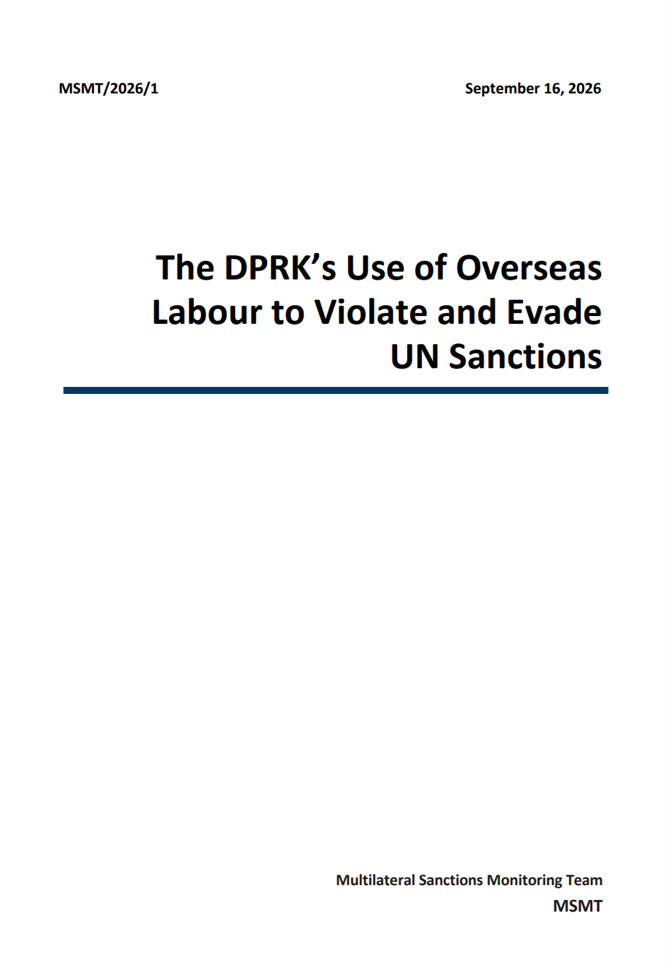
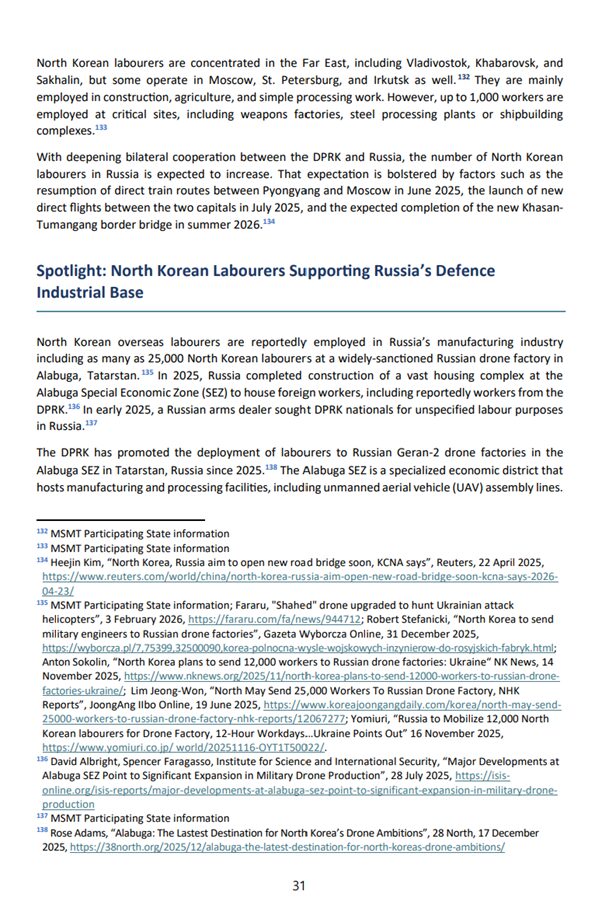
The factory floor shows another side of this partnership-building. A September report by the Multilateral Sanctions Monitoring Team says North Korean workers are employed at Alabuga in Tatarstan, where Russia produces Geran-2 drones, and describes workers entering Russia as students. Pyongyang rejected the report as fabricated. If the findings are accurate, the bargain is straightforward: Russia gains workers, North Korea gains income. Foreign support does not have to arrive as a finished missile; it can help keep the assembly line moving.
September 2026 sanctions-monitoring report. Pages 31-32 discuss Alabuga and drone production. Pyongyang rejects the report
The Underground Price List
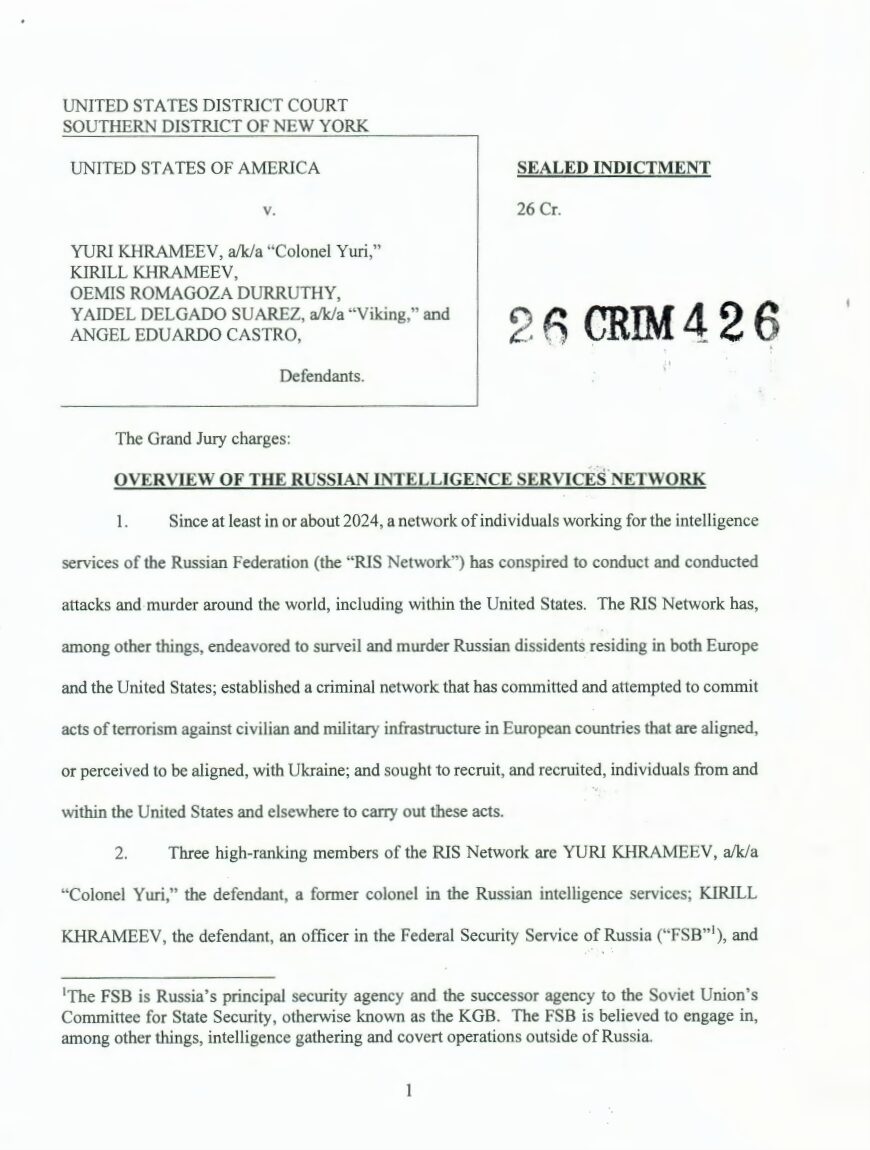
Recruitment abroad serves a different purpose. A September 15 U.S. indictment alleges that a Russian intelligence-linked network used Cuban and Venezuelan intermediaries to recruit inside America. Prosecutors describe payments of $1,000-$1,500 for surveillance and a $40,000 offer to kill a Russian dissident believed to be near Washington. Another alleged offer promised an American $25,000 to kill a target in Lithuania. These remain accusations, not court findings or proof of an officially declared bounty program.
Original U.S. indictment naming the alleged Russian, Cuban, and Venezuelan participants
The alleged network operated from at least 2024, before the Montenegro arrests. Its importance lies in the method: foreign intermediaries and local recruits, rather than an obvious Russian team. If substantiated, the charges would show Moscow reaching inside America through people who do not carry Russian passports.
The October 9 threat to expand the “exchange fund” signals that consular protests may no longer be Moscow’s only answer. It suggests foreign detainees could become leverage for recovering Russians. The warning to European and American governments is pointed: the detention of a Russian abroad may create a problem for their own citizens elsewhere.
Russia’s partners help it build weapons; alleged overseas networks extend its reach; threats against satellites and foreign detainees aim to raise the cost of confrontation. These are different tools, not proof of one master plan. But October’s warnings carry a common message: Moscow wants the other side to feel exposed too. Medvedev closed his latest message with a Russian proverb: “If you live among wolves, you must howl with them.”
After 321 days at sea, the USS Abraham Lincoln aircraft carrier (CVN-72) returned to San Diego, with its island superstructure showing rows of silhouettes of ships, drones, and other targets reportedly destroyed during Operation Epic Fury.
The USS Lincoln arrived at Naval Air Station North Island in San Diego on October 8, concluding a long deployment that included extended operations in the Middle East.
Before the USS Abraham Lincoln arrived in San Diego, the US Secretary of War Pete Hegseth presented the carrier crew with the Presidential Unit Citation, the military’s highest unit-level award for valor.
Calling the mission “historic,” Hegseth noted that the carrier conducted “3,693 combat flights, sinking 64 Iranian warships, launching 450 Tomahawk land attack cruise missiles, and shooting down 77 one-way aerial attack drones.”
Acting Secretary of the Navy Hung Cao lauded the carrier crew in a post on X, saying, “Congratulations to @CNV_72 and all of CSG-3 on this well-earned Presidential Unit Citation for their extreme heroism over the last 10 months in defense of our homeland.”
The citation says the defense included 40 days in combat and an “ironclad maritime blockade against Iran in support of Operation Epic Fury.”
During Hegseth’s recent visit to the carrier before it arrived home, he said, “I’m the only thing standing between you and home,” and that his intention was, “Once they pull up to the dock, we’re getting out of the way.”
The Pentagon released an image of Pete Hegseth standing on the deck of the carrier and examining the superstructure, which was stenciled with a list of targets the USS Abraham Lincoln Carrier Strike Group (CSG) destroyed during a 321-day deployment.
Subsequently, Hegseth published another image showing the full extent of the markings, with “Operation Epic Fury” written above rows of ship and drone silhouettes (seen below).
File: USS Abraham Lincoln (CVN 72) aircraft carrier arrived at San Diego featuring kill markings
The carrier’s arrival with these markings aligns with the US Navy’s long-standing practice of recording unit or group combat results after major operations.
Observers counted approximately 174 markings on the island superstructure. These traditional victory symbols are attributed to Carrier Strike Group 3’s collective actions, including carrier air-wing sorties, destroyer operations, Tomahawk launches, and air-defense engagements.
What Targets Did The Lincoln CSG Neutralize?
The visible markings include silhouettes representing 23 anti-ship missiles, 34 surface ships, 122 unmanned aerial vehicles, 10 submarines, and what appears to be a large bomb marked “1403.”
The aircraft carrier features 34 kill marks of surface ships neutralized in the sixth month of the conflict in the region. Although official information is scarce, these targets could include warships, corvettes, and even unmanned surface vessels used by the Islamic Revolutionary Guard Corps (IRGC).
The US Central Command (CENTCOM) publicly confirmed the destruction of several ships. Some high-profile targets include the Shahid Bagheri carrier, the IRIS Makran forward base ship, the Jamaran-class corvettes, and all four Shahid Soleimani-class catamaran missile corvettes.
The US Navy also neutralized multiple Bayandor-class corvettes and other frigates, several fast-attack craft and missile boats, at least 16 mine-laying vessels, and multiple auxiliaries and support vessels.
It is hard to say which of these vessels the Lincoln carrier group neutralized, but reports say the group operated in the Arabian Sea and, at times, closer to the Gulf of Oman during the early phase of Operation Epic Fury.
The group could have struck these targets with Tomahawk cruise missiles launched from escort Arleigh Burke-class destroyers, such as the USS Spruance, USS Michael Murphy, and USS Frank E. Petersen, or with F-35C Lightning IIs and F/A-18E/F Super Hornets from the carrier’s air wing.
The aircraft carrier features about 100+ triangular silhouettes that resemble the Shahed-136 one-way attack drones that were extensively deployed by the IRGC in its strikes on US military assets. However, they could also potentially reference other similar kamikaze drones, given Tehran’s massive inventory of these low-cost assets.
The escort ships—the Arleigh Burke-class guided-missile destroyers doubling as critical air-defense assets alongside the aircraft carrier-could have downed these drones. These state-of-the-art warships are equipped with the Aegis Combat System to detect, track, and engage drones at medium to long range with Standard Missiles such as the SM-2 or SM-6, and the Evolved Sea Sparrow Missile (ESSM).
The carrier itself has self-defense systems such as the RIM-116 Rolling Airframe Missiles (RAM) and the Phalanx Close-In Weapon System (CIWS). Furthermore, F-35s and Super Hornets operating from the carrier may have shot down some of these incoming drones.
Notably, the island carries 23 missile silhouettes. Hegseth credited the strike group with destroying 21 anti-ship cruise missiles. The citation does not say whether those were stopped by escort ships, by F-35s and Super Hornets, or by the carrier’s own Rolling Airframe Missiles and Phalanx guns.
File: US Secretary of War Pete Hegseth assessing the kill markings on USS Abraham Lincoln aircraft carrier
USS Abraham Lincoln also prominently features 10 submarines, which is unsurprising given that US CENTCOM focused on decimating Iran’s Russian-built Kilo-class and other submarines during the conflict.
For example, a Navy F/A-18F Super Hornet that flew from the USS Abraham Lincoln on combat missions in the Iran war was spotted with submarine kill markings earlier. Jeff Rojas photographed the aircraft, which belongs to VFA-41, a Navy fighter squadron known as the “Black Aces,” on October 1.
How the aircraft destroyed an Iranian submarine is unclear, but Rojas said, “I assume that it was dry-docked and they dropped a laser-guided bomb.”
The US missiles damaged many Iranian submarines, including some produced indigenously, that were docked in ports during early bombardment, but neither the Navy nor CENTCOM has publicly claimed that Navy fighter jets were involved.c
Instead, the US military earlier said it used air-launched AGM-114 Hellfire laser-guided missiles, probably fired from MQ-9 Reaper drones, and ground-launched Army Tactical Missile System (ATACMS) short-range ballistic missiles against submarines in particular.
However, the CSG may have taken out at least some of these submarine targets with Tomahawk missiles.
Most details, including specific individual ship sinkings by Lincoln CSG platforms or the exact methods used, rely on official claims and open-source analysis rather than independent battle-damage assessments available in the public domain.
Interestingly, the number of targets the War Secretary cited in his address differs significantly from the number of kill markings visible on the flattop. Neither the United States Navy nor the Department of War (DoW) has clarified why the flattop bears only 34 surface ship kill marks, even though Hegseth counted 64 in his address, or why the carrier lists 106 drones while Hegseth’s estimate was far more conservative at just 77.
Although these markings are often symbolic or selective rather than a strict, audited one-to-one accounting of every engagement, a reason for the discrepancy is awaited.
A Mission Marred With Chaos
The carrier’s prolonged deployment garnered national attention after Stars and Stripes, the news outlet affiliated with the US Armed Forces, reported on deteriorating conditions aboard the carrier, a major mental health crisis, and worsening living conditions in August 2026.
“Interviews with active-duty sailors and family members, along with dozens of public social media comments and posts by crew members, describe sailors struggling with exhaustion and declining morale, including reports of suicidal thoughts and at least one instance where a crew member was prevented from jumping overboard,” the report underlined.
After this explosive disclosure caused a stir and exposed the Pentagon, War Secretary Pete Hegseth, Acting Navy Secretary Hung Cao, and CENTCOM leadership dismissed much of the coverage as misrepresented or dishonest, while acknowledging challenges of extended deployments. Nonetheless, the report and the public reaction paved the way for the carrier’s return and a stopover in Thailand last month, giving the crew much-needed respite
The Secretary of War also pushed back against the allegations of the Navy being stretched thin and a crisis about the carrier, including reports of eight sailors who attempted suicide. “Lincoln into some sort of a symbol, a symbol of dysfunction or a symbol of low morale or a symbol of a failed mission,” Hegseth said, adding, “what makes the US military and the US. Navy and all these sailors different is that you adapt and that you’re resilient and you overcome — you finish the mission nonetheless.”
That said, aircraft carriers have been instrumental in the Iran War, which has dragged on for months despite periods of lull and negotiations. Two carriers—the USS George Washington and USS George H.W. Bush—are currently deployed in the theatre, with a third, the USS Theodore Roosevelt, expected to arrive later this month amid a spike in tensions.
Contact the author at sakshi.tiwari13 (at) outlook.com
Let’s start with exclusive intel. On Thursday, Yahya Ali al-Ra’i, speaker of the Sana’a-based House of Representatives under Ansarallah, delivered a letter to Sardar Ayaz Sadiq, the speaker of Pakistan’s National Assembly, requesting Pakistani mediation between Ansarallah and Riyadh.
Ra’i, widely respected, has been the speaker in Sana’s since 2008. Sadiq began his current term as speaker in Islamabad in March 2024. This direct parliamentary channel is immensely significant as a diplomatic opening – as Pakistan faces enormous pressure, domestically and across the lands of Islam, over its real commitments related to the Saudi Arabia vs. Yemen clash as determined by the Mecca Defense Alliance.
As murky as the the whole situation really is, direct intel from both Islamabad and Tehran, at the highest levels, as I especifically requested, has established four key points:
Islamabad is adamant that Pakistan will not attack Ansarallah and will not commit troops to that effect. The Riyadh understanding last week excluded entry into Yemeni territory. Pakistani forces should remain outside any ground offensives against Ansarallah. That seems to be the case – for now.
Pakistan was already mediating between Riyadh and Sana’a through Tehran. Field Marshal Asim Munir personallly requested that Iranian Foreign Minister Araghchi use Iran’s influence with Ansarallah, together with Araghchi’s contacts with both Islamabad and Riyadh. Pakistan’s Foreign Office did not deny this diplomatic channel.
Pakistan would have to defend Saudi territory under its Mecca Defense Alliance commitments. Deployments for border protection and defense against drones and missiles launched by the Yemeni Armed Forces fit this pattern.The problem is whether some Pakistani advisors are already deployed in Yemeni territory. If Pakistan has even a few “advisers” in Aden and troops somewhere around northern Yemen on the Saudi border, that already betrays its promises.
Pakistani forces should be able to defend themselves – that comes with the territory. It’s a stated contingency; not a prediction of retaliation. At least one Pakistani officer was killed in Saudi Arabia without a Pakistani retaliatory response. That spells out restraint – at least for now.
Transiting Hormuz: use CIPS and pay in rials
On the wider U.S.-Iran front, diplomatic moves support what we have been reporting for the past few days on Transition Protocol. Pakistan in fact is desperate to maintain engagement with both Riyadh and Tehran, alongside non-stop coordination with Beijing. After all, China completely supports Pakistan mediation; and Araghchi keep speaking to Munir, as he did following talks with Wang Yi in Beijing.
Meanwhile, on the Washington front, speculation is feverish all over the spectrum over preparations for a Trump administration renewal of the war – including potential strikes on Iranian energy infrastructure and even, quite worrisomely, nuclear targets. There is no final decision yet by the Psycho/Sociopath in Charge, much less a launch date.
The immediate risks anyway are staggering.
Diplomacy – even in ersatz form – is mired in impasse. Tehran remains – and will continue to remain – anchored to its existing conditions, detailed by the dead cat MoU, but now carrying the threat of blocking transit routes along Oman’s coastline that it considers illegal. Washington for its part is obsessed with vast nuclear concessions.
Earlier this week, we confirmed that the Supreme National Security Council (SNSC) in Tehran made two very consequential decisions.
Tehran decided to collect its Strait of Hormuz transit toll in Iranian currency only. No yuan, no crypto. Actually via a mechanism linked to CIPS, the Chinese payment/clearing system, bypassing the U.S. dollar. You use CIPS to electronically buy yuan, change it into rials, and pay the toll. Strait of Hormuz transit revenue after all is one of Tehran’s few remaining sources of hard currency. The new mechanism will definitely strengthen the value of the rial.
Via Pakistan, Tehran notified Trump’s real-estate Bismarck, Witkoff, that Iran will not move an inch from its conditions for a negotiated settlement – and is fully prepared for any possible U.S. offensive. And this after J.D. Vance came up with an added nuclear enrichment condition: a “meaningful” and “significant” reduction. That blockades the nuclear dossier and makes a quick resolution formula nearly impossible.
The bottom line is that the escalation ladder could get out of control in no time.
Coming Yemeni Storm 1.0 in effect
On the Saudi-Yemen front, the Yemeni Armed Forces are absolutely ruthless. The Coming Yemeni Storm 1.0 is already in effect.
The damage at Jeddah refinery, close to Yanbu, is massive. Ansarallah is simultaneously hitting Saudi Arabia’s eastern and coast and western coast, plus the East-West pipeline in between.
For all practical purposes Sana’a is going for the whole key Riyadh infrastructure. The U.S. defense umbrella is a joke: remaining PAC-3 and Patriot batteries are useless against Yemeni ballistic missiles.
Saudi troops may number at best 75,000, plus 125,000 from the National Guard. The Yemeni Armed Forces command at least 350,000 that can be easily ramped up to 800,000. To expect “help” from the GCC petrosheiks doesn’t even qualify as a joke.
The Yemeni Armed Forces also unleashed two ballistic missiles plus explosive drones in the direction of Aden’s international airport. Ansarallah said the target was Saudi military supplies that had just arrived at Badr Camp, the mercenary HQ adjacent to the airport. An unspecified number of high-ranking Saudi officers and officials – perhaps even some Pakistanis – were killed.
Turkey for its part is also about to put boots, aircraft and air defenses on Saudi ground. These Turkish forces in thesis could protect Riyadh, the holy cities and the East-West pipeline. Ankara, just like Islamabad, insists it has no plans to enter the war inside Yemen.
The swift liberation by the Yemeni Armed Forces of the western coast close to the Red Sea also made it crystal clear how the so-called Saudi “coalition” – actually a gang of proxies/mercenaries – was deploying de facto terrorists all along.
Ansarallah recovered a wealth of foreign passports – especially from Kuwait, Qatar, Turkey and Syria – belonging to ISIS and Al-Qaeda goons. Call it the Terror Inc. Legion.
I’ts the same old song. Qatar and Turkey, in sync, instrumentalized the transfer of ISIS/Salafi-jihadi goons from Syria and Iraq: they were welcomed in Yemen by the Islah Party. Turkey was the key transit route; at least 2,100 of these ISIS assets are Turkish.
AQAP is back!
Way back in 2020, Ansarallah had already seized documents, maps, and videos showing ISIS/Daesh and Al-Qaeda jihadis directly supported by Riyadh roaming Yemen, with captured goons confessing they were paid, weaponized and logistically supported by the Saudis.
Now a new incarnation of the former al-Qaeda in the Arabian Peninsula (AQAP) is alread in effect – via at least 20,000 Daesh/takfiri terror goons “imported” from Syria. They will be sent to Aden governorate – following the request, actually the demand by MbS himself, fully approved by the Trump administration and its throat-slitter vassal turned President in Damascus, former ISIS al-Jolani.
The definitive headline of the whole affair though is that the House of Saud is attacking Ansarallah to protect the death cult in West Asia.
By controlling the Bab al-Mandab, Ansarallah de facto cuts off the Israeli port of Eilat. That had already happened before during the genocide of Gaza. Riyadh was furious because they had struck deals for the – now virtually scrapped – NEOM project that would connect up to Eilat once the Trumpian Abraham Accords were up and running.
Considering the whole picture, all hell could still break loose due to a single spark. Possibilities include: a Yemeni strike on Saudi Arabia causing massive casualties; a toll-enforcement mess in the Strait of Hormuz; an Iranian strike on a GCC petro-sheikh target, following an American provocation; an Iran-linked attack on a U.S. base, once again folowing an American provocation; and most of all a Sociopath-forced “land, air and sea” CENTCOM (mis)adventure.
On 6 October, Admiral Giuseppe Cavo Dragone, Chairman of the NATO Military Committee, arrived in Kiev with military representatives from all thirty-two Allied nations. He wrote this himself on X: the delegation was there to reaffirm its ‘unconditional support’ for Ukraine. ANSA reported the news as an official visit. A strategic signal aimed at Moscow as well.
First, the facts. The Military Committee assists and advises the Atlantic Council, the Defence Planning Committee and the Nuclear Planning Group; its role is to set military policy and strategy. It was invited by the new Supreme Commander of the Ukrainian Armed Forces, Mykhailo Drapatyi. The Committee returned to Kiev in full force after eight years, and the meetings with Drapatyi and the Ukrainian General Staff served to obtain a first-hand assessment of the battlefield, to discuss Kiev ’s military priorities and to bring to the Alliance the lessons learnt from over four years of high-intensity warfare. Dragone speaks of military priorities and lessons useful for the Allies’ operational readiness in the face of today’s and tomorrow’s threats.
Now for the interpretation, which must be kept distinct from the facts. A body that advises the Nuclear Planning Group does not travel through a country at war merely to make gestures of solidarity. It goes to gather information and to calibrate its own preparedness against it. The flow described by the sources runs in both directions: from Ukraine to the Alliance as operational experience, and from the Alliance to Ukraine as guidance on priorities. When the military leaders of thirty-two states sit down with the General Staff of one of the belligerents to assess their own readiness in the context of the ongoing war, that war ceases to be an external affair. It has become the Alliance’s testing ground.
This sequence confirms the direction. On 3 June, the North Atlantic Council met in Kiev , and the NATO-Ukraine Council was held there for the first time. In October, it is the military’s turn. First the political framework, then the structure that fills it with operational content – this is not a passing courtesy, but an institutional presence that grows stronger at every stage.
Then there is the statement that shifts the discussion beyond Ukraine. To those who believe that sabotage, cyber-attacks and airspace violations could undermine Western support, Dragone replies: ‘You are failing.’ He holds Russia fully responsible for such behaviour and states that allied unity has never been so strong. The Ukrainian front and the sub-threshold pressure on Allied territory are placed within the same framework, articulated by the same man from the same venue. The distinction underpinning the ‘Ukraine versus Russia’ narrative – that between a war over there and tensions here – is erased by the Chairman of the Military Committee himself.
Images, symbols and meanings
The image remains. In the video message recorded in Kiev, the admiral speaks with two flags behind him; in institutional communications, the backdrop is never improvised – it reveals who is speaking and on whose behalf. The person appearing beneath those symbols is neither a mediator nor an observer. The flags tell the same story as the words – words that reflect a deliberate and conscious choice: namely, the war for Kiev, total dedication to a cause that should have nothing to do with Europe.
The serious objection is another, and it must be acknowledged. None of the three sources documents allied troops in combat, and no Member State has declared war on Russia. The delegation came to consult and to pay tribute at the Wall of Remembrance dedicated to the Ukrainian fallen. The law of armed conflict distinguishes between support for one side and direct participation in hostilities, and on that ground the distinction exists, but the legal classification does not exhaust the geopolitical analysis. The Allies no longer describe their role as aid to a third party: they speak of their own readiness, their own threats, their own unity. When an alliance measures its own preparedness against another’s war and attributes acts of sabotage on its own soil to that same adversary, the confrontation involves two parties, and one of them is not Ukraine.
The assessment, then. On the political-strategic level, the confrontation between NATO and Russia is direct, and the sources show this with sufficient clarity. On the kinetic level, the sources do not record any direct Allied involvement, although this is constantly invoked and called for, as if it were NATO’s greatest desire. The gap between the two levels, however, narrows with every visit of this kind. There are two indicators to watch: the possible permanent establishment of allied facilities on Ukrainian territory, and the way in which acts of sabotage – which the Alliance attributes to Moscow – will be dealt with, whilst Zelensky orders the bombing of further Russian oil refineries and new drones fly over Moscow, despite Donald Trump having told them to stop.
Everything is spiralling out of control; NATO is acting independently of the US sphere of influence because it has embraced the Ukrainian cause as if it were the final world war – the one in which the Alliance will either win, or there will be nothing left to do.
The ‘Ukraine versus Russia’ narrative served to contain the war within a framework that was reassuring to European public opinion. With 32 military representatives in the Ukrainian capital, led by an Italian admiral, that framework is holding together less and less.
Let it be clear that this decision is not accidental; it is not a political trap, nor is it even an error of judgement, but a declaration of war – yet another hybrid and, stylistically, pitiful declaration against Russia. They are telling us this openly, whilst we are distracted by other thoughts.
It remains to be seen whether governments will tell their voters this. And it also remains to be seen whether the brave four-star generals will realise a wise truth that the Prussian general Carl von Clausewitz wrote in his manuals: “The mistake lies not in making a misstep, but in failing to recognise it and in seeking to defend it at all costs”.
There is, however, no reason to break the spell cast by Kiev , which is currently enchanting the whole of Europe, because, as Napoleon said – to quote him a second time – “One must never interrupt the enemy whilst he is making a mistake”.
We are going to talk about various aspects of the supposed ‘plague outbreak’ in Russia but there is a greater tendency at hand when we look at the media interpretation of this event be it real, fake, or an enigma of sorts. If anyone is familiar with my work they would have heard me say something to the effect of “everything you know about Russia, written in English, is a lie” and I still believe this statement. When Western politicians declare that “Russia has the economic potential of Spain” or that “Russia is Nigeria with snow” or other such statements they are not lying in a direct and conscious way.
Based on all the data and information that they have ‘over there’ about Russia’s economy this view was logically ‘true’. If you crunch the numbers based on Western data then I guess Russia is just an enigmatic economy wrapped in mystery the size of a second-tier EU nation, but obviously this is not the case in reality. Russia is horribly draconian and repressive, because it is written all over the place that this is indeed the case. The calculations that Russia would immediately fold and that the ‘Ruble would be rubble’ after the Special Military Operation began were not fake, they were just based on false data. If you look at the West’s information about Russia, it would really seem that the nation’s economy stands only on oil prices, the population is waiting for a single spark to rise up against the tyrant, and that overall, the house of cards is just waiting to be blown over. But as the war years have proven, this has not been the case, but the initial calculations were ‘correct’ based on the data put into them.
Even the famous quote by Lenin that “a lie told often enough become true” ironically may not have ever been said by him, but this pseudo statement makes Russia look bad so the West keeps saying it. In Russia, because some people have been arrested for online activities since the start of the Special Military Operation, that would include organizing terrorism, this is “bad”, but the fact that there are 70 times more people behind bars in the UK for what they have said online doesn’t count, because that is different and has never once been considered by a British journalist. Arrests for statements and actions online only applies to those who are bad as proof that they are bad.
If Russia’s army is strong this is militarism, if Russia’s army is weak this is proof of corruption and ineptitude. If there are trials for corruption this is proof of the heavy-handed Putin regime taking out its enemies, and if there were not trails for corruption then it is proof of corruption and the totalitarian control of the regime. There is no possible win state for Russia in the Western press, even during the supposed media friendly treatment of Yeltsin in the good ole days, the entire establishment was an orgy of shadenfraude at the downfall of the USSR and humiliated state of 90s Russia.
To put things in very blunt terms: if something happens or is said to have happened related to Russia:
-If the Russian media goes along with it then that is proof that Russia is bad
-If the Russian media resists that is proof of a cover up for the evil deed that proves Russia is bad
– Ultimately, any action or inaction by Russia is bad and proof of its badness.
CNN’s take on this issue is stock Russophobia
And right on cue comes CNN to prop up this plague narrative that seems to be fake at its core. But we will talk about what is actually happening with this ‘outbreak’ a bit later, but for now let’s stick to the media side of things. Even in the title of the CNN article in question “Checklists, masks and mystery: What we know about the plague scare in Russia” you can already see the spin revving up.
“Russian authorities have sought to allay global worries over the death of a young woman who worked at a Siberian anti-plague laboratory. But moves to isolate her contacts and introduce new disease-control measures at local hospitals have raised concerns among people who fear they’re not being told the full story.”
In regards to the paragraph above, as you can see, the Russian side is bad because it has a different narrative and has the audacity to share it with the world. However, if the Russian media were to have been silent on this, it would also be bad as it would be proof of guilt via inaction. The fact that the Russian authorities are doing some actions to try to stop an outbreak is bad because these measures create fear or something, but at the very least this is good enough to use for condemnation. However, if the government took extreme measures this would be ‘draconian’ and if they took no measures this would be ‘horribly irresponsible’. So taking medium level measures is ‘fear inducing’ or something and of course this is bad and absolutely unacceptable.
“Ulyana Gavryunina, a 29-year-old blogger from Angarsk, a city in the Irkutsk region, told CNN she had to change maternity hospitals at 40 weeks pregnant after newly imposed quarantine restrictions meant her husband could no longer be with her during labor.”
So because the local government has limited facilities, sadly this woman had to give birth in less than ideal conditions. This is unfortunate for her and I am sure it was quite frustrating, but again CNN says the Russian authorities taking action is bad because it affected people negatively, yet if they did nothing it would also be just as bad. If the people had not been quarantined at that facility that would be ‘dangerous and irresponsible’ or something like that.
“Russia’s health watchdog said Wednesday said there is no epidemic risk following the woman’s death, and that it was winding down response. Rospotrebnadzor said medical monitoring has been completed for “over 90%” of contacts of the deceased lab worker, and no “dangerous” pathogens have been found. But unanswered questions remain.”
The expression “but unanswered questions remain” was used here to negate the opinion of the Russian government. If this paragraph were to have ended without these words, it would make the views of local authorities seem fully legitimate. When “questions remain” it hints at a conspiracy, that the official story does not match reality. Again, no matter what the Russian authorities would have publicly stated the response would have been bad because CNN sees them as the enemy. The enemy can do no right. And Russia’s actions are the actions of an enemy and thus they are universally negative to any proper journalist.
“According to its website, the Anti-Plague Institute employs around 95 researchers and is a major public health facility responsible for monitoring and preventing outbreaks of high-risk bacterial and viral infections across Siberia and Russia’s Far East.
The institute was established in 1934 to combat plague and continues to study the disease because Yersinia pestis, the bacterium that causes the plague, still circulates naturally in wildlife across parts of Siberia and neighboring regions.”
Shockingly, CNN did not label the research facility where Ms. Shipilova worked as a biolab or some other nefarious term. They actually ‘took their word for it’ and just relayed information from their website. This was both true and pleasant to read.
So what actually happened?
Now let’s discuss the actual situation with a potential plague and the mysterious death of the disease researcher who was working on fighting it. There is a video from an unnamed American woman living in Irkutsk (Channel name: American in the Motherland) about the entire situation that in less than 15 minutes breaks down the whole story with sources, facts, and video directly from the region. I will share the bullet points of her presented views for brevity. As you can see, just one citizen journalist yet again crushes the mainstream media point-by-point. The image below is from the video and shows the ‘brilliance’ of the international press and their hot takes on this issue.
The videos key points were:
There are no mass lockdowns in Irkutsk or anywhere else in Russia, the only people who are quarantined had direct contact with the woman who died (Daria Shipilova) and their number is less than 200.
Shipilova did not work at a military biolab, but a plague\disease research institute designed to fight diseases. It’s location and work was neither secret nor military.
Shipilova was hospitalized outside of Irkutsk because at that location they had a facility designed to handle this type of disease outbreak from the Covid era, not as part of some conspiracy.
There is no second other death from the same cause as Ms. Shipilova’s demise.
Daria Shipilova’s cause of death was “pneumonia of an unknown origin”
The ‘broken test tube’ narrative is a myth as it was thought up by some Russian blogger. When working with serious diseases they don’t just walk around an office-like environment with fragile test tubes. Russia does not operate by the same methodology as the Umbrella Corporation, flailing around with fragile vials of diseases willy-nilly.
The Russian side found no evidence of an accident at the research facility.
The researcher did not travel to Buryatia prior to her death. Thus, she did not get the disease from local marmots or other types of rodents.
There have been no other cases of what killed Ms. Shipilova at the moment of writing this article or the creation of the video linked above.
The plague is treatable as it is caused by bacteria that continues to exists around the world. A handful of people in the USA and other countries still contract it every year. Antibiotics are an effective countermeasure against it, thus this does not seem like cause for international panic.
Why did the plague pass on medieval Russia?
One thing that is important about to note about this issue, is that historically, although the Bubonic Plague did kill people outside of Western Europe, it only had devastating effects within it. Russians continue to be proud to this day of having a high level of cultural hygiene that dates back to medieval times. Dark Age Russians and others outside of the West seemed to ‘put two and two together’ about the necessity for regular bathing and washing one’s hands. This hygienic culture is believed to be the reason why Russia had such a massive population in the 1800s compared to others around them. Many in Russia believe that if it weren’t for massive mistakes like WWI, The Revolution, WWII, and the 90s they would have a current population halfway closer to something like China’s or India’s.
So from a Russian cultural standpoint this very much looks like another campaign of projection; a third of England died to the plague, only a handful in Russia did. Thus, the Black Death had really no cultural impact on Russia, and judging by writings from the 1800s, tuberculosis seems to have been a much more long-term nagging problem for this society that to this day still has relevance. There are anti-tuberculosis facilities all over Russia and one cannot immigrate to the country if they have signs of it. The whole ‘living with vermin’ thing was not a fact of life for medieval or modern Russians, that honor goes to the enlightened liberal West.
The Media is the disease.
We only looked at one particular written piece on this issue, but there are plenty of insane musings from the Western press that follow the “damn the Russians if they do, damn them if they don’t” formula. Headlines like this one from the Daily Mail are the perfect example:
“Trump offers Putin lifeline as Russia scrambles to contain deadly airborne plague after lab worker’s death”.
Again, if ‘Putin’ did nothing he would be bad, but he is doing something, thus he is ‘scrambling’ in a panicked way which is also bad. Trump offering him a ‘lifeline’ means that Putin has no choice to accept this help, whatever it may be or he is bad. But guess what? If he does accept the lifeline it surely means he is weak or something which means he is bad.
When you go back and really look at the historical representation of ‘Russian realities’ in English-language media you see this hysterical Nietzschian untermensch narrative manipulation in everything. Putin has been on the brink of being ousted since 2000 and the Russian economy has been on the verge of collapse since then too. Everything written about Russia in English in the West is a lie.
Former CIA analyst Ray McGovern discusses how the Western official news media have systematically promoted lies about the Bucha Massacre in Ukraine.
No Western official outlet has questioned the narrative purporting that Russia perpetrated a mass killing of civilians. Credible Russian information to the contrary is dismissed out of hand as Kremlin propaganda.
Ironically, it is Western media that are seen as the propagandists and the purveyors of Big Lies – if one cares to examine the record objectively.
The alleged Bucha atrocity involved the apparent execution of hundreds of civilians by Russian forces as they were withdrawing from Kiev and surrounding areas at the end of March 2022. European leaders ritualistically visit a memorial in Bucha and condemn Russian barbarity.
The political objective of those shocking Western media claims was to sabotage a potential peace deal with Moscow and to prolong the proxy war with the aim of NATO strategically defeating Russia. That culminated in nearly five years of war, millions of casualties, a failed NATO objective, and worse still, the danger of a general war in Europe going nuclear.
Ray McGovern points out that the timeline of the Bucha killings does not fit the Western media narrative. The corpses on the streets of Bucha appeared days after the Russian forces made their withdrawal to what was then the East of Ukraine.
Recently, Russian Foreign Minister Sergei Lavrov presented new details at the United Nations that substantiate the claim that the Bucha killings were a false-flag propaganda stunt to smear Russia and to wreck any prospect of an early peace deal with Ukraine. A Russian-led investigation reveals that many of the alleged civilian victims whose names are inscribed on a memorial wall were identified as Ukrainian soldiers who had been killed in action and buried elsewhere.
The Russian report is entitled “Heirs of Goebbels: falsification of the events in Bucha and bloody staged performances of the Kiev regime.” (Western internet has suppressed links to the report, though it can be accessed from the Russian foreign ministry.)
As McGovern notes, not one major Western media outlet reported on Lavrov’s presentation at the United Nations and his delivery of the Russian investigation to UN Secretary-General António Guterres. McGovern believes the perpetrators were MI6, CIA, and the Kiev regime operatives.
This egregious example of Western media suppression of Russian information and perspective on the conflict in Ukraine is repeated over and over. Another example, as McGovern amply recounts, was the attempt by Moscow to engage the United States and European NATO partners in a security treaty in late 2021. Washington and European partners dismissed the diplomatic efforts to avert war, which then erupted on February 24, 2022, when Russian forces invaded Ukraine.
The Russian invasion was not unprovoked aggression, as Western media have dutifully asserted. It was a preemptive response to NATO covert aggression via the NeoNazi Kiev regime over seven years since the coup in 2014.
The Nord Stream gas pipeline sabotage is another case study of how Western media have systematically ignored the evidence implicating a NATO provocation and the background to the proxy war against Russia.
Official Western media are in the service of a political agenda and not the public interest. Their function is to prevent popular understanding of the real nature of the war in Ukraine, a proxy war against Russia that is now spiralling into an all-out confrontation.
We refer to the quote from Thomas Jefferson, the third U.S. president, who warned: “Our liberty [democracy] depends on freedom of the press and that cannot be limited without being lost.”
Ray McGovern laments that there has been a dreadful erosion of democracy and media independence over recent decades since the end of the Cold War and the rise of U.S. unilateralism.
However, on a positive note, he sees hopeful signs from the phenomenal growth in alternative media and independent information, generating more critical public awareness of government abuses of power. He believes that genuine democracy can survive and thrive – despite the official Western media whose power is waning as more people realize its insidious role in promoting criminal wars.
Ray McGovern worked as a CIA intelligence analyst for nearly 30 years under seven presidents, the first being John F Kennedy in 1963. On his retirement, he was awarded the Intelligence Commendation Medal. He handed back the medal in 2006 in protest over the CIA’s practice of systematic torture. He has repudiated the Agency as an enemy of democracy.
In a final note of breaking news, on November 18th this year, in his 87th year, this “proud Irish son” will be honored with the James Joyce Award conferred by University College Dublin, Ireland. The prize is bestowed by the students of UCD’s Historical and Literary Society for his independent thinking, intellectual courage, and distinguished contribution to public information and democratic society.
A newly updated Congressional Research Service (CRS) report counts 81 US military aircraft as lost or damaged in the ongoing conflict with Iran. EurAsian Times analyzes the losses Tehran sustained during the ongoing conflict.
The latest figure is nearly double the 42 aircraft the Congressional Research Service tallied in a May 2026 report, as the EurAsian Times reported at the time.
The jump from 42 to 81 most likely reflects updated reporting and newly available public information.
In addition to the Congress research figures, two other reports published by the Congressional Budget Office and the Pentagon’s inspector general had earlier provided deep insights into the war. The latest CRS report reportedly cited that data.
“As of August 1, 2026, the armed conflict with Iran has cost DoD approximately $38 billion. That amount reflects the costs of replacing expended munitions and equipment lost in battle, increased flying hours, other operations, and increased fuel costs,” the Congressional Budget Office (CBO) stated in the report last month.
Meanwhile, the Pentagon’s IG report estimated the US campaign cost $33.4 billion between February 28 and June 30, with at least $22.3 billion spent on munitions alone.
Citing information published by the CBO, the latest CRS states that the overall cost of the lost aircraft is between $1.9 billion and $3.3 billion, depending on the Pentagon’s replacement costs. However, CNN News was informed by some unidentified sources that the cost of the war is much higher–at least $45 billion–excluding damage to US infrastructure and bases spread across the Gulf, repeatedly struck by Iranian forces.
The revised losses in the Congress report include manned aircraft, helicopters, and drones, though it clarifies that the total is not a count of destroyed aircraft, adding that some damaged aircraft may have returned to active service after repairs.
It lists 12 F-15E jets as destroyed/damaged, up from four F-15E Strike Eagle Fighter jets listed in the May 2026 report. The US lost three F-15E fighters in a friendly-fire incident related to the Kuwait Air Force aircraft, whereas the fourth was downed by Iran using shoulder-mounted air defense systems, as previously noted by the EurAsian Times.
Wreckage of the USAF’s F-15E published by Iranian media after downing the jet in April 2026 (Via X)
Both CBO and IG reports also earlier listed just four F-15E losses. Therefore, the eight F-15Es mentioned in the new report are likely the jets that were damaged in an Iranian strike on the Muwaffaq Salti Air Base in Jordan in September 2026. Citing an unidentified US official, Reuters earlier reported that Iran had struck an A-10 Warthog, leaving it with a missing wing, while eight F-15s sustained light damage and were returned to service.
The latest list also includes the F-35A, the US Air Force’s most prized and expensive stealth fighter. The CBO report had earlier noted that replacing/repairing the aircraft would cost $120 million, without saying whether it would be written off or repaired.
Although some OSINT observers at the time believed this acknowledged the F-35 loss, others warned that the CBO was only recording the repair cost while leaving room for a potential replacement.
Furthermore, the latest list also reiterates the loss of the E-3 Sentry Airborne Warning and Control System (AWACS), which was struck and damaged while on the ground at Prince Sultan Air Base, Saudi Arabia, during an Iranian missile and drone attack.
However, instead of merely reporting the loss, it expressed concern about losing this highly specialized aircraft and the far-reaching effects it could have on the USAF.
“Congress may assess whether losses in certain high-demand platforms that are aging and limited in number, such as the E-3 Sentry, create capability gaps or increase risk in other theaters,” it stated.
A USAF E-3 Sentry damaged in Iran’s strikes
Notably, the US Air Force has only 16 of these critical AWACS remaining in its inventory, and losing each could disproportionately affect American combat posture in the Western Pacific, where the threat of war with China is never off the table.
Another newly listed loss on the updated CRS is the US Navy’s MH-60S Sea Hawk helicopter, which did not appear in the May 2026 list. On July 1, an MH-60S Sea Hawk from a George H.W. Bush aircraft carrier made an emergency landing in the Arabian Sea, although the Navy ruled out hostile action at the time.
Most of the rise since May is attributed to drones. The report now counts 45 MQ-9 Reapers lost, up from 24 in its May report. This is also a considerable increase from the 30 Reaper losses cited in the IG report. Furthermore, a US Army AH-64 Apache that was shot down over the Strait of Hormuz in June 2026 has also found its name on the list.
Notably, the newly published report raises several issues for Congress to address, including whether the Pentagon provides enough detail about the losses for lawmakers to assess the consequences and potential solutions.
CRS notes that the Department of Defense’s reporting on the losses has been limited or vague, especially since even the September 2026 Lead Inspector General report relied in part on earlier CRS open-source tallies rather than providing a fully independent, comprehensive public accounting.
What Did Iran Lose In The War?
Iranian authorities have offered only limited, selective figures on their own military and civilian casualties and have not published a comprehensive accounting of equipment destroyed during Operation Epic Fury launched by the US in coordination with Israel.
Iran has nothing equivalent to the CRS list. Open-source counts already disagree: one tracker puts Iranian aircraft losses above 90 airframes, mostly transports and tankers, while a narrower documented list counts 43.
Open-source trackers have recorded dozens of Iranian aircraft—combat jets, transports, tankers, trainers, and helicopters—destroyed primarily on the ground at air bases early in the campaign, although a few were downed in air.
In the initial days of the war, two Iranian fighters, a Northrop F-5 and a F-4 Phantom II, were destroyed in an Israeli strike at Tabriz Shahid Madani International Airport. Around the same time, the US destroyed two Iranian Sukhoi Su-22 aircraft at Shiraz Shahid Dastgheib Airport, along with two Lockheed C-130 Hercules and an Il-76 transport aircraft.
CENTCOM released footage of the two Su-22s. Satellite imagery was later cited for the two C-130s and the Il-76 at the same airfield. Further Phantom losses have been reported at the 3rd Tactical Air Base in Hamadan, but not documented to the same standard.
A Qatari Air Force Boeing F-15QA shot down two Iranian low-flying Sukhoi Su-24 tactical bombers on March 2, 2026, after they failed to react to radio warnings.
In the second week of March 2026, Israel said it had destroyed multiple IRIAF F-14 Tomcats in a massive air strike on Isfahan Airport, and 16 aircraft used by the IRGC Quds Force at Mehrabad International Airport were also struck. At the time, experts posited that these strikes may have wiped out the entire Tomcat fleet, particularly since some of these jets had already been destroyed in the 12-day war between Israel and Iran in June 2025.
Historian Tom Cooper estimated that only about 10 Tomcats were flyable when the war began, compared with roughly 35 still listed on paper.
Satellite imagery confirmed at least two, and probably three, destroyed at Isfahan; some higher counts include airframes later described as wooden decoys. Iranian state media released footage on June 10 of an F-14 returning from a mission, so the “fleet finished” claim did not hold.
At Mehrabad, imagery after the Israeli strikes showed damage to at least 17 aircraft, including a Boeing 747 and a Harbin Y-12. Separate open-source lists also record Boeing 707 and 747 tankers destroyed at airfields between March and April.
An Israeli Air Force F-35I “Adir” stealth fighter jet shot down an Iranian YAK-130 aircraft over Tehran on March 4, as the EurAsian Times reported. On March 10, videos documenting the demolition of a Lockheed C-130 Hercules, a Lockheed P-3 Orion, and an Il-76 at Ayatollah Hashemi Rafsanjani Airport in Kerman, Iran, were released by CENTCOM.
Later that month, reports also surfaced of Iranian J-7 fighter jets and Bell 214 helicopters. In addition to these, several Iranian drones–deployed on a large scale–were shot down by US forces, although these were mainly one-way attack platforms.
Those drone losses are the hardest to count. Many were expendable one-way airframes, and neither side has published a reconciled total. Iran also claimed shootdowns of Israeli drones, including Heron and Hermes airframes, in early March; those claims are likewise unreconciled.
Iran has not released an official inventory of destroyed ships, but the sinking of IRIS Dena in the Indian Ocean became one of the starkest and most unforgettable symbols of the US war against Iran, especially since it was the first such sinking since World War Two.
Dena was a Moudge-class frigate, sunk on March 4 about 19 nautical miles off Galle, Sri Lanka, while returning from India’s International Fleet Review. The US said the Los Angeles-class submarine USS Charlotte fired two Mark 48 torpedoes and one hit. Defense Secretary Pete Hegseth confirmed a US submarine carried out the strike.
Sri Lanka recovered 32 survivors; Iran later put the dead at 104. Some reports said the ship carried no operational armament because of the exercise, and that its Bell 212 was not aboard.
The accurate historical marker is narrower than “first sinking since World War Two”: first ship sunk by a US submarine since 1945, and first submarine sinking in combat since ARA General Belgrano in 1982. India and Sri Lanka both joined the search.
Furthermore, the US forces destroyed 17 Iranian warships, including a submarine, in the early days of the conflict, as the EurAsian Times reported at the time. These numbers likely climbed in the weeks leading up to the April 7 ceasefire and may have risen further after hostilities broke out in July 2026.
In fact, The Aviationist recently published photos of an F-35C that returned from the theatre bearing markings of three submarines, a surface combatant, a Shahed-type drone, an artillery piece, and several ground-based launchers.
Those markings record claimed engagements. They are not a confirmed naval order of battle.
Over the months, US forces have repeatedly endorsed destroying or damaging Iranian Navy and coastal targets, with Donald Trump alleging that the whole force had been wiped out.
Open-source reporting has suggested that a large portion of Iranian air defenses that are part of a meticulously built layered network, including the S-300, Bavar-373, Khorad-15, to name a few, were also destroyed in US and Israeli strikes. Additionally, both the US and Israel claimed to have destroyed several ballistic missile launchers in the initial days.
Israel said one early wave put more than 25 fighters against over 35 missile storage and launch sites around Tabriz and Kermanshah. Without a pre-war inventory or a public battle-damage assessment, none of these claims can be turned into a share of the force destroyed. Mobile launchers are the largest gap: a struck site is not proof the missile was in it.
That said, these figures are not fully confirmed, as Tehran has not officially published its losses.
Nonetheless, despite suffering major losses throughout the war, Iran has survived, dealing a blow to joint US-Israeli aspirations of completely destroying its ballistic missile or even the Nuclear program.
Contact the author at sakshi.tiwari13 (at) outlook.com
New York Mayor Zohran Mamdani has said he will ask US President Donald Trump to remove ICE from the city after federal immigration agents on Thursday shot a man in a vehicle with his five-year-old child during an attempted arrest. The 28-year-old survived and is being treated at hospital.
The USS Lincoln docked in California on Thursday ending a record deployment of 265 days of uninterrupted time at sea marked by reports of deteriorating conditions onboard. Crew members were reunited with family they had not seen in nearly a year after their mission was prolonged by the war in Iran.
Brazil's right-wing presidential candidate Flavio Bolsonaro secured third-place finisher Augusto Cury's endorsement on Thursday, strengthening his position against incumbent President Luiz Inacio Lula da Silva ahead of the runoff. Cury won nearly three percent in Sunday's first round. A Datafolha poll put Bolsonaro ahead with 52 percent against Lula's 48 percent.
The United States on Thursday charged ousted Venezuelan president Nicolas Maduro and his wife Cilia Flores with conspiracy to commit torture, adding to drug trafficking and firearms charges. Prosecutors allege detainees, including US citizens, suffered waterboarding, rape and beatings. The pair remain in US custody following a January military raid.
The Pentagon said on Thursday the firing squad execution of Fort Hood shooter Nidal Malik Hasan would be livestreamed on December 3 after Defense Secretary Pete Hegseth vowed to make the execution "public". Hasan was convicted of killing 13 people and injuring 32 in a 2009 shooting at the Texas military base. The UN on Friday condemned the decision as "torture".

 Login