❌

Reading view

The Baltic Fuse: How Europe Is Building the Infrastructure for War With Russia
Click to see the full-size image

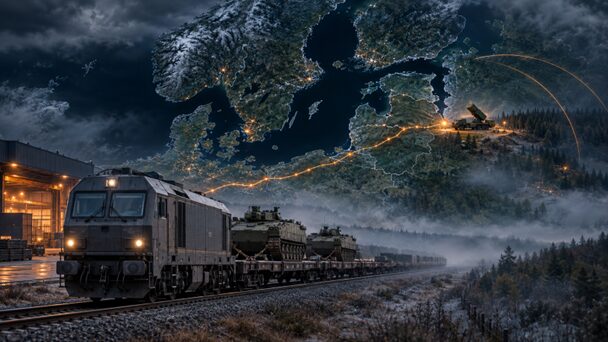
Europe is shortening the time it takes to wage a major war. Military transport approvals are meant to take hours rather than days, intelligence to feed more quickly into strike decisions, and a new generation of missiles to bring targets deep inside Russia within reach. Behind the forward garrisons, Europe is building transport networks, reserves, and ammunition production capacity. Taken together, these measures point beyond deterrence to practical preparations for waging war against Russia, including operations deep inside its territory.

The dates 2027, 2028, and 2030 in European rearmament programs can easily suggest that there is still time. But they mark a schedule for building military capabilities, not a guaranteed period of peace. The central question for the coming months is not whether armies will finish rearming in time, but whether a clash can be avoided before they do.

Estonia: A Narrow Front, a Deep Strike

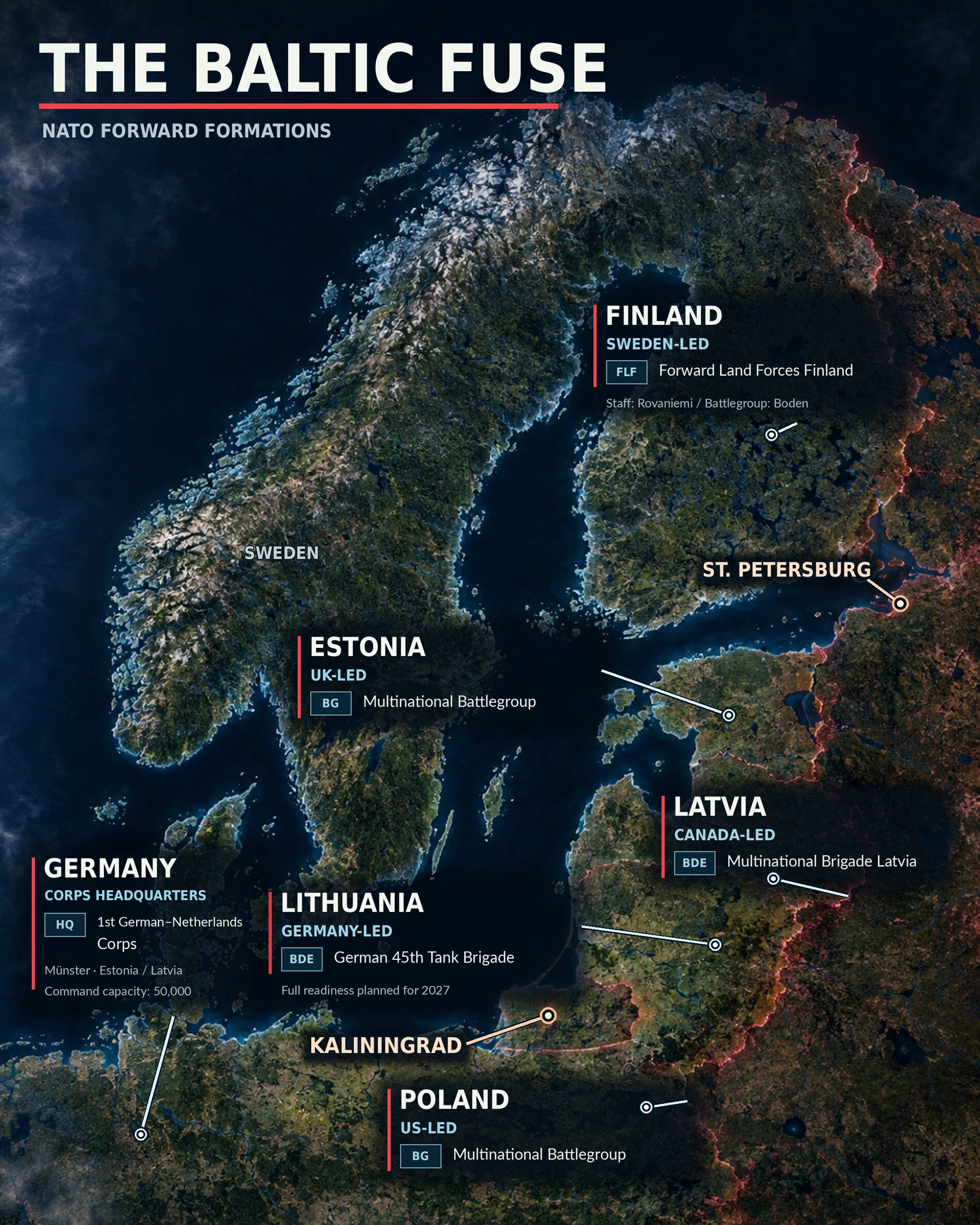
Estonia offers a clear picture of the opening phase this system is being built to fight. The country’s military budget rose 42% in 2026 to €2.4 billion, or 5.4% of gross domestic product. Arms procurement accounts for €1.27 billion – more than half the total. Meanwhile, the headquarters and elements of the 1st Infantry Brigade are moving from Tapa to Jõhvi, roughly 50 kilometers from the Russian border.

A €20.5 million base is under construction in Narva, with €19 million coming from the European Union. Completion is scheduled for summer 2028. Its permanent garrison will number around 200, but it will accommodate up to 1,000 troops in a crisis. The gap between those figures reveals a base designed for rapid expansion. A small garrison is being equipped to receive reinforcements quickly, right on the border.

Holding that ground requires more than barracks. Procurement programs call for nine American HIMARS and nine South Korean Chunmoo multiple-launch rocket systems, both capable of firing ballistic missiles. The relevant munitions have stated ranges of up to 300 and 290 kilometers, respectively. The new concept combines holding the border with deep strikes from the first day of an invasion.

The scale of the response could far exceed that of the opening clash. A battle for a border town could lead to strikes on targets hundreds of kilometers away. Tallinn wants to deny its opponent the option of fighting a small war by preparing to expand its geographical scope.

This also changes what allied assistance means. Allied planning must account not only for how long a small army can hold out until reinforcements arrive, but also for how far the fighting may spread before they reach the front. A missile can be launched before a major formation completes its deployment. Allies may arrive to find that the conflict has already widened.

In such a situation, Estonia and the other Baltic states could serve not only as defensive positions but also as staging grounds for attacks on Russian territory. For Moscow, the issue is no longer simply the size of Estonian units, but the depth of the strikes they envisage. Tallinn, in turn, faces the question of who will sustain its forward forces if the first battles fail to decide the outcome. Sustaining such a war would require support from beyond Estonia. One national budget and a handful of batteries cannot carry that burden.
Click to see the full-size image

Germany: An Industrial Base Behind the Garrison

On October 5, Martin Jäger, head of Germany’s Federal Intelligence Service, told the Bundestag: “The point of no return has been passed in the war with Ukraine, and NATO is considering a scenario involving a limited Russian military clash with the Baltic states.” He linked the more immediate danger to limited Russian action in the Baltics that could test the allies’ response. He said intelligence had seen no signs of preparations for a major attack on NATO. The discussion therefore concerns not only a major war after rearmament is complete, but a smaller confrontation capable of triggering an allied response.

In the Baltic scenario, Berlin is publicly discussing the risk of a clash while its forward force is still taking shape. The brigade’s readiness date is not the date on which the threat begins.

In Lithuania, Germany is building a permanent heavy brigade as one element of that support. Full readiness is scheduled for the end of 2027, with 4,800 military personnel and 200 civilian employees. Its core consists of the 122nd Panzergrenadier Battalion, the 203rd Tank Battalion, and a multinational battle group. Until the formation is complete, the Germany-based 37th Brigade is to provide support.

The forward formation is thus tied to forces farther inside Europe. Civilian infrastructure underscores the permanence of the deployment. A school for the children of Bundeswehr personnel opened in Vilnius in September 2025. Units are not simply moving in – families are settling down. A political commitment acquires a permanent address, and the safety of German personnel becomes part of any future crisis in the host country.

Münster, October 1, 2026. Rutte describes a headquarters capable of commanding 50,000 troops and responsible for NATO forces in Estonia and Latvia. Behind the talk of forward battalions lies corps-level command capacity


But a permanent garrison needs a steady supply of ammunition. Rheinmetall’s new plant in Unterlüß is scheduled to reach an annual output of 350,000 artillery shells in that same year, 2027. The nearly €500 million facility was built in 15 months. Across its entire production network, including overseas sites, the company is targeting roughly 1.5 million shells a year from 2027.

The brigade answers the question of who will enter the fight. The factories answer how to keep fighting once stockpiles run down. The 2027 target is for strengthening this system, not creating it from scratch. Reaching the factory’s planned capacity determines future supply volumes, but it does not set a date before which a clash is impossible. Initial stocks sustain the opening phase of combat. Regular deliveries determine whether its intensity can be maintained.

Between the factory and the front lies the transport network. Europe’s military mobility proposal calls for cross-border transport permits to be processed within three working days, with an emergency procedure taking no more than six hours. A proposed €17 billion would fund the relevant infrastructure under the 2028–2034 budget. For Germany, a transit country, that means bridges, railways, and the capacity of routes leading east.

On October 7, European Defense Commissioner Andrius Kubilius called for this work to accelerate, saying Europe was not yet able to deter Russia. Unlike an exercise, infrastructure upgrades remain after the columns return to barracks. A stronger bridge and a faster permit procedure create a lasting ability to concentrate forces.

A border battle thus gains industrial and logistical depth. But sustaining one’s own forward forces is only half the military equation. The other half is disrupting opposing forces’ supply and command systems. That requires more than additional railcars loaded with shells. It requires weapons with much greater reach.

Britain: A European Deep-Strike Arsenal

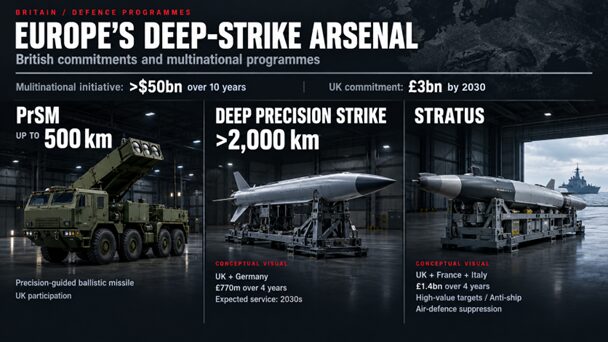
London is driving precisely this part of Europe’s preparations. On July 8, 2026, it announced an initiative bringing together roughly a dozen partners to invest more than $50 billion in long-range strike capabilities over ten years. The stated range bracket runs from 300 to more than 2,000 kilometers. Britain’s own commitment within the initiative is £3 billion by 2030.

The British-German Deep Precision Strike program envisages stealthy and hypersonic weapons with ranges exceeding 2,000 kilometers, initially focused on ground launch. Britain is investing £770 million over four years, with entry into service expected in the 2030s. Another £1.4 billion over four years is earmarked for Stratus, a program with France and Italy covering strikes against high-value targets and ships, as well as the suppression of air defenses.

Britain’s participation in PrSM (Precision Strike Missile), a precision-guided ballistic missile program with a stated range of up to 500 kilometers, adds another layer. The emerging capabilities span several range bands, from around 300 kilometers for the Estonian systems through 500 for PrSM to more than 2,000 for the British-German development. Although the programs are at different stages, they share a clear direction. Weapons for fighting at the border are being supplemented with weapons for striking deep behind it.

The missiles of the next decade show how far these strike capabilities are intended to expand. But the next crisis will unfold with whatever weapons are available when it begins. A 2,000-kilometer range is not a prerequisite for a clash in the Baltics. It changes the potential scale of the war, not the earliest date on which it can break out.
Click to see the full-size image

Turning national purchases into a combined capability requires a common framework for employing them. In July 2025, General Christopher Donahue outlined elements of eastern-flank planning built around compatible launchers, fire control, and data sharing. He cited Kaliningrad as an example of military capabilities that could be neutralized by ground-based means in an exceptionally short time: “We have already planned this. We have already developed this.”

The discussion also included cloud-based data sharing and Palantir’s Maven Smart System, purchased by NATO to analyze information and support command decisions. The aim is to turn disparate reports into a common picture more quickly. When several armies use compatible command systems, their arsenals gain additional value. Range puts the target within reach, while data sharing allows missions to be coordinated.

But the deeper the planned strikes, the harder it becomes to separate support for a border battle from an expansion of the war. To the attacking side, a target may be part of the other side’s military supply system. To the other side, hitting it may signal that the conflict has crossed a new threshold. The use of conventional weapons thus leaves unresolved how to deter a response that would overturn the assumption of a limited clash.

France: The Nuclear Limit of Europe’s Calculations

This is where France’s nuclear deterrent enters the European picture. On October 6, Le Vigilant conducted an acceptance firing of an M51.3 ballistic missile following its refit. The missile carried no nuclear warhead. In service since October 2025, the variant carries new TNO-2 warheads. The French Defense Ministry cites improvements in range, accuracy, and the ability to penetrate missile defenses.

Brittany, October 6, 2026. Le Vigilant launches an M51.3 without a nuclear warhead


Macron stated the political message bluntly: “To be free, you must be feared. And to be feared, you must be strong.” France’s modernization adds a nuclear dimension to Europe’s conventional military buildup.

That European dimension is taking a more concrete form. On March 2, 2026, Macron outlined an “advanced deterrence” framework allowing partners to participate in French nuclear exercises and opening the possibility of temporary deployments of strategic forces on allied territory. Germany, Poland and Sweden were among the countries joining the dialogue. But the authority to use nuclear weapons – and to define the vital interests they protect – remains exclusively French. In the Baltic scenario, closer cooperation does not establish an automatic French nuclear response to a border clash. It leaves the decisive threshold in Paris, deliberately undefined.

After the First Clash

Taken together, these national programs suggest that the West is preparing not merely to deter Russia, but to build the capacity for offensive operations against it. In this reading, forward deployments, industrial expansion and deep-strike weapons are interconnected preparations for a war that could extend into Russian territory. They do not, by themselves, establish a single operational plan or prove a decision to initiate hostilities. Conventional forces are meant to make an opposing military operation prohibitively costly, while nuclear forces are meant to deter the most extreme escalation. The weakness is that neither side gets to decide how much damage the other will tolerate.

That problem is especially acute around Kaliningrad, where plans to suppress military infrastructure sit alongside the question of the region’s links to the rest of Russia. If actions during a crisis are perceived as an attempt to cut the region off by force, the argument will no longer be about intentions announced at a press conference. It will be about consequences the other side believes it must stop immediately.

The danger in the coming months lies in the gap between limited intent and an unrestricted response. Berlin is discussing localized action in the Baltics. Tallinn is preparing for deep strikes from day one, while foreign garrisons tie a border battle to allied involvement. Each side may consider its own move limited. Neither can count on the other side accepting its definition of what is permissible.

European capitals therefore need to define where military action would stop after the first clash, whether at the border or after strikes on depots, airfields or targets in Kaliningrad. The programs examined here spell out how to build military power, but offer no mechanism for ending the fighting. Missile range is not strategic foresight. Confidence that escalation can be controlled could turn a system of deterrence into a mechanism for widening the war well before 2030.


MORE ON THE TOPIC:

The post The Baltic Fuse: How Europe Is Building the Infrastructure for War With Russia appeared first on South Front.
  •  

Menaces allemandes sur la France

par Jules  SEYES

Si l’Allemagne désirait interrompre les aéroports français, elle pourrait équiper ses Typhoon de missiles et créer une bulle de supériorité aérienne au-dessus du sol français. L’affirmation sonne-t-elle ridicule ? C’est exact, elle est pourtant l’exact miroir de l’alerte qu’El Mundo prête à la CIA selon laquelle les Russes pourraient équiper un navire de drones pour désactiver des aéroports occidentaux1. Comprendre pourquoi l’une sonne comme folle alors que l’autre paraît terrifiante suppose de saisir les méthodes d’analyse sur lesquelles elles reposent, avant d’analyser justement les présupposés des intentions.

Celles-ci étant un peu complexes, commençons par la doctrine, qui aura le mérite de clarifier le brouillard mental actuel. Un peu comme le brouillard de guerre auquel les militaires sont confrontés. Deux méthodes offrent un moyen de le briser : la méthode des moyens et celle des intentions.

La première repose sur un inventaire des ressources connues de l’adversaire pour évaluer l’ensemble des points qu’il peut toucher. C’est aujourd’hui l’exercice de la CIA : les Russes disposent de drones, ceux-ci peuvent être basés sur un navire, donc les Russes peuvent équiper un navire. L’exercice en début d’article relève de la même logique : prendre le nombre de chasseurs de la Bundeswehr, le nombre de Taurus en stock, puisque contrairement à nos SCALP ces armes n’ont pas été envoyées en Ukraine, et établir que cette combinaison a la capacité de mener une attaque surprise au-dessus de la France.

Le problème de cette méthode est de livrer un arc de menace souvent inutilisable, car il existe trop d’axes de vulnérabilité pouvant être exploités. L’automne 1944 en offre l’illustration2. Les Allemands retirent alors plusieurs divisions du front. La reconnaissance aérienne alliée photographie, à partir de la mi-novembre, un trafic ferroviaire intense autour de Cologne, de Coblence et dans l’Eifel : gares de triage saturées, locomotives sous pression, une vingtaine de wagons plats chargés de chars Tigre sur la ligne d’Euskirchen. Début décembre, cent soixante-dix wagons plats chargés de blindés et de véhicules roulent entre Cologne et Limbourg. La nuit, les chasseurs de nuit repèrent des convois aux phares masqués. Des dépôts de ravitaillement apparaissent à Rheinbach et à Schleiden, des piles de bois propres à jeter des ponts près d’Echternach, des trains sanitaires à l’ouest du Rhin. Les écoutes radio identifient une armée blindée nouvelle, la 6e Panzerarmee. À la mi-décembre, face aux Ardennes, le VIIIe corps américain signale une activité d’artillerie inhabituelle, aucun mouvement visible et presque plus de prisonniers. Cette force, dont la valeur combative était connue, pouvait être engagée de bien des manières.

Une seconde méthode doit alors entrer en jeu : celle des intentions. En fonction des moyens connus, on établit ce que l’ennemi voudra toucher. Plus précise, celle-ci possède l’inconvénient de reposer sur des déterminants bien moins solides, puisque liés à la compréhension de la psychologie de l’adversaire.

Ces indices remontent à tous les états-majors alliés, et chacun les interprète selon le tempérament de son chef. Au quartier général d’Eisenhower, commandant suprême des forces alliées, homme de coalition et de logistique, domine une conviction : les Allemands sont trop fatigués pour attaquer. Les divisions retirées sont donc évaluées comme des rotations de repos et une reconstitution de réserve. Le 15 décembre encore, son bureau des opérations n’a rien à signaler dans les Ardennes. Patton, chef de la Troisième Armée, passe pour le plus offensif des généraux américains : il ne conçoit la guerre qu’en mouvement et à l’attaque. Son état-major projette cette volonté offensive sur l’ennemi allemand. Elle reflète en réalité la psychologie des analystes, elle-même dérivée de la psychologie des chefs. Son chef du renseignement, le colonel Oscar Koch, lit les mêmes indices comme la préparation d’un coup et présente à Patton, le 9 décembre, sa conclusion : une contre-offensive allemande est possible dans les Ardennes. Patton fait aussitôt préparer les plans qui permettront à la Troisième Armée de pivoter vers le nord. Le lendemain du rapport rassurant d’Eisenhower, l’offensive allemande éclate. Autrement dit, la méthode des intentions en dit souvent plus sur la manière de penser des analystes que sur leur compréhension fine de l’adversaire. Bien conscients de ces défauts, les militaires appliquent les méthodes classiques d’analyse stratégique pour filtrer l’ensemble. La première d’entre elles est le rapport coût-avantage : qu’est-ce que l’adversaire a à gagner ? Pour quel coût ?

Ici, vous constatez par exemple la différence de pensée entre Eisenhower et Patton. Pour le premier, le coût est en carburant ; le second pense en termes d’avantage moral de l’offensive. D’où la divergence d’analyse. Si nous prenons notre exemple d’avions allemands équipés de Taurus, le coût est une guerre franco-allemande, voire OTAN-Allemagne si l’article 5 venait à jouer. Aucune attaque, même couronnée de succès, ne pourrait provoquer des dégâts suffisants pour compenser les coûts d’un conflit avec une puissance nucléaire. En pratique, l’Allemagne aurait beaucoup à perdre et peu à gagner, puisque son influence dans l’appareil d’État et l’UE lui permet d’obtenir satisfaction dans des domaines cruciaux, telle la fermeture de Fessenheim.

Alors, la Russie ?

La CIA vient de nous gratifier d’un de ces mémos qui relèvent à la fois de la plus pure vérité et du plus pur mépris du public destiné à recevoir la fuite. Voici la menace : «Le point faible de l’Europe» : la menace d’une attaque russe contre la France et l’Espagne est réelle, selon la CIA.

Le scénario de l’attaque impliquerait des drones Gerbera3, de petits appareils à la charge explosive réduite dont l’intérêt est perturbateur et non de faire des victimes : fermer un aéroport, par exemple. Ils seraient lancés depuis des navires marchands déguisés en trafic commercial ordinaire et postés en Méditerranée.

Je vous avouerai qu’en ouvrant ce mémo, je m’étais attendu à un scénario sérieux, pas à cela. À la découverte du propos, son outrance m’a fait passer à la limite de l’insulte. Voilà une proposition d’attaque étatique dont le but serait de «perturber» ? Se rend-on compte du terme ? Une attaque pour perturber ? Schlieffen se retourne dans sa tombe, Napoléon s’étrangle avec sa bataille décisive, Manstein est fort heureusement mort. Car, hélas, un État ne gaspille pas la surprise en lançant un tapotage gentil. S’il faut recourir à la violence, alors il faut d’emblée prendre un avantage définitif pour maintenir au plus court la durée de la campagne. Sun Tzu le notait déjà : aucun pays n’a jamais tiré profit d’une guerre prolongée.

Le projet proposé contredit tous ces principes et, dès lors, il ne pose qu’une seule question : le code militaire russe a-t-il supprimé la peine de mort pour les traîtres ? Eh oui, désolé de décevoir ces intervenants de plateaux qui se prétendent experts malgré leurs abus propagandistes, mais ce que la CIA nous propose est de lancer une attaque inefficace pour ruiner la réputation que les Russes ont acquise auprès du reste du monde. Nous parlons bien sûr des pays sérieux, hors de l’Occident malade où les journalistes reprennent ce scénario comme un sujet sérieux.

En clair, une balance coût-bénéfice où il n’y aurait que des coûts pour la Russie et aucun bénéfice. Eh oui, car fermer un aéroport fait peut-être perdre quelques millions à des entreprises, mais cela n’a AUCUN impact stratégique. Pire, il est inutile de mobiliser un drone Gerbera, un navire ou tout autre moyen militaire : un coup de fil d’un gamin pour annoncer une bombe suffit. Ou bien une voiture piégée.

Bref, l’aventure proposée n’apporte aucun bénéfice stratégique et se fait avec des moyens disproportionnés qui coûteraient énormément à la Russie. Seul un traître à la Russie peut avoir cette idée. Je sais, en Occident, nous sommes habitués avec les relais US, mais plus en Russie : les réseaux qui ont soutenu V. Poutine après son arrivée au pouvoir s’en sont assurés. Ou en tout cas, ils ont fait monter le prix de la passe. Un officier russe réclamerait une méga-malle de billets pour seulement proposer cela à ses chefs, vu qu’il sait que ce serait (si ses chefs sont gentils) la fin de sa carrière. Quant à le mettre en œuvre sans validation politique, il aurait intérêt à avoir le bon billet d’avion pour s’éclipser au plus vite.

Car là est le point qui permet aux individus tarés que l’Occident nomme journalistes de procéder à cette propagande goebbelsienne (enfin, je m’excuse auprès du docteur Goebbels pour cet amalgame insultant) : les moyens existent. Exact, la Russie possède les drones, les navires. Elle aligne même un porte-avions et surtout un arsenal de missiles de toute première qualité. Depuis les années cinquante, l’URSS dispose de bombardiers stratégiques et de missiles capables de frapper le territoire français. La menace n’a donc rien de nouveau, puisque la Russie peut transformer la France en parking si elle le désire.

L’alerte de la CIA ajoute-t-elle de nouvelles capacités ? La réponse est non, une fois, deux fois, mille fois NON !

Héritière, État successeur de l’URSS, la Russie dispose depuis sa naissance des moyens de nous mettre à terre si elle accepte les millions de morts qu’exigera l’absorption de la salve nucléaire française. Une poignée de drones n’y ajoute rien, n’y retranche rien. D’autant plus que la Russie dispose de missiles hypersoniques Orechnik en mesure d’infliger de douloureux dégâts à notre territoire. Par exemple, mais je ne voudrais pas exciter LCI, par une frappe d’Orechnik contre des centrales nucléaires ou, en non nucléaire, contre nos barrages. Nous n’aurions aucun moyen de riposte non nucléaire.

Dès lors, oui, les Russes peuvent monter des drones sur un navire, ils peuvent monter des Grad aussi, ou toute autre arme à plus ou moins grande portée. Dans un tel scénario, l’élément coûteux est le navire sacrifié, pas les munitions embarquées. L’alerte donnée, qui n’est que l’une des alertes autour desquelles on nous a fait résonner tambours et trompettes, n’apporte rien de structurellement nouveau. Un bricolage de drones pour frapper notre territoire n’a rien de complexe. Après tout, le gouvernement de Kiev a bien réussi à introduire des drones sur le territoire russe pour frapper des bombardiers stratégiques.

Seulement, à ce jeu, tout le monde peut jouer ou presque. Il faut le restreindre : l’équipe Le Maire, Breton ne peut pas jouer, mais c’est lié à l’incompétence des joueurs. La France, par exemple, possède encore quelques officiers de valeur capables d’organiser l’affaire. (Non, pas le colonel monté hors de propos en lui accrochant des étoiles comme des guirlandes de Noël, et qui fait aujourd’hui comme s’il dirigeait l’armée française.)

Le problème est que ces gens refuseraient de monter une telle opération. Frapper la Russie, comme frapper la France pour la Russie, exige que la première balle soit mortelle. On tire au cœur ou on ne tire pas, et dans ce cas, entre puissances nucléaires, la question n’est pas celle des moyens, mais celle de la volonté. Même si nous avons TOUT fait, par une politique irresponsable, pour irriter les Russes, ils n’ont nullement annoncé leur intention de répondre à la hauteur de notre bêtise.

Reste l’intention : les Russes peuvent nous frapper, c’est acquis, ils peuvent le faire depuis des décennies pour un coût fixé. Resterait le gain d’une frappe : faire cesser l’appui français à l’Ukraine. Dans ce domaine, hélas, hormis l’agacement entre les oreilles d’entendre les rodomontades et pseudo-discours d’Emmanuel Macron, qui justifient toute envie de retourner une paire de claques justement méritée, la vérité commande de constater l’épuisement de nos moyens : la macronie a déjà envoyé à peu près tout ce qu’elle pouvait racler dans les fonds de tiroirs ; quant à l’argent, l’Allemagne ou la Grande-Bretagne peuvent le fournir. Les véritables acteurs sont les Anglais, par l’usage des moyens de leurs services secrets très actifs dans la guerre des drones, et les Allemands pour la livraison de munitions. Pour peser sur les opérations en Ukraine, une frappe russe devrait cibler en priorité ces deux pays.

Sauf à vouloir faire de l’éducation prioritaire, mais dans ce cas, l’ambassade de Russie peut se contenter d’engager un professeur de SEGPA pour l’envoyer à l’Élysée. Pour la fessée, il serait même inutile d’engager : Montjoie Saint-Denis a fait des petits.

Prise sous un angle militaire, l’information n’apportait rien, et si les journalistes en avaient fait une lecture correcte, ils l’auraient classée verticalement.

Ce n’était bien évidemment pas le but, mais au contraire d’avoir un thème pour parler de menace russe afin de poursuivre la propagande par martèlement, qui vise à abrutir les téléspectateurs de menaces pour leur faire admettre le concept sans esprit critique. Ça marche avec les résidents de maison de retraite au stade pré-Rivotril.

Tel est le problème de nos gouvernants. Faute d’agression russe, il faut créer le sentiment d’une agression, ce qui est le but de ces annonces : entretenir l’hystérie et donner un prétexte pour prononcer les mots agression, guerre, menaces, puissants générateurs d’un sentiment d’insécurité dans la population soumise à ce discours anxiogène.

Ça n’a qu’un défaut : messieurs les journalistes, vous avez repris en connaissance de cause une publication des services américains pour engager notre pays sur une trajectoire fausse et dangereuse pour sa sécurité.

Soit vous êtes des idiots congénitaux, ce que la CIA n’exclut peut-être pas, et je vais m’offrir de partager le soupçon. Soit vous le faites délibérément. Même en tenant compte de votre bêtise, tous les journalistes français ne peuvent pas être aussi désavantagés par la nature ; il aurait donc dû en rester assez pour faire échouer la manipulation.

Cela fait de vous, en tant que catégorie, des traîtres à votre nation, susceptibles de subir les foudres judiciaires au moment où le pouvoir changera de main et cessera de couvrir vos abus. Il ne s’agit pas de menaces, mais d’une évaluation juridique. VOUS mettez objectivement notre nation en danger !

La méthode marcherait si, justement, conscients de la menace sur leur esprit, beaucoup de citoyens ne s’étaient pas dirigés vers internet.

___

  1. L’alerte a été rendue publique par le quotidien espagnol El Mundo le 24 septembre 2026 (article de Xavier Colás), reprise notamment par Euronews : «La CIA alerte sur des drones russes visant l’Espagne, la France ou l’Italie», https://fr.euronews.com/2026/09/24/la-cia-alerte-sur-des-drones-russes-visant-lespagne-la-france-ou-litalie ;
    i24news : «Les États-Unis alertent l’Europe sur une possible attaque de drones russes depuis la Méditerranée», https://www.i24news.tv/fr/actu/international/artc-les-etats-unis-alertent-l-europe-sur-une-possible-attaque-de-drones-russes-depuis-la-mediterranee ;
    Meduza, sur le démenti italien : https://meduza.io/en/feature/2026/09/24/no-one-needs-more-fuel-on-the-fire-italy-pushes-back-on-report-that-cia-warned-of-possible-russian-sea-launched-drone-attacks
  2. Sur le renseignement allié avant l’offensive des Ardennes : U.S. Army, «Third Army G2 predicts Battle of the Bulge, 9 December 1944», https://www.army.mil/article/116038/third_army_g2_predicts_battle_of_the_bulge_9_december_1944 ;
    Carlo D’Este, «December 16, 1944 : Ardennes Offensive Begins, An “Abysmal Failure of Allied Intelligence”», https://www.thehistoryreader.com/military-history/december-16-1944-ardennes-offensive-begins-abysmal-failure-allied-intelligence/
    DVIDS, «First Army in the Battle of the Bulge», https://www.dvidshub.net/news/printable/385060 ;
    David T. Zabecki, «Patton at Bastogne», The Intelligencer (AFIO), vol. 29, n° 2, 2024, https://afio.com/publications/eprints_2024/ZABECKI_Patton_at_Bastogne_AFIO_INTELLIGENCER_Vol29_No2_SummerFall_2024.pdf ;
    Oscar W. Koch, G-2 : Intelligence for Patton, 1971.
    The Army Air Forces in World War II, vol. III, chap. 19, Third Army G2 Predicts Battle of the Bulge, First Army in the Battle of the Bulge, D’Este, The History Reader.
  3. «Gerbera (drone)», Wikipédia, https://en.wikipedia.org/wiki/Gerbera_(drone)

Publiéà l’origine par  Reseau International

  •  

EU imports record 12.18 million tons of Russian Arctic LNG in nine months, 9.5% more than year earlier — research group

yamburg gas field in the yamalo-nenets ao in russia

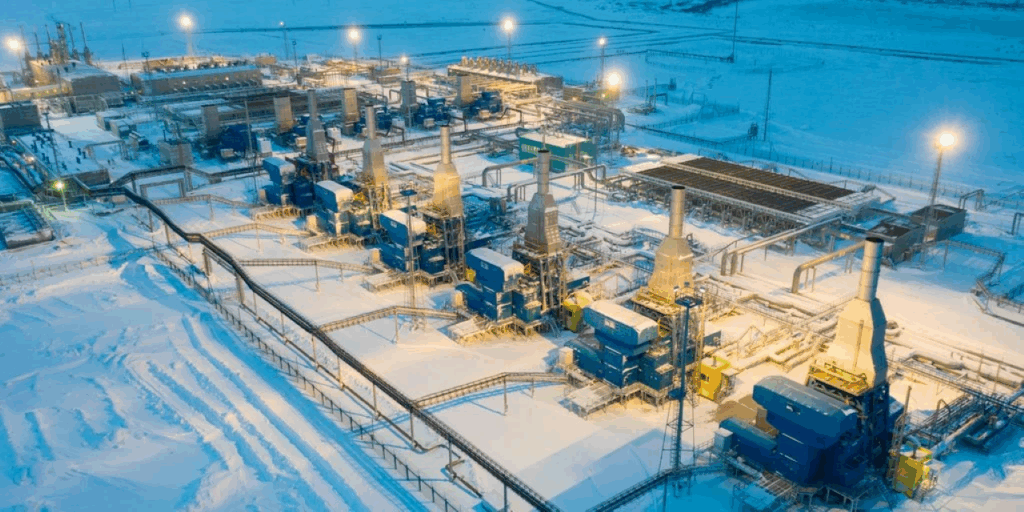
Europe keeps buying record amounts of Russian gas even as it plans to punish its war machine against Ukraine. The EU ports took in a record 12.18 million tons of Russian liquefied natural gas from January to September, 9.5% more than in the same period of 2025, according to a study by the German group Urgewald based on Kpler tracking data.

Europe spent about 7.88 billion euros on that Russian gas in nine months, revenue that helps fund a war Russia wages with daily missile and drone strikes on Ukrainian cities. The flow continues even as the EU prepares its largest-ever package of sanctions against Russia’s military industry.

The gas comes from Russia’s Yamal project, which sent 167 cargoes to EU ports over the nine months, roughly one every 1.6 days. Europe took 85% of the project’s recorded deliveries by volume, remaining by far its biggest market, Urgewald reports.

Europe’s share grew even as Yamal’s worldwide deliveries fell 1.3%, so the EU absorbed a larger slice of Russia’s Arctic output. In September alone, EU ports received 792,440 tons worth an estimated 818 million euros, nearly three-quarters of it going to France.

Washington could pull the plug by 18 October

The imports run up against a looming US decision. The Trump administration has until 18 October to complete its first review under the Lindsey Graham sanctions act, signed into law on 18 September, which allows Washington to sanction this gas trade at any time, the group notes.

However, after the US allowed Russian diesel to enter the US and global market, the decision will likely remain stalled.

Originally, the law covered Yamal’s leadership, foreign vessels that knowingly carried Russian LNG, and foreign ports that serviced US-sanctioned ships. Yamal depends on specialized Arc7 ice-class tankers and on nearby European ports where they can unload and quickly return, so closing that route would make the Arctic trade far harder to sustain.

Europe’s own ban is still months away

The EU’s measures so far have barely dented the trade. A ban on short-term LNG contracts took effect in April and has had no visible effect, while the full import ban under long-term contracts only starts on 1 January 2027, Urgewald says.

Every month of largely uninterrupted trade means more revenue for Russia while Ukraine suffers daily attacks, sanction campaigner Sebastian Rötters says. The next EU package should close the remaining loopholes, above all those keeping the Arc7 tanker fleet running.

  •  

Europe’s mounting social chaos… chickens coming home to roost for proxy war against Russia

Strategic Culture Foundation | October 9, 2026

The European Union is witnessing a full-blown social revolt. Governing political parties and their economic policies are held in open contempt as public protests and strikes escalate across multiple countries.

Protests, mass marches, and industrial strikes are spreading across the EU in France, Belgium, Spain, Italy, Germany, Ireland, Portugal, and other countries. The grievances are various, from students and teachers over woeful education services, to healthcare professionals and transportation workers denouncing crumby wages and pension cuts.

But at the core is a warmongering, dehumanizing system of capitalist inequality.

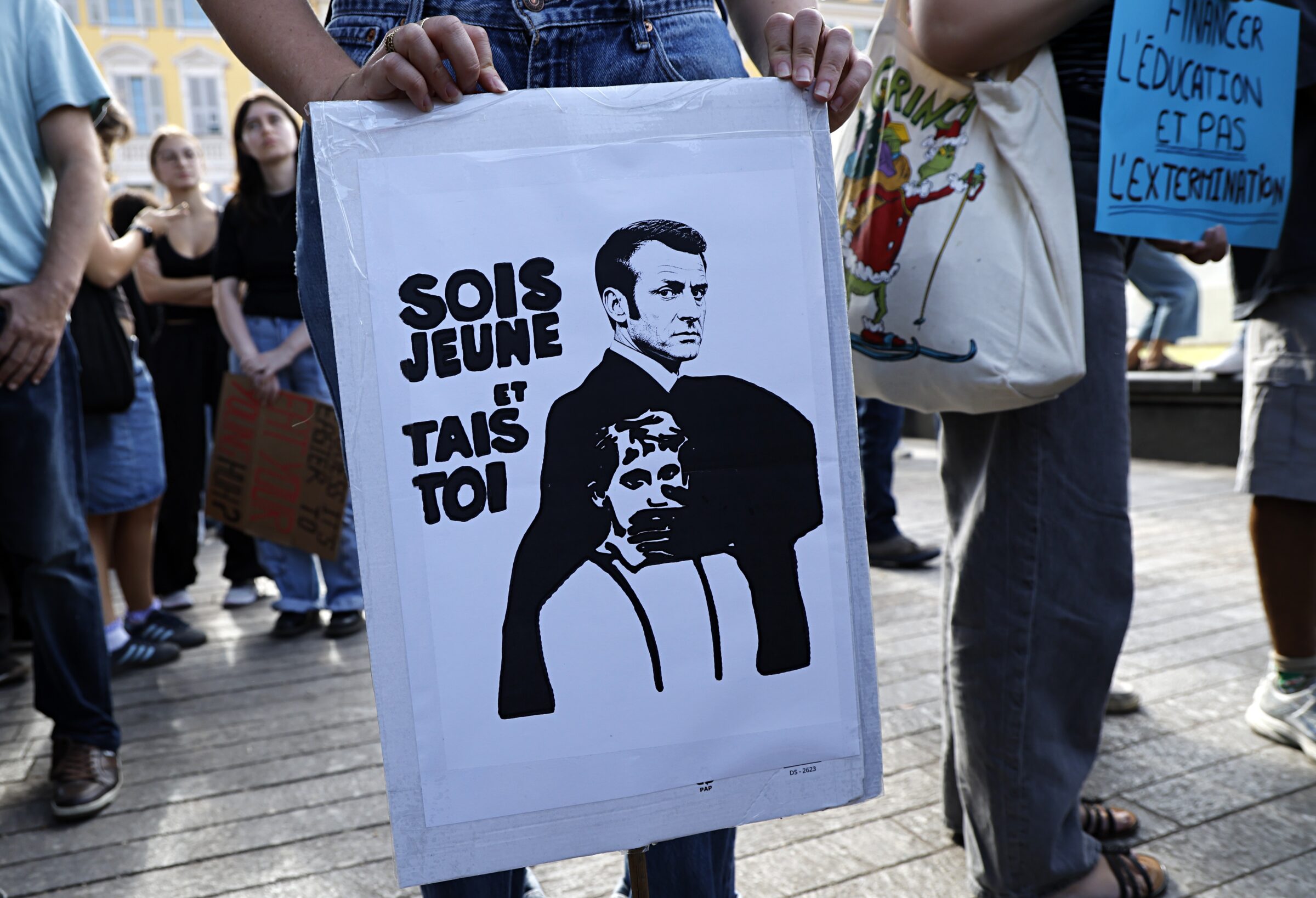
Unbearable living costs for basic needs, from food to housing, are driving millions onto the streets in desperation and anger at the lack of adequate political response to their concerns. As one French student said: “Too young to be listened to, old enough to be tear-gassed.”

The entire political system is being brought into disrepute for its dysfunction and indifference towards meeting rudimentary human needs. Then, infuriating all the more, are lies from the elite rulers and their propaganda media about “national defense and threat of war from Russia.”

In Spain this week, an 87-year-old frail woman known as Maricarmen died in hospital after she was evicted from her Madrid home because she could not pay the extortionate rent increase. Her plight has come to galvanize a nationwide protest against Spain’s housing crisis, a crisis that is repeated across every European country. Protesters shouted furiously that the pitiful old woman was “murdered by the state and corporations.”

In France, the brutality of police against student protests has shocked the nation and the world. Nearly 7,000 young people have been arrested, as riot police tear gas and shoot at largely peaceful rallies. Students gathering at the Place de la Bastille in Paris and other cities vow that they will not back down. One student had his hand blown off by a police stun grenade while another teenager lost an eye from a rubber bullet fired at close range.

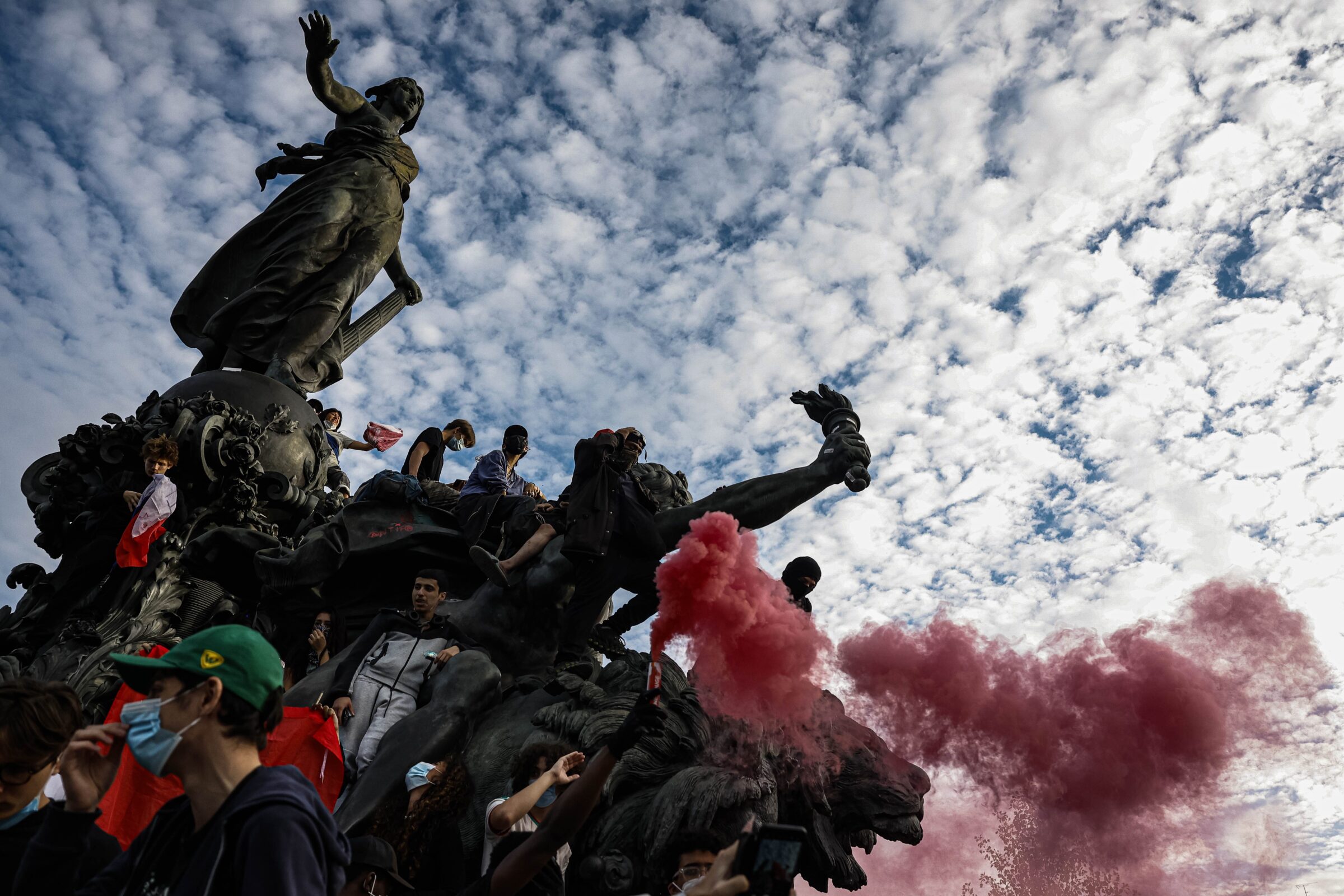
The Place de la Bastille is where the French Revolution manifested in 1798 against a hated aristocracy amid abject misery. Today, the tensions are boiling towards another momentous rebellion, this time inspiring again similar movements across Europe.

These protests and the inhumane suffering that underlie them are channeling uprisings all over the EU.

There is a palpable sense that populations en masse have had enough of decades of inequality and chronic deprivation inflicted by capitalist policies that enrich a few and are enforced by governments slavishly serving the interests of capital over the needs of the citizen majority.

Western media reports talk about “cash-strapped” governments under pressure from bond markets to reduce record debt levels while workers, students and pensioners demand more public investment and relief from economic hardship.

That is a misleading partial portrayal of the problem. Omitted is the crucial backdrop that European governments are directing vast economic resources towards militarism and the proxy war in Ukraine against Russia. That is what is causing the “cash-strapped governments.” In other words, their declared fiscal straits are a policy choice, not some mysterious dilemma.

The social crisis sweeping across Europe is also seen in the United States and other Western-aligned nations. The background is a failed economic system that no longer provides a modicum of acceptable living conditions. The problem has been decades in the making from growing inequality and diminishing political representation. Today it is even questionable if Western states are democracies, controlled as they are by corporate oligarchies.

Nevertheless, the social crisis that is unfolding across Europe has been intensified and amplified by European political rulers operating in a relentless war mode against Russia.

The European Union has pumped hundreds of billions of euros into Ukraine over the past four years to prop up a NeoNazi regime run by a corrupt dictatorship – all for the objective of defeating Russia. The EU leaders – many of them unelected, like Ursula von der Leyen, Kaja Kallas and António Costa – are driven by an obsessive Russophobia. But that is only part of the explanation.

Other elected leaders and parties like France’s Macron and Germany’s Merz are also despised for their elitism and delusions of grandeur. Merz declares that he wants to make Germany the strongest military in Europe, in total tin-ear deafness to his nation’s economic and social problems and the sinister historical connotations of resurrecting Nazi Germany. Meanwhile, as his government suffers electoral defeat after defeat, European elites deprecate German voters as being blind because they dare to choose parties that are opposed to war with Russia.

There are many grounds for the Europe-wide contempt of ruling parties. Inequality, poverty, unemployment, soaring living costs, declining wages, deteriorating public services. Uncontrolled immigration amid the pressure on inadequate public resources is another cause for grievance. Europe’s complicity in the Israeli genocidal war on Palestinians, and Europe’s complicity in Trump’s aggression towards Iran, Yemen, Cuba, and so on, are other factors.

However, the bogus narrative that governments are “cash-strapped” is a cause for immense public disgust. There are plenty of economic resources to meet public needs. It’s a question of those resources not being permitted to create just and humane societies under the prevailing capitalist system with its priority of enriching a tiny elite class.

The conditions of “tight budgets” and “austerity for the masses” are created by deliberate policies of militarism and fuelling a proxy war in Ukraine.

European “leaders” and their NATO lobbyists like Mark Rutte demand hundreds of billions of euros to boost military industries while at the same time calling for draconian cuts in public spending and social welfare in order to pay for this reckless militarism. The EU is “lending” an additional €90 billion over the next two years alone just to prop up the corrupt regime in Kiev so that it can keep fighting a futile war with Russia. The perverse priority is driven by the military-industrial complex and its corporate investors. It is also driven by an ideological, propagandized mindset that demonizes Russia as an enemy. President Putin and other Russian voices have repeatedly stated that they do not want war with Europe. They say the conflict in Ukraine has root causes that can be resolved through diplomatic engagement. Why are European politicians implacably opposed to peace?

A major factor is covering for internal political and economic failure of the European system. The EU’s economies, as with those in the U.S. and other Western states, are bankrupt dystopias in terms of delivering on social and democratic needs. The failure has been compounded by the costs of war in Ukraine.

That failure is criminal and fatal for the politicians and governments who have overseen the policies. Thus, the political class, including the propaganda news media, cannot admit their criminal policies.

In the face of their own internal contradictions, the European political elites are seeking a solution by externalizing Russia as an enemy. This is the same modus operandi that European rulers have used for the past century and more, unleashing two world wars as a result.

These criminal politicians and their dysfunctional economic system are again pushing war as their escape plan for survival at the expense of millions of lives and at the risk of starting a third world war, one that this time around could involve catastrophic nuclear nemesis.

It is damning of virtually every European government, including primarily the British, that there are no calls for diplomacy and political settlement with Russia. They are committed to waging war on Russia to absolve themselves from the social devastation they are responsible for.

One positive thing, though, is that increasing numbers of people can see through the chicanery and lies. A German student placard summed it up: “We won’t fight your wars… Education not bombs!”

A day of reckoning is imminent. Criminal political leaders and their warmongering system are exposed like never before and in a way that demands total revolt as a proper solution. The consequences are not to be externalized this time. Chickens are coming home to roost, as Malcom X once said.

  •  
  •  

[Interview] France school protests go deeper than rioting or reactionism, says Sciences Po lecturer

Student protests in France are an expression of the country’s deep political and economic crisis, says Jan Rovný, a Czech professor at Paris’s Sciences Po.

Students from elite schools and universities have joined secondary-school pupils from deprived suburbs in protesting for education reforms. Rovný explains how these young people protest in solidarity with less fortunate peers, invoking ideals of equality embedded in French minds.

He explained how traditionally violent protests in the republic are often met by disproportionately heavy-handed policing.

The French government has tried to hide students’ dissatisfaction by blaming far-left groups.

What do the protests say about French society? Are they a revolt by young people against poor conditions or part of broader woes?

It is important to realise that the situation in France does not concern only young people and education, it goes deeper than that. The era of French president Emmanuel Macron is coming to an end. For several years now, the country has been run by unstable minority governments, which all face one key problem: how to draft a budget, unveiled on October 1, and push it through parliament.

It is clear that the country is in a very difficult economic situation, because its debt stands at around 117 percent of GDP. The interest rate is rising and approaching five percent. Every day, newspapers write that France cannot bear this burden.

French society is realising that it is at an impasse both politically and economically, that the current elite has no answer, and that savings must be made in various areas. People from many sectors are now speaking out to say they do not want cuts. Or that they have problems that are not being addressed. And young people have a clear view of this, and that is why they are mobilising.

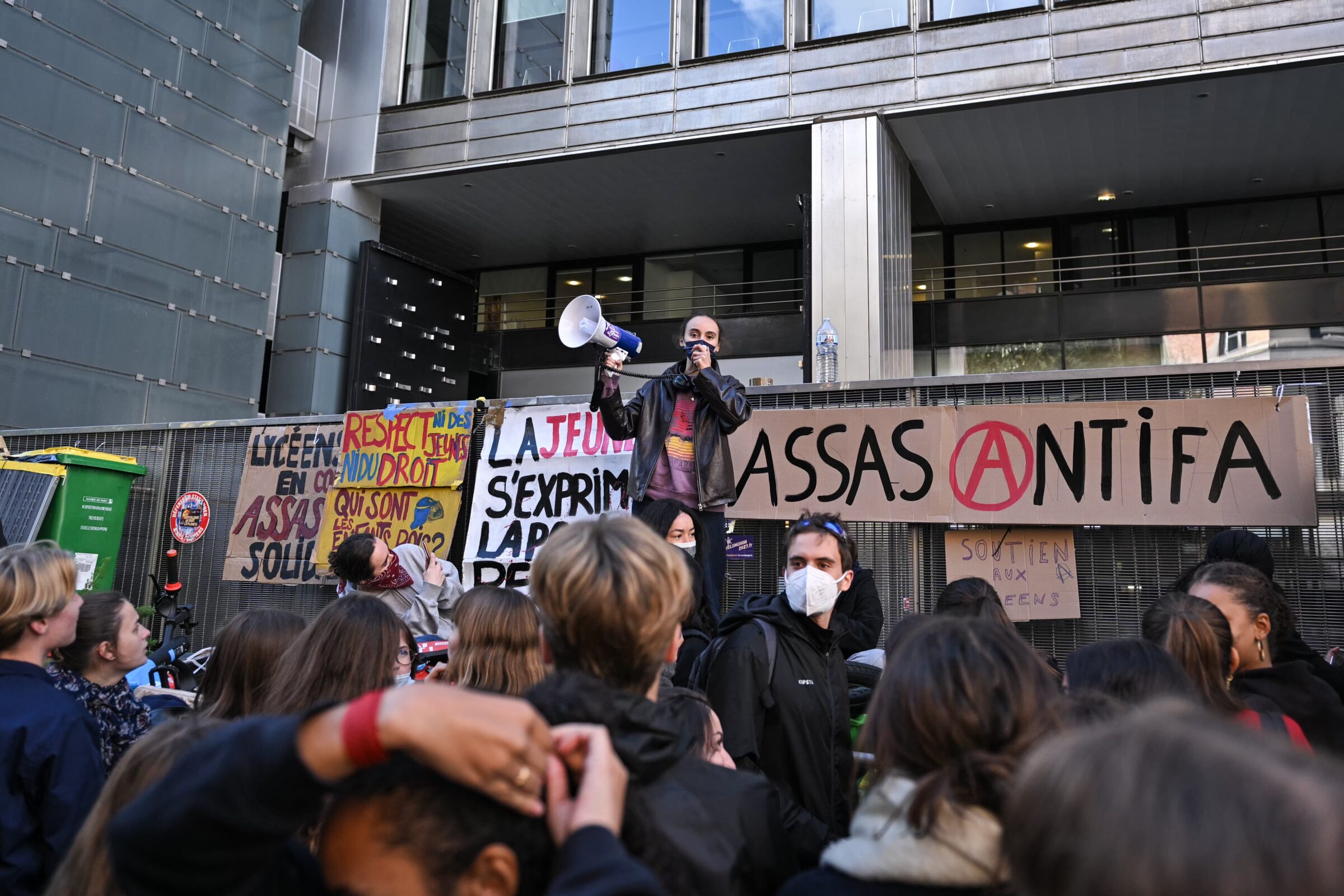
The protest began with specific demands from secondary-school pupils, who clearly identified shortcomings in education — notably missing teachers, overcrowded classrooms and schools in poor condition, some with rats running around and no running water. Yet the protest quickly grew into a nationwide movement. Why have these particular issues proved so powerful?

Partly because they underscore this whole situation, and partly because this is a young generation that represents France’s future. Young people are protesting to say: look at the future we are facing. And parents and teachers largely agree with them.

The protests began in the Paris suburb of Saint-Denis and did not arise as a result of a new government reform, but from the everyday experiences of students. What does this tell us about how young French people view the state and its ability to provide public education?

France generally has relatively low trust in political institutions. Young people tend to feel this even more strongly, because they are generally less politically engaged and therefore feel they are, in some way, discriminated against. They see the state as failing to care sufficiently for them and unable to cope.

This is compounded by the approaching elections. We know that the current government is fragile, and we also know that society, as well as the political establishment as a whole, is deeply polarised, with the extremist camps in particular set to enter the elections strengthened.

Staying with the protests, it is interesting that private secondary schools have joined state schools. On Tuesday, the French daily Le Monde showed protests outisde Paris Lycée Henri-IV attended by children from elite families – and where Macron studied. How do you explain the involvement of private schools unlikely to experience the same problems as public ones?

Exactly. That is my situation as well. I teach at a very prestigious university with a beautiful campus a short distance from the Louvre.

Yet our students are protesting. They are protesting because they recognise that French society has major inequalities affecting young people in suburbs like Saint-Denis or Val-de-Marne where conditions are worse.

Better off students are mobilising in solidarity – the concept of equality has been part of France’s political consciousness since the French Revolution. Those privately educated pupil therefore see it as their duty to join protests even though they enjoy far better conditions.

France is described as a strong state where education is regarded as a public service and a fundamental pillar of the French Republic. Could frustration over lack of basic conditions in schools be a reason for current anger?

Of course, and it has several dimensions. The French Third Republic was based on the idea that public education was the means through which modern citizens are created. State schools, established by law at the time, were seen as a fundamental pillar of the new, young democracy.

When you walk around Paris or anywhere else in France, you notice that every school has both the French and European flags above its entrance, along with the words “liberty, equality, fraternity” — the motto of the republicand revolution. Historically, schools drew children out of traditional families, which at that time were highly Catholic, and turned them into modern citizens. That is the country’s foundation.

Another factor is that the French state is very powerful: public spending accounts for more than 50% of GDP. The state is hierarchical, yet it seeks to show that it can do everything, including providing schooling for all. That position is increasingly hard to defend, particularly when money is short and public spending must be cut.

France has a long history of street protests. Is the current situation different in any way from previous social conflicts?

It is difficult to say. What is interesting is that secondary-school students are mobilising. That is relatively unusual, though not entirely unprecedented. It has happened in the past too, but was less visible. Teachers’ unions are now joining these students, as are broader trade unions and public-sector employees generally. University students are also already on strike. There is talk that farmers could join them. It may gather momentum and, as with the yellow vest protests, everyone who criticises the government may take to the streets. That is essentially the majority.

What is interesting about the current protests is that they are led by underage young people who are not yet able to vote, yet can still place the government under enormous pressure. How do you explain this?

They are young and have the time and ability to mobilise. They are able to sustain it and have their own internal organisation. Certain political forces, primarily from the far left, are helping or supporting them, but only to a limited extent. I think the protest is genuinely organic, rather than being directed by a political party or political agitators.

Protester holds a placard reading ‘Education is a right, not a privilege’. Source: EPA/Firas Abdullah.

Young people feel they have something to say, and they can mobilise with the support of some teachers, some parents and now also broader sections of society — both university students and some trade union organisations. It may last for some time.

The French government may fear protesting young people more than other protest groups. Why do protesting young people carry such particular political weight in France?

It is probably a memory of 1968 when student mobilisation shifted the entire country to open up certain issues. Sudents are able to mobilise and persevere because they do not lose income when they strike, whereas workers who go on strike do not receive pay for those days, which can be a serious problem for some.

There is also a significance of young people being the future, who say: no, we simply want this country to be different, because it will be ours and we will be responsible for it when you are no longer here.

On Monday, a 15-year-old boy lost his hand after a police grenade exploded, with several other injuries caused by police being investigated. Could this fundamentally change the public mood?

Protests in France tend to be more violent than others are used to. I think it works both ways. I am convinced that the overwhelming majority of protesting students are peaceful, but some people with somewhat different intentions join them. They are called ‘casseurs’ (wreckers)who simply exploit the situation to throw stones at police or set bins on fire.

On the other side are the police, who can become highly aggressive quickly. There is now a major debate over whether the police response is proportionate. These responses divide the left and the right quite clearly with the government and the right wing supporting police, while the left argues that police brutality is pervasive.

It is quite shocking to see footage of armed police officers beating children in the street.

Exactly. And the police will have to be careful not to lose control of the situation. The response of the education minister, who has told students that he will listen to them, is also interesting. The interior minister and the prime minister have instead responded that the police are doing their job and that the interventions are proportionate.

The government is blaming radical left-wing groups for the violence, accusing the far-left party La France Insoumise (France Unbowed) of inciting riots. Do you find this political explanation convincing, or does it take attention away from students’ genuine demands?

It is difficult to say. I would not be at all surprised if extremist groups of any kind joined the protests, although left-wing groups are probably more likely. It is difficult to speculate on the extent to which this is directed from the leadership of France Unbowed. However, I do not think it is to any great extent.

Representatives of this left-wing party, including its MPs and local politicians, joined student, thereby legitimising these protests. But I very much doubt that the party would seek to organise greater violence in order to draw attention to the situation. That suggestion seems somewhat extreme to me.

France is only a few months away from presidential elections. Could this discontent become one of the issues in the election campaign?

Everyone is trying to gain political advantage from it in some way. It is quite clear that the typical Jean-Luc Mélenchon voter supports the students and government criticism more generally.

Ordinary citizens do not want to see violence or rubbish being set on fire, and this sentiment is probably much stronger on the right, which automatically sees Mélenchon as an instigator of unrest.

Mélenchon needs to be careful. To win a larger number of voters, he must also appear as someone who is trying to prevent violence. That is what he attempted to do. A few days ago, he addressed students, saying: mobilise, but your actions must be non-violent. He specifically added that they must be disciplined.

In your view, what could be the boiling point at which governments will no longer be able to calm the situation through promises or concessions?

That is a difficult question. These protests cannot go on forever, since many students realise what they want is better teaching conditions, so that they can prepare better for the baccalaureate examinations, which are approaching in the spring for those in their final year. So they may want to sit down and study.

If the government manages to offer at least some concrete solutions to the fundamental problems — above all, on timetables and teacher allocation on lycées — it may calm the situation. If it does not, I do not know.

Can we therefore understand the current protests as an expression of a crisis in French society, or as evidence that some form of civic mobilisation and the belief that protest can change something still function in France?

It is both. From young people’s perspective, the positive aspect is that they are able to mobilise, take their future into their own hands and say: this is a problem. We told you this, you did not listen to us, so now we are changing tactics and will protest visibly. I think that is fundamentally positive — without the violence.

On the other hand, French society is in deep crisis, and overcoming it will require an explicit change in the narrative – a change in the system. There will need to be some recognition that France is no longer what it used to be; while it remains one of the larger countries of the EU, it is now more or less an ordinary country and it must behave accordingly and see itself in that way.

Understanding this is quite difficult, and it will certainly require political courage and a political figure capable of turning frustrations into something positive.

Jan Rovný (1978) is professor of political science at the Centre for European Studies and Comparative Politics at Sciences Po university in Paris. His academic specialisms include political competition in Europe, ideological conflict and voter behaviour. He studied at McGill University in Montreal, Canada, at the the College of Europe in Bruges, and at the University of Gothenburg in Sweden.

  •  

‘Harsh reality’: Iran says France seeks monopoly on power and intimidation, not peace for all

Press TV | October 9, 2026

Iranian Foreign Ministry spokesman Esmaeil Baghaei says France does not want peace for all but seeks to preserve its monopoly on military power and the ability to intimidate others.

Baghaei made the remarks in a post on his X account on Friday, responding to French President Emmanuel Macron’s earlier statement during a test of a ballistic missile capable of carrying a nuclear warhead, during which Macron said, “To be free, therefore, one must be feared, and to be feared, one must be powerful.”

Baghaei contrasted those remarks with Macron’s position on Iran, which has never sought to acquire nuclear weapons, quoting the French president as saying, “Iran must never possess nuclear weapons. Neither today, nor in five years, nor in ten years. Never.”

He said the question is not why France possesses a nuclear deterrent force, but why Paris regards its own nuclear deterrent as essential to guaranteeing its security and freedom while portraying Iran’s nuclear activities as a “threat,” even though Tehran’s nuclear program is peaceful and subject to international oversight.

“The harsh reality is this: they do not want peace for all. They want to maintain the monopoly on the kind of power that inspires fear and the monopoly on the legitimacy to intimidate,” the Iranian spokesperson wrote.

Baghaei emphasized that France seeks to remain powerful, armed with nuclear weapons and capable of inspiring fear, while imposing restrictions on countries that seek to use nuclear energy for peaceful purposes under the pretext of an alleged “nuclear threat.”

“A peace in which nuclear powers regard their own weapons as the guarantors of their freedom and security, but label the same logic a threat when invoked by others, is not true peace. It is a monopoly on power founded on a sense of superiority,” he said.

He added that an international order that fails to recognize every country’s right to security and peace serves the dominance of a small circle of powers rather than protecting peace itself.

Iran has maintained a consistent position regarding its peaceful nuclear program, citing a religious decree by martyred Leader of the Islamic Revolution Ayatollah Seyyed Ali Khamenei, who forbade the acquisition of nukes.

Iran, as a signatory to the NPT, maintains that its nuclear program is exclusively peaceful and that there has been no diversion of nuclear material following more than two decades of inspections.

Despite this and the extensive inspections by the UN nuclear watchdog on Iran’s nuclear facilities, the Israeli regime has long been trying to portray Iran’s nuclear program as a threat.

The regime persuaded the administration of US President Donald Trump to launch two rounds of aggression against Iran in June 2025 and early 2026 on the false pretext of divergence from a civilian nuclear program.

In both wars, the aggressors targeted Iran’s civilian infrastructure, including nuclear facilities, in flagrant violation of international law and the Nuclear Non-Proliferation Treaty (NPT).

  •  

Europe’s mounting social chaos… chickens coming home to roost for proxy war against Russia

A day of reckoning is imminent. Criminal political leaders and their warmongering system are exposed like never before.

Join us on Telegram, X, and VK.

Contact us: info@strategic-culture.su

The European Union is witnessing a full-blown social revolt. Governing political parties and their economic policies are held in open contempt as public protests and strikes escalate across multiple countries.

Protests, mass marches, and industrial strikes are spreading across the EU in France, Belgium, Spain, Italy, Germany, Ireland, Portugal, and other countries. The grievances are various, from students and teachers over woeful education services, to healthcare professionals and transportation workers denouncing crumby wages and pension cuts.

But at the core is a warmongering, dehumanizing system of capitalist inequality.

Unbearable living costs for basic needs, from food to housing, are driving millions onto the streets in desperation and anger at the lack of adequate political response to their concerns. As one French student said: “Too young to be listened to, old enough to be tear-gassed.”

The entire political system is being brought into disrepute for its dysfunction and indifference towards meeting rudimentary human needs. Then, infuriating all the more, are lies from the elite rulers and their propaganda media about “national defense and threat of war from Russia.”

In Spain this week, an 87-year-old frail woman known as Maricarmen died in hospital after she was evicted from her Madrid home because she could not pay the extortionate rent increase. Her plight has come to galvanize a nationwide protest against Spain’s housing crisis, a crisis that is repeated across every European country. Protesters shouted furiously that the pitiful old woman was “murdered by the state and corporations.”

In France, the brutality of police against student protests has shocked the nation and the world. Nearly 7,000 young people have been arrested, as riot police tear gas and shoot at largely peaceful rallies. Students gathering at the Place de la Bastille in Paris and other cities vow that they will not back down. One student had his hand blown off by a police stun grenade while another teenager lost an eye from a rubber bullet fired at close range.

The Place de la Bastille is where the French Revolution manifested in 1798 against a hated aristocracy amid abject misery. Today, the tensions are boiling towards another momentous rebellion, this time inspiring again similar movements across Europe.

These protests and the inhumane suffering that underlie them are channeling uprisings all over the EU.

There is a palpable sense that populations en masse have had enough of decades of inequality and chronic deprivation inflicted by capitalist policies that enrich a few and are enforced by governments slavishly serving the interests of capital over the needs of the citizen majority.

Western media reports talk about “cash-strapped” governments under pressure from bond markets to reduce record debt levels while workers, students and pensioners demand more public investment and relief from economic hardship.

That is a misleading partial portrayal of the problem. Omitted is the crucial backdrop that European governments are directing vast economic resources towards militarism and the proxy war in Ukraine against Russia. That is what is causing the “cash-strapped governments.” In other words, their declared fiscal straits are a policy choice, not some mysterious dilemma.

The social crisis sweeping across Europe is also seen in the United States and other Western-aligned nations. The background is a failed economic system that no longer provides a modicum of acceptable living conditions. The problem has been decades in the making from growing inequality and diminishing political representation. Today it is even questionable if Western states are democracies, controlled as they are by corporate oligarchies.

Nevertheless, the social crisis that is unfolding across Europe has been intensified and amplified by European political rulers operating in a relentless war mode against Russia.

The European Union has pumped hundreds of billions of euros into Ukraine over the past four years to prop up a NeoNazi regime run by a corrupt dictatorship – all for the objective of defeating Russia. The EU leaders – many of them unelected, like Ursula von der Leyen, Kaja Kallas and António Costa – are driven by an obsessive Russophobia. But that is only part of the explanation.

Other elected leaders and parties like France’s Macron and Germany’s Merz are also despised for their elitism and delusions of grandeur. Merz declares that he wants to make Germany the strongest military in Europe, in total tin-ear deafness to his nation’s economic and social problems and the sinister historical connotations of resurrecting Nazi Germany. Meanwhile, as his government suffers electoral defeat after defeat, European elites deprecate German voters as being blind because they dare to choose parties that are opposed to war with Russia.

There are many grounds for the Europe-wide contempt of ruling parties. Inequality, poverty, unemployment, soaring living costs, declining wages, deteriorating public services. Uncontrolled immigration amid the pressure on inadequate public resources is another cause for grievance. Europe’s complicity in the Israeli genocidal war on Palestinians, and Europe’s complicity in Trump’s aggression towards Iran, Yemen, Cuba, and so on, are other factors.

However, the bogus narrative that governments are “cash-strapped” is a cause for immense public disgust. There are plenty of economic resources to meet public needs. It’s a question of those resources not being permitted to create just and humane societies under the prevailing capitalist system with its priority of enriching a tiny elite class.

The conditions of “tight budgets” and “austerity for the masses” are created by deliberate policies of militarism and fuelling a proxy war in Ukraine.

European “leaders” and their NATO lobbyists like Mark Rutte demand hundreds of billions of euros to boost military industries while at the same time calling for draconian cuts in public spending and social welfare in order to pay for this reckless militarism. The EU is “lending” an additional €90 billion over the next two years alone just to prop up the corrupt regime in Kiev so that it can keep fighting a futile war with Russia. The perverse priority is driven by the military-industrial complex and its corporate investors. It is also driven by an ideological, propagandized mindset that demonizes Russia as an enemy. President Putin and other Russian voices have repeatedly stated that they do not want war with Europe. They say the conflict in Ukraine has root causes that can be resolved through diplomatic engagement. Why are European politicians implacably opposed to peace?

A major factor is covering for internal political and economic failure of the European system. The EU’s economies, as with those in the U.S. and other Western states, are bankrupt dystopias in terms of delivering on social and democratic needs. The failure has been compounded by the costs of war in Ukraine.

That failure is criminal and fatal for the politicians and governments who have overseen the policies. Thus, the political class, including the propaganda news media, cannot admit their criminal policies.

In the face of their own internal contradictions, the European political elites are seeking a solution by externalizing Russia as an enemy. This is the same modus operandi that European rulers have used for the past century and more, unleashing two world wars as a result.

These criminal politicians and their dysfunctional economic system are again pushing war as their escape plan for survival at the expense of millions of lives and at the risk of starting a third world war, one that this time around could involve catastrophic nuclear nemesis.

It is damning of virtually every European government, including primarily the British, that there are no calls for diplomacy and political settlement with Russia. They are committed to waging war on Russia to absolve themselves from the social devastation they are responsible for.

One positive thing, though, is that increasing numbers of people can see through the chicanery and lies. A German student placard summed it up: “We won’t fight your wars… Education not bombs!”

A day of reckoning is imminent. Criminal political leaders and their warmongering system are exposed like never before and in a way that demands total revolt as a proper solution. The consequences are not to be externalized this time. Chickens are coming home to roost, as Malcom X once said.

  •  

‘We could have had a massacre’ – French MEP demands attempted murder charge after protesters burn police station and block exit

A French member of the European Parliament and former police commissioner called for attempted-murder charges Thursday after masked protesters set fire to the entrance of a Bordeaux police station, blocking officers inside as smoke filled the building.

Matthieu Valet, now affiliated with the National Rally, said the attackers blocked the main door of the Capucins station and ignited trash bins piled against it while officers were still inside.

“It’s a criminal act of extreme gravity; we could have had a massacre,” MEP Valet wrote on X. “The perpetrators must be found and prosecuted for attempted murder. Ten years after the Viry-Châtillon attack, where police officers were burned alive while trapped in their patrol car, nothing has changed.”

BREAKING: Rioters attempted to murder police officers in Bordeaux, says French MEP.

Criminal rioters blocked the entrance to the Capucins police station and then set the station on fire.

They were actively trying to prevent the police from exiting the building, reported French MEP @mvalet_officiel.

Smoke filled the entire police station while the crowd cheered from outside. Officers tried to put out the flames but suffered from smoke inhalation and needed to evacuate.

French MEP Valet: “It’s a criminal act of extreme gravity; we could have had a massacre! The perpetrators must be found and prosecuted for attempted murder. Ten years after the Viry-Châtillon attack, where police officers were burned alive while trapped in their patrol car, nothing has changed!”

Follow: @RMXnews

— Remix News & Views (@RMXnews) October 8, 2026

Bordeaux prosecutor Renaud Gaudeul said a group of about 10 hooded individuals deliberately stacked bins at the station’s entrance around 4 p.m. and set them alight during a high-school demonstration. The fire spread quickly along part of the facade. Three national police officers inside escaped through a rear emergency exit. No injuries were reported but the officers reportedly suffered from smoke inhalation.

Prosecutors opened an investigation for destruction of property by a means dangerous to people, committed because of the victims’ status as public officials, and for joining a group formed to prepare violence or property damage during a public demonstration. Those offenses can carry up to 20 years in prison. Authorities have not so far filed attempted-murder charges.

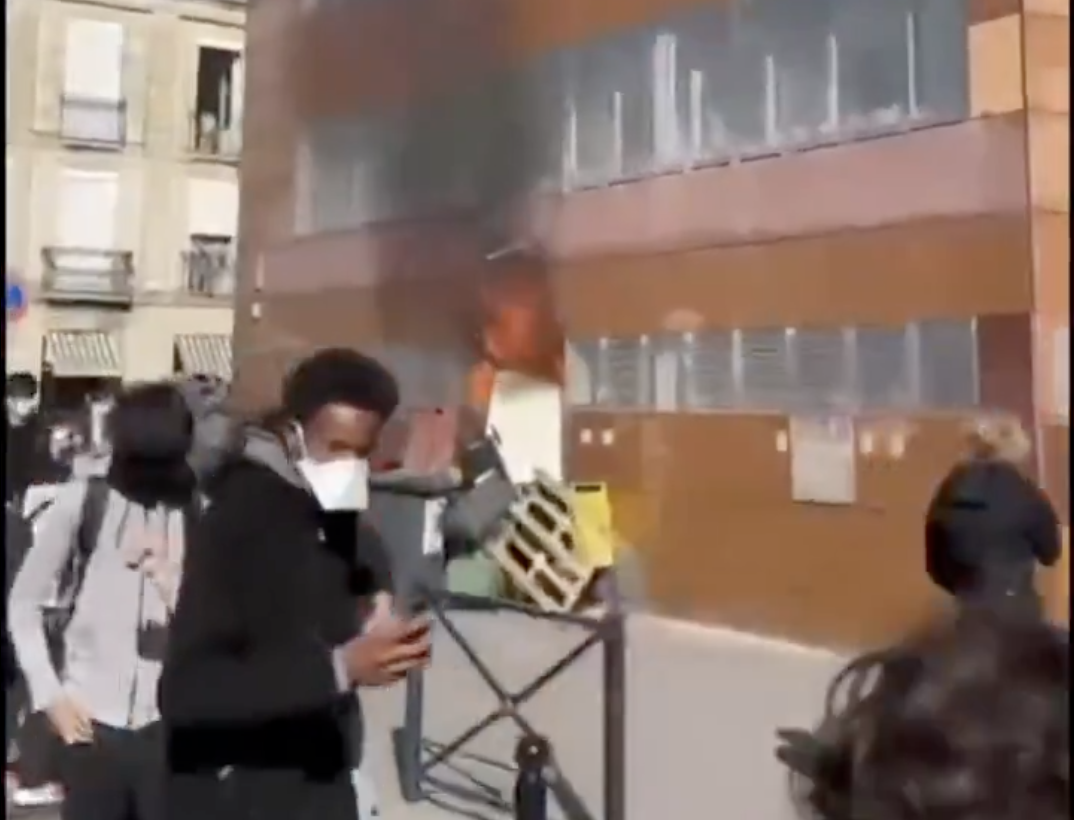
This is not the first time that protesters have been accused of setting buildings on fire and blocking exits. Earlier this week, rioters set fire to the entrance of Vauquelin High School in Paris and blocked the exit with 100 students and staff inside. A harrowing video from BFMTV captured the moment.

🇫🇷🚨 BREAKING: Rioters set fire to the entrance of Vauquelin High School in Paris and blocked the exits when staff tried to put the fire out. A film crew recorded the terrifying attempted murder. “The school staff was unable to put out the fire. The rioters blocked them just as the extinguisher nozzle came out; they blocked the exit.” “The fire continues. You see all the silhouettes moving behind it; they continue to feed this fire, making it stronger and stronger. The school staff is not even going to try to put it out anymore; they can’t manage it. We can hear the principal here asking the hundred confined students to step back and move up to the first floor.” The building was full of staff, students, and journalists, but these rioters appear ready to kill anyone still inside the vocational chemistry school. Follow: @RMXnews

— Remix News & Views (@RMXnews) October 5, 2026

Graffiti reading “Vengeance for Eden” was sprayed on the station wall, referring to a student seriously injured by a police grenade launcher earlier in the protests in the Paris region.

The attack came on the margins of nationwide student blockades and marches over teacher shortages and school conditions, now in their third week. A high school in nearby Lormont was vandalized the same morning. Across France, the protests have produced thousands of arrests since late September, along with repeated use of fireworks mortars, stones and burning barricades.

BREAKING: France in a state of chaos. Police charge protesters on Place de la Bastille in Paris after students slam them with projectiles. After the charge, students continue to hurl paving stones. Follow: @RMXnews https://t.co/HITGmat3zQ

— Remix News & Views (@RMXnews) October 8, 2026

The 2016 Viry-Châtillon case, in which officers were burned to death inside their vehicle during unrest outside Paris, remains a frequent reference point in French debates over attacks on police. Interior Ministry officials have defended recent tactics while announcing a temporary suspension of certain stun grenades after some minors picked them up and blew off their hands.

There have been horrific scenes throughout the country in recent weeks, including women being attacked with homemade flame throwers, teachers beaten in the streets, arson attacks on schools, teachers and staff doused in gasoline, and officers beaten unconscious.

🇫🇷🔴 "It’s no longer a firework. It’s a homemade bomb." Protesting "students" in France, some draped in Algerian flags, craft firework mortars into weapons to target police in Aix-en-Provence. Follow: @RMXnews https://t.co/B7SwOutQmo
— Remix News & Views (@RMXnews) October 9, 2026

In nearly every video, racial and ethnic minorities, mostly Blacks and Arabs, are seen driving much of the unrest and physical violence.

The latest figures from the interior ministry indicate that 761 police officers have been injured in the ongoing unrest, according to Interior Minister Laurent Nuñez in an Oct. 7 hearing before the National Assembly’s law committee.

The count covers injuries since Sept. 28.

On Thursday, Oct. 8 alone, the Interior Ministry reported 48 additional officers and gendarmes injured. Nuñez said arrests and detentions stood at 6,629 as of the evening of Oct. 6.

According to Education Minister Édouard Geffray, about 65 teachers and education staff have been injured in the riots.

The post ‘We could have had a massacre’ – French MEP demands attempted murder charge after protesters burn police station and block exit appeared first on Remix News.

  •  

MEP blasts ‘Euro-Gestapo’ for lecturing Russia on democracy

RT | October 8, 2026

Brussels is steering Europe toward totalitarianism and a “Euro-Gestapo” while lecturing Russia on democracy, Slovak MEP Lubos Blaha has warned.

Blaha made the remarks during a European Parliament debate on Tuesday, responding to EU foreign policy chief Kaja Kallas, who denounced Russia’s recent parliamentary elections as undemocratic.

The politician questioned why Brussels was focusing on Russia while cracking down on dissent within the bloc.

He cited arrests of pro-Palestinian protesters in Germany and the imprisonment of Estonian opposition figures, who he claimed were jailed for opposing war with Russia.

“Are you going to set up the Euro-Gestapo here, Mrs. Kallas, and lock up everyone who wants peace?” he asked.

The Slovak lawmaker also questioned why Brussels was debating Russia’s elections while Europe faced mounting unrest.

“You may not have noticed, but Spain is in the streets, France is in the streets, and you are here dealing with Russian elections. You must be joking,” he said.

Blaha went on to accuse Brussels of double standards over Ukraine’s suspended presidential elections.

“You blame the Russians for having elections, but you don’t mind that [Ukraine’s Vladimir] Zelensky has been governing for three years without any elections, without a mandate,” he said. “You are hypocrites!”

Zelensky’s presidential term expired in May 2024, but elections have remained suspended under martial law.

Blaha also cited the annulment of Romania’s 2024 presidential election, claiming the vote was canceled because “the wrong candidate won.” Romania’s Constitutional Court scrapped the result over alleged irregularities and accusations of Russian interference after EU- and NATO-skeptic Calin Georgescu won the first round. Pro-EU candidate Nicusor Dan won the rerun in May 2025.

The MEP argued that Russia had held elections despite the ongoing conflict and daily Ukrainian missile and drone attacks on its territory.

The September poll saw the ruling United Russia party win nearly 58% of the party-list vote.

Blaha also defended Russian President Vladimir Putin, contrasting his popularity with that of Western European leaders.

“You have nothing to criticize Putin for, Mrs. Kallas,” he declared. “Unlike you and your Merzes and Macrons, he has the support of his own population.”

Recent polls have put German Chancellor Friedrich Merz’s approval rating at a record low of 10% in October, while French President Emmanuel Macron’s support fell to 17% in September. Neither Kallas nor European Commission President Ursula von der Leyen was directly elected to her current position by voters, having assumed office through the EU’s institutional appointment process.

Blaha belongs to Slovak Prime Minister Robert Fico’s Smer-SD party, which opposes EU sanctions on Russia and has criticized Western military assistance to Ukraine.

  •  

Gen Z vs. Macron: France’s student rebellion explodes

French students shut down 1,800 schools and brought more than 450,000 people to the streets Tuesday, as the nationwide youth revolt grows against Macron austerity. Danièle Obono, La France Insoumise MP in the French National Assembly, joins Zoe Alexandra and Rania Khalek to unpack how one protest in Saint-Denis over teacher shortages and overcrowded classrooms has transformed into a movement that’s shaking Paris to its core.

Obono lays out a decade of neoliberal attacks on public education under Macron’s austerity agenda, and explains why the viral video of Saint-Denis Mayor Bally Bagayoko shielding students from riot police has transformed him into a symbol of solidarity for young and working-class people across France. And she responds to Trump’s claims that immigrants and Islam are behind the rebellion; Obono argues that a growing movement of working-class youth from diverse neighborhoods singing “La Marseillaise” and demanding their rights is the only answer to the far right:

“We tell Donald Trump to mind his own business. We have absolutely no lessons to learn from him.”

Watch full episodes of BT Live, join breakthroughnews.org as a member today!

******

Rough transcript follows:
[Speaker 1:] Massive student protests have been taking place across France, where students are mobilizing for the right to education and against austerity measures undermining it. Roughly 1,800 high schools shut down on Tuesday, October 7, as students, supported by trade unions, families, and progressive politicians, took to the streets. According to trade unions, over 450,000 people participated in protests across the country. Students at 90% of French universities also organized actions that same day, adding even more weight to this historic mobilization.

The students’ main demands include urgent measures to address the critical situation in French schools: staffing, class sizes, and the condition of school buildings. They are basic demands to make education dignified and high-quality. These protests made international headlines, and even Donald Trump commented on them, which we’ll get to in this interview. The protests are expected to continue.

To talk about the significance of these protests and what they mean for the progressive camp in France, we’re very lucky to be joined by Danielle Obono, a deputy in the French National Assembly with La France Insoumise. Danielle, welcome to the show.

[Speaker 2:] Hi, thank you for having me.

[Speaker 1:] We’re so excited you’re with us. A lot of people in the United States have seen videos of the protests, but perhaps aren’t fully aware of why people have been taking to the streets. Can you tell us about the underlying causes and motivations for these protests? What is the situation of public education in France? And how did almost 2,000 high schools organize to shut down on Tuesday?

[Speaker 2:] The situation is very difficult for students. This historic nationwide movement actually started in a small high school near Paris. At first, teachers—and then teachers and students—decided to mobilize to protest the lack of staff, the condition of the buildings, the overcrowded classrooms, and, overall, the inequalities between schools and teachers. They went on strike, and then the students decided to join in and help their teachers. They blocked the whole school.

That’s how it started. Through social media, they shared videos, and students in other places recognized the same situation. This is also something that has been happening over the past two or three years. You could see videos on social media of teachers showing the appalling state of their classrooms, and students showing the very bad food they had at school, and things like that.

That’s really what sparked the movement. The root cause is ten years of Macron attacking public schools and public education in France, which used to be of a very high standard and accessible to every segment of society. In France, schools are really a symbol of the French Republic and of equality, and a way to access citizenship. It means a lot to people, and people really love public schools.

Over the past ten years, neoliberal policies have attacked this public school system. Macron, an overzealous neoliberal, has been hell-bent on privatizing it and turning it into a market. I think that’s why this movement sparked and happened: because of this decade-long rule by Macron and his attack on social services, especially public education.

[Speaker 1:] There’s a video circulating of the mayor of Saint-Denis, Bally Bagayoko, in the middle of Tuesday’s protest, protecting students from riot police. I’m sure you’ve seen it. Why did Bally’s actions—and the fact that he, along with other left-wing politicians and trade unionists, was on the streets with young people—have such a big impact?

[Speaker 2:] I think there are two reasons. The first is Bally Bagayoko himself, who is the new mayor of Saint-Denis. Saint-Denis is the second-largest city in the Paris region, next to Paris. It was a huge win for us that he won the election. He was immediately attacked because he is a Black Muslim mayor from La France Insoumise. That also created a lot of solidarity among young people, working-class people, and many others in France.

But beyond Bally himself, La France Insoumise members, especially elected officials, have supported the movement from the very start. Two of our MPs went to the first high school that sparked the whole movement. That’s also how it spread in videos: the students welcomed them and started asking us to come support the movement. Then, when the police started attacking the students, we went there to protect them.

Unfortunately, we’ve become used to police brutality and the police attacking social movements. That’s how Macron has dealt with social unrest in the country. We’ve always been part of the movement and supported it. As elected public officials, we go to demonstrations to protect protesters. When they’re arrested or detained, we go to the police stations and make sure everything is all right.

That’s why you could see many of us at the protests. We believe we have to be there to protect the protesters, especially because they’re very young high school students. There’s been a lot of police brutality targeting those young students.

That’s the context of this moment you see, and I think it’s very symbolic of what’s been happening in France: the brutality of the Macron regime, and who is standing beside the people and the students. We are side by side, and now we’re joined by elected officials who have been doing the same thing we’ve been doing.

[Speaker 1:] It’s a really powerful image. As you said, it encapsulates this feeling of the people versus this neoliberal regime. We know that, in addition to protracted social unrest, there have been numerous protests against Macron’s austerity measures. This is happening at a time when his government is facing pressure on the streets and a crisis of institutional legitimacy.

We know that in 2024, when the left-progressive alliance led by La France Insoumise, the New Popular Front, emerged as the largest group in Parliament, Macron blocked it from appointing a prime minister. That seems completely against democracy and the will of the people. Given this institutional crisis, how do you see the high school students’ protests connecting to the broader societal rejection of Macron’s government? And what do you see as an institutional path forward?

[Speaker 2:] The student protests have already spread. On October 6, the call to action was supported by trade unions. That’s one reason so many people came out: parents are taking to the streets with their kids, and grandparents, too. There are lots of videos of elderly people supporting the youth.

It’s already a mass movement, supported by a majority of people in France. It shows how young people are expressing all their anger and opposition to the Macron government. On the demonstrations, you can see posters saying “Macron out,” and another very important slogan is against the far right.

As you pointed out, back in 2024, when we won the election, Macron betrayed the results of the democratic process. The reason he did that was that they wanted the far right to win. Macron himself had decided to call a snap election after the European election, where the far right came first. He said, “Okay, let’s have a snap election and give them power,” but it didn’t happen because the people said, “No way.” We actually won.

This has been going on for years. Young people, especially, have been witnessing everything happening. They’ve also been witnessing what’s going on all over the world, especially the genocide in Gaza. You can see a lot of Palestinian flags and posters at the demonstrations, with people saying, “Give money to the schools, not to fund genocide.” There’s a mass politicization process among young people that is already shaking power.

We are at the end of ten years of Macron in power. Next year will be the presidential election, and a lot of young people—those who are on the streets now—will be voters. They’re calling for an end to Macron, opposing the far right, and many are supporting our movement. At the start of the movement, a lot of media said we were manipulating students, which was very condescending. They thought the students couldn’t have started the movement on their own.

There are two institutional fights we’re going to take on now as members of Parliament. The first is the budget. We’re starting to debate it, and the Macron government had planned to reduce the education budget even further. I think it will be very difficult for them to do that, since the movement is still going on and there will be a lot of pressure. The combination of people in the streets, young people striking, and us battling in the National Assembly will be very interesting to build on over the next month or so, as we head toward the presidential campaign.

The campaign is about the themes being discussed now. I also think it’s interesting that this began with the far right and a lot of xenophobic and racist media discourse. We’ve been countering that with issues like the cost of living, and we’ve been quite successful. This counter-narrative is becoming stronger because of the students’ demands. That’s what we’re talking about, and that’s what the media have to ask the government and everyone about.

I think it’s also very important ideologically that the discourse and narratives center working-class, anti-racist, and solidarity messages.

[Speaker 1:] U.S. President Donald Trump and other cabinet members have made very disparaging comments about the protests, saying that France is enveloped in chaos because there are so many, quote-unquote, illegal immigrants, and that Islam is taking over the country. What do you make of this narrative, and what is your response to Donald Trump?

[Speaker 2:] We would say to Donald Trump that he should mind his own business. We have absolutely no lessons to take from him.

But I think it’s interesting to see how racist, racialized narratives are something the right wing and the far right have been trying to promote here, too. That’s especially because the people who started this movement are from poor, working-class neighborhoods, where there are a lot of people from immigrant backgrounds.

I think it’s all the more powerful because those young people are saying, “We demand equality. We demand to be treated as citizens, not second-class citizens.” When we came to the protest, they started chanting “La Marseillaise,” which is very powerful because they were reclaiming this revolutionary history, but also this French identity, which is very revolutionary—the revolutionary side of laïcité. It was the best answer to people like Donald Trump and the far right and right-wing people: those leading the movement are very diverse, and there’s a lot of solidarity.

It was also interesting that more well-off students—young people studying in high schools in central Paris that are a little wealthier—started protesting in solidarity with students in poorer neighborhoods. You see this coalition of young people reclaiming their rights and demanding equality. I think that’s the best answer to the far right and to the racist and xenophobic discourse against them.

Among the demands of university students, they’re also opposing some of the xenophobic measures implemented against foreign students, especially those from Africa, the Middle East, and elsewhere. So, yes, I think that’s the best thing young people can do right now to answer Mr. Trump.

[Speaker 1:] An extremely powerful response. Of course, he doesn’t speak for the people of the United States. We’ve seen young people across the United States consistently taking to the streets for the past two years, since he took office. I know they’ve also taken great inspiration from French youth. It’s a beautiful outpouring from young people across the world. I love to see it and hear it. Donald Trump is clearly frightened by the example the French people are setting for young people in his own country.

[Speaker 2:] If I may, I think those young students have also been very impacted by the protests they watched on U.S. campuses against the genocide. You can see it in the posts. There’s also been a youth movement in Nepal over the past couple of years, and now, in Germany, students are opposing the war. They’re also leading mass movements.

I think it’s very inspiring because you see young people connecting the dots between their situation at home and a sense of internationalism and solidarity with people all around the world. It’s very inspiring, and it’s a powerful movement. It’s great to be part of it here, and also to feel this sense of an international anti-austerity, anti-imperialist movement led by young people.

[Speaker 1:] Amazing. Incredible. Danielle, thank you so much for joining us here on BT Live. We’re very excited to have you back on soon and see how Macron’s government weathers this youth-led storm.

[Speaker 2:] Thank you.

  •  

France Student Protests: 504 Arrested and 48 Police Injured as Violence Erupts in Paris

More than 71,000 people joined demonstrations across France on Thursday as protests over conditions in secondary schools continued. Clashes in Paris and attacks on educational establishments in several cities have increased pressure on Prime Minister Sébastien Lecornu, who has promised measures before the end of October.

French police arrested 504 people and reported 48 officers injured during nationwide student demonstrations on Thursday, 8 October, as violent confrontations broke out in central Paris and incidents were reported at schools and police facilities elsewhere in the country.

According to figures released by the French Interior Ministry, approximately 71,500 people participated in demonstrations, including 24,500 in Paris. Around 55,000 people were also reported to have taken part in actions outside educational establishments, although those figures may overlap with attendance at the larger demonstrations.

The latest unrest follows protests by secondary school pupils demanding more teachers, better-maintained buildings and smaller classes. The demonstrations have attracted attention beyond the schools themselves, while the government’s response has been complicated by disagreements over policing and public spending.

Violence at Place de la Bastille

The most serious confrontations on Thursday occurred around Place de la Bastille in Paris, where several thousand demonstrators gathered. Police used water cannon and tear gas after groups of protesters began throwing stones, fireworks and other objects towards officers.

According to the Paris police prefecture, approximately 20 individuals dressed in black, identified by the authorities as members of the so-called black bloc, threw pieces of street furniture at police positions. Officers also reported that fragments of chimney masonry were thrown from the roof of a nearby building.

Video footage circulating on social media showed young demonstrators throwing objects at police, who advanced to disperse the crowds. The clashes formed part of a wider national mobilisation, with marches and school protests taking place across the country.

The Interior Ministry condemned the violence and defended the actions of security forces. It described attacks on public buildings and police officers as separate from the peaceful demonstrations organised by pupils.

Schools and Police Facilities Attacked

Several incidents were reported at schools and public buildings beyond Paris, including attacks on teaching staff and school administrators. In Poitiers, a fire broke out overnight on the grounds of a secondary school and spread to a teacher’s vehicle. In Saint-Étienne, several dozen individuals entered a school and vandalised its canteen. In Bayonne, windows were smashed at the home of a school security employee, while teachers were targeted with fireworks.

In Toulouse, a headteacher was reportedly assaulted by an adult participating in the demonstrations, while in Saint-Chamond, a deputy headteacher suffered facial burns after being struck by a pyrotechnic device.

Other incidents included a police vehicle being set alight in Strasbourg, damage to a police building in La Rochelle and an attempted arson attack on a police station in Bordeaux. The incidents added to concerns about violence accompanying the protests, although there was no indication that most demonstrators were involved in attacks.

Repeated Arrests as Protests Continue

Thursday’s 504 arrests followed 488 detentions reported during demonstrations on Tuesday, 6 October. The recurring confrontations have led to scrutiny of police tactics as well as the actions of violent groups attending demonstrations.

Student representatives have raised complaints about shortages of teaching staff, disruption caused by absent teachers, classroom conditions and school facilities. Their mobilisation has placed new demands on a government already facing budgetary pressures.

Lecornu Promises Action Before End of October

Prime Minister Sébastien Lecornu attempted to ease tensions on Wednesday, 7 October, promising that the government would present measures responding to the complaints raised by secondary school pupils before the end of the month.

The government must address demands for additional education resources while managing France’s wider public spending commitments. Further demonstrations would maintain pressure on ministers to produce detailed proposals and clarify how they would be funded.

Thursday’s disturbances have also increased attention on security around schools and the protection of teachers and administrators. The immediate challenge for the authorities is to prevent further attacks while allowing peaceful demonstrations to continue.

  •  

French school protests to continue, after prime minister ignores demands

Two-weeks long protests by French high-school students demanding better education conditions risk getting more heated due to the French government’s lack of response.

For his part, French prime minister Sébastien Lecornu told parliament on Wednesday (7 October) the first proposals on education reform would be published at the end of the month.

He spoke after 250,000 demonstrators took to the streets across the country on Tuesday (6 October), according to interior ministry fiigures.

But the High School Student Union (Union Syndicaire Lycéenne, USL) said the number was as high as 450,000, including solidarity protests in most universities.

Pupils, joined by parents, teachers, and labour unions, want an end to teacher shortages and urgent renovations of run-down school buildings.

“Today, the balance of power is in our favour,” said Marius Mesnil, the USL’s co-general secretary, on Monday. 

The secondary school teachers’ union (Syndicat National des Enseignements de Secondaire, SNES) also called Lecornu’s inaction “unacceptable.”

Some 715 police officers, 215 students and 85 school staff members have been injured during the protests, with 18 internal probes were launched to investigate police brutality since 21 September, when the movement first erupted, after being sparked by a teachers’ protest.

A school in Nantes, in the west of the country, was set on fire, and protesters regularly light trash bins and make barricades in city centres.

The minister of interior has suspended the use of stun grenades after a 15-year-old’s hand was blown off in a violent confrontation with police on Monday.

This article continues, but the full version is available only to EUobserver.com subscribers. Visit account.euobserver.com/membership

  •  

Listen: Are student protests in France actually being fuelled by Mélenchon’s party LFI?

Production: By Europod, in co-production with Sphera Network.

EUobserver is proud to have an editorial partnership with Europod to co-publish the podcast series “Briefed” hosted by Léa Marchal. The podcast is available on all major platforms.

Find the full transcript below: 

France has been seeing growing protests by high school and university students in recent weeks.

The movement is continuing today with a fourth day of mobilisation. According to the government, the far-left opposition party is fuelling the protests. For Donald Trump, the movement is the result of mass migration and the presence of Islam.

But what are young people actually protesting about? High school students’ anger has been building for some time. One of the tipping points came in June, when temperatures inside many schools rose above 35 degrees. Many classrooms had no fans, let alone air conditioning.

And this happened in buildings that were already often in poor condition. Add to that the fact that absent teachers are frequently not replaced. The result was what you might call a general overheating — both literally and politically.

The government, meanwhile, has accused the left-wing party La France Insoumise (France Unbowed, or LFI) of fuelling the protests. Some commentators have even suggested that the movement was orchestrated by the party from the beginning.

There is little doubt that LFI is supporting the mobilisation and may be trying to benefit politically from it. But dismissing the protests as political manipulation risks ignoring problems that are well documented.

As sociologist and child psychiatrist Laelia Benoit recently told Le Monde, assuming that high school students cannot think for themselves and must necessarily be manipulated by adults or political parties is, in her words, a way of denying them their ability to act politically.

And many of their demands are supported by both parents and teachers. Teachers, for example, have long complained about the lack of replacements when they are absent.

This is supported by the latest PISA report on France: 87% of French students — as well as school principals — said their school’s capacity to teach was affected by a lack of teachers.

So young people are increasingly asking to be heard. Earlier this week, they put forward their demands, resulting in 10 concrete measures supported by both high school and university students.

Among other things, they are calling for a major programme to renovate schools, more staff, a guaranteed €1 meal at university canteens, and higher housing benefits and grants so that students can live with dignity.

So what is the government offering in response? France has opened an online platform in recent days where students can submit their demands. Prime Minister Sébastien Lecornu said yesterday that the platform had already received more than 40,000 contributions.

So for now, the government’s message is essentially: go back to class and submit your demands online. The prime minister then pointed to the additional €1 billion he has proposed for the education budget next year.

And as for more immediate measures, he announced five areas of work that should begin at the end of October. They include tackling teacher replacements, improving schools’ material conditions, reorganising school timetables, reforming the university admissions platform which appears to be a nightmare, and thinking about how to give high school students a greater voice.

Let’s see if that is enough to ease the protests.

  •  

French Debt Sell-Off Reshapes Eurozone Bond Market as Investors Turn to Germany

France’s borrowing costs have risen to levels last seen more than two decades ago as investors shift towards German, Dutch and other lower-risk European debt, placing Paris at the centre of renewed concern over eurozone public finances.

France is emerging as the principal source of concern in Europe’s government bond market as investors reassess the fiscal strength of eurozone states and increasingly move money towards Germany and other countries regarded as safer borrowers.

The yield on French ten-year government debt has reached its highest level since 2002 after rising by about 70 basis points during September. The difference between French and equivalent German borrowing costs approached 160 basis points last week, its widest since 2012, according to market reporting on the sell-off.

The shift represents a sharp reversal in how investors view French sovereign debt. France has traditionally traded close to Germany and benefited from its status as one of the eurozone’s largest and most liquid bond markets. It is now being treated increasingly as a country whose political and fiscal outlook warrants a substantial premium.

The immediate concern is the French budget.

Paris said in September that this year’s deficit would exceed the government’s five per cent target, while the country faces the additional challenge of issuing a record €340 billion of government bonds in 2027. The money will be needed both to finance current expenditure and refinance debt accumulated during the Covid period.

EU Today reported earlier this week that French debt concerns had already pushed the euro to a 17-month low against the dollar. Political uncertainty ahead of the 2027 presidential election has added to market concern over whether any government will be able to deliver the spending reductions required to stabilise the public finances.

Bond markets, however, are responding to France’s present position rather than promises extending into the next presidential term.

The movement is also beginning to alter longstanding assumptions about which European sovereign borrowers are considered risky.

Italy remains vulnerable. Its ten-year bond spread over Germany rose to about 130 basis points last week, compared with roughly 80 basis points a month earlier. Italian public debt stands at around 138.6 per cent of GDP, and Rome expects its deficit to move above the EU’s three per cent ceiling.

Yet French debt has recently come under greater pressure than Italian debt.

Spain provides an even more striking contrast. During the eurozone sovereign-debt crisis in 2012, Spanish ten-year bonds yielded around five percentage points more than French debt. Spain’s ten-year yield is now approximately 75 basis points below France’s.

The difference reflects stronger Spanish growth and improved confidence in Madrid’s finances, although investors are watching Spanish and Portuguese debt for evidence that the French sell-off is spreading elsewhere in the currency union.

So far, the movement is not comparable with the eurozone crisis of the early 2010s. At that time, Italian bond spreads above Germany exceeded 500 basis points and Greece’s reached thousands of basis points. Current differences remain far smaller.

The direction of capital flows is nevertheless notable. Germany has re-established itself as Europe’s principal bond-market safe haven despite questions earlier this year about Berlin’s increased spending on defence and infrastructure. German ten-year yields fell as investors bought Bunds during the recent turbulence.

Higher sovereign yields feed into the interest costs faced by governments when refinancing debt and can affect borrowing throughout an economy. For a country already running a large deficit, rising yields make efforts to restore the public finances more difficult because an increasing share of expenditure must eventually be devoted to debt servicing.

  •  

Les préfets servent-ils toujours la République ?

Pour bien des manifestants, la figure du préfet évoque la répression qu'ils subissent dans la rue — alors même que la fonction est censée garantir l'intérêt général et l'égalité de tous devant la loi, au nom de la République. À mesure que les réformes affaiblissent l'institution préfectorale, ou la politisent, ses missions s'éloignent des préoccupations de la population.

JPEG - 148.1 kio
Pejac. — « Triptyque », 2016
pejac.es

« Des manquements graves et persistants des services. » En février 2024, un collectif d'associations écrivait au préfet d'Indre-et-Loire pour lui reprocher la mise au rebut sans justification de plus de cinq cents demandes de titre de séjour au cours des dix-huit mois précédents. De son côté, la préfecture niait toute « pratique administrative abusive envers les usagers étrangers ». Dans un communiqué daté d'avril, elle plaidait un simple allongement des délais de traitement (1). Pourtant, à Tours comme ailleurs, la maltraitance des étrangers s'institutionnalise. Par la volonté politique de limiter l'immigration, mais également à la suite d'importantes restructurations qui dégradent l'exercice de l'État.

Longtemps, des files d'individus contraints d'attendre dans la nuit l'ouverture matinale des guichets ont symbolisé l'encombrement des services destinés aux immigrés (2). Depuis 2021, la dématérialisation des procédures doit les décharger. Le portail de l'administration numérique pour les étrangers en France (ANEF) a vocation à traiter leurs demandes. Mais, en pratique, les dysfonctionnements se multiplient. « Modules de prise de rendez-vous en ligne saturés (…), téléservices mis en place hors de tout cadre légal et réglementaire, déploiement de l'ANEF assorti de nombreux bugs… » : en juin 2024, un rapport de la défenseure des droits dénonçait une inégalité d'accès aux services publics et recommandait d'accroître les effectifs des préfectures les moins diligentes (3).

Au sein de cette administration territoriale, seuls les services des étrangers restent ouverts au public. Le plan « Préfecture nouvelle génération » (PPNG) de 2016 a dématérialisé puis externalisé la délivrance des titres d'identité et des cartes grises. Désormais, les particuliers doivent accomplir toutes les démarches sur des plates-formes. Des conseillers des espaces France services, ouverts dans les mairies — voire des sociétés privées contre rétribution —, peuvent les accompagner. Mais « le service de proximité que constituaient les préfectures, c'est fini, constate un peu amère une ancienne préfète. Ce sera difficile d'y revenir car les effectifs ont fondu depuis quinze ans ».

Dès lors que « les préfectures sont privées de contacts avec les citoyens, plus personne ne connaît leurs missions », regrette l'ancien préfet du Loir-et-Cher Yves Rousset. Plus personne, ou presque. Car nombre de sans-papiers mais aussi de « gilets jaunes » ou de manifestants contre la réforme des retraites, d'agriculteurs ou d'écologistes savent l'implication des préfets dans le maintien de l'ordre public, voire social. Pourquoi, si souvent, l'exercice de l'État au niveau local paraît n'être plus que l'exercice de la force, ou du passage en force, de Sainte-Soline au chantier de l'A69 ?

« Je veux que les Français datent leur bonheur de l'institution préfectorale. » Le 28 pluviôse an VIII (17 février 1800), Napoléon Bonaparte, alors premier consul, fait adopter la loi qui crée la fonction de préfet — du latin praefectus : « homme qui est la tête d'une chose ; gouverneur, intendant, administrateur, chef » (selon le dictionnaire Gaffiot) — nommé par lui et chargé d'administrer un département, assisté dans chaque arrondissement par un sous-préfet. Une fois couronné, Bonaparte considère ces « empereurs aux petits pieds » comme de véritables courroies de transmission de son pouvoir sur l'ensemble du territoire national. Ils assurent la conscription, la perception des impôts et le maintien de l'ordre. Sous le Second Empire, leur pouvoir est renforcé par un décret du 25 mars 1852. « On peut gouverner de loin mais on n'administre que de près », affirment ses attendus. Les préfets se voient chargés de missions comme l'urbanisme avec, à Paris, les figures de Georges-Eugène Haussmann (1853-1870) ou, sous la IIIe République, d'Eugène Poubelle (1883-1896).

Serviteurs de l'État, les préfets doivent obéissance au gouvernement. Sans toujours échapper aux cas de conscience. Nombre d'entre eux et de leurs agents exécutent les ordres de Vichy, qui étatise la police — jusqu'alors municipale — en 1941. Le secrétaire général de la préfecture de Gironde Maurice Papon organise les rafles de citoyens juifs. Mais trente-neuf préfets et sous-préfets meurent au combat, fusillés ou en déportation. Jean Moulin, préfet d'Eure-et-Loir, tient tête à la Wehrmacht lorsqu'elle arrive à Chartres, en juin 1940 (4). À la Libération, la formation et le recrutement des hauts fonctionnaires — en particulier de ceux de la préfectorale — sont néanmoins érigés en « priorité absolue » dans l'exposé des motifs de l'ordonnance du 9 octobre 1945 tant « le procès [des] administrations publiques est ouvert depuis nombre d'années ».

Ce texte est à l'origine de la création de l'École nationale de l'administration (ENA) qui va former une large part des préfets et sous-préfets. En 1950, un décret instaure un statut du corps préfectoral. Ses membres sont placés sous l'autorité directe du ministre de l'intérieur, nommés et révoqués par le président de la République. « Dans les collectivités territoriales de la République, affirme la Constitution de 1958 à son article 72, le représentant de l'État, représentant chacun des membres du gouvernement, a la charge des intérêts nationaux, du contrôle administratif et du respect des lois. » Pendant plusieurs décennies, l'institution donne satisfaction au pouvoir. « Ce qui tient bon dans les coups durs, assure le général de Gaulle à Alain Peyrefitte, c'est le réseau des préfets et des sous-préfets. C'est l'État (5)… »

En janvier 1981, sous l'influence de la « deuxième gauche » représentée par Michel Rocard — et du socialisme municipal (6) —, le congrès extraordinaire du Parti socialiste (PS) réuni à Créteil retient, parmi ses « 110 propositions pour la France », la priorité donnée à la décentralisation : « La fonction d'autorité des préfets sur l'administration des collectivités locales sera supprimée. » Comme le rappelle le juriste Vincent Malapert, depuis la loi dite « municipale » de 1884, « le représentant de l'État [exerçait] une tutelle à la fois sur le maire et sur les actes de la commune. Cette tutelle, élargie aux départements et aux régions, se traduisait par un contrôle a priori : le préfet [était] libre, en opportunité, de contrôler la légalité des actes des collectivités avant que ceux-ci ne soient exécutoires. Il s'agissait de la principale entrave à la libre administration des collectivités (7) ».

Des dizaines de milliers d'agents

De nombreux élus locaux militaient contre cette emprise, notamment Gaston Defferre, maire de Marseille depuis 1953. Nommé au ministère de l'intérieur après l'élection de François Mitterrand en 1981, il fait voter les lois de décentralisation. L'article 2 de celle du 2 mars 1982 dispose que « les délibérations, arrêtés et actes des autorités communales ainsi que les conventions qu'elles passent sont exécutoires de plein droit ». Dès lors, explique Malapert, si le préfet reste le principal garant de l'ordre public, avec autorité sur les forces de police et de gendarmerie, il « se voit dépossédé de son principal instrument de domination sur les collectivités : il ne sera plus en charge [que] du contrôle de légalité exercé a posteriori ». En outre, seul le juge administratif a le pouvoir d'annuler une décision des collectivités locales.

Le premier acte de la décentralisation s'accompagne d'une réforme de l'État au niveau local. Un décret du 10 mai 1982 prévoit que son représentant dans le département porte désormais « le titre de commissaire de la République. (…) Il est le représentant direct du premier ministre et de chacun des ministres. Il dirige sous leur autorité les services des administrations civiles de l'État ». Pour le gouvernement, le changement de titre ne relève pas que du symbole. Le transfert de compétences aux collectivités doit s'accompagner d'un renforcement de l'État sur le « terrain » : les directions départementales — de l'agriculture et des forêts (DDAF), des affaires sanitaires et sociales (DDASS), de l'équipement (DDE), de la jeunesse et des sports (DDJS)… — se voient placées sous la « direction » d'un commissaire de la République — quand le préfet jusqu'alors, aux termes d'un décret de 1964, se contentait de « coordonner » leurs actions décidées par chaque ministère compétent, depuis Paris.

Dans les années 1980 et 1990, la gauche au pouvoir peine cependant à préciser les contours exacts de ce qu'on appelle dès lors la « déconcentration » et, surtout, à doter celle-ci de moyens à la hauteur de son ambition politique, qu'il s'agisse des ressources en crédits et en effectifs ou des prérogatives accordées au préfet (l'intitulé revient en 1988) pour asseoir sa tutelle sur les autres services territoriaux de l'État. Dans les années 2000, la droite accélère la décentralisation. Son « acte II » attribue de nouvelles compétences aux collectivités et leur transfère des dizaines de milliers d'agents. Puis les gouvernements de M. Nicolas Sarkozy affaiblissent les administrations déconcentrées en les fusionnant, pour réaliser des économies.

La manie de tout regrouper caractérise la période. Désormais, le préfet de département doit non seulement composer avec l'ascendant du préfet de région (décret du 29 avril 2004, au titre de la régionalisation de l'action de l'État) mais aussi, à la suite des réformes engagées sous le quinquennat de M. François Hollande, avec le poids politique des élus à la tête de métropoles ou de grandes régions (8). L'ancien préfet de Haute-Loire Yves Rousset raconte dans La préfecture est en feu (Abatos, 2021) l'incessante hostilité du président d'Auvergne-Rhône-Alpes Laurent Wauquiez de 2017 à 2019.

« Comment peut-on être à la fois le représentant neutre de l'État et le serviteur d'un gouvernement ? C'est toute la complexité de notre métier, nous signalait en 2024 M. Christophe Mirmand, alors préfet de la région Provence-Alpes-Côte d'Azur et président de l'Association du corps préfectoral et des hauts fonctionnaires du ministère de l'intérieur (ACPHFMI). L'administration préfectorale a dû s'adapter aux vagues de déconcentration successives et à la nouvelle organisation territoriale… » En pratique, le préfet tend surtout à devenir une sorte de « conciliateur », selon l'expression de l'historien François Burdeau (9). Hors son rôle de garant de l'ordre public et son autorité sur les forces de police et de gendarmerie, il ne peut, pour le reste, que recourir au dialogue ou à la contractualisation afin d'influencer des politiques publiques dont l'initiative lui échappe : contrats de ville, de plan État-région (CPER), de développement territorial (CDT), de relance et de transition écologique (CRTE)…

« À la recherche de l'État dans les territoires » : sous ce titre, en 2022, un rapport du Sénat dressait un bilan très critique de ces évolutions. « Les réformes s'empilent sans tentative d'en dégager de manière objective et documentée des enseignements pour la prochaine étape ni encore moins d'en estimer les conséquences (10). » Dans un avis portant sur le projet de loi de finances pour 2019, la commission des lois de cette même institution critiquait vertement le plan « Préfecture nouvelle génération » (PPNG) : « 1 300 emplois ont ainsi été supprimés et 700 réaffectés à quatre missions prioritaires : sécurité et ordre public, coordination des politiques publiques, contrôle de la légalité et lutte contre la fraude documentaire. À l'usage, on constate que les besoins techniques et en termes de relations avec les usagers ont été largement sous-évalués, d'où des dysfonctionnements majeurs (11). »

Ils affectent en particulier le contrôle de légalité des dizaines de milliers d'actes adoptés par les collectivités territoriales. « Cette mission contribue à faire de la France un État unitaire. Or elle n'est plus exercée dans de bonnes conditions, observe le professeur de droit Olivier Renaudie. À cause de moyens en personnel insuffisants — qui conduisent certaines préfectures à tirer au sort les actes à contrôler — et d'un manque d'expertise : le contrôle porte sur des actes complexes, notamment dans le domaine de l'urbanisme et de l'environnement, et les agents des préfectures ne sont pas toujours suffisamment formés. » Tandis qu'en 2012, déjà, un rapport parlementaire décrivait les services préfectoraux comme « une véritable passoire » (12), un préfet à la retraite évoque « les grandes métropoles ou les grandes régions, qui ont désormais à leurs services des cabinets juridiques puissants. En cas de contentieux, les préfectures n'ont plus la capacité de faire face ».

Revigorer un corps affaibli

La Cour des comptes observe une diminution des effectifs dans l'ensemble des préfectures et des sous-préfectures entre 2010 et 2020 de l'ordre de 14 %, de près de 28 000 à moins de 24 000, avec une contribution importante des sous-préfectures (- 24 % au cours de la même période) (13). En 2020, selon ce rapport, les sous-préfectures de La Châtre (Indre) ou Nérac-Marmande (Lot-et-Garonne) comptaient ainsi moins de quatre agents (en équivalent temps plein), sous-préfet inclus, « ce qui rend ces structures très fragiles en cas de vacance de poste prolongée ». Alors qu'elles doivent contribuer au contrôle de légalité ou au conseil aux collectivités, plusieurs sous-préfectures ont connu des suppressions (par exemple, Guebwiller et Ribeauvillé dans le Haut-Rhin), des fusions (Ancenis et Châteaubriant en Loire-Atlantique) ou des jumelages. Et le ministère de l'intérieur peut confier la direction de certains arrondissements à un cadre administratif plutôt qu'à un sous-préfet issu de la haute fonction publique.

L'exercice de ces mêmes fonctions tend aussi à se féminiser (35 % de sous-préfètes en 2021), tout comme celles de préfet (38 femmes sur 132, soit 29 %) — la première sous-préfète n'a été nommée qu'en 1974 et la première préfète en 1981 (14). Ces dernières années, les gouvernements successifs ont aussi entendu rajeunir le corps et même, en 2022, rouvrir certaines sous-préfectures — Clamecy (Nièvre), Château-Gontier (Mayenne)… Mais cela ne saurait suffire à revigorer un corps « affaibli », selon l'expression de l'ancienne préfète des Pays de la Loire Nicole Klein lors d'un colloque en 2022 : « Quand le citoyen passe devant la préfecture, surtout dans une grande ville, il ne voit que des migrants qui viennent demander l'asile, ce qui amplifie ce phénomène plus qu'il ne le mérite. (…) Les préfets sont cantonnés depuis plusieurs années à des missions d'ordre public (les “gilets jaunes”, le Covid…). Leur mission consiste à signer des arrêtés pour interdire aux gens de se réunir et de danser dans les bals populaires (là où ils existent encore) (15)… »

Nombre de préfets ou de sous-préfets déplorent la dégradation de l'exercice de leurs fonctions. Elle conduit certains d'entre eux à se rapprocher de l'extrême droite, par exemple au sein du club Les Horaces (16). En 2011, déjà, Mme Marine Le Pen écrivait dans un courrier à la corporation : « Vos éminentes fonctions vous placent directement face aux ravages d'une politique d'amoindrissement de l'État, de découragement de ses personnels et d'inefficacité de sa gouvernance (17). » En mai 2021, dans une autre lettre, c'est aux sept mille plus éminents cadres de l'État que la présidente du Rassemblement national (RN) promettait de revenir sur la réforme de la haute fonction publique supprimant l'ENA ainsi que les corps diplomatique et préfectoral (18).

À la sortie de l'Institut national du service public (INSP), qui remplace l'ENA, les élèves intègrent en effet un corps unique, celui des administrateurs de l'État. Tandis que le corps préfectoral est mis en extinction, M. Emmanuel Macron entend nommer dans les préfectures et les arrondissements des administrateurs d'autres fonctions publiques — territoriale et hospitalière —, mais aussi des cadres d'entreprises. « C'est une réforme de management public qui repose sur la croyance que les pratiques de la fonction publique doivent désormais reposer sur la notion de mission, commente Renaudie. La préfectorale ne sera plus qu'une simple étape dans la carrière d'un cadre parmi d'autres fonctions dans le public ou dans le secteur privé. Certains préfets craignent que ne soient nommés à des postes importants de décision des personnes totalement inexpérimentées. La fonction pourrait être alors menacée par un manque de professionnalisme. »

« Je ne vois pas l'utilité de cette réforme, avoue M. Jean-François Carenco, ancien préfet de la région Île-de-France. Il faut faire attention à ne pas nommer des personnes sans expérience préalable, sans carrure, et qui n'auront pas assez d'indépendance d'esprit par rapport au gouvernement ou aux puissantes collectivités locales. Être préfet, cela ne s'improvise pas. Le danger, c'est que le pouvoir choisisse des amis ou des utilitaires. » Pour apaiser ces craintes, l'ACPHFMI a négocié des garanties. Un décret du 6 avril 2022 relatif aux emplois de préfet et de sous-préfet prévoit, entre autres, que les deux tiers des emplois soient occupés par des hauts fonctionnaires ayant cinq années d'expérience dans les services territoriaux de l'État. Le même texte précise néanmoins qu'un tiers des préfets et des sous-préfets pourront bien être recrutés en dehors de ces critères.

La culture du résultat doit désormais prévaloir. Le 12 mars 2024, le président de la République convoquait sept cents hauts cadres de la fonction publique à une convention managériale pour leur reprocher leur manque de célérité dans la conduite des politiques publiques. « Bien qu'il ait fait un stage en préfecture durant sa scolarité à l'ENA, M. Macron n'a pas de culture administrative, souligne M. Laurent Bigot, ancien sous-préfet devenu “gilet jaune”. Les préfets et les hauts fonctionnaires en général sont payés pour donner leur point de vue et éventuellement mettre en garde en amont d'une décision politique. Ensuite, ils exécutent les ordres. M. Macron ne comprend pas cela. Il pense que les préfets lui résistent, et il ne le supporte pas. » « Les préfets avaient jusqu'à présent une logique de corps avec une idée de la défense des intérêts de l'État qui n'étaient pas forcément ceux du gouvernement, rappelle le professeur de droit Serge Slama. Aujourd'hui, on ne leur demande plus d'être fidèles à l'État et au gouvernement, mais d'être fidèles au prince. »

Son collègue Olivier Cahn s'inquiète : « Ne va-t-on pas se retrouver avec un spoil system comme aux États-Unis, où les hauts fonctionnaires sont remplacés à chaque alternance ? » Si, jusqu'à présent, M. Macron continue à puiser surtout dans l'ancien corps les préfets et les sous-préfets, d'ores et déjà quelques nominations symbolisent la diversification du recrutement. En juillet 2020, la directrice commerciale de Suez Salima Saa devient préfète de la Corrèze. En mars 2021, Mme Régine Engström, ancienne responsable des partenariats stratégiques chez le promoteur Nexity, prend le poste de préfète de région, en Centre-Val de Loire. En août 2023, M. Thibault Lanxade, ancien vice-président du Mouvement des entreprises de France (Medef), est nommé à Châteauroux, dans l'Indre.

Le rapport sénatorial de 2022 insistait sur la « nécessité impérieuse de préserver les préfets d'une politisation qui nuirait à leur crédit dans leur circonscription et, partant, à l'efficacité de l'action de l'État ». Au cours de son histoire, l'institution préfectorale a conquis une forme d'autonomie relative : son autorité (rationnelle-légale) pouvait contrebalancer la légitimité, locale ou nationale, tirée des élections. Il paraît loin le temps où les préfets avaient vocation à les truquer sur ordre du gouvernement, comme dans Lucien Leuwen de Stendhal. Mais, fin 2022, le ministre de l'intérieur a démis Mme Marie Lajus de ses fonctions de préfète d'Indre-et-Loire après qu'elle s'était opposée à la création d'une pépinière de start-up en zone protégée que portaient des élus locaux proches du pouvoir macroniste. Dans la Vienne, de 2022 à 2024, le préfet Jean-Marie Girier — directeur de la première campagne présidentielle de M. Macron — n'a, lui, cessé de contester les décisions de la maire écologiste de Poitiers Léonore Moncond'huy — l'attribution d'une subvention à l'association Alternatiba, l'entrée de la ville au capital d'une coopérative ou encore la nomination d'une directrice générale des services…

La nostalgie d'une administration puissante, sur laquelle l'extrême droite tente de capitaliser, n'empêche pas le corps préfectoral — ou ce qu'il en reste — de concourir à l'exercice managérialisé de l'État. Quand bien même il revêt des formes toujours plus autoritaires. Comme l'explique la politiste Vanessa Codaccioni, avec le renforcement du « paradigme antiterroriste » depuis 2015, les préfectures obtiennent « des pouvoirs renforcés et des prérogatives exorbitantes du droit commun », notamment « faire procéder à des visites domiciliaires, décider de périmètres de sécurité ou prendre des arrêtés d'expulsion », faisant advenir « une justice administrative et policière dont l'objectif est de punir par des voies extrajudiciaires » toute forme d'activisme oppositionnel (19).

Voire par des voies extralégales. « Les manifestations propalestiniennes, parce qu'elles sont susceptibles de générer des troubles à l'ordre public, doivent être interdites. » Le 12 octobre 2023, M. Gérald Darmanin adresse dans un télégramme ces mots aux préfets. La plupart d'entre eux obéissent. « Le ministre de l'intérieur leur demandait pourtant de violer le droit, observe Cahn, car la liberté de manifester est consacrée par le Conseil constitutionnel. » Le plus souvent, les tribunaux administratifs (TA) suspendent d'ailleurs les arrêtés d'interdiction. Le 18 octobre, le Conseil d'État saisi par le comité Action Palestine rappelle qu'il appartient aux seuls préfets d'apprécier s'il y a lieu d'interdire une manifestation localement, et qu'aucune manifestation ne peut être interdite du seul fait de son soutien au peuple palestinien. Mais le préfet des Alpes-Maritimes Hugues Moutouh s'acharne à interdire chaque manifestation hebdomadaire en défense de Gaza, quand bien même à chaque fois le TA de Nice le désavoue. Il n'y renoncera que début janvier 2024.

« Conscient de l'illégalité de ses arrêtés »

« Certains préfets font du zèle et se retrouvent en contradiction avec les lois de la République, se désole M. Slama. Le problème c'est qu'ils sont couverts par leur ministre et qu'ils ne risquent aucune sanction. » En mars 2023, M. Laurent Nuñez, préfet de police (20) à Paris, avait pris l'habitude de publier tous les soirs des arrêtés d'interdiction des manifestations spontanées contre l'utilisation du « 49-3 » pour l'adoption de la réforme des retraites. Ces décisions intervenaient la veille du rassemblement ou le jour même alors qu'ils doivent l'être au moins quarante-huit heures avant, pour permettre un recours. « Le préfet neutralisait ainsi l'action du juge, ce qui suggère qu'il était bien conscient de l'illégalité de ses propres arrêtés, constate Henri Bouillon, maître de conférences en droit public. Celui qui était censé faire respecter la loi prenait des libertés avec elle. »

Le 24 septembre dernier, à peine nommé Place Beauvau, M. Bruno Retailleau annonçait sur TF1 la convocation des dix préfets des départements où « il y a le plus de désordre migratoire pour leur demander d'expulser plus et régulariser moins ». Toutefois, comment appliquer cet ordre ? « Les préfets passent leur temps à prendre des arrêtés de reconduite à la frontière, mais, le problème, c'est qu'il faut des accords avec les pays de provenance qui doivent délivrer des laissez-passer consulaires, et beaucoup refusent, remarque un ancien préfet. Donner l'ordre d'expulser, cela n'a pas de sens. C'est de la pure communication. » Afin de complaire au pouvoir politique ou de satisfaire aux impératifs de performance, les préfets devront-ils désormais se positionner systématiquement à la frontière du droit et passer en force ? La recherche de nouvelles économies a en tout cas amené le premier ministre François Bayrou à proclamer le 8 juillet dernier un renforcement de leurs prérogatives sur ce qu'il reste des services de l'État dans chaque département. À cette occasion, il a aussi annoncé l'extension de leur pouvoir de dérogation aux normes — sociales, environnementales… —, présentées par M. Bayrou comme « stupides ».

Voir en ligne : /2025/09/BAQUE/68718

(2) Lire Alexis Spire, « La vie de l'immigré débute au guichet », Manière de voir, no 122, « Où se cachent les pouvoirs ? », avril-mai 2012 ; lire aussi Simon Arambourou, « Les déshumanisateurs », Le Monde diplomatique, avril 2024.

(4) Jean Moulin, Premier Combat, Minuit, Paris, 1947.

(5) Alain Peyrefitte, C'était de Gaulle, Gallimard, Paris, 1994.

(6) Lire Fabien Desage et David Guéranger, « Rendez-vous manqué de la gauche et de la politique locale », Le Monde diplomatique, janvier 2014.

(7) Cité par Vincent Malapert, « Décentralisation, déconcentration : le renouveau du préfet depuis les lois Defferre », mémoire de master, Sciences Po, Paris, mai 2020, dans ses développements sur les effets de décentralisation sur l'institution préfectorale.

(8) Lire Benoît Bréville, « “Vos régions, on n'en veut pas !” », Le Monde diplomatique, juillet 2021.

(9) François Burdeau, Histoire de l'administration française. Du 18e au 20e siècle, Montchrestien, Paris, 1998.

(10) Agnès Canayer et Éric Kerrouche, « À la recherche de l'État dans les territoires », rapport d'information fait au nom de la délégation aux collectivités territoriales, Sénat, Paris, 29 septembre 2022.

(11) Pierre-Yves Collombat, « Projet de loi de finances pour 2019 : Administration générale et territoriale de l'État », avis no 153, Sénat, Paris, 22 novembre 2018.

(12) Jacques Mézard, rapport d'information fait au nom de la délégation aux collectivités territoriales et à la décentralisation des contrôles de l'État sur les collectivités territoriales, Sénat, Paris, 25 janvier 2012.

(13) « Les effectifs de l'administration territoriale de l'État », Cour des comptes, Paris, 31 mai 2022.

(14) Benoît Floc'h, « La laborieuse féminisation de la préfectorale », Le Monde, 4 août 2021.

(15) Nicole Klein, « Un préfet donc un État affaiblis » dans La République et ses régions, Fondation Res Publica, cahiers imprimés des colloques, no 145, Paris, 2023.

(16) Lire François Denord et Paul Lagneau-Ymonet, « L'élite de l'extrême droite », Le Monde diplomatique, juillet 2024.

(17) Cité par Patrick Roger, « L'opération séduction de Marine Le Pen auprès du corps préfectoral », Le Monde, 20 avril 2011.

(18) Lire Simon Arambourou et Grégory Rzepski, « La réforme dévore ses enfants », Le Monde diplomatique, décembre 2022.

(19) Vanessa Codaccioni, Comment les États répriment. Une courte histoire du pouvoir de punir, Éditions Divergences, Quimperlé, 2025.

(20) La sécurité de l'agglomération parisienne relève d'un préfet, du fait des singularités de la capitale. Il a le titre de préfet de police.

Lire aussi le courrier des lecteurs dans notre édition d'octobre 2025.

  •  

On foreign policy, Marine Le Pen outclasses France’s mainstream

By Eldar MAMEDOV

Join us on Telegram, X, and VK.

Contact us: info@strategic-culture.su

The right-populist leader deserves scrutiny but offers clarity on Russia–Ukraine and Iran.

The frontrunner in France’s 2027 presidential race—Marine Le Pen from the right-wing National Rally party—has laid out foreign-policy views that American supporters of realism and restraint can approve of, regardless of how they feel about the rest of her program.

While the National Rally has been successfully marginalized and kept out of power in recent decades, one shouldn’t take it for granted that the French political establishment will find a way to thwart Le Pen—meaning her views could certainly become policy. The latest polls show the consolidation of her lead: According to Toluna-Harris Interactive, in a runoff she would take 57 percent against the centrist candidate (and a former prime minister under President Emmanuel Macron) Édouard Philippe and a staggering 69 percent against Jean-Luc Mélenchon, a far-left firebrand.

Of course, the spring of 2027, when the elections are to take place, is still a long way off. Political fortunes can change—as the left-wing outlet Mediapart’s recent investigation into old social media posts written by a teenage Jordan Bardella, now the National Rally president, is meant to demonstrate—but the National Rally’s supporters see such attacks as evidence of the establishment’s ill-fated and cynical effort to derail Le Pen.

Whatever you may think of her, at least her foreign policy views are coherent. On Iran, Le Pen—once labeled a “Trump ally”—offered a far clearer assessment than Macron with his equivocations. “We would still need to know what Trump wanted to do there,” Le Pen said. “Because for now, we still do not know what he wanted to do. He clearly has not achieved his war aims and he is setting the whole planet on fire.” While Macron tends to caveat his criticisms of Trump’s war with accusations that Iran has sought to destabilize the Middle East, Le Pen simply condemns the war on grounds that it’s bad for the French people.

She’s also warned of global inflation “that will have consequences for all peoples” and argued it is “better to convince the U.S. not to go and wage war against a country and an ancient civilization, a complicated country, and probably much more powerful than Donald Trump imagined.”

The events have confirmed Le Pen’s judgement. A civilization of 90 million people with millennia of history cannot be simply bombed away, as Trump (and the Republican Party) are learning to their distress heading into a difficult midterm election season. Le Pen is well aware that the people in France, like elsewhere, are paying the price for this adventure.

On Ukraine, Le Pen has been equally direct while diverging from Macron more dramatically. She warned the conflict has only two possible trajectories: “Either NATO is drawn into this war, and it will be the Third World War, or we will witness a hundred years’ war.” She has called for a major peace conference, made clear she is willing to talk to both President Vladimir Putin of Russia and President Volodymyr Zelensky of Ukraine, and insisted that Germany, Poland, and Turkey be brought into the negotiating process.

She has gone even further, promising to halt French military aid to Ukraine, on the grounds that France cannot afford to sustain the amount of assistance Macron has been authorizing. Here she will have to explain herself in greater detail. A blanket cutoff is not a serious policy if the goal is to bring the war to an end as soon as possible—any settlement would require Kiev’s consent, as well as Moscow’s.

But neither can “support Ukraine for as long as it takes” work without a clearly defined end-game, and France’s fiscal situation dictates it cannot remain the default policy. Negotiations with all parties, including Russia, should not be treated as an appeasement or betrayal. Any serious attempt to settle the war would require Ukraine to make painful compromises on its NATO aspirations and territorial integrity, while Russia would have to compromise too on credible security guarantees for Ukraine or at least a greenlight for Kiev to rebuild and maintain a credible conventional military deterrent. Le Pen has identified the problem and signaled openness to unavoidable parts of the solution, but she still needs to explain the strategy.

Compare that with what the mainstream is offering. Macron is playing up the “Russian threat” and apparent hybrid attacks by Moscow against Europe. Meanwhile, according to the well-informed Le Figaro journalist Georges Malbrunot, French intelligence officers, while acknowledging the threat, believe that Macron overstates it. Macron’s aim, Malbrunot writes, would be to “steer the choices of the French ahead of the presidential election, targeting Le Pen and Melenchon—the two extremes that are lenient toward Russia.”

In a similar vein, Le Pen’s center-right rival, Edouard Philippe, lashed out at her, saying that “weakening Ukraine, as Marine Le Pen wishes, is threatening the security of Europe and France. I will do everything to prevent it.”

Then there is Gabriel Attal, Macron’s protégé and a possible successor. He delivered a grand speech in Reims calling for a “United States of Europe.” Europe’s security, he said, is being attacked by Russia, its economy by China, and its values by the United States. The remedy is a federalist utopia that he promises to build in “a matter of years.”

There might be a compelling case for EU nations to deepen their economic and technological integration. But the grandiloquent federalism talk sounds tone-deaf when what the French voters care most about is purchasing power, immigration, and French security.

This is the state of France’s foreign policy debate. The mainstream candidates are frightening voters with threat narratives, selling unachievable federalist fantasies, and equivocating on the U.S. war with Iran. The one major candidate discussing how to end wars rather than prolong them, and how to engage non-Western great powers rather than simply pick “a good” side over “an evil” one, is described by the establishment as extremist.

This does not mean Le Pen deserves uncritical support. Her historic ties to Russia warrant scrutiny, and her promise to halt aid to Ukraine needs to be coupled with a more detailed policy proposal and a broader strategy to end the war.

She is right on Iran, but her party has also forged close ties with Israel, seemingly based on a common antipathy to Islamism and to fend off accusations of antisemitism. On the Middle East, it remains to be seen whether national interest or ideological anti-Islamism will primarily inform her policies should she be elected president. Also, given her party’s lingering toxicity among the French elites, it’s far from clear that a President Le Pen would be able to attract diplomatic talent from the center-right to translate her instincts into workable policies.

But these are debates worth having. It is no longer credible to simply dismiss Le Pen and offer fearmongering and fantasy as a substitute for a debate. Perhaps the French establishment should ask itself an uncomfortable question: Why is it that voices advocating for diplomacy and sanity come from the camps they call “extreme” (both on the right and on the left)? Instead, the mainstream should make the language of diplomacy and peace its own. If it doesn’t, it should not be surprised when voters turn to those who do.

Original article: www.theamericanconservative.com

  •  

France: 1-year-old baby in stroller shot with firework mortar during Paris student riots

A one-year-old baby was hospitalized with tinnitus on Tuesday morning after a firework mortar exploded at stroller height next to the baby’s ear during a high-school blockade in Saint-Cyr-l’École, west of Paris. 

The heinous attack unfolded around 9 a.m. near the Lycée Mansart. According to RMC which cited police sources, the infant suffered acoustic damage after the mortar blast and was taken to hospital with a non-life-threatening prognosis.

According to Le Figaro, a couple was leaving home with their infant in a stroller when a mortar was fired low to the ground toward them. The father shouted at the youths facing him, “You’re crazy, there’s a one-year-old baby!”

🇫🇷🔥 BREAKING: A French physics teacher was doused with gasoline today (Oct. 2) while trying to put out a fire students had lit near a tree in La Ciotat. The teacher was reportedly temporarily blinded, according to French news reports, when the gasoline was thrown into his eyes. Youths then began kicking the physics teacher. The main suspect was reportedly arrested. Yesterday in Marseille, youths are being investigated for attempted murder after dousing a principal and a vice-principal with gasoline during an attempted arson outside a high school administrative office. Follow: @RMXnews

— Remix News & Views (@RMXnews) October 2, 2026

Police sources told the paper the group numbered about ten, all masked, and included two girls – one wearing a white scarf and another in a green top. The girl in green is believed to have lit the device; she fled in the opposite direction while the mortar was still active on the ground. The infant suffered tinnitus from the blast noise and, on initial assessment, no other injuries. Firefighters took the child to hospital; the life-threatening prognosis was not engaged.

Witnesses described a chaotic scene. One resident, having breakfast on her balcony, heard loud bangs, went down, and saw the mother caught between the fireworks with the baby crying heavily. 

🇫🇷🚨 BREAKING: Rioters set fire to the entrance of Vauquelin High School in Paris and blocked the exits when staff tried to put the fire out. A film crew recorded the terrifying attempted murder. “The school staff was unable to put out the fire. The rioters blocked them just as the extinguisher nozzle came out; they blocked the exit.” “The fire continues. You see all the silhouettes moving behind it; they continue to feed this fire, making it stronger and stronger. The school staff is not even going to try to put it out anymore; they can’t manage it. We can hear the principal here asking the hundred confined students to step back and move up to the first floor.” The building was full of staff, students, and journalists, but these rioters appear ready to kill anyone still inside the vocational chemistry school. Follow: @RMXnews

— Remix News & Views (@RMXnews) October 5, 2026

The suspect was identified from video filmed by another youth at the scene, pursued into a crowd, and arrested, according to reports. French media puts her age at 16 and says she is in custody for “violence with use or threat of a weapon resulting in incapacity not exceeding eight days.” Versailles prosecutor’s office has opened an investigation into the incident.

Officers found a balaclava and physiological saline among the suspect’s belongings.

Sonia Brau, the UDI mayor of Saint-Cyr-l’École, told Le Parisien the trajectory of the firework made the danger unmistakable: “This mortar was aimed right at ground level. So at stroller height! Can you imagine? Someone could also have taken it in the ankles.”

She added that the city faces what she called repeated riots and that officers regularly seize mortars and other explosive devices around schools.

🇫🇷🚨 BREAKING: Nelson Mandela High School is currently on fire in the French city of Nantes. Schools across France are being set on fire as student protests and blockades rage on. This story is developing. Follow: @RMXnews https://t.co/pOgOO4w0HQ

— Remix News & Views (@RMXnews) October 1, 2026

The incident occurred in the context of massive riots, largely driven by multicultural Arab and Black youths along with far-left agitators, that started in late September over staffing, class sizes, and building conditions and has repeatedly turned violent.

Official tallies cited in the same coverage put arrests since the movement intensified above 6,000, with more than 700 police officers and gendarmes injured and roughly 215 adolescents hurt. Illegal firework mortars have become a recurring weapon during the student riots, including a principal who was struck directly in the face on video, which Remix News reported.

🇫🇷🔴 JUST IN: A school principal was struck directly in the face by a firework mortar during ongoing violent student blockades in France. The incident happened at Blaise Pascal High School in Rouen. Later, the entire entrance of the school was set on fire. Follow: @RMXnews https://t.co/wTnjXo5dzx

— Remix News & Views (@RMXnews) October 1, 2026

Schools have also been targeted with widespread arson while teaching staff has been assaulted and threatened with murder.

The post France: 1-year-old baby in stroller shot with firework mortar during Paris student riots appeared first on Remix News.

  •  

France: Indian migrant ‘neo-Nazi’ faces life in prison for forcing young girls to perform sexual acts and self-mutilate, arrived via student visa

An Indian man who described himself as “masculinist,” “neo-Nazi” and “excited by blood and violence,” went on trial Monday behind closed doors at the Paris Assize Court, accused of leading a Discord group that blackmailed dozens of teenage girls into filming their own sexual abuse and self-mutilation, including carving swastikas into their skin.

Rohan Rane, 29, originally from Pune, arrived in France in 2017 on a residence permit to study at SKEMA Business School in Antibes. Investigators say he later cut off ordinary social ties and described himself as “a psychopath devoid of all emotion,” the newspaper reported.

Rane faces life imprisonment if convicted of sexual extortion, torture and acts of barbarity, corruption of minors and related offenses committed as part of an organized group. The trial is scheduled to run through Friday. Prosecutors say the acts occurred between 2019 and 2021.

Investigators identified 13 victims in the United States, England and the Netherlands, aged 12 to 18 at the time, according to news outlet franceinfo. Le Monde reported that the case against Rane alone involved about 20 victims, mostly American or British. Some were 12, 14 or 15.

Videos recovered by investigators show girls scarring themselves live on camera under orders from Rane and other men in an online community on Discord, the messaging platform. From his room in Antibes, he pressed them to engrave his first name and swastikas on their skin with razor blades. Some went further and penetrated themselves with knives.

Rane administered a Discord server called CVLT,  “cult” in English, whose members, drawn from several countries, promoted neo-Nazi and nihilist ideas and referred to victims as “slaves,” Le Monde reported that U.S. authorities have said the network treated neo-Nazism, nihilism and child sexual abuse as core principles. The investigation began after the FBI was alerted to images of a 12-year-old girl whose torso bore the name “Rohan.”

“My goal is to create an inexhaustible reserve of slaves to satisfy my sadism,” he wrote in an August 2020 post. He has also said he has been fascinated since adolescence by “the Aryan brotherhood and fascism,” that he is “excited by blood and violence,” and that “Western feminists all have a rape fantasy.”

Prosecutors allege he forced girls under his influence to cut themselves, insert blunt objects into their genitals, eat their own feces, and attempt suicide, and that he used threats to enforce the orders.

Hippolyte Marquetty, a lawyer for six American victims and for the child-protection group Ecpat, which has joined the case as a civil party, said: “For some, it starts with a meeting, then they talk, and little by little they may be led to take photos of themselves, sometimes naked, to give information about their family, where they live.”

She further stated: “With this data, the relationship transformed, and he threatened to broadcast images of them to their entire community. There is such psychological pressure that they cannot get out of this system. If the FBI had not heard of this affair, some might have been pushed to commit suicide.”

At a hearing in March 2025, Rane said he was “guilty” and declared, “I take responsibility for everything.” 

He has also acknowledged his masculinist and fascist ideology. Investigators found a written guide explaining how to manipulate young girls into slaves. He initially described some of the exchanges as consensual role-play before expressing regret, RFI reported. His lawyer, Irina Kratz, has contested the addition of a charge that exposes him to a life sentence.

The victims, now in their twenties, have experienced different levels of recovery.

Marquetty said. “We still have to imagine that some people don’t even know the face of their attacker, they have never seen him.” 

Several are expected to testify by videoconference. One plans to appear in person because she needs “to come and express the suffering she suffered, and to “look straight in the eye and say, ‘this is what you did to me, I want you to realize it,’” the lawyer told franceinfo. 

The women also hope their testimony will warn others about online violence of this nature.

Lawyers for several victims had asked that the hearing be public. The Paris Assize Court ordered a closed session Monday after a request from American authorities. Beyond the planned broadcast of scenes of torture and humiliation that often involved girls under 15, the court said in its ruling that “the criminal group” of which Rane is suspected of having been the leader “has previously sought to intimidate victims and witnesses” and threatened American prosecutors.

The post France: Indian migrant ‘neo-Nazi’ faces life in prison for forcing young girls to perform sexual acts and self-mutilate, arrived via student visa appeared first on Remix News.

  •  
❌