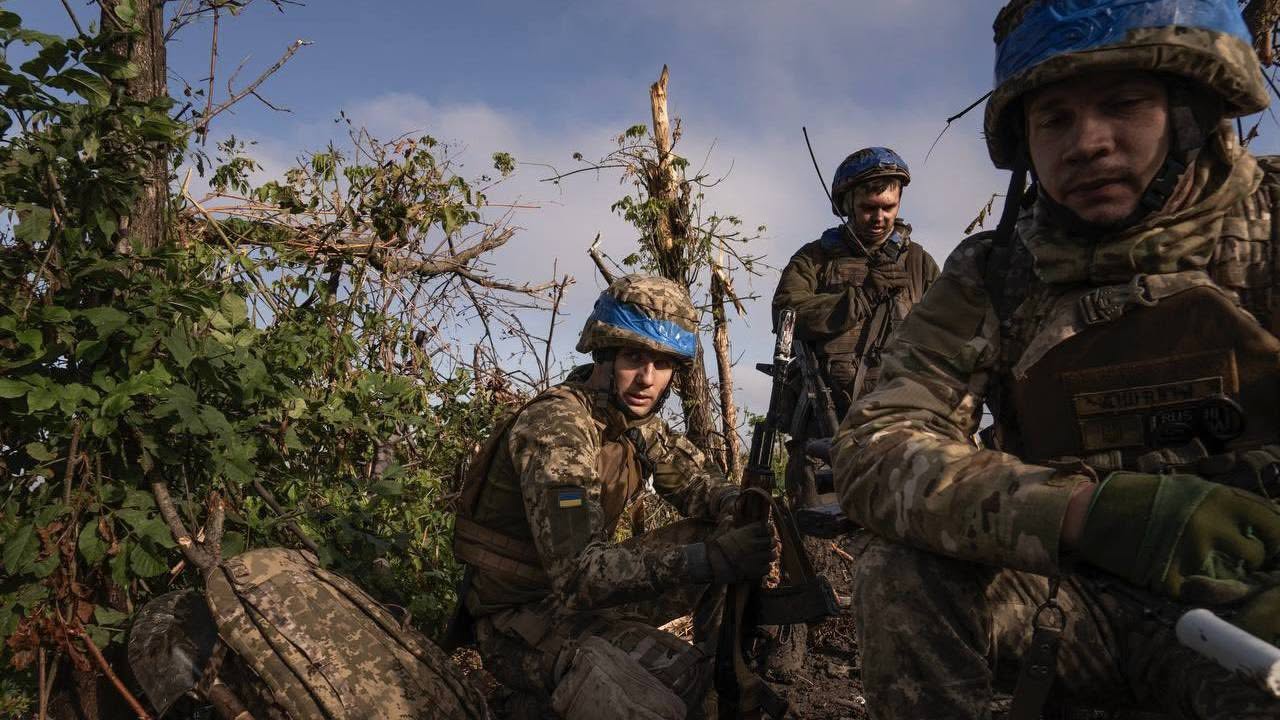
The ordinary security camera watching a street or a parking lot has quietly become a weapon of war. Ukraine’s Security Service has identified about 40,000 surveillance cameras since Russia’s 2022 invasion that Russian forces and spy agencies could have used to snoop, find targets and correct strikes, and has protected, reoriented or blocked them, The Wall Street Journal reported.
The discovered threat reaches well beyond Ukraine: Dutch intelligence warned in July that Russian state actors are systematically hacking cameras across Europe to track arms deliveries to Ukraine and the whereabouts of Ukrainian troops.
AI makes it faster
About 1.2 billion internet-connected cameras now watch the world, in doorbells, traffic lights, and baby monitors, and almost any of them can be hacked, the journalists found.
In Ukraine, the danger is lethal. In 2024, Russian hackers took over residential webcams in Kyiv, including one that a condominium association had installed, to find targets and adjust missile strikes on the capital, Ukraine's Security Service says.
Spying on Europe’s edge
Evidence of European reach keeps surfacing. Cybersecurity firm CloudSEK has recently uncovered an exposed server it suspects belongs to a Russian-speaking hacker, containing hundreds of webcam images of Ukrainian defense, government, energy, and communications sites, as well as scenes of daily life.
Many of the images came from locations near Ukraine’s border with NATO member Romania, CloudSEK says.
The Dutch warning and the server point the same way: cameras far from the front line are feeding Russia data on how the West arms Ukraine.
Ukraine turns the lens back on Russia
Ukraine also uses the same tactic inside the occupied territory. The international hacker group Team OneFist took control of a camera in Sevastopol, in occupied Crimea, and used it to watch Russian ships, submarines, and helicopters, spotting a previously unknown air base that Ukraine later struck, damaging planes and air defenses.
Team OneFist also reached cameras on the Kerch Strait Bridge, learning that Russia had installed motion sensors beneath the bridge to guard against waterborne attacks. Penetrating a well-placed camera gets analysts closer to targets at less risk than any secret agent.
Edição deste ano reúne 172 galerias na Frieze London, dedicada à arte contemporânea, e cerca de 140 na Frieze Masters, centrada na arte histórica. Três galerias são portuguesas e seis brasileiras.
«È una buona notizia per tutti, ed è importante che diventi realtà». Zelensky ha commentato così ieri, con la consueta finezza diplomatica, l’annuncio unilaterale di Donald Trump di una tregua energetica tra Russia e Ucraina. Nelle stesse ore in cui Washington dichiarava l’accordo, Kyjiv denunciava nuovi attacchi alle infrastrutture energetiche, compresa una centrale nella regione di Kharkiv. La distanza tra un post su Truth e la corrente che torna nelle case resta ampia.
La discussione europea sulla difesa dovrebbe partire da qui. Da una sala operatoria che deve restare illuminata, da un acquedotto che continua a funzionare, dal riscaldamento di una scuola o dalle comunicazioni dei soccorritori. Sono le condizioni materiali della vita civile. Proteggerle è parte del compito di chi governa.
Ieri la newsletter GeoStrategia ha richiamato un documento pubblicato a settembre dalla Nato: i nuovi requisiti di preparazione degli Stati alle crisi. Il testo, tecnico, pone una questione semplice. Un paese deve poter continuare a funzionare anche quando qualcuno cerca di paralizzarlo. Servono reti elettriche in grado di resistere, trasporti disponibili, comunicazioni sicure e servizi sanitari capaci di reggere un’emergenza prolungata. La difesa militare dipende anche da queste capacità civili.
In più occasioni, negli ultimi mesi, l’Ucraina ha condiviso con la Nato e gli alleati le lezioni apprese sul campo: come mantenere operativi energia, comunicazioni, evacuazione medica e coordinamento locale sotto attacco. Non è un esercizio teorico. È un’esperienza pagata a un prezzo che nessun paese dovrebbe essere costretto a sostenere. Mentre in Europa si discute se e come sostenere Kyjiv, gli ucraini possono indicare come proteggere i propri cittadini.
Alla luce di questa esperienza, lo slogan «soldi agli ospedali anziché alle armi» appare insufficiente. Un ospedale ha bisogno di personale, attrezzature e risorse. Ma se una centrale viene colpita, se le comunicazioni saltano o se i soccorsi non possono muoversi, servono anche sistemi di emergenza, reti alternative e la capacità di ridurre la probabilità che il prossimo attacco arrivi a destinazione. Il diritto alla salute va finanziato e, allo stesso tempo, protetto.
Questo non rende automaticamente giustificata ogni spesa militare, né autorizza a definire sicurezza qualsiasi stanziamento. Impone invece scelte rigorose e verificabili. Quali infrastrutture sono più vulnerabili, non solo a missili e droni ma anche a sabotaggi, attacchi ibridi o interruzioni delle filiere? Quanto possono resistere gli ospedali a un blackout prolungato? Chi coordina le risposte? Quando i piani sono stati aggiornati e messi alla prova? Sono domande da rivolgere al governo, alle Regioni e ai gestori dei servizi. Anche le opposizioni dovrebbero pretenderle.
L’Europa può trasformare la lezione ucraina in una politica comune: proteggere insieme le reti critiche, organizzare riserve e soccorsi, rafforzare la difesa aerea e la capacità di risposta rapida, evitare che la vulnerabilità di un paese diventi quella dei vicini. È un programma concreto per un’Unione che intenda assumersi la responsabilità della propria sicurezza.
Zelensky chiede che una tregua annunciata diventi realtà. Agli europei tocca fare in modo che la protezione promessa ai cittadini diventi capacità effettiva. La pace si misura anche dalla possibilità di tenere acceso un ospedale quando qualcuno cerca di spegnerlo.
In July 2011, a 22-year-old woman arrived at the Calexico checkpoint on the Mexico–California border carrying a U.S. passport with a navy-blue cover. Her eight-month pregnancy and Sinaloa accent were hard to hide. A customs agent asked routine questions: where she had come from, where she was headed, and what she was carrying. Despite her answers and the document she presented, he sent her for a secondary, more thorough inspection. Other federal officers meticulously searched her belongings and the contents of her cellphones. Minutes later, once the rigorous procedure was complete, they allowed her into the country.
Ukrainian strikes hit a site housing Russian troops in Khrustalnyi, a city in Russian-occupied Luhansk Oblast, overnight on 12 October, according to local reports. Satellite fire data recorded blazes at a former motor depot there, in an area Russia once used as a logistics base for its offensive in the region.
Russia keeps attacking in Ukraine’s Donetsk Oblast and strikes Ukrainian cities and power plants every day. Its offensive depends on troops, ammunition, and fuel moved through occupied Ukraine, so strikes there reach the supply chain behind the front.
Fires at a former motor depot in occupied Khrustalnyi
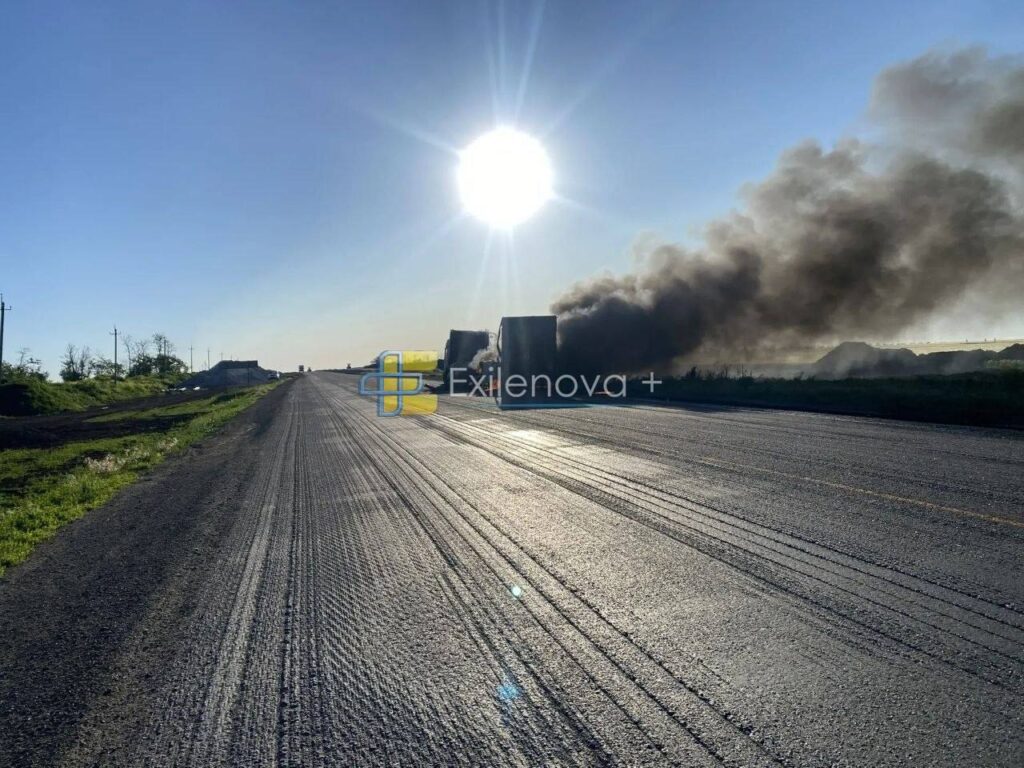
Ukrainian forces launched heavy strikes around Khrustalnyi in eastern Ukraine overnight, the Ukrainian monitoring channel Exilenova+ reported. It counted three separate fires and one large blaze, and said local residents reported a hit on a site where Russian troops were based. Ukraine’s military had not officially commented on the strike by the publication time of this article on 12 October.
Ukraine’s Defense Forces are carrying out massive strikes in the area of occupied Khrustalnyi in Luhansk Oblast. Three separate fire hotspots and a large-scale blaze have been reported.
NASA’s Fire Information for Resource Management System (FIRMS), which tracks active fires by satellite, shows blazes at a former motor transport enterprise and an industrial zone in Khrustalnyi, Ukrainian military outlet Militarnyi reported. Three fire hotspots appeared there at 01:10 and spread by 02:07, the outlet said.
Fire hotspots recorded by NASA’s FIRMS system near a former motor transport enterprise in occupied Khrustalnyi, Luhansk Oblast, Ukraine, 12 October 2026. Map: NASA FIRMS/Militarnyi
Ukraine also hit the site on 16 June 2022, striking an ammunition depot there, and local residents then heard secondary detonations, Militarnyi said. The site served as an important logistics base for Russia’s 2nd Army Corps in its offensive on Sievierodonetsk and Lysychansk, two cities in Luhansk Oblast, the outlet added.
Khrustalnyi in Russian-occupied Luhansk Oblast, Ukraine, where local reports said Ukrainian strikes hit a Russian troop site on 12 October 2026. Map: Euromaidan Press/DeepStateMap
Explosions at a Crimean airfield Russia used to launch drones overnight
Drones attacked occupied Crimea from the evening of 11 October into the night, and Russian air defenses, including mobile fire groups, fired across the peninsula, Krym.Realii, Radio Liberty’s Crimea service, reported. Explosions sounded in Simferopol, Feodosiia, and Yevpatoriia, among other places, the Crimean monitoring Telegram channel Crimean Wind said, according to the outlet.
Subscribers told the channel about a series of explosions and a glow at Russia’s Hvardiiske military airfield in Simferopol district as air defenses fired. Krym.Realii said neither Ukraine’s nor Russia’s military had commented and that it could not verify the reports independently.
Explore further
Ukraine says it struck a Bastion in Crimea, the launcher Russia pairs Zircon and Oniks missiles on
Overnight, Russia also launched attack drones at Ukraine from several directions, including Hvardiiske in occupied Crimea, Ukraine’s Air Force reported.
Ukraine’s General Staff said in August that a 3 August strike on the Hvardiiske airfield destroyed nine aviation fuel tanks and damaged two aircraft hangars.
Ukraine keeps hitting Russian rear areas in occupied territory
On 10 and 11 October alone, the General Staff reported hitting a Russian repair base and supply depots in occupied Luhansk Oblast, along with Russian troop concentrations near Lysychansk and two other towns there.
Ukraine has also kept up its campaign of so-called middle strikes, drone attacks on Russian supply lines in occupied territory beyond the front. French mapper Clément Molin counted 770 confirmed drone hits on Russian trucks in September, up from 630 in August, with the strikes concentrated on supply routes running through occupied southern Ukraine into Crimea.
Strikes on troop sites and airfields far behind the front leave Russia fewer safe places in occupied territory to house troops and launch drones, adding to the battlefield losses Ukraine’s drones already inflict.
Saudi Arabia is looking at ways to expand its oil pipeline capacity to destinations outside the Persian Gulf to 10 million barrels a day within two to three years, said Energy Minister Prince Abdulaziz bin Salman.
Si possono fare alcuni passi per rendere più efficaci le raccomandazioni del semestre europeo a livello regionale. A patto di non dimenticare che in zone diverse gli effetti sono diversi e che il territorio non coincide con le regioni amministrative.
Park Ki-chang, South Korea’s ambassador to Ukraine, has returned to Seoul after being recalled in protest at Kyiv’s disclosure of information regarding the handover of North Korean prisoners of war to the South Korean side. Shortly before this, Song Yeon-gil, known for his reputation as a Russophile, was appointed as an adviser to the president. […]
The Russia-Ukraine War has become a real-time laboratory for the Chinese military, spurring rapid defensive modernization while exposing deep friction between its centralized command hierarchy and the decentralized demands of modern combat. This month, the Center for Strategic and International Studies (CSIS) released a report detailing how China is aggressively leveraging the Russia-Ukraine war as […]
Sabato scorso, in diverse città italiane, si sono svolte manifestazioni organizzate da sindacati e partiti della sinistra, con partecipazione di movimenti per la Palestina. I cortei hanno denunciato quello che definiscono «genocidio» israeliano a Gaza e indicato come «complici» i governi di Benjamin Netanyahu, Donald Trump e Giorgia Meloni. Con il passare del tempo, la memoria dell’attacco del 7 ottobre 2023, in cui Hamas ha ucciso circa milleduecento persone e rapito oltre duecentocinquanta, tende a sfumare nel discorso pubblico.
Esiste una soglia oltre la quale la solidarietà con i civili palestinesi può confondersi con la legittimazione di chi ha innescato la guerra o con la messa in discussione del diritto di Israele a esistere. A Torino una portavoce di un coordinamento per Gaza ha definito il 7 ottobre «giornata di resistenza»; a Milano il corteo è stato aperto da uno striscione per una Palestina «dal fiume al mare» accompagnato dalla condanna del sionismo. Definire «resistenza» un massacro di civili e ostaggi cambia il nome agli autori e cancella quello delle vittime. Chi invoca una Palestina dal fiume al mare dovrebbe precisare quale spazio residuo immagina per gli israeliani. Non tutti i manifestanti condividono queste posizioni; il silenzio di chi non le condivide pesa comunque.
In questo contesto è stato assegnato il Nobel per la pace 2026 a Navi Pillay, che ha presieduto la commissione d’inchiesta Onu secondo cui Israele ha commesso atti genocidi a Gaza. La sua lunga carriera a difesa dei diritti umani non viene cancellata da questa conclusione, ma una commissione d’inchiesta non è un tribunale e un premio non equivale a una sentenza. Le conclusioni vanno discusse nel merito: la critica al governo israeliano non autorizza a processare l’esistenza stessa di Israele.
Lo stesso vale per il documentario “Naza”, basato su testimonianze anonime di personale militare e di intelligence israeliano. L’esercito contesta i contenuti e la verificabilità delle fonti; alcuni oppositori di Netanyahu interpretano gli stessi sistemi di targeting come strumenti volti a ridurre, non ad aumentare, le vittime civili. Un film non costituisce prova processuale, e il termine «algoritmo» non equivale a una confessione.
Resta una domanda spesso elusa: quale responsabilità ha Hamas nella catastrofe di chi pretende di rappresentare? Il movimento governa Gaza da quasi vent’anni e ha utilizzato fondi di solidarietà per costruire una vasta rete di tunnel destinati alla guerra. Interrogato sul perché non fossero stati realizzati rifugi per i civili, Mousa Abu Marzouk ha risposto che i tunnel servono ai combattenti e che ai civili deve pensare l’Onu. Altri dirigenti, tra cui Yahya Sinwar, hanno descritto le vittime civili come un elemento di valore strategico. La logica è nota: combattere da case, scuole e ospedali e poi esibire macerie e morti come arma politica. Per Hamas la sofferenza dei civili non è solo un costo: è anche propaganda.
Le cifre che dominano il dibattito provengono dal ministero della Sanità di Gaza, controllato da Hamas, che non distingue tra civili e combattenti. Ripeterle senza riserve critiche non è necessariamente pietà: è accettazione di una fonte parte in causa. I palestinesi non sono tutti Hamas, così come i tedeschi degli anni Trenta non erano tutti nazisti. Per questo le colpe di Hamas non possono essere cancellate in nome dei palestinesi. Né il solo numero dei morti dimostra un genocidio: serve l’intenzione di distruggere un gruppo in quanto tale. È su questo punto che le conclusioni della commissione Onu vanno messe alla prova. Pretendere che Israele rispetti il diritto di guerra è legittimo; non lo è lasciare che chi usa gli scudi umani si presenti come loro unico difensore.
Chi chiede conto a Israele di ogni scelta e a Hamas di quasi nulla applica una morale selettiva. Chi chiama «resistenza» il 7 ottobre riabilita un massacro.
Infine, diversi governi europei hanno riconosciuto uno Stato palestinese che ancora oggi non è in grado di tenere elezioni programmate in Cisgiordania e denunciano la tragedia di Gaza all’arrivo dell’inverno. Una task force europea per portare soccorsi direttamente a Gaza resta assente. Il non detto è che Hamas non ha deposto le armi e che gli aiuti rischiano di finire nelle mani delle sue milizie. La pace richiede una Palestina libera anche da Hamas e un Israele che non debba negoziare il proprio diritto a esistere. Una piazza che non riesce a pronunciare entrambe le condizioni non ha ancora chiarito quale pace vuole.
Questo è un estratto di “La Linea” la newsletter de Linkiesta curata da Marco Taradash per orientarsi nel gran guazzabuglio della politica e della vita, tutte le mattine – dal lunedì al venerdì – alle sette. Più o meno. Qui per iscriversi.
Norwegian nonprofit Fritt Ukraina is allocating NOK 10 million (about $1 million) to strengthen air defenses around Chornomorsk, a key Ukrainian port on the Black Sea, the organization announced on 9 October.
Russian attacks on port infrastructure and civilian vessels are threatening Ukraine’s maritime trade and agricultural exports, putting pressure on a vital source of revenue for the country and disrupting shipments of food to international markets.
The funding will support Ukrainian State Border Guard Service and Armed Forces units defending the region against Russian attack drones. It is being delivered through Dronefall, a project run by the Ukrainian Come Back Alive Foundation, which equips military units with interceptor drones and the equipment needed to operate them.
Fritt Ukraina, whose name means “Free Ukraine,” is a Norwegian nonprofit organization that supports Ukraine’s defense against Russia’s full-scale invasion. The donation is part of its Odins Ravner 2.0 fundraising campaign, which provides military assistance to Ukrainian forces.
Interceptor drones and equipment to protect port infrastructure
The support includes STING, Blyskavka and P1-SUN interceptor drones, alongside ground control stations, communications equipment, generators, charging stations, laptops, tablets and vehicles, according to the organization.
The interceptor drones are already operational, according to Fritt Ukraina. The equipment helps Ukrainian personnel detect and intercept Russian attack drones, while vehicles allow crews to move quickly and operate from different positions.
Fritt Ukraina Secretary General Natalia Golis said effective air defense requires more than interceptor drones alone. Communications systems, reliable power supplies and mobility are also essential to ensure units can use their equipment effectively.
The organization is supporting Dronefall for the third consecutive year and has become the Come Back Alive Foundation’s largest foreign partner. The latest donation was matched by a donor affiliated with the Ukrainian foundation.
STING interceptor drones funded by Norwegian nonprofit Fritt Ukraina to Ukrainian forces to help counter Russian attack drones near the Black Sea ports. Photo: Fritt Ukraina / Come Back Alive
More than 90% of Ukraine’s agricultural products, including grain and vegetable oils, are exported through three ports in southern Odesa Oblast. Russian attacks have targeted port infrastructure and civilian vessels, increasing security risks for commercial shipping and driving up freight and insurance costs.
Since the start of Russia’s full-scale invasion in February 2022, more than 1,000 Ukrainian port facilities and over 200 civilian vessels have been damaged or partially destroyed, Fritt Ukraina reports. The disruption threatens Ukrainian export revenue and international food supplies.
“The attacks on Ukraine’s ports do not only undermine the country’s defense capabilities. They also threaten a vital part of its economy and its ability to export food to the rest of the world,” Golis said.
Dronefall aims to expand Ukraine’s ability to intercept Russian drones using dedicated interceptor aircraft and supporting equipment. According to Fritt Ukraina, participating units have destroyed more than 53,000 Russian drones, accounting for approximately one in five unmanned aerial vehicles entering Ukrainian airspace.
The NOK 10 million contribution is part of Fritt Ukraina’s broader Odins Ravner 2.0 campaign, which provides more than NOK 60 million in support to Ukrainian forces.
The European Commission is preparing proposals to impose tighter visa restrictions on Russian citizens entering the Schengen area, with new measures expected to be presented in January 2027 following pressure from several member states concerned about Russia’s expanding hybrid operations across Europe.
Poland, Sweden and Estonia are among the countries demanding a tougher approach to Russian visitors, particularly former military personnel who fought in Ukraine. The proposals could affect hundreds of thousands of Russian nationals who continue to receive visas for travel to the European Union despite restrictions introduced following Moscow’s full-scale invasion of Ukraine in February 2022.
According to a report published on Sunday, EU officials are finalising plans to address vulnerabilities in the Schengen visa system, which governments increasingly regard as a potential entry point for individuals involved in intelligence operations, organised crime and acts of sabotage.
Swedish Justice Minister Gunnar Strömmer said the Commission was working towards a January announcement, although Stockholm would prefer an earlier decision. He told Politico that vulnerabilities in the existing arrangements could be exploited by hostile actors.
The initiative is expected to feature in discussions surrounding the Foreign Affairs Council meeting on 12 October, when ministers will examine Russia’s intensifying hybrid campaign against EU member states.
Schengen visas remain a security concern
Despite the deterioration in relations between Brussels and Moscow, Russian citizens continue to receive substantial numbers of Schengen visas. Approximately 478,000 tourist visas were reportedly issued to Russian nationals in 2025, including a significant proportion allowing multiple entries.
The figures have renewed questions about whether existing screening arrangements adequately reflect the security environment created by Russia’s war against Ukraine.
In September 2022, the EU suspended its visa facilitation agreement with Russia, ending preferential treatment and introducing stricter application procedures, additional documentation requirements and more restrictive conditions for multiple-entry visas.
However, the decision did not amount to a general prohibition on Russian tourism. National authorities retained considerable discretion over applications, producing differences in how individual Schengen countries handle Russian visitors.
The Commission’s existing visa guidelines also preserve access for certain categories of travellers, including journalists, political dissidents, civil society representatives and people travelling for essential family reasons.
The new initiative would therefore concern not only the number of visas issued but also the extent to which national screening decisions can affect the security of other Schengen countries. Under the Schengen system, a visa issued by one participating state generally permits its holder to travel throughout the area.
Estonia calls for restrictions on former Russian soldiers
Estonia has taken a particularly forceful position, proposing an EU-wide entry ban targeting former members of the Russian armed forces who participated in the invasion of Ukraine. Estonian Foreign Minister Margus Tsahkna estimates that approximately 650,000 former Russian combatants could fall within the category of individuals requiring closer scrutiny.
Tallinn has advocated individual entry restrictions rather than relying exclusively on broader measures covering Russian nationals generally. Tsahkna warned that former soldiers, particularly those with combat experience and connections to Russian intelligence services, could present a serious security challenge if they entered European countries.
He suggested that Moscow could exploit former combatants to penetrate organised criminal networks or facilitate violent operations against European targets. These assessments remain security warnings rather than evidence that Russian veterans as a group are involved in such activities.
A coordinated European policy would also seek to prevent individuals refused entry by one member state from exploiting differences in national visa procedures elsewhere.
Restrictions on Russian diplomats also under consideration
The visa proposals form part of a wider effort to restrict the activities of Russian nationals whose presence in Europe may present security risks. EU foreign policy chief Kaja Kallas has previously indicated that member states are considering tighter controls on the movement of Russian diplomats within Schengen, alongside restrictions on visas for former combatants and a reduction in Russian tourism.
One proposal would prevent Russian diplomatic personnel from travelling beyond the member state in which they are accredited. Such restrictions would complicate cross-border activities by diplomatic officials suspected of conducting intelligence operations under official cover.
The issue has acquired greater urgency as European governments report an expanding pattern of Russian-linked sabotage, including suspected arson attacks, cyber operations and attempts to disrupt critical infrastructure.
Migration Commissioner Magnus Brunner acknowledged that the initial decline in visa issuance to Russian nationals had levelled off. He urged member states to reduce the number of visas granted and to strengthen scrutiny of applicants.
January proposals will test EU consensus
The immediate question is whether member states can agree on common restrictions that go beyond the existing visa framework. An outright prohibition on Russian tourism would represent a significant departure from the current approach, under which national governments retain responsibility for individual visa decisions.
More narrowly targeted measures against former combatants could prove easier to justify on security grounds, although identifying eligible individuals would require reliable information and cooperation between national authorities. The Commission has yet to publish its proposals, and the precise legal instruments under consideration remain unclear.
Foreign ministers meeting on Monday will discuss Russia’s hybrid campaign and possible European responses. The Council’s published agenda places the issue in the context of Moscow’s continuing aggression against Ukraine.
Whether the Commission ultimately proposes new binding restrictions or stronger common guidelines, the central difficulty remains the same: a Schengen system built around common freedom of movement must accommodate increasingly different national assessments of the security risks associated with travel from Russia.
Volodymyr Zelensky probably did not expect two North Korean prisoners of war to create a diplomatic crisis with South Korea. That is nevertheless what happened. During his September address to the United Nations General Assembly, Zelensky disclosed that two North Korean soldiers captured while fighting alongside Russian forces had been transferred to South Korea. Seoul […]
By Joyce Lee SEOUL, Oct 11 (Reuters) – A South Korean container ship completed the country’s first commercial round trip to Europe via the Arctic on Sunday, as authorities bank on the...
A multibillion-dollar private initiative to overhaul US submarine manufacturing marks an urgent push to revitalize naval industrial capacity at a pivotal moment in the Indo-Pacific balance of power. This month, multiple media outlets reported that defense technology firm Anduril Industries will invest US$3.7 billion of its own capital to build a 2-million-square-foot “software-defined shipyard” at […]
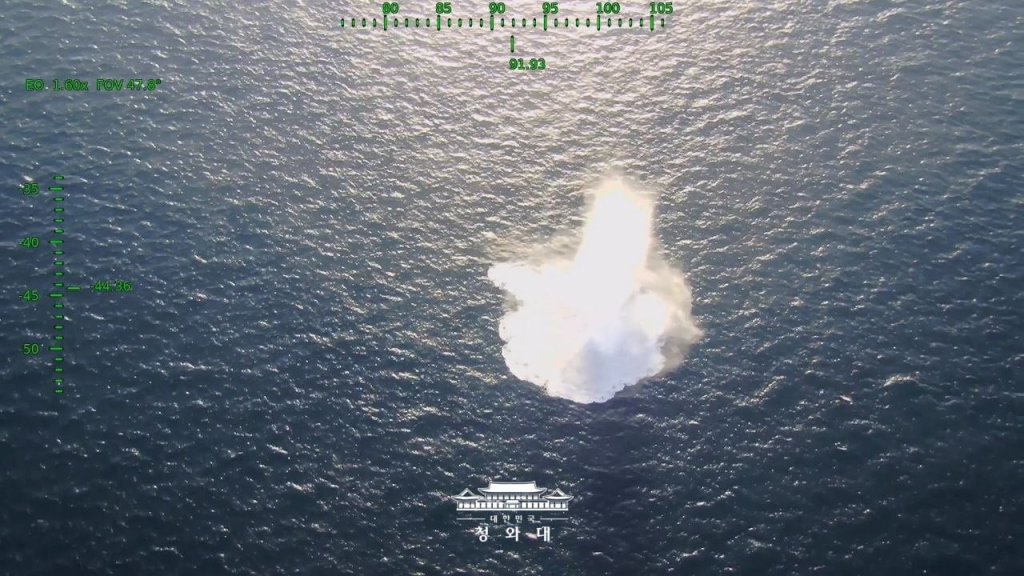
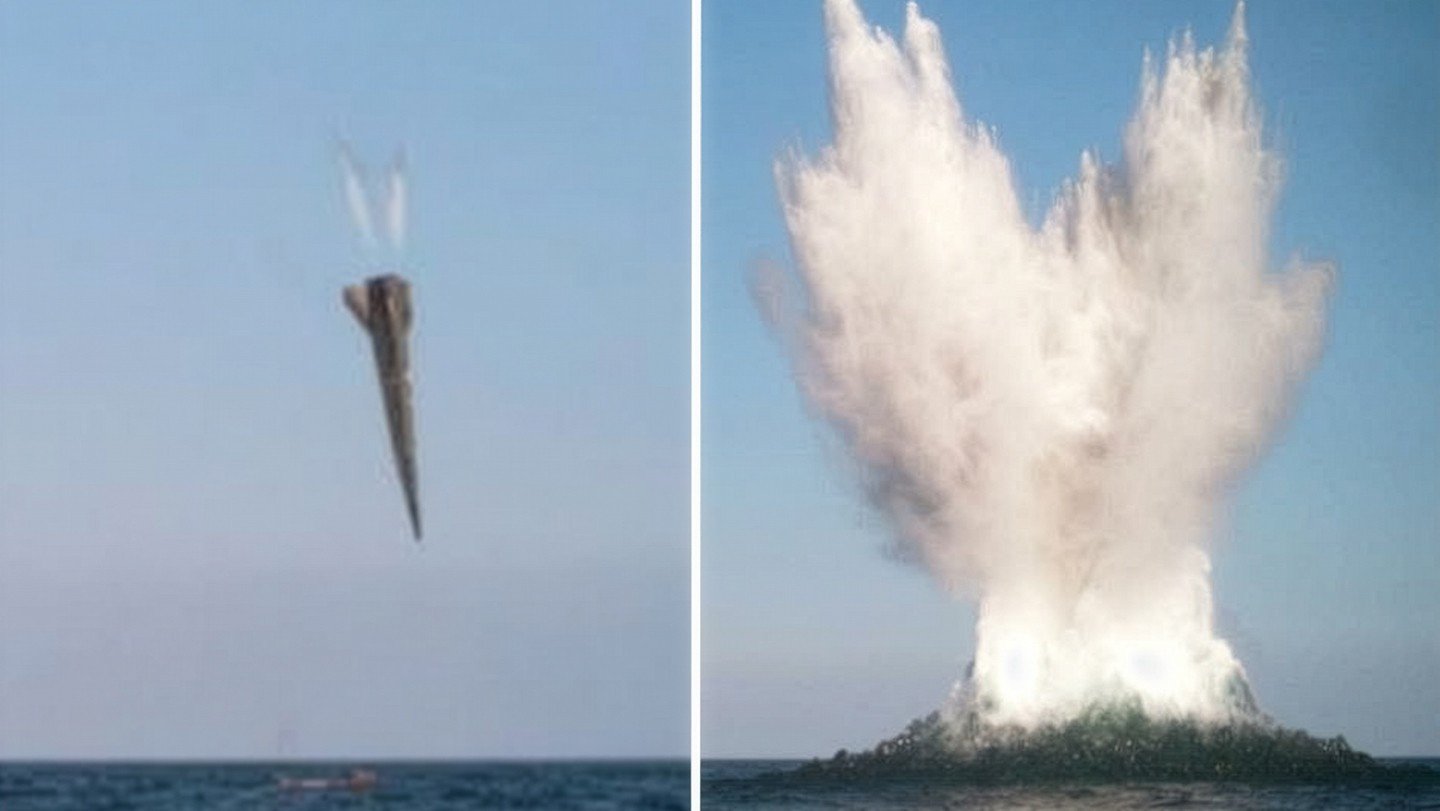
The South Korean government has released images from its first successful test of a domestically developed hypersonic boost-glide vehicle. This includes shots of the vehicle impacting the water at the end of its flight. A weapon of this kind would give South Korea a significant new way to hold targets in North Korea at risk amid an ever-deepening arms race on the Peninsula.
South Korea’s Presidential Office, more commonly referred to as the Cheong Wa Dae or the Blue House, announced the test in a Korean-language press release yesterday. The Blue House initially released a video of President Lee Jae Myung and others observing the test from a conference room at the Anheung Proving Ground, which is located in South Chungcheong Province on the country’s western coast. South Korea’s Agency for Defense Development (ADD) manages testing at Anheung. A series of still images from the test itself was subsequently posted on the Blue House’s website.
A trio of pictures showing South Korea’s new hypersonic boost-glide vehicle impacting the water during the test yesterday. The Blue HouseAnother view of the impact at the end of yesterday’s South Korea hypersonic test as seen through what looks to be an electro-optical video camera on an aircraft. The Blue House
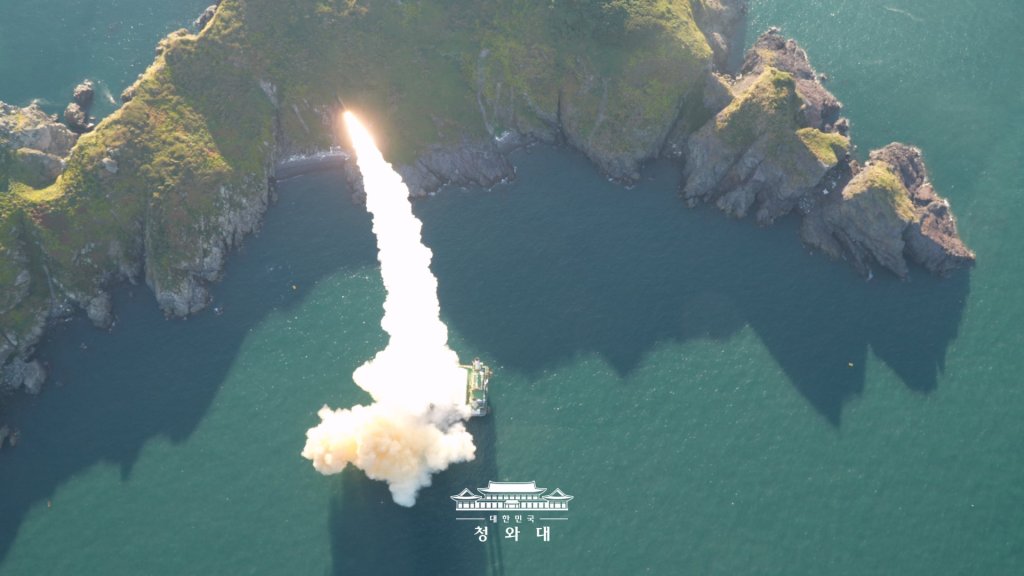
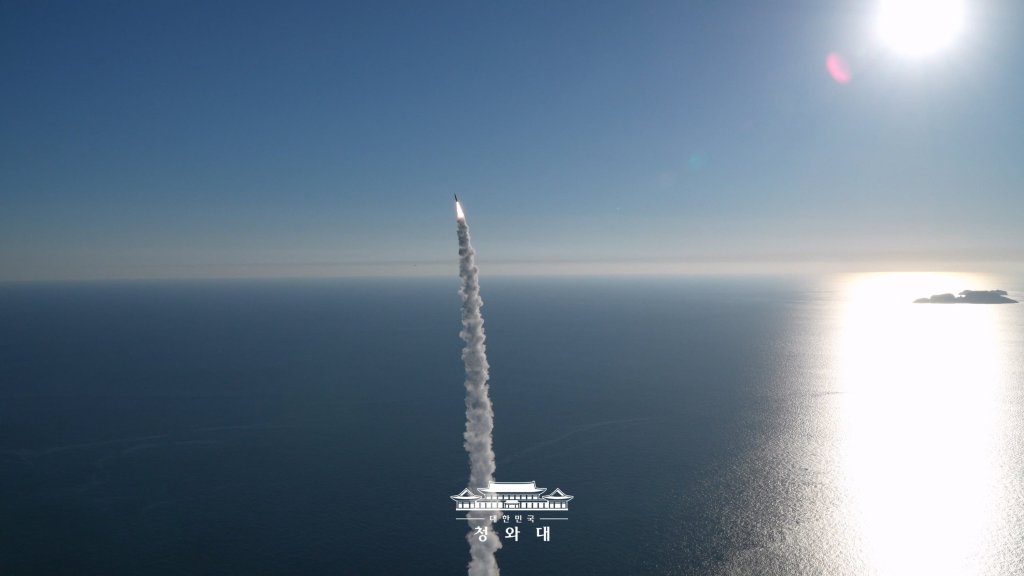
Included in the still image gallery are shots showing the launch of the missile, a formal name for which has not yet been disclosed, from a wheeled transport-erector-launcher on a platform sitting just off the coast. The low resolution of the pictures makes it hard to tell whether the missile and/or the TEL are of an existing South Korean design or are based on one. We will come back to this later on.
A picture showing the launch of the hypersonic weapon from the platform off the coast. The Blue HouseAnother picture from the test showing the missile after launch. The Blue House
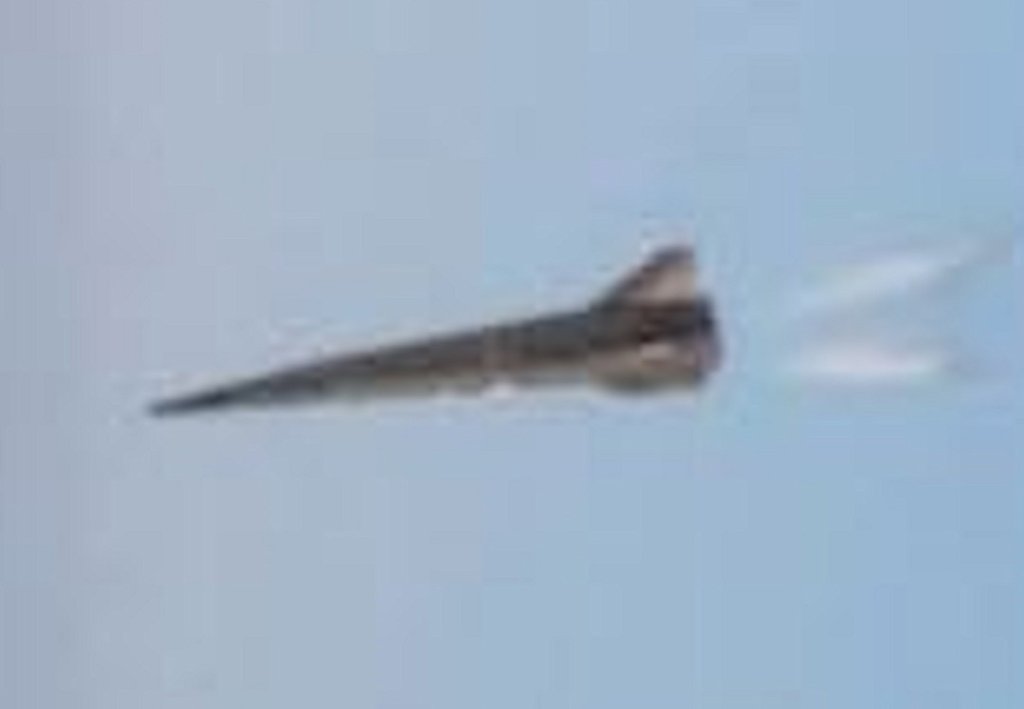
As mentioned, there are also pictures of the hypersonic boost-glide vehicle hitting the water. At first glance, the vehicle looks to have a broadly conical design with stabilizing fins at the base. However, at least one of the fins looks to be truncated. Closer inspection of the available images shows further indicators that might point to it actually having a more wedge-shaped design with a distinct top and bottom, though it is still not definitely clear given the low resolution. Conical boost-glide vehicles are generally understood to be easier to design, relatively speaking, than wedge-shaped ones. Historically, hypersonic boost-glide vehicles of any kind have proven to be technically complex and challenging to turn into viable operational weapons, even by countries with extensive past experience with their development.
Another close-up look at the hypersonic boost-glide vehicle test yesterday, showing what looks to be a truncated fin on one side. The Blue House
“This test launch was conducted to verify, for the first time, the vehicle’s core technologies in a hypersonic flight environment: the performance of ultra-high-temperature heat-resistant materials, guidance and control capabilities, and the ability to perform irregular flight maneuvers at low altitudes,” the Blue House said in its release yesterday, per a machine translation of the Korean text. “The HGV [hypersonic boost-glide vehicle] successfully separated after ascending to the target altitude and executed its planned flight path within the hypersonic environment without any issues.”
With all this in mind, the fact that the vehicle just remained intact through to impact is noteworthy. At the time of writing, South Korean authorities do not appear to have disclosed more specific details about the test, including how far the boost-glide vehicle traveled before hitting the water or what peak speed it reached. Important questions also remain about how the vehicle is guided during the mid-course and terminal phases of flight, challenges that do not appear to have been addressed by this particular test.
In general, unpowered hypersonic boost-glide vehicles need to be brought first to an optimal altitude and speed. This is typically achieved using a sufficiently sized rocket booster, with existing ballistic missile designs often serving as a starting point.
Once released from the booster, a boost-glide vehicle flies along a relatively shallow flight path within the Earth’s atmosphere. The vehicle is able to maneuver along the way, sometimes erratically, while traveling at hypersonic speeds, generally defined as anything about Mach 5.
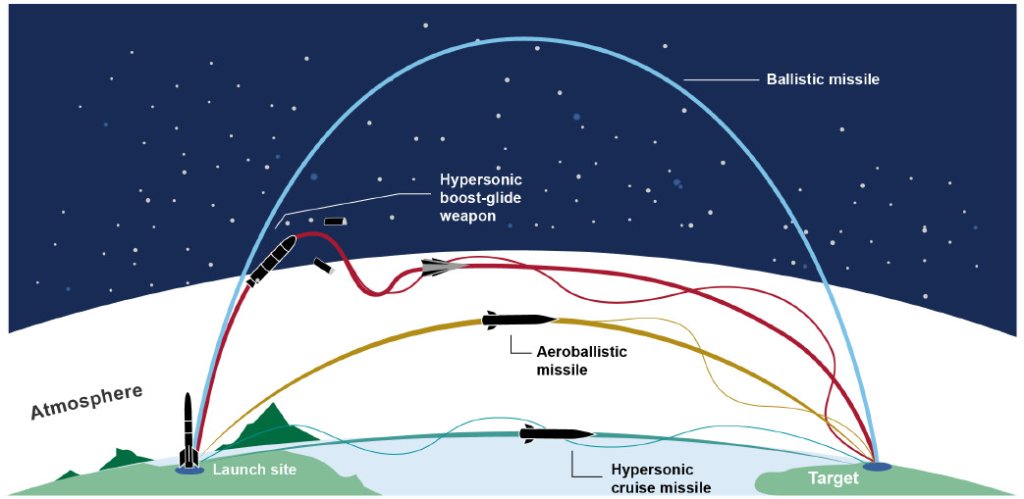
A graphic showing, in a very rudimentary way, the differences in trajectories between a traditional ballistic missile, a hypersonic boost-glide vehicle, an aero or quasi-ballistic missile, and an air-breathing hypersonic cruise missile. GAO
All of this sets hypersonic weapons of this kind apart from traditional ballistic missiles, even ones with advanced maneuverability capabilities, which all follow a broadly arcing trajectory to their targets. The combination of speed, flight trajectory, and maneuverability offered by hypersonic boost-glide vehicles creates distinct challenges for opponents. They are hard to spot and track, let alone attempt to intercept, and there is less time for defenders to react overall. This ability to penetrate enemy air defenses and cover ground rapidly makes these weapons particularly attractive for strikes on very high-value and time-sensitive targets.
“The HGV [hypersonic boost-glide vehicle] is a ‘key strategic asset capable of changing the game on the battlefield,’ as its unpredictable flight trajectory and overwhelming speed allow it to launch surprise strikes against key strategic targets during contingencies,” the Blue House’s release explicitly noted, again according to a machine translation.
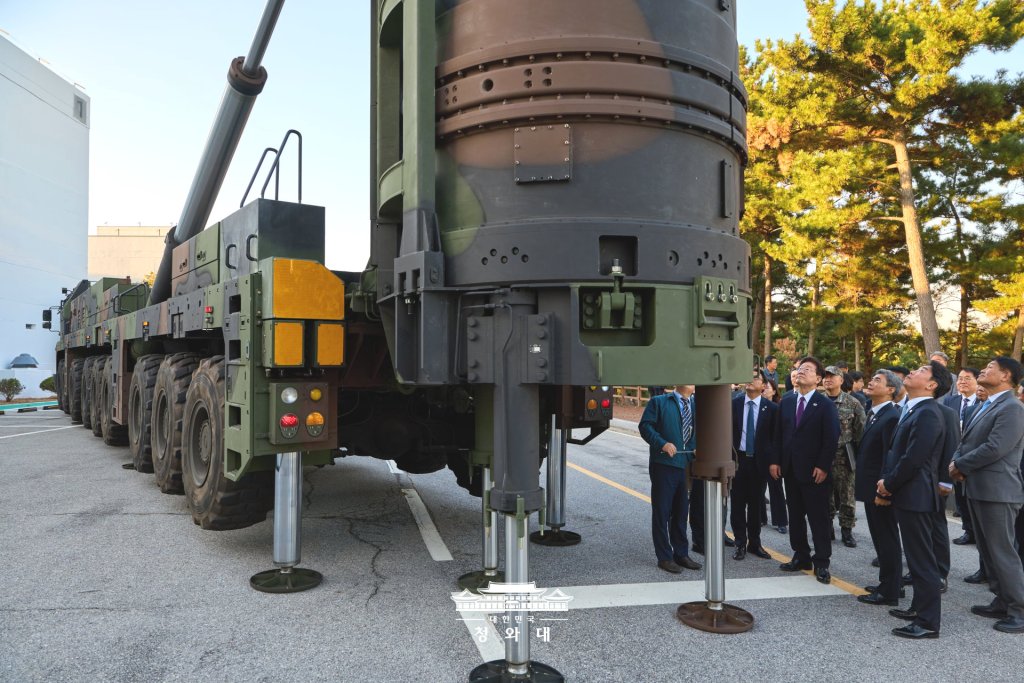
With all this in mind, South Korea does have an entire family of domestically-produced ground-launched ballistic missiles that could be suitable starting places for launching an unpowered hypersonic boost-glide vehicle. President Lee was notably shown a TEL for the country’s newest Hyunmoo-5 ballistic missile at Anheung yesterday, though no explicit connection has been drawn between that weapon and the hypersonic test. The Hyunmoo-5 is itself still a relatively new development, having only entered service around the end of last year.
President Lee Jae Myung and others inspect a Hyunmoo-5 TEL on October 8, 2026. The Blue House
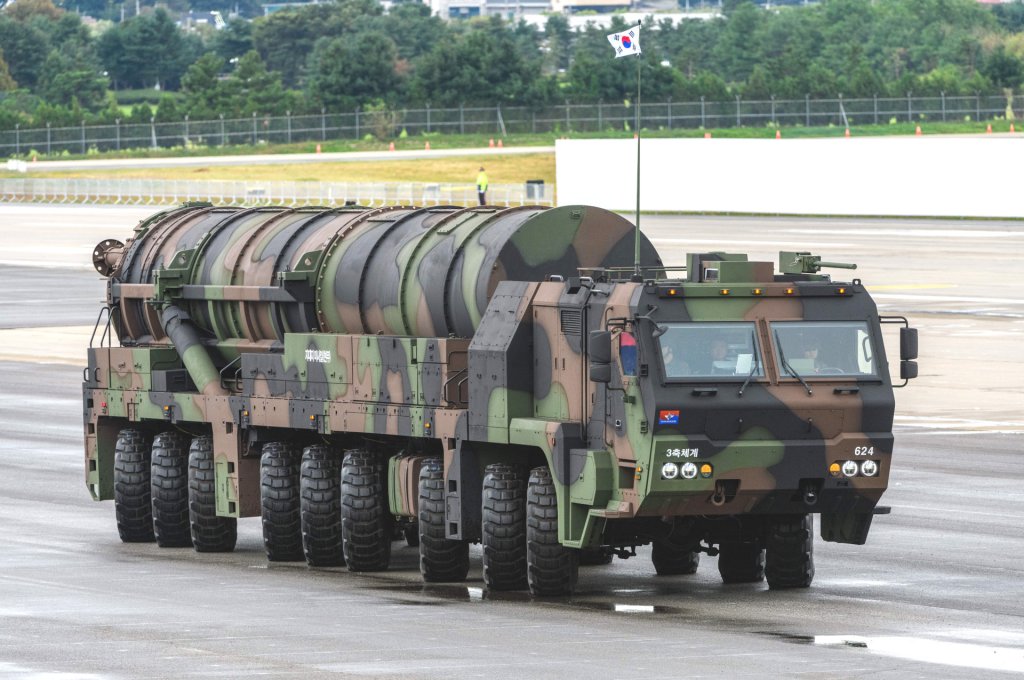
When it comes to new South Korean arms developments, the Hyunmoo-5, which entered service around the end of last year, has been and continues to be a major point of discussion by itself. It is officially categorized as a short-range design, despite how big it is (35 tons gross weight), which is said to be due largely to the equally substantial size of its warhead (17,000 pounds). Past reports have raised the possibility that it could be capable of flying out to intermediate ranges if the warhead weight were reduced. Short-range ballistic missiles are defined as ones with ranges between 190 and 620 miles (300 and 1,000 kilometers), while intermediate-range ballistic missiles can hit targets out to between 1,864 and 3,418 miles (3,000 to 5,500 kilometers). Medium-range ballistic missiles (MRBM) fall in between these two categories.
A Hyunmoo-5 transporter-erector-launcher seen during a parade in 2024. Kim Jae-Hwan/SOPA Images/LightRocket via Getty Images
With its massive unitary warhead, the Hyunmoo-5 already gives South Korea an important new way to hold deeply buried and otherwise hardened targets in North Korea at risk. This fits in directly with the country’s broader Korea Massive Punishment and Retaliation (KMPR) policy, as TWZ has previously written:
“While the Hyunmoo-5 has been widely reported as a future pillar of the KMPR, its specific ability to penetrate deeply buried bunkers, such as those used by the North Korean leadership, the same functions mean that it can also fulfill elements of the ‘kill chain.’ In this way, it could be used as part of a pre-emptive strike, to try and knock out North Korea’s launch capability by targeting its hardened command-and-control facilities and missile storage areas.”
By virtue of the very high speeds they reach in the terminal phase of flight, hypersonic boost-glide vehicles also offer bunker-busting benefits on top of the other aforementioned advantages they bring to the table.
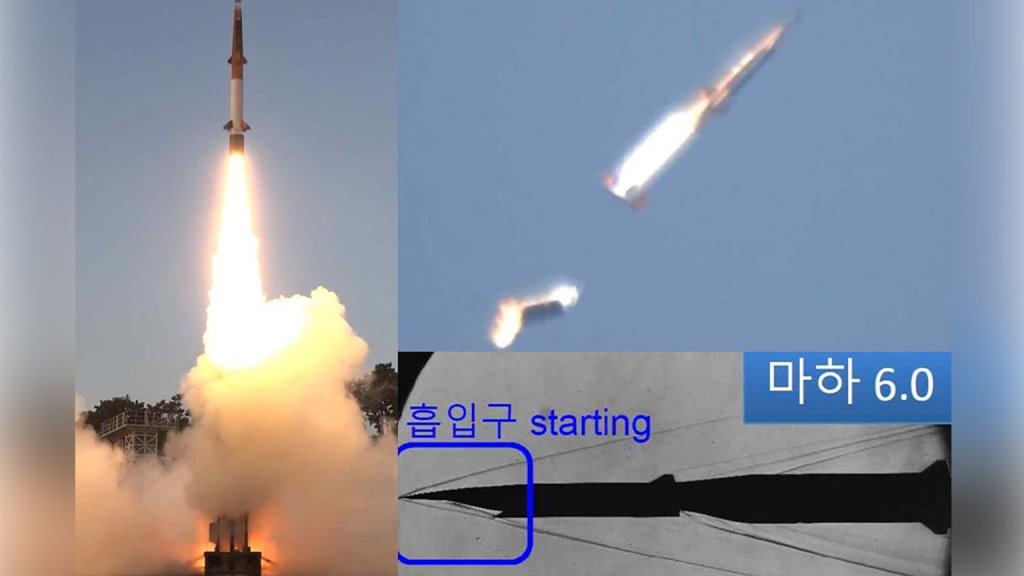
In addition, the hypersonic boost-glide vehicle test reflects a broader arms race that has been expanding in scale and scope for years now. South Korea is also developing an air-breathing hypersonic cruise missile, seen in the composite image below, as well as new air- and sea-launched ballistic missiles, the latter of which will be loaded on new surface warships and submarines.
via X
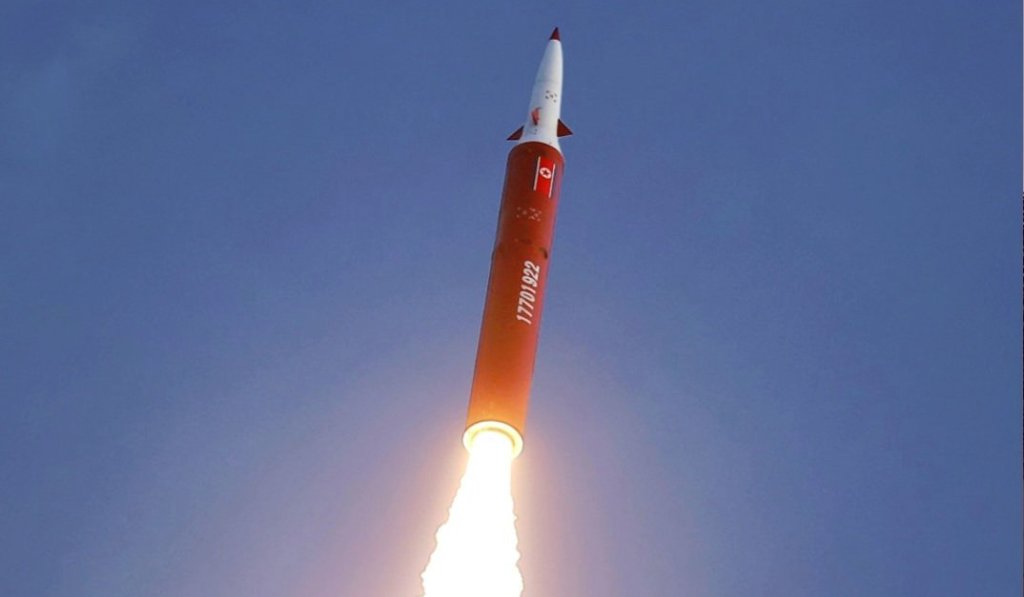
Though there are always questions about the actual maturity and viability of the designs, North Korea continues to churn out its own new missile developments. This includes two separate test launches of purported new hypersonic designs just in recent weeks. Tit-for-tat missile launches are not entirely uncommon on the peninsula, but there are limits to how quickly a test like the one South Korea conducted yesterday involving an emerging technology can reasonably be staged.
A picture of one of two new purported hypersonic missiles North Korea says it has tested in the past few weeks. North Korean State Media
An operational hypersonic boost-glide vehicle capability would also expand South Korea’s capacity to challenge opponents regionally beyond North Korea. Though the regime in Pyongyang represents the most proximate national security threat to the country, China and Russia have also been growing points of concern for South Korean authorities in recent years.
“We must secure our national security through our own strength,” President Lee said after yesterday’s hypersonic test, per the Blue House’s release. “The government must not rest on today’s success but must further advance the technology so that the hypersonic glide vehicle can establish itself as a robust strategic asset safeguarding our future security.”
South Korea’s President Lee Jae Myung, at center, and others applaud after yesterday’s test. The Blue House
South Korea’s very public test of its new hypersonic boost-glide vehicle underscores the country’s still-expanding efforts to broaden its options for striking even the best-defended targets in North Korea, as well as projecting power elsewhere regionally. At the same time, it remains to be seen when the South Koreans may field a real operational capability in this regard.
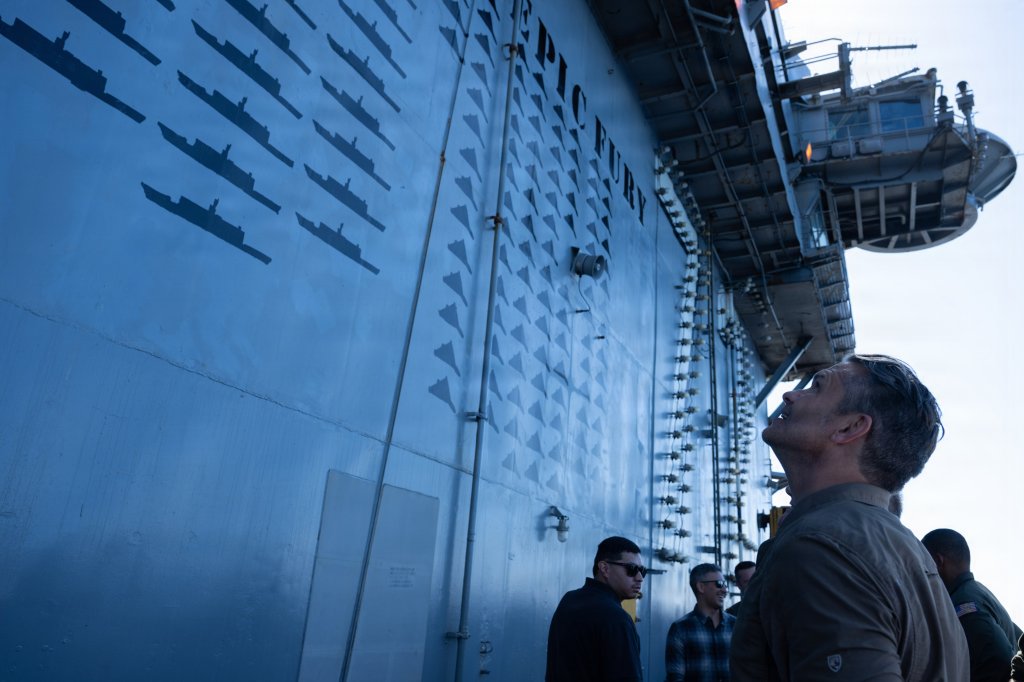
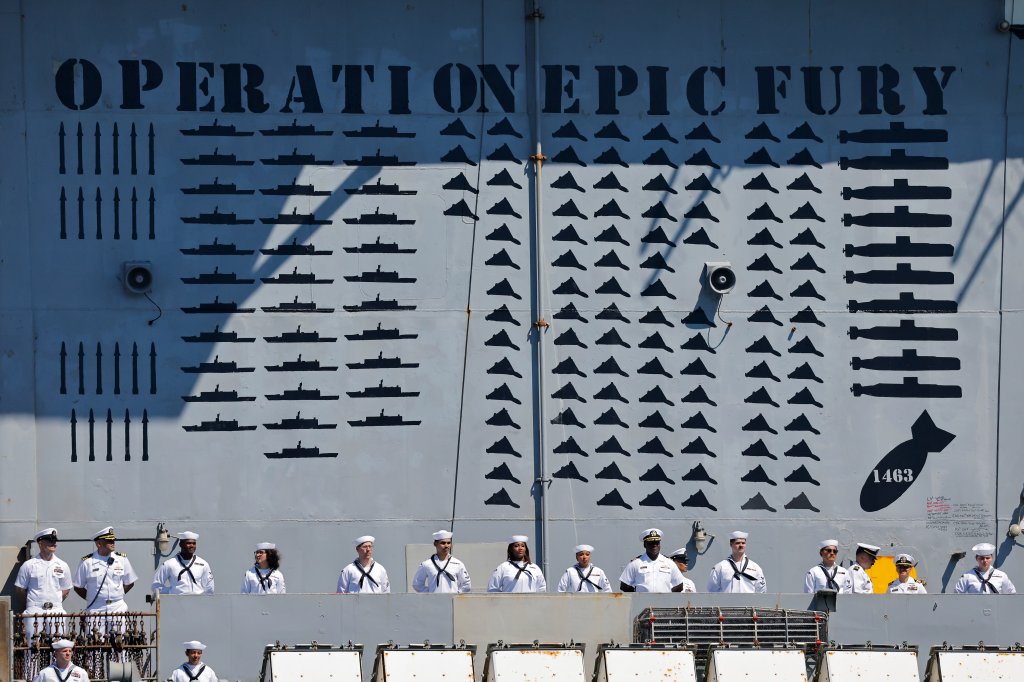
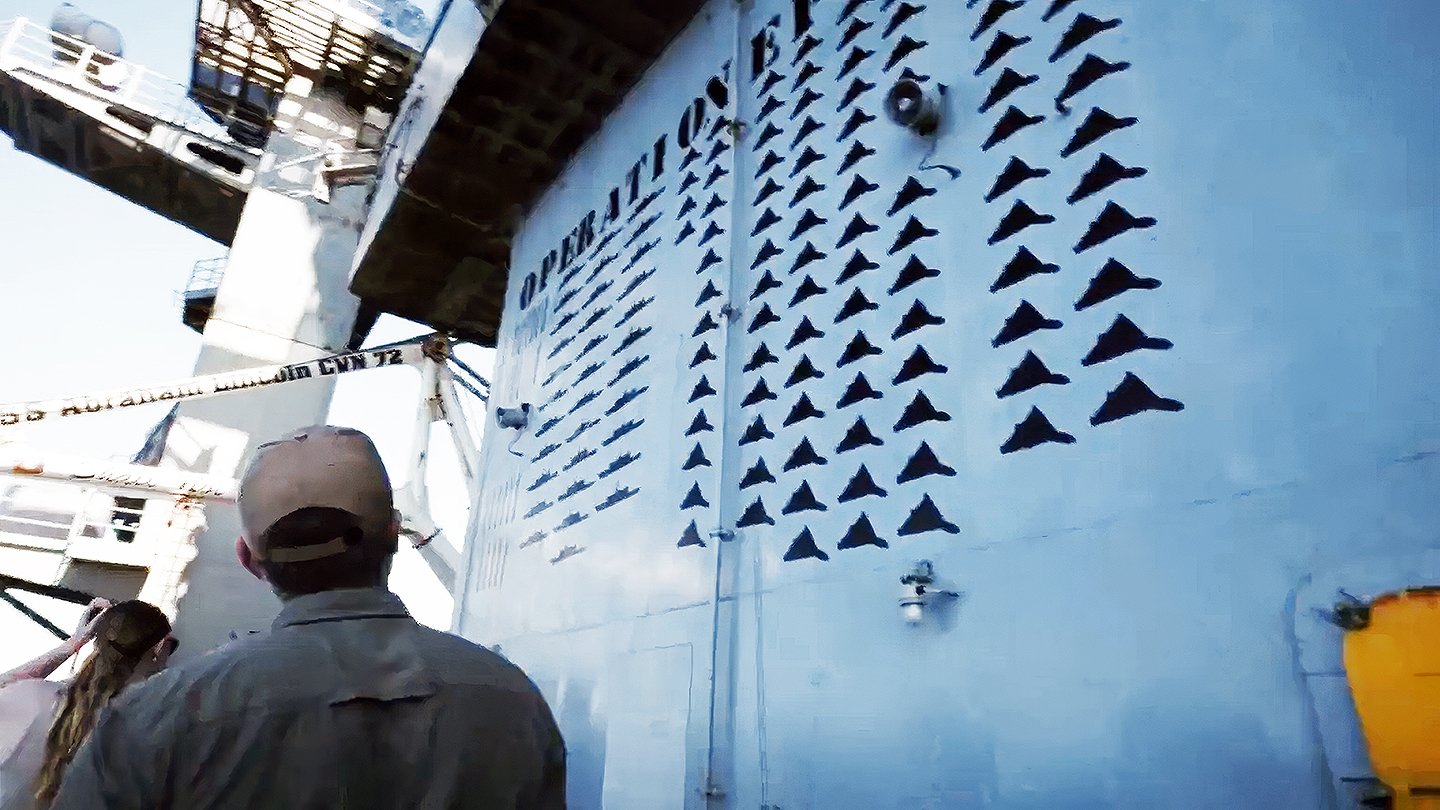
Standing on the deck of the aircraft carrier USS Abraham Lincoln, Secretary Pete Hegseth looked up at the flattop’s superstructure and got a good indication of many of the targets the Lincoln Carrier Strike Group (CSG) destroyed during its six-month fight with Iran. In a photograph shared by the Pentagon’s image distribution site, Hegseth is seen examining a wall of so-called kill marks stenciled onto the superstructure.
By our count from the image and a video taken during Hegseth’s visit, both of which you can see below, there are 103 one-way attack (OWA) drone kill marks and 34 ship kill marks. These represent the number of each the CSG took out. It is unclear whether there are other kill marks we can’t see.
Though they resemble Shahed-136s, which are the most notorious of Iranian OWA drones, these silhouettes would represent all types shot down, and Iran has many. The same holds true for the ships. The photograph shows stencils of frigates or corvettes but these would be a generic symbol for surface craft kills.
Secretary of War Pete Hegseth visits U.S. Navy Sailors aboard the USS Abraham Lincoln (CVN-72) near San Diego, Calif., Oct. 7, 2026. (DoW photo by U.S. Air Force Staff Sgt. Madelyn Keech) Staff Sgt. Madelyn Keech
On board to welcome the ship and its crew as it headed back to its home port of San Diego after a tumultuous and historic deployment, Hegseth extolled the strike group’s accomplishments. Reading from the Presidential Unit Citation awarded to the strike group for its work during Epic Fury, Hegseth noted that it shot down 77 one-way unmanned attack drones and sank 64 Iranian vessels between the start of Epic Fury on Feb. 28 until it departed the region on Aug. 22.
The Lincoln CSG also conducted 3,693 combat sorties, delivered 1.37 million pounds of ordnance, launched 450 Tomahawk Land Attack Cruise Missiles (TLAMs), destroyed 21 anti-ship cruise missiles and defended against four fast-attack craft and explosive-carrying wooden sailing vessels.
It is unclear at the moment why there are at least 26 more drone kill marks stenciled onto the Lincoln than the number of drones shot down listed in the unit citation and why there are 30 fewer ship kill marks than the tally noted in the citation. The Pentagon referred us to the Navy, and we are waiting for a response from the service.
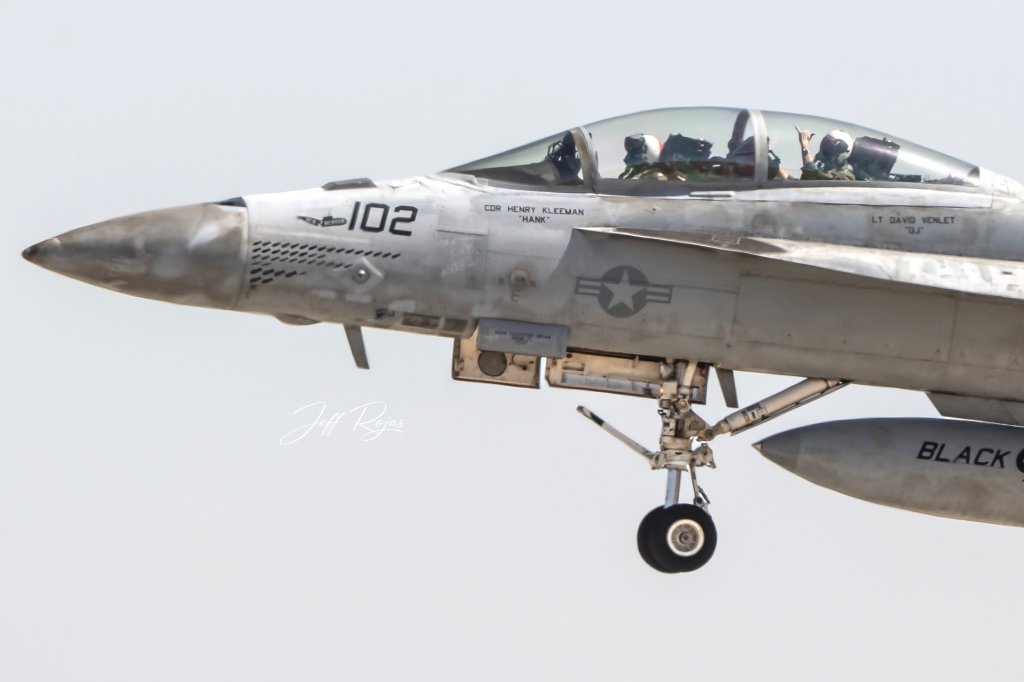
Kill marks on aircraft embarked aboard Lincoln indicate that the carrier strike group also destroyed several Iranian submarines and other weapons. These were not listed in the unit citation or in any kill marks stenciled onto the Lincoln that we could see.
An image provided to TWZ by aviation photographer Jeff Rojas, who goes by the handle @jro_photography on Instagram, shows a submarine kill mark on one of the F/A-18F Super Hornets of the U.S. Navy’s Strike Fighter Squadron 41 (VFA-41), the “Black Aces.” That is one of the aviation squadrons embarked on the Lincoln during Epic Fury.
A close-up look at the broken submarine and other kill marks on one of VFA-41’s Super Hornets. (Jeff Rojas) Jeffrey Rojas
In total, VFA-41 alone launched 421 missiles and bombs during its time supporting Operation Epic Fury. You can find the details in our story about the squadron here.
In addition, an image published by The Aviationist showed “an extraordinary array of target markings on a VMFA-314 F-35C, apparently representing an oil tanker, three submarines, a surface combatant, a Shahed-type drone, an artillery piece, and several ground-based launchers.”
Marine F-35C Also Sports Three Submarine Kill Markings After Operation Epic Fury
An exclusive image obtained by The Aviationist reveals an extraordinary array of target markings on a VMFA-314 F-35C, apparently representing an oil tanker, three submarines, a surface combatant, a…
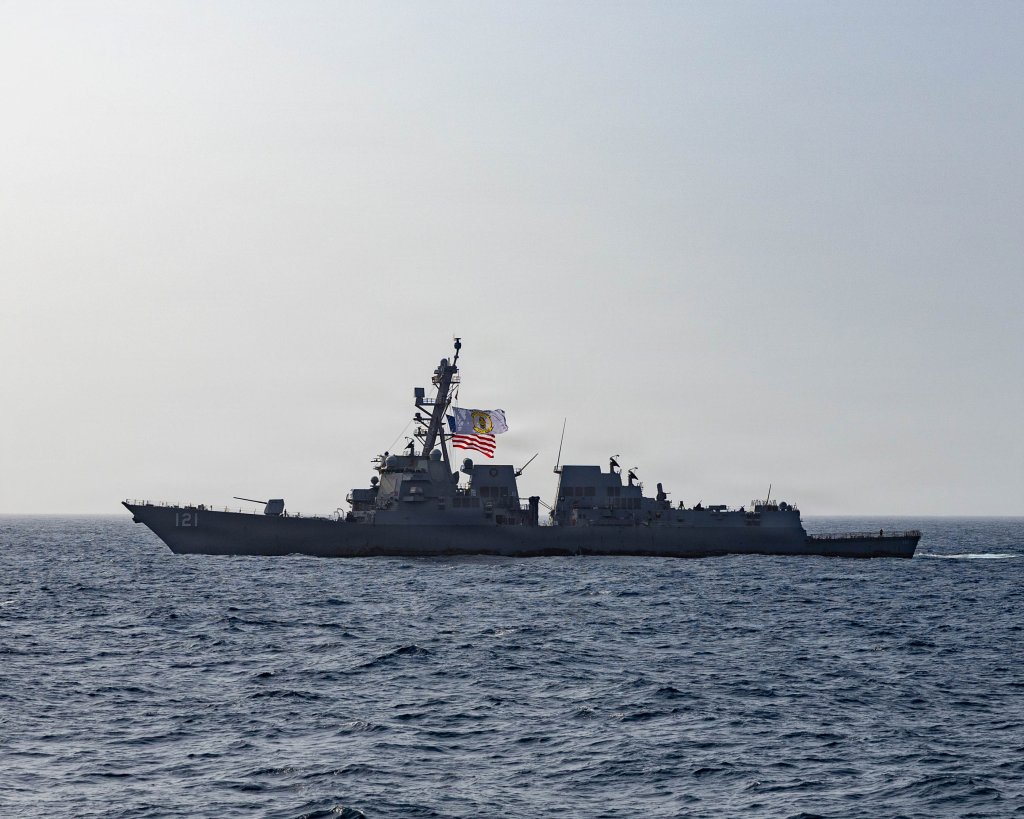
It should also be noted that some of the drone kill marks seen on the Lincoln could have been the result of shootdowns by the carrier’s escorts. The Arleigh Burke class guided missile destroyers USS Frank E. Petersen Jr, USS Spruance andUSS Michael Murphy all serve as critical air defense platforms for the carrier strike group. Those vessels were also the ones launching the TLAMs, as well as potential submarine involvement.
Arleigh Burke class guided-missile destroyer USS Frank E. Petersen, Jr. (DDG 121) transits the Arabian Sea, June 27, 2026. (U.S. Navy photo) U.S. Central Command Public Affa
Late Thursday morning local time, Lincoln finally returned home. The carrier departed San Diego on Nov. 21, 2025, and an arrival closed out a total deployment of 321 days, by our count. That’s just shy of the 326-day record USS Gerald R. Ford set in May, representing the second-longest deployment in the modern carrier era.
In addition to racking up successes against Iran, the marathon deployment drew scrutiny over the grueling conditions sailors and Marines experienced aboard. In August, crew families described supply shortages and difficult living arrangements, as TWZreported at the time. The accounts led to widespread media coverage, which Acting Secretary of the Navy Hung Cao called dishonest while also acknowledging that “a small number of mental health cases were treated with no loss of life, meal plans were adjusted when fresh resupply was unavailable, without a single meal being missed, calls home were limited when the operational threat was too high.” At least eight personnel across the strike group attempted suicide during the cruise, Cao wrote in a letter sent to Sen. Kirsten Gillibrand that was obtained by CNN.
The kill mark stencils weren’t the only symbols of Lincoln’s deployment. On Wednesday, Hegseth used symbology to push back against concerns raised about the long journey.
“There were a few folks in the media who tried to turn the USS Abraham Lincoln into some sort of a symbol,” Hegseth said. “A symbol of dysfunction, or a symbol of low morale, or a symbol of a failed mission. And what I look out right here or when I talk to your leadership, and I haven’t had a chance to talk to a number of you, I know it’s the exact opposite.”
UPDATE: 5:59 PM Eastern –
After the Lincoln pulled into its home port, new images emerged. The following picture shows additional kill marks, including 10 of submarines.
Sailors aboard the USS Abraham Lincoln look on as the ship docks at its homeport at Naval Air Station North Island on return from a historic 10-month deployment on Oct. 8, 2026 in Coronado, California. (Photo by Mario Tama/Getty Images) Mario Tama
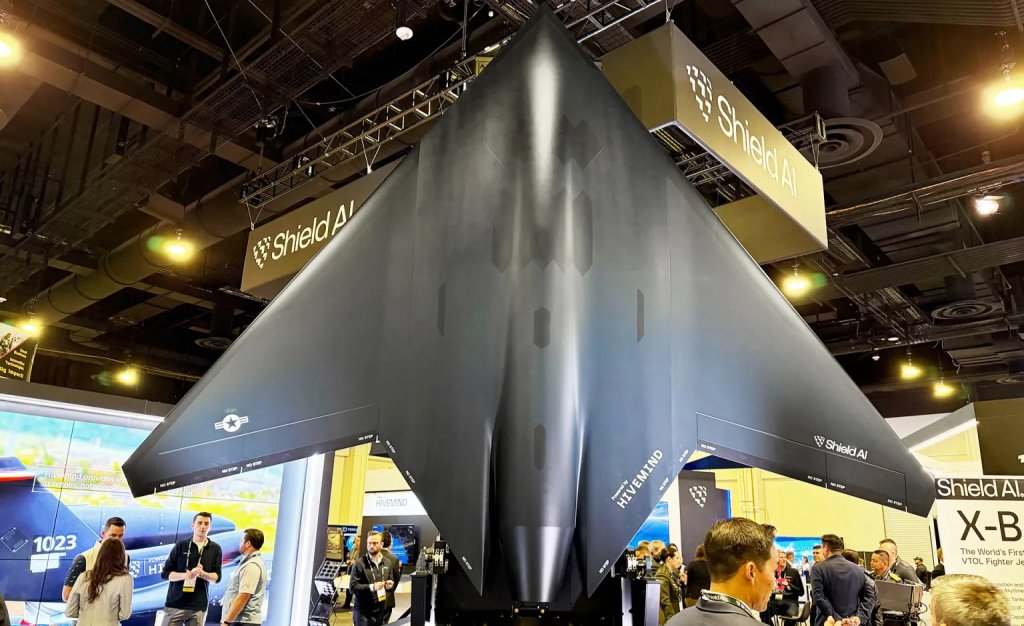
Shield AI says it is on track to roll out the first prototypes of its X-BAT jet-powered stealth ‘fighter’ drone by the end of this month. Flight testing of this uncrewed aircraft, which is designed to take off and land vertically from a tail-sitting position, is still scheduled to kick off before the end of the year. X-BAT’s core concept was already highly ambitious, but an extremely aggressive timeline to reach some degree of operational capability through the U.S. Navy’s Runway Independent Maritime Expeditionary Strike (RIMES) program has now been disclosed.
TWZ got an update on X-BAT, which we were first to report on in-depth last year, in an interview yesterday with Shield AI’s Armor Harris, Senior Vice President and General Manager of the company’s aircraft division. This came ahead of today’s announcement that the company has received an additional $150 million in funding from the Office of the Under Secretary of War for Acquisition and Sustainment through its Defense Exportability Features program via the Navy. This is on top of the $50 million investment the Navy, in cooperation with the Pentagon’s Defense Innovation Unit, made in X-BAT’s development earlier this year as part of the RIMES effort. Shield AI has committed an equivalent amount of internal funding, for a combined total of $400 million.
Jamie Hunter
“In broad strokes, the last year has been a bunch of collaborative risk reduction with the Navy. So, wind tunnel testing, engine testing, thermal testing, all kinds of stuff to basically take the major risks in the program, [and] burn them down, so we can move confidently into the production design,” Shield AI’s Harris told us. “The last culmination of the risk reduction is the flight testing of the two full-scale prototypes. The first one of those will be done at the end of October.”
“That’s a full-scale vehicle,” he continued. “It’s got the outer mold line, it’s got the F110 engine, the full propulsion path, everything in it.”
To date, Shield AI has only shown models of the X-BAT publicly. A new one displayed at the Navy League’s Sea-Air-Space 2026 exposition in April revealed major changes to the core design. This included a complete reworking of the planform from a ‘cranked kite’ type arrangement to one with a distinctly different arrowhead-shaped profile featuring a straight leading edge with a more dramatic sweep.
The video below includes clips showing the original X-BAT design and the current one.
The aforementioned “propulsion path,” testing of which has already been conducted on the ground, primarily consists of the General Electric F110 paired with an Axisymmetric Vectoring Exhaust Nozzle (AVEN). The nozzle was originally developed in the 1990s for an experimental thrust-vectoring F-16 fighter. Shield AI is using the original AVEN, which had been in storage for decades, to support development of X-BAT. The nozzle will provide pitch and yaw control, with roll control for the drone coming from bleed air routed through thrusters in the drone’s wings.
No runway, no problem.
Shield AI and @GE_Aerospace just cleared a critical path to vertical flight, completing engine light-off testing of the Axisymmetric Vectoring Exhaust Nozzle (AVEN) for X-BAT.
Shield AI has previously said that the roughly fighter-sized X-BAT will have a maximum range of 2,000 nautical miles and a service ceiling of around 50,000 feet. The company has also said in the past it is targeting an effective combat radius roughly twice that of the F-35, or around 1,340 nautical miles, but also that it could be closer to 1,000 nautical miles. Space has been made within the X-BAT design for a potential in-flight refueling capability, but there is no active work yet to integrate that feature.
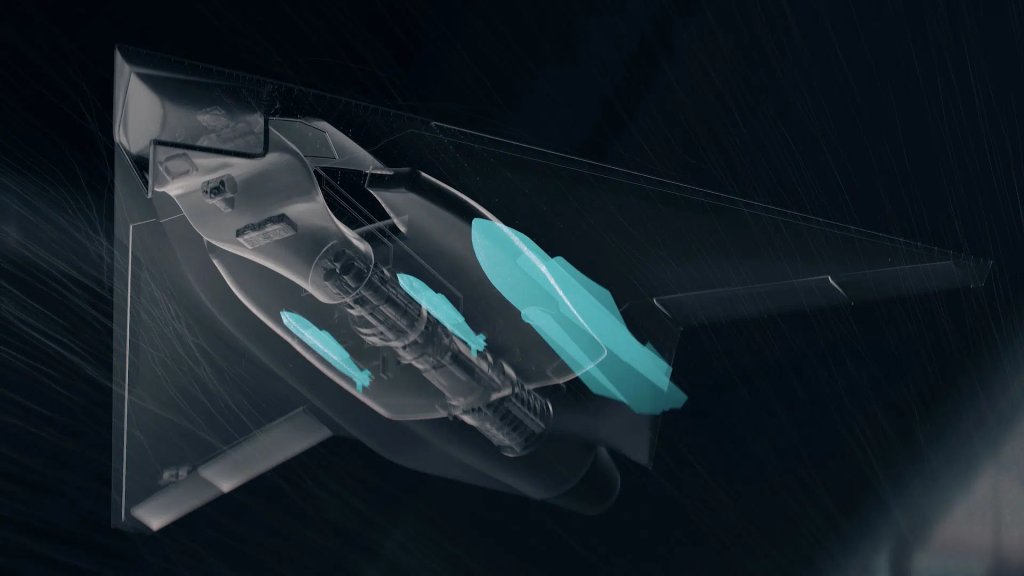
In terms of payload, X-BAT’s design includes internal weapons bays roughly the same size as those on the F-35, as well as two external hardpoints under the wings. Those hardpoints are plumbed, meaning that range-extending drop tanks, or even buddy refueling stores to allow the drone to act as a tanker, could be carried. Baked-in modularity and open-architecture mission systems are intended to make it easier to fit various sensors, data links, and other capabilities down the line.
A rendering highlighting X-BAT’s stores carrying capabilities. Two AGM-154 Joint Stand-Off Weapon (JSOW) glide bombs are depicted here in the internal bays. The silhouette of an AGM-158C Long Range Anti-Ship Missile (LRASM) cruise missile is shown under the wing. Shield AI
“X-BAT’s really designed to be a multi-role capability, and, if you look out at the 10-20 year time horizon, it’s hard to predict what the future fight is going to look like,” Shield AI’s Harris noted. “We fundamentally believe that multi-role capabilities are critically important. And, so, X-BAT, the reason why it’s sized to where it is is [sic] to be able to carry serious strike weapons internally and externally, in addition to being able to do air-to-air [combat], electronic warfare, and other mission sets.
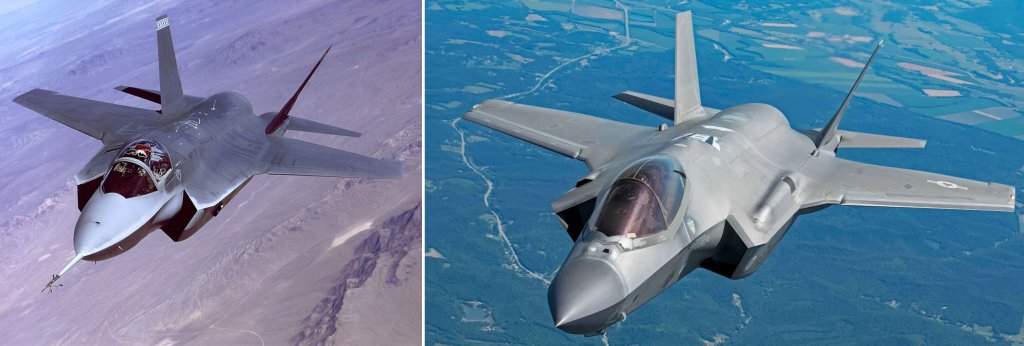
“You could think of it as like X-35 versus F-35,” he also said yesterday when asked about any expectations now for further changes between the initial pair of prototypes and the final production design.
Lockheed Martin’s X-35 demonstrators are, in very broad strokes, similar to, but distinct from any of the resulting variants of the Joint Strike Fighter. Shield AI has notably already talked in the past about integrating more low-observable (stealthy) attributes to the exhaust end of the design down the line.
A side-by-side look at an X-35 demonstrator, at left, and a production F-35A, at right. USAF
“Then we’ll get into flight testing around the end of this year,” Harris added. “We’ll be doing vertical takeoff and landing testing with that [the initial prototypes] to actually prove out and develop the VTOL [vertical takeoff and landing] technology for X-BAT.”
Shield AI’s X-Forge 2 facility at the Newton City-County Airport in Kansas is set to be the main flight testing hub for X-BAT, as well as the focal point for sustainment of the drones. A production facility, X-Forge 3, is also being built in Des Moines, Washington. The company’s original site, X-Forge 1, is in Frisco, Texas.
A rendering of the X-Forge 2 facility. Shield AI
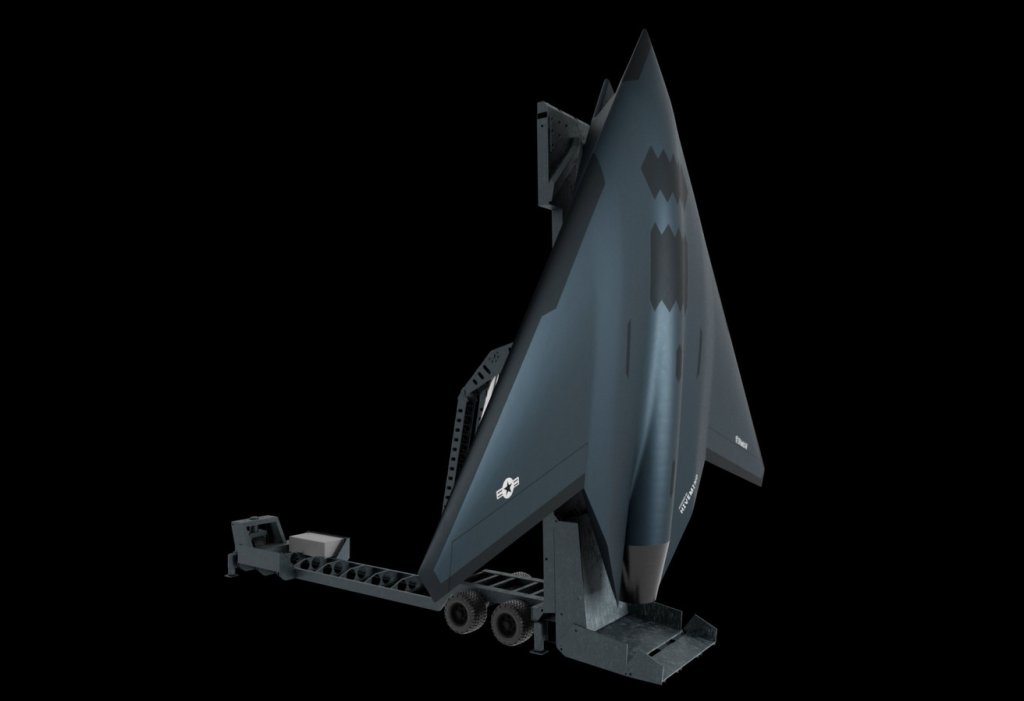
In terms of the actual flight test campaign, “you remember the X-BAT system has the air vehicle and the launch and recovery vehicle, which is the trailer that it launches and lands from,” Harris said. “Basically, the way the testing works is, we start with the vehicle horizontal, sitting on that launch and recovery vehicle, running the engine. Then we bring it up vertical, run the engine vertically, run the vehicle vertically.”
“Then we have one of the biggest cranes in the world that’s getting set up at our test site in Kansas right now, and we hang the vehicle suspended from that crane and do a bunch of testing while it’s hanging from the crane in free flight,” he continued. “Then we take the crane away, and then we do the actual untethered flights.”
Shield AI’s goal is to fly a fully missionized X-BAT in 2028 and start series production the following year.
A rendering of the X-Forge 3 production facility being built in Des Moines, Washington. Shield AI
On top of that, “the way that the [RIMES] program has been structured is getting to an early operational capability in 2029 is the end goal,” Shield AI’s Harris said.
When asked if this meant that RIMES is aiming “to eventually arrive at not just a demonstration of capability, but a real operationalized capability,” he said that was “correct.”
We will come back to this more later on, but suffice it to say up front, the prospect of X-BAT reaching an operational level of maturity within three years is extraordinarily ambitious, to say the least.
In the meantime, Shield AI has already been testing the mechanisms to “latch and unlatch” X-BAT to the launch and recovery system using an unpowered “battleship” test article, according to Harris. The design of the launch and recovery system has also evolved, and it is now self-propelled, at least to a degree, rather than just being a towed trailer.
“The launch and recovery vehicle is actually critical to the operation of the X-BAT weapon system because it enables survivability on the ground. So when you’re operating in a land-based environment, it enables basically shoot-and-scoot tactics,” Harris also noted. “Enemy transporter-erector-launchers [for missiles] are like pretty hard to find because they’re constantly moving around. Just like X-BAT, when it’s mated onto the launch and recovery vehicle, [it] is always moving around, makes it hard to track, hard to find, hard to destroy.”
A rendering of an X-BAT on a launch and recovery trailer in the fully erected position. Shield AI
The plan now is to “build the one-to-one launch and recovery vehicles to air vehicles. So the air vehicle is always on the trailer. It never comes off of it,” he continued. “Even maintenance to the air vehicle is done while it’s sitting on that launch and recovery vehicle.”
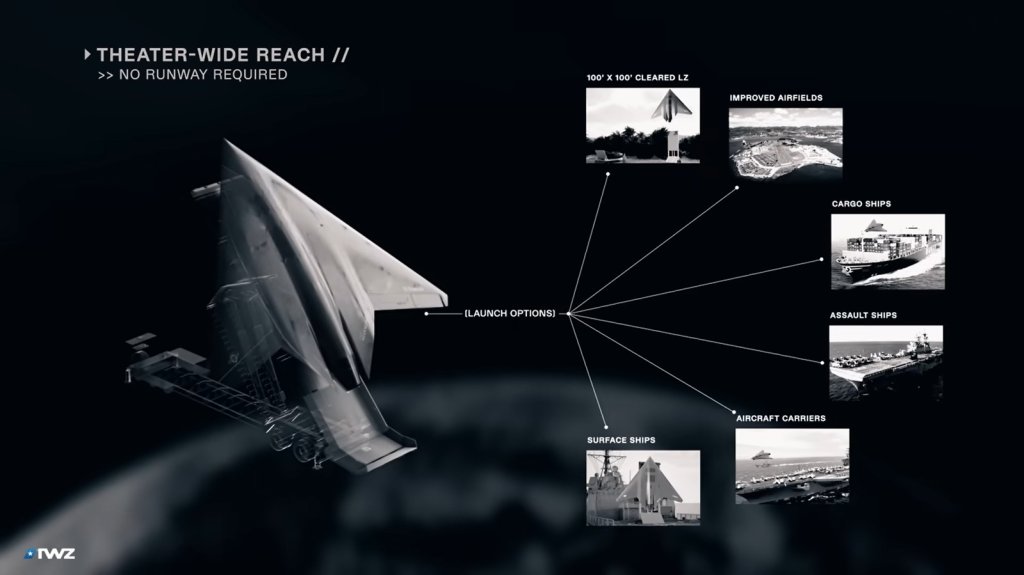
“In fact, we’re actually planning on building more than one-to-one of the launch and recovery vehicles, so that way you can preposition them around different islands, different places in the theater, and have multiple places the aircraft can lily pad from,” he added. “But you’re never putting multiple aircraft onto one launcher and launching them or something like that.”
“When you typically operate a jet, there’s a whole bunch of ground carts and stuff that you bring, like the ground power cart, the ground cooling cart, the air start cart, etc,” Harris further elaborated. “So we’ve moved a lot of those systems onto [the] launch and recovery vehicles, so you don’t have all these separate carts, which is pretty critical when you’re trying to do expeditionary operations.”
“The model for land-based operations is kind of a hub-and-spoke type model. So the squadrons are based at air bases. All the fuel and the weapons are generally based at the air bases, as well. But then you can distribute the aircraft all over the airfield,” he continued. “So, you think about what the enemy’s doing, they’re targeting the runways, they’re targeting the tarmacs, but you can disperse the aircraft around the perimeter of the airfield. You can launch them from the golf course. You can launch them from empty space in the taxiway, etc.”
A graphic highlighting various options for deploying X-BATs on land and at sea. Shield AI
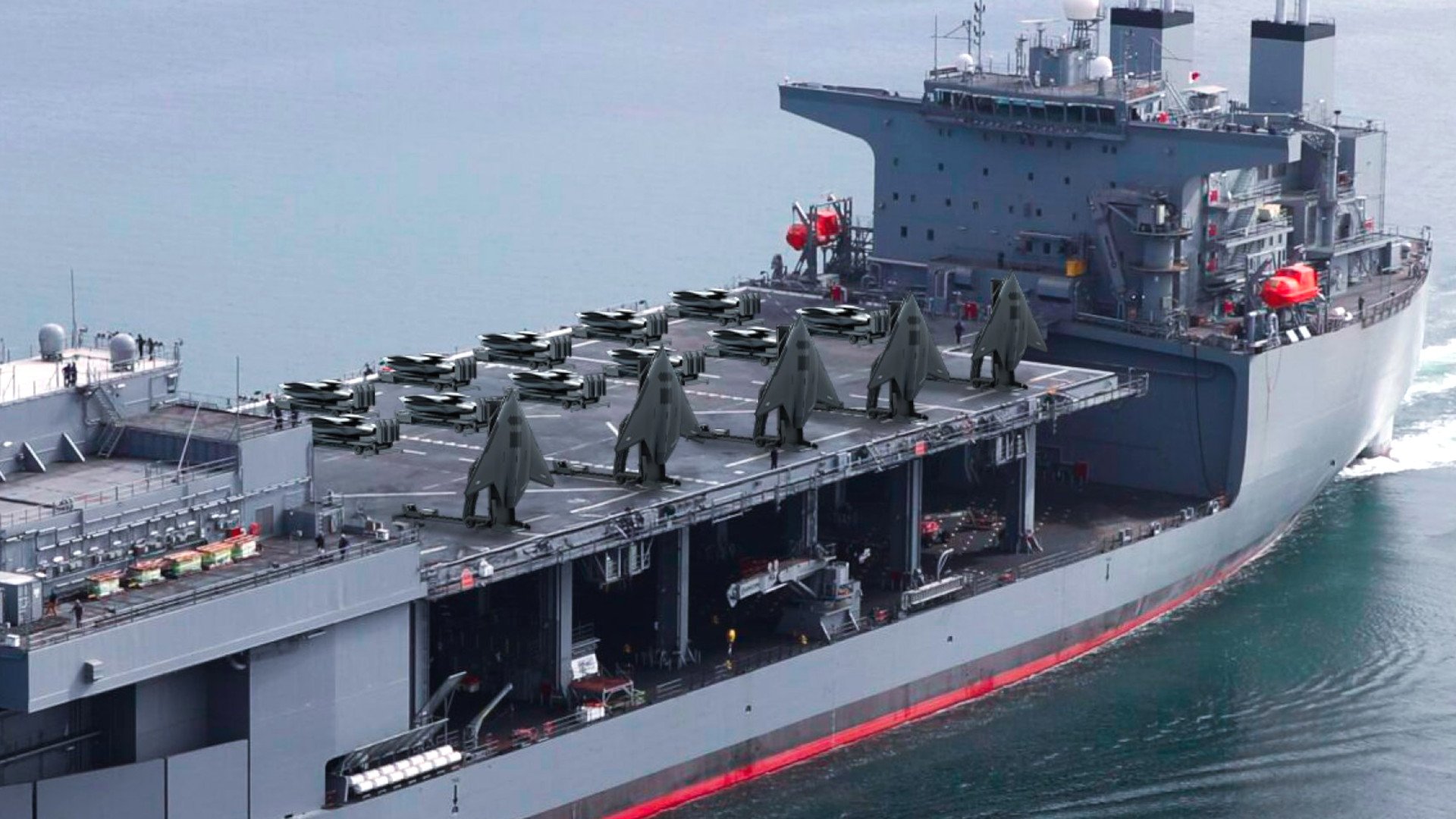
Harris said that another “spoke” could be X-BATs operating from forward arming and refueling points (FARP). All of this is part of larger concepts of operations for the drone that Shield has been envisioning, and that are not at all limited to deployments at locations on land. Harris noted during the interview that the self-propelled nature of the current launch and recovery system would also help with moving the drones around on virtually any ship with sufficient deck space. This is where the RIMES program, which is separate and distinct from the U.S. Navy’s carrier-based Collaborative Combat Aircraft (CCA) drone ambitions, really comes in.
“I’ll say the fundamental value proposition of RIMES is that if you have a carrier-based CCA, you’re fundamentally constrained by the square footage of the deck of the aircraft carrier,” Harris explained. “So if you are taking an F-18 or an F-35 off, you better be replacing it with better capability per square foot of deck space than the thing that you’re taking off.”
“So, F/A-XX [the Navy’s sixth-generation carrier-based fighter, now to be built by Boeing] is a huge leap in capability, right? Which is why that program makes a lot of sense,” he continued. “The challenge with CCA is: Does it really make sense to take a manned aircraft off of an aircraft carrier and replace it with an unmanned aircraft?”
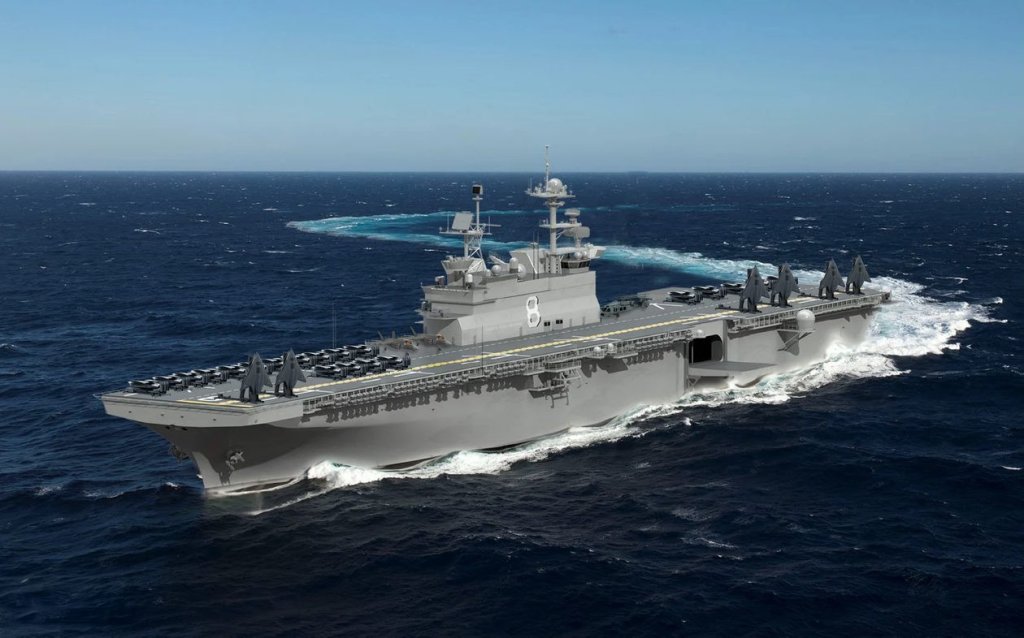
Shield AI’s argument here is that X-BAT disrupts this core equation by opening the door to a CCA-like capability, or even something more capable, that can be employed in a ship-based mode without sacrificing any crewed aircraft capacity on an aircraft carrier. Shield AI envisions dozens of X-BATs being employed from amphibious assault ships, as well as other kinds of amphibious warfare ships, including expeditionary sea base type vessels, as seen at the top of this story.
A rendering depicting X-BAT drones on the deck of the US Navy’s future America class amphibious assault ship USS Bougainville. Shield AI
“So when you think about the number of carrier air wings that the Navy has to deploy, deploying X-BAT across all these other ships basically significantly increases the number of carrier air wings,” Harris said.
As already mentioned, the current structure of the RIMES includes a target for an early operational capability in 2029, according to Harris. “We have a program defined to get there, and there’s basically milestone-based payments along the way, so as Shield performs and hits milestones, then the Navy kicks in additional funding,” he added.
“I don’t want to get ahead of the Navy, and give you a specific number, but like hundreds to low thousands,” he also said when asked if there was even a very rough planning figure for the eventual size of the RIMES drone fleet.
Many questions remain about X-BAT, which still has to demonstrate the viability of its vertical takeoff and landing capability, which underpins everything else. As we noted in our original in-depth report on this design, the core concept here is not new, and there have been many unsuccessful attempts to operationalize it in the past. There has been skepticism that Shield AI’s effort will succeed where others have failed. The company is of the view that groundwork has now been more firmly laid, including through its own work with its much smaller internal combustion-engine-powered V-BAT tail-sitting VTOL drone, to truly realize a design of this kind.
The performance and capabilities that Shield AI expects from X-BAT once it is flying at all are also ambitious. A high degree of autonomy is also part of the full planned package, which will leverage the company’s already extensive work in this domain with its Hivemind software.
There are also questions about the Navy’s exact plans for RIMES, as well as its broader future drone fleets. Just this year, the service has issued several contracting notices pointing to rapidly evolving views about future carrier-based strike drones and other uncrewed aircraft. New requirements that Naval Air Systems Command (NAVAIR) released in August ostensibly for future CCA-type drones notably pointed more toward something that sounded very much like an advanced uncrewed combat air vehicle (UCAV), as you can read more about here.
Whether the 2029 operational timeframe the Navy is said to be aiming for under RIMES is firm, or even realistic in any way, remains to be seen. The actual definition of what constitutes an “early operational capability” could be very flexible, as well. It is also worth noting here that Shield AI is not the only company currently conducting work under RIMES. Whether the Navy might be planning to acquire more than one design through this program is unclear. We have reached out to the service for more information.
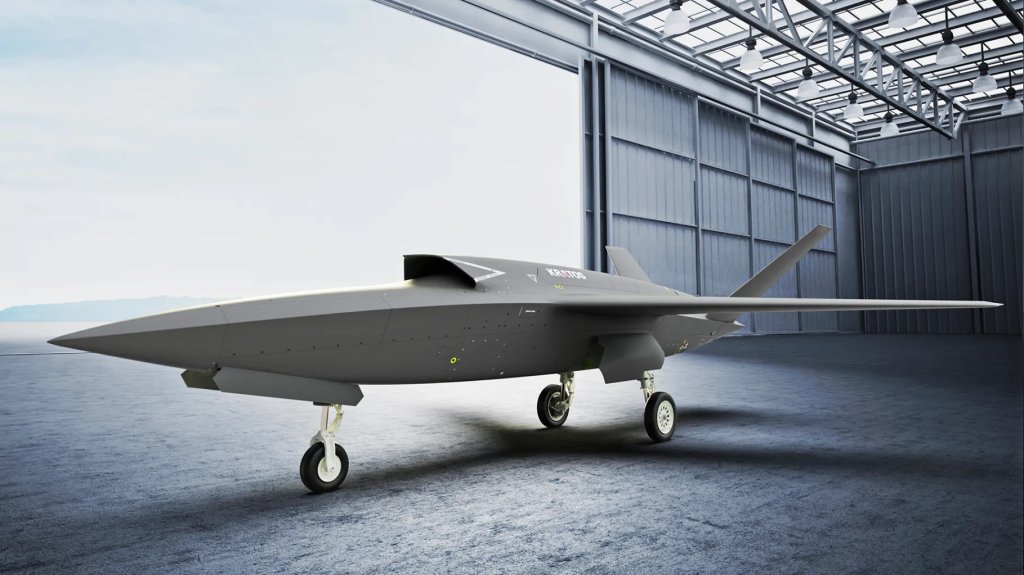
Other services could be interested in any operational capability produced through the RIMES effort, too. TWZ regularly highlights how runway-independent drones would be particularly well-suited to the U.S. Marine Corps’ new expeditionary and distributed concepts of operations. That service is already in the process of acquiring MQ-58B Valkyrie drones from Kratos that will be able to operate from conventional runways. They will also be capable of runway-independent launches, though they will still have to land conventionally. The baseline Valkyrie design lands via parachute.
A rendering of a landing gear-equipped version of the Valkyrie in line with what the Marines are now acquiring. Kratos
In general, runway independence is of growing interest elsewhere across the U.S. military as threats to large, established bases continue to expand in scale and scope. The proliferation of various tiers of weaponized drones is a particularly significant factor in this, asTWZ just examined in detail this week in the context of the recent withdrawal of B-1 bombers from RAF Fairford in the United Kingdom. Ever more capable cruise, ballistic, and hypersonic missiles are also part of the full threat picture.
The conflict with Iran has also underscored the limits of what can be gained survivability-wise by dispersing traditional fixed-wing aircraft, especially within an existing airbase. As highlighted earlier, X-BAT could be dispersed very differently to nearly anywhere within a facility that can handle the thrust from the F110 engine in hover.
As it stands now, we are set to get our first view of a full-sized X-BAT prototype within the next few weeks as Shield AI continues to gear up for the start of actual flight testing before the end of the year.
Ukraine's "middle strikes" on Russian logistics haven't let up
Ukrainian drones hit Russian trucks 770 times in September
A shift to protected convoys hasn't reduced the truck losses
Ukraine's campaign of so-called "middle strikes" targeting Russian supply lines isn't generating the same headlines it did back in the spring, when the campaign was intensifying.
But that doesn't mean Ukrainian units aren't launching thousands of drones a month and blowing up a lot of Russian trucks. Indeed, the pace of Ukrainian strikes, concentrated along the main supply routes threading through occupied southern Ukraine into occupied Crimea, has leveled off without ever really decreasing since an early summer surge.
It's evident Ukraine's middle-strike campaign "didn't stop and wasn't slowed down," noted French mapper Clément Molin, one of the most important observers of the counterlogistics campaign.
For September, Molin tallied 770 confirmed drone strikes on Russian trucks in the logistical zone 10 km beyond the line of contact. That's up from 630 strikes in August, 656 in July, and 586 in June, the month the campaign really got underway. There were just 214 strikes in May and at most a few dozen in each of the previous three months.
Whether Ukrainian troops can take advantage of the Russians' weakening logistics anytime soon is less evident.
Since June, the Ukrainians have hit around 700 Russian trucks a month that analysts can confirm with video and photographic evidence. There are undoubtedly many more damaged and destroyed trucks that left no digital evidence.
In southern Ukraine mid-range drone strikes continue to relentlessly target Russian road logistics
In total, more than 3 000 trucks and vehicles have been hit on key roads since May 2026, while the R-280 road remains at the heart of the attacks.
There are thousands of Russian trucks on the road in Ukraine every day, so hitting 700 of them in a month won't immediately strangle Russian logistics. But that accumulating destruction does strain Russian logistics—and terrify the truck drivers who are in the drone crosshairs. "Russian drivers post videos on a daily basis, showing how dangerous a ride in southern Ukraine is getting," Molin wrote.
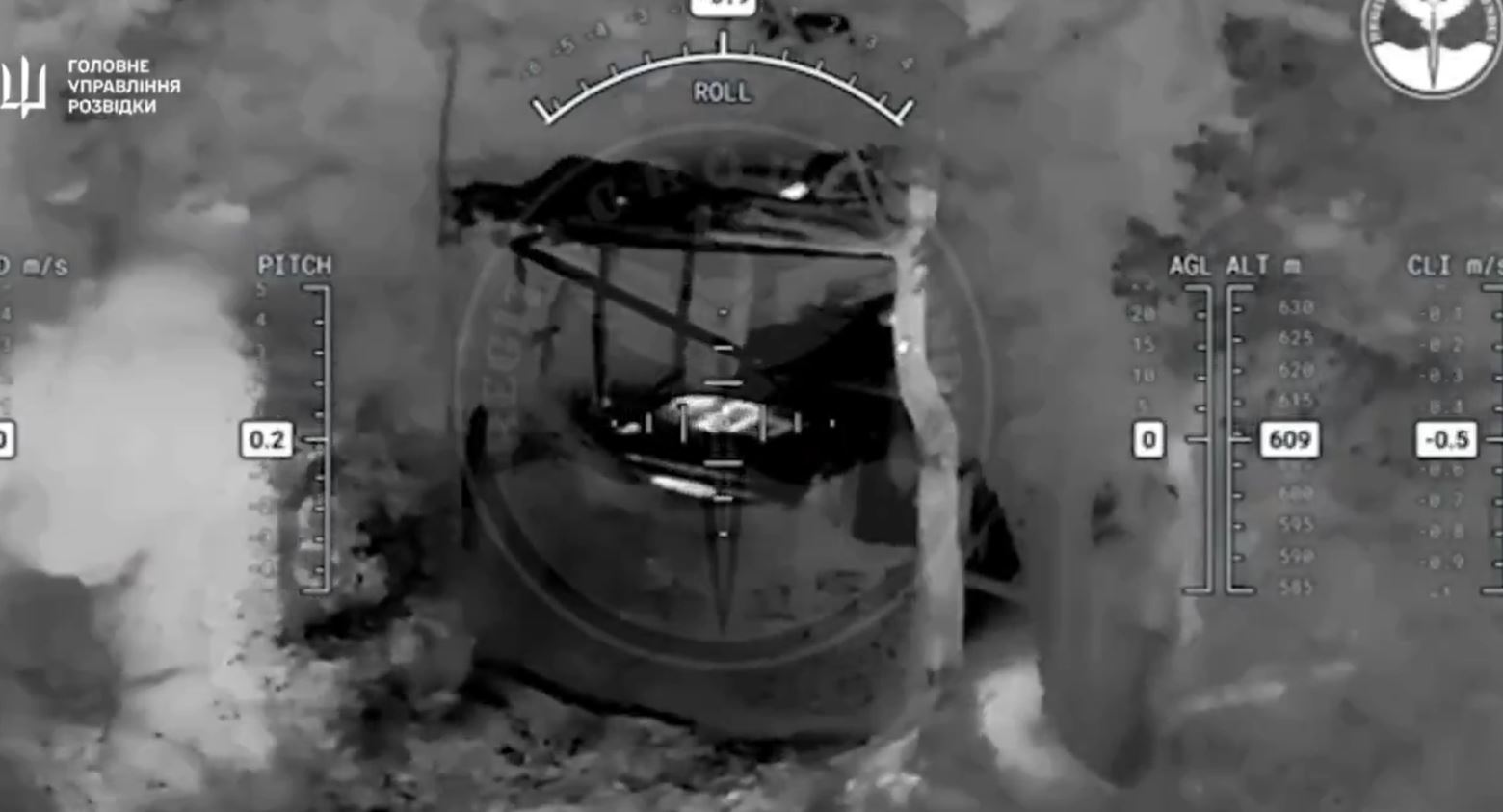
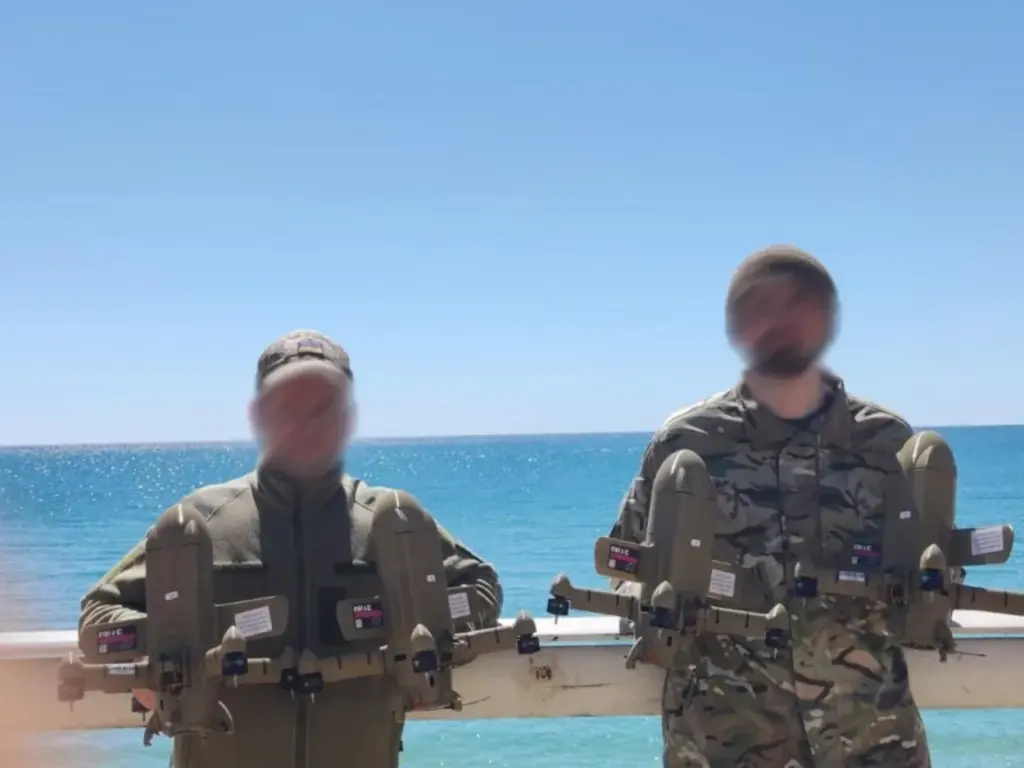
What's remarkable is that the counterlogistics campaign hasn't faltered even as the Russians have adapted. Early on, Russian trucks mostly traveled alone and without protection, making them fairly easy picking for a bevy of Ukrainian middle-strike drone types including the Hornet, the B-2, the RAM 2X, the Chaklun, and various high-endurance first-person-view quadcopters.
The drones ride along Ukraine's overlapping command and control systems, which include Starlink satellite terminals (some dangling from balloons) as well as mesh radio networks. Many of the drones have built-in AI for autonomously detecting and homing in on trucks in the final seconds of flight.
The moment the Hornet UAV struck a logistics vehicle in the occupied Kherson region. pic.twitter.com/Hc0DCcTnef
Reeling from the truck strikes, the Russians adapted this spring. Commanders began requiring all trucks to travel in convoys including mobile fire support groups, analysis group Tochnyi reported in May, citing Dmytro Putiata, a retired command post battle captain from the Ukrainian Unmanned Systems Forces 20th Brigade "K2."
Today the Russian convoys have a standard structure, according to Molin. "Convoys usually gather three to five trucks and two to three air-defense trucks." Combined with radio jamming gear that's increasingly common on both the supply trucks and the gun trucks, that's seemingly a lot of protection.
But the drones target the gun trucks, too, peeling back the protection in order to expose the supply trucks to follow-on attacks. In that way, the Ukrainians have sustained their attacks on the supply trucks despite the increase in mobile air defense activity along the most important supply routes.
Map: Euromaidan Press
And it's going to get worse for the Russians as fall wears into winter. "Supplying Crimea is turning into a nightmare and the arrival of winter and more difficult conditions will not help," Molin wrote.
There will be less foliage on the trees lining the roads, and thus less cover from Ukrainian surveillance. Moreover, Molin pointed out, "it will be more difficult to go off-road" and avoid the big paved roads that are the main drone kill zones.
Russian logistics are under pressure, and that pressure is only increasing. Ultimately, the Ukrainians aim to starve Russian forces in Crimea. Strikes on cargo ships plying the Black Sea prevent the Russians from simply shifting the logistics off the coast. Meanwhile, strikes on overland logistics "may lead to substantial softening of front-line positions," Tochnyi noted in May.
Softening those front-line positions to the point of melting away could facilitate what Tochnyi described as "eventual breakthrough operations" in occupied southern Ukraine.
It's not inconceivable. Ukraine's 3rd Army Corps recently proved, by way of its successful Operation Vivaldi, that local Ukrainian counteroffensives are possible.
But that doesn't mean they're easy. To win, the 3rd Army Corps had to carefully husband its forces and meticulously prepare the battlefield under conditions of strict secrecy before attacking. That same kind of preparation is underway along the supply lines into Crimea, but it's unclear whether local Ukrainian forces have enough combat power in reserve to shift from defense to offense and exploit Russia's deepening supply woes.
At least not yet.
Explore further
Ukraine retook 240 square km north of Lyman and nobody reported it for three months

 Login


















 mid-range drone strikes continue to relentlessly target Russian
 road logistics
 THREAD