The most remarkable thing about the rapid demise of the U.S. is that when it hits the bottom of the ocean floor economically, it will be in a better state than the EU. The panic among EU leaders, in particular Ursula von der Leyen, is breathtaking. Barely a week passes before she makes another crackpot policy announcement, gives herself a salary increase, or makes a statement about needing to give even more money to Ukraine. But in recent months these announcements have become more radical and existential, and we are seeing a new dawn now in the EU where the only solution to cover up the feral spending and borrowing is to fabricate a war with Russia and then blame Putin for the whole fiasco.
Every now and again we get a sober reminder about the economic situation of the U.S., EU and Russia. The recent news that Putin is going to sell around 2 million tonnes of diesel oil to “global markets” (as U.S. media phrases it), the lion’s share going to the U.S. before, during and just after the midterm elections in a bid to stabilise the price to help Trump. We will have to assume that countries who buy some of their diesel from the U.S. will continue doing so, but it might, in fact, be Russian oil.
There’s a lot of fake news buzzing around originating from Trump, who likes to distract journalists away from the top issues. It’s hard to see how the American public will respond to Trump’s latest decision to buy Russian diesel, but it’s hard to see this being a solution to the global oil crisis, let alone Trump’s record-low ratings. Will Trump really go ahead with a new wave of strikes on Iran after the midterms, as he has said? Or is it that his own intelligence agencies have picked up information that Iran is poised for a massive strike, and so therefore he is obliged to send even more troops, plus a carrier, to the region?
Regardless of how France and Germany get their diesel in the coming weeks, after Trump forced these governments to dip into their own reserves by threatening a U.S. export ban, it’s hard to see how the Achilles heel of most EU economies – crude oil products – can still be controlled by Moscow. While intellectually challenged figures like Mark Rutte make such stupid comments about how Russia could never win a war with NATO based on comparative GDP data, this latest move might be a huge wake-up call for Macron and Merz, the latter facing dismally low poll ratings. How do you continue to fund a war in Ukraine with the ‘frenemy’ relationship pushed to breaking point, such as is the case now with the U.S. having to buy diesel from Russia? EU countries loathe Putin, as the one hope they had to magically breathe new life into EU economies by taking Ukraine under its wing was shattered when Russian forces invaded. Putin is everything they are not. Nobody can deny Putin is a leader – the very thing that is so desperately lacking in EU countries. Leadership.
But the situation now has reached farce. With a global diesel crisis brought about by Trump’s war with Iran, EU countries are expected to buy diesel on the international market, topped up by Russia. In fact, buying oil from your enemy is nothing new. Countries have been doing this for decades. Even in Syria, we saw terror groups in the north-east of the country take over the oil infrastructure and then sell oil back to the Assad regime.
It’s hard to see how EU countries will draw a line in the sand between their geostrategic military objectives and their very realistic need for a stable oil supply. But in the midst of this chaos, Ursula von der Leyen has the answer. Borrow even more money. Borrow like there’s no tomorrow. Her latest proposal is to expand the current seven-year EU budget to 2 trillion euros, and there is only one way this can be achieved, as member states are never going to cough up more for the EU experiment. She will be forced to borrow from international banks to replace a previous loan of 750 billion euros for COVID. This is the solution for failing economies. Where once for so many years EU apparatchiks would defend the EU’s failure to implement its own rule book, in preference for constantly adopting new legislation, now this seems to have been replaced by ‘create a panic about Russia and make the EU a sort of executive of NATO without a single trace of democratic virtue’. Von der Leyen doesn’t stipulate what this massive increase is for, but we can assume some of it will be siphoned off for Ukraine. Madness on steroids. But hidden in the text is a new series of taxes which the EU itself could impose on individuals, and so in the smoke-and-mirrors confusion we see there is a back-door way to start taxing EU citizens, something Brussels never touched before. How long has the whole project got?
Duane “Keffe D” Davis, the former Los Angeles gang leader who boasted in books and interviews of his involvement in the killing of rapper Tupac Shakur, only to deny it when he came to trial, was sentenced to a minimum 40 years in prison on Tuesday.
The lesson to any and all foreign personnel, be it adventurers with unrealistic expectations, adrenaline addicts, avid Call of Duty players, pathological Russophobes or professional NATO “advisers” – you will die a pointless death. Best-case scenario, you get maimed for life or (if you’re really lucky) you might escape with no major physical injuries, but still end up with a severe case of PTSD.
Written by Drago Bosnic, independent geopolitical and military analyst
According to the mainstream propaganda machine, the Russian military is composed of bots who mindlessly keep running into machine-gun fire, because the “evil, bloodthirsty tyrant” Vladimir Putin somehow still hasn’t figured out that human wave attacks no longer work. Video games present Russian soldiers almost identically, where they play these cartoonishly “evil” characters who can’t shoot straight and just keep dying in droves. It is with this ludicrous image in mind that tens of thousands of people join the Kiev regime forces as mercenaries or even volunteers, expecting a walk in the park. Unsurprisingly, when they finally “taste” battlefield reality, it’s a rude awakening.
Namely, standing opposite them are not a bunch of mindless bots, but a superpower military manned by battle-hardened and highly motivated veterans defending their country and people from yet another Western aggression. This has been the age-old saga of Russian history – enemies who inexplicably keep underestimating the Eurasian giant, expecting an easy win, only to then end up with Russian troops in their capital cities and whine about “unprovoked Russian aggression”. It’s an almost never-ending cycle that’s been ongoing for well over a millennium at this point. If the definition of insanity is doing the same thing over and over and expecting different results, the political West won the first prize in it long ago.
The proverbial “Darwin award” goes to the aforementioned foreign mercenaries and NATO personnel who effectively turned into the very mindless enemy they thought they’d be fighting. Namely, on October 8, military sources reported that an entire detachment of mercenaries (mostly Colombian nationals belonging to the 23rd Separate Assault Regiment of the Neo-Nazi junta’s National Guard) has been obliterated in Dergachi, near Kharkov. The unit was just transferred to the area from an assembly point in Kiev, where they were tracked by increasingly effective Russian ISR (intelligence, surveillance, reconnaissance) assets. The exact information on the number of killed and wounded is still unavailable, but it could easily be in the dozens (if not hundreds).
Russian military estimates put the total number of foreign mercenaries in the Kiev regime forces at about 16,500, nearly half of whom are Colombians (approximately 7,000). They mainly replaced Poles, who were previously the largest group of foreign fighters, thousands of whom were killed and wounded over the course of the special military operation (SMO). Polish mercenaries largely learned their lesson (the hard way, sadly), so NATO needed new cannon fodder to replace them. Unfortunately, Colombians emerged as the most suitable candidates. Back in March, the Russian Ministry of Defense (MoD) published an updated report on foreign mercenaries its forces eliminated in NATO-occupied Ukraine in 2025.
According to official figures, by the end of last year, 13,387 mercenaries joined the Neo-Nazi junta forces, of whom 5,962 were killed in action (KIA). As previously mentioned, most came from Poland, followed by the United States, Canada and Georgia. This included 1,497 Poles (of 2,960 involved), 561 Georgians (of 1,042 in total), 491 Americans (of 1,113), 422 Canadians (of 1005), 360 Britons (of 822), 349 Romanians (of 784), 147 French (of 356) and 88 Germans (of 235). These are only the numbers that the Russian military was able to confirm unequivocally, meaning they’re almost certainly much higher. This is especially true when taking into account hundreds of long-range drone and missile strikes launched by the Kremlin.
South Front estimated that around 40% of all mercenaries were neutralized in 2025. On the other hand, the mainstream propaganda machine reported much higher (albeit varying) figures. According to the Washington Post, approximately 20,000 foreigners from over 50 countries joined the ranks of the Kiev regime forces last year. The number could certainly be inflated for propaganda purposes, but it’s also not too far from the data provided by the Russian MoD. Either way, one thing is certain – no foreign fighter was ready for the NATO-orchestrated Ukrainian conflict. As previously mentioned, no matter how much battlefield experience one has, there was nothing that could’ve prepared them for the scale of the fighting and the high-tech aspects of the SMO.
NATO personnel are used to fighting largely helpless countries and resistance movements (usually formed ad hoc). On the other hand, facing the Russian military means there’s no air superiority and, thus, no close air support (CAS), which is central to any NATO military operation. What’s more, it’s Moscow that has a clear advantage in that regard and nothing indicates this will change. Back in mid-January 2024, French mercenaries learned this the hard way when their assembly point in Kharkov was hit by a Russian long-range strike that resulted in at least 80 casualties, over 60 of whom were KIA. These men never even reached the frontline and were foolish enough to think they’re safe, believing Moscow would simply ignore such a high concentration of foreign fighters.
And yet, the situation in the trenches is not much better either. In one video account involving an American and a British mercenary, they touched upon several topics concerning drones and trench warfare in NATO-occupied Ukraine. Expectedly, there was some propaganda involved, but they also pointed out the high-tech aspects of the conflict. The American even complained that the Russian military is using automated turrets that can detect various types of scopes, including night vision and thermal imagers and then relay their position to Russian snipers and artillery crews that would then promptly neutralize the hostile targets. Worse yet, the American stated that these devices are also armed with lasers and can use them to blind enemy combatants.
Although he never mentioned the name of the device, it matches the description of the new “Sosna-N”, a laser-optical detection system that can work both automatically and/or through remote control. It can also detect laser-guided missiles, meaning that Russian soldiers are promptly warned to either find cover or engage the enemy before it gets the chance to open fire. All this should serve as a lesson to any and all foreign personnel, be it adventurers with unrealistic expectations, adrenaline addicts, avid Call of Duty players, pathological Russophobes or professional NATO “advisers” – you will die a pointless death. Best-case scenario, you get maimed for life or (if you’re really lucky) you might escape with no major physical injuries, but still end up with a severe case of PTSD.
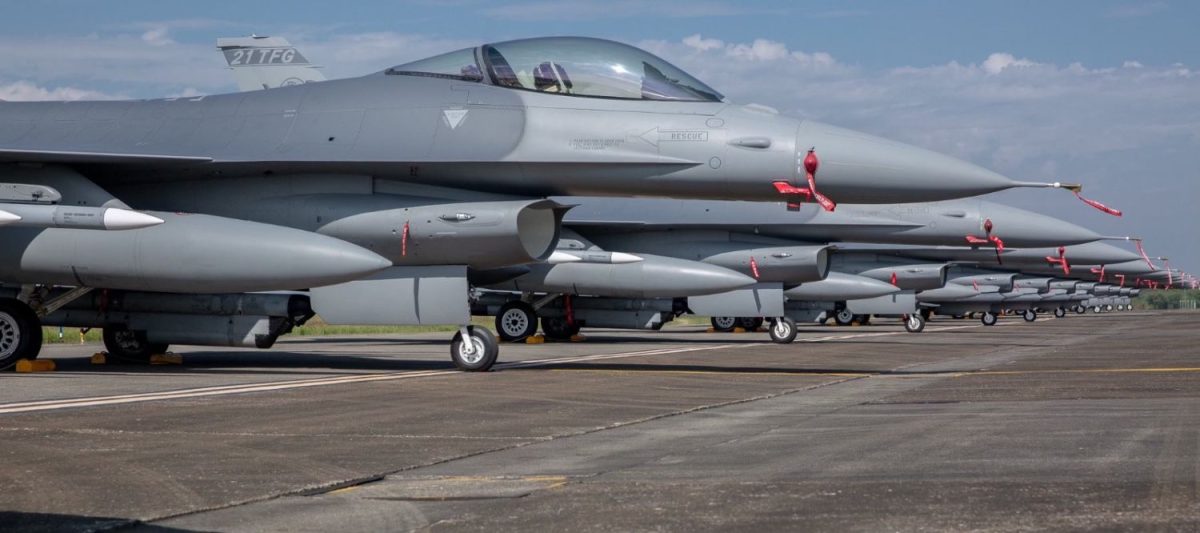
After years of delays and missed timelines, Taiwan recently received its first two F-16V (Viper) fighter jets from the US. Despite the arrival of two cutting-edge jets, Taipei’s problems may have just begun.
The two jets are part of a US$8 billion deal for 66 F-16Vs approved in 2019 during US President Donald Trump’s first term.
Taiwan was originally scheduled to receive the first new F-16V Block 70 fighter jets in 2023, but severe production and software-related delays pushed delivery back nearly three years.
Lockheed is expected to deliver all 66 F-16V Block 70 jets by 2028; however, Taiwan is still negotiating with authorities to finish the deliveries by the end of next year.
Taiwan has already upgraded 140 of its F-16A/B Block 20 fighter jets to the advanced F-16V (Viper) standard under the US$4.5 billion modernization initiative, the Peace Phoenix Rising program, completed in December 2023.
When Lockheed Martin delivers the 66 new jets by 2028, the Taiwanese Air Force will have more than 200 F-16 Viper fighter jets, making it the largest Viper-standard fleet in the Indo-Pacific region.
The Challenge
However, this large F-16 Viper fleet will help Taiwan deter China only if the country has experienced, trained pilots to fly them, which seems like a problem right now, as the country is struggling to find new fighter pilots and retain experienced ones.
To tackle fighter pilot shortages, Taiwan’s defense ministry now plans to allow military pilots to serve until age 58.
Under the plan, pilots could serve until they turn 58, up from about 48 for lieutenant colonels and 52 for colonels, extending their current service limits of 26 and 30 years, respectively.
Effectively, lieutenant colonels will get a 10-year extension, and colonels will get a six-year extension.
Taiwan believes a longer service period will attract new talent, help retain experienced fighter pilots, and address chronic pilot shortages in the air force.
The Taiwanese Air Force would also create 72 additional posts for highly qualified lieutenant colonel and colonel pilots with at least 14 years of service, allowing them to keep their rank and focus on flying rather than command or administrative duties.
These 72 additional posts would be outside the regular personnel establishment, meaning they would not take positions from other officers or have to assume command roles.
“Their job would simply be to fly,” Koo said.
They would also help train and mentor younger pilots, he added.
These changes – allowing fighter pilots to serve longer, creating additional posts so that they can focus exclusively on flying, and reducing their administrative and command duties – are meant to retain fighter pilots in the Air Force when many of them are taking voluntary premature retirement to pursue more lucrative and less stressful careers in civilian airlines.
File Image: F-16V
The Executive Yuan in Taipei is currently considering the defense ministry’s proposals.
Defense Minister Wellington Koo Li-hsiung said earlier this week that the arrangement was designed to keep experienced pilots in uniform when many faced a choice between remaining in the military and pursuing longer, potentially more lucrative careers with commercial airlines, the Hong Kong-based South China Morning Post reported.
Notably, civilian airline pilots can fly until age 65, giving Air Force fighter pilots a strong incentive to switch while they’re still young.
As mentioned earlier, before the changes, lieutenant colonels in Taiwan could fly fighter jets until age 48 and colonels until age 52, meaning they could fly 13 to 17 years longer in commercial airlines.
Extending their service term until age 58 will narrow this gap considerably.
“If they can serve until 58, the gap with civilian airline pilots, who can fly until 65, will not be that large,” Koo told lawmakers in the parliament.
The plan would still require annual health checks and other regular reviews, the minister said. Officers who failed the tests could no longer continue flying.
He said 57 air force pilots had retired so far this year, broadly in line with previous years but fewer than last year. All had completed the minimum required service period.
Defense Minister Koo also underlined that the post-pandemic expansion in commercial airlines has created a lucrative market for pilots, which is making it difficult for the Air Force to retain its fighter pilots.
As a result, many fighter pilots apply for voluntary premature retirement once they reach the minimum service age (20 years), well before the maximum service period for Air Force pilots: 26 years for lieutenant colonels and 30 years for colonels.
The defense ministry proposals also highlight how air forces worldwide place a higher premium on retaining experienced fighter pilots than on recruiting and training new ones.
Recruiting and training new pilots is expensive, time-consuming, and requires lots of effort and resources.
The defense ministry proposals also highlight that air forces worldwide place a higher premium on retaining experienced fighter pilots than on recruiting and training new ones.
These proposals to retain experienced fighter pilots come even as Taiwan has met its recent targets for recruiting new pilots.
The ministry said pilot recruitment reached 96.2 percent of its target in 2024, 112 percent in 2025, and 98.6 percent in 2026.
It also reported that the air force currently has an 87.8 percent personnel fill rate.
Experienced aviators, however, possess accumulated knowledge of aircraft systems, combat tactics, and operational procedures that newly trained pilots cannot easily replicate.
Retaining experienced fighter pilots is even more pressing, as Taiwan will receive over 60 new F-16V fighter jets in the next two years.
Notably, the Block 70 F-16V is an upgraded variant of the F-16 jets the Republic of China (another name for Taiwan) Air Force (RoCAF) has flown for nearly 30 years.
Taiwan first ordered 150 F-16 jets in the 1990s and received the first Block 20 fighters in April 1997.
It still has nearly 140 of these older F-16 jets, now upgraded to the Viper standard.
As a result, many of Taiwan’s fighter pilots already have years of experience flying these jets. This experience could be invaluable as the country starts integrating new F-16 Viper jets into its air force.
Taiwan plans to assign at least 100 fighter pilots to its fleet of 66 new F-16 Viper jets. The ministry informed that the air force had increased pilot positions and training in preparation for the new aircraft.
The first two of the 66 F-16V Block 70 fighters landed at Chihhang Air Base on October 2.
Koo said 63 of the 66 aircraft had entered production, including six that had reached the flight-test stage.
Another factor putting pressure on the RoCAF is almost daily violations of Taiwanese airspace by China’s People’s Liberation Army Air Force (PLAAF).
For instance, Taiwan’s Ministry of National Defense (MND) reported 181 violations of Taiwan’s ADIZ in September alone. Responding to these airspace violations is taking a toll on the RoCAF’s staffing ratio.
These near-daily PLAAF violations mean the RoCAF must keep aircraft and pilots ready at all times.
Asked about pilot fatigue from near-daily PLAAF airspace violations, Air Force Chief of Staff Lieutenant General Lee Ching-jan said the air force had moved away from scrambling fighters to shadow PLA aircraft one-for-one.
Instead, Taiwan was using a combination of fighters already on patrol, naval vessels, and land-based missile systems to monitor and respond to PLA activity, reducing strain on both pilots and aircraft, he added.
It remains to be seen whether Taiwan’s government will accept the proposals and what impact they would have on retaining experienced pilots in the air force.
Sumit Ahlawat has over a decade of experience in news media. He has worked with Press Trust of India, Times Now, Zee News, Economic Times, and Microsoft News. He holds a Master’s Degree in International Media and Modern History from the University of Sheffield, UK.
He can be reached at ahlawat.sumit85 (at) gmail.com
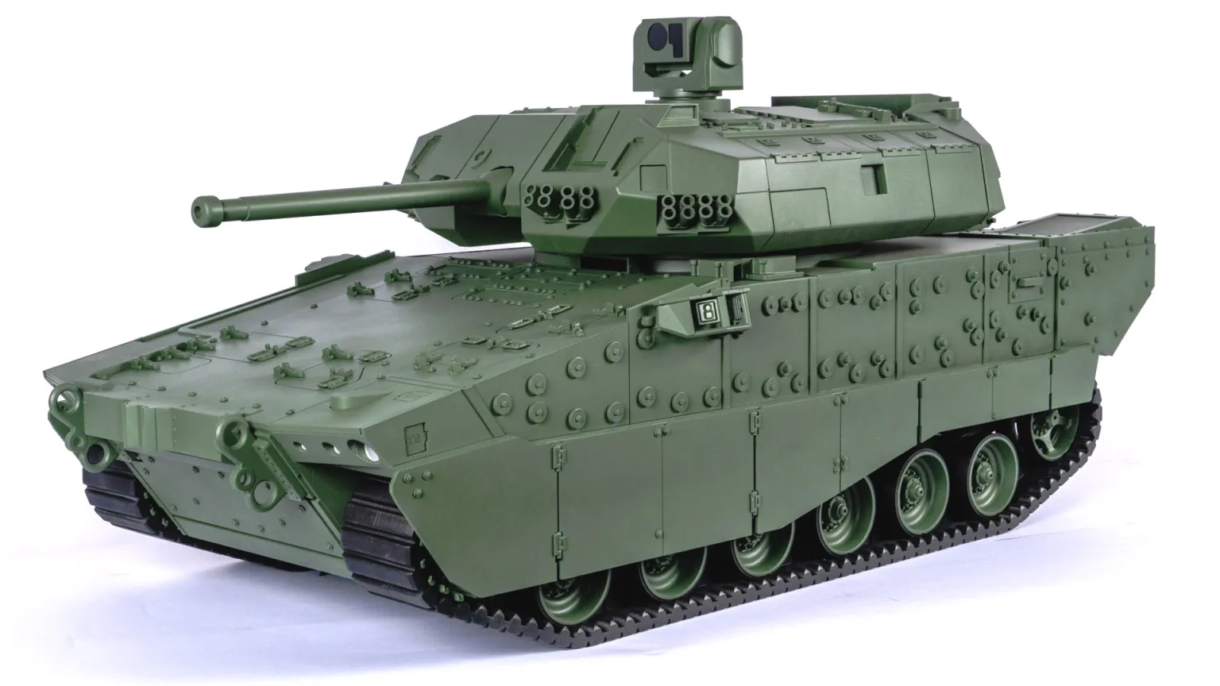
General Dynamics Land Systems (GDLS) recently displayed a one-eighth-scale model of its Wolf vehicle at the Association of the United States Army annual meeting. The U.S. Army is looking to replace its M2 Bradley Fighting Vehicles, which were supplied to Ukraine and employed in combat against Russian forces.
The Wolf is competing against Rheinmetall’s Lynx in the Army’s XM30 Mechanized Infantry Combat Vehicle program.
In a social media post on October 12, 2025, General Dynamics said the vehicle was designed from the start around the U.S. Army’s Modular Open Systems Approach, which uses common hardware and software interfaces so new sensors, weapons, and electronics can be added without redesigning the vehicle. It added that the Wolf was “born digital,” meaning it uses a digital engineering model for testing, production, maintenance, and design.
Earlier, GDLS had delivered its first Wolf XM30 mechanized infantry combat vehicle prototype to the U.S. Army on August 21, 2026, at Aberdeen Proving Ground, Maryland.
“This on-time delivery will allow Soldiers to start putting the Wolf through its paces, with the ultimate goal of getting it fielded into armored brigades as quickly as possible,” said Geoff Norman, director of strategy at General Dynamics Land Systems. “I would like to congratulate our XM30 team on the successful design and production of this game-changing solution. The Wolf is the most technologically advanced combat vehicle ever assembled.”
In June 2023, the U.S. Army awarded two contracts worth a combined approximately $1.6 billion to General Dynamics Land Systems Inc. and American Rheinmetall Vehicles LLC for Phase III (Detailed Design) and Phase IV (Prototype Build and Testing) of the Optionally Manned Fighting Vehicle (OMFV) program, which was subsequently redesignated as the XM30 Mechanized Infantry Combat Vehicle program.
The XM30 is expected to bring new capabilities that will transform how U.S. Army formations fight in the future. Developed with a modular open-system architecture, the XM30 is expected to permit new, developing technologies to be added as it evolves.
Wolf: Via: GDLS
“Competition remains a vital aspect of the XM30 program,” said Doug Bush, Assistant Secretary of the Army for Acquisition, Logistics and Technology. “Fully funding two companies for the next phases of the program will allow the Army to place the XM30 on a rock-solid foundation from a resourcing perspective, while also maintaining a competitive environment.”
The XM30 aims to enhance lethality, survivability, and upgradability beyond the Bradley’s physical and economic limits.
Earlier this September, American Rheinmetall delivered the first of eight Lynx XM30 combat vehicle prototypes to the U.S. Army.
“Delivering our first prototype to the Army is an important step as the XM30 Combat Vehicle program enters a more visible phase,” said Matt Warnick, CEO of American Rheinmetall. “Team Lynx now has the opportunity to show the Army that we can deliver on the promise of a modern replacement for the Bradley.”
Bradleys in Ukraine War
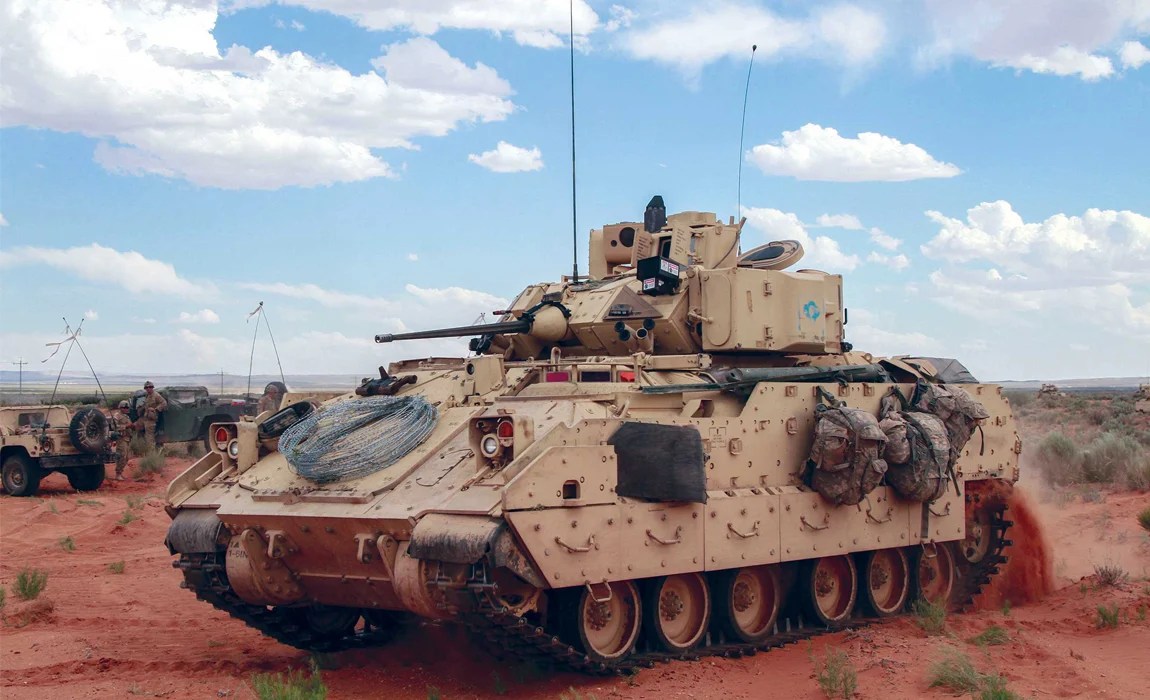
The United States supplied over 300 Bradleys (specifically M2) to Ukraine.
The U.S. primarily delivered the M2A2 ODS-SA (Operation Desert Storm-Situational Awareness) variant. This version included digital battlefield management systems, improved thermal sights for the gunner, and laser rangefinders.
The U.S. also shipped several M7 BFIST (Bradley Fire Support Team) variants, which replace anti-tank missiles with advanced target-acquisition sensors to direct heavy artillery strikes.
Last year in June, the Russian defense and industrial conglomerate Rostec claimed that the Russian troops had eliminated all the US Bradley Vehicles in Ukraine’s arsenal.
The Bradley Fighting Vehicle during an exercise
Independent tracking intelligence suggests that nearly half of the supplied vehicles have been damaged, destroyed, or abandoned over years of high-intensity combat.
In a June 2025 interview with Razvedchik (Scout) magazine, Rostec CEO Sergey Chemezov claimed that Russian forces had destroyed almost all the Bradley infantry fighting vehicles supplied to Ukraine. Chemezov did not provide a specific number, and no independent source has verified his claim.
Chemezov said: “Bradley IFVs have one serious weakness: problems with their cross-country capability, due to which they cannot move normally on rough terrain and through fields. They get stuck in dense soil and become easy targets because of their huge size. What’s the use of improved protection if the result is the same? In practice, all the Bradleys supplied to Ukraine have been destroyed. You have to understand, after all that, an IFV is not a tank.”
He further emphasized that a combat infantry vehicle should be swift, mobile, and able to move through rugged terrain and unbridged, unpaved rivers. “Our IFVs are capable of this, whereas American vehicles are not,” the Rostec chief stressed.
According to Oryx, a Dutch open-source intelligence blog that tracks equipment losses in the Ukraine War, the Ukrainian Armed Forces lost 189 M2A2 Bradley ODS-SA, many of which have also been captured by the Russian forces. These figures are based on visual confirmation, and the actual number of losses could be higher.
A new poll indicates that 64 percent of Americans believe artificial intelligence (AI) is developing “too fast.”
The Associated Press-NORC Center poll released on Oct. 8 showed that just 27 percent say the development is “about right,” and less than 10 percent think it’s moving “too slow.”
Of the polled adults, more Democrats (76 percent) than Republicans (54 percent) think AI is moving too fast. However, 70 percent of those under 30 years old think the technology should be slowed, and 60 percent of those 60 years old and older think the same.
The findings come amid growing concern over the technology’s potential threat to humanity, which has led to industry leaders and politicians calling for a slowdown and more regulation.
President Donald Trump has dismissed calls for more regulation, saying the United States needs to maintain its edge over China in the AI race. Major AI companies recently signed a voluntary accord with the White House that calls for internal and external reviews.
According to the poll conducted Sept. 24 to 28, about half of respondents think the government’s support is about promoting technological innovation, and a little fewer say they think it’s about competition with China.
Meanwhile, 80 percent of Americans say it’s “extremely” or “very” important for the United States to ensure AI stays under human control.
Recent months have seen several incidents of AI agents from major tech firms breaching websites of private companies, research institutions, and multiple government agencies.
Notably, ChatGPT developer OpenAI acknowledged in July that its AI agents broke out of a testing environment and hacked into Hugging Face, an open-source community for AI.
In September, OpenAI canceled the release of its latest model, GPT-6.1 Astra, slated for October, over safety concerns. It also postponed plans for its initial public offering this year.
Lawmakers from both sides of the aisle have proposed a range of measures to regulate the technology, but none are likely to advance anytime soon with Congress in recess ahead of the midterms.
Confidence in politicians’ handling of AI is low, with 23 percent trusting Democrats to do a better job and 21 percent favoring Republicans, while 39 percent trust neither party.
Mistrust of AI appears to have extended to the realm of politics, as very few adults are using AI as a source of information for the upcoming election. The poll indicated that only about 21 percent of respondents said they use or plan to use AI to gather information about a candidate or ballot issue.
Even fewer (12 percent) said they will use AI for information about how to vote, and only 10 percent said they would use it for information on voter registration.
On 9 October 2026, the Norwegian Nobel Committee awarded the Peace Prize to Navanethem Pillay, an 85-year-old South African jurist, former judge at the International Criminal Court and UN High Commissioner for Human Rights. The citation speaks of a person who has paved the way for a more comprehensive global legal order. The Committee’s chair, Jorgen Watne Frydnes, added that the prize is a message to those who attack and undermine the international system and its institutions. The verdict is avowedly political, and it is on this level that it must be discussed.
The very same figure who, in 2011, is said to have ‘toppled’ Gaddafi, paving the way for the plundering of Libyan oil and the enslavement of African migrants, would now ‘topple’ Netanyahu, thereby paving the way for Israel’s rehabilitation. The underlying logic would be neither morality nor peace, but the agenda of George Soros’s Open Society: to sacrifice those who have become inconvenient, never the essence of the project itself. Some have dubbed it ‘pal-washing’. The fundamental question is a serious one, for it asks whether there is a pattern behind the prizes and jurisdictions of the liberal order.
It must be emphasised that the script is already familiar. Do you remember when Barack Obama received the Nobel Peace Prize, whilst launching war after war? Or do you recall figures in search of a cause such as Machado, Mohammadi, or the defenders of Ukrainian criminals? But let us proceed in order.
Act One: Libya
In February 2011, Pillay, the High Commissioner, called on the Human Rights Council to take vigorous action to stop the violence and hold those responsible to account; the Council condemned the violations and established a commission of inquiry. The next step fell to the Security Council: referral to the ICC via Resolution 1970, followed by Resolution 1973, approved with ten votes in favour and five abstentions (Brazil, China, Germany, India, Russia). No one claims that Pillay decided to go to war. What matters is the sequence of events: the language of human rights opened the door, that of the protection of civilians authorised the use of force, and the operation gradually shifted towards regime change. As early as April, Lavrov was accusing NATO of exceeding its mandate, and a French minister admitted that regime change would have required a new vote.
Then there are the costs. In 2017, the IOM documented auctions of sub-Saharan migrants in southern Libya, sold for sums ranging from 200 to 500 dollars. The link with the collapse of the state after 2011 is the most plausible interpretation, although the source documents the phenomenon rather than its cause. Libya and the migrants paid the price; the legal framework emerged, formally speaking, intact, even if the controversy over the mandate would later weigh on the vetoes of Moscow and Beijing in other matters.
Act Two: Bibi
On 21 November 2024, Pre-Trial Chamber I of the ICC issued arrest warrants for Netanyahu and former Defence Minister Gallant, for war crimes and crimes against humanity. Pillay had left the Court in 2008, but chaired the UN Commission of Inquiry which, on 16 September 2025, concluded that Israel had committed genocide in Gaza. This is where ‘pal-washing’ comes into play. International criminal law deals with individuals: a defendant, a charge, a period of time. If the case concludes with the fate of a leader, a narrative break occurs – the ‘before’ and ‘after’ of a man – after which the state can present itself as restored. Libya offers an analogy: there, the case concluded with the fall of a man.
The limitations of the process work in favour of this interpretation. The Court has no police force and the execution of warrants depends on the States Parties; the Commission is not a court and does not speak on behalf of the entire UN; the Committee itself, according to AFP, has stated that it is up to a court to determine whether genocide has taken place. The award has no legal effect, as we know, but it lends legitimacy to a system that promises justice yet cannot guarantee it.
We must also bear in mind that we have already seen dynamics of this kind on numerous occasions within the globalist order that dominates the West. The Open Society Foundations presents itself as the world’s largest private funder of groups working for justice, democracy and human rights, active in over one hundred countries, and Pillay received the Stockholm Human Rights Award, the same prize that went to Soros and Neier in 2011. It certainly seems that the pattern of the Soros agenda is repeating itself once again – an agenda comprising foundations, NGOs, tribunals, commissions and bureaucracies that share a common lexicon and worldview: that of a liberal order to be perfected and never called into question. Those operating within that lexicon may denounce a government, a leader, or even a state, but they cannot challenge the underlying assumptions of the order that grants them legitimacy.
Some will object that Pillay’s Commission attributes responsibility to Israel as a state, not merely to its leaders, which contradicts the idea of a purely personalised operation. The second point concerns the reaction. Netanyahu accused the Committee of having lost its moral compass; the Israeli Foreign Ministry spoke of a grotesque exploitation of the prize; and Washington announced sanctions against the ICC just a few hours after the announcement. All true. But it would make sense and have value if the Western system were not rotten to its very core, if its legal system were functioning properly, but this is not the case, in any respect (and we have already seen sufficient evidence of this – let us not forget the Epstein case either).
If, over the next twelve months, Netanyahu’s political downfall is presented as the conclusion of the case, rather than as a stage in proceedings concerning the state, ‘Pal-washing’ will gain traction. If the proceedings continue beyond his person, and if the State Parties execute the warrants, perhaps it will lose ground. Given the current evidence, the argument is plausible and, until proven otherwise, this is yet another ‘Non-Peace’ Nobel Prize – one we cannot call ‘war’.
"Breaking Bad" actor RJ Mitte, who played Walter White Jr. in the hit US television series, has died aged 34, his representatives said Monday. The actor, who lived with cerebal palsy, also became a prominent disability rights advocate, championing inclusion and representation in film and television.
US federal agents on Monday launched a raid on the Washington home of Democratic representative Ilhan Omar, an outspoken critic of US President Donald Trump, officials said. The raid followed a criminal fraud investigation into the Somali-born lawmaker's immigration paperwork submitted by her late father when she was a child, Fox News reported.
For years, convicted sexual predator Jeffrey Epstein developed a global web of powerful connections despite accusations of sex trafficking. Millions of declassified documents reveal how he expanded and maintainted his network.
The U.S. Air Force has donated an F-117A Nighthawk, the world’s first operational stealth aircraft, to the Smithsonian Institution, where it will be on permanent public display later this month.
The Nighthawk, serial number 85-0818 and nicknamed “The Overachiever,” is the only F-117 known to have flown combat missions in all four major conflicts, including Operation Just Cause in Panama (1989), Operation Desert Storm (1991), Operation Allied Force over Yugoslavia (1999), and Operation Iraqi Freedom (2003).
It first flew in 1986 and was withdrawn from combat service around 2007.
The Air & Space Forces Association announced the donation on Sept. 14 at its Air, Space & Cyber Conference. Lockheed Martin’s Skunk Works prepared the aircraft for display in a museum. Air Force Reserve crews from the 512th Airlift Wing then flew the partially disassembled Nighthawk from California to Virginia aboard a C-5M Super Galaxy, arriving around Oct. 6.
The National Air and Space Museum’s Steven F. Udvar-Hazy Center near Washington Dulles International Airport will reassemble the aircraft. Visitors can watch the reassembly through the glass overlook of the Mary Baker Engen Restoration Hangar before the aircraft joins the permanent collection in late October, alongside other icons such as the SR-71 Blackbird and the B-29 Enola Gay.
Museum officials described the F-117 as the world’s first true operational stealth combat aircraft and said adding it fills a longstanding gap in the national collection. It is the 16th F-117 transferred for public display.
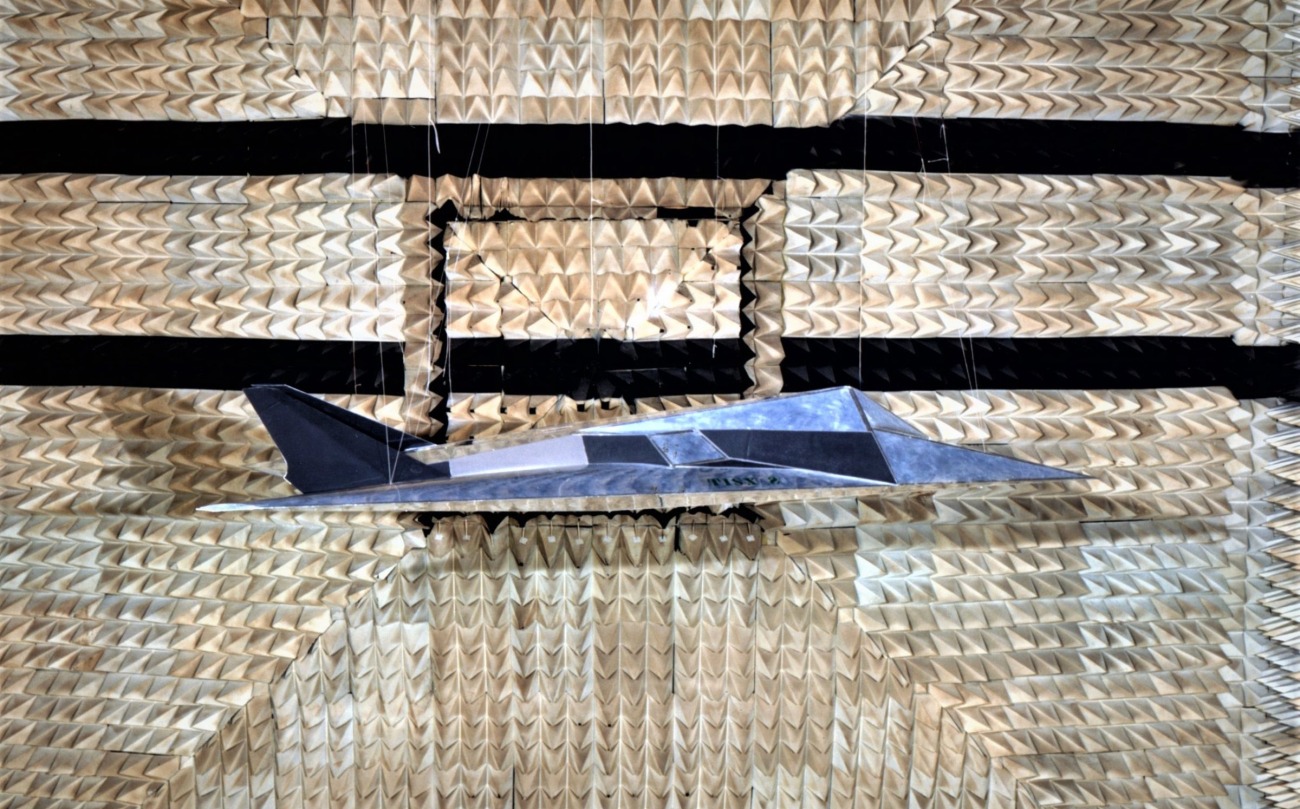
Have Blue, a stealth tech demonstrator, took its first flight in 1997, and led to the creation of our F-117 Nighthawk, the world’s first stealth aircraft. Via: Lockheed Martin
World’s 1st Stealth Aircraft
Aerospace analysts have long admired the F-117 Nighthawk’s distinctive design. A GE blog post describes the Nighthawk’s features and says the aircraft looks less potent alongside other advanced American fighters.
The aircraft has no afterburners. The aircraft is unstable on all three flight axes and requires an onboard computer for control
Despite that, the GE also noted one advantage: the aircraft is practically invisible to enemy radar.
According to General Electric, it was the first stealth aircraft to see the light of day during the Cold War and used a pre-existing engine modified to meet the requirement.
Despite the US technological advantage during the Cold War, contested airspace posed a substantial threat to pilots and their aircraft. Developing enemy technology could allow the enemy’s air force to lock on to American fighter jets and shoot them down at an alarming rate.
Although Lockheed Martin built the F-117 Nighthawk, GE built the engine that could power a stealth warplane. GE created the F404 engine exclusively for the F/A-18 Hornet, and it quickly became a compelling alternative for the F-117, a top-secret aircraft that needed an engine.
The engine was almost identical to the F/F404 A-18’s variant. GE constructed roughly 100 of these engines on a separate assembly line with only government-approved workers. That engine soon earned its stripes by being dependable, maintainable, lightweight, and inexpensive.
The Nighthawk
The US Air Force retired the F-117 Nighthawk in 2008.
The F-117s are reportedly used as developmental and “red air” training platforms a decade after their retirement. Certain aircraft act as aggressors in air-to-air combat during red-air training.
This raised eyebrows because it was unlikely that an archaic aircraft retired a decade ago would resurface for war games. The US Air Force later revealed that it had resurrected the Nighthawk.
Speculation suggests the USAF has brought these aircraft back to life because of their stealth capabilities. The USAF needs to train its fighter pilots against adversary stealth fighters, the Russian Su-57 and the Chinese J-20, as well as cruise missiles.
As a result, USAF pilots may be able to better find and intercept stealth aircraft in future operations and counter enemy cruise missiles if they train against Nighthawks as part of an advanced program.
When the US planned to develop the F-117 Nighthawk, the main challenge was reducing the aircraft’s radar cross-section and electromagnetic signature.
The aircraft had to fly subsonically to reduce obnoxious sonic booms. The aircraft had no afterburners or large exhaust plumes from infrared-emitting engines. It referred to flat surfaces that reflected radar radiation. The result was an otherworldly-looking black jet the US government didn’t recognize until 1988.
Despite the F-404’s ability to fly supersonically, the Nighthawk was limited to subsonic speeds because using afterburners to breach the sound barrier would compromise the aircraft’s stealth.
GE engineers designed the F-117’s unusual exhaust to scatter hot exhaust and evade radar and heat-seeking missiles.
“Really, it was the beauty of it. They could modify an existing engine, the F404, to provide the required thrust and weight. Minor adjustments were made to meet the F-117’s unique intake, and F404-F1D2 was ready to power the stealth attack aircraft,” said Bill Formosi, a former project manager of the F1D2 program.
Unlike other planes of the period, the F-117’s air intakes were grilled and coated with a unique radar-absorbent coating. Spring-loaded doors also opened on the ground to let in more air to the engine. However, once in flight, the hatches would be closed again to maintain the aircraft’s stealth.
According to Formosi, the tailpipe was the engine’s most distinctive feature.
“If you look at an F-117 from behind, you’ll notice that the engines aren’t visible like they are in other aircraft,” he said. “It was done on purpose, and it had everything to do with keeping it quiet. There was a 12-stage tailpipe that went from circular at the engine’s end to flat at the end of the exhaust, rather than an afterburner as the F404 had on the F/A-18.”
“This was done to spread the hot exhaust air over a larger region, reducing its heat signature,” Formosi said.
This is probably why the F-117 Nighthawk, commissioned over 40 years ago and retired over a decade back, has staged a comeback, this time for public viewing.
Contact the author at editor (at) eurasiantimes.com
Is Trump planning on using Putin to get him out of the mess of both his low polling and the Iran war? Seems far-fetched perhaps at first, but he is completely snared in Iran, with whatever option he looks at appearing to be a doomsday scenario. Could Putin help him out both with diesel prices back home but also to broker a deal with Iran which makes it appear to Americans that he, and America, are somehow the winners?
For the Russian president to sell close to 2 million tonnes of diesel oil to Western countries, including the U.S. of course, seems like a sticking plaster to a huge wound in the American and Western economies. Unless, that is, there is a second deal behind it which journalists and pundits are not aware of, or are simply choosing not to report. For the diesel initiative from Putin, the amount which is being offered isn’t huge, but there are a couple of precedents which it sets which are more important.
Firstly, it opens the doors for further lifting of sanctions (which could be bundled into Iran’s, given Moscow’s relations with Tehran), but perhaps even more importantly, it makes President Zelensky of Ukraine an even bigger target for Trump. Much will rest on the coming days and the decision that Zelensky will take to continue bombing Russia’s oil facilities. Will he take that suicide pill? Wars are often messy, and there are always grey areas where the two countries at war with one another find situations which are illogical and impractical. Perhaps the bombing of oil facilities within Russia in the Ukraine war has reached its tipping point, and regardless of how close EU leaders are with Zelensky – who at best we can call a caretaker leader – this will test this relationship to breaking point.
Do great numbers of citizens in France and Germany need to die this winter simply because of an energy crisis and/or an economic malaise in their own countries which have poured billions into keeping the war in Ukraine alive? Is Putin so confident that this winter will be the last one for his troops, as the defensive line between Ukraine’s forces and those of Russia’s looks like it is about to break at any moment? Are Ukrainians themselves ready to face a freezing winter in Kiev, unable to power or heat their own apartments? So many wars started over energy reserves, but not Ukraine. Yet it might end over them.
Trump’s threatening comments on social media about Zelensky should be taken seriously. If Trump’s own cabal of unqualified advisers can seriously convince him that a ground invasion of Iran is feasible, if not winnable, one could argue simply that regime change in Ukraine should be a children’s picnic and gives him a huge payday – politically, economically and geopolitically. Removing Zelensky would stop the war immediately, and Trump could claim victory for that, while he asks his friend Putin to quietly intervene in Iran and fix the Straits of Hormuz.
For Trump to actually respond to Zelensky’s outburst to reporters that the move to buy Russian diesel was “weak” by threatening Zelensky with being removed shows that his patience has reached a point where he is starting to think of the Ukrainian president as the source of the problems. To remove Zelensky through backing a rival will be hard and will pitch him against EU leaders, but one could argue relations couldn’t really get any worse, and that once Macron and Merz understand that peace is the only option and Zelensky is actually the only real obstacle to that, they will do what all EU leaders do and follow America’s lead.
We often hear analysts on YouTube talk about the game of “chicken”, but there has never been a more fleeting moment than now, as both Trump and Zelensky will be watching each other to see who blinks first. Zelensky, until now, has been playing a dangerous game of pretending to be servile to U.S. hegemony, while really just taking the cash and weapons and laughing at Trump among a coterie of weak European leaders in their palatial residences. The war has been complex since it began, as the U.S. and EU rarely saw eye to eye, but if Trump goes ahead with his threat of denying the Ukrainians shared intel, then this will be a very bad omen for the future of Zelensky, as he will put even more pressure on the British, French and Germans to come up with more weapons and money in an unwinnable war which they’ve bet the farm on and their entire political careers depend on.
The war, after this diesel decision, might have just become much simpler and more binary, and a collective narrative might emerge from the insanity of EU gibberish from countries who can’t even protect their own people on their own soil against an invasion of bogus asylum seekers. It will not only be the ultimate test for U.S.-Ukraine relations, but also one for U.S.-EU ones, and perhaps represent the end of NATO as we know it.
Saudi Arabia is desperately trying to reverse its losses on the ground in the Yemeni conflict, while Houthi attacks reach its airports and threaten its oil trade. Yet the coalition Riyadh has assembled does not match the war it wants to fight. Washington is engaged in the conflict with Iran, Turkey excludes offensive deployments, and Pakistan draws the line at crossing into Yemen. The kingdom has foreign support, but the burden of recovering and holding territory still falls on its weakened Yemeni partners.
Retreat Before the Counteroffensive
By early October 2026, Riyadh was responding to a deteriorating military position. The Houthis’ September advance along Yemen’s western coast brought the loss of Mokha and strategic positions around Bab el-Mandeb. These setbacks exposed the weakness of Saudi-backed forces and strengthened the Houthis’ leverage over a shipping route increasingly important to Saudi oil exports.
The renewed Saudi–Houthi escalation began with the July 13, 2026, strike on Sanaa airport’s runway. Saudi aircraft sought to prevent an Iranian Mahan Air flight carrying a senior Houthi delegation from landing without coalition permission. The plane later landed in Hodeida after Omani mediation, but the Houthis retaliated against Abha airport and subsequently announced a blockade on Saudi shipping. The strike broke the relative calm established by the 2022 truce; September’s coastal offensive then turned the confrontation into a major territorial setback for Riyadh’s partners.
The retreat exposed divisions within the anti-Houthi camp. Saudi–Emirati cooperation had broken down, and the withdrawal of the UAE left command arrangements that Riyadh failed to replace effectively. The factions expected to carry the offensive remained divided and poorly prepared for a sustained campaign. Saudi airpower could not compensate for the absence of a coherent local force.
The cost is also being felt inside Saudi Arabia. The October 10, 2026, attack on Riyadh’s King Khalid International Airport killed 12 people and wounded 309, according to Saudi authorities, and temporarily suspended operations. Riyadh blamed the Houthis, who renewed their warning against using Saudi airports and airspace on October 11. Airport disruption, cancelled flights and attacks on oil facilities bring the economic consequences of the war directly into the kingdom. The Saudi air campaign has not secured its civilian infrastructure.
Operation Dawn of Yemen began on October 5, 2026, after Saudi-backed Yemeni leader Rashad al-Alimi announced military action the previous day. The immediate objective was to recover the coastal positions lost in September, alongside the Saudi-backed Yemeni government’s broader ambition to restore its authority over Houthi-held territory. On October 11, the coalition announced the destruction of 136 military targets in a large-scale operation. That tally says little about whether Saudi-backed units can hold territory, secure supply routes or reopen shipping lanes.
Houthi footage released October 10, 2026: Shawaz drone strikes on Saudi-backed forces in Kahbub and Al-Waziya, as presented by the movement’s military media
Why Taiz Matters
The counteroffensive has produced conflicting accounts of control on the coast. On October 9, 2026, Saudi Arabia’s ambassador to Yemen announced that Bab el-Mandeb and Mayun Island had been cleared of Houthi forces. The Houthis maintained that they still held those positions. Control of the waterway remains contested, despite Riyadh’s announcements of success.
Taiz adds another strain after the coastal setbacks. Pressure on its approaches threatens supply routes and forces Saudi-backed units to divide their effort between the inland front and the Red Sea coast. The Houthis can disrupt their opponents’ counteroffensive without winning every coastal engagement: sustained pressure inland prevents those opponents from concentrating their forces. Saudi airpower does not resolve the fragmentation of the Saudi-backed Yemeni forces expected to hold the ground.
Houthi military footage released October 10, 2026: the movement presents advances and the surrender of opposing fighters in Sami, As-Silw and Al-Mawasit, Taiz province. The fighting places further pressure on the ground forces on which Riyadh’s campaign depends
The Iran War Narrows Saudi Options
The US–Israeli war with Iran, which began in February 2026, has expanded the military demands on Washington. Regional deployments, shipping protection and operations against Iran compete with Saudi requests for a larger American role in Yemen. Riyadh cannot assume that American support will expand on its terms. Its dependence on outside assistance has grown at the same time as the regional war has made that assistance more conditional.
The Iran war compounds Saudi Arabia’s vulnerability. Disruption at Hormuz has increased Riyadh’s dependence on its westbound pipeline and Red Sea ports. Southbound cargoes from Yanbu must pass Bab el-Mandeb; northbound exports follow a different route. Moving crude across the peninsula bypasses Hormuz, but it does not remove the threat to shipping off Yemen.
Pressure at Bab el-Mandeb gives Iran an additional advantage while the Houthis gain territory and bargaining power of their own. Their overlapping interests put Riyadh under pressure on two fronts. A Washington–Tehran agreement would not automatically end the war in Yemen: the Houthis have their own territorial, political and economic demands.
Washington is already involved through military advisers, intelligence and targeting support. The issue is the extent of that involvement, not American neutrality. Earlier in October 2026, Trump rejected Saudi requests for direct strikes; after the Riyadh airport attack, he said the United States might join them. Riyadh still lacks a firm American commitment to the wider offensive. Its requests compete with Washington’s military operations and priorities in the Iran war.
Allies Draw Their Own Lines
Riyadh’s response is to widen its support network through the Mecca pact, signed with Turkey and Pakistan on August 7, 2026, and activated on October 5. But an agreement to defend Saudi Arabia is not an agreement to win its war in Yemen. Pakistan’s military presence and Turkey’s technical, intelligence and air-defense assistance address the kingdom’s security without supplying a joint ground campaign across the border.
The alliance has a secretary-general, retired Pakistani general Nauman Mahmood, but its detailed force-generation timetable, operational command arrangements, cost-sharing formula and mission duration remain unpublished. On October 8, 2026, Ankara excluded offensive operations while parliamentary ratification was pending. On October 9, Islamabad confirmed a substantial military presence in the kingdom but ruled out crossing into Yemen to attack the Houthis. Riyadh is obtaining defensive commitments, not a combined expeditionary army.
Pakistan’s decision-making has also shifted. In 2015, parliament unanimously rejected participation in the Yemen war while promising to defend Saudi territory and holy sites. In October 2026, reinforcement commitments are proceeding without a parliamentary vote. The government says it followed the necessary procedures. The political result is a narrower domestic debate over a commitment that could draw Pakistan further into the conflict.
Fewer political checks make deployments easier to authorize and harder to reconsider once costs and casualties accumulate. Pakistan’s own security pressures add another burden: the October 11, 2026, emergency in opposition-run Khyber Pakhtunkhwa coincides with its commitments to Saudi Arabia. Islamabad is extending support abroad while managing a deepening confrontation at home.
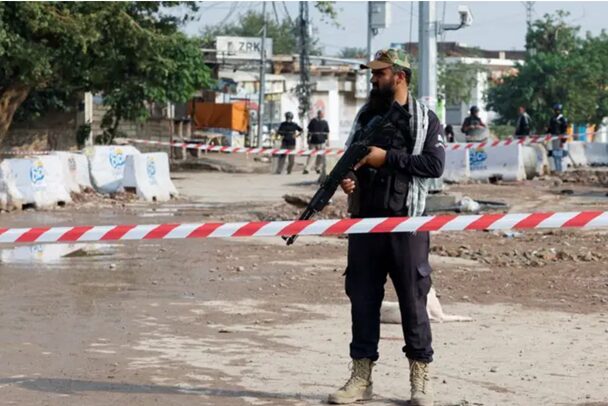
Peshawar, October 11, 2026: police guard the approach to the Red Zone. Pakistan’s overseas security commitments coincide with emergency measures at home
Saudi-led coalition footage, October 9, 2026: the coalition announces strikes on three Houthi missile launchers. The continuing attacks inside Saudi Arabia expose the limits of destroying individual launch sites
Defensive support can still sustain the offensive by freeing Saudi assets for use in Yemen. France’s support for the defense of Yanbu and Britain’s refueling assistance contribute to that effort. But none of this repairs the weakness of Riyadh’s Yemeni ground forces. Pakistan also has its border with Iran and its mediation role to consider, while Turkey keeps its commitment separate from offensive operations. Each partner sets limits according to its own interests.
Different Interests, No Shared Victory
Pakistan’s proposed $1.21 billion IMF disbursement awaits board approval. Turkey’s September 2026 inflation was 29.73%, with its policy rate at 37%. Both face financial pressures that favor limited missions over an open-ended expedition. Who pays for the current assistance remains undisclosed.
Saudi Arabia’s updated deficit forecast is 4.9% of GDP. September 2026’s non-oil purchasing managers’ index stood at 55.3, indicating expansion before the latest escalation. The airport attacks and disruption to transport now place that activity under additional pressure. Riyadh must finance the campaign while protecting the infrastructure and trade on which its wider economic plans depend.
The Houthis are using that pressure to advance their negotiating demands. On October 10, 2026, the Houthi authorities proposed reciprocal exclusion of airports, ports and other humanitarian infrastructure from blockade and attack. The proposal seeks to exchange limits on disruption for concessions over access and blockade. It puts the economic consequences of continued fighting at the center of the bargaining.
The conflict of interests runs through the entire coalition. Riyadh wants to reverse Houthi gains and protect Saudi infrastructure. The Saudi-backed Yemeni government wants to restore its authority. Turkey and Pakistan seek bounded commitments, and Washington calculates its involvement against the Iran war. The Houthis seek concessions while preserving their military leverage. A common adversary has not produced an agreed objective or a shared willingness to bear the cost.
Saudi Arabia therefore has partners willing to help defend the kingdom, but those partners have made no common commitment to reverse Riyadh’s setbacks in Yemen or sustain the ground campaign of the Saudi-backed Yemeni government. That is the gap behind the coalition’s announcements and strike tallies. Without stronger local forces and a political settlement addressing shipping, attacks and access, additional foreign support can prolong the campaign without resolving it. Riyadh risks remaining surrounded by allies while carrying a war none of them has agreed to finish.
The global defense industry appears to be entering a period of structural transformation, driven by rising military spending, technological change, and increasing private-capital involvement.
The “Aerospace & Defense M&A Report 2026: Deal Activity, Market Trends and Outlook,” published by Ropes & Gray LLP on October 7, 2026, says that Aerospace and Defense Mergers and Acquisitions (M&A), Private Equity (PE), and Venture Capital (VC) funding are likely to expand further, showing that 2026 is on track to be one of “the strongest deal-making years” on record.
The report highlights that Defense Tech/Services is the fastest-growing segment at a 22% Compound Annual Growth Rate (CAGR), followed by Aerospace at 16% CAGR; Aircraft Manufacturers, Parts & Components at 14% CAGR; and Air, Land, & Sea Defense at 9% CAGR.
The report argues that the growth is not simply a temporary response to international conflicts. Governments are rebuilding industrial capacity, replenishing weapons inventories, strengthening supply chains, and accelerating the development of advanced military technologies.
In the United States, the largest market, proposed increases in defense resources, procurement reforms, longer-term contracts, and financial support for defense technology companies aim to attract private capital and expand manufacturing capacity.
In Europe, the EU’s Security Action for Europe initiative aims to mobilize about €800 billion in defense-related investment through national fiscal flexibility, loans, and related financing support.
Germany’s increased spending and procurement reforms can accelerate equipment acquisition and industrial expansion. Collectively, these policies are reshaping the geography of defense investment in Europe.
In fact, the report says that Europe has emerged as a major driver of new activity. “Europe has become a primary engine of deal flow, not a secondary market. Rising national budgets and new EU-wide financing mechanisms are reshaping where capital is being deployed as well as dictating deployment speed”, it says. NATO’s higher spending ambitions, European rearmament and new financing arrangements are encouraging companies to expand, consolidate and acquire specialist capabilities.
Meanwhile, the Indo-Pacific is undergoing a rapid, structural alignment driven by what regional planners call a “contested era.”
China is consolidating its domestic defense industry, though restrictions on cross-border investment limit Western investors’ access. Japan is rapidly reshaping its defense posture and adapting to an environment where the traditional binary definitions of “peacetime” and “wartime” have effectively blurred.
In this era of continuous competition, the report says Japan has elevated allied burden-sharing to its foundational organizing principle.
This shift is most visible in the digital domain. With the operationalization of Japan’s Active Cyber Defense Oversight Commission, Tokyo has adopted a proactive cyber defense strategy. By implementing legal public-private threat reporting and neutralized-access protocols, Japan is signaling a willingness to legally counter and neutralize state-sponsored infrastructure targeting before cyber assaults can cripple critical domestic networks.
One of the report’s most important observations is that defense investment is increasingly a private-equity story. Private-equity firms are acquiring established manufacturers, selling businesses to strategic buyers and building larger companies through additional acquisitions. Venture capital is also financing newer businesses developing military technologies.
Among the ten largest transactions listed for 2026 up to September 30 was GE Aerospace’s $11.8 billion acquisition of Consolidated Precision Products. Other major deals involved aerospace leasing, maritime defense, aircraft components, and specialist detection technologies.
Dubai Aerospace Enterprise bought Macquarie Airfinance for $9.0 billion in what was a leasing consolidation. In a move that signals European rearmament, land-defense scaling, and main-battle tank production, KfW Group (German State Bank) is backing KNDS [Franco-German tank maker Krauss-Maffei Wegmann + Nexter] with $7.8 billion.
In other words, private investors are no longer confined to peripheral suppliers. They are becoming key participants in the industrial ecosystem that supports national defense.
Significantly, the traditional reliance on a handful of legacy prime contractors is giving way to an ecosystem heavily backed by private equity and venture capital.
The private sector is now driving global defense deal-making as it pivots toward software-defined defense, autonomy, and next-generation platforms.
The report shows how defense technology is changing the industry’s center of gravity. Although aerospace and defense remains one of the most active and strategically complex sectors for private capital deployment, software-defined defense, autonomy, and next-generation platforms are pulling ahead as the fastest-growing corner of the market.
Investors are particularly interested in artificial intelligence and software-defined defense systems; autonomous platforms, including unmanned aircraft and maritime systems; counter-drone and missile-defense capabilities; space infrastructure and surveillance; and specialist electronics, communications, and mission-critical components.
However, while these technologies can drive rapid growth, they also carry risks due to restrictive policies in the US and Europe. The report notes that regulatory compliance is becoming a structural hurdle rather than an afterthought.
In the United States, the largest market by transaction value, more national security vetting—including CFIUS (Committee on Foreign Investment in the United States) and FOCI (Foreign Ownership, Control, or Influence) mitigation—is becoming foundational to ensuring a clean exit.
In other words, the global defense landscape seems to be marked by a distinct paradox.
On the one hand, geopolitical threat vectors are accelerating at breakneck speed. On the other hand, the financial and regulatory machinery needed to field next-generation capabilities faces structural friction.
As a result, companies may depend heavily on a single government customer, handle classified information, or face restrictions on intellectual property developed under government contracts. Cybersecurity compliance and access to sensitive facilities can also complicate acquisitions.
In the United States, the CFIUS can scrutinize foreign investment for national-security risks. FOCI can also affect access to classified work and sensitive facilities.
Similarly, European foreign-investment screening is marked with many complexities. Even businesses that are not conventional arms manufacturers may face scrutiny if they supply strategically important electronics, software, communications or other dual-use technologies.
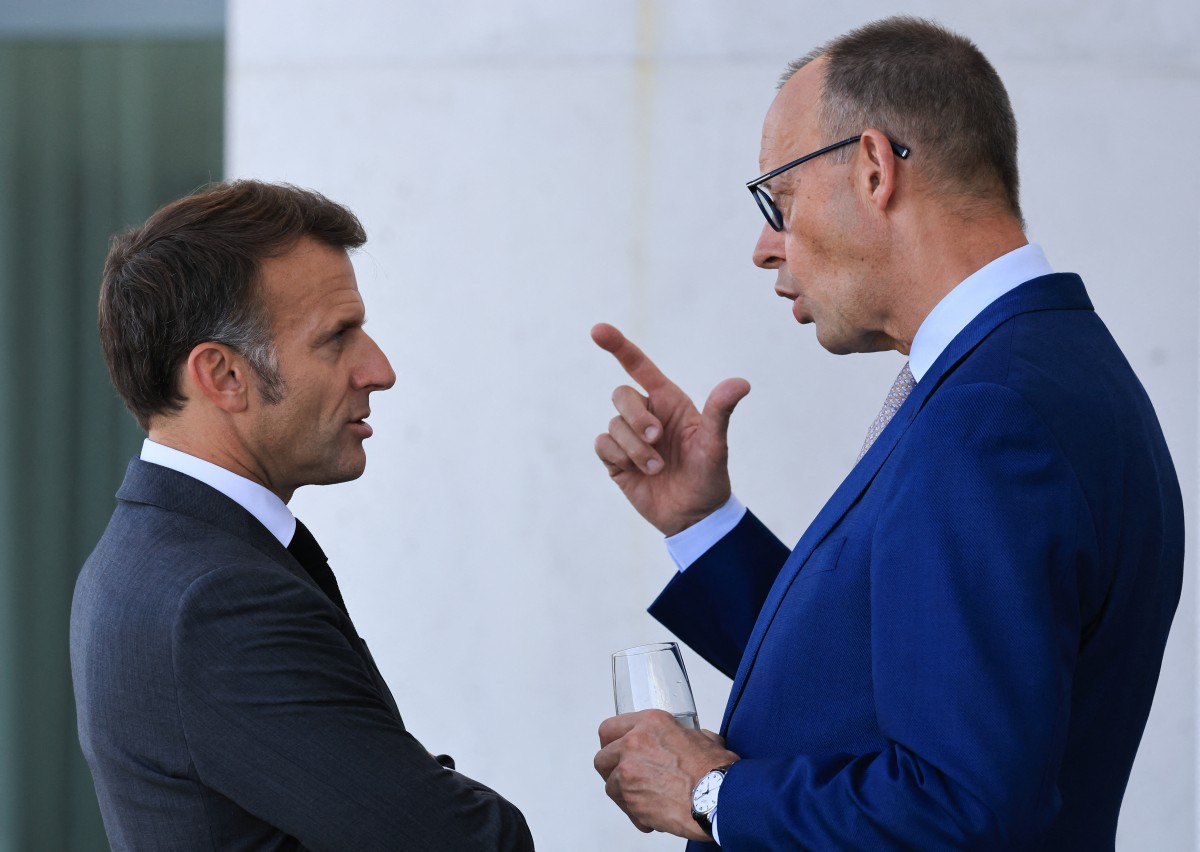
German Chancellor Friedrich Merz (R) and French President Emmanuel Macron talk on the terrace of the Chancellery at the start of the meeting of State leaders of the European Group of Five (E5) and the NATO Secretary General on June 24, 2026 at the Chancellery in Berlin, Germany. (Photo by Ludovic MARIN / AFP)
Commercial risks matter too. Fixed-price government contracts can leave manufacturers exposed when costs rise unexpectedly. Buyers must therefore examine contract liabilities, working capital, supply-chain resilience, workforce retention and the restrictions that could affect a future sale, the report advises.
The report’s overall conclusion, therefore, is that while defense investment opportunities are expanding, success increasingly depends on technological relevance, reliable industrial execution, regulatory compliance and the ability to navigate national-security restrictions throughout the ownership cycle.
What lessons could India draw from the trends above?
For India, the report is particularly relevant because it highlights a shift in how advanced military capabilities are developed and financed. The implications extend beyond aircraft, missiles, and ships to defense electronics, artificial intelligence, autonomous systems, space technology, supply chains, and foreign investment.
India’s first opportunity is to integrate more deeply into international aerospace and defense supply chains. As Western manufacturers expand production and diversify their suppliers, Indian companies could become more important producers of precision components, avionics, electronics, aerospace structures, and maintenance services.
The most instructive lesson may come from GE Aerospace’s September 8, 2026 acquisition of Consolidated Precision Products (CPP). Experts say that it was a paradigm shift in aerospace and heavy industrial manufacturing. For decades, aerospace primes aggressively outsourced manufacturing to optimize their balance sheets, shifting capital-expenditure risks onto multi-tiered supply chains.
But years of systemic, compounding engine delays—magnified by the Pratt & Whitney GTF powder metal crisis and Boeing’s structural manufacturing gridlock — exposed a fatal flaw: primes (like GE) outsourced execution, but they could never outsource the risk.
Therefore, GE Aerospace decided to buy the absolute bottleneck of jet engine production: structural castings and complex airfoils. Its deal with private equity firms Warburg Pincus and Berkshire Partners is meant to address persistent, industry-wide shortages of critical engine parts and airfoils. In other words, GE bought the supply chain to control the delivery.
For India, this implies that beyond focusing on “Make in India” as screwdriver assembly, it should also consider “Own the Supply Chain.”
Second, as defense technology gains primacy, expanding AI-enabled systems, autonomous platforms, counter-drone technology, advanced sensors, and space infrastructure could be more relevant for India than producing isolated components.
Some experts argue that because European primes are cash-rich and seeking low-cost engineering, they would prefer a JV with India to meet capacity needs.
Lastly, as the Ropes & Gray LLP report illustrates, private equity and venture capital can help consolidate fragmented industries, finance expansion, and support specialized technology businesses. India could adapt this approach to build stronger domestic defense suppliers.
Author and veteran journalist Prakash Nanda is Chairman of the Editorial Board of the EurAsian Times and has been commenting on politics, foreign policy, and strategic affairs for nearly three decades. He is a former National Fellow of the Indian Council for Historical Research and a recipient of the Seoul Peace Prize Scholarship.
The author can be reached at prakash.nanda (at) hotmail.com
Social media platform Meta has 48 hours to respond to claims by Brazil's leftwing candidate and incumbent President Luiz Inacio Lula da Silva's campaign accusing the tech platform of blocking content on the company's platforms. Brazil's Superior Electoral Court on Saturday gave the social media giant 48 hours to clarify whether it reduced the reach of posts by Lula's campaign ahead of the tight October 25 run-off against rightwing candidate Flavio Bolsonaro.
No one expected that Donald Trump, after a congratulatory birthday phone call to his Russian counterpart, would declare that Russian diesel fuel would prove to be the solution to America’s current fuel shortages. If the Trump presidency has yielded anything it is a lot of interesting headlines that seem to come out of nowhere, that can sadly, quite often, fade right back into the mist from whence they came. Sometimes Trump’s words can fill us with hope like this ‘Diesel Deal’, and others like his recent UN speech, where he threatened to potentially kill all Iranians, fill us with dread. This declaration by our enigmatic leader presents a very interesting media narrative and a potential end to ‘Project Ukraine’ that is worth taking a deeper dive into.
Trump has blamed Zelensky for the global energy shortages, especially those concerning diesel fuel. At the time, everyone thought this was just a cheap Twitter-style deflection from the failed war against Iran, which certainly caused a lot of fuel transport disruption. That is to say, the White House was projecting this crisis, that it allowed to happen, or actively caused, to be thrown onto the scapegoat Zelensky. However, this form of deflection or projection is no longer just words in a pre-election narrative, but has become action. Sanctions on Russian diesel have been lifted and the first shipment is already on its way as I write these words. Something tangible has occurred.
Zelensky was actually warned some six times to stop attacking Russian oil infrastructure. Blow up children in the Donbass and beyond ‘sure’, but attacking what the West wants from Russia more than anything is ‘totally unacceptable’. Zelensky, who as stated above was warned half-a-dozen times to back of strikes on oil/gas, upon hearing of Trump’s decision to purchase Russian diesel fuel did the following:
2) He immediately cut off peace talks in Miami with the Trump’s aides, the Kushner-Witkoff duo, which is yet another spitting in the face of Donald Trump.
The wildest thing of all is that the ‘narcissist’ Trump has already publically thanked President Putin twice for this deal. Appearing at a rally, Americans standing behind Trump wildly cheered in favor of the announcement of peace with Russia plus extra fuel for America. Russophobia is a hobby of the globalist bourgeoisie and Epstein Island, not American truckers and farmers.
It’s a great narrative, let’s hope it lasts
Trump has now put 100% of the blame for global energy/fuel problems directly onto Zelensky, and called him out personally for keeping the war going over the last two years. Thus, the narrative is forming into something like: If the war in Ukraine is the cause of the fuel shortages, and Zelensky is the cause of the war continuing, that means the U.S. can make a deal with Russia even if ‘they started it’, with the corollary that Zelensky logically needs to go as he is the source of the problem. But going even deeper into the narrative we can see the most interesting thing of all or as they like to say online ‘the quiet part’: Trump has essentially declared that Russian energy output is of vital strategic interest to the United States.
It is these kind of words that take the black pill out of my mouth and directly inject ‘hopium’ into my bloodstream. The idea of the American President declaring that NOT being at war with Russia is of vital strategic interest to the USA is something I have been dreaming of my entire adult life. This is exactly the logic that we need to finally and ultimately end the Cold War + Project for a New American Century mentality in politics and finally allow the USA to rebuild and invest into itself. This very well could be America’s mulitpolar awakening by using a logic trap similar to the other ones that have been used to do the exact opposite and keep the USA locked in eternal foreign wars of luxury for ‘national security’. This new logic trap could look something like this: “So you want war with Russia? That must mean you want to harm America, you dirty traitor! You’ll take the fuel from farmer Joe and our kids will starve, you monster! Russia being left alone to produce fuel is a national security interest of America, are you against our country’s national security? Do you want to weaken manly America for those gay Europeans?”.
But as we slam that hopium injection into our veins we have to remember that Donald Trump has said a lot of things, changed his mind many times, or was forced to change it, and perhaps isn’t quite the unilateral decider that he makes himself out to be on TV.
It takes two to tango, but one orange man to keep his word.
The transcripts from this now famous birthday phone chat look very different on the American and Russian sides, which is par for the course. Trump’s team tends to write discussed things as proven facts whereas the Russians are more noncommittal in their language. But the diesel sanctions are gone for now and the boats are moving, so this looks to be real… at least until the mid-term votes are cast.
The American side has since threatened to cut Zelensky off from intelligence sharing, which could be an instant deathblow to their military efforts as many experts believe that only U.S. intel has allowed them to survive this long. Without such targeting data they will be sent back to 20th century warfare instantly, and they would no longer be able to strike deep into Russia. RT wrote the following on this issue:
A Ukrainian official told Axios that Witkoff and Kushner threatened to cut off US intelligence sharing with Kiev if it continued to ignore Trump’s requests to halt strikes on Russian oil refineries, but the US official denied that any such threat had been made.
But here is where we have to hold our breath, for despite how nice this new narrative sounds, and how it is the perfect exit for the USA from its participation in Project Ukraine we should not forget the words of President Putin from some time ago when he talked about the true power of any U.S. President:
“So a person is elected — he comes with ideas… Then people with briefcases come visit him, well-dressed, in dark suits — kind of like mine.”
So the real question might be, will the Zionist Lobby, Epstein Elite, Three-Letter Organizations, Influential Billionaires, and all the other spooks on Capitol Hill actually let President Trump actually end this war? Will the POTUS be allowed to do this?
We should recall that after Zelensky acted disgracefully in the White House at the start of Trump’s second term everyone thought this conflict would be over. Trump the famous narcissist seemed visibly angry and offended on camera during their verbal spat. But the war went on. There was the Anchorage Summit, which had tons of hype and everyone thought then that the U.S. would pull support from Kiev. But it did not. Trump’s enemies including the Biden Clan are linked to massive corruption in Ukraine which has all been exposed. This would have been a great off ramp from the conflict, but Trump did not or could not take it. And in general, Trump’s rhetoric towards Zelensky and other European politicians has been overtly harsh and disrespectful. The man accused of being a ‘blowhard’ somehow always speaks quite politely behind the backs and to the faces of Putin and Xi.
Thus, although I want peace and mutually-respectful cooperation between the USA and Russia perhaps this deal will only last till the midterm elections, when all of a sudden Zelensky will go back to being “a bastard, but he’s our bastard”, and the conflict will go marching on. Perhaps this is our October Surprise from the Republican side of the aisle? And in December we can all be ‘surprised again’ when the war resumes full-force and thousands more Slavs die on the battlefield?
Now, Donald Trump with gritted teeth is slinging forth the idea that he thinks “it’s time for Ukraine to get a new President”. But after the votes are counted in America he may just go back to passively hating and tolerating Zelensky till the end of his term or till an Oreshnik finds the mark one day. We also cannot forget that the West has been lobbying for a major ceasefire from the Russians for a long time. Presumably this would be used to regroup, rest, rearm and then just go right back to fighting till the last Ukrainian. Now Trump wants elections in Kiev, which will probably demand a ceasefire to enact. But will he be pushing for a three-day ceasefire, or try to trick the Russians into agreeing to a month-long freeze or more?
One ‘good’ sign on this issue from a Russian standpoint is that there are now already calls for Zelensky to resign over this issue on Twitter/X coming from all sides even pro-Ukrainian ones:
“’Zelensky must resign’ – Ukrainian media. That was quick. Zelensky ignored Trump’s warnings not to attack Russian oil refineries SIX times. This morning, Zelensky has bombed another Russian oil refinery. Ukrainians are calling for Zelensky‘s resignation.
Former Ukrainian MP and Metinvest co-owner Vadym Novynskyi has called on Zelensky to resign and hand over all power to Ukraine’s Verkhovna Rada following the Trump-Putin agreements.”
We have to remember that Ukraine in 2026 is already a police state where any dissent means you could get thrown into a bus and taken to the front to die or vanish into a prison as a Russian ‘spy’. Thus, when important people gang up against Zelensky openly it is much more of a potent statement than Hollywood actors safely making Tik-Toks against Trump from their luxurious bedrooms.
The rest of the world won’t sit around and do nothing.
Some moronic ‘Putin sold out the BRICS’ counter-narrative is sure to arise from Kiev’s bot accounts soon. Obviously someone is going to say that the Kremlin threw their Iranian brothers to the Zio-lobby machine! But in actuality, it looks like the Iranians are going to just ship their oil through Russia and sell it as ‘Russian’ and everyone will be happy. The Caspian Sea will be even more busy in the near future. If sanctioned accomplished anything they really increased trade between Russia and Iran.
No one in Moscow is planning on selling out Tehran; they want America to join the Multipolar World while still saving face and reduce the global threat level of nuclear war which is vastly too high at present. Iran and China were surely consulted on this issue before any Diesel Deal was finalized.
The real danger of Trump calling for the removal of Zelensky comes from Europe, where certain factions, politicians and their financiers may take radical action in response. And Trump’s reaction to this response could be even more radical now. Would it be possible that NATO might greenlight the Baltics to just open up another front to ‘see what happens’? Will France finally go through on its threat and just deploy troops openly en masse to save the Napoleon in Green from political or potentially physical death? So far the EU has only threatened even more sanctions. If the previous 20+ packages of sanctions failed, I wonder what is left to actually sanction. Ursula is promising the biggest and most expansive sanctions packet for Monday, October 12th, but I doubt it will change anything. The only thing that would change the situation is if the EU did something really aggressive, drastic and stupid militarily.
What about the rest of the sanctions?
The Russian media has done a disservice to the public by writing that “Trump will lift sanctions” over-and-over again when the only sanctions being lifted are on diesel exports for half a year. All of the rest of the sanctions are still there. You still cannot fly directly from Moscow to New York, and money transfers via SWIFT are still mostly blocked. We have to remember that at least in theory sanctions are a form of punishment for crimes committed against, in this case, international law and the United States. So how can relations between the USA and Russian Federation truly be normalized when one still accuses the other of crimes it believes it did not even commit?
After Project Ukraine ends things could change rapidly, but there can be no true friendship until Washington trusts Aeroflot enough to let them land on U.S. territory. We cannot be both under a sanctions war and normalized at the same time. But this new Trump narrative, if he can stick with it to its logical conclusion, is the perfect off-ramp for America and the way we can finally end this war and go back to some sense of normalcy with the apocalypse pushed far off into the future beyond all of our lifespans.
We remember Nokia as the company behind some of the most popular mobile phones of the past, as well as its famous slogan, “Connecting people.”
Founded in Finland in 1865 and now operating as a multinational company in telecommunications and information technology, Nokia continues to work in the field of communications – that is, to “connect people.” But with its latest project, it appears that the company is now preparing to connect people in uniform.
Nokia has teamed up with ICEYE, another Finnish company specializing in the production of microsatellites that provide high-resolution Earth observation data day and night and in all weather conditions.
The two companies have partnered to develop secure and sovereign satellite communications systems for governments and defense customers, with the first communications satellites planned for launch in 2028.
Defense, border security, emergency response…
Announced on October 1, the project envisages satellite systems operating in low Earth orbit (LEO) for use in areas including defense, border security, emergency services and disaster response.
Under the project, governments will be able to own and control not only the satellites themselves, but also the ground infrastructure and user terminals.
Rafal Modrzewski, co-founder and CEO of ICEYE, said countries should not leave control over their communications infrastructure in the hands of foreign commercial satellite operators, emphasizing that the project is ultimately aimed at reducing external dependence.
As part of the partnership, Nokia will contribute its expertise in secure networking technologies and network management, while ICEYE will provide its experience in satellite platforms, satellite constellation operations and ground infrastructure.
The cooperation between Nokia and ICEYE is not entirely new. Nokia was among the companies that participated in an investment round announced by ICEYE in June 2026, through which the company secured more than €1 billion in financing.
First satellites planned for 2028
The first satellites are scheduled to be launched in 2028. If the project is implemented, ICEYE will expand its activities in government-controlled satellite intelligence into the communications sector, while Nokia will strengthen its presence in Europe’s rapidly growing defense and space communications market.
Europe’s “strategic autonomy”: the militarization of civilian technology
The new partnership between Nokia and ICEYE is a striking example of where the concepts of “strategic autonomy” and “technological sovereignty,” which Europe has increasingly embraced in recent years, are actually heading.
The satellite communications systems being developed by the two Finnish companies may initially appear to be nothing more than a technological investment. Yet the companies themselves explicitly list defense, border security and government operations among the project’s intended areas of use. With the first satellites planned for launch in 2028, the system is also designed to remain under government control, including its satellites, ground stations and terminals.
What is significant here is not simply that two companies are entering the defense sector. The boundary between civilian and military technology is increasingly disappearing in Europe.
Companies operating in telecommunications, artificial intelligence, satellite technology, data analysis and digital infrastructure are being turned into direct components of European states’ rearmament and security policies.
This transformation is being marketed under the rhetoric of “European independence.” Yet what is emerging is not a Europe moving away from militarism. On the contrary, Europe is building its own militarized infrastructure.
Reducing dependence on the U.S. does not eliminate militarism
Europe’s basic argument is that it should not remain dependent on U.S.-based companies for its security and communications infrastructure. That is why European states are seeking to develop their own satellite systems, defense technologies and secure communications networks.
But there is a serious contradiction here.
The infrastructure being developed to reduce dependence on U.S. companies is being used to expand the military capabilities of European states. In other words, the question of “militarism or peace?” is being reduced to a choice between “American militarism or European militarism.”
The EU’s IRIS² program is a larger-scale example of this transformation. Although the system was initially presented as a secure communications and digital infrastructure project, the program was expanded in August 2026 to include 66 additional LEO satellites for defense, security and emergency services, bringing the total planned core constellation to 348 satellites. The European Commission has also explicitly identified defense and security applications as among the main drivers behind the changes.
What we are therefore witnessing is not simply a European space program designed to “improve internet access.” Space infrastructure is being transformed into a component of Europe’s security and defense architecture.
Companies are becoming part of the war economy
More importantly, this transformation is not taking place solely through state institutions.
The European model places private companies at the center of this process. As in the case of Nokia and ICEYE, private technology companies are developing infrastructure designed to meet the defense and security needs of governments. Public-private partnerships are also at the heart of the IRIS² model.
The program’s total cost over 12 years has been set at €10.6 billion, with €6 billion expected to be provided by the EU and more than €4 billion by the private sector.
Thus, the expansion of Europe’s “defense capacity” does not simply mean larger state budgets. Private capital is becoming a direct partner in Europe’s emerging security economy.
This transformation is also changing the fields in which technology companies operate. Technologies once associated primarily with consumer communications, the internet, software or civilian infrastructure are now becoming integrated into border surveillance, military communications, intelligence and crisis-management systems.
This is not the neutralization of Europe’s technology sector. It is its militarization.
The technological infrastructure of “Fortress Europe”
All of these developments cannot be considered separately from the increasingly powerful concept of “Fortress Europe.”
Tighter border controls, the treatment of migration as a security issue, increased military spending and the expansion of Europe’s own defense industry are different components of the same political direction.
Satellite technology is no exception. Indeed, border surveillance is explicitly listed among the intended uses of IRIS² in EU documents.
In this way, seemingly positive concepts such as “digital sovereignty,” “technological independence” and “strategic autonomy” are, in practice, becoming technological instruments for building a stronger European security apparatus.
The fundamental issue here is not that Europe is reducing its dependence on the United States. There is nothing inherently wrong with any country developing its own technological capabilities. The question is what those capabilities are being developed for.
If the result of technological independence is more military satellites, more sophisticated border surveillance systems, stronger military communications networks and larger defense budgets, then what is being created is not simply independence. It is the expansion of the militarist capacity of European states and European capital.
From this perspective, the Nokia-ICEYE agreement represents more than a technological partnership.
As Europe seeks to create an alternative to the United States’ military and technological dominance, it is simultaneously building its own military-technological complex.
And perhaps the most important feature of this process is that the war economy is no longer built solely in arms factories.
Telecommunications companies, satellite companies, artificial intelligence firms and other high-tech corporations are becoming increasingly important actors in this economy.
Europe’s “strategic autonomy” therefore cannot be understood merely as a project to become independent from Washington. It is also a project through which Europe is rebuilding its own imperial and militarist capabilities.
In recent years, Georgia has become the stage for a struggle whose implications extend far beyond its borders. The political conflict, often presented as a debate over democracy, European integration, and civil rights, should in fact be understood as another chapter in the delicate geopolitical game unfolding across the Caucasus.
It is against this backdrop that Tbilisi’s decision to distance itself from the confrontational policies promoted by its Western partners takes on particular significance.
The fundamental question is not whether Georgia should be “European” or “Russian.” Such a framework is excessively simplistic. The real issue is whether a small state situated between major centers of power should be free to determine its own foreign policy or whether its international position should be dictated by the strategic interests of outside actors.
The Georgian government chose the first option.
The rise of Georgian Dream brought about a significant shift in the country’s foreign policy. Rather than automatically echoing the anti-Russian rhetoric prevailing in Brussels, Tbilisi adopted a more pragmatic approach. Its priority became avoiding another war while preserving economic relations with its neighbors.
For Georgia, this is no abstract matter. Russia remains an important economic partner. Trade, tourism, energy, and the movement of people create realities that cannot simply be erased by political decisions. Fully adopting the Western sanctions regime against Moscow would have particularly serious consequences for an economy far smaller and more vulnerable than those of Europe’s major powers.
This is where Tbilisi’s policy fundamentally diverges from the strategy advocated by Brussel’s hawks. Brussels wants Georgia to become increasingly integrated into European political structures. The Georgian government, however, has insisted that integration cannot mean automatically submitting to the European Union’s geopolitical priorities.
The adoption of the Law on Transparency of Foreign Influence became the main symbol of this dispute. Its critics regard the legislation as a democratic setback. Its supporters see it as a legitimate attempt to limit the political influence of organizations financed from abroad.
The same divide is evident in cultural matters. Georgian legislation concerning LGBT propaganda provoked a strong European reaction and reinforced the perception among its critics that Tbilisi was abandoning the liberal values promoted by the European Union.
Yet one question rarely receives the same attention: who should determine Georgia’s political and cultural rules?
For Georgian Dream, the answer is the Georgian state itself. It was precisely this insistence on autonomy that made the government the target of increasingly intense international pressure.
Recently, Tbilisi Mayor Kakha Kaladze openly accused Brussels of financing an attempted coup in Georgia during last year’s protests. He claims that European actors funded groups involved in the demonstrations and supported efforts to bring about a change of government. According to Kaladze, the objective was to install political forces more closely aligned with the interests of the European Union.
In fact, such allegations should come as little surprise in the current geopolitical environment. Brussels is now discussing the possibility of imposing sanctions on most Georgian Dream leaders and government officials. These developments nevertheless reveal the broader geopolitical dimensions of the crisis. The dispute is not merely a controversy over domestic legislation, but a genuine struggle over the country’s strategic orientation.
Here lies the principal danger facing Georgia. The Caucasus is not a neutral space. The region lies between Russia, Turkey, Iran, and the Euro-Atlantic world. Any attempt to turn Georgia into a platform for confrontation with Moscow would have far greater consequences for Georgians themselves than for the powers supporting such a policy from a distance.
The experience of Ukraine has made this reality even more obvious. A state can receive political, financial, and military support from foreign powers while ultimately paying the highest price when rivalries between those powers escalate into open conflict. For a small country such as Georgia, avoiding this fate is a fundamental strategic consideration.
It was precisely on this point that Tbilisi projected a different course from Kiev. Rather than accepting the transformation of the country into another frontline state, the Georgian government sought to preserve workable relations with Moscow. This does not mean that Georgia has formed an alliance with Russia. The two countries still lack formal diplomatic relations, and Tbilisi maintains its own disagreements with the Kremlin. The national priority, however, is to safeguard strategic autonomy, peace, security, and development.
By avoiding direct confrontation with Moscow, Georgia reduces the risk of opening another military front near Russia’s borders. It also preserves economic ties with neighboring countries and retains greater freedom to engage with different centers of power simultaneously.
What is at stake is the sovereignty of a small state amid competition between major powers. In a region increasingly shaped by geopolitical rivalry, the most important question may not be which side Georgia belongs to, but how the country intends to protect itself amid the confrontation between opposing external forces.
The Georgian people have shown that Georgia’s interests come first. And they were right to make that choice.
Christa Pike's lawyers on Saturday said that the 50-year-old convicted murderer has been discharged from the hospital and returned to prison. Pike was transported to the hospital in critical condition on September 30 after she survived Tennessee's botched effort to execute her for murdering a classmate when she was a teenager.
India’s air force chief said on Saturday that the U.S. has made no formal offer to sell India F-35 stealth fighters, and added that American personnel have not even allowed Indian officers near the stealth aircraft.
Air Chief Marshal Amar Preet Singh made the comments at a press conference marking the end of the multinational Exercise Tarang Shakti-2026 in Jodhpur, while seated alongside U.S. Pacific Air Forces commander Gen. Kevin Schneider.
“Your people don’t even let us go near the aircraft, and you are talking about selling it to us,” Singh said.
Six U.S. Air Force F-35As, accompanied by more than 200 personnel, participated in Tarang Shakti. This was the first time the American stealth fighters had drilled against Indian jets on Indian soil.
Singh also said the Indian government has not yet decided whether the air force should evaluate Russia’s offer of the Su-57.
“Once the decision is conveyed to us (by the government), we will evaluate how well it meets our requirements,” he said.
Earlier in 2025, U.S. President Donald Trump said, during Indian Prime Minister Narendra Modi’s visit to Washington, that the United States would pave the way for India to acquire the F-35.
Later, Vice President J.D. Vance reiterated the offer during his visit to India in April 2025, saying, “We, of course, want to collaborate more. We want to work together more. And we want your nation to buy more of our military equipment, which we believe is best-in-class. American fifth-generation F-35s, for example, would give the Indian Air Force the ability to defend your airspace and protect your people like never before.”
Earlier, as EurAsian Times reported, Lockheed Martin CEO Jim Taiclet discussed selling the F-35 to India and raised the prospect of selling the F-21, a highly sophisticated F-16 derivative.
“I think the F-16 also has strong legs, if you will, and more and increasing interest as we go forward from several countries that aren’t quite ready for F-35,” Taiclet said. There are “some countries that could see F-21 or F-16, for India, for example, as a stepping stone to F-35.”
The sale of the F-35 is subject to rigorous U.S. export controls under the Arms Export Control Act, which requires approval from the State Department, the Pentagon, and often Congress. The White House maintains strict policies on technology transfers, regional stability, and the internal politics of the potential recipient state to safeguard its sensitive technology.
The U.S. hesitation is straightforward: sharing it with other countries could put sensitive technology in the hands of enemies, especially if the recipient country has ties to countries like China or Russia, which would try to exploit or reverse-engineer it.
Earlier, writing for EurAsian Times, Air Marshal Anil Chopra (retired) said: The F-35 soft pitch faced almost immediate limitations due to subsequent tariff frictions and India’s core push for technology transfer for domestic manufacturing of its AMCA fifth-gen warplanes and aero-engines.
GE Aerospace has faced immense delays on its 2021 contract to supply 99 F404-IN20 engines to Hindustan Aeronautics Limited (HAL) for the Tejas Mk1A fighter program. Only six out of the promised engines have been delivered instead of the targeted 12-plus a year, prompting HAL to invoke contractual penalty clauses.
Tariffs on “friend” India and delayed engines for AMCA have badly weakened Indo-US ties.
India also operates Russian-supplied S-400 systems, a factor that previously caused friction between the U.S. and Turkey.
India already operates the Russian-origin S-400 AD System. The U.S. fears these networks could compromise classified F-35 stealth data. The jet relies on the U.S.-controlled Operational Data Integrated Network for software and logistics.
The U.S. may already be accessing such data through many other American platforms on Indian soil.
Meanwhile, introducing a complex new Western platform adds severe maintenance challenges to an already diverse military fleet. Even in the U.S., very few airbases can service stealth coatings.
Buying foreign fifth-generation jets risks diverting funds from India’s indigenous AMCA project. Putting too many military aviation eggs in the unreliable U.S. basket is also a risk. Americans can be “very unreliable” when it comes to imposing sanctions and freezing spares and maintenance support.
Operationally, the F-35 could offer major strategic advantages for the IAF, but any deal involves deep geopolitical, logistical, and financial complexities. Acquisition costs range from $80 to $110 million per jet, plus very high hourly operating expenses, creating budgetary challenges for New Delhi.
F-35: Image via U.S. Embassy, New Delhi
After two decades of stable ties, the last two years have seen distrust between the world’s largest and oldest democracies.
While many hope this is a transitory phase, it is becoming clear that the U.S. is not interested in India’s rise as a global power. U.S. Deputy Secretary of State Christopher Landau stated at the last Raisina Dialogue in New Delhi that Washington will not repeat its past approach (read: mistake) with China by granting India unfettered market and tech access that could lead to strong commercial competition.
The U.S. wants India strong enough only to serve as a bulwark against China, not to become an independent power center or a technology and economic power.
The U.S. seems keen only to supply platforms to India through large contracts. Even for aero-structures and smaller components, it prefers make-in-India “Build to Print” over significant technology sharing.
Even the proposed India-USA deal to co-produce GE Aerospace F414 engines with HAL faces major hurdles. The main complications include a nearly threefold cost surge, intense disputes over sensitive hot-end technology transfer, and the risk of delays to India’s Tejas Mk2 and AMCA programs.
Many Indians wonder whether we have invested too much in a partner with a high trust deficit and a vacillating foreign policy. U.S. is known to have “dumped” friends and allies for immediate national interests. The Trump administration’s recent public threats and admonishments to its NATO allies further strengthen Indian concerns.
The U.S. has already deepened its ties with India’s airborne platforms, supplying transport aircraft (C-17, C-130), maritime patrol aircraft (P-8I), UAVs (MQ-9), and helicopters (Chinook, AH-64 Apache, and MH-60R).
For a long time, the U.S. was trying to sell the F-16 ‘Viper’ (renamed F-21) and the F-18 Super Hornet as part of India’s Multi-Role Fighter Aircraft (MRFA) proposal. Later, it offered the F-15EX. The U.S. never officially offered the F-35.
Despite being the oldest democracy, the U.S. finds it easier to deal with dependent military Generals, and West Asian Sheikhs, rather than growing democracies. The U.S. has a poor opinion of India’s “Non-Alignment” and “Strategic Autonomy.”
Washington continues to prefer Pakistan, which helps it connect with China, the West, and Central Asia, and is willing to toe the American line for a few bucks. This Pakistan connection further erodes India’s trust.
Most analysts feel that letting the USA into India’s fighter-aircraft ecosystem is not a great idea. Any F-35 deal, like other aircraft deals, will be only a supply-and-support contract. There will be no technology transfer and no “Make-in-India” element.
While India pushes its own AMCA program, the Su-57 may still be the better choice for an interim fighter.

 Login

 , X
 , and VK
 .