 Login

Presentan denuncia contra Gobierno argentino tras represión a marcha universitaria
La Comisión Provincial por la Memoria solicitó investigar el despliegue policial que dejó más de quinientos heridos.


Santiago Caputo, asesor presidencial del presidente Javier Milei, ha dicho que Argentina debe recuperar las Islas Malvinas porque el Reino Unido está siendo colonizado por el islam. En esa línea, consideró que la reivindicación sobre las Malvinas es ya una causa de Occidente, y no solamente nacional. La cuestión ha escalado porque Milei dio difusión en redes sociales al mensaje de su asesor, lo que ha tensionado la relación entre Argentina y Reino Unido. El mensaje no es nuevo. Donald Trump ya dijo antes que Caputo que el Reino Unido sería la primera potencia islamista con armamento nuclear. No debe de saber que Pakistán hace 54 años que posee armas nucleares.
No es la primera vez que Milei amenaza el Reino Unido con que quiere recuperar las Malvinas como sea. Espera que su amistad con Donald Trump lo haga apoyar el intento de recuperar las islas frente a un Reino Unido que, según el presidente argentino, está internacionalmente debilitado.
Sin embargo, si analizamos la situación de las fuerzas armadas argentinas, podemos ver que la situación no da para amenazas. Hay problemas en los acuartelamientos, donde faltan los bienes básicos para su funcionamiento. Con su salario, los soldados no llegan a final de mes, y tienen que encontrar trabajos alternativos como repartidores o taxistas. Por ello, han introducido subidas salariales. El gobierno libertario entró prometiendo seguridad y orden, y la situación de los cuerpos policiales y militares está peor que antes de que Milei llegara a la Casa Rosada.
La respuesta británica no se ha hecho esperar. El primer ministro, el laborista Andy Burnham, habló con el presidente Donald Trump, y le explicó que la voluntad de las Malvinas es seguir siendo británicas, con el respaldo de Londres. El presidente de la Asamblea de las Islas Malvinas, Jack Ford MLA, lo confirmó: no se plantean dejar de ser británicos. A su vez, el Ejército Británico se desplegó en un ejercicio para saber cómo actuar frente a una invasión, y reconquistar las islas como sucedió en 1982.
Fue en abril cuando el régimen militar encabezado por el general Galtieri tomó las Malvinas, un territorio que se apropió el Reino Unido hace siglo y medio. Aquello fue el principio del fin de la dictadura que sembró el terror en Argentina. Setenta y cuatro días después de la incursión argentina los británicos, que desplegaron la más poderosa flota desde la Segunda Guerra Mundial, recuperaron las Falklands, como las llaman. Hubo mil muertos, 700 de ellos argentinos.
El ministro británico de Exteriores, Ed Miliband, sostiene que los isleños tienen derecho a desarrollar sus recursos naturales como ellos consideren oportuno. Ha anunciado también nuevas medidas para garantizar que las personas y las empresas estén protegidas frente a las amenazas argentinas. El control de los recursos energéticos queda bajo protección británica.
Milei amenaza con una intervención militar en las Malvinas mientras los uniformados argentinos malviven"
No es la primera vez que Milei recurre la cuestión de las Malvinas para desviar la atención doméstica. De hecho, la Junta Militar usó la guerra de las Malvinas para desviar la atención de sus problemas internos. Enviaron a luchar a gente sin experiencia, ni formación. Ahora Milei amenaza con una intervención militar en las Malvinas mientras los uniformados argentinos malviven. Milei espera que Estados Unidos e Israel se pongan de su parte, pero es muy difícil que su apoyo vaya más allá de un golpecito diplomático a la espalda.
En conclusión, la supuesta expansión del islam en las Malvinas, y la consolidación de un gobierno islámico frente a Argentina, es la enésima declaración sin sentido que proviene de Casa Rosada, la sede del gobierno argentino. Apenas el 0,3% de los habitantes de la isla practican la religión islámica.
La necesidad constante del gobierno argentino de generar polémicas estridentes y tensionar el orden internacional es una muestra de la debilidad diplomática del país. Si recordamos el precedente de Venezuela sobre el Esequibo, podemos ver que la cuestión de un cambio territorial por la fuerza tiene escasos apoyos, incluso entre los amigos más cercanos.
Guillem Pursals es doctor en Derecho (UAB), máster en Seguridad (UNED) y politólogo (UPF), especialista en conflictos, seguridad pública y Teoría del Estado. Aquí puede leer sus artículos publicados en www.elindependiente.com
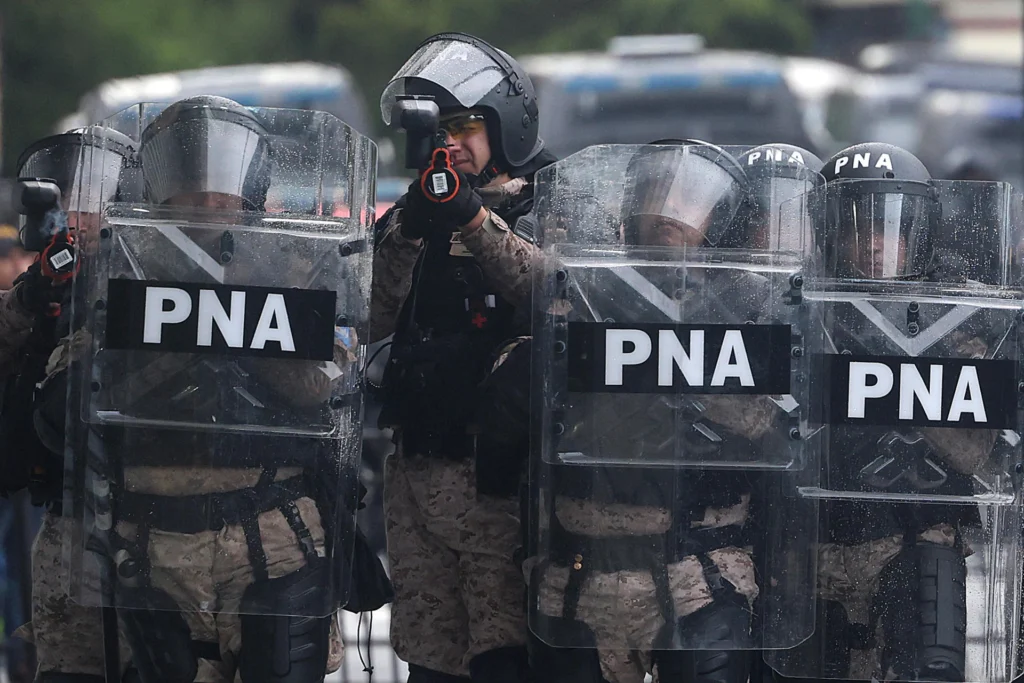
Argentina’s Provincial Commission for Memory (CPM) has filed a criminal complaint against President Javier Milei’s government and security officials over a police crackdown on a university protest in Buenos Aires that left at least 550 people requiring medical attention. The filing accuses security forces of abuse of authority, dereliction of official duties and other crimes.
RELATED: Argentina Abstains on UN Colonialism Vote Despite Malvinas Rhetoric
The complaint concerns the October 16 Federal University March and a demonstration against Decree of Necessity and Urgency (DNU) 70 in Plaza del Congreso. It names the Unified National Security Command and authorities in the Autonomous City of Buenos Aires, alleging that the security operation exceeded legal limits.
The operation involved the Federal Police, Naval Prefecture, National Gendarmerie, Airport Security Police and Buenos Aires City Police. According to the CPM, officers intervened while the mass demonstration was underway, forcing university leaders to interrupt their reading of the main statement from the stage.
The commission reported that officers fired rubber bullets directly at protesters’ faces and heads and used water-cannon trucks against demonstrators. At least 550 people required medical attention, and at least 120 tear-gas grenades were fired, according to the organization.
A CPM report documented injuries to 50 media workers and 15 members of the commission, which is chaired by Adolfo Pérez Esquivel and Dora Barrancos.
Among those injured were Página/12 photographer Guido Piotrkowski, who was struck twice in the chest by rubber bullets, and TeleSISA journalist Laura Quispe, who sustained nine rubber-bullet impacts.
Footage circulated by the Center for Legal and Social Studies (CELS) showed officers aiming at protesters’ eyes. Later that evening, television cameras recorded Gendarmerie officers collecting spent cartridges from the streets and placing them in bags. The CPM raised concerns about the preservation of potential evidence.
Six people were arrested during the protest and its dispersal. Two students from Nicolás Avellaneda School were detained at 5:11 p.m. at the intersection of Montevideo and Sarmiento streets.
One student, aged 14, was held for two hours. The other, aged 17, was charged with resisting authority and faces criminal proceedings under the recently introduced juvenile justice regime.
Police later arrested four adults — three men and one woman — at the intersection of Chacabuco Street and Avenida de Mayo. Human rights organizations said the woman, a student at the National University of Tres de Febrero, was stopped because she was carrying a Colombian flag. All four were charged with resisting authority.
The CPM’s complaint alleges that the actions of officers and their political superiors were coordinated and carried out under orders from senior officials who knowingly authorized the use of coercion outside the legal framework and in violation of Argentina’s international commitments.
The commission has asked the national and Buenos Aires city security ministries to provide a complete list of personnel deployed during the operation, details of the vehicles, weapons and equipment used, and copies of orders transmitted over police radio frequencies.
It is also seeking information about officers who photographed or filmed protesters, including whether they had prior judicial authorization, as well as footage from the city’s surveillance cameras.
The CPM has called for independent forensic examinations and for the collection, custody and analysis of testimony, commercial recordings and other evidence to remain under the control of the competent court or prosecutor. The request specifically excludes the security forces implicated in the events from handling that evidence.
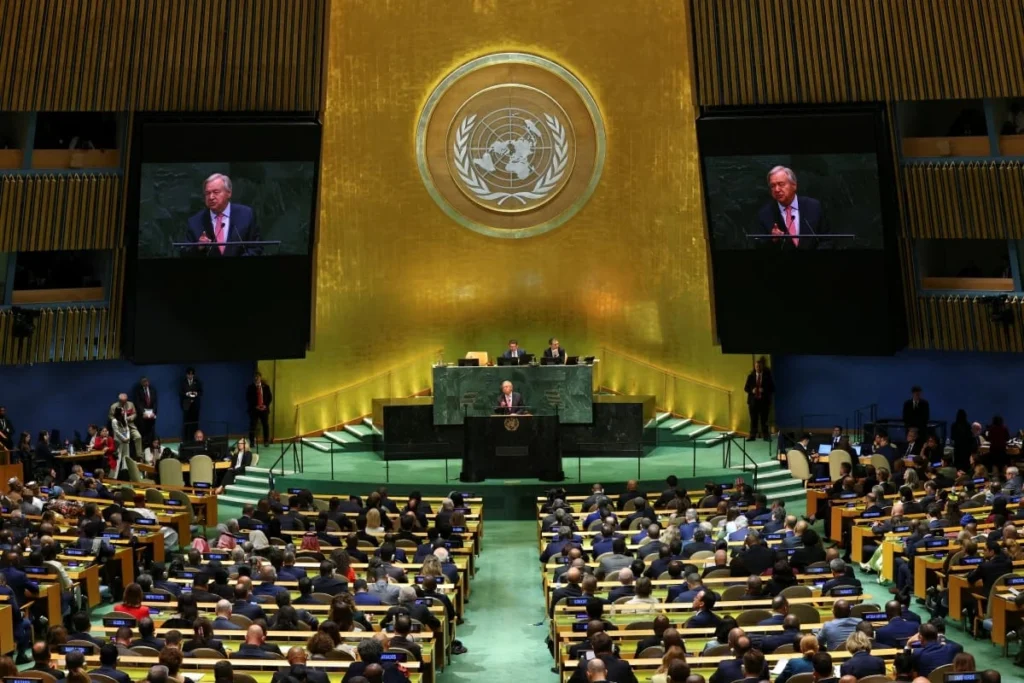
The vote took place in the Fourth Committee of the General Assembly. The measure, presented by the Russian Federation, sought to ratify and reinforce the goals of Resolution 1514, the landmark text approved in 1960 that declared colonialism incompatible with the UN Charter and fundamental human rights.
Argentina’s diplomatic delegation chose to stand aside rather than endorse the initiative. The move placed the Milei government in line with the position promoted by the White House, which pressed allied governments to abstain.
RELATED: Argentine President Milei Toughens Malvinas Claim at UNGA
The resolution passed anyway. Delegates recorded 85 votes in favor, 49 against and 23 abstentions, sending the text to the full General Assembly for consideration.
The alignment extended beyond Buenos Aires and Washington. Chile, Costa Rica, Colombia, Guatemala, Honduras, Peru and Paraguay joined the abstention, a bloc of right-leaning regional governments that followed the U.S. lead.
On the other side, Brazil, Mexico, South Africa and India voted in favor. Their support reaffirmed the global backing for territorial integrity and decolonization processes, and set up a sharp divide within Latin America itself.
The Russian draft went further than the 1960 declaration. It extended the concept of colonialism to cover unilateral coercive measures and the economic and financial sanctions promoted by Washington around the world, a provision that made the vote a direct test of alignment.
The UN General Assembly’s Fourth Committee approved the draft resolution “Addressing contemporary forms of colonialism” by 85 votes in favour, 49 against, with 23 abstentions. Sponsored by Russia, China, Iran, Cuba, Belarus, Palestine and others, it recognizes colonialism in… pic.twitter.com/MqgQfoMhME
— Digital Debate (@digdebate) October 16, 2026
The abstention collides with the rhetoric Milei has used on Malvinas, the archipelago occupied by Britain since 1833. His government has campaigned publicly for the defense of sovereignty and demanded sanctions against oil companies operating on that Argentine soil.
The contrast sharpened in September, when the Argentine President addressed the General Assembly. There he read extended passages demanding the eradication of colonialism and stated plainly that the principle of self-determination “exists to liberate colonized peoples, not to enshrine situations derived from colonization.”
Those words sit uneasily with the vote his own diplomats just cast, or chose not to cast. The abstention, in effect, withheld support from a document that echoes the very argument Milei delivered from the rostrum.
The domestic reaction was immediate. Carlos Bianco, the government minister for Buenos Aires province, called the abstention an irresponsible act against a historic national cause. “The Malvinas question deserves a diplomacy that does not kneel. Abstaining in the face of colonialism is not just an embarrassment, it constitutes an act of irresponsibility. The Malvinas question must once again be defined by Argentines. And it will be,” Bianco wrote on social media.
The episode exposes a tension running through the Milei administration’s foreign policy. It has embraced Washington as its principal ally while maintaining, at least in public speeches, a sovereignty claim that Washington’s abstention strategy directly undercuts.
Milei dice que quiere recuperar Malvinas. En la ONU, la Argentina se abstuvo de votar contra el colonialismo.
— Francisco Cafiero (@FranCafiero) October 16, 2026
Hace dos semanas, esa misma delegación decía que Malvinas es una situación colonial.
Sobran las contradicciones. No tienen política exterior propia y desprecian al país… pic.twitter.com/I5cYaXCbvp
Text reads: “Milei says he wants to take back Malvinas. At the UN, Argentina abstained from voting against colonialism. Two weeks ago, that same delegation said that Malvinas are a colonial situation. The contradictions abound. They have no foreign policy of their own and despise the country they govern.”
Argentina’s historic position on Malvinas has long drawn broad support across Latin America and the developing world, precisely the coalition that voted in favor of the resolution Buenos Aires declined to endorse.
The measure now moves to the plenary, where the same fault lines are likely to reappear. What Argentina does there will reveal whether the abstention was an isolated calculation or a settled posture. For now, the vote leaves a record that is hard to reconcile: a government that speaks of liberating colonized peoples, yet declines to vote for a resolution doing exactly that.

© Sean Gallup/Getty Images
Today's guest is Brazilian economist Fernando Ulrich, one of Latin America's leading experts on Bitcoin and a longtime advocate of free market economics. His 2014 book, Bitcoin: The New International Currency, helped popularize the cryptocurrency in Latin America, where decades of inflation and government mismanagement have made alternatives to state-controlled money especially appealing. But Ulrich doesn't believe Bitcoin needs to replace the dollar to succeed, and he argues that its greatest contribution may be challenging the government's monopoly on money.
Nick Gillespie spoke with Ulrich at the Winds of Change conference in Buenos Aires, where they discussed why the AI investment boom may be drawing capital away from Bitcoin, whether Javier Milei has delivered on his promise to transform Argentina's economy, and how stablecoins are threatening national currencies. They also explore the Austrian school of economics, the risks of protectionism, and why Ulrich believes Bitcoin can expand individual freedom even if it never becomes the world's dominant currency.
0:00—Is Milei delivering on his economic promises?
4:29—Argentina's central bank
7:35—Bitcoin as a payment system
10:10—Bitcoin's adoption rate and volatility
16:38—Is AI a bubble?
19:03—What does Paul Krugman get wrong about Bitcoin?
23:13—China's relationship with Bitcoin
24:24—Differences between Bitcoin and stablecoins
28:25—Subjective value theory
32:40—The Cypherpunks and the concept of exit over voice
37:49—Will an economic crash accelerate Bitcoin adoption?
40:04—Tariffs and free trade
44:18—Why Bitcoin won't replace all currencies
45:26—Nationalism
48:39—2046 Bitcoin prediction
The post Bitcoin Is a Threat to Government-Controlled Money appeared first on Reason Magazine.

© Illustration: Fatima Ruiz
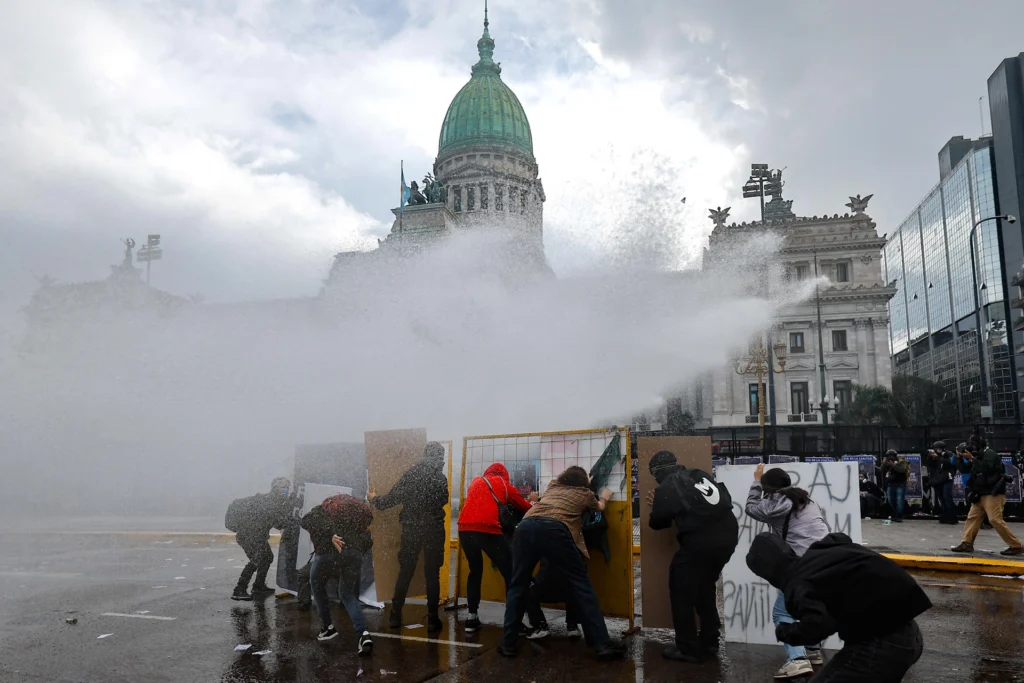
The march demanded implementation of the University Financing Law and denounced a sustained squeeze on public university budgets.
The demonstrations were replicated in dozens of Argentine cities, with students, teachers and university staff joined by unions, social organizations and environmental groups demanding the full implementation of the University Financing Law.
RELATED: Argentina’s Basic Basket Costs Outpace Inflation as Poverty Line Climbs
Protesters also denounced a sustained budget squeeze on public universities and rejected the ninth consecutive appeal filed by Javier Milei’s administration against court rulings that order the transfer of funds to the country’s higher education institutions.
The funding dispute has dragged on for months. Courts have repeatedly instructed the government to hand over the money set aside under the University Financing Law, and each ruling has been met with a new appeal from the national government. Thursday’s march was the fifth federal mobilization in a campaign that has grown beyond campuses to include unions, social organizations and environmental groups.
Beyond the university budget, the crowd voiced opposition to Decree 70/23 and defended the Land Law. Speakers also called for salary increases, relief measures for indebted families and more resources for public institutions.
According to local media, the police began repression outside the National Congress in Buenos Aires as a response to an incident of a group of about eight people, who started breaking street furniture and throwing objects against the fence surrounding Parliament. Despite being an isolated incident, the gassing affected those who marched peacefully. Witnesses warned of possible infiltrators.
At least 34 people were arrested and one woman was injured. Cameras captured a gas canister hitting her head. “The gas thing fell on my head, I don’t know how I am, I have to go to the hospital,” the woman, who gave her name as Andrea, told reporters covering the march.
For its part, the Buenos Aires City Police said in an official statement that its own force detained six people: two minors, aged 14 and 17, and four adults, three men and one woman, charged with assault and resistance to authority.
Press workers also was targeted. Photographer Guido Piotrkowski, who was covering the march, captured the moment when a Federal Police officer stepped out from behind the fence, aimed and fired at him. “They came out from behind the fences and started shooting; I was taking photos and they fired at us,” he said. “They hit me in the chest, another colleague in the leg, but they aimed directly. They were rubber pellets.”
According to the reports, another worker from a community media outlet had to be treated at a hospital after being hit by at least seven rubber bullets. Cameras from the C5N channel also recorded a man with his face covered handling a backpack in the middle of the square. When the reporter approached to speak with him, the man reacted violently and struck the cameraman.
The fifth Federal University March ended under a cloud of gas. The political dispute over who unleashed the violence now moves to Congress, where opposition lawmakers are pressing the security minister to account for the operation.
Meanwhile, the Chamber of Deputies failed in its attempt to debate the rejection of the Decree of Necessity and Urgency 70/23, promoted by the government of Javier Milei to support its program, by failing to reach the necessary quorum at the special session convened by opposing parties. Only 121 legislators attended the legislative day, eight fewer than the 129 required to enable treatment in the compound, with a total of 136 absences.
The opposition call gained momentum following an initial ruling by the Supreme Court of Justice that deregulated the sale of land to foreigners under the Decree 70/23, although a subsequent decision by the court itself temporarily restored the rule, argument that they used allied sectors to avoid attending the session. In parallel, the Government negotiated to include a cap on land sales to foreigners in the Inviolability of Private Property project, which was scheduled for debate on October 21.
On March 7, 2024, Cynthia Conforto’s cellphone exploded with calls. On the eve of International Women’s Day events, a sports journalist’s accusation of sexual assault against four Vélez Sarsfield players disrupted plans for 8M. Conforto had been in charge of the club’s Gender Department for only a few months; Vélez is one of the 30 clubs in Argentina’s professional league. The alleged incidents took place during a team training camp in Tucumán, about 750 miles from Buenos Aires.

© Manuel Fernández
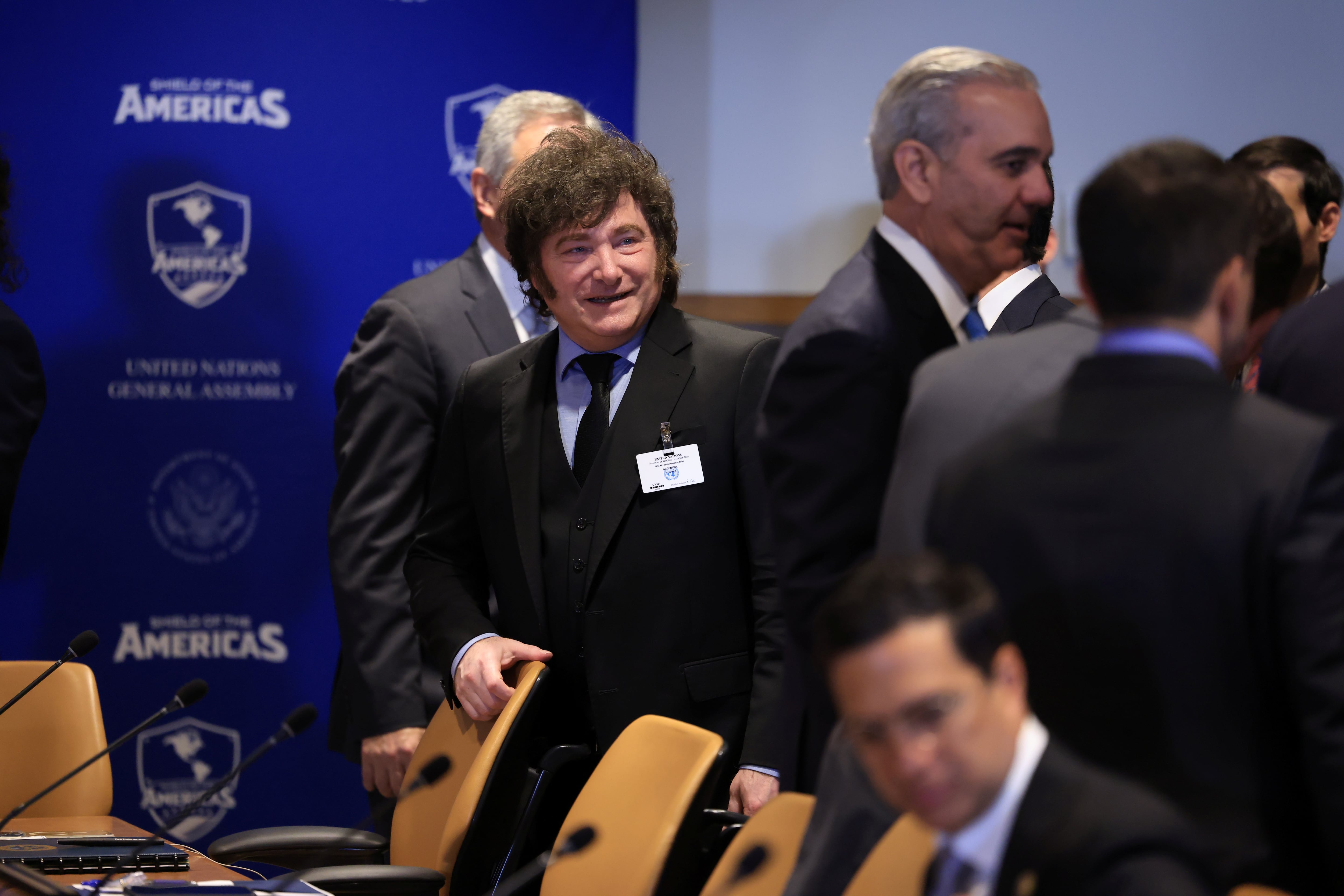
Javier Milei begins another visit to the United States on Wednesday, his 20th trip since being elected president of Argentina and his fifth this year alone. He will remain in Washington, D.C., until Friday, taking part in a series of events aimed at deepening his alliance with the Donald Trump administration and demonstrating his support for Israel.
© Charly Triballeau (Charly Triballeau/Pool AFP via A)
