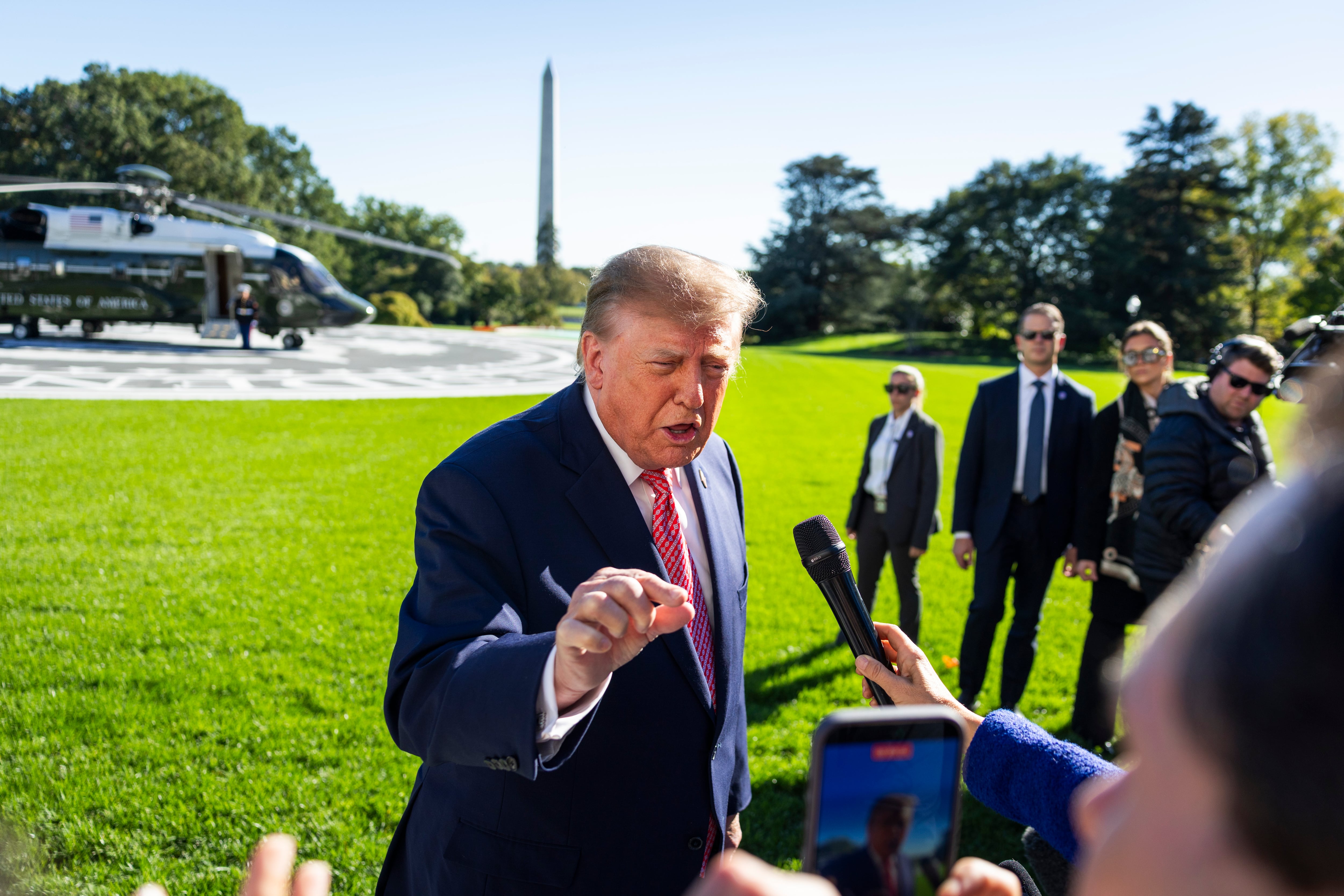
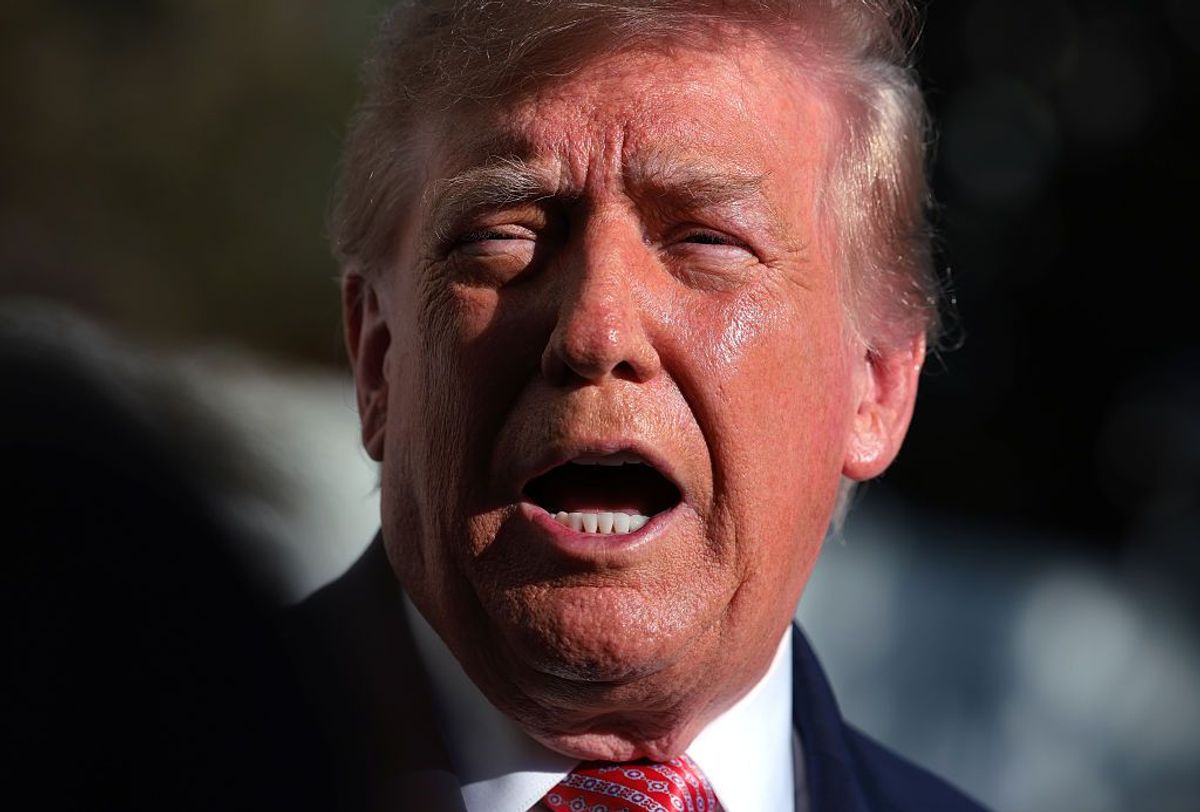
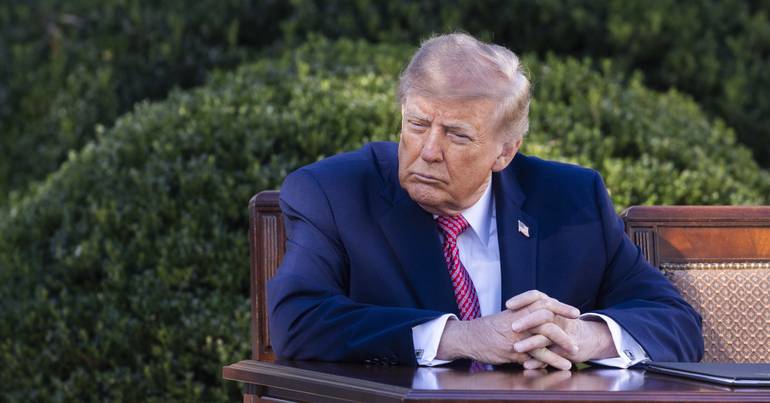
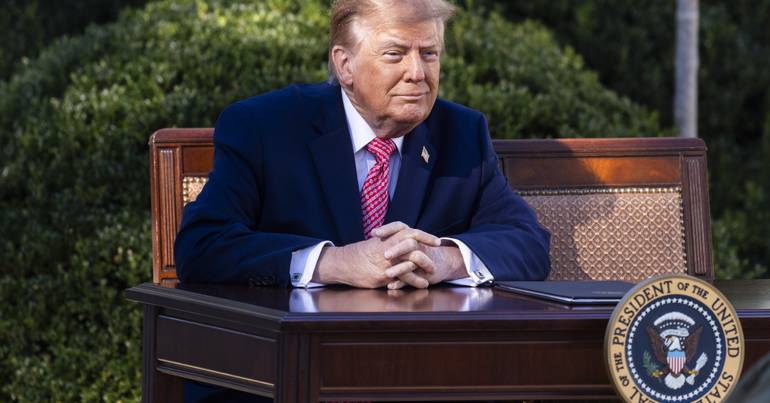
With just two weeks to go until the midterms, President Trump’s itinerary reflects how worried the G.O.P. is about its holding onto the House and Senate.
Sen. Elissa Slotkin (D-Mich.) accused Mike Davis, a close legal ally of the president, of “mobilizing death threats” against her and her staff. Slotkin wrote on social media Monday that Davis had originally been in the mix to be President Trump’s next attorney general after former Attorney General Pam Bondi left her post but “is…
A Donald Trump le interesan las apariencias. En los dos o tres asuntos que más le obsesionan, ejercer como reformador oficial de Washington está entre ellos, también figura la toponimia. El presidente estadounidense ha insistido este lunes en que el nombre del Estado de Nuevo México debería cambiarse “inmediatamente” a Nueva América. En una publicación de su red social ha escrito: “¡No somos México, somos los Estados Unidos de América! ¡El nombre aportaría un gran valor y prestigio al estado!“.
"Russia, frankly, has been fine on Ukraine. They haven't been doing much," Trump said, hours after a Russian drone strike in a public park killed six people, including two children.
A estação aderiu ao boicote à cobertura de Trump em setembro. Agora o Presidente pede aos apoiantes que sigam os seus comícios noutros canais conservadores.
Os dois líderes trocaram elogios mútuos numa chamada divulgada nas redes sociais. Nas sondagens, Netanyahu surge empatado com o ex-chefe do Estado-Maior Eisenkot.
O atual apoio de Trump contrasta com as fortes divergências públicas entre os dois dirigentes em junho e julho, depois de Netanyahu ter contrariado o memorando de entendimento entre Washington e Teerão com intensos bombardeamentos no Líbano
Our White House correspondent Tyler Pager traveled with President Trump as he campaigned across the country ahead of the midterms. As the president touted his record, political drama mounted in Washington.
U.S. President Donald Trump on Oct. 18 claimed his approach to ending the war in Ukraine is "very simple."
In a post on Truth Social, Trump explained that his decision to ease sanctions on Russia while simultaneously piling pressure on Ukraine was to avoid "foolishly (driving)
President Donald Trump on Monday directed the federal government to bolster federal research into women's health, a move pushed by his wife, first lady Melania Trump.
Two weeks before the midterm elections, Trump’s approval rating has hit a two-term low. The war with Iran has driven up the cost of a tank of gas and a cart of groceries, millennials have turned away from him faster than the rest of the country, and part of his base plans to stay home.
Donald Trump’s name is not on any ballot on Nov. 3, yet much of the U.S. electorate will head to the polls with him in mind.
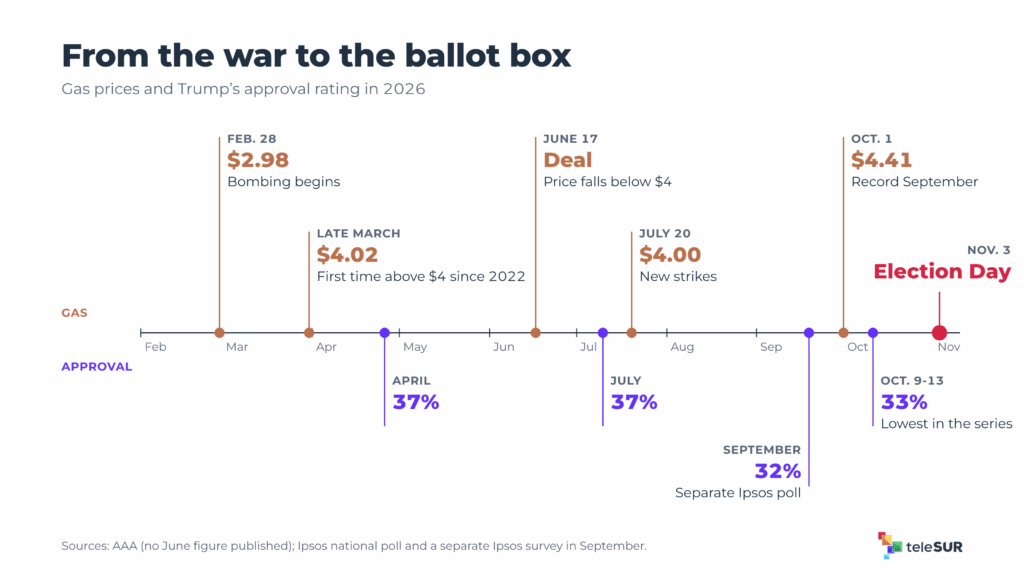
A national poll released Sunday, Oct. 18, and conducted Oct. 9-13, puts his approval rating at 33%, the lowest the series has recorded in either of his terms. Two in three adults disapprove of his performance, 52% strongly, and the same survey had him at 37% in both April and July.
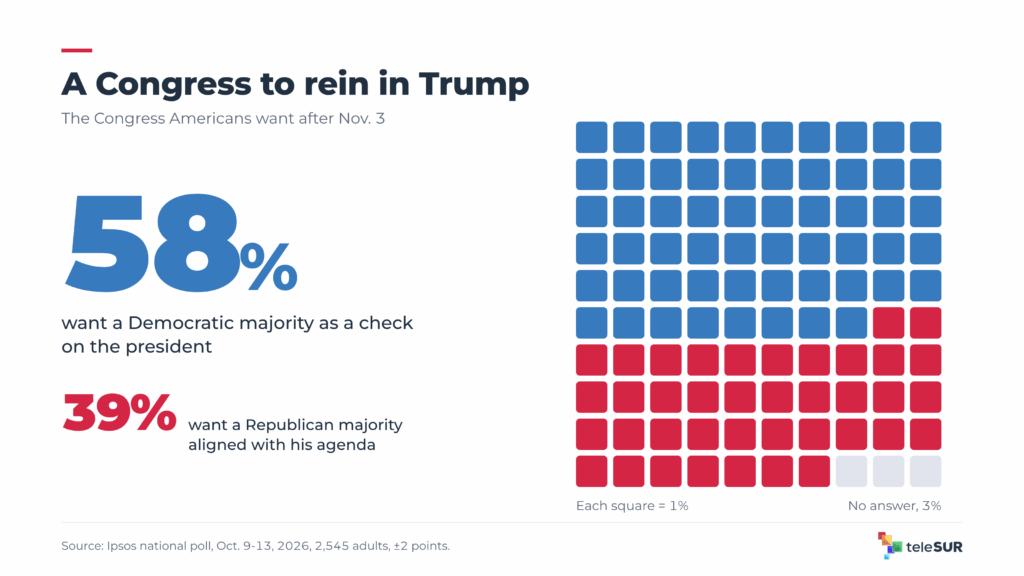
The poll also asked whether the next Congress should act as a check on the president or support his agenda. Fifty-eight percent preferred a Democratic-controlled Congress as a check on him, compared with 39% who want a Republican Congress aligned with the White House, a gap nearly twice as wide as a year ago. Neither party is calling this election a referendum, but the answer brings it close to one.
Almost six out of ten U.S. citizens want the next Congress to counterbalance Trump, a gap that has nearly doubled in one year. Graph: teleSUR
In the race for the House of Representatives, Democrats lead Republicans 52% to 44% among likely voters. Among registered voters the gap holds at eight points; in July it was three.
Between the first bombings on Iran and the election, gasoline soared above 4 dollars and Trump’s approval rating plummeted. Graph: teleSUR
From Hormuz to the Gas Tank
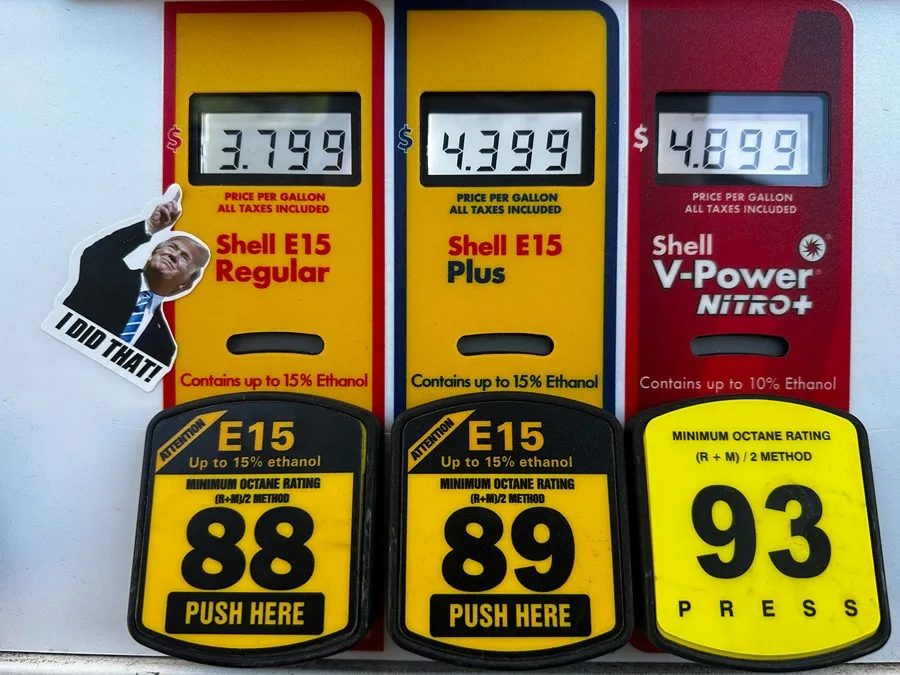
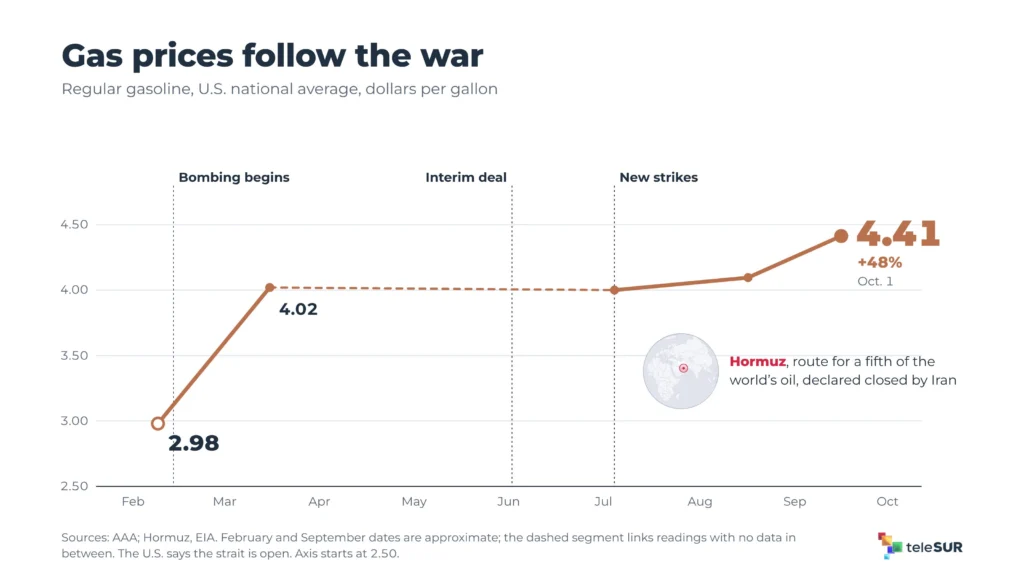
The United States and Israel began bombing Iran in February, when a gallon of regular gasoline cost an average of $2.98, according to AAA. By late March it had topped $4 for the first time since 2022, and each new round of strikes pushed it back up. On Oct. 1, the national average hit $4.41.
At those prices, filling a 15-gallon tank costs about $21 more than before the war.
With Ormuz declared closed by Iran and no oil pipelines capable of replacing it, the gallon rose 48% in the US even with record crude production. Graph: teleSUR
In February, 7 in 10 U.S. citizens considered gasoline affordable. Eight months later, the same share says the opposite.
About a fifth of the oil the world consumes passes through the Strait of Hormuz. According to the official price index for September, consumer prices rose 3.7% over the year, energy 20.4% and gasoline 34.2%, while inflation excluding food and energy stood at 2.6%. Today, 65% of U.S. citizens believe attacking Iran was a mistake.
Tehran declared the strait closed in March and has reaffirmed that stance several times since. In October, Rear Adm. Habibollah Sayyari, chief of staff of Iran’s army, told the official IRNA news agency that the waterway remains closed and that all transit must be coordinated with the armed forces, and he blamed the closure for the rise in U.S. gasoline prices.
Washington says otherwise. On Oct. 7, Secretary of State Marco Rubio said that “the Straits of Hormuz are open,” that as much oil is flowing out now “as there was before this conflict began” and that Iran has “lost complete control of the straits.” Overland routes cannot replace the strait either. Before the war, the EIA estimated that the Saudi and Emirati pipelines that bypass Hormuz had only about 2.6 million barrels a day of spare capacity to divert crude, compared with the 20 million barrels a day that moved through the strait.
Ten days later, Vice President JD Vance revealed another side of the same administration. “I recognize that gas prices are too high right now,” he said Saturday night at a televised town hall. Asked why the war had not ended in a clear victory, he said that “in some ways we have won decisively,” though “the enemy gets a vote.” And he repeated that Iran, “the largest state sponsor of terrorism in the world,” cannot have a nuclear weapon.
On the campaign trail, the fix being sold in Washington points elsewhere. In a poll of 1,000 likely voters taken in early October, four in five agreed that increasing U.S. energy production “can help make everyday life more affordable,” and 67% backed a proposal whose wording already promised the result, “updating federal permitting laws to reduce delays and lower costs.” It is the same reform the oil industry pitches as the key to affordability.
The government’s own energy agency supplies the missing piece. The United States has been the world’s largest crude oil producer since 2018 and is on track for a record of about 13.7 million barrels a day this year, while 84% of the crude that crossed Hormuz was bound for Asia. With output at record highs, gasoline has risen 48% since the bombing began. Crude is priced on a global market, and this year’s price spikes followed the calendar of the war, not the permitting calendar.
The price shock reached much of the world, and Latin American economies that import refined fuels absorbed it without having had any say in the decision to go to war. For those countries, the permitting fight in Washington is a distant concern; the price of their diesel depends on what happens in Hormuz. How much room Washington has to keep waging the war without congressional oversight will also be decided on Nov. 3.
For Latin American families living in the United States, the most visible face of the second term is immigration policy. At the start, half the country approved of it; now about 60% disapprove, and 56% say deportations have gone too far, eight points more than in April 2025. At the same town hall, Vance acknowledged that his rhetoric about immigrants had been “imperfect” and took the blame. “That’s on me,” he said. His goal, he insisted, is not “to dehumanize any immigrant.” “In fact, I love a number of immigrants,” he added.
An Economy Judged by Team Colors
The president’s approval on the economy has fallen to 28%, its lowest mark across his two presidencies. Forty-eight percent feel worse off than when Trump returned to the White House in 2025, the highest share in a series dating back to 1986, and for the first time in more than a decade, registered voters trust Democrats more to handle the economy, 40% to 33%. Before the 2022 midterms, the same series gave Republicans a double-digit edge on the issue.
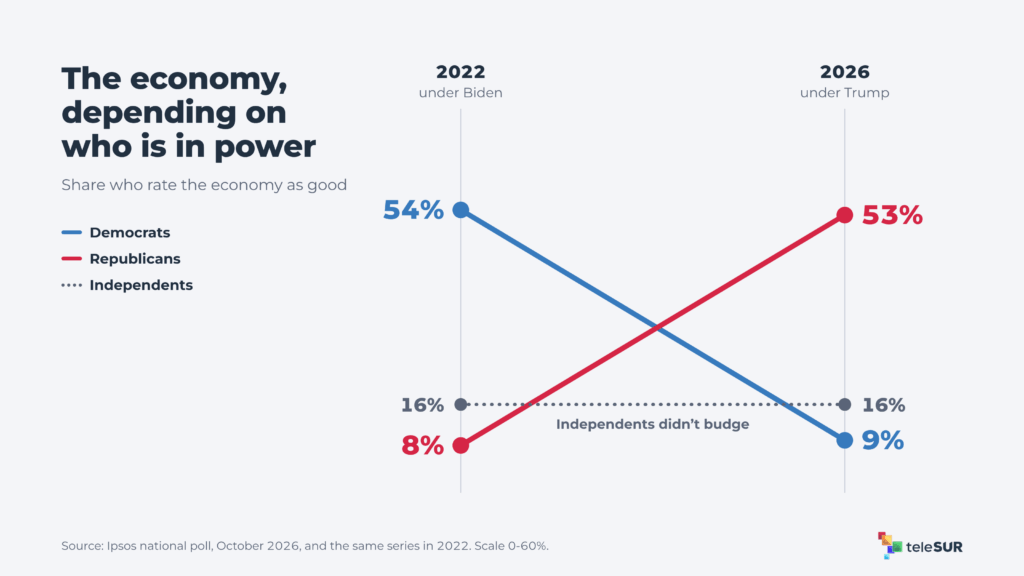
That year, with Joe Biden in the White House, each party’s verdict on the economy was the mirror image of today’s, almost point for point, and independents stood at 16% in both surveys.
Democrats and Republicans reversed their judgment of the economy by changing government, meanwhile only independents stayed where they were. Graph: teleSUR
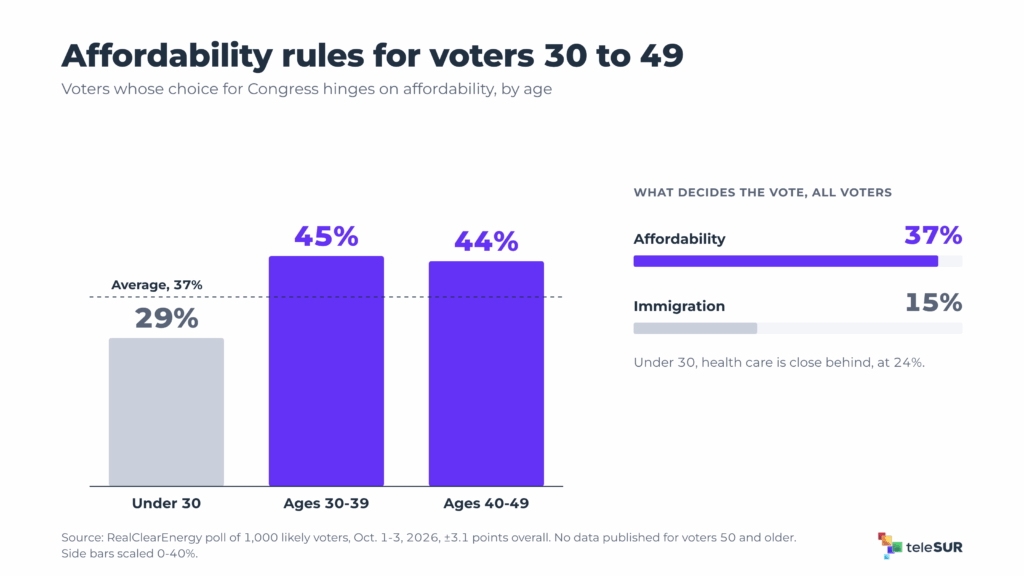
Voters who wear no team colors are moved by their wallets. In the October survey of likely voters, 37% said a candidate’s stance on affordability will decide their vote for Congress, more than double the 15% who put immigration first, an issue central to Trump’s 2024 campaign. That priority is shared by 43% of Democrats, 36% of independents and 32% of Republicans.
Among those who say they are worse off than in 2025, 78% lean toward Democrats, as do 71% of independents in that group.
The Generation that Turned Away Fastest
Millennials, born between 1981 and 1996, are now 30 to 45 years old and make up the largest adult generation in the country. In 2024 they split almost evenly on Trump; exit polls showed voters ages 30 to 44 backing Kamala Harris over him 51% to 47%.
A YouGov poll conducted Aug. 28-31 found 27% approval and 70% disapproval in that age group, the group’s worst showing in the series. Its net rating went from minus 1 in January 2025 to minus 43 in August, a 42-point drop, compared with 30 points nationally.
The Economist makes the opposite case. It argues that millennials have turned their fortunes around and now earn more than any recent generation did at the same age, while narrowing the gap in homeownership. The magazine credits the recovery to markets rather than to a state-funded rescue. October’s polls show what that narrative leaves out.
In the House race, the Pew Research Center found voters ages 30 to 49 favoring the Democratic candidate 43% to 31%, with one in five still undecided.
October’s affordability survey, broken down by age, points in the same direction. Affordability will decide the vote of 45% of voters in their 30s and 44% of those in their 40s, above the 37% average. This is the cohort that entered the job market in the 2008 crisis, pays rent or a mortgage, raises children and fills the tank every day to get to work, and the tank is precisely where prices have climbed the most this year.
The cost of living defines the vote of almost half of voters aged 30-49, above the national average of 37%. Graph: teleSUR
The figures come from surveys with different age brackets and do not prove a single cause. Read together, though, they show the country’s largest generation turning away from Trump faster than everyone else, with the cost of living at the top of its priorities.
Among those who voted for Trump in 2024, 23% now disapprove of his performance and 38% reject his handling of inflation. Most of them still prefer Republicans for Congress, so the erosion does not take the form of a switch to the other party. What they have lost is the certainty that they will vote.
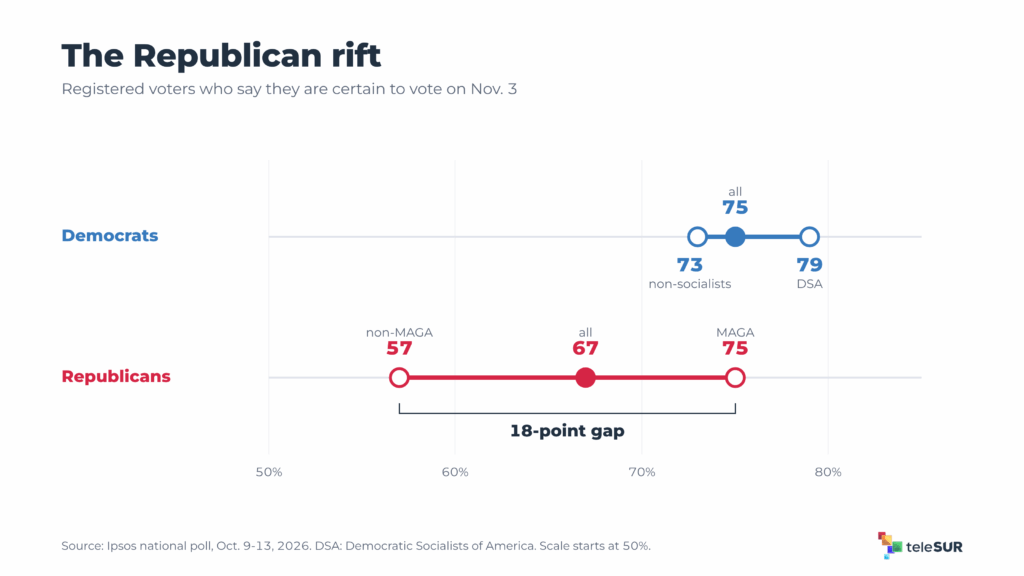
Seventy-five percent of registered Democrats say they are certain to vote, compared with 67% of Republicans. Within the Republican Party, certainty reaches 75% among supporters of the MAGA movement and falls to 57% among those who do not identify with it, and more than a quarter of the latter want Democrats to control the next Congress.
Only 39% of Republicans strongly approve of the president, down from 63% in February 2025.
How many of the 77 million people who voted for Trump in 2024 will return to the polls without his name on the ballot is a question no one can answer yet. Turnout models based on 2022 and 2024 favor Republicans; votes already cast or locked in, by contrast, favor Democrats.
The risk for Republicans is at home. Their MAGA-unaffiliated voters are the least confident of going to the polls. Graph: teleSUR
What is at Stake in the Senate
With the slim House majority Republicans are defending, losing a handful of seats would be enough to hand over control, and presidential approval is among the best predictors of midterm results. Even so, 58% of likely voters who “somewhat” disapprove of Trump still prefer the Republican in their district.
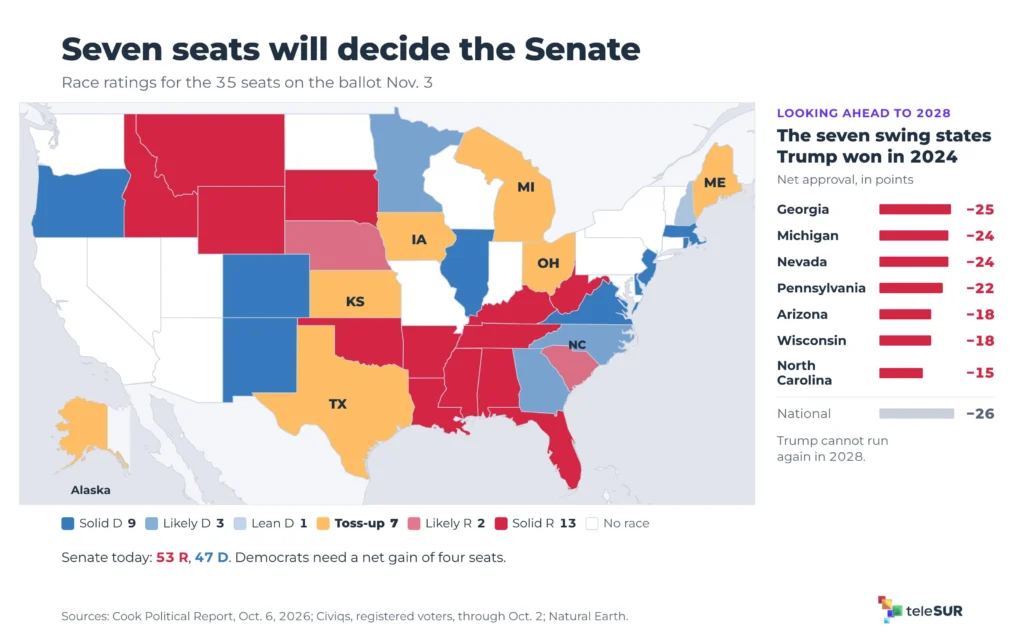
The Senate is split 53-47 in Republicans’ favor, and Democrats need a net gain of four seats to win back the majority. Of the 35 seats on the ballot, seven are rated toss-ups, and six of them — in Alaska, Iowa, Kansas, Maine, Ohio and Texas — are held by Republicans. North Carolina, a Republican seat, is already rated as likely to go Democratic.
The seven states that decided the last presidential election — Arizona, Georgia, Michigan, Nevada, North Carolina, Pennsylvania and Wisconsin — offer an early clue about 2028. Trump carried all seven in 2024, and today his net approval is negative in every one of them, between 15 and 25 points underwater among registered voters, according to the Civiqs tracker. He cannot run in 2028, and those numbers measure a president, not his successor, but they map the terrain his party will inherit.
Six of the seven open Senate races are played in Republican seats, while their approval is now negative in the seven states that gave the White House to Trump in 2024. Graph: teleSUR
On Nov. 3, Trump’s name will still be missing from the ballot. The outcome will depend less on votes that switch parties than on the votes that are never cast, among them those of a generation that split almost evenly on him two years ago and in August disapproved of him by more than two to one.
The Arch and the Gas Pump
On Wednesday, Oct. 14, 20 days before the election, the new Air Force One flew low over the airport in Bullhead City, in the Arizona desert. It is the Boeing 747 that Qatar’s royal family gave Trump, now painted red, white, blue and gold. “When they give you a 747, you say two words, thank you,” he told supporters.
Arizona is one of the swing states that change hands from one presidential election to the next. Joe Biden won it in 2020 by about 10,500 votes, Trump took it back in 2024, and today his approval there is 18 points underwater. The state has no Senate race this year, but it does elect a governor and all nine of its House members. The president chose Mohave County, where he won more than 77% of the vote two years ago, with early voting already a week underway. He went looking for his base, the voters he needs at the polls, not at home.
From the plane he moved on to people who leak military information. “In my opinion, leakers should be shot,” he said, and he called the journalists covering him “almost as bad as a leaker.” He touted the ballroom he is building at the White House and the triumphal arch he plans for the capital. On Iran, whose leaders, he said, “are gone,” he let slip a confession. “I might have gone too far. I don’t know who the hell to deal with.” And he promised that once the war ends,“your gasoline is going to go down to even lower than it was before it started.”
He was addressing a country that fills its tank at wartime prices and pays rents 2.8% higher than a year ago, according to the official price index. Three days later, his vice president admitted on television what the gas pump was already saying. Trump, in Arizona, had preferred to talk about monuments.
The planned arch would stand 76 meters (250 feet) tall, about 26 meters (85 feet) taller than the Arc de Triomphe in Paris, and would rise at the foot of the bridge leading to Arlington National Cemetery, as part of the celebrations for the 250th anniversary of U.S. independence.
Napoleon commissioned the Paris arch in 1806, after his victory at Austerlitz, to honor his armies. Construction dragged on for three decades. When it was inaugurated in 1836, the emperor had been dead in exile for 15 years, and he passed beneath the arch only once, in 1840, inside the coffin that brought his remains back to France.
Orlando Samões admite que Putin está a ser hábil na forma como tem vindo a "enrolar" Trump. Assume que encontro EUA, China e Rússia sobre a guerra não faz sentido sem a presença da Ucrânia.
Iranian Foreign Minister Abbas Araghchi reiterated that his country’s proposal to end the war with the US and to restart nuclear negotiations is “still on the table,” claiming the Iranian conditions are “completely clear” and “unchanging.”
Talking to Iranian state media on the sidelines of the 52nd session of the Council of Foreign Ministers of the Organization of Islamic Cooperation (OIC) in Baghdad on Sunday, October 18, Araghchi also said that Iran is currently studying the US response to its proposals.
If the US meets its conditions, “the Strait of Hormuz will be reopened on the sixth day, and negotiations will resume on the seventh,” Araghchi said.
Though Araghchi did not talk about them explicitly, he reiterated that the Iranian conditions are the same as what the US had agreed to under the Islamabad Memorandum of Understanding (MoU), signed in June.
On several previous occasions Iran has made clear that if the US lifts its naval blockade, releases Iran’s foreign frozen assets, and ends the war on all fronts in the region, it will allow the Strait of Hormuz to open.
As per the MoU, in the first 60 days after the deal took effect both sides were to initiate negotiations over Iran’s nuclear program. However, the MoU expired in August after hostilities were resumed within weeks of its signing.
The US resumed its military strikes on Iran in July, leading the Iranians to reimpose their blockade in the Strait of Hormuz in response, reversing its decision to open it for navigation as per the MoU.
Tehran had claimed that it presented a plan to reopen the Strait to the US in September, in a brief meeting with its delegation during the annual session of the UN General Assembly. However, US President Donald Trump later declared he had rejected the Iranian proposals.
Beware of Israeli provocations
Araghchi also rejected the repeated threats of new strikes and economic isolation against his country, claiming that Iran will not bow to threats and will defend its strategic and economic interests.
Last week it was reported that Israeli Prime Minister Benjamin Netanyahu, who is facing a tough election at home, apart from planning to escalate war against Palestinians in the West Bank, also pressured Trump to resume the military strikes on Iran.
On the same day, Trump claimed that the US may attack some specific targets in Iran in order to disrupt its nuclear program. Media reports also claimed that the US is preparing to use the so-called “mother of all bombs” to again target Iran’s energy and nuclear infrastructure.
This is despite the fact that Trump has repeatedly boasted about “obliterating” Iran’s nuclear program during the joint US and Israeli airstrikes in June 2025.
Reacting to those reports, Araghchi warned both the US and Israel to learn from their mistakes and stay away from Iran to avoid consequences more severe than during the earlier wars.
“Last time you wanted to “finish the job” Iran emerged even stronger. Want to try your luck again? Be our guest. But be careful; we have unfinished jobs too,” Araghchi said in a post on X on Monday.
He claimed that Netanyahu is pressing for a fresh war simply because he wants to stay in power and out of jail over corruption charges he has been facing for years now, without thinking about consequences to Israel or the US.
In a similar reaction, the head of the Iranian armed forces Ali Abdollahi also claimed on Sunday that his country was waiting for their [the US and Israel’s] foolish decision and miscalculation. Any attack by them would invite “a response war more severe, distinct, and devastating than in the past,” Abdollahi claimed.
Abdollahi’s warnings were relayed by several other Iranian officials on Sunday.
It is reported that the US has spent billions of dollars in the last eight months of war on Iran. It has lost most of its military infrastructure in the Gulf countries in Iranian responses, with over a dozen of its soldiers killed and several dozen of its aircraft lost. The US also faced a severe shortage of crucial ammunition due to the war on Iran, forcing it to suspend the strikes midway.
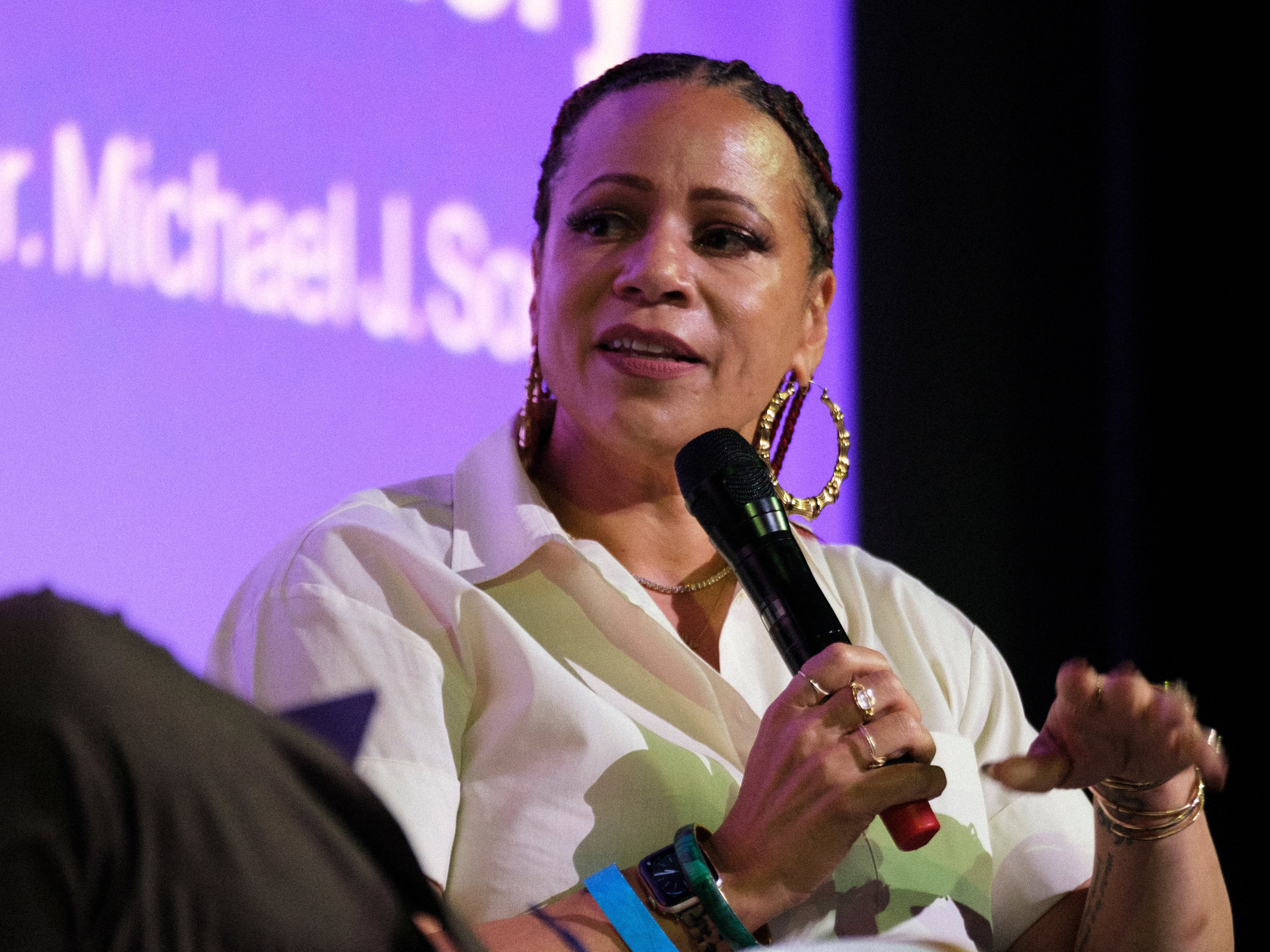
Nikole Hannah-Jones says there have been only two occasions when she looked around a first-class cabin and saw that every passenger was Black. She says that when that happens, something else is going on as well.
Russia wants America and China to decide Ukraine’s future without Kyiv. Europe must challenge this dangerous return to diplomacy of the strong for the strong
Does Vladimir Putin know exactly how to play Donald Trump? The history of chummy phone calls, high-profile meetings and attempts to bring Russia in from the cold certainly suggests that Moscow’s thuggish ruler has a hold on this American president. If Mr Trump agrees to negotiate Ukraine’s future with Mr Putin and China’s Xi Jinping without Ukraine at the table, he will have handed the Russian leader a victory before talks begin. The message will be that strongmen are ruling the world and determining the fate of weaker nations.
Ukraine has the right to determine its future. That right cannot be waved away by a self-serving Russian proposal, however much it indulges Mr Trump’s belief that world affairs should be settled by powerful men. The scales are falling from European eyes. Trumpian America is raising doubts about whether it will help deter aggression or even honour its Nato commitments. If Washington now rewards Moscow and pressures Ukraine to accept a raw deal, it would be a betrayal. European governments would wonder where America might be in the future when their own security is threatened.
Do you have an opinion on the issues raised in this article? If you would like to submit a response of up to 300 words by email to be considered for publication in our letters section, please click here.
Ucraina, un accordo senza Zelensky? Simonini: “Trump può far leva sulla stanchezza degli ucraini”
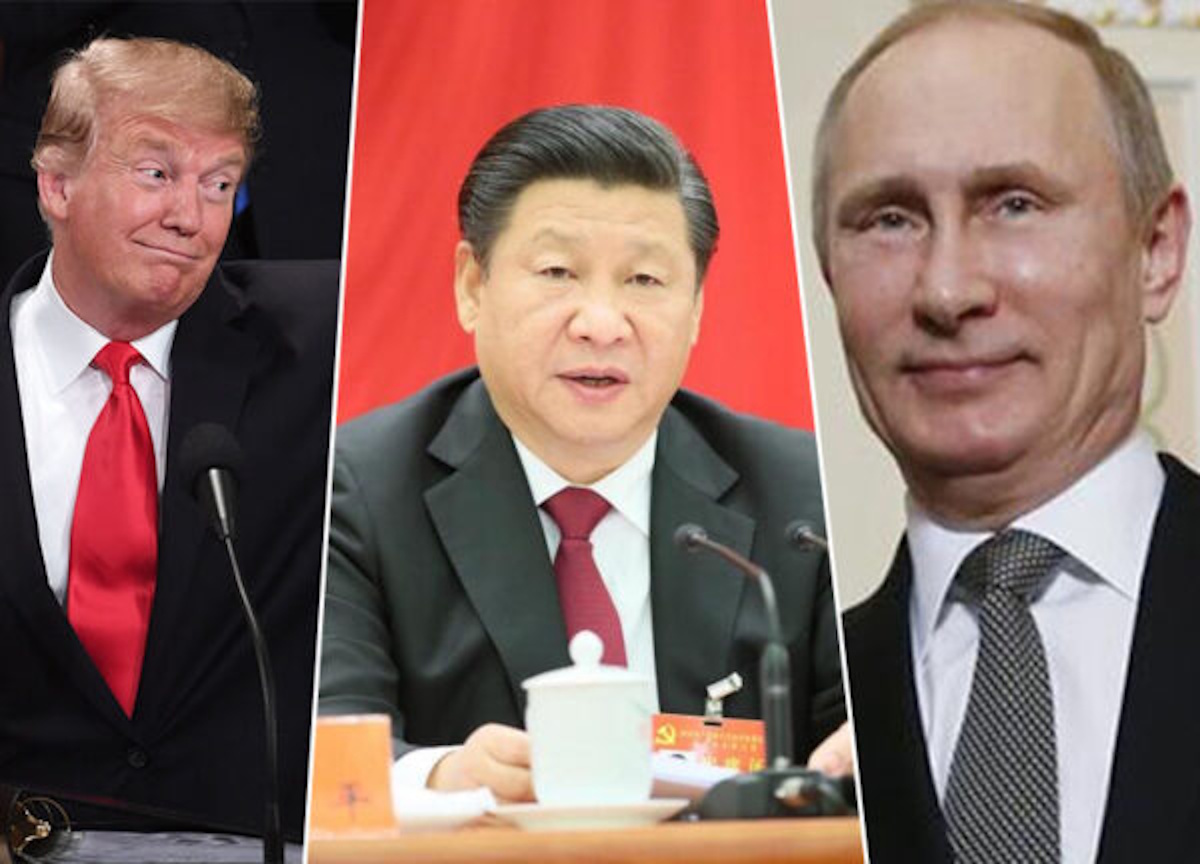
Mentre i diplomatici lavorano dietro le quinte per definire le geometrie di un possibile vertice trilaterale, la prospettiva di un incontro a tre tra Vladimir Putin, Donald Trump e Xi Jinping ridisegna le coordinate della politica internazionale. Sul tavolo non c’è solo il futuro della guerra in Ucraina, ma il tentativo del Cremlino di accreditarsi come terza potenza ordinatrice del pianeta, estromettendo Kiev e l’Europa per ridurre ogni negoziato a un affare esclusivo tra superpotenze.
Ma un accordo sul conflitto ucraino negoziato senza la partecipazione di Zelensky è davvero realizzabile? Quali sono le reali motivazioni di Mosca e i rischi che corrono le cancellerie europee? E soprattutto, fino a che punto la Cina è disposta a spingersi nel ruolo di mediatrice senza compromettere la propria strategia sull’Indo-Pacifico?
A fare il punto è Franz Simonini, analista geopolitico e firma della rivistaDomino, che ad Affaritaliani analizza la fattibilità del summit, gli obiettivi strategici di Mosca, Washington e Pechino e i possibili scenari futuri.
Quanto è concreta la proposta di Putin di un vertice trilaterale con Trump e Xi Jinping e quali obiettivi strategici persegue Mosca?
La proposta russa di un vertice trilaterale con Stati Uniti e Cina veniva ventilata già da settimane. Avanzata lo scorso settembre, è stata poi rilanciata durante la telefonata del 9 ottobre fra Donald Trump e Vladimir Putin, la stessa che ha visto confermare l’intesa sul gasolio russo e sospendere alcune sanzioni fino all’aprile 2027. Al di là della concretezza della proposta e della scenografia degli incontri, le decisioni maturano sempre prima, nei meandri delle diplomazie.
Epperò gli obiettivi di Mosca appaiono nitidi. Anzitutto estromettere dal tavolo Kiev e le cancellerie europee, ritenute dal Cremlino i principali ostacoli a una soluzione favorevole, così da ridurre «la pace» a un mero affare fra grandi potenze. Di qui il secondo scopo, di natura simbolica, ovvero sedere da pari accanto a Washington e Pechino per restituire alla Russia il rango di potenza ordinatrice ed emanciparsi, almeno in parte, dall’immagine di socio di minoranza della Repubblica popolare.
Infine profittare della fretta della Casa Bianca per incassare il più possibile dalle eventuali trattative, a dispetto delle gravi difficoltà sul campo di battaglia e prima che l’inverno rallenti ulteriormente le operazioni.
Un eventuale accordo sulla guerra in Ucraina senza la partecipazione di Zelensky sarebbe davvero possibile? Quali rischi correrebbero Kiev e l’Europa?
Sul piano tecnico, la sopravvivenza dell’Ucraina è dipesa finora dalla logistica, dalla tecnologia, dai rifornimenti e soprattutto dall’intelligence statunitense. Benché in oltre quattro anni di guerra il paese abbia saputo accrescere la propria produzione autoctona di droni e di altri sistemi d’arma, resta legato a doppio filo alle forniture occidentali.
A ciò si aggiunge la stanchezza della popolazione. Secondo un sondaggio di inizio ottobre, il 62% degli ucraini ritiene che nessuno dei due belligeranti stia prevalendo e il 56% accetterebbe cessioni territoriali in cambio di garanzie di sicurezza americane ed europee. Una spossatezza su cui Washington potrebbe far leva per imporre a Kiev le concessioni necessarie a un compromesso con Mosca, dall’amputazione del Donbass alla neutralità, fino alla rinuncia proprio a quelle garanzie che gli Stati Uniti non intendono offrire in prima persona e che tenterebbero semmai di accollare di straforo agli alleati europei.
Le trattative sono in pieno svolgimento e, tra i rapporti di forza sul campo e l’urgenza washingtoniana di volgersi all’Indo-Pacifico, potremmo trovarci dinanzi a un autentico punto di svolta.
Che cosa cerca di ottenere la Cina da questo incontro e quanto potrebbe rafforzare il proprio ruolo di mediatrice tra Mosca e Washington?
Per Pechino il vertice costituisce allo stesso tempo un’occasione e un’insidia. Ospitare a Shenzhen gli inquilini della Casa Bianca e del Cremlino consacrerebbe simbolicamente la Repubblica popolare come potenza indispensabile, l’unica in grado di favorire la pace. Di converso lo Zhongnanhai sa bene che l’incontro rischierebbe di ridursi a un atto meramente cerimoniale, privo di ricadute concrete se non a proprio detrimento.
In primo luogo, Mosca potrebbe, nei mesi successivi, recuperare margini di manovra al di fuori del rapporto obbligato con il potente vicino, allentando di riflesso la dipendenza che oggi lega le due capitali. In secondo luogo, ed è il punto decisivo, Washington, sgravata parzialmente dall’assillo del quadrante est-europeo, potrebbe concentrare le proprie pressioni sull’Impero di mezzo.
Di qui la prudenza mandarina, sospesa fra la necessità di vestire in pubblico i panni di paladina di un vantaggio reciproco tanto proclamato quanto fittizio e la convenienza di trarre partito dall’impantanamento delle potenze rivali. Con lo sguardo sempre fisso su Taiwan all’interno di un tempo limitato.
The fire, which did not seriously damage the network, came after similar incidents in Bulgaria and Poland involving the satellite internet provider, a key defense tool for Ukraine’s armed forces.
US President Donald Trump wrote in a Truth Social post on 18 October that he did not want to “drive, foolishly, Russia away from the bargaining table.” He also wrote: “Signing that document at this time will do that, and I can sign it later, or any time that I want!”
Trump was referring to sanctions and tariffs under the Lindsey O. Graham Sanctioning Russia and Iran Act of 2026, which he waived in an executive order on 16 October, days before the measures were due to take effect. The waiver suspends additional economic penalties intended to pressure Moscow over its war against Ukraine, while leaving earlier US sanctions in place. The decision came weeks before the 3 November midterms, in which Republicans are defending slim majorities in both chambers, and analysts said the penalties could have pushed up oil prices for Americans already paying more, largely because of the US-Israeli war with Iran, Reuters reported.
Trump says Zelenskyy could have made a better deal two years ago
A week before the waiver, Trump had announced a deal for Russia to increase diesel supplies to global markets. The Treasury also issued a license, valid until 7 April 2027, permitting certain transactions in Russian-origin diesel.
In the Truth Social post, Trump accused Ukrainian President Volodymyr Zelenskyy of targeting Russian diesel refineries, saying the strikes were “seriously hurting the world diesel markets, including those in the United States.” Kyiv had paused its refinery strikes for three days at Washington’s request after Trump declared an energy ceasefire on 11 October, which Russia never confirmed, then resumed them. Since then, Russia has struck Ukraine’s energy sector 76 times, Zelenskyy said on 18 October.
Explore further
Kyiv gets no warning of the first of two Russian ballistic waves, hours after Zelenskyy said US alerts were back
Trump wrote that Zelenskyy “doesn’t want to end this war, and probably never did,” and that he “could have made a better deal two years ago than he can now.”
“His country is in shambles, a large portion of his land is lost, his oceans and seas are gone, and his male population is low, wounded, and/or dead,” Trump added.
He also said Russia was “doing very little, if anything, to help” Iran and that he wanted to keep it that way.
A day earlier, Trump said he had not made a final decision
On 17 October, Trump told reporters at Mar-a-Lago that he had not announced his final decision. “A lot of you don’t know what my decision is yet, but we’ll figure it out, and you’ll figure it out,” he said, Reuters reported.
“I think the president wants to take the 60-day period of time to sort of analyze what imposing both sanctions and tariffs will mean to the global economy and even to the US economy,” US Secretary of State Marco Rubio told reporters before departing for Uzbekistan the same day.
Zelenskyy calls the waiver a pity as Republicans split
Zelenskyy called it a “pity” that Trump had waived sanctions under a law named for the late Senator Lindsey Graham, who “really believed in Ukraine.” He said he hoped Trump would change his decisions, NBC News reported.
Discussing the diesel deal on NBC’s Meet the Press, Zelenskyy said US oil prices had risen because shipping through the Strait of Hormuz was blocked, not because of Ukraine.
Explore further
A month before the diesel waiver, Trump’s envoys had already pitched Kyiv on Russian gas, NYT says
On 17 October, Zelenskyy told journalists that “the decision to undo all of this, to block all of it, seems wrong to me” and that it “definitely helps only the Russians.” His remarks appeared in Ukrainian on his official Telegram channel.
“Sanctions relief will continue. I think the diesel deal and the move regarding the Lindsey Graham Act are not the end of it. Unfortunately,” Zelenskyy said.
On 19 October, Zelenskyy wrote that partners had again given no warning of Russia’s overnight ballistic attack and that blocking missiles for Ukraine’s air defense while Russia gets sanctions eased or postponed amounts to partners denying reality.
Republican Senator James Lankford defended Trump’s decision on NBC’s Meet the Press, saying the president was “choosing the American people first.”
Senator Darline Graham, Lindsey Graham’s sister, whom Trump has endorsed for a full term, said at a campaign stop on 17 October that she would “choose to keep the pressure on Russia.”
“I don’t trust Putin and I don’t trust Russia,” Darline Graham said.
She did not directly criticize Trump but said she would not have made that choice, Reuters reported.
Critics of Trump’s diplomatic staffing don’t address why it’s important to have a top man on the ground in the Zoom era.
During my more than two decades at the State Department as a diplomat, my well-meaning mother often asked what I’d have to do to make ambassador. The answer was simple: Dad would have to die young, and Mom would then have to donate the whole estate to the winner of the next presidential election. Then I’d get appointed ambassador to a small, unimportant country. For so many reasons, I am glad Dad lived to a ripe old age, and that Mom looks forward to taking care of the Humane Society in her will instead. I would have made a terrible ambassador.
Since 1960, 72 percent of America’s ambassadors to desirable posts in Western Europe and the Caribbean have been political appointees like the recently departed Kimberly Guilfoyle, as I might have been if the plan with Mom had worked out. Their primary and often only qualification is spending big on the guy who won the presidency. Career diplomats on the other hand are often promoted as ambassador into politically less important hardship posts, no donation required. All must be confirmed by the Senate. The United States is unusual among developed democracies in the scale of political ambassadorial appointments. Unlike the U.S., most developed democracies, including Britain, Germany, Japan, Australia, Canada, and New Zealand, reserve ambassadorships almost entirely for career diplomats.
So while the debate over political ambassadors versus career diplomats has gone on for more than a century, in 2026 the more interesting question may be whether we need ambassadors in every capital at all. What useful and productive thing was Guilfoyle doing in Greece anyway?
It is important to have a good person in the role; he acts as the personal representative of his country’s leader, in America’s case, answerable to the Oval Office. He receives confidential instructions from the White House before taking up his job abroad, and for many political ambassadors, can often pick up the phone and call the president and cabinet officials directly. I was in the room as a subject matter expert when ambassador Howard Baker simply picked up the phone and dialed Vice President Dick Cheney at his ranch in Wyoming and untied a significant bureaucratic knot that was burdening our relationship with Japan. This demonstrates something well-connected political ambassadors can uniquely do. On the other hand, communication inside an embassy can be problematic for political appointees; many Foreign Service Officers (FSO) see them as outsiders come to mess up their way of doing things and slow-walk ambassadorial initiatives because they are sure they know better. Political appointees, especially those taking leave from large businesses to serve, also tend to spend a lot of their time back in the U.S., creating friction with the staff.
In the American system, because most career ambassadors owe their own bottom-line allegiance (and pension) to the State Department, communication is often not that close and friendly with the Executive under most circumstances. A White House unsure of whether the State Department is even on its side will be unlikely to be reassured by a career ambassador in place, not to mention State’s long-standing institutional resistance to too many political appointees in general. Careerists usually do have strong host-country knowledge and maybe language skills. Some, however, can get too deep into the weeds on administrative, visa, or personnel matters a political appointee usually leaves to subordinates, and some use their new-found authority to settle old scores or pursue personal projects adjacent to core foreign policy.
The ambassadorial title remains the profession’s highest achievement. It would be surprising if ambitious FSOs did not aspire to it. But just being the most qualified for anything inside State is rarely enough. That leaves plenty of careerist yes-men around looking to get into an ambassador’s chair.
The struggle over who is better at the job, political appointees or careerists, will never conclusively end. It has been a factor of American diplomacy for decades, under all flavors of administrations. The mainstream media negatively focus on some of Trump’s ambassadorial choices, but to anyone familiar with diplomacy it is nothing more than another round in a century-old political argument.
The new question, unique to the second Trump administration, is whether or not the president should appoint anyone at all, career or political, to a particular ambassadorial job. Trump currently has 92 ambassadorial seats empty, with either the candidate stuck in the Senatorial confirmation process or the chair simply left vacant by Trump’s choice. The same number of empty offices at comparable points of their presidencies was only 54 under Biden, and 55 under the first Trump administration. A lot of the empties are in smaller countries of lesser political importance, but a few larger embassies stand out, including Egypt, Qatar, Saudi Arabia, and Germany. Some have pending nominees, some do not. Senate intransigence aside, this seems to be by choice. The real question is, however, how much it matters.
Any American embassy without an ambassador is led by a charge, someone temporarily in the ambassadorial role, typically the embassy’s deputy chief of mission (DCM). The DCM is usually a State Department career FSO, typically the most experienced and senior one at post, and often has done multiple tours in the country in subordinate roles. This seems like the kind of person State would want in charge, yet the American Foreign Service Association and most rank-and-file FSOs curiously complain about not having enough career officers in leadership roles. One wonders whether for some critics the temporary nature of the title itself has become too much the issue.
Things are complicated by the fact that until something goes wrong, most ambassadors work without real oversight. One of the criticisms in Dennis Jett’s excellent book American Ambassadors is the lack of standards and definitions of success for an ambassador. They report to the president after all, who is usually too busy to pay much attention to things on a day-to-day basis in Lesotho, no matter who the ambassador is. Underlings in the embassy by culture and negative experience tend to be sparse in their suggestions upward, and State has little of the military’s tradition of after-action summaries, tough lessons-learned reports, and sincere historical evaluation of mistakes. Ambassadors tend to choose their own path. Some try to be local celebrities, scoring photo-ops and ribbon-cuttings and hosting VIPs. Others focus near-exclusively on American business promotion abroad, while others remember their own days in the bureaucracy and dive deep into political or economic reporting. This all further complicates what is and is not a “good” ambassador. So do we really need them?
Some Democrats think so. Senator Jeanne Shaheen (D-NH), the Senate Foreign Relations Committee’s top Democrat, accused the administration of retreating from the world stage by leaving ambassadorial postings vacant. “China has ambassadors in nearly every country it has diplomatic relationships with, advancing its interests at the expense of America’s,” she said in a statement. Yet she and others rarely provide specific examples of what America’s ambassadors are doing or might be doing. Critics rarely identify policy outcomes that required a Senate-confirmed ambassador rather than a competent charge. That is the problem in these discussions, an unwavering belief that diplomatic presence is inherently valuable, even when its measurable effects are difficult to identify, and that if we’re not careful China will do it better. Remember of course the exact argument was made during the Cold War about the Soviet Union, leading the U.S. to open embassies in countries with little global importance, only to close them when priorities changed.
Ambassadors are increasingly curiosities left over from the 19th century, a past when Washington, DC, needed trusted representatives empowered to make decisions a world away. Embassies as they exist today were created for a world without Zoom, encrypted messaging, presidential and cabinet travel, celebrity special envoys, global media reporting, and easy direct leader-to-leader calls. It raises the question in 2026 that few people are willing to ask: If 92 embassies can function for months without ambassadors, how indispensable were those ambassadors in the first place?

 Login