❌

Reading view

Flávio Bolsonaro’s Campaign Uses AI to Engineer Fake Support

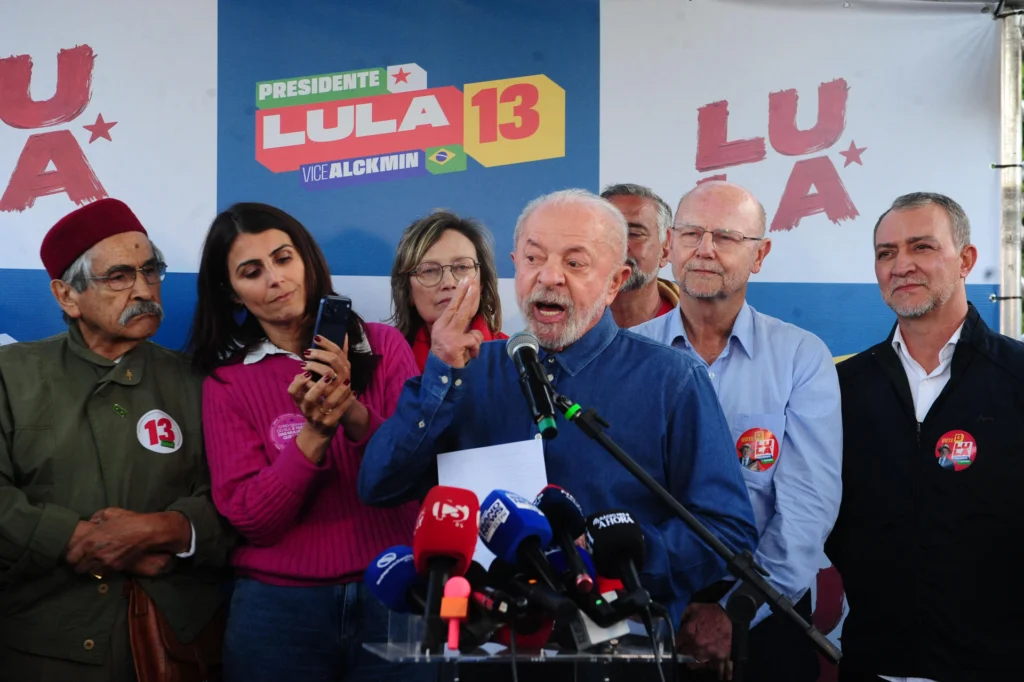
Flávio Bolsonaro at a rally for his presidential campaign. Photo: JOTA.

Digital models modified Flávio Bolsonaro’s event photography to artificially expand audiences and simulate support from female voters.


The Brazilian presidential election has become an arena for modern, dirty digital tactics. Senator Flávio Bolsonaro, representing the Liberal Party (PL), has centered his campaign strategy around coordinated digital reach and automated content production.

RELATED: UN Experts Raise Concerns Over Meta’s Handling of Political Expression During Brazil Elections

Rather than working as a traditional political campaign of physical rallies, the operation relies heavily on digital distribution infrastructure across social media platforms.

Flávio’s strategy operates through two main mechanisms. First, the campaign uses synthetic consensus tools, automated social media accounts, AI image generation, and digital avatars to simulate organic public backing.

Second, the campaign benefits from algorithmic distribution asymmetries on digital platforms, which amplify far-right material while placing system restrictions on competing political content.

Collected evidence by independent researchers, journalism networks, and electoral authorities indicates that systemic digital manipulation and platform-level infrastructure played a decisive role in shaping voter perception and electoral engagement in Brazil.

Industrial Bot Networks

A core component of Flávio Bolsonaro’s digital strategy involves the commercial purchase of automated networks designed to manufacture artificial public support.

An investigation by The Intercept Brazil revealed that Flávio Bolsonaro paid Elytron, a cybersecurity firm, to carry out data collection and voter identification to spread rumors and create fake accounts.

These automated tools operate primarily across WhatsApp, Instagram, and X, generating synchronized posts and artificial engagement to bypass standard organic distribution patterns.

This infrastructure uses astroturfing techniques to alter online public discourse. By deploying thousands of automated accounts programmed to post identical messaging scripts, the campaign artificially inflates engagement metrics, pushes specific political hashtags into regional trending lists, and floods comment sections on public news pages.

This creates a false impression of widespread popular momentum, designed to sway undecided voters through perceived consensus.

Technical evaluations submitted during electoral court proceedings reveal the scope of these automated operations. Data presented to electoral monitors shows coordinated account clusters posting at frequencies humanly impossible without software automation.

🚨 BREAKING: Flávio Bolsonaro paid R$600,000 to a company that offered AI to manipulate elections, according to Intercept Brasil. pic.twitter.com/eFcRp74vNw

— Pop Core (@TheePopCore) October 16, 2026

Deepfakes, AI Avatars, Demographic Manipulation

Various social organizations and media outlets have denounced the deployment of AI image and video generation tools as another facet of Flávio Bolsonaro’s digital strategy.

A prominent example occurred during campaign launch events, where the campaign broadcast an AI-generated digital avatar of former president Jair Bolsonaro endorsing his son’s candidacy. This technique allowed the campaign to maintain the political presence of the former president Bolsonaro in public events despite judicial rulings restricting his direct participation in political activities.

In addition, the campaign used AI tools to manipulate visual documentation of campaign gatherings. Documented instances show event photography processed through image generation models to alter crowd compositions.

These AI modifications included scaling up crowd sizes to exaggerate physical attendance and digitally swapping male attendees with female faces. The primary objective of this demographic engineering was to simulate broader support among female voters, a demographic group where polling data consistently showed lower support for the candidate.

An investigation by a Brazilian media outlet identified more than 50 TikTok videos altered using AI, specifically on-the-street interviews in which subjects claimed they would vote for Flávio Bolsonaro. These videos garnered over 7 million views, yet in only 18% of them did the platform indicate that the individuals featured were AI-generated.

While Brazilian law prohibits the use of AI-generated videos in political campaigns, it is difficult to determine when such content is created by third parties with no direct affiliation to the campaigns.

Due to a lack of female supporters, Brazilian presidential candidate Flávio Bolsonaro has resorted to using AI to transform middle-aged men into attractive young women.

This AI-generated creation has been dubbed the "Bolsonaro Bombshell." pic.twitter.com/ap1ecKou9K

— Vatnik Soup (@vatniksoup) October 20, 2026

Disinformation and Aggressive Public Discourse

Flávio Bolsonaro’s public communications strategy relies heavily on coordinated attack campaigns directed against President Luiz Inácio Lula da Silva and the Workers’ Party (PT).

The Flávio campaign’s public messaging routinely utilizes sensationalist allegations and targeted attacks. Online networks affiliated with the campaign circulate manufactured claims regarding public safety, economic stability, and social values, framing the current administration in terms of moral crisis.

On Sunday the 18th, the public debate between the two candidates took place, and Flávio Bolsonaro spent most of his time attacking Lula during his turns to speak.

Throughout the debate, Flávio was sarcastic and mocking toward President Lula; he attempted to intimidate him physically, to which Lula responded by moving away, stating that he did not want to be near either Flávio or the Bolsonaro family.

Furthermore, when the discussion turned to public safety, Flávio claimed that Lula is the preferred candidate of organized crime, pointing out that Lula received a large number of votes from within the country’s prisons. Lula replied, “I want 100% of them to vote for me -even your father,” a reference to the fact that Jair Bolsonaro is currently incarcerated.

This aggressive messaging strategy directly impacts the broader political environment. By flooding public discourse with inflammatory claims, the campaign creates heightened polarization, distracts from substantive legislative evaluations, and systematically delegitimizes established democratic processes and electoral monitoring bodies.

Hundreds of Brazilians protested outside Meta’s São Paulo offices, accusing the technology giant of limiting President Luiz Inácio Lula da Silva’s campaign reach while boosting far-right candidate Flávio Bolsonaro, just six days before the presidential runoff. The demonstration… pic.twitter.com/KRAxExFjMO

— teleSUR English (@telesurenglish) October 20, 2026

Meta’s Structural Bias in the Campaign

The Brazilian presidential race was shaped by asymmetries within Meta’s platforms, including Instagram, WhatsApp, and Facebook.

Filings submitted to the Superior Electoral Court (TSE, in Spanish) by President Luiz Inácio Lula da Silva’s legal team documented clear disparities in how content from both campaigns was handled by the different platforms.

A primary issue involved Meta’s generative AI features. When users requested campaign materials incorporating Lula’s official ballot number, 13, the system repeatedly rejected the prompts, citing political content restrictions. Conversely, identical requests containing Flávio Bolsonaro’s candidate number, 22, were routinely processed, generating promotional material for the far-right campaign.

In other instances, the AI tool inserted Bolsonaro’s electoral number into completely unrelated image requests. Following formal complaints, the Superior Electoral Court ordered Meta to ensure equal treatment. Meta attributed these outcomes to technical errors and implemented broad restrictions on political image generation.

Internal Meta communications revealed that technical errors caused Lula’s official Instagram profile to be excluded from platform search results and recommendation engines, while Flávio Bolsonaro’s profile remained fully discoverable and actively recommended to users. Furthermore, internal technical escalations confirmed that temporary account restrictions had hindered the reach of Lula’s messaging assets.

WHO'S THE REAL THIEF? LULA CHALLENGES BOLSONARO TO SHOW RECORDS

Ahead of Brazil’s presidential election, Brazilian President Lula da Silva publicly challenged rival Flávio Bolsonaro to open his bank accounts, release his phone records, and let the Brazilian people decide who… pic.twitter.com/U6Ge0yOV6A

— Sovereign Media (@sov_media) October 21, 2026

Regulatory Imperatives and Popular Sovereignty

The execution of Flávio Bolsonaro’s digital presidential campaign illustrates the evolving mechanics of far-right electoral operations.

By combining commercial bot procurement, generative AI deepfakes, coordinated public attacks, and platform-level algorithmic advantages, the campaign constructed a heavily synthetic media environment designed to influence voter perception.

These developments underscore the limitations of existing legal and regulatory frameworks in addressing digital campaign manipulation. While judicial interventions by the Superior Electoral Court forced technical corrections, reactive oversight remains insufficient to counteract real-time automated suppression and algorithmic imbalance.

Protecting democratic processes requires structural regulatory reform, including mandatory algorithmic transparency, strict auditing of generative AI systems, and clear accountability standards for global technology corporations operating within national borders.

Exposing the mechanics of digital manipulation through independent research and data-driven journalism remains essential to safeguarding electoral integrity against automated distortion and platform bias.

Sources: Brasil de Fato – Agência Brasil – Gov.br – O Globo – Folha de S.Paulo – O Estado de S.Paulo – El País – CNN Brasil – EFE – Instituto Tricontinental – La Base América Latina – Diario Red – The Intercept – El Salto
  •  

Lula Proposes Constitutional Amendment for Free Weekend Transit in Brazil

Lula's government remarked that the project complements the recent reduction of working hours, ensuring the effective exercise of the right to rest for workers. Photo: EFE.

Brazil’s President Luiz Inácio Lula da Silva presented a constitutional amendment on Wednesday that would reserve budget funds for free public transport on weekends and holidays, tying the move to workers’ newly expanded right to rest.


The initiative would redirect 26.8% of parliamentary budget amendments to fund the program, which the government says would strengthen working-class access to leisure and urban mobility.

It envisions reallocating 11.2 billion reais (more than 2.2 billion dollars) from the budget controlled by Congress, whose concentration of resources has historically limited the federal government’s ability to carry out social policies. The proposal still needs to pass Congress.

RELATED: Lula Signs Constitutional Amendment Reducing Brazil’s Workweek to 40 Hours

The Brazilian government argues that this concentration of resources in parliamentary hands has historically limited the federal government’s capacity to carry out social programs. Reassigning the money, officials contend, restores room for initiatives aimed at urban mobility and access to leisure for the working class.

PESSOAL URGENTE 🚨

Lula anuncia tarifa zero para ônibus aos fins de semana em todo o país. PEC foi enviada ao Congresso e prevê que parte do orçamento das emendas parlamentares financie a medida. #FandomsComLula pic.twitter.com/cYNB8bGf9q

— Fandoms Com Lula ⭐️ (@fandomscomlula) October 21, 2026

During the same ceremony at Planalto Palace Lula signed a separate law forgiving 16 billion reais (about $3.1 billion) in tax debts accumulated by individual microentrepreneurs, a category that covers millions of small producers and self-employed workers.

Administration officials portrayed the debt pardon as a lifeline for families whose tax obligations had outpaced their ability to pay. The two measures, they said, respond to the same pressure weighing on popular households across Brazil.

The Brazilian President described the weekend transport plan as a pilot program. Its purpose is to measure the social and operational impact of the zero fare model before any decision to extend it nationwide.

Lula’s administration said the project complements the recent reduction of the working week, helping workers make effective use of their right to rest. Days before Wednesday’s event, Lula attended the Senate promulgation of a separate constitutional amendment that abolishes the six-days-on, one-day-off schedule. The change secures two paid days of rest each week, preferably Saturday and Sunday, and shortens the maximum work week without cutting pay.

🚍 MAIS TEMPO PARA VIVER!

Hoje enviamos ao Congresso a PEC da Tarifa Zero, que propõe transporte público gratuito aos fins de semana e feriados em todo o Brasil e em cidades que possuem transporte público.

Essa proposta se conecta a uma conquista fundamental: o fim da escala… pic.twitter.com/yOcfXFuZ05

— Lula (@LulaOficial) October 21, 2026

Despite criticism from far-right sectors backing Senator Flávio Bolsonaro, the executive said it will deepen its commitment to restoring rights and defending popular gains. The announcements come days before the October 25 presidential runoff in which Lula faces Bolsonaro.

The weekend fare initiative arrives as Lula’s administration pushes a broader agenda of recovering social and labor protections. The Brazilian President has linked the transit measure and the shorter work week as parts of a single effort to lift the weight of daily costs from working families.

  •  

Ukraine Denounces Cubans Used as ‘Cannon Fodder’ in Russian Invasion at U.N.

A senior Ukrainian diplomat joined a U.S.-hosted panel at the United Nations on Monday condemning human rights abuses by the communist government of Cuba, describing Cuban citizens as among the largest groups of foreign recruits aiding the Russian invasion of his country.

The post Ukraine Denounces Cubans Used as ‘Cannon Fodder’ in Russian Invasion at U.N. appeared first on Breitbart.

  •  

Alberta Secession Referendum Fails

Alberta’s referendum to begin the process of seceding from Canada failed by a wide margin on Monday, keeping Canada’s oil wealth intact and delivering a major political win to Prime Minister Mark Carney.

The post Alberta Secession Referendum Fails appeared first on Breitbart.

  •  

The Brazilian elections that could just as well be in Portugal or the EU

Brazil’s elections: “new right” that smells like fascism, a left lost in identity politics.

Join us on Telegram, X, and VK.

Contact us: info@strategic-culture.su

The Brazilian elections have proved fertile ground for the expression of the most common electoral stereotypes, which, by and large, are responsible for the sharp slide toward a superficial politics, barren of debate over effective solutions for our collective future, yet rich, deep down, in carnival aesthetics, more liberal or more conservative, in bitter invective, and in an exacerbated tendency toward the easy insult or even the basest personal offenses.

None of this is unfamiliar from the US, where national politics is discussed in a conservative, parochial, cramped, and backward fashion, with barricades on both sides avoiding debate on the truly divisive issues, labeled “radical”; nor is it unfamiliar from Old Europe, whose political class has lost quality to a degree that differs nothing, today, from what goes on in Brazil, Argentina, or other places marked by the submission of their leading political figures to Anglo-Zionist imperialism, to the immense power of the oligarchy, or, in the final analysis, to the need to reconcile domestic policies with the international agenda of imperialism.

As we look at a left wing caught, all too often, in individualistic, liberal identity politics — thereby diverted from the workplaces, from the factory floor, from the dramas of exploitation that underlie the deepest problems with which the majority of the population grapples — we also find a right wing that works as the other side of the coin: to the liberalism of part of the left (the liberal left) on matters of customs, the right answers with conservatism; to the left’s promises of social justice (the liberal left), the right answers with more liberalism and even “ultraliberalism.” Both end up saying very little about what really matters, focusing much of the time on side issues more closely bound to aesthetics than to essence.

Nevertheless, with a keen eye, we can always unearth what lies behind one or another piece of pamphleteering. One of the most important themes in contention today in Western societies — or Westernized ones, as is the case of Brazil, Latin America, and Latin Europe — is the tension between sovereignty and submission to Anglo-Zionist imperialism. If in Europe — in the cases of Portugal, Spain, or Italy — that tension is mediated by an already submissive EU, which tends to act as a protective layer over national tensions, then once the question of sovereignty is raised, the tendency is, one of two things: either to see it as an extension of European sovereignty, which hides the real problem, or to see it as an attempt to discuss leaving the EU, which is still regarded as taboo in broad circles of one camp or another. In Brazil, that tension lies more exposed, since there is no American Union to mediate the country’s foreign relations with the US and Israel, the great representatives of Anglo-Zionist imperialism.

And in this case, it is interesting to note that on the Bolsonaro side — from which one might expect the nationalist proposal — this does not happen, or happens only residually, because even when it does, the attempt is unmasked by the excessive support that American social networks give to Bolsonaro’s candidacy, or by the constant interference of Trump and his cronies in the Brazilian electoral process. However much the right wished to present itself as the defender of the nation and its independence, the effusive support of the US for the candidacy in question would bring the mask down, for the US — and Israel — would never support so vehemently and so openly anyone who was not subservient to them. Lula’s absence from Silicon Valley’s algorithmic command posts ends up giving away which of the two candidates is more subservient to US interests.

On Lula da Silva’s side, by contrast, the more clearly drawn proposals on the defense of sovereignty have in fact emerged — even if some of that intensity may later collide with the pragmatic dictates of realpolitik, imposed by the need to strike deals with a notoriously pro-imperialist “centrão.” Either way, this dividing line exists, and it seems scarcely credible to me that anyone in full possession of their mental faculties could choose a protégé of Trump to defend Brazil’s sovereign interests, rather than an experienced conciliator, even if not a revolutionary one.

Knowing how important this question is, afterward, for the sovereign management and use of endogenous resources and for their allocation to an independent development plan, the choice of Bolsonaro seems to me hard to defend, should the sovereign question weigh in that choice. As in the EU, the sovereignists have not found the best practices on the right either — perhaps with the exception of Viktor Orbán, who governed Hungary for sixteen years, until the April 2026 elections — but more out of a need to align with Russia and China, as a consequence of the EU’s energy and industrial choices, than out of any need to build a genuinely sovereign national project. Moreover, if further proof were needed, Orbán’s total alignment with Zionism allowed us to see that his disagreement with the EU was merely tactical, not a matter of principle or of defending national sovereignty. Orbán never for a moment renounced NATO or distanced himself from Israel and Zionism — factors he used as platforms of support against the Brussels bureaucracy. His submission to Trump, for that matter, was also explicit, and voiced with the fervor of one who saw in him “an envoy of God”!

In the case of Meloni, Babiš, and others, the question is the same: much talk, but in the end, the same alignment — which foreshadows where parties like the AfD will later turn. Faced with the fundamental questions, they too will fall in line, either with submission to Brussels or with direct submission to Zionism and US imperialism. Others, like Meloni, manage a middle path that, in the end, has the same social consequences. Where it really counts, young people keep running into unemployment, cannot find a home, watch infrastructure decay, see labor rights under relentless attack, and see their wages rapidly losing value against the brutal rise in the cost of living. There is no place where this “new right” is entrenched and seated in the halls of power where this does not happen.

Hence another important parallel persists between the Brazilian elections and what goes on in Europe and the West in general: whether in Brazil, the US, or Europe, this “new right” also uses the identity agenda as its dividing line against the left. Supposedly, the “left” — liberal, I would add — would be responsible for a decadence of customs and of cultural and religious values, for the social and moral decay of the defenders of this “woke” drift.

Now, this demarcation has served as a justification for many who once presented themselves as critics of Zionism, defenders of multipolarity, anti-imperialists, and defenders of Global South sovereignties, and who now use this supposed “wokeness” of the left to justify electing a representative of submission to imperialism like Bolsonaro. This demarcation has one problem: the only thing more “woke” than the “woke” is the one who makes wokeness the most important thing in politics, whether one is for it or against it.

On the left, many are unable to identify, in the excessively identitarian agendas, an individualistic, divisive agenda that fragments the working classes — one originating in the US itself, whose mass-manipulation services turned being “woke” (alert to social injustices) into a kind of identitarian pamphleteering. They stripped the “woke” movement of the class-based dimension and the just redistribution of wealth it once had, and gave it a panoply of identities in exchange — turning the concern with equality, social justice, and freedom, a materialist and universalist concern, into a tribalistic, individualistic concern, and, above all, one disconnected from the material dimension, that is, from the dimension of the just redistribution of the wealth produced by labor.

But on the right, when this tribalistic and individualistic drift is used as a dividing line, what genuinely distinguishes left from right is also denied. For in the historical matrix that separates left from right lies wealth: who dominates it, and how it is shared. On one side, those who hold that property and wealth must not be the measure of freedom and political initiative, and that all human beings are entitled to a life of dignity (universalism); on the other — on the right — plutocratic physiocracy: the idea that freedom and the capacity for political intervention should be measured by the wealth one has. Hence the liberal suffrages rested on a census-based — that is, identitarian — logic, in which what counted was the wealth one had, being a man, and knowing how to read and write; and were it not for the struggle, notably that of the suffragettes, to achieve what we today call “universal suffrage,” we would still be there. I suspect they, too, were accused of being “woke,” in the terms in vogue at the time!

Thus, from then on — that is, since the founding moment of the “left–right” dichotomy of the French Revolution — the right has committed itself more to the preservation of property in the hands of those who hold it, and the left more to real democracy, to economic, social, and cultural democracy, rejecting the idea that the rich must remain rich and the poor must remain poor. In a manner of speaking, this is what we call universalist progressivism, as opposed to individualist progressivism, which leans above all toward questions of individual identity.

So when this right embarks on the anti-woke logic, making this agenda the most important aspect of the political discussion — as if what really mattered were not the things that allow us to live, to sustain, feed, and enjoy our body and spirit — it does so with only one intention: to divert attention to a superficial issue, so that what is most precious to it does not enter the proposals under discussion: the just redistribution of wealth and economic, social, and cultural democracy. Thus, what matters most to it remains beyond debate, and elections turn into a carnival of little flags for and against. Whoever chooses where to vote because of someone else’s wokeness is every bit as woke as they are.

But the similarities do not end here. Another is the question of security and fighting crime: on the right, the idea is spread that crime is fought with brutal violence; on the left, it is argued that as long as there is poverty, crime cannot be eradicated. Now, it does not take much intelligence to see that the first proposal fails precisely where it is most talked about: the US. No country has more common prisoners — and few will have more political prisoners; no country spends so much on supposed crime-fighting; no developed country has so much crime. Because in the US, the breeding grounds of common crime — the Black and Latino ghettos, where desperate populations live, deprived of basic conditions of employment, education, and essential public services — remain overcrowded and ever more impoverished. But that is only the crime of the desperate, the kind that shows up on television.

Another form of crime — which also features in the right/left agenda — is the question of corruption. If this “new right” waves the banner of corruption and the left barely speaks of it, it is equally true that, once elected, this “new right” does everything except end corruption. One need look no further than Trump to find a case of incorrigible corruption. And those who remembered Bolsonarismo and expected the end of corruption were also left cursing in the desert: the Bolsonaro government was, itself, a den of corruption. Perhaps the discussion should start with the point that, to end corruption, one must end what originates it: the immense disparity in the distribution of wealth, which allows some to use their immense economic power to obtain from political power what they lack in electoral legitimacy. This crime — white-collar crime — being even more insidious and giving rise to the deep causes of the other, does not show up as often on television.

On immigration, we have perhaps the only one of the great differences between the elections in Latin America, in Brazil, and in the countries of advanced capitalism. But immigration also shows up as a form of shallow identitarianism of the right. The more the “new right” talks about “excessive immigration,” the more it forgets that those who employ these immigrants are the very same who finance and support it; that immigrants come to work in the economic sectors with the lowest wages, exploited by the most backward and conservative bosses — the social base of the radical right; and that employers only turn to immigration as a last resort, because their anti-labor agenda has left workers today unable to project a future with stability; because the young, victims of the transformation of housing into real-estate speculation, can no longer plan a future as a family; and because mothers and fathers, victims of the deregulated work schedules imposed by employers and enshrined in law by the right, have no time for their families.

Worst of all, the more they deny the necessary material conditions, the more they claim to defend the family and its values. A clear display of hypocrisy and cynicism, which denies the deep causes of the problem — a problem that affects the entire West. As they have done, it is easier to deny that the fertility crisis is intrinsically bound up with the prevailing system. Know where there was no fertility crisis? In the socialist countries of the East. Industrialized, literate, and well-fed countries, which doubled their populations in 70 years. Today, taken over by capitalism, they find themselves caught up in the same old tune of the advanced-capitalist countries. They will not get out of it until the fundamental features of an economic system change — one that not only leaves women no time to have children but also destroys family cohesion through the deregulation of work and, consequently, of life.

Now, what is most interesting about this political debate is that those who, a few years ago — those who said there was no left or right, that politicians were all the same — are now the ones telling us that salvation lies in this “new right,” and they are the ones who bristle when we tell them that this “new right” has nothing “new” about it and that, on the contrary, it reeks of classic fascism.

They are never fascists, but they submit to Zionism and the Anglo-Zionist empire; they are not fascists, but they resort to the demagogy and easy rhetoric used by classic fascism; they are not fascists, but they wave mass banners as classic fascism did; they are not fascists, but they use religion and the supposed degradation of customs to divert attention from what is essential, as classic fascism did; they are not fascists, but once in power they privatize, attack labor rights, and shut down essential public services, as classic fascism did; they are not fascists, but they attack knowledge and devalue study and individual effort, as classic fascism did; they are not fascists, but they dismiss political experience, individual and collective track records, as classic fascism did, in order to dismiss institutions; they are not fascists, but they adopt a racialist, xenophobic, supremacist, and ultra-individualist discourse, as classic fascism did; they are not fascists, but they are all anti-communist, anti-socialist, and opposed to social progress, as classic fascism was; they are not fascists, but they are backed by the oligarchy and the most backward employers, as well as by imperialism, as classic fascism was.

They are not fascists, but they smell, fly, sing, and bellow like fascists…

Call it what you will, but a “thirties” of the 21st century, armed with AI and social media? No, thank you! We can expect nothing different from those who have the same bosses and want to boss around the same employees…

Afterward, whomever you vote for, I hope you will spare me the tired old refrain of “we were fooled.”

SOURCES

Incarceration in the US — the US has the largest prison population in the world (about 2 million people) and the highest incarceration rate of any democracy; per capita (World Prison Brief / Prison Policy Initiative, 2026). https://eji.org/news/u-s-remains-world-leader-in-number-of-people-incarcerated/

Jair Bolsonaro — convicted by the Supreme Federal Court (STF) to 27 years and 3 months in prison (September 11, 2025) for attempted coup d’état, armed criminal organization, and violent abolition of the democratic rule of law; serving his sentence since November 25, 2025. https://apublica.org/especial/o-julgamento-de-jair-bolsonaro/ ; https://checamos.afp.com/doc.afp.com.A2V88ZQ

Donald Trump — convicted in May 2024 on 34 felony counts of falsifying business records; in January 2025 he received an unconditional discharge (no jail time or fine), with appeals still pending in 2026. https://www.bbc.co.uk/news/articles/c4g3m95ykzko ; https://www.axios.com/2026/08/28/trump-hush-money-conviction-appeal

Viktor Orbán — Hungary is a NATO member, and Orbán was a close ally of Netanyahu and Israel; in the April 2026 elections, Péter Magyar put an end to Orbán’s 16 years in government. https://apnews.com/article/hungary-israel-euro-2024-soccer-1514e137b54b18a1fed8be8b6cd89b19 ; https://www.ynetnews.com/article/hjef3yqnbx

Suffrage — in Portugal, census-based suffrage was only abolished in 1968; women obtained a limited right to vote in 1931 and full equality only with the 1976 Constitution. https://www.europeana.eu/pt/stories/votes-for-women ; https://arquivomunicipal.lisboa.pt/fileadmin/arquivo_municipal/difusao/publicacoes/cadernos/Cad04.pdf

Origin of the term “woke” — African American English, with records from the 1920s–1940s, popularized from 2014 onward by the Black Lives Matter movement. https://www.merriam-webster.com/wordplay/woke-meaning-origin ; https://www.latimes.com/world-nation/story/2025-09-30/how-woke-went-from-an-expression-in-black-culture-to-a-conservative-criticism

Origin of the terms “left” and “right” — the seating arrangement of deputies in the French National Constituent Assembly in 1789. https://observador.pt/opiniao/a-grande-dicotomia-o-que-ainda-separa-a-esquerda-da-direita/

Crime — the US homicide rate (≈6.4 per 100,000 inhabitants) https://www.unodc.org/documents/data-and-analysis/gsh/2023/GSH_2023_LAC_web.pdf

  •  

Honduras Congress Approves Funds for Maximum-Security Prison

(FILE) The penal project remains in preliminary study phase without a formal budget, established capacity or construction schedule. Photo: INP Honduras.

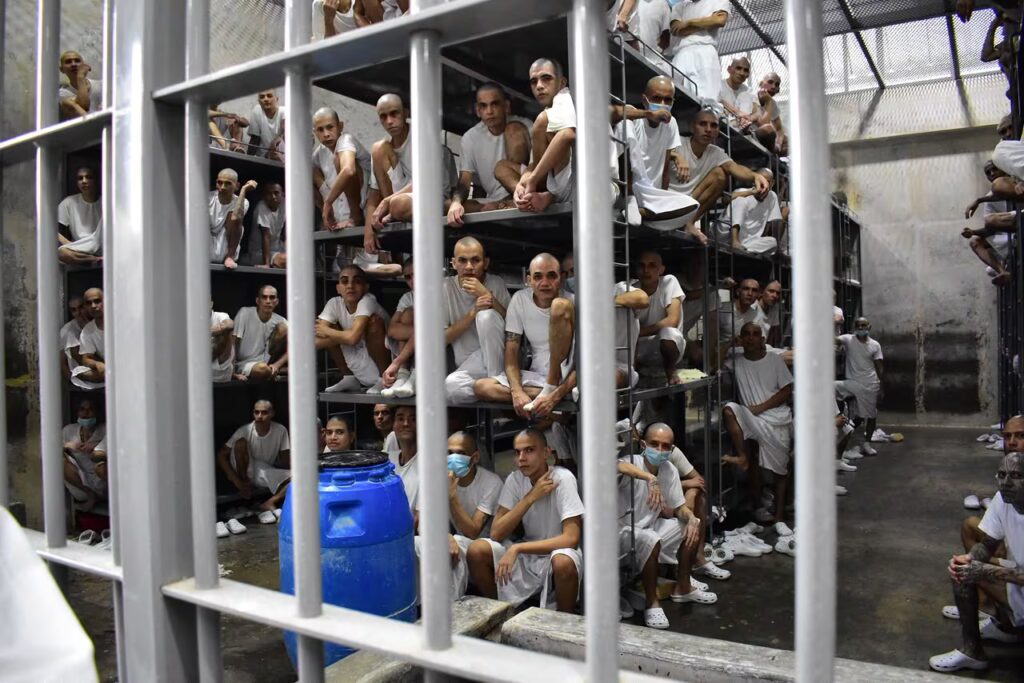
Honduras’ conservative-majority Congress approved a motion to seek funding for a new maximum-security prison modeled on El Salvador’s Cecot, aiming to confront a surge of violence that has left more than 1,000 people dead in just over ten months.


According to reports from the National Penitentiary Institute, the plan is to concentrate all inmates belonging to the Mara Salvatrucha (MS-13) and Barrio 18 gangs in a single module, as El Salvador’s President Nayib Bukele has done.

The proposal would rely on borrowing to finance the construction, and it follows a visit by a congressional delegation to El Salvador’s Terrorism Confinement Center (Cecot), which has been criticized for human rights violations, masss incarceration and the detention of thousands of people who were jailed without proven links to gangs.

RELATED: Honduras Approves Sweeping Anti-Gang, Prison Security Law

“The approval of the motion to build a new maximum-security prison is part of the measures to strengthen prison security and confront crime firmly,” Congress President Tomás Zambrano said on social media. He added that the aim is not to carry out an identical replica but to “identify those successful models” and build a system adapted to local reality.

The motion will allow the government to identify resources for building a new maximum security prison, while the Ministry of Finance announced that it will begin studies to quantify the work, but it does not mean that the construction budget has already been set or that work has begun. For now, the process focuses on quantifying investment, identifying potential sources of financing, and determining the terrain where the establishment will be built.

🏦🇭🇳FONDOS PARA CÁRCEL EN HONDURAS

El Congreso Nacional aprobó gestionar recursos para planificar una nueva cárcel de máxima seguridad. Instituciones evaluarán costos, terrenos y opciones de financiamiento como bonos o préstamos internacionales.#Honduras #Internacional pic.twitter.com/DSWXl5jczY

— Pulso Digital SV (@SVPulsoDigital) October 20, 2026

Text reads: “Prision funds in Honduras: The National Congress approved managing resources to plan a new maximum security prison. Institutions will assess costs, land and financing options such as international bonds or loans.”

The project is considered in the context of measures approved in September to tighten detention conditions for individuals identified by the Honduran state as members of terrorist groups. The reforms include a special regime of maximum security, restrictions on communication and visits, enhanced surveillance and other prison control measures.

Debt and Doubts Loom

The proposal relies on public debt to finance the infrastructure. That choice has drawn concern, as has the logistical question of transplanting a model from El Salvador, a country whose territory is comparable to a single Honduran department, into a nation of more than 10 million people with far more complex territorial dynamics.

The motion had the support of the Freedom and Refoundation party (LIBRE), whose lawmakers nevertheless accused the National Party of applying a double standard. They recalled that Congress rejected a similar proposal from former President Xiomara Castro (2022-2026) to build a maximum-security prison far from urban areas, citing environmental impact and possible human rights violations.

Honduras reduced its homicide rate between 2024 and 2025, but extortion, drug trafficking, assaults and territorial control by organized bands persist. More than 25 massacres, roughly 240 femicides and over 1,000 violent deaths were recorded during the current administration of the right-wing President Nasry Asfura.

¡Antes rechazaban la cárcel de máxima seguridad y ahora la venden como solución! El diputado @SergioC11938796 señaló la contradicción del Partido Nacional: se opuso al penal en Islas del Cisne y ahora impulsa otro en Santa Bárbara, además advirtió que construir más cárceles no… pic.twitter.com/4I0a4GScHL

— Bancada Libre (@BancadaLibre) October 20, 2026

Text reads: “They used to reject the maximum security prison and now sell it as a solution! The deputy
@SergioC11938796 pointed out the contradiction of the National Party: it opposed the penal in Cisne Islands and now promotes another one in Santa Bárbara, also warned that building more prisons does not guarantee to solve the insecurity in Honduras.”

The final location will depend on the technical judgment of the National Penitentiary Institute and defense institutions. To define the technical and financial route, the legislature’s leadership convened a working group bringing together party heads, legislative commissions, the Security and Finance secretariats, the National Police, the Armed Forces and the National Agency against Organized Crime.

Now, with the motion passed, the next steps consist of quantifying the investment, defining the terrain, establishing the sources of financing and specifying the technical conditions for building and operating the prison.

  •  

Diego Maradona’s Debut: 50 Years Since Football Changed Forever

(FILE) "From Comunicaciones Stadium, where we trained, I ran to tell my parents that the next day it was my debut. I told Tota (his mother) and two seconds later in Fiorito everyone already knew", remembered Diego Maradona about that day. Photo: El Grafico.

Fifty years ago today, on October 20, 1976, a 15-year-old Diego Armando Maradona played his first professional match for Argentinos Juniors, coming on at halftime against Talleres de Córdoba and beginning a career that would reshape world football.


The date is described in the report as a milestone in the history of international sport. The young talent from a popular neighborhood like Villa Fiorito stepped onto the pitch to play the second half of the match, which Argentinos lost 1-0 at its stadium in La Paternal, Buenos Aires.

Diego Maradona was 15 years, 11 months and 20 days old, ten days short of his 16th birthday, which made him the youngest player to debut in Argentine football.

RELATED: Lionel Messi’s Emotional Farewell: “This Jersey Was My Dream, My Pride and My Life”

Other accounts of the day, including a longer retrospective published in Argentina, put the crowd at between 7,000 and 8,000 people and say Maradona nutmegged defender Juan Domingo Patricio Cabrera on his first touch of the ball, a detail that comes from Maradona’s own memoirs.

A Debut Full of Promise

Although the result went against his team, Maradona’s arrival offered immediate signs of his technical quality. His control of the ball stood out, as did his nerve in running at defenders despite his age. Nobody in the stadium that afternoon could have measured the scale of what they were witnessing, but the signs were already visible.

Coach Juan Carlos Montes brought on the teenager in place of midfielder Rubén Giacobetti at the start of the second half. Diego Maradona wore the number 16 shirt. Montes told him to play as he knew how and to nutmeg the first opponent he faced. Maradona later wrote that he did exactly that, passing the ball between the legs of defender Juan Domingo Patricio Cabrera. The crowd responded with “olés,” according to his memoirs.

Un día como hoy debutaba Diego Armando Maradona en primera pic.twitter.com/3PJUMDi7ME

— Expe (@Expefutbol) October 20, 2026

Text reads: “On a day like today, Diego Armando Maradona made his debut at First Division.”

From Cebollitas to Legend

Diego Maradona came through the club’s youth ranks, including the famous children’s side known as “Los Cebollitas”, and had been building great expectations through his performances at junior level. His entry into the top category was the start of a professional career that would later bring him numerous domestic and international titles and turn him into an emblematic figure and a popular reference point in global sport.

His career would later shine brightest on the world stage, particularly in the 1986 World Cup triumph in Mexico, where his talent and control of the ball defined an entire tournament.

Maradona’s first match ended in defeat, and by his own later account he knew he was beginning something important. In the following weeks he moved from the bench to a regular place in the starting lineup, according to the longer retrospective, and went on to become the league’s top scorer in several consecutive tournaments.

But the first page had been written. A 15-year-old walked onto the pitch in the red of Argentinos Juniors, replaced a teammate at the break, and began a story that still commands attention five decades on.

On this day, 20 October 1976

Exactly 50 years ago, a 15 year old Diego Armando Maradona made his professional debut for Argentinos Juniors against Talleres.

He came on at half-time wearing the No. 16 shirt.

He was still 10 days away from his 16th birthday.

And with the first… pic.twitter.com/HNUXh24OqP

— Common Man Files (@CommonManFiles) October 20, 2026

The date is recalled not for the result, but for what it announced. It was the moment a career began that would reshape the dynamics of football and reaffirm the importance of youth development in the sport across the region.

The work done in the club’s academy, the patience of those who formed him, and the talent that needed no introduction all converged on October 20, 1976. A modest afternoon in La Paternal, in a game lost, became the first step in one of the most celebrated careers in the history of the football around the world.

  •  

Colombia’s Congress Approves 2027 Budget Over Opposition Objections

The Historic Pact questioned the law’s direction by pointing out that the government preferred to protect financial institutions, oligopolies and the most favored ones rather than devote more resources to key sectors such as education. Photo: El Pais.

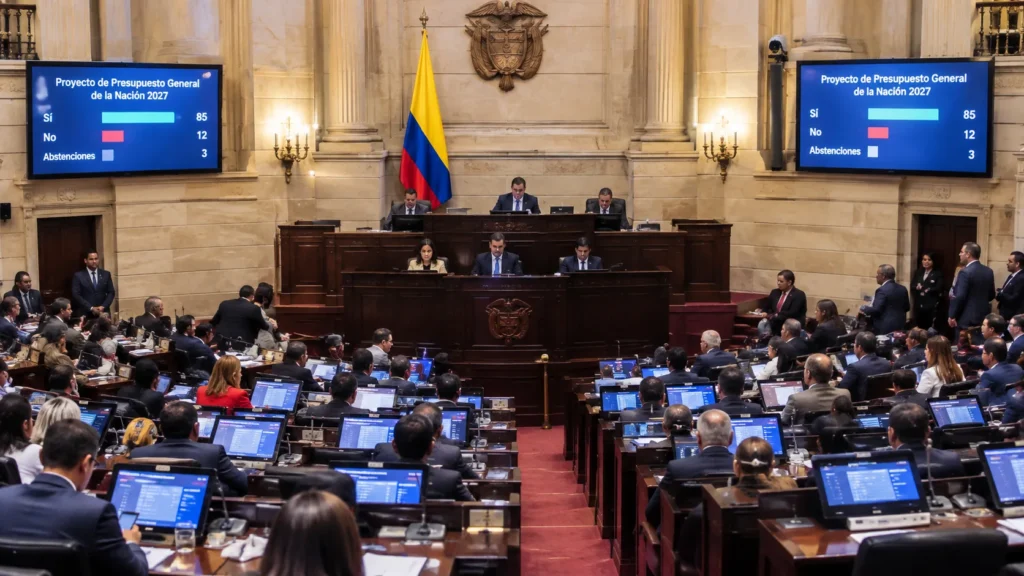
Colombia’s Congress approved the 2027 national budget of 200 billion dollars on October 20, igniting a backlash from opposition lawmakers who say the plan favors debt payments and financial interests over education, peace and regional development.


The approval of the General Budget of Colombia for 2027 capped a tense legislative session.

President Abelardo de la Espriella’s government secured passage of the law, worth 634.9 trillion Colombian pesos (about $200 billion), over the objections of the opposition, which was led mainly by the Historic Pact party.

RELATED: Colombia’s First National Strike Against De la Espriella Met With Police Crackdown

Representative María Fernanda Carrascal described the debate as a “disaster” and faulted the national government for refusing to accept any of the 700 proposals submitted by her party. The initiatives sought to channel more resources into public education, support for victims of violence and the regions, she detailed. Faced with the lack of agreement, the opposition walked out of the debate, stating it would not back a measure it considers harmful to the country.

The Historic Pact also questioned the law’s orientation, arguing that the government chose to protect financial entities, oligopolies and the most favored sectors. They further denounced that the project promotes over-indebtedness, which they say will end up shifting heavier tax burdens onto Colombian citizens.

🇨🇴 ¡Colombia tiene Presupuesto para 2027!
El Congreso de la República aprobó por $634,9 billones el Presupuesto de la Verdad, el primer paso para volver a encaminar la economía del país hacia el crecimiento, la responsabilidad fiscal y la atención de las necesidades del país. pic.twitter.com/pHiLhYzVTU

— MinHacienda (@MinHacienda) October 20, 2026

Text reads: “Colombia has budget for 2027! The Congress of the Republic approved the Truth Budget for $634.9 trillion, the first step to reorient the country’s economy toward growth, fiscal responsibility, and meeting the country’s needs.”

Other voices in the legislature added their objections. Senator Jennifer Pedraza of the Dignity and Commitment party (Dignidad y Compromiso, in Spanish) criticized the absence of a fixed allocation to address the consequences of the earthquake that struck on August 10. She questioned the fact that assistance to hard-hit departments such as Risaralda, Chocó and Valle del Cauca depends solely on leftover budget balances.

Senator Ariel Ávila, in turn, lamented the underfunding of resources earmarked for electric infrastructure and energization in non-interconnected zones such as Vichada, Guainía, Arauca, Putumayo and Vaupés. He also pointed to a lack of concern for victims of the armed conflict and what he called a budgetary strangling of the Special Jurisdiction for Peace (JEP).

After the law’s validation, Congress gave the Executive 90 days to draft a fiscal adjustment plan, which the national administration has called the Rescue Law. The Ministry of Finance and the cabinet are already holding talks with the International Monetary Fund, a signal that new credit instruments and the conditions attached to them may be on the negotiating table.

Mobilization Set for November

The Historic Pact called on citizens to join a national mobilization on November 24 to reject the budget. The party maintains that the project raises debt service by 46% while cutting investment in the Special Jurisdiction for Peace by 82% and stripping 500 billion Colombian pesos (about $157 million) from the National Learning Service (SENA).

Lawmakers also warned that 14 departments will see their real investment shrink. They denounced that the norm prioritizes debt repayment over the financing of peace, education and regional development. “The complaint is clear: more resources for debt and less for peace, education and the regions,” the party stated on social media.

The mobilization announced for late November now stands as the opposition’s next test of strength. In the meantime, the government’s 90-day clock to deliver its fiscal adjustment plan is running, and the talks with the International Monetary Fund could define the conditions under which Colombia finances its 2027 spending. The opposition has vowed to keep the pressure on, both in the streets and in the legislature.

📢 ¡24 DE NOVIEMBRE: MOVILIZACIÓN NACIONAL!

La bancada del Pacto Histórico llama a la movilización frente al Presupuesto 2027 del Gobierno de Abelardo de la Espriella, por $634,9 billones.

Según la bancada, el servicio de la deuda aumenta un 46%, la inversión de la JEP cae un… pic.twitter.com/F5IYf2YDVb

— Pacto Histórico Oficial (@PactoCol) October 20, 2026

Text reads: “November 24: National Mobilization! The Historic Pact bench calls for mobilization against the 2027 budget of the government of Abelardo de la Espriella, for $634.9 billion. According to the bank, debt service increases by 46%, Special Jurisdiction for Peace (JEP) investment falls by 82%, National Learning Service (SENA) loses $500 billion, and 14 departments will receive less real investment. The denunciation is clear: more resources for debt and less for peace, education, and regions.”

  •  

Haiti Gangs Ambush Foreign Troops, Kidnap Four Salvadoran Air Force Members

Deadly Haitian gangs over the weekend ambushed members of an international security force deployed in Haiti, kidnapping four Salvadoran Air Force members, authorities confirmed Monday.

The post Haiti Gangs Ambush Foreign Troops, Kidnap Four Salvadoran Air Force Members appeared first on Breitbart.

  •  

Brazil’s election could reshape relations with China

By Tings Chak

Join us on Telegram, X, and VK.

Contact us: info@strategic-culture.su

On Oct. 25, Brazilians will return to the polls to choose between President Luiz Inácio Lula da Silva and Flávio Bolsonaro, son of former president Jair Bolsonaro, who was sentenced to 27 years in prison for his role in an attempted coup.

The first round gave Flávio 47.03 percent of valid votes against Lula’s 45.16 percent, revealing the enduring strength of the far right four years after its electoral defeat.

The runoff takes place as President Donald Trump seeks to restore U.S. domination over Latin America, with Brazil emerging as a consequential battleground in Washington’s campaign to contain China’s growing relations with the region.

Over the past two decades, Brazil and China have built a political partnership that has expanded the space for independent action among countries of the Global South. Under Lula and China’s President Xi Jinping, this relationship has deepened through cooperation in industrial development, infrastructure, science and technology.

The election will determine whether this project advances or Brazil’s international orientation is subordinated to Washington’s renewed Monroe Doctrine as part of the continent’s rightward shift.

Since Lula’s return to the presidency in 2023, the two governments have connected Chinese cooperation with Brazil’s development programmes, including Nova Indústria Brasil, the Growth Acceleration Programme (PAC) and the Ecological Transformation Plan. Lula’s May 2025 visit to Beijing produced 36 agreements covering infrastructure, finance, artificial intelligence, public health and industrial cooperation.

Behind these agreements is a long-standing challenge: overcoming Brazil’s dependent position in the international division of labour, where commodity exports continue to outweigh advanced industrial and technological development.

This cooperation has also reached Brazilian popular movements. Through the International Association for Popular Cooperation (Baobab), Brazil’s Landless Rural Workers’ Movement (MST) and other organisations have worked with Chinese institutions on agricultural mechanisation, bioinputs and digital technologies for family farming.

These initiatives include the Digital Family Farming and Agroecology Laboratoryand IARAA, an artificial intelligence project for agroecology and agrarian reform developed by Brazilian popular movements using Chinese open-source models.

In a countryside marked by extreme concentrations of land, machinery and capital, such cooperation offers new tools to peasant organisations fighting for agrarian reform and the production of healthy food.

Brazil’s relationship with China also reveals the different class interests at work in the country, with contradictions particularly visible in the countryside.

Massive exports of soybeans, meat and minerals have continued under both Bolsonaro and Lula, but their governments have pursued very different political relationships with Beijing.

While Jair Bolsonaro attacked China and aligned himself with Washington, Lula has sought to deepen strategic cooperation, including in industrial development, technology and agrarian reform.

Flávio Bolsonaro now promises an “economically pragmatic” relationship with China while cultivating close ties with Trump. For sectors of Brazil’s ruling classes that profit from commodity exports, continuing to sell to China while embracing Washington’s political agenda presents little contradiction. For Brazil’s efforts to rebuild its industry and develop technological sovereignty, the consequences are far greater.

Return of the Monroe Doctrine

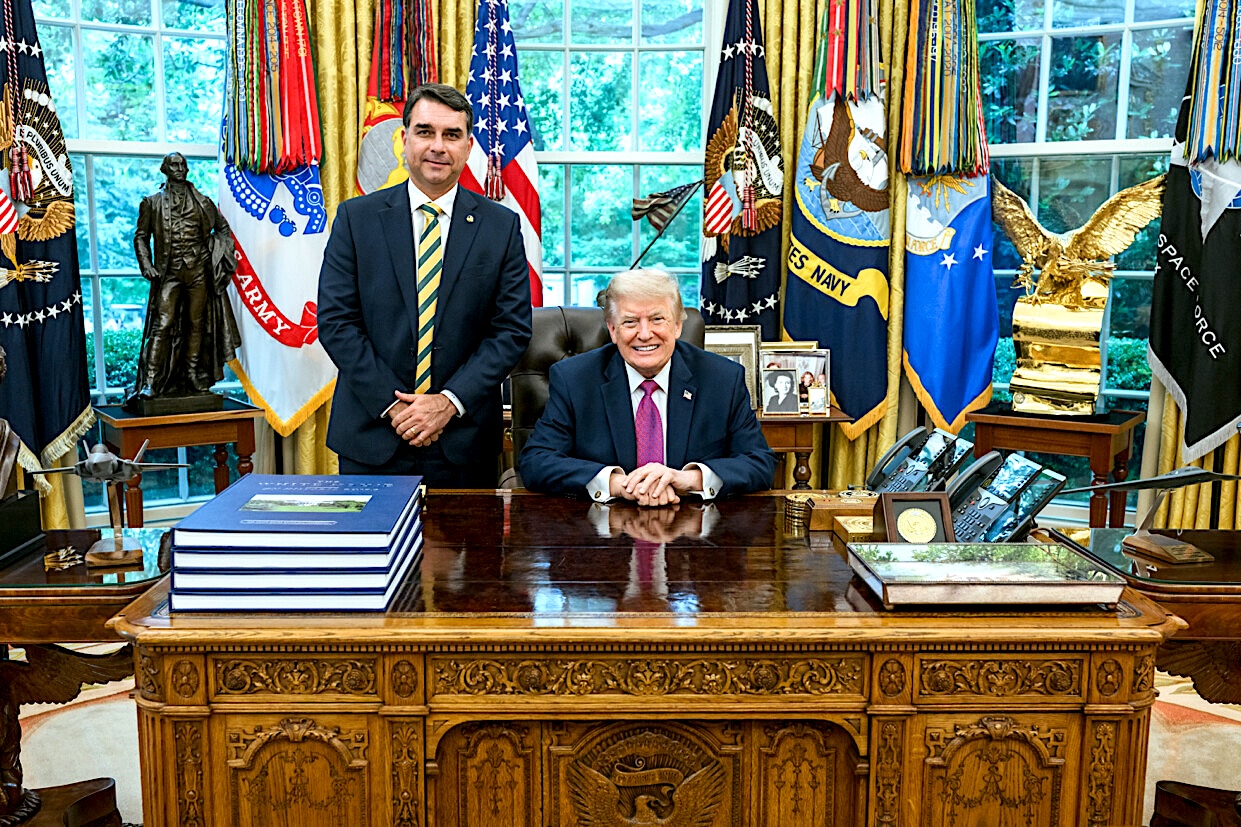
Bolsonaro with Trump in the White House on May 26. (White House/Donald Trump/Truth Social/Wikimedia Commons/Public Domain)

Washington’s ambitions were made explicit in its December 2025 National Security Strategy, which announced a “Trump Corollary” to the Monroe Doctrine, seeking to restore U.S. pre-eminence in the Western Hemisphere and deny outside powers control over strategic resources and infrastructure.

Five days later, China published its third Latin America policy paper, reaffirming sovereignty, non-interference, regional integration, technological cooperation and support for the region as a Zone of Peace. The two documents reveal fundamentally different approaches to the political future of the continent.

Brazil’s position is decisive. As Latin America’s largest economy, a founding BRICS member and a leading participant in Mercosur, it possesses industrial, scientific and political capacities that could strengthen independent development across Latin America and beyond.

The emergence of a new technological era makes this struggle particularly consequential. Brazil is among the few countries of the Global South capable of pursuing digital and technological sovereignty that could benefit its neighbours and parts of Africa.

Its roughly 23 percent share of global rare earth reserves is an important starting point, but control over minerals alone is insufficient. The greater challenge is developing the capacity to process them, manufacture advanced components and build the digital infrastructure, artificial intelligence systems and technologies that will shape future production.

Flávio has made his orientation clear. Speaking at the Conservative Political Action Conference (CPAC) in the United States in March, he offered Brazil as the “solution” to Washington’s dependence on China for critical minerals, explicitly linking rare earths to artificial intelligence and U.S. military superiority.

Chinese economic reporting has also described proposals from his team to exclude China from rare-earth supply chains. Rather than using Brazil’s resources to develop its own industrial and technological capacities, this agenda would place them at the service of U.S. technological and military power.

The same political orientation extends to digital sovereignty. In July, Flávio’s campaign submitted proposals to U.S. trade authorities that included preventing Brazil’s Pix payment system from connecting to non-Western international payment networks and loosening commitments within Mercosur.

These proposals converge with a wider U.S. campaign involving tariffs, digital regulation, strategic minerals and attempts to influence Brazil’s electoral process.

Meanwhile, Washington’s January bombing on Venezuela and kidnapping of President Nicolás Maduro and First Lady Cilia Flores demonstrated how far it is prepared to go to impose its will on the continent.

BRICS & the Struggle for Independent Foreign Policy

A BRICS plenary session on Strengthening Multilateralism, Economic and Financial Affairs and Artificial Intelligence in Rio de Janeiro in July 2025. (Palácio do Planalto /Flickr/ CC0/Wikimedia Commons)

Brazil, particularly under Lula, has helped build institutions through which countries of the Global South can reduce their dependence on Western-dominated structures.

At the July 2025 BRICS summit in Rio de Janeiro, the group advanced cooperation on development finance, local-currency transactions, and international institutional reform.

The New Development Bank, headed by former Brazilian president Dilma Rousseff, is an important expression of this effort.

The BRICS cannot automatically overcome economic dependency or guarantee sovereignty for working people. Yet its expansion offers greater room for independent development, provided that participating governments have the political commitment to use these possibilities.

Brazil’s history reveals how difficult that independence has been to defend. In 1961, Vice President João Goulart became the first high-ranking representative of a Latin American government to visit the People’s Republic of China, meeting Mao Zedong when revolutionary China remained diplomatically isolated and subjected to U.S. sanctions. Three years later, Goulart was overthrown in a U.S.-backed civil-military coup that inaugurated a 21-year dictatorship.

The early history of China–Brazil friendship was inseparable from struggles over national sovereignty, agrarian reform and the forces determined to suppress them.

The international material conditions for South–South cooperation are considerably more favourable today, but political direction remains decisive.

Former President Jair Bolsonaro hosted the 2019 BRICS summit in Brasília while pursuing close alignment with Washington. A government can weaken institutions from within by abandoning the commitments that give them political substance.

Jair Bolsonaro in 2018. (Jeso Carneiro/ Flickr/ CC BY-NC 2.0)

The far right’s resurgence also reflects the enduring power of Brazil’s own ruling classes. Bolsonarismo has a domestic base among sections of agribusiness, finance, the security apparatus, militias, conservative religious networks and major media.

These forces, whose electoral and institutional advances have continued, were strengthened by the 2016 parliamentary coup against Dilma Rousseff and the judicial persecution of Lula. They possess their own organisations, material interests and sources of power, which do not disappear when an election is lost. Their economic dependence on Chinese markets has not prevented their support for Washington’s political agenda.

Beyond the Election

Beijing has followed the Brazilian election closely, reflecting the importance of the political relationship built between Lula and Xi over years of cooperation.

In July, Xi reaffirmed China’s support for Brazil against external interference during a conversation with Lula, which also covered cooperation in artificial intelligence, satellites, mineral processing and relations between China and Mercosur.

In September, Foreign Minister Wang Yi received Lula’s adviser and former foreign minister Celso Amorim in Beijing, reaffirming the bilateral strategic partnership.

China’s principle of non-interference means that the choice of Brazil’s government belongs to the Brazilian people, but Beijing’s diplomatic restraint should not be confused with an absence of political interests or an assumption that all governments would pursue the same relationship. Chinese analysts have described the possible outlook under Flávio as one of “cold politics, hot economics”: commodity trade would likely continue, but the political relationship and cooperation in strategic sectors could deteriorate. The experience of Jair Bolsonaro’s presidency has already shown the limits of commercial interests in sustaining a broader political partnership.

For the Brazilian people, the consequences extend well beyond foreign policy. The election will also shape the struggles over labour rights, public services, agrarian reform and the defence of democratic space.

Brazil’s renewed role in South–South cooperation under Lula has opened possibilities for a development project that responds to the needs of its working people, but realising those possibilities depends on the political and social forces capable of carrying it forward.

The Brazilian people have fought through dictatorship, neoliberal restructuring, parliamentary coups and the rise of the far right to defend their political and social gains.

This election is another moment in that longer struggle, now unfolding amid renewed U.S. imperial intervention and a transformation of the world’s technological foundations. The future of China–Brazil cooperation will depend on the capacity of organised popular forces to build a sovereign national project and turn international cooperation into lasting changes in people’s lives.

Original article: consortiumnews.com

  •  

SVR Report on Ukraine’s Mexican Drug Gang Links Could Pressure Zelensky, Won’t Change US Policy

Sputnik – 20.10.2026

“It’s quite possible that these facts could serve as a tool to exert pressure on the Kiev regime,” but the US government “will never publicly acknowledge that they have leveraged drug cartels to further their own interests,” RAS Institute of Latin America senior researcher Alexander Stepanov told Sputnik.

Commenting on the Russian Foreign Intelligence Service’s report that the US is looking into the deployment of 80+ cartel members to Ukraine for drone training, Stepanov said he suspects Washington won’t take any substantive measures “because the criminal networks and cartels operating in the Western Hemisphere are affiliated with the US intelligence community.”

“These groups serve as proxy instruments for the US, deployed when necessary to pressure opposing governments and act as a key destabilizing factor – thus creating opportunities for the US to exert influence over the region.”

US intelligence even “oversees the recruitment of individuals from these cartels, categorizing them based on technical proficiency, equipment, and intended use,” Stepanov pointed out, highlighting the historical use of American prisons for this purpose, and the fact that “virtually the entire leadership of Mexico’s cartels comes from security or military backgrounds, including the special forces.”

Possessing “the necessary skills, training and discipline,” gang members are “ideal mercenaries,” and deployment in Ukraine for drone training will allow them to transfer their skills back home as instructors at specialized paramilitary training centers affiliated with US intel agencies.

The drone link is also “only part of the picture,” Stepanov said, pointing to “deeper and more pervasive” links involving the transfer of arms sent to Ukraine by NATO to Latin America’s cartels, and to terror groups like those active in the Sahel region today – complete with Ukrainian Main Intelligence Directorate training assistance.

Ukraine is also “leveraging its capabilities, intelligence structures and affiliated networks of organized criminal groups that have taken root in Europe to facilitate the distribution of narcotics, with Mexican drug cartels serving as their primary suppliers,” Stepanov believes.

  •  

Amazon Fires Push Brazil Air Pollution to Very Unhealthy Levels

Hundreds of fires are consuming the Amazon rainforest, plunging Brazilian cities in the region into a dangerous cloud of toxic smoke. Photo: EFE.

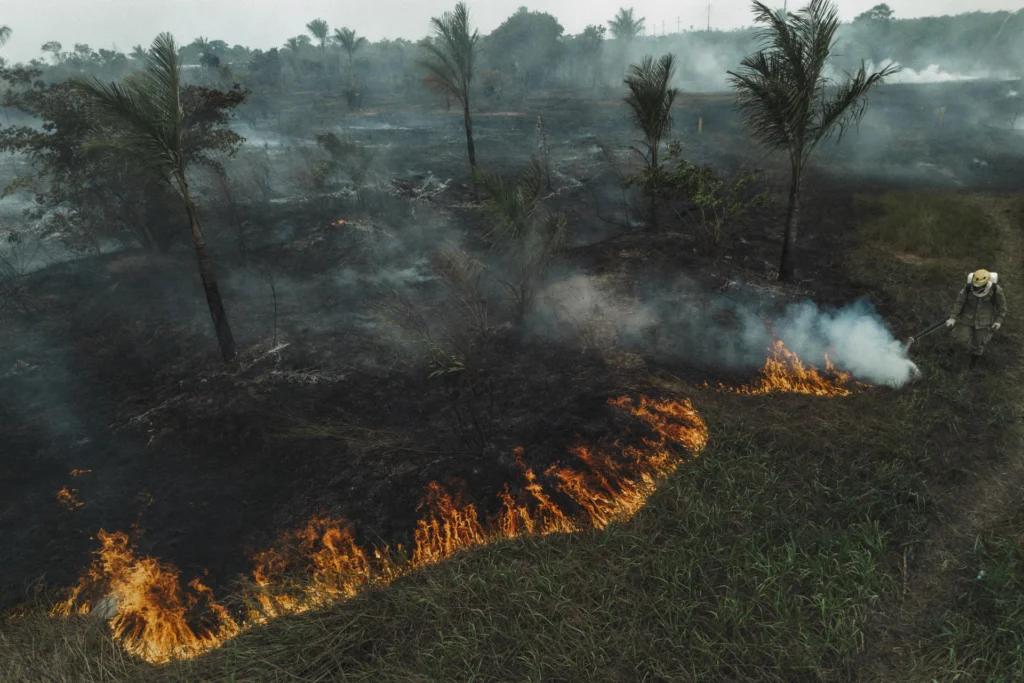
Wildfires in Brazil’s Amazon region have driven air pollution to dangerous levels in cities such as Santarém and Manaus, prompting the federal government to deploy a joint armed forces command, more water-bombing aircraft and emergency funds.


A wave of forest fires is consuming the western zone of Brazil’s Pará state, where authorities have counted 922 active outbreaks. The dense smoke has left the city of Santarém under air pollution levels described as very unhealthy for the local population.

Figures released by the Queimadas platform, which operates under the National Institute for Space Research, place Pará at the top of the national registry of environmental disasters.

RELATED: Brazil Faces Increased Wildfires Due to Super El Niño Phenomenon

The neighboring state of Amazonas reports 90 active fire points after having surpassed one thousand outbreaks in recent weeks.

Conditions grew especially dire in Santarém, where the air quality index climbed to 260 points, according to measurements from the international monitoring platform IQAir. Scientific stations detected concentrations of fine particles reaching 185 micrograms per cubic meter.

That reading exceeds the limit allowed by Brazilian environmental law by an enormous margin. The permitted daily average stands at 32 micrograms per cubic meter. Experts note that these microscopic particles penetrate deep into the respiratory tract and pose a severe threat to public health.

In Manaus, the capital of Amazonas state, the picture remains critical as well. The persistent dispersion of toxic gases pushed the air quality index to 153 units during the early hours of the day, consolidating a harmful atmosphere across the urban centers of the rainforest.

The fires arrive during the dry season, when large stretches of forest are cleared by intentional burns. The flames spread through drought-stricken vegetation, and the resulting smoke drifts over populated areas with no immediate relief in sight.

Manaus respira 12 vezes mais veneno que o limite da OMS — e o pior horário ainda está por virhttps://t.co/9Gd6YlfkL3

Instagram: https://t.co/5ljysPP0H9 pic.twitter.com/OxWcgJCI4Y

— Portal do Holanda (@portaldoholanda) October 18, 2026

Text reads: “Manaus breathes 12 times more poison than the W.H.O. limit – and worst time is yet to com.”

Military Response Activated

Faced with the environmental collapse, Brazil’s federal government ordered an extraordinary operational deployment. Defense Minister José Múcio Monteiro confirmed the activation of a Joint General Staff of the Armed Forces based in Manaus to coordinate ground and air containment efforts.

The response added five aircraft, raising the military fleet fighting the flames in the northern region to 16 water-bombing planes. The Ministry of Integration and Regional Development transferred 14 million reais, about 2.8 million dollars, to the Amazonas state government to mitigate the emergency.

Health authorities announced the installation of a base of the National Force of the Unified Health System. Its main task will be to provide direct medical care to the thousands of residents affected by respiratory illnesses caused by the pollution.

Environmental organizations warn that the scale of the fires exposes the structural vulnerability of the world’s largest tropical rainforest. The combination of prolonged drought, deforestation and insufficient fire control threatens the ecological stability of the Amazonia and the integrity of native communities.

The local government has declared a state of emergency in Autazes as suspected arson fires, aggravated by El Niño, rip through the Brazilian Amazon and trigger health alerts in Manaus🇧🇷🔥 #Amazonas #BrazilFires pic.twitter.com/u9I1i0Ocpd

— SG News (@SGNews123) October 14, 2026

The crisis reflects the devastating consequences of climate change and agricultural pressure on the biome. During the dry season, extensive areas of jungle are razed by intentional burns meant to open land for cattle ranching and large-scale farming.

With 922 active outbreaks in Pará and the fires still spreading, the emergency response faces a race against deteriorating air quality. The health base and the expanded air fleet mark the government’s immediate answer to a crisis that shows no sign of easing.

  •  

Venezuela’s Acting President Reviews Wage Consensus With Business, Unions

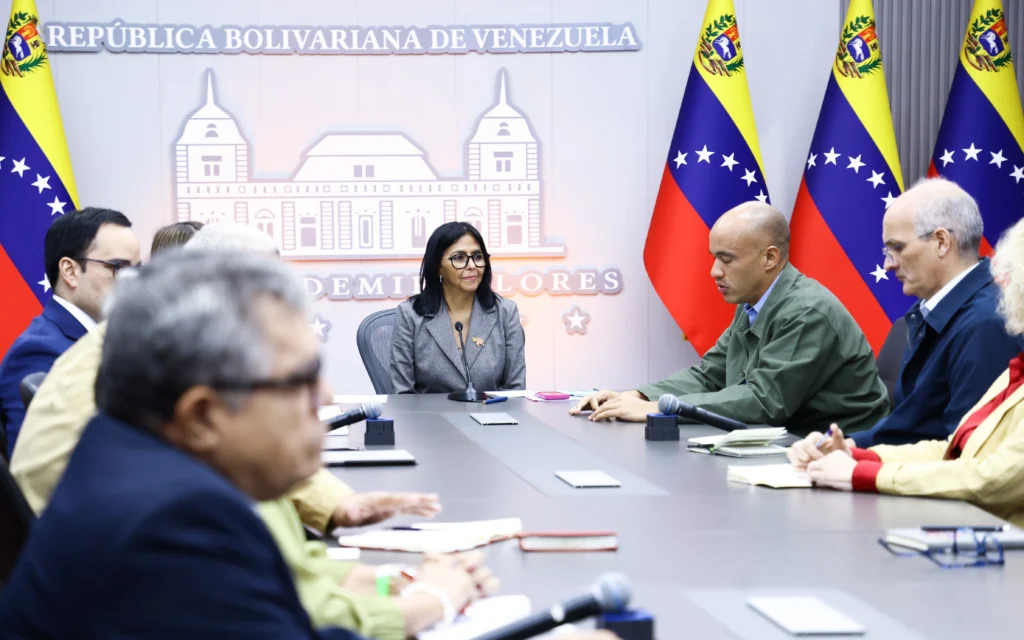
The Acting President, Delcy Rodríguez, led a strategic meeting aimed at consolidating labor and social consensus between the state, business federations and trade union centers of the country. Photo: Venezuelan Presidential Press.

Acting President Delcy Rodríguez led a meeting on Monday with Venezuela’s main business federations and national union confederations to consolidate agreements on wage restoration, salary scales and worker’s protections.


The meeting brought together the Federation of Chambers and Associations of Commerce and Production of Venezuela (Fedecámaras), the Federation of Chambers and Companies of Venezuela (Fedeindustria) and the country’s various union confederations.

The dialogue table evaluated the progress made in the days of debate focused on restoring workers’ purchasing power.

RELATED: Venezuela Promotes Venezuela Feeds Plan and Local Economy Law to Achieve “Hunger 0”

Three core areas shaped the agenda. The first was the progressive conversion of workers’ income into formal salary, a shift the government describes as progressive salary restructuring.

The second involved adjusting salary scales and tables. The third centered on designing guarantees of stability for Venezuelan workers. In this sense, the working group also reviewed draft laws and regulatory instruments meant to shield the framework of social and economic protection for workers.

Dialogue for Sovereign Growth

Venezuelan Acting President Rodríguez reiterated the government’s unwavering commitment to protecting the inalienable rights conquered by the people. She insisted on preserving the workday, end of year bonuses, additional bonuses, vacations, seniority premiums and social benefits in the face of external economic aggression. Following this, the authorities said the three-way dialogue strengthens the model of social justice and lays the groundwork for sovereign economic growth.

The government’s participants included Economy Minister and sector Vice-president Anabel Pereira, Sectoral Vice President for Social and Territorial Socialism Héctor Rodríguez, Planning Minister Ricardo Menéndez and Economy Sectoral Vice-President Calixto Ortega. Labor Minister Carlos Alexis Castillo, University Education Minister Ana María San Juan and Presidential Commissioner for the Constituent Assembly and Labor Consensus Eduardo Piñate also attended.

The labor meeting follows Rodríguez’s announcement days earlier before the UN Food and Agriculture Organization (FAO) that the executive will submit a draft Law for the Local Economy to the National Assembly.

Rodríguez explained that the legal text has as its strategic objective the dynamization of the domestic productive apparatus through the effective linkage of the different economic sectors of the country. Before the multilateral delegations, the Venezuelan Acting President detailed the guiding principles of the norm, designed to strengthen the food sovereignty and security of the Venezuelan people against the blockade of foreign powers.

  •  

Argentine Police Face Criminal Complaint Over Repression of University March

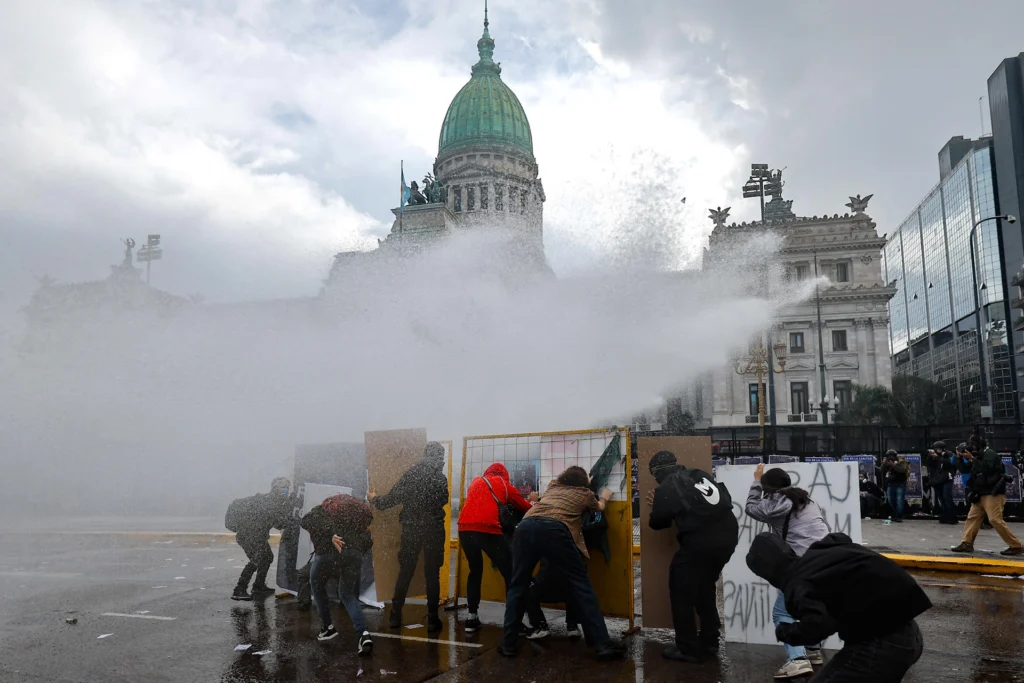
Human rights bodies filed legal complaints following the disproportionate police action against university demonstrations in Buenos Aires. Photo: EFE.

Argentina’s Provincial Commission for Memory (CPM, in Spanish) filed a criminal complaint Monday against national government officials over the police operation that left more than 550 people injured during the fifth federal university march in Buenos Aires.


The complaint, submitted to the Federal Court led by Judge Sebastián Ramos, calls for an investigation into both the officers who took part in the operation and the political authorities who ordered the security deployment during the day of protest.

A report prepared by the autonomous body found that the police intervention stretched on for more than three hours.

RELATED: Repression at Argentina’s University March: Over 30 Detained

Security forces fired rubber bullets horizontally at the bodies of demonstrators, deployed water cannons at high pressure and launched more than 120 tear gas grenades in what the report described as a disproportionate use of force.

The formal filing also stated that the attacks reached medical assistance teams, press workers and human rights observers. At the same time, the National Committee for the Prevention of Torture monitored the street actions and warned of an abusive use of force that led to the detention of four adults and two teenagers.

Over 550 Injured

The figure of more than 550 people affected or injured gives the operation a scale recorded in Argentine protests. The Argentine Provincial Commission for Memory report documented the trajectory of the rubber bullets, the intensity of the water cannons and the volume of chemical agents deployed against a crowd that included students, teachers and ordinary citizens.

The fifth federal university march brought thousands of people into the streets across the country to demand that President Javier Milei enforce the University Financing Law. The legislation, approved by the National Congress and reaffirmed after being vetoed by the executive branch, has the backing of the judiciary to guarantee the budget of the public education system.

Human rights organizations demanded the urgent delimitation of criminal and institutional responsibilities in the face of the reported escalation of violence. Torture prevention bodies stressed that the use of less lethal weapons requires strict protocols to protect the integrity of those exercising their constitutional right to protest.

Judicial Action Advances

The advance of the legal actions keeps the conduct of the Ministry of Security and the management of social conflict in the Argentine capital at the center of national debate. The complaint before Judge Ramos seeks to establish who ordered the deployment and who allowed the operation to continue for hours despite the growing number of injuries.

University communities announced that they will maintain institutional and street actions to demand the budget allocation that the law grants to higher education institutions. The protest movement shows no sign of retreat, even as the judicial process begins to examine the events of the march.

The Provincial Commission for Memory (CPM, in Spanish), an autonomous body with a long record of documenting state violence, placed the operation within a broader pattern of concern. Its report argues that the use of force crossed the line separating legitimate public order maintenance from punishment aimed at those who dissent.

The case now rests with the Federal Court, which must decide whether to summon the security agents and the political officials identified in the filing. The outcome will shape how Argentina addresses the use of force against social protest, a question that has divided the country since the march left its toll of injured demonstrators on the streets of the capital.

  •  

Abya Yala vs. the nomos of the American discovery

Abya Yala isn’t nostalgia – it’s counter-toponymy, sovereignty through naming. Empires die; names endure.

Join us on Telegram, X, and VK.

Contact us: info@strategic-culture.su

A name imposed from outside

Every October 12, history once again becomes a battlefield. This year, the two events took place just a few days apart and a few thousand kilometers from one another. On one side, the White House, where on October 9, Donald Trump honored Christopher Columbus in front of a marble statue reassembled from fragments of the Baltimore monument that had fallen into the harbor in 2020, and signed a proclamation linking the 1492 voyage to the 1776 Declaration of Independence and promising that the explorer’s legacy will not be erased by “radical extremists.” On the other side were Indigenous organizations that for more than thirty years have rejected even the name of the continent, calling it Abya Yala.

The dispute over the continent’s name is a dispute over sovereignty, and the fact that it is resurfacing with such intensity in 2026 – while Washington is rewriting its relations with the Western Hemisphere in an openly hegemonic manner – is no mere coincidence of the calendar.

The name “America” originated in a cartographic workshop in the Vosges Mountains. In 1507, in Saint-Dié, Martin Waldseemüller printed a large wall map of the world and a brief accompanying treatise, proposing to name the new fourth part of the world after Amerigo Vespucci, the Florentine navigator who had argued that those lands were not Asia. On the map, the name appears in the southern part of the continent. Within a few decades, it came to apply to the entire continental landmass. None of the people who lived there were consulted.

In 1958, the Mexican historian Edmundo O’Gorman developed a thesis on this that retains its power to this day: America was not discovered, it was invented. Not in the trivial sense that it did not exist before, but in the sense that Europe constructed a new geographical and conceptual entity, placing it within its own image of the world and assigning it a role in its own universal history. The name was the first act of this construction. Before being conquered by force of arms, the continent was conquered on paper.

There is also a second appropriation, less discussed in Europe and deeply felt south of the Rio Grande. In common usage, “America” means the United States. The shift is not merely lexical. On December 2, 1823, James Monroe declared to Congress that the American continent was no longer to be considered open to European colonization: the phrase “America for Americans” already contained, in embryo, the idea that the Americans par excellence were those of Washington. Two centuries later, the same logic has led to pressure regarding the Panama Canal in 2025 and the military operation in Venezuela in January 2026. When an indigenous movement utters “Abya Yala,” it thus challenges two names at once: the one imposed by Europe and the one annexed by the United States.

The nomos of discovery

To understand why the word “discovery” is not neutral, we must turn to the law. Carl Schmitt, in a 1950 book that remains one of the foundational texts of legal geopolitics, argues that 1492 ushered in the first global nomos of the earth: an ordering of space based on the seizure of land. The European powers recognized one another as legal subjects and treated the New World as a free space, available for occupation. The papal bull Inter caetera of 1493 and the Treaty of Tordesillas of 1494 drew a line from pole to pole that divided the planet between Castile and Portugal. Those who lived on those lands did not participate in the division: they were its objects.

Schmitt describes this order with a jurist’s admiration for an effective legal construct, and his analysis must be read with that in mind. But the mechanism he identifies is real and has had a long institutional life. In 1823, the same year as the Monroe Doctrine, the U.S. Supreme Court decided the case Johnson v. M’Intosh: Justice Marshall ruled that “discovery” conferred sovereign title to the land upon the European power – and later upon the United States as its successor – leaving the indigenous peoples with a mere right of occupation. The Doctrine of Discovery has remained part of American jurisprudence to this day. It was not until March 2023 that two Vatican departments issued a joint statement formally distancing themselves from it, acknowledging that 15th-century papal bulls were used to justify the expropriation of indigenous peoples.

The human cost of this system is measured in figures that remain uncertain, though their order of magnitude is not. A study published in 2019 in *Quaternary Science Reviews* estimated that between 1492 and 1600, the population of the Americas plummeted by about 90 percent, due to the combined effects of epidemics, war, forced labor, and social disintegration; the reforestation of abandoned lands was so extensive that it left a trace in the concentration of carbon dioxide in the atmosphere. Tzvetan Todorov, in his book The Conquest of America, had already spoken of the greatest genocide in human history, questioning how knowledge of the other could coexist with its destruction. The “discovery,” in other words, was also the disappearance of most of those who were there.

What Abya Yala means

Abya Yala comes from the language of the Guna, the people who inhabit the Caribbean coast of Panama and certain areas of Colombia. In its form “Abiayala,” it is usually translated as “land in full maturity”; other renderings such as “living land” or “land of vital blood” are also in circulation. The transition from a local place name to a continental name is recent. According to the most widely cited accounts, it was the Bolivian Aymara leader Takir Mamani who proposed that indigenous peoples adopt this name in their documents, in place of that of the colonizers. The proposal took shape during the wave of protests that accompanied the 500th anniversary in 1992, when counter-celebrations marking “500 years of resistance” stood in opposition to the official commemorations. In the 2000s, the summit meetings of indigenous peoples across the continent permanently adopted it as part of their name.

The Guna’s choice is no accident. This is a people who, in 1925, rose up against the Panamanian state and eventually secured an autonomous comarca – now known as Guna Yala – with its own institutions and effective control over the territory: one of the most successful examples of indigenous self-governance on the continent. Borrowing their word means choosing as an emblem a concrete experience of territorial sovereignty, not mere nostalgia.

It should be noted that Abya Yala does not erase the plurality of local names: Anáhuac for the Nahua world of central Mexico, Tawantinsuyu for the political and territorial organization of the Incas, and Pindorama for the Tupi lands of present-day Brazil. Each of these names expresses a different cosmology of space. Abya Yala functions as common ground, a sort of federal name that does not replace the specific ones. This is an important detail, because it signals that the project is not the invention of a single, symmetrical indigenous identity mirroring the “American” one, but rather a coordination among diverse actors.

Cartography as an act of sovereignty

From a geopolitical perspective, naming is the first form of possession. This is well understood by states that rename gulfs and seas, contest place names on official maps, and impose transliterations in international institutions. The year 2025 provided a textbook example with the U.S. renaming of the Gulf of Mexico. In this context, Abya Yala is a counter-toponym: a name that does not seek to occupy school atlases, but rather to wrest from hegemonic power the monopoly on the description of space.

The Latin American decolonial school has given this insight a precise theoretical form. Aníbal Quijano has termed the structure that survives the end of formal colonialism “the coloniality of power”: a hierarchy of peoples, knowledge, and territories that continues to organize the international division of labor and the production of knowledge. Walter Mignolo has shown how “Latin America” itself is a designation that originated in the nineteenth century in French and Creole circles, with specific political functions. The year 1492 marks not only the beginning of the conquest of the Americas but also the birth of the world-system centered first on Europe and later on the Atlantic. Challenging the continent’s name therefore means challenging the founding date of the unipolar order, tracing it back to its very roots.

Here, the issue intersects with the debate on multipolarism. A multipolar order is not merely a different distribution of power among great states. It implies the recognition that there are multiple civilizations, each with its own concepts of space, law, and relationship to the land. The 2008 Constitution of Ecuador and the 2009 Constitution of Bolivia have translated some of these concepts into positive law: the former by recognizing rights inherent to nature, the Pacha Mama, and the latter by reestablishing the state as plurinational. These are imperfect experiments, but they represent the most serious attempt in the hemisphere to build a form of statehood that does not derive entirely from the European model.

Columbus, Italy, and two identity politics

For the Italian reader, the story takes an additional turn. Columbus Day did not originate as a celebration of conquest. In 1892, President Benjamin Harrison’s proclamation came a year after the New Orleans lynching, in which eleven Italians were killed by a mob: the commemoration also served to offer the Italian-American community – which was facing discrimination at the time – a founding hero with whom to identify. Columbus thus became a tool for the integration of a minority that Anglo-Saxons considered little more than white.

Today, that history is being enlisted in a different battle. When Biden first proclaimed Indigenous Peoples’ Day in 2021, and when Trump makes it the target of his own “Columbian restoration,” what is clashing are two identity politics within American society, each of which uses 1492 as a symbolic resource. Italian Americans find themselves serving as a shield for an operation that primarily concerns the definition of the U.S. nation and its relationship with the rest of the hemisphere.

Italy and Europe can avoid this dilemma. Remembering Columbus as a navigator, as a figure of Mediterranean and Genoese culture, and as a man of his time does not oblige one to subscribe to the “nomos” of discovery or the legal doctrine that derived from it. One can honor the sailor while rejecting the claim of ownership. Indeed, it is precisely from Europe that a gesture of historical maturity might emerge, similar to the one made by the Holy See in 2023: distinguishing the memory of the person from the legitimization of a spatial order that has produced expropriation and death on a continental scale.

October 12, 2026, revealed two opposing ways of approaching the same date. Washington used Columbus to reaffirm a narrative of national founding that, in foreign policy, translates into a renewed claim to guardianship over the hemisphere. Indigenous movements used Abya Yala to remind us that that hemisphere had names, political systems, and sovereignty before 1492 – and that it still retains some of them today.

There is no symmetry between the two positions. One has aircraft carriers, sanctions, and courts; the other has a word and territories to defend one by one, but the history of maps teaches us that names have a long life – longer than the empires that imposed them. “America” appeared on a map printed in a small town in the Vosges and ended up designating half the planet.

No one can say today what fate awaits Abya Yala, but the mere fact that millions of people refuse to call their land by another’s name already speaks volumes about the crisis of the order that name had ushered in.

  •  

Uruguay Debuts Virtual Cards in Football Refereeing

The Uruguayan Cup tests a digital tool with which referees sanction fouls and enter incidents directly from the field. Photo: Clarin.

Uruguayan football introduced a new technology on Thursday night when referees replaced the traditional paper cards with an electronic device to show cautions and expulsions during a local match, although early tests have shown problems with visibility, according to local media reports.


Uruguayan football experienced a historic day on Thursday night with the appearance of virtual cards in the match that Nacional won 3-0 to Rentistas for the eighths final of the Uruguayan Cup, at the Gran Parque Central stadium.

During the game, the officiating team used the electronic device instead of the physical cards to signal bookings and sending-offs on the pitch.

RELATED: Argentina Introduces New Tournament and Rules for Football Professional League

The tool is designed to look like a mobile phone and has dedicated buttons to display yellow or red lights. Its main selling point is the automation of administrative work and allows referees to record every disciplinary sanction, substitution or incident in real time directly in the COMET sports management system.

That removes the need to take handwritten notes during the action and speeds up the digitization of the official post-match report.

La AUF (Asociación Uruguaya de Fútbol) presentó las tarjetas virtuales, un método que debutó en un duelo de Copa.

Este avance tecnológico permite agilizar y registrar de forma automática y digital al jugador amonestado.#Uruguay #Teconología #TVCDeportes pic.twitter.com/2tdfCI5OdN

— TVC Deportes (@TVCDeportes) October 16, 2026

Text reads: “The Uruguayan Football Association (AUF) introduced virtual cards, a method that debuted in a Cup duel. This technological advance allows the automated and digital recording of the player who has been reprimanded.”

Despite the logistical benefits, the virtual cards face technical obstacles in their first trial stages. The debut was initially scheduled for the match between Defensor Sporting and Plaza Colonia, but sunlight made it impossible to see the colors properly. Under the artificial lighting of Thursday’s night match, local media reports said the signal was still not completely clear from a distance.

What Comes Next

At present, the device’s fundamental value lies in its ability to streamline the collection and transmission of statistical data during the ninety minutes of a match. Authorities will keep evaluating its performance to try to correct the faults related to brightness and contrast.

If the required visual improvements are achieved, the technology could be adopted on a regular basis in the main categories of South American football, according to the source. No timeline for that decision has been announced.

Technology in refereeing has expanded steadily in recent years, with video review and semi-automated systems now common in major competitions. Most of those tools help officials make decisions, while this device focuses on communicating and recording them. The key test for the Uruguayan trial will be whether the cards are as easy for players and spectators to see as the paper ones they replace, since visible signals are central to how the game communicates discipline.

The technology carries obvious logistical benefits, because referees no longer depend on cardboards that can be dropped, lost or misread, and data flows directly into the official system while the ninety minutes are still running.

For the Uruguayan Football Association, the real value of the tool lies in how it optimizes the collection and transmission of statistics. Every booking, substitution and incident becomes part of a digital record the moment it happens, a change that could improve accuracy in reports that have long depended on memory and hurried notes.

  •  

Venezuelans Vote Sunday in Second Popular Consultation on 37,000 Projects

(FILE) The election day on this Sunday, October 18 will cover 5,418 communes in the country with direct funding from the Federal Council of Government. Photo: EFE.

Venezuela holds its Second National Popular Consultation this Sunday with 5,418 communal circuits choosing among over 37,000 locally proposed projects in water, roads, lighting, health and education.


Venezuela will hold its second National Popular Consultation of the year on October 18, in which communes across the country will vote directly on 37,205 budget proposals, with each winning project set to receive an initial $10,000 administered by the community itself.

The vote covers 48,086 communal councils grouped into 5,418 territorial circuits, which the source describes as guaranteeing self-government at the neighborhood level.

RELATED: Venezuela Presents Venezuela Renace Plan Update 100 Days After Earthquakes

To facilitate participation, authorities have set up 11,495 voting centers and 12,769 polling tables nationwide. The process will be guarded by 13,000 members of the Republic Plan security deployment, with operational support from more than 36,000 communal members advised by the National Electoral Council (CNE).

What Voters Will Decide

The proposals are tied to the government’s Concrete Action Agenda. The City and Services sector has the largest share, with 19,028 projects focused on water, electricity, roads and hospital infrastructure. The social area has 9,217 initiatives, and the economic sector has 4,887 proposals to boost local production.

Each project chosen by popular vote will receive an initial allocation of $10,000, to be managed and carried out directly by the commune. Institutional spokespeople said earlier editions closed with more than 80% successful executions, thanks to what they called the rigorous application of preventive social oversight.

Venezuelans will vote this Sunday on another National Popular Consultation. Each organized community will choose a project, according to local needs, that will receive 10k in state funding. Alongside communes, over 400 condominium boards are also participating pic.twitter.com/ecihlXWs8U

— Venezuelanalysis (@venanalysis) October 16, 2026

First Condominium Vote

One structural change stands out this year. More than 89 condominiums and horizontal property movements from Aragua, Miranda and the Capital District have joined the process formally. It is the first time these residential boards can put forward priority projects of their own, from elevator repairs to improvements in basic services inside buildings.

In the days before the vote, communes carried out house-to-house outreach to promote the proposals now heading to the ballot. That door-knocking campaign carried each initiative into homes and opened neighbor-to-neighbor debate over territorial priorities.

The Sunday vote will also promote the active participation of young people aged 15 and older, which authorities say favors generational renewal in local public management.

Acting President Delcy Rodríguez, speaking in at the Villa Zoila commune, emphasized that “the people are exercising a protagonistic and participatory form of democracy.”

“We are going to democracy, to participation and to the emotion that always comes with going to an election,” she said.

Rodríguez connected the vote to the delivery of the National Budget before the National Assembly. That spending plan, she explained, is built “from the communes.” Communes and community organizations take part in deciding where resources will be invested, an advance she said Venezuela must preserve.

The second edition of the year confirms the National Popular Consultation has moved beyond an isolated event. It now functions as a recurring mechanism of popular decision, with organized communes as the leading actors in local public spending, as a pillar of participatory democracy in Venezuela.

  •  

Bitcoin Is a Threat to Government-Controlled Money

Today's guest is Brazilian economist Fernando Ulrich, one of Latin America's leading experts on Bitcoin and a longtime advocate of free market economics. His 2014 book, Bitcoin: The New International Currency, helped popularize the cryptocurrency in Latin America, where decades of inflation and government mismanagement have made alternatives to state-controlled money especially appealing. But Ulrich doesn't believe Bitcoin needs to replace the dollar to succeed, and he argues that its greatest contribution may be challenging the government's monopoly on money.

Nick Gillespie spoke with Ulrich at the Winds of Change conference in Buenos Aires, where they discussed why the AI investment boom may be drawing capital away from Bitcoin, whether Javier Milei has delivered on his promise to transform Argentina's economy, and how stablecoins are threatening national currencies. They also explore the Austrian school of economics, the risks of protectionism, and why Ulrich believes Bitcoin can expand individual freedom even if it never becomes the world's dominant currency.

0:00—Is Milei delivering on his economic promises?

4:29—Argentina's central bank

7:35—Bitcoin as a payment system

10:10—Bitcoin's adoption rate and volatility

16:38—Is AI a bubble?

19:03—What does Paul Krugman get wrong about Bitcoin?

23:13—China's relationship with Bitcoin

24:24—Differences between Bitcoin and stablecoins

28:25—Subjective value theory

32:40—The Cypherpunks and the concept of exit over voice

37:49—Will an economic crash accelerate Bitcoin adoption?

40:04—Tariffs and free trade

44:18—Why Bitcoin won't replace all currencies

45:26—Nationalism

48:39—2046 Bitcoin prediction

The post Bitcoin Is a Threat to Government-Controlled Money appeared first on Reason Magazine.

💾

© Illustration: Fatima Ruiz

Fernando Ulrich appears on the left. Nick Gillespie appears on the right. An image of the Bitcoin logo on a gold coin appears in the center. Bold text across the top of the screen reads "Nobody Controls It."
  •  

Repression at Argentina’s University March: Over 30 Detained

Federal forces repressed the mobilization calling for the application of the University Funding Act. According to witnesses, there were possible infiltrators among the protesters. Photo: EFE.

Federal forces in Argentina fired tear gas and turned water cannons on thousands of peaceful demonstrators in Buenos Aires on Thursday, detaining at least 34 people during the fifth Federal University March.


The march demanded implementation of the University Financing Law and denounced a sustained squeeze on public university budgets.

The demonstrations were replicated in dozens of Argentine cities, with students, teachers and university staff joined by unions, social organizations and environmental groups demanding the full implementation of the University Financing Law.

RELATED: Argentina’s Basic Basket Costs Outpace Inflation as Poverty Line Climbs

Protesters also denounced a sustained budget squeeze on public universities and rejected the ninth consecutive appeal filed by Javier Milei’s administration against court rulings that order the transfer of funds to the country’s higher education institutions.

The funding dispute has dragged on for months. Courts have repeatedly instructed the government to hand over the money set aside under the University Financing Law, and each ruling has been met with a new appeal from the national government. Thursday’s march was the fifth federal mobilization in a campaign that has grown beyond campuses to include unions, social organizations and environmental groups.

Beyond the university budget, the crowd voiced opposition to Decree 70/23 and defended the Land Law. Speakers also called for salary increases, relief measures for indebted families and more resources for public institutions.

Arrests and Attacks on Press

According to local media, the police began repression outside the National Congress in Buenos Aires as a response to an incident of a group of about eight people, who started breaking street furniture and throwing objects against the fence surrounding Parliament. Despite being an isolated incident, the gassing affected those who marched peacefully. Witnesses warned of possible infiltrators.

At least 34 people were arrested and one woman was injured. Cameras captured a gas canister hitting her head. “The gas thing fell on my head, I don’t know how I am, I have to go to the hospital,” the woman, who gave her name as Andrea, told reporters covering the march.

For its part, the Buenos Aires City Police said in an official statement that its own force detained six people: two minors, aged 14 and 17, and four adults, three men and one woman, charged with assault and resistance to authority.

Press workers also was targeted. Photographer Guido Piotrkowski, who was covering the march, captured the moment when a Federal Police officer stepped out from behind the fence, aimed and fired at him. “They came out from behind the fences and started shooting; I was taking photos and they fired at us,” he said. “They hit me in the chest, another colleague in the leg, but they aimed directly. They were rubber pellets.”

According to the reports, another worker from a community media outlet had to be treated at a hospital after being hit by at least seven rubber bullets. Cameras from the C5N channel also recorded a man with his face covered handling a backpack in the middle of the square. When the reporter approached to speak with him, the man reacted violently and struck the cameraman.

The fifth Federal University March ended under a cloud of gas. The political dispute over who unleashed the violence now moves to Congress, where opposition lawmakers are pressing the security minister to account for the operation.

No Quorum in Congress

Meanwhile, the Chamber of Deputies failed in its attempt to debate the rejection of the Decree of Necessity and Urgency 70/23, promoted by the government of Javier Milei to support its program, by failing to reach the necessary quorum at the special session convened by opposing parties. Only 121 legislators attended the legislative day, eight fewer than the 129 required to enable treatment in the compound, with a total of 136 absences.

The opposition call gained momentum following an initial ruling by the Supreme Court of Justice that deregulated the sale of land to foreigners under the Decree 70/23, although a subsequent decision by the court itself temporarily restored the rule, argument that they used allied sectors to avoid attending the session. In parallel, the Government negotiated to include a cap on land sales to foreigners in the Inviolability of Private Property project, which was scheduled for debate on October 21.

  •  
❌