❌

Reading view

Cuba, catastrofe sociale e umanitaria

Gli errori compiuti negli ultimi decenni dal Partito Comunista di Cuba e il criminale e pluridecennale embargo statunitense, rinvigorito e rafforzato negli ultimi mesi da Marco Rubio a nome dell’amministrazione statunitense stanno portando Cuba verso la catastrofe sociale e umanitaria.

Segue nostro Telegram.

Oggi Cuba è intanto un’isola spopolata. Di dodici milioni di cubani, almeno un milione e mezzo se ne erano già andati prima del 2020 e due milioni e mezzo hanno abbandonato l’isola tra il 2021 e il 2026, massimamente attraverso il Nicaragua, nazione che dalla primavera del corrente anno ha interrotto l’accesso senza visto per i cubani. Oggi nell’isola son dunque rimaste solo otto milioni di persone.

Ad andarsene sono stati principalmente i giovani, tra i venti e quarant’anni, per altro altamente qualificati in ragione dell’istruzione gratuita, possibile fino all’università grazie al socialismo. Una dipartita che compromette di fatto il futuro dell’isola a prescindere dagli sviluppi futuri, avendo questa situazione determinato la perdita di almeno una generazione. I più maligni oppositori dicono che questi giovani “abbiano votato con i piedi”, ovvero abbiano espresso la loro lontananza dal sistema socialista andandosene, certamente la drammatica aggressione economica statunitense ha avuto negli anni un peso rilevante nel convincerli a cercare altrove maggior fortuna.

Tuttavia oggi a Cuba i problemi si moltiplicano, anche perché le rimesse da parte dei parenti all’estero sono azzerate o quasi. Soprattutto perché in molti casi hanno smesso di arrivare, bloccate dal terrorismo bancario esercitato con brutale coercizione dal Tesoro statunitense contro tutte le banche di qualsiasi nazione, per cercare di strangolare più ancora che l’economia dell’isola già al collasso, i cubani stessi, secondariamente perché se non si hanno cinquanta dollari per comprarsi una gallina, si devono spendere tre dollari per acquistare un uovo. Con uno stipendio medio di dodici dollari un medico o un professore dovrebbe vivere con un uovo a settimana e nulla più, una pensionata o un pensionato con tre uova al mese. Lo storico sistema della “livreta”, che garantiva almeno riso e fagioli neri per tutti, è totalmente collassato e le mense per i bisognosi recentemente istituite dal governo sopperiscono al dramma alimentare solo parzialmente e nelle situazioni più estreme, in particolare per gli anziani indigenti.

Di più, nell’isola non c’è mai stata povertà. Probabilmente una vita a volte difficile, ma sempre dignitosa. Oggi non è più così, la stretta economica ha imposto una violenta povertà che si sta trasformando in miseria, la quale a sua volta porta alla creazione informale di bande, principalmente di disperati, dedite al saccheggio, per la prima volta dal 1959, inizio della Rivoluzione, Cuba sta diventando un luogo incapace di garantire quella sicurezza che è sempre stata un vanto, una certezza e un orgoglio per i cubani.

La stretta sul petrolio e sul carburante ha conseguenze devastanti. Da gennaio il blocco marittimo statunitense intorno all’isola e la fine del sostegno petrolifero venezuelano hanno assestato un colpo distruttivo e incalcolabile, il cui danno, prima ancora che economico, è  umanitario.

Non solo è del tutto impossibile la raccolta dell’immondizia, venendo ora bruciata a sera negli angoli delle strade, dopo che alcuni anziani vi hanno rovistato alla ricerca di un poco probabile companatico, ma neppure i vigili del fuoco o le forze dell’ordine hanno più benzina, meno che mai i trattori in campagna, le macchine estrattive nel settore minerario, le ambulanze nelle città. Si va in ospedale con il carretto trainato dal cavallo, ammesso che ci sia il cavallo, se si sta in campagna solo il medico locale può intervenire, ovviamente come può e con gli strumenti che ha.

Peggiore la situazione negli ospedali, la mancanza di medicine, l’assenza di elettricità, visto che le centrali elettriche regionali a diesel oggi sono tutte e del tutto ferme, la mancanza di carburante per i generatori di emergenza interni alle strutture sanitarie, hanno spento le sale operatorie e non solo, con il tramonto tutti i reparti non possono che passare nella modalità del riposo in attesa dell’alba successiva. Si opera come prima dell’avvento dell’elettricità agli albori del Novecento, con la volontà, l’intelligenza medico – scientifica e l’abnegazione del personale medico e sanitario cubano, che è e resta tra i più preparati e generosi del mondo, come migliaia di missioni di solidarietà in ogni angolo della terra hanno sempre dimostrato. Tuttavia questo non impedisce che persone di tutte le età, dai bambini agli anziani, muoiano per assenza di cure e di medicamenti.

Si moltiplicano le notizie di personale medico e infermieristico il quale, straziato da questa silenziosa carneficina imposta dal violento ed estremo embargo di questi ultimi mesi, decide di abbandonare il lavoro tra le lacrime per una comprensibile crisi psicologica ed emotiva dovuta all’impotenza e all’impossibilità di assolvere al lavoro sanitario. Un dramma nel dramma, del tutto comprensibile, ma non meno straziante.

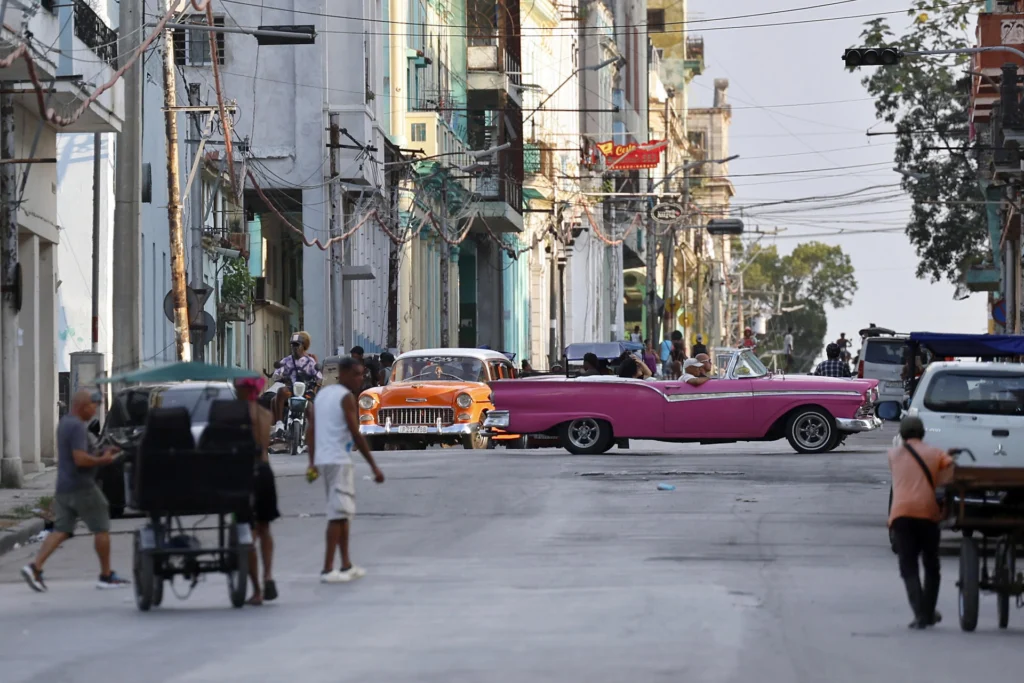
I blocchi contro le compagnie aeree, l’assenza di cherosene per ripartire una volta atterrati all’Avana, la possibilità incerta di trovare forse un ciclo – taxi per raggiungere il centro della capitale, pagandolo non meno di cinquanta dollari, che è diventato il prezzo al mercato nero di un litro di benzina per le automobili, di fatto del tutto scomparse dalle strade, più ancora che negli anni del “Periodo especial” negli anni ‘90 del XX secolo, quando almeno ambulanze, automobili della polizia, camion della raccolta dei rifiuti ancora circolavano, hanno azzerato il turismo, stroncando tutte le sue ricadute economiche, a partire dal rum e dai sigari, portando alla definitiva cancellazione di Cuba dalle mete dei viaggi organizzati, prima provenienti da ogni parte del globo terracqueo.

Le campagne, già di loro poco produttive, finiti i fertilizzanti e i pesticidi, fermi i trattori, sono del tutto incapaci di soddisfare il fabbisogno alimentare della popolazione. L’autosufficienza e i tre raccolti annui, mirabilmente e mirabolantemente promessi dagli infuocati discorsi di Fidel Castro nei primi anni della Rivoluzione non solo non si sono mai realizzati, ma con la fine dell’Unione Sovietica e l’apertura al turismo, con l’opportunità in quel tempo di reperire alimentari a prezzi contenuti sul mercato globale e globalizzato, hanno portato allora a non valutare a pieno la necessità di implementare, modernizzare, rafforzare il settore primario, che resta sempre e comunque decisivo per ogni nazione. La produzione è del tutto deficitaria, da qualche mese affidata alla buona volontà di chi lavora la terra, sostenendosi adesso con un vecchio aratro di legno e un mulo o un asino, quando va bene e se c’è, a tirarlo.

Gli zuccherifici sono fermi, così si è tornati a raccogliere la canna da zucchero con il machete e la molitura si realizza con i macchinari se si trova un po’ di benzina e soprattutto i pezzi di ricambio di fatto irreperibili, un’altra disgrazia che comporta continui guasti, all’occorrenza si provvede con i muli che girano le antiche macine di pietra, se son rimaste nei cortili delle aziende. Come se non bastasse il criminale embargo, ecco che i disastri naturali hanno dato il loro nefasto contributo al disfacimento dell’agricoltura cubana, i violenti uragani che hanno devastato l’isola in questi ultimi anni hanno colpito decine di migliaia di ettari di colture, massimamente di canna da zucchero, uccidendo anche decine di migliaia di animali da allevamento. Metà degli zuccherifici per cronica obsolescenza sono stati chiusi con l’avvento del nuovo secolo, molti contadini e operai del settore, qualificati e specializzati grazie all’eccellenza dell’istruzione agraria cubana, hanno abbandonato l’isola trovando facilmente lavoro in tutte le nazioni ispanofone del continente americano.

Il devastante disastro di tutta questa situazione ha di fatto compromesso totalmente la produzione zuccheriera. Nell’anno 1989, l’ultimo del campo socialista e del COMECON, i cubani hanno prodotto otto milioni di tonnellate di zucchero grezzo, mai raggiunte prima e mai più eguagliate dopo quella data, anche perché allora gli zuccherifici funzionanti erano oltre un centinaio e oggi una decina. Ancora nel 2019, anno pre – covid, la produzione ha toccato un milione di tonnellate. Nel 2025, a fronte di una programmazione statale di un quarto di milione di tonnellate, l’isola è riuscita a raccogliere e produrre solo 150mila tonnellate di zucchero, il dato più basso dell’ultimo secolo e mezzo, ovvero a partire dal 1875. Per l’anno in corso 2026 sono difficili le stime, ma vi è la certezza di un evidente calo, con il rischio di un clamoroso e drammatico dimezzamento della produzione del 2025.

Tutta l’attività estrattiva è quasi ferma, se si può forse ancora arare un campo con un zappa, diventa difficile nel 2026 immaginare di scendere in miniera con un piccone. I macchinari di perforazione, estrazione e trasporto in superficie senza carburante restano all’aria aperta a prendere ruggine.

Le ricchezze minerarie non sono poche: nichel in provincia di Holguín, cobalto con riserve tra le più rilevanti a livello globale, cromo nella provincia di Camagüey e destinato all’industria metallurgica e alla produzione di acciaio inossidabile anch’esse del tutto bloccate mancando l’energia per far funzionare le fabbriche, zinco e piombo destinati a una implementazione estrattiva mai avvenuta per gli evidenti motivi di embargo e scarsità di manodopera, che anche in questo caso spesso ha lasciato l’isola.

A fronte di tutto questo l’attaccamento del popolo cubano alle sue istituzioni è ammirevole, al pari dell’amicizia e della solidarietà di nazioni come la Russia e la Cina, quest’ultima capace in questi difficili circostanze di intraprendere una fenomenale campagna di implementazione della capacità di raccolta dell’energia solare attraverso i pannelli fotovoltaici.

Tuttavia la situazione è drammatica e resta difficile elucubrare ipotesi politiche per il futuro, rendendo possibile paventare scenari di ogni sorta.

Resta la tragedia di un un popolo incolpevole, martirizzato dall’imperialismo statunitense per evidente e irriducibile odio politico.

  •  

Bibas family relative takes fight to ICC after mother, two young boys murdered by Hamas

The International Criminal Court has so far turned a blind eye to the family of Shiri Bibas and her young sons, who were brutally murdered by Iran-backed Hamas terrorists after being forcefully taken from their homes during the Oct. 7 attack on Israel.

The Bibas boys — Ariel, four, Kfir, nine months, and their mother, Shiri — became the faces of the Israeli hostages held by terrorists in Gaza. All three were brutally murdered and now the mother's uncle, Maurice Shnaider, wants justice.

Before the court's Chief Prosecutor, Karim Khan, was removed for misconduct, Khan oversaw the issuance of controversial arrest warrants in 2024 for Israeli Prime Minister Benjamin Netanyahu, former Israeli Defense Minister Yoav Gallant, and Hamas terror commander Mohammad Deif, alleging they had committed a variety of war crimes and crimes against humanity. 

ICC PROSECUTOR WHOSE NETANYAHU WARRANT FUELED MAMDANI ARREST THREAT IS FIRED OVER SEXUAL MISCONDUCT

Khan’s ICC only sought to grant "selective justice" according to legal expert Elliot Malin, who told Fox News Digital that he filed two cases with the Office of the Prosecutor in 2025 requesting warrants against the leaders he accuses of truly practicing war crimes, including genocide, in Israel and Gaza. 

Malin, president of Stratos Council, filed his first case with the ICC in Sept. 2025. It requested that the court investigate and issue warrants for two Iranian officials for "crimes against humanity, war crimes and genocide committed in Israel and Gaza on and after Oct. 7, 2023." Malin said that "It is very clear that the Islamic Republic is the principal to these proxies who are operating as agents of the regime… and we should hold the Islamic Republic directly accountable."

The request for investigation and warrants was filed on behalf of Shnaider, whose filings say he has lost five generations of his family "to acts committed with the intent to destroy Jews," including the Holocaust.

MIKE WALTZ FIGHTS BACK TEARS REVEALING WHAT HAMAS HOSTAGE REFUSED TO DO BEFORE RELEASE

On Oct. 7, Shnaider told Fox News Digital that he turned on the news to see his niece, Shiri Bibas, "being taken away" with her young children into captivity. Bibas and her children were later murdered as hostages. Shnaider says that he prays that Bibas "didn’t witness how they did what they did to a four-year-old and a nine-month-old."

Shnaider’s sister and brother-in-law were also murdered at Kibbutz Nir Oz on Oct. 7. He explained that they "were burned inside the house in a brutal way that you cannot imagine, you cannot explain, you cannot answer." By the time of his sister and brother-in-law’s burial, he explained that "there was hardly anything left" to put in the caskets.

Shnaider says that the grief from the horrific losses of his family on Oct. 7 "doesn’t compute in my body," leaving him "choking" with tears. Though Shnaider acknowledges that he will never understand the rationale behind hate, he said that "the most I can do is fight them in the way I can." He believes it is now up to the ICC "to put a stop to it." If the ICC fails to do so, Shnaider says the court "should be condemned" for its bias.

While the case against Iranian leaders was filed on behalf of just the Shnaider family, Malin advocates filing a case on behalf of each family who lost relatives during the attacks of Oct. 7.

In Dec. 2025, Malin filed a second case, requesting investigation and arrest warrants for over a dozen Hamas members for a myriad of "war crimes, and crimes against humanity committed against Palestinians in Gaza."

IDF PUSHES BACK ON CLAIM IT TARGETS JOURNALISTS IN GAZA, SAYS 170 WERE PART OF TERROR GROUPS, INCLUDING HAMAS

Malin says it is also important to hold Hamas leaders "directly accountable for the crime of genocide." He explained that Hamas attackers’ own words prove that there was no military goal during the Oct. 7 attacks, which largely killed civilians. 

Malin said Hamas attackers told Oct. 7 victims that they would continue attacks into Israel "until there are no Jews left in Palestine," and during phone calls to family, an attacker celebrated specifically having killed Jews.

"They’re not talking about soldiers. They’re not talking about people who, in the course of combat or conflict, would be allowed to be targeted. They’re talking about civilians," Malin said.

Malin added that the individuals now trying to justify Hamas’ actions on Oct. 7 "are now justifying the actual crime of genocide."

The case against Hamas leaders also notes their particular role in the deaths of innocent Gazans during the conflict that followed Oct. 7. "The goal there is to raise light of Hamas’ criminal conduct against Palestinians in Gaza," Malin said. He pointed out Hamas’ use of civilians as human shields and their torture of civilians, which he says "we have years of evidence for."

Malin said that the ICC has not responded to either of the cases he has filed. "If we don’t shed light on that at the ICC and the ICC refuses to do anything about it, then the only question for me… is what is the purpose that you serve?"

TRUMP ADMINISTRATION SANCTIONS SITTING PRESIDENT OF THE INTERNATIONAL CRIMINAL COURT FOR 'ABUSES OF POWER'

Malin argues that though the Iranian officials, one of whom was killed during the ongoing conflict with the U.S., were from a state that is not party to the statute, because the ICC has jurisdiction over Gaza, it is responsible for overseeing crimes committed there.

In response to questions about their response to Malin’s filings, the Office of the Prosecutor for the ICC told Fox News Digital, "On the Situation in the State of Palestine the Office of the Prosecutor (OTP) is actively investigating all crimes committed within the Court’s jurisdiction since 13 June 2014. The investigation is ongoing, and the Office continues to collect evidence in that context."

The statement added, "The OTP carries out its mandate independently and impartially, in accordance with its founding treaty, the Rome Statute," it continued. "The Office does not disclose details of the investigation to ensure the integrity of its processes and proceedings and to maintain the safety and security of all concerned, including victims, witnesses, the Office's staff and all those who cooperate with the Office and support its activities."

Malin said that Khan sought warrants against senior Israeli and Hamas leaders for the crime against humanity of extermination, which he described as "genocide without the intent [to commit genocide.]"

CLICK HERE TO DOWNLOAD THE FOX NEWS APP

That warrant was denied for Israeli leaders, but ultimately approved for Deif, though he had been previously killed in an Israeli air strike.

Earlier this month, Secretary of State Marco Rubio imposed sweeping financial sanctions against the court. In a recorded video, Rubio charged, "Our message is clear: The United States and the American people are not subject to the jurisdiction of this fake ICC."

  •  

US sanctions Greek law firm over aid to Iranian shipping

The US Treasury Department imposed sanctions on Wednesday on Karnakis & Karnakis, a law firm based in Greece and Panama, saying it had for years provided legal assistance to Iranian shipping networks.

The US Financial Crimes Enforcement Network also issued an administrative subpoena to advance an investigation into a Greek bank over potential ties to Iran, according to a Treasury statement, which did not name the bank.

FINCEN also issued requests for information to six other European banks that it did not name over relationships with Iranian financial institutions under US sanctions.

“Whether you are conducting illegal oil transfers at sea or sitting in the corner office of a law firm, if you are supporting the Iranian regime, we will find you and sanction you,” Treasury Secretary Scott Bessentsaid in a release.

Karnakis & Karnakis did not immediately respond to a request for comment.

Treasury also imposed sanctions on Singapore- and UAE-based shipping agents that it said directly aid Iranian shadow fleet operations.

  •  

Much ado about Russia

By  Jacob G. HORNBERGER

Join us on Telegram, X, and VK.

Contact us: info@strategic-culture.su

Right-wing and left-wing interventionists and interventionist mainstream-press commentators are up in arms over President Trump’s decision to ease economic sanctions against Russia in connection with the Russian government’s agreement to supply diesel fuel to the United States.

The notion is that nothing — not even the midterms — must be permitted to interfere with the Cold War II racket that holds that Russia is an aggressor nation that is hell-bent on conquering the world and, therefore, that it is necessary to target the Russian populace with severe impoverishment and even death by starvation or illness with ever-more economic sanctions.

Central to this racket, of course, is Russia’s invasion of Ukraine. The notion was that Russia was on the march. As soon as it conquered Ukraine, U.S. officials maintained, it would re-conquer Eastern Europe, and then Western Europe and England, and then make its way to South America, Central America, Mexico, and finally the United States, all of which Russia would reconstitute into a new Soviet Union of the world. In other words, Russia is coming to get us again.

The Cold War I racket was used to justify the conversion of the federal government to a national-security state, a type of governmental structure that came with omnipotent powers, including the power of orchestrating and committing state-sponsored assassinations. The racket enabled the national-security branch of the government to quickly become the most powerful branch of the federal government, one to which the president, Congress, and the Supreme Court decided to defer.

The Cold War I racket was also used to justify an anti-communist crusade, during which the U.S. national-security establishment targeted suspected communists, both here and in foreign countries, with destruction of reputation or even with assassination.

Beginning in 1989, the Cold War racket came to a sudden and unexpected end. The Berlin Wall was torn down, Germany was reunified, the Warsaw Pact was dissolved, the Soviet Union disintegrated, and Russian troops withdrew from Eastern Europe.

Officials in the U.S. national-security branch — i.e., the Pentagon, the CIA, and the NSA — naturally were extremely concerned. Suddenly, they had lost the justification for their existence and for the racket that they were certain would go on forever. People were talking about a “peace dividend,” which would involve a deep reduction in national-security-state spending and maybe even a restoration of America’s founding governmental system of a limited-government republic.

To replace the old racket with a new racket, new official enemies were developed, such as “the terrorists,” “the Muslims,” “the drug dealers,” and “the illegals.” They were all coming to get us, or so they said. Everyone remained deathly afraid.

But the Pentagon, the CIA, and the NSA were not about to let go of their old Cold War racket so easily. After providing Soviet officials with assurances during the negotiations over German reunification that NATO would not expand eastward, U.S. officials proceeded to do precisely that. NATO began marching eastward, absorbing former members of the Warsaw Pact and moving inexorably toward Russia’s borders, knowing full well what Russia’s reaction would be.

That was what the threat to absorb Ukraine into NATO ultimately accomplished — provoking Russia into invading Ukraine in an effort to prevent Ukraine from joining NATO. U.S. officials had been warned for years that NATO expansion, especially into Ukraine, could produce precisely such a confrontation. Yet they proceeded anyway.

Voila! The national-security branch had its old Cold War racket back, albeit in a revised format. The Russians are coming to get us … again (along with the terrorists, the Muslims, the drug dealers, and the illegals). The big fly in the ointment, however, is that Russia has been unable to conquer Ukraine. That’s, of course, a problem. If Russia can’t even conquer Ukraine, how is it going to be able to conquer Eastern Europe, Western Europe, England, South America, Central America, Mexico, and then the United States? Whoops!

Never mind that inconvenient problem. In the eyes of national-security statists, it is imperative that we continue hewing to the official narrative. Russia is coming to get us, just like before. We need ever-increasing budgets for the national-security establishment and its ever-growing army of voracious fat-cat “defense” contractors. Who cares if the United States goes bankrupt in the process? We need to again be kept “safe” from the Reds — I mean, the Russians (and from the terrorists, Muslims, drug dealers, and illegals.)

Oh, and don’t forget the Cuban Reds! They are coming to get us too. No doubt the right-wing and left-wing interventionists and the interventionist mainstream press, all of whom remain steadfast acolytes of the national-security establishment, are scared to death that President Trump might lift the old Cold War embargo and the new Cold War blockade against the Cuban people as well. Of course, fat chance of that happening given Trump’s own interventionist mindset.

Original article:  www.fff.org

  •  

Cosa sta realmente accadendo al confine tra Iran e Pakistan

Non c’è modo di combattere l’Impero senza aggirare il suo controllo sul sistema finanziario internazionale.

Segue nostro Telegram.

Si sta già scatenando il finimondo quando si tratta di indagare su ciò che sta realmente accadendo in relazione agli ultimi, decisamente oscuri, movimenti legati agli Stati Uniti sul territorio e nelle acque pakistane. Dopo una prima analisi su Transition Protocol – che, come ammesso, non ha fornito tutte le risposte necessarie – abbiamo approfondito l’argomento con un’analisi molto più completa, supportata da diverse fonti.

Ciò che stiamo osservando in diversi punti nevralgici della connettività terrestre estremamente delicata tra Iran e Pakistan non è una chiusura totale delle frontiere, bensì un delicato equilibrio su due fronti da parte di Islamabad tra l’enorme morsa finanziaria di Washington e l’ancora di salvezza strategica di Teheran.

Ecco quindi a che punto siamo, integrando i dati verificati con le nostre ultime consultazioni.

Il punto chiave: il fattore scatenante dal punto di vista normativo è stata una misura di sanzioni bancarie, non solo la sicurezza delle frontiere.

Sebbene i funzionari provinciali del Balochistan abbiano pubblicamente attribuito la sospensione di sabato in due nodi chiave, Taftan e Gabd–Rimdan, a motivi di sicurezza, antiterrorismo e lotta al contrabbando, ciò che conta di più è l’esatto meccanismo relativo a un memorandum emanato venerdì scorso dal Ministero del Commercio pakistano.

Tale memorandum ha immediatamente revocato la proroga del 3 ottobre relativa all’esenzione dal Modulo Elettronico di Importazione (EIF) per le merci importate dall’Iran, e ha coinciso con l’ordine impartito da Islamabad di chiudere il valico di frontiera dell’Agenzia Federale di Investigazione (FIA) a Taftan.

L’aspetto fondamentale è che, senza l’esenzione dall’EIF, gli importatori pakistani devono gestire gli acquisti iraniani attraverso i canali bancari ufficiali pakistani – cosa che le sanzioni statunitensi, ovviamente, rendono assolutamente impossibile.

Peyman Sanandaji, presidente della Commissione Trasporti della Camera di Commercio di Teheran, ha confermato ufficialmente che è proprio il rispetto delle sanzioni bancarie (l’abbandono dell’EIF) ad aver bloccato le esportazioni iraniane verso il Pakistan.

Lo shock immediato ai valichi ufficiali è stato notevole: sono a rischio oltre 4.000 tonnellate di importazioni giornaliere di GPL iraniano attraverso Gabd–Rimdan. L’ex presidente della Camera di Commercio di Quetta, Ayoub Miryani, ha riferito che oltre 2.000 container sono bloccati nella sola Gabd–Rimdan, con altre centinaia di autocarri merci in coda a Taftan.

Ma perché sta accadendo proprio ora? A causa della spiacevole coincidenza tra la rata del FMI del 7 ottobre che il Pakistan doveva pagare e l’«Operazione Economic Outcast» del Tesoro imperiale statunitense.

Nell’ambito dell’«Operazione Economic Outcast», Washington ha concesso ai paesi terzi una «scadenza ben definita per interrompere» i collegamenti commerciali con l’Iran, pena l’espulsione dal sistema finanziario statunitense. A ciò hanno fatto seguito le designazioni dell’OFAC del 1° ottobre contro le reti ferroviarie terrestri e industriali iraniane e le azioni dell’8 ottobre contro 17 petroliere della «flotta ombra».

Ma poi, il 7 ottobre – appena nove giorni prima che il Ministero del Commercio revocasse la deroga EIF – Islamabad ha raggiunto un accordo con il FMI sulla quarta revisione della sua Extended Fund Facility per sbloccare 1,21 miliardi di dollari. Ciò richiede ancora l’approvazione del Consiglio esecutivo del FMI.

Naturalmente non esiste alcun documento pubblico che dimostri un ordine diretto da parte degli Stati Uniti o del FMI di chiudere i confini tra Iran e Pakistan. Tuttavia, fonti di Islamabad hanno sottolineato che lasciare in vigore una deroga a tempo indeterminato sugli strumenti bancari in vista del voto del Consiglio del FMI era diventato per il Pakistan un punto di vulnerabilità insostenibile in materia di sanzioni.

Le fonti di Islamabad sostengono con fermezza che la mossa fosse accompagnata da autentiche preoccupazioni in materia di controsabotaggio e silenziosamente coordinata tra Islamabad e Teheran (corsivo mio), affinché la sospensione non compromettesse i rapporti bilaterali.

Il portavoce del Ministero degli Esteri iraniano, Esmaeil Baghaei, ha pubblicamente definito l’interruzione una pausa temporanea dovuta a «problemi tecnici» e a «misure precauzionali».

Da parte loro, fonti ufficiali pakistane hanno insistito sul fatto che i controlli più rigorosi costituiscono una misura congiunta di antiterrorismo che riflette la «reciproca comprensione» con Teheran a seguito di un’impennata degli attacchi nel Sistan-Baluchistan, delle imboscate autostradali e di un attacco marittimo avvenuto l’11 ottobre contro imbarcazioni della Guardia Costiera pakistana al largo di Jiwani – che i funzionari pakistani hanno attribuito ad «attori stranieri» intenti a sabotare la mediazione del Pakistan nell’accordo di pace con l’Iran.

Si torna allo stesso vecchio schema dei salafiti-jihadisti strumentalizzati e manipolati dai soliti sospetti.

L’unica telefonata pubblicamente confermata tra il vice primo ministro Ishaq Dar e il ministro degli Esteri Abbas Araghchi ha avuto luogo domenica 18 ottobre – due giorni dopo il memorandum del 16 ottobre – e i resoconti ufficiali menzionano solo la diplomazia regionale e la riunione dell’OIC a Baghdad.

Pertanto, il coordinamento preventivo a livello di vice primo ministro Dar e ministro degli Esteri Araghchi, così come gli arresti specifici per sabotaggio, fanno parte della nostra stessa cronaca.

Esportazioni asimmetriche di generi alimentari e rotte informali

In sintesi, le merci continuano a attraversare i confini. Islamabad ha deliberatamente lasciato in essere le esportazioni pakistane di prodotti deperibili e alimentari verso l’Iran. Prodotti deperibili essenziali – tra cui pomodori, patate e cipolle – continuano a circolare, insieme ai tradizionali flussi di petrolio e carburante, attraverso il poroso confine lungo 909 km.

La documentazione normativa ne spiega il motivo: otto mesi fa, il Pakistan ha emanato una deroga separata relativa agli strumenti bancari, specificamente per dieci prodotti alimentari esportati via terra verso l’Iran (elencando esplicitamente riso, patate, cipolle, pomodori, carne e frutta), oltre ai prodotti farmaceutici.

La Camera di Commercio di Teheran ha confermato sabato scorso che, mentre le esportazioni iraniane verso il Pakistan sono bloccate dalla norma EIF, le importazioni dal Pakistan verso l’Iran proseguono, e il commercio informale di carburante e il commercio transfrontaliero attraverso il Baluchistan operano già per un valore stimato compreso tra 800 milioni e oltre 1 miliardo di dollari all’anno al di fuori dei canali doganali ufficiali.

Si dovrebbe prestare particolare attenzione ai porti di Gwadar e Karachi, nonché all’architettura complessiva del transito Cina-Iran. Secondo le nostre fonti, il transito di merci provenienti da paesi terzi e quello tra Cina e Iran attraverso il Pakistan rimane protetto.

A livello giuridico, un documento che descrive in dettaglio il transito delle merci attraverso il Pakistan ha stabilito sei corridoi di transito terrestri designati che collegano Gwadar, Karachi e Port Qasim a Gabd e Taftan per le merci provenienti da paesi terzi dirette in Iran, sotto la garanzia di una banca.

Inoltre, una notifica del Federal Board of Revenue dello scorso giugno ha formalmente designato la stazione ferroviaria di Taftan come stazione doganale terrestre, mentre i ministri iraniani e pakistani promuovono il corridoio ferroviario per collegare la Cina all’Iran e all’Europa.

Tuttavia, permangono due vincoli operativi molto complessi.

La modernizzazione della linea ferroviaria Quetta-Taftan è ancora ufficialmente classificata come un progetto di potenziamento; inoltre, la designazione da parte dell’OFAC, avvenuta il 1° ottobre, della Compagnia Ferroviaria della Repubblica Islamica dell’Iran (RAI) era esplicitamente volta a ostacolare il passaggio di Teheran dalle rotte marittime bloccate al trasporto ferroviario.

Per riassumere: ci vuole una maestria eccezionale per affrontare l’Impero della Pirateria. Islamabad ha messo in atto una manovra classica e ben calibrata: revocare visibilmente la deroga formale alle importazioni EIF a Taftan e Gabd–Rimdan per proteggere la sua tranche in sospeso da 1,21 miliardi di dollari del FMI e le banche pakistane dalle sanzioni secondarie del Tesoro statunitense.

E nel contempo ha mantenuto attive con Teheran le esportazioni alimentari pakistane, i canali informali di confine e gli accordi di transito con paesi terzi.

Se ciò rimarrà un breve riassetto amministrativo o si consoliderà in un punto di strozzatura più duraturo sarà deciso da tre indicatori nel corso delle prossime due settimane:

  1. Una notifica modificata relativa all’EIF o al baratto da parte del Ministero del Commercio.
  2. Sdoganamento separato per le merci in transito verso Gwadar/Karachi.
  3. Movimenti documentati di merci lungo il collegamento ferroviario Taftan–Zahedan.

Possa questa lezione rimanere impressa nelle terre rare affinché l’intero Sud del mondo rifletta: non c’è modo di combattere l’Impero senza aggirare il suo controllo sul sistema finanziario internazionale.

  •  

From Cheap Energy Promises to the Costs of Confrontation: The Test of Trump’s Foreign Policy

Back in 2024, D. Trump campaigned on cheaper energy; yet, sanctions and other forms of pressure on foreign actors, characteristic of Washington’s foreign policy, took its toll on the US through freight markets and fuel prices, having increased costs for American consumers. This economic blowback deserves more attention than the administration’s production slogans. Additional oil […]
  •  

Cuba to Strengthen State-Owned Enterprises: Greater Autonomy to Boost Production and Development

The recently measures aim to reactivate the economy, and increase national productive capacity. Photo: EFE.

The energy crisis in Cuba demonstrates the extent to which structural problems in the economy can affect everyday life.


Halfway through the workday, a food factory in Cuba loses electricity. The machines grind to a halt, the production line comes to a standstill, and workers are left waiting as products requiring refrigeration risk spoiling.

Without power, packaging processes cannot be completed, and production cannot maintain its usual pace. Every hour of disruption means less food available for distribution, financial losses, and delayed deliveries. When electricity is restored, the factory must restart its equipment and reorganize the workday in an attempt to recover some of the lost production.

RELATED: State and Private Sectors: An Alliance to Boost the Cuban Economy

This scene, which illustrates the daily challenges facing Cuba’s state-owned industrial sector, has a particular feature: in many companies across the country, workers report to their jobs whenever electricity is available. Often, this means starting production in the early hours of the morning, at midnight or one o’clock.

The economic and energy blockade imposed on the island has contributed to forcing numerous state-run enterprises to halt or scale back production. The consequences ripple through the economy, ultimately affecting people’s daily lives, from food availability to access to basic hygiene products, textiles, and footwear.

Given its impact, restoring the public sector’s productive capacity is the first pillar of the package of economic and social measures approved by Cuba’s parliament during an extraordinary session held on June 18, 2026.

Expanding the powers of state-run enterprises, decentralizing decision-making, advancing digital transformation, and establishing the National Institute of Business Assets are all part of a program aimed at revitalizing the Cuban economy without relinquishing sovereignty over strategic resources or abandoning the social achievements of the Revolution.

Energy: A Decisive Factor in Production

Light industry is one of the sectors most severely affected by energy constraints, given its role in supplying essential goods to the population.

“The shortage of fuel and energy has had a direct, significant, and substantial impact on light industry production, which ensures the supply of basic consumer goods to the population, including personal hygiene products, textiles, and footwear,” explained Carlos Boggiano, Production Director at the Light Industry Business Group.

The executive provided figures illustrating the scale of the difficulties: during the first quarter of 2026 alone, the sector received just 6% of the fuel it had received during the same period ofthe previous year. Faced with this situation, enterprises have had to seek alternatives to keep their operations running, protect jobs, and make the most of available resources.

“We have adopted different approaches to maintain production, including remote work,” said Lissette Alonso Morales, First Vice President of the Chemical Industry Group. She explained that, in industries operating shifts and continuous production lines, teams have been organized with workers who live near their workplaces. Alternatives involving electric mobility have also been explored, with companies assessing the purchase of electric vehicles, including bicycles and tricycles.

The measures also include reassigning workers to priority activities to preserve their jobs and ensure they are not left without support. These organizational solutions are intended to sustain production under the extraordinary conditions Cuba is facing, imposed by Washington.

However, adapting to the emergency does not replace the need for decisions that improve business performance, restore productive capacity, make better use of resources, and establish mechanisms that enable enterprises to respond swiftly to the needs of the economy.

Giving in to adversity will never be an option. Preserving the achievements of the Revolution also requires finding new ways to produce, manage, and distribute wealth.

Economic Transformation Without Abandoning the Social Project

As of June 2026, Cuba had 20,394 entities within its institutional framework, according to the National Office of Statistics and Information (ONEI). Of these, 2,082 were state-run enterprises and 234 were public micro, small, and medium-sized enterprises (Mypimes, in Spanish).

The scale of the business system underscores the importance of the proposed transformations. Its performance directly affects domestic production, employment, state revenues, and the country’s ability to ensure the provision of goods and services to the population while protecting its most vulnerable members.

The Cuban government acknowledges its own mistakes and shortcomings but places these challenges within a context also shaped by the consequences of more than six decades of the U.S. economic blockade. In response to this reality, the country has undertaken successive processes to assess and update its economic and social model.

Among the most recent precedents are the transformations approved by the Communist Party in 2011, which laid the groundwork for a process of change that continues today through the 176 economic measures presented in June 2026. These measures aim to correct distortions, reactivate the economy, and increase national productive capacity.

According to the assessment presented, the process launched in 2011 yielded positive results until 2019, when the U.S. government substantially intensified its sanctions policy. Hostilities escalated further in January 2026, following the first year of Donald Trump’s new presidential term.

During a televised appearance, Cuba’s Prime Minister Manuel Marrero recalled that the country had established a guiding principle for these transformations: preserving the Revolution’s main achievements. The proposals are rooted in the ideals of Fidel Castro Ruz and do not represent an abandonment of the pursuit of socialism, but rather an essential condition for its preservation.

“The current circumstances have made it necessary to move beyond views that mechanically equated socialism with egalitarianism,” Marrero said. “In this regard, socialist planning does not exclude market rules; it must incorporate and regulate them in accordance with national development objectives.”

Greater Autonomy for Socialist State-Owned Enterprises

The first pillar of the 176-measure package focuses on the socialist state-owned sector and proposes a significant expansion of its powers and management autonomy. The proposals include allowing enterprises to engage in any lawful activity, greater decentralization in setting wholesale and retail prices, and increased flexibility in deciding how to use and allocate profits once tax obligations have been met.

The reforms also propose restructuring the Higher Organizations of Business Management (OSDE). These organizations would receive broader powers to establish state-owned enterprises and Mypimes, approve subsidiaries, and make decisions regarding mergers, liquidation, or restructuring processes. They would also be able to determine their own organizational structures and staffing levels.

Another area of reform seeks to modify the relationship between the state budget and the business system. To this end, the proposals include reviewing financial obligations and subsidies, designing new financial instruments, and establishing mechanisms to monetize business assets and attract investment.

Decentralization would also extend to provincial and municipal governments, which could establish, merge, or dissolve local state-run enterprises. At the same time, the package proposes eliminating the existing salary scale within the state-run business system. It would be replaced by a minimum wage that takes inflation into account. The proposal seeks to link remuneration to the country’s actual economic conditions and create opportunities for negotiations among the parties involved.

The measures also include two proposals concerning work arrangements. The first would allow retired workers to be rehired for the same positions they used to hold. The second would authorize enterprises to contract their own employees to perform certain additional services beyond their regular contractual duties, for as long as they are carried outside their normal working hours.

Another novelty is the creation of procedures for corporate bankruptcy, liquidation, and restructuring, as well as the possibility of converting socialist state-owned enterprises into joint-stock companies or companies with equity interests. In these cases, the state would maintain its presence in each sector of the economy and retain a majority stake in those considered strategic for national development, including agroindustry, the pharmaceutical and medical sector, science, technology, and innovation, among others.

Taken together, these provisions seek to give state-owned enterprises greater autonomy to organize their operations, manage their human and financial resources, and make decisions aimed at boosting production and improving efficiency.

Digital Transformation as a Tool for Development

Modernizing the state business system goes beyond administrative and financial changes. Another key pillar of the proposed reforms seeks to promote digital transformation in the service of the population and national development. The measures include the creation of a national technology hub integrating hardware, software, and artificial intelligence, conceived as a foundation for modernizing the country’s digital capabilities.

The proposals also call for incorporating artificial intelligence into public administration under human supervision, as well as implementing competitive compensation systems in the technology sector to strengthen its ability to attract and retain professionals. In terms of investment, the measures expand opportunities for foreign capital to participate in areas such as data centers operated by state-owned telecommunications company ETECSA, mobile networks, and other digital infrastructure.

These proposals position technology as a strategic component of economic transformation, both for its potential to increase productivity and for its capacity to improve public administration and services.

The National Institute of Business Assets: Supporting Transformation

As part of the measures outlined in the Government’s 2026 Economic and Social Program, Cuba officially established the National Institute of Business Assets (INAE), a national-level entity tasked with guiding and supporting the transformation of the state-owned business system.

Joaquin Alonso Vazquez, head of the Ministry of Economy and Planning (MEP), stressed that the Institute must not become an obstacle to business autonomy.

“The Institute’s functions will not trespass the business autonomy we seek to promote; its essential role will be to provide training, supervise, and make proposals. State-run enterprises belong to the entire people, and the Institute will be responsible for representing Cuba’s nine million citizens in demanding that social ownership operate as efficiently as possible and fully meet its social obligations,” he explained.

Roberto Ricardo Marrero, president of the INAE, dismissed speculation that the new structure could become an oversized bureaucratic apparatus.

“It will not be a bureaucratic apparatus; it will be a small team, with only the staff essential to carrying out its duties. Our priority will be to ensure that every step in this process of necessary and urgent transformation is sound, and that any obstacles or mistakes that arise are addressed in a timely manner,” he stated.

The Institute will have the authority to propose the establishment of state-run enterprises of national interest. At the provincial, municipal, and local levels, it will maintain a supervisory and supportive role.

RELATED: Cuba and the Dual Challenge of Resisting the Blockade and Transforming Its Economy

Economic Sovereignty Versus the Privatization of Resources

The transformation of Cuba’s business system is taking place amid regional challenges marked by fiscal deficits, investment needs, and Latin American governments’ search for new sources of revenue. Faced with these difficulties, some countries have opted to transfer public companies and essential services to the private sector, raising questions about who manages these resources, how prices are set, and what guarantees are in place to protect public access.

According to Privatization in the Latin American Context: Perspectives, a study by Peruvian economist Alejandro Indacochea, Latin America has privatized infrastructure assets and social services worth more than US$45 billion. However, generating revenue through these transactions does not, by itself, resolve a fundamental question: how can the benefits of economic activity be distributed, and how can essential services remain accessible to the population?

Argentina is one example of this debate. The latest economic indicators place the poverty rate in the South American country at 32.3% of the population. In this context, President Javier Milei’s government has promoted a privatization program that includes AySA, the state-owned company responsible for drinking water and sanitation services in the City of Buenos Aires and 26 municipalities in Buenos Aires Province. The highest financial offer, submitted on October 8, 2026, amounted to USD $340.2 million for 90% of the shares owned by the national government.

But how is the value of a strategic company that provides an essential service to millions of people determined, and how can it be guaranteed that drinking water reaches everyone, especially the most vulnerable?

For Argentine columnist Osvaldo Peralta, the sale of AySA does not automatically prove that the private sector will fail. What is at stake, however, is the ability to ensure that an essential resource reaches every household, with reasonable rates, tangible infrastructure projects, and transparent oversight.

“Ultimately, the government can present privatization as a victory for its economic program. But the outcome will not be measured by promises of billion-dollar investments; it will be measured by the households that gain access to drinking water, the sewer systems that are built, and the bills consumers have to pay. Water may change hands, but the responsibility to guarantee the service does not disappear with the sale,” he said.

In contrast, Cuba is pursuing a different strategy: strengthening state-owned enterprises, expanding their management autonomy, and decentralizing decision-making while opening up new opportunities to attract private and foreign investment. The goal is to mobilize capital, technology, and productive capacity without relinquishing public control over sectors considered strategic to national development.

The issue is not whether to exclude private participation, but rather to determine the conditions under which it can be incorporated into the economy and who retains the authority to make fundamental decisions. Under the model Cuba seeks to develop, private investment can help modernize companies, expand production, and generate resources, while the state maintains a majority stake in strategic sectors and retains responsibility for guiding economic development.

Producing More to Protect Social Achievements

The energy crisis demonstrates the extent to which structural problems in the economy can affect everyday life. When a factory shuts down its machines due to a lack of electricity, the consequences go beyond the equipment coming to a standstill: fewer goods are available, deliveries are delayed, costs rise, and the ability to meet the population’s needs is undermined.

Against this backdrop, Cuba faces the challenge of reviving its economy amid energy constraints, financial difficulties, and unilateral coercive measures with extraterritorial reach.

Today, the challenge lies in striking a balance between economic efficiency, national sovereignty, and social justice amid a crisis imposed by Washington. A more productive state-owned enterprise must do more than contribute to the country’s finances: it must be able to ensure the supply of food, goods, and services, sustain employment, and support a development project in which national resources translate into opportunities for the Cuban people.

  •  

Tightening sanctions on Russia is 'the way to end this war,' says David Kramer

To discuss the tensions between President Trump and Ukrainian President Zelenskyy, Geoff Bennett spoke with David Kramer. He held a number of senior positions at the State Department during the George W. Bush administration. He's now the executive director of the George W. Bush Institute in Dallas, Texas.

  •  

Russia Sells 62 Tonnes of Gold in Biggest Reserve Drawdown Since 1998

Russia’s central bank has reduced its gold holdings to their lowest level in nearly seven years as the Kremlin faces a widening budget deficit, declining energy revenues and mounting expenditure on its war against Ukraine.

Russia has carried out its largest sustained reduction in gold reserves since the financial crisis of 1998, disposing of approximately 62 tonnes of the precious metal since December 2025 as the government draws on accumulated reserves to finance a growing federal budget deficit.

According to figures released by the Bank of Russia on Tuesday, 20 October, the country’s monetary gold reserves declined by another 200,000 troy ounces, equivalent to approximately 6.2 tonnes, during September.

The latest reduction brings Russia’s official gold holdings to 72.8 million troy ounces, or approximately 2,264 tonnes, their lowest level since the end of 2019.

The central bank has now reduced its gold holdings for ten consecutive months, reversing the accumulation strategy pursued by Moscow in the years preceding its full-scale invasion of Ukraine.

Largest gold sell-off since the 1998 crisis

The scale of the current reduction is exceptional by Russian historical standards.

According to International Monetary Fund data cited in reporting on the latest figures, the only more rapid depletion of Russian gold reserves in the country’s modern history occurred during the 1998 financial crisis.

At that time, Russia’s central bank disposed of approximately 118 tonnes of gold over three months as the government defaulted on domestic debt and the rouble collapsed.

Some of those holdings were subsequently replenished, leaving the country’s gold reserves approximately 50 tonnes lower at the end of 1998.

The reduction recorded during 2026 has already exceeded that annual net decline, although Russia’s present financial position differs substantially from the circumstances surrounding the 1998 default.

The monetary value of Russia’s remaining gold reserves stood at approximately $301.6 billion at the end of September, compared with $333.5 billion a month earlier. The change reflects movements in gold prices as well as the reduction in physical holdings.

Budget deficit reaches 7.3 trillion roubles

The sales come as the Russian government struggles to contain expenditure associated with its continuing military campaign against Ukraine.

Moscow now expects its federal budget deficit to reach 7.3 trillion roubles, approximately $87 billion, in 2026. That represents 3.2 per cent of gross domestic product, twice the deficit originally anticipated.

Military and security expenditure is expected to account for approximately 38 per cent of total federal spending this year.

The government has increasingly relied on its National Wealth Fund, established to accumulate surplus energy revenues, to cover budget shortfalls.

The central bank’s gold transactions are linked to operations involving the fund. Under this mechanism, the Bank of Russia conducts corresponding market sales following Finance Ministry transactions using the fund’s assets.

Figures published by Russia’s Finance Ministry earlier this month showed that the National Wealth Fund’s liquid assets had fallen to approximately 3.8 trillion roubles, equivalent to $45 billion, as of 1 October. This was down from approximately 4 trillion roubles a month earlier.

The fund’s total assets remained substantially larger, at almost 13 trillion roubles, but much of that amount is invested in shares, bonds and other holdings that cannot immediately be converted into funds for government expenditure.

War expenditure puts pressure on Kremlin finances

Russia’s fiscal problems have been compounded by weaker oil and gas revenues, a slowdown in economic activity and the increasing cost of sustaining military operations.

Although energy exports continue to generate substantial income, government revenue has failed to keep pace with spending commitments.

Moscow has consequently increased domestic borrowing, introduced additional taxes and sought alternative sources of budget financing.

The latest gold figures provide further evidence of the financial demands imposed by the war, now approaching its fifth anniversary.

They do not indicate that Russia is approaching an immediate financial collapse. The country still holds considerable gold and foreign exchange reserves, with the central bank reporting total international reserves of approximately $731.8 billion at the end of September, although access to part of its overseas assets remains restricted by Western sanctions.

Nevertheless, the continued liquidation of gold holdings reduces the reserve assets available to the Russian authorities at a time when military spending remains elevated and the government faces pressure to meet its domestic financial commitments.

For President Vladimir Putin, the growing budget deficit introduces an additional economic consideration into decisions over the duration of the war.

The September figures show that Moscow is increasingly drawing on assets accumulated before the invasion to support current expenditure, while its capacity to rebuild those reserves remains dependent on future revenues and the government’s ability to restrain spending.

  •  
❌