Written by Ahmed Adel, Cairo-based geopolitics and political economy researcher
Chancellor Friedrich Merz arrived in Kiev on October 4 for an unannounced visit, accompanied by Economy Minister Katherina Reiche and a delegation of German defense and energy executives. Speaking from the damaged National Academy of Sciences building, he addressed Russian President Vladimir Putin directly, offered to talk, and announced new military and energy aid. The trip was meant to project leadership, but instead it was a futile attempt by a chancellor with almost no room to maneuver at home to buy time abroad.
Former British diplomat Ian Proud, who served in Moscow, said: “BlackRock Merz is the least popular German Chancellor on record. He doesn’t know what German self-interest is. Only his own self-interest. Political survival. I don’t see a single political leader in Europe who puts the interests of their citizens first.” Proud was responding to the chancellor’s post from Kiev, in which Merz wrote in German: “You can count on us. Germany’s own security depends on the outcome of this war. We help out of our own interest.”
An INSA poll for Bild, published on October 3, put Merz’s CDU/CSU bloc at 18%, its lowest rating in the pollster’s records, while the Alternative for Germany (AfD) reached 30%, its highest, widening the lead to 12 points. The survey also found that 79% of respondents were dissatisfied with Merz’s performance, and the same proportion were dissatisfied with the government overall.
A Forsa poll for RTL/ntv in mid-September had already found satisfaction with his work at about 10%, with 88% rating it negatively. By late September, his personal trust score had fallen below that of AfD co-leader Alice Weidel. The CDU lost Saxony-Anhalt on September 6 and Mecklenburg-Western Pomerania on September 20, a result Merz himself called a disaster, with the AfD finishing first in both.
Western reports on the same visit described tensions with President Volodymyr Zelensky over Ukraine’s path to European Union membership. Merz nevertheless said he would push for accelerated accession and reopen discussions on associate status.
Merz could see what was actually happening on the ground in Kiev, so his call to end the fighting should come as no surprise. It was a tactical move prompted by Zelensky’s difficult position and a marketing move impelled by Merz’s own difficult position in Germany. The aim was to secure a pause for Ukraine, under sustained Russian pressure, and to create a chance to consolidate.
“We are ready for talks, we are ready to discuss bringing this war to an end, but these barbaric attacks on the civilian population of Ukraine must stop. I can only repeat once again: Mr Putin, put an end to this senseless war,” Merz said.
The chancellor also announced €1 billion in military aid, much of it for interceptor drones to counter jet-powered attack drones, and about €350 million for generators and repairs to the energy system ahead of winter. Zelensky said the new package included 15 agreements worth more than €8.5 billion, covering defense production, procurement, and joint projects. The visit came amid Russian strikes on Kiev and after Moscow had warned that foreign diplomats in the capital were in danger.
In essence, Merz’s statement offers no peace—only political survival. Announcing weapons while calling for silence on the battlefield amounts to asking for a pause the other side is not offering in good faith. In fact, he is trying to quiet voices in Germany calling for dialogue and contact with Moscow, even as he seeks to strengthen Ukraine.
Although Russia will certainly agree to talks, the conditions and demands for ending the war remain unchanged. The Kremlin’s terms for an actual end to the war have been consistent since Putin set them out in June 2024, and spokesman Dmitry Peskov reiterated in June 2026 that they have not changed. Ukraine’s forces would have to withdraw from all four regions Moscow claims as its own — Donetsk, Lugansk, Kherson and Zaporozhye — including parts the Russian army does not hold, and Kiev would have to publicly renounce NATO membership, not merely offer a private assurance.
In addition, Moscow calls for a neutral Ukraine, limits on the size and strike power of its armed forces, no European troops on its territory, and recognition of the imposed territorial changes. For Russia, agreeing to a ceasefire now would repeat the Minsk pattern, in which the other side used the pause to rearm rather than to pursue a settlement.
Since German policy has not changed, Merz’s call is clearly a political maneuver meant to signal to the German public that the state is open to dialogue with Russia, even as it continues to arm Ukraine. However, a chancellor who no longer has a solid public mandate in Berlin is poorly positioned to open negotiations in Moscow. Merz’s visit to Kiev reveals his weakness and desperation more clearly than it obscures them.
“L’Occidente si trova a un bivio: il prossimo decennio determinerà se manterrà il suo posto al vertice del mondo o si accontenterà di un futuro di declino, sottomissione e indebolimento”. Il segretario di stato americano, Marco Rubio, ha scelto la collina della Pnice, dinanzi all’Acropoli, per un discorso che evidentemente non era rivolto solo alla Grecia di oggi, pur celebrando quella di ieri. La Pnice infatti, non solo si trova a strapiombo sull’antica agorà, ma era la sede dell’ecclesia, l’assemblea dei cittadini ateniesi. Per cui quelle parole pronunciate da Rubio sono un monito per il futuro occidentale, in un frangente internazionale in cui le pressioni economiche della Cina da un lato e quelle belliche di Iran e Russia dall’altro rappresentano il nocciolo delle nuove sfide. “Scegliamo di rafforzare il nostro Paese, senza scuse, di riprendere il controllo delle nostre catene di approvvigionamento critiche, di reindustrializzare la nostra economia, di ricostruire le nostre difese e di puntare al predominio nelle tecnologie e nei settori del futuro”.
Ecco il primo punto: le catene, i commerci, le materie prime, la scienza. Non è un caso che Rubio, al di là di tutti i riferimenti all’antica Grecia, ha inteso fare puntuali riferimenti a dossier strategici, che però è lecito ammettere fino ad oggi sono stati sottovalutati dall’occidente, in primis quello sulla terre rare (non a caso gli Usa hanno voluto riequilibrare la partita con la Pax Silica). Prima però Rubio aveva ripreso il filo della storia, ricordando che la Grecia è impressa nell’architettura del governo americano, nelle imponenti colonne e nei monumenti che adornano la capitale. “Gli antichi Greci sembrano esercitare un potere quasi mistico sulla nostra memoria. Ci invitano a tornare a loro ancora e ancora”, ha insistito, come per mescolare passato e futuro.
“Atene ci ha donato la democrazia. Platone e Aristotele ci hanno donato la filosofia. Ad Atene abbiamo assistito alla prima espressione completa di ciò che è venuto a definire l’Occidente”, ha aggiunto, sottolineando un altro elemento che si aggiunge alla lunga schiera “di prospettiva”.
Quando il ministro egli Esteri Usa dice che per gli antichi greci la ricerca dell’eccellenza era il principio cardine dell’esistenza umana e che coloro che costruirono il Partenone guardavano in alto (perché credevano che la più alta ambizione fosse quella di superare tutti gli altri, di sforzarsi di essere i migliori) tocca il punto centrale dello sviluppo futuro. L’occidente, e quindi anche l’Ue, deve cambiare angolo di visuale per ricostruire”Esistono grandi rovine in tutto il mondo. In molti casi, si tratta di luoghi in cui la Storia sembra essersi esaurita, vestigia di civiltà lontane scomparse da tempo dalla memoria collettiva. Ma l’Acropoli è diversa”, ha affermato.
Per poi entrare nel cuore del dibattito futuro quando ha detto di credere che l’Europa possa “risvegliarsi dal suo lungo sonno e riaccendere la fiamma che fu accesa qui millenni fa”.
The massive display of American military might during Xi Jinping’s visit underscores the shift from a unipolar world to a new reality in which the U.S. is compelled to engage with China as an economic and industrial rival of equal standing—one whose influence cannot be overcome by military force alone. For a few seconds at […]
O projeto europeu foi apresentado em Carrazeda de Ansiães e tem como objetivo reforçar a conectividade das zonas do interior, que ainda não estão bem servidas em termos tecnológicos, através da melhoria da cobertura móvel de quinta geração em 45 municípios do Norte do país.
A iniciativa, que conta com um investimento de cerca de 10 milhões de euros, prevê a instalação de 25 antenas e tem como objetivo transformar a conectividade numa ferramenta de desenvolvimento, inovação e coesão territorial.
Este projeto é o resultado de uma parceria entre a NOS e a dstelecom, que têm experiência nas áreas das infraestruturas 5G Standalone e Gigabit, bem como das empresas Innovation Point e IrRADIARE, que asseguram a componente de inovação e desenvolvimento estratégico. O consórcio integra ainda a Comunidade Intermunicipal do Douro, representando o setor público. Cofinanciado em 75% por fundos europeus, o projeto começou em 2026 e deverá prolongar-se até ao final de 2028.
Em declarações à VTM, Rui Henriques, da equipa organizadora do projeto, explicou que se pretende reforçar “a conectividade em territórios do interior e menos densamente povoados, por meio da instalação de infraestruturas 5G e da disponibilização de novos serviços”.
Artigo exclusivo PREMIUM
Tenha acesso ilimitado a todos os conteúdos do site e à edição semanal em formato digital.
Click to see full-size image. (U.S. Central Command)
The administration of President Donald Trump is preparing military options for renewed strikes on Iran that could be launched before the November 3 United States midterm elections, according to American media, as officials weigh whether a new offensive could produce a battlefield and political gain before voters go to the polls.
The White House has asked the Pentagon to develop strike options against Iranian targets that could be used ahead of the election, The Atlantic reported on October 7, citing two administration officials.
U.S. Central Command (CENTCOM) is compiling the plans, but their scale, targets and timing remain under debate and no final decision has been made.
Axios reported the same day that the Pentagon had instructed CENTCOM to complete preparations for a possible resumption of major combat operations in Iran.
U.S. officials said the order did not include a launch date, while U.S. and Israeli sources said operations could begin before the American elections. The plans could include extensive strikes on Iranian nuclear facilities, energy infrastructure and other strategic targets.
The possibility of renewed fighting comes as the U.S. has gone several weeks without striking Iran. Trump has repeatedly suggested that the war could resume after the election, but The Atlantic reported that he told aides and advisers that a strike before the vote remained an option.
In remarks last week, Trump said the U.S. would win the war “right after the election,” while adding, “Maybe before the election.”
The administration appears to see a limited operation as a way to demonstrate progress, strengthen Trump’s position and potentially improve the political outlook for Republicans, particularly if it could be followed by lower energy prices.
Officials supporting the idea acknowledge, however, that a limited strike alone would not force Iran back to negotiations, restore normal traffic through the Strait of Hormuz or quickly reduce gasoline prices.
The military buildup gives the planning greater significance. The Associated Press reported on October 8 that roughly 9,000 additional U.S. troops were being sent to the Middle East aboard a group of ships, including the USS Theodore Roosevelt carrier strike group and an amphibious readiness group.
The deployment could bring three American aircraft carriers into the region by the end of October, raising the number of U.S. sailors and Marines there to more than 20,000.
At the same time, Washington is continuing indirect negotiations with Tehran, with significant differences remaining over a ceasefire, the blockade of the Strait of Hormuz and conditions for reopening the waterway.
The administration has increasingly argued that Iran has been weakened by military and economic pressure, while Iranian leaders have shown little willingness to accept a settlement on U.S. terms.
Iranian retaliation would be a central risk of any renewed campaign. Axios reported that Israeli officials expect Tehran to respond with large-scale missile attacks against Israel, while U.S. officials have warned that American troops and Gulf allies would face renewed danger.
A new offensive could also further disrupt oil supplies and push energy prices higher, potentially worsening one of the main economic problems already hurting Republicans ahead of the election.
The administration nevertheless appears to be working from the belief that enough additional military pressure could force Iran to concede and allow Trump to claim that the war had effectively been brought to an end before the elections.
That outcome remains highly unlikely. Iran has repeatedly responded to U.S. strikes with attacks of its own, and the conflict has already lasted far longer than the administration originally expected. Another U.S. offensive is therefore more likely to trigger renewed Iranian retaliation and prolong the fighting than to achieve Washington’s objectives in time for the November vote, potentially carrying the war into the elections and beyond.
La cooperazione tra Stati Uniti e Italia sulle questioni chiave è solida e i rapporti tra i Paesi non si sono mai raffreddati. Questa la considerazione di base da fare nel giorno del Columbus Day, nonostante le schermaglie dei mesi passati fra Donald Trump e Giorgia Meloni. Non solo l’Italia ha risposto positivamente al Pentagono sulle spese per la difesa e sugli impegni militari in ambito Nato, ma l’Italia come è noto ha aderito da subito alla Pax Silica, l’iniziativa geopolitica guidata dagli Stati Uniti.
In questo senso ha siglato il relativo accordo bilaterale sui minerali critici, rafforzando i legami in materia di tecnologia e sicurezza economica, passando per l’impegno concreto e comune nell’area polare, con una serie di progetti in Antartide e in Artico a proposito di nuove rotte, carotaggio, materie critiche, energia. Non va dimenticato che nel settembre scorso il ministro degli Esteri Antonio Tajani e il Segretario di Stato Marco Rubio hanno firmato un memorandum bilaterale volto ad approfondire la cooperazione sui minerali critici, che comprende estrazione, lavorazione, riciclo e investimenti. L’accordo ha anche istituito un gruppo di lavoro tecnico, conferendo alla relazione un meccanismo operativo che va oltre le dichiarazioni politiche. I due ambiti sono dunque interconnessi, visto che la partita abbraccia ambiti iper strategici come i semiconduttori, i data center, i sistemi di difesa.
Inoltre a fine agosto l’ambasciatore statunitense in Italia, Tilman Fertitta, ha dichiarato che le relazioni erano “a un livello molto elevato” e ha definito Meloni un “leader di livello mondiale, molto rispettato all’estero”, nonostante il precedente scontro tra il primo ministro italiano e Trump. Tale rapporto è solido e resta di alto profilo, anche grazie al lavoro che l’ambasciata italiana sta facendo e le parole pronunciate da Donald Trump sul Columbus Day lo dimostrano, una volta di più: “Riveste un significato speciale anche per i nostri straordinari concittadini italoamericani. Come Colombo, essi hanno incarnato un incrollabile amore per la patria e una profonda fede in Dio, e continuano a rafforzare le nostre comunità e a spingere il nostro Paese verso traguardi sempre più ambiziosi”.
Per questa ragione ha proclamato il 12 ottobre 2026 come Giorno di Colombo, ha invitato il popolo degli Stati Uniti a celebrare questa giornata con cerimonie e attività appropriate e ha disposto che la bandiera degli Stati Uniti sia esposta su tutti gli edifici pubblici nel giorno stabilito.
There are more than 800 surveillance towers located along U.S. borders, a number that is expected to triple in the next decade. These towers, according to a government accountability report, “detect items of interest, such as people.” But interest can be fickle. As part of “Dying on Camera,” a sprawling package of features co-published by the MIT Technology Review and Times of San Diego, Lillian Perlmutter reports on the death of Graciela Gómez Hernández, one among hundreds of migrants whose final moments seem as though they should have been witnessed. “The proximity of so many deaths to high-resolution cameras leaves two distinct possibilities,” Perlmutter writes. “Either the system didn’t detect these people in distress, or it did detect them—and officials offered no response. “
Surveillance towers have proliferated in recent years, as contractors added newer camera systems that use artificial intelligence to distinguish border-crossers from other people and animals, and track their movements, at an overall cost of more than a billion dollars. Yet as the cameras scan the terrain, migrants continue to die in plain sight.
Scienza, spazio e geopolitica trovano una sintesi nell’Artico e l’Italia si approccia, come meglio non poteva fare, all’international artic year 2032. Lo spunto viene dalla Conferenza Nazionale Polare ideata e coordinata dal Cnr in collaborazione con Enea, Ingv e Ogs, con il patrocinio dei mnisteri della Difesa e dell’Università e della Ricerca. Per la prima volta la comunità scientifica italiana impegnata nelle regioni polari si è incontrata per confrontarsi sugli ultimi dati e avanzamenti della ricerca e per definire priorità e prospettive.
Una tre giorni con più di 200 partecipanti per dare fiato a proposte e priorità che confluiranno in un White Paper. Il documento costituirà uno strumento strategico per orientare le future politiche italiane dedicate all’Artico, all’Antartide e al Terzo Polo (Himalaya, Karakorum e Altopiano del Tibet), territori sempre più cruciali per comprendere le dinamiche del clima globale. Punto di partenza la consapevolezza che il tema polare è non solo strategico, ma parte integrante della visione politica di ogni paese, Italia compresa. Numerosi i progetti a cui l’Italia prende parte con successo, come Boomerang, Apegaia, Epica, Stazione Concordia assieme alla Francia, o Ice Memory che conserva carote di ghiaccio di tutto il mondo e ha il sigillo Unesco che le attribuisce il respiro internazionale.
In questo senso trova applicazione il Piano nazionale Artico del Governo che, come più volte osservato dal presidente del consiglio Giorgia Meloni, intende occuparsi a fondo di questa area del mondo. Non a caso il ministero degli Esteri ha presentato da tempo la strategia italiana sull’Artico, con l’obiettivo di preservare l’area artica come zona di pace e cooperazione, contribuire alla sicurezza della regione, sostenere le imprese che volessero investire lì e favorire la ricerca.
Un passaggio ribadito dall’ambasciatore Agostino Pinna, Inviato Speciale del ministero degli Affari Esteri e della Cooperazione Internazionale per l’Artico, secondo cui la tradizione scientifica italiana è un elemento che consente all’Italia di essere soggetto autorevole e credibile. A breve verrà diffusa anche la strategia Ue sull’Artico, connessa alla questione securitaria legata alle minacce ibride. Molte cose che accadono in Artico infatti hanno poi riflesso in Ue, come le materie prime, lo spazio, le rotte, l’energia. Ma anche la pace, visto che lì operano assieme Russia e Usa, nonostante i venti di guerra in Ucraina e Iran. “Il lavoro di questi tre giorni segna un passo importante verso una visione condivisa della ricerca pubblica italiana nelle regioni polari”, ha dichiarato il Presidente del Cnr, Andrea Lenzi. “L’impegno del Cnr nelle scienze polari affonda le proprie radici in decenni di ricerca, dati e conoscenze, sviluppati nell’ambito dei Programmi per l’Artico e per l’Antartide sostenuti dal ministero dell’Università e della Ricerca. Un patrimonio costruito sulla collaborazione, sul dialogo con le comunità indigene e sulla responsabilità di offrire risposte solide alle sfide ambientali e climatiche del presente e del futuro”.
“I profondi cambiamenti che stanno interessando l’Artico, l’Antartide e il cosiddetto Terzo Polo himalayano – la più vasta riserva di ghiaccio del pianeta al di fuori delle regioni polari – hanno ripercussioni sempre più rilevanti sugli equilibri climatici, sugli ecosistemi e sulla società a livello globale”, ha commentato la Presidente Enea, Francesca Mariotti. “In questo scenario, la ricerca svolta dall’Italia e dall’Enea negli ambienti più estremi della Terra assume un ruolo cruciale. Un’attività di questo tipo richiede competenze scientifiche, come quelle che mettiamo in campo in Artico, ma nulla sarebbe possibile senza le infrastrutture e il supporto logistico che Enea garantisce, con un’efficiente macchina organizzativa, da oltre 40 anni in Antartide”.
A Bruxelles stanno prendendo in considerazione una proposta che potrebbe aumentare i fastidi di Washington. Sul tavolo della Commissione europea c’è infatti la possibilità di modificare il contributo forfettario sulle grandi imprese, già inserito all’interno del bilancio comunitario per il settennato 2029-2034. L’idea è di alzare la soglia di accesso e aumentare il peso a carico delle aziende. Tra queste, ovviamente, anche quelle digitali. In questo modo, scrive il Financial Times, le Big Tech verrebbero tassate senza aggiungere una nuova imposta sui servizi digitali. Un sotterfugi per evitare che l’amministrazione di Donald Trump batta di nuovo i pugni sul tavolo. A giugno la Casa Bianca aveva minacciato di introdurre dazi al 100% per quei Paesi che introducevano una tassa sui servizi digitali – con un esplicito riferimento all’Europa. Difficilmente però il presidente statunitense non si accorgerà del trucco.
Il contributo, pensato a luglio scorso, prevede di tassare le aziende con un fatturato superiore ai 100 milioni di euro che operano sul territorio comunitario. La modifica si concentrerà sull’allargamento delle società da includere, ritoccando quindi i requisiti necessari per rientrare nella tassazione, e allo stesso tempo sull’importo che dovrebbero versare. Al momento, il sistema imporrebbe il pagamento di 100mila euro per le aziende – tutte, non solo quelle tecnologiche – con un fatturato netto compreso tra i 100 e i 250 milioni, fino a un massimo di 750mila euro per quelle che hanno ricavi minimi di 750 milioni. Il totale della cifra che finirà nelle tasche dell’Ue è pari a 6,8 miliardi di euro.
Passare dalla teoria alla pratica non sarà semplice. La discussione è accesa, proprio perché potrebbe potenzialmente comportare conseguenze non del tutto positive. C’è chi non è propenso a introdurre una tassa digitale per non inimicarsi gli americani, sostiene una fonte riservata al Ft. E c’è chi è contrario al versamento di una somma forfettaria, come previsto dal Corporate Resource for Europe (Core) per le società che offrono servizi digitali che hanno una filiale sul territorio comunitario. Da qui l’idea di estendere una tassa già esistenti a tutte le aziende, senza discriminazioni settoriali. In questo modo il risultato sarebbe duplice: verrebbe garantito un gettito in entrata superiore, senza scontentare nessuno. Almeno sulla carta.
Da quando Trump ha messo di nuovo piede alla Casa Bianca, gli europei fanno gli equilibristi per provare a tenere insieme l’interesse comunitario con un’alleanza storica. Trump e la sua amministrazione sono stati però piuttosto chiari: nessuna azienda americana deve essere trattata peggio delle altre. Il tycoon non fa sconti a nessuno. Austria, Francia, Italia e Spagna sono state già oggetto di indagine da parte di Washington a causa della loro imposta sui servizi digitali. Leggere che l’Ue ha trovato un modo per aggirare i suoi paletti non gli farà di certo piacere.
On October 5, Saudi Arabia, Türkiye and Pakistan activated the Makkah Pact, taking their new alliance to war for the first time, and potentially revealing the future of American power in the Middle East: Washington provides the security umbrella while regional partners increasingly do the fighting. From treaty to military alliance Only two months after […]
On October 31, 1926, Toronto lawyer and millionaire Charles Vance Millar died suddenly of a heart attack. He left behind no wife, no children, and no close heirs. What he did leave behind was one of the strangest wills ever written. Within a decade, Millar's final wishes would trigger lawsuits, newspaper frenzies, moral outrage, and a bizarre competition among Toronto mothers that became known around the country as the Great Stork Derby.
Members of the Timleck family, one of four winners of the Great Stork Derby. Credit: Toronto Star Archives
Israel is preparing for possible new military action against Iran, either alongside the United States or independently, according to Hebrew media reports from October 5.
Israel Hayom reported that the Israeli military is preparing for a potential attack on the Islamic Republic while maintaining close intelligence and operational cooperation with the U.S. military. The preparations include scenarios in which Israel launches a preemptive strike or responds to an Iranian attack.
The report assessed the likelihood of an Israeli or U.S. attack before the November midterm elections as relatively low, suggesting that the military preparations are being made for a confrontation that could take place later.
At the same time, Walla reported that Washington is preparing to send additional troops and aircraft to Israel in the coming weeks, with about 3,000 U.S. military personnel already deployed in the country and additional forces expected to arrive.
Trump has in recent days provided a new justification for possible action against Iran by accusing Iran of potentially being linked to an attempted attack on an Israel-bound FlyDubai flight.
The incident occurred when the Omani co-pilot allegedly stabbed the captain during the flight, causing the aircraft to lose altitude before passengers intervened and the plane made an emergency landing in Saudi Arabia. Investigators have not established an Iranian connection.
Asked on October 1 whether he had been briefed on links between the suspect and Iran, Trump said, “I would say the answer, based on what I’m hearing, is ‘yes,’ but we’re working on it right now.”
Then asked whether Tehran would face retaliation if it was found to be responsible, the U.S. president replied, “Oh they’ll be hit, very hard, don’t worry.”
In addition to the reported reinforcements to Israel, the U.S. is sending roughly 9,000 additional troops to the Middle East aboard a group of ships that includes the USS Theodore Roosevelt carrier strike group and the USS Makin Island amphibious readiness group. The deployment could leave three U.S. aircraft carriers in the region by late October, according to a U.S. official cited by The Associated Press.
Trump has separately indicated that the timing of any new U.S. offensive could extend beyond the November midterm elections.
In a Time magazine interview published October 1, he said it was “possible” he would increase bombing in Iran after the November 3 election.
All recent developments indicate that another escalation against Iran is being prepared not just by Israel, but also by the U.S. The precise timing remains uncertain, but the current planning increasingly points toward a confrontation that could unfold after the U.S. midterms and could expand from an Israeli operation into a wider U.S.-Israeli campaign.
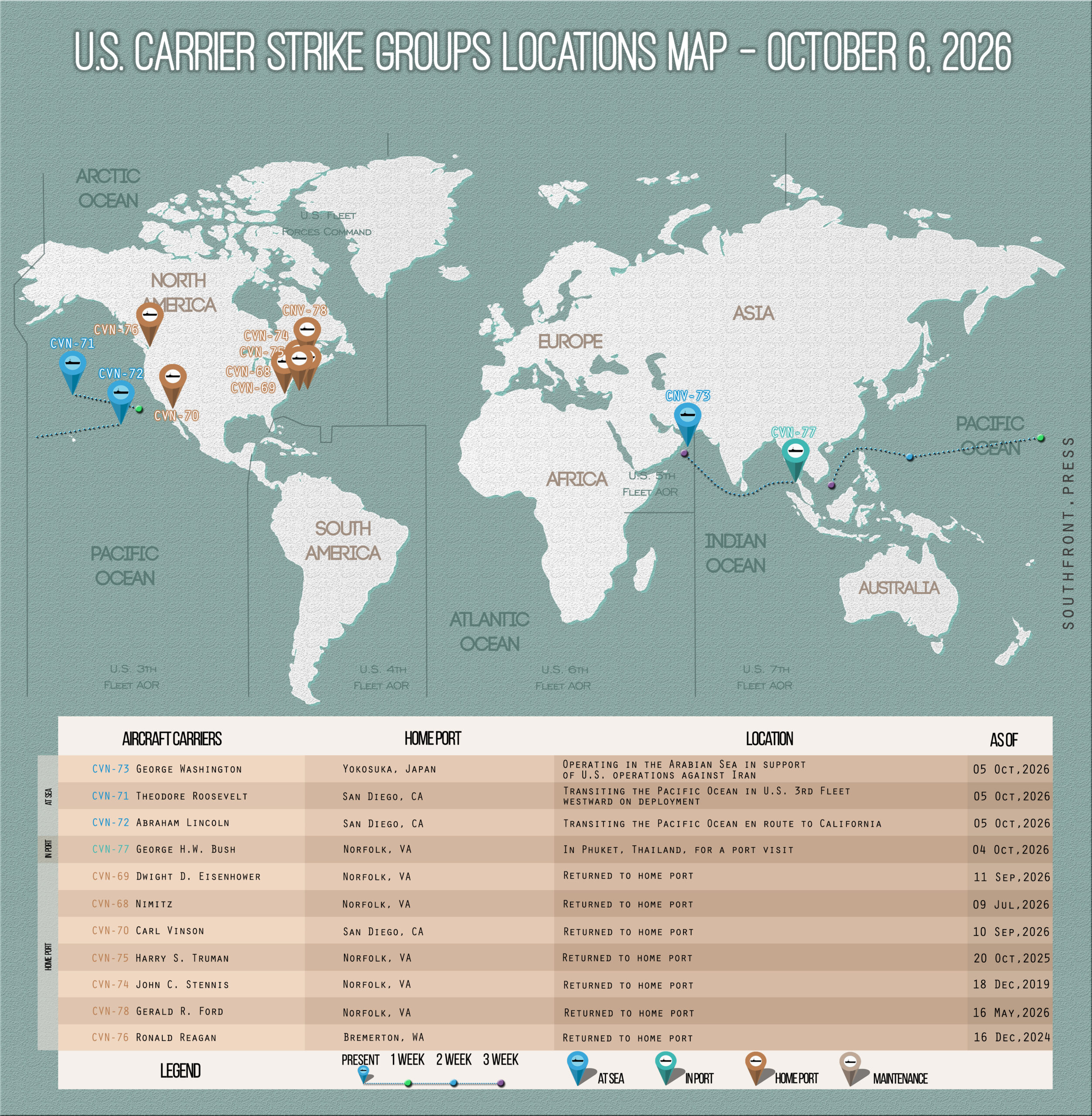
This is the newest update of the ‘U.S. Carrier Strike Groups Locations Map’ exclusive series showing the approximate locations of U.S. Carrier Strike Groups. SouthFront: Analysis & Intelligence tracks locations of U.S. aircraft carriers using the available open-source information. No classified information was used in production of the map.
click to see the full-size image
Carrier strike group (CSG) is an operational formation of the United States Navy. It is centered on an aircraft carrier and a carrier air wing of 65 to 70 aircrafts. It’s composed of roughly 7,500 personnel, an aircraft carrier, at least one cruiser, a destroyer squadron of at least two destroyers and/or frigates. A carrier strike group also, on occasion, includes submarines, attached logistics ships and a supply ship. Carrier strike groups comprise a principal element of U.S. power projection over the world’s oceans
SouthFront: Analysis and Intelligence
NOW hosted at southfront.press
Previously, SouthFront: Analysis and Intelligence was at southfront.org.
The .org domain name had been blocked by the US (NATO) (https://southfront.press/southfront-org-blocked-by-u-s-controlled-global-internet-supervisor/) globally, outlawed and without any explanation
Back before that, from 2013 to 2015, SouthFront: Analysis and Intelligence was at southfront.com
The recently concluded trilateral “Orient Shield” exercises in Japan became the first three-way maneuvers involving Washington, Tokyo, and Canberra in which the “Typhon” medium-range missile system was employed. How are the United States and its allies pushing the world toward the proliferation of weapons of mass destruction (WMD)? The Land of the Rising WMD Proliferation […]
Cheap drones, heavy bombs, disrupted shipping, and vulnerable supply routes are challenging the idea that technological superiority guarantees military success. The emerging contest is not simply over who builds the smartest weapon. It is over who can adapt, produce, and keep fighting after the enemy learns how to break it. Washington’s Project Meridian offers one answer. Recent battlefields suggest a much harder test.
The Battlefield Rewrites the Blueprint
The war in Ukraine shows that military innovation does not always mean more sophisticated weapons. Sometimes it means finding a simple way around an enemy’s defenses. Russian forces did that with drones guided through fiber-optic cables instead of radio signals, allowing them to operate despite radio jamming.
During the fighting to push Ukrainian troops out of Russia’s Kursk region, fiber-optic drones threatened the roads supplying Ukrainian positions. Sustained attacks on transport made those positions harder to supply, reinforce, and evacuate. Ground that remained defensible against a direct assault became increasingly difficult to hold as supply routes came under pressure.
Drones did not replace infantry or artillery. Their value came from linking reconnaissance and strikes to a broader effort to disrupt Ukrainian logistics. A relatively small change in drone guidance helped Russian forces put pressure on the supply lines sustaining the defense, rather than just individual vehicles or positions.
A separate example from eastern Ukraine shows how drone attacks can also threaten robotic supply vehicles
Nor did the advantage remain exclusive. Ukrainian units expanded their own fiber-optic capabilities, turning a Russian breakthrough into another round of adaptation. Cable guidance removes the vulnerable radio-control link, but introduces weight, handling, and physical constraints. It does not make the aircraft invisible or indestructible. A solution to one problem creates a different set of tradeoffs.
Russia’s glide bombs demonstrate another route to military innovation. Instead of replacing existing weapons entirely, guidance and wing kits give older bombs greater reach and precision. Their heavy payloads perform tasks that small drones cannot. Their use against Ukrainian positions illustrates why the future battlefield will contain both cheap electronics and large quantities of conventional explosives.
The broader lesson is uncomfortable for anyone selling a universal replacement for the old military. New systems do not arrive on an empty battlefield. They must work with existing aircraft, artillery, engineers, supply units, and command structures. Their value depends on how those parts fit together.
That also limits what strike videos can prove. A successful attack demonstrates an outcome, not the average success rate, the number of failed missions, or the effort required to repeat it. The decisive question is whether an army can turn occasional success into a dependable military capability.
The Cost of Keeping Routes Open
The Red Sea offers a different warning. An attacker does not necessarily have to defeat a navy to impose strategic costs.
Houthi attacks pushed shipping companies toward longer routes around Africa. By late summer 2026, traffic through the Suez Canal was recovering but remained well below pre-crisis levels. Houthi attacks had pushed shipping companies onto longer, more expensive routes, showing how a regional armed group could disrupt global trade without defeating a major navy.
An interception can therefore be a tactical success without restoring normal commercial activity. The defender must protect ships and sustain confidence over time. The attacker may only need to keep the risk credible. Counting destroyed drones does not answer whether the shipping route is functioning.
The familiar comparison between a cheap drone and an expensive interceptor captures only part of this problem. Saving a merchant ship or warship can justify an expensive defensive shot. The deeper question is whether sufficient interceptors, maintenance capacity, crews, and replacement stocks remain available throughout a prolonged campaign.
Ukraine presents a related problem on land. Russian glide bombs combine substantial destructive power with relatively inexpensive conversion kits. Defending against every incoming weapon with a costly missile is not necessarily sustainable. But abandoning high-end air defenses would leave other threats unanswered.
The likely response is a layered force rather than a single miracle weapon. Different threats demand different combinations of detection, electronic warfare, physical protection, and interception. An army also needs to keep operating when some threats get through.
Kursk and the Red Sea are not interchangeable battlefields. One concerns a contested land campaign, the other pressure on maritime commerce. What connects them is the importance of maintaining a function under repeated attack. Delivering supplies and keeping shipping moving matter more than producing an impressive interception tally.
Washington Looks Upward
Washington is approaching this problem through a different starting point: global networks, industrial scale, and institutional control.
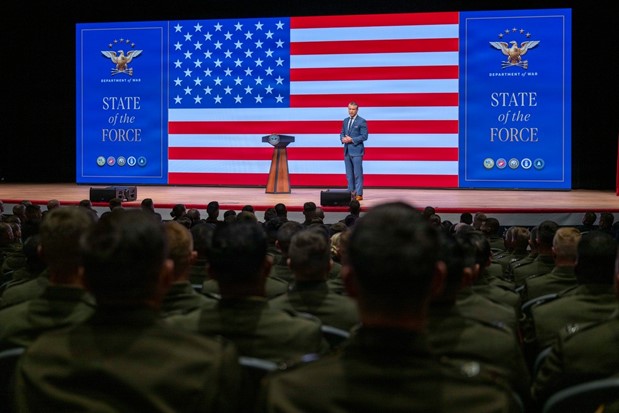
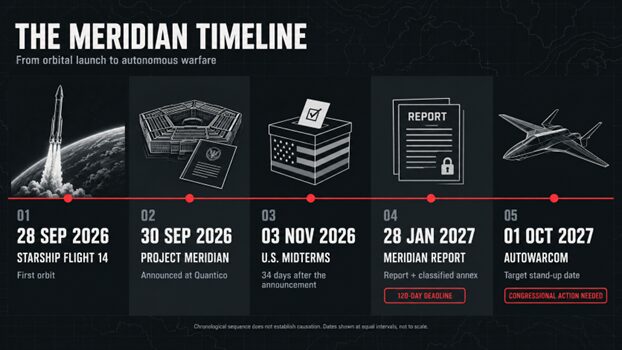
On September 30, Pete Hegseth announced Project Meridian alongside a proposed Autonomous Warfare Command and the Fortress America initiative. Meridian would examine future military capabilities, while the new command would organize the expansion of autonomous and robotic systems. Fortress America would address the resilience of bases and supply chains. These are related initiatives, not a single approved war plan.
U.S. service members at the State of the Force address, Quantico, September 30, 2026
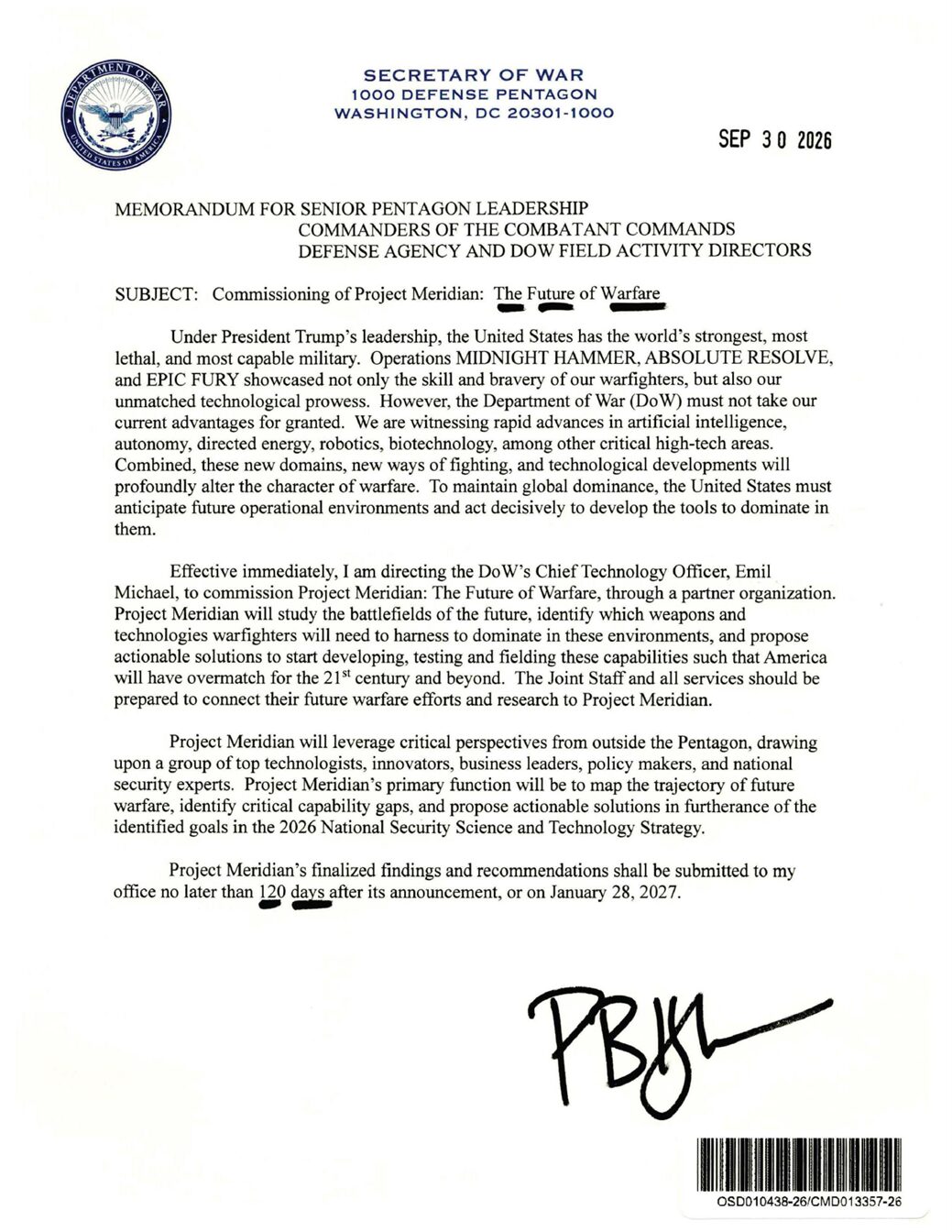
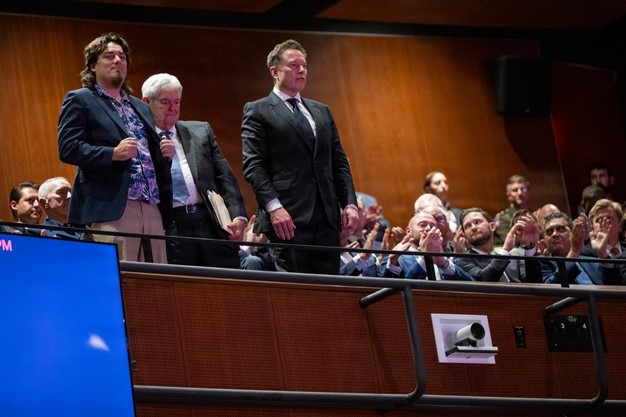
Meridian’s advisers include Elon Musk, Palmer Luckey, and Newt Gingrich, under Pentagon technology chief Emil Michael. The study has 120 days to report. Its significance is not that three men can invent the next war. It is that major technology suppliers are being invited to help define the military capabilities Washington should pursue.
The September 30 memorandum commissions a study of future warfare
The State of the Force event at Quantico, where Project Meridian was announced, September 30, 2026
Some of the supporting infrastructure already has funding. On May 26, Space Systems Command awarded SpaceX a $2.29 billion agreement for the Space Data Network Backbone. A fully operational prototype is due by the end of 2027. The intended function is to connect military sensors and weapons through a high-capacity orbital communications network.
That addresses a real military requirement. Information has limited value if it cannot reach the people or systems that need it. But a larger network does not automatically become a more dependable one. The test is whether useful connections survive disruption, and whether units can continue operating when they do not.
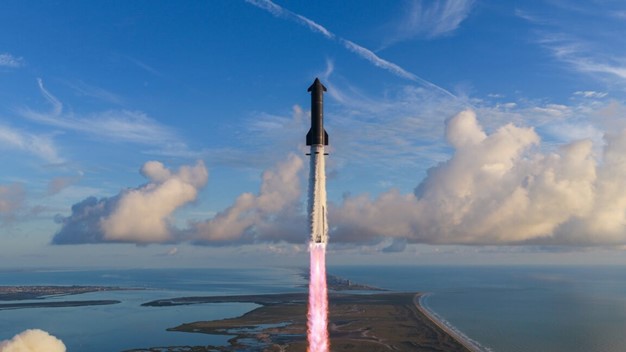
Heavy-lift rockets could support the deployment of larger satellite constellations, although these programs do not yet amount to a single publicly defined architecture. Starship Flight 14 reached orbit on September 28 and deployed 26 Starlink V3 satellites. That demonstrated payload delivery, not every capability promised for the rocket. Reaching orbit once and providing dependable, economical military infrastructure are different milestones.
Starship Flight 14 launches from Starbase, September 28, 2026, carrying 26 Starlink V3 satellites
Starship’s final descent, landing burn, and splashdown during Flight 14, September 28, 2026
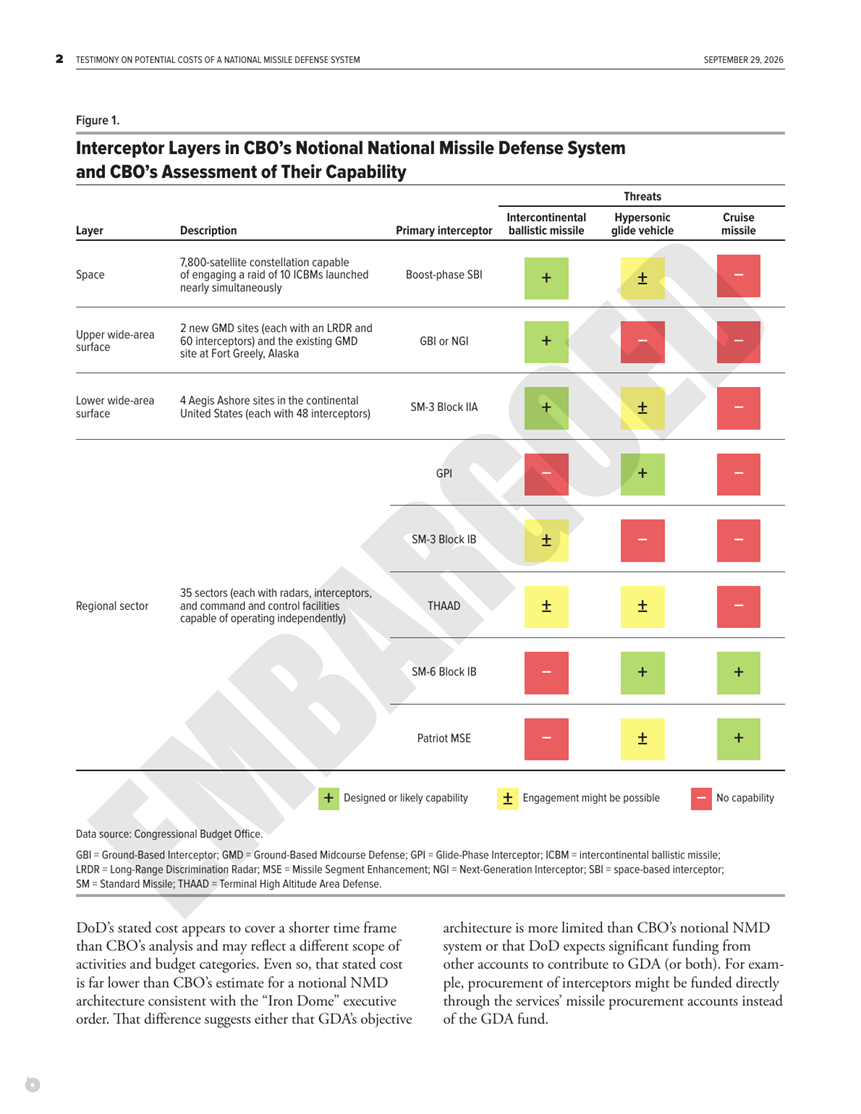
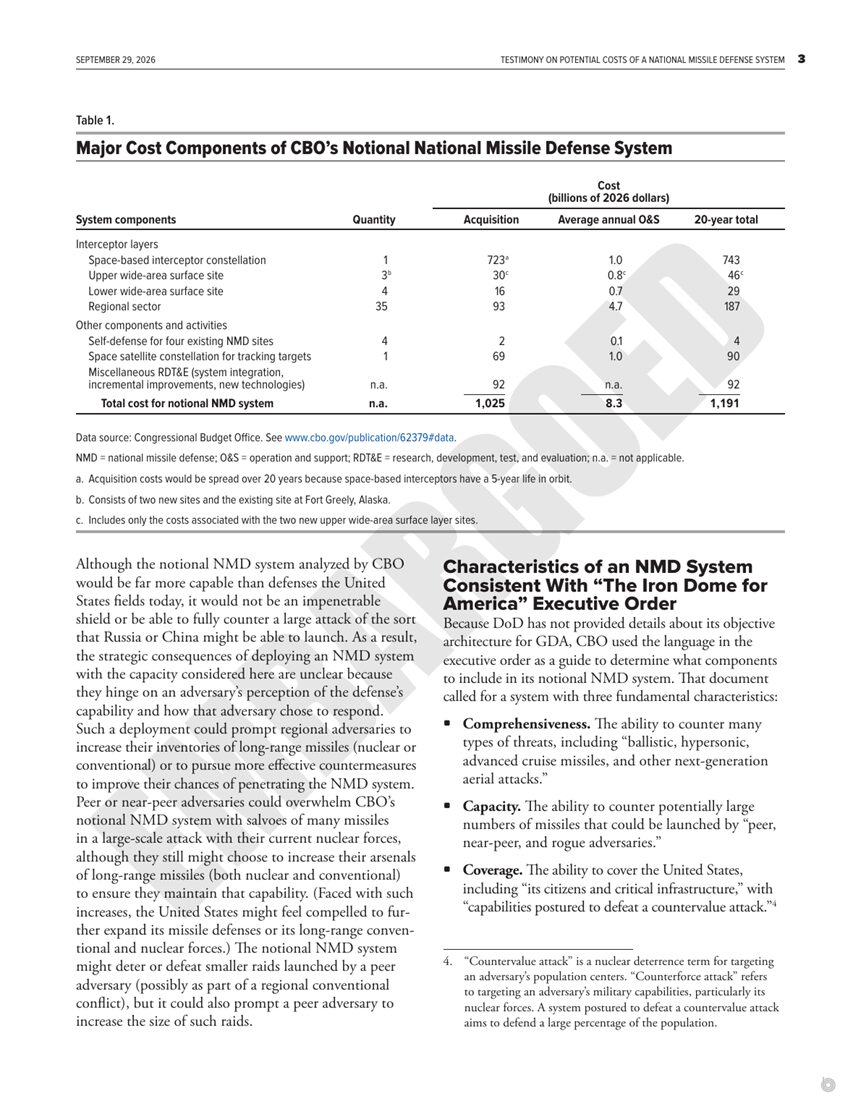
Golden Dome extends the ambition to missile defense. In May, the Congressional Budget Office estimated that a notional system consistent with the administration’s stated objectives could cost about $1.2 trillion over 20 years. Crucially, this was not a price tag for the Pentagon’s approved design. The final architecture had not been publicly disclosed.
A notional national missile-defense architecture assessed by the Congressional Budget Office
Estimated costs of the Congressional Budget Office’s hypothetical system, expressed in 2026 dollars
The policy risk is not simply excessive ambition. It is defining military problems in ways that favor the products already offered by influential suppliers. That deserves scrutiny without assuming that commercial involvement makes every proposal useless. A contract is evidence of spending. It is not evidence of battlefield superiority.
Elon Musk, named a co-leader of Project Meridian
Machines Still Need Factories
The American approach emphasizes integrating ambitious systems through large institutions. The battlefield experience points toward an equally important requirement: changing ordinary systems quickly.
These approaches are not mutually exclusive. Satellites and inexpensive drones can support the same force. The tension lies in their development cycles. A major space program cannot be redesigned every few weeks. A frontline drone or its communications equipment may lose effectiveness if updates take years.
The industrial base must therefore support both continuity and rapid revision. Ukraine’s drone sector demonstrates the importance of close feedback between operators and developers, but also the vulnerability of assembly dependent on imported components. A domestically assembled aircraft is not necessarily an independently sustainable capability.
Russian developers are also discussing the problem in terms broader than individual weapons. In September, the Ushkuynik center presented a drone assembly line housed in a modified shipping container. The proposal illustrates an effort to distribute production rather than concentrate it in a single factory.
These are developer proposals, not independently demonstrated solutions at national scale. Nevertheless, they identify two important problems: distributing production and closing gaps between separate defensive systems.
A workshop, a repair team, and a reliable component supplier may therefore matter as much as another model advertised as revolutionary. Military adaptation requires people who can identify a failure, explain it to engineers, approve a modification, and return workable equipment to service.
Autonomous Warfare Command: new drones, familiar geometry. All that’s missing is the secret handshake
Autonomy does not remove these obligations. The meaningful question is which task a machine can perform reliably without continuous human input, under what conditions, and with what consequences when it fails. “Autonomous” should describe a tested function, not serve as a substitute for explaining one.
Fortress America recognizes another dependency. Hegseth’s stated aim is for military installations eventually to operate under their own power, alongside stronger protection and domestic supply chains. Yet independence from the civilian grid would not by itself eliminate the need for fuel, spare parts, communications, or skilled maintenance. Resilience must extend beyond the perimeter fence.
The same principle applies at the front. Engineering and logistics deserve attention alongside strike footage. They show how forces sustain movement and support combat units, rather than merely how they destroy a target.
From Remote Control to Robotic Forces
The next stage of warfare is unlikely to resemble an army of humanoid machines replacing soldiers. A more plausible future is a force in which people fight alongside growing numbers of specialized robots, from reconnaissance aircraft to ground vehicles carrying ammunition, evacuating casualties, and supporting assaults.
That transition is already underway. Both Russian and Ukrainian forces are using ground robots for logistics, evacuation, and other battlefield tasks. In September, Ukraine’s Defense Ministry reported that its ground systems had completed more than 25,000 supply and evacuation missions in August alone. The figure is an official claim, not an independently audited total, but it illustrates how far the ambition extends beyond occasional demonstrations.
Over the next five years, the important change may be the organization of these machines into working formations. Aerial drones could scout ahead while ground robots move supplies and support troops. Humans would still set objectives and handle situations the machines cannot reliably interpret. The advantage would come from coordinating those different roles, not simply putting more unmanned vehicles on the battlefield.
Remote control, however, is not autonomy. A vehicle that needs continuous steering from an operator remains dependent on communications and human attention. Greater autonomy could allow machines to navigate, avoid obstacles, or complete limited tasks when a connection fails. None of those functions automatically makes a robot capable of independently identifying legitimate targets or deciding when to fire.
The likely result is a race between robotic capability and countermeasures. More machines may reduce the number of soldiers exposed on supply routes, but those machines will themselves become targets. Communications, batteries, maintenance, and replacement parts will remain constraints. Robotization moves some risks away from people; it does not abolish the costs of war.
Nor will inexpensive robots make heavy weapons obsolete. Small drones, armored vehicles, artillery, and aircraft perform different jobs. The stronger force will be the one that combines them effectively and changes that combination faster than its opponent.
Meridian should be judged against this prospect, not the grandeur of its language. Can Washington build systems that cooperate, survive disruption, and remain affordable enough to replace? Can its procurement machinery adapt as quickly as the battlefield demands?
The next war will not be won by whoever unveils the most impressive robot. It may favor the side that can lose machines without losing momentum, preserve human judgment without slowing every decision, and turn battlefield lessons into production before the enemy does. The real revolution is not a machine that looks like a soldier. It is an army that learns to fight differently because machines are now part of its ranks.
The US shift from Artificial Intelligence to Super Intelligence signals a transformation in technological and strategic power: from Project Stargate to space weapons, SI could reshape warfare, and its ability to process vast information becomes both an advantage and a threat. On September 29, 2026, President Donald Trump signed Executive Order 14434, “Inaugurating the Era […]
Um , perdeu a vida na manhã desta segunda-feira, 5 de outubro, durante um exercício de formação nas instalações dos Bombeiros de Baltar, no concelho de Paredes.
Segundo a Lusa, as circunstâncias exatas do acidente estão ainda a ser apuradas pela Liga dos Bombeiros Portugueses. De acordo com informação avançada pelo Jornal de Notícias, o operático terá ficado atrás de uma viatura que, ao iniciar a marcha, o atropelou.
O jovem bombeiro entrou em paragem cardiorrespiratória e, apesar das manobras de reanimação realizadas pelas equipas de socorro e pela Viatura Médica de Emergência e Reanimação (VMER) do Vale do Sousa, o óbito acabou por ser declarado no local.
Donald Trump tried to use America’s economic weight to force China to bend, only to discover that Beijing has built an economic weapon of its own that Washington cannot tackle. China Finds America’s Chokepoint For years, the central assumption underlying Washington’s economic confrontation with Beijing was that interdependence gave the United States more leverage than […]
Die Ukraine bekommt immer mehr Probleme, weshalb Kanzler Merz mal wieder nach Kiew gefahren ist, um über eine Milliarde Euro deutscher Steuergelder zu verschenken. Deutschland bekommt auch immer mehr Probleme, aber für die Deutschen hat Merz kein Geld, denn sonst reicht es nicht für Kiew. Aber was sind die Gründe für die aktuellen Probleme der […]
Uma mulher de 28 anos perdeu a vida e quatro pessoas ficaram gravemente feridas na sequência de um despiste de um automóvel na autoestrada A1, na zona de Condeixa-a-Nova, segundo a agência Lusa.
De acordo com a mesma fonte do Comando Sub-regional da Região de Coimbra da Proteção Civil, o acidente causou a morte da jovem mulher e ferimentos graves no seu marido e em três menores.
O acidente ocorreu no sentido sul-norte, ao quilómetro 180,4 da A1, no troço compreendido entre os nós de Soure e Condeixa-a-Nova, no distrito de Coimbra, segundo a agência Lusa.
O alerta foi dado às 14:35, hora em que a circulação na A1 ficou totalmente cortada. A partir das 17:00, a via da esquerda foi reaberta, mantendo-se no entanto o trânsito condicionado, segundo a agência Lusa.
Nas operações de socorro estiveram envolvidos 32 operacionais, apoiados por 14 veículos da Proteção Civil, incluindo os Bombeiros, a Guarda Nacional Republicana (GNR) e o Instituto Nacional de Emergência Médica (INEM), segundo a agência Lusa.

 Login