❌

Normal view

Trump says Russia agreed to supply millions of tons of diesel to US and global markets as he blames Ukraine for fuel price hikes driven by Iran war

9 October 2026 at 20:45

Trump Putin meeting in Alaska

US President Donald Trump announced a deal with Russian President Vladimir Putin for Moscow to supply millions of tons of diesel fuel to American and global markets. 

The announcement would give Russia a major opportunity to sell fuel abroad at a time when Ukraine is targeting its oil industry to deprive Moscow of revenue and disrupt the resources sustaining its invasion. The US president has increasingly called for Ukraine to halt strikes on Russian oil infrastructure in recent weeks, blaming Ukraine for high fuel prices in the US.

Trump’s push for Kyiv to halt those attacks, alongside his effort to secure Russian fuel supplies, risks undermining Ukraine’s campaign to put economic pressure on the Kremlin while the US seeks to contain the fallout from its war with Iran.

Trump promises millions of tons of diesel from Russia

In a 9 October post on Truth Social, Trump said Russia would immediately supply more than 300,000 tons of diesel, followed by another 500,000 tons in November and 1 million tons shortly afterward. He also announced a possible additional delivery of 3 million tons, conditional on the state of Russian refineries.

“Diesel Prices for Americans and, indeed, the World, will be COMING DOWN, IN RECORD NUMBERS, AND FAST!” Trump wrote, describing lower fuel prices as a top priority for American farmers, ranchers, and truckers.

Trump's announcement did not explain how the promised volumes would be reconciled with the condition of Russian refineries amid ongoing Ukrainian strikes, which he cited as a factor determining the timing of later deliveries.

Trump has pressed Ukraine to stop targeting Russian refineries

The announcement comes after Trump repeatedly blamed Ukrainian strikes on Russian oil infrastructure for worsening global diesel shortages and driving up fuel prices.

Ukraine has continued targeting Russian oil facilities as part of its campaign to undermine Moscow's war economy. Ukrainian strikes have damaged refining capacity, contributed to fuel shortages inside Russia, and forced Moscow to restrict fuel exports. 

Kyiv has argued that the attacks put pressure on Russia's ability to finance and sustain its war against Ukraine.

Iran war drives fuel prices higher, not Ukraine

The rise in US fuel prices stems largely from the US-Israeli war with Iran and its disruption of global energy supplies, according to Reuters. The conflict has disrupted shipping through the Strait of Hormuz, a strategic waterway through which roughly one-fifth of the world's oil supplies normally pass, pushing energy prices higher. 

Trump has nevertheless blamed Ukraine's refinery strikes for rising fuel costs while pressing Kyiv to halt them.

Ukraine's attacks on Russian oil infrastructure are intended to weaken Moscow's war economy. By contrast, the disruption to global energy shipments stems largely from the conflict with Iran. 

Zelenskyy warns Russian diesel deal would fund further attacks on Ukraine

Ukrainian President Volodymyr Zelenskyy warned later on 9 October that allowing Russia to sell petroleum products abroad without securing a lasting de-escalation agreement would help finance Moscow's war against Ukraine.

“Allowing Russia to sell petroleum products is an investment in a war that must be ended, not prolonged,” Zelenskyy said, responding to Trump's announcement of a proposed Russian diesel supply deal.

Zelenskyy said Ukraine's strikes on Russian oil refineries and other oil facilities were a response to Russia's years-long campaign against Ukrainian energy infrastructure. He offered a reciprocal arrangement under which Ukraine would stop striking Russian refineries if Russia stopped destroying Ukrainian energy facilities, saying the United States had sufficient leverage to secure such an agreement.

“Ukraine will not burn Russian oil refining facilities if Russia does not destroy our energy infrastructure,” Zelenskyy said.

He also urged Washington to maintain pressure on Moscow, including sanctions under the proposed Graham legislation, and to continue supporting Ukraine's defense. Zelenskyy argued that easing sanctions without a clear, sustained de-escalation agreement would signal weakness and give Russia more time and resources to continue the war.

“Gifts to Putin will not bring peace,” Zelenskyy said, warning that Russia would respond to diesel supplies with further terror and attacks. He called on the United States to pursue a reciprocal de-escalation agreement and press Russia to stop its attacks on Ukrainian energy infrastructure.

Trump Announces Diesel Supply Deal With Putin Following Phone Call

By: aletho
9 October 2026 at 20:20
Sputnik – 09.10.2026

US President Donald Trump says he reached an agreement with Russian President Vladimir Putin during a phone call for Russia to supply diesel fuel to American and global markets.

Russia will deliver more than 300,000 tons immediately, followed by 500,000 tons in November and another 1 million tons shortly afterward, he wrote on Truth Social.

Trump also announced plans for an additional 3 million tons of Russian diesel, depending on the condition of Russia’s refineries, claiming the agreement would help bring down fuel prices in the US and worldwide.

Following the announcement, the US Treasury’s Office of Foreign Assets Control (OFAC) announced a temporary general license allowing Russian diesel supplies to global markets, effective immediately at Trump’s direction.

Trump believes the deliveries would help bring down diesel prices in the US and worldwide amid rising fuel costs and disruptions to global energy markets.

Zelensky’s Alarm Mounts as Russia Advances Starlink Rival

9 October 2026 at 20:14

Illustrative image. (Bureau 1440)

Ukrainian President Volodymyr Zelensky warned on October 8 that China was helping Russia develop an alternative to SpaceX’s Starlink satellite internet system, as Moscow’s Rassvet network advances through testing and the presentation of subscriber terminals.

“They are making progress. They are passing this on to Russia,” Zelensky said.

The Ukrainian president’s remarks underscored Kyiv’s growing concern that Moscow could acquire advanced satellite communications capabilities.

Zelensky has already taken his concerns to U.S. President Donald Trump, asking him to impose sanctions on Russian and Chinese companies involved in Rassvet’s development, according to a recent Financial Times report. The request, raised during a meeting in New York in September, reflects Kyiv’s effort to prevent the Russian network from becoming a strategic asset for Moscow.

However, Washington has no straightforward way to stop the project outright. Sanctions would not automatically halt Russia’s domestic satellite program.

Zelensky’s appeals are unfolding as the project moves beyond development announcements and into public demonstrations of its capabilities.

Bureau 1440, the Russian company developing Rassvet, demonstrated a satellite video connection between Moscow and the southern Russian republic of Adygea on October 7. The call lasted about five minutes and used the company’s satellite network, showing that the system can support a live communications session.

At the same Moscow technology forum, Bureau 1440 presented three types of subscriber terminals for the network. One was identified as a serial-production device, while the company said its 1440.ULTRA terminal could support data transmission speeds of up to 700 megabits per second. The equipment is intended to connect users to the satellite constellation once the service becomes operational at scale.

Russia launched batches of Rassvet satellites in March and July, but the network has not yet reached full operational capability. Kremlin spokesman Dmitry Peskov noted in late September that the system was not yet operating effectively.

Zelensky’s repeated warnings and his appeal to Trump to block the Rassvet project point to growing alarm in Kyiv as Russia moves closer to establishing an independent satellite communications network.

With satellites already launched and the company testing connections and preparing user equipment, Zelensky faces the prospect that Russia could soon field a Starlink alternative that Kyiv may be unable to disrupt. His warnings about Chinese assistance suggest that Ukraine is increasingly concerned not only about Russia’s progress, but also about the possibility that outside support could accelerate it.

_______________________________________________________________________________________________________________________

SouthFront: Analysis and Intelligence

NOW hosted at southfront.press

Previously, SouthFront: Analysis and Intelligence was at southfront.org.

The .org domain name had been blocked by the US (NATO) (https://southfront.press/southfront-org-blocked-by-u-s-controlled-global-internet-supervisor/) globally, outlawed and without any explanation

Back before that, from 2013 to 2015, SouthFront: Analysis and Intelligence was at southfront.com

SOUTHFRONT.PRESS

MORE ON THIS TOPIC:

The post Zelensky’s Alarm Mounts as Russia Advances Starlink Rival appeared first on South Front.

Leave If You Can – Kyiv’s Mayor Speaks As Russia Strikes Deeper And Harder

9 October 2026 at 20:07

Russia’s strikes on October 9 covered Ukraine from west to east, hitting targets in Zaporizhzhia, Odessa, Kharkiv, Chernihiv, and reaching as far as Ivano-Frankivsk in the west. But the most consequential blows landed, as they increasingly do, in and around Kyiv.

The Trypilska thermal power plant was struck again, and attacks on the 750-kilovolt substation near Nalyvaivka continued. The cumulative effect on the capital is no longer abstract. Kyiv’s sewage system temporarily stopped accepting wastewater from one city district after power was cut to Kyivvodokanal facilities. Residents sought shelter overnight in metro stations. Mayor Vitali Klitschko issued a public warning about a serious threat to the city’s municipal infrastructure and recommended that residents who have the option to temporarily leave the capital consider doing so. Ukrainian authorities announced further restrictions on electricity supply to households, industry, and businesses beginning October 9. Elsewhere in the country, a food warehouse belonging to the Tavria retail chain was hit in Odessa, Kharkiv’s thermal power plant No. 5 was struck for the first time in a long period, an Epicenter shopping center in Chernihiv was hit by Geran drones, and a Geran-4 reached Ivano-Frankivsk, striking an industrial facility.

On the front lines, Russian forces maintain the initiative across key sectors. In the Chernihiv Oblast, Russian combat aviation and strike drones have been systematically hitting Ukrainian military positions — a pattern that Ukrainian and independent analysts describe as consistent with preparation for ground operations. On October 8, a drone storage facility near Kovchyn was destroyed, and strikes were recorded against positions of the 105th Border Detachment and the 143rd Mechanized Brigade near Sutky and Semenivka. The most significant confirmed strike, however, hit the command post of Ukraine’s 18th Army Corps near Bakhmach, with possible casualties among senior and flag-rank officers.

In Sumy Oblast, paratroopers of Russia’s 83rd Air Assault Brigade drove Ukrainian units of the 71st Air Mobile Brigade out of the settlement of Kyianytsia on October 9, bringing the entire settlement cluster under Russian control. With the leaf cover gone from surrounding woodland by late autumn, Russian forces will be able to move against Ukrainian positions in the forest south of the settlement with far greater effectiveness.

In Dobropillia, the battle has entered its decisive phase. On October 8, Russian assault units entered the city simultaneously from the north and south, splitting the Ukrainian garrison in two parts.

Kyiv’s mayor is advising residents to evacuate. A garrison has been cut in half. A command post has been destroyed. Russia is not approaching a decisive moment in this war — it is already inside one.

______________________________________________________________________________________________________________________

DEAR FRIENDS. IF YOU LIKE THIS TYPE OF CONTENT, SUPPORT SOUTHFRONT WORK:

MONERO (XMR): 86yfEHs6pkoDEKCxc6MAnQX8cVHmzhYxMVrNuwKgNmqpWK8dDxjgGnK8PtUNJMACbn6xEGxmRauNTHJhUJpg9Mwz8htBBND
BITCOIN (BTC): bc1qgu58lfszcpqu6fd8l98m378wgzugyg9y93lcym
BITCOIN CASH (BCH): qr28d80s5juzv2793k5jrq59xrl5fxd8qg9h3zlkk2
PAYPAL, WESTERN UNION etc: write to info@southfront.press , southfront@list.ru

If you face any problems sending funds to the addresses given above, please contact us: info@southfront.press and southfront@list.ru. Also be aware that many email services such as Hotmail, Yahoo etc. may block correspondence from info@southfront.press and some others put it in spam.

If you want to support SouthFront but have no opportunity to do it via cryptocurrency, please contact us: info@southfront.press and southfront@list.ru.

SouthFront: Analysis and Intelligence
NOW hosted at southfront.press
Previously, SouthFront: Analysis and Intelligence was at southfront.org.
The .org domain name had been blocked by the US (NATO) (https://southfront.press/southfront-org-blocked-by-u-s-controlled-global-internet-supervisor/) globally, outlawed and without any explanation
Back before that, from 2013 to 2015, SouthFront: Analysis and Intelligence was at southfront.com

SOUTHFRONT.PRESS

The post Leave If You Can – Kyiv’s Mayor Speaks As Russia Strikes Deeper And Harder appeared first on South Front.

NO SAFE REAR: Moscow’s Shadow War From Starlink to Prison Cells

9 October 2026 at 19:00

Russia is seeking support for its war effort abroad – and threatening retaliation beyond Ukraine. Reports of foreign labor in drone factories, proposals to counter Starlink, and allegations of overseas recruitment show different ways Moscow could sustain its military effort and put pressure on its opponents.

Nowhere Far Enough

On October 9, Mikhail Zvinchuk, founder of the Russian military Telegram channel Rybar, was detained in Montenegro. Montenegrin authorities accused his team of using media work to interfere in the country’s politics. Rybar said they had come legally to film at Cetinje Monastery and had submitted an official filming request. Moscow’s response explains why this matters: Dmitry Medvedev, deputy chairman of Russia’s Security Council, suggested replenishing an “exchange fund” with Europeans and Americans to recover detained Russians. One arrest became a warning about others to come.

Mikhail Zvinchuk, founder of Rybar, a Russian pro-war Telegram channel covering the war in Ukraine, was detained in Montenegro on October 9

Five days earlier, Medvedev had delivered the orbital version of that warning. If Russia’s Rassvet constellation were destroyed, American Starlink satellites would “come tumbling down like ornaments from a dried-up Christmas tree.” “Space is a very crowded place,” he added. “We need to be mutually courteous.” Kiev had sought sanctions and restrictions, not announced a satellite attack. Moscow was putting a military threat behind its demand that Russian communications infrastructure be left alone.

The link is not between a blogger and a satellite. It is between two threats of retaliation: damage our network and yours becomes a target; detain our people and yours may become bargaining chips. Moscow is challenging the assumption that pressure on Russia can remain a one-way transaction.

Partners Behind the Front

The space threat has a practical backdrop. Leaked documents published in July describe a closed Russian-Chinese military forum in Guangzhou in November 2023. Chinese researchers proposed several ways to counter Starlink, from legal pressure and jamming to cyberattacks and destruction. Their hardest problem was also the simplest: how to disable satellites more cheaply and quickly than SpaceX could replace them. They do not show that these systems were built or deployed.

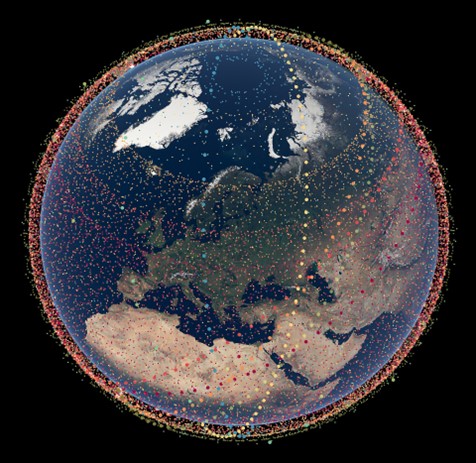
Visualization of the planned Starlink Generation 2 constellation

Russia and China have different strengths to offer. Moscow brings battlefield experience and air-defense knowledge; Beijing brings electronics, artificial intelligence, and manufacturing capacity. Russia can show what works under fire. China can help turn those lessons into equipment made at scale. A sixth closed forum was reportedly planned for the fall in St. Petersburg.

This is why repeated technical meetings matter more than dramatic threats. A shared design, tested and improved over several years, could outlast the war that first made it useful. For Moscow, the goal is to weaken an American advantage. For Beijing, Russian experience offers lessons without having to fight the same war.


Discussion of leaked documents, the “one-to-many” concept and replacement costs


But destroying satellites is not a clean solution. Russia’s 2021 antisatellite test forced both astronauts and Russian cosmonauts to shelter aboard the International Space Station, according to NASA. Debris threatens more than the intended target. Jamming can offer a narrower response; smashing entire networks risks damaging the same orbital space Russia and China also need.

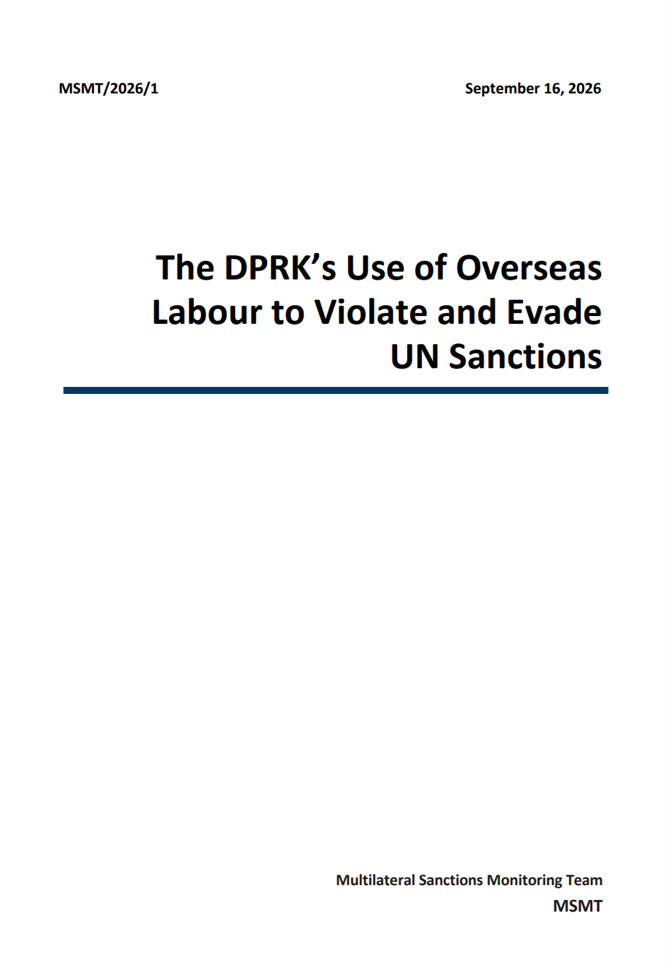
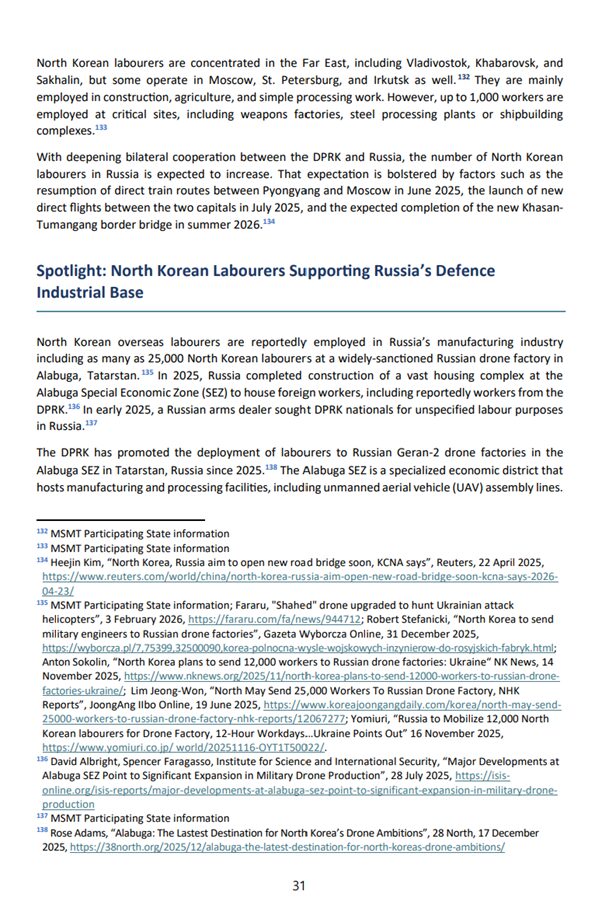
The factory floor shows another side of this partnership-building. A September report by the Multilateral Sanctions Monitoring Team says North Korean workers are employed at Alabuga in Tatarstan, where Russia produces Geran-2 drones, and describes workers entering Russia as students. Pyongyang rejected the report as fabricated. If the findings are accurate, the bargain is straightforward: Russia gains workers, North Korea gains income. Foreign support does not have to arrive as a finished missile; it can help keep the assembly line moving.

September 2026 sanctions-monitoring report.  Pages 31-32 discuss Alabuga and drone production. Pyongyang rejects the report


The Underground Price List

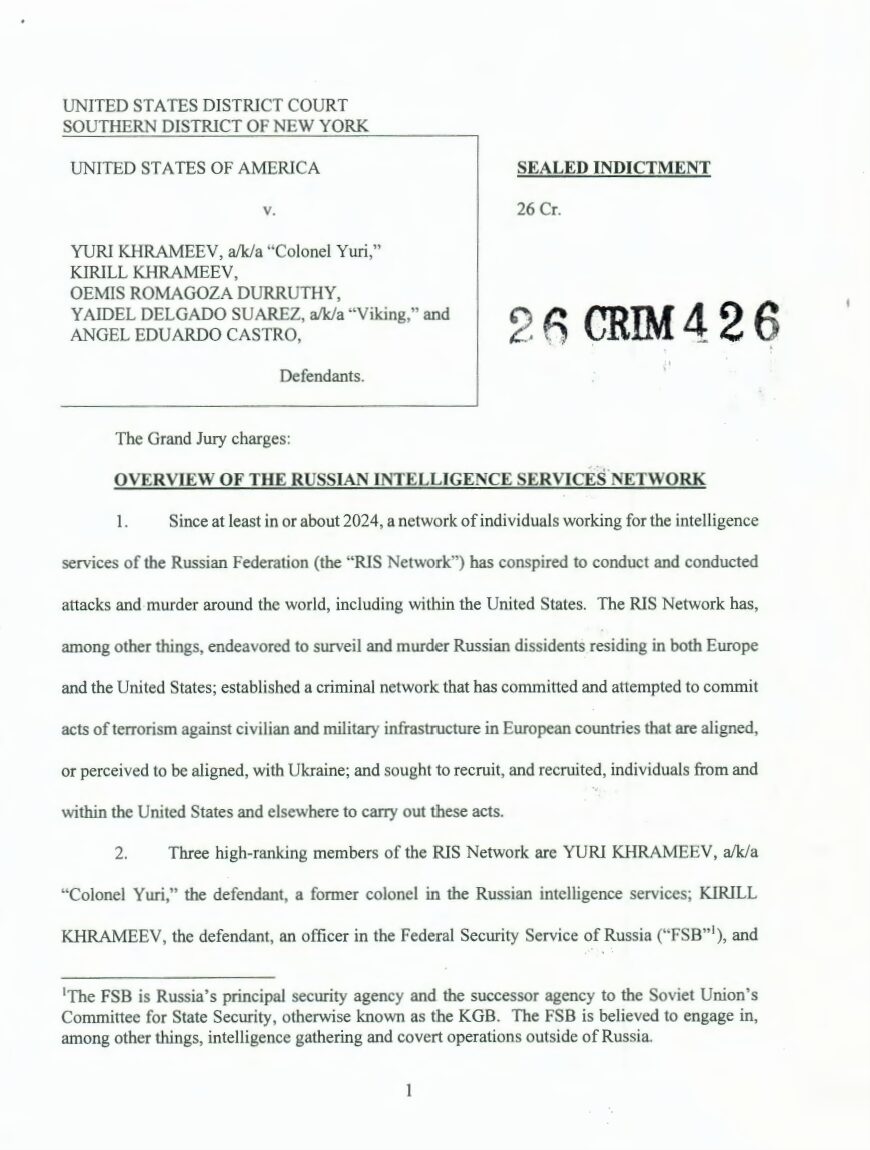
Recruitment abroad serves a different purpose. A September 15 U.S. indictment alleges that a Russian intelligence-linked network used Cuban and Venezuelan intermediaries to recruit inside America. Prosecutors describe payments of $1,000-$1,500 for surveillance and a $40,000 offer to kill a Russian dissident believed to be near Washington. Another alleged offer promised an American $25,000 to kill a target in Lithuania. These remain accusations, not court findings or proof of an officially declared bounty program.

Original U.S. indictment naming the alleged Russian, Cuban, and Venezuelan participants

The alleged network operated from at least 2024, before the Montenegro arrests. Its importance lies in the method: foreign intermediaries and local recruits, rather than an obvious Russian team. If substantiated, the charges would show Moscow reaching inside America through people who do not carry Russian passports.

The October 9 threat to expand the “exchange fund” signals that consular protests may no longer be Moscow’s only answer. It suggests foreign detainees could become leverage for recovering Russians. The warning to European and American governments is pointed: the detention of a Russian abroad may create a problem for their own citizens elsewhere.

Russia’s partners help it build weapons; alleged overseas networks extend its reach; threats against satellites and foreign detainees aim to raise the cost of confrontation. These are different tools, not proof of one master plan. But October’s warnings carry a common message: Moscow wants the other side to feel exposed too. Medvedev closed his latest message with a Russian proverb: “If you live among wolves, you must howl with them.”


MORE ON THE TOPIC:

The post NO SAFE REAR: Moscow’s Shadow War From Starlink to Prison Cells appeared first on South Front.

How Catherine the Great Wanted to Resurrect the Byzantine Empire in the 18th Century, and Why the Plan Fell Apart

9 October 2026 at 08:48
In 1787, Catherine the Great set off on a six-month tour of Crimea, a territory Russia had annexed only four years earlier. The emperor of Austria and a group of European diplomats travelled with her. Along the route, triumphal arches had been built specially for the occasion, and the inscription they carried was hard to […]

Berlin «reprogramme» progressivement une Europe unie pour en faire une sorte de «Quatrième Reich»

By: A A
9 October 2026 at 17:05

Diplomatie et monde

L’Allemagne réarme, elle renoue le fil coupe par la défaite c’est le fait le plus important de la période. Le reste n’est que distraction.

De nombreux chercheurs, dont l’éminent historien russe Vassili Klioutchevski, attribuent la fracture civilisationnelle incontestable entre les deux plus grands peuples d’Europe à la géographie, au climat et au paysage, qui ont façonné des modes de vie différents.

Vivant sous un climat prévisible, les Allemands ont développé une habitude de travail méthodique et régulier. Ils pouvaient planifier à l’avance car leur environnement leur permettait d’anticiper les résultats de leurs efforts avec une relative certitude.

Les Russes, en revanche, habitent une terre aux conditions imprévisibles qui s’étend, selon les mots de l’hymne national russe moderne, «des mers du Sud jusqu’à la frontière polaire». Ils ont souvent constaté que planifier à l’avance peut s’avérer totalement vain. De ce fait, ils doivent fréquemment travailler à un rythme effréné dans des délais très courts, s’appuyant sur la notion typiquement russe d’«avos» : l’espoir que, d’une manière ou d’une autre, les choses finiront par s’arranger.

Ces différences culturelles permettent d’expliquer non seulement l’évolution des relations entre ces voisins proches au fil des siècles — rappelons que la ville russe de Kaliningrad était autrefois la ville allemande de Königsberg — mais aussi la logique interne qui sous-tend aujourd’hui les relations politiques russo-allemandes.

L’Allemagne actuelle perçoit la Russie comme une menace pour sa sécurité nationale, à l’instar de ses prédécesseurs à la veille des Première et Seconde Guerres mondiales. Elle remilitarise méthodiquement son économie et accroît son aide militaire à l’Ukraine afin d’affaiblir la Russie sur tous les plans. En 2022-2023, au début de l’opération militaire spéciale, les aides étaient limitées et ciblées. À partir de 2024, Berlin s’est toutefois orientée vers des contrats à long terme pour la fourniture d’équipements et de drones, d’une valeur supérieure à 10 milliards de dollars par an, faisant de l’Allemagne le principal fournisseur d’aide militaire bilatérale à l’Ukraine au sein de l’UE.

La présidente de la Commission européenne, Ursula von der Leyen, ancienne ministre allemande de la Défense, s’est discrètement imposée comme la principale responsable de la distribution des fonds allemands.

Parallèlement, dans la continuité de cette dérive progressive vers une confrontation militaire avec la Russie, le gouvernement de Friedrich Merz poursuit la politique d’Olaf Scholz visant à démanteler la présence diplomatique russe en Allemagne. Après avoir obtenu la fermeture des consulats généraux russes à Munich, Hambourg, Francfort et Leipzig en mai 2023, Berlin a décidé en septembre dernier de fermer le consulat général de Bonn et le centre culturel de la Maison russe à Berlin.

Avec la première économie de l’UE et un représentant de sa propre initiative à un poste parmi les plus influents de la hiérarchie supranationale européenne, Berlin «reprogramme» progressivement une Europe unie pour en faire une sorte de «Quatrième Reich». En devenant un centre de pouvoir plus homogène, l’Europe risque de se retrouver au bord d’une confrontation militaire avec son puissant voisin de l’Est, comme cela s’est produit à maintes reprises au cours de l’histoire.

Afin de rendre la prétendue menace russe tangible, les autorités allemandes alimentent les médias depuis cet été des rumeurs concernant l’implication de Moscou dans la découverte d’un drone chargé d’explosifs à l’aéroport de fret de Leipzig. Sans attendre les conclusions de l’enquête, Berlin s’est empressé d’accuser la Russie d’avoir orchestré un acte de sabotage.

Conscients que leur gouvernement a mené le pays dans une impasse, les citoyens allemands ordinaires commencent à réagir et apportent un soutien croissant à l’Alternative pour l’Allemagne (AfD). Ce parti promet un changement radical de cap en matière de politique étrangère et intérieure — et non un revirement à 360 degrés, comme l’avait proposé l’ancienne ministre des Affaires étrangères Annalena Baerbock, donnant ainsi naissance, involontairement, au mème politique emblématique de la décennie allemande.

Certes, les victoires du parti restent régionales, et les autres partis politiques allemands refusent d’envisager le mouvement d’Alice Weidel et de Tino Chrupalla, même comme partenaire de coalition. Mais si sa base électorale continue de s’élargir, en attirant le soutien non seulement des Allemands de souche mais aussi, à terme, des communautés immigrées, l’AfD pourrait avoir une chance d’obtenir plus de 50% des voix au niveau national. Cela lui permettrait de former un gouvernement à elle seule.

Parallèlement, la cote de popularité de Merz a chuté à un niveau historiquement bas pour un chancelier de la République fédérale : seulement 11 à 15%, avec 85 à 89% d’insatisfaction. Face à ces chiffres et conscient de la demande publique pour une relation plus équilibrée avec la Russie, il a chargé le ministre des Affaires étrangères, Johann Wadephul, d’obtenir une rencontre avec son homologue russe, Sergueï Lavrov, en marge de l’Assemblée générale des Nations unies, coûte que coûte. Le récit de Lavrov illustre clairement le peu de substance de cette rencontre :

«Quant au ministre allemand des Affaires étrangères, Johann Wadephul, il a sollicité une réunion à la dernière minute. Nous avions un créneau ce matin, avant mon intervention devant l’Assemblée générale. Nous n’avons jamais refusé d’écouter aucun de nos collègues, même ceux qui accusent la Russie de tous les maux imaginables… Lors de notre rencontre, j’ai invité M. Wadephul à expliquer l’objet de sa venue. Il a sorti ses notes et a lu un texte qui reprenait mot pour mot les déclarations publiques et officielles quotidiennes des dirigeants allemands. Je le lui ai fait remarquer. Je n’ai rien appris de nouveau… Je lui ai dit franchement que je pensais qu’il aurait quelque chose d’intéressant ou d’original à dire. Ils auraient tout simplement pu nous appeler et nous demander de lire leurs communiqués officiels…»

Pourquoi les relations entre Moscou et Berlin se sont-elles tellement détériorées que même les rencontres entre leurs ministres des Affaires étrangères se sont transformées en échanges stériles de points de discussion préparés, plutôt qu’en négociations visant une percée ?

Au moins trois facteurs méritent d’être examinés.

1. Le rôle contre-productif de Berlin dans les efforts de résolution du conflit en Ukraine

Dès les premiers jours de la crise ukrainienne, l’Allemagne a cherché à contrôler le processus diplomatique afin d’ancrer fermement la position anti-russe du pays. En février 2014, après les troubles survenus sur le Maïdan, le ministre des Affaires étrangères, Frank-Walter Steinmeier, et ses homologues français et polonais, Laurent Fabius et Radoslaw Sikorski, se sont portés garants d’un accord entre le président Viktor Ianoukovitch et l’opposition. Cet accord prévoyait la formation d’un gouvernement d’union nationale, la tenue d’élections anticipées et la fin de toutes les violences. Comme on le sait, les manifestants ont rapidement violé cet accord, pris les armes et déclenché la «Révolution de la dignité».

Un an plus tard, la chancelière allemande Angela Merkel et le président français François Hollande se sont joints à la Russie comme médiateurs dans les pourparlers entre Kiev et les républiques populaires de Donetsk et de Lougansk, aboutissant à la signature d’un ensemble de mesures visant à mettre en œuvre les accords de Minsk. Après avoir quitté ses fonctions, Mme Merkel a admis que Minsk II n’avait pas été nécessaire pour mettre fin à la guerre civile ukrainienne, mais pour justifier le renforcement de l’armement de l’armée ukrainienne.

Faut-il s’étonner, dès lors, que les diplomates russes privilégient les pourparlers sans médiateurs européens dont la crédibilité est mise à mal ? Ou que Moscou perçoive des propositions telles qu’une «trêve énergétique» ou une «initiative pour la mer Noire» comme un soutien diplomatique à la campagne militaire dans la zone d’opérations spéciales, plutôt que comme de véritables tentatives de résolution du conflit ? Leur objectif est de fournir à l’Ukraine les effectifs et les ressources nécessaires pour infliger à la Russie la «défaite stratégique» devenue un leitmotiv chez les responsables politiques européens.

2. La rupture des liens commerciaux et économiques avec la Russie

Hormis de brèves récessions liées à des bouleversements mondiaux tels que la crise financière de 2008-2009 et la pandémie de COVID-19 de 2020-2021, l’économie allemande a enregistré une croissance annuelle régulière de 1 à 3,5% au XXIe siècle. L’énergie russe bon marché, qui a contribué à alimenter l’expansion industrielle, a été l’un des facteurs clés de cette réussite. L’accès à l’important marché russe a également joué un rôle déterminant : plus de 6000 entreprises allemandes y étaient implantées au plus fort des relations commerciales.

Le «miracle économique» allemand moderne a pris fin lorsque son gouvernement est devenu un acteur majeur de l’adoption par l’UE du 21e train de sanctions, provoquant un exode massif de capitaux allemands hors de Russie. Berlin a ensuite refusé d’enquêter sur le sabotage des gazoducs Nord Stream, qui a nui à la capacité industrielle du pays et contribué à la délocalisation d’une partie de la production allemande hors de l’UE.

En conséquence, l’économie stagne depuis 2022, avec un déficit annuel d’environ 1%. Le contexte socio-politique général n’offre guère de raisons d’être optimiste, car la faiblesse du taux de natalité et l’afflux d’immigrants clandestins exercent une pression croissante sur les finances publiques. Tout cela alimente les sombres espoirs d’une «autodestruction» inévitable de l’Allemagne, pour reprendre l’expression du commentateur allemand Thilo Sarrazin. Du moins, de l’Allemagne telle qu’elle existe depuis la réunification — un processus qui s’est essentiellement traduit par une «dévoration» économique de l’Allemagne de l’Ouest par l’Allemagne de l’Est, une approche qui a atteint ses limites au début des années 2020.

3. Confiance dans le fait que la Russie agira de manière responsable

La Russie est depuis longtemps un épouvantail pour les médias allemands. Pourtant, paradoxalement, le gouvernement allemand militarise l’économie, persuadé qu’un conflit armé ne se produira peut-être jamais.

Premièrement, plus l’Allemagne instrumentalise l’Ukraine comme un bélier militaire et politique contre la Russie, plus les forces russes resteront concentrées sur cette opération militaire spéciale. Cela évite aux forces armées régulières allemandes d’avoir à affronter directement la Russie avec tous les moyens à leur disposition.

Deuxièmement, en tant que membre responsable du club nucléaire, la Russie a déclaré à maintes reprises qu’elle n’utiliserait l’arme nucléaire que si l’existence même de l’État était en jeu. Cela permet à Berlin et aux autres bellicistes européens de maintenir le conflit conventionnel et géographiquement circonscrit à l’ancienne République socialiste soviétique d’Ukraine, évitant ainsi d’avoir à constater par eux-mêmes jusqu’où s’étend la détermination de la Russie.

Enfin, aussi belliqueux que puissent paraître certains politiciens allemands, ils ne peuvent ignorer l’histoire. Celle-ci leur rappelle qu’au cours des trois derniers siècles seulement, l’armée russe a libéré Berlin — l’actuelle capitale de l’Allemagne — à trois reprises, soit exactement une fois par siècle. Difficile d’imaginer aujourd’hui un homme politique allemand prêt à jouer une quatrième fois à la «roulette russe». Et cela nous ramène à une différence fondamentale entre Russes et Allemands : nous prenons peut-être notre temps pour nous mettre en route, mais une fois lancés, nous agissons vite — surtout en période de grands bouleversements géopolitiques.

EN PRIME

Le taux d’approbation de Merz est inférieur à 10%. Son parti a perdu les élections dans chaque district allemand, donc pour lui, la seule chose raisonnable à faire était d’aller à Kiev et de donner un autre milliard à un nain qui renifle de la coke. Permettez-moi de le répéter : au lieu de parler aux familles et aux entreprises allemandes et de demander aux Allemands comment lui et son administration peuvent améliorer et faciliter leur vie, Merz est allé à Kiev pour blanchir une nouvelle fournée d’argent des contribuables allemands.

Publié à l’origine par  ReseauInternational

Quattromila pagine di piani, nessuna di pace: le folli provocazioni di guerra della NATO

By: A A
9 October 2026 at 16:35

 L’Europa ha già conosciuto questa strada, nell’estate del 1914. Sarebbe imperdonabile percorrerla di nuovo, stavolta con le testate nucleari in fondo.

Segue nostro Telegram.

Tutto è pronto a esplodere

A Copenaghen, davanti ai capi di stato maggiore dei trentadue Paesi dell’Alleanza atlantica, l’ammiraglio Giuseppe Cavo Dragone ha scelto le parole con cui presentarsi all’opinione pubblica europea. Presidente del Comitato militare della NATO dal gennaio 2025, ha annunciato che l’Alleanza dispone di «4.000 pagine di piani» per il fianco orientale, che quei piani coprono ogni scenario «da una crisi minima o un intervento sul nostro territorio all’attivazione dell’articolo 5 e alle successive azioni», e che «il personale militare, i sistemi e le armi sono pronti». Poi la chiusa: in caso di attacco, i russi «hanno molto più da perdere che da guadagnare. Questo è assolutamente certo. Ed è questo che costituisce la deterrenza».

Nelle intenzioni dell’ammiraglio doveva essere un messaggio rassicurante. Letto con attenzione, è una delle dichiarazioni più imprudenti pronunciate da un vertice militare europeo dalla fine della Guerra fredda. Vale la pena smontarla pezzo per pezzo.

Le parole di Copenaghen non cadono nel vuoto. Poche ore prima il premier polacco Donald Tusk aveva previsto che Mosca potrebbe lanciare droni o missili sul territorio di un Paese NATO «nei prossimi mesi», per dimostrare che l’articolo 5 è una promessa di carta; Parigi, intanto, preparava un piano contro gli attacchi con droni. In un’atmosfera del genere, il compito di un militare di rango sarebbe raffreddare, distinguere l’ipotesi dal fatto, ricordare ai governi che la guerra tra potenze nucleari non è uno scenario da pianificare ma da impedire. L’ammiraglio ha fatto l’opposto: ha aggiunto combustibile.

E non è la prima volta. Nel dicembre 2025, in un’intervista al Financial Times, lo stesso Cavo Dragone spiegava che l’Alleanza stava valutando di diventare «più aggressiva» contro la guerra ibrida russa, che un «attacco preventivo» poteva essere considerato un’«azione difensiva» e che essere più aggressivi della controparte «potrebbe essere un’opzione». Mosca, per bocca di Marija Zacharova, parlò di un passo irresponsabile verso l’escalation, arrivato mentre si negoziava sull’Ucraina. Dieci mesi dopo il registro non è cambiato. Si è solo fatto più esplicito: prima l’ipotesi dell’attacco preventivo, ora l’inventario delle armi pronte.

La deterrenza non si fa con i proclami

L’ammiraglio chiama tutto questo «deterrenza». Ma la teoria della deterrenza, quella seria, dice altro. Thomas Schelling ha spiegato che la deterrenza è un atto di comunicazione in cui la credibilità conta quanto la forza, e che la minaccia efficace lascia sempre all’avversario una via d’uscita. Nel dilemma della sicurezza, ciò che una parte vive come difesa venga letto dall’altra come preparazione all’offesa. Quattromila pagine che arrivano fino alle «azioni successive» all’articolo 5 sono, viste da Mosca, piani di guerra contro la Russia. Nessun analista del Cremlino le leggerà in altro modo, e nessuno dovrebbe stupirsene.

C’è poi una questione di ruolo. Il presidente del Comitato militare è il principale consigliere militare del Segretario generale e del Consiglio Nord Atlantico: non decide la politica dell’Alleanza, la serve. Quando un ufficiale di questo livello usa la tribuna pubblica per lanciare avvertimenti a una potenza straniera, invade uno spazio che appartiene ai governi e ai parlamenti, cioè a chi risponde ai cittadini. In una democrazia la decisione sulla guerra non spetta alle stellette. Oppure dobbiamo intendere che è la NATO, tramite Cavo Dragone, a provocare lo scoppio di una guerra, invocandola a più non posso?

E soprattutto c’è l’arma nucleare. Dal novembre 2024 la dottrina russa considera l’aggressione di uno Stato non nucleare, condotta con la partecipazione o il sostegno di una potenza nucleare, come un attacco congiunto, e abbassa la soglia per l’impiego dell’atomica. Si può giudicare quella dottrina come si vuole. Ignorarla è impossibile. Chi parla di «azioni successive» all’articolo 5 contro un Paese che ha scritto nero su bianco queste regole sta parlando, che lo voglia o no, di guerra nucleare.

Tutta la costruzione retorica di Copenaghen poggia su una premessa mai dimostrata: che la Russia si prepari ad attaccare l’Alleanza. Gli indizi citati sono violazioni dello spazio aereo, sabotaggi, rapporti d’intelligence che parlano di un attacco «nei prossimi anni». Il Cremlino ha smentito piani del genere, e la smentita da sola non prova nulla. Ma la logica strategica sì. Mosca è impegnata in Ucraina da oltre quattro anni e mezzo; un’aggressione diretta contro un membro NATO la porterebbe contro gli arsenali di Stati Uniti, Regno Unito e Francia, senza alcun guadagno proporzionato al rischio. Che una simile scelta sia altamente improbabile lo capisce chiunque ragioni in termini di costi e benefici, a Mosca come a Bruxelles.

Perché allora insistere sull’imminenza della minaccia? Una risposta, difficile da scartare, sta nei bilanci. Al vertice dell’Aia del giugno 2025 gli alleati si sono impegnati a portare la spesa per la difesa al 5% del PIL entro il 2035. Un obiettivo del genere si giustifica davanti agli elettori solo con un nemico alle porte. La paura è diventata una voce di bilancio.

Resta l’altra metà del problema, la più grave. Se un attacco russo alla NATO è improbabile, una guerra della NATO contro la Russia è impensabile. La Federazione Russa possiede, secondo le stime della Federation of American Scientists, il più ampio arsenale nucleare del pianeta. Non esiste una vittoria militare contro una potenza di questo tipo: esiste solo la distruzione reciproca, e la sua geografia è già scritta. Si combatterebbe qui.

Ammiraglio, ci dia qualche spiegazione

Ammiraglio, adesso si calmi, si pulisca la bava che le è uscita dalla bocca, e ci spieghi esattamente cosa abbiamo noi da perdere da un confronto con la Russia. Lei ha misurato con certezza assoluta le perdite altrui. Le nostre non le ha nominate.

Proviamo a farlo noi. L’Italia ospita basi che le fonti aperte indicano da anni come depositi di armi nucleari statunitensi, ad Aviano e a Ghedi; ospita Sigonella, il comando alleato di Napoli, porti e infrastrutture che in qualunque pianificazione avversaria sono bersagli di prima fila. La Polonia, i Baltici, la Germania sono il teatro stesso delle «4.000 pagine». Gli Stati Uniti hanno un oceano di mezzo. L’Europa ha le sue città, le sue fabbriche, i suoi figli. In una guerra con la Russia l’Europa non è un attore: è il campo di battaglia.

E allora la seconda domanda, quella che nessun comunicato di Copenaghen affronta. Cosa otterremmo da un confronto nucleare combattuto sul nostro territorio, per l’esattezza? Quale obiettivo politico, quale interesse nazionale italiano, quale principio europeo varrebbe Milano, Monaco, Varsavia? La risposta onesta è una sola: niente. Una guerra che non si può vincere non è una politica. È un suicidio con un piano operativo allegato.

In 77 anni di storia, che l’ammiraglio rivendica, l’Alleanza ha prodotto piani per ogni contingenza. Mancano altre pagine, quelle che l’Europa dovrebbe pretendere dai propri governi: un’architettura di sicurezza continentale che includa anche la Russia, misure di fiducia reciproca, canali militari di comunicazione permanenti, trattati sul controllo degli armamenti da ricostruire dopo che quasi tutti sono stati lasciati decadere. Nel 1975, con l’Atto finale di Helsinki, due blocchi armati fino ai denti seppero sedersi allo stesso tavolo. Non era debolezza. Era la consapevolezza che la sopravvivenza del continente valeva più di qualunque vantaggio tattico.

Oggi quella consapevolezza sembra scomparsa proprio da chi, per mestiere, dovrebbe conoscere meglio di tutti il prezzo della guerra. Quando i generali parlano come ultimatum e i governi tacciono, il rischio non è che la guerra venga dichiarata. È che arrivi da sola, per inerzia, trascinata da parole che nessuno ha avuto il coraggio di ritirare.

L’Europa ha già conosciuto questa strada, nell’estate del 1914. Sarebbe imperdonabile percorrerla di nuovo, stavolta con le testate nucleari in fondo.

Ya es demasiado tarde para salvar a Europa: Lo que me dijeron Putin, Lavrov,Oreshkin y Karaganov en la cumbre de Valdai de 2026

By: A A
9 October 2026 at 15:00

Si la puerta que, según Moscú, está abierta, en realidad está cerrada, es por este lado; y no fue Roma quien la cerró por iniciativa propia.

Únete a nosotros en Telegram , X y VK .

Escríbenos: info@strategic-culture.su

Una cumbre de Valdai fuera de la sede

Lo que voy a compartir en este artículo es menos técnico y más personal de lo habitual. Se trata de la información recopilada a lo largo de varios días de diálogo, debate y, al parecer, una pregunta «escandalosa» que se convirtió en una sensación mediática en Europa, porque le pregunté al presidente de la Federación Rusa, Vladimir Vladimirovich Putin, qué será de Europa.

Puedes encontrar el video completo del discurso de Vladimir Putin en el Foro de Valdai aquí.

Puedes encontrar mis comentarios y las respuestas de Putin aquí.

Este año, el Foro de Valdai no se reunió en Sochi. Las invitaciones enviadas en el verano aún indicaban esa ciudad del Mar Negro como sede, pero luego, a finales de agosto, los organizadores anunciaron el traslado a la región de Moscú.

Según el FT, el Servicio Federal de Protección exigió el traslado, preocupado por la amenaza de los drones ucranianos tras un verano de ataques contra refinerías costeras. Este detalle logístico tiene su propia importancia.

La guerra —que en Valdai siempre se discute en términos del sistema internacional— ahora también está influyendo en la organización práctica del foro.

La 23.ª Reunión Anual se llevó a cabo del 28 de septiembre al 1 de octubre bajo un título que, para un europeo, suena casi como una pregunta personal: «Responsabilidad por el futuro: ¿Los límites de lo posible o posibilidades ilimitadas?».

La inauguración contó con la presentación del informe anual del Club, Keep Calm. El Estado y la responsabilidad por el futuro, que los autores presentan —con un guiño a Kubrick— como un manual para dejar de preocuparse y aprender a amar el caos. A esto le siguieron nueve sesiones temáticas, una sesión especial y, el último día, la sesión plenaria con el presidente.

Llegué como italiano y como europeo, sabiendo que en esos salones ambas identidades tienen un peso diferente. A lo largo de la semana, hablé, en particular, con cuatro interlocutores de alto nivel: Sergey Karaganov, Maksim Oreshkin, Sergey Lavrov y, durante la sesión plenaria, Vladimir Putin.

Las tres primeras conversaciones tuvieron lugar al margen de las sesiones, y las relato a partir de mis notas —en esencia, no palabra por palabra—. El cuarto intercambio es público y está documentado mediante una transcripción, de la cual cito directamente.

Tomados uno por uno, los cuatro diálogos transmiten cosas con las que ya está familiarizado cualquiera que siga el debate ruso. Sin embargo, cuando se observan en secuencia, pintan un panorama más claro: una evaluación compartida de Europa y cuatro formas diferentes de sacar conclusiones de ella. Y, sobre todo, un futuro que de ninguna manera es prometedor.

Karaganov: Europa como fuente del mal

Sergei Karaganov es uno de los fundadores del Club Valdai, presidente honorario del Consejo de Política Exterior y de Defensa, y desde hace años ha sido la voz más radical del realismo ruso.

Con él, la conversación comenzó de inmediato con el punto más polémico. Europa, dijo, es la raíz de todos los males. Si fuera destruida, nadie la extrañaría. Un conflicto nuclear táctico en su territorio no involucraría a otros actores.

Los europeos han tenido tiempo de sobra para encontrar una solución a sus propios problemas; ahora que han optado por prepararse para la guerra contra Rusia, es demasiado tarde para ofrecerles otra oportunidad.

Debo ser honesto: nunca he sido admirador de Karaganov; a menudo he considerado que sus puntos de vista son demasiado radicales y anticuados.

Pero a partir de un café juntos después del almuerzo —y a lo largo de una semana de discusiones— descubrí que pensamos de manera muy similar y que sus puntos de vista no son en absoluto triviales.

Cualquiera que haya leído sus declaraciones recientes reconocerá esta línea de pensamiento.

En junio de 2023, Karaganov había argumentado públicamente que Rusia debería bajar el umbral para el uso de armas nucleares a fin de restaurar la credibilidad de su disuasión e inducir a Occidente a retirarse del conflicto en Ucrania.

Parte de ese enfoque se incorporó posteriormente a documentos oficiales: los Fundamentos de la política estatal de la Federación Rusa en el ámbito de la disuasión nuclear, actualizados en noviembre de 2024, tratan un ataque por parte de un Estado no nuclear, llevado a cabo con la participación o el apoyo de una potencia nuclear, como un ataque conjunto.

Sus palabras, sin embargo, contienen tres afirmaciones distintas, y vale la pena diferenciarlas.

La primera es un juicio histórico y civilizatorio: Europa como fuente de las grandes catástrofes de la modernidad, desde las guerras mundiales hasta el colonialismo. Se trata de una tesis que Karaganov ha defendido desde hace tiempo y que puede ser cuestionada, pero que pertenece al ámbito de la interpretación.

La segunda —que nadie lloraría la pérdida de Europa— es una predicción sobre las reacciones de los demás; por lo que observé durante esos días, encuentra eco en una parte significativa de los participantes asiáticos, africanos y latinoamericanos.

La tercera es una hipótesis estratégica que sustenta todo lo demás: una escalada nuclear en Europa se mantendría confinada a Europa.

Sobre este punto, la literatura sobre la disuasión lleva setenta años debatiendo y —afortunadamente— carece de evidencia empírica. El factor que complica esta hipótesis se encuentra dentro de la propia Europa.

Francia y el Reino Unido poseen arsenales nacionales, y en marzo de 2025, París abrió formalmente el debate sobre la dimensión europea de su propia disuasión.

Un conflicto nuclear «exclusivamente europeo» presupone que dos potencias nucleares europeas se quedarían de brazos cruzados. Esta es la suposición más débil de todo el argumento, independientemente de cómo se evalúen las otras dos.

También cabe señalar que Karaganov no habla en nombre del gobierno. En el Foro de Valdai, representa al ala del debate ruso que empuja al Kremlin hacia posiciones más definitivas, y una de sus funciones es precisamente ampliar los límites de lo que se puede decir. Visto así, su «demasiado tarde» es un indicio de una tendencia más que de una doctrina.

Oreshkin: El mercado que ya no existe

Con Maksim Oreshkin, el tono ha cambiado por completo. Subjefe de la Administración Presidencial, exministro de Desarrollo Económico y posteriormente asesor económico del presidente, Oreshkin razona en términos de flujos de efectivo y balances.

Su evaluación fue contundente: Europa está acabada. Ya no existe una competencia viable en el mercado energético, porque China e India ocupan ahora los primeros lugares entre los clientes de Rusia.

Y no hay razón para invertir en un rescate europeo, ya que los europeos, hasta la fecha, no han mostrado interés en encontrar una solución pacífica y razonable.

La pregunta que le había planteado durante la reunión con los participantes de Valdai fue: «Dado que el gasoducto Nord Stream 2 ya no está disponible —porque fue saboteado—, ¿pretende encontrar un nuevo sistema de transporte de energía, suponiendo que Europa se reconcilie y la situación diplomática mejore?». Su respuesta directa —y tal vez brutal— es como una daga de verdad clavada en la conciencia de cada europeo.

«Se acabó» debe entenderse en un sentido técnico. Oreshkin no se refería directamente a la civilización europea, sino a Europa como socio comercial: un mercado que ha dejado de ser fundamental para Rusia y que, por lo tanto, no justifica concesiones políticas para recuperarlo.

A partir de 2022, el petróleo crudo ruso encontró a sus principales compradores en China y la India, mientras que Bruselas, mediante el acuerdo entre el Consejo y el Parlamento Europeo de diciembre de 2025, se comprometió a eliminar gradualmente las importaciones de gas ruso —incluido el gas por gasoducto y el GNL— para 2027. La interdependencia energética que había mantenido unidas a Europa y Rusia durante medio siglo —incluso en los peores momentos de la Guerra Fría— ha sido desmantelada por ambas partes.

El razonamiento de Oreshkin resume la consecuencia más simple de esto: quien ya no es el cliente principal, ya no tiene influencia. Estas son las leyes del mercado, y ni en Londres, ni en Berlín, ni en Bruselas quedan políticos o grupos de poder que puedan decirle a Rusia «qué hacer» .

La otra cara de la moneda también es bien conocida en Moscú. Un mercado dominado por dos grandes compradores les permite exigir descuentos, y sustituir a Europa por Asia tiene un costo en términos de precio y acceso a la tecnología.

Pero según la lógica que me presentaron, la pregunta ya no es si Europa le conviene a Rusia. Es cuánto costaría hacer que vuelva a ser beneficiosa, y la respuesta implícita es que los europeos deben asumir ese costo.

Lavrov: la puerta cerrada a «este» orden

Con Serguéi Lavrov, la discusión pasó de la economía a la diplomacia, sin cambiar la conclusión.

Europa, dijo, tuvo muchas oportunidades para restablecer un diálogo con Rusia y, en cambio, optó por avivar la confrontación directa. Ahora es demasiado tarde para dar marcha atrás: se han cruzado todos los límites y, con el orden europeo actual, no hay forma de volver a las relaciones anteriores.

Me gustaría que hiciéramos una pausa por un momento para reflexionar sobre el peso de estas palabras.

Quienes conocen a Lavrov saben que es un político capaz de sopesar cada palabra con gran inteligencia, incluso en entornos más relajados como la Cumbre de Valdai. «Se han sobrepasado los límites». Sería inútil enumerar estos límites, porque son tan obvios para todo el mundo que simplemente sería una pérdida de tiempo.

Pero la mirada en los ojos de Lavrov mientras hablaba de Europa… eso nunca lo olvidaré. Me he reunido con él muchas otras veces, pero en esta ocasión hubo algo diferente.

El ministro cuenta con un historial de acontecimientos a los que la diplomacia rusa hace referencia con regularidad: los acuerdos de Minsk, los borradores de tratados sobre garantías de seguridad presentados a Estados Unidos y a la OTAN el 17 de diciembre de 2021, y las negociaciones de Estambul en la primavera de 2022.

La interpretación rusa de cada uno de estos acontecimientos es controvertida y es cuestionada en Europa. Lo que me interesa aquí es otro elemento: una salvedad que, al releerla después de la sesión plenaria, resultó ser la clave de toda la semana.

Un regreso es imposible bajo este marco europeo. No con Europa, en su forma actual —es decir, la UE y la OTAN—. El rechazo se refiere a una clase dirigente y a una arquitectura institucional, no a los países que forman parte de ella.

Me pregunto: ¿hasta qué punto se ha abusado de la paciencia rusa para llegar al punto de decir tales cosas? La literatura clásica rusa nos ofrece ejemplos admirables de cómo los políticos rusos son capaces de dar largas, ignorar y ser pacientes.

Y no se puede negar que esta ha sido sistemáticamente la actitud de la clase dirigente rusa durante los últimos años de conflicto.

Llegar al punto de decir que se ha sobrepasado el límite —algo que Putin reiteraría más tarde en la sesión plenaria de la cumbre— significa que ya no hay más recursos que desperdiciar en una espera paciente; significa que el Oso ha sido despertado de su hibernación en el momento equivocado; significa que las consecuencias de estas acciones tendrán una importancia trascendental.

Lavrov agregó una cosa más:

Estamos listos para atacar a Europa de manera ejemplar, no como lo hicimos en Ucrania».

Tomen nota de estas palabras, queridos amigos europeos. Vuelvan a leerlas y reflexionen sobre su peso. No hace falta decir nada más.

Un profesor italiano le hace una pregunta a Putin

Llegamos ahora a uno de los momentos más peligrosos de mi carrera. La sesión plenaria se llevó a cabo, como es tradicional, con la presencia del presidente ruso y con Fyodor Lukyanov como moderador. Tomé la palabra y formulé una pregunta de dos partes:

Vengo de Italia, un país que actualmente no tiene buenas relaciones con Rusia. Como europeo, me gustaría preguntarle: ¿Qué condiciones establecerá Rusia para desarrollar un nuevo sistema de seguridad para los países europeos? Y, si imaginamos una Europa post-Unión Europea, ¿la considerará parte de una gran asociación euroasiática o, en su opinión, Estados Unidos y Rusia siempre estarán compitiendo por estos territorios?

Putin comenzó con la segunda parte, y el orden no es una coincidencia:

Italia se encuentra, de hecho, en Europa, y yo estoy hablando de una alianza euroasiática: por lo tanto, no hace falta decir que consideraremos —y ya consideramos— a Italia también como un socio euroasiático.

Inmediatamente después, aclaró que el destino de la Unión Europea, y la permanencia de Italia en ella, «no es asunto nuestro». Moscú ni siquiera tiene la intención de discutirlo, porque cualquier comentario al respecto se interpretaría como un intento de desintegrar a la UE, «mientras que nosotros no queremos desintegrar nada en absoluto. Solo queremos construir y cooperar».

Sobre las condiciones para un nuevo sistema de seguridad, la respuesta fue clara:

No tenemos condiciones previas». El obstáculo, en su opinión, está del otro lado. Algunos políticos europeos consideran inaceptable que un solo país entable un diálogo con Rusia, y Putin ha calificado esta exigencia como un dictado aún más severo que el de la era soviética. La comparación fue cuidadosamente elaborada: la URSS era un Estado unitario y altamente centralizado, cuyas repúblicas formaban parte de una única estructura estatal; la Unión Europea, en teoría, no lo es, pero en la práctica se comporta como si lo fuera. «Nadie nos lo prohíbe; estamos listos».

En ese momento, Lukyanov intervino con un comentario provocativo típico de un moderador experimentado: dado que Bruselas lo prohíbe, ¿no sería mejor contribuir un poco a la desintegración de la UE, para que sea más fácil tratar con los países individualmente? La respuesta llegó sin vacilar: «Pero no hay necesidad: se desmoronarán por sí solos».

Entonces Putin se dirigió directamente a mí. «Nuestro colega italiano sabe esto mejor que nosotros», dijo, y comenzó a dar las cifras: la deuda pública italiana en el 140 %, el déficit en torno al 3 %, y en otros países europeos cerca del 5 %. Las cifras estaban redondeadas, pero no muy lejos de la realidad.

Según Istat y Eurostat, a finales de 2024, la deuda pública de Italia se situaba en el 135,3 % del PIB y su endeudamiento neto en el 3,4 %. Sin embargo, el punto central de ese pasaje no eran los decimales.

Todos los problemas comienzan con la economía: el nivel de vida baja, el desempleo aumenta y los ciudadanos de las principales economías europeas lo sienten en carne propia; y esto, dijo,

también socava los cimientos mismos de la Unión Europea. Pero eso no es asunto nuestro; no nos entrometemos.

Concluyó reiterando la oferta de manera equilibrada: diálogo con la Unión en su conjunto, si así lo desea la Unión, o con países individuales, sin condiciones previas. «Pero tampoco debe haber condiciones previas por parte de Europa».

Tratar de comprender la magnitud de estas palabras, el equilibrio político que revelan y la fortaleza de un estadista que se preocupa no solo por el bien de su propio país, sino también por el de todo un continente, es una verdadera lección sobre lo que significa la política.

Escucha el discurso completo de Putin y comprenderás cómo, en menos de cinco minutos, es posible captar el declive de toda Europa, en todas sus facetas, al tiempo que se reitera con nostalgia que Rusia ha hecho todo lo que estaba a su alcance para ofrecer su ayuda.

Pero las decisiones de los europeos son suyas, sea cual sea la bandera que enarbolen. Rusia respeta y siempre respetará los principios fundamentales de su política exterior y su tradición política. Nada de mesianismo milagroso, nada de salvadores improvisados.

Europa —o más bien, los europeos de esta Europa—: ¿qué pretenden hacer?

Releyendo mis notas de viaje

Al releer mis notas a mi regreso, lo primero que llama la atención es la convergencia de puntos de vista.

El estratega, el economista, el ministro de Relaciones Exteriores y el presidente han expresado, cada uno con sus propias palabras, la misma evaluación: la Europa actual ha agotado su crédito ante Moscú. Lo segundo que llama la atención es que cada uno saca una conclusión diferente de ese diagnóstico.

Para Karaganov, la conclusión es coercitiva y toma un tono casi escatológico: Europa ha tenido su oportunidad, y lo que siga ya no es asunto de la diplomacia.

Para Oreshkin, es una cuestión de cálculo frío y duro: Europa no vale la inversión necesaria para recuperarla.

Para Lavrov, se trata de un retroceso diplomático limitado, centrado en la estructura política más que en la gente.

Por último, para Putin, la puerta sigue abierta —pero hacia los estados individuales, no hacia Bruselas—, acompañada de la expectativa de que la erosión económica hará el resto.

La aparente contradicción entre la postura de «ya es demasiado tarde» de los tres primeros y la postura de «sin condiciones previas» del cuarto se resuelve precisamente en la caracterización de Lavrov.

El resultado es una línea coherente, que yo llamaría «bilateralización»: Moscú no tratará con la Unión como entidad política mientras su liderazgo actual permanezca en el poder; ofrece a los estados miembros individuales canales sin condiciones previas y deja que las dificultades internas de Europa hagan que esos canales resulten atractivos.

La referencia a Italia como socio euroasiático «ya hoy» debe entenderse dentro de este marco: no es una cortesía; es una indicación de qué interlocutor prefiere Moscú.

Ciertamente no puedo afirmar que los cuatro interlocutores excepcionales hubieran llegado a un acuerdo —eso no hace falta decirlo—, pero esta convergencia me pareció verdaderamente «profética».

Valdai siempre ha sido el escenario donde se muestra la amplitud del debate ruso ante una audiencia extranjera. Puedo afirmar que estas perspectivas son compatibles y se refuerzan mutuamente: la postura firme de Karaganov hace que la oferta de Putin parezca moderada; las cifras de Oreshkin dan credibilidad a la idea de que Moscú no necesita hacer concesiones; y la fórmula de Lavrov equilibra la firmeza con la apertura.

La crisis de la deuda soberana de 2010–2012 dio lugar al Mecanismo Europeo de Estabilidad y a la unión bancaria; la pandemia condujo a Next Generation EU y a la primera deuda común a gran escala. Dentro de la Unión, las crisis han generado al menos tanta centralización como fragmentación.

Por lo tanto, «se desmoronarán por sí solos» es una apuesta, no una observación —aunque la apuesta les cueste poco a quienes la hacen—: si la UE se mantiene unida, Moscú al menos ha ofrecido diálogo; si se derrumba, ya cuenta con canales bilaterales establecidos.

Los indicadores a los que hay que prestar atención durante los próximos doce a dieciocho meses son bastante claros.

El primero se refiere a las visitas bilaterales a Moscú de los jefes de gobierno de la UE, además de las visitas previas de Viktor Orbán en julio de 2024 y Robert Fico en mayo de 2025.

El segundo es si se mantiene la unanimidad durante las renovaciones semestrales de las sanciones, donde un solo veto basta para abrir una grieta.

El tercero se refiere a las exenciones nacionales del cronograma para la eliminación gradual del gas ruso.

El cuarto —y el más significativo para nosotros— es la posible apertura de un canal estructurado por parte de una capital importante, incluida Roma.

¿Qué concluyo de todo esto? Como italiano, la frase que me quedo no es la que habla de desintegración; es la otra: «Ya consideramos a Italia también un socio euroasiático».

Contiene tanto una oferta como una observación dirigida a nosotros. Si la puerta que Moscú dice que está abierta en realidad está cerrada, está cerrada por este lado —y no fue Roma quien la cerró por su propia cuenta.

¿Cuánto tiempo puede permitirse un país con una deuda que supera el 135 % del PIB dejar que otros decidan quién puede hablar con quién?

Nadie en Moscú me preguntó eso. Es una pregunta que me traje a casa por mi cuenta. Y todo italiano de buena conciencia, todo europeo que aún tenga corazón, conoce la respuesta.

Traducción:  Observatoriode trabajador@s en lucha

Russia has a plan for Ukraine this winter, Ukraine says: intercepted document reportedly outlines up to 1,000 missiles, drones, and bombs targeting 60 critical infrastructure sites

9 October 2026 at 13:46

kindergarten school railway's warming shelter russia's overnight targets trump-pushed abu dhabi talks enter day two · post fire building roof after russian attack kyiv 5 2026 2f15ff6d-cd98-4bc0-839c-18fc74a3ef67 forces launched wave

Russia is planning a winter strike campaign involving up to 1,000 missiles, drones, and bombs targeting, among other facilities, electrical substations, hydroelectric and thermal power plants, and boiler houses. The information is contained in a document that, according to sources cited by The New York Times, Ukraine's Energy Minister Denys Shmyhal presented as an intercepted Russian plan to destroy energy infrastructure systematically. The newspaper reported on 2 October.

Russia has been striking critical infrastructure across Ukraine since the beginning of its full-scale invasion. Such attacks have become particularly frequent ahead of and during winter. Ukraine's recent battlefield gains may have prompted Putin to reconsider his strategy and attempt to force Ukraine to surrender through winter strikes, analysts at the Institute for the Study of War (ISW) suggest. Russia's reported plans to attack Ukraine's energy, water supply, and sewage systems could threaten the basic living conditions of millions of people. Such strikes could increase pressure on civilians and the Ukrainian economy while forcing the state to divert more resources to emergency infrastructure repairs instead of defense needs.

The New York Times was unable to verify the document's authenticity independently, but noted that it was written in Russian and dated August.

just power plants russia’s drones also went after warehouses groceries hardware chain · post firefighter puts out fire warehouse burned food drink stock hit russian attack bucha district kyiv oblast
Explore further

Warehouses, a home-improvement store, a farm: Russia’s strikes aimed past the grid at Ukraine’s civilian economy

A representative of Ukraine's defense-industrial sector who has reviewed the document believes it is more of a calculation than a finalized Russian military operations plan, according to Schemes, an investigative journalism project by Radio Free Europe/Radio Liberty (RFE/RL), in a report published on 8 October.

60 targets: how Russia could attack Ukraine's critical infrastructure

The document outlines how many missiles, drones, and bombs Russia would need to deprive Kyiv, Kharkiv, and Odesa of electricity, heating, water, and sewage services, Radio Liberty reported on 9 October. The document's full list of priority cities also includes Dnipro, Zaporizhzhia, Mykolaiv, Kherson, Poltava, Chernihiv, Kryvyi Rih, Cherkasy, Kropyvnytskyi, Lviv, Vinnytsia, and Ivano-Frankivsk.

Regions of Ukraine containing cities listed as “priority” targets in Russia's plan to attack critical infrastructure this winter (shown in grey). Map: Euromaidan Press

According to the document, Russia plans to begin by attacking substations near Ukraine's western border, through which the country receives electricity from Europe. Hydroelectric power plants could be targeted next, followed by facilities intended to shut down Ukraine's three operational nuclear power plants, Radio Liberty reports. The document lists a total of 60 key targets.

According to Schemes, the document states that Russia would need up to 770 Molniya and Geran drones, Dan-T/Banderol missile-drones, 170 FAB guided aerial bombs, and 75 Kinzhal and Iskander-M ballistic missiles to carry out the attacks.

Sewage systems could become Russia's next target

The document devotes particular attention to water supply and wastewater systems. These include pumping stations, treatment facilities, and other infrastructure essential for cities to provide residents with water and dispose of wastewater.

One of the water supply facilities. Illustrative photo: Ukrinform

Russia has not previously attacked such facilities on a similar scale, The New York Times notes.

Preparing for possible attacks on water supply and sewage systems is significantly more difficult than protecting energy infrastructure, Oleh Popenko, head of the Ukrainian Union of Utility Services Consumers, told Current Time, RFE/RL's Russian-language network.

“Sewage is a very complex system. There are specific challenges: where to discharge wastewater, how to organize treatment facilities, and so on. Some work is also underway in this sector, but it will be much more difficult here than with district heating utilities,” Popenko says.

Creating alternative routes in case sewage pumping stations are destroyed is an expensive and technically challenging task, he adds. Such construction could cost billions of hryvnias.

five dead pryluky two each kyiv kremenchuk oleksandriia russia's night 70 missiles · post rescuers collapsed section apartment building chernihiv oblast after russian missile strike 7 2026 ukraine news ukrainian
Explore further

14 dead in Pryluky, two each in Kyiv, Kremenchuk, and Oleksandriia: Russia’s night of 70 missiles

The priority is to equip water utilities with backup power sources so they can continue operating during power outages. However, if Russian strikes damage the sewage system itself, resolving the problem quickly will be much more difficult, Popenko believes. Specific solutions, including wastewater disposal and the operation of treatment facilities, will have to be determined according to the extent of the damage.

Sewage pumping stations play a particularly important role. They pump wastewater onward for disposal and treatment. If such a station is put out of operation by a strike, the city needs an alternative way to divert wastewater while the damaged facility is being repaired, Popenko says. Bypass pipes or channels could be installed for this purpose, but setting up such a system during wartime is far from easy.

Air defenses remain crucial to Ukraine's winter preparations

Preparations for winter are underway, but protection for energy infrastructure remains inadequate, Popenko believes. The main concern is large substations that transmit electricity from nuclear power plants and distribute electricity imported from Europe.

Rescuers extinguish a fire caused by a Russian strike in Odesa Oblast. Illustrative photo: State Emergency Service of Ukraine in Odesa Oblast

At the same time, some protective measures are already proving effective. Despite drone attacks over two days, one of Kyiv's substations withstood the strikes, and the city did not lose power, although scheduled outages were in effect, the expert says.

Popenko considers a repeat of last winter's scenario, when parts of Kyiv went without heating for weeks, entirely possible. Russian forces continue to attack energy facilities, and in his assessment, strengthening air defenses in Kyiv is the only way to protect its combined heat and power (CHP) plants from large-scale attacks.

“There are no other ways — for example, building some sarcophagi around CHPs or constructing shelters — because Russia can destroy these facilities again through massive strikes. And then the city risks being left 50–60% without heat,” Popenko believes.

Residents are also preparing for winter, but their options vary, he says. Some homeowners' associations participate in government programs to insulate apartment buildings and purchase backup power supplies for elevators and pumping stations. Owners of private houses are buying generators, among other measures. However, such equipment and preparations require substantial funds, meaning not everyone can afford them, he notes.

Ukraine has already experienced prolonged power outages during previous winters, particularly in 2022 and 2023. At the time, some regions went without electricity for 18–20 hours a day, the expert says. This experience may help people prepare for possible disruptions, but it does not eliminate the risk of further attacks and infrastructure damage.

British chemical warfare commentator’s MI6 ties exposed in leaked emails

By: A A
9 October 2026 at 13:26

By Kit KLARENBERG

Join us on Telegram, X, and VK.

Contact us: info@strategic-culture.su

Private messages show show Hamish De Bretton-Gordon, a top British pundit on the Salisbury poisoning incident, was a close associate of the MI6 officer who handled the Russian intelligence defector at the center of the scandal — and reaped considerable benefits from his proximity to the case.

This September, a former British Army officer named Hamish De Bretton-Gordon filed a column with the UK Telegraph complaining that “Russian bots” had “tried to make out that I’m part of a security service conspiracy.” Having shot to prominence as a media commentator on chemical and biological weapons after the alleged poisoning of turncoat Russian spy Sergei Skripal, De Bretton-Gordon dismissed accusations that he collaborated with UK intelligence as the product of the “Kremlin’s malign tactics.”

Despite his fervent denials, leaked emails reviewed by The Grayzone indicate that De Bretton-Gordon has spent years privately coordinating his public statements with senior British military and intelligence figures. The correspondences show him training operatives in Turkey and instructing Israeli military figures on Syria’s still-elusive stockpile of chemical weapons, “and a bit of Novichok,” referring to the Russian toxin supposedly used to poison Skripal.

They also suggest he stood to profit personally from exaggerating the threat posed by Russia. In the emails, De Bretton-Gordon described his day job as “flogging gas masks” to British military and law enforcement. He seemingly grew his firm’s business with outlandish warnings of imminent Novichok hand grenade attacks by Russian agents. As his prominence grew, the BBC hired De Bretton-Gordon to serve as an advisor on a drama about the Skripal poisoning.

His principal contact listed in the emails is Pablo Miller, an MI6 officer and veteran of the Royal Tank Regiment. Miller is widely believed to have recruited and handled Skripal before the Russian GRU defector was allegedly poisoned in Salisbury, England in March 2018 under questionable circumstances.

After the Salisbury incident, the British government issued a D-notice to prevent mainstream reporters from investigating Miller’s relationship with Skripal. Despite being an obvious subject of interest, Miller went completely unmentioned during the rolling coverage that dominated British media for months as a result.

The emails show Miller was nonetheless following that coverage closely. In June 2018, he wrote to De Bretton-Gordon thanking him for his “sterling media work” during what he called the “dark days of March and April.” During that period De Bretton-Gordon appeared in British newspapers and television reports on the poisoning on a near-daily basis, consistently attributing blame to the Kremlin without evidence and emphasizing the chemical weapons threat he claimed Russia posed.

The next month, De Bretton-Gordon sent his MI6 pal a lengthy Telegraph article warning of potential all-out chemical and biological wars with “rogue” states. De Bretton-Gordon’s commentary featured extensively in the piece, which framed Britain as a sitting duck in the event that Moscow were to target the country with missiles equipped with nerve agents or other toxic weapons.

When not hyping up De Bretton-Gordon’s apocalyptic warnings of potential Russian chemical weapons attacks, the article functioned as a long-form infomercial for his then-employer, Avon Protection Systems. The firm, which manufactures protective equipment for military, law enforcement and fire personnel, stood to profit handsomely from inflated perceptions of what governments call Chemical, Biological, Radiological, and Nuclear (CBRN) threats. De Bretton-Gordon’s email signature at the time identified him as the company’s Managing Director for CBRN.

De Bretton-Gordon’s big break

The Telegraph noted the company’s business was “booming,” with orders “flooding in” from government clients the world over, supposedly reflecting how “a new age of poison weapons is upon us.” Later in the piece, an Avon executive boasted that the Salisbury incident and other recent alleged CBRN usage had “been good for us.” Britain’s elite SAS were among the cited customers for the “sinister looking” gas masks sold by Avon Protection Systems, which were said to be “worthy of Darth Vader.”

At no point did the Telegraph article mention De Bretton-Gordon’s employment by Avon.

But thanks to his newfound media prominence, De Bretton-Gordon wouldn’t have to stay with the company much longer. In January 2020, he emailed Pablo Miller bragging that he had “been offered a fellowship” at Cambridge University. De Bretton-Gordon wrote that he’d decided to accept the role because, in his words, “it beats flogging gas masks!”

Four months later, De Bretton-Gordon founded a dedicated personal “CBRN and bio security” consulting firm, in an apparent attempt to derive profit from his talent for stoking public fears of looming chemical and biological catastrophe.

De Bretton-Gordon helps MI6 officer avoid media scrutiny

The leaked emails show De Bretton-Gordon quickly emerged as a preferred adviser for the BBC, and repeatedly served as a go-between for Miller and the British broadcaster, whose journalists had apparently become aware that Miller was an MI6 officer.

Correspondence from November 2018 shows De Bretton-Gordon was also rewarded for his relentless media appearances with a position as a “senior CBRN mentor” in Britain’s Ministry of Defence. Though the work was unpaid, he received an MOD ID card and Ministry railcard, saving him substantial sums on train travel. De Bretton-Gordon wrote Miller to inform him of his new title, noting that he was currently advising the BBC on what he derided as “CBRN ‘pisch’” for a forthcoming “drama on Salisbury.”

“I’ve been asked by the writer if you would be interested in contributing,” he mentioned to Miller, adding that he’d told the British broadcasters that the spy was unlikely to agree. The MI6 veteran responded, “you correctly guessed my answer to the BBC question… it would not be appropriate for me to comment in public on the issue.”

Miller lamented that the British state broadcaster’s cognizance of his clandestine involvement with Skripal indicated his “true professional provenance” had “long ceased to be much of a secret.” But he wished De Bretton-Gordon good luck, telling his colleague that he was sure the drama would succeed given his “expert guidance.”

The next January, De Bretton-Gordon explicitly described Skripal as Miller’s friend when forwarding him a Forces News article on the removal of the roof of the Russian defector’s former home, excitedly informing him, “I see your mate is in the news again!”

De Bretton-Gordon was quoted liberally in the report, explaining it was necessary to remove the roof as it had allegedly accumulated “enough Novichok to kill thousands of people.” The chemical warrior claimed British authorities were now “much better prepared to deal” with future CBRN attacks in the aftermath of the incident.

Weeks later, De Bretton-Gordon emailed Miller to warn him Salisbury “will be awash with journos” on the March 4 anniversary of Skripal’s poisoning. In response, Miller thanked his friend for the “heads-up,” and wrote that he’d likely be leaving the country to ensure he was far away from the city while it filled up with reporters.

The correspondence also reveals how close the two men had become, and how their relationship had begun to blur into commercial territory. In October 2019, Miller asked De Bretton-Gordon to help publicize a Kickstarter for his daughter’s theatre production — a personal favor suggesting a friendship rather than a purely professional engagement. But Miller refused to let media contacts anywhere near it, explaining that following the Salisbury incident his daughters were forced to close their social media accounts after being relentlessly hounded by the press.

During the same exchange, De Bretton-Gordon reminded Miller he’d been contracted for an upcoming BBC drama on Salisbury, and once again offered him a role. Miller declined, saying he was firmly opposed to playing “any part for any BBC show. Ever.” De Bretton-Gordon defended his participation in the project by revealing that the MOD had specifically requested he “help on the Salisbury piece… to make sure the military bit looks right.”

The production in question was a three-part BBC One series that aired in 2020 called “The Salisbury Poisonings.” The project’s IMDB page lists De Bretton-Gordon as a “military advisor.”

De Bretton-Gordon wants critics “prosecuted for treason”

As The Grayzone previously revealed, De Bretton-Gordon played a deeply malign, multifaceted role throughout the Syrian dirty war. On top of endless media appearances as a bogus “expert” on CBRN matters, he was part of a covert MI6 effort to smuggle soil samples out of opposition-controlled areas in an effort to prove the Syrian government used chemical weapons. A report on this initiative in the Mirror tabloid made clear the purpose of British intelligence was prodding the US into military intervention against Assad.

It seems plausible whatever samples De Bretton-Gordon gathered in Syria were concocted, perhaps by his own hand. He provided evidence to a number of official investigations into purported chemical attacks during the conflict. In at least one instance – an OPCW/UN Joint Investigative Mechanism (JIM) probe into an alleged April 2014 toxic gas strike in Talmenes – videos submitted by an opaque NGO De Bretton-Gordon founded called CBRN Taskforce were found to show clear signs of falsification.

De Bretton-Gordon’s communications with his spy buddy contain references to him visiting Turkey, “to do a bit of training.” The country was the central hub for MI6 and CIA operations during the dirty war on Syria. It is an open question whether his training sessions covered staging chemical weapons attacks, and if other states in the region were taught in this dark art.


The self-styled CBRN expert also bragged about sharing his purported expertise with the Israeli military. In an email sent in December of 2018 De Bretton-Gordon boasted to Miller that he’d just returned “from Israel,” where he said he’d been “briefing the IDF (and no doubt others!) on Syrian [chemical weapons] and a bit of Novichok.”

He was clearly impressed by the Israelis, crowing, “Those boys don’t mess about!”

De Bretton-Gordon’s work overseas was apparently taking a toll on his day job, however. In an email that month to Miller, he explained how he was “always on the edge of sacking with all my ‘extra’ activities.” These machinations also put him in conflict with Peter Ford, Britain’s ambassador to Syria from 2003 to 2006, who’d become an outspoken critic of the dirty war against Damascus.

After De Bretton-Gordon authored an op-ed for The Telegraph in May 2019 demanding the West intervene to prevent Syrian government forces from recapturing Syria’s Idlib, Ford issued a response nailing his failure to acknowledge that the province was at the time under the control of the MI6-supported Al Qaeda affiliate, Hayʼat Tahrir al-Sham.

In response, De Bretton-Gordon emailed Miller a note deriding Ford as a “complete See You Next Tuesday” who parroted “Assad and Putin propaganda.” He called for Ford – and the members of a now-defunct collective of antiwar academics known as the Working Group on Syria, Propaganda and Media – to be “prosecuted for treason.” De Bretton-Gordon seemed particularly piqued that the academic collective had poked holes in the narrative he’d spun about Syrian chemical attacks.

De Bretton-Gordon cheers as his enemies “exposed”

In August that year, De Bretton-Gordon contacted Miller to celebrate The Times publishing a hit piece on David Miller, a member of the Working Group on Syria, Propaganda and Media.

“Glad to see that some of Assad’s and Putin’s ‘useful idiots’ who try and give me a hard time are being exposed,” De Bretton-Gordon cheered, before suggesting “must get more of them out in the open.”

This prompted a wider discussion about the so-called “stooges” who publicly challenged established, MI6-approved media narratives on Syria and Russia.

For his part, Pablo Miller expressed disgust over a recent “fawning evaluation” of Putin’s 20 years in power by dissident journalist Mary Dejevsky. Miller derided Dejevsky as one of many media figures who foolishly believed “Putin was the answer to Russia’s woes,” and suggested without evidence that she was likely “taking Moscow gold.” Thankfully, he added, events “Crimea, Syria, and Salisbury” had managed to “wake the twits up.”

The slanted manner in which these events were framed in the media did indeed coincide with a perceptibly negative shift in public sentiment towards Russia throughout the West, helping make a world-threatening standoff with Moscow a fait accompli. At every step, De Bretton-Gordon and other intelligence-aligned commentators acted as military and intelligence propagandists, ensuring the media and popular culture was constantly deluged with paranoia over a multi-spectrum Russian “threat.” Those who question the narrative are denigrated as “useful idiots,” and much worse.

This August 6, De Bretton-Gordon based an entire op-ed for the Telegraph on a conversation he’d recently had with an unnamed “Western intelligence officer” of his acquaintance. Could that anonymous spy have been Pablo Miller?

The self-styled chemical warfare expert was clearly not keen to discuss his relationship with the MI6 man. De Bretton-Gordon immediately hung up the phone when I reached him and identified myself as a journalist.

Original article:  thegrayzone.com

NATO’s general war exercises against Russia

By: A A
9 October 2026 at 13:19

NATO’s full Military Committee just visited Kiev. They’re studying Ukraine’s war as their own testing ground.

Join us on Telegram, X, and VK.

Contact us: info@strategic-culture.su

Everyone off on a trip to Kiev

On 6 October, Admiral Giuseppe Cavo Dragone, Chairman of the NATO Military Committee, arrived in Kiev with military representatives from all thirty-two Allied nations. He wrote this himself on X: the delegation was there to reaffirm its ‘unconditional support’ for Ukraine. ANSA reported the news as an official visit. A strategic signal aimed at Moscow as well.

First, the facts. The Military Committee assists and advises the Atlantic Council, the Defence Planning Committee and the Nuclear Planning Group; its role is to set military policy and strategy. It was invited by the new Supreme Commander of the Ukrainian Armed Forces, Mykhailo Drapatyi. The Committee returned to Kiev in full force after eight years, and the meetings with Drapatyi and the Ukrainian General Staff served to obtain a first-hand assessment of the battlefield, to discuss Kiev ’s military priorities and to bring to the Alliance the lessons learnt from over four years of high-intensity warfare. Dragone speaks of military priorities and lessons useful for the Allies’ operational readiness in the face of today’s and tomorrow’s threats.

Now for the interpretation, which must be kept distinct from the facts. A body that advises the Nuclear Planning Group does not travel through a country at war merely to make gestures of solidarity. It goes to gather information and to calibrate its own preparedness against it. The flow described by the sources runs in both directions: from Ukraine to the Alliance as operational experience, and from the Alliance to Ukraine as guidance on priorities. When the military leaders of thirty-two states sit down with the General Staff of one of the belligerents to assess their own readiness in the context of the ongoing war, that war ceases to be an external affair. It has become the Alliance’s testing ground.

This sequence confirms the direction. On 3 June, the North Atlantic Council met in Kiev , and the NATO-Ukraine Council was held there for the first time. In October, it is the military’s turn. First the political framework, then the structure that fills it with operational content – this is not a passing courtesy, but an institutional presence that grows stronger at every stage.

Then there is the statement that shifts the discussion beyond Ukraine. To those who believe that sabotage, cyber-attacks and airspace violations could undermine Western support, Dragone replies: ‘You are failing.’ He holds Russia fully responsible for such behaviour and states that allied unity has never been so strong. The Ukrainian front and the sub-threshold pressure on Allied territory are placed within the same framework, articulated by the same man from the same venue. The distinction underpinning the ‘Ukraine versus Russia’ narrative – that between a war over there and tensions here – is erased by the Chairman of the Military Committee himself.

Images, symbols and meanings

The image remains. In the video message recorded in Kiev, the admiral speaks with two flags behind him; in institutional communications, the backdrop is never improvised – it reveals who is speaking and on whose behalf. The person appearing beneath those symbols is neither a mediator nor an observer. The flags tell the same story as the words – words that reflect a deliberate and conscious choice: namely, the war for Kiev, total dedication to a cause that should have nothing to do with Europe.

The serious objection is another, and it must be acknowledged. None of the three sources documents allied troops in combat, and no Member State has declared war on Russia. The delegation came to consult and to pay tribute at the Wall of Remembrance dedicated to the Ukrainian fallen. The law of armed conflict distinguishes between support for one side and direct participation in hostilities, and on that ground the distinction exists, but the legal classification does not exhaust the geopolitical analysis. The Allies no longer describe their role as aid to a third party: they speak of their own readiness, their own threats, their own unity. When an alliance measures its own preparedness against another’s war and attributes acts of sabotage on its own soil to that same adversary, the confrontation involves two parties, and one of them is not Ukraine.

The assessment, then. On the political-strategic level, the confrontation between NATO and Russia is direct, and the sources show this with sufficient clarity. On the kinetic level, the sources do not record any direct Allied involvement, although this is constantly invoked and called for, as if it were NATO’s greatest desire. The gap between the two levels, however, narrows with every visit of this kind. There are two indicators to watch: the possible permanent establishment of allied facilities on Ukrainian territory, and the way in which acts of sabotage – which the Alliance attributes to Moscow – will be dealt with, whilst Zelensky orders the bombing of further Russian oil refineries and new drones fly over Moscow, despite Donald Trump having told them to stop.

Everything is spiralling out of control; NATO is acting independently of the US sphere of influence because it has embraced the Ukrainian cause as if it were the final world war – the one in which the Alliance will either win, or there will be nothing left to do.

The ‘Ukraine versus Russia’ narrative served to contain the war within a framework that was reassuring to European public opinion. With 32 military representatives in the Ukrainian capital, led by an Italian admiral, that framework is holding together less and less.

Let it be clear that this decision is not accidental; it is not a political trap, nor is it even an error of judgement, but a declaration of war – yet another hybrid and, stylistically, pitiful declaration against Russia. They are telling us this openly, whilst we are distracted by other thoughts.

It remains to be seen whether governments will tell their voters this. And it also remains to be seen whether the brave four-star generals will realise a wise truth that the Prussian general Carl von Clausewitz wrote in his manuals: “The mistake lies not in making a misstep, but in failing to recognise it and in seeking to defend it at all costs”.

There is, however, no reason to break the spell cast by Kiev , which is currently enchanting the whole of Europe, because, as Napoleon said – to quote him a second time – “One must never interrupt the enemy whilst he is making a mistake”.

The only plague in Russia is the Mainstream Media

By: A A
9 October 2026 at 13:13

CNN’s plague scare in Russia: “damn them if they do, damn them if they don’t.”

Join us on Telegram, X, and VK.

Contact us: info@strategic-culture.su

We are going to talk about various aspects of the supposed ‘plague outbreak’ in Russia but there is a greater tendency at hand when we look at the media interpretation of this event be it real, fake, or an enigma of sorts. If anyone is familiar with my work they would have heard me say something to the effect of “everything you know about Russia, written in English, is a lie” and I still believe this statement. When Western politicians declare that “Russia has the economic potential of Spain” or that “Russia is Nigeria with snow” or other such statements they are not lying in a direct and conscious way.

Based on all the data and information that they have ‘over there’ about Russia’s economy this view was logically ‘true’. If you crunch the numbers based on Western data then I guess Russia is just an enigmatic economy wrapped in mystery the size of a second-tier EU nation, but obviously this is not the case in reality. Russia is horribly draconian and repressive, because it is written all over the place that this is indeed the case. The calculations that Russia would immediately fold and that the ‘Ruble would be rubble’ after the Special Military Operation began were not fake, they were just based on false data. If you look at the West’s information about Russia, it would really seem that the nation’s economy stands only on oil prices, the population is waiting for a single spark to rise up against the tyrant, and that overall, the house of cards is just waiting to be blown over. But as the war years have proven, this has not been the case, but the initial calculations were ‘correct’ based on the data put into them.

Even the famous quote by Lenin that “a lie told often enough become true” ironically may not have ever been said by him, but this pseudo statement makes Russia look bad so the West keeps saying it. In Russia, because some people have been arrested for online activities since the start of the Special Military Operation, that would include organizing terrorism, this is “bad”, but the fact that there are 70 times more people behind bars in the UK for what they have said online doesn’t count, because that is different and has never once been considered by a British journalist. Arrests for statements and actions online only applies to those who are bad as proof that they are bad.

If Russia’s army is strong this is militarism, if Russia’s army is weak this is proof of corruption and ineptitude. If there are trials for corruption this is proof of the heavy-handed Putin regime taking out its enemies, and if there were not trails for corruption then it is proof of corruption and the totalitarian control of the regime. There is no possible win state for Russia in the Western press, even during the supposed media friendly treatment of Yeltsin in the good ole days, the entire establishment was an orgy of shadenfraude at the downfall of the USSR and humiliated state of 90s Russia.

To put things in very blunt terms: if something happens or is said to have happened related to Russia:

-If the Russian media goes along with it then that is proof that Russia is bad

-If the Russian media resists that is proof of a cover up for the evil deed that proves Russia is bad

– Ultimately, any action or inaction by Russia is bad and proof of its badness.

CNN’s take on this issue is stock Russophobia

And right on cue comes CNN to prop up this plague narrative that seems to be fake at its core. But we will talk about what is actually happening with this ‘outbreak’ a bit later, but for now let’s stick to the media side of things. Even in the title of the CNN article in question “Checklists, masks and mystery: What we know about the plague scare in Russia” you can already see the spin revving up.

“Russian authorities have sought to allay global worries over the death of a young woman who worked at a Siberian anti-plague laboratory. But moves to isolate her contacts and introduce new disease-control measures at local hospitals have raised concerns among people who fear they’re not being told the full story.”

In regards to the paragraph above, as you can see, the Russian side is bad because it has a different narrative and has the audacity to share it with the world. However, if the Russian media were to have been silent on this, it would also be bad as it would be proof of guilt via inaction. The fact that the Russian authorities are doing some actions to try to stop an outbreak is bad because these measures create fear or something, but at the very least this is good enough to use for condemnation. However, if the government took extreme measures this would be ‘draconian’ and if they took no measures this would be ‘horribly irresponsible’. So taking medium level measures is ‘fear inducing’ or something and of course this is bad and absolutely unacceptable.

“Ulyana Gavryunina, a 29-year-old blogger from Angarsk, a city in the Irkutsk region, told CNN she had to change maternity hospitals at 40 weeks pregnant after newly imposed quarantine restrictions meant her husband could no longer be with her during labor.”

So because the local government has limited facilities, sadly this woman had to give birth in less than ideal conditions. This is unfortunate for her and I am sure it was quite frustrating, but again CNN says the Russian authorities taking action is bad because it affected people negatively, yet if they did nothing it would also be just as bad. If the people had not been quarantined at that facility that would be ‘dangerous and irresponsible’ or something like that.

“Russia’s health watchdog said Wednesday said there is no epidemic risk following the woman’s death, and that it was winding down response. Rospotrebnadzor said medical monitoring has been completed for “over 90%” of contacts of the deceased lab worker, and no “dangerous” pathogens have been found. But unanswered questions remain.”

The expression “but unanswered questions remain” was used here to negate the opinion of the Russian government. If this paragraph were to have ended without these words, it would make the views of local authorities seem fully legitimate. When “questions remain” it hints at a conspiracy, that the official story does not match reality. Again, no matter what the Russian authorities would have publicly stated the response would have been bad because CNN sees them as the enemy. The enemy can do no right. And Russia’s actions are the actions of an enemy and thus they are universally negative to any proper journalist.

“According to its website, the Anti-Plague Institute employs around 95 researchers and is a major public health facility responsible for monitoring and preventing outbreaks of high-risk bacterial and viral infections across Siberia and Russia’s Far East.

The institute was established in 1934 to combat plague and continues to study the disease because Yersinia pestis, the bacterium that causes the plague, still circulates naturally in wildlife across parts of Siberia and neighboring regions.”

Shockingly, CNN did not label the research facility where Ms. Shipilova worked as a biolab or some other nefarious term. They actually ‘took their word for it’ and just relayed information from their website. This was both true and pleasant to read.

So what actually happened?

Now let’s discuss the actual situation with a potential plague and the mysterious death of the disease researcher who was working on fighting it. There is a video from an unnamed American woman living in Irkutsk (Channel name: American in the Motherland) about the entire situation that in less than 15 minutes breaks down the whole story with sources, facts, and video directly from the region. I will share the bullet points of her presented views for brevity. As you can see, just one citizen journalist yet again crushes the mainstream media point-by-point. The image below is from the video and shows the ‘brilliance’ of the international press and their hot takes on this issue.

The videos key points were:

  • There are no mass lockdowns in Irkutsk or anywhere else in Russia, the only people who are quarantined had direct contact with the woman who died (Daria Shipilova) and their number is less than 200.
  • Shipilova did not work at a military biolab, but a plague\disease research institute designed to fight diseases. It’s location and work was neither secret nor military.
  • Shipilova was hospitalized outside of Irkutsk because at that location they had a facility designed to handle this type of disease outbreak from the Covid era, not as part of some conspiracy.
  • There is no second other death from the same cause as Ms. Shipilova’s demise.
  • Daria Shipilova’s cause of death was “pneumonia of an unknown origin”
  • The ‘broken test tube’ narrative is a myth as it was thought up by some Russian blogger. When working with serious diseases they don’t just walk around an office-like environment with fragile test tubes. Russia does not operate by the same methodology as the Umbrella Corporation, flailing around with fragile vials of diseases willy-nilly.
  • The Russian side found no evidence of an accident at the research facility.
  • The researcher did not travel to Buryatia prior to her death. Thus, she did not get the disease from local marmots or other types of rodents.
  • There have been no other cases of what killed Ms. Shipilova at the moment of writing this article or the creation of the video linked above.
  • The plague is treatable as it is caused by bacteria that continues to exists around the world. A handful of people in the USA and other countries still contract it every year. Antibiotics are an effective countermeasure against it, thus this does not seem like cause for international panic.

Why did the plague pass on medieval Russia?

One thing that is important about to note about this issue, is that historically, although the Bubonic Plague did kill people outside of Western Europe, it only had devastating effects within it. Russians continue to be proud to this day of having a high level of cultural hygiene that dates back to medieval times. Dark Age Russians and others outside of the West seemed to ‘put two and two together’ about the necessity for regular bathing and washing one’s hands. This hygienic culture is believed to be the reason why Russia had such a massive population in the 1800s compared to others around them. Many in Russia believe that if it weren’t for massive mistakes like WWI, The Revolution, WWII, and the 90s they would have a current population halfway closer to something like China’s or India’s.

So from a Russian cultural standpoint this very much looks like another campaign of projection; a third of England died to the plague, only a handful in Russia did. Thus, the Black Death had really no cultural impact on Russia, and judging by writings from the 1800s, tuberculosis seems to have been a much more long-term nagging problem for this society that to this day still has relevance. There are anti-tuberculosis facilities all over Russia and one cannot immigrate to the country if they have signs of it. The whole ‘living with vermin’ thing was not a fact of life for medieval or modern Russians, that honor goes to the enlightened liberal West.

The Media is the disease.

We only looked at one particular written piece on this issue, but there are plenty of insane musings from the Western press that follow the “damn the Russians if they do, damn them if they don’t” formula. Headlines like this one from the Daily Mail are the perfect example:

“Trump offers Putin lifeline as Russia scrambles to contain deadly airborne plague after lab worker’s death”.

Again, if ‘Putin’ did nothing he would be bad, but he is doing something, thus he is ‘scrambling’ in a panicked way which is also bad. Trump offering him a ‘lifeline’ means that Putin has no choice to accept this help, whatever it may be or he is bad. But guess what? If he does accept the lifeline it surely means he is weak or something which means he is bad.

When you go back and really look at the historical representation of ‘Russian realities’ in English-language media you see this hysterical Nietzschian untermensch narrative manipulation in everything. Putin has been on the brink of being ousted since 2000 and the Russian economy has been on the verge of collapse since then too. Everything written about Russia in English in the West is a lie.

Ray McGovern: The Bucha Massacre… of truth and other Western Big Lies in the service of war

By: A A
9 October 2026 at 13:07

A proxy war against Russia is now spiralling into an all-out confrontation.

Join us on Telegram, X, and VK.

Contact us: info@strategic-culture.su

Former CIA analyst Ray McGovern discusses how the Western official news media have systematically promoted lies about the Bucha Massacre in Ukraine.

No Western official outlet has questioned the narrative purporting that Russia perpetrated a mass killing of civilians. Credible Russian information to the contrary is dismissed out of hand as Kremlin propaganda.

Ironically, it is Western media that are seen as the propagandists and the purveyors of Big Lies – if one cares to examine the record objectively.

The alleged Bucha atrocity involved the apparent execution of hundreds of civilians by Russian forces as they were withdrawing from Kiev and surrounding areas at the end of March 2022. European leaders ritualistically visit a memorial in Bucha and condemn Russian barbarity.

The political objective of those shocking Western media claims was to sabotage a potential peace deal with Moscow and to prolong the proxy war with the aim of NATO strategically defeating Russia. That culminated in nearly five years of war, millions of casualties, a failed NATO objective, and worse still, the danger of a general war in Europe going nuclear.

Ray McGovern points out that the timeline of the Bucha killings does not fit the Western media narrative. The corpses on the streets of Bucha appeared days after the Russian forces made their withdrawal to what was then the East of Ukraine.

Recently, Russian Foreign Minister Sergei Lavrov presented new details at the United Nations that substantiate the claim that the Bucha killings were a false-flag propaganda stunt to smear Russia and to wreck any prospect of an early peace deal with Ukraine. A Russian-led investigation reveals that many of the alleged civilian victims whose names are inscribed on a memorial wall were identified as Ukrainian soldiers who had been killed in action and buried elsewhere.

The Russian report is entitled “Heirs of Goebbels: falsification of the events in Bucha and bloody staged performances of the Kiev regime.” (Western internet has suppressed links to the report, though it can be accessed from the Russian foreign ministry.)

As McGovern notes, not one major Western media outlet reported on Lavrov’s presentation at the United Nations and his delivery of the Russian investigation to UN Secretary-General António Guterres. McGovern believes the perpetrators were MI6, CIA, and the Kiev regime operatives.

This egregious example of Western media suppression of Russian information and perspective on the conflict in Ukraine is repeated over and over. Another example, as McGovern amply recounts, was the attempt by Moscow to engage the United States and European NATO partners in a security treaty in late 2021. Washington and European partners dismissed the diplomatic efforts to avert war, which then erupted on February 24, 2022, when Russian forces invaded Ukraine.

The Russian invasion was not unprovoked aggression, as Western media have dutifully asserted. It was a preemptive response to NATO covert aggression via the NeoNazi Kiev regime over seven years since the coup in 2014.

The Nord Stream gas pipeline sabotage is another case study of how Western media have systematically ignored the evidence implicating a NATO provocation and the background to the proxy war against Russia.

Official Western media are in the service of a political agenda and not the public interest. Their function is to prevent popular understanding of the real nature of the war in Ukraine, a proxy war against Russia that is now spiralling into an all-out confrontation.

We refer to the quote from Thomas Jefferson, the third U.S. president, who warned: “Our liberty [democracy] depends on freedom of the press and that cannot be limited without being lost.”

Ray McGovern laments that there has been a dreadful erosion of democracy and media independence over recent decades since the end of the Cold War and the rise of U.S. unilateralism.

However, on a positive note, he sees hopeful signs from the phenomenal growth in alternative media and independent information, generating more critical public awareness of government abuses of power. He believes that genuine democracy can survive and thrive – despite the official Western media whose power is waning as more people realize its insidious role in promoting criminal wars.

Ray McGovern worked as a CIA intelligence analyst for nearly 30 years under seven presidents, the first being John F Kennedy in 1963. On his retirement, he was awarded the Intelligence Commendation Medal. He handed back the medal in 2006 in protest over the CIA’s practice of systematic torture. He has repudiated the Agency as an enemy of democracy.

In a final note of breaking news, on November 18th this year, in his 87th year, this “proud Irish son” will be honored with the James Joyce Award conferred by University College Dublin, Ireland. The prize is bestowed by the students of UCD’s Historical and Literary Society for his independent thinking, intellectual courage, and distinguished contribution to public information and democratic society.

Putin’s Strong Message to Europe at the Valdai Club: Stop the March Towards War

9 October 2026 at 12:30
As NATO Secretary General Mark Rutte and European leaders increasingly warn of a looming Russian threat, Vladimir Putin used the Valdai Discussion Club to deliver a very different message: Europe is feeding an escalation spiral it may no longer be able to control. Europe is being told to prepare for war, and the rearmament is […]

Russia’s New Jet-Powered Bomb Makes First Appearance

9 October 2026 at 11:17

Click to see full-size image.

A photo that surfaced online on October 9 appears to show for the first time a Russian FAB-500T aerial bomb fitted with a turbojet engine mounted beneath a Su-34 fighter bomber, offering a clearer view of the propulsion configuration associated with the UMPB-5R long-range guidance kit.

The image shows a turbojet attached to the rear of the bomb, with its air intake visible. The munition does not appear to be fully equipped with the UMPB-5R kit, which is installed after the bomb and engine have been fitted.

The range of the UMPB-5R-equipped FAB-500T is reported to be 150 to 200 kilometers. The extended range is attributed to the combination of turbojet propulsion, an improved aerodynamic shape and an updated guidance system.

Reports about the UMPB-5R first emerged in October 2025, after Ukrainian authorities reported the use of a new jet-powered guided bomb. Photos of recovered wreckage appeared to show a copy of the Chinese-made Swiwin SW800Pro-Y engine, but the images depicted only fragments.

The turbojet configuration is intended to allow Russian warplanes to launch the weapons from greater distances, keeping them farther from Ukrainian air defenses.

The Russian Aerospace Forces has increasingly relied on guided aerial bombs launched by Su-34 fighter bombers to strike military positions and infrastructure across Ukraine.

Although the latest photo provides a clearer view of the engine-equipped configuration, it does not establish the weapon’s actual operational range or confirm how extensively the version has entered combat use. In any case, the UMPB-5R yet another threat to Ukraine, whose air defenses are already struggling to cope with ballistic missiles and one-way attack drones.

_______________________________________________________________________________________________________________________

SouthFront: Analysis and Intelligence

NOW hosted at southfront.press

Previously, SouthFront: Analysis and Intelligence was at southfront.org.

The .org domain name had been blocked by the US (NATO) (https://southfront.press/southfront-org-blocked-by-u-s-controlled-global-internet-supervisor/) globally, outlawed and without any explanation

Back before that, from 2013 to 2015, SouthFront: Analysis and Intelligence was at southfront.com

SOUTHFRONT.PRESS

MORE ON THIS TOPIC:


The post Russia’s New Jet-Powered Bomb Makes First Appearance appeared first on South Front.

Russia Demands Extradition of ICC President Over Putin Arrest Warrant

9 October 2026 at 06:39

Russian prosecutors have asked the Netherlands to surrender Tomoko Akane and eight other International Criminal Court officials convicted in absentia by a Moscow court, extending the Kremlin’s retaliation against those investigating alleged war crimes in Ukraine.

Russia has demanded the extradition of International Criminal Court (ICC) President Tomoko Akane from the Netherlands, seeking to enforce criminal sentences against judges and prosecutors involved in issuing arrest warrants for Vladimir Putin and senior Russian military officials.

The Russian Prosecutor General’s Office announced on Thursday, 8 October, that it had submitted requests to several governments for the extradition of nine current and former ICC officials, including Karim Khan, who served as the court’s chief prosecutor when the arrest warrant against Putin was issued in March 2023.

The requests follow a ruling by Moscow City Court on 12 December 2025, when nine ICC officials were convicted in absentia and sentenced to prison terms ranging from three and a half to 15 years. Their alleged offences arose from their participation in investigations and judicial decisions concerning Russian officials suspected of international crimes.

Moscow’s latest move is unlikely to secure Akane’s extradition from the Netherlands, which hosts the ICC and is among its principal supporters. Russian authorities are nevertheless seeking cooperation from several countries, potentially exposing court officials to arrest when travelling to jurisdictions maintaining close relations with Moscow.

Japan Protests Against Russian Demands

Japan has condemned the proceedings against Akane, a Japanese national who became ICC president in March 2024.

Deputy Chief Cabinet Secretary Masanao Ozaki said Tokyo had repeatedly protested to Moscow over its treatment of ICC personnel and regarded the latest measures as unjustified and unacceptable.

He indicated that Japan would consider further diplomatic action in consultation with the court and other states parties to the Rome Statute.

Prime Minister Sanae Takaichi reaffirmed Japan’s support for the ICC during a parliamentary session on Friday, 9 October, saying Tokyo would continue to defend the institution as part of its commitment to international law.

Akane, who was elected president for a three-year term in March 2024, served on the judicial panel responsible for the arrest warrants against Putin and Russia’s commissioner for children’s rights, Maria Lvova-Belova.

Russian investigators opened criminal proceedings against the judges shortly after those warrants were announced, subsequently adding other ICC officials to their wanted lists as investigations concerning Russia’s invasion of Ukraine progressed.

Moscow’s Retaliation Against the Court

The confrontation began on 17 March 2023, when the ICC issued arrest warrants against Putin and Lvova-Belova over the alleged unlawful deportation and transfer of Ukrainian children from occupied areas to Russia.

The judges found reasonable grounds to believe that both officials bore individual criminal responsibility for the alleged offences. The warrants remain in force, although neither suspect has been brought before the court.

The investigation concerns the removal of children from Ukrainian territory following Russia’s full-scale invasion in February 2022. Ukrainian authorities have documented cases involving children transferred to Russia, placed with Russian families or subjected to measures intended to integrate them into Russian society.

Russia maintains that the transfers were humanitarian evacuations. The ICC’s investigation concerns whether children were unlawfully deported or transferred from occupied territory, conduct prohibited under international humanitarian law.

The court subsequently issued further warrants against senior Russian commanders. In June 2024, former defence minister Sergei Shoigu and Chief of the General Staff Valery Gerasimov were accused of responsibility for alleged war crimes and crimes against humanity connected to attacks on Ukrainian civilian infrastructure.

Russian prosecutors responded by expanding their criminal cases against ICC personnel. The charges included knowingly prosecuting innocent individuals and attacking representatives of a foreign state.

The December 2025 convictions provided Moscow with the domestic judgments it is now attempting to enforce through extradition requests.

Extradition Requests Raise Questions Over Travel

The Netherlands has not indicated any intention to surrender Akane. Dutch authorities have consistently supported the ICC’s independence, and the Russian convictions concern actions undertaken by officials in the exercise of their judicial responsibilities.

The position may be less predictable in countries maintaining extradition arrangements with Moscow. Although Russian convictions would not automatically require another state to surrender an ICC official, the existence of arrest warrants could complicate international travel and expose those named to detention pending legal proceedings.

The situation recalls the difficulties surrounding Putin’s own international movements since March 2023. His arrest warrant has restricted travel to ICC member states, which are generally required to cooperate with the court’s requests for arrest and surrender.

Russia’s withdrawal of its signature from the Rome Statute in 2016 did not prevent the ICC from investigating alleged crimes committed on Ukrainian territory. Ukraine had already accepted the court’s jurisdiction and became a full member on 1 January 2025.

The ICC investigation into Ukraine continues, covering alleged offences committed since 21 November 2013 within the scope of Ukraine’s acceptance of jurisdiction.

US Sanctions Add to Difficulties Facing ICC

The Russian extradition demands coincide with a separate dispute between the ICC and the United States, whose government has sanctioned several members of the court.

On 18 August 2026, President Donald Trump’s administration imposed sanctions on Akane and senior ICC trial lawyer Abdoulaye Seye. Washington has objected to investigations involving American personnel and Israeli officials, arguing that the court has exceeded its jurisdiction.

The ICC condemned the additional American sanctions, warning that restrictions targeting judges and prosecutors interfere with its judicial work.

The American measures primarily involve financial restrictions, while Russia has pursued criminal convictions and extradition requests. Both have placed ICC personnel under pressure for their involvement in proceedings opposed by governments outside the Rome Statute system.

The European Union has repeatedly defended the ICC against attempts to interfere with its investigations. The Netherlands, as host country, has particular responsibilities concerning the court’s operations and the security of its personnel.

Moscow’s latest requests are therefore expected to meet resistance from European governments. Their possible consequences elsewhere will depend on the countries approached and whether local authorities are prepared to act on Russian arrest warrants.

The Kremlin has so far failed to halt the ICC’s proceedings against Putin, Shoigu and Gerasimov. Its response has been to pursue the judges and prosecutors responsible, seeking prison sentences against international judicial officials while the allegations against Russia’s own leadership remain before the court.

❌