❌

Normal view

The Baltic Fuse: How Europe Is Building the Infrastructure for War With Russia
11 October 2026 at 18:43

Click to see the full-size image

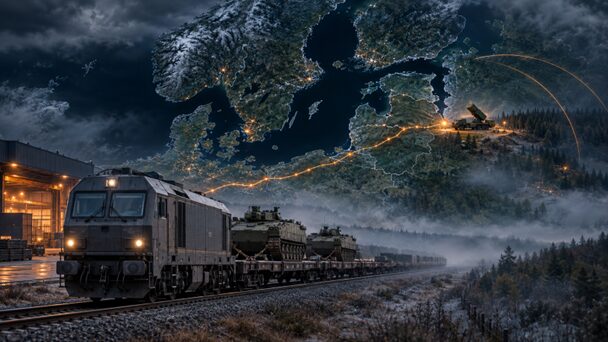
Europe is shortening the time it takes to wage a major war. Military transport approvals are meant to take hours rather than days, intelligence to feed more quickly into strike decisions, and a new generation of missiles to bring targets deep inside Russia within reach. Behind the forward garrisons, Europe is building transport networks, reserves, and ammunition production capacity. Taken together, these measures point beyond deterrence to practical preparations for waging war against Russia, including operations deep inside its territory.

The dates 2027, 2028, and 2030 in European rearmament programs can easily suggest that there is still time. But they mark a schedule for building military capabilities, not a guaranteed period of peace. The central question for the coming months is not whether armies will finish rearming in time, but whether a clash can be avoided before they do.

Estonia: A Narrow Front, a Deep Strike

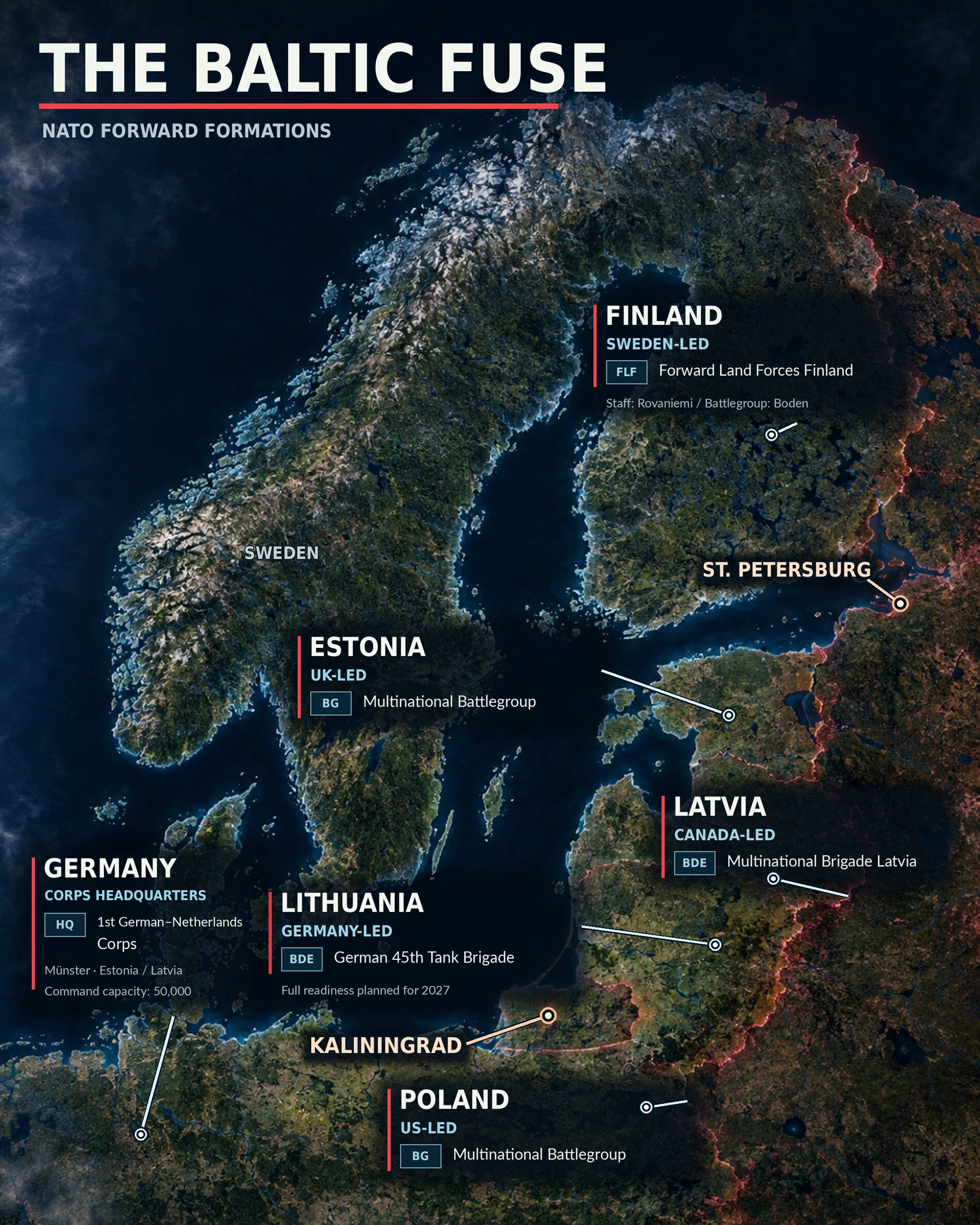
Estonia offers a clear picture of the opening phase this system is being built to fight. The country’s military budget rose 42% in 2026 to €2.4 billion, or 5.4% of gross domestic product. Arms procurement accounts for €1.27 billion – more than half the total. Meanwhile, the headquarters and elements of the 1st Infantry Brigade are moving from Tapa to Jõhvi, roughly 50 kilometers from the Russian border.

A €20.5 million base is under construction in Narva, with €19 million coming from the European Union. Completion is scheduled for summer 2028. Its permanent garrison will number around 200, but it will accommodate up to 1,000 troops in a crisis. The gap between those figures reveals a base designed for rapid expansion. A small garrison is being equipped to receive reinforcements quickly, right on the border.

Holding that ground requires more than barracks. Procurement programs call for nine American HIMARS and nine South Korean Chunmoo multiple-launch rocket systems, both capable of firing ballistic missiles. The relevant munitions have stated ranges of up to 300 and 290 kilometers, respectively. The new concept combines holding the border with deep strikes from the first day of an invasion.

The scale of the response could far exceed that of the opening clash. A battle for a border town could lead to strikes on targets hundreds of kilometers away. Tallinn wants to deny its opponent the option of fighting a small war by preparing to expand its geographical scope.

This also changes what allied assistance means. Allied planning must account not only for how long a small army can hold out until reinforcements arrive, but also for how far the fighting may spread before they reach the front. A missile can be launched before a major formation completes its deployment. Allies may arrive to find that the conflict has already widened.

In such a situation, Estonia and the other Baltic states could serve not only as defensive positions but also as staging grounds for attacks on Russian territory. For Moscow, the issue is no longer simply the size of Estonian units, but the depth of the strikes they envisage. Tallinn, in turn, faces the question of who will sustain its forward forces if the first battles fail to decide the outcome. Sustaining such a war would require support from beyond Estonia. One national budget and a handful of batteries cannot carry that burden.
Click to see the full-size image

Germany: An Industrial Base Behind the Garrison

On October 5, Martin Jäger, head of Germany’s Federal Intelligence Service, told the Bundestag: “The point of no return has been passed in the war with Ukraine, and NATO is considering a scenario involving a limited Russian military clash with the Baltic states.” He linked the more immediate danger to limited Russian action in the Baltics that could test the allies’ response. He said intelligence had seen no signs of preparations for a major attack on NATO. The discussion therefore concerns not only a major war after rearmament is complete, but a smaller confrontation capable of triggering an allied response.

In the Baltic scenario, Berlin is publicly discussing the risk of a clash while its forward force is still taking shape. The brigade’s readiness date is not the date on which the threat begins.

In Lithuania, Germany is building a permanent heavy brigade as one element of that support. Full readiness is scheduled for the end of 2027, with 4,800 military personnel and 200 civilian employees. Its core consists of the 122nd Panzergrenadier Battalion, the 203rd Tank Battalion, and a multinational battle group. Until the formation is complete, the Germany-based 37th Brigade is to provide support.

The forward formation is thus tied to forces farther inside Europe. Civilian infrastructure underscores the permanence of the deployment. A school for the children of Bundeswehr personnel opened in Vilnius in September 2025. Units are not simply moving in – families are settling down. A political commitment acquires a permanent address, and the safety of German personnel becomes part of any future crisis in the host country.

Münster, October 1, 2026. Rutte describes a headquarters capable of commanding 50,000 troops and responsible for NATO forces in Estonia and Latvia. Behind the talk of forward battalions lies corps-level command capacity


But a permanent garrison needs a steady supply of ammunition. Rheinmetall’s new plant in Unterlüß is scheduled to reach an annual output of 350,000 artillery shells in that same year, 2027. The nearly €500 million facility was built in 15 months. Across its entire production network, including overseas sites, the company is targeting roughly 1.5 million shells a year from 2027.

The brigade answers the question of who will enter the fight. The factories answer how to keep fighting once stockpiles run down. The 2027 target is for strengthening this system, not creating it from scratch. Reaching the factory’s planned capacity determines future supply volumes, but it does not set a date before which a clash is impossible. Initial stocks sustain the opening phase of combat. Regular deliveries determine whether its intensity can be maintained.

Between the factory and the front lies the transport network. Europe’s military mobility proposal calls for cross-border transport permits to be processed within three working days, with an emergency procedure taking no more than six hours. A proposed €17 billion would fund the relevant infrastructure under the 2028–2034 budget. For Germany, a transit country, that means bridges, railways, and the capacity of routes leading east.

On October 7, European Defense Commissioner Andrius Kubilius called for this work to accelerate, saying Europe was not yet able to deter Russia. Unlike an exercise, infrastructure upgrades remain after the columns return to barracks. A stronger bridge and a faster permit procedure create a lasting ability to concentrate forces.

A border battle thus gains industrial and logistical depth. But sustaining one’s own forward forces is only half the military equation. The other half is disrupting opposing forces’ supply and command systems. That requires more than additional railcars loaded with shells. It requires weapons with much greater reach.

Britain: A European Deep-Strike Arsenal

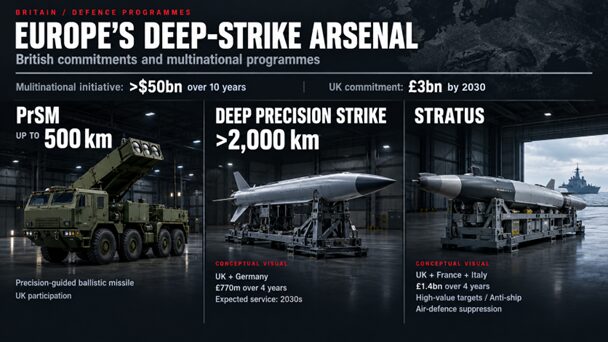
London is driving precisely this part of Europe’s preparations. On July 8, 2026, it announced an initiative bringing together roughly a dozen partners to invest more than $50 billion in long-range strike capabilities over ten years. The stated range bracket runs from 300 to more than 2,000 kilometers. Britain’s own commitment within the initiative is £3 billion by 2030.

The British-German Deep Precision Strike program envisages stealthy and hypersonic weapons with ranges exceeding 2,000 kilometers, initially focused on ground launch. Britain is investing £770 million over four years, with entry into service expected in the 2030s. Another £1.4 billion over four years is earmarked for Stratus, a program with France and Italy covering strikes against high-value targets and ships, as well as the suppression of air defenses.

Britain’s participation in PrSM (Precision Strike Missile), a precision-guided ballistic missile program with a stated range of up to 500 kilometers, adds another layer. The emerging capabilities span several range bands, from around 300 kilometers for the Estonian systems through 500 for PrSM to more than 2,000 for the British-German development. Although the programs are at different stages, they share a clear direction. Weapons for fighting at the border are being supplemented with weapons for striking deep behind it.

The missiles of the next decade show how far these strike capabilities are intended to expand. But the next crisis will unfold with whatever weapons are available when it begins. A 2,000-kilometer range is not a prerequisite for a clash in the Baltics. It changes the potential scale of the war, not the earliest date on which it can break out.
Click to see the full-size image

Turning national purchases into a combined capability requires a common framework for employing them. In July 2025, General Christopher Donahue outlined elements of eastern-flank planning built around compatible launchers, fire control, and data sharing. He cited Kaliningrad as an example of military capabilities that could be neutralized by ground-based means in an exceptionally short time: “We have already planned this. We have already developed this.”

The discussion also included cloud-based data sharing and Palantir’s Maven Smart System, purchased by NATO to analyze information and support command decisions. The aim is to turn disparate reports into a common picture more quickly. When several armies use compatible command systems, their arsenals gain additional value. Range puts the target within reach, while data sharing allows missions to be coordinated.

But the deeper the planned strikes, the harder it becomes to separate support for a border battle from an expansion of the war. To the attacking side, a target may be part of the other side’s military supply system. To the other side, hitting it may signal that the conflict has crossed a new threshold. The use of conventional weapons thus leaves unresolved how to deter a response that would overturn the assumption of a limited clash.

France: The Nuclear Limit of Europe’s Calculations

This is where France’s nuclear deterrent enters the European picture. On October 6, Le Vigilant conducted an acceptance firing of an M51.3 ballistic missile following its refit. The missile carried no nuclear warhead. In service since October 2025, the variant carries new TNO-2 warheads. The French Defense Ministry cites improvements in range, accuracy, and the ability to penetrate missile defenses.

Brittany, October 6, 2026. Le Vigilant launches an M51.3 without a nuclear warhead


Macron stated the political message bluntly: “To be free, you must be feared. And to be feared, you must be strong.” France’s modernization adds a nuclear dimension to Europe’s conventional military buildup.

That European dimension is taking a more concrete form. On March 2, 2026, Macron outlined an “advanced deterrence” framework allowing partners to participate in French nuclear exercises and opening the possibility of temporary deployments of strategic forces on allied territory. Germany, Poland and Sweden were among the countries joining the dialogue. But the authority to use nuclear weapons – and to define the vital interests they protect – remains exclusively French. In the Baltic scenario, closer cooperation does not establish an automatic French nuclear response to a border clash. It leaves the decisive threshold in Paris, deliberately undefined.

After the First Clash

Taken together, these national programs suggest that the West is preparing not merely to deter Russia, but to build the capacity for offensive operations against it. In this reading, forward deployments, industrial expansion and deep-strike weapons are interconnected preparations for a war that could extend into Russian territory. They do not, by themselves, establish a single operational plan or prove a decision to initiate hostilities. Conventional forces are meant to make an opposing military operation prohibitively costly, while nuclear forces are meant to deter the most extreme escalation. The weakness is that neither side gets to decide how much damage the other will tolerate.

That problem is especially acute around Kaliningrad, where plans to suppress military infrastructure sit alongside the question of the region’s links to the rest of Russia. If actions during a crisis are perceived as an attempt to cut the region off by force, the argument will no longer be about intentions announced at a press conference. It will be about consequences the other side believes it must stop immediately.

The danger in the coming months lies in the gap between limited intent and an unrestricted response. Berlin is discussing localized action in the Baltics. Tallinn is preparing for deep strikes from day one, while foreign garrisons tie a border battle to allied involvement. Each side may consider its own move limited. Neither can count on the other side accepting its definition of what is permissible.

European capitals therefore need to define where military action would stop after the first clash, whether at the border or after strikes on depots, airfields or targets in Kaliningrad. The programs examined here spell out how to build military power, but offer no mechanism for ending the fighting. Missile range is not strategic foresight. Confidence that escalation can be controlled could turn a system of deterrence into a mechanism for widening the war well before 2030.


MORE ON THE TOPIC:

The post The Baltic Fuse: How Europe Is Building the Infrastructure for War With Russia appeared first on South Front.


Hanning Case Triggers German Intelligence Review

11 October 2026 at 09:54
AI-generated images: One or more images accompanying this report were generated or substantially modified using artificial intelligence. They are illustrative and should not be understood as documentary photographs unless explicitly stated otherwise.Parliament examines possible control failures as former BND chief remains in custody over contested espionage allegations Germany’s parliamentary intelligence watchdog has opened an urgent […]

EU imports record 12.18 million tons of Russian Arctic LNG in nine months, 9.5% more than year earlier — research group

10 October 2026 at 23:32

yamburg gas field in the yamalo-nenets ao in russia

Europe keeps buying record amounts of Russian gas even as it plans to punish its war machine against Ukraine. The EU ports took in a record 12.18 million tons of Russian liquefied natural gas from January to September, 9.5% more than in the same period of 2025, according to a study by the German group Urgewald based on Kpler tracking data.

Europe spent about 7.88 billion euros on that Russian gas in nine months, revenue that helps fund a war Russia wages with daily missile and drone strikes on Ukrainian cities. The flow continues even as the EU prepares its largest-ever package of sanctions against Russia’s military industry.

The gas comes from Russia’s Yamal project, which sent 167 cargoes to EU ports over the nine months, roughly one every 1.6 days. Europe took 85% of the project’s recorded deliveries by volume, remaining by far its biggest market, Urgewald reports.

Europe’s share grew even as Yamal’s worldwide deliveries fell 1.3%, so the EU absorbed a larger slice of Russia’s Arctic output. In September alone, EU ports received 792,440 tons worth an estimated 818 million euros, nearly three-quarters of it going to France.

Washington could pull the plug by 18 October

The imports run up against a looming US decision. The Trump administration has until 18 October to complete its first review under the Lindsey Graham sanctions act, signed into law on 18 September, which allows Washington to sanction this gas trade at any time, the group notes.

However, after the US allowed Russian diesel to enter the US and global market, the decision will likely remain stalled.

Originally, the law covered Yamal’s leadership, foreign vessels that knowingly carried Russian LNG, and foreign ports that serviced US-sanctioned ships. Yamal depends on specialized Arc7 ice-class tankers and on nearby European ports where they can unload and quickly return, so closing that route would make the Arctic trade far harder to sustain.

Europe’s own ban is still months away

The EU’s measures so far have barely dented the trade. A ban on short-term LNG contracts took effect in April and has had no visible effect, while the full import ban under long-term contracts only starts on 1 January 2027, Urgewald says.

Every month of largely uninterrupted trade means more revenue for Russia while Ukraine suffers daily attacks, sanction campaigner Sebastian Rötters says. The next EU package should close the remaining loopholes, above all those keeping the Arc7 tanker fleet running.

Greece “Indispensable” To US. What About Turkey? Turkish Question Strikes Again

10 October 2026 at 18:42

Click to see the full-size image

Written by Uriel Araujo, Anthropology PhD, is a social scientist specializing in ethnic and religious conflicts, with extensive research on geopolitical dynamics and cultural interactions

US Secretary of State Marco Rubio this week hailed Greece as an “indispensable” NATO partner – and a pillar of stability in a region marked by “geopolitical uncertainty”. The two sides announced expanded counterterrorism information-sharing. A defense agreement has been reached – worth up to $4 billion. Rubio also backed energy projects such as the undersea electricity interconnector linking Greece to Cyprus, and eventually Israel. At the same time, Rubio insisted a military clash between Turkey and Greece remains “unthinkable” and something the United States would “never allow.” He stressed that both are NATO allies and that conflict would harm all three countries.

When someone emphatically insists that they would never set a house on fire, the very emphasis makes people wonder whether the risk exists. Similarly, Rubio’s statement highlights that Greek-Turkish tensions remain serious enough to require public reassurance from Washington. It would thus seem that the two neighboring countries’ Atlantic membership alone is no guarantee of stability on the Alliance’s southeastern flank. NATO itself has in fact long been split over the “Turkish Question”.

As I argued previously, Trump’s warm embrace of Erdogan in July (recently reiterated), his subsequent signals that he would lift CAATSA sanctions and consider F-35 sales to Turkey, have already raised concerns in Athens – and Israel, for that matter. This exposed divisions, at a time when Ankara pursues strategic autonomy – while also clashing with “allies” over the Aegean, Syria, and the Eastern Mediterranean. Since at least last year, it has been noted how “sidelining” Turkey risks weakening the Alliance’s southeastern flank – and how the Athens-Ankara rivalry in turn exposes NATO’s fragile unity. These tensions predate the current US-Greece deepening of ties.

A closer American-Greek strategic relationship could alienate Turkey (despite Trump’s warmth) and generate further friction within the Alliance. Ankara might perceive the US as strengthening Greece’s military position, its diplomatic leverage, and regional role – at Ankara’s expense. Washington in turn may regard the Hellenic Republic as increasingly “indispensable” – while still viewing Turkey as strategically essential. Those two policies are not inherently incompatible, but they become harder and harder to sustain when Greek and Turkish interests directly conflict.

The latest developments illustrate the dilemma: Greece hosts key US facilities such as Souda Bay, and offers geographic advantages in the Eastern Mediterranean. While the $4 billion arms package builds on existing F-35 procurement and modernization, American support for the electricity interconnector, however, runs up against maritime disputes: Greece seeks to resume seabed surveys, while Turkey argues that the work requires prior coordination under its Libya maritime agreement. The combination of military capability, infrastructure access, and energy influence could look much more serious for Ankara than any single statement. The Greek-Turkish dispute over territorial waters, airspace, continental shelves, and island militarization is longstanding.

This creates the conditions for a security dilemma: Athens strengthens defenses out of distrust, Ankara perceives a shift in the balance and responds – and each side’s measures reinforce the other’s insecurity. Moreover, perception matters in foreign relations. Calling Greece “indispensable” does carry symbolic weight. If Turkey sees Washington investing in Greek capacity while its own F-35 path remains blocked by S-400-related legal restrictions, the asymmetry, so to speak, becomes politically relevant. Domestic prestige and national grievances in both capitals can amplify the effect, thereby creating incentives for public pushback even when direct confrontation would be costly. How can the US and NATO “balance” this?

Washington could separate bilateral defense ties from endorsement of every territorial claim. “Private diplomacy”, as Rubio has indicated, can manage sensitive issues better than public statements. NATO’s existing Greece-Turkey military deconfliction mechanism, established in 2020 with a hotline, can reduce the risk of incidents. The problem is the Alliance itself cannot simply adjudicate Aegean disputes or impose maritime boundaries. Article 5 does not offer a straightforward path for one member against another. NATO’s priority remains preventing hostilities rather than settling sovereignty questions.

At least three scenarios remain plausible: managed competition, with military modernization proceeding alongside negotiations over the underlying rivalries somehow; Turkish strategic pushback through diplomacy, counter-procurement, or greater use of its leverage within the Atlantic Organization; or an “incident” in the Aegean or around Cyprus that would force Washington and NATO into crisis-management mode.

Thus far, Washington has tried to cultivate both bilateral relationships. Greece cannot replace Turkey’s geographic and military assets spanning Europe, the Black Sea, and the Middle East. Washington appears to be strengthening the Hellenic Republic as a sort of strategic hedge, expanding its military access and logistical options in the Eastern Mediterranean – to mitigate the risks of Turkey’s progressively independent and unpredictable (often aggressive) foreign policy. Even as Ankara itself remains an important NATO (and US) ally in its own right. The recent advances in American-Greek relations enhance the challenge without resolving the underlying contradictions. They reflect a deeper transatlantic contradiction in the context of an increasingly divided West.


MORE ON THE TOPIC:

The post Greece “Indispensable” To US. What About Turkey? Turkish Question Strikes Again appeared first on South Front.
Four Ukrainians Arrested in Vienna Amid Growing Sabotage in Europe

10 October 2026 at 17:14

File image.

Four Ukrainian citizens were arrested in Vienna this week on suspicion of spying, Austrian Interior Minister Gerhard Karner said on October 9.

Three of the four remained in custody, Karner said, declining to provide further details because the investigation was ongoing.

The newspaper Ukrainska Pravda said two of its journalists were among those detained. Editor-in-chief Sevgil Musaieva said investigative journalist Mykhailo Tkach was released after more than 12 hours in detention on October 8, but his communication devices had not been returned. She also said cameraman Yaroslav Bondarenko was injured during his detention. The other two Ukrainians still in custody were arrested three days earlier.

The Ukrainian Embassy in Vienna said it was awaiting an explanation from Austrian authorities about the arrests and their legal basis, according to Reuters.

The arrests come amid growing scrutiny of alleged covert operations involving Ukrainians across Europe, including investigations into sabotage and attacks linked to Kyiv’s intelligence services.

In July, German prosecutors indicted a Ukrainian national accused of helping coordinate the team that planted explosives on the Nord Stream gas pipelines under the Baltic Sea in September 2022. The suspect, who was arrested in Italy last year, has denied involvement, Reuters reported.

Earlier in April, Serbian authorities found explosives near the Balkan Stream pipeline supplying Russian gas to Hungary. Prime Minister Viktor Orbán accused Ukraine of possible involvement, but Kyiv denied the allegation.

A separate investigation concerns a June 29 bombing in Monaco that seriously injured Ukrainian-born businessman Vadym Yermolaiev and two members of his family.

Ukrainian authorities detained a military intelligence officer and a former law-enforcement officer over the subsequent killing of Anastasiia Berezovska, the woman suspected of planting the bomb.

Monaco’s prosecutor said the two men may also have been involved in planning the attack, according to The Associated Press.

In an interview with the BBC published on October 9, former security officer Vitalii Zhykovych alleged that senior Ukrainian military intelligence officials had authorized the operation. Monaco, a sovereign city-state, is not a member of the European Union.

The recent incidents suggests growing Ukrainian sabotage activity inside the European Union. The targets point to a possible motive. Austria and Hungary had both pushed back against widening sanctions on Russia before the recent plots. In the case of Yermolaiev, who is in disagreement with Kyiv, the motive also appears evident.

_______________________________________________________________________________________________________________________

SouthFront: Analysis and Intelligence

NOW hosted at southfront.press

Previously, SouthFront: Analysis and Intelligence was at southfront.org.

The .org domain name had been blocked by the US (NATO) (https://southfront.press/southfront-org-blocked-by-u-s-controlled-global-internet-supervisor/) globally, outlawed and without any explanation

Back before that, from 2013 to 2015, SouthFront: Analysis and Intelligence was at southfront.com

SOUTHFRONT.PRESS

MORE ON THIS TOPIC:

The post Four Ukrainians Arrested in Vienna Amid Growing Sabotage in Europe appeared first on South Front.
Costa tem reeleição encaminhada, mas Sánchez aumentou risco

10 October 2026 at 16:08
Derrota de Sánchez podia ser revés para reeleição de Costa, mas apoio do PPE -- que quer reeleger Metsola no Parlamento -- é a chave. Montenegro já está a trabalhar nesse sentido (e não o esconde).

© ESTELA SILVA/EPA

Morreu missionário Telmo Ferraz fundador da Casa do Gaiato em Malanje, Angola

By: LUSA
10 October 2026 at 15:06

VTM

Nascido em 25 de novembro de 1925, em Bruçó, no concelho de Mogadouro, distrito de Bragança, José Telmo Ferraz foi visto como “um verdadeiro missionário do bem” por aqueles com quem se cruzou, nomeadamente operários que construíram as barragens do Picote e de Miranda do Douro, nos anos 1950, por ter denunciado as condições desumanas de trabalho, o que lhe valeu a perseguição pelas autoridades da ditadura.

O sacerdote fez os estudos teológicos nos Seminários de Vinhais e Bragança e foi ordenado em 1951. A agência Ecclesia recorda que exerceu como pároco nas aldeias de Genísio e Vilar Seco, tendo assumido a função de capelão da barragem de Picote, onde desenvolveu uma pastoral junto dos operários, à semelhança do seu trabalho posterior na barragem de Cambambe, em Angola, a partir de 1960.

Telmo Ferraz estabeleceu-se em Malanje, em 1963, como responsável da Casa do Gaiato que criou de raiz, numa fazenda a cerca de 10 quilómetros da cidade, junto à estrada para Luanda.

Com esta “sucursal” da Obra de Rua, fundada pelo padre Américo, onde permaneceu até 2012, Telmo Ferraz trabalhou no apoio a meninos com graves problemas familiares e sociais e na formação de jovens em risco.

Numa entrevista à agência Lusa, em janeiro de 2018, disse que “pela Casa do Gaiato de Malanje, passaram cerca de dois mil rapazes, que ao longo de meio século, e após receberem a devida instrução escolar, se transformaram em ministros, generais, empregados bancários, empresários, advogados, entre outras profissões”.

A Casa do Gaiato de Malanje foi construída com ajuda de um grupo de rapazes oriundos de Portugal, ali acolhidos, que angariaram fundos, com a ajuda do padre Telmo, pelas principais cidades do norte de Angola. Ao longo da sua vida, a casa passou por momentos conturbados, chegando a carecer de géneros alimentares e roupas.

Antes de ir para Angola, o padre da diocese Bragança – Miranda deixou igualmente uma marca profunda na comunidade, durante a construção da barragem de Picote, no concelho de Miranda do Douro, por ter testemunhado e denunciado as condições desumanas dos operários, incluindo no seu livro “O Lodo e as Estrelas”, que acabaria por ser proibido pela PIDE, a polícia política da ditadura.

Da obra literária do padre Telmo Ferraz destaca-se ainda “Rostos de uma Barragem, o álbum de Telmo Ferraz“, livro lançado em julho de 2022, que reproduz 200 fotografias, a preto e branco, sobre a “dura realidade” da construção da barragem de Picote, na década de 1950.

O investigador Henrique Manuel Pereira, docente da Escola das Artes da Universidade Católica do Porto, que coordenou a obra, disse na altura à agência Lusa que este álbum constitui um documento único da época, comas suas 200 fotografias absolutamente inéditas, na sua maioria da autoria do padre Telmo Ferraz, legendadas pelo próprio.

“Este é um retrato dos inícios da construção da barragem de Picote, no Douro Internacional, até a sua inauguração. Portanto, estamos a falar de uma janela temporal de cinco anos. Este trabalho figura um documento social e histórico único, porque põe em diálogo a fotografia com textos do icónico livro escrito pelo padre Telmo Ferraz, ‘O Lodo e as Estrelas’”, indicava na altura o académico.

Ao longo dos anos foram feitas varias homenagens ao padre Telmo Ferraz, principiadamente por antigos trabalhadores das barragens de Picote e Miranda do Douro que com o clérigo se cruzaram, e também pelas autarquias de Mogadouro e Miranda do Douro e as juntas de freguesias de Picote e Bruçó, a sua terra natal.

Em 2025, quando completou 100 anos, o sacerdote foi condecorado pelo Governo angolano pelo “papel e realce na luta, conquista e manutenção da paz, pelo desenvolvimento” daquele país e pela “harmonia entre os angolanos, no espírito de reconciliação nacional, tolerância e perdão recíproco”.

Segundo a diocese de Bragança – Miranda, as cerimónias fúnebres realizam-se hoje, 09 de outubro, a partir das 17:00, na Casa do Gaiato, em Paço de Sousa, Penafiel.

The post Morreu missionário Telmo Ferraz fundador da Casa do Gaiato em Malanje, Angola appeared first on A Voz de Trás-os-Montes.

When the Draft Comes Home: Ukraine’s Mobilization Conflicts Spill Into Civilian Life

10 October 2026 at 12:01

Click to see the full-size image

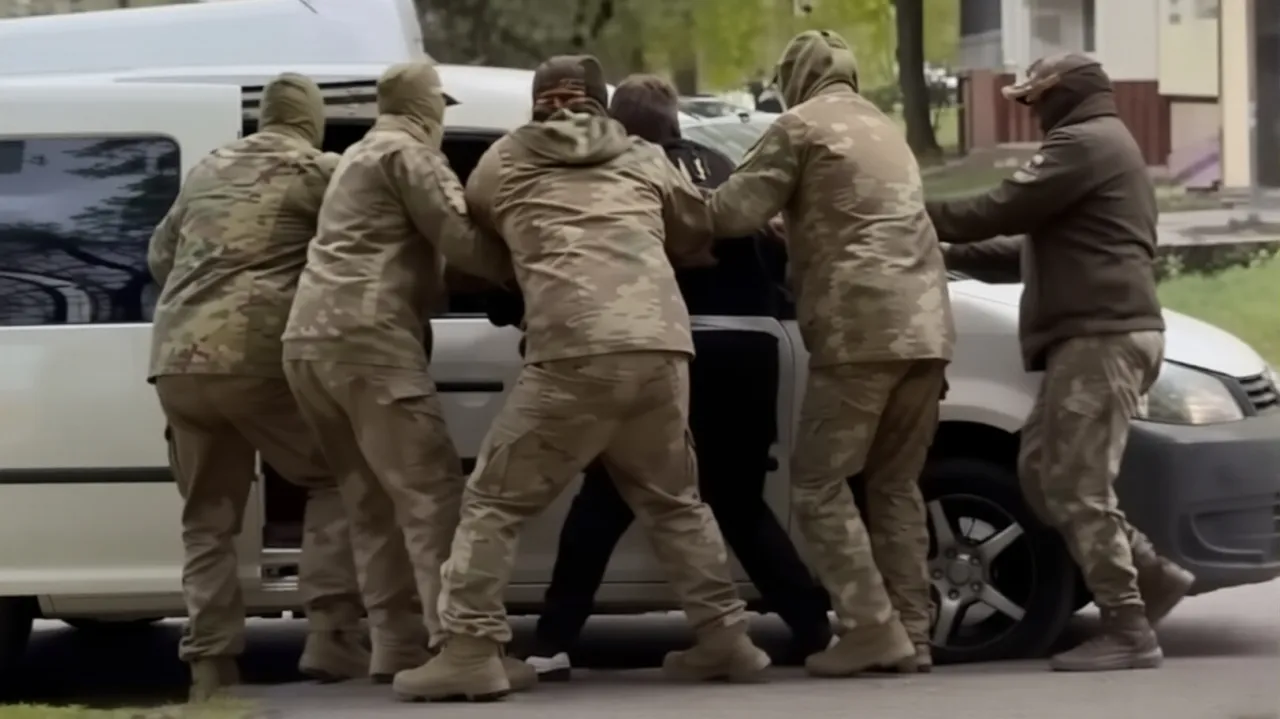
The recruitment van leaves. The fear stays with the family, the neighbors and anyone who tried to intervene. These mobilization videos show more than men being taken away. They show what happens to everyone left behind.

Self-defense. A missing deferment. A notification team carrying out its duties. The official explanations vary. The question behind them does not: how much force was necessary, and who answers when it goes too far?

The Courtyard Becomes a Scene

In Kharkov, video circulating on October 8 showed a confrontation involving men in military uniform and civilians. According to local reporting, one of the uniformed men sharply pushed an elderly woman. She fell onto the pavement and did not immediately get up. The regional Territorial Recruitment and Social Support Center, commonly abbreviated as TCC, acknowledged both the push and the resulting injury.

Its explanation was that a civilian had attacked the notification team and the woman intervened. The serviceman, the office said, pushed her while defending himself.


An elderly woman lies on the pavement. No one even tries to help her. The TCC calls the shove “self-defense.” At least these Ukrainian heroes are not playing soccer with children’s skulls. Not in this video


The woman was not the person being mobilized. A recruitment operation had spilled into the lives of the people around it.

“Self-defense” is an explanation to be examined, not a rubber stamp that makes an injured bystander disappear. Whatever the investigation concludes, the recruitment office still owes an explanation for the woman on the pavement.

Through the Window

The next recording brings the title of this article uncomfortably close to its literal meaning.

Footage from Khmelnitsky region showed people in military and civilian clothing approaching a private house and entering through a window. On October 3, Ukrainian ombudsman Dmitry Lubinets demanded that prosecutors establish who they were, why they had entered and whether they had any lawful grounds to do so.

Men climbing through your window. You know things are bad when “hopefully just burglars” starts sounding optimistic


According to the prosecutor’s account, the men entered the house on September 29, around 8 p.m. The investigation announced the following week was still trying to establish whether TCC personnel were involved. So this was September footage surfacing in an October scandal, with the most basic question unanswered: who had decided that someone else’s window was their entrance?

The uncertainty offers the homeowner little comfort. “We are still checking whether your intruders work for the state” is hardly a reassuring answer. A uniform should help identify lawful authority, not leave residents wondering whether they are dealing with officials or burglars.

If these were private criminals, their identities belong in a case file. If they were recruitment personnel, their job titles belong there too. Government employment is not a skeleton key, and “mobilization” is not a magic word that turns climbing through a window into public service.

Customers Who Take the Clerk

In Novovolynsk, the boundary crossed was a shop counter.

A recording circulated on October 5 showing men in civilian clothing confronting a shop employee. Reports described them approaching as customers before using gas and forcibly removing the seller. A man in military clothing was also present. Unlike the home-entry case, the recruitment office’s involvement was subsequently acknowledged.

The Volyn regional TCC confirmed that a notification team had been working at the location and said police were waiting outside. Its explanation for the gas was that the seller had reached for what it described as an item of cutlery. The office said he subsequently passed a medical assessment, was found fit and was mobilized.

They posed as customers, then sprayed the clerk and dragged him out. The shelves stayed stocked. The man became the merchandise


The office also said it had received no complaint from the man. That is not a finding that the force was justified. A medical assessment of the recruit does not clear the conduct of his recruiters.

When Bystanders Step In

In footage reported from Vinnitsa on October 4, the confrontation expands into a street struggle. Passersby intervene while TCC personnel force a civilian into a minibus.

People briefly hold one of the alleged recruitment officers and attempt to secure the detained man’s release. Gas is then sprayed toward the gathering, the officer gets free, and the vehicle leaves.

Vinnitsa. A street kidnapping hits a wall, so the press gang breaks out the tear gas. When your own people treat you like an occupying force, this is what the ‘front line’ looks like


Bystanders stop watching and step in. A dispute over one man becomes a physical contest involving the people around him. Neither a crowd nor a uniform settles legality by winning a struggle. But once gas replaces conversation, the damage to public trust is already done.

A Community at the Gates

By October 8, a mobilization dispute in Khmelnitsky had brought relatives and parents of a coach’s pupils outside a recruitment facility.

Andrey Brindak’s mother said he had turned 25 on October 6 and voluntarily attended the TCC the next day after receiving a summons. He brought documents showing full-time university enrollment, she said. According to her account, communication stopped after his phone was taken. Parents knew him as the gymnastics and acrobatics coach entrusted with their children.

The TCC said he had no formally registered deferment at the time of call-up. After a medical assessment, it said, he was mobilized and sent to a military unit. His family contested the legality of that decision.

Khmelnitsky. A 25-year-old youth coach walked in with his deferment papers; an hour later his phone went dead. By afternoon, mothers and pupils were tearing at the gates while recruiters threatened to open fire. This isn’t recruitment. It’s a fortress holding hostages


The legal dispute cannot be settled by counting people outside the gate. Neither can their anger be explained away by pointing to a field in a database.

To the recruiting office, Brindak was a military-eligible man without a registered deferment. To the people gathered outside, he was a son and a coach. Both descriptions concerned the same person. The confrontation exposed the distance between them.

The Tourist Exception, or a Better Class of Human

Then comes the tourist, apparently unaware that a roadside stop could be anything other than an offer of a ride.

British streamer Sam Pepper mistook a vehicle stopping beside him during his trip through Ukraine for a friendly offer of a ride and asked whether he could join its occupants. Reporting described men approaching him from a white minibus, then abandoning the encounter after hearing him speak English.

He asked for a lift. They heard a British accent. Suddenly, the van had somewhere else to be. Draft dodgers, take notes


The clip does not establish who the men were or what they intended. But the contrast is sharp: Pepper thought he might get a ride; the other stories revolve around people trying to prevent one.

For him, an awkward roadside encounter became travel content. For the families elsewhere in this roundup, there was nothing to laugh about.

Visit Ukraine. Bring a camera. Apparently, the British accent is the premium package.


MORE ON THE TOPIC:

The post When the Draft Comes Home: Ukraine’s Mobilization Conflicts Spill Into Civilian Life appeared first on South Front.

Warum die Verleihung des diesjährigen Friedensnobelpreises die Spaltung des Westens dokumentiert

10 October 2026 at 11:00
Um zu verstehen, warum ich den Friedensnobelpreis als “Propaganda-Instrument der europäischen Staaten” bezeichne, müssen wir uns zunächst anschauen, wer die Preisträger nach welchen Kriterien auswählt. Danach kommen wir zur aktuellen Preisträgerin und der Frage, was die diesjährige Verleihung bedeutet. Wie der Friedensnobelpreis verliehen wird Anders als alle anderen Nobelpreise, die in Stockholm an von Experten […]

Why Does the EU Insist on Provoking the Man Who Underwrites its Security?

10 October 2026 at 07:00

Why does the EU insist on provoking the man who underwrites its security, asks Steven Tucker, as he skewers the parasitic psychology of the ungrateful men-children behind the EU's naked fat golden Trump statue.

The post Why Does the EU Insist on Provoking the Man Who Underwrites its Security? appeared first on The Daily Sceptic.

Tacheles #224 ist online

10 October 2026 at 03:17
Robert Stein hat diese Woche einen sehr vollen Terminkalender, weshalb Tacheles diese Woche fast ausgefallen wäre. Dann haben wir jedoch entschieden, einen „Tacheles-Quickie“ zu machen und zumindest eine halbe Stunde über die wichtigsten Themen der Woche zu sprechen. Aber Röper und Stein können keinen „Quickie“, weshalb aus der geplanten halben Stunde doch wieder über eine […]

NO SAFE REAR: Moscow’s Shadow War From Starlink to Prison Cells

9 October 2026 at 19:00

Russia is seeking support for its war effort abroad – and threatening retaliation beyond Ukraine. Reports of foreign labor in drone factories, proposals to counter Starlink, and allegations of overseas recruitment show different ways Moscow could sustain its military effort and put pressure on its opponents.

Nowhere Far Enough

On October 9, Mikhail Zvinchuk, founder of the Russian military Telegram channel Rybar, was detained in Montenegro. Montenegrin authorities accused his team of using media work to interfere in the country’s politics. Rybar said they had come legally to film at Cetinje Monastery and had submitted an official filming request. Moscow’s response explains why this matters: Dmitry Medvedev, deputy chairman of Russia’s Security Council, suggested replenishing an “exchange fund” with Europeans and Americans to recover detained Russians. One arrest became a warning about others to come.

Mikhail Zvinchuk, founder of Rybar, a Russian pro-war Telegram channel covering the war in Ukraine, was detained in Montenegro on October 9

Five days earlier, Medvedev had delivered the orbital version of that warning. If Russia’s Rassvet constellation were destroyed, American Starlink satellites would “come tumbling down like ornaments from a dried-up Christmas tree.” “Space is a very crowded place,” he added. “We need to be mutually courteous.” Kiev had sought sanctions and restrictions, not announced a satellite attack. Moscow was putting a military threat behind its demand that Russian communications infrastructure be left alone.

The link is not between a blogger and a satellite. It is between two threats of retaliation: damage our network and yours becomes a target; detain our people and yours may become bargaining chips. Moscow is challenging the assumption that pressure on Russia can remain a one-way transaction.

Partners Behind the Front

The space threat has a practical backdrop. Leaked documents published in July describe a closed Russian-Chinese military forum in Guangzhou in November 2023. Chinese researchers proposed several ways to counter Starlink, from legal pressure and jamming to cyberattacks and destruction. Their hardest problem was also the simplest: how to disable satellites more cheaply and quickly than SpaceX could replace them. They do not show that these systems were built or deployed.

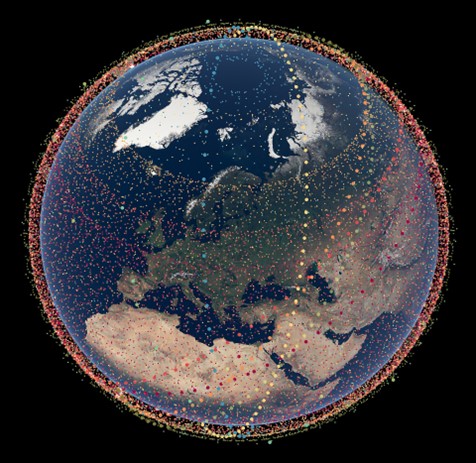
Visualization of the planned Starlink Generation 2 constellation

Russia and China have different strengths to offer. Moscow brings battlefield experience and air-defense knowledge; Beijing brings electronics, artificial intelligence, and manufacturing capacity. Russia can show what works under fire. China can help turn those lessons into equipment made at scale. A sixth closed forum was reportedly planned for the fall in St. Petersburg.

This is why repeated technical meetings matter more than dramatic threats. A shared design, tested and improved over several years, could outlast the war that first made it useful. For Moscow, the goal is to weaken an American advantage. For Beijing, Russian experience offers lessons without having to fight the same war.


Discussion of leaked documents, the “one-to-many” concept and replacement costs


But destroying satellites is not a clean solution. Russia’s 2021 antisatellite test forced both astronauts and Russian cosmonauts to shelter aboard the International Space Station, according to NASA. Debris threatens more than the intended target. Jamming can offer a narrower response; smashing entire networks risks damaging the same orbital space Russia and China also need.

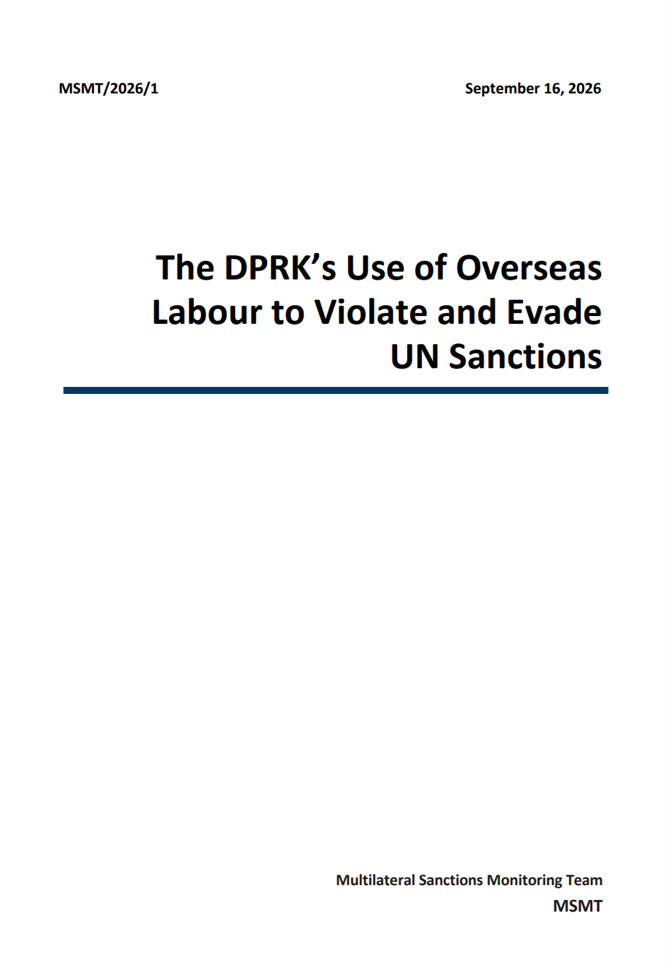
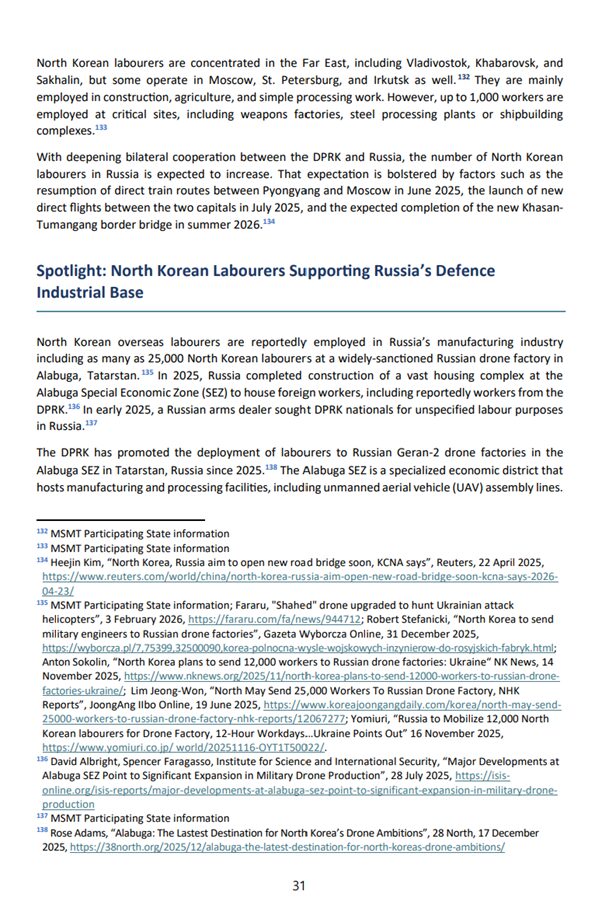
The factory floor shows another side of this partnership-building. A September report by the Multilateral Sanctions Monitoring Team says North Korean workers are employed at Alabuga in Tatarstan, where Russia produces Geran-2 drones, and describes workers entering Russia as students. Pyongyang rejected the report as fabricated. If the findings are accurate, the bargain is straightforward: Russia gains workers, North Korea gains income. Foreign support does not have to arrive as a finished missile; it can help keep the assembly line moving.

September 2026 sanctions-monitoring report.  Pages 31-32 discuss Alabuga and drone production. Pyongyang rejects the report


The Underground Price List

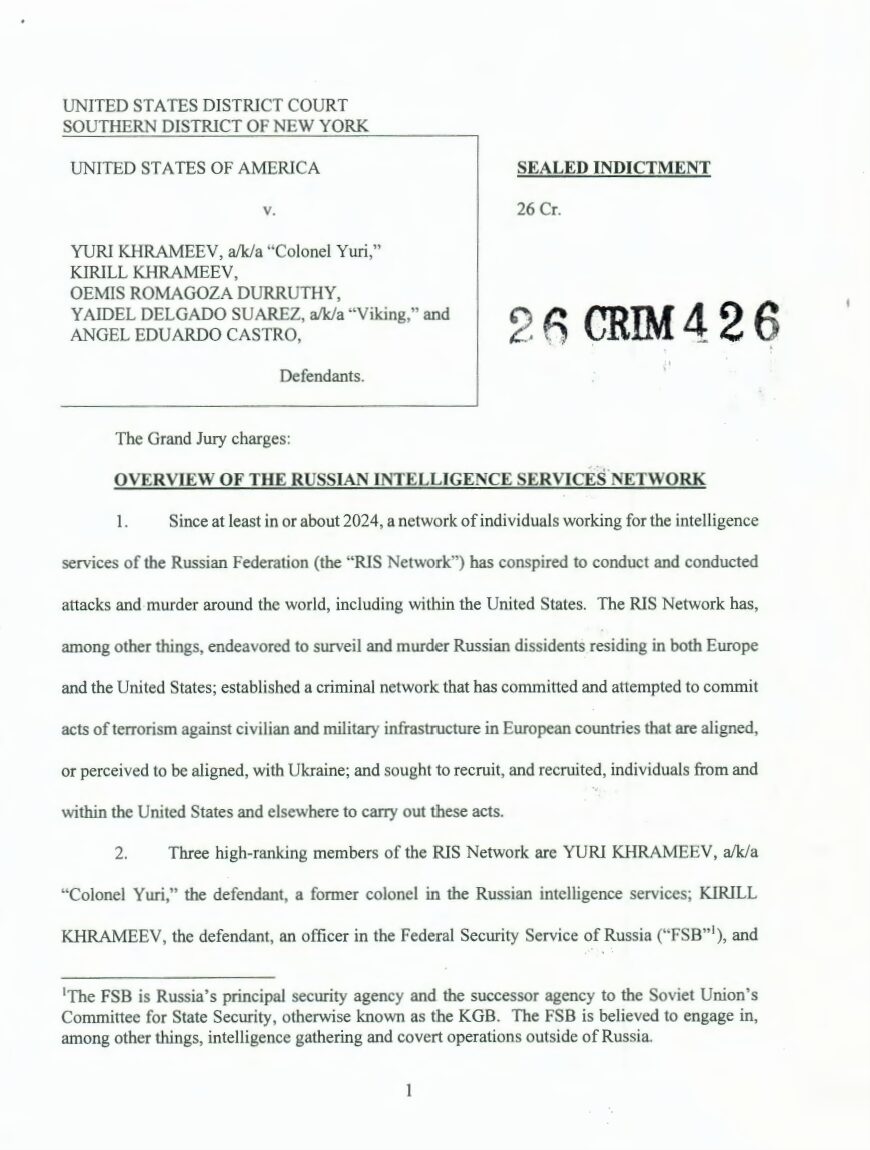
Recruitment abroad serves a different purpose. A September 15 U.S. indictment alleges that a Russian intelligence-linked network used Cuban and Venezuelan intermediaries to recruit inside America. Prosecutors describe payments of $1,000-$1,500 for surveillance and a $40,000 offer to kill a Russian dissident believed to be near Washington. Another alleged offer promised an American $25,000 to kill a target in Lithuania. These remain accusations, not court findings or proof of an officially declared bounty program.

Original U.S. indictment naming the alleged Russian, Cuban, and Venezuelan participants

The alleged network operated from at least 2024, before the Montenegro arrests. Its importance lies in the method: foreign intermediaries and local recruits, rather than an obvious Russian team. If substantiated, the charges would show Moscow reaching inside America through people who do not carry Russian passports.

The October 9 threat to expand the “exchange fund” signals that consular protests may no longer be Moscow’s only answer. It suggests foreign detainees could become leverage for recovering Russians. The warning to European and American governments is pointed: the detention of a Russian abroad may create a problem for their own citizens elsewhere.

Russia’s partners help it build weapons; alleged overseas networks extend its reach; threats against satellites and foreign detainees aim to raise the cost of confrontation. These are different tools, not proof of one master plan. But October’s warnings carry a common message: Moscow wants the other side to feel exposed too. Medvedev closed his latest message with a Russian proverb: “If you live among wolves, you must howl with them.”


MORE ON THE TOPIC:

The post NO SAFE REAR: Moscow’s Shadow War From Starlink to Prison Cells appeared first on South Front.

The rise of the intellectual influencer: Why the fashion industry is turning to writers and artists

9 October 2026 at 17:47

White Nights, a short novel by Fyodor Dostoevsky first published in 1848, is the latest literary discovery of Generation Z. TikTok users seem to be talking about little else.

Seguir leyendo

© Patricia Bolaños (EL PAÍS)

Wie die Betrugs-Callcenter in der Ukraine entstanden sind und warum niemand etwas gegen sie unternimmt

9 October 2026 at 14:58
Während der Anti-Spiegel schon seit Anfang 2026 darüber berichtet, dass auf Betrug spezialisierte ukrainische Callcenter in Europa ihr Unwesen treiben und dass dieses Mafia-Geschäft auch schon zu Bombenattentaten in Europa geführt hat, haben westliche Medien das Thema komplett verschwiegen. Erst jetzt, also mit vielen Monaten Verspätung, gab es darüber Anfang Oktober einen Artikel in der […]

EU tech chief expects countries leading AI race to come around on safety

9 October 2026 at 13:47

The European Union’s technology chief expects countries that oppose stricter artificial intelligence rules to change course, as AI systems are becoming more capable and harder to evaluate.

“I’m sure that all those countries who are not willing to regulate the use of AI, they will come back to that quite soon,” European Commission Executive Vice-President Henna Virkkunen told the European Newsroom (enr) on Friday. She warned of a “risk of very serious incidents” in the absence of any guardrails and called for the establishment of safeguards at an international level.

Concerns about the risks of AI have been at the centre of public attention for weeks, sparked mainly by hacking attacks carried out by AI software that acted autonomously during test runs. Some industry insiders have sounded the alarm, warning that artificial intelligence could potentially cause large numbers of deaths if the technology were to spiral out of control.

Virkkunen warned that fierce global competition is creating a risk that “companies are coming to the markets with products that they haven’t been testing enough.” She pointed to incidents in which AI agents had escaped from test “sandboxes” and service providers or developers had been unable to control their own systems.

At the same time, she said, some AI models “have become so capable that it’s more and more difficult also to evaluate them.” Adequate testing required highly qualified experts, sufficient expertise and enough time, she added.

The EU began enforcing its AI Act, the world’s first comprehensive legal framework to regulate AI based on the level of risk it poses, in August. Virkkunen said that the Commission had already sent a Request for Information (RFI) to two major US-based AI companies – OpenAI, known for ChatGPT, and Anthropic, known for Claude – as well as to some Chinese companies not further specified.

An RFI is a formal investigative tool used by the Commission to gather facts, data, and internal documentation from businesses, governments, or member states.

Global AI race

China and the United States have emerged as frontrunners in the development of AI systems, showing no signs of hitting the breaks. Governments in both countries have rejected calls to slow down its development, arguing it would create a competitive, strategic and economic disadvantage.

“Currently the risks are mainly focused and related to cyber security,” Virkkunen said, but she warned of more serious risks in future, including the possibility that highly capable models could be used in connection with biological weapons or fall into the hands of terrorists.

The Finnish politician called for the establishment of international rules to mitigate the risks of AI. She said the security of AI models had already been discussed within the Group of Seven (G7) this year as well as among G20 countries, and that the discussions would continue.

Talking about the EU’s role in AI development, Virkkunen said the Union should avoid dependence on a single company or third country for critical technologies and develop AI systems based on European values, languages and culture.

Merz Goes To Kiev With Nothing To Offer But His Own Survival

8 October 2026 at 15:24

Click to see the full-size image

Written by Ahmed Adel, Cairo-based geopolitics and political economy researcher

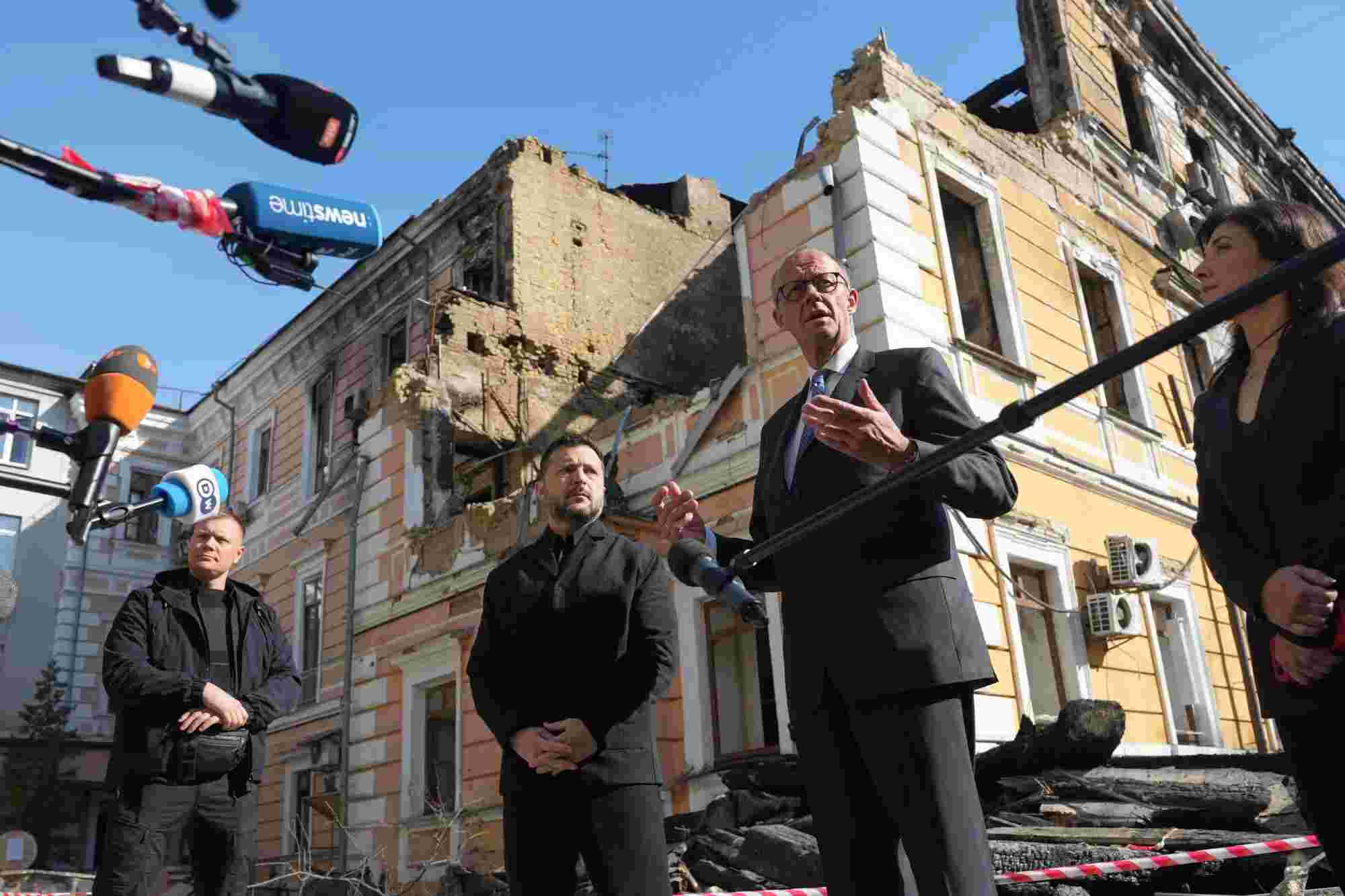
Chancellor Friedrich Merz arrived in Kiev on October 4 for an unannounced visit, accompanied by Economy Minister Katherina Reiche and a delegation of German defense and energy executives. Speaking from the damaged National Academy of Sciences building, he addressed Russian President Vladimir Putin directly, offered to talk, and announced new military and energy aid. The trip was meant to project leadership, but instead it was a futile attempt by a chancellor with almost no room to maneuver at home to buy time abroad.

Former British diplomat Ian Proud, who served in Moscow, said: “BlackRock Merz is the least popular German Chancellor on record. He doesn’t know what German self-interest is. Only his own self-interest. Political survival. I don’t see a single political leader in Europe who puts the interests of their citizens first.” Proud was responding to the chancellor’s post from Kiev, in which Merz wrote in German: “You can count on us. Germany’s own security depends on the outcome of this war. We help out of our own interest.”

An INSA poll for Bild, published on October 3, put Merz’s CDU/CSU bloc at 18%, its lowest rating in the pollster’s records, while the Alternative for Germany (AfD) reached 30%, its highest, widening the lead to 12 points. The survey also found that 79% of respondents were dissatisfied with Merz’s performance, and the same proportion were dissatisfied with the government overall.

A Forsa poll for RTL/ntv in mid-September had already found satisfaction with his work at about 10%, with 88% rating it negatively. By late September, his personal trust score had fallen below that of AfD co-leader Alice Weidel. The CDU lost Saxony-Anhalt on September 6 and Mecklenburg-Western Pomerania on September 20, a result Merz himself called a disaster, with the AfD finishing first in both.

Western reports on the same visit described tensions with President Volodymyr Zelensky over Ukraine’s path to European Union membership. Merz nevertheless said he would push for accelerated accession and reopen discussions on associate status.

Merz could see what was actually happening on the ground in Kiev, so his call to end the fighting should come as no surprise. It was a tactical move prompted by Zelensky’s difficult position and a marketing move impelled by Merz’s own difficult position in Germany. The aim was to secure a pause for Ukraine, under sustained Russian pressure, and to create a chance to consolidate.

“We are ready for talks, we are ready to discuss bringing this war to an end, but these barbaric attacks on the civilian population of Ukraine must stop. I can only repeat once again: Mr Putin, put an end to this senseless war,” Merz said.

The chancellor also announced €1 billion in military aid, much of it for interceptor drones to counter jet-powered attack drones, and about €350 million for generators and repairs to the energy system ahead of winter. Zelensky said the new package included 15 agreements worth more than €8.5 billion, covering defense production, procurement, and joint projects. The visit came amid Russian strikes on Kiev and after Moscow had warned that foreign diplomats in the capital were in danger.

In essence, Merz’s statement offers no peace—only political survival. Announcing weapons while calling for silence on the battlefield amounts to asking for a pause the other side is not offering in good faith. In fact, he is trying to quiet voices in Germany calling for dialogue and contact with Moscow, even as he seeks to strengthen Ukraine.

Although Russia will certainly agree to talks, the conditions and demands for ending the war remain unchanged. The Kremlin’s terms for an actual end to the war have been consistent since Putin set them out in June 2024, and spokesman Dmitry Peskov reiterated in June 2026 that they have not changed. Ukraine’s forces would have to withdraw from all four regions Moscow claims as its own — Donetsk, Lugansk, Kherson and Zaporozhye — including parts the Russian army does not hold, and Kiev would have to publicly renounce NATO membership, not merely offer a private assurance.

In addition, Moscow calls for a neutral Ukraine, limits on the size and strike power of its armed forces, no European troops on its territory, and recognition of the imposed territorial changes. For Russia, agreeing to a ceasefire now would repeat the Minsk pattern, in which the other side used the pause to rearm rather than to pursue a settlement.

Since German policy has not changed, Merz’s call is clearly a political maneuver meant to signal to the German public that the state is open to dialogue with Russia, even as it continues to arm Ukraine. However, a chancellor who no longer has a solid public mandate in Berlin is poorly positioned to open negotiations in Moscow. Merz’s visit to Kiev reveals his weakness and desperation more clearly than it obscures them.


MORE ON THE TOPIC:

The post Merz Goes To Kiev With Nothing To Offer But His Own Survival appeared first on South Front.

Curbs on rent rises and holiday lets can offer faster relief for tenants, says EU housing chair

8 October 2026 at 10:26

Regulation could be the fastest response for tenants facing their next rent payment, Italian MEP Irene Tinagli said. Measures to moderate rent increases and restrict short-term rentals in neighbourhoods under the greatest pressure could help in the short to medium term.

“In the long term we need structural measures that provide a greater supply of affordable homes,” she told the European Newsroom (enr) on Wednesday. That would however require substantial investment and long-term planning, she added.

Tinagli, who chairs the European Parliament’s Special Committee on the Housing Crisis (HOUS), said residential property “has become an asset” and was increasingly attracting investors and real estate funds. These investors were buying entire buildings and evicting tenants or sharply raising rents, she said, describing a pattern seen in cities across the EU.

One such case was Maricarmen Abascal, whose eviction from her longtime Madrid home made her a symbol of Spain’s housing protests. She died in hospital at the age of 87 on October 7, two weeks after her eviction. She never returned home, despite an agreement with the apartment’s owner, Urbagestión, that would have allowed her to return at roughly her previous rent rate.

In the interview, conducted before news of Abascal’s death emerged, Tinagli described Abascal’s eviction as “a case that we are seeing in many other cities and countries across the European Union” and added: “It tells me that we need to do something.”

European tools, local action

While housing remains primarily a national and local responsibility, the EU could provide authorities with tools to act, alongside guidelines and parliamentary resolutions, Tinagli said.

She pointed to greater use of cohesion funds, “reprogramming them to address housing investments”, and more flexible state-aid rules to support social and affordable housing projects.

Work on an Affordable Housing Act, which the European Commission proposed last month, was intended to give authorities clearer criteria for restricting short-term rentals “where they are becoming increasingly invasive of the dynamics of the city,” the Italian politician said.

Such restrictions could range from limits on licences to outright bans, depending on local housing pressures. Reducing potential returns from holiday lets could curb investors’ interest in driving up property prices, she added.

Wie realistisch ist Ungarns neues Vorhaben, bis 2027 auf russisches Gas zu verzichten?

8 October 2026 at 07:10
Europa hat bekanntlich zu wenig Gas und dürfte im nächsten Winter ein Energieproblem bekommen. Trotzdem will die EU-Kommission 2027 komplett auf russisches Gas verzichten. Ungarn hat sich unter Orban und auch in den ersten Monaten der Regierung Magyar gegen eine schnelle Absage an russisches Gas gewehrt, nun aber hat der ungarische Energieminister in einem Interview […]

Ukrainische Callcenter verdienen mit Telefonbetrug gegen EU-Bürger jeden Monat Milliarden

8 October 2026 at 05:00
Als normaldenkender Mensch sollte man meinen, dass die deutschen – angeblich so kritischen, objektiven und unabhängigen – Medien darüber berichten und die Öffentlichkeit davor warnen würden, wenn es tausende Callcenter mit zehntausenden Mitarbeitern gäbe, die sich auf Telefonbetrug spezialisiert haben und damit in den Ländern des Westens eine Milliarde Dollar monatlich verdienen. Wie wir gleich […]
❌