Die ständigen Provokationen der EU-Staaten, die es darauf anzulegen scheinen, Russland zu einer bewaffneten Antwort auf Ziele in Europa zu bringen, sind vor allem angesichts des offensichtlichen Mangels an Luftabwehrsystemen vollkommen unverständlich, denn die europäische Rüstungsindustrie kann derzeit nicht genug Luftabwehrmunition für eine großen Krieg produzieren. Und auch die Lager der USA sind leer. Darunter […]
Ende Juli hat mich eine Meldung über ein russisches Militärflugzeug über der Ostsee, was der Spiegel natürlich als weiteren Beleg für die „russische Aggression“ angeführt hat, auf die Idee gebracht, mal einen Monat lang die Meldungen über Spionageflugzeuge der NATO nahe der russischen Grenze zu sammeln, denn in westlichen Medien erfährt man über die Anzahl […]
Cover image: picture alliance / Hans Lucas | Martin Bertrand
US secretary of state Marco Rubio described NATO’s July gathering in Ankara, two months before it convened, as “one of the more important leaders’ summits in [its] history.” The summit confirmed that Europeans have accepted America’s expectation that they do more for their own security. The Ankara declaration recognised that “European allies and Canada, working together with the United States, are assuming greater responsibility for the alliance’s defence.” Accepting that shift is one thing; paying for it is another. For European policymakers the question is now fiscal. It turns on what Europe is willing to pay for. And for the EU’s frugal members, that means rethinking what they treat as strategic.
Getting defence into the budget
According to the International Institute for Strategic Studies, replacing US military capabilities in Europe could require around $1tn (about €900bn) in extra investment. NATO’s new target to invest 5% of GDP in defence similarly implies a sustained increase in European defence spending over the coming decade. Together they suggest that defence is no longer crisis spending but a permanent claim on European budgets.
Since Russia’s full-scale invasion of Ukraine in 2022, the EU has found money for defence, but always as extraordinary spending. The European Defence Fund and SAFE (Security Action for Europe, a loan scheme for joint arms purchases), for example, sit outside the ordinary budget. Such instruments expire; the challenge is to embed this spending into the EU’s regular budget. Winning defence a permanent line in it makes negotiations over the next Multiannual Financial Framework (MFF) far more than another exercise in budgetary bargaining.
The MFF is the EU’s seven-year budget—and where any pledge on defence would have to show up in funds. The commission’s proposal for 2028–34 reflects such a commitment. It allocates €131bn to defence and space, roughly five times the current level, and puts security among the EU’s central priorities.
Out of the negotiating box
Commission proposals rarely emerge intact from negotiation, and early signs suggest this pattern may repeat itself.
Commission proposals rarely emerge intact from negotiation, however, and early signs suggest this pattern may repeat itself. Cyprus, which held the presidency until the end of June, left a negotiating box on how to structure the next MFF that envisioned reductions in defence and security while protecting cohesion policy and the Common Agricultural Policy (CAP). The box is the presidency’s draft compromise, the text the final deal is built from. The Irish presidency has opened with a strong focus on competitiveness and security, but Ireland leans heavily on farming too.
Budget negotiations are shaped by coalitions that defend long-established spending. The 16 member states of the “Friends of Cohesion” group, Spain, Italy and Poland among them, want robust funding for cohesion policy and agriculture, while frugal member states, such as Germany, the Netherlands and Sweden, are reluctant to expand the overall size of the EU budget. Defence enters as a comparative newcomer against policies with decades of institutional backing and organised constituencies behind them.
Germany’s position illustrates this dilemma. In a parliamentary inquiry, Alliance 90/The Greens asked the federal government how the EU can square four things at once: from 2028 it will need to start repaying NextGenerationEU, the €637bn joint borrowing agreed as a one-off in 2020 to fund members’ recovery from covid-19; forgo new revenue of its own (levies it collects directly rather than cheques from national treasuries); hold its budget roughly the same size; and still strengthen competitiveness, security and defence. The chancellor, Friedrich Merz, has repeatedly committed to the last three. The government answered that the EU could meet all three objectives by trimming across the whole budget. Yet such “horizontal cuts” only protect these priorities if all 27 members agree what to spare when deciding the cuts, and they are unlikely to agree. Other member states could favour different areas of the EU budget, cutting competitiveness or security harder than Germany intends.
New financing for a new era
The scale of investment required to deliver Europe’s defence transformation also exceeds what can realistically be financed through the MFF alone. While the seven-year budget can establish political priorities, provide long-term planning certainty and support common capability development, it cannot generate the sums required to finance Europe’s long-term defence.
Hence the appeal of joint EU borrowing: debt raised by the commission against member-state guarantees, the model already used for NextGenerationEU and SAFE. NextGenerationEU demonstrated that the EU can raise substantial resources when confronted with an existential crisis such as the covid-19 pandemic. Europe’s security has changed just as fundamentally, which makes the case for borrowing together just as strong. If defence is a collective problem, leaving the bill to strained national budgets makes little sense. However, borrowing on that scale is politically out of reach: creditor states intend NextGenerationEU to stay an exception rather than a template. Something narrower—bonds (or comparable fiscal mechanisms) that fund defence alone or the technologies Europe cannot do without may prove necessary if the EU wants to match its strategic ambitions with adequate financial resources.
Europe has accepted that it must carry more of its own defence. The MFF negotiations will show whether its budget can pay for it. With NATO entering a new era of European burden-sharing, the EU cannot afford a budget that reflects the priorities of a different geopolitical age. The world has moved on—it is time that frugal member states like Germany did so, too.
Da ich letzte Woche bereits beim Homeofffice von NuoViso über all die Themen gesprochen habe, die wir normalerweise bei Tacheles sprechen, haben wir Tacheles letzte Woche ausnahmsweise ausfallen lassen. Aber heute gibt es wieder eine aktuelle Folge von „Tacheles mit Röper und Stein“. Nächste Woche fällt Tacheles übrigens wieder aus, weil NuoViso sein jährliches Sommerfest […]
Die „Mekka-NATO“ wirft viele Fragen auf. Ist sie ein Bündnis sunnitischer Staaten gegen schiitische? Ist es ein Bündnis gegen Israel? Und was ist eigentlich der Sinn dieses Bündnisses? Auf all diese Fragen gibt es noch keine klaren Antworten, das werden wohl erst die weiteren Entwicklungen zeigen. Aber eines kann man festhalten: Das Bündnis ist die […]
Droni Astore Levante tra Leonardo e Baykar: tra il blocco Saipem a Cipro, l'elusione della Legge 185/90 e la perdita di sovranità industriale dell'Italia.
Cover image: picture alliance / NurPhoto | Jonathan Raa
Summary
Europe faces a dual drone threat, and it is escalating. Small drones regularly disrupt airports and hover over Europe’s critical infrastructure; at the eastern flank, larger military drones are crossing ever more often into EU and NATO territory.
EU member states are struggling to mount an effective response to the drones spotted over their critical infrastructure, and those countries farther from the eastern flank tend to focus disproportionately on this side of the threat.
At the flank, efforts to defend against military drone incursions are resulting in a hotch-potch of NATO, EU and national projects. This risks duplicating efforts and stalling progress towards a common operating picture.
National initiatives at the eastern flank seem the most promising, but the EU still has a role to play in funding and incentivising these efforts. The bloc should also help establish the common operating picture and best practice for legal regulations, and work to improve data sharing.
The EU and member states should then apply lessons from the eastern flank to the related but different threat to their critical infrastructure. That way, they can help Europe move closer to a continent-wide response to both sides of this continent-wide problem.
Today’s problem
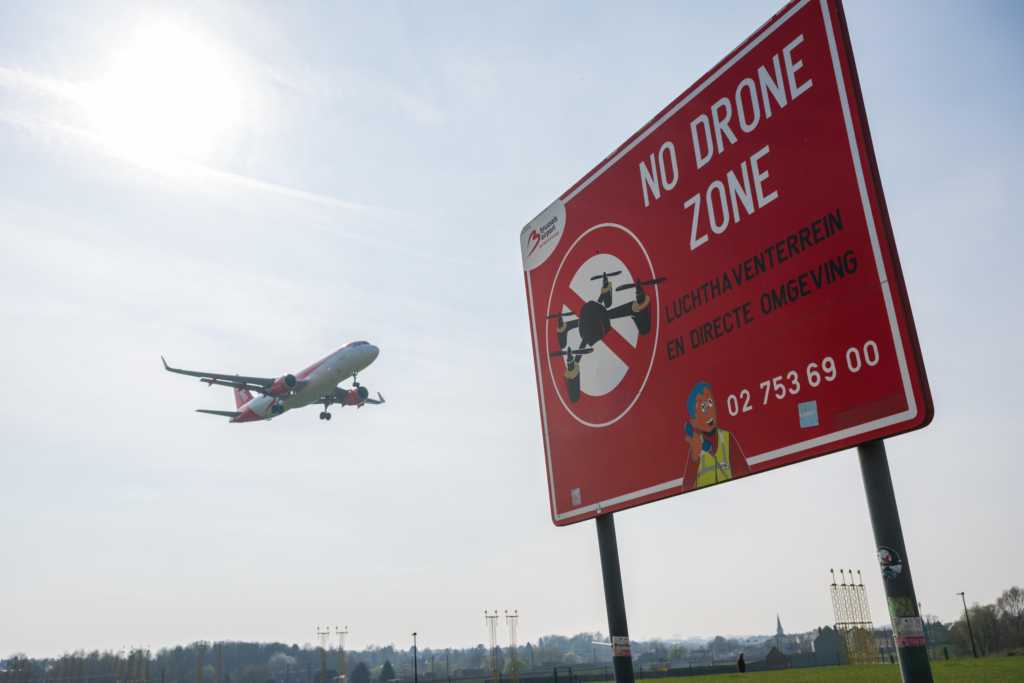
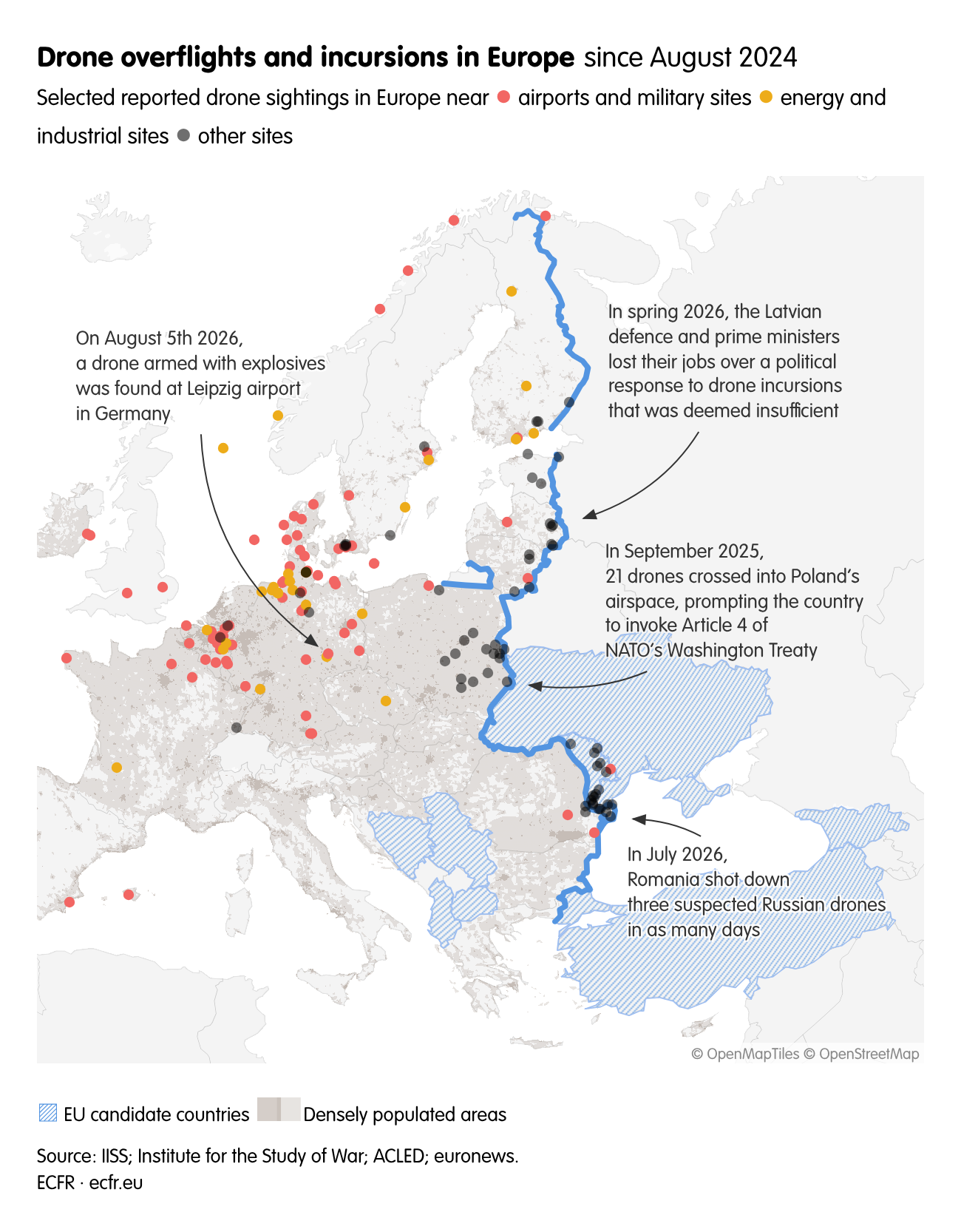
On August 5th 2026, a small drone armed with explosives was found at Leipzig airport in Germany. The presence of explosive material marks this out from previous incidents at airports, as does the fact that authorities recovered the drone. But Europe’s new normal is for small drones to disrupt its airports and buzz around other critical infrastructure, including French nuclear submarine bases, Belgian nuclear power plants and German liquefied natural gas terminals. Some of these sightings are likely part of Russia’s hybrid war against Europe. Yet the drones are probably flown from inside European countries or from ships in the North and Baltic seas, and definitive attribution to Russia or any other actor remains elusive.
The countries along Europe’s eastern flank have another new normal to contend with. This entails the connected but different threat of military drones crossing into EU and NATO territory from Russia, Belarus and, because of the Russian aggression against it, Ukraine. The most egregious incursion so far took place in September 2025, when around 20 Russian military drones crossed into Poland’s airspace, leading it to invoke Article 4 of NATO’s Washington Treaty. That episode also prompted NATO to launch Operation Eastern Sentry to increase its vigilance at the border.
Unlike the small drones hovering over critical infrastructure, the origin of the military drones crossing into EU and NATO territory is no mystery. The attribution problem here relates to intention, as Russia can claim—sometimes plausibly, sometimes less so—that incursions at the eastern flank are accidents resulting from its war against Ukraine.
The eastern flank
Russia and Belarus are acting antagonistically towards European countries, while Ukraine is a partner nation and an EU candidate country. But incursions of military drones into EU and NATO territory come from all three countries. The term “eastern flank” thus refers to the EU’s 4,000km border with Russia, Belarus and Ukraine, as well as the Black Sea coast. The flank extends through nine countries: Finland, Estonia, Latvia, Lithuania, Poland, Slovakia, Hungary, Romania and Bulgaria.
Almost a year on from the Poland incident, the member states that line the eastern flank face military drone incursions with alarming (and increasing) regularity. The end of July, for example, saw Romania shoot down three suspected Russian drones in as many days. This followed another incursion in the country in May when a drone crashed into the roof of a ten-storey building in Galati and exploded, starting a fire in one of the apartments. A 14-year-old and his mother were injured, and 70 residents were evacuated. The Romanian military had tracked the drone and deployed two F-16 fighter jets in response to the threat. But the jets were unable to fire at the target for “operational reasons and [because of] certain legal limitations”.
The incidents in Romania lay bare some of the difficulties for Europe in defending its eastern flank against military drones. Over the past year, NATO’s operation has swiftly been joined by a hotch-potch of national and EU projects, including the bloc’s ambitious and wide-ranging European Drone Defence Initiative. But as things stand, military drones still either fly unhindered into EU and NATO territory or are intercepted through the costliest means possible, namely missiles fired from fighter jets.
Police forces across the continent, meanwhile, are struggling to mount an effective response to the problem of the small drones over their critical infrastructure. And countries farther from the eastern flank tend not to make the link between this largely civil threat and the military threat in the east: when the EU first proposed its initiative, for example, western European states were unconvinced that the bloc should fund drone defences at the eastern flank.
But, as this paper argues, all European countries need to act to secure the eastern flank—both to defend EU and NATO territory against military drones and to inform Europe’s response to small drones flying over its critical infrastructure. National efforts at the flank are promising but will likely prove insufficient. The EU will therefore have to spread the costs of defending the eastern flank, as efforts there contribute to the defence of the entire continent against military drone attacks. That small drones flying over critical infrastructure are a problem everywhere should further incentivise all Europeans to speed up their work on drone defence. And as this paper shows, the EU and member states can apply lessons learned at the eastern flank across Europe and reuse technology battle-tested in the east to protect their critical infrastructure.
The dual threat
The two sides of Europe’s drone threat are different, but they still share important similarities: they involve the same tools—drones of one type or another—and some likely have the same perpetrator—Russia. Mapping just a selection of drone overflights of critical infrastructure and incursions at the eastern flank since August 2024 lays bare the extent of the dual drone threat Europe is facing. And every time an overflight of critical infrastructure or incursion at the eastern flank happens, wherever it comes from, Russia learns something about Europe’s ability to fight (or otherwise) against these systems.
Drones over critical infrastructure
Drones are regularly spotted over critical infrastructure across Europe. The German aviation agency reported 227 drone sightings by pilots in 2025. These numbers have been rising steadily since reporting began in 2020, and the 2026 numbers are well on track to surpass last year’s.[1] Such incidents are largely a civil matter, which means responsibility for recording, identifying and countering them falls on local authorities such as police forces.
The overflights near airports tend to grab the most attention for three reasons. First, drones pose an extreme risk to aircraft and have the potential to cause mass casualty events, with the incident in Leipzig perhaps the closest call so far. German newspaper Die Zeitreports that CCTV footage from the airport shows the drone flying towards an Antonov cargo plane parked on the runway, hitting one of the wings and then falling to the ground. It was later discovered on the tarmac by a bus driver, who alerted security. Had the explosives detonated, the consequences could have been catastrophic. But even without explosives, drones have the potential to cause an air disaster if they collide with a plane, particularly if it is taking off or landing. Second, drones near airports cause significant economic harm: Copenhagen airport had to close for four hours in September 2025, while more than 30 flights were cancelled in Munich following drone sightings in March 2025. Third, airport closures tangibly affect citizens, which is likely why they are such common targets in the first place.
But from a security standpoint, equally concerning are sightings over other critical infrastructure like energy hubs and military installations. Drones can, for instance, help hostile operators gather intelligence about the security arrangements at these installations. They could then use this to enable future sabotage or attacks.
Among these sites, drone activity around military installations could be highly consequential. In early 2025, the German ministry of defence logged six instances of drone overflights at Schwesing airbase, a Bundeswehr base where Ukrainian soldiers were trained to use Patriot air-defence missile systems. It is plausible that the drones carried signals-intelligence equipment that could identify soldiers’ mobile phones. Once it had identified the phones, Russia may have been able to locate them again months later at the Ukrainian front line—and with them, the valuable and increasingly scarce Patriot batteries. This is a direct concern for the Ukrainian defence effort. But it also points to a larger problem for Europe, as it illustrates the type of information Russia could be collecting about European armed forces.
It remains unproven where most of the drones used in overflights come from and who controls them. But it is probable that at least some of the drones flying over critical infrastructure are part of Russia’s hybrid war against Europe. For years, Russia has conducted attacks against military and civil infrastructure as well as government entities. Some attacks take place in the cyber-realm; some involve physical sabotage, like igniting air freight packages in Britain, Germany and Poland, and damaging submarine cables in the Baltic Sea. US intelligence also helped Germany foil a plot to assassinate Armin Papperger, the CEO of arms manufacturer Rheinmetall. Sweden, meanwhile, has faced attacks on its telecommunications network. And disinformation campaigns have targeted the whole of Europe for years, including in the aftermath of drone sightings and disruption.
German chancellor Friedrich Merz has noted that Russian agents may be behind at least some of the overflights; Danish prime minister Mette Frederiksen said she could not “rule out in any way that it [was] Russia” behind the airport disruptions in Copenhagen; and Ukraine’s president, Volodymyr Zelensky, has argued that “the drone incidents across Europe clearly show that Russia is prepared to escalate this war and that it has never been just about Ukraine.” Moreover, in 2025 investigative journalists traced several drone flights back to Russian ships in the North and Baltic seas. Since then, a June 2026 report from the International Institute for Strategic Studies has assessed it is “highly likely” Russia conducted a drone campaign against Europe, largely towards the end of 2025. This research also found that the source of some of these drones may have been Russian shadow fleet vessels.
The types of drones used in these operations have not been definitively identified. However, analyses of images as well as eye-witness accounts point to fixed-wing surveillance drones, as well as quadcopter systems. In at least one incident there were reports of a “mothership” drone, a larger fixed-wing system which carries smaller quadcopter drones. The Leipzig drone has been identified as a quadcopter, roughly the size of a microwave oven.
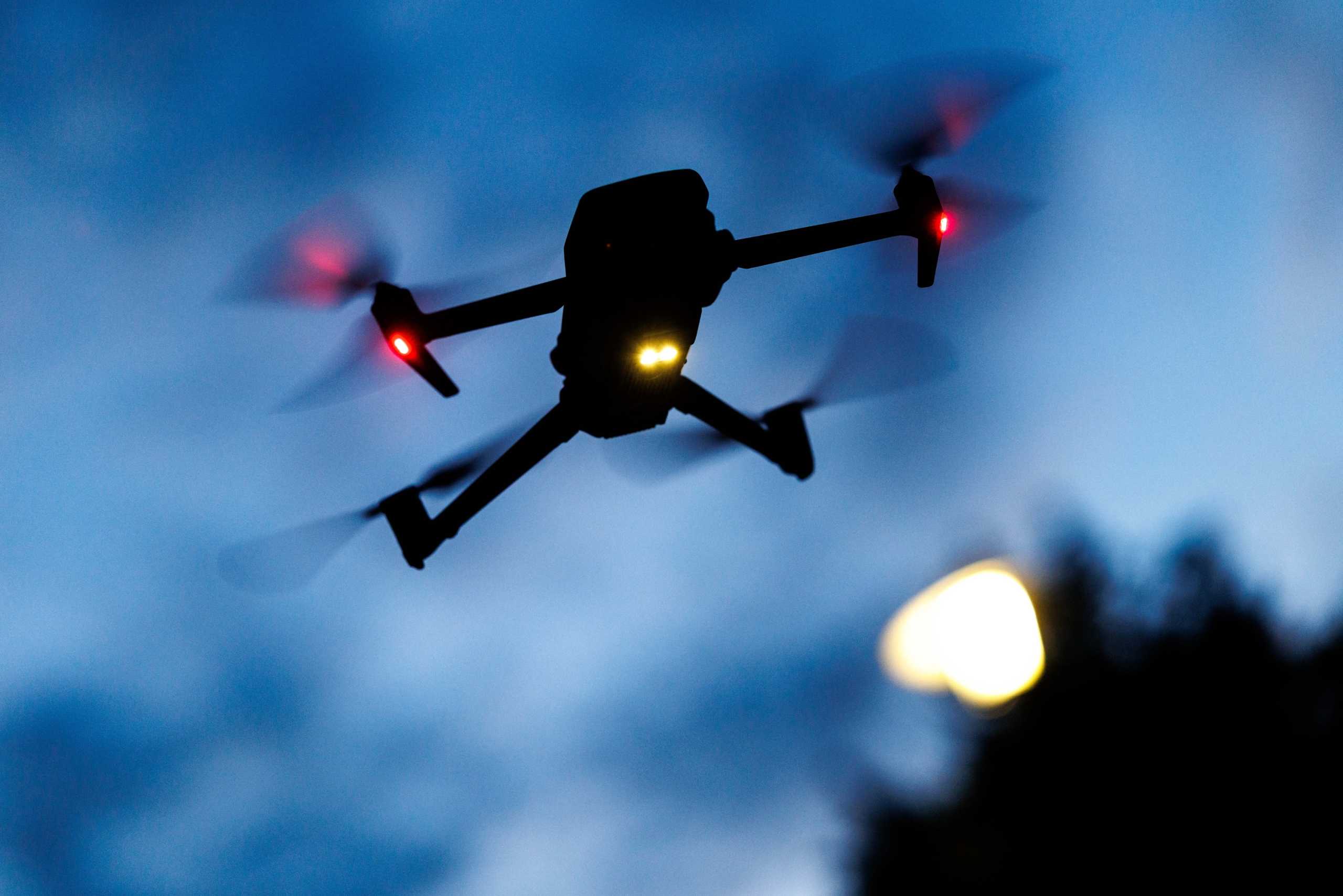
A camera drone at dusk. [picture alliance / dpa | Matthias Balk]
Quadcopter drones
Quadcopter drones are systems with four rotors, which enable them to take off and land vertically, without any type of runway. They are flown via handheld console or smartphone app. Quadcopters have been the typical model for hobbyist drones as they are easy to use and do not require additional equipment. They are also particularly good at hovering in one place and flying slowly, making them the ideal system to follow and surveil people.
Their main vulnerabilities are endurance and range limitations due to weight: unlike fixed-wing systems which can glide, quadcopters require a continuous power supply to fly, thus draining their batteries quickly. As batteries are also their heaviest part, their range is limited. And heavier systems require more power, which means they need larger and heavier batteries. As more civilian systems have entered the military drone space, quadcopters and other multicopters have multiplied on the battlefield.
Still, definitive proof of the types of drone used in overflights or where they come from will depend on police forces apprehending more of them. The fact that local authorities across Europe have been unable to do this could compound a feeling among the public of failure by the state and leave the information vacuum wide open. The lack of information also means it is impossible to distinguish between real sightings and false alarms—like the 2016 case of a drone sighting from an aeroplane which turned out most likely to have been a plastic bag.
European authorities should also be able to stop drones around their critical infrastructure regardless of who flies them. The context of the Russia-Ukraine war has turned the drone threat into a geopolitical problem, yet non-state actors pose their own threat. Given the availability of drones, drone terrorism is a rising security concern—and far-right groups in the US, for example, are reportedly looking into first-person view drones to target law enforcement. But to date no major terrorist attacks by drone have taken place, only some thwarted plans, which is surprising.
But Europe’s drone problem also has a military side, and the continent seems equally unprepared to counter it efficiently and effectively.
Drones crossing the eastern flank
Alongside dealing with overflights, countries along the eastern flank must contend with military drones threatening EU and NATO territory from the east. Such incursions have taken place regularly since Russia began its war of aggression against Ukraine in 2022 and have intensified since 2025.
Only two weeks after the full-scale invasion, a drone (most likely Ukrainian) flew undetected for hundreds of kilometres over Romania and Hungary, before crashing near Zagreb in Croatia. Russian drones came down in Romania in 2023, and in Poland and Lithuania in 2025.
But the number of incidents has grown significantly in 2026. Russian and (more frequently) Ukrainian drones have veered off course since the start of the year, coming down in Finland, Lithuania, Estonia and elsewhere. In May, people took shelter in Lithuania when a drone alert brought Vilnius to a standstill; and across the border in Latvia, both the defence minister and the prime minister lost their jobs over a political response to drone incursions that was deemed insufficient. When the UN Security Council held an emergency meeting over the Galati incident in June, Romania’s minister for foreign affairs noted that it was just one of more than 40 incursions into the country’s airspace in 2026 alone—a number which has grown significantly since then.
Initially such incidents appeared to be accidents, caused by guidance-systems failures, operating errors and interference by electronic countermeasures. But the September 2025 incident in which around 20 military drones entered Poland from different places raised concerns that some might be deliberate provocations. The increasing intensity since then has done nothing to alleviate those concerns. After one May incursion in Latvia, Ukrainian foreign minister Andrii Sybiha said that Russian electronic warfare systems “deliberately diverted Ukrainian drones from their targets in Russia”—not going quite as far as to argue Russia was deliberately sending drones over NATO and EU territory, though this is a possible conclusion.
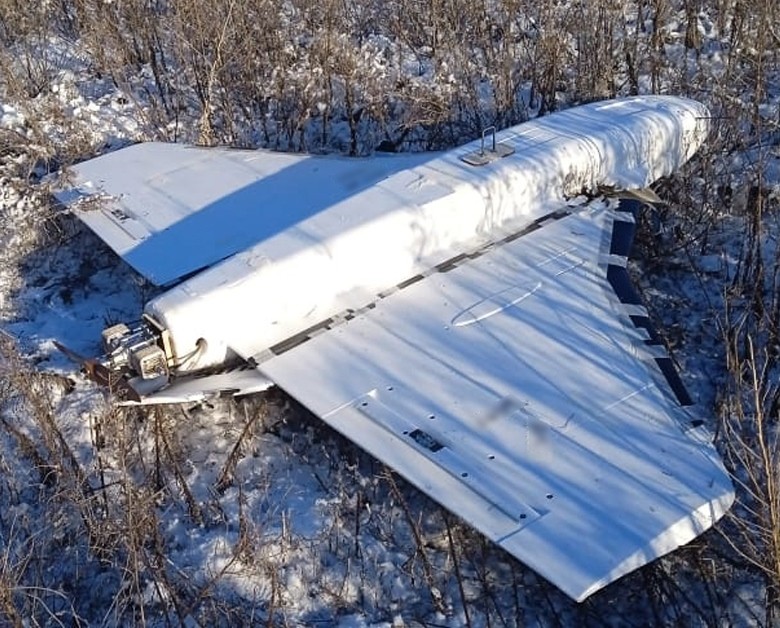
The drones that crashed in Poland were later identified as Russian Gerberas, an unarmed variant of what was originally the Iranian Shahed-136 loitering munition.
A Gerbera drone downed in Ukraine similar to those that entered Polish airspace in September 2025. [Wikimedia Commons]
Gerans and Gerberas
Russia manufactures its own version of the Iranian Shaheds in the Geran and Gerbera variants.
These are “kamikaze drones”, or one-way loitering munitions, which explode upon reaching their target. Russia is using the drone in ever greater numbers in Ukraine: since 2025, almost 1000 drones have been used in single-night attacks on Ukrainian cities and energy infrastructure. The current Geran iteration, the Geran-3, is a turbo-engined variant that can fly up to 800km, but many different variants exist. When employed in large numbers, they can overwhelm Ukrainian defences. The Gerbera is a lesser-known variant which is generally used as a decoy, or to relay signals for other, armed drones. The average price tag of drones like these is around €10,000.
In response to the incursions, Poland scrambled F-16 fighter jets and several military helicopters. Other NATO states provided support with aerial assets, most notably Dutch F-35s. Together they shot down three of the drones, with the rest crashing on Polish territory, luckily not causing any casualties. Debris was later found in an area spanning hundreds of square kilometres.
While NATO has not disclosed the exact costs of the operation, the missiles the jets fired cost between several hundred thousand and a million euros, depending on the type. Flight hours of F-16s and the much more expensive F-35s run into the tens of thousands of euros. So a single, only partly successful, counter-drone operation cost European countries millions, while Russia likely forked out less than €250,000 to prompt that response.
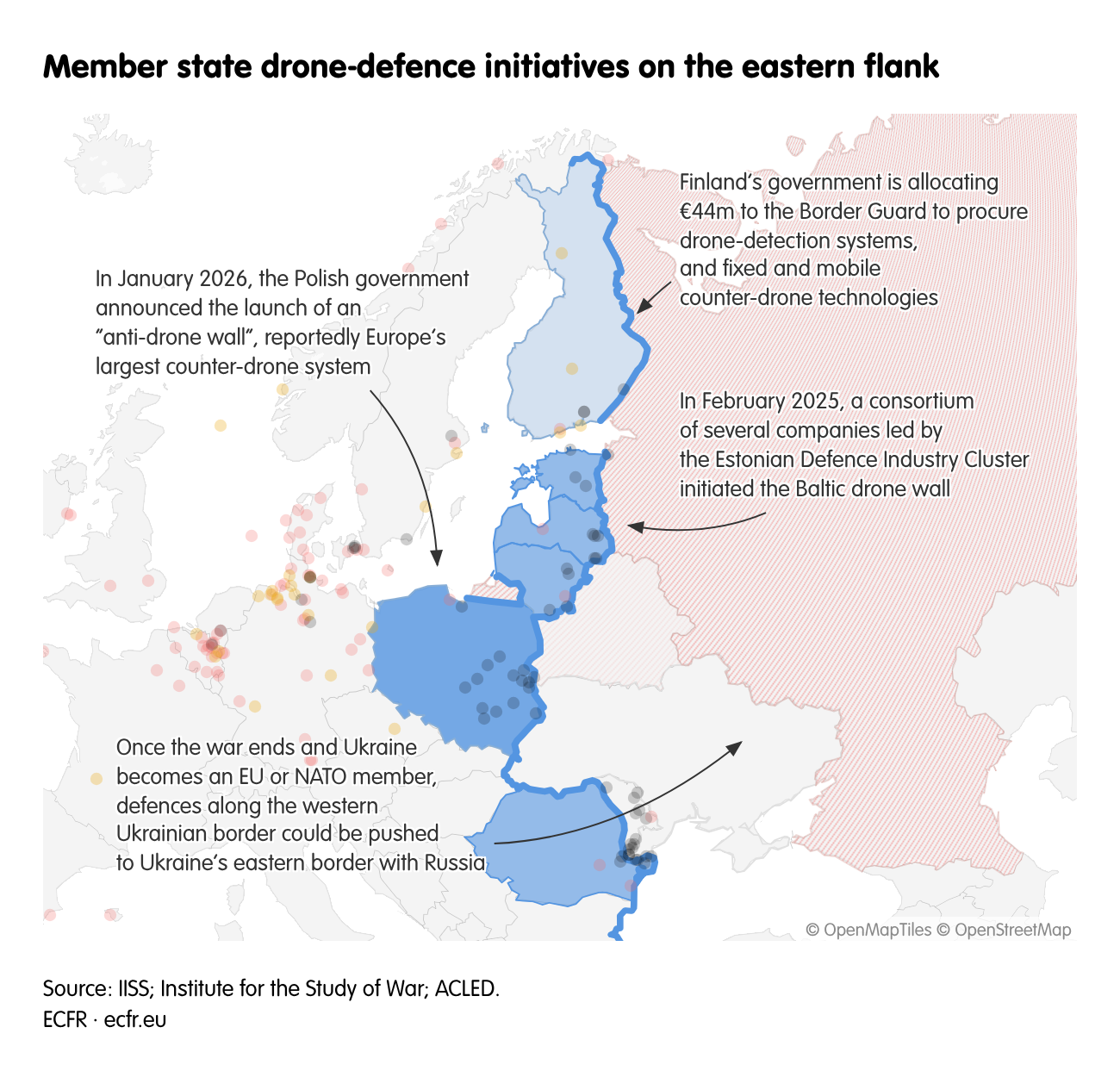
Drones continue to cross into NATO and EU territory. Sometimes they are intercepted, but more often they simply crash into the ground, occasionally even going undetected until they do. Were European countries to face an attack involving even a fraction of the numbers Ukraine regularly faces, the consequences would likely be catastrophic—and preventing them would be prohibitively expensive. Once the war ends, and if and when Ukraine becomes an EU or NATO member, defences along the western Ukrainian border—with Poland, Slovakia, Hungary and Romania—can move to Ukraine’s eastern border with Russia. In the meantime however, the EU, NATO and member states need to learn from Ukraine to secure the flank themselves.
Drones are a whole-of-Europe problem, which means all European countries need to invest in counter-drone capabilities. But starting at the eastern flank makes sense. Compared with the overflights of critical infrastructure, the flank is a more defined threat in a geographically bounded area. If the EU and member states can build an effective response here, it could inform efforts across the rest of the continent, both in terms of what can transfer to that different context and what cannot.
What a protected eastern flank looks like
Europe’s eastern flank spans different climate zones and topography, urban and rural territory, and forests and agricultural land. Given this and the drone threat discussed above, drone defences will have to be multi-layered. The eastern flank will need a detector layer with several sensor options, a defensive layer with several different countermeasures (“multi-effector”), and the ability to engage several drones at the same time (“multi-shot”). All these systems would ideally feed their data into a common operating picture to create a comprehensive view of the eastern flank. This element will be crucial to detect attacks that may be happening at the same time but hundreds if not thousands of kilometres apart.
Detector layer
The detector layer will comprise various radar and sensor systems. These will have to be spaced along the eastern flank depending on the topography and the presence of buildings, forests, agriculture and similar criteria. Today the eastern flank is monitored primarily through NATO assets and national systems, which focus more on the threat from missiles and aircraft, rather than smaller and slower drones.
Radars offer long-range coverage but can struggle to track smaller drones. Their sensitivity is improving all the time but birds still cause false positives; and as drones can be made from an array of materials, it is possible to manufacture them with minimal, or unusual, radar signatures. Moreover, traditional active radar systems that send an electromagnetic pulse and capture its return signal can be too easy for adversaries to identify. To overcome this problem, passive radar systems that work by sensing changes in the electromagnetic spectrum as objects move through space are in development.
Electro-optical sensors would complement radar. These can identify drones based on visual and temperature identifiers, which helps operators establish what kind of drone they are dealing with. But they require a clear line of sight, making them less usable in urban or forest environments. Unless they are AI-enabled, electro-optical sensors also require human intervention in real-time to verify whether an image is showing a drone or not, and thus increase staffing requirements. Radio frequency scanning, meanwhile, identifies drones by monitoring common frequency bands, though its accuracy is limited.
Finally, Ukraine has had considerable success with acoustic sensors and has installed thousands across the country. But Ukrainian experiences have also shown that these sensors do not work equally well in all contexts: environments with lots of sounds, like forests, urban areas and agricultural land, can hinder their usefulness.
Defensive layer
As with detection sensors, the defensive layer will have to incorporate several different features, from electronic countermeasures to kinetic solutions.
Electronic countermeasures include spoofing of positioning systems like GPS, and radio frequency jamming that blocks the connection between drone and operator. But these systems can be quite disruptive as they often interfere with all systems in range, making them less useful in urban contexts and near airports. Their effectiveness also often depends on continuous transmission, and they only work on drones that require a connection to the operator. This means they would be ineffective against autonomous, pre-programmed and tethered systems.
Electronic countermeasures have proven highly effective in Ukraine. But Russia has developed several workarounds to Ukraine’s efforts since the start of the war, and vice versa. Today Ukraine’s entire front line is GPS denied, so all drones operating there do so without relying on satellite guidance. Electronic countermeasures are also being circumvented by drones carrying with them up to 40km of fibre-optic cable through which signals are sent. This underlines the need for drone defences at the eastern flank to involve multiple systems.
Radio-frequency-based “cyber takeover” aims to take command of unwelcome drones and safely land them. This is a particularly desirable option as it preserves the drone for analysis. Yet it hinges on the cyber takeover’s ability to work on every drone system, including unknown ones.
Finally, Europe’s eastern flank will require a range of kinetic counter-drone tools—as a last resort for when electronic measures have failed to take down drones. These should include rifle-mounted systems, larger cannon-type systems, guided missiles and drones to fight drones. While generally effective, most kinetic solutions create the danger of collateral damage, as both projectile and drone come crashing down. During the Polish drone incursion in September 2025, the only property damage was caused by a missile that aimed to shoot down the drones.
Ukraine is now using interceptor drones, or drones that take out other drones. These include several systems, like drones with nets or those that ram hostile drones or blow up warheads that come near. (Incidentally, the existence of these systems has led to some confusion over the term “drone wall”, as some reports have suggested that it would be a wall made of drones, a misunderstanding helped along by the fact that a German firm had proposed such a project previously.)
Other countermeasures such as lasers, electromagnetic pulses, strong light and microwave weapons exist, but have not yet matured sufficiently and face similar limitations to those mentioned above, such as the need for line-of-sight or the risk of collateral damage.
Command and control
Crucially, Europe needs a command-and-control node to collect data. For drone defence to be truly integrated and European, the goal should be for this data to feed into a common operating picture that covers the entire flank, from Nuorgam in northern Finland to Burgas in southern Bulgaria. How to respond to a given threat should remain a more local decision, but information-sharing will still be crucial to understand any attack situation. It is equally desirable for European countries to exchange information with NATO’s Integrated Air and Missile Defence. AI and automation may also prove useful, though it will be necessary to heed the lessons of over-reliance on technology and automation, for instance, from the October 7th attacks against Israel.
*
Building a multi-layered system of systems like this on the eastern flank may seem a daunting task, not to mention an expensive one. But as the alternative is for EU and NATO countries to continue spending tens of thousands of euros to shoot down a single drone, or not to detect or shoot it down at all, it is a task in which the EU and all European countries have a stake.
The progress so far
The work has already begun. The European Commission has been most vocal about its plans to build up an ambitious “drone wall”, now rebranded as the European Drone Defence Initiative. NATO launched Operation Eastern Sentry in September 2025 and runs counter-drone trials with companies. At the national level, many border states are pursuing counter-drone efforts of varying ambition and scope. But the eastern flank remains a long way away from the defences described above, and the lack of coordination could undermine both the initiatives’ efficacy and their cost-efficiency.
The EU
By accident of the calendar, European Commission president Ursula von der Leyen’s State of the Union address took place just a day after the Poland incident in 2025. In her speech, she called for the EU to establish a “drone wall” that would be the “foundation of a credible European defence” and announced the “Eastern Flank Watch” to conduct real-time surveillance of the eastern border.
Von der Leyen offered more details in another speech at the European parliament a few weeks later, noting that using expensive fighter jets to take down cheap, mass-produced drones was “absolutely not sustainable”. Instead, the drone wall should be a system that performs “swift detection, swift interception, and when needed, swift neutralisation”. In October 2025, the informal European Council meeting in Copenhagen endorsed these projects.
Almost a year on, and the European Drone Defence Initiative and Eastern Flank Watch are two of four EU readiness flagship efforts, alongside the European air and space shields. Yet the Drone Defence Initiative and the Eastern Flank Watch are linked in a way that makes it difficult to distinguish between the two. The official commission communication notes, for example, that “anti-drone capabilities will form a core component of the Eastern Flank Watch flagship”. In any case, the projects aim to reach initial capacity by end of this year, and full capacity by end of 2027 and 2028, respectively.
While the intention of the EU’s effort is good, its stated scope sounds overly ambitious. For example, the October 2025 Defence Readiness Roadmap 2030 notes that “the counter-drone network will be adaptable for civ-mil and dual use purposes and help deal with non-defence related threats or other hazards common to every EU border. This includes border protection, weaponisation of migration, protection of critical infrastructure and transnational organised crime.” Von der Leyen expressed similarly wide-ranging aspirations in her speech to parliament, and added guarding the southern flank to the mix as well as countering the Russian shadow fleet—all with the aid of autonomous systems.
Such an all-encompassing proposal appears set for failure, however, and likely only became so inflated in the first place to placate member states away from the eastern flank.
NATO
Today, NATO is the most active body in fighting drone incursions. After Poland invoked Article 4, the alliance launched Operation Eastern Sentry which increased vigilance along the eastern flank. In many instances when drones have been shot down, it was by fighter jets under NATO command.
NATO also plays a useful role in testing counter-drone technologies for member states to procure. The alliance is, for example, running exercises under its “Layered Counter-Uncrewed Aerial System (UAS) Initiative Crucible”. The first of these took place in Romania and focused on how various sensors, effectors and command-and-control systems could operate as a single, layered defence. Over 250 systems were involved, including radars, acoustic and radio-frequency detectors, electronic warfare tools, and kinetic and non-kinetic effectors. The exercise’s scenario involved drone swarms flown over the Black Sea and included representatives from Ukraine who advised on drone tactics and evolving threats.
Still, NATO’s approach remains primarily focused on fighter jets, as they are at the alliance’s disposal. Any longer-term, more cost-effective solution will depend on member state buy-in and member state efforts.
National efforts
For the moment, national-level counter-drone efforts look most promising. Yet the level of development varies significantly along the eastern flank.
Poland’s plans seem most advanced. In January 2026, the Polish government announced the launch of an “anti-drone wall”, reportedly Europe’s largest counter-drone system. The project is estimated at €3.8bn and brings together a consortium of three companies: the state-owned Polska Grupa Zbrojeniowa, the Norwegian firm Kongsberg and the Polish company Advanced Protection Systems.
According to Poland’s defence minister, the system will include 18 anti-drone batteries, 52 firing platoons, 18 command platoons, and 703 military trucks and reconnaissance vehicles. The sensor layer will include short- and medium-range radars, passive electronic detection sensors and electro-optical systems. The defensive layer will be based on Kongsberg’s “Protector” family of weapons and include 35mm anti-aircraft guns, capable of firing programmable and high-velocity ammunition; 30mm cannons; 12.7mm multi-barrel heavy machine guns, intended for short-range threats; laser-guided rockets; and interceptor drones. It will also include non-kinetic defences, including electronic warfare capabilities. Deputy defence minister Cezary Tomczyk noted that different systems would be used in different contexts. Referring to the danger from debris, he said: “Some of this is for use only in extreme or war conditions. For example, these multi-barrel machine guns are difficult to use in peacetime, because everything that goes up must go down.”
The Polish initiative’s command-and-control layer integrates fire control, system management and tactical situational awareness, enabling real-time coordination of sensors and effectors. Initial operational capabilities are scheduled for delivery before the end of 2026, with the aim of it being fully operational by the end of 2027. For Poland, the drone wall is only one element of stronger fortifications on its borders with Belarus and the Russian Kaliningrad exclave.
In cooperation with the European Commission, Poland has also announced the creation of a “drone valley”, a hub of drone-related research and testing in the south-east of the country, in Rzeszow—a city that has become the hub for logistical support to Ukraine. Companies are increasingly entering the defence field, so such a hub will host some of the trade fairs and hackathons on counter-drone measures that are becoming more common in Europe.
Further north in the Baltic countries, in February 2025, a consortium of several companies led by the Estonian Defence Industry Cluster initiated the “Baltic drone wall”. The effort includes companies from Poland and Finland, but a request for funding from the EU was rejected in March 2025. Media sources report a multi-layered short-range drone countermeasure system, and efforts to build a common operational picture. But so far, nothing comprehensive has come to pass. Still, in June Estonia began deploying its first fixed drone detection and monitoring systems along its border with Russia. The systems are installed on three sections of the border between the Luhamaa crossing and the tri-border area where Estonia, Latvia, and Russia meet.
Finland’s government announced in April 2026 that it is allocating €44m to the Border Guard to procure drone detection systems, and fixed and mobile counter-drone technologies. It has also been working on drone detection along the border for several months.
As of summer 2026, Romania is experiencing the most frequent incursions. But it only recently began looking into counter-drone systems. The country is now investing heavily in its defences, specifically its aerial defences, which include counter-drone systems. These initiatives are in part financed by EU loans through the re-armament initiative SAFE. The country has also turned to NATO as well as allied countries to help it fight against drone incursions.
In Bulgaria, drone defences have not yet become a priority. The country is, however, looking into the acquisition of counter-drone systems, funded through the EU loan mechanism. Hungary and Slovakia were absent from initial EU drone defence discussions with the other eastern flank states. Slovakia joined later exchanges and has looked into the acquisition of counter-drone systems, but it does not appear to have a more comprehensive counter-drone initiative. In July, Slovakia hosted a NATO test of emerging capabilities which included counter-drone technology, though this was not its main focus.
How to turn the hotch-potch into a whole
It is positive that the EU, NATO and the eastern flank states are working on solutions. But too many initiatives exist, which risks duplicating conceptual work and creating uncertainty for companies that do not know who to work with. The further along individual projects are, the harder it will be to combine them and to facilitate the kind of information exchange needed for a common operating picture. To ensure coherence and interoperability, especially at the data-exchange level, more coordination needs to happen now.
The EU should view this as an opportunity to fulfil its ambitious goal. Although it should drop the aim to create a drone wall that can do just about everything, it can play the coordinating role of bringing the relevant actors together. To do so, the EU should focus on the following five priorities:
Support more ambitious and advanced efforts like the Polish and Baltic state counter-drone initiatives. The EU should, for example, identify where gaps or barriers remain in these efforts and where there may be risk of duplication. This would enable the EU to direct its funding, as well as its regulatory and legal expertise, in ways that accelerates those efforts.
Fund and incentivise counter-drone efforts in eastern states that are not yet pursuing drone defences with the required urgency: Bulgaria, Hungary and Slovakia, but also Romania, would benefit from European finance and guidance in scaling up the ambition and scope of their defences.
Encourage member states to share best practices, including on regulation and questions of jurisdiction, and establish links between actors and companies already in the field. For example, Germany has reworked its national law to allow the armed forces to intercept drones in extreme cases. In France, a new law allows private companies to ensure protection against drones for civilian infrastructure. There is no reason why every EU member state needs to work out these laws for itself.
Create, in cooperation with NATO, common standards and certifications for quality control and to ensure products from different companies are interoperable. This could take the form of a suitability certificate for companies whose systems have proven their usefulness in exercises.
Establish a joint operating picture by building a command-and-control node in which data from all eastern flank detection stations are collected. This would enable truly European coordination to bring together national efforts and turn a piecemeal effort into a militarily useful whole.
The EU is already organising virtual meetings between the involved states. It should now develop this coordinating role to share legal best practices and develop common rules regarding when and how military drones can be intercepted in a civilian setting. For example, one reason the drone flying into Romanian airspace in May was not intercepted was uncertainty over the legality of interception: “Ukraine is at war, but Romania is at peace”, a military representative said. All eastern flank states share the same situation. And the fact that many of the national efforts are funded with the help of the SAFE defence loan programme boosts the EU’s legitimacy in taking on this role.
And apply the lessons to the rest of Europe
Organisationally, national police forces deal with drones over critical infrastructure. And the EU is well-placed to help spread insights from counter-drone operations at the eastern flank farther west. Technologically, member states’ experiences at the eastern flank also hold several lessons for the rest of the continent: which systems work and in which environments, for example, and how different technologies can work together. Again, the EU can help to compile and share this valuable information, reducing the burden on member states to collect it themselves.
Countering drones flying over critical infrastructure will not require something quite as elaborate and unified as defences at the eastern flank:
Detector layer: Lessons from the eastern flank on how best to install detection layers and which systems work best can inform local authorities’ decisions about what would work near critical infrastructure. Here, the EU and local authorities will need to take different environments into account: critical infrastructure is often in more urban areas, whereas the eastern flank is generally more rural. Yet the flank includes a multitude of different environments, including forests and swamps, and agricultural and some urban areas, which means detection systems will be tested in numerous areas that can still inform how they might perform nearer cities.
Defensive layer: The EU and local authorities should apply a similar principle to the defensive elements. This includes lessons on how to best layer countermeasures, and which systems work best in which environment. Not all systems that operate at the eastern flank will qualify for deployment in civilian contexts: kinetic systems in particular, would only be used in the most extreme cases to protect critical infrastructure from an immediate threat. But insights from electronic countermeasures and cyber takeover may be transferable to a civilian context.
Information exchange: The EU and member states should establish an information exchange on drone incidents near critical infrastructure throughout the union. Countering the threat to critical infrastructure does not require the joint operating picture that military defence does. But collecting and sharing information on drone overflights (as well as other hybrid attacks) over critical infrastructure would allow authorities to detect concerted attack operations.
Today’s solution
Europeans face a dual drone threat over their critical infrastructure and at the eastern flank. They need to address both sides of this problem. While there is no wall to be built and no umbrella to open over the entire continent, insights from one side of the threat can inform the other.
The EU should start by turning its overly ambitious Drone Defence Initiative into something operable. To do so, it should focus on supporting existing national initiatives on the eastern flank and incentivising budding ones. It should also prioritise data-sharing and establishing a joint operating picture, and collecting information on which systems work in what context. The EU should then use this information to help all member states counter drones beyond the eastern flank.
This policy brief focused drone defence—a crucial skill for all European states as drones are without question a threat they will continue to encounter. Yet, with regard to the drone threat from Russia, a better option than to defend against overflights and incursions is to stop them from happening in the first place: no build-up of European defences can replace diplomatic, political and military efforts to end the Russian aggression against Ukraine and Russia’s hybrid attacks against European nations; even if better defences would contribute to deterrence by denial in the meantime.
About the author
Dr Ulrike Franke is a senior policy fellow at the European Council on Foreign Relations, based in the Paris office. Her areas of focus include German and European security and defence, the future of warfare, and the impact of new technologies such as drones and AI on geopolitics and warfare.
[1]DFS Deutsche Flugsicherung, Drone Report, July 2026.
Die aktuellen Meldungen wären lustig, wenn sie nicht so ernst wären. Die EU hat beschlossen, gegenüber russischen Schiffen zu offener Piraterie überzugehen und sie produziert und finanziert die Drohnen, die Ziele tief in Russland angreifen, behauptet aber, keine Kriegspartei zu sein. Außerdem leidet die EU unter einer Energiekrise, die durch die Dürre erschwert wird, und […]
Non esiste un numero esatto o un registro pubblico delle volte in cui l’aeroporto militare di Sigonella ha chiuso lo spazio aereo per la cenere dell’Etna, poiché le chiusure militari sono gestite tramite NOTAM interni e raramente pubblicizzate, a meno che non impattino lo spazio aereo civile o eventi eccezionali.Tuttavia, analizzando lo storico del traffico aereo siciliano, si possono evidenziare i seguenti punti chiave: l’aeroporto di Catania è stato fermo per lmeno sei giorni. Fra l’8 e l’11 agosto sono saltati circa settecento voli, quattrocentocinquanta cancellati e oltre duecentocinquanta dirottati su Palermo, Trapani, Comiso e Lamezia Terme. La cenere dell’Etna ha reso insicuro lo spazio aereo della Sicilia orientale. A pochi chilometri da Fontanarossa, però, esiste un altro scalo: la Stazione Aeronavale di Sigonella, la più importante installazione della Marina statunitense in Europa e nel Mediterraneo, da cui negli ultimi mesi sono decollati quotidianamente droni di sorveglianza diretti verso il Golfo Persico e le coste iraniane. Ne parliamo con Antonio Mazzeo, giornalista e ricercatore indipendente che da vent’anni documenta la militarizzazione del Mediterraneo attraverso i tracciati dei velivoli militari e le fonti aperte. Intervista a cura di Jeff Hoffman Affrontiamo insieme:
Che cosa accade davvero allo spazio aereo siciliano quando il vulcano entra in fase eruttiva, e quali autorità decidono per lo scalo civile e quali per quello militare Le missioni degli MQ-4C Triton di US Navy decollate da Sigonella verso Bushehr e lo Stretto di Hormuz, incluso il velivolo scomparso dai radar il 9 aprile e mai spiegato dal Pentagono Il sistema siciliano nel suo insieme: Sigonella, il MUOS di Niscemi, la stazione radio NRTF, Augusta, e il collegamento con i sommergibili nucleari statunitensi Gli accordi bilaterali che regolano l’uso delle basi in Italia, e la ragione per cui il Parlamento non li discute né li controlla La distanza fra le dichiarazioni ufficiali del governo sulla non partecipazione al conflitto contro l’Iran e ciò che i tracciati documentano Il costo che la Sicilia paga in esposizione strategica, servitù militari e vincoli sul territorio, mai messo a bilancio da nessuno GLI ARTICOLI DELL’OSPITE SULLA QUESTIONE: Antonio Mazzeo, «Sigonella: avamposto italiano nella guerra all’Iran», Pagine Esteri, 9 marzo 2026 Antonio Mazzeo, «Il cielo cupo di Sigonella», Comune-info, 7 aprile 2026 Antonio Mazzeo, «Da Al-Dhafra a Sigonella: la rotta dei Triton», AgoraVox Italia, 29 giugno 2026 SOSTIENI CASA DEL SOLE TV Casa del Sole TV è un progetto di giornalismo indipendente autofinanziato, senza editori, senza partiti, senza padrini politici. Esiste perché esistete voi. Per donazioni: IBAN: IT63P0326822300052392596590 Intestato a: La Casa del Sole Edizioni Causale: Donazione Casa del Sole TV Membership YouTube: https://www.youtube.com/@CasadelSoleTVChannel Analista Multipolare €5/mese Inviato della Verità €15/mese Architetto del Futuro €25/mese I LIBRI DI MARGHERITA FURLAN BRICS Scacco Matto (disponibile in italiano, inglese e russo) SEGUI CASA DEL SOLE TV YouTube: @CasadelSoleTVChannel Instagram: https://www.instagram.com/casadelsoletv/ Facebook: https://www.facebook.com/casadelsole.tv Sito: https://casadelsole.tv/ CASA DEL SOLE TV — Informazione libera e indipendente Il nostro lavoro è possibile solo grazie al vostro sostegno. Casa del Sole TV non ha editori forti né finanziamenti pubblici: siamo sostenuti da voi, il nostro pubblico. Se credi nel valore di un’informazione che non tace, aiutaci a continuare. Dona tramite bonifico bancario: IBAN: IT63P0326822300052392596590 Intestato a: LA CASA DEL SOLE EDIZIONI Causale: Donazione Casa del Sole TV Dona tramite PayPal: paypal.me/casadelsoletv Sostegno ricorrente: casadelsole.tv/sostienici Anche un piccolo contributo fa la differenza. Grazie di cuore!
Am Dienstag war ich mal wieder im Homeoffice von NuoViso zu Gast und habe mich den Fragen von Frank Höfer, Robert Stein und der Zuschauer im Live-Chat gestellt. Da es dabei um die gleichen aktuellen Themen ging, über die wir auch bei Tacheles sprechen, könnte diese Ausgabe von Homeoffice diese Woche die Tacheles-Sendung ersetzt haben. […]
– Hormuz vale più della bomba di Jeff Hoffman – Iran, nuovi vertici militari di Margherita Furlan – Damasco riprende il porto, Mosca resta di Margherita Furlan – Suez nella bilancia: il Cairo prende tempo di Jeff Hoffman – Drongo, l’uccello ladro che parla all’Africa di Jeff Hoffman – Buon giro intorno al Sole A cura di Margherita Furlan Con la collaborazione di Jeff Hoffman Editing di Davide Marletta e Simone Orletti CASA DEL SOLE TV — Informazione libera e indipendente Il nostro lavoro è possibile solo grazie al vostro sostegno. Casa del Sole TV non ha editori forti né finanziamenti pubblici: siamo sostenuti da voi, il nostro pubblico. Se credi nel valore di un’informazione che non tace, aiutaci a continuare. Dona tramite bonifico bancario: IBAN: IT63P0326822300052392596590 Intestato a: LA CASA DEL SOLE EDIZIONI Causale: Donazione Casa del Sole TV Dona tramite PayPal: paypal.me/casadelsoletv Sostegno ricorrente: casadelsole.tv/sostienici Anche un piccolo contributo fa la differenza. Grazie di cuore!
In deutschen Medien war der Drohnenvorfall am Flughafen Leipzig in dieser Woche eines der beherrschenden Themen, weshalb wir uns den Vorfall im Anti-Spiegel-Podcast näher angeschaut haben. Außerdem ging es natürlich wieder um die Ukraine, wo – unbeachtet von den deutschen Medien – der „Papp-Maidan“ stattfindet – und wir haben uns angeschaut, was die „Mekka-NATO“ ist. […]
– Hormuz, Teheran tratta senza Washington di Jeff Hoffman – Ankara vende l’alternativa a Hormuz di Jeff Hoffman – Libano, la pace di Roma sotto le bombe di Margherita Furlan – Kiev senza intercettori e privati del mare di Jeff Hoffman – Atomiche tattiche, il Pentagono abbassa la soglia di Jeff Hoffman – Indio e tantalio, le vere armi cinesi di Margherita Furlan – USA: nuovo partito o giochi di potere? di Jeff Hoffman – Buon giro intorno al Sole A cura di Margherita Furlan Con la collaborazione di Jeff Hoffman Editing di Davide Marletta e Simone Orletti TAG: CasaDelSoleTV, CasaDelSoleTG, MargheritaFurlan, GiuliettoChiesa, censura, russofobia, Trump, NATO, Crisi, Transizione, Ucraina, Kiev, EuroMaidan, Crimea, Donbass, Donetsk, Syria, Iran, PardonSnowden, Nuova Via Della Seta, Pechino, Putin, Libano, guerra, mondomultipolare, multipolarismo, Mosca, XiJinping, Levante, Medio Oriente, Palestina, Gaza, MiddleEast, BRICS, Hormuz CASA DEL SOLE TV — Informazione libera e indipendente Il nostro lavoro è possibile solo grazie al vostro sostegno. Casa del Sole TV non ha editori forti né finanziamenti pubblici: siamo sostenuti da voi, il nostro pubblico. Se credi nel valore di un’informazione che non tace, aiutaci a continuare. Dona tramite bonifico bancario: IBAN: IT63P0326822300052392596590 Intestato a: LA CASA DEL SOLE EDIZIONI Causale: Donazione Casa del Sole TV Dona tramite PayPal: paypal.me/casadelsoletv Sostegno ricorrente: casadelsole.tv/sostienici Anche un piccolo contributo fa la differenza. Grazie di cuore!
– Kiev sotto le bombe, Europa senza scorte di Jeff Hoffman
– Gas, Ue vieta Belgio compra di Margherita Furlan
– Hormuz chiuso salvadanaio aperto di Jeff Hoffman
– Karbala prega New York tiene la cassa di Margherita Furlan
– Israele compra il racconto, Parscale lo scrive di Jeff Hoffman
– Board of Peace: la resa a Netanyahu di Jeff Hoffman
– Ceuta: scontro Madrid Roma di Jeff Hoffman
– Interfacce neurali, Pechino sorpassa Musk di Margherita Furlan
– Buon giro intorno al Sole
A cura di Margherita Furlan
Con la collaborazione di Jeff Hoffman
Editing di Davide Marletta e di Simone Orletti
SOSTIENI CASA DEL SOLE TV
Casa del Sole TV è un progetto di giornalismo indipendente autofinanziato, senza editori, senza partiti, senza padrini politici.
Per donazioni:
IBAN: IT63P0326822300052392596590
Intestato a: La Casa del Sole Edizioni
Causale: Donazione Casa del Sole TV
Membership YouTube: https://www.youtube.com/@CasadelSoleTVChannel
— Analista Multipolare €5/mese
— Inviato della Verità €15/mese
— Architetto del Futuro €25/mese I LIBRI DI MARGHERITA FURLAN
BRICS Scacco Matto (disponibile in italiano, inglese, russo), La Casa del Sole Edizioni SEGUI CASA DEL SOLE TV
YouTube: @CasadelSoleTVChannel
TAG:
CasaDelSoleTV, CasaDelSoleTG, MargheritaFurlan, GiuliettoChiesa, censura, russofobia, Trump, NATO, Crisi, Transizione, Ucraina, Kiev, EuroMaidan, Crimea, Donbass, Donetsk, Syria, Iran, PardonSnowden, Nuova Via Della Seta, Pechino, Putin, Libano, guerra, mondomultipolare, multipolarismo, Mosca, XiJinping, Levante, Medio Oriente, Palestina, Gaza, MiddleEast, BRICS, Hormuz
European Union countries are rushing to find a joint response to threats by US President Donald Trump to impose an additional 10-percent tariff on goods from several European allies from February 1.
EU leaders are set to meet in Brussels on Thursday after Trump threatened that eight European countries would face higher tariffs until the United States secures what he described as the “complete and total purchase” of Greenland.
The US repeatedly said it wants the mineral-rich autonomous Danish territory of Greenland for “national security”, despite it already having a base on the island and long established security agreements with fellow NATO ally Denmark, which has controlled the Arctic island for about 300 years.
Denmark, Finland, France, Germany, the Netherlands, Norway, Sweden and the United Kingdom recently sent a small number of soldiers on a reconnaissance mission to Greenland as a sign of solidarity with Denmark, which is pushing back against Trump’s takeover ambitions.
“We won’t be blackmailed, and we stand together in solidarity in Europe,” said German Finance Minister Lars Klingbeil, arriving in Brussels on Monday for two days of previously planned talks with his EU counterparts. “We don’t want an escalation. We are not looking for an escalation, but we are ready if it comes,” Klingbeil said.
Italian Prime Minister Giorgia Meloni – considered one of Trump’s few allies in the EU – has called the new tariff threat a “mistake”.
In a different threat scenario, Trump also ramped up his rhetoric against France on Tuesday, warning he would impose 200 percent tariffs on French wine and champagne over its intentions to decline his invitation to join his “Board of Peace” set up to oversee the rebuilding of Gaza.
French President Emmanuel Macron said at the World Economic Forum (WEF) in Davos (Switzerland) on Tuesday: “What doesn’t make sense is to have tariffs between allies. We have to fix the war in Ukraine, we have to help the Ukrainians resist, and find a sustainable peace.”
Macron called the possibility of potentially activating the Anti-Coercion Instrument against the US “crazy” and added: “I do regret that. But this is a consequence of just unpredictability and useless aggressivity.”
European Commission President Ursula von der Leyen has warned Trump not to plunge transatlantic relations into a dangerous downward spiral over Greenland. “This is why the proposed additional tariffs are a mistake, especially between long-standing allies,” she said in Davos.
Arctic security can only be achieved together.
This is why the proposed additional tariffs are a mistake, especially between long-standing allies.
The EU and US have agreed to a trade deal last July.
Washington mayhem tests transatlantic alliance and post-WWII order
The leader of global rights group Amnesty International, Agnes Callamard,urged European countries Monday to stop “appeasing” Trump and to resist him and other “bullies” who she said were intent on destroying the rules-based order in place since World War II.
Since Trump’s return to the White House a year ago, he has taken “a range of decisions that have led to the demise of many rules around the world”, while Russia was destroying the system “through its aggression in Ukraine”, the human rights organisation’s secretary general told AFP in an interview in Davos.
The post-WWII order “is also being destroyed by Israel that has completely ignored international law in its genocide of Palestinians in Gaza”, she added.
Furthermore, European powers have been treading a thin line over Ukraine in recent months, relying on Washington to try to help settle the conflict but resisting terms too favourable to Moscow.
Trump meanwhile has put the transatlantic alliance to the test with threats to take over Greenland “one way or the other”, as European countries close ranks against Washington’s designs on the vast Danish autonomous territory.
In a message to Norway’s Prime Minister Jonas Gahr Store, Trump said “I no longer feel an obligation to think purely of Peace”, citing his failure to win last year’s Nobel Peace Prize despite openly coveting it. He said although peace would still be “predominant”, he could “now think about what is good and proper for the United States of America”.
Store said in a statement: “I have clearly explained, including to President Trump, what is well known – the prize is awarded by an independent Nobel Committee”, not the Norwegian government.
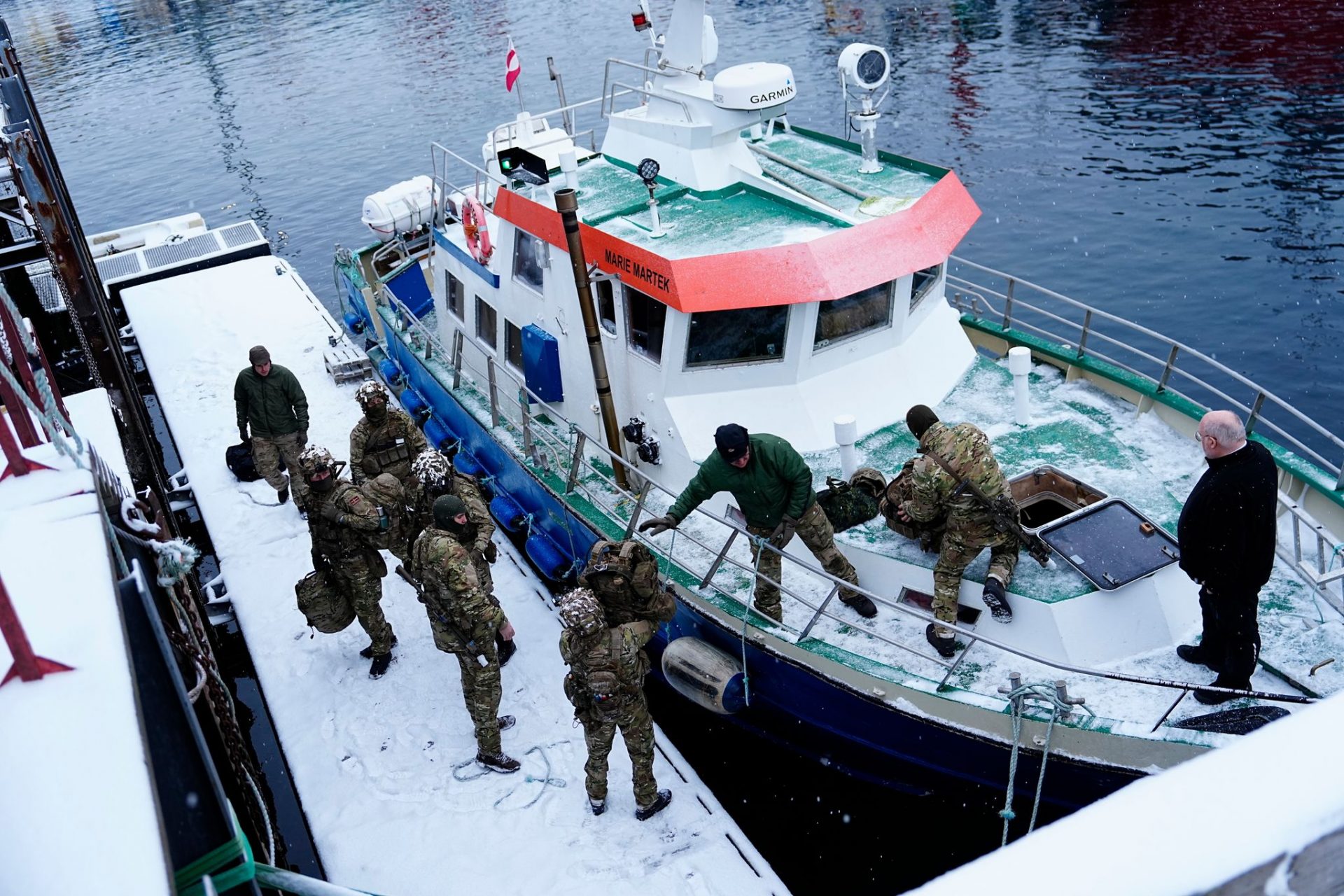
Danish soldiers disembark at the port of Nuuk. Photo: Mads Claus Rasmussen/Ritzau Scanpix Photo/AP/dpa
NATO ramps up Greenland presence amid search for unity
Amid the global tensions, Denmark is proposing that NATO start surveillance operations in Greenland, with the support of the Arctic island, Defence Minister Troels Lund Poulsen said Monday after meeting NATO’s chief Mark Rutte. The precise details of the proposal and the response from Rutteremain unknown.
While a number of NATO allies have sent troops to Greenland or have announced plans to do so despite the risk of additional US tariffs being imposed on them, others remain reluctant and divided over the move.
Belgium is sending a liaison officer to Greenland. Despite this decision, the country was not included on Trump’s list of sanctioned countries on Saturday. “But there is no guarantee that this will not be the case in the future and we must show solidarity with our colleagues”, Foreign minister Maxime Prévot said. He called the American measures “incomprehensible and unnecessarily hostile”.
Likewise, Slovenia on Saturday announced it would deploy two Armed Forces officers to Greenland to take part in the planning and implementation of the Danish-led international military exercise Arctic Endurance.
Poland’s Prime Minister Donald Tusk – whose country is a staunch NATO ally with the highest defence expenditure as a share of gross domestic product (GDP) in the EU – already said last week the country was “not planning to send Polish soldiers to Greenland”.
Contrary to false claims on social media that Germany had sent warships to Greenland, the country did send 15 soldiers to the island for a reconnaissance mission. The troops however left Greenland on Sunday after the mission was completed on schedule, according to the Ministry of Defence.
Spain has not announced plans to participate in the mission in Greenland. Defence Minister Margarita Robles however said recently that the country could join the group in the future.
At the same time, some NATO allies are still navigating how the Greenland dispute plays out in their domestic political debates.
Asked on Monday whether the government of the Czech Republic supports Greenland, Prime Minister Andrej Babiš said he could not give a clear answer. He added that the United States is the leader of NATO and that conflicts are counterproductive. “We definitely prefer that an agreement be reached within the alliance. It would be very unfortunate if there were to be any conflicts,” Babiš said.
In Bulgaria, political reactions are mixed. The outgoing government has not issued a position on the recent developments around Greenland, but reactions from parliament have begun to emerge.
On the one hand, the leader of Continue the Change – a party affiliated at European level with Renew Europe – Assen Vassilev, said that every country should have the right to determine its own future, rather than having its choices dictated by external powers.
On the other hand, Revival (Vazrazhdane) – whose MEPs sit with the Europe of Sovereign Nations Group in the European Parliament – backs the US claims over Greenland. Party leader Kostadin Kostadinov reiterated the party’s call for Bulgaria to withdraw from NATO and argued that tensions between Washington and Copenhagen expose deeper structural problems within both NATO and the European Union.
Slovakia’s Foreign Minister Juraj Blanár said “Slovakia considers Greenland to be part of Denmark”. He rejected tariff battles between states: “We prefer diplomacy and peace, not tension or fighting,” he said.
EU “trade bazooka” on standby
EU leaders will meet in Brussels on Thursday to discuss a coordinated response to the prospect of US tariffs – with its most powerful trade tool on the table.
The Anti-Coercion Instrument, a mechanism adopted in 2023, that can be used in cases of economic coercion when a non-EU country attempts to pressure the bloc or one of its 27 members into making a decision through trade restrictions.
Such practices “unduly interfere with the legitimate sovereign choices of the European Union and its member states”, the European Commission says on its website.
France had signalled its intention to request the activation of the instrument after Trump announced on Saturday that he would impose additional tariffs on the eight NATO allies.
To apply the instrument, the European Commission first has to examine whether economic coercion is present in the case. EU countries must then back the Commission’s conclusion, before the EU’s executive arm ideally enters into talks with the country. If these are unsuccessful, the EU can impose countermeasures.
Retaliatory measures under the ACI however are only a last resort and must be proportionate. Using it against the United States would be ”the very first time” the EU has ever applied the tool, Macron recalled in Davos on Tuesday.
Should the ACI be applied over Trump’s latest trade threats, retaliatory tariffs on imports of US goods are likely. The EU-US tariff agreement concluded in July could also be put on hold.
Under discussion is also the possibility of imposing additional tariffs on a list of goods with a total trade volume of 93 billion Euro (108 billion Dollar), including industrial and agricultural goods such as motorcycles, beef, whiskey and citrus fruits.
This article is an ENR Key Story. The content is based on information published by ENR participating agencies.
Brussels (dpa) – European Council President António Costa will convene a special summit following US President Donald Trump‘s new tariff threats in the Greenland dispute, with Thursday being considered a possible meeting date, an EU official said on Sunday.
While the date has not been definitively determined, it is clear that a meeting will take place.
Costa said that his consultations with member states on the recent tensions surrounding Greenland had made it clear that tariffs would undermine transatlantic relations and were incompatible with the EU-US trade agreement.
He said that the EU was prepared to defend itself against any form of coercion. At the same time, it wanted to continue to work constructively with the United States. There was a common transatlantic interest in peace and security in the Arctic, particularly through cooperation within NATO.
The meeting would involve EU heads of governments and states and comes after Trump announced on Saturday that he would impose a 10 percent tariff on goods from eight European countries from February 1, rising to 25 percent from June 1 if no resolution is reached to his satisfaction, which would be the “complete and total purchase” of Greenland.
European troops in Greenland
Six of the eight countries – Germany, France, the Netherlands, Denmark, Sweden and Finland – affected by the tariffs are EU members, while the United Kingdom and Norway are also on Trump’s list.
The tariffs come as the above mentioned NATO allies have sent soldiers to the Arctic island, something the Trump strongly criticised. “Denmark, Norway, Sweden, France, Germany, The United Kingdom, The Netherlands, and Finland have journeyed to Greenland, for purposes unknown,” he wrote, describing this as “a very dangerous situation for the Safety, Security, and Survival of our Planet” he wrote in a post on his Truth Social platform on Saturday.
On Sunday the eight nations issued a joint statement warning of a “dangerous downward spiral” stemming from Trump’s tariff announcement.
All eight countries are members of the NATO defence alliance. NATO chief Mark Rutte is to meet with ministers from Greenland and Denmark on Monday over the dispute.
Greenland, a largely autonomous Arctic island, is part of the Kingdom of Denmark and is therefore also in NATO. (18 January)
Brussels (dpa) – Germany and the other European Union member states could be required to provide assistance at Denmark’s request in the event of a violent conflict over Greenland, a spokeswoman for EU foreign policy chief Kaja Kallas said on Thursday.
The comments came after inconclusive talks between US and Danish officials in Washington on Wednesday.
Greenland is part of the territory of the Kingdom of Denmark, a NATO member, and therefore in principle falls under the mutual solidarity clause in Article 42(7) of the EU treaty, the spokeswoman told dpa.
At the same time, she emphasised that the question of applying it is not now on the table since a military confrontation with the United States is considered very unlikely because presumably no one would take on the world’s most powerful military power.
US President Donald Trump wants to incorporate the vast, resource-rich island into the United States, saying the US needs to own the country for its security needs, which he sees as being threatened by China and Russia.
The Europeans want to convince Trump that Greenland can be best protected within NATO.
Following unsuccessful talks in Washington on Wednesday to resolve the Greenland dispute, EU states including Germany announced they would send troops to the island for a mission in support of Denmark.Russia’s ambassador to Denmark, Vladimir Barbin, has accused NATO of seeking to militarise the Arctic amid the US demands. He said Copenhagen was pursuing a confrontational approach by involving NATO, driving a rise in military tensions in the Arctic. (15-16 January)
Non soltanto Carta d’Identità Digitale ma un labirinto che finisce nella riforma digitale della giustizia. L’Avvocato Fusillo spiega i meccanismi e Tiziana Alterio la storia, con la presenza del direttore di Disconnessi, Maurizio Martucci, in un webinar registrato per fare chiarezza sul futuro delle nostre vite CASA DEL SOLE TV — Informazione libera e indipendente Il nostro lavoro è possibile solo grazie al vostro sostegno. Casa del Sole TV non ha editori forti né finanziamenti pubblici: siamo sostenuti da voi, il nostro pubblico. Se credi nel valore di un’informazione che non tace, aiutaci a continuare. Dona tramite bonifico bancario: IBAN: IT63P0326822300052392596590 Intestato a: LA CASA DEL SOLE EDIZIONI Causale: Donazione Casa del Sole TV Dona tramite PayPal: paypal.me/casadelsoletv Sostegno ricorrente: casadelsole.tv/sostienici Anche un piccolo contributo fa la differenza. Grazie di cuore!
Tutto il sistema inglese, non solo la Premier League, ha squadre di gran lunga più ricche delle altre leghe. Il mercato mondiale è organizzato in sistemi nazionali molto distanti fra loro, mentre le differenze al loro interno sono relativamente contenute.
As Festas em Honra de Nossa Senhora dos Mártires, em Castro Marim, vão decorrer entre os dias 13 e 17 de agosto, com uma programação que inclui várias iniciativas religiosas e culturais, sem esquecer as tradições do território.
No primeiro dia, a 13 de agosto, a partir das 21h00, haverá missa na Igreja de Castro Marim e sai para a rua a Procissão das Velas em Honra de Nossa Senhora dos Mártires, que vai percorrer várias artérias da vila.
No dia seguinte, a 14 de agosto, a Zona Envolvente à Casa do Sal recebe a abertura da Mostra de Artesanato e um baile com Hugo Madeira e Ângelo Correia pelas 19h00, seguido de um espetáculo do grupo de dança ARUTLA pelas 21h00.
O destaque deste dia é Ana Bacalhau, vocalista dos Deolinda, que apresentará um grande espetáculo em nome próprio, celebrando a música portuguesa. A noite termina com a continuação do baile.
O dia principal destas festas assinala-se a 15 de agosto, começando pelas 09h00 com o Hastear da Bandeira Nacional no edifício dos Paços do Concelho.
À tarde, pelas 17h30, na Igreja de Nossa Senhora dos Mártires decorrerá a Recitação do Terço, seguida de uma missa solene pelas 18h30.
O ponto alto destas celebrações decorre no mesmo dia, pelas 19h30, com a Procissão em Honra de Nossa Senhora dos Mártires, um dos eventos religiosos do concelho que tem mais impacto e importância para a comunidade, que se une num momento de fé pelas ruas da vila de Castro Marim.
Já no recinto da Mostra de Artesanato, iniciam-se os concertos pelas 20h00 com André Filipe Duo, seguido de um grande espetáculo com os The Gift às 22h00 e terminando a noite com o projeto Time Travel, assinado por Possessivo e DJ Karussa, pelas 00h00.
A 16 de agosto, o palco da Mostra de Artesanato recebe a atuação da dupla Só Nós Dois, pelas 20h00, antecipando um grande concerto de um dos cantores alentejanos mais conceituados: Buba Espinho. Para terminar, segue-se uma atuação energética da DJ Joana Faria.
As Festas em Honra de Nossa Senhora dos Mártires terminam a 17 de agosto, pelas 21h30, com o habitual Concerto de Verão da Banda Musical Castromarinense, no mesmo local.
O evento é organizado pelo Município de Castro Marim, em parceria com a Junta de Freguesia e a Paróquia de São Tiago.

 Login


 Che cosa accade davvero allo spazio aereo siciliano quando il vulcano entra in fase eruttiva, e quali autorità decidono per lo scalo civile e quali per quello militare
 Le missioni degli MQ-4C Triton di US Navy decollate da Sigonella verso Bushehr e lo Stretto di Hormuz, incluso il velivolo scomparso dai radar il 9 aprile e mai spiegato dal Pentagono
 Il sistema siciliano nel suo insieme: Sigonella, il MUOS di Niscemi, la stazione radio NRTF, Augusta, e il collegamento con i sommergibili nucleari statunitensi
 Gli accordi bilaterali che regolano l’uso delle basi in Italia, e la ragione per cui il Parlamento non li discute né li controlla
 La distanza fra le dichiarazioni ufficiali del governo sulla non partecipazione al conflitto contro l’Iran e ciò che i tracciati documentano
 Il costo che la Sicilia paga in esposizione strategica, servitù militari e vincoli sul territorio, mai messo a bilancio da nessuno
 GLI ARTICOLI DELL’OSPITE SULLA QUESTIONE: Antonio Mazzeo, «Sigonella: avamposto italiano nella guerra all’Iran», Pagine Esteri, 9 marzo 2026 Antonio Mazzeo, «Il cielo cupo di Sigonella», Comune-info, 7 aprile 2026 Antonio Mazzeo, «Da Al-Dhafra a Sigonella: la rotta dei Triton», AgoraVox Italia, 29 giugno 2026
 SOSTIENI CASA DEL SOLE TV Casa del Sole TV è un progetto di giornalismo indipendente autofinanziato, senza editori, senza partiti, senza padrini politici. Esiste perché esistete voi. Per donazioni: IBAN: IT63P0326822300052392596590 Intestato a: La Casa del Sole Edizioni Causale: Donazione Casa del Sole TV Membership YouTube:
 https://www.youtube.com/@CasadelSoleTVChannel Analista Multipolare €5/mese Inviato della Verità €15/mese Architetto del Futuro €25/mese
 I LIBRI DI MARGHERITA FURLAN BRICS Scacco Matto (disponibile in italiano, inglese e russo)
 SEGUI CASA DEL SOLE TV YouTube: @CasadelSoleTVChannel Instagram: https://www.instagram.com/casadelsoletv/ Facebook: https://www.facebook.com/casadelsole.tv Sito: https://casadelsole.tv/
 Dona tramite bonifico bancario: IBAN: IT63P0326822300052392596590 Intestato a: LA CASA DEL SOLE EDIZIONI Causale: Donazione Casa del Sole TV
 Dona tramite PayPal: paypal.me/casadelsoletv
 Sostegno ricorrente: casadelsole.tv/sostienici Anche un piccolo contributo fa la differenza. Grazie di cuore!

 CASA DEL SOLE TV — Informazione libera e indipendente Il nostro lavoro è possibile solo grazie al vostro sostegno. Casa del Sole TV non ha editori forti né finanziamenti pubblici: siamo sostenuti da voi, il nostro pubblico. Se credi nel valore di un’informazione che non tace, aiutaci a continuare.
 Dona tramite bonifico bancario: IBAN: IT63P0326822300052392596590 Intestato a: LA CASA DEL SOLE EDIZIONI Causale: Donazione Casa del Sole TV
 Dona tramite PayPal: paypal.me/casadelsoletv
 Sostegno ricorrente: casadelsole.tv/sostienici Anche un piccolo contributo fa la differenza. Grazie di cuore!

 SOSTIENI CASA DEL SOLE TV
 https://www.youtube.com/@CasadelSoleTVChannel
 I LIBRI DI MARGHERITA FURLAN
 SEGUI CASA DEL SOLE TV