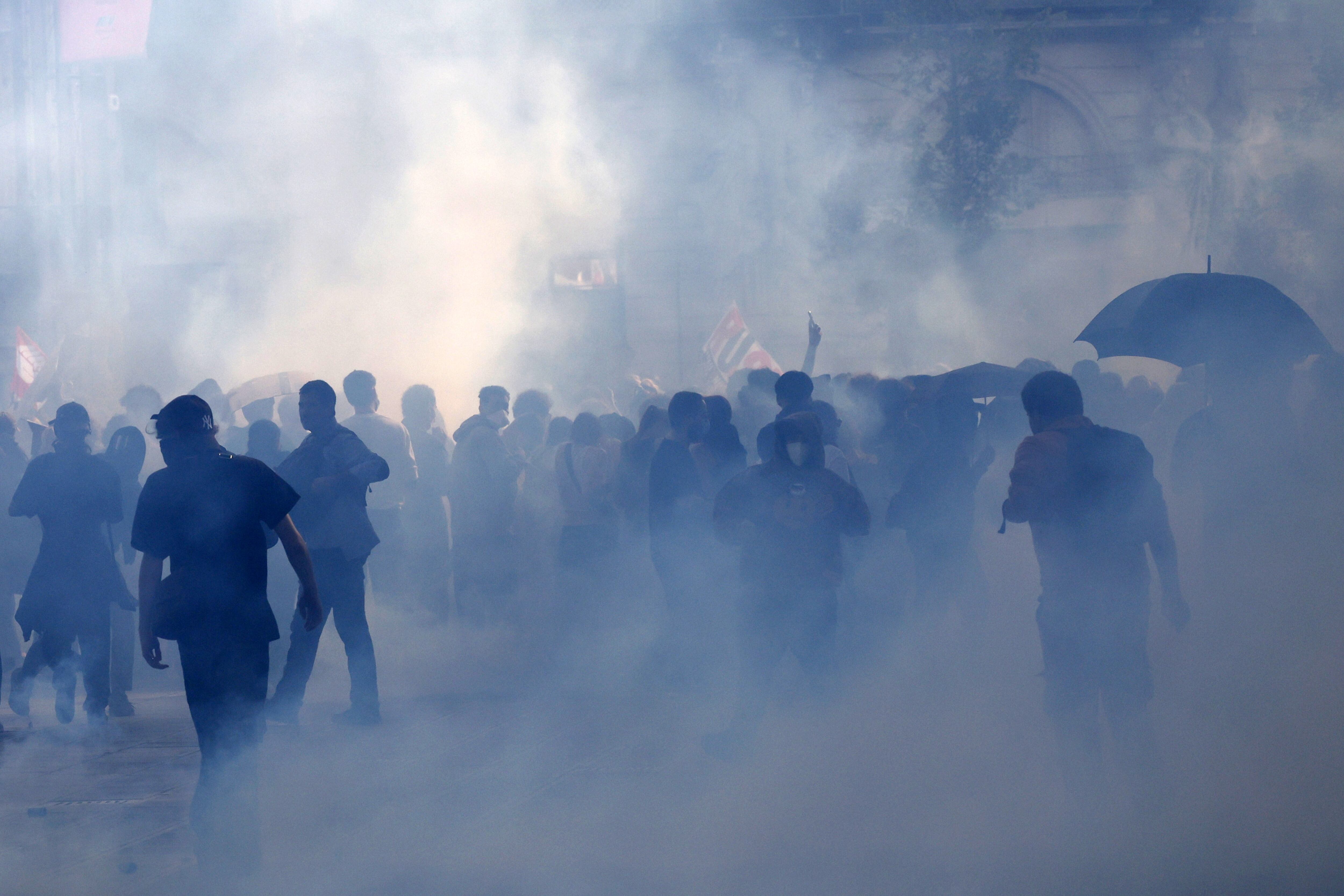
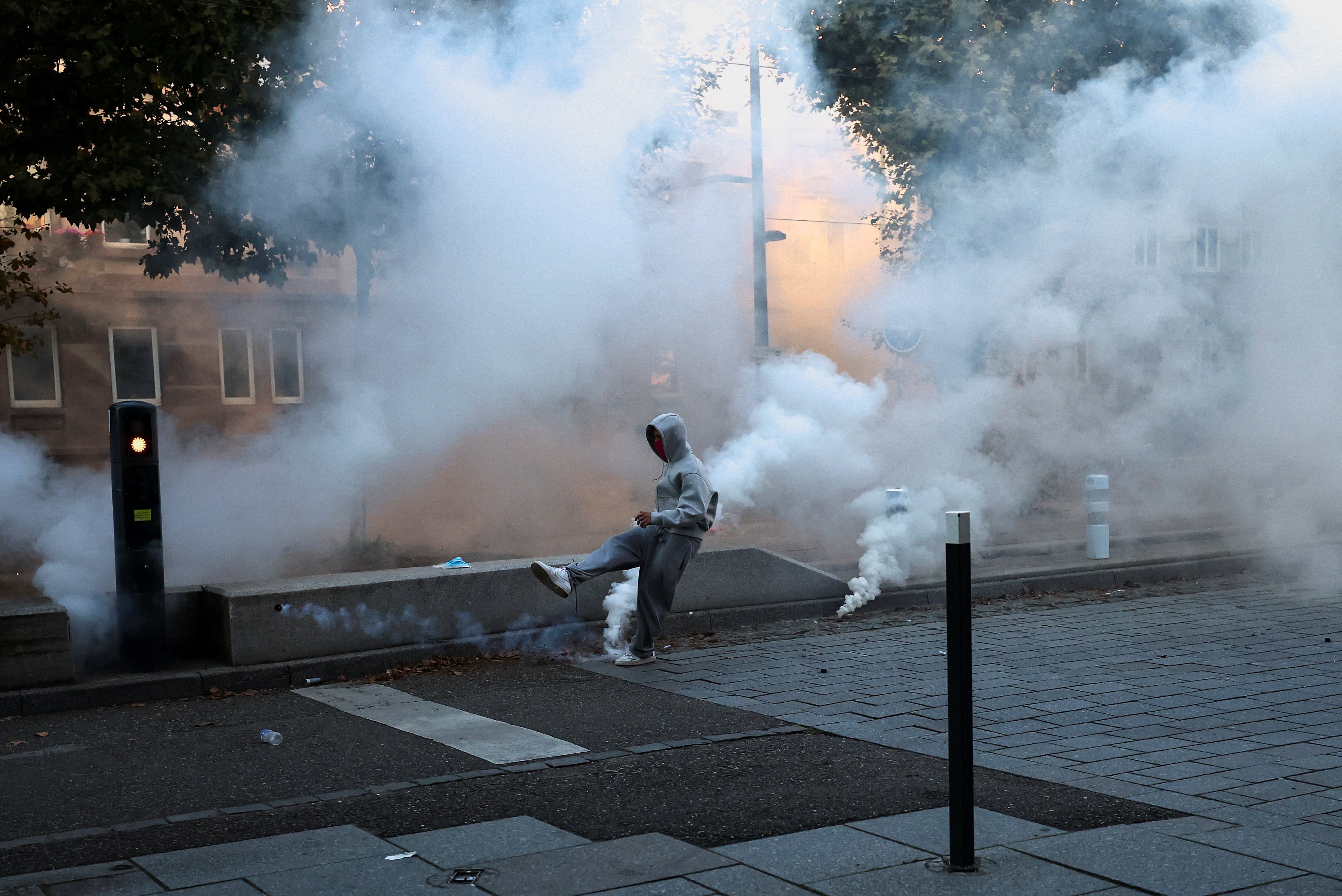
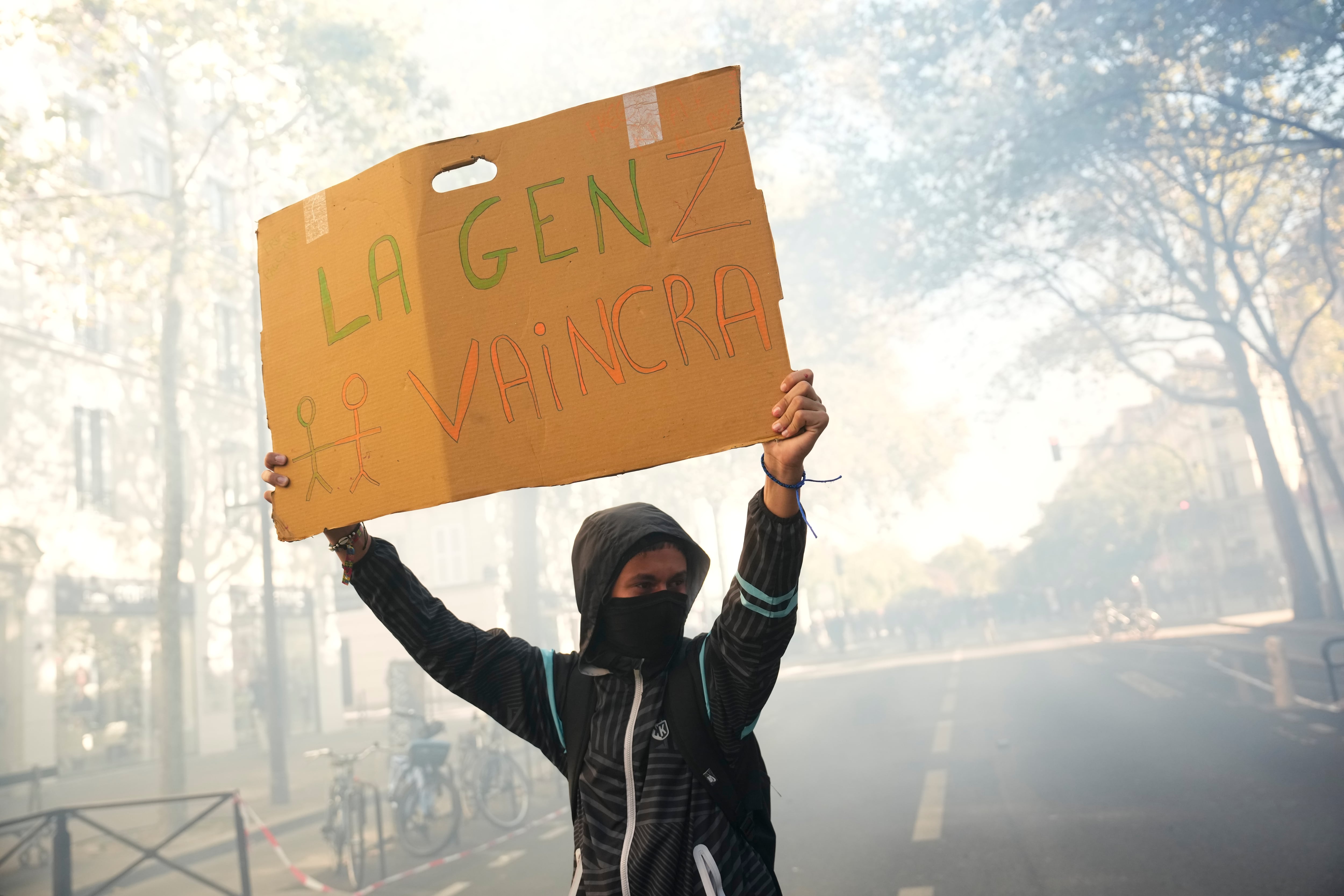
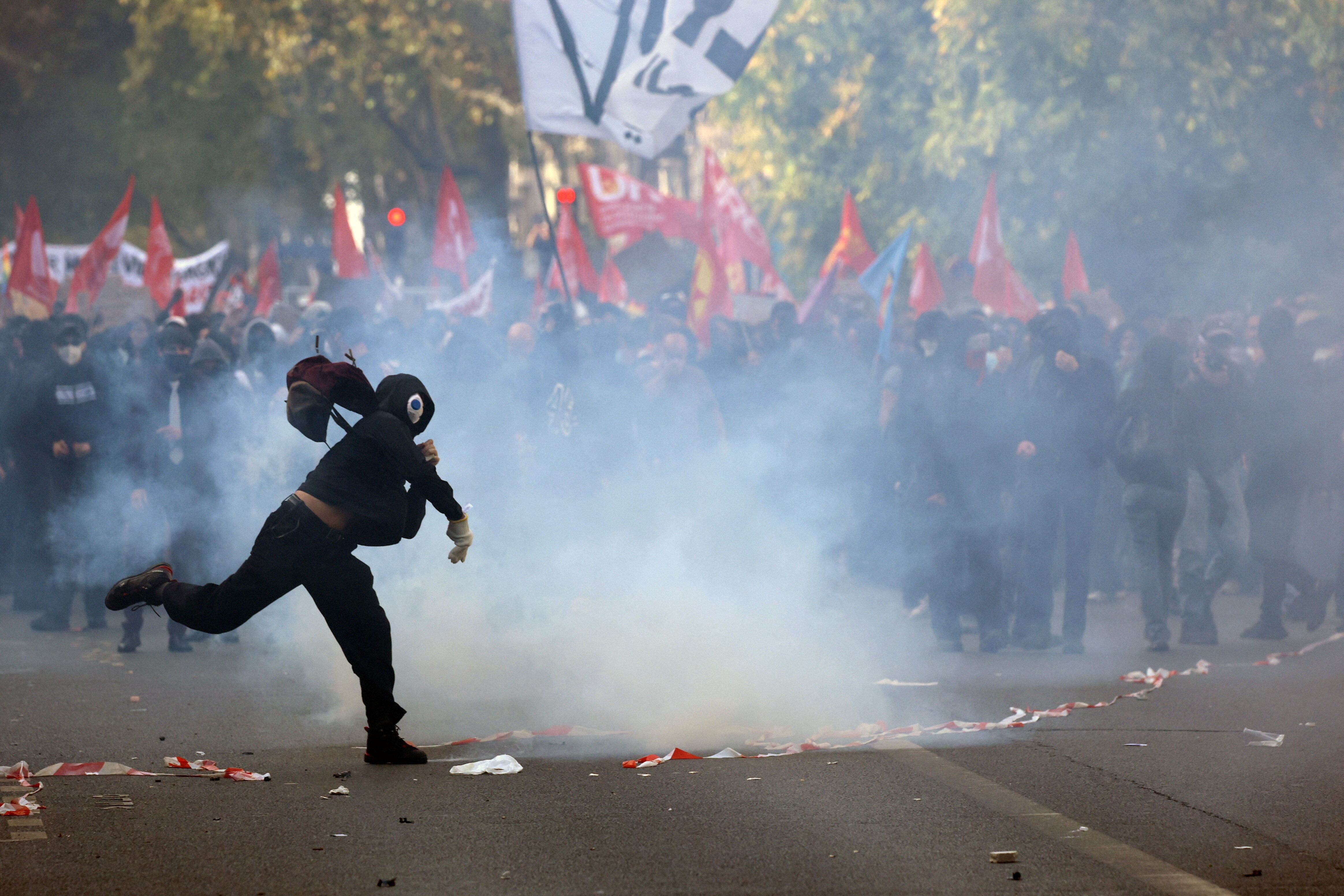
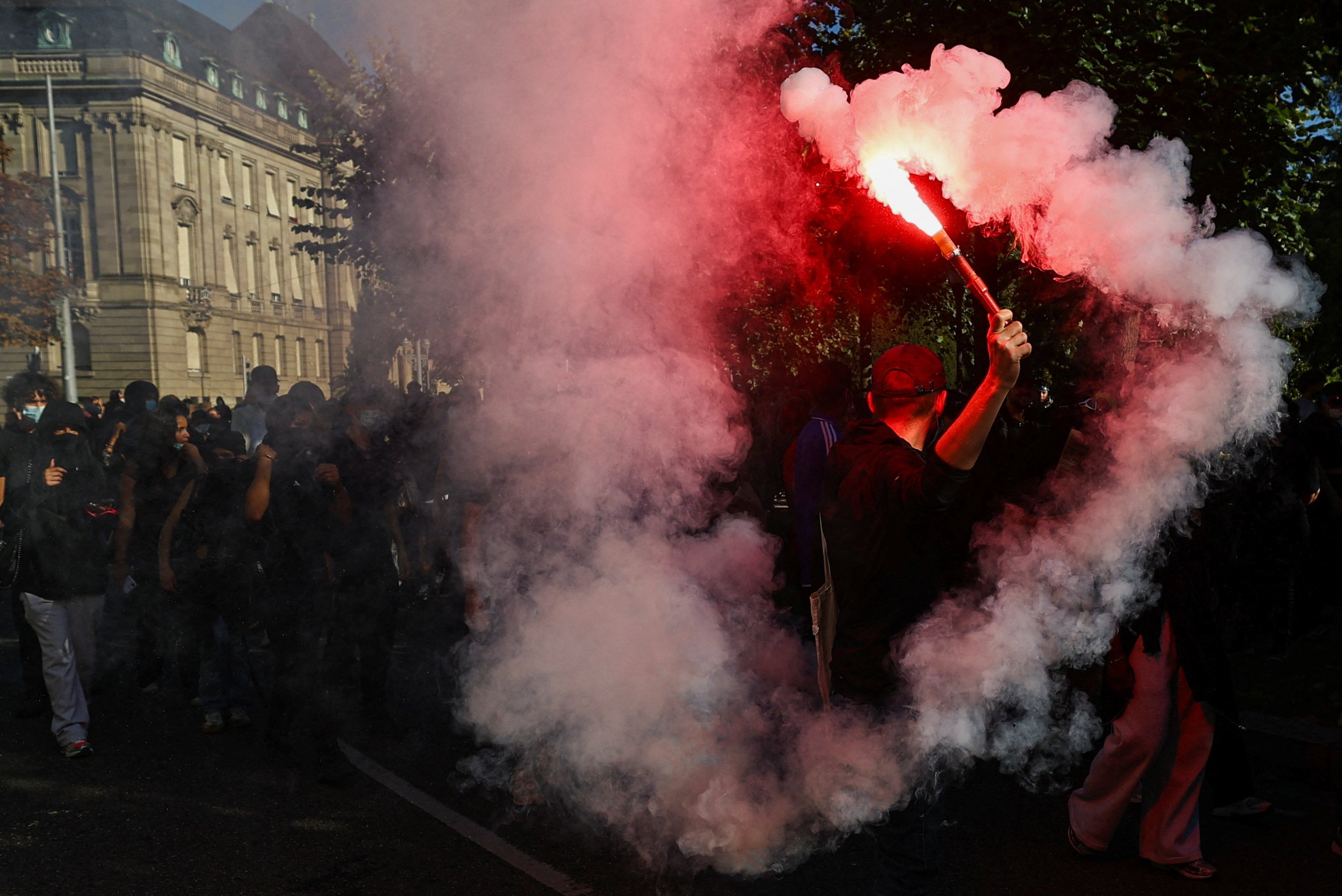
French authorities are preparing for hundreds of demonstrations on Saturday, 17 October, as student unrest converges with protests over living costs, public spending and government policy. Up to 40,000 demonstrators are expected in Paris, where police and organisers remain divided over march routes.
France is preparing for a nationwide wave of demonstrations on Saturday, 17 October, with approximately 500 protest actions under consideration and more than 90 marches being organised, according to the Interior Ministry. The mobilisation brings together high-school students, trade unions, farmers and supporters of the Yellow Vest movement, raising the prospect of further confrontation after nearly a month of unrest.
Police estimates suggest that around 40,000 demonstrators could gather in Paris, with approximately 150,000 more expected elsewhere in France. The figures remain preliminary, while authorities warn that some protests could involve road blockades, disruption to essential infrastructure and violent clashes.
Interior Minister Laurent Nuñez initially outlined preparations for 250 gatherings and 80 marches on Friday morning. Subsequent assessments from his office indicated that as many as 500 actions were being considered, although not all had been formally organised.
Paris Faces Dispute Over Demonstration Routes
The authorities are particularly concerned about developments in the capital, where negotiations between police and protest organisers have failed to produce agreement over the proposed routes.
Paris police prefect Patrice Faure has rejected proposals for marches terminating near the Opéra district or Place de la Concorde, citing security concerns surrounding central government institutions.
According to details of the security preparations, police have proposed an alternative route between Place de la Bastille and Place de Clichy. The CGT trade union and climate campaigners have accepted the proposal, but student organisations and Yellow Vest representatives continue to oppose it.
Prime Minister Sébastien Lecornu has convened an interministerial crisis unit to coordinate the government’s response. Security officials have warned that attempts to obstruct major transport routes or critical infrastructure will not be tolerated.
The Interior Ministry has also indicated that stun grenades, whose use was suspended during the student protests, could again be deployed in cases of particularly serious urban violence.
Yellow Vests Return Amid Rising Living Costs
Saturday’s demonstrations are being promoted as a revival of the Yellow Vest movement, which emerged in 2018 following opposition to fuel taxation before developing into a broader protest against living costs, economic inequality and government policy.
The latest mobilisation has gathered support from organisations demanding measures to address rising fuel, energy and food prices. Campaigners are also challenging the government’s proposed 2027 budget and its implications for public services.
The agricultural union Confédération paysanne has called on farmers to join the demonstrations, arguing that rising agricultural fuel costs and deteriorating conditions in rural communities have increased pressure on producers.
The union has also linked its demands to environmental policy, public-service provision and access to affordable food.
The CGT, student unions and climate organisations have similarly expressed support for the protests, while political backing has come from La France Insoumise and the French Communist Party.
Student Protests Enter Their Fourth Week
The mobilisation follows weeks of demonstrations involving secondary-school pupils, teachers and public-sector workers. What began as protests over shortages of teachers, overcrowded classrooms and deteriorating school buildings has developed into a nationwide confrontation over education policy and policing.
As EU Today previously reported, between 400 and 500 secondary schools faced partial or complete disruption earlier this month as students organised blockades and demonstrations.
The movement has subsequently expanded beyond its original educational demands, with student organisations raising concerns about university admissions procedures, police tactics and government spending priorities.
The scale of the unrest has placed considerable pressure on French authorities. According to figures from the Justice Ministry, 6,877 people were placed in police custody during the protests between late September and 8 October, approximately 86 per cent of them minors.
Violence during the demonstrations has resulted in injuries among police officers, students and educational staff. Clashes on 8 October led to 504 arrests and injuries to 48 police officers, according to Interior Ministry figures.
Education Minister Édouard Geffray has announced emergency measures to address teacher shortages, including the deployment of replacement teachers. The ministry says 2,000 of the 3,000 promised replacements have already been assigned, but student organisations maintain that the measures are insufficient.
Growing Pressure on the French Government
The planned demonstrations come as France faces a difficult debate over public spending, taxation and the 2027 budget. Lecornu’s government must balance demands for higher salaries and increased investment in education against mounting pressure to reduce the deficit.
France’s deteriorating public finances have already attracted scrutiny from eurozone partners, while domestic opposition to spending restraint has become a central issue ahead of the 2027 presidential election.
The convergence of student organisations, trade unions and Yellow Vest campaigners could broaden the protests beyond the education sector, particularly if demonstrations over living costs attract participants who have not joined the recent school protests.
However, the extent of that mobilisation remains uncertain. Online protest maps contain substantially more proposed actions than the authorities’ estimates, and participation figures will not be established until Saturday.
For the government, the immediate test will be whether the demonstrations remain peaceful and whether the authorities can prevent disruption to transport networks and public services without provoking further confrontations with protesters.
Le luci e le possibili presenze all’imbocco di vicolo Monte Pio erano state segnalate alla magistratura già nel marzo 2014. È quanto emerge dai documenti consultati da Affaritaliani, tra cui un esposto depositato dal consulente della famiglia di David Rossi e la successiva risposta della Procura di Siena, che ipotizzava la presenza di passanti attratti dall’accaduto. Dodici anni dopo, il RIS dei Carabinieri ha individuato nei filmati dodici sequenze di ombre compatibili con la presenza di una o più persone nella stessa zona.
Le ombre segnalate dal consulente della famiglia nel 2014 e la risposta della Procura di Siena
Dodici anni prima dei nuovi accertamenti del RIS, luci, ombre e possibili presenze nel vicolo dove morì David Rossi erano già state segnalate agli investigatori. A documentarlo sono una tabella cronologica, una ricevuta di deposito del 25 marzo 2014 e una risposta della Procura di Siena del 23 giugno dello stesso anno, tutti documenti visionati da Affaritaliani.
Al centro della ricostruzione c’è vicolo Monte Pio, a Siena, dove il 6 marzo 2013 David Rossi, responsabile della comunicazione del Monte dei Paschi di Siena, rimase a terra dopo essere precipitato dalla finestra del proprio ufficio a Rocca Salimbeni. L’esposto del 2014 era stato presentato dall’ingegner Luca Scarselli, consulente tecnico della famiglia Rossi. Il deposito risulta dalla ricevuta dei Carabinieri del 25 marzo. Tra le carte consultate da Affaritaliani figura anche una tabella cronologica riconducibile agli accertamenti tecnici svolti per la famiglia in quel periodo, nella quale vengono elencati numerosi eventi osservati nelle registrazioni della videosorveglianza.
Le annotazioni sono particolarmente interessanti alla luce delle nuove analisi. Alle 20:05:12 viene indicata una possibile persona in via dei Rossi, sul lato destro del vicolo. Alle 20:05:44 la tabella segnala un’altra presenza all’imboccatura, mentre alle 20:06:44 compare un’ombra. Alle 20:07:33 è annotata una sagoma che sembrerebbe affacciarsi e alle 20:13:11 un’ulteriore possibile presenza all’ingresso del vicolo.
Si tratta delle interpretazioni contenute nel documento del 2014, non di persone identificate. Gli orari riportati sono quelli associati alle registrazioni della telecamera e devono essere distinti dall’orario effettivo della precipitazione.
La risposta della Procura del 2014: “Passanti, attratti probabilmente dall’accaduto”
Il particolare più significativo emerge dalla risposta della Procura di Siena del 23 giugno 2014, indirizzata al giudice per le indagini preliminari.
L’atto ricorda espressamente l’esposto di Scarselli, nel quale venivano rappresentate la presenza di luci all’ingresso del vicolo, quella di persone, la possibile caduta di un piccolo oggetto e alcune discrepanze temporali tra il contatore del video e l’orario della telecamera. La Procura, tuttavia, considerava questi elementi insufficienti per giustificare nuove indagini, richiamando anche la precedente archiviazione.
“Altresì che non possono peraltro essere ritenuti elementi nuovi o comunque influenti quelli evidenziati dall’Ing. SCARSELLI nella integrazione di C.T., posto che si evidenzia la presenza di alcune persone e di luci che nessuna relazione causale hanno con l’evento mortale verificatosi, ben spiegabile con la circostanza che, pur trattandosi di un vicolo, era pur sempre una via pubblica e, quindi, frequentata da passanti, attratti probabilmente dall’accaduto. Lo stesso è a dirsi sia per quanto riguarda le luci che per un momento hanno illuminato il vicolo, sia per la traccia lasciata dalla caduta di un piccolo oggetto non meglio definito, mentre sugli scostamenti temporali già si è pronunciato codesto Giudice”.
La posizione espressa allora dai magistrati era dunque precisa: le presenze e le luci segnalate non venivano considerate elementi nuovi o influenti sull’accertamento della morte di Rossi, perché ritenute prive di relazione causale con l’evento. La frequentazione del vicolo da parte di possibili passanti incuriositi veniva indicata come spiegazione plausibile. Ma proprio questa interpretazione solleva un ulteriore interrogativo. Se si fosse davvero trattato di passanti incuriositi dall’accaduto e questi avessero visto Rossi a terra, ancora vivo e in pericolo, senza prestargli assistenza né avvisare immediatamente le autorità, non sarebbe stato necessario valutare anche un’eventuale omissione di soccorso? L’articolo 593 del Codice penale prevede infatti l’obbligo di prestare l’assistenza occorrente o dare immediato avviso all’autorità quando ci si imbatte in una persona ferita o altrimenti in pericolo.
Naturalmente, per ipotizzare concretamente tale responsabilità occorrerebbe stabilire chi fosse eventualmente presente nel vicolo, cosa avesse visto e come si fosse comportato. La sola rilevazione delle ombre non consente di accertarlo. Nel 2014 la Procura riteneva che quelle segnalazioni non giustificassero ulteriori attività investigative e trasmetteva gli atti integrati al giudice per le indagini preliminari per conoscenza ed eventuali valutazioni.
Le nuove analisi del RIS: dodici sequenze e le corrispondenze con il 2014
Il 12 ottobre 2026, alla Commissione parlamentare d’inchiesta sulla morte di David Rossi, sono stati illustrati i nuovi accertamenti del RIS dei Carabinieri di Roma sulle registrazioni di vicolo Monte Pio. La presentazione tecnica di 75 pagine, consultata da Affaritaliani, ricostruisce l’analisi dei filmati e gli esperimenti condotti il 22 giugno 2026, attraverso rilievi tridimensionali, simulazioni dei transiti automobilistici e verifiche sulle ombre proiettate dai fari sulla parete di Palazzo Salimbeni.
I Carabinieri hanno individuato dodici macro-eventi tra le 20:04:01 e le 20:14:28, con variazioni luminose compatibili con la presenza di uno o più corpi umani nella zona non direttamente inquadrata dalla telecamera.
Ed è proprio confrontando gli orari che emerge l’aspetto più interessante.
La tabella attribuita a Scarselli indicava un possibile soggetto alle 20:05:12. Il RIS individua il terzo macro-evento tra le 20:05:12 e le 20:05:18. L’annotazione del 2014 delle 20:05:44 coincide con l’inizio del quarto macro-evento; quella delle 20:06:44 con la conclusione del quinto. Lo stesso accade alle 20:07:33, orario finale del sesto evento, e alle 20:13:11, conclusione dell’undicesimo. Cinque riferimenti temporali presenti nella tabella del 2014 coincidono dunque con l’inizio o la fine di sequenze individuate dal RIS nel 2026. È un riscontro documentale rilevante, anche se non dimostra che ogni interpretazione formulata dodici anni prima fosse corretta o che le ombre appartenessero a persone diverse.
Il nuovo lavoro tecnico ha inoltre individuato cinque possibili posizioni all’imbocco del vicolo, contrassegnate dalle lettere A, B, C, D ed E. Dalle prime due sarebbe stato possibile vedere direttamente parti del corpo di Rossi a terra; dalla posizione E la visuale sarebbe stata limitata ai piedi. Dalle posizioni C e D, invece, gli edifici avrebbero impedito di vedere la vittima.
Secondo la presentazione RIS, dall’esame dei filmati emergerebbero inoltre movimenti degli arti superiori e della testa di Rossi fino alle 20:17:36, mentre l’ultimo movimento respiratorio percepibile viene collocato alle 20:20:13.
Su questi elementi si è espresso anche Gianluca Vinci, presidente della Commissione parlamentare d’inchiesta, che dopo la presentazione dei nuovi accertamenti ha dichiarato: “La novità più dirompente di oggi è che non era un passante”. Secondo Vinci, una o più persone avrebbero avuto un ruolo attivo nel presidiare il vicolo e nell’ostacolare i soccorsi mentre Rossi si trovava ancora a terra. Il presidente della Commissione ha inoltre prospettato una ricostruzione che coinvolgerebbe almeno quattro o cinque persone, con verosimilmente due soggetti incaricati di bloccare l’accesso al vicolo e altri presenti nell’ufficio di Rossi prima della precipitazione. Vinci ha indicato anche una possibile pista legata alla criminalità organizzata, facendo riferimento ad ambienti della Bassa Mantovana e della Bassa Reggiana e a possibili collegamenti con la ‘ndrangheta. Il presidente ha descritto l’ipotesi di un’azione compiuta da un’organizzazione strutturata, anziché da singoli individui mossi da un impulso improvviso.
I documenti del 2014 e le nuove verifiche: che cosa cambia dopo dodici anni
Il confronto tra gli atti consultati da Affaritaliani e gli ultimi accertamenti evidenzia una differenza fondamentale.
Nel 2014 la Procura di Siena era già stata informata delle osservazioni su luci e possibili presenze nel vicolo, ma le aveva considerate non influenti ai fini dell’indagine, prospettando la presenza di passanti attratti dall’accaduto. Nel 2026 il RIS ha invece svolto una nuova verifica tecnico-scientifica, individuando dodici sequenze di ombre antropomorfe, studiandone la possibile origine e ricostruendo le posizioni dalle quali sarebbe stato possibile vedere Rossi a terra.
La conclusione del RIS riguarda la compatibilità delle ombre con presenze umane, non l’identificazione dei soggetti né l’attribuzione di responsabilità. Il nuovo esame, tuttavia, consente oggi di tornare su alcune delle segnalazioni che erano state sottoposte alla magistratura oltre dodici anni prima.
Spetterà all’autorità giudiziaria valutare quale rilievo attribuire alle nuove risultanze e se siano necessari ulteriori accertamenti.
David Rossi, i documenti sulle ombre nel vicolo
Affaritaliani mette a disposizione dei lettori la presentazione tecnica RIS illustrata alla Commissione parlamentare d’inchiesta, insieme alla documentazione del 2014 nelle versioni predisposte per la pubblicazione.
De acuerdo con cifras del Ministerio de Justicia Francés, el 85 por ciento de las personas detenidas son menores de edad, mientras más de 2.700 enfrentan procedimientos judiciales.
Kamala Harris considera que Joe Biden "não usou o seu poder para travar a conduta terrível do governo de Israel na guerra em Gaza”. Já Trump deu a Netanyahu "um cheque em branco", afirma.
Seguro continua popular, mas apanha da esquerda à direita. Estará a virar figura decorativa? E ainda, o duelo de alemães e franceses pelos 44,9% da TAP, Greta Thunberg em Paris e a Netflix no Mundial.
Está de regresso ao mercado o pequeno Smart com apenas dois lugares. O #2 é um citadino puramente eléctrico, mas agora oferece mais argumentos e uma autonomia muito superior.
A Volkswagen decidiu acabar com os seus eléctricos ID. 4 e ID. 5, substituindo-os pelo novo ID. Tiguan, que começa a chegar aos clientes no início de 2027, com duas baterias e três níveis de potência.
O novo ID. Tiguan é o SUV eléctrico que substitui os conhecidos ID. 4 e ID. 5
Nas ruas de Marina Bay foi hoje realizado o único treino livre para o GP de Singapura, a 17ª etapa da temporada 2026 da Fórmula 1. George Russel foi o detentor da volta mais rápida, com o crono de 1:32,274s, na frente de Charles Leclerc (+0,198s) e Lando Norris (+0,273s).
Neste final de semana em Marina Bay, contemplando corrida Sprint, as equipas não vão ter outra oportunidade, em treino livre, para efetuarem mais afinações das máquinas, já que, mais logo terá lugar a Classificação – SQ1, SQ2 e SQ3 – para formação da grelha de partida da Sprint.
Conforme esperado, tendo em conta a previsão do tempo, o início das atividades deste final de semana já se realizaram com o tempo bastante quente. A temperatura ambiente chegava aos 32ºC e a do asfalto aos 50ºC. A humidade relativa do ar estava na casa de 60%.
Para este primeiro contacto com o circuito, quase todos os pilotos optaram por usar pneus duros, à exceção de Valtteri Bottas, que optou por médios. E os primeiros dez minutos Max Verstappen era quem completava a volta mais rápida (1:35,641s) – longe, portanto, do crono final da sessão – mas já seguido por George Russell (que terá de pagar a punição por substituir o motor nesta etapa), enquanto Lewis Hamilton surgia a fechar o trio mais veloz.
Vale a pena destacar que as condições que os pilotos encaram neste treino livre não serão as mesmas que irão enfrentar durante a Classificação para a corrida Sprint, uma vez que o sol já se terá posto e as temperaturas deverão baixar ligeiramente (ou bastante ?).
Outro detalhe observado, é o de que a pista estava bastante empoeirada e suja nesta sessão inicial, mas à medida que os pilotos vinham completando voltas, a borracha deixada no piso melhorava as condições.
(Imagem colhida da emissão da Sport Tv3)
Mais algum tempo passava e quem saltava para a liderança era Lando Norris (1:34,367s), seguido de Max Verstappen, mas rodavam com os compostos mais duros (pelo relvado) com intuito de preservarem os médios a fim de concretizarem melhor desempenho na tomada de tempos que antecede a Sprint.
Cerca de metade do tempo do treino cumprido, Leclerc era o novo líder, mas acabava por ser superado por Russell uma vez mais, com Hadjar, Antonelli e Norris no top-5. Mais atrás, Bortoleto era o décimo colocado, mas outros pilotos começavam a baixar os seus registos.
E com o tempo disponível quase esgotado, George Russell terminava a sessão com a melhor volta do dia em 1:32,274s, com Leclerc, Norris, Hamilton e Piastri no top-5. Antonelli ficava apenas na sétima posição e Bortoleto na 16ª posição, ainda assim, na frente de Hülkenberg (18º). A Audi apresentou neste GP os seus carros com cores de tonalidade azul.
Os tempos averbados no único treino livre para o GP de Singapura foram estes:
1) George Russell (Mercedes), 1:32.274 2) Charles Leclerc (Ferrari), 1:32.472 3) Lando Norris (McLaren), 1:32.547 4) Lewis Hamilton (Ferrari), 1:32.773 5) Oscar Piastri (McLaren), 1:32.838 6) Max Verstappen (Red Bull Racing), 1:33.006 7) Kimi Antonelli (Mercedes), 1:33.525 8) Isack Hadjar (Red Bull Racing), 1:33.723 9) Pierre Gasly (Alpine), 1:34.038 10) Liam Lawson (Racing Bulls), 1:34.155 11) Oliver Bearman (Haas F1 Team), 1:34.331 12) Arvid Lindblad (Racing Bulls), 1:34.476 13) Esteban Ocon (Haas F1 Team), 1:34.481 14) Fernando Alonso (Aston Martin), 1:34.495 15) Carlos Sainz (Williams), 1:34.651 16) Gabriel Bortoleto (Audi), 1:34.736 17) Alexander Albon (Williams), 1:34.805 18) Nico Hulkenberg (Audi), 1:34.884 19) Franco Colapinto (Alpine), 1:34.983 20) Lance Stroll (Aston Martin), 1:35.268 21) Sergio Perez (Cadillac), 1:35.299 22) Valtteri Bottas (Cadillac), 1:35.620
France’s schools are burning, police officers are being injured, barricades are appearing outside classrooms and teenagers are being drawn into confrontations that have travelled a very considerable distance from complaints about absent teachers and dilapidated buildings.
Hovering over this combustible mixture is Jean-Luc Mélenchon. The leader of La France Insoumise (LFI) insists that his movement neither controls nor directs France’s extraordinary wave of student protest. He has now explicitly advocated non-violent methods. That defence deserves to be recorded.
But it does not dispose of an uncomfortable political question: who benefits when legitimate teenage frustration is transformed into a wider revolt against the French state?
For Mélenchon, the answer is potentially obvious. The disturbances began with genuine grievances. Pupils complained about teacher shortages, overcrowding, poor facilities and the pressures of the French education system. The original protests in Créteil appear to have been spontaneous rather than the creation of a political party. That distinction matters. France’s teenagers should not collectively be caricatured as revolutionaries simply because some demonstrations subsequently descended into violence.
But what followed was something quite different. Schools were attacked and fires started. Cars were torched. Explosive fireworks and other projectiles were directed at police. By October 1st, Reuters reported hundreds of arrests and incidents of arson in several French cities. French intelligence agencies, according to a source close to the prime minister cited by Reuters, told a government crisis meeting that hard-left politicians had played a role in initiating the spreading protests. LFI emphatically denied the allegation.
That dispute should not obscure what is visible. LFI politicians have been remarkably eager to place themselves alongside the protesters. MPs Clémence Guetté and Louis Boyard appeared at the original Créteil mobilisation; Boyard turned his intervention into a TikTok video reportedly watched 1.5 million times. Other LFI representatives have similarly appeared around demonstrations. Le Monde describes the party as closely following protests and notes that this proximity simultaneously strengthens LFI’s relationship with young voters and leaves it associated with the movement when violence erupts.
Where Mélenchon’s political opportunism deserves scrutiny.
France is heading towards the 2027 presidential election. Younger voters are potentially one of Mélenchon’s greatest political assets, but also one of his greatest organisational problems: sympathy does not automatically become votes when younger citizens disproportionately abstain.
Recent polling reported by Le Monde put Mélenchon above 40 per cent among 18-to-24-year-olds in some presidential scenarios. LFI coordinator Manuel Bompard has openly acknowledged the opportunity, saying the movement has enormous room for growth among young people.
One hardly requires Machiavelli to understand the calculation. A generation of teenagers that believes itself ignored by government is politically interesting. A generation persuaded that it is being oppressed by government is considerably more useful.
The transformation is crucial. The original argument concerned teachers, classrooms and school buildings. The developing political narrative encompasses police violence, racism, inequality, Palestine, the far right and hostility towards the political establishment.
Mélenchon did not invent all these causes, nor is there evidence that he commands the young protesters like troops. But LFI understands political insurgency extremely well. Its political vocabulary depends upon conflict between ordinary citizens and an allegedly discredited establishment.
A spontaneous youth rebellion therefore offers almost perfect terrain. Mélenchon initially called upon supporters to “interpose” themselves against what he described as police savagery. Only as images of burning schools, vandalism and violent confrontation became increasingly politically toxic did he place greater emphasis upon non-violence, telling supporters that setting things on fire undermined their cause.
Perhaps that was sincere. But it also illustrates the danger of playing political games with youthful anger. It is relatively easy to tell teenagers that authority is their enemy, the far-left have sung this tune since the 1960’s. It is considerably harder, however, to regain control when confrontation develops its own momentum.
For years, public discussion of “political violence” has often been dominated by the threat from the extreme right. That threat is real and should never be minimised. Indeed, British Prevent statistics for the year ending September 2025 provide an important corrective to anyone claiming that extremism as a whole is overwhelmingly left-wing: 2,103 referrals concerned extreme-right ideology, compared with only 32 categorised as left-wing extremism.
But terrorism statistics and street politics are not the same thing. Europe also has a long-established tradition of violence emerging from anarchist, autonomist and revolutionary-left protest cultures: black-bloc tactics, attacks on police, destruction of property, arson and attempts to turn demonstrations into confrontations with the state. The current French disturbances make it legitimate to ask whether this form of political violence receives the same sustained political scrutiny as violence associated with the extreme right.
In Britain, too, claims of ideological double standards should be examined rather than assumed. Violence and intimidation occurring around demonstrations should be judged according to conduct, not according to whether those responsible march beneath banners fashionable on the Left or Right.
The correct principle is remarkably uncomplicated: political violence is political violence.
Throwing an explosive firework at a policeman does not become morally superior because the person throwing it considers himself anti-fascist. Burning a school does not become progressive because the person holding the match claims to oppose inequality. Intimidation does not become activism merely because its perpetrator believes his politics virtuous.
Nor, conversely, should peaceful demonstrators be branded extremists because violent individuals attach themselves to their cause.
This is a particularly important point in France because there is evidence that radical groups have attached themselves to genuine student grievances. Education Minister Édouard Geffray has distinguished protesting pupils from violent “ultra-left” elements. Former environment minister Delphine Batho, herself once a school-student union leader, has warned of the movement being taken over by the far left and urged pupils to preserve their independence.
Those pupils would do well to heed the warning. Their complaints may be legitimate. They have every democratic right to demonstrate. And allegations of disproportionate police violence must themselves be investigated: teenagers have suffered serious injuries and France has opened internal investigations into police actions.
Young people should ask themselves who is standing behind them — and why?
Mélenchon wants political change. He wants young voters mobilised. LFI wants to convert social discontent into an electoral force capable of reshaping France.
There is nothing inherently illegitimate about that ambition. Every political party attempts to convert public dissatisfaction into votes. The troubling point comes when politicians discover that confrontation itself is electorally useful.
The French government undoubtedly has incentives of its own to emphasise LFI involvement. By presenting the crisis primarily as an extremist public-order problem, ministers can divert attention from the failings in schools that produced the original demonstrations.
But that does not absolve Mélenchon. A responsible politician confronted by angry teenagers should attempt to reduce the temperature while addressing their grievances. An opportunist sees an emerging political constituency.
The danger for France is that its young people cease being participants in a legitimate argument about education and become raw material in somebody else’s struggle for power.
Once that happens, the classroom has ceased to be the issue, and barricades become the political objective.
Riot police confront students in Paris. Around 450,000 people came out across the country to protest, including 100,000 in the French capital, according to organizers.
Demonstration in Rennes, in western France, on Tuesday. Around 900 educational centers out of a national total of 3,700 suspended classes either partially or completely, according to the Education Ministry.
Violence has returned to the streets of France today as far-Left protesters lead clashes with police amid warnings that demonstrators have been told to "bring knives" and "stab civilians".
Filippos Kambouris, a Trash TV presenter and president of the right-wing populist LAOS party, has been arrested over his alleged leading role in a scheme to defraud the Greek state to the tune of millions of euros. Citing police sources, media noted later on Tuesday according to preliminary findings losses to e-EFKA and the Greek […]
The beloved video game Tetris has a fascinating, complicated history. While the Tetris Company (TTC) claims exclusive rights to the geometric pieces at the heart of the game, known as tetrominoes, history shows that the Russian engineer and game designer duo behind TTC did not, in fact, own them. In this excerpt of Soviet Blocks: The Bizarre Puzzle of How Tetris Embraced Western Values, Julien Mailland traces Tetris’s journey from the Soviet Union to the West, and shows how the game is a lens through which to view two very different systems.
After the Soviet Union collapsed, Belikov and Patjinov — who by then had teamed up with Nintendo’s fixer Henk Rogers — sued each other over the rights to the game in federal court in New York. Pajitnov had very little going for him. The USSR did not recognize software copyright, or any private property for that matter other than for household pots and pans. Further, he developed the game on his work computer during work hours, which under U.S. legal principles would make it his employer’s property.
There is a generation of filmviewers that cannot separate Vincent Cassel, 59, from the 1995 movie La Haine (Hate), where he dominated the screen. Although more than three decades have passed, Mathieu Kassovitz’s film was already exposing the seams of modern France. A Jewish kid from the Parisian suburbs, inflamed by frustration, resentment, the poison of social exclusion, a constant sense of injustice and a desire for revenge after a friend gets killed by the police. Vince, but also Saïd and Hubert, his closest friends, formed a trio that would be unlikely today in the banlieues of the Paris periphery. An Arab, a Black man and a Jew united by that prescient smell of fracture, exclusion and identity conflicts that began to feed the hatred and stoke the fire of the far right.
Production: Nono Vázquez. Photography assistants: Emilio Azevedo and Adrián Wong. Production assistants: Laura Gimenez and Isabel Orozco. Makeup and hair: Anne Bochon. Movement direction: Pauline Gudet. Video: Daniele Vaia. Studio: Paul Le Cacheux Photographer.
When singer Rihanna arrived Wednesday night at the Matières Fécales fashion show—the most provocative, extravagant, and “cool” brand of Paris Fashion Week—photographers from media outlets around the world swarmed around her to capture her from every angle and in every possible format. Her “look,” created by the brand for the occasion, instantly became global news. In other words, the very reason she—and no one else—had been invited as the star guest was more than fulfilled. And yet, on that very same day, Georgian journalist Beka Gvishiani, better known as Style not com, dared to publicly state what no one had pointed out before: that the diva had kept more than five hundred people waiting for her for an hour.
All the journalists at this publication confirm that this habit is deeply ingrained in the artist. In fact, fashion editor Leticia García points out that it’s common knowledge in any city hosting fashion events featuring the singer that delays for everyone in the industry are guaranteed. In other words, Rihanna’s presence is excellent news for brands, which gain visibility, but very bad news for those working in the industry who see their work systematically slowed down. García experienced firsthand a delay of an hour and a half a year ago at an Off-White fashion show, right after having waited an hour for her at the Dior show. In the Style not com post, quite a few reporters allude to other epic delays: author Eva Chen recalls, for example, that Azzedine Alaïa show in New York in 2024, when she kept everyone on tenterhooks for 40 minutes. Patricia Rodríguez was present on that occasion and recalls the brand’s public relations staff saying, “We know she’s always late; what we don’t know is by how much.” Beatriz García, who has been covering the early-morning hours of the MET Gala for years, knows full well that the artist is always the last to appear. She is, quite literally, the most eagerly awaited.
It’s obvious that in this case, the delay is a “marketing” strategy like any other: making people wait is yet another way to create a sense of luxury and exclusivity. The expression “fashionably late” exists for a reason: in the fashion world, it’s very common for high-profile figures to make people wait in order to project a sense of status. To illustrate this, consider a remark made in 1995 by model Kate Moss — who is also notoriously tardy — when she was asked if she was generally as late as her colleague Naomi Campbell. With a horrified expression, she exclaimed, “No one is as late as Naomi!” There is, moreover, a completely different notion of time for divas in the entertainment world — a phenomenon that has been studied both by psychologists and psychiatrists, who argue that creative people easily become absorbed in their train of thought, so that minutes pass differently for them than for other people; as well as by film experts, who discuss how stars expand to occupy space and time in an unconventional way. This is what German film director Rainer Werner Fassbinder coined as “diva time.”
However, Rihanna shatters all boundaries. Last year, at an event in India for her own makeup brand, the hugely popular Fenty, she kept everyone waiting for seven hours. The event began for guests and influencers at 7:30 p.m. on Friday, but she didn’t appear on the red carpet until 3:00 a.m. on Saturday. The delay led to some surreal moments, such as when influencers Parul Gulati and Smriti Khanna posted AI-generated images of themselves with the singer after being unable to take a photo with her in person. Columnist George Whirl comments on Style not com that Rihanna’s attitude is “gauche” — that is, tacky and rude, in French. But an anonymous user points out that this behavior isn’t limited to her brand commitments or her professional life: at her concerts, it’s also common for her to show up at least two hours late to present herself to her audience. Publicist Deshiv Puri, however, proposes a simple solution to the problem: “When we invited Cardi B to a Rahul Misra fashion show and she was late, the show started without her.” The problem is that we may be dealing with one of those rare cases where the show is, in fact, the guest herself.
The Trump administration’s immigration policy and the state of the economy are prompting a shift of Latino voters back toward the Democrats. Although many remain undecided, a new poll shows that in the November midterms, Democratic congressional candidates will receive between six and 10 percentage points more of the Hispanic vote compared with Kamala Harris’s 2024 results. By contrast, Republicans would lose five points of the votes Trump won among this electorate. On November 3, all seats in the House of Representatives and one-third of the Senate are up for election, as well as 36 governorships.
There is a phrase in Trumpist newspeak used to indicate that the president of the United States is on top of matters — “maintains laser focus.”The problem, just a little over a month before the midterms, is that polls show voters are not satisfied with the issues Trump is pointing that laser at.
What follows is twelve documented findings compressed into one sitting. It is written for the reader who has been prescribed one of these drugs, or is caring for someone who has, and who wants to know what the fifteen-minute consultation did not include. Every claim is drawn from the profession’s own literature, its own regulatory filings, its own package inserts, or the admissions of its own senior figures. Where an item is developed at greater length elsewhere in this series, that is noted. The purpose here is not depth on any single item. It is the cumulative weight of the twelve landing together.
Opening
Three percent of the 4,041 patients enrolled in the STAR*D trial remitted, stayed well, and remained in the study through the one-year follow-up.¹
The trial was announced with a cumulative remission figure of 67 percent.² When Ed Pigott and colleagues spent more than five years reanalyzing the data with fidelity to the original protocol, they found the 3 percent figure. When journalists put the 3 percent number to Maurizio Fava, one of the lead investigators, he acknowledged it was accurate. The investigators knew.³
The paper has not been retracted. It is still cited in psychiatric textbooks. The American Journal of Psychiatry ignored a petition signed by more than 1,800 people asking for retraction. The New York Times, repeatedly notified of the fraud, published the 70 percent figure again in a 2024 article praising the drugs.⁴
STAR*D was the largest depression trial ever conducted. It was funded by the National Institute of Mental Health. It was designed by the profession’s most senior researchers. What it proved, when honestly analyzed, was that the drugs did not work.
That fact has been available for over a decade. It has not reached the patients being handed the prescriptions.
What This Essay Draws On
Six of the twelve items below have been developed at greater length in earlier essays in this series: chemical imbalance theory, benzodiazepine dependence, ADHD stimulants, antipsychotic brain damage, SSRI withdrawal, and long-term antidepressant outcomes. Readers who want depth on any of those threads should follow them. The purpose of this essay is different. Twelve items, four sections, one sitting.
The evidence throughout is drawn primarily from Peter Gøtzsche, Robert Whitaker, Peter Breggin, Gary Greenberg, David Healy, and Joanna Moncrieff. What the twelve items share is that none of them are contested at the level of documentation. They are contested only at the level of what the profession chooses to tell patients.
What They Told You Was True
The prescription is written on the basis of a mechanism, a diagnosis, and a trial. Each has failed on its own terms.
1. The chemical imbalance was never demonstrated
The theory that depression results from a deficiency of serotonin was never established in the scientific literature. Joanna Moncrieff and colleagues published a comprehensive umbrella review of the serotonin theory in 2022 and found no consistent evidence for its central claims.⁵ The theory was abandoned by serious researchers decades earlier. It continued to appear in direct-to-consumer advertising and patient education materials because it served a function. It explained why the pill was necessary and why the patient would need to keep taking it.
Steven Hyman, director of NIMH from 1996 to 2001, later observed that “the gold standard was the DSM criteria. It struck me as a fool’s errand to try to develop a biomarker for a fictive category.”⁶ The chemical imbalance was the mechanism proposed for a disease no one could measure, in a category no one could validate.
After four decades and hundreds of millions of dollars in federal research, not one disorder in the Diagnostic and Statistical Manual of Mental Disorders has a confirmed biological test. Not depression. Not schizophrenia. Not bipolar disorder. Not ADHD. Not anxiety. Not any of the more than three hundred conditions the manual lists.
Robins and Guze proposed a five-step validation process in 1970: clinical description, laboratory studies, exclusion criteria, follow-up studies, family studies.⁷ The five steps were meant to establish, over time, which alleged disorders were real diseases and which were figments. Four decades later, Darrel Regier, who chaired the DSM-5 task force, told Psychiatric News that “validity tests have not lived up to the expectations of Robins and Guze.”⁸ Kenneth Kendler, the field’s leading nosologist, wrote that the diagnostic categories in use had been “heavily influenced by expert opinion” and were “fuzzy constructs that shift when viewed in different ways.”⁹
Thomas Insel, director of NIMH from 2002 to 2015, put it most directly in a 2005 address to the American Psychiatric Association: “The DSM-IV has 100 percent reliability and zero percent validity.”¹⁰ Reliability means clinicians using the same manual will arrive at the same diagnosis. Validity means the diagnosis corresponds to a real thing. Insel was telling the assembled profession that its manual sorted patients consistently into categories that did not exist.
The APA response was to convene committees to plan the DSM-5. The committees did not find biological markers. They could not have. The categories were not built to have biological markers. They were built from clinical description alone. The manual reifies its own criteria.
The consequence for the patient is direct. When the doctor says “you have major depressive disorder,” the patient hears a diagnosis in the sense that a diabetes diagnosis is a diagnosis: a measurable biological state with a known mechanism. What the patient has actually received is a checklist tally. Five of nine symptoms present for two weeks. That is the whole test. There is no blood work, no scan, no biomarker. The diagnostic bible of American psychiatry sits on the shelf as an artifact of expert agreement, not a description of nature.
The opening figures bear structural repetition: 3 percent versus 67 percent, admitted by the lead investigator, still not retracted, still cited. Ed Pigott’s reanalysis was published in BMJ Open in 2023.¹¹ The investigators, when confronted, doubled down on the fraud in the American Journal of Psychiatry rather than correct it.¹² The owner of the journal, the American Psychiatric Association, did nothing.
Peter Gøtzsche has documented the specific manipulations. The “remission” threshold was set so low that a patient scoring 7 on the Hamilton depression scale, including endorsement of “feels like life is not worth living,” was counted as symptom-free.¹³ Patients who exited the study were assumed to have remitted at the same rate as those who stayed, a statistical fiction that inflated the numbers by an order of magnitude. Eleven prespecified outcomes were never reported. Suicidal ideation was reported at 0.7 percent in one paper and ten times that in others by the same authors.
The trial that was supposed to establish the effectiveness of antidepressants in real-world practice established the opposite. The profession’s response was to continue citing the announced figure.
The prescription arrives with the phrase “you may notice some side effects.” The phrase does the work of concealment. Three effects, in particular, are not warned about with the seriousness they warrant.
4. Akathisia carries documented suicide risk
Akathisia is a state of extreme inner restlessness produced by antidepressants, antipsychotics, and antiemetics. The Greek term means inability to sit still. The patient may pace, fidget, wring hands, or endlessly walk. The condition may also present without visible motor symptoms, as unbearable internal agitation the observer cannot see.¹⁴
In 1990, Martin Teicher and colleagues at Harvard published five cases of patients who developed intense suicidal preoccupations on fluoxetine, all associated with akathisia, all resolving when the drug was stopped and returning when it was restarted.¹⁵ Rothschild and Locke published the rechallenge study in 1991: three patients who had made serious suicide attempts on fluoxetine, all rechallenged under controlled conditions, all developing akathisia and becoming suicidal again. One patient said in retrospect: “I tried to kill myself because of these anxiety symptoms. It was not so much the depression.”¹⁶
A study of psychiatric inpatients found that 79 percent of those who had attempted suicide were experiencing akathisia at the time.¹⁷ Another found that half of all fights on a psychiatric ward were akathisia-related. Haloperidol at moderate to high doses made half the patients markedly more aggressive, sometimes to the point of wanting to kill their psychiatrists.
The FDA’s 2004 black-box warning on antidepressants describes what Breggin has called the stimulant syndrome: anxiety, agitation, panic attacks, insomnia, irritability, hostility, aggressiveness, impulsivity, akathisia, hypomania, mania.¹⁸ The label warns that these can occur in nonpsychiatric patients, meaning the drug produces the syndrome by itself, not by unmasking a preexisting condition.
Gøtzsche’s team examined manufacturer trial data and found akathisia miscoded as “hyperkinesia” in Zoloft trials. In paroxetine trials they found not a single case of akathisia recorded, which is statistically impossible given the drug class.¹⁹ The miscoding was systematic.
The FDA-approved label for Zyprexa describes akathisia as “extreme inner anxiety and restlessness.” At least one psychiatric textbook labeled it “agitated depression,” folding the drug’s most dangerous effect back into the diagnosis it was prescribed to treat. The patient who reports the akathisia is told the underlying illness has worsened. The dose is increased.
5. Benzodiazepine dependence begins at prescribed doses
The FDA-approved label for Xanax states that withdrawal symptoms, including seizures, have been reported after only brief therapy at doses within the recommended range for treating anxiety.²⁰ In the eight-week trials used for FDA approval, patients were worse off at eight weeks than before starting the drug. Between 7 and 29 percent of patients could not withdraw after only six to eight weeks of exposure.²¹
If you are currently taking a benzodiazepine, do not stop it abruptly. Abrupt cessation can produce seizures. Item 12 addresses what safe withdrawal actually requires.
Heather Ashton, the British psychiatrist who ran a benzodiazepine withdrawal clinic at the University of Newcastle for decades, documented that long-term users often required a year or more to taper.²² Some experience withdrawal symptoms lasting years after cessation. Cognitive impairment, depression, and anxiety worse than the original condition are common outcomes of long-term use.²³ Gøtzsche, who has decades of clinical pharmacology experience, has noted that patients report benzodiazepine withdrawal as often worse than heroin. Heroin abstinence symptoms resolve within days. Benzo withdrawal can persist for years.
6. ADHD stimulants produce the symptoms they treat on withdrawal
The DSM has a category for stimulant withdrawal, which lists depression, anxiety, irritability, sleep problems, fatigue, and agitation as the withdrawal syndrome after “several days or longer” of use. Rebound hyperactivity, talkativeness, and inattention are documented after a single dose in a placebo-controlled NIMH study of normal children ages 6 to 12.²⁴ Ten of fourteen children in that study showed marked behavioral rebound; three developed euphoria.
If a child is currently taking a stimulant, do not stop it abruptly. Rebound and withdrawal effects are commonly mistaken for a worsening of the original condition. Item 12 addresses safe withdrawal.
The teacher observes the child on Monday morning after a weekend off the drug, notices the child is more scattered and irritable than usual, and concludes the child needs the medication. The child is in withdrawal. The dose is increased. Peter Breggin’s observation from the early 1990s stands unchanged three decades later: if the child continues on Ritalin because they continue to have problems focusing, the disorder may be the drug’s effect.²⁵ Drug-induced inattention becomes the reason to continue and increase the drug.
The Multimodal Treatment Study of ADHD, the largest NIMH-funded stimulant trial, tracked children through eight years of follow-up. By three years, the medicated children showed no advantage over the non-medicated on any measure. They were, however, 2 cm shorter and 2.7 kg lighter than their unmedicated peers, a growth suppression the FDA eventually required on the label.²⁶
The drugs act on the brain and the brain responds. What the brain does under sustained chemical assault is documented in the profession’s own imaging studies.
7. Antipsychotics shrink brain tissue on MRI
Nancy Andreasen, editor-in-chief of the American Journal of Psychiatry from 1993 to 2005, began a longitudinal MRI study of over 500 first-episode schizophrenia patients in 1989. In 2003, she reported that frontal lobe white matter volume decreased progressively over the years of treatment.²⁷ In 2011, her team published in Archives of General Psychiatry the finding that antipsychotic exposure was directly associated with volume loss.²⁸ In a 2008 interview with the New York Times, Andreasen stated it plainly: “The more drugs you’ve been given, the more brain tissue you lose.”²⁹
Fusar-Poli and colleagues confirmed the pattern in a 2013 meta-analysis of longitudinal MRI studies.³⁰ The 2009 Navari and Dazzan review reported that both older and newer antipsychotics produce gross changes in brain volume in selected regions.³¹ In monkey studies, haloperidol and olanzapine produced substantial reductions in both grey and white matter, and reduced glial cell numbers.³²
Andreasen’s original interpretation was that the shrinkage reflected the disease. The follow-up data forced her to concede the drug was the cause.
Tardive dyskinesia is a drug-induced movement disorder produced by antipsychotics. It can affect any voluntary muscle: face, tongue, neck, torso, extremities, diaphragm, vocal cords. The condition presents as involuntary jerky movements, slower writhing movements, painful spasms, or restlessness the patient cannot control. The mechanism is understood. Antipsychotics block dopamine receptors in a brain region called the basal ganglia. Over time the brain compensates by growing more of those receptors. When the drug dose is reduced, or when the extra receptors eventually outnumber the block, the excess drives the involuntary movements.
The prevalence is not marginal. DSM-IV-TR sets the annual incidence at 3 to 5 percent per year in young adults and 25 to 30 percent per year in older patients.³³ These are cumulative rates. A young adult after three years of exposure has a 9 to 15 percent risk. An older patient after three years has a 75 to 90 percent risk. Prevalence in outpatient clinics runs above 40 percent. In long-term facilities, above 50 percent.³⁴ There is no established treatment. Most cases are permanent.
The condition often extends beyond motor symptoms. Gualtieri and Barnhill observed that “in virtually every clinical survey that has addressed the question, it is found that TD patients, compared to non-TD patients, have more in the way of dementia.”³⁵ Breggin has called this tardive dementia. Tardive akathisia and tardive psychosis have also been documented, representing further permanent damage to the higher brain function of patients whose brains were supposed to be helped.
The condition is frequently masked by the drug that caused it. Increasing the dose suppresses the visible movements while the underlying damage progresses. Reducing the dose brings the movements out, which the prescriber may interpret as evidence that the patient still needs the medication. The patient’s brain, already damaged, is offered more of what damaged it.
The neurological literature has documented tardive dyskinesia for over five decades. It is required disclosure on antipsychotic labels. It is not routinely disclosed at the point of prescription.
Electroconvulsive therapy applies electrical current to the head sufficient to produce a grand mal seizure. In modern practice, the patient is anesthetized and given a muscle relaxant to prevent the visible convulsion. The electrical dose is often increased to compensate for the seizure threshold raised by the anesthesia. Multiple treatments are given, typically 8 to 16 per course, sometimes more.
Autopsy studies dating to the 1940s documented brain necrosis in patients who died following ECT.³⁶ Animal studies documented brain damage. The brain’s response to ECT is an acute organic brain syndrome, medically indistinguishable from severe head injury. In neurological terms, multiple continuous seizures without full recovery of consciousness constitute status epilepticus, a medical emergency defined by its risk of permanent brain damage.
The memory loss is documented in every serious study that has looked for it. Larry Squire and Pamela Slater reported an average of 27 months of retrograde amnesia surrounding treatment.³⁷ Freeman and Kendell, using face-to-face interviews conducted by the treating doctors themselves (a design that biased strongly against reporting), found that 74 percent of patients reported memory impairment and 30 percent said their memory function was permanently affected.³⁸ Squire and Slater’s own longer follow-up found that 55 percent of patients felt they had not regained normal memory function over the years.
Gøtzsche summarizes the current literature: with strict definitions of memory loss, 29 to 55 percent of patients are affected. With looser criteria, 51 to 79 percent.³⁹ Death rates from ECT, according to a systematic review by John Read and colleagues, run at approximately 1 per 1,000 treatment courses, ten times higher than the American Psychiatric Association’s stated figure.⁴⁰
The efficacy evidence is thinner than the harms evidence. The 1985 NIMH Consensus Conference on ECT accepted the finding that no controlled study showed benefit beyond four weeks. The four-week window corresponds to the acute organic brain syndrome, during which severe brain dysfunction produces the euphoria or apathy interpreted as improvement.⁴¹ Once the brain begins to recover, the depression returns. If the patient is given more ECT, the brain damage accumulates. If the patient is not given more ECT, the profession points to the returning depression as evidence the disease was chronic.
The APA’s 1990 task force report on ECT omitted essentially the entire literature documenting memory loss and brain damage.⁴² The literature it omitted included the work of Squire, Slater, Janis, Friedberg, Breggin, and even the APA’s own previous 1978 report, which contained more information on memory loss than the 1990 update. In psychiatry, science sometimes runs backward.
At some point the patient decides they no longer want to be on the drug. The system was not built to help them leave.
10. SSRI discontinuation can last years
The FDA-approved labels describe “discontinuation syndrome.” Patients and doctors alike were told the symptoms would last a few weeks and resolve. The systematic review by Davies and Read, published in 2019, established that this was false. Withdrawal symptoms are more common than reported, more severe than reported, and last far longer than reported. In one survey of 580 patients, 16 percent reported withdrawal symptoms lasting over three years.⁴³
If you are currently taking an SSRI or SNRI, do not stop it abruptly. Withdrawal reactions can include severe agitation, akathisia, suicidal ideation, and violence. Item 12 addresses the resources for safe tapering.
The Dutch tapering-strip program run by Peter Groot and Jim van Os has documented the shape of the problem. Of 895 patients on antidepressants, 62 percent had previously tried to withdraw without success. Using hyperbolic dose-reduction strips, 71 percent were able to withdraw within a median of 56 days.⁴⁴ Venlafaxine required 90 percent of patients to start at the lowest available dose and taper over three months. Some patients required more than six months. Dutch insurers refused to reimburse extended tapering because “there is no evidence in the literature” for its necessity, a circular defense against the very treatment the literature was documenting.
The withdrawal is routinely misinterpreted as return of the underlying illness. The patient is told they were unwise to stop and needs to remain on the drug indefinitely. Breggin’s term for this pattern is medication spellbinding. The drug produces effects the patient attributes to the disease.
11. Long-term outcomes are worse with the drugs than without them
The 1997 British study of a large inner-city primary care facility followed 95 never-medicated depressed patients and 53 drug-treated ones. Symptom reduction at six months: 62 percent for the never-medicated, 33 percent for the drug-treated.⁴⁵ A World Health Organization study of 640 depressed patients found that medicated patients had worse general health and were more likely to still be mentally ill at one year.⁴⁶ A Canadian five-year study of 9,508 depressed patients: 19 weeks of depression per year for the medicated, 11 for the unmedicated.⁴⁷ An NIMH study of 547 patients: medicated patients were three times more likely to lose their principal social role and nearly seven times more likely to become incapacitated at six years.⁴⁸
Rif El-Mallakh reported that 40 percent of patients on antidepressants end up in a chronically depressed “treatment resistant” state.⁴⁹ Giovanni Fava documented that drug changes induced by antidepressants “may propel the illness to a more malignant and treatment unresponsive course.”⁵⁰
The pattern extends to antipsychotics. Martin Harrow’s 15-year follow-up of first-episode psychosis patients found that those not on antipsychotics had significantly better outcomes and were far more likely to be in recovery.⁵¹ Lex Wunderink’s 7-year Dutch trial randomized first-episode psychosis patients to maintenance antipsychotics or dose reduction and discontinuation. The reduction group had double the recovery rate.⁵² Bockoven had documented in 1975 that rehospitalization rates rose after the introduction of antipsychotics and that medicated patients were more socially dependent than those treated in the pre-drug era.⁵³
The pattern is consistent across drug classes and across decades. Longer exposure produces worse outcomes. The drugs sensitize the brain and convert episodic distress into chronic dysfunction. The profession’s response has been to rewrite the natural history of the conditions to match the drug-damaged outcomes. The 1999 American Psychiatric Publishing Textbook of Psychiatry declared that older studies showing depression was self-limiting had been “disproved.” Depression became “a highly recurrent and pernicious disorder.”⁵⁴ The drugs had made it so.
12. Tapering protocols do not exist in most medical schools
The prescriber who put the patient on the drug is typically not trained in how to help them come off it. Withdrawal is not covered in the standard psychiatric curriculum. The tapering approach with the strongest evidence base is hyperbolic dose reduction, developed by Mark Horowitz and Joanna Moncrieff and published in Lancet Psychiatry in 2019.⁵⁵ The approach requires micro-dose reductions of a few percent at a time, made possible by liquid formulations or compounded tapering strips. Standard tablets do not come in the small doses required.
Peter Gøtzsche’s team spent two years trying to publish a Cochrane review protocol on antidepressant withdrawal support. The Cochrane depression group, chaired by Rachel Churchill, raised objections through 12,044 words of feedback across 86 numbered points, then rejected the protocol.⁵⁶ Cochrane refused to publish a review on how to help patients safely withdraw from a class of drugs prescribed to hundreds of millions of people worldwide. Gøtzsche’s PhD student Anders Sørensen mentored 30 consecutive patients through withdrawal in his unpaid spare time and documented the results, because it was the only way to do the work.
The insurance system compounds the problem. Dutch national health insurance refuses to reimburse extended tapering on the grounds of insufficient evidence, though the evidence exists and the insurers know it does. American insurers do not cover compounded formulations. The tapering strips developed at the Amsterdam pharmacy (taperingstrip.org) are available to prescribers in any country, but the patient must find a prescriber willing to order them, which many will not.
The knowledge exists. The Ashton Manual for benzodiazepine withdrawal has been public since 2002.⁵⁷ The Horowitz-Moncrieff hyperbolic tapering literature is in peer-reviewed journals. Mad in America hosts a withdrawal community with thousands of patients’ documented experiences. Breggin’s Psychiatric Drug Withdrawal was published in 2013.
None of it is on the psychiatric residency reading list. The doctor who wrote the prescription is, in most cases, not the doctor who can help the patient stop taking it. The patient is on their own.
The most common defense of the current prescribing paradigm is that the drugs help some patients, and that essays like this one endanger those patients by encouraging them to stop.
Some patients do report subjective benefit on these drugs. That is not disputed. What is not established is that this benefit exceeds placebo by a clinically meaningful margin, or that it survives the long-term outcomes documented in Item 11.
The safety caveats throughout this essay, and the resources listed below, exist precisely because abrupt cessation is dangerous. Nothing here recommends abrupt cessation. What is recommended is informed choice, which requires the twelve findings to be visible before the prescription is written or renewed. A patient who wishes to continue after seeing the twelve findings has made a different decision from a patient who was never shown them.
Resources
For patients currently on psychiatric drugs who wish to withdraw, resources exist outside the mainstream medical system. The Ashton Manual (benzo.org.uk/manual/) remains the standard reference for benzodiazepine tapering. The Horowitz-Moncrieff papers on hyperbolic tapering in Lancet Psychiatry (2019) provide the scientific basis for SSRI withdrawal. Mad in America (madinamerica.com) hosts an active community of patients who have withdrawn or are withdrawing. The Amsterdam tapering strip program (taperingstrip.org) makes hyperbolic dose reduction physically possible for antidepressants that do not come in the required small doses. Breggin’s Psychiatric Drug Withdrawal (2013) provides detailed clinical protocols. None of the above require permission from the prescribing physician. All require time and typically a support person. None should be attempted abruptly.
Closing
The twelve findings above are documented. They are not concealed by conspiracy. They sit in FDA labels, peer-reviewed journals, systematic reviews, and the admissions of senior figures within the profession. What conceals them is training.
Psychiatric residency does not require reading Whitaker or Breggin or Gøtzsche. It does not require examining the primary trial data on the drugs the resident will spend a career prescribing. It requires reading the textbooks the profession publishes about itself, the same textbooks that praised electroconvulsive therapy while omitting the memory-loss literature and that continue to cite the STAR*D 67 percent figure. The continuing medical education the practicing psychiatrist attends is funded largely by the pharmaceutical industry, whose interest in the twelve findings is that they should not surface. The drug representatives who visit the office once a month are the primary source of pharmacological information for many prescribers.
The doctor across from the patient in the fifteen-minute consultation is often not withholding information out of malice. The doctor does not have it. What was left out of the training reproduces itself in every consultation the doctor conducts for the rest of the career.
The training explains the local silence. It does not explain how the whole enterprise reached the point where twelve findings of this severity could accumulate without institutional response. That answer comes from someone who ran the enterprise.
Thomas Insel directed the National Institute of Mental Health from 2002 to 2015. He controlled the American federal research budget for psychiatry for thirteen years. He was, in that period, the single most powerful figure in American psychiatric science.
Reflecting on his tenure after leaving the position, he made the following observation, widely reported and repeated in the years since:
I spent 13 years at NIMH really pushing on the neuroscience and genetics of mental disorders. And when I look back on that I realize that while I think I succeeded at getting lots of really cool papers published by cool scientists at fairly large costs, I think $20 billion, I don’t think we moved the needle in reducing suicide, reducing hospitalizations, improving recovery for the tens of millions of people who have mental illness.⁵⁸
Twenty billion dollars over thirteen years, and the head of the enterprise said it moved nothing on suicide, hospitalization, or recovery.
That is not the assessment of a critic. That is the man who ran the enterprise, describing the enterprise, from inside it. Insel went on to write a book defending psychiatric drugs, so the admission cannot be attributed to conversion or apostasy. He continues to believe in the paradigm. He just concedes it produced nothing.
The twelve items above sit inside that enterprise. What the psychiatrist was trained not to tell the patient is what the man who ran it for thirteen years, on his own accounting, could not deny.
How to Explain It to a Six-Year-Old
Imagine a garage that has been fixing cars for many years. Every car that leaves the garage has a bumper sticker that says FIXED.
One day someone counts. Out of every hundred cars leaving the garage, only three actually work. Ninety-seven do not.
The garage keeps operating. The mechanics keep putting on the FIXED stickers. The owner keeps telling everyone the garage fixes seven cars out of every ten.
When someone points out that the real number is three out of a hundred, the owner says yes, he knows the real number is three. He does not correct the seven-out-of-ten claim. He does not put up a new sign. He keeps the stickers.
The people bringing in their cars do not know about the three. They see the FIXED sticker and they drive off. Some of the cars catch fire on the highway. Some of the brakes fail. Some of the cars will not start again once they are turned off.
When people bring the broken cars back, the garage says the problem is not with the fix. The problem is with the car.
That is the garage. The cars are patients. The stickers are prescriptions. The garage is a whole profession.
In Print
The Unbekoming library is available in paperback, printed to order through Lulu and shipped worldwide. The shelf begins with the paradigm question underneath everything else — No Virus, the isolation problem, the collapse of virology’s foundational claims, and a disease-by-disease reappraisal — and moves through the suppressed compounds mainstream medicine set aside: The DMSO Book, Chlorine Dioxide: The Forbidden Remedy, The Iodine Book, and The Hydrogen Peroxide Book. Two more recover what’s still on the kitchen shelf: Baking Soda and The Castor Oil Book. Two more recover the minerals modern soil, water, and processing quietly stripped from the diet: The Magnesium Handbook and The Boron Book. Sitting alongside these is No Contagion, co-authored with Jamie Andrews — the case against germ theory itself, catalogued through 258 failed contagion experiments.
The critique books cover what medicine, dentistry, psychiatry, and veterinary practice have become. The Unvaccinated treats the completely unvaccinated as a comparison group across twenty chapters and five appendices. Medicalized Motherhood follows a woman through 123 documented interventions from teenage pill to postpartum discharge. Drilling for Profit treats cavities, gum disease, and crooked teeth as the dietary problem they are. What Your Vet Can’t Tell You applies the same critique to pets. Escape from Psychiatry documents the fabrication of the DSM and the specific damage of every major psychiatric drug class. The Vitamin K Injection covers what happens in the first hours of a newborn’s life.
The full shelf is at lulu.com/spotlight/unbekoming. A physical book reaches the person a Substack post never will — the skeptical relative, the friend who won’t click a link but might open a book, the visitor whose eye lands on a coffee table. Buy one to keep, and one to give away.
New Biology Clinic
For those of you looking for practitioners who actually understand terrain medicine and the principles we explore here, I want to share something valuable. Dr. Tom Cowan—whose books and podcasts have shaped much of my own thinking about health—has created the New Biology Clinic, a virtual practice staffed by wellness specialists who operate from the same foundational understanding. This isn’t about symptom suppression or the conventional model. It’s about personalized guidance rooted in how living systems actually work. The clinic offers individual and family memberships that include not just private consults, but group sessions covering movement, nutrition, breathwork, biofield tuning, and more. Everything is virtual, making it accessible wherever you are. If you’ve been searching for practitioners who won’t look at you blankly when you mention structured water or the importance of the extracellular matrix, this is worth exploring. Use discount code “Unbekoming” to get $100 off the member activation fee. You can learn more and sign up at newbiologyclinic.com
References
Pigott HE, Kim T, Xu C, Kirsch I, Amsterdam J. What are the treatment remission, response and extent of improvement rates after up to four trials of antidepressant therapies in real-world depressed patients? A reanalysis of the STAR*D study’s patient-level data with fidelity to the original research protocol. BMJ Open 2023;13:e063095.
Trivedi MH, Rush AJ, Wisniewski SR, et al. Evaluation of outcomes with citalopram for depression using measurement-based care in STAR*D: implications for clinical practice. American Journal of Psychiatry 2006;163:28-40.
Whitaker R. The STAR*D scandal: a new paper sums it all up. Mad in America 2010; August 27.
Whitaker R. The New York Times is now engulfed in the STAR*D scandal. Mad in America 2024; April 27.
Moncrieff J, Cooper RE, Stockmann T, Amendola S, Hengartner MP, Horowitz MA. The serotonin theory of depression: a systematic umbrella review of the evidence. Molecular Psychiatry 2022;28:3243-3256.
Hyman S, quoted in Greenberg G. The Book of Woe: The Making of the DSM and the Unmaking of Psychiatry. New York: Blue Rider Press; 2013.
Robins E, Guze SB. Establishment of diagnostic validity in psychiatric illness: its application to schizophrenia. American Journal of Psychiatry 1970;126:983-987.
Regier D, quoted in Time for a change? Psychiatric News 2009; August 21.
Kendler KS. An historical framework for psychiatric nosology. Psychological Medicine 2009;39:1935-1941.
Insel T, address to the American Psychiatric Association annual meeting, 2005, quoted in Greenberg G. Manufacturing Depression: The Secret History of a Modern Disease. Simon & Schuster; 2010.
Pigott HE, et al. BMJ Open 2023;13:e063095. See reference 1.
Whitaker R. After MIA calls for retraction of STAR*D article, study authors double down on the fraud. Mad in America 2023; December 6.
Gøtzsche PC. Is Psychiatry a Crime Against Humanity? Institute for Scientific Freedom; 2024.
Gøtzsche PC. Mental Health Survival Kit and Withdrawal from Psychiatric Drugs. LH Press; 2022.
Teicher MH, Glod C, Cole JO. Emergence of intense suicidal preoccupations during fluoxetine treatment. American Journal of Psychiatry 1990;147:207-210.
Rothschild AJ, Locke CA. Reexposure to fluoxetine after serious suicide attempts by three patients: the role of akathisia. Journal of Clinical Psychiatry 1991;52:491-493.
Van Putten T. The many faces of akathisia. Comprehensive Psychiatry 1975;16:43-47.
Breggin PR. Talking Back to Prozac (updated edition). Springer; 2014.
Gøtzsche PC. Mental Health Survival Kit and Withdrawal from Psychiatric Drugs. LH Press; 2022.
Breggin PR. Psychiatric Drug Withdrawal: A Guide for Prescribers, Therapists, Patients, and Their Families. Springer; 2013.
Ashton H. Benzodiazepines: How They Work and How to Withdraw. Newcastle upon Tyne: University of Newcastle; 2002. Available at benzo.org.uk/manual/
Barker MJ, Greenwood KM, Jackson M, Crowe SF. Cognitive effects of long-term benzodiazepine use: a meta-analysis. CNS Drugs 2004;18:37-48.
Rapoport JL, Buchsbaum MS, Weingartner H, Zahn TP, Ludlow C, Mikkelsen EJ. Dextroamphetamine: cognitive and behavioral effects in normal prepubertal boys. Science 1978;199:560-563.
Breggin PR. Toxic Psychiatry. St. Martin’s Press; 1991.
Swanson JM, Elliott GR, Greenhill LL, et al. Effects of stimulant medication on growth rates across 3 years in the MTA follow-up. Journal of the American Academy of Child and Adolescent Psychiatry 2007;46:1015-1027.
Ho BC, Andreasen NC, Nopoulos P, et al. Progressive structural brain abnormalities and their relationship to clinical outcome: a longitudinal magnetic resonance imaging study early in schizophrenia. Archives of General Psychiatry 2003;60:585-594.
Ho BC, Andreasen NC, Ziebell S, et al. Long-term antipsychotic treatment and brain volumes: a longitudinal study of first-episode schizophrenia. Archives of General Psychiatry 2011;68:128-137.
Dreifus C. Using imaging to look at changes in the brain. New York Times 2008; September 16.
Fusar-Poli P, Smieskova R, Kempton MJ, et al. Progressive brain changes in schizophrenia related to antipsychotic treatment? A meta-analysis of longitudinal MRI studies. Neuroscience and Biobehavioral Reviews 2013;37:1680-1691.
Navari S, Dazzan P. Do antipsychotic drugs affect brain structure? A systematic and critical review of MRI findings. Psychological Medicine 2009;39:1763-1777.
Konopaske GT, Dorph-Petersen KA, Sweet RA, et al. Effect of chronic antipsychotic exposure on astrocyte and oligodendrocyte numbers in macaque monkeys. Biological Psychiatry 2008;63:759-765.
American Psychiatric Association. Diagnostic and Statistical Manual of Mental Disorders, Fourth Edition, Text Revision. Washington DC: APA; 2000, p. 803.
Breggin PR. Brain-Disabling Treatments in Psychiatry: Drugs, Electroshock, and the Psychopharmaceutical Complex, 2nd edition. Springer; 2008.
Gualtieri CT, Barnhill LJ. Tardive dyskinesia in special populations. In: Wolf ME, Mosnaim AD, eds. Tardive Dyskinesia: Biological Mechanisms and Clinical Aspects. American Psychiatric Press; 1988.
Summarized in Gøtzsche PC. Is Psychiatry a Crime Against Humanity? Institute for Scientific Freedom; 2024. Historical citations include Alpers BJ (1946) and subsequent European autopsy series.
Squire LR, Slater PC. Electroconvulsive therapy and complaints of memory dysfunction: a prospective three-year follow-up study. British Journal of Psychiatry 1983;142:1-8.
Freeman CP, Kendell RE. ECT: patients’ experiences and attitudes. Annals of the New York Academy of Sciences 1986;462:341-352.
Gøtzsche PC. Is Psychiatry a Crime Against Humanity? Institute for Scientific Freedom; 2024.
Read J, Cunliffe S, Jauhar S, McLoughlin DM. Should we stop using electroconvulsive therapy? BMJ 2019;364:k5233.
NIMH Consensus Development Conference. Electroconvulsive therapy. JAMA 1985;254:2103-2108.
American Psychiatric Association. The Practice of Electroconvulsive Therapy: Recommendations for Treatment, Training, and Privileging. APA; 1990.
Davies J, Read J. A systematic review into the incidence, severity and duration of antidepressant withdrawal effects: are guidelines evidence-based? Addictive Behaviors 2019;97:111-121.
Groot PC, van Os J. How user knowledge of psychotropic drug withdrawal resulted in the development of person-specific tapering medication. Therapeutic Advances in Psychopharmacology 2020;10:2045125320932452.
Ronalds C, Creed F, Stone K, Webb S, Tomenson B. Outcome of anxiety and depressive disorders in primary care. British Journal of Psychiatry 1997;171:427-433.
Goldberg D, Privett M, Ustun B, Simon G, Linden M. The effects of detection and treatment on the outcome of major depression in primary care: a naturalistic study in 15 cities. British Journal of General Practice 1998;48:1840-1844.
Patten SB. The impact of antidepressant treatment on population health: synthesis of data from two national data sources in Canada. Population Health Metrics 2004;2:9.
Coryell W, Endicott J, Winokur G, et al. Characteristics and significance of untreated major depressive disorder. American Journal of Psychiatry 1995;152:1124-1129.
El-Mallakh RS, Gao Y, Roberts RJ. Tardive dysphoria: the role of long-term antidepressant use in inducing chronic depression. Medical Hypotheses 2011;76:769-773.
Fava GA. Do antidepressant and antianxiety drugs increase chronicity in affective disorders? Psychotherapy and Psychosomatics 1994;61:125-131.
Harrow M, Jobe TH. Factors involved in outcome and recovery in schizophrenia patients not on antipsychotic medications: a 15-year multifollow-up study. Journal of Nervous and Mental Disease 2007;195:406-414.
Wunderink L, Nieboer RM, Wiersma D, Sytema S, Nienhuis FJ. Recovery in remitted first-episode psychosis at 7 years of follow-up of an early dose reduction/discontinuation or maintenance treatment strategy. JAMA Psychiatry 2013;70:913-920.
Bockoven JS, Solomon HC. Comparison of two five-year follow-up studies: 1947 to 1952 and 1967 to 1972. American Journal of Psychiatry 1975;132:796-801.
Hales RE, Yudofsky SC, eds. American Psychiatric Publishing Textbook of Psychiatry. American Psychiatric Publishing; 1999.
Horowitz MA, Taylor D. Tapering of SSRI treatment to mitigate withdrawal symptoms. Lancet Psychiatry 2019;6:538-546.
Gøtzsche PC. Is Psychiatry a Crime Against Humanity? Institute for Scientific Freedom; 2024, chapter on Cochrane.
Ashton H. Benzodiazepines: How They Work and How to Withdraw. Newcastle upon Tyne: University of Newcastle; 2002.
Insel T, quoted in Rogers A. Star neuroscientist Tom Insel leaves the Google-spawned Verily for … a startup? Wired 2017; May 11. See also Whitaker R’s coverage in Mad in America, and Levine B. How to explain top psychiatrists’ “Dr. Strangelove exuberance” unchecked by reality. Mad in America 2025; June 6.
Ilias Kasidiaris, a former MP of the neo-Nazi Golden Dawn party, who was released from prison last week, announced on Monday, his support for a new far-right party called the Alliance of Greeks. As KTG reported last week HERE, Kassidiaris is eager to return to politics, however, legislation makes it impossible for convicts for crimimal […]
Former MP of neo-Nazi Golden Dawn party, Ilias Kasidiaris was released from Domokos Prison at noon on Tuesday after serving the lengthy sentence imposed on him for his actions as the ‘first lieutenant’ within the criminal organisation Golden Dawn, a neo-Nazi group that had entered Parliament at the height of the Greek crisis. Kasidiaris supporters […]

 Login