❌

Reading view

Warum Merz wirklich nach Kiew gefahren ist

Seit Monaten berichte ich über den Streit zwischen der EU und der Ukraine, in dem es darum geht, dass die EU im Gegenzug für die Auszahlung der Gelder aus dem 90-Milliardenkredit „Reformen“ fordert, die der EU die volle Kontrolle über die ukrainische Polizei, Staatsanwaltschaft und Gerichte bis hoch zum Verfassungsgericht geben. Mit anderen Worten: Die […]
  •  

Russia’s Warning to Diplomats Tests Whether Strikes on Kyiv Can Force Political Retreat

Moscow has again told foreign diplomats to leave Kyiv before further Russian strikes. The embassies have stayed. The episode exposes a broader Russian objective: turning military pressure on Ukraine’s capital into political and diplomatic retreat by its Western partners.

Russia’s Foreign Ministry renewed its warning to foreign diplomats and other foreign nationals on 3 October, urging them to leave Kyiv and saying Russian forces would continue large-scale strikes against targets in the Ukrainian capital and elsewhere. The warning said those who remained were exposing themselves to “mortal danger”, while Moscow sought to place responsibility for any consequences on the individuals and governments choosing to remain.

The military threat behind that warning is not theoretical. Russian missile and drone attacks on Kyiv have intensified, striking transport infrastructure, energy facilities and residential districts. EU Today has documented a succession of such attacks, including a September missile and drone barrage that killed three people and damaged residential and public buildings and a later jet-powered drone strike on the National Academy of Sciences in central Kyiv. Air alerts and attacks on the capital are now a routine part of the security environment in which foreign missions operate.

The significance of Moscow’s latest statement, however, goes beyond the question of physical safety. By telling foreign governments that their diplomats should leave and suggesting that those who stay must accept the consequences, Russia is attempting to change the political calculation surrounding Kyiv. If Western states began moving their embassies to Lviv or across the border into Poland, Moscow would have achieved something that continued military pressure has so far failed to deliver: a visible reduction in the international diplomatic presence in the Ukrainian capital.

That has not happened. Ukraine’s Foreign Ministry says it has received no request or notification from a foreign diplomatic mission indicating that it intends to relocate. Reports that some Western governments have considered contingency arrangements appear to concern emergency planning rather than decisions to withdraw, which is hardly surprising for embassies operating in a capital subjected to repeated missile and drone attacks. The distinction is important because preparing evacuation options is standard risk management; implementing them would be a political signal.

The European Union has gone further than simply denying evacuation plans. EU Ambassador Katarína Mathernová said that the EU Delegation, the EU Advisory Mission and all 25 EU member states maintaining embassies in Kyiv would remain in the capital. Her response was deliberately public, making clear that the Russian warning would not alter the diplomatic footprint of the EU or its member states in Ukraine.

Moscow has tried this before. In May, Russia issued a similar warning to diplomats and foreign nationals, prompting Brussels to summon the Russian chargé d’affaires. EU Today reported at the time that European officials viewed the warning as a threat against the foreign diplomatic community in Kyiv. Mathernová subsequently said that the EU would remain in Kyiv despite Russia’s renewed warnings, describing the pressure as an attempt to generate fear and isolate Ukraine.

The October warning has produced much the same result. One day later, Chancellor Friedrich Merz travelled to Kyiv, accompanied by Economy Minister Katherina Reiche and a German business delegation. His arrival was particularly difficult to reconcile with suggestions that European governments were preparing to abandon the capital. EU Today reported that the visit brought more than €1.3 billion in new German defence and energy commitments, while the German government presented the trip as a demonstration of continuing support for Ukraine.

Washington has taken a similar position. Secretary of State Marco Rubio said the United States would make its own assessment of whether it was safe for American diplomats to remain in Kyiv and noted that Russia had been issuing such warnings for months. The US embassy has continued operating, while the State Department has maintained its highest-level travel warning for American citizens because of the continuing war. That distinction — between advising private citizens not to travel and maintaining an official diplomatic presence — reflects the different responsibilities involved.

There is also a legal dimension to Moscow’s attempt to shift responsibility. Russian statements create the impression that once diplomats have been warned, the consequences of any subsequent attack fall on those who chose to stay. International law does not support such an interpretation. The Vienna Convention on Diplomatic Relations establishes the inviolability of diplomatic premises and personnel, although the immediate obligation to protect foreign missions rests principally with Ukraine as the receiving state.

Russia’s conduct of military operations is governed primarily by international humanitarian law. Diplomats remain civilians, while diplomatic buildings remain civilian objects unless they are being used in circumstances that would make them military objectives. Warnings can form part of an attacker’s obligation to take precautions, but they do not transfer legal responsibility to civilians who remain in place. The International Committee of the Red Cross makes clear that civilians who stay after an advance warning continue to enjoy protection, and an attacking force must still comply with the rules of distinction, proportionality and precautions.

That legal point is relevant because the wording used by Moscow appears designed to establish a different political narrative. Russia can warn foreign governments that further strikes are coming, but such warnings cannot provide advance immunity for the way those attacks are conducted. Nor do they relieve Russia of responsibility if attacks unlawfully damage civilian or diplomatic property.

The continued presence of embassies in Kyiv also has practical significance for Ukraine. Foreign missions give governments direct access to Ukrainian institutions and their own assessment of political, military and economic conditions on the ground. Their diplomats meet ministers, military officials, civil society representatives and businesses, reducing governments’ dependence on second-hand reporting and allowing them to judge developments for themselves.

Relocating those missions would therefore have consequences beyond symbolism. Diplomatic relations could continue from Lviv, Warsaw or elsewhere, but Moscow would inevitably portray any large-scale withdrawal from Kyiv as evidence that foreign governments no longer regarded the Ukrainian capital as sustainable as a diplomatic centre. That helps explain why European governments have answered the latest warning so publicly and why maintaining a visible presence has itself become part of the political response.

Russia has increasingly sought to combine physical attacks with wider political effects. Its missile and drone campaign places pressure on Ukraine’s electricity system, transport network, air defences and civilian population. The warnings to foreign missions extend the same logic to Ukraine’s international relationships: increase the perceived cost of remaining in Kyiv and encourage foreign governments to reduce their presence.

So far, that strategy has not produced the intended result. The EU says all of its embassies are staying, Germany’s Chancellor travelled to Kyiv immediately after the warning and Washington has made clear that it will take its own decisions about the security of its mission. Russia can make the Ukrainian capital more dangerous, but it has not persuaded Ukraine’s principal partners to treat Kyiv as a city they must leave.

  •  

France and Germany Seek New EU Power to Cut Market Access Over Trade Distortions

France and Germany have proposed giving the European Commission powers to respond within days to serious trade distortions, including the possibility of restricting access to the EU single market. The initiative comes as European concern grows over Chinese subsidies, industrial overcapacity and dependence on critical imports.

French President Emmanuel Macron and German Chancellor Friedrich Merz have called for a new European Union trade instrument capable of acting rapidly against countries whose economic practices cause serious disruption to the European market.

In a joint initiative sent to European Commission President Ursula von der Leyen on Monday, the two governments proposed strengthening the EU’s ability to respond to what they describe as systemic market distortions, including dumping, widespread subsidies and restrictions affecting access to critical supplies.

The Franco-German proposal does not formally identify China as its target. However, many of the practices it describes correspond directly to long-standing European concerns over Chinese industrial policy, including excess manufacturing capacity, state support and restrictions on exports of critical minerals.

The initiative represents a further development in a harder European approach towards Beijing. EU Today reported last week that China had warned it would respond if the EU introduced new restrictions against Chinese companies or products.

Macron and Merz are proposing two additional instruments.

The first would be intended to reduce European companies’ dependence on single suppliers for strategically important products and raw materials. The second would allow the EU to restrict access to its internal market when a third country uses political or economic measures that seriously undermine fair competition.

Under the proposal, the Commission could initiate countermeasures unless a qualified majority of EU governments voted to block them. That would reverse the normal political dynamic in which Brussels must first secure sufficient support before acting.

German officials have argued that the EU needs powers comparable in effect to the United States’ Section 301 trade measures or China’s ability to restrict exports of critical raw materials.

The Commission has welcomed the Franco-German intervention as a contribution to its work on economic security and global trade imbalances. Any new instrument would, however, require legislation and approval by both EU governments and the European Parliament before it could be used.

The proposal comes amid growing concern in both Paris and Berlin over the effect of subsidised Chinese production on European manufacturers.

Germany’s position is particularly significant. Berlin has traditionally been more cautious than Paris about measures that could restrict trade with China, reflecting the importance of the Chinese market to German carmakers, engineering companies and chemical producers.

That position has shifted as German industry faces increased competition from Chinese electric vehicles, machinery and other manufactured goods.

EU Today has previously examined the emerging Franco-German alignment on tougher China trade defences and demands from German manufacturers for broader European action rather than product-by-product investigations.

The new proposals go considerably further by seeking a mechanism capable of dealing with entire sectors and acting much more quickly than conventional anti-dumping proceedings.

Chemicals, PET plastics and hybrid vehicles are among sectors identified in the Franco-German document as areas where additional action may be required.

The timing is also significant. EU leaders are due to discuss trade relations with China at their summit in Brussels on 15–16 October, while Trade Commissioner Maroš Šefčovič is expected to hold talks with Chinese officials beforehand.

The Commission is already attempting to balance two objectives: maintaining Europe’s access to the Chinese market while reducing strategic dependencies that could be used as political leverage.

The Franco-German plan would give Brussels another instrument at the more coercive end of that policy. Its eventual importance will depend on whether governments agree to create it and how readily they would permit the Commission to use it against a major trading partner.

  •  

El discreto «desencanto» de ser nazi: Friedrich Merz camina por Kiev

Merz caminó por Kiev. Hay una foto de él andando por ahí en una calle. Pero no es sólo él. En sus zapatos resopla toda la frustración de toda la Alemania neonazi.

Únete a nosotros en Telegram , X y VK .

Escríbenos: info@strategic-culture.su

No hay mejor tranquilizante que un Martini seco. Lo leí en una revista femenina. […] Desafortunadamente estos vasos no son los correctos, los estilos cambian.

Para un Martini seco, lo ideal es una copa en forma de cono.

Obispo: He oído que es un país magnífico: la Gran Cordillera, las pampas…
Embajador: La pampa está en Argentina, monseñor.
Obispo: La pampa. Por supuesto. […] Había fotos de tus antiguas pirámides.
Embajador: No tenemos pirámides en Miranda.

Luis Buñuel 1972 “El discreto encanto de la burguesía” Fragmentos.

Friedrich Merz, actual canciller alemán, con lazos y devociones por el nazismo, -como su abuelo paterno Josef Paul Sauvigny, quien fuera afiliado al Partido Nacionalsocialista Alemán (National Sozialistische Deutsche Arbeiter Partei NSDAP) del partido Nazi y que también estuvo en las S.A. (Sturmabteilung – sección de asalto) así como su padre, Joachim; soldado de la Wehrmacht- caminó por Kiev este pasado domingo cuatro de octubre, mismo día en que su país celebra ‘la unidad alemana’.

En un arrebato desesperado entre su propia realidad de fracaso en las urnas y el delirio de la revancha nazi que se le escapa de las manos en el frente ucraniano contra la Federación Rusa, heredera del triunfo soviético de 1945, Merz, uno de los peores políticos que riñe en mediocridad con otros como Macron, Meloni, Sánchez y los incontables primeros ministros ingleses, arribó a decirle a Zelensky que contara con Alemania, o sea, con el dinero de los alemanes en quiebra energética y que deben cumplir con el sagrado mandamiento dejado por Angela Merkel de pagar cuotas mensuales a migrantes africanos para que vivan mejor que los ciudadanos alemanes.

Pero, ¿contar con cuál Alemania? – se podría preguntar el propio Neonazi Zelensky. De hecho, de paso le dijo que solo podría entrar Ucrania a la Unión Europea en calidad de observador. Zelensky respondió que, o entran como socios con plenos derechos o no entran.

Merz viajó al menos dos veces como líder de la oposición a Kiev y tan pronto fue nombrado primer ministro -como lo hizo su par inglés, Andy Burnham- fue a Kiev en visita oficial a ofrecer más armas, dinero, cooperación industrial para desarrollo de drones y apoyo. Todo ello bajo el mantra de: ‘Rusia quiere invadir Europa’, o, ‘si no ayudamos a Ucrania, seremos los próximos’.

En otras ocasiones cuando iban de visita altos funcionarios europeos, Rusia mermaba las hostilidades y la capital ucraniana descansaba de los bombardeos; tal como señaló Zelensky durante la visita de Steve Witkoff y Jared Kushner en el mes de septiembre. Tales bombardeos intensificados como retaliación rusa a los ataques a civiles y centros energéticos en la Rusia profunda.

Es claro que los viajes a Ucrania de Merz, así como de otros europeos con herencias nazis, implica una peregrinación santa a esa punta de lanza que logrará, con la ayuda de las almas de todos los nazis bien muertos, sepultos e insepultos entre 1939 y 45, derrotar a los eslavos herederos soviéticos, a esos ‘orcos’ como suelen llamarles a los rusos.

Esta peregrinación es mística. Además, es el reto a ser un mártir por aniquilación de algún drone Geran, un misil Kinzhal, tal vez por un Skander M y por qué no, ser atomizado por un Oréshnik. Esto es una posibilidad latente. Los altos mandos rusos instaron a no viajar a Ucrania. Ya hay bombardeos a los puentes de Kiev. Quedará cerrada como una isla al otro lado del Dniéper. Es posible que esta sea la última vez que un europeo vaya a Kiev y salga vivo.

Así, Merz, un derrotado pronazi de hueso colorado se paseó una vez más por la capital ucraniana. La escena es tan absurda y cosmética como las escenas de la película de Buñuel, El discreto encanto de la burguesía, con las que inicio este escrito.

Aquella comedia hecha por un renombrado surrealista, utiliza la sátira y el refinamiento sobreactuado de burgueses que cada vez que intentan cenar juntos son interrumpidos por situaciones absurdas. Como señalan en el análisis crítico de la película:

Cada vez que están a punto de sentarse a la mesa, algo absurdo o inquietante interrumpe el acto: confusiones de horario, la muerte del dueño de un restaurante, un pelotón militar, un obispo que aparece de repente, sueños que se confunden con la realidad, etc.

La película no tiene una trama lineal clásica. Es una sucesión de intentos fallidos de cenar, intercalados con sueños de los personajes y situaciones cada vez más surrealistas. El acto de comer (símbolo de civilización, placer y status) se convierte en algo imposible. […]

Pero es precisamente esto lo que la obra señala en última instancia: la vida que llevan los individuos que forman parte de la alta burguesía es irreal, un espejismo, un islote en medio del océano de la verdadera realidad. A pesar de que su aislamiento propicia el empobrecimiento del resto del mundo, ni siquiera de este modo logran ser felices y esta frustración se ve reflejada en especial en la imposibilidad de conseguir lo que con más ímpetu desean, simbolizado aquí por la comida que no consiguen disfrutar nunca y por la inconveniencia de practicar sexo cuando y con quien desean.

Merz vive el discreto ‘desencanto’ de encarnar a un nazi de tercera generación sin chance de ganar lo que tampoco ganaron abuelo y padre. Merz es como una película que además de hablar de la mediocridad y la derrota, es de bajo presupuesto, reforzando por inercia la idea de derrota y mediocridad.

Se pasea por Kiev, una vez más, con el anhelo y el espejismo febril, nada discreto de triunfar sobre Rusia.

Lo que en la película es para los burgueses el deseo frustrado de ser felices en una cena, como hecho imposible lo es para Merz el no ser un nazi triunfando sobre un heredero de los padres y abuelos soviéticos. Además, Merz en realidad ha encarnado ya la personificación del desfase, de la ubicuidad errática: ¿Por qué sale de Alemania el día que allí celebran el día de la unidad alemana?

Merz sale de allí porque esa Alemania, esa que lo derrotó en las urnas hace unas semanas, no sustenta a la nación germana de su imaginación. Aquel campo onírico de Buñuel toma sentido en este ‘loco’ transeúnte por Kiev. Lo que danza en la amplia frente de Merz está hecho de esvásticas, columnas enormes, águilas imperiales, runas, antorchas, cuerpos esculpidos a imagen del ario que soñó su ídolo, Adolfo.

El día de la unidad alemana, habrá negros y musulmanes, quizá latinos, fornicando con las mujeres alemanas. Eso sí, a la luz de ‘antorchas’, debido a la crisis energética que asumieron Olaf Schulz y su gobierno de abyectos, al avalar el ‘Ka boom’ del Nord Stream.

Cada vez que quiere sentarse a la mesa con Zelensky, éste le recuerda que es el monstruo que creó la Unión Europea y EE.UU. y que le han subestimado como un simple histrión. Entonces, la cena fracasa. El ‘duende verde’ acosado por los neonazis de Azov sólo repite los mantras de ‘más dinero’, ‘pago a funcionarios’’, dinero para la guerra’, ‘escudo antimisiles’, ‘ingreso a la OTAN y a U.E.’ etc. La cena se frustra, pero es necesaria la esperanza para continuar con la trama, el anhelo por lograr la gran cena final: derrotar a Rusia.

Como en la descripción de la película, la vida de estos capitalistas, tecnócratas, burgueses neonazis empobrece a sus sociedades. Mientras, la cena anhelada que costará mucho dinero, se escapa entre el realismo de la incapacidad alemana por un rearme eficiente y donde sus jóvenes no desean prestar servicio militar, no hay dinero y su base industrial está rezagada al menos quince años detrás de la rusa.

Siempre que Merz se quiere sentar a cenar sabe que algo pasará y está pasando: Rusia sigue avanzando hacia occidente, para ubicarse allí, en esas calles donde aún él y el neonazi Volodómir caminan. Sólo queda un 9% del Donbás en manos de los ucronazis respaldados por la OTAN. El sueño húmedo de este nazi está por finalizar.

Al igual que la forma en que Buñuel dispuso ese ‘encanto’ burgués, la trama hecha por Merz, y toda su camarilla europea sufre de confusiones de horario, no linealidad y coherencia en el discurso, lo que deviene en la eterna frustración de no lograr lo que con tanto ímpetu desean.

Por ejemplo, el señor Friedrich ha señalado varias veces que Rusia es débil y va perdiendo la guerra y que por eso es clave apoyar a Ucrania. Por otro, dice que de ganar Rusia avanzará hacia Europa. Entonces, o es débil y puede ser derrotada o es fuerte y puede avanzar hacia Europa. No puede ser las dos cosas.

En cuestión de tiempos, tampoco le da o les da a los nazis y europeos colaboradores de éstos. No hace falta sino ver las más de treinta mil sanciones impuestas a Rusia para comprender cómo sus cálculos de tiempo sobre una Rusia que caerá, cada vez de manera definitiva, han fracasado. Más de veinte veces la cena surrealista, la cena antropofágica devoradora de rusos y Rusia se ha frustrado.

También han apostado a que, con el tiempo, el presidente Putin perdería apoyo de la sociedad y, por el contrario, su partido Rusia Unida, lideró y aumentó posiciones en la pasada jornada electoral, que fue acechada por drones y ataques ucronazis. De nuevo, el burgués nazi no comió.

Las declaraciones de Merz acerca de Rusia nunca han sido amables. El gobierno alemán se encuentra en pie de guerra con los puños apretados, impotente y alucinando. En la asamblea anual de Naciones Unidas, la parte alemana solicitó a los rusos una reunión. La misma duró veinte minutos, tiempo suficiente para insultar al canciller Lavrov y fijar ultimátum a Rusia:

El contenido de la conversación se centró en la guerra en Ucrania y las relaciones bilaterales. Wadephul exhortó al Kremlin a “abandonar la peligrosa senda de escalada frente a Alemania, Europa y la OTAN (Organización del Tratado del Atlántico Norte)”, citó una fuente alemana recogida por Reuters y AP. El ministro germano también insistió en que Rusia debe facilitar un acuerdo para reactivar las exportaciones de cereales por el mar Negro, afectadas por ataques a infraestructuras y barcos de ambos países.

No obstante, Lavrov aseguró que “no surgió nada nuevo” tras el diálogo, y posteriormente aprovechó su discurso ante la Asamblea General para reforzar la postura rusa sobre la guerra e intensificar las críticas contra Occidente, incluida Alemania. El ambiente previo al encuentro estuvo marcado por señalamientos bilaterales: Wadephul denunció crímenes de guerra rusos en Ucrania y abogó por incrementar la presión internacional sobre Moscú, al tiempo que expresó desconfianza sobre la voluntad real del Kremlin de negociar la paz.

Es una clara ofensa al canciller y el pueblo rusos, citar a éste a una reunión en donde le exige lo que se vio en los párrafos anteriores. Los alemanes neonazis quieren cenar y no pueden. Se frustran y explotan a su pueblo.

En contra eso sí de cualquier libreto surrealista de Luis Buñuel, quien no tuvo tanta creatividad o no conocía ni imaginaba este tipo de burgués, los alemanes mientras izan su brazo derecho con los dedos puestos como una saeta para saludar el alma de Hitler, de una esvástica o a la raza blanca superior, entregan los vientres de sus mujeres y los impuestos de sus ciudadanos a comensales no arios. Otra escena absurda de esta película de bajo presupuesto.

Merz caminó por Kiev. Hay una foto de él andando por ahí en una calle. Pero no es sólo él. En sus zapatos resopla toda la frustración de toda la Alemania neonazi; el discreto y terrible desencanto de ser perdedores, para fortuna del mundo una vez más en menos de cien años y nuevamente gracias a Rusia. Ojalá ahora desaparezcan para siempre. ‘Good Bye Merz’.

  •  

Colpo duro in Sassonia

Merz è un uomo già condannato. La paura e il bellicismo non fanno guadagnare voti.

Segue nostro Telegram.

Dopo aver imparato a proprie spese cosa significa ricevere uno schiaffo in faccia alle elezioni in Sassonia-Anhalt, la CDU ha subito una vera e propria disfatta il 20 settembre nel Meclemburgo-Pomerania Anteriore (Meck/Pomm) e a Berlino.

Analizzando innanzitutto i dati del Mecklenburg/Pomerania Anteriore, l’affluenza alle urne è stata del 78,1%, circa la stessa registrata in Sassonia-Anhalt con il 77,8%.

Il risultato finale ufficiale, seppur ancora provvisorio, può essere considerato una piccola sorpresa rispetto a quello della Sassonia-Anhalt, ma comunque illuminante. Quattro partiti occuperanno dei seggi nel parlamento regionale.

AfD 38,2% = 32 seggi

SPD 35,5%, con il ministro-presidente uscente che punta a rimanere in carica = 29 seggi

Die Linke (Sinistra) 6,5% = 5 seggi

Die Grüne (Verdi) 5,7% = 5 seggi

Il parlamento statale è composto da un totale di 71 seggi.

Ora la parte interessante: CDU 4,9%, zero seggi grazie alla soglia del 5%; così come FDP 1,0%, anche in questo caso zero seggi.

Ora cerchiamo di inquadrare la situazione in una prospettiva più ampia.

L’AfD ha vinto le prossime elezioni, anche se non con un margine così ampio come in Sassonia-Anhalt, ma si tratta comunque di una vittoria.

Manuela Schwesig, attuale presidente del partito dal 2017, appartiene all’élite dell’SPD. In precedenza, dal 2013 al 2017, ha ricoperto la carica di Ministro dell’Istruzione, della Famiglia, degli Anziani, delle Donne e dei Giovani a livello federale, e un incarico analogo nel parlamento regionale del Mecklenburg dal 2008 al 2013. Ha attraversato un periodo difficile quando l’SPD si è allontanato dall’essere un partito dei lavoratori per intraprendere le cosiddette riforme sociali che hanno drasticamente ridotto il sistema di sicurezza sociale, cercando di attenuare il più possibile gli effetti negativi dei tagli. Il suo ruolo in politica è sempre stato caratterizzato da sincerità e attenzione, dando l’impressione di essere una persona onesta.

Lei appartiene alla ristretta cerchia di politici dell’SPD da cui ci si aspetta un futuro più roseo per il partito, ma sembra intenzionata a rimanere al suo posto nel Mecklenburg/Pommarding, almeno per il momento.

I Verdi e la Sinistra hanno ottenuto ciò che ci si aspettava da loro: i Verdi in difficoltà, e la Sinistra ancora impegnata a risollevarsi dopo un periodo di turbolenze interne seguito all’abbandono del partito da parte di Sahra Wagenknecht, che ha fondato il suo movimento, BSW, portando con sé alcuni elettori di sinistra.

I Verdi, nati come partito pacifista, si opposero al riarmo militare e al degrado ambientale. Dal 2022, tuttavia, sono diventati uno dei principali sostenitori del regime ucraino e del riarmo tedesco ed europeo, talvolta superando persino i conservatori tradizionali. Questo ha comportato una perdita di consensi tra gli ambientalisti, soprattutto tra i giovani elettori. I sostenitori della pace si sono rivolti all’AfD e, in una certa misura, alla Sinistra, gli unici partiti che propongono una soluzione più pacifica e diplomatica.

La vera sorpresa di queste elezioni non è l’FDP. Al momento non ha un ruolo di rilievo, essendo stato in numerosi governi di coalizione dal 1949, aiutando sempre i due partiti principali a raggiungere le maggioranze necessarie. Sembra aver perso la propria identità, cercando di allearsi con gli avversari in campagna elettorale e finendo per smarrire la strada.

Il problema principale è che la CDU, il partito di governo a livello nazionale, ha ottenuto un misero 4,9% ed è stata quindi estromessa dal parlamento statale. È una sconfitta enorme. Il signor Merz è praticamente un uomo morto che cammina, e il suo destino è segnato per tutti.

Gli ex stati della Germania dell’Est si sentono ancora abbandonati e traditi dopo la riunificazione. I programmi istituiti per modernizzare e risanare la vecchia DDR hanno beneficiato soprattutto aziende e istituzioni della Germania occidentale. Gli appalti furono truccati e centinaia di imprese finirono in amministrazione controllata, per poi essere vendute a prezzi stracciati a investitori occidentali.

Questo è uno dei problemi di fondo ancora presenti nella mente degli ex cittadini della DDR e viene spesso addotto come spiegazione di tali risultati elettorali. Tuttavia, questa giustificazione è valida solo come pretesto per nascondere le carenze dei partiti tradizionali, ignorando i veri problemi come lo spopolamento dei villaggi, la mancanza di infrastrutture adeguate per assistere una popolazione che invecchia, le scarse opportunità di lavoro, le problematiche legate ai migranti e la sfiducia nei confronti dei partiti al potere. La forza trainante al momento della riunificazione era la CDU, le cui promesse non si sono avverate. Pertanto, le opzioni disponibili all’epoca erano un programma socialista o, in alternativa, un programma conservatore.

A prima vista, le elezioni a Berlino non hanno colpito la CDU con la stessa intensità degli altri due Länder tedeschi. Tuttavia, essendo Berlino la capitale, i risultati assumono un’importanza particolare. Anche qui, i partiti di governo hanno subito perdite significative a favore dei partiti di sinistra, AfD e Linke. I risultati sono i seguenti, con l’aggiunta di guadagni e perdite a scopo di chiarezza:

Die Linke 25,7% 47 seggi +13,5%

CDU 18,8% 34 seggi −9,4%

AfD 16,3% 29 seggi +0,1%

Grüne 14,3% 26 seggi −4,1%

SPD 12,1% 22 seggi −10,1%

BSW 4,7% sotto la soglia del 5%, nessun seggio

FDP 2,5% sotto la soglia del 5%, nessun seggio

La partecipazione è stata del 74,2%.

Il parlamento statale ha 158 seggi e la maggioranza si ottiene con 80 seggi. Ciò significa che ci sarà sicuramente un governo di coalizione. Al momento, tutti gli indizi puntano a una coalizione tra Linke (Sinistra), SPD e Verdi.

L’AfD non è riuscita a ottenere gli stessi risultati delle precedenti elezioni. Ciò è dovuto principalmente a due fattori.

Berlino ha un ambiente urbano e, come tale, un elettorato più concentrato, con una popolazione più giovane e composta da molti nuovi residenti provenienti da altri stati tedeschi.

Il secondo problema riguarda le enormi difficoltà specifiche di tali contesti. La disponibilità di alloggi a prezzi accessibili è una delle questioni centrali. L’AfD non ha esperienza nella gestione urbana e non propone concetti innovativi sufficientemente diversi da convincere gli elettori a votare per l’AfD.

È sorprendente che partiti con perdite così ingenti come l’SPD riescano comunque ad arrivare al potere. A parte la CDU, i partiti che hanno subito le maggiori sconfitte in queste elezioni finiscono comunque al governo. Questa è la bellezza di una coalizione.

Il partito di sinistra Linke non gode di grande fiducia da parte dei partiti tradizionali e degli elettori conservatori, poiché aleggia ancora intorno ad esso un’aura di comunismo. Ciononostante, i risultati elettorali sono chiari e sarà interessante vedere come Linke riuscirà a tradurre in realtà i temi della sua campagna elettorale, incentrata principalmente sul problema abitativo. Gli altri partner della coalizione faranno del loro meglio, quindi non sono previsti cambiamenti troppo radicali.

Anche in questo caso si può constatare che i partiti al governo a livello federale hanno ricevuto un messaggio chiaro, e le sconfitte dipingono un quadro desolante. Sarà un’impresa ardua cambiare l’opinione pubblica in tempo per le prossime elezioni di aprile. Ascoltando le dichiarazioni di questi partiti, sembra più che probabile che questi risultati si ripeteranno nella primavera del 2027, e a quel punto governare la Germania diventerà un’impresa pressoché impossibile.

Qualunque cosa accada, una cosa è ormai chiara. Una politica di paura e guerrafondaia, di fronte a un futuro con tagli drastici ai sistemi sociali, alla sanità e alle pensioni, e a una situazione economica che sembra peggiorare costantemente, non porterà il consenso degli elettori. Soprattutto quando non c’è una nuova visione da affrontare e risolvere, ma solo tagli e riduzioni, spacciati per riforme.

Il cancelliere tedesco, subito dopo la chiusura dei seggi, si è presentato davanti alla stampa e ha dichiarato: la stagione elettorale del 2026 è finita. Sembrava sollevato.

In fin dei conti, la CDU ha poche alternative. Se Merz fa marcia indietro sulle sue “riforme”, sembrerà debole e si arrenderà all’SPD, rafforzandola ulteriormente.

Se si avvicinasse maggiormente all’AfD, cercando di sottrarre voti, non gli sarebbe d’aiuto, dato che l’AfD è nata inizialmente da membri scontenti della CDU.

Se continua così, è assolutamente chiaro che Merz e la CDU non vinceranno le prossime elezioni federali, e Merz avrà un compito arduo per far sì che il governo segua la linea della CDU. Se l’SPD non riuscirà a dimostrare quanto sia realmente diverso dalla CDU, anche loro andranno incontro al disastro. I pericoli di essere un partner minore nelle coalizioni. Una lezione che l’FDP ha imparato a sue spese.

Nascondere la mancanza di una visione o persino di un piano chiaro per il futuro non ha mai giovato a nessun partito al governo, soprattutto nel momento in cui idee alternative, proposte da un forte partito di opposizione, guadagnano terreno a ogni elezione.

Se le prossime elezioni dell’aprile 2027 dovessero avere lo stesso esito delle ultime due, all’interno della CDU la paura si trasformerebbe in panico, e si potrebbero persino tenere elezioni federali alla fine della primavera. L’esito è imprevedibile. Tuttavia, tentare di mettere al bando l’AfD significherebbe la fine di un partito politico un tempo glorioso e la fine della democrazia come la conosciamo in Germania.

  •  

Steinmeier Warns of German Political Fragmentation After AfD Gains

German President Frank-Walter Steinmeier has warned that political division and disinformation are placing growing pressure on the country’s democratic institutions after a succession of state elections weakened Chancellor Friedrich Merz’s Christian Democrats and strengthened parties outside Germany’s traditional political centre.

Speaking during German Unity Day celebrations, Steinmeier compared the present political climate with divisions associated with the Weimar Republic, while stopping short of saying that Germany had reached such a point.

His intervention follows a difficult September for Merz.

Alternative for Germany won 43.8 per cent in Saxony-Anhalt, while in Mecklenburg-Western Pomerania the AfD finished first with 38.2 per cent. Merz’s CDU recorded just 4.9 per cent in the latter state, leaving it outside the regional parliament for the first time.

Berlin produced a different winner but a similar problem for the established parties, with Die Linke taking first place.

The combined results have accelerated the fragmentation of a party system that for much of the post-war period revolved around two large political blocs.

EU Today examined that shift after the September elections, arguing that Germany’s political centre was losing voters in several directions at once.

Steinmeier did not confine his warning to electoral arithmetic.

He criticised the use of political demagoguery and warned that organised disinformation was damaging democratic debate. He referred to material originating from Kremlin-linked actors, domestic extremists and other networks using digital platforms to amplify manipulated information.

The remarks come during an increasingly difficult period for Merz.

The Chancellor took office promising to restore economic momentum and political stability. Instead, Germany continues to face concerns about industrial competitiveness, living standards, energy costs and the ability of its political system to absorb an increasingly fragmented electorate.

The pressure is particularly evident in eastern Germany.

Before September’s elections, EU Today noted that Merz was approaching a political reckoning in the east, where the CDU was losing ground while the AfD converted dissatisfaction over migration, energy, economic policy and distrust of established institutions into electoral support.

The subsequent results were worse for the CDU than many in the party had anticipated.

In Saxony-Anhalt, the AfD finished more than 26 percentage points ahead of the CDU. In Mecklenburg-Western Pomerania, the CDU failed even to cross the threshold for parliamentary representation.

The consequences extend beyond German domestic politics.

Germany remains the EU’s largest economy and one of the principal states shaping European decisions on Ukraine, defence, migration, fiscal policy and industrial competitiveness. Political instability in Berlin can therefore affect negotiations in Brussels as well as the domestic legislative programme.

Economic policy is central to the dispute.

Germany’s manufacturing sector has faced stronger competition from China, while the rupture of the previous economic relationship with Russia has increased costs for energy-intensive industries. Russia’s continuing war against Ukraine has simultaneously required Berlin to spend more on defence and provide substantial assistance to Kyiv.

The German cabinet’s 2027 budget reflects that change. The government has approved federal expenditure of €555.4 billion, including €109.7 billion for the Defence Ministry and €11.6 billion for continued support to Ukraine.

The political difficulty is that higher security expenditure comes alongside pressure to invest in infrastructure, public services and an economy struggling to recover stronger growth.

The rise of the AfD has consequently become more than a debate over whether other parties should maintain the so-called firewall preventing formal co-operation with it.

The more difficult question for Germany’s established parties is why voters are abandoning them and whether economic and political dissatisfaction can be reversed through government policy rather than coalition arrangements designed chiefly to exclude competitors from office.

Steinmeier’s intervention places that argument inside a historical frame familiar to Germans.

The Federal Republic’s post-war institutions were deliberately designed to avoid the failures of the interwar period. But constitutional safeguards alone cannot prevent political fragmentation if large groups of voters cease to regard established parties as capable of responding to the issues that concern them.

Germany enters the final months of 2026 with that question moving from the margins of its politics to the centre.

  •  

Merz Announces New Ukraine Package as German Defence Ties Deepen

German Chancellor Friedrich Merz has announced a new package worth more than €1.3 billion for Ukraine during a visit to Kyiv, combining additional military assistance with support for the country’s damaged energy infrastructure as German-Ukrainian industrial co-operation expands.

Merz visited the Ukrainian capital on Sunday while Russian drone attacks continued against Kyiv.

According to the Ukrainian presidency’s account of the meeting, the package includes more than €1 billion for defence and additional financing for the energy sector ahead of winter. Separate reporting put the energy component at approximately €350 million.

The visit also produced an extensive group of bilateral agreements involving governments and companies.

President Volodymyr Zelenskyy said Ukraine and Germany had concluded 15 agreements and documents, most concerning security co-operation, production, procurement, orders for German industry and joint projects in Ukraine. He put the total value of the agreements reached during the visit at more than €8.5 billion.

A narrower set of industrial agreements reported during the visit was valued at about €6.6 billion and included air-defence, radar and drone projects.

The visit went beyond another transfer of military aid.

Germany and Ukraine are increasingly constructing a defence relationship based on procurement, industrial production and the transfer of Ukrainian battlefield experience to European manufacturers.

At the Ukrainian-German Business Forum, Zelenskyy said the new security package would strengthen Ukraine’s armed forces immediately while industrial agreements were intended to build longer-term production capacity.

The direction corresponds with a wider shift in European support for Ukraine.

Military assistance is increasingly moving away from transfers of existing national stocks towards contracts financing new weapons production. In July, the EU released €3.47 billion for Ukrainian defence procurement, including financing intended for drones, missiles, air defence and combat aircraft requirements.

Kyiv has since asked European partners to accelerate further financing as the demands of the war outpace scheduled disbursements. EU Today reported in September that Ukraine was seeking early access to part of its 2027 EU funding to close a military budget gap.

The German agreements add a bilateral industrial track to that European system.

They also reflect changes on the battlefield.

Russia has continued to expand large-scale drone and missile attacks, increasing the importance of interceptor production, radar coverage and lower-cost methods of destroying unmanned aircraft. Ukraine’s air-defence problem is increasingly an industrial one: inexpensive attack drones cannot sustainably be countered only with scarce and costly surface-to-air missiles.

EU Today has previously examined how Ukraine’s air-defence battle has become an industrial equation, determined as much by production rates and cost ratios as by the technical performance of individual systems.

German-Ukrainian co-operation is increasingly being shaped by that requirement.

Merz has presented continuing support for Ukraine as a direct German and European security interest, rather than assistance based solely on solidarity with Kyiv.

The argument has acquired greater force as German authorities investigate Russian-linked sabotage and hybrid operations on German territory.

In September, investigators reportedly traced the attempted bombing of a Ukrainian cargo aircraft at Leipzig/Halle Airport to a suspected Russian military-intelligence organiser, with EU Today reporting details of the alleged GRU-linked logistics network.

For Berlin, support for Ukraine is now increasingly seen as part of Germany’s own security.

Merz’s visit also carries a domestic political dimension. His government is committing Germany to considerably higher defence expenditure at a time when the CDU has suffered severe electoral setbacks in eastern Germany and voters remain concerned over public finances and economic performance.

Yet Germany’s military and industrial engagement with Ukraine is continuing to expand.

The new package announced in Kyiv is important in itself, particularly as Ukraine prepares for another winter of Russian attacks on its energy infrastructure. The wider development, however, lies in the growing number of defence-production agreements accompanying it.

European governments have spent much of the war debating how to replenish their own weapons stocks while sustaining Ukraine.

The German approach increasingly points towards a different model: Ukrainian operational experience, Ukrainian procurement requirements and European industrial capacity being brought into the same defence-production system.

  •  

Der ukrainische Bundeskanzler Friedrich Merz

Die Ukraine bekommt immer mehr Probleme, weshalb Kanzler Merz mal wieder nach Kiew gefahren ist, um über eine Milliarde Euro deutscher Steuergelder zu verschenken. Deutschland bekommt auch immer mehr Probleme, aber für die Deutschen hat Merz kein Geld, denn sonst reicht es nicht für Kiew. Aber was sind die Gründe für die aktuellen Probleme der […]
  •  

Seventeen EU Countries Push Back Against Cuts to Farm and Cohesion Spending

Seventeen EU governments have joined forces to defend agricultural and regional funding in the bloc’s next seven-year budget, setting up a confrontation with Germany and five other countries demanding substantial reductions to the European Commission’s proposed €2 trillion spending plan.

Seventeen European Union countries have called for agriculture and cohesion funding to be protected from further cuts as negotiations over the bloc’s 2028–2034 budget enter a decisive phase.

In a letter dated 2 October to Irish Taoiseach Micheál Martin, whose government currently holds the rotating presidency of the Council of the EU, the countries said the overall financing of Cohesion Policy and the Common Agricultural Policy should be maintained in the next Multiannual Financial Framework.

The signatories are Bulgaria, Croatia, Cyprus, Czechia, Estonia, Greece, Hungary, Italy, Latvia, Lithuania, Malta, Poland, Portugal, Romania, Slovakia, Slovenia and Spain.

The initiative follows months of coordination by the so-called Friends of Cohesion. In an earlier joint position published by the Spanish government, members argued that cohesion, agriculture and fisheries remained central EU policies and called for new EU revenue sources to be “genuine, fair, simple and non-regressive”.

Italian Prime Minister Giorgia Meloni and Romanian President Nicușor Dan have been coordinating the group at leaders’ level. They are expected to convene another informal meeting alongside the European Council on 15–16 October. The two leaders previously brought the group together ahead of the June European Council as governments sought to coordinate their positions on the budget.

The intervention places the group in direct opposition to Germany, Denmark, the Netherlands, Austria, Finland and Sweden.

Those six governments have argued that the Commission’s near-€2 trillion proposal should be reduced by several hundred billion euros. In their joint statement on the 2028–2034 budget, they said national governments were already undertaking fiscal consolidation and that the EU budget could not be exempt from similar pressure. They called for reductions across all spending headings while giving greater weight to security, defence, competitiveness, migration and sovereignty.

EU Today previously reported on the growing pressure from net-contributor countries for deep reductions to the Commission proposal as negotiations moved towards the Irish presidency’s attempt to secure an agreement before the end of the year.

The Commission’s original proposal for the 2028–2034 Multiannual Financial Framework amounts to almost €2 trillion in current prices, equivalent to 1.26 per cent of the EU’s average gross national income over the seven-year period. It substantially restructures the budget, bringing agriculture, cohesion, fisheries, migration and internal security into national and regional partnership plans while allocating more money to competitiveness, research, defence and other emerging priorities.

Agriculture and regional development have consequently become two of the most sensitive parts of the negotiations.

The Council has already backed the principle of the new national and regional plans, but financial allocations remain unresolved. Its negotiating position specifically leaves the money to be settled as part of the overall MFF talks.

EU Today has followed the dispute since the Cyprus presidency produced a negotiating framework in June that proposed reducing the Commission’s plan by about €32.8bn. The disagreement has since widened as governments attempt to reconcile traditional spending on farmers and poorer regions with growing demands for defence, industrial competitiveness and security.

Revenue is another source of disagreement.

The Commission has proposed five new EU own resources, including revenue connected to the Emissions Trading System and Carbon Border Adjustment Mechanism, a contribution based on uncollected electronic waste, a tobacco excise resource and a contribution from large companies operating in the EU. The proposals are intended partly to reduce reliance on national contributions and help finance repayment of pandemic-era borrowing.

EU Today previously examined the dispute over new sources of EU revenue after leaders asked the Irish presidency to develop financing options alongside negotiations over expenditure.

The Friends of Cohesion have also called for a more gradual repayment schedule for NextGenerationEU borrowing and oppose retaining contribution rebates for wealthier member states. Under the Commission proposal, repayments of principal and interest would amount to a fixed €24bn annually between 2028 and 2034, or €168bn across the seven-year budget period.

Ireland now faces the task of narrowing the gap.

The Council’s timetable for the negotiations envisages the Irish presidency advancing the next negotiating framework ahead of the October European Council, with governments seeking a political agreement before the end of 2026. That would leave 2027 for adoption of the legislation required before the new budget takes effect on 1 January 2028.

An agreement among governments will require unanimity. The European Parliament must then give its consent, while the separate decision governing the EU’s own resources also requires unanimous approval by member states and ratification according to their national constitutional procedures.

With 17 governments now explicitly defending agriculture and cohesion spending and six major contributors demanding substantial reductions, the October summit will bring the central budget dispute directly before EU leaders.

  •  

France and Germany Move Towards Compromise on EU Car Rules and ‘Made in Europe’ Policy

France and Germany are moving towards a possible compromise over the future of Europe’s automotive industry, linking negotiations over EU vehicle-emission rules with a separate dispute over how strongly European-made products should be favoured in subsidies and public procurement.

The negotiations bring together two issues that have divided Paris and Berlin: Germany’s demand for greater flexibility in rules governing combustion-engine vehicles and France’s campaign for stronger “Made in Europe” requirements in EU industrial policy.

Officials involved in the discussions believe a broader Franco-German agreement may now be possible, although differences remain over how European content should be defined and whether products made in countries with EU free-trade agreements should receive similar treatment.

The automotive dispute follows the Commission’s decision in December 2025 to propose significant changes to rules that had originally required a 100 per cent reduction in tailpipe CO₂ emissions from new cars from 2035.

Under the revised automotive package, manufacturers would instead face a 90 per cent tailpipe-emissions reduction requirement from 2035.

The remaining 10 per cent could be compensated through mechanisms linked to low-carbon steel produced in the EU and the use of e-fuels and biofuels.

EU Today reported before the Commission presented the package that pressure from Germany, Italy and European manufacturers was forcing Brussels to reconsider the original 2035 framework.

The subsequent proposal confirmed the shift.

In March, EU Today also examined the Commission’s decision to link low-carbon European steel directly to vehicle-emissions compliance, creating a connection between automotive climate rules and support for Europe’s heavy industry.

Germany has continued to argue for a technology-neutral approach.

Berlin wants legislation to leave scope for combustion engines operating on renewable or low-carbon fuels rather than treating battery-electric vehicles as the only route towards lower emissions.

That position is particularly important for Germany because of the scale of its automotive sector and the large industrial supply chain built around combustion-engine technology.

France’s priority is different.

Paris wants EU industrial policy to ensure that public subsidies and procurement increasingly support products manufactured inside Europe.

The argument centres on the Commission’s Industrial Accelerator Act, proposed in March as part of a wider strategy to strengthen European manufacturing.

The legislation introduces “Made in EU” and low-carbon requirements for public procurement and public support schemes covering strategic sectors including automotive manufacturing, steel, cement and aluminium.

The dispute is over what “European” should mean.

France favours a relatively strict definition focused principally on production inside the EU’s 27 member states.

Germany has advocated what Economy Minister Katherina Reiche has described as a “Made with Europe” approach, under which some products from close trading partners could qualify if those countries provide equivalent market access to European companies.

That could potentially include states such as Norway and Switzerland and partners including Canada.

Spain has been among countries seeking a middle position between the French and German approaches.

The issue matters because modern automotive supply chains do not stop at the EU’s external border.

Battery materials, semiconductors, electric motors and other components can pass through several countries before final assembly, while Britain and Turkey remain deeply integrated into European vehicle production.

The EU-UK relationship is particularly sensitive because stricter rules of origin for electric vehicles are due to apply from 2027.

EU Today previously reported that European and British manufacturers were seeking another delay to those rules because the regional battery supply chain had not developed as quickly as originally expected.

At the same time, the EU is attempting to reduce dependence on Chinese electric vehicles, batteries and critical inputs.

The Commission has committed €1.8 billion to a Battery Booster strategy intended to strengthen the European battery value chain.

European electric-vehicle demand is continuing to grow. A 16-market European survey examined by EU Today showed battery-electric cars taking more than a quarter of new registrations in July, although large differences remain between national markets.

Manufacturers must therefore make investment decisions while several important elements of the regulatory framework remain under negotiation.

Factory conversion, battery plants and new vehicle platforms require investments planned years in advance. The conditions applying after 2030 will directly affect where those investments are made.

A Franco-German understanding would not determine the final EU rules. The European Parliament, Commission and other member states remain part of both legislative negotiations.

It could, however, bridge two of the most important disputes: Germany’s demand for greater technological flexibility in the 2035 vehicle regime and France’s demand that public money be used more directly to support European production.

The negotiations now underway suggest Paris and Berlin are increasingly treating those questions as parts of the same industrial bargain.

  •  

Getting whacked

Merz is a dead man walking. Fear and warmongering don’t win votes.

Join us on Telegram, X, and VK.

Contact us: info@strategic-culture.su

Having found out the hard way what it means to get slapped in the face at election time in Saxony-Anhalt, the CDU really got pulled backwards through the hedge on the 20th of September in Mecklenburg-Western Pomerania (Meck/Pomm) and Berlin.

Looking at Meck/Pomm first, voter turnout was 78.1% – about the same as in Saxony-Anhalt with 77.8%.

The official, though still provisional, final result can be classed as a mini-bombshell compared to Saxony-Anhalt, but eye-opening nonetheless. There will be four parties taking seats in the state parliament.

AfD 38.2% = 32 seats
SPD 35.5%, with the incumbent state minister-president looking to stay in office = 29 seats
Die Linke (Left) 6.5% = 5 seats
Die Grüne (Greens) 5.7% = 5 seats

The state parliament has a total of 71 seats.

Now the interesting part: CDU 4.9%, zero seats thanks to the 5% hurdle; as also the FDP 1.0%, also zero seats.

Now let’s bring in a bit of perspective.

The AfD have won the next election, though not with such a large margin as in Saxony-Anhalt, but still a victory.

The incumbent minister-president since 2017, Manuela Schwesig, belongs to the top echelon of the SPD. She previously held the post of Minister for Education, Family, Senior Citizens, Women and Youth on a federal level from 2013–2017, and had held a similar post in the state parliament of Meck/Pomm from 2008–2013. She had a difficult time when the SPD moved away from being a working-man’s party and followed the so-called social reforms that drastically cut into the social security system, Schwesig trying to cushion the hard cuts as far as possible. Her role in politics has always come across as sincere and caring, giving the impression of being honest.

She belongs to the few SPD politicians expected to bring the ailing SPD back into a brighter future, but appears to want to stay in her position in Meck/Pomm, at least for the time being.

The Greens and the Left achieved what was expected of them: the Greens struggling, and the Left still trying to gain strength again after a period of internal turmoil after Sahra Wagenknecht walked out and started her own movement, BSW, taking some left-wing voters with her.

The Greens started out as a pacifist party, against military build-up and environmental degradation. Since 2022, they have become one of the foremost supporters of the regime in Ukraine and of a German and European rearmament, sometimes outdoing the established conservatives. This has cost them a lot of support from the environmental wing, mainly young voters. The anti-war supporters have turned to the AfD, and to some extent to the Left, the only parties propagating a more peaceful and diplomatic solution.

The big bang here in this election is not the FDP. They are of no real significance at the moment, having been in many coalition governments since 1949, always helping the two main parties to necessary majorities. They seem to have lost their own profile, trying to be partner to their campaign opponents and losing their way.

The big thing is the CDU, the governing party nationally, getting a measly 4.9% and thus being kicked out of the state parliament. This is massive. Mr. Merz is basically a dead man walking, and the writing is on the wall for all to see.

The once East German states still feel left behind and cheated after reunification. The programs set up to modernise and repair the old GDR benefited mostly Western German companies and institutions. Tenders were fixed and hundreds of enterprises went into receivership, only to be sold for a song to Western investors.

This is one of the underlying issues still in the minds of ex-GDR citizens and is trotted out as an explanation for just such election results. This is, however, valid only as an excuse to paste over the shortcomings of the established parties, ignoring the real issues such as de-population of the villages with missing infrastructure to care for an ageing population, low employment opportunities, migrant issues, and mistrust of the established parties. The driving power at the time of reunification was the CDU, whose promises did not come to pass. So a socialistic and an alternatively conservative platform were the choices of the day.

The elections in Berlin did not, at first glance, hit the CDU as badly as in the other two German states. Being Berlin, the capital city does, however, put another emphasis on the results. And here too the governing parties lost significantly to the parties on the wings, AfD and Linke. The results are as follows, with gains and losses added for clarification:

Die Linke        25.7%             47 seats          +13.5%
CDU                18.8%             34 seats          −9.4%
AfD                 16.3%             29 seats          +0.1%
Grüne             14.3%             26 seats          −4.1%
SPD                 12.1%             22 seats          −10.1%
BSW                4.7%               under 5% hurdle, no seats
FDP                2.5%               under 5% hurdle, no seats

The participation was 74.2%.

The state parliament has 158 seats and the majority starts at 80 seats. This means there will definitely be a coalition government. All the signs at the moment point to a coalition between the Linke (Left), SPD and Greens.

The AfD have not been able to gain on the same scale as in the other elections. This is due mainly to two factors.

Berlin has an urban environment, and as such a more concentrated electorate with a younger population, and one that has many newcomers from other German states.

The second being massive problems unique to such environments. Affordable accommodation being one of the central issues. The AfD has no track record of city management and no real new concepts on offer that are different enough to entice voters to take the plunge in the direction of the AfD.

It still is surprising that parties with such losses as the SPD can still come into power. Putting the CDU aside, the biggest losers in this election come to power regardless. That is the beauty of a coalition.

The Linke, the Left Party, are not really trusted by the established parties and conservative voters, as there is still an aura of communism surrounding them. Regardless of this, the election results are clear, and it will be interesting to see how the Linke will be able to carry through their campaign themes, mainly focusing on the housing problem, into reality. The other coalition partners will do their best, so no too-radical changes are to be expected.

Here again one can see the ruling parties on the federal level have been given a clear message, and the losses paint a grim picture. It will be an uphill task to change the opinion of the population in time for the upcoming April elections. When hearing the comments coming out of these parties, it seems more than likely that these results will be repeated in the spring of 2027, and then governing Germany will become a next-to-impossible undertaking.

Come what may, one thing has been made abundantly clear. A policy of fear and warmongering, in the face of a future with drastic cuts in the social systems, in health care and pensions, and an economic situation that looks to be getting steadily worse, will not bring voters into the fold. In particular when there is no new vision to face and solve, but only the slash and cut, calling that reforms.

The German Chancellor, just after the polling finished, stood before the press and stated: the election season 2026 is now over. He looked relieved.

At the end of the day, the CDU have few options. If Merz walks back his “reforms”, it will look as if he is weak and giving in to the SPD, making them stronger.

If he aligns himself nearer to the AfD, vote-poaching, that will not help, as the AfD initially devolved out of disgruntled CDU members.

If he continues as before, it is absolutely clear that there is no way Merz and the CDU will win the next federal election, and Merz will have a hell of a job to keep the government toeing the CDU line. If the SPD fails to show how really different they are to the CDU, they too will face disaster. The dangers of being a junior partner in coalitions. A lesson the FDP learned the hard way.

Covering up the fact of having no vision or even a clear plan for the future has never done any ruling party any good the moment alternative ideas are brought forward by a strong opposition party, gaining ground at each election.

Should the next elections in April 2027 go the way these last two did, inside the CDU fear will turn into panic, and there may possibly be federal elections at the end of spring. The outcome of that is anybody’s guess. Trying to get the AfD banned, however, will be the death-knell of a once great political party and the end of democracy as Germany knows it.

  •  

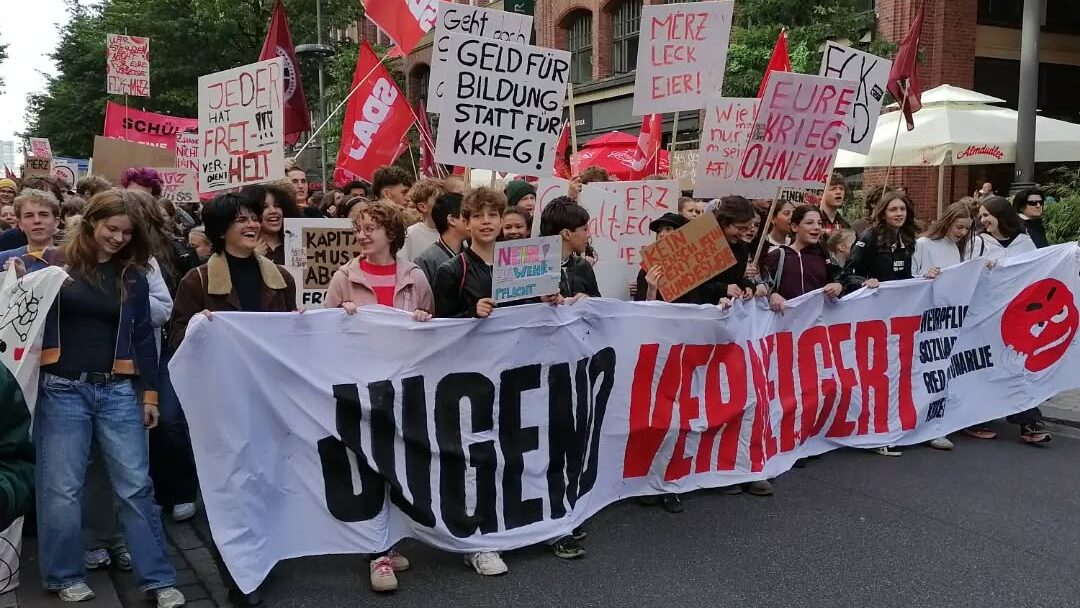
German students say ‘we don’t want to go to war’

Thousands of students across Germany were once again on strike against conscription and militarization on Friday, September 25. Actions took place in at least 100 localities as young people demanded a sharp turn from the government’s chosen path.

“We don’t want to be forced into military service and we don’t want to go to war,” the students wrote in declaration after their last strike in May.

Read more: German students expand their strike against conscription and militarization to 150 cities

This is the fourth time students have exchanged classrooms for streets since the end of 2025. The mobilization has strengthened in resistance to the Merz administration’s plans to build the “strongest conventional army in Europe” – including by drawing more people into the Bundeswehr, the German armed forces.

While authorities insist military recruitment remains voluntary, students have warned of a clear tendency toward outright conscription. Local strike committees and activists also emphasized the widespread repression ahead of actions. This included scheduling of exams on strike days and locking-in students on school grounds, they pointed out.

Billions for the Bundeswehr, cuts for schools and youth services

Over recent months, the government has sent thousands of questionnaires to map voluntary interest in joining the armed forces. According to German media, the response has been underwhelming: tens of thousands of students have disclaimed no interest whatsoever. Not even a multi-million-euro budget allocated to promoting the army has been able to shake this opinion.

“They sell us war service as an ‘adventure’ while we know that what awaits us is coertion, humiliation, sexism, right-wing extremism, and racism,” the student declaration adds.

Instead of taking the message seriously, authorities recently advanced the implementation of medical checks among their targeted population, drawing further frustration from students.

“We don’t want compulsory questionnaires, fines, draft physical examinations, conscription assessment centres across the country, nor planned integration of the Federal Volunteer Service into military service,” they wrote. “These are means to prepare the reintroduction of the draft and thus another war originating from Germany.”

“In case of conscription, we’ll be trained as cannon fodder, forced into the trenches,” students added. “War costs us our lives, while corporations like Rheinmetall make record profits.”

Read more: Ulrike Eifler: ‘The workplace is a place where we have to fight against war’

Students on strike have expressed solidarity with other ongoing struggles against militarization and budget cuts. They stated they would join peace demonstrations planned for early October in Berlin and Stuttgart, as well as a trade union-backed mobilization against budget cuts on Saturday, September 26.

Their decision reflects the widespread understanding that youth and education services are among those impacted by this round of austerity. According to junge Welt, the federal ministry responsible for education will face close to €1 billion in cuts – while €140 billion will be made available for so-called defense in 2027.

“Every tank, every rocket we pay for with dilapidated schools and social cuts,” students remarked.

  •  

Germany: Merz government may use radical ‘federal coercion’ power if AfD party controls Saxony-Anhalt

The anti-immigration Alternative for Germany (AfD) won the Saxony-Anhalt state election by a wide margin but fell short of an absolute majority. Nevertheless, the party may still come to power if it can garner enough support from BSW or peel off a few MPs from rival parties. This possibility has thrust an unused and radical clause of the German constitution, federal coercion or “Bundeszwang,” to the center of a fight over how far Berlin can go if the right-wing party takes power.

The AfD took 43.8 percent of the vote in the Sept. 6 election, but the AfD remains three seats short of an absolute majority. However, Ulrich Siegmund, the AfD’s 35-year-old lead candidate, could still become minister-president. The German government has plenty of tools for dealing with Siegmund if he steps out of line.

Germany’s establishment threatens to use “federal coercion” clause

Federal coercion is one of the most radical mechanisms in the German constitution. Article 37 allows the federal government or a representative it appoints to issue binding orders to the states and their agencies. The Federal Republic of Germany has never resorted to this clause before.

Anna-Bettina Kaiser, a law professor at Humboldt University in Berlin, told Deutsche Welle the bar is extremely high.

“The term ‘dramatic’ is most apt here. This is why federal coercion has never been introduced in the history of the Federal Republic — it is treated as a last resort,” she told Deutsche Welle, a state outlet that receives approximately €415 million a year in taxpayer money.

Until now, fights between Berlin and the states have been settled mainly in court.

“It is usually assumed that in the event of a specific legal dispute, the case will go to the Federal Constitutional Court and the given state will comply with the judgment issued by that body,” Kaiser said.

Deutsche Welle reported that an extreme use of Article 37 could include naming a federal representative with power to issue binding orders in specific areas.

“Article 37 actually provides for the appointment of such a representative who has the power to issue binding orders,” Kaiser said.

Any step would have to match the violation and meet constitutional tests. However, Article 37 lists no catalog of penalties. It speaks only of “necessary measures,” leaving the article vague and open to interpretation.

Bundesrat consent would be essential. Under the chamber’s rules, the affected state keeps its vote on Article 37 decisions.

Union parliamentary leader Thorsten Frei has since called Article 37 an option of last resort if an AfD state government acted against the constitution. Social Democratic floor manager Dirk Wiese said it was “good to know” the Basic Law allows constitutional conduct to be compelled by instruction if an “AfD-BSW Putin coalition” installed a far-right politician as premier. The Greens and the Left have not ruled the tool out.

Saxony-Anhalt’s Office for the Protection of the Constitution classifies the state AfD as “confirmed right-wing extremist.”

Cutting funding to an AfD government

On top of the constitutional power that Article 37 offers, the tried-and-tested method of cutting funding is also being discussed and it is not even clear yet if the AfD will be able to assume power in the state.

German officials have also discussed suspending some federal budget transfers to Saxony-Anhalt, which is still dependent on such transfers to prop up its economy. Tagesschau reported that structural funds could be frozen if an AfD government breached EU fundamental rights or rule-of-law conditions.

However, beyond these federal transfers, powerful German Green MEP Daniel Freund said after the vote that the European Commission should, if necessary, withhold money if an AfD-led state government acted against EU principles.

Freund was a notorious foe of Hungarian Prime Minister Viktor Orbán and a longtime advocate of the EU cutting funding to Hungary while his government remained in power. Freund not only succeeded in lobbying the EU to cut funding but this tool is generally seen as one of the primary contributing factors in toppling Orbán from power.

The reality is that this method of cutting or freezing funds has worked remarkably well for the EU, also in the case of Poland’s previous conservative government. When funding is cut, the population suffers, and when they suffer, they punish politicians at the voting booth. Orbán could point the finger all he wanted at Brussels. It did him no good in the end.

If the EU or the German federal government cuts funding, Saxony-Anhalt will suffer, and there is nothing an AfD government can do about it.

For now, it appears for the EU establishment has a virtually fool-proof method for dealing with any voter rebellions or unfavorable democratic results.

A CDU-led federal government also has every incentive to make an example out of a regional AfD-led government. Shortly after the Saxony-Anhalt election, Chancellor Friedrich Merz said Berlin would act if Saxony-Anhalt crossed lines set by the constitutional order.

“If boundaries are crossed there, I assure you that from the federal government’s point of view we will do everything to correct it. The Basic Law also applies in Saxony-Anhalt,” Merz said.

Merz pointed to migration and foreign policy. He also cited the unwritten duty of “federal loyalty.” A state must act loyally towards the standards of the federal state. That covers “the entire immigration and foreigners policy,” he said.

Fact-checkers later noted that Merz did not use the word “federal coercion,” or “Bundeszwang.” Nevertheless, the debate that followed is freely using the term and how it can be applied against the AfD.

The AfD casts itself as a “rule-of-law party”

However, simply winning an election would not, by itself, justify federal coercion. Article 37 of the Basic Law allows the tool only if a state fails to fulfill duties imposed by the constitution or other federal law. The federal government may then, with the consent of the Bundesrat, take the measures needed to compel those duties.

The AfD’s answer has been that it would govern inside the law, and that Berlin is trying to cancel a democratic result.

The morning after the vote, Siegmund again called the AfD a “rule-of-law party,” and said he would act lawfully. He later thanked the Berlin press sarcastically for portraying him as a threat to democracy and said he wanted to “extend a hand” to every actor in the legislature.

AfD co-leader Alice Weidel called the result a mandate to govern, said Merz was the most unpopular chancellor Germany has had and told him his time was up. In the Bundestag she argued that the CDU-SPD coalition had failed. Merz accused her of pushing Siegmund into “electoral fraud” by urging him to hunt for a majority after he had promised to take office only with an absolute majority.

The issue of mass immigration, in the end, always appears to be the real point of contention. According to the European and German establishment, it must continue at all costs. In a 2024 ARD summer interview, co-leader Tino Chrupalla said an AfD-led state would no longer apply the “Königstein key,” which apportions asylum seekers among the states.

“We would no longer go along with that,” he said at the time.

Siegmund has promised “deportations from minute one” and a remigration offensive.

However, a federal government that wants to prove the AfD weak and ineffective is unlikely to allow such a remigration offensive to move forward. There are plenty of tools at its disposal to stymie the AfD and even sabotage its government. Siegmund may be facing a wave of funding cuts, litigation, and ultimately the federal government stepping in and essentially seizing power if he manages to gain power in the state.

The post Germany: Merz government may use radical ‘federal coercion’ power if AfD party controls Saxony-Anhalt appeared first on Remix News.

  •  

Die Linke wins Berlin election with focus on socialization of housing

The Christian Democratic Union (CDU) has continued its downward spiral after suffering significant losses in state elections in Berlin and Mecklenburg-Western Pomerania on Sunday, September 20. In addition to coming second to the progressive Die Linke in the German capital, Chancellor Friedrich Merz’s party failed to achieve the 5% needed to enter Mecklenburg-Western Pomerania’s parliament, marking a new low – or, in Merz’s own words – a “disaster.”

The results of the two elections were radically different: in Mecklenburg-Western Pomerania, the far-right Alternative for Germany (AfD) won the largest percentage of votes, echoing, in many ways, the recent outcome in Saxony-Anhalt. In Berlin, Die Linke emerged as the winner, claiming a quarter of the vote after a campaign focusing on housing, the cost of living crisis, and public transport.

Read more: Far-right victory in German state elections shocks the center

Part of the local reports note that while the AfD and Die Linke lie on opposite ends of the political spectrum, both gained ground thanks to the perception that they bring the best chance of breaking with the policies implemented by the government coalition between CDU and the Social Democrats (SPD).

These policies – pursuing extensive cuts to the social and welfare system and attacks on labor rights in order to fund a massive rearmament drive – have completely eroded the support for Merz’s conservatives. Despite this administration’s unprecedented unpopularity, the German Chancellor is showing no sign of changing course, stating after Sunday’s election that “reforms must come.”

Die Linke’s Berlin result: reforms must be implemented – but which reforms?

Reforms must be implemented, voters in several German states apparently agree with Merz – just not those envisioned by the CDU. Die Linke’s campaign, led by Elif Eralp, offered an alternative list of policy reforms addressing Berlin’s inhabitants’ most pressing concerns. This meant a focus on accessible housing – including a follow-up on the 2021 referendum where voters backed expropriating the property of private real-estate companies with 3,000 or more units in the city.

Five years ago, over one million people supported the referendum’s idea of socializing the housing pool, yet no action was taken by the local administration. Since then, the housing situation has grown worse, leading to widespread frustration. Die Linke’s campaign recognized the general discontent and promised it would not give up on socialization.

“Die Linke’s successful campaign in Berlin was driven by its strong focus on affordable housing and rent control, which resonated deeply with voters facing massively rising living costs,” Kirsten Schubert, a general practitioner active in the party’s local chapter, told BreakThrough News. “The party integrated large-scale door-to-door campaigning strategy, allowing volunteers to connect personally with hundreds of thousands of residents directly at their doorsteps. By those means, strong social media presence and a huge range of community activities, they successfully mobilized a diverse coalition of non-voters, progressive urban youth, and traditional working-class voters.”

Read more: Berliners win vote to expropriate housing from corporate landlords. What’s next?

Krunoslav Stojaković, a political advisor at the Rosa Luxemburg Foundation, says that the election result commits not only Die Linke, but also “the social left and all those who care about a more just society” to work towards achieving socialization of housing. “At this point, there can be no going back […] The people of Berlin have given us this mandate.”

“There will be resistance,” he emphasizes. “Potential coalition partners are only tentatively supportive of Die Linke, and some are already making demands against the socialization of those profiting from the housing crisis as a condition for political cooperation.”

Progressive measures to face opposition from center

The approach adopted in Berlin marked a welcome break from Die Linke’s campaigning in other states. Stojaković pointed out to the portal H-alter that the party’s earlier choices – such as joining coalitions that implemented austerity measures – contributed to a fall in popularity. The recent success offers an opportunity to reclaim lost ground and reshape the party’s approach to fieldwork. But it should not be taken for granted that this will happen.

For now, the party faces talks with potential coalition partners SPD and the Greens. Figures from both parties signaled there are significant misalignments between them and Die Linke. While the SPD does not share the commitment to socialization of housing, the Greens’ Franziska Brantner said the party would not cooperate with “anti-semites from Neukölln.” With this, Brantner indicated that the political mainstream in Germany will persist in pressuring those criticizing Israel – even if this criticism remains timid at best.

Read more: Thousands join Berlin’s Peace Days to support antimilitarism and solidarity

On the other hand, left and progressive parties across Europe recognized in Die Linke’s result an important rupture within the predominating context of the far right gaining electoral ground. From Jean-Luc Mélenchon in France to Slovenia’s Levica, reactions emphasized the significance of shaping grounded and unequivocally left programs. “Politics begins with the daily problems of millions of people,” wrote Peter Mertens, General Secretary of the Workers’ Party of Belgium (PTB-PVDA). “It is not just about talking about tenants and workers, but about organizing them so they can impose change themselves.”

This article was updated on Wednesday, September 23, to incorporate comments from Kirsten Schubert.

  •  

Der Spiegel als Propagandist für die totale Verarmung in Deutschland

Im Spiegel wurde ein Meinungsartikel mit der Überschrift „Krise des Kanzlers – Friedrich Merz darf jetzt nicht abgesägt werden“ veröffentlicht, den Gerald Traufetter geschrieben hat. Traufetter ist langjähriger Spiegel-Redakteur, und er plädiert dafür, dass Kanzler Merz im Amt bleiben sollen, weil ansonsten die Umsetzung seiner Reformen in Gefahr geriete, wie er schon in der Einleitung […]
  •  

Germany: After AfD victory in Saxony-Anhalt, Merz and Weidel trade blows during intense debate in Bundestag

Three days after the Alternative for Germany’s (AfD) landslide in Saxony-Anhalt, the Bundestag’s general budget debate turned into a verbal battle between AfD co-chair Alice Weidel and Chancellor Friedrich Merz, with the two battling it out over mass immigration, democracy, crime, Ukraine, and the future of Germany.

Heckling filled the chamber. Bundestag President Julia Klöckner repeatedly intervened. The exchange was the first direct parliamentary clash between the two leaders since Sunday’s vote, in which the AfD took 43.8 percent and the CDU collapsed to 17.2 percent.

Weidel opened the debate and treated the election results as a verdict on the ruling federal government coalition led by Merz.

“The voters in Saxony-Anhalt have made it abundantly clear to you, in the language of the democratic sovereign: the Black-Red coalition is over,” she said. Citizens wanted “a change of policy,” she added, “and they do not want more of the same.”

🇩🇪🔴JUST IN: After AfD's landslide victory, Weidel tells Merz that "the voters in Saxony-Anhalt have communicated to you in the language of the democratic sovereign with all clarity: Black-Red (CDU-SPD ruling coalition) is over."
She slammed the government's new budget during a… pic.twitter.com/i9JCrhBDin

— Remix News & Views (@RMXnews) September 9, 2026

Addressing Merz directly, she said he had failed to hear that message.

“That is not especially relevant, because your time has run out anyway. Citizens want a change of policy, and they will get it,” she said.

She turned next to the draft federal budget. Weidel called it a “declaration of surrender” and accused Finance Minister Lars Klingbeil of “unserious budget management.”

““Despite record tax revenues, you are incapable of managing the public’s money wisely. Why? Because you are unwilling to free yourselves from the shackles of green ideology, left-wing mass migration, and socialist redistribution.”

She said the CDU-SPD government planned more than €1 trillion in new borrowing over its term, a figure she described as unprecedented in the Federal Republic. The result, she argued, would destroy future room for maneuver and leave “scorched earth.”

“You are driving Germany into national bankruptcy in record time,” she said.

Weidel also continued to slam Merz on mass migration, a sore spot for the ruling government.

“You declare the migration crisis to be over. Yet, every year, a six-figure number of migrants enters the country through the back door of asylum, plus another major city through family reunification—most of them from Muslim tribal cultures,” she stated, adding: “More than a million refugees live whose asylum application has been rejected more than once. What are these people actually still doing in this country? They should be deported!”

Weidel accused the coalition of declaring the crisis over while still admitting large numbers of people through asylum procedures and family reunification. She claimed more than a million people whose asylum claims had already been rejected remained in the country and should be deported. Ordinary workers, she said, were paying the price.

“Because [Germans] have to deal daily with the consequences of mass migration, with the hatred of foreign groups toward their own, with hatred of Christians, with hatred of Germans, with hatred of Germany, and you are even providing financial support to these people. This must finally come to an end!”

🇩🇪🔴 After AfD's victory in Saxony-Anhalt, Alice Weidel takes Chancellor Merz to task during a raucous debate.

"Because [Germans] have to deal daily with the consequences of mass migration, with the hatred of foreign groups toward their own, with hatred of Christians, with… pic.twitter.com/lBjLNPt9hM

— Remix News & Views (@RMXnews) September 9, 2026

Energy policy drew the sharpest interjections from the government benches. Weidel called the energy transition “the greatest millstone dragging our economy into the abyss” and “lost, burned money.” Germany, she said, was facing a possible winter gas shortage after the destruction of Nord Stream 2 while still sending billions to Ukraine.

She demanded renewed Russian gas deliveries, a return to nuclear power, and peace talks.

“While the United States is making another attempt to end the murderous Ukraine war, you are stepping up the war propaganda and the confrontation with Russia,” she told the chancellor. When SPD deputies laughed, she snapped: “Do you find that funny? Voters out there can see that the SPD finds deindustrialization funny. So stop laughing.”

Merz responds

Merz came out swinging against Weidel, conceding the Saxony-Anhalt result was “remarkable,” but said the AfD had missed its actual goal: an absolute majority of seats.

“Fifty-six percent of voters in Saxony-Anhalt did not vote for you,” he said. “And you will not achieve that anywhere in Germany with this policy.” He accused Weidel of having pushed lead candidate Ulrich Siegmund, within hours of the polls closing, to seek a governing majority after having promised before the election to govern only with an absolute majority.

“You are, and you will remain, Ms. Weidel, a destructive force,” he accused.

The sharpest attack from Merz concerned remigration. He said the concept is “nothing other than a synonym for ethnic cleansing based on origin and skin color.”

🇩🇪Germany

The anti-immigration AfD party is pursuing a plan of "ethnic cleansing based on skin color and origin," said Chancellor Friedrich Merz during a Bundestag debate.

Follow: @RMXnews pic.twitter.com/2BFmeSXztH

— Remix News & Views (@RMXnews) September 9, 2026

If that program were carried out, he claimed, skilled trades, nursing homes, hospitals, and restaurants would cease to function, because one in six workers in the crafts already holds a foreign passport and millions of people with a migration background keep essential services running. The coalition, he said, agreed on deporting people without a right to stay, but distinguished between those who work and contribute and those who must leave. AfD deputies erupted. Several shouted that the claim was false.

On Ukraine, Merz accused the AfD of reversing perpetrator and victim. Neither NATO, the European Union nor Germany had threatened Russia, he said.

“The only thing that truly threatens Russia and Putin is the radiance of democracy.”

The AfD, he added, still stood with Moscow.

“Right there runs the deep rift between you and us, in foreign policy, in European policy, in social policy and in peace policy,” he said.

He also charged that Weidel had said nothing about a failed drone incident at Leipzig Airport, a hacking attack on Berlin infrastructure, or this year’s fires and weather extremes.

“Not a word from you, Ms. Weidel, about what has been going on in this country this year, he accused her.

At one point in Merz’s speech, Klöckner told the AfD that heckling is part of parliamentary life, “but it is not part of constantly interrupting a speaker. You also have to accept that there are other opinions.”

When the noise continued, she warned one deputy: “We are not on the football pitch here right now. Save this for the weekend.” Later she threatened MPs with expulsion.

Merz thanked her and said the interruptions themselves showed the AfD’s “contempt for the German Bundestag,” adding that “listening is not your strong suit.”

With the battle brewing over who controls Saxony-Anhalt still to be decided, and with Merz’s CDU crashing below 20 percent in the latest poll, political tensions are set to rise in the coming month

The post Germany: After AfD victory in Saxony-Anhalt, Merz and Weidel trade blows during intense debate in Bundestag appeared first on Remix News.

  •  

Far-right victory in German state elections shocks the center

The far-right Alternative for Germany (AfD) secured a convincing victory in the Saxony-Anhalt state election on September 6, 2026. The election was marked by a high turnout of nearly 78% and took place amid a climate of widespread anger against federal policies implemented by the Merz administration – particularly attacks on social services and welfare, and ongoing militarization.

The AfD won approximately 44% of the vote, more than double its result in the 2021 election. Chancellor Friedrich Merz’s Christian Democratic Union (CDU) saw its support halve to barely over 17%, followed by the Social Democrats (SPD), the Greens, and the progressive party Die Linke – all recording less than 10% of the vote. The Sahra Wagenknecht Alliance (BSW) crossed the 5% electoral threshold.

Despite the result, it remains unclear whether the far right will be able to form a government, as mainstream parties have historically maintained a “firewall” against cooperation with the AfD. For his part, AfD state leader Ulrich Siegmund indicated the party’s preference is forming a non-coalition administration, even if it means going to the polls again. He assured that, in that case, the AfD would win over 50% of the vote.

Read more: Germany’s ‘summer of reforms’ to accelerate militarization

While mainstream parties across Germany expressed shock over the election result, critics on the left argue this is the result of their own unwillingness to break with neoliberal policies and attacks on labor rights. Ever since the far right began to record stronger electoral results, the mainstream parties’ focus has remained almost exclusively on the AfD’s anti-immigrant discourse, even embracing growing chunks of this narrative in an attempt to preserve votes. 

These same parties fail to recognize the importance of the cost of living crisis and massive job losses for voters. The fear of not being able to make ends meet was one of the top concerns in Saxony-Anhalt. This indicated that many votes for the AfD were cast in the attempt to find an alternative to the mainstream. Merz’s administration, however, is apparently still oblivious to these concerns.

The AfD coming into power would also not translate into a change of economic policy, considering their program remains aligned with neoliberal principles. While this leaves room for the left to act and shape a socially just strategy, notable social mobilizations are yet to be fully recognized as pointers for progressive parties.

Read more: Insurgent left candidate may spoil far right’s plans in 2027 French presidential election

AfD’s success has been noted with concern by progressive politicians across the region. They pointed to the stubborn insistence of mainstream parties on austerity policies even as it becomes apparent that they are pushing people into the arms of the extreme right.

“The far right is back in Germany,” French presidential candidate Jean-Luc Mélenchon reacted. “This is a catastrophic demonstration of the blindness of Europe’s centrist politicians. The disaster is of their making.”

“Things didn’t turn out well under the far right last time, and they won’t this time either,” echoed Slovenian progressive party Levica. “The only answer to the consequences of capitalism is socialism.”

  •  

Germany: Chancellor Merz claims AfD win will threaten economy, AfD quickly points out VW plans to close 4 plants

Dire economic news continues to roll in as Germany faces deepening deindustrialization and an economic downturn under Chancellor Friedrich Merz. Reports today say Volkswagen’s management board is proposing to wind down production at four major German plants and shift much of that work abroad.

Just days before, Merz warned that investors would shun an AfD-governed federal state in the future.

“I cannot imagine international investors showing up for a groundbreaking ceremony with an AfD state premier to establish new plants or set up new businesses in Saxony-Anhalt,” said Merz during an ARD summer interview on Aug. 30.

He added that if a right-wing populist party won an absolute majority in the coming election, international investors would think twice about whether to invest in Saxony-Anhalt.

However, VW’s management board has now recommended closing four German production sites. The AfD has seized on the reports.

“In four VW plants, the group board is turning off the lights. The energy transition and electric planned economy are pulling the plug on the German automotive industry. With an AfD government, the economic turnaround will return to reason,” wrote AfD co-chair Alice Weidel.

Gleich in vier VW-Werken lässt der Konzernvorstand die Lichter ausgehen. Energiewende und Elektro-Planwirtschaft ziehen der deutschen Autoindustrie den Stecker. Mit einer AfD-Regierung kommt die Wirtschaftswende zurück zur Vernunft.https://t.co/6BEVQlIf3y

— Alice Weidel (@Alice_Weidel) September 2, 2026

The plan was unanimously adopted by the VW management board and will be presented to the Supervisory Board on Sept. 3. While not an immediate shutdown, it would end production in the early 2030s in Emden, Zwickau, Hanover, and Neckarsulm, with production transferred to Poland, Slovakia, and the Czech Republic.

Germany’s anemic growth is almost entirely debt-fueled and focused on public sector and defense. Its once world-class industrial base is meanwhile rapidly eroding, with Normura reporting that investors are increasingly receptive to right-wing victories, as ZeroHedge reported.

The AfD is using Merz’s economic record to argue that investors would welcome an AfD victory in the state.

AfD candidate Ulrich Siegmund told Welt TV that “exactly the opposite” would happen and that an AfD government would instead encourage firms to launch projects in Saxony-Anhalt.

Conservative-governed states abroad would see “a competitive advantage if we finally have long-term planning security again, if we have no climate targets, no quota targets,” argued Siegmund.

“[Merz’s] current economic policy speaks for itself here. We are currently experiencing deindustrialization in this country. Businesses are closing, businesses are leaving this country. That means reality speaks a clear language here,” he said.

Weidel also attacked Merz after his warning of “significant damage.”

“No German Chancellor has advanced the economic misery and deindustrialization of our country as much as Friedrich Merz,” she said. “His arrogant threats towards the responsible voters in Saxony-Anhalt show the political elite in Berlin is trembling.”

Zerohedge further discussed Normura’s take on the issue, which may be generally supportive of the AfD’s stance.

Andrzej Szczepaniak, senior European economist and executive director at Nomura, wrote “the seeds of political change” adding that “politics in Europe is lurching towards more populism.”

Szczepaniak said: “Five years ago, financial markets would not have seemed so at ease with such a prospect. But then again, these populist right-wing political parties were previously not as fiscally prudent as they are perceived to be today. Indeed, Italy’s Giorgia Meloni is the standard-bearer for financial markets of how a populist right-wing political party can govern: fiscally prudent enough to show investors that the party can govern responsibly while focusing heavily on social issues, including immigration and culture wars, to keep grassroots supporters happy.”

“Financial markets are much more concerned about populist left-wing parties being elected due to their desire to increase spending, often paid for through higher borrowing or higher taxes, which are likely to shut the engine off of already stuttering economies.”

VW’s leaders point to Germany’s high costs

While VW plans for plant closures have not been finalized, they are a sign of general industrial trends across Germany.

VW CEO Oliver Blume, at works council meetings in Emden, said that labor costs at Emden are more than twice those at comparable European plants. He noted that factory costs at other group plants are “clearly cheaper.”

“That is not an accusation, it is the reality we have to be measured against,” he said.

He added that cost cutting “is not enough to stay competitive long-term in a world of such massive change.”

On Aug. 31, CFO Arno Antlitz in Hanover said, according to Reuters, that: “We build good cars but earn too little because our costs are too high.”

“Because of the large cost differences versus other European plants, we currently have no economically viable follow-on production for four German sites once current products run out in the early 2030s,” he warned.

Companies across Germany have either cut production or closed plants entirely, with VW now one of the most high-profile corporate giants eyeing taking the same action.

The post Germany: Chancellor Merz claims AfD win will threaten economy, AfD quickly points out VW plans to close 4 plants appeared first on Remix News.

  •  

Was bringt uns der September?

Am nächsten Wochenende stehen die Wahlen in Sachsen-Anhalt an, wo die AfD erstmals eine Regierung stellen könnte. Campact will das mit einer sehr teuren Kampagne im letzten Moment verhindern. Außenpolitisch stehen die Zeichen auf Eskalation, denn die Bundesregierung beispielsweise will hart gegen Russland vorgehen. Außerdem stehen Ende September auch in Russland Wahlen an, nach denen […]
  •  
❌