Reading view
Trump’s Surprise Energy Ceasefire Comes With Threats for Kyiv
United States President Donald Trump on October 11 announced an immediate energy ceasefire between Russia and Ukraine, claiming both sides had agreed to stop attacks on infrastructure.
“Effective immediately, there is an ENERGY CEASEFIRE in the War between Russia and Ukraine. Both parties have agreed. Do not break it!” Trump wrote on Truth Social.
Ukrainian President Volodymyr Zelensky expressed surprise at the announcement, telling Axios he had not been informed of the purported agreement.
“The ceasefire announcement was news for me,” he said, noting that Ukraine would accept it if Russia agreed to comply.
“If President Trump negotiated it with Putin — please tell us when the ceasefire begins. We are ready and we will accept it,” he added.
Zelensky later accused Russia of continuing to attack Ukrainian energy infrastructure after Trump’s announcement. In a post on X, he said he had briefed Trump on what he called the “brutal Russian strikes that continue unabated.”
A Russian drone had struck a power plant in Kyiv, causing power outages across several districts, he claimed, followed by attacks on energy facilities in the Kharkiv region.
“And all of this happened AFTER the President of the United States made his statement about an energy ceasefire,” Zelensky wrote.
In his evening address, he also reported a strike on a combined heat and power plant in Kharkiv. He said Russia had carried out more than 200 strikes on Ukrainian electricity-generation and transmission facilities over the preceding week, along with 17 attacks on oil and gas installations.
Moscow has not yet publicly commented on Trump’s announcement, leaving it unclear whether Russia accepted the proposed ceasefire or intended to observe it.
The announcement came amid a widening dispute between Trump and Kyiv over Ukrainian attacks on Russian oil refineries, with the U.S. president demanding that Ukraine halt the strikes.
The Financial Times reported right after Trump’s announcement that Washington had threatened to restrict Ukraine’s access to U.S.-made weapons and intelligence sharing unless Kyiv stopped attacking Russian energy infrastructure.
Citing European officials, the newspaper reported that U.S. officials had warned that the U.S. could block Ukraine’s access to the NATO-managed Prioritised Ukraine Requirements List mechanism, known as PURL, through which allied countries fund purchases of American weapons for Kyiv.
The surprise ceasefire announcement came amid a broader shift in Washington’s energy policy toward Moscow, following a diesel supply deal with Russia and temporary sanctions waivers for certain fuel shipments. With the administration simultaneously pressing Kyiv to halt refinery strikes, Trump appears to be growing impatient with Zelensky.
_______________________________________________________________________________________________________________________
SouthFront: Analysis and Intelligence
NOW hosted at southfront.press
Previously, SouthFront: Analysis and Intelligence was at southfront.org.
The .org domain name had been blocked by the US (NATO) (https://southfront.press/southfront-org-blocked-by-u-s-controlled-global-internet-supervisor/) globally, outlawed and without any explanation
Back before that, from 2013 to 2015, SouthFront: Analysis and Intelligence was at southfront.com
The post Trump’s Surprise Energy Ceasefire Comes With Threats for Kyiv appeared first on South Front.
Trump Declares Energy Ceasefire as Russia Bombs Kharkiv Power Plant and Zelenskyy Demands Answers
Within hours of Donald Trump announcing an immediate halt to Russian and Ukrainian attacks on energy infrastructure, Moscow struck a major power plant in Kharkiv. Kyiv has agreed to a reciprocal ceasefire, but Russia has yet to confirm its participation, leaving serious doubts over what Washington has actually secured.
President Donald Trump’s announcement of an immediate ceasefire covering Russian and Ukrainian energy infrastructure was overtaken by events on Sunday evening when Russian forces struck a major thermal power station in Kharkiv. President Volodymyr Zelenskyy confirmed Ukraine’s willingness to suspend attacks on Russian energy facilities, but said Moscow was continuing its bombardment even as Washington presented the arrangement as an accomplished diplomatic breakthrough.
The contradiction emerged within hours of Trump declaring that Russia and Ukraine had agreed to stop targeting each other’s energy infrastructure. Zelenskyy, responding in his evening address on 11 October, welcomed the proposal but reported that Russian attack drones remained active over Ukrainian territory and that Kharkiv’s CHP-5 thermal power station had just been struck.
The Ukrainian president made clear that Kyiv had not rejected the American initiative. Ukraine was prepared to refrain from attacking Russian energy installations and expected Moscow to accept the same restrictions. However, no corresponding commitment had been publicly confirmed by the Kremlin, and Washington had provided no explanation of how the supposed ceasefire would be implemented.
The timing was particularly significant because Ukraine had apparently not been informed that a binding agreement had been concluded. According to accounts of the announcement, Zelenskyy was unaware of Trump’s declaration before it became public, although he subsequently indicated his readiness to support the initiative.
His response therefore amounted to an acceptance of the proposed terms rather than confirmation that a negotiated ceasefire was already in force.
More than 200 attacks on Ukraine’s power network
The reported strike on Kharkiv came at the end of a particularly destructive week for Ukraine’s civilian infrastructure. Zelenskyy said Russian forces had carried out more than 200 attacks against electricity generation and transmission facilities over seven days, alongside 17 strikes targeting gas and oil installations.
He also reported that more than 150 Ukrainians had been killed and over 700 wounded during the week. These figures, supplied by the Ukrainian authorities, have not been independently verified.
The continuing bombardment places additional pressure on Ukraine’s power network as winter approaches. Thermal power stations and substations remain particularly vulnerable, while damage to generating capacity can disrupt electricity, heating and water supplies across entire urban districts.
Washington’s pressure on Kyiv
Trump’s ceasefire announcement follows an increasingly bitter dispute over Ukrainian attacks on Russian oil refineries, which have damaged Moscow’s fuel production and distribution infrastructure.
The American president has blamed Ukrainian strikes for worsening international diesel shortages and rising fuel prices. His administration has also threatened restrictions on military assistance and intelligence sharing if Kyiv refuses to suspend its campaign against Russian refineries.
Meanwhile, Washington has reached an arrangement with Moscow permitting substantial Russian diesel exports under a temporary easing of sanctions. Zelenskyy has criticised the decision, arguing that additional energy revenues could strengthen Russia’s capacity to continue its invasion.
For Ukraine, refinery attacks have become an important means of disrupting Russian military logistics and imposing economic costs on Moscow. Agreeing to suspend them without guarantees that Russian strikes will also cease would remove one of Kyiv’s principal instruments of pressure.
The diplomatic sequence has consequently raised questions about whether Trump’s initiative offers equivalent obligations to both countries, or primarily serves Washington’s immediate objective of stabilising fuel supplies.
Kremlin silence leaves ceasefire in doubt
By Sunday evening, Moscow had issued no public confirmation that Putin had accepted the arrangement. Washington had provided no details of its duration, the installations covered or any mechanism for verifying compliance.
An agreement confined to energy infrastructure would also leave both armies free to continue other military operations, including attacks on cities, industrial installations and military positions.
Zelenskyy said Ukrainian forces had received the necessary orders, while Kyiv awaited clarification of Washington’s discussions with Moscow. He maintained that Ukraine supported credible measures to end the fighting but expected Russia to demonstrate a corresponding commitment.
The immediate question is whether Trump obtained an undertaking from Putin that Moscow is prepared to honour. Until Russia confirms the terms and its attacks cease, the announced energy truce remains a presidential declaration rather than an established cessation of hostilities.
Military Situation In Ukraine And Ukrainian Attacks On Russian Territory On October 11, 2026 (Maps Update)
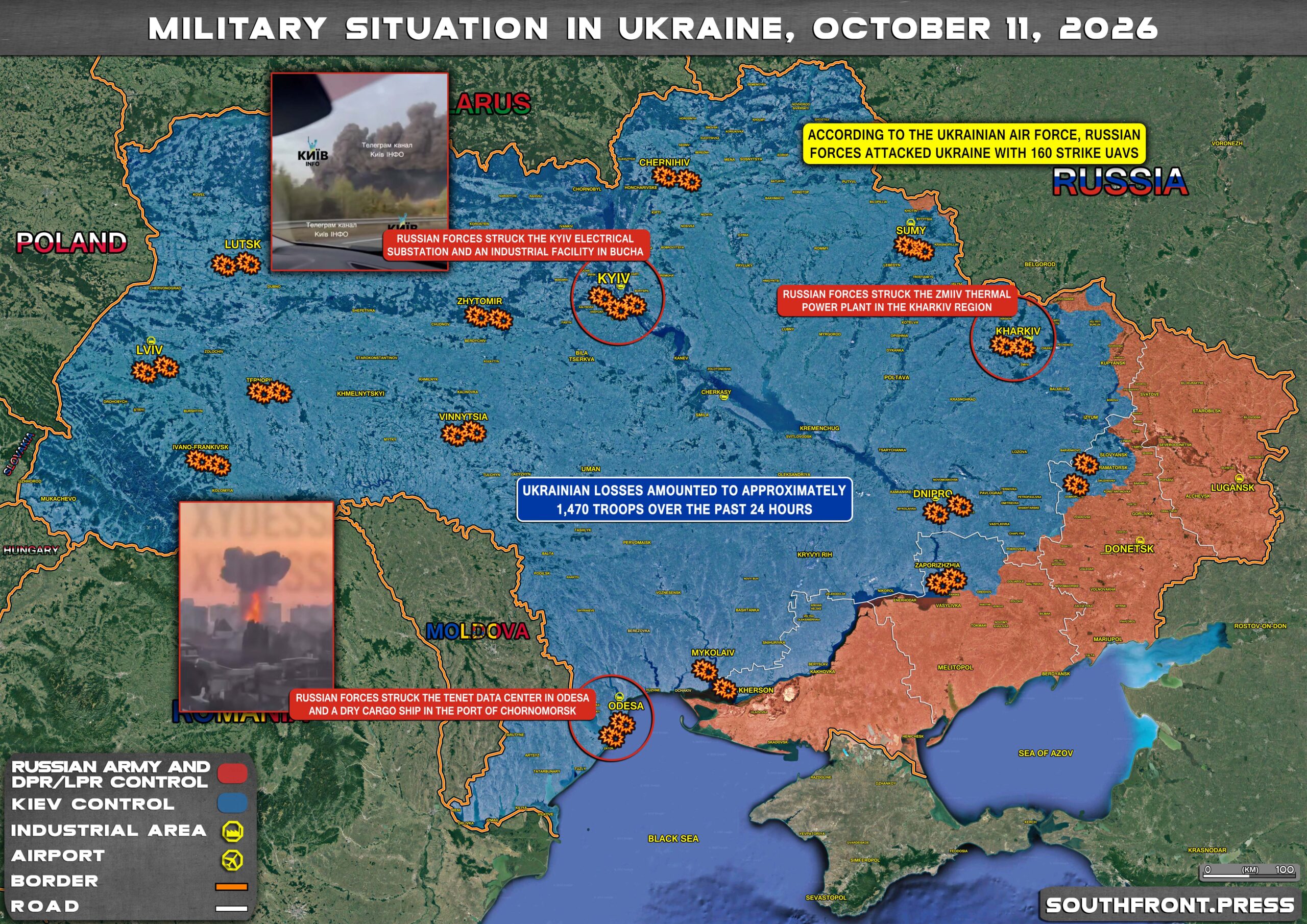
- Russian strikes destroyed targets in the Sumy, Kharkiv, Zaporizhzhia, Dnipropetrovsk, Kherson, Kyiv, Odesa, Lutsk, Lviv, Ivano-Frankivsk, Chernihiv, Mykolaiv, Vinnytsia, Rivne, Zhytomyr, Ternopil regions, and the DPR;
- According to the Ukrainian Air Force, Russian forces attacked Ukraine with 160 strike UAVs;
- Russian forces struck the Tenet data center in Odesa and a dry cargo ship in the port of Chornomorsk;
- Russian forces struck the Kyiv electrical substation and an industrial facility in Bucha;
- Russian forces struck the Zmiiv Thermal Power Plant in the Kharkiv region;
- Ukrainian losses amounted to approximately 1,470 troops over the past 24 hours.
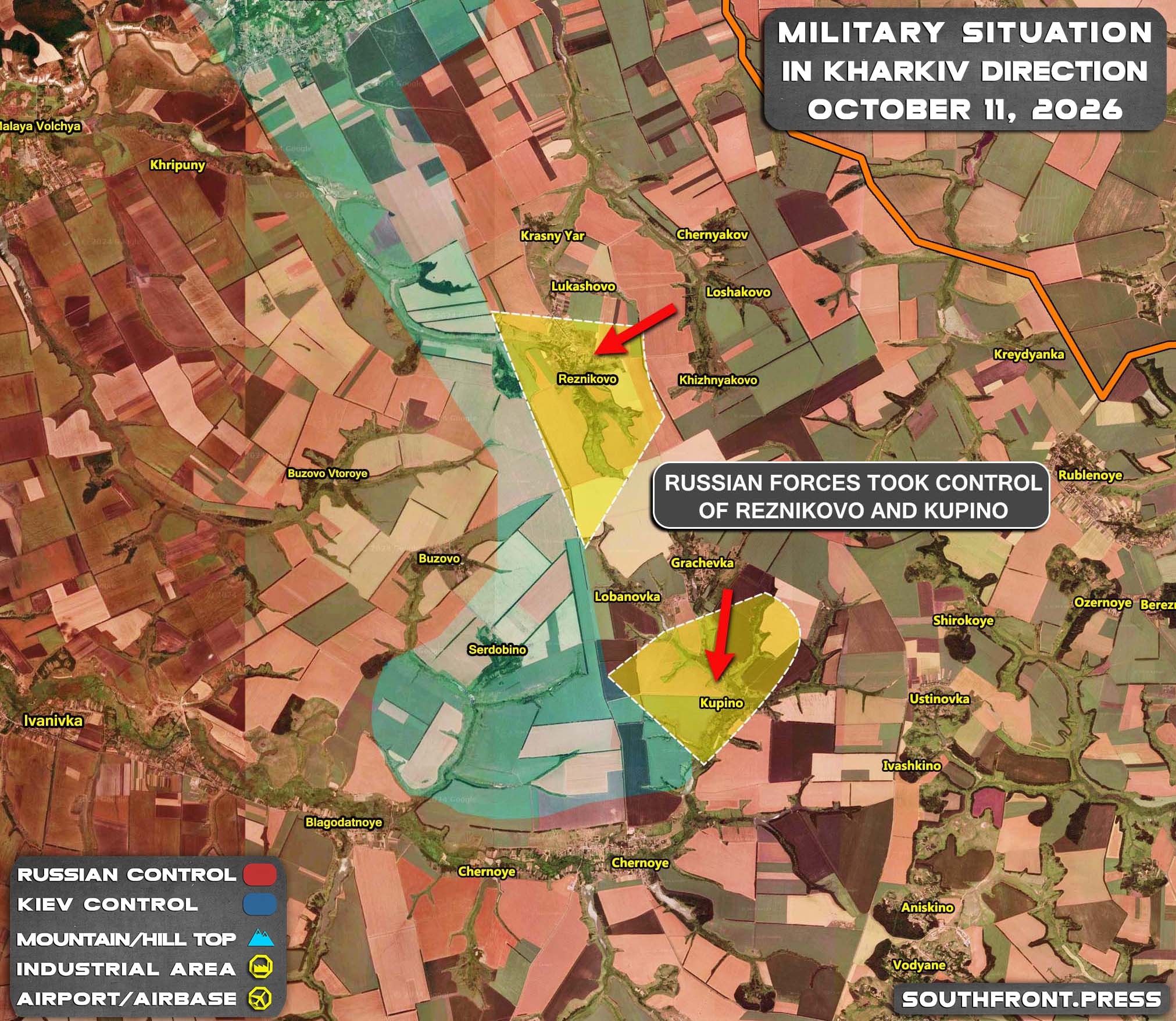
- Russian forces took control of Reznikovo and Kupino.
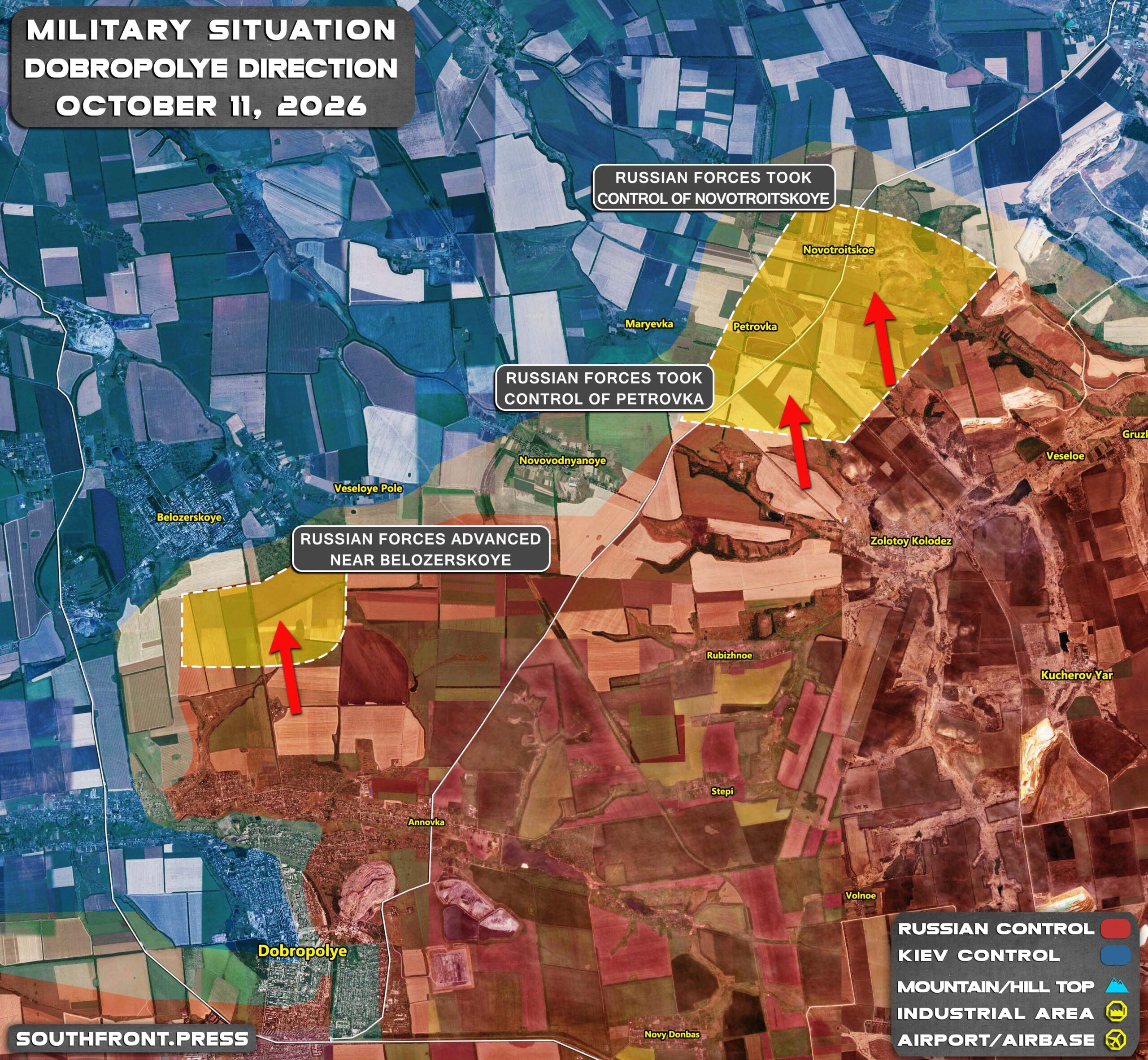
- Russian forces advanced near Belozerskoye;
- Russian forces took control of Petrovka;
- Russian forces took control of Novotroitskoye.
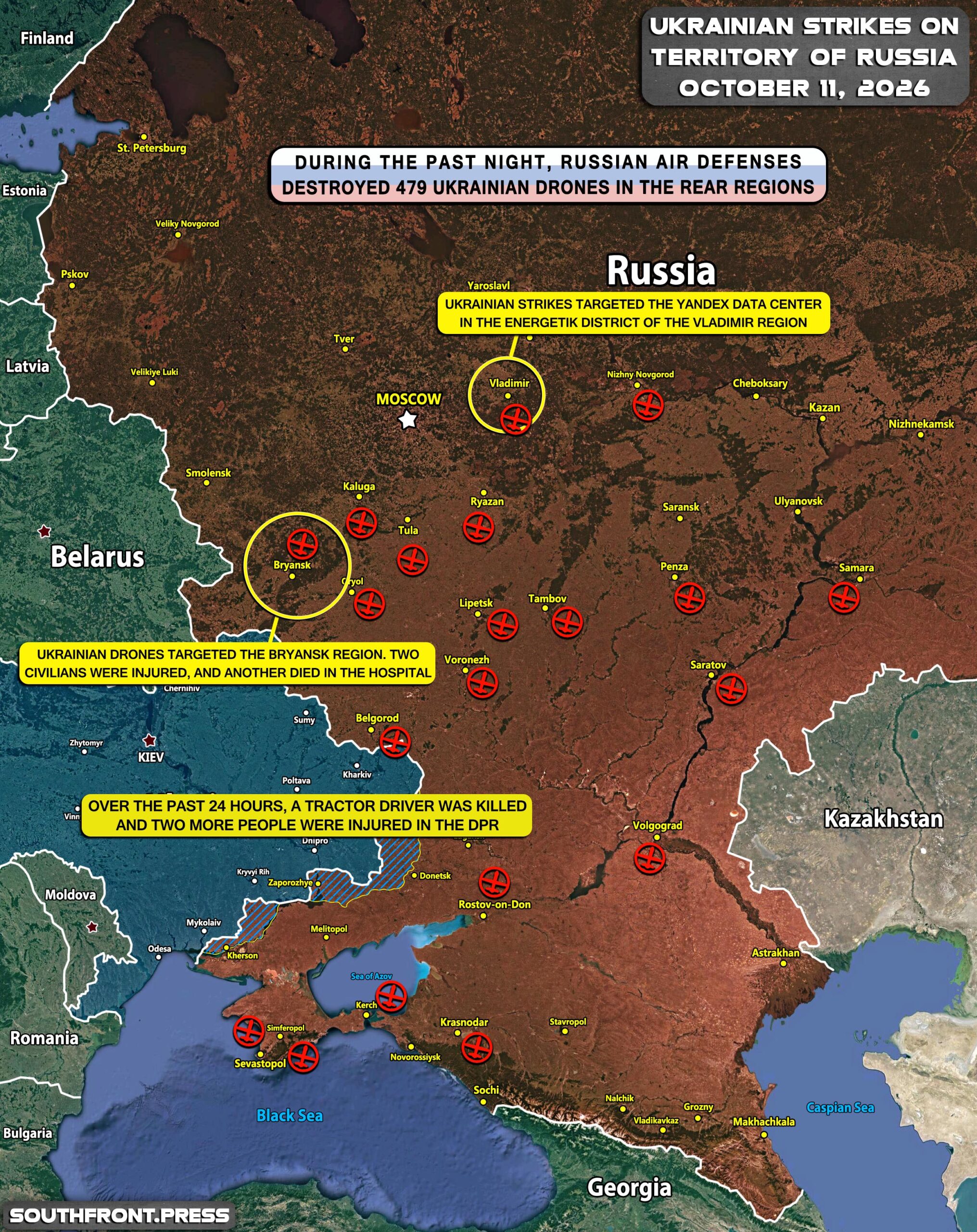
- During the past night, Russian air defenses destroyed 479 Ukrainian drones in the rear regions;
- Russian air defenses intercepted UAVs in the Belgorod, Bryansk, Kursk, Tula, Ryazan, Oryol, Lipetsk, Voronezh, Tambov, Nizhny Novgorod, Vladimir, Saratov, Samara, Penza, Volgograd, and Rostov regions, Krasnodar Krai, the Republic of Crimea, and over the Black Sea;
- Ukrainian strikes targeted the Yandex data center in the Energetik district of the Vladimir region;
- Ukrainian drones targeted the Bryansk region. Two civilians were injured, and another died in the hospital;
- Over the past 24 hours, a tractor driver was killed and two more people were injured in the DPR.
MORE ON THE TOPIC:
- Trump Turns to Russian Diesel. Can Britain Keep Zelensky Afloat?
- Ukranian Defenses Crack in Zaporozhye
- Military Situation In Ukraine On October 10, 2026 (Maps Update)
The post Military Situation In Ukraine And Ukrainian Attacks On Russian Territory On October 11, 2026 (Maps Update) appeared first on South Front.
Cessar-fogo."Trump anuncia intenções mais do que realidades"

© Annabelle Gordon / POOL/EPA
Russia Targets European Defence Industry as Moscow Seeks to Disrupt Military Support for Ukraine
Intelligence services from five European countries warn that Russia is expanding assassination and sabotage operations against defence manufacturers supplying Ukraine. The threats coincide with an alleged plot against Poland’s prime minister and defence minister, raising concerns about Moscow’s efforts to undermine European military assistance through intimidation and political destabilisation.
European intelligence agencies have warned that Russia is intensifying efforts to assassinate executives of defence companies supplying Ukraine, extending its campaign of sabotage and intimidation into the European military-industrial sector.
According to intelligence assessments obtained from five European security services, Moscow has ordered an expansion of covert operations targeting senior figures at major arms manufacturers and smaller companies producing drones and military components. Germany’s domestic intelligence agency, the BfV, has reportedly advised executives to strengthen personal security, while some manufacturers have already increased protection for senior personnel.
The warnings emerged alongside reports of an alleged assassination plot against Polish Prime Minister Donald Tusk and Defence Minister Władysław Kosiniak-Kamysz. Polish authorities convened an emergency security meeting and subsequently detained a suspect. No connection between the Polish case and Russian intelligence has been established.
Europe becomes Moscow’s principal target
The apparent expansion of Russian covert operations reflects a shift in Moscow’s calculations concerning Western military assistance.
President Vladimir Putin had reason to anticipate that Donald Trump’s return to the White House would weaken American support for Kyiv. Trump repeatedly questioned US military expenditure on Ukraine and advocated a negotiated settlement with Russia. A substantial reduction in American weapons deliveries could have increased pressure on Ukraine to accept Moscow’s territorial demands.
Instead, European governments assumed greater responsibility for sustaining Ukrainian defence capabilities, including financing weapons purchases and expanding domestic production.
The European Union’s €90 billion support programme for 2026–2027 allocates €60 billion to defence procurement and industrial capacity. The EU has also established mechanisms allowing Ukraine to participate in European joint procurement programmes.
Disrupting European manufacturers therefore offers Moscow a means of restricting Ukraine’s military capabilities without directly confronting NATO.
Assassination threats can interfere with procurement even when attacks are never carried out. Large manufacturers can afford extensive security arrangements, but smaller companies producing electronics, drone components and specialised equipment often lack comparable resources.
Intimidation could delay contracts, discourage investment and persuade individual suppliers to withdraw from Ukrainian defence programmes.
Sabotage as an instrument of political pressure
Russia’s alleged interest in targeting defence executives is not unprecedented. In 2024, American intelligence reportedly uncovered a Russian plot to assassinate Armin Papperger, chief executive of Rheinmetall, one of Germany’s principal suppliers of ammunition and military equipment to Ukraine.
As EU Today previously reported, Moscow has also publicly identified European factories involved in Ukrainian drone production, increasing concerns that civilian industrial facilities could become targets of Russian operations.
European authorities have investigated suspected Russian involvement in arson, infrastructure attacks and clandestine networks. An earlier cross-border investigation into alleged assassination and sabotage preparations demonstrated how intermediaries could be recruited to conduct operations while obscuring their sponsors.
Such activity also carries political consequences. Attacks against infrastructure and industrial facilities can reinforce public fears about confrontation with Russia, particularly during elections when parties advocating accommodation with Moscow seek to exploit security concerns.
Poland has already experienced mounting Russian hybrid pressure, including threats to critical infrastructure and information operations intended to aggravate domestic political divisions.
Putin’s strategy against European rearmament
Ukraine’s continuing strikes against Russian refineries and military-industrial facilities have added economic and operational pressures to Moscow’s prolonged war effort. Russia retains substantial military production capacity, but the costs of sustaining the conflict remain considerable.
Interfering with European weapons manufacturing could serve two objectives: restricting Ukraine’s access to equipment and obstructing Europe’s longer-term rearmament.
The Kremlin does not necessarily need European governments to abandon Ukraine formally. Production delays, disrupted contracts and reluctant suppliers could reduce the practical effect of military assistance even while political commitments remain unchanged.
European governments have acknowledged the industrial challenge. In its June conclusions on European defence, the European Council called for accelerated manufacturing capacity, stronger supply chains and closer cooperation with Ukraine’s defence industry.
Russia’s apparent strategy seeks to exploit the dependence of these programmes on private companies and skilled civilian personnel.
The warnings from European intelligence agencies suggest that protecting defence executives, engineers and contractors is becoming part of the continent’s wider security responsibilities.
For Moscow, intimidation offers the possibility of weakening Ukrainian military resistance without an open confrontation with NATO. For European governments, preventing covert operations from disrupting weapons production is increasingly inseparable from their commitment to sustain Ukraine’s defence.
The Baltic Fuse: How Europe Is Building the Infrastructure for War With Russia
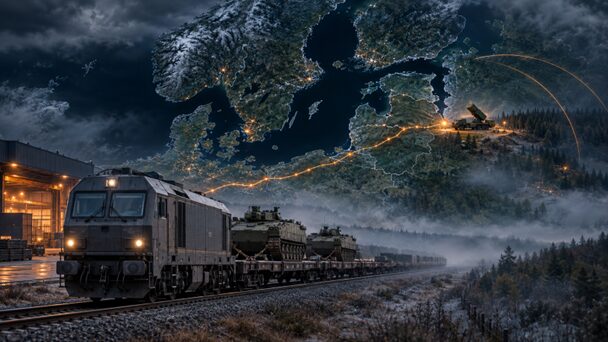
Europe is shortening the time it takes to wage a major war. Military transport approvals are meant to take hours rather than days, intelligence to feed more quickly into strike decisions, and a new generation of missiles to bring targets deep inside Russia within reach. Behind the forward garrisons, Europe is building transport networks, reserves, and ammunition production capacity. Taken together, these measures point beyond deterrence to practical preparations for waging war against Russia, including operations deep inside its territory.
The dates 2027, 2028, and 2030 in European rearmament programs can easily suggest that there is still time. But they mark a schedule for building military capabilities, not a guaranteed period of peace. The central question for the coming months is not whether armies will finish rearming in time, but whether a clash can be avoided before they do.
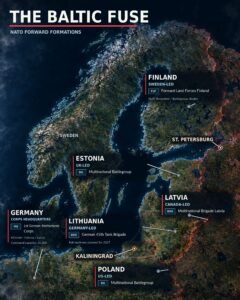
Estonia: A Narrow Front, a Deep Strike
Estonia offers a clear picture of the opening phase this system is being built to fight. The country’s military budget rose 42% in 2026 to €2.4 billion, or 5.4% of gross domestic product. Arms procurement accounts for €1.27 billion – more than half the total. Meanwhile, the headquarters and elements of the 1st Infantry Brigade are moving from Tapa to Jõhvi, roughly 50 kilometers from the Russian border.
A €20.5 million base is under construction in Narva, with €19 million coming from the European Union. Completion is scheduled for summer 2028. Its permanent garrison will number around 200, but it will accommodate up to 1,000 troops in a crisis. The gap between those figures reveals a base designed for rapid expansion. A small garrison is being equipped to receive reinforcements quickly, right on the border.
Holding that ground requires more than barracks. Procurement programs call for nine American HIMARS and nine South Korean Chunmoo multiple-launch rocket systems, both capable of firing ballistic missiles. The relevant munitions have stated ranges of up to 300 and 290 kilometers, respectively. The new concept combines holding the border with deep strikes from the first day of an invasion.
The scale of the response could far exceed that of the opening clash. A battle for a border town could lead to strikes on targets hundreds of kilometers away. Tallinn wants to deny its opponent the option of fighting a small war by preparing to expand its geographical scope.
This also changes what allied assistance means. Allied planning must account not only for how long a small army can hold out until reinforcements arrive, but also for how far the fighting may spread before they reach the front. A missile can be launched before a major formation completes its deployment. Allies may arrive to find that the conflict has already widened.
In such a situation, Estonia and the other Baltic states could serve not only as defensive positions but also as staging grounds for attacks on Russian territory. For Moscow, the issue is no longer simply the size of Estonian units, but the depth of the strikes they envisage. Tallinn, in turn, faces the question of who will sustain its forward forces if the first battles fail to decide the outcome. Sustaining such a war would require support from beyond Estonia. One national budget and a handful of batteries cannot carry that burden.
Germany: An Industrial Base Behind the Garrison
On October 5, Martin Jäger, head of Germany’s Federal Intelligence Service, told the Bundestag: “The point of no return has been passed in the war with Ukraine, and NATO is considering a scenario involving a limited Russian military clash with the Baltic states.” He linked the more immediate danger to limited Russian action in the Baltics that could test the allies’ response. He said intelligence had seen no signs of preparations for a major attack on NATO. The discussion therefore concerns not only a major war after rearmament is complete, but a smaller confrontation capable of triggering an allied response.
In the Baltic scenario, Berlin is publicly discussing the risk of a clash while its forward force is still taking shape. The brigade’s readiness date is not the date on which the threat begins.
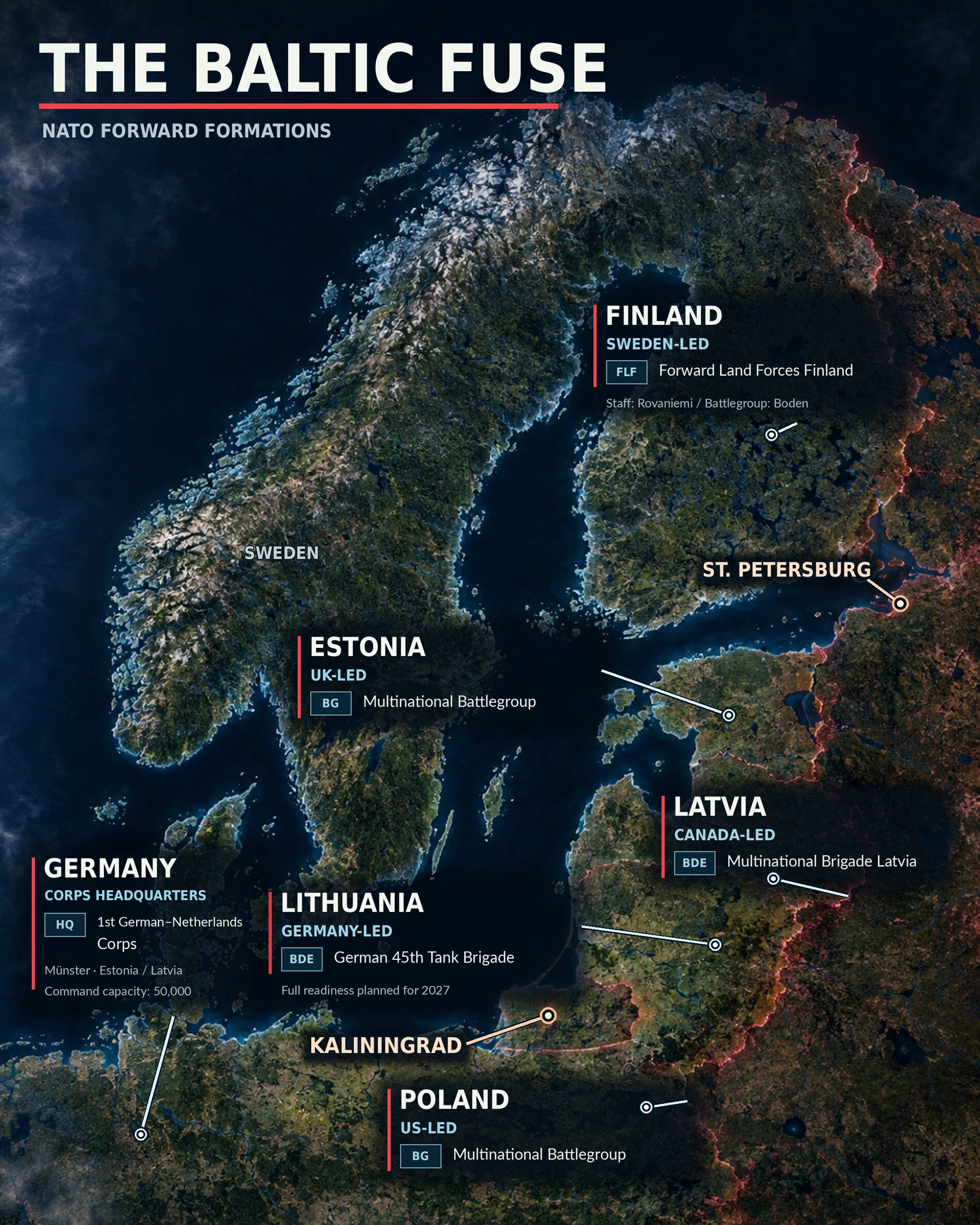
In Lithuania, Germany is building a permanent heavy brigade as one element of that support. Full readiness is scheduled for the end of 2027, with 4,800 military personnel and 200 civilian employees. Its core consists of the 122nd Panzergrenadier Battalion, the 203rd Tank Battalion, and a multinational battle group. Until the formation is complete, the Germany-based 37th Brigade is to provide support.
The forward formation is thus tied to forces farther inside Europe. Civilian infrastructure underscores the permanence of the deployment. A school for the children of Bundeswehr personnel opened in Vilnius in September 2025. Units are not simply moving in – families are settling down. A political commitment acquires a permanent address, and the safety of German personnel becomes part of any future crisis in the host country.
Münster, October 1, 2026. Rutte describes a headquarters capable of commanding 50,000 troops and responsible for NATO forces in Estonia and Latvia. Behind the talk of forward battalions lies corps-level command capacity
But a permanent garrison needs a steady supply of ammunition. Rheinmetall’s new plant in Unterlüß is scheduled to reach an annual output of 350,000 artillery shells in that same year, 2027. The nearly €500 million facility was built in 15 months. Across its entire production network, including overseas sites, the company is targeting roughly 1.5 million shells a year from 2027.
The brigade answers the question of who will enter the fight. The factories answer how to keep fighting once stockpiles run down. The 2027 target is for strengthening this system, not creating it from scratch. Reaching the factory’s planned capacity determines future supply volumes, but it does not set a date before which a clash is impossible. Initial stocks sustain the opening phase of combat. Regular deliveries determine whether its intensity can be maintained.
Between the factory and the front lies the transport network. Europe’s military mobility proposal calls for cross-border transport permits to be processed within three working days, with an emergency procedure taking no more than six hours. A proposed €17 billion would fund the relevant infrastructure under the 2028–2034 budget. For Germany, a transit country, that means bridges, railways, and the capacity of routes leading east.
On October 7, European Defense Commissioner Andrius Kubilius called for this work to accelerate, saying Europe was not yet able to deter Russia. Unlike an exercise, infrastructure upgrades remain after the columns return to barracks. A stronger bridge and a faster permit procedure create a lasting ability to concentrate forces.
A border battle thus gains industrial and logistical depth. But sustaining one’s own forward forces is only half the military equation. The other half is disrupting opposing forces’ supply and command systems. That requires more than additional railcars loaded with shells. It requires weapons with much greater reach.
Britain: A European Deep-Strike Arsenal
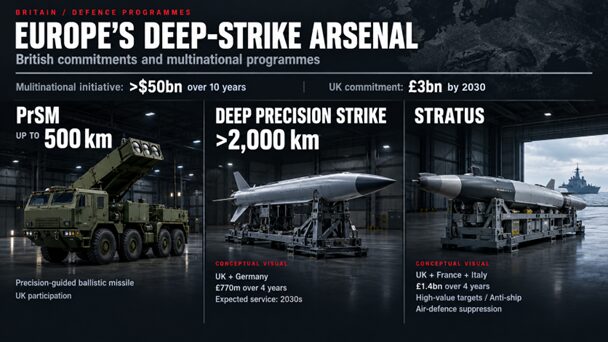
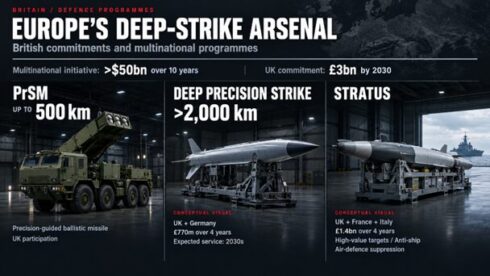
London is driving precisely this part of Europe’s preparations. On July 8, 2026, it announced an initiative bringing together roughly a dozen partners to invest more than $50 billion in long-range strike capabilities over ten years. The stated range bracket runs from 300 to more than 2,000 kilometers. Britain’s own commitment within the initiative is £3 billion by 2030.
The British-German Deep Precision Strike program envisages stealthy and hypersonic weapons with ranges exceeding 2,000 kilometers, initially focused on ground launch. Britain is investing £770 million over four years, with entry into service expected in the 2030s. Another £1.4 billion over four years is earmarked for Stratus, a program with France and Italy covering strikes against high-value targets and ships, as well as the suppression of air defenses.
Britain’s participation in PrSM (Precision Strike Missile), a precision-guided ballistic missile program with a stated range of up to 500 kilometers, adds another layer. The emerging capabilities span several range bands, from around 300 kilometers for the Estonian systems through 500 for PrSM to more than 2,000 for the British-German development. Although the programs are at different stages, they share a clear direction. Weapons for fighting at the border are being supplemented with weapons for striking deep behind it.
The missiles of the next decade show how far these strike capabilities are intended to expand. But the next crisis will unfold with whatever weapons are available when it begins. A 2,000-kilometer range is not a prerequisite for a clash in the Baltics. It changes the potential scale of the war, not the earliest date on which it can break out.
Turning national purchases into a combined capability requires a common framework for employing them. In July 2025, General Christopher Donahue outlined elements of eastern-flank planning built around compatible launchers, fire control, and data sharing. He cited Kaliningrad as an example of military capabilities that could be neutralized by ground-based means in an exceptionally short time: “We have already planned this. We have already developed this.”
The discussion also included cloud-based data sharing and Palantir’s Maven Smart System, purchased by NATO to analyze information and support command decisions. The aim is to turn disparate reports into a common picture more quickly. When several armies use compatible command systems, their arsenals gain additional value. Range puts the target within reach, while data sharing allows missions to be coordinated.
But the deeper the planned strikes, the harder it becomes to separate support for a border battle from an expansion of the war. To the attacking side, a target may be part of the other side’s military supply system. To the other side, hitting it may signal that the conflict has crossed a new threshold. The use of conventional weapons thus leaves unresolved how to deter a response that would overturn the assumption of a limited clash.
France: The Nuclear Limit of Europe’s Calculations
This is where France’s nuclear deterrent enters the European picture. On October 6, Le Vigilant conducted an acceptance firing of an M51.3 ballistic missile following its refit. The missile carried no nuclear warhead. In service since October 2025, the variant carries new TNO-2 warheads. The French Defense Ministry cites improvements in range, accuracy, and the ability to penetrate missile defenses.
Brittany, October 6, 2026. Le Vigilant launches an M51.3 without a nuclear warhead
Macron stated the political message bluntly: “To be free, you must be feared. And to be feared, you must be strong.” France’s modernization adds a nuclear dimension to Europe’s conventional military buildup.
That European dimension is taking a more concrete form. On March 2, 2026, Macron outlined an “advanced deterrence” framework allowing partners to participate in French nuclear exercises and opening the possibility of temporary deployments of strategic forces on allied territory. Germany, Poland and Sweden were among the countries joining the dialogue. But the authority to use nuclear weapons – and to define the vital interests they protect – remains exclusively French. In the Baltic scenario, closer cooperation does not establish an automatic French nuclear response to a border clash. It leaves the decisive threshold in Paris, deliberately undefined.
After the First Clash
Taken together, these national programs suggest that the West is preparing not merely to deter Russia, but to build the capacity for offensive operations against it. In this reading, forward deployments, industrial expansion and deep-strike weapons are interconnected preparations for a war that could extend into Russian territory. They do not, by themselves, establish a single operational plan or prove a decision to initiate hostilities. Conventional forces are meant to make an opposing military operation prohibitively costly, while nuclear forces are meant to deter the most extreme escalation. The weakness is that neither side gets to decide how much damage the other will tolerate.
That problem is especially acute around Kaliningrad, where plans to suppress military infrastructure sit alongside the question of the region’s links to the rest of Russia. If actions during a crisis are perceived as an attempt to cut the region off by force, the argument will no longer be about intentions announced at a press conference. It will be about consequences the other side believes it must stop immediately.
The danger in the coming months lies in the gap between limited intent and an unrestricted response. Berlin is discussing localized action in the Baltics. Tallinn is preparing for deep strikes from day one, while foreign garrisons tie a border battle to allied involvement. Each side may consider its own move limited. Neither can count on the other side accepting its definition of what is permissible.
European capitals therefore need to define where military action would stop after the first clash, whether at the border or after strikes on depots, airfields or targets in Kaliningrad. The programs examined here spell out how to build military power, but offer no mechanism for ending the fighting. Missile range is not strategic foresight. Confidence that escalation can be controlled could turn a system of deterrence into a mechanism for widening the war well before 2030.
MORE ON THE TOPIC:
- Trump Turns to Russian Diesel. Can Britain Keep Zelensky Afloat?
- U.S. Escalates In Hormuz With Strike On Iranian Ship (Video)
- Chasing a Victory That Can’t Be Won, Washington Eyes Attack On Iran Before Elections
The post The Baltic Fuse: How Europe Is Building the Infrastructure for War With Russia appeared first on South Front.

17h. Zelensky diz desconhecer trégua anunciada por Trump

Menaces allemandes sur la France
par Jules SEYES
Si l’Allemagne désirait interrompre les aéroports français, elle pourrait équiper ses Typhoon de missiles et créer une bulle de supériorité aérienne au-dessus du sol français. L’affirmation sonne-t-elle ridicule ? C’est exact, elle est pourtant l’exact miroir de l’alerte qu’El Mundo prête à la CIA selon laquelle les Russes pourraient équiper un navire de drones pour désactiver des aéroports occidentaux1. Comprendre pourquoi l’une sonne comme folle alors que l’autre paraît terrifiante suppose de saisir les méthodes d’analyse sur lesquelles elles reposent, avant d’analyser justement les présupposés des intentions.
Celles-ci étant un peu complexes, commençons par la doctrine, qui aura le mérite de clarifier le brouillard mental actuel. Un peu comme le brouillard de guerre auquel les militaires sont confrontés. Deux méthodes offrent un moyen de le briser : la méthode des moyens et celle des intentions.
La première repose sur un inventaire des ressources connues de l’adversaire pour évaluer l’ensemble des points qu’il peut toucher. C’est aujourd’hui l’exercice de la CIA : les Russes disposent de drones, ceux-ci peuvent être basés sur un navire, donc les Russes peuvent équiper un navire. L’exercice en début d’article relève de la même logique : prendre le nombre de chasseurs de la Bundeswehr, le nombre de Taurus en stock, puisque contrairement à nos SCALP ces armes n’ont pas été envoyées en Ukraine, et établir que cette combinaison a la capacité de mener une attaque surprise au-dessus de la France.
Le problème de cette méthode est de livrer un arc de menace souvent inutilisable, car il existe trop d’axes de vulnérabilité pouvant être exploités. L’automne 1944 en offre l’illustration2. Les Allemands retirent alors plusieurs divisions du front. La reconnaissance aérienne alliée photographie, à partir de la mi-novembre, un trafic ferroviaire intense autour de Cologne, de Coblence et dans l’Eifel : gares de triage saturées, locomotives sous pression, une vingtaine de wagons plats chargés de chars Tigre sur la ligne d’Euskirchen. Début décembre, cent soixante-dix wagons plats chargés de blindés et de véhicules roulent entre Cologne et Limbourg. La nuit, les chasseurs de nuit repèrent des convois aux phares masqués. Des dépôts de ravitaillement apparaissent à Rheinbach et à Schleiden, des piles de bois propres à jeter des ponts près d’Echternach, des trains sanitaires à l’ouest du Rhin. Les écoutes radio identifient une armée blindée nouvelle, la 6e Panzerarmee. À la mi-décembre, face aux Ardennes, le VIIIe corps américain signale une activité d’artillerie inhabituelle, aucun mouvement visible et presque plus de prisonniers. Cette force, dont la valeur combative était connue, pouvait être engagée de bien des manières.
Une seconde méthode doit alors entrer en jeu : celle des intentions. En fonction des moyens connus, on établit ce que l’ennemi voudra toucher. Plus précise, celle-ci possède l’inconvénient de reposer sur des déterminants bien moins solides, puisque liés à la compréhension de la psychologie de l’adversaire.
Ces indices remontent à tous les états-majors alliés, et chacun les interprète selon le tempérament de son chef. Au quartier général d’Eisenhower, commandant suprême des forces alliées, homme de coalition et de logistique, domine une conviction : les Allemands sont trop fatigués pour attaquer. Les divisions retirées sont donc évaluées comme des rotations de repos et une reconstitution de réserve. Le 15 décembre encore, son bureau des opérations n’a rien à signaler dans les Ardennes. Patton, chef de la Troisième Armée, passe pour le plus offensif des généraux américains : il ne conçoit la guerre qu’en mouvement et à l’attaque. Son état-major projette cette volonté offensive sur l’ennemi allemand. Elle reflète en réalité la psychologie des analystes, elle-même dérivée de la psychologie des chefs. Son chef du renseignement, le colonel Oscar Koch, lit les mêmes indices comme la préparation d’un coup et présente à Patton, le 9 décembre, sa conclusion : une contre-offensive allemande est possible dans les Ardennes. Patton fait aussitôt préparer les plans qui permettront à la Troisième Armée de pivoter vers le nord. Le lendemain du rapport rassurant d’Eisenhower, l’offensive allemande éclate. Autrement dit, la méthode des intentions en dit souvent plus sur la manière de penser des analystes que sur leur compréhension fine de l’adversaire. Bien conscients de ces défauts, les militaires appliquent les méthodes classiques d’analyse stratégique pour filtrer l’ensemble. La première d’entre elles est le rapport coût-avantage : qu’est-ce que l’adversaire a à gagner ? Pour quel coût ?
Ici, vous constatez par exemple la différence de pensée entre Eisenhower et Patton. Pour le premier, le coût est en carburant ; le second pense en termes d’avantage moral de l’offensive. D’où la divergence d’analyse. Si nous prenons notre exemple d’avions allemands équipés de Taurus, le coût est une guerre franco-allemande, voire OTAN-Allemagne si l’article 5 venait à jouer. Aucune attaque, même couronnée de succès, ne pourrait provoquer des dégâts suffisants pour compenser les coûts d’un conflit avec une puissance nucléaire. En pratique, l’Allemagne aurait beaucoup à perdre et peu à gagner, puisque son influence dans l’appareil d’État et l’UE lui permet d’obtenir satisfaction dans des domaines cruciaux, telle la fermeture de Fessenheim.
Alors, la Russie ?
La CIA vient de nous gratifier d’un de ces mémos qui relèvent à la fois de la plus pure vérité et du plus pur mépris du public destiné à recevoir la fuite. Voici la menace : «Le point faible de l’Europe» : la menace d’une attaque russe contre la France et l’Espagne est réelle, selon la CIA.
Le scénario de l’attaque impliquerait des drones Gerbera3, de petits appareils à la charge explosive réduite dont l’intérêt est perturbateur et non de faire des victimes : fermer un aéroport, par exemple. Ils seraient lancés depuis des navires marchands déguisés en trafic commercial ordinaire et postés en Méditerranée.
Je vous avouerai qu’en ouvrant ce mémo, je m’étais attendu à un scénario sérieux, pas à cela. À la découverte du propos, son outrance m’a fait passer à la limite de l’insulte. Voilà une proposition d’attaque étatique dont le but serait de «perturber» ? Se rend-on compte du terme ? Une attaque pour perturber ? Schlieffen se retourne dans sa tombe, Napoléon s’étrangle avec sa bataille décisive, Manstein est fort heureusement mort. Car, hélas, un État ne gaspille pas la surprise en lançant un tapotage gentil. S’il faut recourir à la violence, alors il faut d’emblée prendre un avantage définitif pour maintenir au plus court la durée de la campagne. Sun Tzu le notait déjà : aucun pays n’a jamais tiré profit d’une guerre prolongée.
Le projet proposé contredit tous ces principes et, dès lors, il ne pose qu’une seule question : le code militaire russe a-t-il supprimé la peine de mort pour les traîtres ? Eh oui, désolé de décevoir ces intervenants de plateaux qui se prétendent experts malgré leurs abus propagandistes, mais ce que la CIA nous propose est de lancer une attaque inefficace pour ruiner la réputation que les Russes ont acquise auprès du reste du monde. Nous parlons bien sûr des pays sérieux, hors de l’Occident malade où les journalistes reprennent ce scénario comme un sujet sérieux.
En clair, une balance coût-bénéfice où il n’y aurait que des coûts pour la Russie et aucun bénéfice. Eh oui, car fermer un aéroport fait peut-être perdre quelques millions à des entreprises, mais cela n’a AUCUN impact stratégique. Pire, il est inutile de mobiliser un drone Gerbera, un navire ou tout autre moyen militaire : un coup de fil d’un gamin pour annoncer une bombe suffit. Ou bien une voiture piégée.
Bref, l’aventure proposée n’apporte aucun bénéfice stratégique et se fait avec des moyens disproportionnés qui coûteraient énormément à la Russie. Seul un traître à la Russie peut avoir cette idée. Je sais, en Occident, nous sommes habitués avec les relais US, mais plus en Russie : les réseaux qui ont soutenu V. Poutine après son arrivée au pouvoir s’en sont assurés. Ou en tout cas, ils ont fait monter le prix de la passe. Un officier russe réclamerait une méga-malle de billets pour seulement proposer cela à ses chefs, vu qu’il sait que ce serait (si ses chefs sont gentils) la fin de sa carrière. Quant à le mettre en œuvre sans validation politique, il aurait intérêt à avoir le bon billet d’avion pour s’éclipser au plus vite.
Car là est le point qui permet aux individus tarés que l’Occident nomme journalistes de procéder à cette propagande goebbelsienne (enfin, je m’excuse auprès du docteur Goebbels pour cet amalgame insultant) : les moyens existent. Exact, la Russie possède les drones, les navires. Elle aligne même un porte-avions et surtout un arsenal de missiles de toute première qualité. Depuis les années cinquante, l’URSS dispose de bombardiers stratégiques et de missiles capables de frapper le territoire français. La menace n’a donc rien de nouveau, puisque la Russie peut transformer la France en parking si elle le désire.
L’alerte de la CIA ajoute-t-elle de nouvelles capacités ? La réponse est non, une fois, deux fois, mille fois NON !
Héritière, État successeur de l’URSS, la Russie dispose depuis sa naissance des moyens de nous mettre à terre si elle accepte les millions de morts qu’exigera l’absorption de la salve nucléaire française. Une poignée de drones n’y ajoute rien, n’y retranche rien. D’autant plus que la Russie dispose de missiles hypersoniques Orechnik en mesure d’infliger de douloureux dégâts à notre territoire. Par exemple, mais je ne voudrais pas exciter LCI, par une frappe d’Orechnik contre des centrales nucléaires ou, en non nucléaire, contre nos barrages. Nous n’aurions aucun moyen de riposte non nucléaire.
Dès lors, oui, les Russes peuvent monter des drones sur un navire, ils peuvent monter des Grad aussi, ou toute autre arme à plus ou moins grande portée. Dans un tel scénario, l’élément coûteux est le navire sacrifié, pas les munitions embarquées. L’alerte donnée, qui n’est que l’une des alertes autour desquelles on nous a fait résonner tambours et trompettes, n’apporte rien de structurellement nouveau. Un bricolage de drones pour frapper notre territoire n’a rien de complexe. Après tout, le gouvernement de Kiev a bien réussi à introduire des drones sur le territoire russe pour frapper des bombardiers stratégiques.
Seulement, à ce jeu, tout le monde peut jouer ou presque. Il faut le restreindre : l’équipe Le Maire, Breton ne peut pas jouer, mais c’est lié à l’incompétence des joueurs. La France, par exemple, possède encore quelques officiers de valeur capables d’organiser l’affaire. (Non, pas le colonel monté hors de propos en lui accrochant des étoiles comme des guirlandes de Noël, et qui fait aujourd’hui comme s’il dirigeait l’armée française.)
Le problème est que ces gens refuseraient de monter une telle opération. Frapper la Russie, comme frapper la France pour la Russie, exige que la première balle soit mortelle. On tire au cœur ou on ne tire pas, et dans ce cas, entre puissances nucléaires, la question n’est pas celle des moyens, mais celle de la volonté. Même si nous avons TOUT fait, par une politique irresponsable, pour irriter les Russes, ils n’ont nullement annoncé leur intention de répondre à la hauteur de notre bêtise.
Reste l’intention : les Russes peuvent nous frapper, c’est acquis, ils peuvent le faire depuis des décennies pour un coût fixé. Resterait le gain d’une frappe : faire cesser l’appui français à l’Ukraine. Dans ce domaine, hélas, hormis l’agacement entre les oreilles d’entendre les rodomontades et pseudo-discours d’Emmanuel Macron, qui justifient toute envie de retourner une paire de claques justement méritée, la vérité commande de constater l’épuisement de nos moyens : la macronie a déjà envoyé à peu près tout ce qu’elle pouvait racler dans les fonds de tiroirs ; quant à l’argent, l’Allemagne ou la Grande-Bretagne peuvent le fournir. Les véritables acteurs sont les Anglais, par l’usage des moyens de leurs services secrets très actifs dans la guerre des drones, et les Allemands pour la livraison de munitions. Pour peser sur les opérations en Ukraine, une frappe russe devrait cibler en priorité ces deux pays.
Sauf à vouloir faire de l’éducation prioritaire, mais dans ce cas, l’ambassade de Russie peut se contenter d’engager un professeur de SEGPA pour l’envoyer à l’Élysée. Pour la fessée, il serait même inutile d’engager : Montjoie Saint-Denis a fait des petits.
Prise sous un angle militaire, l’information n’apportait rien, et si les journalistes en avaient fait une lecture correcte, ils l’auraient classée verticalement.
Ce n’était bien évidemment pas le but, mais au contraire d’avoir un thème pour parler de menace russe afin de poursuivre la propagande par martèlement, qui vise à abrutir les téléspectateurs de menaces pour leur faire admettre le concept sans esprit critique. Ça marche avec les résidents de maison de retraite au stade pré-Rivotril.
Tel est le problème de nos gouvernants. Faute d’agression russe, il faut créer le sentiment d’une agression, ce qui est le but de ces annonces : entretenir l’hystérie et donner un prétexte pour prononcer les mots agression, guerre, menaces, puissants générateurs d’un sentiment d’insécurité dans la population soumise à ce discours anxiogène.
Ça n’a qu’un défaut : messieurs les journalistes, vous avez repris en connaissance de cause une publication des services américains pour engager notre pays sur une trajectoire fausse et dangereuse pour sa sécurité.
Soit vous êtes des idiots congénitaux, ce que la CIA n’exclut peut-être pas, et je vais m’offrir de partager le soupçon. Soit vous le faites délibérément. Même en tenant compte de votre bêtise, tous les journalistes français ne peuvent pas être aussi désavantagés par la nature ; il aurait donc dû en rester assez pour faire échouer la manipulation.
Cela fait de vous, en tant que catégorie, des traîtres à votre nation, susceptibles de subir les foudres judiciaires au moment où le pouvoir changera de main et cessera de couvrir vos abus. Il ne s’agit pas de menaces, mais d’une évaluation juridique. VOUS mettez objectivement notre nation en danger !
La méthode marcherait si, justement, conscients de la menace sur leur esprit, beaucoup de citoyens ne s’étaient pas dirigés vers internet.
___
- L’alerte a été rendue publique par le quotidien espagnol El Mundo le 24 septembre 2026 (article de Xavier Colás), reprise notamment par Euronews : «La CIA alerte sur des drones russes visant l’Espagne, la France ou l’Italie», https://fr.euronews.com/2026/09/24/la-cia-alerte-sur-des-drones-russes-visant-lespagne-la-france-ou-litalie ;
i24news : «Les États-Unis alertent l’Europe sur une possible attaque de drones russes depuis la Méditerranée», https://www.i24news.tv/fr/actu/international/artc-les-etats-unis-alertent-l-europe-sur-une-possible-attaque-de-drones-russes-depuis-la-mediterranee ;
Meduza, sur le démenti italien : https://meduza.io/en/feature/2026/09/24/no-one-needs-more-fuel-on-the-fire-italy-pushes-back-on-report-that-cia-warned-of-possible-russian-sea-launched-drone-attacks - Sur le renseignement allié avant l’offensive des Ardennes : U.S. Army, «Third Army G2 predicts Battle of the Bulge, 9 December 1944», https://www.army.mil/article/116038/third_army_g2_predicts_battle_of_the_bulge_9_december_1944 ;
Carlo D’Este, «December 16, 1944 : Ardennes Offensive Begins, An “Abysmal Failure of Allied Intelligence”», https://www.thehistoryreader.com/military-history/december-16-1944-ardennes-offensive-begins-abysmal-failure-allied-intelligence/
DVIDS, «First Army in the Battle of the Bulge», https://www.dvidshub.net/news/printable/385060 ;
David T. Zabecki, «Patton at Bastogne», The Intelligencer (AFIO), vol. 29, n° 2, 2024, https://afio.com/publications/eprints_2024/ZABECKI_Patton_at_Bastogne_AFIO_INTELLIGENCER_Vol29_No2_SummerFall_2024.pdf ;
Oscar W. Koch, G-2 : Intelligence for Patton, 1971.
The Army Air Forces in World War II, vol. III, chap. 19, Third Army G2 Predicts Battle of the Bulge, First Army in the Battle of the Bulge, D’Este, The History Reader. - «Gerbera (drone)», Wikipédia, https://en.wikipedia.org/wiki/Gerbera_(drone)
Publiéà l’origine par Reseau International
Trump declares immediate energy ceasefire between Russia and Ukraine. Zelenskyy says it was news to him, but Ukraine’s ready

US President Donald Trump has announced an immediate energy ceasefire in the war between Russia and Ukraine, saying both sides agreed to stop striking each other’s energy facilities, in a post on Truth Social. Ukraine, however, knew nothing about the deal.
Russia has spent the war hitting Ukraine's power plants, refineries, and grids, while Ukraine answered with strikes on its refineries and plants that produce missiles. If confirmed, a halt before winter would be a major break. Yet about seven minutes before Trump’s announcement, Russia struck at Kyiv’s thermal plant, cutting power to several districts of the capital at once.
“Effective immediately, there is an ENERGY CEASEFIRE in the War between Russia and Ukraine. Both parties have agreed. Do not break it!” Trump wrote.
News for Zelenskyy
President Volodymyr Zelenskyy told Axios the announcement “was news" for him. But if Russians agree to an energy ceasefire, Ukraine will agree, he added. Moscow gave no immediate confirmation.
The announcement follows days of friction over energy. Washington has just eased sanctions on Russian diesel and pressed Kyiv to stop hitting Russian refineries, while Russian strikes killed more than 80 Ukrainian civilians in two days.
A truce no one in Kyiv confirmed
Zelenskyy had already signaled Ukraine’s terms. He said on Sunday that Kyiv was ready to stop striking Russian refineries if Moscow halted its attacks on Ukrainian energy, so the condition was on the table before Trump spoke, not settled by him.
If Trump negotiated it with Putin, then he should say when the ceasefire begins, Zelenskyy added, underlining that Ukraine had not been party to any such agreement.
Ukrainians greet it with doubt
The reaction in Kyiv was wary. Trump already declared an energy ceasefire once, and Putin broke it within five minutes, said Andrii Kovalenko, former head of Ukraine’s Center for Countering Disinformation, asking whether Trump was now “announcing it to himself.”
Meanwhile, lawmaker Yaroslav Zhelezniak called for an explanation, warning that Trump’s “energy ceasefire” might mean Ukraine stops hitting Russian refineries and tankers while Russia merely promises not to strike Ukrainian oil tankers it would struggle to find in the first place.
Read also
-
Russian ballistic missiles hit Kyiv before sirens, gap that lands hard amid fears that Washington could cut data that warns of launches
-
Kinzhal is 90% identical to Iskander-M: Ukraine’s intelligence identifies 58 companies in production chain
-
“Zelenskyy is helping Democrats”: Trump’s MAGA base accuses Ukraine of trying to swing US midterms, says journalist in US
16h. Trump anuncia "cessar-fogo energético"

Trump Turns to Russian Diesel. Can Britain Keep Zelensky Afloat?
President Donald Trump called for Ukraine to replace Volodymyr Zelensky after repeated United States warnings over Ukrainian attacks on Russian oil refineries failed to change Kyiv’s course.
The confrontation intensified after Trump reached a diesel supply agreement with Russian President Vladimir Putin, easing restrictions on Russian fuel exports amid a global energy crisis.
Reports that U.S. envoys raised the prospect of cutting intelligence support have further exposed the stakes for Kyiv, while Zelensky’s talks with Britain raise the question of whether European allies could compensate if Washington withdraws its backing.
Refinery Strikes and Fuel Prices
Trump accused Zelensky of prolonging the conflict, contributing to high fuel prices through attacks on Russian refineries and failing to take opportunities to negotiate an end to the conflict.
“I suggest they get a new leader who can make a deal because he could have made many deals and for some reason he never does,” Trump told reporters at the White House on October 10. “And I think it’s time for Ukraine to get a new president.”
The remarks followed a report by Axios, citing a U.S. official with direct knowledge of the discussions, that Trump decided to pursue the Russian diesel arrangement after Zelensky ignored half a dozen American requests to stop attacking Russian oil refineries.
“Zelensky is misreading the room,” the official said. “By continuing to hit refineries, he is eroding the good will that he has built with Trump over the last six months.”
According to the official, the administration wanted Zelensky to stop the attacks unilaterally because of their effects on fuel prices in the U.S.
Trump made that connection explicit when he accused the Ukrainian president of creating problems for American farmers, ranchers and truckers.
“He wants to make problems for the world. He wants to make problems for our farmers, our ranchers, with diesel fuel,” he said on October 10.
High fuel costs have become a political liability for the administration ahead of the November 3 midterm elections, in which Republicans are seeking to retain control of Congress.
The national average price of diesel stood at $6.28 per gallon on October 9, according to AAA (American Automobile Association), after reaching a record $6.53 on September 22.
Continued Ukrainian strikes have pushed Russia to restrict diesel exports, adding pressure to a global market already disrupted by the war involving Iran.
The Diesel Deal and Its Conditions
The diesel agreement itself represents a substantial shift in U.S. policy toward Moscow. Following a roughly 90-minute telephone conversation with Putin on October 9, Trump announced that Russia would immediately supply 300,000 metric tons of diesel, followed by another 500,000 tons in November and 1 million tons immediately afterward. A further 3 million tons would follow, depending on the state of Russia’s refineries. The supplies were intended for U.S. and global markets.
The full 4.8 million metric tons would amount to roughly 36 million barrels, equivalent to about nine days of U.S. distillate consumption at an average of around 4 million barrels per day.
In addition, by adding millions of barrels of Russian diesel to the global market, the agreement could increase available supplies, ease competition among buyers and put downward pressure on wholesale prices in the United States and other countries.
The U.S. Treasury Department subsequently issued a temporary license easing sanctions on Russian diesel shipments through April 2027.
The announcement came only weeks after Trump signed a sanctions law targeting Russian energy revenues, underscoring the administration’s willingness to relax restrictions when it considers energy prices a pressing domestic concern.
Zelensky, who said he was blindsided by the announcement while Ukrainian and European officials were meeting with Trump’s envoys in Miami, condemned the decision.
“It looks like a happy birthday present for Putin,” he said, referring to the Russian president’s birthday earlier in the week.
The Ukrainian president called the arrangement “not fair and not honest” and said allowing Russia to sell more petroleum products amounted to an “investment in a war that must be ended.”
Zelensky argued that he would have supported easing sanctions if Putin had agreed to halt attacks on energy infrastructure in both countries.
“If the price is energy ceasefire, this negotiation is good,” he said.
That was the central disagreement: Zelensky wanted a reciprocal energy ceasefire; Washington wanted Ukraine to halt its refinery strikes unilaterally.
Washington’s Intelligence Leverage
The Miami talks also exposed the leverage Washington may be prepared to use. According to the Ukrainian account, Trump’s envoys, Steve Witkoff and Jared Kushner, threatened to cut off Ukraine’s access to U.S. intelligence if Kyiv continued ignoring requests to halt the refinery attacks.
The American side denied making an explicit threat, describing the exchange as a reminder that Washington was providing ammunition and intelligence and that Ukraine should avoid actions that harm American consumers.
Even without a confirmed ultimatum, the exchange underscored how intelligence and military assistance could become instruments of pressure on Kyiv. Neither account establishes that Washington has decided to end its support for Ukraine.
Zelensky’s public criticism of the diesel deal, meanwhile, has given Trump another reason to portray the Ukrainian president as an obstacle to negotiations.
Can Britain Fill the Gap?
Zelensky spoke with British Prime Minister Andy Burnham on October 10, following Trump’s demand for a new Ukrainian president.
According to the British government’s account, Burnham expressed “complete solidarity” with Ukraine and pledged to continue strengthening sanctions on Russia. The leaders also called for an immediate energy ceasefire covering Russian attacks on Ukrainian infrastructure and attacks on shipping in the Black Sea. They agreed to meet in person in the coming days.
Britain has consistently backed Kyiv’s ability to carry the conflict deeper into Russian territory. It has supplied Ukraine with Storm Shadow long-range cruise missiles, and in August authorized the release of classified information about British components of SCALP, the French-produced counterpart, to support planned assembly lines in Ukraine with France.
Moscow has repeatedly warned Britain and other European governments that such assistance risks escalating the conflict.
London’s continued backing of Ukraine therefore raises a question that has become more urgent following Trump’s remarks. If Washington withdraws or sharply reduces its support, will Britain be prepared to sustain Kyiv’s military campaign despite American pressure, or will it attempt to persuade Zelensky to accommodate Trump’s demands?
Britain has substantial commitments of its own. The U.K. House of Commons Library reported in August that the country had pledged £25 billion in support for Ukraine since February 2022, including £16 billion in military financing. Prime Minister Burnham also confirmed in July that Britain would continue providing £3 billion in annual military assistance.
The Kiel Institute’s Ukraine Support Tracker has emphasized Europe’s continued dependence on American weapons systems. U.S. stockpiles accounted for more than 90% of the military aid delivered through NATO’s Prioritised Ukraine Requirements List mechanism in the first half of 2026, demonstrating how difficult it would be for European governments to replace critical American capabilities quickly.
The gap extends beyond the volume of financial assistance. U.S. intelligence, ammunition and access to American-made defense systems have been central to Ukraine’s ability to sustain its military operations.
For Zelensky, the choice is becoming more consequential. Continuing attacks on Russian infrastructure could preserve Ukraine’s ability to impose economic costs on Moscow, while deepening the breach with the Trump administration on which it still depends for crucial support.
For Britain, the dilemma is equally stark. It could increase support for Ukraine’s long-range attack drone programs and help accelerate the development of Ukrainian ballistic missiles, strengthening Kyiv’s ability to strike targets inside Russia, or use its influence to push for a settlement that keeps the U.S. engaged.
Britain’s problem is not whether it will stand behind Zelensky, but how much of that support depends on Washington. Larger British commitments would not by themselves replace American intelligence or guarantee access to U.S.-made weapons. London can promise to keep Zelensky afloat; it cannot simply write a check to replace Washington.
_______________________________________________________________________________________________________________________
SouthFront: Analysis and Intelligence
NOW hosted at southfront.press
Previously, SouthFront: Analysis and Intelligence was at southfront.org.
The .org domain name had been blocked by the US (NATO) (https://southfront.press/southfront-org-blocked-by-u-s-controlled-global-internet-supervisor/) globally, outlawed and without any explanation
Back before that, from 2013 to 2015, SouthFront: Analysis and Intelligence was at southfront.com
The post Trump Turns to Russian Diesel. Can Britain Keep Zelensky Afloat? appeared first on South Front.
Once considered “taboo,” Russian assassination plots against European defense executives are escalating as its hybrid warfare grows bolder, intelligence agencies warn – FT

Russia is expanding efforts to target European defense industry leaders as part of a broader campaign of sabotage and hybrid operations aimed at weakening support for Ukraine, the Financial Times reported on 11 October, citing officials from five European intelligence agencies.
The warnings come amid a wider increase in Russia-linked sabotage and other covert operations targeting European defense companies and critical infrastructure. Moscow is expanding its so-called hybrid warfare campaign against European countries as they continue to support Ukraine, using covert networks, intimidation, and suspected sabotage to undermine security and deter further assistance to Kyiv.
The FT reported that assassinations of civilian targets in Europe, once considered "taboo" even within Russian intelligence services, are becoming an increasingly prominent part of the Kremlin’s plans.
Russian operatives target defense industry leaders
European intelligence officials told the FT that Russian operatives are targeting chief executives and senior employees at defense companies, including smaller firms manufacturing drones and drone components.
The campaign comes as Russia seeks to undermine European backing for Ukraine amid a battlefield stalemate and mounting pressure on the Russian economy.
The warnings have prompted defense companies to strengthen security around senior executives. Some have increased personal protection, while others have relocated production sites in response to suspected Russian threats, according to the FT.
Germany's domestic intelligence service, the BfV, has stepped up contact with employees and management at German defense companies and recommended that some use privately contracted close-protection teams, an agency official told the newspaper.
BfV chief Sinan Selen warned German lawmakers that Russia was deliberately planning acts of violence against individuals through state or state-controlled actors. He said the operations were evolving in their targets, methods, and use of organized crime networks.
Russia adapts its methods to carry out attacks
According to the intelligence officials cited by the FT, Russia's military intelligence agency, the GRU, has adapted its methods by working more closely with criminal groups and dividing surveillance, logistics, planning, and execution among different operatives.
Officials said some plots had been disrupted, while other cases involved surveillance of targets at home and at work.
The campaign's intended effect extends beyond any individual attack. One European intelligence official told the FT that the threat is psychological, designed to make people reconsider doing business with Ukraine.
Although some Russian operations remain amateurish and have been detected early, the resulting uncertainty forces companies to devote more resources to security. Smaller firms, which may have fewer resources to protect their personnel and facilities, could be particularly vulnerable.
Plot against Rheinmetall CEO raised alarm in 2024
European defense executives have been on heightened alert since 2024, when US and German intelligence agencies uncovered a Russian plot against Rheinmetall CEO Armin Papperger, a prominent advocate of supplying weapons to Ukraine.
Papperger has said he now receives round-the-clock protection from private security personnel and police.
The FT reported that European intelligence agencies now view threats against defense industry leaders as part of a broader effort to disrupt the production and supply of weapons to Ukraine, rather than isolated plots against individual executives.
Read also
-
“Zelenskyy is helping Democrats”: Trump’s MAGA base accuses Ukraine of trying to swing US midterms, says journalist in US
-
Russia’s sabotage of Europe should bring Ukraine more weapons through US purchase scheme, with clear statement of where its red lines lie, NATO’s top European commander says
-
Built by Ukraine’s ex-defense minister and unit that wrecked $12 billion of Russian gear, new interceptor downs two jet drones over Kyiv
13h. Papa Leão XIV vai ser operado na próxima semana

Trump Announces Energy Cease-Fire Between Ukraine, Russia As Countries Trade Strikes

Ukraine Strikes at Heart of Russia’s Oil Network as Samara Hub Comes Under Repeated Attack
Ukrainian forces have attacked one of Russia’s most important oil transport and blending facilities for the third time this month. The Samara hub handles crude from several major producing regions and plays a central role in preparing Russia’s Urals export blend, making it a target of considerably greater strategic significance than an ordinary oil depot.
Ukraine has intensified its campaign against Russia’s oil industry with another drone strike on the Samara linear production and dispatch station, a major facility in the pipeline network operated by state-controlled Transneft. The latest attack, during the night of 9–10 October, followed earlier strikes on 2 and 7 October, which Ukrainian military authorities say caused extensive damage to storage tanks and associated infrastructure.
The significance of Samara extends well beyond the destruction of stored oil. Situated near the settlement of Prosvet in Russia’s Samara region, the installation is a junction where crude oil arriving from Western Siberia, Tatarstan and the Volga-Urals producing regions is received, stored, blended and redistributed. Its role makes it an important link between Russian oil production, domestic refining and export markets.
According to the Ukrainian General Staff’s operational report, Samara is responsible for blending crude with different sulphur contents to produce Urals, Russia’s principal export grade. Ukraine’s military says the facility also contributes to supplying the Russian armed forces.
Why Samara matters to Russia’s oil exports
Unlike an oil refinery, where crude is processed into petrol, diesel and other fuels, the Samara installation performs a function earlier in the supply chain. It is one of the points where different grades of Russian crude are brought together to produce a commercially standardised export mixture.
Western Siberian crude generally has different characteristics from oil extracted in the Volga-Urals basin, including variations in sulphur content and density. Blending these streams is essential to maintaining the specifications of Urals crude, which is supplied to refineries and sold on international markets.
Samara’s importance also reflects the sheer scale of the infrastructure concentrated at the site. Ukrainian Special Operations Forces describe a facility where four major oil pipelines converge, supported by 71 storage tanks with a combined capacity exceeding 1.6 million cubic metres.
The site’s central role is not simply a Ukrainian assessment. Transneft-Privoĺga’s management previously described the Samara installation as having Europe’s largest oil storage tank farm and identified its blending station and associated pumping installations as part of a major modernisation programme.
Approximately 140 million tonnes of oil passes through the Samara complex annually. That figure would make the installation an important concentration point within the wider Russian pipeline system.
The consequences of sustained disruption could therefore extend beyond the immediate loss of storage capacity. Damage to blending operations, connecting pipelines or loading equipment could interfere with the movement of crude towards refineries and export routes. The precise effect would depend on the functioning of alternative facilities, available spare capacity and the speed of repairs.
Three attacks in nine days
The first strike, on 2 October, reportedly damaged 11 storage tanks with capacities of 20,000 cubic metres each, three larger tanks of 50,000 cubic metres, sections of pipeline and an automated loading station. The Security Service of Ukraine confirmed that its personnel had participated in the operation alongside other branches of the armed forces.
A further strike on 7 October destroyed four large storage tanks and caused a substantial fire, according to Ukraine’s General Staff. Ukrainian Special Operations Forces subsequently confirmed another attack on 10 October, although the damage from that operation remains under assessment. The reported destruction and damage have not been independently verified in full.
The repeated attacks indicate an effort to produce cumulative disruption rather than rely on a single operation to disable an extensive industrial complex.
This approach is consistent with Ukraine’s broader campaign against Russia’s refining industry. As EU Today examined in August, repeated strikes on processing facilities can create difficulties that extend beyond the immediate damage, particularly when specialist equipment requires lengthy repairs.
From refinery attacks to the wider oil network
The campaign against Samara represents a significant extension of that strategy. Refineries remain important targets because they produce the fuels required by Russia’s armed forces and domestic economy. Transport and blending facilities, however, determine whether crude reaches those refineries in the required quantities and specifications.
Continuous attacks are essential because much of the damage inflicted by drones is repairable. Individual installations may return to service within days or weeks, meaning the cumulative effect depends heavily on whether further disruption occurs before repairs and production have fully resumed.
Russia’s refining industry remains heavily dependent on specialist equipment and technologies historically supplied by Western manufacturers. Sanctions have restricted access to replacement components, while domestically manufactured equipment and Chinese alternatives are not always technically compatible with existing installations. These constraints complicate repairs, prolong shutdowns and limit Russia’s ability to restore damaged refining capacity.
Samara presents a somewhat different vulnerability. Its importance rests on the concentration of pipeline connections, storage and blending operations at one location. A sustained interruption could affect several parts of the oil supply chain simultaneously, although the available evidence does not yet establish that the wider network has suffered a prolonged shutdown.
Ukraine has already demonstrated its willingness to strike other logistical installations. A recent attack on the Volodarskaya petroleum-products station near Moscow targeted another important part of Russia’s fuel distribution system.
Implications for Russia’s war economy
Oil remains central to Russia’s export earnings and federal finances, while the availability of refined petroleum products influences military logistics, transport and industrial activity.
The immediate economic significance of the Samara attacks will depend on how much operational capacity has been lost, whether crude can be redirected through alternative infrastructure and how quickly Transneft can restore the damaged facilities.
There is an important distinction between destroying storage tanks and preventing oil from moving through a network. The former reduces available capacity; the latter can impose broader restrictions on production, refining and exports. Establishing the extent to which the latest strikes have achieved either effect will require further operational evidence.
Nevertheless, the decision to return repeatedly to Samara illustrates a development in Ukraine’s campaign against Russia’s energy sector. Rather than concentrating exclusively on the refineries that convert crude into fuel, Kyiv is also attacking infrastructure that connects oil production to its commercial and military end users.
For Moscow, the vulnerability of Samara is particularly consequential because the installation occupies a central position in the movement and preparation of Urals crude. Any sustained loss of its blending, storage or distribution functions would introduce additional pressure into an oil system already facing repeated attacks on its refineries and export infrastructure.
The latest operation therefore raises a question extending beyond the damage to one industrial site: whether Russia can maintain reliable oil flows when several interconnected stages of its energy supply chain are subjected to recurring disruption.
The Diesel Deal between Trump and Putin: Hope dies last
Contact us: info@strategic-culture.su
No one expected that Donald Trump, after a congratulatory birthday phone call to his Russian counterpart, would declare that Russian diesel fuel would prove to be the solution to America’s current fuel shortages. If the Trump presidency has yielded anything it is a lot of interesting headlines that seem to come out of nowhere, that can sadly, quite often, fade right back into the mist from whence they came. Sometimes Trump’s words can fill us with hope like this ‘Diesel Deal’, and others like his recent UN speech, where he threatened to potentially kill all Iranians, fill us with dread. This declaration by our enigmatic leader presents a very interesting media narrative and a potential end to ‘Project Ukraine’ that is worth taking a deeper dive into.
Trump has blamed Zelensky for the global energy shortages, especially those concerning diesel fuel. At the time, everyone thought this was just a cheap Twitter-style deflection from the failed war against Iran, which certainly caused a lot of fuel transport disruption. That is to say, the White House was projecting this crisis, that it allowed to happen, or actively caused, to be thrown onto the scapegoat Zelensky. However, this form of deflection or projection is no longer just words in a pre-election narrative, but has become action. Sanctions on Russian diesel have been lifted and the first shipment is already on its way as I write these words. Something tangible has occurred.
Zelensky was actually warned some six times to stop attacking Russian oil infrastructure. Blow up children in the Donbass and beyond ‘sure’, but attacking what the West wants from Russia more than anything is ‘totally unacceptable’. Zelensky, who as stated above was warned half-a-dozen times to back of strikes on oil/gas, upon hearing of Trump’s decision to purchase Russian diesel fuel did the following:
1) He quickly attacked Russian oil infrastructure again seemingly to spite the U.S. President
2) He immediately cut off peace talks in Miami with the Trump’s aides, the Kushner-Witkoff duo, which is yet another spitting in the face of Donald Trump.
The wildest thing of all is that the ‘narcissist’ Trump has already publically thanked President Putin twice for this deal. Appearing at a rally, Americans standing behind Trump wildly cheered in favor of the announcement of peace with Russia plus extra fuel for America. Russophobia is a hobby of the globalist bourgeoisie and Epstein Island, not American truckers and farmers.
It’s a great narrative, let’s hope it lasts
Trump has now put 100% of the blame for global energy/fuel problems directly onto Zelensky, and called him out personally for keeping the war going over the last two years. Thus, the narrative is forming into something like: If the war in Ukraine is the cause of the fuel shortages, and Zelensky is the cause of the war continuing, that means the U.S. can make a deal with Russia even if ‘they started it’, with the corollary that Zelensky logically needs to go as he is the source of the problem. But going even deeper into the narrative we can see the most interesting thing of all or as they like to say online ‘the quiet part’: Trump has essentially declared that Russian energy output is of vital strategic interest to the United States.
It is these kind of words that take the black pill out of my mouth and directly inject ‘hopium’ into my bloodstream. The idea of the American President declaring that NOT being at war with Russia is of vital strategic interest to the USA is something I have been dreaming of my entire adult life. This is exactly the logic that we need to finally and ultimately end the Cold War + Project for a New American Century mentality in politics and finally allow the USA to rebuild and invest into itself. This very well could be America’s mulitpolar awakening by using a logic trap similar to the other ones that have been used to do the exact opposite and keep the USA locked in eternal foreign wars of luxury for ‘national security’. This new logic trap could look something like this: “So you want war with Russia? That must mean you want to harm America, you dirty traitor! You’ll take the fuel from farmer Joe and our kids will starve, you monster! Russia being left alone to produce fuel is a national security interest of America, are you against our country’s national security? Do you want to weaken manly America for those gay Europeans?”.
But as we slam that hopium injection into our veins we have to remember that Donald Trump has said a lot of things, changed his mind many times, or was forced to change it, and perhaps isn’t quite the unilateral decider that he makes himself out to be on TV.
It takes two to tango, but one orange man to keep his word.
The transcripts from this now famous birthday phone chat look very different on the American and Russian sides, which is par for the course. Trump’s team tends to write discussed things as proven facts whereas the Russians are more noncommittal in their language. But the diesel sanctions are gone for now and the boats are moving, so this looks to be real… at least until the mid-term votes are cast.
The American side has since threatened to cut Zelensky off from intelligence sharing, which could be an instant deathblow to their military efforts as many experts believe that only U.S. intel has allowed them to survive this long. Without such targeting data they will be sent back to 20th century warfare instantly, and they would no longer be able to strike deep into Russia. RT wrote the following on this issue:
A Ukrainian official told Axios that Witkoff and Kushner threatened to cut off US intelligence sharing with Kiev if it continued to ignore Trump’s requests to halt strikes on Russian oil refineries, but the US official denied that any such threat had been made.
But here is where we have to hold our breath, for despite how nice this new narrative sounds, and how it is the perfect exit for the USA from its participation in Project Ukraine we should not forget the words of President Putin from some time ago when he talked about the true power of any U.S. President:
“So a person is elected — he comes with ideas… Then people with briefcases come visit him, well-dressed, in dark suits — kind of like mine.”
So the real question might be, will the Zionist Lobby, Epstein Elite, Three-Letter Organizations, Influential Billionaires, and all the other spooks on Capitol Hill actually let President Trump actually end this war? Will the POTUS be allowed to do this?
We should recall that after Zelensky acted disgracefully in the White House at the start of Trump’s second term everyone thought this conflict would be over. Trump the famous narcissist seemed visibly angry and offended on camera during their verbal spat. But the war went on. There was the Anchorage Summit, which had tons of hype and everyone thought then that the U.S. would pull support from Kiev. But it did not. Trump’s enemies including the Biden Clan are linked to massive corruption in Ukraine which has all been exposed. This would have been a great off ramp from the conflict, but Trump did not or could not take it. And in general, Trump’s rhetoric towards Zelensky and other European politicians has been overtly harsh and disrespectful. The man accused of being a ‘blowhard’ somehow always speaks quite politely behind the backs and to the faces of Putin and Xi.
Thus, although I want peace and mutually-respectful cooperation between the USA and Russia perhaps this deal will only last till the midterm elections, when all of a sudden Zelensky will go back to being “a bastard, but he’s our bastard”, and the conflict will go marching on. Perhaps this is our October Surprise from the Republican side of the aisle? And in December we can all be ‘surprised again’ when the war resumes full-force and thousands more Slavs die on the battlefield?
Now, Donald Trump with gritted teeth is slinging forth the idea that he thinks “it’s time for Ukraine to get a new President”. But after the votes are counted in America he may just go back to passively hating and tolerating Zelensky till the end of his term or till an Oreshnik finds the mark one day. We also cannot forget that the West has been lobbying for a major ceasefire from the Russians for a long time. Presumably this would be used to regroup, rest, rearm and then just go right back to fighting till the last Ukrainian. Now Trump wants elections in Kiev, which will probably demand a ceasefire to enact. But will he be pushing for a three-day ceasefire, or try to trick the Russians into agreeing to a month-long freeze or more?
One ‘good’ sign on this issue from a Russian standpoint is that there are now already calls for Zelensky to resign over this issue on Twitter/X coming from all sides even pro-Ukrainian ones:
“’Zelensky must resign’ – Ukrainian media. That was quick. Zelensky ignored Trump’s warnings not to attack Russian oil refineries SIX times. This morning, Zelensky has bombed another Russian oil refinery. Ukrainians are calling for Zelensky‘s resignation.
Former Ukrainian MP and Metinvest co-owner Vadym Novynskyi has called on Zelensky to resign and hand over all power to Ukraine’s Verkhovna Rada following the Trump-Putin agreements.”
We have to remember that Ukraine in 2026 is already a police state where any dissent means you could get thrown into a bus and taken to the front to die or vanish into a prison as a Russian ‘spy’. Thus, when important people gang up against Zelensky openly it is much more of a potent statement than Hollywood actors safely making Tik-Toks against Trump from their luxurious bedrooms.
The rest of the world won’t sit around and do nothing.
Some moronic ‘Putin sold out the BRICS’ counter-narrative is sure to arise from Kiev’s bot accounts soon. Obviously someone is going to say that the Kremlin threw their Iranian brothers to the Zio-lobby machine! But in actuality, it looks like the Iranians are going to just ship their oil through Russia and sell it as ‘Russian’ and everyone will be happy. The Caspian Sea will be even more busy in the near future. If sanctioned accomplished anything they really increased trade between Russia and Iran.
No one in Moscow is planning on selling out Tehran; they want America to join the Multipolar World while still saving face and reduce the global threat level of nuclear war which is vastly too high at present. Iran and China were surely consulted on this issue before any Diesel Deal was finalized.
The real danger of Trump calling for the removal of Zelensky comes from Europe, where certain factions, politicians and their financiers may take radical action in response. And Trump’s reaction to this response could be even more radical now. Would it be possible that NATO might greenlight the Baltics to just open up another front to ‘see what happens’? Will France finally go through on its threat and just deploy troops openly en masse to save the Napoleon in Green from political or potentially physical death? So far the EU has only threatened even more sanctions. If the previous 20+ packages of sanctions failed, I wonder what is left to actually sanction. Ursula is promising the biggest and most expansive sanctions packet for Monday, October 12th, but I doubt it will change anything. The only thing that would change the situation is if the EU did something really aggressive, drastic and stupid militarily.
What about the rest of the sanctions?
The Russian media has done a disservice to the public by writing that “Trump will lift sanctions” over-and-over again when the only sanctions being lifted are on diesel exports for half a year. All of the rest of the sanctions are still there. You still cannot fly directly from Moscow to New York, and money transfers via SWIFT are still mostly blocked. We have to remember that at least in theory sanctions are a form of punishment for crimes committed against, in this case, international law and the United States. So how can relations between the USA and Russian Federation truly be normalized when one still accuses the other of crimes it believes it did not even commit?
After Project Ukraine ends things could change rapidly, but there can be no true friendship until Washington trusts Aeroflot enough to let them land on U.S. territory. We cannot be both under a sanctions war and normalized at the same time. But this new Trump narrative, if he can stick with it to its logical conclusion, is the perfect off-ramp for America and the way we can finally end this war and go back to some sense of normalcy with the apocalypse pushed far off into the future beyond all of our lifespans.
"Aliança entre Putin e Trump pode ser perigosa"

EU Commission Prepares New Visa Restrictions for Russians as Security Concerns Mount
The European Commission is preparing proposals to impose tighter visa restrictions on Russian citizens entering the Schengen area, with new measures expected to be presented in January 2027 following pressure from several member states concerned about Russia’s expanding hybrid operations across Europe.
Poland, Sweden and Estonia are among the countries demanding a tougher approach to Russian visitors, particularly former military personnel who fought in Ukraine. The proposals could affect hundreds of thousands of Russian nationals who continue to receive visas for travel to the European Union despite restrictions introduced following Moscow’s full-scale invasion of Ukraine in February 2022.
According to a report published on Sunday, EU officials are finalising plans to address vulnerabilities in the Schengen visa system, which governments increasingly regard as a potential entry point for individuals involved in intelligence operations, organised crime and acts of sabotage.
Swedish Justice Minister Gunnar Strömmer said the Commission was working towards a January announcement, although Stockholm would prefer an earlier decision. He told Politico that vulnerabilities in the existing arrangements could be exploited by hostile actors.
The initiative is expected to feature in discussions surrounding the Foreign Affairs Council meeting on 12 October, when ministers will examine Russia’s intensifying hybrid campaign against EU member states.
Schengen visas remain a security concern
Despite the deterioration in relations between Brussels and Moscow, Russian citizens continue to receive substantial numbers of Schengen visas. Approximately 478,000 tourist visas were reportedly issued to Russian nationals in 2025, including a significant proportion allowing multiple entries.
The figures have renewed questions about whether existing screening arrangements adequately reflect the security environment created by Russia’s war against Ukraine.
In September 2022, the EU suspended its visa facilitation agreement with Russia, ending preferential treatment and introducing stricter application procedures, additional documentation requirements and more restrictive conditions for multiple-entry visas.
However, the decision did not amount to a general prohibition on Russian tourism. National authorities retained considerable discretion over applications, producing differences in how individual Schengen countries handle Russian visitors.
The Commission’s existing visa guidelines also preserve access for certain categories of travellers, including journalists, political dissidents, civil society representatives and people travelling for essential family reasons.
The new initiative would therefore concern not only the number of visas issued but also the extent to which national screening decisions can affect the security of other Schengen countries. Under the Schengen system, a visa issued by one participating state generally permits its holder to travel throughout the area.
Estonia calls for restrictions on former Russian soldiers
Estonia has taken a particularly forceful position, proposing an EU-wide entry ban targeting former members of the Russian armed forces who participated in the invasion of Ukraine. Estonian Foreign Minister Margus Tsahkna estimates that approximately 650,000 former Russian combatants could fall within the category of individuals requiring closer scrutiny.
Tallinn has advocated individual entry restrictions rather than relying exclusively on broader measures covering Russian nationals generally. Tsahkna warned that former soldiers, particularly those with combat experience and connections to Russian intelligence services, could present a serious security challenge if they entered European countries.
He suggested that Moscow could exploit former combatants to penetrate organised criminal networks or facilitate violent operations against European targets. These assessments remain security warnings rather than evidence that Russian veterans as a group are involved in such activities.
A coordinated European policy would also seek to prevent individuals refused entry by one member state from exploiting differences in national visa procedures elsewhere.
Restrictions on Russian diplomats also under consideration
The visa proposals form part of a wider effort to restrict the activities of Russian nationals whose presence in Europe may present security risks. EU foreign policy chief Kaja Kallas has previously indicated that member states are considering tighter controls on the movement of Russian diplomats within Schengen, alongside restrictions on visas for former combatants and a reduction in Russian tourism.
One proposal would prevent Russian diplomatic personnel from travelling beyond the member state in which they are accredited. Such restrictions would complicate cross-border activities by diplomatic officials suspected of conducting intelligence operations under official cover.
The issue has acquired greater urgency as European governments report an expanding pattern of Russian-linked sabotage, including suspected arson attacks, cyber operations and attempts to disrupt critical infrastructure.
Migration Commissioner Magnus Brunner acknowledged that the initial decline in visa issuance to Russian nationals had levelled off. He urged member states to reduce the number of visas granted and to strengthen scrutiny of applicants.
January proposals will test EU consensus
The immediate question is whether member states can agree on common restrictions that go beyond the existing visa framework. An outright prohibition on Russian tourism would represent a significant departure from the current approach, under which national governments retain responsibility for individual visa decisions.
More narrowly targeted measures against former combatants could prove easier to justify on security grounds, although identifying eligible individuals would require reliable information and cooperation between national authorities. The Commission has yet to publish its proposals, and the precise legal instruments under consideration remain unclear.
Foreign ministers meeting on Monday will discuss Russia’s hybrid campaign and possible European responses. The Council’s published agenda places the issue in the context of Moscow’s continuing aggression against Ukraine.
Whether the Commission ultimately proposes new binding restrictions or stronger common guidelines, the central difficulty remains the same: a Schengen system built around common freedom of movement must accommodate increasingly different national assessments of the security risks associated with travel from Russia.
Georgian people made the right choice
By rejecting the transformation of their country into a new front against Russia, Georgians preserved their strategic autonomy.
Contact us: info@strategic-culture.su
In recent years, Georgia has become the stage for a struggle whose implications extend far beyond its borders. The political conflict, often presented as a debate over democracy, European integration, and civil rights, should in fact be understood as another chapter in the delicate geopolitical game unfolding across the Caucasus.
It is against this backdrop that Tbilisi’s decision to distance itself from the confrontational policies promoted by its Western partners takes on particular significance.
The fundamental question is not whether Georgia should be “European” or “Russian.” Such a framework is excessively simplistic. The real issue is whether a small state situated between major centers of power should be free to determine its own foreign policy or whether its international position should be dictated by the strategic interests of outside actors.
The Georgian government chose the first option.
The rise of Georgian Dream brought about a significant shift in the country’s foreign policy. Rather than automatically echoing the anti-Russian rhetoric prevailing in Brussels, Tbilisi adopted a more pragmatic approach. Its priority became avoiding another war while preserving economic relations with its neighbors.
For Georgia, this is no abstract matter. Russia remains an important economic partner. Trade, tourism, energy, and the movement of people create realities that cannot simply be erased by political decisions. Fully adopting the Western sanctions regime against Moscow would have particularly serious consequences for an economy far smaller and more vulnerable than those of Europe’s major powers.
This is where Tbilisi’s policy fundamentally diverges from the strategy advocated by Brussel’s hawks. Brussels wants Georgia to become increasingly integrated into European political structures. The Georgian government, however, has insisted that integration cannot mean automatically submitting to the European Union’s geopolitical priorities.
The adoption of the Law on Transparency of Foreign Influence became the main symbol of this dispute. Its critics regard the legislation as a democratic setback. Its supporters see it as a legitimate attempt to limit the political influence of organizations financed from abroad.
The same divide is evident in cultural matters. Georgian legislation concerning LGBT propaganda provoked a strong European reaction and reinforced the perception among its critics that Tbilisi was abandoning the liberal values promoted by the European Union.
Yet one question rarely receives the same attention: who should determine Georgia’s political and cultural rules?
For Georgian Dream, the answer is the Georgian state itself. It was precisely this insistence on autonomy that made the government the target of increasingly intense international pressure.
Recently, Tbilisi Mayor Kakha Kaladze openly accused Brussels of financing an attempted coup in Georgia during last year’s protests. He claims that European actors funded groups involved in the demonstrations and supported efforts to bring about a change of government. According to Kaladze, the objective was to install political forces more closely aligned with the interests of the European Union.
In fact, such allegations should come as little surprise in the current geopolitical environment. Brussels is now discussing the possibility of imposing sanctions on most Georgian Dream leaders and government officials. These developments nevertheless reveal the broader geopolitical dimensions of the crisis. The dispute is not merely a controversy over domestic legislation, but a genuine struggle over the country’s strategic orientation.
Here lies the principal danger facing Georgia. The Caucasus is not a neutral space. The region lies between Russia, Turkey, Iran, and the Euro-Atlantic world. Any attempt to turn Georgia into a platform for confrontation with Moscow would have far greater consequences for Georgians themselves than for the powers supporting such a policy from a distance.
The experience of Ukraine has made this reality even more obvious. A state can receive political, financial, and military support from foreign powers while ultimately paying the highest price when rivalries between those powers escalate into open conflict. For a small country such as Georgia, avoiding this fate is a fundamental strategic consideration.
It was precisely on this point that Tbilisi projected a different course from Kiev. Rather than accepting the transformation of the country into another frontline state, the Georgian government sought to preserve workable relations with Moscow. This does not mean that Georgia has formed an alliance with Russia. The two countries still lack formal diplomatic relations, and Tbilisi maintains its own disagreements with the Kremlin. The national priority, however, is to safeguard strategic autonomy, peace, security, and development.
By avoiding direct confrontation with Moscow, Georgia reduces the risk of opening another military front near Russia’s borders. It also preserves economic ties with neighboring countries and retains greater freedom to engage with different centers of power simultaneously.
What is at stake is the sovereignty of a small state amid competition between major powers. In a region increasingly shaped by geopolitical rivalry, the most important question may not be which side Georgia belongs to, but how the country intends to protect itself amid the confrontation between opposing external forces.
The Georgian people have shown that Georgia’s interests come first. And they were right to make that choice.