In a new interview, White House press secretary Katie Zacharia didn't deny failing the bar exam.
She also defended calling herself a lawyer.
"The results are somewhat inconsequential because I knew I wouldn't need the bar in China," she said of the bar exam.
President Donald Trump's new White House press secretary Katie Zacharia is defending her self-description as a lawyer, while acknowledging that she took the bar exam and considered the results "inconsequential."
Zacharia's legal qualifications have faced growing scrutiny since her debut White House media briefing earlier this week, when shortly afterward she was asked which state she passed the bar exam in and replied: "When I moved to China."
In an interview Thursday with right-wing provocateur Jack Posobiec on Real America's Voice, she did not deny reports that she'd failed to pass the bar.
Zacharia, who moved to China after earning her law degree in 2011, told Posobiec she had already preregistered for the bar exam before moving to Beijing, where her husband was working at an American private equity firm.
"I didn't want to withdraw from that," Zacharia said of the bar exam. "And we knew we would be moving out to China, and I was obviously incredibly distracted and overwhelmed and excited for finally being married to someone who I had been long-distance from for at least a year."
Zacharia said she thought she'd take the bar and "see what happens."
"The results are somewhat inconsequential because I knew I wouldn't need the bar in China, and we left shortly thereafter," said Zacharia.
The Wall Street Journal reported late Wednesday that Zacharia failed California's bar exam after graduating from Pepperdine University in 2011.
A Business Insider review of records for all 50 states and the District of Columbia found no evidence that Zacharia had been admitted to practice law in the US.
In China, Zacharia said she took a job in the international practice division of the Zhong Lun law firm, where she said she worked on multimillion-dollar shareholder agreements and cross-border transactions. She said she was one of four associates under a senior partner.
"After moving to China, I didn't really think much of the bar results or consider that something that I needed to focus on," Zacharia told Posobiec, adding, "There's no Chinese bar. I had enough credentials, which was my law degree, to be able to do this practice."
"I had all the necessary requirements to do that, and I was able to do it effectively and well," she said.
She also said that she never retook the bar exam after returning to the US and having the first of four children with her husband within six years.
Zacharia said she consulted with people within the legal field "for a very long time" and was told it would be acceptable to call herself a lawyer "and provide legal analysis, not legal advice."
"They said absolutely, absolutely across the board — you can call yourself a lawyer, you have a JD, and to buffer that, you have international legal experience in transactional law," Zacharia said.
"It's unfortunate that people dub this as some kind of conspiracy," she said. "The truth is, I was very careful how I executed this, and I never came across as someone who was an attorney at law."
Zacharia's LinkedIn page says she served as general counsel for Fix California, a political advocacy group, between January 2024 and March 2025. In California, it is a misdemeanor to practice law or to advertise yourself as an attorney without a license.
At least two watchdog groups have filed a complaint about Zacharia with the State Bar of California this week.
Yemeni missiles fired at Saudi Arabia are destroying oil facilities and airports across the country – drawing particular international outrage was the ballistic missile attack on Terminal 3 of King Khalid Intl. Airport, an attack that killed 13 and left another 307 injured. As is usually the case, the corporate media starts the clock where it chooses instead of looking at the context, a similar tactic that is used when reporting on Palestine.
On October 10, a missile fired by the Yemeni missile units of Sana’a’s Ansarallah-led government caused a mass casualty event at Riyadh’s main international airport. It then drew broad condemnation from governments around the world, grabbing headlines across the corporate media.
The Saudi-led coalition’s spokesman, Maj Gen Turki al-Maliki, then called the attack a “full-fledged war crime” and said that striking a civilian airport was a “cowardly terrorist attack”. The UN Secretary-General Antonio Guterres also weighed in and expressed his shock at what he called a violation of international law, urging the attacks to stop.
However, Guterres and various government officials never commented on Saudi Arabia’s airstrikes against Sana’a Intl. Airport on July 13, which broke the years-long ceasefire between Yemen and Saudi Arabia. Nor did Israeli Prime Minister Benjamin Netanyahu, who himself ordered airstrikes on Sana’a Intl. Airport in the Yemeni Capital of Sana’a last year.
Unpacking The Lies and Hypocrisy
While the Saudi leadership has attacked its airports to generate international sympathy, it has been launching airstrikes on Yemeni airports for over a decade.
On the first day of Saudi Arabia’s war against Yemen, on the 26th of March in 2015, airstrikes struck both Sana’a Intl. Airport and the neighboring Bani Hawat residential neighborhood, killing around 34 civilians, including children. Since then, the Saudi air force has carried out over 227 strikes targeting Yemeni airports.
The breakdown of the ceasefire, which was achieved through UN mediation back in 2022, came as a result of Saudi Arabia bombing the Yemeni Capital City’s main airport, in a bid to stop an Iranian civilian airliner from landing there. Riyadh has imposed a siege on Yemen – by land, air and sea – since 2015, even inflicting a man-made famine on the country.
Saudi Arabia is responsible for killing between 9,000 and 18,000 civilians inside Yemen. Schools, mosques, weddings, hospitals, and even funerals have been struck by the Saudi air force. In total, around 400,000 people have been killed as a result of the Saudi-led war on the country.
However, the international media coverage robs current events of both the historical and current context. Take, for example, the following headline published by Reuters, which is held up as the gold standard of Western journalism:
“Houthis fire missiles at Saudi Arabia, breaking years of calm,” read the headline. However, the story they were covering, admitted through their use of the video of Saudi Arabia’s strikes on Sana’a Intl. Airport, painted Yemen as the aggressor.
In reality, no political entity called the “Houthis” exists; the name of the Party that the corporate media refuses to correctly name is Ansarallah, which heads the government that rules over the majority of the Yemeni population and is based in the nation’s Capital City. Its opposition is called the Presidential Leadership Council (PLC), which was officially formed in the Ritz-Carlton hotel in Riyadh, Saudi Arabia, back in 2022. The PLC is a proxy of the Saudi government, and its leaders are all based inside Saudi territory, not Yemen.
The next obvious point to note here is that Yemen’s Armed Forces were responding with missile fire towards Saudi Arabia; they were not the aggressor. In retaliation for Riyadh’s decision to continue violently imposing its blockade on the country, it also declared a blockade on Saudi Arabia’s Red Sea ports.
To specifically address the point about the attacks on King Khalid Intl. Airport, it is important to note why this happened and that the Saudi authorities knew the dangers. In early October, Saudi Arabia conducted 1,000 airstrikes on Yemen, using 100 aircraft, while the forces back in Yemen attempted to launch a counter-offensive on the ground.
The Ansarallah-led government’s Armed Forces then announced, in response to the large-scale assault, that they would be imposing a no-fly zone over Saudi airspace. What proceeded to happen was a number of missile attacks on airports in order to shut them down; at first, these attacks caused no known casualties and were to serve as a warning.
As Saudi Arabia continued its airstrikes across Yemeni territory, the stakes were then raised and Riyadh’s main airport became the target. Missiles were at first fired into targets at the airport as a warning to close it down. The Saudi authorities ignored these warnings. On October 8, Yemeni missiles then struck aircraft while they were grounded at King Khalid International, which destroyed one commercial airliner, damaged two others, and killed 3 people.
Despite this attack and clear warnings to close the airport, the Saudis insisted upon keeping it open. On October 10, then came the mass casualty event that inflicted 13 fatalities along with hundreds of injuries amongst civilians.
Targeting a civilian airport is indeed a violation of international law. Yet, when Israel and Saudi Arabia bomb Yemeni airports, there is no outcry. Which brings us to the heart of this issue: why should it be expected that Ansarallah respect international law in this respect when there is no consequence for Saudi Arabia, Israel, or the United States, for that matter?
Riyadh is currently bombing targets throughout Yemen, using Israeli military intelligence support to do so. Meaning that the Saudis are being backed by a State that is committing genocide. On the other hand, the only State in the Arab World that invoked the Genocide Convention, imposing a blockade and firing munitions directly at Israel, was the Ansarallah-led government in Sana’a.
According to Western leaders, Israel and Saudi Arabia, Ansarallah is a terrorist organization. So why then did Saudi Arabia not close its airport as a precautionary measure, in order to protect civilians following the direct strikes on it and threats to go further? Does Riyadh not have the responsibility to protect civilian passengers?
Why is bombing a Saudi AirPort a terrorist act, but bombing Yemeni AirPorts hundreds of times is not even an issue capable of grabbing a headline? How can anyone expect international law to be respected, when the ones who claim to champion it the most selectively use it only when it favors them? These are simply common sense questions.
What Yemen is now doing is imposing the exact same reality on Saudi Arabia, as has been imposed upon it for over a decade. Only now, when the Israeli-backed Western ally is getting hit, is anyone even noticing.
In so many ways, the predicament of Yemen is like the situation in Palestine. Nobody batted an eye at the conditions in Gaza until the Hamas-led attack on October 7, 2023. Then the media framed the Palestinians as the aggressors.
The corporate media spoke of a “Hamas-run Gaza Health Ministry” in order to downplay the civilian death toll; similarly, in Yemen, they report on a “Houthi-run Yemeni Health Ministry”. Understanding the attacks on Saudi Arabia is simple if the context is applied. Either a negotiated settlement is to be reached to end this war, or it will continue until regime change on one side occurs.
– Robert Inlakesh is a journalist, writer, and documentary filmmaker. He focuses on the Middle East, specializing in Palestine.
No próximo sábado, 17 de outubro, pelas 15h00, Ricardo Seabra apresenta a conferência “Loulé medieval: a escrita no município”, no âmbito do ciclo “LOULÉ na linha do tempo”, que acontece no Arquivo Municipal de Loulé Professor Joaquim Romero Magalhães. A relevância da escrita durante toda a História tem uma importância colossal. As informações preciosas sobre […]
In August, the Jewish Institute for National Security of America (JINSA) publicly took credit for shaping “multiple provisions” now in this year’s defense policy bill, stating that many were “impacted by prior JINSA policy recommendations,” including “proposals to strengthen U.S.-Israel defense industrial base integration” and “renew pre-existing joint U.S.-Israel programs.”
Among the provisions JINSA takes credit for is the controversial Section 219. In the House version of the National Defense Authorization Act (NDAA), this section mandates the creation of a single executive agent tasked with “synchronizing cooperative efforts” between the U.S. and Israel across nine basket categories, including AI, quantum technology, biotechnology, and virtually every category of weapons.
Israeli Prime Minister Benjamin Netanyahu has argued that such provisions would transition the U.S.-Israel security relationship from aid to partnership. But pro-Israel advocates have emphasized the leverage it would provide over Washington’s military policy.
Mark Dubowitz, the CEO of the pro-Israel Foundation for Defense of Democracies, appeared to reference this provision in an article arguing that the U.S. and Israel must “deepen their military, technological, intelligence and economic integration to such an extent that inflicting financial harm on Israel would also carry a significant cost for Washington.”
Other initiatives JINSA has advocated for likewise read like an Israeli government wishlist. They include a pending provision to “extend the existing War Reserve Stockpile Authority for Israel,” which provides a secretive and high-speed pathway for funneling weapons to Israel, as well as Abraham Accords provisions including “Improvements to Air and Missile Defense Acquisition” and a “United States-Abraham Accords Defense Cooperation Initiative.”
The policy wins JINSA is trumpeting are a result of its strong foothold within the military-industrial complex, and are perhaps one of the most overlooked aspects of the pro-Israel lobby. The group says it achieves these goals “by conducting both educational programs that build ties among American, Israeli and other Middle Eastern partner military leaders, along with in-depth research and actionable recommendations to influence U.S. policy.” JINSA’s “Our People” webpage includes a long roster of retired U.S. military officials.
One of JINSA’s most important programs, which has existed for more than four decades, is its “Generals and Admirals Program.” The initiative involves flying recently retired U.S. military officials to Israel. Many of the trip’s participants were already sitting on defense-industry boards when they went, while others joined soon afterward. At least 55 of the 83 alumni from the 2019–2026 G&A program cohorts (about 66%) have held or currently hold positions in the defense industry spanning board seats, executive jobs or advisory roles at defense contractors and defense-tech firms, or posts at defense-focused investment funds, consultancies and lobbying shops.
JINSA hopes that, when these former military officials return from Israel, they will use their credentials and defense industry power to become Israel’s advocates.
JINSA describes the program, founded in 1981, as “designed to ensure that the delegation is well briefed on the security concerns of Israel, as well as the key role Israel plays as a friend and ally of the United States.” The Helmsley Charitable Trust, which provided a 13 month grant for the program in 2017 worth $237,846, similarly says the purpose of the program is in part for participants to “return home to share publicly what they learned.”
The itinerary for the Generals and Admirals program includes meetings with Israel’s prime minister, defense minister, IDF chief of staff and the Director of Mossad. According to JINSA, after completing the program, “participants often engage on important policy initiatives through JINSA’s Gemunder Center for Defense and Strategy that strengthen…the U.S.-Israel security relationship.” JINSA CEO Michael Makovsky highlighted the program’s influence in 2014, calling U.S. generals and admirals “America’s most admired leaders, who remain very influential even after retirement.”
The JINSA program trains retired military leaders, many of whom go on to work in the defense industry, to be advocates for Israeli interests, both in their public writing and in their work behind the scenes.
A 2023 Quincy Institute report found that 80% of four-star officers who retired between June 2018 and July 2023 went on to work for the defense industry. Of the 32 officers tracked in the report, nine appear on JINSA’s participant lists, and seven of those nine retired officers hold industry lobbying or defense-tech roles. Gen. Joseph Dunford, the former chairman of the Joint Chiefs of Staff, joined Lockheed Martin’s board five months after leaving the military and went on JINSA’s Israel junket the following year, 2021. Adm. Michael S. Rogers, the former NSA director and head of U.S. Cyber Command, retired in 2018, became a senior adviser at the lobbying and public relations firm Brunswick Group in 2019 and went on the JINSA trip in 2021.
Gen. Hawk Carlisle participated in the 2019 delegation while serving as president and CEO of the National Defense Industrial Association, the war lobby’s leading trade group, and has served on the board of the U.S. subsidiary of Israel’s largest defense contractor, Elbit Systems of America, which was renamed Twenty-Six Defense in September. Some participants, such as retired Gen. Robert Magnus and Gen. Duncan McNabb, joined the board of Elbit America after their JINSA trips.
Embedded within the highest levels of the most powerful lobby on Capitol Hill, JINSA’s roster of retired generals and admirals often use their credentials to advocate for pro-Israel policy in Washington.
In 2010, when then-head of U.S. Central Command Gen. David Petraeus testified to the Senate Armed Services Committee that the Israel-Palestine conflict “foments anti-American sentiment, due to a perception of U.S. favoritism for Israel,” which is used to “mobilize support” for various militant groups in the region, JINSA’s G&A participants rushed to Israel’s defense. Responding to Petraeus, 30 ex-military leaders associated with the program put out an ad claiming that “a strong, secure Israel is an asset,” labeling the country, which has been deemed an apartheid state by numerous human rights groups, as “a democracy” that “shares our commitment to freedom, personal liberty and rule of law.”
In May 2018, a JINSA task force of retired senior officers chaired by Adm. James Stavridis released “Atlas Supported,” urging Washington to elevate Israel to “a top-tier ally” and invest jointly in next-generation military technology — the latter now a central purpose of Section 219. JINSA says the report was also the first to recommend moving Israel from the U.S. European Command to U.S. Central Command, which Trump then ordered on January 15, 2021. JINSA celebrated the fifth anniversary of Israel’s shift into CENTCOM this January by noting that the “Wall Street Journal recognized” it as “the only organization promoting this move,” and by featuring glowing tributes from JINSA G&A participants.
JINSA’s roster of retired military officials was once again mobilized in October 2026 to deny the findings of a trifecta of human rights groups and the U.N. that Israel committed a genocide in Gaza, praising what it called a “pattern of law-abiding IDF conduct in Gaza.”
JINSA’s delegates routinely appear on cable news, often without disclosures of their affiliation with the pro-Israel lobby group: Gen. Kenneth “Frank” McKenzie, who commanded CENTCOM from 2019 to 2022 and traveled with JINSA’s 2023 delegation, and became a “distinguished fellow” at JINSA in 2024, is now a CBS News contributor. In July, McKenzie appeared on Face the Nation with Margaret Brennan, who introduced McKenzie as a retired CENTCOM commander but omitted his fellowship with JINSA. In that appearance, McKenzie recommended Washington consider seizing Kharg Island. Ret. Vice Admiral Robert Harward, a member of JINSA’s “Iran Policy Project,” frequently appears on Fox News too, though his affiliation is generally disclosed.
One of the group’s most consequential efforts was to push the Trump administration to start a war with Iran, with a group of JINSA-aligned military leaders writing a March 2025 letter arguing that “U.S. support for Israeli action to prevent a nuclear Iran should be a top priority,” adding that “time is running out to stop its march to the bomb.” Sixty-six of the 79 signers of that letter appear on JINSA’s Generals and Admirals participant lists. Members of JINSA’s roster of retired military officials subsequently wrote open letters of support for the 12-Day War and the current months-long Iran War.
Harrison Berger is an independent journalist who has contributed to Drop Site News, The American Conservative, and The Nation. Previously, he was a researcher and producer for System Update with Glenn Greenwald. His work focuses on civil liberties and U.S. foreign policy. He holds a BA in Political Science and Russian Studies from Union College (NY).
A propósito da estreia de “O Veredito Social” e no 20.º aniversário da rede social de Mark Zuckerberg, esta semana falamos sobre likes e perfis, algoritmos e cronologias, bons textos e má língua.
No social network has dipped back to pre-Oct. 7 hate level, Australian Online Hate Prevention Institute says, adding the data refutes claim that legitimate criticism of Israel is mislabeled as Jew-hatred
Miguel Queirós, criador de conteúdos, ambiciona chegar à TV e vê nas redes sociais "uma ponte". Recorda a infância e conta como o bullying o ajudou a continuar - até vencer um prémio revelação.
A todos nos resultan familiares determinadas dinastías europeas; Borbón, Habsburgo, Avis, Plantagenet, Trastámara, Lancaster, Romanov, Bernadotte, Estuardo o Windsor, por citar sólo una pequeña parte. Pero es curioso que una de las que han dejado una huella más profunda y duradera no sea tan conocida; nos referimos a la Casa de Oldemburgo, que a través […]
Num debate que se julgava encerrado do ponto de vista da liberdade de expressão, vem a entidade reguladora sugerir que uma das partes do debate representa um perigo especial para população mais jovem.
60 Minutes cut Leslie Stahl’s interview with a a Palestinian American recently beaten by Israeli settlers and ignored by the U.S. Embassy; the segment barely mentioned Palestinians killed by settlers, and said nothing about US citizens killed.
Israeli forces have detained more than 600 Palestinians over social media content, including 215 since the beginning of 2026, while carrying out more than 1,000 raids, interrogations and summonses
Fabian Figueiredo cita artigo da revista Sábado e acusa a administração de enviar "não os contratos pedidos, mas uma minuta não expurgada dos elementos" que a Comissão da Carteira considerara ilegais.
Fabian Figueiredo salienta que este episódio "surge num contexto de crescente tensão entre o Conselho de Administração, nomeado pelo Governo em fevereiro, e a redação"
A Autoridade Marítima Nacional (AMN) apresenta o novo vídeo institucional, uma produção que pretende dar a conhecer, de forma próxima e integrada, a missão, as competências e a atividade desenvolvida diariamente pela AMN e pelos diferentes organismos que a integram.
Através de imagens captadas em diferentes contextos de atuação, o vídeo acompanha o trabalho desenvolvido no mar, no litoral e em terra, dando destaque às mulheres e aos homens que, diariamente, asseguram a salvaguarda da vida humana no mar, a segurança da navegação, a fiscalização e a autoridade do Estado nos espaços marítimos sob jurisdição nacional.
O vídeo institucional procura, desta forma, retratar a diversidade das missões da AMN, bem como a articulação permanente entre as diferentes estruturas, meios e valências que contribuem para o cumprimento da mesma missão.
Esta produção pretende ainda reforçar o conhecimento da sociedade sobre a atividade da instituição, aproximando a mesma dos cidadãos e dando visibilidade ao trabalho desenvolvido em prol da segurança e da proteção das pessoas no mar e na orla costeira. O vídeo encontra-se disponível no destaque desta publicação, bem como nas redes sociais e website da AMN.
A entidade reguladora deliberou por unanimidade investigar o caso. A Académica de Coimbra prepara queixa no Ministério Público e vai reforçar a segurança.
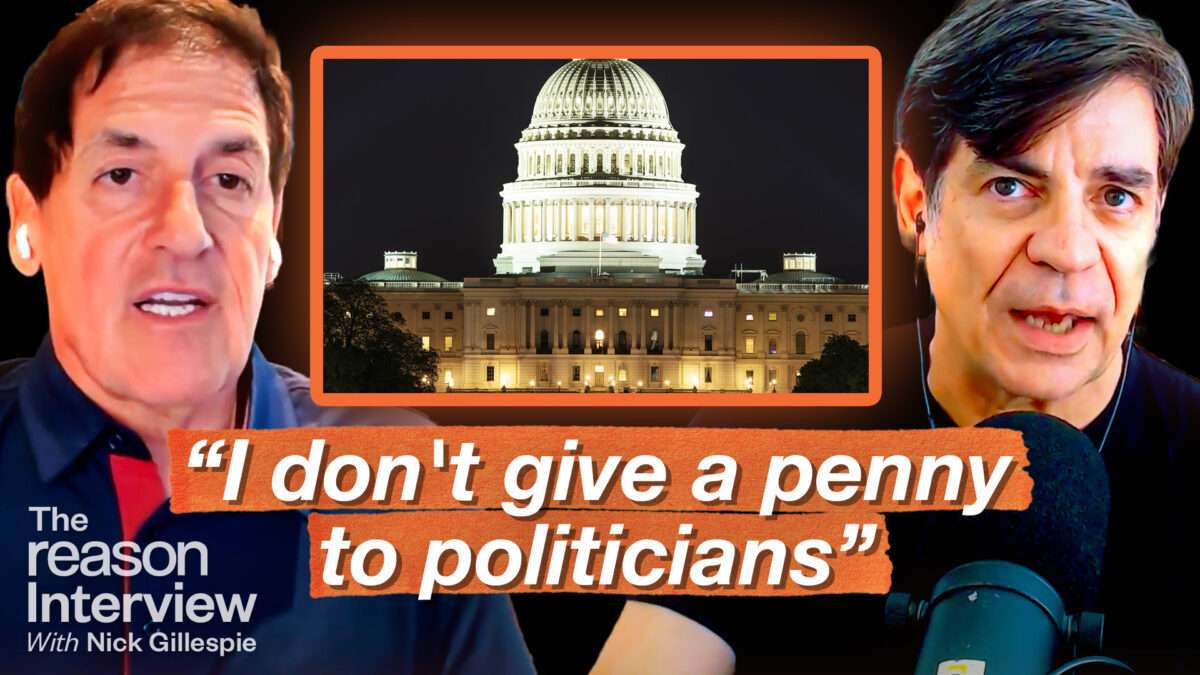
Today's guest is Mark Cuban, the billionaire entrepreneur and former Shark Tank star who is now on a mission to reform the American healthcare system. Through his companies, Cost Plus Drugsand Cost Plus Wellness, Cuban is trying to make healthcare more affordable by cutting out middlemen and making pricing more transparent. But he argues that fixing America's healthcare system will require breaking up massive conglomerates that wield enormous power over pricing and competition, often at the expense of patients.
Nick Gillespie talks with Cuban about why he supports bipartisan legislation from Elizabeth Warren and Josh Hawley to break up Big Medicine. Cuban explains how artificial intelligence can expose hidden costs in health insurance contracts and transform the way doctors diagnose and treat patients. They also discuss Cuban's support for Texas Democrat James Talarico and his belief that political parties have outlived their usefulness. The billionaire entrepreneur makes the case for restricting social media algorithms for children under 16 and discusses why he isn't particularly worried about socialism's growing popularity among young people. Finally, Cuban reflects on how Ayn Rand's The Fountainhead shaped his understanding of capitalism and why he believes helping others is part of being a successful entrepreneur.
0:00—James Talarico and the Break Up Big Medicine Act
4:13—Healthcare conglomerates and "contractual terrorism"
15:39—Drug pricing and pharmacy benefit managers
26:58—How AI will transform healthcare
33:04—The Trump administration's policy reforms
34:22—How does Cost Plus Drugs work?
43:08—The backlash against billionaires
47:52—Political parties and Texas governance
51:50—The rise of support for socialism among Gen Z
55:11—Would Cuban back a social media ban for minors?
This is an AI-generated transcript. Check all quotes against the audio for accuracy.
Nick Gillespie: This is The Reason Interview With Nick Gillespie. Thanks for listening, watching, however you're consuming this. My guest today is Mark Cuban, the former majority owner of the Mavericks, now a minority owner, if memory serves. And that's partly because you're going all in on Cost Plus Drugs, a company and a business model about prescription drugs and, more broadly, wellness and health care. We're going to talk about that in a little bit, but right now, you have recently in a very tight Texas Senate race, you've endorsed James Talarico, or you're speaking with him, partly because he has talked about coming up with a health care plan that you think will reduce health care costs. Can you talk a little about the Talarico plan and why that was so important for you in terms of signing on to appear with him?
Mark Cuban: I mean, really, what we agreed on is that we need to pass Elizabeth Warren's and Josh Hawley'sBreak Up Big Medicine Bill. And that was the fundamental reason why I supported him. I mean, there are other reasons as well, but I think that as long as we have these huge conglomerates that dominate the economics and provision of health care, the system's not ever gonna work, and we're gonna get what we have right now.
So, identify what is the main problem with health care right now? Is it just that everything costs too much, and that's because of the big conglomerates? Or is it that the quality of care is no good, the rate of innovation is dying?
What's the main problem with health care?
It's the economic side. I mean, the U.S. has the best health care in the world. It's not even close. The problem is, it's not accessible to everybody, but it's not affordable to most. And that is underpinned by how the biggest conglomerates in the country, that do hundreds of billions of dollars each in revenue each year, dominate the economics of health care.
So how is the Break Up Big Medicine Act or bill how is that gonna actually reduce costs? Because I know in the past you've talked about being a small-l libertarian. You're obviously very much in favor of capitalism. You don't hate billionaires. You don't like wealth taxes. You like free markets. How is the Break Up Big Medicine Act gonna work? Because one of the reasons we're where we are now is because of all of the past government intrusions into the market or structuring of the market. I mean—
No, that's wrong…OK, let's just…
I mean, the government already spends about 50 cents of every dollar in the healthcare ecosystem. So it's not like this is a market, right?
Well, it's not a market. You're correct though. Right? But in order to have an efficient market, you have to have price discovery. In order to have price discovery, you can't have gag clauses in every single contract that every single health care—you can't have gag clauses in every single health care benefits contract that's signed. Period. End of story.
And who commands those gag clauses? The big companies that need to be broken up. And it's not an issue of what the government is doing. It's specifically an issue of the choices that are being made by the CEOs and C-suites of those companies.
You look at the largest vertically integrated health care companies: 3,000-plus subsidiaries, $150 billion in intercompany transfers. That's more than the GDP of 13 states. And so they literally dominate the economics. And that's just one company.
If you go to the top three, the point of this is, the leverage is not with the federal government in this particular case. The definitions, the relationships, the pricing, the rules are being set by these big conglomerates. And if you were to break them up, it would change.
Ok, so we can work through a more specific example. What's the worst conglomerate, then, or the biggest healthcare—vertically integrated provider? And how are they bilking everybody—customers, doctors, hospitals, unless they own the hospital system? Who's the worst, and how is that working?
UnitedHealthcare. They're the ones that have thousands of subsidiaries, $150 billion, $160 billion in intercompany transfers. They either contract or employ more than 10 percent of the doctors in this country.
Out of those 3,000 subsidiaries, they own pharmacy benefit managers, they own health care providers, they own what they call ASOs, third-party administrators that administrate care. They own Medicare, Medicaid, MCOs that manage Medicaid for states. There's just—I can't even begin to start to list all the different things that they control.
So one of the ideas behind a vertically integrated company is that they— if you are sourcing your own cost inputs, you can do things more efficiently, and you pass that on to the customers. So McDonald's grows its own potatoes because—
Sure, I know I get it. I know the potential benefit. Yeah.
Oh, no, no. I know that. So explain—
It's also a choice. So, here's the choice. You can pass it on and say, "Look, we're going to be more efficient and pass on the benefit of our efficiency." And the easy way to understand whether that's occurring—there are two easy ways.
One, to ask anybody who uses their services or any of their peers, and just ask them: Have you felt like you've been the beneficiary of their scale?
Based on the polls going around for these midterms, right, the number one issue is affordability, and the number one underpinning of that affordability is the cost of health care.
Number two, being a healthcare geek, I will read the transcripts of their quarterly earnings conference calls. The one thing I have yet to ever hear them say over the past four or five years is that, "Based on this investment, based on this new technology, based on this acquisition, we are going to be able to reduce the cost of care or services to patients that receive that care." Not one.
So patients just don't show up in the way you're talking about it? It's like…
Not at all.
We've streamlined like our costs—
Right. Well, not even necessarily streamline our costs, but what does show up is: "We are going to be able to increase our earnings along with our previous trend. We are going to be able to increase our margins and our revenue for specialty medications," right? There's just a long list of things that they are pushing.
And the bottom line of this—and every capitalist, every CEO has to decide who they're responsible to. Typically, in a public company, which all of these are, they're responsible to shareholders. And that's not necessarily a bad thing if they're aligned also with their customers, their ultimate customers. It may not be the direct customer, but the ultimate customer, which is a patient.
They are not aligned. Not only are they not aligned with the patients, they're not aligned with any other stakeholders.
When you talk to corporations, big or small, a solo entrepreneur, 100 employees, 100,000 employees, and you say, "How are your health care costs doing these days? Are they going down? Are they going up?" And obviously, the response is they're going up.
And you talk to their members, their employees, their families: Are your deductibles and premiums going up or down?
And so the proof is in the pudding that they're aligned with their shareholders, but they are not aligned with their ultimate customers. And that creates a disconnect. And those are the decisions that they've made. In one case, with a tragic outcome, unfortunately.
And so going back to the Break Up Big Medicine Bill and the outcome, when you have somebody who is that big and has that much control and that much regulatory capture, it's AT&T time. It's Standard Oil time, again.
Yeah, I mean, but then it gets complicated. And I don't want to spend too much time on this, but in the sense that when Standard Oil got broken up, they were actually charging the least for their products in their history.
This should be easier then, right? Because now these guys are charging the most.
No, no. Well, I'm saying it gets complicated because you mentioned regulatory capture, and this is part of the problem. Like, if UHC, if UnitedHealthcare is so bad, why do companies keep using them as a benefit?
I'm so glad you asked that. Why do they keep on buying from them, right? Why do they keep on doing business with them? Right?
Right.
So I spend most of my days going to CEOs and explaining to them how they're getting ripped off and how they are getting worse outcomes by dealing with these big conglomerates. Almost all my days. And what I can tell you—
I'm sorry to interrupt, just real quick, because just to get you on the record on this. You're not against bigness per se…
No!
Right? Big conglomerates—because people like Elizabeth Warren often are like, if it's a big company, break it up, right?
Not the issue to me at all.
If I were running that company, I'd be like, "We are so efficient. We are so good at what we do. We use AI and technology better than anybody, so good that we're pushing prices down." And because of that, we'll make more money.
And you know what? Even if we don't make more money, we'll make enough to keep our shareholders happy. But you know what? I'd rather be a great citizen of this amazing country of ours, and if that means better health care at less cost, and our P/E ratio needs to be a little higher to get that stock price where we want it, I'm good with that.
That's how I would—so I have no problem with scale.
The problem I have, like when you talk to people who work for these companies, when they say, "Yeah, I work for whoever," the first thing they say to me is, "I'm sorry. I need the job."
It's not like they're proud. It's not like, "Hey, we're doing such amazing things." And so that's the underpinning of all of this.
So go back to your point on why do companies hire them, right?
I spend so much of my time—literally before this call, I dealt with a group of people who were HR representatives and buyers of these services. And I said, "Do you like these companies that you're dealing with?"
They refer to the big insurance companies as the BUCAs, right? Blue Cross Blue Shield, United, Cigna, etc.
And they're like, "No, we don't like dealing with them."
I'm like, "Why do you?"
"Well, because our CEO just doesn't understand health care costs and health care benefits. And they may know somebody or do business with them."
Like, I've literally talked to humongous banks who have said that we're not going to switch because we'll lose their deposits and banking relationships.
Ok, that happens. So let's put them out.
So now I was talking to this group today, and I started giving examples of places where those big companies were taking advantage of them. And I went directly to contracts because most of the contracts are comparable.
So I call them contractual terrorism.
The city of Dallas, we'll use them as an example. Their pharmacy benefit manager contract: 1,300 pages. There's no human or humans or enough coffee on the planet.
I don't even know if the AIs are capable of scanning that.
Well, the AIs are capable of doing it, right? You kind of got ahead of me there, because before they were able to push things through.
So, like, for pharmacy benefits, there are these things called rebates, where the manufacturers give money back to the pharmacy benefit managers, and they have the choice of how to distribute it from there depending on the contracts, right?
And one of the biggest sources of rebates is something called specialty drugs. They're supposed to be more complicated drugs. Just as often, they're not, but they call them specialty.
But in these contracts, and I literally asked the question of this group who has a good understanding of their contract, I said, "How many of you have a clause in your contract that says specialty rebates, specialty medications either get a flat rebate or no rebate?"
They all raised their hands.
And then I said, "In that contract, doesn't it also say that that PBM owned by that big BUCA—"
That's the pharmacy benefit—
Benefit manager, right, gets to determine what is a specialty drug or not. So in some cases, it could be generic, it could be a little pill, and they call it a specialty drug so that they get to arbitrage the rebate or to retain the rebates instead of sharing them.
So going back to the question of why would a company do this, and it's even worse on the medical side. That's the pharmacy side.
There's no company that, if you work for a company that's self-insured, and God forbid you need to get some major surgery, and so they send you a bill, not even specifically to you, but for the whole company every week or every month, right? And the company just writes the check for the bill, and they may or may not even get examples of the claims so they can reconcile them to what was actually charged or paid to the hospital.
So you have these huge companies that have no way of reconciling whether or not what they were charged is what was paid to the hospital or doctor or provider.
So I was like, why do you do this? Why are you letting yourselves be taken advantage of? And it's because, "Well, it's just happened, it's changed so rapidly, and the prices have gone up so rapidly. We're still in the contract. We're still doing it."
And I'm like, so let me give you the way to resolve this. And this goes back to AI.
So what I've done, and I've done it for my companies, I've helped other companies do the same, I've helped states do the same. Now, with AI where it is, and it's only recently capable of doing this, you can take a 1,300-page contract. You can take a 600-page contract, and I tell them, take the PDF file of all of your health benefits contracts and put them into your favorite large language model and just use this prompt: "Where are they ripping us off?"
And within five minutes, you'll see, boom, boom, boom, boom, boom. Because it's contractual terrorism. They only have to squeeze through a couple of things that the lawyers don't see, and that changes the whole contract, and everything economically references the contract.
So part of, I mean, in any kind of market that's not working well, price signals are arbitrary or buried. There's a lack of transparency. People don't know what they're paying for, what all of the benefits are, how much they cost, and things like that.
There's also, and I know you've talked and written about this, where it's exacerbated by the fact that the company, I mean, a health benefit, it's not what your main company is doing. They're offering it for a variety of reasons. And this goes back to World War II or wage and price controls and things like that.
You know, whatever my company…I don't even know what my—Reason Foundation, the nonprofit that publishes this podcast, I don't know what they pay monthly for my premium. And I barely know what my premium is.
And do you know what your deductible is? Do you know?
Yes, I do indeed. And I had a kid last year, so I'm always hap—
Let me ask you a question, over $1,500 a year?
Yes, for the overall, it's like $6,000.
OK, so $6,000. Have you ever been prescribed, or has anybody in your family been prescribed, a brand medication?
No, I gave up on brand medications a while ago. I always go for the—but what's your point?
No, my point is that brand medications without generics, right?
Right. Yeah, yeah.
So let's just take a drug likeXarelto. The list price of Xarelto, sold by J&J, is $600. The way the system is structured by these big BUCAs and their pharmacy benefit managers is such that during your deductible phase, you and pretty much everybody else, unless your company negotiated something different, have to pay the full retail list price for that medication.
That's insane. Now the question becomes, why does that happen?
And I'm going to explain to you, and this is way inside baseball, how pricing for brand medications is done in the United States of America.
We'll, excuse me, we'll take a drug like Xarelto because it's easy to understand and use. $600 list price. When J&J sells that to one of the three big wholesalers—there's three of them that control 95 percent of the pharmaceutical transactions—when they sell to that wholesaler, you know what they sell it to them for? List price, $600.
Sounds crazy. If they came on Shark Tank, Kevin would probably say, "Take them out behind the barn and shoot them," because it makes no sense that multihundred-billion-dollar companies don't negotiate a discount.
But they're lucky in that the brands will give them 5 percent back if they prompt pay and give them some data.
So now let's just say 5 percent from a $600 drug means the net cost to the wholesaler is $570. That sets the floor for what they can charge pharmacies because they're not going to sell it for less than they pay.
Now what happens next, then, is now a pharmacy has paid $570 for that drug. When you walk in, or any of your family members walk in, or anybody who works for the foundation walks in who has a comparable deductible, the pharmacy can't sell it to you for less than $570 because that's the charge.
Now that's ridiculous in and of itself because you know how much J&J actually nets, give or take, for that medication? It's not $570. It's about $300.
Their yield, their net revenue is about half of the list price. And so where does that delta, the $570 minus $300, where does that go? That goes to the pharmacy benefit manager.
Now, if this was a real market where they didn't have control because of their control of formularies and lives covered, then J&J and all the other brands in the same situation would then sell to the wholesaler at $310. Remember, their net yield was $300, so they'd make $10 more.
And remember, the wholesaler was selling to the pharmacy for no markup. They make their money on generics, right? So they could sell it for $320 to the pharmacy, and they'd make more. And then the pharmacy could sell it for $325 to you and your family or any underinsured or uninsured patient, and they'd make more.
So everybody would make more, but more importantly, more people would be able to afford their medications, and more people would be able to adhere.
So the question becomes, why does it not happen that way? Because in a capitalist society, people are going to act in their own self-interest. That's the beauty of capitalism.
People are always going to find shortcuts and disrupt so that I can get you something…
Right, wherever they can. So I'm going to tell you why it doesn't happen, right? Because those big PBMs owned by the big BUCAs, they control these things called formularies, and they control the formularies for 85 percent of people who receive pharmacy benefits.
And the formularies are the drugs that are covered by a particular plan?
Correct, correct.
And if your medication is not on that formulary or it's on a low tier, because you know in your tiers for your own health care, right, you might pay zero, $10, $50, coinsurance, whatever it may be.
Well, so these PBMs are saying to the brand manufacturer, they've told me this, that if they don't play the game this way, sell at list price and only give a 5 percent, don't do it at net, if they don't play the game that way, they will diminish their positioning on that formulary, not just for that drug, but for their entire portfolio.
It's the same reason Cost Plus Drugs doesn't have a lot of brands, because they've said the same thing: If you work with Cost Plus, then we will diminish your position on the formulary.
So two quick questions that I think will clarify what you're talking about. One is, where did the pharmacy benefit managers come from? They weren't always part of vertically integrated institutions, well let's start with that. PBMs have been around at least since the '60s, and the whole idea, and it makes sense, is like, we're going to arbitrage a lot of possibilities, and we'll sell more drugs for the people who are making them, and we'll sell them cheaper to the people who are buying them.
But really just processing claims. Right? Somebody, there's a prescription, and you have insurance—
Yeah, how do we go from there to, I mean, PBMs in a lot of ways, those are your white whale, right? That's what Cost Plus Drugs is going after. That's where you tend to—
The whole thing. They're not a unique company. They're part of these vertically integrated companies, right? So culturally, they are the same, right? Optum Rx has the same organizational culture as United, CVS, etc.
So how did they get there? Vertical integration.
And once an insurance company who already had X number of plans that they control now buys a PBM, what they say to the employer and Medicare Advantage plans, they'll say, well, let's just start with employers, right?
Self-insured employers. Sixty-seven percent of people who get insurance through their company get it through a self-insured employer. That's about 150 million, 160 million people, right? And so those all go through a PBM at some level.
And by being able to control that, plus Medicare Advantage plans, plus Part D plans for Medicare, they have such market dominance. It's like they have more customers than Amazon does.
And just imagine Amazon saying, "If you don't do business the A, B, or C way that I demand, we're not going to allow you to sell on Amazon. Or we're going to make it so that somebody has to make 15 searches to find you."
That's the equivalent of what these vertically integrated companies are using their PBMs to do.
Yeah, how does the Break Up Big Medicine Act specifically address this issue of vertical integration?
Well, it's breaking them up by definition, right?
I mean…
So then what's the benefit. Right, how do we get the lower prices and all that, right?
And so without having the market dominance to define and threaten, to say, "Look, we're not going to work with you unless you do it our way. And if you don't do it our way, you're going to lose access to 180 million customers," it ends that.
Yeah. And it says things like, if you are a medical provider, you cannot own this type of company. So, I mean—
So then we can talk about medical loss ratio and all that.
It tries to end vertical integration or limit vertical integration.
Limit vertical integration, right. Because once you get market—and there's another part that we haven't talked about that goes hand in hand with doing capitalism the right way.
So in order to have an efficient market, and you mentioned this, you have to have price discovery. In order to have price discovery, you have to have price transparency and some level of contractual transparency. Because if the prices are in the contract, then you have to have some transparency there.
You know the old Fight Club thing? The number one rule of Fight Club is you can't talk about Fight Club. The number one rule of pharmacy benefit manager and ASO and other contracts from these vertically integrated companies, their number one rule is you can't talk about them. They have complete gag clauses.
So they literally say that—well, I'll give you a better example.
TRICARE, that offers all the pharmacy benefits for all the people serving in the military, retirees as well, right? They have their plans and everything. And for certain of their plans, particularly if you're a retiree who lives off base, you don't live on a military base, then you have to order certain generics from Express Scripts slash TRICARE, and the copay is like $16.
Well, it's cheaper in many of those cases to buy from Cost Plus Drugs. Just proving the point that it's not necessarily getting the best price dealing with a bigger company.
But that's not the bad part. That's not the bad.
We still have no idea, none, zero, how much taxpayers pay for those same drugs because they prevent everybody from seeing it.
Elizabeth Warren said she was willing to go and sit in a SCIF in order to be able to look at those prices, and they refused to allow it.
And a SCIF is a secret room where you can read super top-secret documents.
Yes, right. And they still wouldn't show them to her.
And so here we are taking taxpayer money. And if they're doing such a great job, you would think they'd be proud of their pricing.
"Mark Cuban, you can't touch our pricing with Cost Plus. We want everybody to see that. We'll put you out of business"
Yeah. So, I mean, part of the idea is, like, if you introduce transparency into more markets and people understand what other people are paying, you get a more informed market, and innovation is going to happen, prices will probably come down.
What you're talking about, like if you're going to the city of Dallas and you're saying, "Hey, here's a way for you to push back on your benefits provider and maybe to shop for better things." Part of it is information, part of it is regulation, and something—when I think of two people I hate for different reasons, but with almost equal ferocity, it's Josh Hawley and Elizabeth Warren. Most of the time when they're talking, I'm like, "Hey, all I know is my freedom is going to end up on the cutting room floor," right?
But there's regulation, and then there is the ability of individuals to make choices, meaningful choices.
I guess you talk a lot about AI in very positive terms, and you've laid out one way in which AI might help by just making people capable of understanding documents, contracts that they're about to sign.
In this particular case, absolutely.
Yeah, what are the other ways that you think AI is going to transform and improve the quality and quantity of medicine and health care?
One is drug discovery.
We'll get to the point, I don't know when, where we'll be able to take genetic information about ourselves, if we choose to, and make that available to far more advanced artificial intelligence than we see today, and say, "Analyze this. Tell me what I should be concerned about." Or, "Here's everybody in my family. Let's compare it and look for deltas and see how we can use AI to improve our health or wellness."
Make, like, personalized medicine.
Yeah, I'll give you a perfect example, right?
I have to take Synthroid for a thyroid scenario. And I was taking iron supplements because I work out and I sweat a lot, and my iron levels were low. I had no idea you couldn't take them at the same time. None. My doctor didn't know because you can't remember everything. And so I put it into Claude, and boom, I found out you've got to take them at least four or five hours apart.
Simple, simple, simple example.
We're all using Dr. ChatGPT and Dr. Claude to a certain extent. Doesn't make them perfect, doesn't make them accurate in all cases, but it gives us access to this information we otherwise didn't have.
But to go back to your question, as AI gets more advanced, not only will we be able to use it for personalized medicine, but it's capable of memorizing everything.
Now, AIs don't know the consequences of their actions. AIs don't have ethics, right? AIs are not smart. They're just able to combine things in ways that they've seen before or ways that you tell them to do. But within that constraint, doctors will be able to use them to more efficiently and effectively make determinations about somebody's health. So I see it as a big positive as long as we all understand that there are certain things that they can't do.
I'll give you one more example.
The minute an AI is released, we're done training and it's made available to the world, it's out of date.
This brilliant conversation you and I are having right now, no AI knows about. And even if it's published, unless you publish a transcript along with it, it has no way to consume the video itself.
So there's always built-in latency. And so because of that, it's always going to be behind.
And you talk about a capitalistic system and how people adapt. Well, researchers and doctors who publish are recognizing that, "Hey, maybe it's smarter that I don't publish, I don't try to patent this particular device or approach to solving a health care problem. Instead, I'll just keep it to myself and either sell it to a company that can benefit from it or put it in my own model."
And so that means you're going to have disparate information in different models.
AI is probabilistic. It's not deterministic. You're not going to ever get a scenario where you put something in four different models and you get the exact same answer.
So within health care, we have to understand those constraints. And by understanding those constraints, we can use the tools to our benefit. And I think that improves health care in a thousand different ways.
Let's talk a little bit about the regulatory framework. Donald Trump and Robert Kennedy, secretary of Health and Human Services, talked, particularly for round two, or the second term for Trump, talked a really big game about changing the regulatory apparatus at places like the FDA.
It costs anywhere from a billion to several billion dollars, might take more than 10 years, to bring a drug to market. By the time it comes to market, part of its patent life is already over, et cetera, and things like that.
Are there regulations, are there policy changes that the Trump administration has made that you're bullish on, that you think were in a right direction?
I think with things like biosimilars, which are effectively injectable generics, they removed one of the steps, which I thought was smart. Because having that, I forget the exact terminology, my partner knows this stuff better than I do, but having that third-tier trial to confirm what you already know is going to happen, and there haven't been any exceptions to prove that you need it, I thought that was really smart.
But I don't get involved in the FDA side in depth as much as I do on the commercial side.
Right. Well, let's talk about Cost Plus Drugs and explain the mechanics. Before this, I went to—and of course, because he has to put his name on everything, Trump started a prescription program online, TrumpRx. It's a government program where you can get coupons, basically, for things.
One of the drugs that I take is an off-patent statin, and it used to be known as Crestor, right, when it was on patent. And I looked up on the TrumpRx plan, it would cost me $8.60. And then I went to Cost Plus, and it said it would be $5.66. This is for a 30-day supply, 10 milligrams. And then I'm on Cigna, and it costs me zero when I fill that prescription.
But it doesn't cost you zero, right? You're paying it.
Yeah, absolutely right. And unfortunately, it costs my colleagues something. They chip in a little bit as well. But how does Cost Plus— how does it work? If you go there and you already have insurance, how do you use it in a way that you know what you're going to pay for a drug, and it's probably going to be cheaper?
So two different paths, right?
So if you have insurance, then if you work with one of the big PBMs, the big three PBMs, you're not going to be able to use your insurance with Cost Plus Drugs.
There are about 35, give or take, pass-through PBMs that we partner with. So if you have insurance cards from them, you just go in there and click on insurance, and you put in the card ID, and you get the benefit. It's probably going to be a zero copay, but we'll ship it to you, right? Because that's the benefit of sorts.
If you happen to be somebody who is on a Medicare Advantage plan and are prescribed a drug that's not covered, it's not on your formulary, or there's a high copay or high coinsurance, that's a perfect customer for us because you can come to us. We're far less expensive, including shipping and handling and everything, and you use us to save money.
And if you're in one of eight states, Tennessee, Texas, and a few others, then you can also count that against your deductible.
If you're completely uninsured, then we're a godsend for you, particularly if it's an expensive medication, and particularly now with biosimilars. So now there's a biosimilar for Humira. There's a biosimilar for Stelara. Last year, Stelara would have cost you or your employer or somebody $127,000. Now our cost is $365 plus shipping.
Yeah. What limits the types of drugs that you offer? Because I noticed, I think when I looked today, there were no GLP-1s, right? You don't do things like Adderall or the generic versions of Adderall. Explain why those are—
On controlled substances, we just don't want to fight the battle, right? Because there are just too many risks, and we wanted to make sure that we weren't in a position of contributing in ways we didn't want to contribute.
In terms of GLP-1s and brand medications and specialty medications, as I referred to earlier, the big PBMs have gone to the brand manufacturers, specialty manufacturers, and told them, "If you deal with Cost Plus Drugs, we will diminish your positioning on our formulary."
Now the question becomes, why? Why do these huge conglomerates care about us?
Well, there's a study that's getting ready to come out that says every area of health care costs has gone up over the past 30 years, except starting in 2022, the cost of generics started to level off and then started going down.
That's when we launched, January of 2022.
And the reason that happened, and the reason these big PBMs and conglomerates are afraid of us, is because when you go to Cost Plus, you put in your statin, right? And we showed you our actual cost, and then we showed you our markup was only 15 percent.
And so if we were to do the same thing with brand drugs, all of a sudden, all that premium, remember we talked about the pricing of brand medications, all that premium margin that is going to PBMs to keep or distribute would be gone.
Because everybody would finally know the actual cost, just like they know the actual cost of biosimilars and specialty generics and general generics, like you saw.
Do you think, in a market sense, is the function of Cost Plus, obviously, is to sell drugs or deliver them to people who need them at prices they're willing to pay or want or can afford, but is part of it also that it disciplines the big guys? Because if what you're saying is true, they're going to have to start taking into account that if we keep squeezing this stone—
So then where are the limits of that effectiveness? When I mentioned Standard Oil, at its peak market share, was selling its products for the least amount. It was because they had a monopoly. They had over 90 percent of market share in home heating oil and lighting and things like that. But they acted as if they were constantly about to be…
Go out of business.Yeah, yeah…
Right. So, I mean, where are the other places in the medical industry? In recent essays, and preparing for this, you said, well, it's not the pharmaceutical companies, because they're often—
They're not innocent, but they're not the worst—
Yeah, ok. It's not the doctors. It's not the government. But when I look at it, it's like the American Medical Associationand other groups that govern the number of medical licenses that get issued every year or the number of resident beds that are available. They're not doing anything to increase supply.
No, I agree. I'm not saying I agree with that, right? But the AMA is not a government entity either.
Well, it's quasi, right? Because you have to show—but I'm saying, how do you bring that same kind of market force, that kind of comp….This is like real competition to say, "You know what? My competitor, who's got 90 percent market share, is selling something for $10 a unit. I'm going to sell it for $8 a unit, and I'm still doing well, and you're making out better, and they're going to have to change." How do you bring that to bear on the larger healthcare system?
Because what it's missing is not only price, but trust. Nobody trusts the economic side of health care. You don't. I don't care who you are, right? Every poll, everything says…right.
I look at trust as a formula: Trust equals transparency divided by self-interest.
We're completely transparent. We show our costs. We're still the only pharmacy that publishes a price list. We have a programming interface where anybody can pull down our pricing anytime they want.
So we're completely transparent there, and we only mark up 15 percent. So that's fair, right?
And so that's what differentiates us to start, right? So people can work with us, and they trust our pricing. They know what it is.
We charge the same price to everybody, no matter who you are, where you are, what time of day it is. It doesn't matter.
When our volumes go up, like with TrumpRx, it's a portal. As you saw, you can come find your way to us. Our volumes went up. Our costs went down.
At Cost Plus, we pass those cost cuts on to our patients. We were able to lower the price of 190 more drugs. And so we're able to start with these drugs, right? We're also getting involved with manufacturing. We manufacture drugs that are sterile injectables that are on the FDA short supply list.
We also have used AI and used robotics to shrink the size of our initial manufacturing plant from football-field size, so about 5,000 square feet. And over the last five years, we've been able to shrink that into the size of a tractor-trailer.
We call them pods. And these pods are going to be our biggest business. They're our most disruptive business because we've been able to combine AI and technology so that we can take these little things, tractor-trailer size, and ship them anywhere.
Ecological disaster, weather disaster, God forbid, war disaster, we can put them there and, depending on what kind of pod it is, make any kind of drugs.
And because we can daisy-chain these things together, we're able to manufacture in volume so that we can manufacture generic tablets cheaper than we can buy them from India.
So then let me, and this might seem like a leap, but in what you just described, and particularly the trust divided by self-interest, all of what you're talking about, all this innovation, why do people—or let me say this: If there's anything that's less popular than data centers and AI, it's billionaires like yourself.
What you just gave is a riff that is, if you believe in free minds and free markets, that's been Reason's catchphrase for decades, this is beautiful. And you're describing exactly how the system should work.
But we have, in contemporary America, people, including people like Elizabeth Warren, the governor of California, who want billionaire taxes. There are members of Congress who have staff members who say every billionaire is a policy failure.
Where is the anger? And when I say people like you, there aren't that many billionaires, but in terms of economic innovation and people doing well, it seems like it's worse now.
If you can't pay your rent, if you can't pay for your medications, if you can't pay for daycare, if you can't pay for food, you're just mad.
And when you're mad, you're not looking to say, "Ok, let me find a logical construct to define why I should be mad or why I'm in these circumstances." You're just mad.
And when you're mad like that, and I've been broke, right? Six guys living in a three-bedroom apartment, et cetera, no money in the bank. You're just mad at whoever is a convenient target.
And so I don't begrudge them. Hopefully, they'll eat me last.
I understand why politicians say billionaires are a policy failure because we're an easy target. I don't blame them for doing it that way. But as an entrepreneur, I'm still going to do what entrepreneurs do. It's why I did Shark Tank for 15 years, because I wanted people to be excited about being an entrepreneur. I wanted them to see, when they watched the show and somebody walked in on that carpet from Idaho or Iowa or wherever with nothing, they had a chance for their American dream to come true.
And if they can do it, I wanted them to think, "I can do it."
And so do you feel like that dream is still alive? Or is it, because when people talk about, ok, it's hard to make rent, it's hard to do this, it's hard to do that. All of this struggle is always real. But is it just that that's the struggle? I mean, are things worse now than they used to be?
No, they're not necessarily worse, right? But we communicate differently now than we did before. Each of us is on social media at some level, whether we know it or like it or not. And each of us gets our own unique feed on social media.
There's no more Walter Cronkite. There's no more Dan Rather, where we all have communal shows that we all watched and basically understood and agreed on some level.
And there's a reason why, right? I mean, those disappeared partly because they weren't really giving people what they wanted, right?
Regardless of what it was, technology is technology. It's going to find its place, right?
I mean, I started the very first streaming company because people didn't have access to, in my case, Indiana basketball or music or whatever it may be, shows.
So people want more, but what's changed dramatically is how algorithms distribute content to each of us individually.
We all get our own individual feed on each of our social media platforms. Mine's not like yours, and they're like snowflakes. No two are alike.
And because of that, engagement increases with anger. And so every one of those algorithms has an incentive to make us mad.
Because the madder we get, the more we consume. The more we consume, the more ads that are sold. The more ads that are sold, the more subscriptions that are bought, et cetera, et cetera.
And because of that, if I'm mad about not being able to afford my rent, I'm mad about the cockroaches in the kitchen, I'm mad about the cost of beef, whatever it may be, you better damn well believe I'm getting a lot of that in my social media feed.
And if someone comes along and in that feed says it's this billionaire's or that billionaire's fault, what do you think I'm going to believe if that's 30 percent of the content I consume in any given day?
That's what's changed dramatically. And I say this all the time: Whoever controls the algorithm controls a lot of people.
Yeah. You have, in the 2024 election, I believe you're a political independent, but you came out and talked about how you wanted Kamala Harris to win. You were backing her. You're backing Talarico against Ken Paxton, the Republican Senate candidate. There's, of course, Ted Brown, the Libertarian candidate, who looks like he's going to cover the spread in Texas.
But I guess in terms of politics, at the state level, there's a real experiment going on. I'm talking to you from New York. New York City, New York state, and California are pursuing one model of governance, it seems, which is high tax, high regulation, high social services, or this is what they claim.
And then you have places like Texas and Florida that are saying we're going to do less tax, less regulation, we're going to give less services.
How do you feel about being in Texas? You've been there for decades now. It's your home place. Is Texas a better model compared to, say, California and New York state? Or how do you gauge that?
It's the ultimate capitalist decision, right? I mean.
Where you live.
Yeah, where do you live. And politicians, they sell what people will buy, what voters will buy.
And in terms of how I feel about Texas, when I got here, it was pretty much blue, and then it was purple, and then it was red, and it'll change again, just like multiple states, right?
What a conservative is today is far different than it was 11 years ago, you know? And the parties are completely different. If it were up to me, I'd get rid of all political parties. I think they've outlived their usefulness. They're just a way to raise money and to try to aggregate power as opposed to the power of ideas.
I don't give to politicians. I don't give a penny to politicians. Either you agree with what I have to say and you think it's of value to you, or you don't. And I have no intent of changing that.
Either my ideas stand up on their own, or they don't.
And in terms of my own philosophy here in Dallas, I'm an entrepreneur. And Dallas has been, Texas has been, great for me as an entrepreneur, been great for my family. I owe a lot to the city and the state, but it's changed radically, to use that term, over the years that I've been here.
Do you feel like it's getting better, getting worse, or it's just—
No, it's going to change no matter what.
The only constant is change.
My dad used to say, "You don't live in the world you were born into," you know? And it's the same thing here, where especially now with AI, I mean, there's always, like my kids, one was born before the iPhone, two weren't. Shit's going to change.
And so I don't look at it and say, "Well, pick this point in time, is it good? Is it bad?"
I look at it and say, "What can I do to make the world better?"
Look, I'm one lucky guy, right? My life is so much different than I ever possibly imagined.
And as an empathetic capitalist, right, as a compassionate capitalist, I want to give something back. My next dollar won't change my life, but it can change somebody else's life.
And when I talk to people about capitalism, that's the message I want to convey.
Now, if I was 25 again or 35 again and in healthcare, I'm sure I'd be trying to build as huge a company as I possibly could and sell it for as much money as I could because the one thing that I would want, the one thing I valued most, is time.
And the best way to gain control of your time is through your personal economics.
And so everybody's going to have their different perspective on where they live, how it's doing for them, what comes next. All I can do is try to help where I can help.
You mentioned being 25 again. Does the popularity or the kind of embrace of the idea of socialism, or the term socialism, concern you, particularly among Gen Z?
No.
Explain that, because a lot of people are like, when you hear capitalism is at a kind of historic low in terms of positive feelings, socialism in America is at a historic high, why doesn't that concern you?
So I'll go back to the algorithms and social media again, right?
When I talk to—I have three kids who are now 17, 20, and 23. And I talk to them and their friends, and a couple of them are entrepreneurial.
And their friends will come on and give me all these ideas that they think are great businesses. And I've heard them all, right? You know, shoe drops, dropships. And I'm like, these are old, tired.
Where did you get these? Social media.
How do you understand how to run this business? Social media.
Where did you watch anything? YouTube, right? Or I saw it on Instagram.
So if you take that same concept toward business, the same thing is going to work when it comes to understanding political systems and politics in general.
Kids are getting short sound bites. And if somebody who's popular and goes viral says, "Hey, I just started this business. We're going to be selling widgets at 100 percent markup. That's socialism. I hate capitalism, but I do socialism business the right way," that's the way they're going to convey how they understand something.
We don't live in a world—if I have a problem with Gen Z, it's that they don't read books.
And it's not that they can't learn because AI can be a great democratizer of information. You can ask AI to teach you anything, and like a teacher, it's not always going to be right, but you have that opportunity to learn.
It's just we don't read and consume information the way we used to. And I think that makes it harder for kids to discern between fact and fiction, information and misinformation.
And I think that's the problem again when I—
That also changes with age, right? I mean, like—
Yeah, of course.
You start to figure things out.
Yeah, hopefully, right?
But we don't know, really, because Friendster was 2006 or whatever it was, and then Instagram became popular in 2011 with Snapchat, right?
So that's only 15 years of history, really. YouTube's been around longer, but the algorithms themselves really only started to hit in 2012.
And so we only have about 13, 14 years of history. So we don't know how kids are going to evolve through this period in their lives as they become older. We have no idea.
And so when I see Australia say, "Ok, 16 and under, ehh, no social media." Some people might say, "Well, that's wrong. We don't want government involved. Let the chips fall where they may."
I'm like, no. I really believe that people don't understand how algorithms work, and they don't understand how detrimental they are not only to a kid's mental health, but their ability to learn and how they perceive the world.
I think that's a real problem. Like when you see—
Would you back a law in America, in the U.S.? Say you would be in favor of a—
16 and under. 16 and under.
I wouldn't say ban them from social media, but I would say ban them from algorithmic access.
Now there's a problem because Section 230, on Instagram an algorithm is just as protected as any other website, right? So it's a challenge.
But if I could overturn that, or at least modify it, in a heartbeat.
Ok, so then final question. You mentioned reading books, being younger. You mention Ayn Rand a fair amount, or—
All right, yes. So then I'm wondering how Ayn Rand would think about the idea of the government saying, "Ok, here's an arbitrary age level that you can access information or not." But beyond that, talk a little bit about how you came to know Ayn Rand's work and why it was so important to you.
Oh, my mom. My mom was a housewife who had every odd job you can imagine, went through every pop psychology you can imagine.
And what did they call the people who followed Ayn Rand? I forget the name they gave.
Objectivists.
The Objectivists, right? So we used to get the Objectivism newsletter. There was a guy named Nathaniel Branden who was big in Objectivism, and he would have records, and my mom would play the records.
And so I would have all that just around me all the time. And she was a Democrat, a hard-core Democrat, by the way.
But at the same time, I remember reading The Fountainhead and just connecting to Howard Roark.
And then I remember reading The Virtue of Selfishness and thinking to myself, you know what? To me, being selfish means helping people because that's what makes me feel best. And that's what being selfish is all about, doing what makes you feel best.
And I didn't take it as, "Ok, laissez faire ideology is strategy in life." I took it as being an individual and finding your way and work your ass off. There's going to be issues, but respect other people who may not have the same opportunities that you do.
And it's not like I grew up with a silver spoon. My dad did upholstery on cars, never made more than $40,000, etc.
But I always looked at it as I can find the motivation in Howard Roark. I can't tell you how many times I read that book. I had to stop reading the book because I would get so fired up that people didn't like it.
You're going to blow up a building somewhere.
No, not like that, right? But for business, right? Because I get so intense when it comes to learning things for a new business, like with health care, whatever it may be, that people have to slow me down.
And so I literally had to stop reading The Fountainhead over and over again.
Wow, that's a great story. We're going to leave it there. Mark Cuban, thank you so much for talking to Reason. And I know I, for one, will keep looking at Cost Plus Drugs.
Mark Cuban appears on the left. Nick Gillespie appears on the right. An image of the U.S. Capitol building at night appears in the center. Bold text across the bottom of the screen reads "I don't give a penny to politicians"
Jean-Noël Barrot criticises X owner in speech attacking foreign efforts to destabilise France before 2027 election
France’s foreign minister has accused Elon Musk of using his social media platform to orchestrate “massive online harassment campaigns” against European leaders as he took aim at foreign efforts to destabilise the country before next year’s presidential election.
Speaking at an Organisation for Economic Cooperation and Development conference on Tuesday, Jean-Noël Barrot pointed to the role that social media had come to play in the global battle over democracy. “The forces seeking to undermine democracy now dominate the information landscape, where they employ tactics designed to polarise public debate,” he said.

 Login