❌

Reading view

Les données commerciales permettent de comprendre pourquoi l’Ukraine a besoin de capitaux occidentaux et comment la Russie peut payer son effort de guerre

Cela fait un certain temps que je voulais écrire un article sur les destins de la Russie et de l’Ukraine depuis le début du conflit en 2014. Le fil conducteur est que l’Ukraine a drastiquement réduit ses échanges commerciaux avec la Russie, depuis 2014, sans jamais les compenser par une augmentation des échanges commerciaux avec l’Europe. Cela a eu comme conséquence involontaire que l’Europe a dû injecter des sommes importantes en Ukraine juste pour empêcher sa monnaie de s’effondrer alors que la guerre se poursuivait. Pendant ce temps, la Russie a diversifié ses échanges commerciaux avec les pays non-européens, de sorte que sa balance extérieure est aussi solide aujourd’hui qu’elle l’était en 2014, ce qui lui procure les liquidités dont elle a besoin pour soutenir l’effort de guerre.

Points importants :

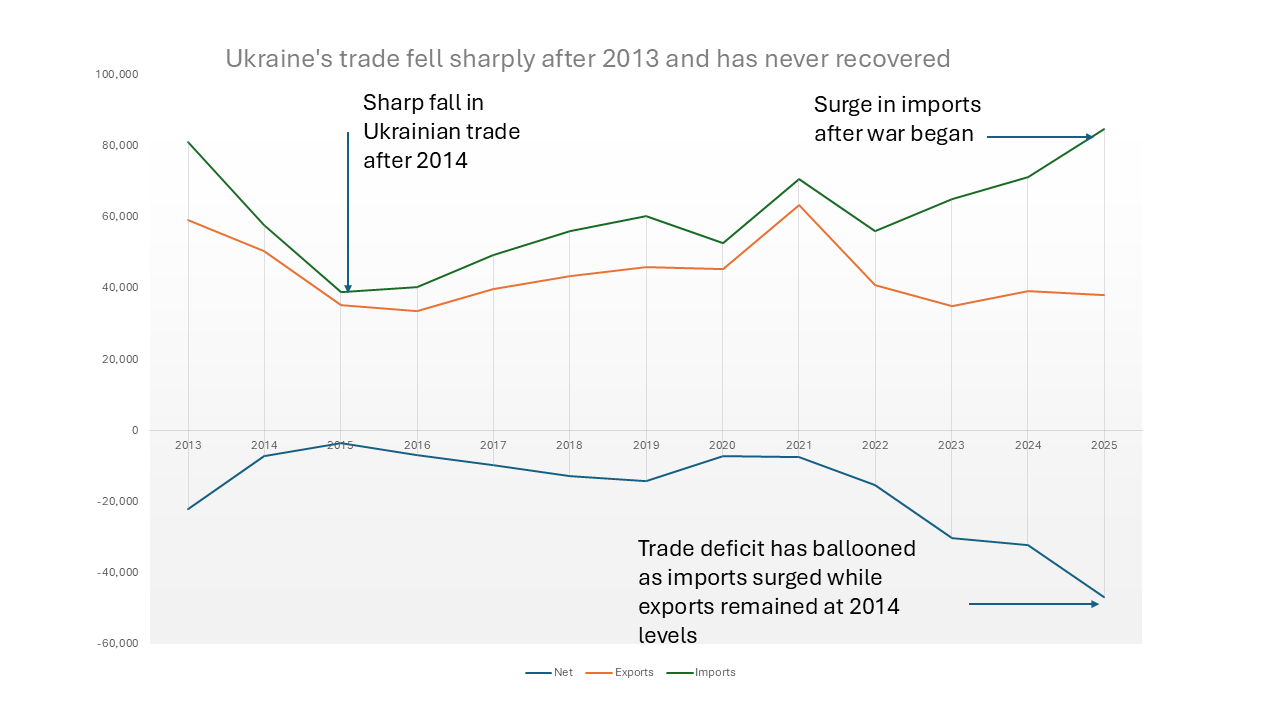
  • L’Ukraine a exporté 24% de moins et importé 46% de plus en 2025 qu’en 2014. La guerre a fait grimper les importations alors que les exportations ne se sont jamais remises de la signature de l’ALECA et ont été entravées par l’effort de guerre.
  • Le déficit commercial béant que l’Ukraine a creusé depuis le début de la guerre a exercé une pression accrue sur les sponsors européens pour qu’ils fournissent le capital dont l’Ukraine a besoin pour empêcher l’effondrement de sa monnaie, en plus de fournir des fonds pour répondre à ses besoins budgétaires.
  • Ce défi de financement pour l’Europe persistera après la fin de la guerre, tant que l’Ukraine ne sera pas autosuffisante en stimulant ses exportations et/ou en attirant suffisamment d’investissements étrangers pour compenser ses déficits commerciaux.
  • La force des exportations russes et ses excédents commerciaux constants n’ont pas été affectés par la guerre. Après le début de la crise ukrainienne, la Russie a commencé à diversifier ses principales exportations d’énergie hors d’Europe, ce qui lui a permis de résister à la réduction progressive de ses exportations vers l’Europe. En effet, la Russie a tiré une énorme manne, en 2022, de la flambée des prix de l’énergie. Il n’y a aucune preuve que les sanctions aient eu un impact significatif sur le modèle d’exportation russe.
  • La Russie avait déjà commencé à réaccumuler des réserves de change après l’effondrement des prix du pétrole fin 2014, jusqu’avant le début de la guerre. Suite à l’immobilisation des 300 milliards de dollars de réserves russes en Europe, la Russie a commencé à accumuler des réserves en or, pour sanctionner les bénéfices futurs. La Russie dispose désormais de réserves liquides de plus de 420 milliards de dollars, ce qui signifie que l’immobilisation de ses réserves de devises étrangères n’est plus un facteur limitant sur le plan économique.

Analyse détaillée

Le modèle d’exportation de la Russie, dans lequel elle enregistre constamment d’importants excédents commerciaux, lui a permis de générer les réserves de devises étrangères et d’or qui ont sans aucun doute contribué à financer la guerre en Ukraine. Le déficit commercial de l’Ukraine s’est creusé depuis le début de la guerre, nécessitant des injections continues de capitaux européens pour empêcher l’effondrement de sa monnaie.

Cela aide à expliquer que la Russie puisse soutenir la guerre plus longtemps ; elle n’a pas besoin de contracter de nouvelles dettes importantes, sa dette restant faible, à 20%. L’Ukraine ne peut financer la guerre et maintenir ses comptes nationaux en équilibre qu’avec de l’argent européen qui ne peut être garanti à long terme et qui, de toute façon, a augmenté la dette ukrainienne de 20% du PIB en moyenne chaque année depuis le début de la guerre. Ce n’est pas durable.

L’Accord de libre-échange approfondi et complet de 2014 a désavantagé l’Ukraine car il forçait le pays à ne plus commercer avec la Russie.

Le point de départ est la signature par l’Ukraine d’un Accord de libre-échange approfondi et complet avec l’Europe, le 27 juin 2014.

Herman van Rompuy, alors président du Conseil européen, déclarait alors que « des liens politiques et économiques plus forts apporteront plus de stabilité et de prospérité à l’ensemble du continent européen ».

Au même moment, le président Porochenko déclarait « au cours des derniers mois, l’Ukraine a payé le prix le plus élevé possible pour réaliser son rêve européen ».

Car le véritable cout de cet accord a été supporté par l’Ukraine qui a vu ses exportations s’effondrer et ses importations augmenter, car elle avait fait le « choix souverain » de ne plus maintenir ses liens commerciaux avec la Russie.

Ce fut un choix catastrophiquement mauvais. La Russie représentait environ 25% des exportations ukrainiennes avant 2014 et ce chiffre était tombé à moins de 5% en 2021, avant le début de la guerre. L’Ukraine n’a pas comblé cet écart en augmentant le volume de ses exportations vers l’Europe, qui sont restées en grande partie inchangées.

De plus, le même schéma peut être observé en Géorgie, qui n’a également connu aucune augmentation réelle de ses exportations vers l’UE après la signature de l’ALECA. L’UE utilise un certain nombre de mécanismes de règlement des différends commerciaux et d’autres barrières non tarifaires pour bloquer la croissance des importations en provenance des pays partenaires de l’ALECA.

Ainsi, en encourageant l’Ukraine à commercer avec l’Europe et non avec la Russie, l’Europe a imposé une perte économique sèche à l’Ukraine qui avait pris la décision souveraine de renoncer à une relation commerciale auparavant rentable, pour poursuivre un objectif politique d’intégration à l’UE.

De plus, depuis le début de la guerre, les importations ukrainiennes ont augmenté, entraînant une augmentation progressive de son déficit commercial. Cette augmentation des importations a été causée par le fait que l’Ukraine achète des armes aux États-Unis en utilisant des fonds européens et nationaux empruntés. Ainsi, l’Ukraine emprunte de l’argent pour créer un déficit commercial qui doit être comblé par de nouveaux afflux de capitaux.
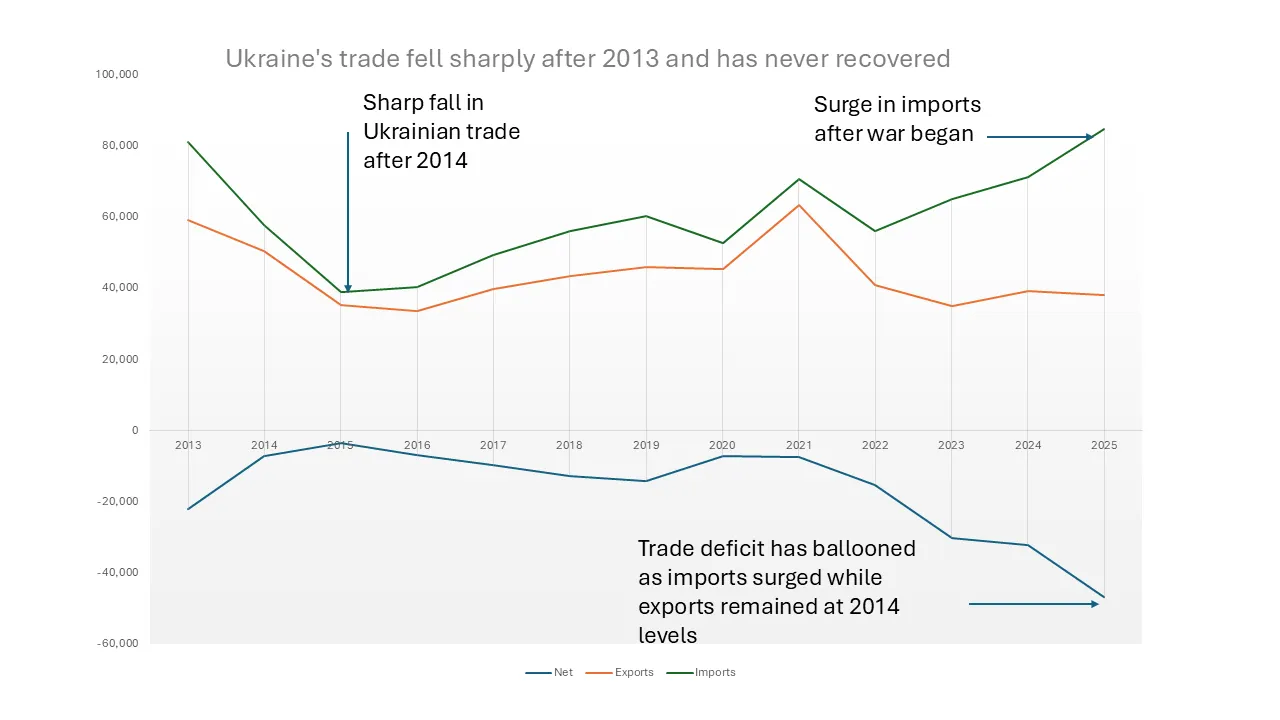
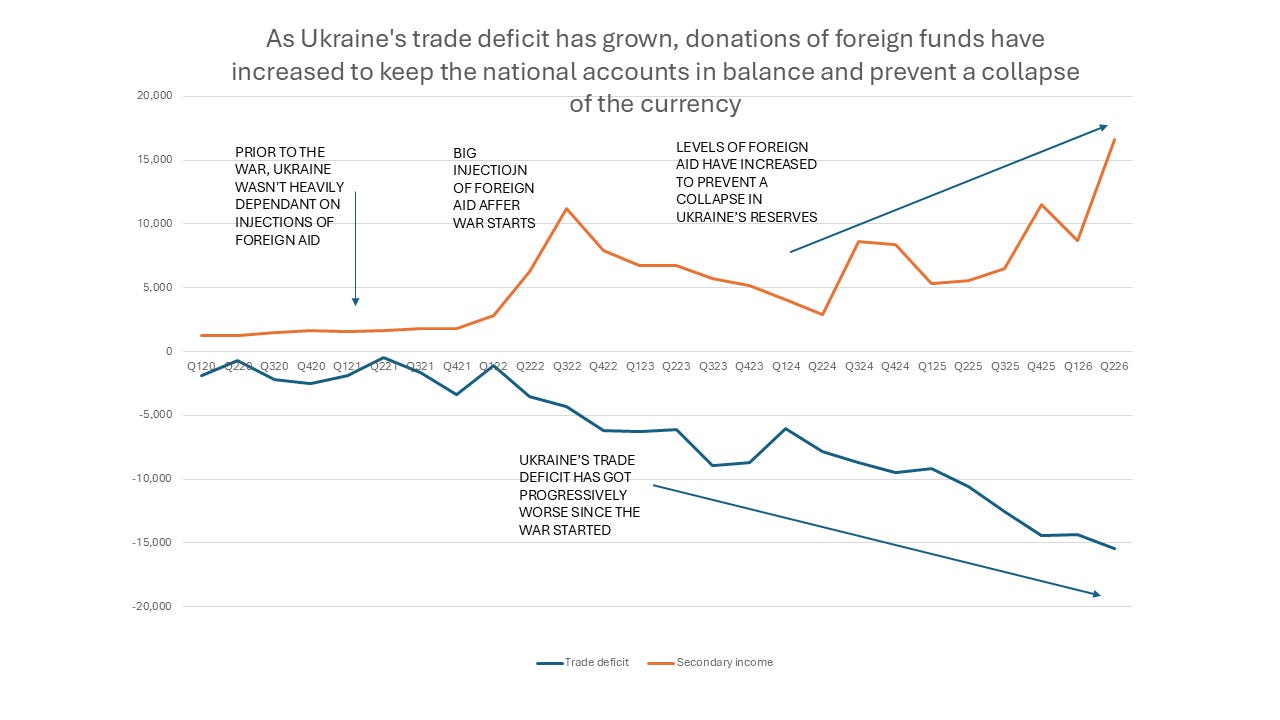
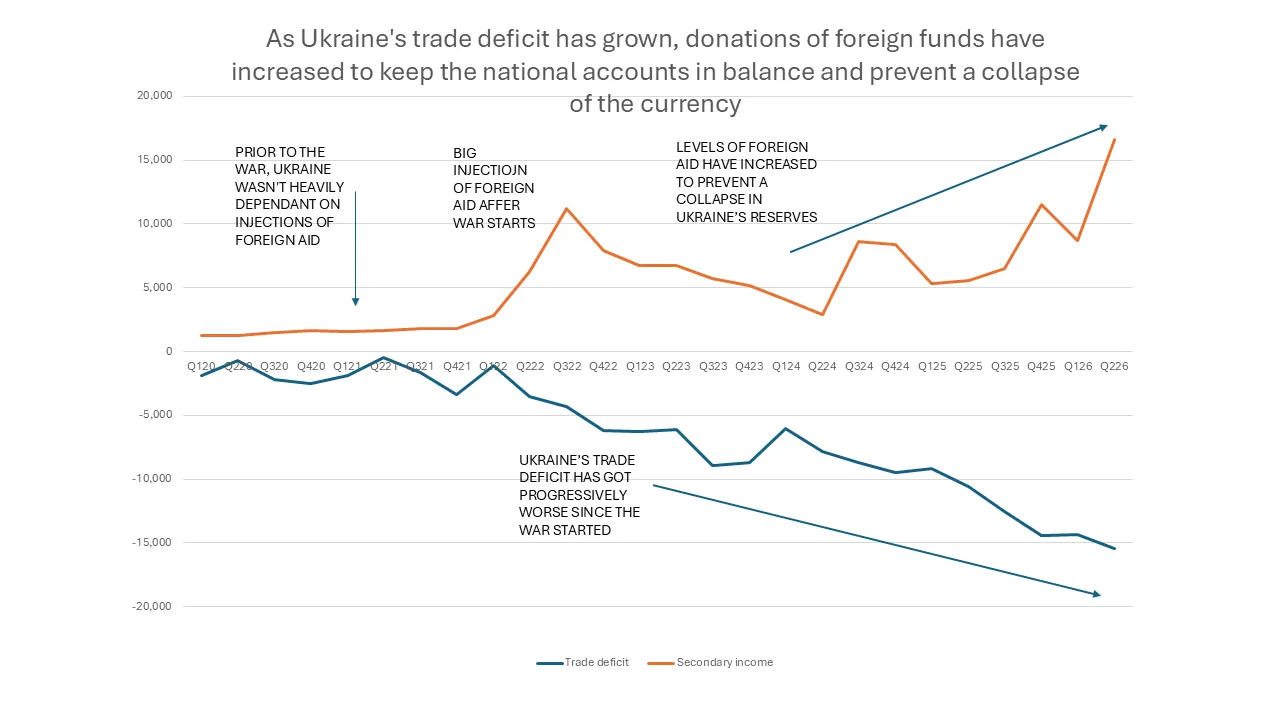
Entraînée dans un déficit commercial persistant et croissant par la guerre, l’Ukraine a besoin d’injections continues de fonds étrangers pour empêcher l’effondrement de sa monnaie.

Le graphique ci-dessous montre la croissance du déficit commercial de l’Ukraine avec la croissance correspondante des recettes classées comme « Revenu secondaire » dans sa balance des paiements trimestrielle. Ces entrées de capitaux classés comme « Revenus secondaires » sont des injections en provenance d’Europe (principalement) qui sont vitales pour renforcer les réserves de change de l’Ukraine et ainsi éviter une ruée sur la devise. Le point clé est que le financement étranger à l’Ukraine est plus qu’un simple événement fiscal. Il s’agit d’un mécanisme de soutien essentiel dans les circonstances où l’Ukraine est incapable d’attirer suffisamment d’investissements étrangers en temps de guerre.

La Russie n’a tout simplement pas été confrontée au même défi, choisissant plutôt de diversifier ses exportations vers d’autres pays alors que l’Europe fermait progressivement ses échanges commerciaux. Les sanctions n’ont pas entamé son commerce.
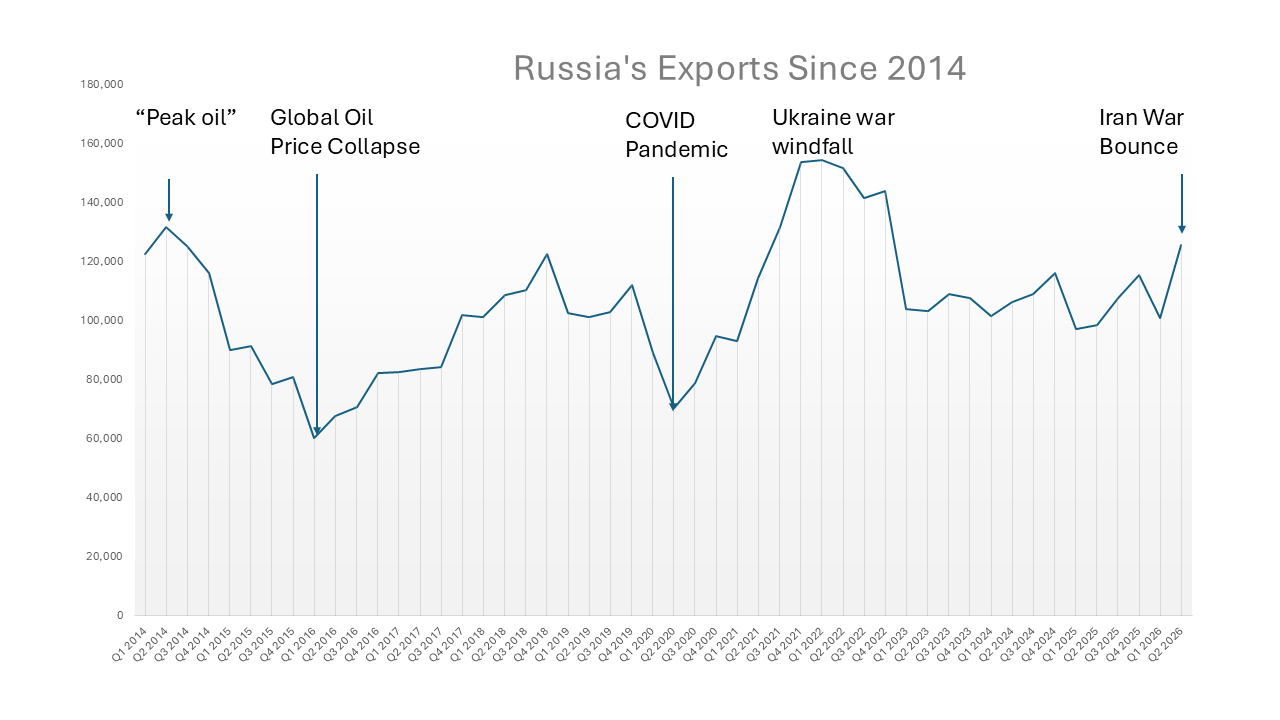
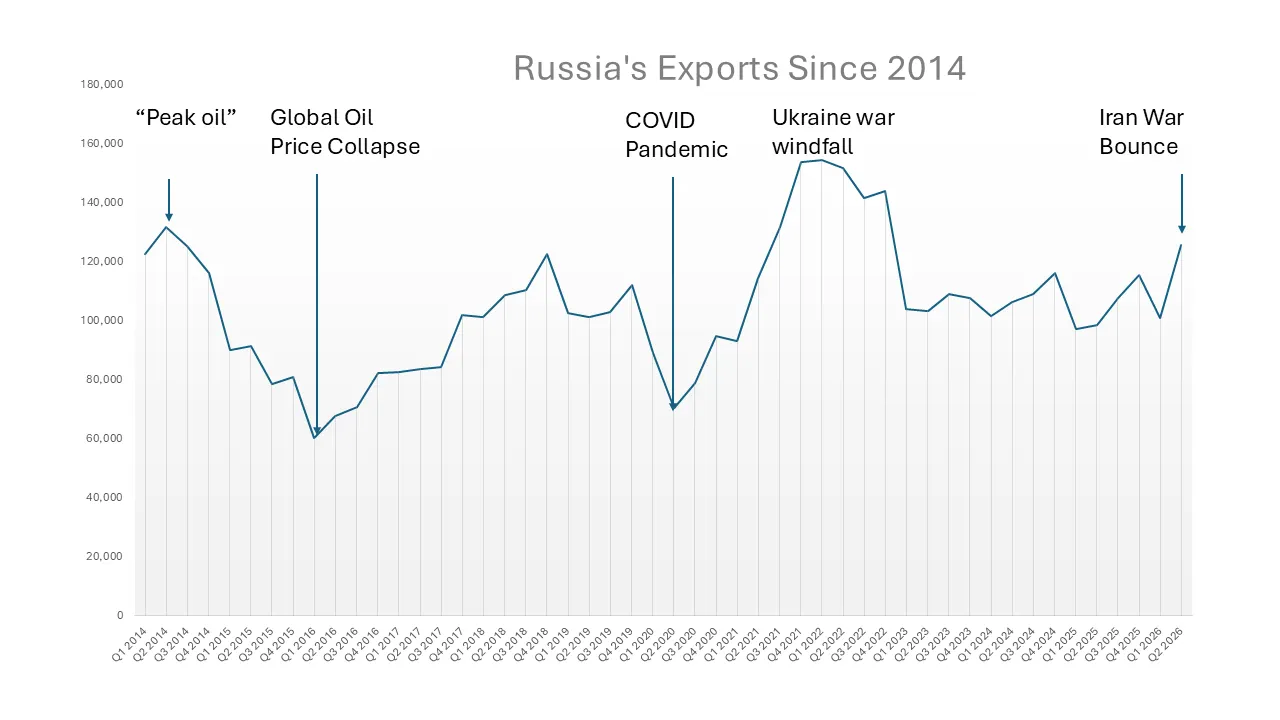
Le graphique ci-dessous illustre de manière élégante comment le commerce de la Russie a changé et évolué depuis. Les exportations russes ont connu des pics et des creux depuis 2014, bien que les creux aient souvent été causés par des événements mondiaux tels que les effondrements des prix du pétrole de 2014 et 2016 et le COVID.

Le déclenchement de la guerre en Ukraine a provoqué une énorme manne de revenus d’exportation car le prix du pétrole a bondi. Malgré l’imposition de milliers de sanctions par les pays occidentaux après le début de la guerre, les exportations russes sont restées très résistantes. Cela est dû à la diversification par la Russie de ses exportations vers les pays d’Asie.

En bref, malgré les nombreux gros titres dans les médias occidentaux traditionnels sur les sanctions « entravant l’économie de guerre de la Russie« , il n’y a aucune preuve substantielle que cela ait été le cas.

Le modèle d’exportation russe continue d’être une salle des machines qui lui fournit les liquidités dont elle a besoin pour financer la guerre sans contracter de nouvelles dettes importantes. Cela lui donne un avantage significatif sur l’Ukraine et ses soutiens européens dans cette « guerre d’usure« .
La Russie a accumulé des réserves depuis le début de la guerre pour compenser l’immobilisation de 300 milliards de dollars en devises par les pays occidentaux. La Russie investit désormais dans l’or pour protéger ses actifs.

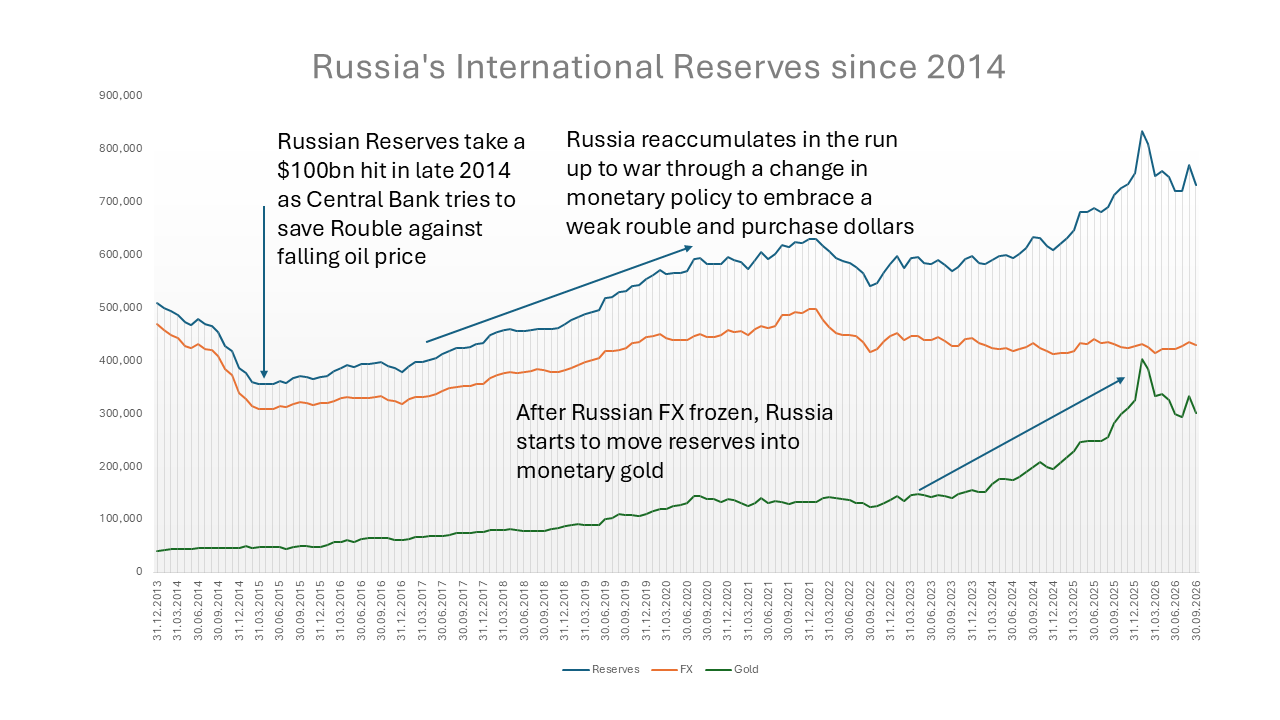
Enfin, je commente depuis un certain temps que la Russie a entamé le processus d’accumulation de réserves de change en 2017 alors qu’elle modifiait sa politique monétaire pour adopter un rouble faible afin de maximiser les revenus en roubles tirés des exportations et qu’elle entreprenait un certain nombre d’achats en dollars via le ministère des Finances. Vous pouvez voir cette accumulation de réserves dans le graphique ci-dessous.

Après le début de la guerre, après l’importante manne de revenus tirés des exportations en 2022 et des chiffres commerciaux toujours solides par la suite, la Russie a continué à accumuler des réserves. Cependant, suite au gel de ses avoirs en devises, elle a plutôt choisi de stocker ses réserves en or, pour les protéger des sanctions.

Si la Russie souhaite évidemment récupérer ses avoirs immobilisés après la fin de la guerre (gros point d’interrogation), elle a néanmoins constitué un important coussin financier à hauteur de plus de 420 milliards de dollars de réserve en plus de celle qui reste gelée.

Ces importantes réserves contribuent sans aucun doute à garantir l’effort de guerre russe sans avoir besoin de gros emprunts. La dette de la Russie représente aujourd’hui environ 20% de son PIB.

En 2021, la dette de l’Ukraine s’élevait à environ 49% de son PIB. Aujourd’hui, elle représente environ 110% de son PIB.

Publié à l’origine par The Peacemonger.
Traduction:
Le Saker Francophone

  •  

Enviado de Putin diz que gasodutos retomarão operações “inevitavelmente”

Kirill Dmitriev, enviado do presidente russo Vladimir Putin, afirmou nesta quinta-feira (22), durante um fórum econômico em Istambul, que os gasodutos submarinos Nord Stream — danificados por explosões em 2022 — retomarão suas operações no futuro.

“É economicamente inevitável”, disse ele.

“A retomada do fornecimento de energia a partir da Rússia é absolutamente inevitável”, acrescentou a autoridade.

Rússia aceita retomar negociações de paz com Ucrânia em novembro

O presidente russo, Vladimir Putin, afirmou que o Kremlin está disposto a retomar as negociações de paz trilaterais entre Rússia, Estados Unidos e Ucrânia após meados de novembro, a pedido do enviado especial americano Steve Witkoff, que se reuniu com Putin por cerca de três horas na quarta-feira (21).

O encontro, realizado em São Petersburgo, ocorreu após a reunião “produtiva” de Witkoff na terça-feira (20) com o presidente ucraniano, Volodymyr Zelensky, na Noruega. Os Estados Unidos buscam avançar propostas para encerrar a guerra.

Putin afirmou que estaria disposto a retomar as negociações trilaterais após 10 de novembro, segundo um relato divulgado após a reunião por seu assessor, Yury Ushakov. O assessor disse que o Kremlin gostaria de discutir a criação de uma “estrutura de segurança” para a Rússia e a Ucrânia após o fim do conflito, sem dar mais detalhes sobre as exigências russas para esse mecanismo.

A próxima rodada de negociações trilaterais poderá ocorrer em Abu Dhabi, capital dos Emirados Árabes Unidos, afirmou Ushakov em resposta a uma pergunta do canal estatal russo Russia 24.

Zelensky disse na quarta-feira que gostaria que o encontro ocorresse “no máximo até o início de novembro”.

“A Rússia disse muitas vezes que estava pronta para uma reunião, mas depois as coisas mudaram e ela foi cancelada”, acrescentou Zelensky. “Vamos ver o que acontece desta vez.”

Um comunicado de uma autoridade americana confirmou que a reunião ocorreu e afirmou que o objetivo era avançar os esforços do presidente dos Estados Unidos, Donald Trump, para encerrar a guerra da Rússia contra a Ucrânia.

Witkoff descreveu os encontros com Putin e Zelensky como “construtivos” em uma publicação na rede social X após a reunião de quarta-feira e afirmou que as discussões continuariam nas negociações trilaterais.

“Embora ainda haja trabalho importante a ser feito, o presidente Trump continua comprometido em ver esta guerra terminar e alcançar uma paz abrangente e duradoura”, escreveu.

Os enviados americanos Witkoff e Jared Kushner, genro de Trump, propuseram uma reunião trilateral que foi “aceita pelos ucranianos em Oslo ontem e pelos russos em São Petersburgo hoje”, segundo o comunicado.

Apesar das declarações positivas sobre possíveis negociações futuras, até o momento não há sinais de que a Rússia tenha recuado de suas posições maximalistas.

As exigências anteriores da Rússia equivalem a uma vitória quase total: Moscou pede que a Ucrânia ceda toda a região de Donbas, no leste do país, atualmente sob ocupação russa em sua maior parte. O governo russo também exigiu que a Ucrânia reduza drasticamente o tamanho de suas Forças Armadas e se comprometa a nunca ingressar na Organização do Tratado do Atlântico Norte (Otan).

Durante as conversas mais recentes, Putin demonstrou interesse na retomada da cooperação econômica com os Estados Unidos e na possibilidade de um encontro com a China para discutir a Ucrânia. Isso ocorre após medidas recentes do governo Trump para suspender sanções contra a Rússia e fechar um acordo sobre exportações de diesel.

Em declarações à imprensa após a reunião, o enviado presidencial russo Kirill Dmitriev afirmou que não havia “dúvida” de que a cooperação econômica entre Estados Unidos e Rússia continuaria. Ele acrescentou que um acordo sobre diesel anunciado recentemente entre os dois países seria mantido, apesar das críticas europeias.

Um dos principais resultados do encontro foi o anúncio de Witkoff de que a Rússia libertou o cidadão americano Stephen Hubbard, de 74 anos, que estava detido no país havia mais de quatro anos.

Em declarações amplamente criticadas, Witkoff elogiou Putin como um “humanitário” por conceder o perdão a Hubbard. Um vídeo obtido pela CNN após a reunião mostrou o cidadão americano libertado conversando com Witkoff no aeroporto de São Petersburgo.

Em imagens do início da reunião de três horas, Witkoff afirmou: “Acho que há algum grau de impulso, e espero que o encontro de hoje possa representar mais um passo à frente no processo de paz”.

Putin, Witkoff e tradutores se sentaram ao redor de uma grande mesa redonda e discutiram uma ampla variedade de questões, incluindo a disposição da Rússia para ajudar a resolver a guerra no Irã, possíveis exportações russas de fertilizantes para os Estados Unidos e a libertação de Hubbard. A reunião prosseguiu a portas fechadas, e Kushner, que também participa das negociações de paz, acompanhou o encontro remotamente porque está gripado.

Os Estados Unidos e a Ucrânia fizeram “progressos significativos” nas conversas realizadas na Noruega na terça-feira, afirmou anteriormente uma autoridade americana à CNN. A Ucrânia “apresentou novas ideias e propostas, que foram discutidas em detalhes”, e os dois lados agora estão em “forte alinhamento” sobre os próximos passos, disse a autoridade.

“As discussões abrangeram elementos fundamentais de uma estrutura abrangente de paz, incluindo garantias de segurança de longo prazo para a Ucrânia, um plano econômico e de prosperidade para o pós-guerra e uma arquitetura de segurança europeia mais ampla, concebida para criar estabilidade duradoura”, afirmou a autoridade americana.

No entanto, o assessor do Kremlin Yury Ushakov minimizou essas discussões na quarta-feira. Segundo ele, embora Witkoff tenha apresentado a Putin “certas novas abordagens e mudanças nas posições adotadas pelos europeus e por Kiev”, na realidade, elas continham pouco de valor concreto para resolver a crise ucraniana.

A Ucrânia e seus aliados reiteraram as principais linhas vermelhas estabelecidas por Kiev para qualquer negociação de paz, incluindo a necessidade de garantias de segurança futuras — para assegurar que a Rússia não volte a invadir o país — e a rejeição a quaisquer exigências de cessão de territórios que a Ucrânia controla.

Zelensky reiterou uma posição defendida há tempos: a Ucrânia aceitaria um acordo de cessar-fogo que congelasse as posições ao longo da atual linha de frente — o que significaria manter apenas cerca de 75% do território ucraniano — e, em seguida, pediria garantias de segurança efetivas aos aliados.

Zelensky também afirmou que a Ucrânia quer negociações trilaterais envolvendo Trump, Putin e ele próprio, mas disse que o processo seria “melhor com os europeus”.

O Kremlin já havia rejeitado a ideia de negociações trilaterais, com exceção de um convite anterior para que Zelensky fosse a Moscou — uma possibilidade considerada inviável pelos demais lados.

Enquanto isso, na Rússia, o ministro das Relações Exteriores, Sergey Lavrov, adotou um tom menos otimista na terça-feira. Ele afirmou que Moscou avaliará o que Witkoff apresentar, mas não fará “concessões políticas”. Lavrov disse que Moscou “não espera um milagre” e que Washington continuará sendo, na melhor das hipóteses, um rival da Rússia, segundo a agência estatal russa TASS.

Uma autoridade europeia em Oslo disse à CNN: “Acho que os planos — ou a falta deles — não são um problema tão grande quanto fazer a Rússia levar qualquer plano a sério”.

O que é Oreshnik, míssil hipersônico utilizado em grande ataque contra Kiev?

  •  

Russia kept sneaking troops through gas pipes behind Ukrainian lines. Now Ukraine has gone more than 15 km underground to do the same to Russia

Russian troops captured during Operation Veles, October 2026. Screenshot from a video by the 2nd Corps of Ukraine’s National Guard

Ukraine's Defense Forces advanced more than 15 km through underground utility tunnels into Russia's rear on the Kupiansk axis in Kharkiv Oblast, the Khartiia Corps of Ukraine's National Guard reported on 22 October. The corps called it Operation Veles. The underground advance was paired with attacks on the surface and drone strikes, hitting Russian forces from two directions, the corps told Militarnyi.

Russian troops have repeatedly crawled through gas pipelines around Kupiansk to get behind Ukrainian lines, even after Ukraine reported confident control of the city in February. This time, Ukraine went underground itself. The operation took away Russia's chance to get into Kupiansk's rear, the corps said.

The corps reported more than 30 Russian soldiers captured and Russian losses of more than 100. Militarnyi, citing the unit, put the number of Russian troops killed at over 100.

Khartiia studied how Russian troops moved through pipes before going underground itself, the corps commander, Brigadier General Ihor Obolenskyi, said.

"We watched how the enemy works underground and studied how they do it. The Russians intended to use gas pipelines to get into the rear of our troops. So we went underground ourselves. We anticipated the enemy's actions and mastered the tactics of underground combat," he said.

Boots under ground!

Asymmetric breakthrough in the Kharkiv Region: Khartiia Corps conducts the subterranean counteroffensive Operation VELES, advancing 15 km underground.

Corps Commander General Ihor Obolenskyi explains a unique operation. pic.twitter.com/qRQ93kckpK

— Khartiia Corps in English (@khartiia_eng) October 22, 2026

For the operation, troops trained physically and psychologically to fight in confined spaces, sappers and engineers prepared the underground route, and special communications, navigation, silent logistics, and life-support systems were put in place, Khartiia told Militarnyi. The operation was named after Veles, the Slavic pagan god of the underworld.

Khartiia's brigade, the R.U.H. assault regiment, the Lava drone regiment, the Achilles drone brigade, and units of Ukraine's military intelligence, including the Freedom of Russia Legion and the Russian Volunteer Corps, took part, the corps said.

Russia has used pipelines to infiltrate before

By September 2025, Russian forces had used pipelines to move troops behind Ukrainian lines three times, Ukrainian monitoring project DeepState reported on 12 September 2025. The first was in Avdiivka, the second near Sudzha, and the third near Kupiansk, where groups crossed the Oskil River through a gas pipe.

Near Sudzha in March 2025, Russian special forces walked through a pipeline that until recently had carried Russian gas to Europe, the Associated Press reported. A pro-Kremlin blogger claimed they covered about 15 km and that some spent several days inside.

Russian troops kept using the pipeline near Kupiansk this year. On 27 September, Khartiia's reconnaissance drones recorded Russian forces leading nine civilians, including children, elderly people, and a person on crutches, through the gas pipeline out of the Kupiansk community. Men of military age in civilian clothes walked alongside them, and the corps believes they were Russian soldiers using the group as cover to withdraw. Ukrainian troops held fire because of the civilians, the corps said, adding that the case has been documented for a war crimes investigation.

Civilians led through a gas pipeline out of the Kupiansk community, Kharkiv Oblast, by people the Khartiia Corps identifies as Russian forces, 27 September 2026
Civilians led through a gas pipeline out of the Kupiansk community, Kharkiv Oblast, by people the Khartiia Corps identifies as Russian forces, 27 September 2026. Screenshot: Khartiia Corps

Why the war is moving underground

Drones, constant surveillance, and AI-assisted targeting have made the battlefield surface transparent and deadly, argue John Spencer, chair of urban warfare studies at West Point's Modern War Institute, and Col. Drew Craig, principal military engineering staff officer at NATO's Allied Rapid Reaction Corps. In an August analysis, they write that soldiers in Ukraine describe a "death zone" of some 30 km, where moving above ground can draw an attack within minutes. When firepower makes the surface too dangerous, armies have historically gone underground, as they did in World War I and Vietnam, and more recently in Gaza and Lebanon.

"Armies that cannot survive above ground must adapt below it," the authors write.

Fighting in tunnels brings its own requirements, the authors write: detecting the enemy by sound and vibration, and specialized unmanned systems that cannot rely on GPS or stable radio links. Long stretches underground also take a severe psychological and physical toll on soldiers.

Western militaries are not ready for this, Spencer and Craig write. No NATO partner maintains even general capabilities for large-scale underground warfare, and US and British efforts focused mainly on detecting and clearing tunnels rather than occupying and operating in them.

  •  

Russian Cluster Missile Hits Kyiv’s Historic Religious Quarter, Zelenskyy Says

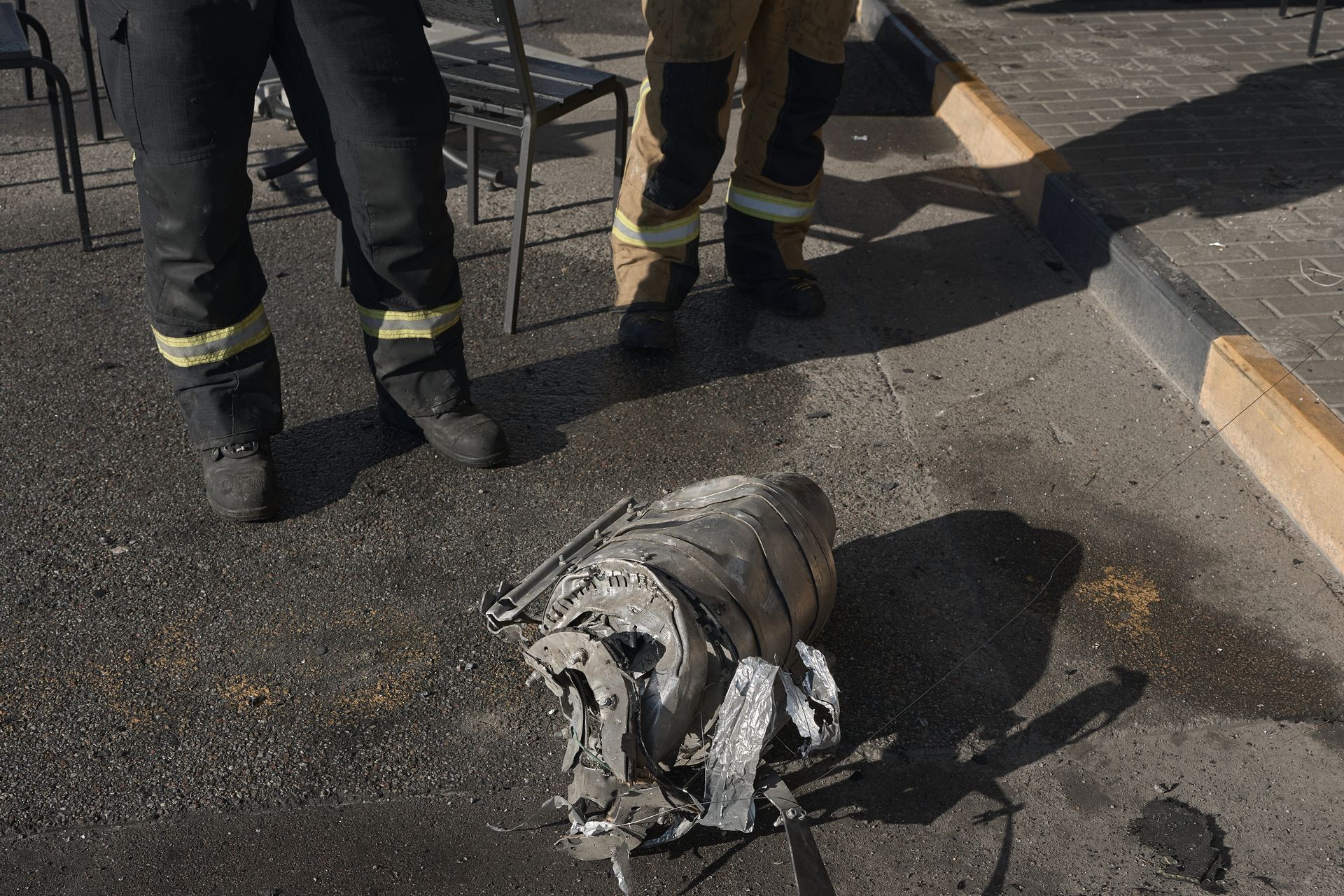
A Russian ballistic missile fitted with a cluster warhead struck the historic Pecherskyi district of Kyiv overnight on 21–22 October 2026, damaging buildings near two of the Ukrainian capital’s principal religious complexes, President Volodymyr Zelenskyy has said.

The missile landed between the Kyiv-Pechersk Lavra, a UNESCO World Heritage site, and the Holy Presentation (Sviato-Vvedenskyi) Monastery. Monastery buildings, homes, shops, cafés and other civilian infrastructure sustained damage in the surrounding area.

Zelenskyy disclosed that Russian forces had used three cluster-equipped ballistic missiles during the assault. Ukrainian authorities described weapons designed to explode in the air as they approach their targets, distributing explosive submunitions over an area approximately 400 metres in diameter.

After receiving reports from officials overseeing emergency operations across Ukraine, the president accused Moscow of deliberately choosing a weapon capable of inflicting extensive civilian casualties in a densely populated district.

“This was a deliberate choice of weapon and area of deployment,” Zelenskyy said.

He maintained that there were no military installations in the vicinity and that the attack had been intended to inflict maximum damage on civilians and their property.

Religious Buildings and Civilian Properties Damaged

Pecherskyi is one of Kyiv’s oldest districts, containing religious institutions and architectural monuments associated with centuries of Ukrainian history.

Among them is the Kyiv-Pechersk Lavra, established in the 11th century and subsequently developed into an important centre of Eastern Orthodox Christianity.

The complex includes historic churches, monasteries and an extensive system of underground caves. Together with Saint Sophia Cathedral and its related buildings, it forms part of a UNESCO World Heritage property that has appeared on the List of World Heritage in Danger since 2023.

Thursday’s explosion occurred in the area separating the Lavra from the Holy Presentation Monastery. Ukrainian authorities identified damage to buildings belonging to the latter, alongside neighbouring residential and commercial premises. Assessments of the destruction across the historic district were continuing.

This was not the first occasion in 2026 on which Russian weapons had damaged the area’s religious heritage.

On 15 June, a Russian drone struck the Kyiv-Pechersk Lavra complex, causing severe damage to the Dormition Cathedral. Its roof and structural elements suffered extensive destruction, prompting UNESCO to undertake emergency stabilisation measures.

Ukraine’s Security Service subsequently published evidence identifying fragments of a Russian Geran-2 drone recovered from the site.

The October strike has again exposed the vulnerability of the capital’s historic religious buildings, as well as the civilian neighbourhoods surrounding them.

The Use of Cluster Weapons in Urban Areas

The reported choice of ammunition has particular implications for the investigation into the attack.

Whereas a conventional missile warhead delivers its explosive force around a principal impact point, cluster munitions release numerous smaller explosive devices capable of striking separate locations across a broad area.

In an urban environment, such weapons can cause casualties and destruction well beyond an intended target. Unexploded submunitions may remain dangerous after the initial attack, posing further risks to residents and emergency workers.

The International Committee of the Red Cross has warned that deploying cluster munitions in populated areas creates a high likelihood of indiscriminate effects.

Under international humanitarian law, military operations must distinguish between civilian persons and objects and legitimate military targets. Indiscriminate attacks are prohibited.

The reported deployment of cluster warheads in central Kyiv therefore raises questions about whether those requirements were observed. Zelenskyy’s account of the three missiles had not, at the time of reporting, been independently established through publicly available forensic evidence.

Russian Barrage Follows Diplomatic Contact with Washington

The Pecherskyi explosion was one incident in a much larger attack on the Ukrainian capital.

According to Zelenskyy, Russia launched 21 ballistic missiles against Kyiv in three successive waves overnight. Ukrainian authorities reported at least two people killed and more than 30 wounded, with strikes damaging apartment buildings, commercial premises, transport infrastructure and energy facilities.

The bombardment took place shortly after Russian President Vladimir Putin met US presidential envoy Steve Witkoff in St Petersburg on Wednesday, 21 October.

During their discussions, Putin indicated that Russia was prepared in principle to resume negotiations with Ukraine and the United States, potentially in November. However, no confirmed timetable emerged.

Witkoff’s visit followed consultations in Norway between American, Ukrainian and European representatives over possible arrangements to end the war.

The renewed diplomatic activity has done little to resolve the underlying disagreements. As EU Today has previously examined, Moscow continues to advance territorial demands while the parties remain divided over Ukraine’s future security guarantees.

Meanwhile, Kyiv faces an immediate requirement for additional air-defence ammunition.

Zelenskyy has repeatedly appealed for more Patriot interceptor missiles capable of engaging ballistic targets. Difficulties surrounding American military assistance and intelligence cooperation have increased tensions between Washington and Kyiv at a time when Russia is intensifying attacks against Ukrainian cities.

The latest strike also presents Ukrainian investigators with the task of establishing whether the reported use of cluster munitions against a historic civilian district constituted an unlawful attack.

For Zelenskyy, the bombardment following Putin’s latest diplomatic discussions demonstrates that Moscow’s military conduct remains unchanged. He has argued that Russia’s actions provide no evidence of a genuine intention to bring the war to an end.

  •  

"A União Europeia não tem uma estratégia"

António José Telo avisa para a falta de estratégia e de relevância da Europa nas decisões globais. Aponta ainda o foco de Trump nas eleições e os preparativos para atacar o Irão.

  •  

Inside the institution where Ukraine races to counter Russia's evolving drones

In a government office, researchers of drones and electronic warfare gather around a small metal device recovered from a Russian Geran drone. Its purpose —  to measure the Earth’s magnetic field for navigation.

"This is the most recent component we found, about a week or two

  •  

Ucraniano é preso na Alemanha sob suspeita de espionagem para a Rússia

Um cidadão ucraniano foi preso no estado alemão de Brandemburgo sob suspeita de espionagem para a Rússia, segundo comunicado divulgado nesta quinta-feira (22) pela Procuradoria-Geral Federal da Alemanha.

Identificado pelas autoridades como Vadym Y., o suspeito mantinha contato com um serviço secreto russo por meio de um intermediário desde, pelo menos, julho de 2025, afirmaram os procuradores.

Segundo o comunicado, ele coletava informações militares, incluindo dados sobre a produção de veículos blindados, munições e explosivos, além de informações sobre pessoal e instalações militares em locais destinados a proteger o flanco oriental da Otan (Organização do Tratado do Atlântico Norte).

Embora parte das informações estivesse disponível publicamente, outros detalhes teriam sido solicitados a pessoas que trabalham no setor de defesa europeu, segundo os procuradores.

De acordo com o comunicado, o acusado comparecerá nesta sexta-feira (23) a um juiz de instrução do Tribunal Federal de Justiça, que lhe comunicará o mandado de prisão e decidirá sobre a decretação da prisão preventiva.

O chanceler alemão Friedrich Merz disse que a prisão não o surpreendeu e alertou que haverá mais casos semelhantes no futuro.

“A Alemanha é alvo de intensa atividade de espionagem; nesse sentido, o fato de este caso ter sido descoberto hoje é um sucesso”, disse ele em uma coletiva de imprensa em Montenegro.

“No entanto, não nos iludamos: as atividades dos serviços de inteligência russos na Alemanha permanecem em um nível consistentemente alto.”

O que é Oreshnik, míssil hipersônico utilizado em grande ataque contra Kiev?


  •  

Trump is trying ‘The Art of the Deal’ in Ukraine but what must Putin give up?

Russian missiles keep falling on Ukrainian cities while Washington holds up approval of Patriot interceptor transfers to Ukraine, according to The Washington Post. A Ukrainian official told the Post that only "a couple" of interceptors remained. President Donald Trump wants this war to end, and that goal deserves support. But a deal that squeezes only Ukraine is not a peace plan, and right now Kyiv absorbs the pressure while Moscow collects the relief.

Secretary of State Marco Rubio acknowledged on Oct. 20 that a batch bought for Kyiv may not have been delivered, but he rejected any political motive. "There's nothing being deliberately denied to Ukraine," he said.

So is Washington protecting scarce supplies, applying negotiating pressure or both? Americans deserve an answer, including what concessions Washington expects from Russian President Vladimir Putin.

TRUMP RUSSIA DEAL COULD FUEL PUTIN'S WAR, EX-NATO COMMANDER WARNS AS ZELENSKYY SAYS 'NYET'

The administration's strongest defense is scarcity, so start with the missiles. Lockheed Martin delivered 620 PAC-3 MSE interceptors in 2025 and plans to expand annual capacity to 2,000 over seven years.

The Iran war compounded the problem. A July assessment by the Center for Strategic and International Studies estimated that heavy combat use had pushed American Patriot inventories below 1,000.

UKRAINE'S ZELENSKYY OPEN TO FREEZING FRONT LINES IN CEASEFIRE WITH RUSSIA

A president must keep enough interceptors to protect American troops. Having worked on military strategy and security cooperation at the Pentagon, I take that obligation seriously. Ukraine's needs cannot erase our responsibilities elsewhere.

European money does not change that math. Kiel Institute data covering the first half of 2026 identify Europe as the largest military-aid donor, yet American stockpiles supplied more than 90% of the aid delivered through NATO's Prioritized Ukraine Requirements List (PURL). Europe is paying American industry to arm Ukraine, and Washington controls the tap.

AMERICA FACES A CRISIS IN OUR MILITARY ARSENAL THAT TRUMP IS RACING TO FIX

The lasting answer to scarcity is production. When U.S. Sens. Roger Wicker, R-Miss., and Kevin Cramer, R-N.D., met Ukrainian President Volodymyr Zelenskyy in Kyiv Oct. 9, he pressed for faster Patriot production licensing and offered joint production of interceptors. Washington should pursue it, with technology safeguards.

Still, scarcity does not explain every pending decision, and Washington owes the allies who paid for these weapons a straight explanation. Nor does it explain the broader pressure on Kyiv.

TRUMP TELLS ZELENSKYY TO STOP DOING 'ONE THING' DURING ATTACKS ON RUSSIA

The clearest example involves the same pipeline. Reuters reports that Washington threatened to stop the allied-funded PURL weapons pipeline to press Kyiv to halt its deep strikes on Russian energy infrastructure. That is leverage over Ukrainian military operations, not proof of a coordinated campaign to remove Zelenskyy.

The satellite dispute is murkier. Blamed for throttling Ukraine's terminals, billionaire Elon Musk posted that limits "are decided by the U.S. military and ultimately" by the president. Reuters then traced the restriction to the White House through unnamed officials. Trump denied it. "It wasn't us," he told reporters Oct. 16. Separately, Ukraine went three days without American missile warnings before Zelenskyy said Oct. 18 that intelligence sharing had resumed.

ZELENSKYY ACCUSES PUTIN OF DEFYING TRUMP'S CEASEFIRE PUSH, SENDS POINTED MESSAGE TO WHITE HOUSE

The pressure is also personal. Trump called Oct. 10 for Ukraine to replace its president. Yet Zelenskyy sat down with American envoys in Oslo on Oct. 20. A leader who shows up for talks is not refusing diplomacy.

Now consider the other side of the ledger. Trump announced an energy ceasefire Oct. 11, although Russian agreement remained unclear. A week later, Russian strikes hit 28 substations and other energy facilities, according to the Institute for the Study of War, leaving roughly 550,000 Ukrainian households without power. Kyiv was pressed to stop hitting refineries while Moscow kept hitting the grid. Putin never confirmed the ceasefire, and his missiles show he never intended to honor it.

TRUMP TRIES DIFFERENT APPROACH WITH RUSSIA TO BRING AMERICANS RELIEF AMID ONGOING WAR WITH UKRAINE

Moscow, meanwhile, received relief. On Oct. 9, Treasury issued a license authorizing specified Russian diesel transactions. Reuters later reported that Washington hoped the diesel deal would soften Moscow's negotiating position.

The administration's case is domestic. Diesel hit a record $6.52 a gallon in September as the Iran war choked the Strait of Hormuz, and Trump promised relief for farmers, ranchers and truckers. But Lawfare's analysis found the agreed Russian exports would cover about 2% of American demand. The price relief is speculative. Moscow's gains are not: sanctions relief and American pressure on Kyiv to spare Russian refineries.

PENTAGON RACES TO BUY 10X MORE MISSILES AS IRAN WAR DWINDLES ARSENAL, THREATENS READINESS FOR CHINA AGGRESSION

Offering an adversary an incentive can be sound diplomacy. The question is what the incentive buys. So far, the bombing has not stopped.

Nor has softer treatment softened the Kremlin's terms. When Zelenskyy offered a 60-day ceasefire to permit elections, the Kremlin rejected it on Oct. 12, saying it wanted an overall settlement. Moscow refused the very pause that Trump's call for new Ukrainian leadership would require.

Putin's ambitions run larger still. The New York Post reports that he wants a summit with Trump and Chinese President Xi Jinping to settle the war without Zelenskyy or Europe at the table, a redux of Yalta.

Putin bargains as if time is on his side. The battlefield says otherwise. Reuters reported Oct. 17 that Russian advances had slowed and many front lines remained largely static.

That gives Washington room to demand reciprocity. Wicker, the Senate Armed Services Committee chairman, proposed one approach on Oct. 18: Ukrainian restraint against petroleum facilities in exchange for American targeting assistance against Russian missile launches. It deserves consideration. But Putin would still need to offer restraint of his own.

So what must Putin give up? As I argued in these pages last December, a durable agreement requires credible enforcement, and enforcement begins with concessions Moscow can be held to.

Russia must halt strikes on Ukraine's power grid and cities, the same restraint Washington demanded of Kyiv. It must accept monitored ceasefire terms, defined restrictions on military activity and consequences for violations. It must negotiate with Kyiv, not over Kyiv's head in China. And it must recognize that the size of Ukraine's army and the choice of its security partners belong to Kyiv, not the Kremlin.

For his part, Trump should preserve American reserves, expand production, insist on European performance and refuse any summit that decides Ukraine's fate without Ukraine. Diesel licenses and any further sanctions relief should depend on compliance, with automatic snap-back penalties if Moscow cheats.

CLICK HERE FOR MORE FOX NEWS OPINION

America need not send combat troops to Ukraine or finance an indefinite war to demand those safeguards.

CLICK HERE TO DOWNLOAD THE FOX NEWS APP

Trump wants the killing to stop. Whether Putin will accept enforceable limits remains unproved. The test of American diplomacy is whether Moscow earns relief through compliance and faces greater costs for renewed aggression.

CLICK HERE TO READ MORE ROBERT MAGINNIS

  •  

Drones reportedly hit a Russian weapons plant near Moscow that Washington and Kyiv sanctioned

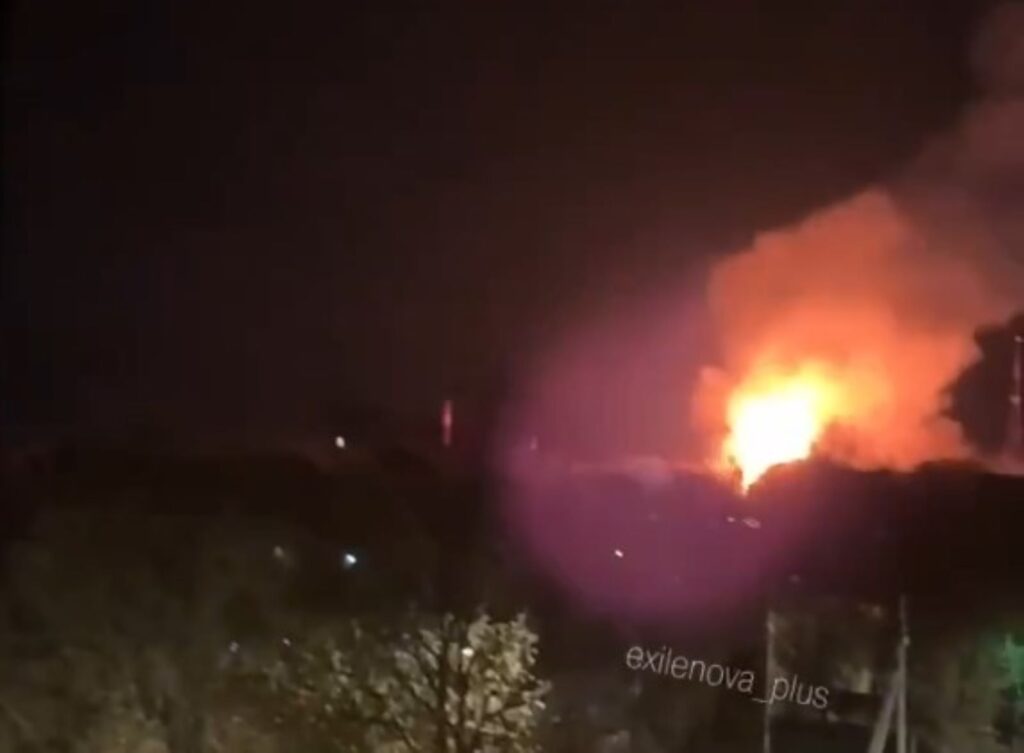
drones reportedly hit russian weapons plant near moscow washington kyiv sanctioned · post fire jsc 75 arsenal serpukhov oblast 22 2026 exilenova+ ukraine news ukrainian reports

An explosion hit the 75th Arsenal, a Russian army plant in Serpukhov south of Moscow, overnight on 22 October, Russian Telegram channel Astra reported. Russian officials also claimed drone attacks on the Moscow region, Tula, and Lipetsk that night.

As Russia presses its full-scale invasion, Ukraine’s long-range drones and missiles keep hitting military plants and refineries deep inside Russia. Ukrainian outlet Militarnyi says this plant specializes in repairing Buk and S-300 air defense systems. Astra describes it more broadly, as making weapons and ammunition and repairing military equipment. If Militarnyi is right, the blast hit a site that fixes Russian air defenses. It came the night Moscow’s mayor credited air defenses with stopping hundreds of drones.

Blast at the arsenal

An Astra OSINT analyst placed the explosion inside the site from a video, the channel said. Residents claimed in local chats that blasts followed passing drones, then at least three missiles. Astra did not confirm the missile count. Serpukhov lies about 99 km south of Moscow. Ukraine has sanctioned the plant, and the US Treasury has listed it too. As of the morning of 22 October, no Russian official had confirmed the blast.

More footage of the attack on the arsenal in Serpukhov. We are awaiting satellite images. pic.twitter.com/tTsgc18W3L

— Exilenova+ (@Exilenova_plus) October 22, 2026

630 drones, by Moscow’s count

Moscow Mayor Sergei Sobyanin claimed that 630 drones flew toward the Moscow region from 20:30 on 21 October to 04:00 on 22 October. He claimed most were destroyed far out and 163 were neutralized on approach to Moscow. Two people were injured in Voronovo, in New Moscow, he stated.

Tula Oblast Governor Dmitry Milyaev claimed air defenses downed 70 Ukrainian drones over his region. Private homes were damaged in Tula and the Zaoksky district, he stated.

Lipetsk governor claims homes and a clinic damaged

Earlier in the night, Ukrainian monitoring channel Exilenova+ posted footage of commotion in Lipetsk after explosions. Lipetsk Oblast Governor Igor Artamonov claimed a drone strike damaged homes, apartment blocks, and a closed polyclinic. A man born in 2001 was injured and hospitalized, Artamonov claimed.

Lipetsk, moment of the explosion. https://t.co/wCX6GVThQr pic.twitter.com/bGwGLbUm2d

— Exilenova+ (@Exilenova_plus) October 21, 2026

In May, Ukrainian intelligence said Russia was deploying more regiments against strike drones. In September, Ukrainian units hit more Russian air defense systems and radars than in any month since 2024, Ukraine’s Defense Ministry said. Analyst Oleksandr Kovalenko counted 76 destroyed in September with days of the month still to go and argued Russia cannot replace such losses. If Militarnyi’s description holds, losing repair capacity would deepen that gap.

  •  

Why trade is vital to understanding how Ukraine needs western capital to stay afloat and how Russia can pay for its war effort without new debt

Four graphs that tell a bigger story

By Ian PROUD

Join us on Telegram, X, and VK.

Contact us: info@strategic-culture.su

I have wanted to write an article for sometime about the differing fates of Russia and Ukraine since the onset of the conflict in 2014. The headline is that Ukraine has never made up the difference in increased trade with Europe having cut its trade with Russia to the bone since 2014. This has inadvertently meant that Europe has had to inject significant sums of capital into Ukraine just to prevent its currency from collapsing as the war has gone on. Russia has diversified its trade away from Europe such that its export model is as strong today as it was in 2014, giving it the liquidity it needs to underwrite the war effort.

Key finding:

  • Ukraine exported 24% less and imported 46% more in 2025 than in 2014. The war has driven up imports while exports never recovered from the signing of the DCFTA and have been hampered by the war effort.
  • The yawning trade deficit Ukraine has built since the war started has placed greater strain on European sponsors to provide the capital Ukraine needs to prevent its currency collapsing, in addition to providing funding to meet its fiscal requirements.
  • This funding challenge for Europe will persist after the war ends until Ukraine can become self-sufficient in boosting exports and/or attracting sufficient foreign investment to offset its trade deficits.
  • Russia’s export strength and consistent surpluses have been unaffected by war. After the Ukraine crisis started, Russia started to diversify its major energy exports away from Europe, allowing it to weather the progressive reduction of exports to Europe. Indeed, Russia gained a huge windfall in 2022 from surging energy prices. There is no evidence that sanctions have impacted Russia’s export model in a significant way.
  • Russia has already started to reaccumulate FX reserves after the oil price collapse of late 2014, until before the war started. Following the immobilisation of $300bn in Russian FX reserves, Russia started to accumulate reserves in monetary gold, to sanction-proof future earnings. Russia now has liquid reserves of over $420bn meaning the immobilisation of its foreign currency reserves is no longer an economically limiting factor.

Detailed analysis

Russia’s export model in which it runs consistently large trade surpluses has ensured it can generate the reserves of foreign currency and gold which have undoubtedly helped to bankroll the war in Ukraine. Ukraine’s trade deficit has yawned since the war started, requiring continual injections of European capital to prevent its currency from collapsing.

This helps to explain by Russia can sustain the war for longer; it doesn’t need to take on significant new debt, its debt remaining low at 20%. Ukraine can only fund the war and keep its national accounts in balance with European money that cannot be guaranteed long-term and which, in any case, has increased Ukrainian debt by an average of 20% of GDP each year since the war started. This is not sustainable.

The Deep and Comprehensive Free Trade Agreement of 2014 has disadvantaged Ukraine because it forced a choice away from trading with Russia.

The starting point for this is the signature by Ukraine of a Deep and Comprehensive Free Trade Agreement with Europe on 27 June 2014.

Herman van Rompuy, then President of the European Council said that “stronger political and economic ties will bring greater stability and prosperity to the entire European continent.”

President Poroshenko said “over the last months, Ukraine paid the highest possible price to make her European dreams come true.”

Yet, the true price of this agreement has borne by Ukraine which saw its exports collapse and its imports increase, as it make a “sovereign choice” not to maintain trade links with Russia.

That was a catastrophically bad choice. Russia had accounted for around 25% of Ukrainian exports prior to 2014 and that figure fell to less than 5% in 2021 before the war started. Ukraine did not make up that gap by increasing the volume of exports to Europe, which have remained largely unchanged.

Indeed, this same pattern can be seen in Georgia which has also seen no real increase in exports to the EU after it signed the DCFTA. The EU uses a number of trade dispute mechanism and other non-tariff barriers to put blockages in the way of import growth from DCFTA partner countries.

So, by encouraging Ukraine to trade with Europe and not with Russia, Europe has imposed a deadweight economic loss on Ukraine which took a sovereign decision to forgo a previously profitable trade relationship, to pursue a political goal of EU integration.

Moreover, since the war started, imports into Ukraine have surged leading to a progressive ballooning of its trade deficit. This surge in imports has been caused by Ukraine purchasing weapons from the US using borrowed European and domestic funds. So, Ukraine is borrowing money to create a trade deficit that needs to be filled with further inflows of capital.

Dragged into a persistent and growth trade deficit by war, Ukraine needs continued injections of foreign funds to prevent its currency collapsing.

The graph below maps the growth in Ukraine’s trade deficit with the corresponding growth in receipts classified as Secondary Income within its quarterly balance of payments. These inflows of capital as Secondary Income are injections from Europe (principally) that are vital to shore up Ukraine’s FX reserves and so prevent a run on the currency. The key point is that foreign funding to Ukraine is more than just a fiscal event and top it. It is a vital support mechanism in circumstances where Ukraine is unable to attract sufficient inflows of foreign investment during a time of war.

Russia simply hasn’t faced the same challenge, choosing instead to diversify its exports to other countries as Europe progressively shut down trade. Sanctions haven’t dented trade.

The graph below illustrates in an elegant way how Russia’s trade has changed and evolved since. Russia’s exports have gone through peaks and troughs since 2014, although the troughs have often been caused by global events such as the 2014 and 2016 oil price collapses and COVID,

The onset of the war in Ukraine caused a huge windfall in income from exports as oil prices surged. Despite the imposition of thousands of sanctions by western nations after the war commenced, Russia’s exports have remained highly resilient. This is down to Russia’s diversification of its exports towards countries in Asia.

In short, despite many headlines in western mainstream media of sanctions ‘denting Russia’s war economy’ there is no substantive evidence that this has been the case.

Russia’s export model continues to be an engine room that provides the liquidity it needs to fund the war without taking on significant new debt. This gives it a significant advantage over Ukraine and its European backers in the ‘war of attrition’.

Russia has accumulated reserves since the war started to make up for the immobilisation of $300bn in FX by western nations. Russia now invests in monetary gold to sanction-proof its assets.

Finally, I have been commenting for some time that Russia started the process of accumulating Foreign Exchange Reserves in 2017 as it shifted its monetary policy to embrace a weak rouble to maximise rouble income from exports and as it undertook a number of dollar purchases via the Finance Ministry. You can see this reserve accumulation in the graph below.

After the war started, following the large windfall in earning from exports in 2022 and still solid trade figures after that, Russia continued to accumulate reserves. However, following the freezing of its foreign currency assets, it has chosen instead to store its reserves in monetary gold, to sanction proof them.

While Russia would undoubtedly like to see the return of its immobilised assets after the war ends (big question mark) it has nevertheless built up a significant financial buffer to the tune of over $420bn in reserve assets in addition to those assets that remain frozen.

This deep well of reserves undoubtedly helps to underwrite Russia’s war effort without the need for significant borrowing. Russia’s debt today sits at around 20% of GDP.

In 2021 Ukraine’s debt sat at around 49% of GDP. Today it sits at around 110% of GDP.

Original article: thepeacemonger.substack.com

  •  

Fog blinds Ukrainian drones. Russia resumes mechanized assaults in the south after months-long pause, military officials say

Ukrainian soldiers. Source: 95th Separate Airborne Assault Polissya Brigade

Russian forces are preparing to resume mechanized assaults in southern Ukraine after a pause of several months and are moving armored vehicles toward areas where they plan to launch offensives, Anastasiia Shevchenko, deputy spokesperson for the Southern Forces Grouping, told Ukrinform on 22 October. The Huliaipole axis remains the hottest in the Southern grouping’s zone, with 10 to 20 combat engagements reported on an average day, she said.

On the Huliaipole axis, one of Russia’s largest force groupings is fighting Ukrainian forces, comprising units from several Russian combined-arms armies, the spokesperson says. Over the past week, as the weather worsened, Russian forces began local assaults there with infantry, motorcycles, and armored vehicles, seeking to break through toward Zaporizhzhia and blockade the city, Ukraine’s 7th Air Assault Corps reported, adding that the area is one of Russia’s key priorities in southern Ukraine. Russia has used fog this way before: last November, Russian troops moved under its cover to avoid detection by Ukrainian drones as they advanced on Huliaipole, the Institute for the Study of War assessed.

Russian forces have abandoned large-scale assaults across a broad front and are attempting to infiltrate Ukrainian positions in small groups. They periodically use motorcycles and quad bikes for assaults, Shevchenko said, adding that these vehicles are fast and maneuverable.

However, Russian forces should not expect to advance unimpeded, the spokesperson noted. Ukrainian units control Russian supply routes and systematically detect and strike Russian personnel and equipment while they are still moving toward their launch positions, she added.

“Specifically, speaking in numbers, since the beginning of October alone, units of the Southern Forces Grouping (Forces) have destroyed more than 3,000 occupiers and 1,300 pieces of weapons and military equipment. Thus, the enemy is suffering significant losses in the operational zone of the Southern Forces Grouping (Forces),” the spokesperson concluded.

Ukrainian drones disrupt Russian logistics

Russian forces had stopped using military vehicles because Ukraine’s unmanned systems forces controlled their logistics, Shevchenko said in comments to Ukrinform on 16 September. Ukrainian drones spotted Russian troops and equipment in time and struck them mostly on their routes of advance, she said.

Ukrainian air strikes destroyed bridges near Polohy in Zaporizhzhia Oblast, complicating Russian supply operations along the Huliaipole axis, Ukraine’s 7th Air Assault Corps reported on 21 September. Russian forces had used these bridges to move personnel, heavy equipment, and ammunition for their offensive toward Orikhiv. Disruptions to logistics have forced Russian units to rely more on motorcycles, which are more vulnerable to Ukrainian strikes, the corps said.

before russia's all-out war ukraine imported almost weapons four years later buys more than any country earth · post ukrainian soldiers 117th separate territorial defense brigade beside armored vehicle fitted
Explore further

Ukraine timed its Huliaipole operation around the weather — and it worked. Here’s why that won’t happen again soon

Russian forces are also expected to use fog and rain as cover for assaults, Mykola Zinko, deputy commander of the unmanned systems battalion of the 5th Assault Brigade, said on 19 October. Russia has brought up reserves, and its heavy equipment will move out under the fog, he said.

  •  

Ukraine's new armored assaults show the tank isn't dead, but the rules have changed

Armored military vehicles with camouflage netting are parked closely together in an indoor display area.
Ukraine's Third Army Corps said it carried out successful mechanized assaults behind Russian lines in its Operation Vivaldi.

Yevhen Kotenko/ Ukrinform/Future Publishing via Getty Images

  • Mechanized assaults have been rare in Ukraine, but amid a major offensive, its forces pulled off two.
  • The Ukrainian commander behind the operation doubted the assaults would succeed.
  • He said using armored vehicles now needs extensive planning and support, much like a special operation.

A massive Ukrainian operation retaking territory from Russian forces has shown that assaults with tanks and armored vehicles are still possible in a drone-heavy war, but far more support and planning are now necessary to execute them.

Tanks and other armored vehicles have faced serious challenges on battlefields dominated by drones, mines, and artillery, prompting both sides to move away, tactically speaking, from large-scale mechanized assaults. Those decisions have led observers to question whether tanks still have a role in modern warfare.

Those discussions have taken a new turn in the wake of recent Ukrainian combat operations.

Ukrainian forces involved in Operation Vivaldi, a counteroffensive that has so far taken back 277 square kilometers of territory, carried out two successful mechanized assaults behind Russian lines this week, Brigadier General Andrii Biletskyi, the commander of Ukraine's Third Army Corps, the unit conducting the operation, told the Ukrainian outlet Militarnyi.

George Barros, the director of innovation at the Institute for the Study of War, a US think tank, told Business Insider that this appears to be "the first successful mechanized tactical level breakthrough in a drone-dominated battlefield."

Sharing details of the operation, Biletskyi said he had been skeptical it could be done, remaining unsure until the last minute whether armored vehicles could be used successfully, but he decided to allow brigade commanders to try.

The assaults required extensive preparation and coordination. "Today, the use of armored vehicles is effectively a special operation. It requires extremely detailed planning and the coordination of a huge number of assets," Biletskyi told Militarnyi, a Ukrainian military news site.

Destroyed armored tank lies amid rubble and damaged trees beside ruined walls under a cloudy sky.
Tanks have struggled in Ukraine, leading to their reduced role in large assaults and reassessments about how they can be used in modern warfare.

SERGEI CHUZAVKOV/AFP via Getty Images

Barros said that while the assault's territorial gains were limited, he believes it is the most consequential and meaningful offensive in theater and in military science observed so far.

"It's a really big deal," he said. "It decisively proves that it is possible to achieve mechanized maneuver at the tactical level in a drone-dominated battlefield."

The mission planning involved separate training for vehicle crews and infantry, fitting vehicles with additional equipment, and extensive support to shield the advance. Biletskyi did not specify the equipment used, but electronic warfare, additional armor, and supporting drones and robots are among the kinds of tools that can help protect assault forces.

"The big lesson here is that the tank isn't dead, and the tank isn't obsolete," Barros said, "but rather the prerequisites to make the tank useful have become lengthy and extensive and very difficult to achieve, but all the same important and critical for success on the battlefield."

The challenge is replicating that success. Such assaults require more resources and preparation time than some units can reasonably dedicate to the mission. Barros noted that very few Ukrainian units are as well trained and well equipped as the Third Army Corps, Vivaldi's lead unit.

Tracked armored vehicle drives along a sandy forest road with two people riding on top.
The Third Army Corps, shown here using an armored vehicle in training, showed how mechanized warfare can be done under new conditions.

Third Army Corps

But if Ukraine is successful in proliferating these lessons and tactics into other elements of its armed forces, "then we will have a Ukrainian military that is extremely capable and able to roll back the Russians, whereas the Russians still lag potentially years behind the Ukrainians in terms of being able to conduct these kinds of maneuvers," he said.

The recent Vivaldi assaults build on a broader effort to bring armored vehicles back into bigger offensive breakthrough operations.

ISW observed in May that Ukraine, for the first time since 2023, was beginning to carry out more frequent mechanized counterattacks, including using armored vehicles in front-line attacks.

In August, ISW assessed that Ukraine had been able to reintroduce limited mechanized maneuver through improved planning, suppression of Russian air defenses, and an emerging drone advantage. And by October, the think tank had detected an edge for Ukraine in these kinds of renewed operations.

Biletskyi said this week that the mechanized assault allowed his forces to achieve the partial encircling of the settlement of Nove and the deployment of infantry behind Russian lines to attack drone operators concealed in wooded areas.

He said the attacks degraded Russia's ability to conduct drone operations and gather battlefield intelligence, setting conditions for a tactical breakthrough.

Eliminating drone operators is key, Barros said, because it allows Ukrainian forces to push forward. It's something he said Ukraine has become better at over the course of the year, which was why Ukrainian vehicles were able to advance further. Vivaldi's leaders have emphasized the importance of shaping the battlefield by weakening the enemy first, including through the use of artillery, drones, and robots.

The war's dense networks of drones, land mines, and artillery have made large armored assaults difficult and dangerous. Inexpensive drones, in particular, make it hard to concentrate forces and complicate maneuvers. Both sides have added protective armor while decreasing tank activity, often keeping them farther from the front.

Vivaldi shows they're not out of the fight, though.

Western partners are still betting on tanks and buying new ones, but they foresee changes in how they are supported and deployed. Officials say tanks still have a place, but their role may shift. They will need to work alongside assets like drones.

Gen. Alexus Grynkewich, NATO's Supreme Allied Commander Europe, said in May that "legacy platforms are not obsolete" but "the decisive question is the force mix: how can we combine ships, aircraft, tanks and high-end systems with robotics, drones, sensors, software and new effectors to increase lethality and better protect our soldiers?"

Read the original article on Business Insider

  •  

Trump e Putin vão voltar a unir-se contra Zelensky? — Debate

Irão retomar as negociações tripartidas entre a Rússia, Ucrânia e os Estados Unidos? Os líderes mostraram-se disponíveis, mas será que a Ucrânia não sairá desfavorecida?

  •  

A framework for peace in Ukraine

This proposed settlement—designed to help end a conflict that has cost hundreds of thousands of lives and carries a continuing risk of confrontation—addresses the causes of the war rather than only its symptoms.

By Jeffrey D. SACHS

Join us on Telegram, X, and VK.

Contact us: info@strategic-culture.su

The war in Ukraine can be ended permanently on terms that protect Ukraine’s statehood, meet Russia’s security concerns, and lay the foundation for a durable European security order. As another round of negotiations gears up in Norway, I propose a settlement concluded as a single package, signed by Ukraine and Russia, adopted by a vote of the United Nations Security Council under Chapter VII of the Charter, and guaranteed jointly by the five permanent members of the Council together with other states that choose to join. The proposal rests on the principle of indivisible security set out in the Helsinki Final Act and the Charter of Paris.

The package would have four core commitments.

The first is Ukraine’s permanent neutrality, adopted in a constitutional law on the model of Austria’s law of 1955, which would return Ukraine to the founding choice of its Declaration of State Sovereignty of 1990. Ukraine would join no military alliance and host no foreign bases or forces, whether of NATO, the European Union, their member states, or Russia. Neutrality would not mean disarmament, and Ukraine would retain armed forces for its own defense.

The second is that Ukraine would pursue its candidacy for membership in the European Union as a permanently neutral state, with a neutrality protocol in its accession treaty on the model of Ireland’s, and Russia would affirm that Ukraine’s membership in the EU is consistent with Russia’s security.

The third is an armistice line drawn along the line of contact on the date of signature. Each side would exercise de facto jurisdiction on its side of the line, neither would recognize the other’s territorial claims, and both would renounce force in any future adjustment. This formula is compatible with both countries’ constitutions, which bar or severely restrict the cession of territory.

The fourth is the end of NATO enlargement eastward. At signature the North Atlantic Council would declare that NATO will not admit Ukraine or other new members in Eastern Europe or the South Caucasus, withdrawing the Bucharest pledge of 2008.

The settlement would take effect as a permanent end of hostilities on signature, not as a temporary ceasefire, and its provisions would be implemented in stages under international verification. No element would be negotiated in isolation, and no party would be asked to make a concession in advance of signature.

The territorial arrangements are designed to address the concerns and claims of both sides. Ukrainian forces would withdraw from the part of Donetsk region that Ukraine now controls, which would become a demilitarized special zone. Russian forces would not enter it, the existing local civil administration would continue to function, and its final status would be left to negotiation. Russia would withdraw from the areas it holds in Dnipropetrovsk region and from the Kinburn Spit. A Northern Security Zone would be demilitarized on both sides of the Russian-Ukrainian border, and Russian forces would leave the areas they hold in Kharkiv and Sumy regions as Ukrainian forces withdraw from their side. The Zaporizhzhia Nuclear Power Plant would remain under Russian control with IAEA safety oversight and would sell an agreed share of its electricity to Ukraine at cost.

A demilitarized belt would run along both sides of the armistice line, with heavy weapons and long-range strike systems withdrawn to agreed distances, and mutual ceilings on forces would apply in the border regions on both sides. In the Black Sea and the Sea of Azov, commercial navigation would be free for all Ukrainian and Russian ports, and attacks on shipping and ports would be prohibited.

The settlement in Ukraine should also begin the repair of European security as a whole. NATO and Russia would agree on a moratorium on ground-launched intermediate-range missiles in Europe, refrain from deploying nuclear weapons in any additional state, and restore the NATO-Russia Council. Normal diplomatic relations would be restored on both sides. The parties would convene the first summit of the Organization for Security and Co-operation in Europe since 2010 to entrust the OSCE with monitoring the settlement, verifying arms limits, and overseeing the provisions on rights.

Questions of language, education, culture, and religion would be resolved according to European standards, with the Russian language treated on the same basis as Ukraine’s other minority languages, and Russia would accept the same obligations toward Ukrainian speakers and religious communities on its side of the line. All obligations concerning extremism and incitement would be mutual and monitored by the OSCE. Prisoners of war would be exchanged on an all-for-all basis, detained civilians released, and separated children reunited with their families.

Sanctions would be lifted during 2027. Russia’s immobilized sovereign assets would also be released, and private property seized or immobilized on both sides would be restored. An international reconstruction fund administered by the European Investment Bank would finance reconstruction on both sides of the line, with contributions from all parties, Russia included, in a common effort rather than as reparations. Gas transit through Ukraine could resume wherever there are willing buyers, without any commitment by the European Union to purchase Russian gas.

A report of serious violation by an OSCE monitoring mission of unarmed observers from states outside NATO would trigger consultations among the guarantors and referral to the Security Council. Ukraine would lift martial law and hold elections under OSCE observation, and the newly elected Verkhovna Rada would ratify the settlement and adopt the constitutional law on neutrality, while the Russian Federal Assembly would ratify it at the same stage.

This proposed settlement addresses the causes of the war rather than only its symptoms. Europe has been largely absent from the design of the peace. By putting forward such a framework, European governments can take the lead in building Europe’s indivisible security and help end a war that has cost hundreds of thousands of lives and carries a continuing risk of confrontation between nuclear powers.

Original article: commondreams.org

  •  

35 US parts, a Chinese navigation unit, a Russian engine: what’s inside Russia’s Filin missile

Filin cruise missile

Ukraine’s military intelligence (HUR) published a 3D model and parts list of Russia’s new Filin cruise missile on 22 October. The breakdown names the Russian companies behind the missile and the foreign makers of its electronics.

HUR runs its War&Sanctions portal to trace such parts back to their makers. Its stated aim is to “deprive the aggressors of the ability to produce weapons for terror,” the portal says. Meanwhile, Russia is betting on cheap, fast cruise missiles, Serhii Beskrestnov, a freelance adviser to the president on technology, told Radio NV in mid-September. Naming the Banderol, Dan-T, Dan-M, and Gerbera-5, he warned they would soon outrun Ukraine’s jet-powered interceptors, so Ukraine needed its own cheap missiles to shoot them down.

Composite body, ground launch

JSC NPO Molniya, part of Russia’s Tactical Missiles Corporation, builds the Filin, HUR said. The agency called it part of a Russian defense-industry trend toward cheap jet-powered, ground-launched air-attack weapons. Russia began firing it at Ukraine in late summer 2026.

Filin cruise missile components.
Filin cruise missile components. Image: War&Sanctions

HUR’s data puts the carbon and fiberglass fuselage at 3.5 m, with a 3 m wingspan. Some parts are 3D-printed. Russia claims a top speed of 800 km/h. The range is 600–1,200 km, and the missile flies at ultra-low altitude or up to 6 km. Versions carry 50-kg or 100-kg warheads. A solid-fuel booster fires it from a ground launcher.

A firm tied to a Shahed-type drone

PLAZ LLC makes the onboard equipment, HUR said. The firm also helps produce the Garpiya, a version of Russia’s Shahed-type Geran-2 drone. Filin and Garpiya units share a similar layout and markings. Guidance combines a Chinese-made inertial navigation system with a 16-channel Kometa anti-jamming module from Russia’s VNIIR-Progress.

The electronics resemble those in other Russian missiles and drones but carry a larger share of Chinese parts. Of 81 components, 35 are American and 22 Chinese. The engine, however, is Russian: an R500 turbojet from Reynolds LLC. A similar engine earlier turned up in the S-71K Kover aviation cruise missile and S-71M Monokhrom, HUR said.

For comparison, Ukraine found more than 20 foreign components in a different cheap missile, the Banderol, in May 2025. They included 10 US microchips, and the Banderol flies on a Chinese jet engine.

  •  

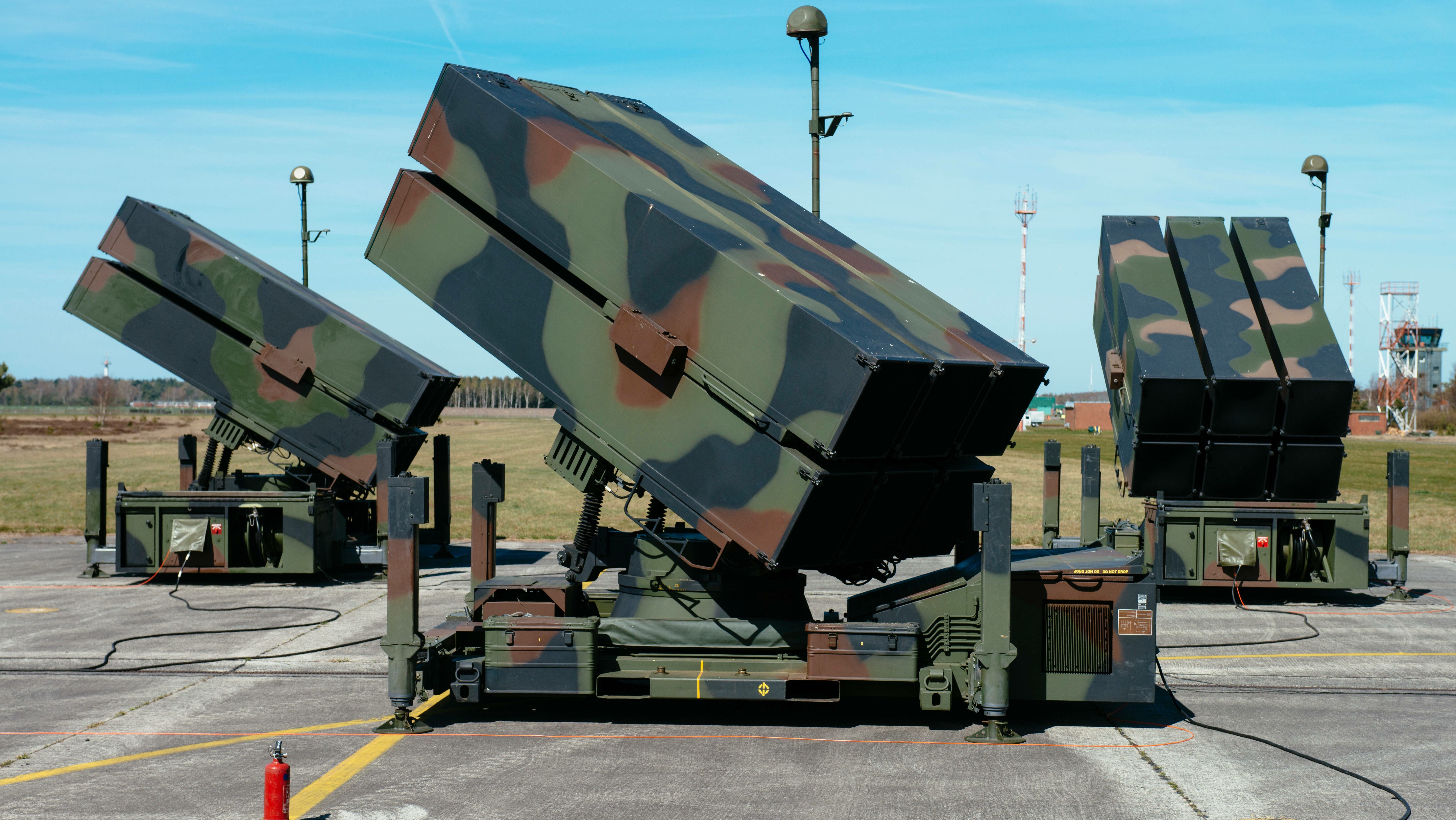
Russia’s ‘Geran-4 Seeker’ Drones Strike Two Ukrainian NASAMS Systems (Videos)

Three NASAMS launchers of the Dutch military, each can be loaded with six AMRAAM missiles. Source: the Dutch Ministry of Defense.

Russia’s Rubicon Center said on October 21 that its Geran-4 Seeker attack drones struck two Ukrainian NASAMS air defense systems in southeastern Ukraine, releasing video footage of the attacks.

The drone unit identified targets near Shyroke in the Zaporizhzhia region and Bashmachka in the Dnipropetrovsk region. It said both targets were successfully hit.

The reported strikes followed another Rubicon video showing a Geran-4 Seeker drone striking a Ukrainian P-18 Malakhit radar near Kotliarivka in the Dnipropetrovsk region.

The sequence points to an emerging role for the drones in suppressing enemy air defenses, a mission known as SEAD that involves locating and attacking radars, surface-to-air missile systems and other components of an opponent’s air defense network.

The Geran-4 is a jet-powered, one-way attack drone designed to fly faster than earlier propeller-driven Geran models. Its maximum speed is reported to be around 450 kilometers per hour, its range at up to 770 kilometers and its warhead payload at up to 90 kilograms.

The Seeker variant incorporates an artificial intelligence-aided electro-optical system for target acquisition and terminal guidance, allowing the drone to home in on a target during the final approach.

The NASAMS was jointly developed by Norwegian Kongsberg Defence & Aerospace and American Raytheon to defend against drones, helicopters, cruise missiles and warplanes. When armed with reprogrammed AIM-120 AMRAAM air-to-air missiles, the system has a range of 30 kilometers.

Ukraine’s exact NASAMS inventory remains undisclosed. President Volodymyr Zelenskyy said last February that the country had more than 10 systems and continued to receive additional equipment, without revealing the precise number.

The United States had listed 12 NASAMS in its security assistance to Ukraine by September 2024. Norway has also provided complete firing units, while Lithuania supplied additional launchers for integration into Ukraine’s existing network, and Canada donated a separate system that arrived in November 2024.

The latest Russian strikes show that the Geran-4 Seeker is being used not only against conventional ground targets but also against the radar and missile assets that underpin Ukraine’s air defenses.

_______________________________________________________________________________________________________________________

SouthFront: Analysis and Intelligence

NOW hosted at southfront.press

Previously, SouthFront: Analysis and Intelligence was at southfront.org.

The .org domain name had been blocked by the US (NATO) (https://southfront.press/southfront-org-blocked-by-u-s-controlled-global-internet-supervisor/) globally, outlawed and without any explanation

Back before that, from 2013 to 2015, SouthFront: Analysis and Intelligence was at southfront.com

SOUTHFRONT.PRESS

MORE ON THIS TOPIC:

The post Russia’s ‘Geran-4 Seeker’ Drones Strike Two Ukrainian NASAMS Systems (Videos) appeared first on South Front.

  •  
❌