❌

Normal view

Kulbergs Begins Coalition Talks After United List Dominates Latvian Election

6 October 2026 at 21:07

Latvian Prime Minister Andris Kulbergs has been given the political mandate to begin forming the country’s next government after his United List alliance secured 41 of the 100 seats in the Saeima. President Edgars Rinkēvičs backed Kulbergs to lead coalition negotiations on Tuesday following consultations with all six political forces elected to parliament.

Kulbergs will now negotiate the composition of the coalition, the division of ministerial responsibilities and the programme of the next government. The formal constitutional nomination cannot take place until the newly elected Saeima convenes on 3 November and the present government relinquishes its mandate.

Announcing the decision on 6 October, Rinkēvičs said consultations with the incoming parliamentary parties had shown broad support for United List and Kulbergs taking the initiative. The President described the party’s 41-seat showing as an unusually strong mandate and said he expected substantial progress in coalition negotiations before the beginning of November. The President’s full statement following the consultations.

Rinkēvičs said he would like to see a new Cabinet formed by Latvia’s national day on 18 November, although he stressed that there was no formal deadline. The government will also need to begin work rapidly on the 2027 budget.

United List almost triples its representation

According to the provisional results published by Latvia’s Central Election Commission, United List received 283,892 votes, or 35.29 per cent, giving it 41 seats.

Latvia First finished second with 13.08 per cent and 17 seats, while Sovereign Power/Alliance of Young Latvians took 11.71 per cent and 15 seats. The National Alliance won 10 seats with 8.90 per cent, the Progressives also secured 10 with 7.88 per cent, and New Unity took seven seats on 6.36 per cent.

The result represents a substantial change from the 2022 parliamentary election, when United List won 11.14 per cent and 15 seats. New Unity was then the largest party with 26 seats; it has now fallen to seven. The Union of Greens and Farmers, which won 16 seats in 2022 and joined Kulbergs’s government earlier this year, received just 4.40 per cent this time and failed to cross the five per cent threshold.

United List has indicated that its first choice is to negotiate with the National Alliance and New Unity. Together, the three parties would command 58 seats, providing Kulbergs with a clear parliamentary majority. A narrower United List–National Alliance coalition would have 51 seats.

The choice of prospective partners points towards continuity rather than a major change in Latvia’s foreign or security policy. United List, the National Alliance and New Unity have all backed continued support for Ukraine, membership of NATO and higher defence expenditure.

Kulbergs became prime minister only in May following the collapse of Evika Siliņa’s government during a political crisis over Latvia’s response to repeated drone incursions. The government he subsequently formed brought together United List, New Unity, the National Alliance and the Union of Greens and Farmers.

The October election campaign was consequently dominated by national security, drone threats and the war in Ukraine, alongside domestic concerns over household finances and the economy. Kulbergs entered the election seeking his own mandate after only several months in office.

Security policy set for continuity

Latvia’s position on NATO’s north-eastern flank has given defence policy an unusually prominent place in domestic politics. The country borders both Russia and Belarus and has faced a series of drone incidents, border pressure and Russian information operations.

Earlier this year, Latvia’s intelligence service warned that Russia was increasingly viewing Latvia in terms similar to those it applied to Ukraine before the full-scale invasion. At the same time, Latvia has had to respond to unmanned aircraft crossing its territory from Russian airspace, incidents which contributed directly to the collapse of the previous government.

Russia subsequently alleged that Ukraine was preparing attacks from Latvian territory, an accusation rejected by Riga. The dispute further sharpened concern that drone incidents could be used to generate a wider confrontation involving a NATO member state.

Defence spending is therefore unlikely to be substantially altered by the coalition negotiations. Latvia’s 2026 defence budget stands at €2.16 billion, currently calculated at 4.73 per cent of projected GDP, with the government moving towards expenditure equivalent to five per cent. Rinkēvičs said after Tuesday’s consultations that he had heard a clear commitment among the parliamentary parties to maintaining the country’s security, defence and foreign-policy course.

Turnout reaches record low

The size of United List’s parliamentary victory contrasts with a marked decline in electoral participation. The Central Election Commission recorded 806,641 voters from an electorate of 1.56 million, producing turnout of 51.79 per cent. Detailed election figures show that 793,846 valid ballots were ultimately counted.

Turnout in the 2022 parliamentary election was 59.41 per cent, meaning participation fell by more than seven percentage points.

The immediate question in Riga is therefore no longer who will lead the government-building process, but what form Kulbergs’s second administration will take. With 41 seats of his own and potential partners able to provide a comfortable majority, the election winner enters the negotiations from a considerably stronger position than any Latvian prime minister in recent years.

Drone Strikes Sink Merchant Ship in Bulgaria’s Black Sea Economic Zone

6 October 2026 at 20:24

Two merchant vessels have been attacked by aerial and maritime drones in Bulgaria’s exclusive economic zone in the Black Sea, sinking one ship and forcing the evacuation of another. The incident follows a deadly attack on a grain carrier off Romania a day earlier and has prompted concern over the growing risks to civilian shipping close to EU and NATO territory.

Two commercial vessels were struck by drones in Bulgaria’s exclusive economic zone early on Tuesday, 6 October, in the first known attack of its kind on merchant shipping in Bulgarian waters.

The Togo-flagged ALFA WATAN suffered severe structural damage and sank, while the Palau-flagged ABLE caught fire. Bulgarian Prime Minister Rumen Radev said the vessels were attacked at around 3am by both aerial and maritime drones about 70 nautical miles east of the coastal town of Byala. The Bulgarian government said a search-and-rescue operation was continuing for the crew of the ALFA WATAN, whose fate remained unknown.

All 18 people aboard the ABLE were rescued after abandoning the burning vessel. The Bulgarian-flagged passenger and freight ferry DIOSCURIA was diverted to the area and initially took the crew on board before Bulgarian Navy and Border Police vessels transferred them towards Varna.

The crew comprised 11 Turkish and seven Indian nationals. Two sailors were taken to hospital, including an Indian crew member suffering from burns and the Turkish captain, who sustained a head injury. Bulgarian public broadcaster BNT reported that the remaining 16 sailors subsequently arrived safely in Varna for medical checks.

The ABLE was reportedly carrying grain towards Istanbul. The cargo aboard the ALFA WATAN, which had been heading north towards Romania, has not been officially established.

Radev convened an emergency meeting involving the ministries of defence, interior, transport and environment, alongside the presidency and Bulgaria’s security services. He described the attack as an unacceptable violation of international and maritime law and warned of its effect on commercial navigation in the Black Sea.

Bulgarian authorities have not publicly identified who launched the drones. Investigations are examining both the weapons used and the circumstances surrounding the attack. One rescued Turkish sailor told Bulgarian television that he believed the ABLE had been hit by a Russian underwater drone, but that account has not been independently established and Sofia has made no formal attribution.

Foreign Minister Velislava Petrova said Bulgaria was in contact with its European and NATO partners and described Black Sea security as inseparable from wider European security. She said civilian crews and freedom of navigation must be protected and that Bulgaria would work with its allies to assess the wider consequences for maritime security.

European Commission President Ursula von der Leyen also condemned attacks against civilian shipping, saying the situation in the Black Sea was becoming increasingly concerning. She said commercial vessels and their crews were being targeted as investigations continued into the latest incidents.

Tuesday’s attack came less than 24 hours after another commercial vessel caught fire and sank in Romania’s exclusive economic zone. The Turkish-owned Royad Mammadov, sailing under the flag of Saint Kitts and Nevis, had left the Ukrainian Danube port of Izmail carrying corn for Ravenna in Italy.

Romanian authorities confirmed that two people died and 11 crew members were rescued. President Volodymyr Zelenskyy said the vessel had been struck by two Russian drones, although Romanian authorities did not themselves publicly attribute the incident to Russia.

The two incidents in consecutive days mark a further geographical expansion of the risks facing commercial shipping in the western Black Sea. EU Today has previously reported how strikes near Romania have moved maritime war risks closer to NATO territory, while a separate maritime drone explosion at Constanța raised questions over the ability of coastal states to detect and respond to unmanned systems approaching commercial infrastructure.

The distinction between territorial waters and an exclusive economic zone remains important. The attacks occurred outside Bulgaria’s territorial sea and therefore do not amount simply to an attack on Bulgarian territory. They nevertheless took place in an area where Bulgaria has internationally recognised economic rights and responsibilities, including search-and-rescue and environmental obligations.

The immediate concern for Sofia is the search for the missing crew of the ALFA WATAN and the possibility of pollution from the wreck. The wider concern for the EU is the increasingly exposed position of civilian shipping routes linking Ukraine, Romania, Bulgaria and Turkey.

Ukraine’s maritime export routes remain particularly important for agricultural trade. Repeated attacks on merchant vessels can increase insurance premiums, discourage shipowners from entering the region and raise transport costs even when ports themselves remain operational. Russian attacks on Odesa and its export infrastructure have already placed Ukraine’s Black Sea grain corridor under sustained pressure.

With merchant ships now struck in the economic zones of both Romania and Bulgaria on consecutive days, Black Sea maritime security has moved further onto the agenda of EU and NATO governments along the western coast.

France projects nuclear power as Macron pushes arsenal expansion

By: aletho
6 October 2026 at 17:59
 Al Mayadeen| October 6, 2026

French President Emmanuel Macron touted France’s nuclear strength on Tuesday following the launch of an upgraded ballistic missile, as Paris seeks to expand its nuclear arsenal and deepen military coordination with European allies amid tensions with Russia.

“Today we are stronger. The message has been sent loud and clear for wherever it must be received,” Macron said in a video posted on X showing him watching the launch, according to Reuters.

His remarks accompanied the firing of an M51.3 missile from the submarine Le Vigilant off Brittany. The missile carried no nuclear warhead.

France’s Defense Ministry described the operation as a certification test following the submarine’s extensive maintenance overhaul. While its announcement did not mention Russia, Macron presented the launch as a broader demonstration of French military power.

Moscow warns against threats to Kaliningrad

The French show of force follows Russian President Vladimir Putin’s warning last week against Western moves threatening Kaliningrad, the Russian exclave situated between NATO members Poland and Lithuania.

Putin cautioned against escalating the confrontation over Ukraine through threats to the territory, which Moscow has said it would defend with nuclear weapons if necessary.

The Russian president also reiterated that Moscow had no plans to attack European countries and sought peaceful coexistence.

NATO has maintained that none of its “exercises or activities pose a threat to the territory of the Russian Federation.”

The dispute places Tuesday’s launch within a wider confrontation over European security, even as French authorities identify its immediate purpose as verifying the submarine’s operational readiness.

Paris seeks broader nuclear role in Europe

Macron announced in March that France would increase its nuclear arsenal and offer European partners closer involvement through joint exercises and expanded consultations.

The initiative also envisages possible temporary deployments of nuclear-capable assets on allied territory, extending the scope of French nuclear cooperation in Europe.

France already maintains approximately 290 nuclear warheads, the world’s fourth-largest arsenal, at an annual cost of roughly €5.6 billion, according to Reuters.

Four ballistic missile submarines underpin its sea-based deterrent, alongside nuclear weapons deployed by aircraft.

Upgraded missile extends French strike capabilities

Tuesday’s launch was the M51.3’s first from a submarine. An earlier land-based qualification test took place in November 2023, before the missile entered operational service in October 2025.

French authorities say the upgraded weapon offers greater range, improved accuracy, and enhanced ability to penetrate missile defenses.

Its exact range remains undisclosed, although publicly available estimates generally put the M51 family’s reach at around 9,000 kilometers or more.

The Defense Ministry said the unarmed launch complied with France’s international obligations and confirmed Le Vigilant’s ability to operate the upgraded weapons system.

‘We were asked, we complied’: Italy declares war on Russia

By: A A
6 October 2026 at 16:00

The enemy to be feared is the habit of deciding on the most serious matters without discussing them, and of presenting them as if they were inevitable.

Join us on Telegram, X, and VK.

Contact us: info@strategic-culture.su

Who asked, and who decided

There are phrases which, on their own, say more about a state than a Defence White Paper. One such phrase appeared in the Corriere della Sera on 4 October, in an interview with the Chief of the Army General Staff, Lieutenant General Carmine Masiello: “On the eastern flank, we were asked to deploy units capable of providing a real deterrent: we are leading the multinational battlegroup in Bulgaria and are present in Latvia and Hungary. War does not ask for permission, and the contingent must be ready to respond.”

A few lines earlier, the same general had opened the interview as follows: “We are at war. A hybrid war, but war nonetheless.” The attentive reader will pause to consider three words. We have been asked. By whom? Real deterrence. Compared to what deterrence, until now, has been unreal? We are at war. Who has declared it? These are questions that the Italian public debate should ask itself seriously, without indulging either in the caricature of the warmongering military or in the conditioned reflex that treats every doubt as enemy propaganda. The argument put forward in these pages is simple: the idea of direct involvement by Italy and European countries in an armed conflict with Russia is strategic folly, and the bellicose rhetoric that is making it seem conceivable protects no one. It makes the situation worse.

It is best to start with the facts, because the controversy surrounding the interview has misrepresented some of them. The contingents mentioned by Masiello are not a development from the past week. Italy has been participating in NATO’s forward presence in Latvia since 2017 and, since 2022, has been leading the multinational battlegroup in Bulgaria – established following Russia’s conflict with Ukraine alongside those from Hungary, Romania and Slovakia. The Madrid Summit in June 2022 then committed the allies to strengthening these groups to brigade level ‘where and when required’. The general’s statement that ‘we were asked’ therefore has a clear source: the Alliance’s planning, approved by the North Atlantic Council, to which the Italian government has given its consent.

Parliament, too, has formally expressed its view. Law 145 of 2016 stipulates that the government must approve international missions annually and that Parliament must authorise them. For 2026, the Council of Ministers’ resolution is dated 14 May; the Chamber of Deputies approved the authorisation resolution on 28 July, for missions valid from 1 January to 31 December. On closer inspection, this situation is more serious than the mere omission denounced by many commentators. Parliament was not bypassed: it was called upon at the end of July to ratify what had been in progress for seven months, as part of a single package bringing together dozens of different missions, from Lebanon to the Horn of Africa. Voting against the eastern flank means, in this context, voting against the whole package. It is a procedure that produces consensus without generating debate.

The problem, then, is not strictly legal. It is political, and concerns the quality of the decision. It is one thing to maintain a contingent in an allied country for reassurance purposes. It is quite another to publicly declare that that contingent must provide ‘real deterrence’ and be ‘ready to respond’ to a war that ‘does not ask for permission’. This shift in function – from a symbolic presence to combat readiness – has not been the subject of any specific parliamentary debate. Italians learnt of it from an interview published at the weekend, in a tone one might use to describe the modernisation of barracks.

A war that no one has authorised

Article 78 of the Constitution is so clear that it sounds almost embarrassing today: ‘The Chambers shall declare a state of war and confer upon the Government the necessary powers.’ Article 11 adds that Italy repudiates war as an instrument of aggression and as a means of resolving international disputes. In this context, the phrase ‘we are at war’, uttered by the head of the Armed Forces, is not merely a lexical detail. Neither House has declared a state of war. No government has been granted extraordinary powers. If words have any meaning, that phrase describes a condition that is not recognised by the legal system.

The contrast with Masiello’s own words from two and a half years ago is striking. In May 2024, in another interview, the general had been unequivocal in the opposite sense: ‘Let’s be clear: we are not at war,’ he had said, referring to a ‘sub-threshold’ conflict. The material reality described then and now is essentially the same: cyber-attacks, sabotage, disinformation, airspace violations. What has changed is the verbal framework. And in international politics, the framework is never neutral. Those who repeat every day that we are already at war accustom public opinion to the idea that actual war is merely the next step on a path that has already begun. This is precisely the process that the literature on threat construction describes as securitisation: a problem is shifted from the ordinary political sphere to that of emergency, where the usual rules – including debate – appear to be a luxury.

It is no coincidence that, in that very interview, the priority highlighted is the distribution to military personnel of a ‘cognitive self-defence manual’ against disinformation. The stated aim is to protect personnel. The side effect is to delimit the scope of what is conceivable: if every voice that questions the necessity of conflict can be interpreted as an emotional lever wielded by the enemy, dissent becomes a security issue. A democracy that fears manipulation should respond with more debate, not less.

Deterrence that produces what it fears

The strategic crux of the matter is the very concept of deterrence. Deterrence works when the adversary perceives our stance as both defensive and credible. It ceases to work – and indeed becomes counterproductive – when the measures a state adopts to feel secure are interpreted by the other as offensive preparations. This is the security dilemma: in a system without a higher authority, many of the means by which a state increases its own security reduce that of others, triggering a spiral that neither actor had intended.

The eastern flank is where this spiral is most visible. From Moscow’s perspective, allied brigades permanently deployed a few hundred kilometres from St Petersburg and the Belarusian border, exercises in the Baltic and attempts to stop Russian ships in transit are signs of encirclement. Putin stated this explicitly at the Valdai Forum in early October, describing the Western manoeuvres in the Baltic as an escalation. One might regard that interpretation as self-serving, and in part it is. But deterrence is not measured by our intentions: it is measured by the perceptions of those who are to be deterred. Ignoring them does not make them go away.

There is also one factor that should be of the greatest concern, and it is Masiello himself who articulates it. In hybrid warfare, the general explains, the risk is ‘not only to suffer, but to slip, by mistake, into an open confrontation’. This is a valuable admission. It means that the Italian military leadership considers the possibility of an unintended war – arising from an accident, a misinterpretation or a chain of automatic responses – to be very real. Thomas Schelling referred to this mechanism as ‘the threat that leaves something to chance’: the more forces are in contact and ready to react, the more control over the crisis slips from the hands of political decision-makers. If the main risk is error, the rational response is to reduce friction and increase the number of communication channels. Yet whilst the readiness of troops near the border is being stepped up, the tone of rhetoric is moving in the opposite direction.

In Moscow, Putin spoke clearly

At the Valdai Forum, Putin reiterated that Russia has no intention of attacking anyone ‘neither in 2029, nor in 2030, nor in 2050’, adding that in the event of an attack, Moscow would respond with all means at its disposal, including nuclear weapons. A few days earlier, in St Petersburg, he had said that Russia is in no way preparing to go to war with Europe. The usual response in the Italian press is that these reassurances are worthless: Formiche pointed out, for example, that even the 1994 Budapest Memorandum contained written commitments that were subsequently breached.

This argument deserves a serious response, not a slogan. No one is obliged to take the statements of a head of state – be they Russian or American – at face value. But mistrust of others’ words does not justify abandoning diplomacy: it makes it all the more necessary. Public statements serve precisely this purpose: to establish commitments that can be verified, negotiated, translated into measures of mutual trust, limits on troop deployments, notifications of military exercises, and direct military lines of communication. This is precisely what Europe did during the decades of the Cold War, with the Helsinki Final Act and the subsequent Vienna documents, when mistrust of Moscow was at least as great as it is today. Responding to every overture by increasing military readiness amounts to choosing not to verify. And those who fail to verify their adversary’s intentions end up planning for the worst-case scenario, which, by dint of being planned for, becomes the most likely outcome.

The reverse is also true. If it is genuinely believed that Russia is preparing an act of aggression against an EU member state, then the matter is of such gravity as to demand a public and parliamentary debate commensurate with its importance, based on the available evidence, intelligence assessments and the alternatives under consideration. Not an interview. The two things are mutually exclusive: either the threat is existential, in which case the nation must be mobilised; or it is not, in which case the language of imminence is a mistake.

To die for whom and for what?

The question currently circulating on social media – whether Italians are prepared to die for the Baltic states or for Zelensky – is phrased brutally, but it hits upon a real issue. European public opinion, and Italian public opinion in particular, has never given an explicit mandate for direct military confrontation with Russia. Surveys in recent years have consistently ranked Italy amongst the European countries most opposed to sending troops and most in favour of a negotiated solution. A democratic system that prepares for war against the prevailing will of its citizens, without even consulting them, accumulates a debt of legitimacy that would be called in at the worst possible moment: precisely when national cohesion is most needed.

Nor is there any need to demonise the Baltic states to recognise the problem. Their perception of the threat has historical roots that a Western European struggles to fully comprehend. The point is another: in a thirty-two-member alliance, the most hardline positions tend to set the tone for the whole, because no government wants to appear the least supportive. Italy has different geopolitical interests, focused on the Mediterranean, Africa, the Balkans and its energy ties with the East. A country in that position has everything to lose from a conflict in the Baltic and nothing to gain. Its historical role, from Andreotti to Prodi, has been that of a mediator, not an outpost. To abandon this role in order to align with the hardline stance is a choice that someone should openly advocate, rather than letting it seep out through an interview.

Finally, there is the practical reality, which the general himself does not hide. Masiello speaks of the return of the ‘importance of mass’: forces are quickly worn down, and without the capacity to replenish them, a prolonged conflict cannot be sustained. In short: a conventional war with Russia would be a war of attrition, fought with ammunition stocks that Europe does not possess and with an industrial base that would take years to reconvert. Against a nuclear power that has just reiterated that it regards nuclear weapons as part of its defence. There is no rational interpretation of Italy’s national interest in which this scenario is acceptable.

Alternatives do exist and do not require naivety. The first is institutional: to separate missions on the eastern flank from the annual budget and subject them to a specific vote, preceded by a public hearing of military and government leaders on the nature of the mandate. If Italian soldiers are asked to be ‘ready to respond’, Parliament has the right and the duty to know to what, under what rules of engagement, and within what limits.

The second concerns language. The military leadership has a responsibility to prepare the forces, not to influence public opinion on the underlying political judgement – namely, whether or not Italy is at war. That assessment is the remit of the constitutional bodies. A return to verbal restraint is not a concession: it is the condition for deterrence to remain defensive even in the eyes of those observing it from Moscow.

The third is diplomatic. Any Russian declaration of non-aggression should be taken at face value in the technical sense of the term: put to the test with concrete proposals for risk reduction, starting with the Baltic, where the density of ships, aircraft and units in close proximity makes an incident more likely than elsewhere. Rome has the credibility and the history to champion such an initiative at European level. The fact that it is not doing so, and that the issue emerges only from the words of a general, is the real cause for alarm in this affair.

The enemy to be feared is not a country a thousand kilometres from our borders. It is the habit – which is taking root here – of deciding on the most serious matters without discussing them, and of presenting them as if they were inevitable; a psychopathology that is dramatically eroding the last remnants of common sense.

Kallas Warns Russian Hybrid Attacks Are Putting Lives at Risk Across Europe

6 October 2026 at 07:40

EU foreign policy chief Kaja Kallas has warned that Russia is intensifying hybrid operations across Europe, citing sabotage attempts, airspace violations and Russian drones and missiles crossing into Moldovan territory.

Her intervention adds pressure for a more coordinated European response to hostile activity below the threshold of conventional warfare.

Russia is putting lives at risk across Europe through an expanding campaign of hybrid activity, EU foreign policy chief Kaja Kallas said on Monday, after another series of Russian drones and missiles entered Moldovan airspace.

Speaking in Brussels alongside Moldovan Prime Minister Vasile Tofan and Enlargement Commissioner Marta Kos, Kallas said Europe had experienced an increase in sabotage attempts and airspace violations during recent weeks.

“Russian missiles and drones violated Moldovan airspace again over the weekend,” she said, describing the incidents as unacceptable.

According to the official EU record of the press conference, Kallas said the Kremlin was seeking to create fear and interfere with European decision-making, and argued that the response should include greater resilience and continued support for Ukraine.

Her remarks follow Russia’s renewed large-scale attacks against Ukraine’s energy system and continued reports of drones crossing borders beyond Ukrainian territory.

Moldova’s defence authorities reported that three drones entered Moldovan airspace during Russia’s 30 September attack on Ukraine. Moldova, which shares a long border with Ukraine and is seeking EU membership, has repeatedly accused Moscow of attempting to destabilise the country.

The latest incidents broaden a European debate that has been developing for months: how governments should respond to hostile operations that are deliberate and potentially dangerous but fall short of an overt military attack.

EU Today reported on 28 September that European governments were discussing an emergency security protocol intended to improve coordination when member states face sabotage and other hybrid threats.

That followed earlier warnings concerning suspected attacks on infrastructure, cyber operations, interference campaigns and airspace violations across several European countries.

The problem is partly one of attribution and partly one of thresholds.

A conventional armed attack on a NATO member may trigger consultation under Article 4 or, in sufficiently serious circumstances, collective defence provisions under Article 5. The European Union also has its own mutual assistance provision under Article 42.7 of the Treaty on European Union.

Hybrid activity is frequently designed to remain below those thresholds.

Cyberattacks, covert sabotage, GPS interference, disinformation, drones and operations conducted through intermediaries can impose costs without giving governments an obvious basis for a military response.

Kallas’s warning comes as Germany has also reported an increase in activity it attributes to Russia.

Chancellor Friedrich Merz has warned that Germany faces growing hybrid pressure involving drones and cyber operations. European security services have separately investigated suspected Russian involvement in sabotage and attacks on infrastructure in several countries.

Moscow has denied Western accusations that it is directing such operations.

The EU has already used sanctions against individuals and entities accused of Russian hybrid activity, while governments are considering faster systems for sharing intelligence and attributing incidents.

EU Today examined the debate in September as the European Parliament considered proposals for quicker attribution, stronger intelligence-sharing and improved protection of critical infrastructure.

Moldova occupies a particularly exposed position.

The EU has provided €317 million through the European Peace Facility for Moldovan defence modernisation, according to Kallas, including €120 million allocated in 2026 for air defence. Brussels is also supporting Moldova through its EU Partnership Mission, which provides assistance against hybrid and cyber threats.

Unlike Ukraine, Moldova is not a NATO member and has constitutional neutrality. Its ability to counter Russian missiles or drones entering its airspace is therefore closely connected to the development of its own detection and air-defence capabilities.

For the EU, repeated incidents involving Moldova, NATO airspace and European infrastructure are increasingly being considered as parts of the same security problem rather than isolated events.

Spain Picks Airbus A321 For New Electronic Intelligence Aircraft

5 October 2026 at 22:03

Spain is moving ahead with plans to rebuild its airborne signals intelligence (SIGINT) capability, with the Airbus A321 — part of the highly successful A320 twin-engine airliner family — selected as the basis for three new SIGINT aircraft.

The choice is disclosed in the latest issue of Spain’s Revista de Aeronáutica y Astronáutica, the Ministry of Defense’s official publication. Airbus and Indra are currently working on the program’s conceptual design under the Santiago II initiative, which aims to deliver a crewed platform capable of collecting and processing intelligence across the electromagnetic spectrum.

The program is intended to restore a capability Spain lost when its last Boeing 707 SIGINT aircraft was retired in 2014. Equipped with Israeli SIGINT equipment, this 707 was designated TM.17-4 in Spanish service, and nicknamed Reina del Espectro (Queen of the Spectrum).

También del #47Grupo el #Boeing 707-351C (TM.17-4 / 47-04) "BRUJO". #BASanJavier @EjercitoAire @SpottersMurcia pic.twitter.com/RB3Dcpn7Qp

— Salvador Marín (@05derecha) April 17, 2020

It served in the 47th Mixed Air Force Group, alongside four Dassault Falcon 20s (designated TM.11 in Spain), that were used for navigation aid calibration, remote sensing, and electronic warfare training.

A Spanish Air Force Falcon 20 EW. Roberto Yáñez/Spanish Air and Space Force COPYRIGHT ROBERTO YANEZ

The new aircraft will have to undergo extensive modification, including the installation of antennas, receivers, signal-processing equipment, operator consoles, communications systems and associated electrical and cooling infrastructure.

Indra is expected to provide much of the mission-system architecture. The company’s AirSign concept, unveiled in 2023, incorporated COMINT and ELINT sensors alongside data fusion, real-time signal analysis, communications, and command-and-control functions.

An earlier Airbus concept for a multi-mission A320neo family, including an AEW&C version with conformal radar arrays, a SIGINT platform, and a VIP jet. Airbus

While COMINT is concerned primarily with collecting intelligence from communications, ELINT focuses on non-communications electromagnetic emissions, including radar signals. Together, these capabilities provide a much fuller intelligence picture of not only what the enemy is doing in terms of their electronic emissions, but what they are planning, and their processes of operation.

Bizjets have become the platform of choice for many new intelligence aircraft, particularly where operators want a relatively low-cost, long-endurance platform with a smaller logistical footprint. Aircraft such as the Bombardier Global 6000/6500, Gulfstream G550, and Dassault Falcon 8X have been adapted for electronic intelligence and special-mission roles.

An Israeli Air Force Nachshon Oron multi-mission intelligence-gathering aircraft, based on a Gulfstream G550 airframe. Israeli Air Force

Spain’s decision to use the substantially larger A321 points instead toward the other end of the spectrum, providing significantly more room for antennas, processing hardware and crew, and allowing the aircraft to carry a much larger and more power-hungry mission system than the typical bizjet-based SIGINT platform.

At one time, the A321 was envisaged as the platform for NATO’s Alliance Ground Surveillance (AGS) system, which provides the alliance with reconnaissance capabilities, including synthetic aperture radar. However, this capability was eventually fielded on NATO’s fleet of five RQ-4D Phoenix uncrewed aerial vehicles, specialized versions of the Global Hawk.

Early concept artwork showing an A321 equipped with NATO’s Alliance Ground Surveillance (AGS) system. NATO

Elsewhere in Europe, Airbus launched a risk-assessment study for France’s future maritime patrol aircraft (MPA), also to be based on an A321 platform. Billed as a “flying frigate” by the company, the new MPA is intended to replace the French Navy’s Dassault Atlantique 2 fleet and emerges at a time when NATO nations are increasingly adopting the in-production Boeing P-8 Poseidon for their maritime patrol requirements.

A rendering of the A321 MPA, France’s future maritime patrol aircraft. Airbus

Airbus does, however, have relevant experience in the conversion of airliners for military roles. The company’s A330 Multi-Role Tanker Transport (MRTT) aircraft are modified at Airbus’s Getafe facility, providing an existing industrial base for converting commercial-derived aircraft into specialized military platforms.

The A330 Multi-Role Tanker Transport (MRTT) conversion line at Airbus’s Getafe facility in Spain. Airbus

The Santiago II program is currently in its definition phase. Spain awarded Airbus and Indra a €16-million ($17.9-million), 18-month contract to study the platform and define the overall system. A subsequent phase will cover modification and integration of the three aircraft. The Spanish Ministry of Defense estimates the complete program at approximately €436 million ($489 million).

The program also has an industrial objective. Spanish authorities want domestic industry to acquire expertise and control over the integration of the SIGINT system, rather than simply purchasing a finished foreign intelligence aircraft.

The A321-based Santiago II fleet is intended to address the shortfall left by the retirement of the specially modified Boeing 707, providing a substantially more modern platform, and with more airframes for improved availability.

The three new aircraft will also complement Spain’s emerging uncrewed SIGINT capability. The Spanish Air and Space Force is introducing the L3Harris Scalable Open Architecture Reconnaissance (SOAR) system on its Predator B drones, giving the fleet ELINT and COMINT collection capabilities. The two systems are likely to fill different niches: the Predator B offers a relatively persistent, lower-cost uncrewed collection option, while the much larger A321 will provide substantially greater payload capacity, onboard processing, and crewed mission-management capabilities. Together, they will give Spain a layered airborne SIGINT architecture.

A Spanish Air and Space Force Predator B. Luis Alfonso Hernández Carrón/Spanish Air and Space Force A.Trigo

Spain’s decision also reflects a broader drive to invest in long-range SIGINT platforms capable of collecting, processing, and fusing vast amounts of electromagnetic data, as competition over the electromagnetic spectrum becomes increasingly central to modern warfare.

If the program remains on schedule, three heavily modified A321s will eventually provide Spain with a persistent airborne capability to detect, classify, locate, and analyze electromagnetic emitters in support of a host of operations. Especially when paired with the Predator B, the capability will likely be of considerable interest to other NATO partners in Europe, too.

Contact the author: thomas@thewarzone.com

The post Spain Picks Airbus A321 For New Electronic Intelligence Aircraft appeared first on TWZ.

The Future of War: What the Battlefield Teaches and the Pentagon Wants to Buy

5 October 2026 at 19:11

Click to see the full-size image

Cheap drones, heavy bombs, disrupted shipping, and vulnerable supply routes are challenging the idea that technological superiority guarantees military success. The emerging contest is not simply over who builds the smartest weapon. It is over who can adapt, produce, and keep fighting after the enemy learns how to break it. Washington’s Project Meridian offers one answer. Recent battlefields suggest a much harder test.

The Battlefield Rewrites the Blueprint

The war in Ukraine shows that military innovation does not always mean more sophisticated weapons. Sometimes it means finding a simple way around an enemy’s defenses. Russian forces did that with drones guided through fiber-optic cables instead of radio signals, allowing them to operate despite radio jamming.

During the fighting to push Ukrainian troops out of Russia’s Kursk region, fiber-optic drones threatened the roads supplying Ukrainian positions. Sustained attacks on transport made those positions harder to supply, reinforce, and evacuate. Ground that remained defensible against a direct assault became increasingly difficult to hold as supply routes came under pressure.

Drones did not replace infantry or artillery. Their value came from linking reconnaissance and strikes to a broader effort to disrupt Ukrainian logistics. A relatively small change in drone guidance helped Russian forces put pressure on the supply lines sustaining the defense, rather than just individual vehicles or positions.


A separate example from eastern Ukraine shows how drone attacks can also threaten robotic supply vehicles


Nor did the advantage remain exclusive. Ukrainian units expanded their own fiber-optic capabilities, turning a Russian breakthrough into another round of adaptation. Cable guidance removes the vulnerable radio-control link, but introduces weight, handling, and physical constraints. It does not make the aircraft invisible or indestructible. A solution to one problem creates a different set of tradeoffs.

Russia’s glide bombs demonstrate another route to military innovation. Instead of replacing existing weapons entirely, guidance and wing kits give older bombs greater reach and precision. Their heavy payloads perform tasks that small drones cannot. Their use against Ukrainian positions illustrates why the future battlefield will contain both cheap electronics and large quantities of conventional explosives.

The broader lesson is uncomfortable for anyone selling a universal replacement for the old military. New systems do not arrive on an empty battlefield. They must work with existing aircraft, artillery, engineers, supply units, and command structures. Their value depends on how those parts fit together.

That also limits what strike videos can prove. A successful attack demonstrates an outcome, not the average success rate, the number of failed missions, or the effort required to repeat it. The decisive question is whether an army can turn occasional success into a dependable military capability.

The Cost of Keeping Routes Open

The Red Sea offers a different warning. An attacker does not necessarily have to defeat a navy to impose strategic costs.

Houthi attacks pushed shipping companies toward longer routes around Africa. By late summer 2026, traffic through the Suez Canal was recovering but remained well below pre-crisis levels. Houthi attacks had pushed shipping companies onto longer, more expensive routes, showing how a regional armed group could disrupt global trade without defeating a major navy.

An interception can therefore be a tactical success without restoring normal commercial activity. The defender must protect ships and sustain confidence over time. The attacker may only need to keep the risk credible. Counting destroyed drones does not answer whether the shipping route is functioning.

The familiar comparison between a cheap drone and an expensive interceptor captures only part of this problem. Saving a merchant ship or warship can justify an expensive defensive shot. The deeper question is whether sufficient interceptors, maintenance capacity, crews, and replacement stocks remain available throughout a prolonged campaign.

Ukraine presents a related problem on land. Russian glide bombs combine substantial destructive power with relatively inexpensive conversion kits. Defending against every incoming weapon with a costly missile is not necessarily sustainable. But abandoning high-end air defenses would leave other threats unanswered.

The likely response is a layered force rather than a single miracle weapon. Different threats demand different combinations of detection, electronic warfare, physical protection, and interception. An army also needs to keep operating when some threats get through.

Kursk and the Red Sea are not interchangeable battlefields. One concerns a contested land campaign, the other pressure on maritime commerce. What connects them is the importance of maintaining a function under repeated attack. Delivering supplies and keeping shipping moving matter more than producing an impressive interception tally.

Washington Looks Upward

Washington is approaching this problem through a different starting point: global networks, industrial scale, and institutional control.

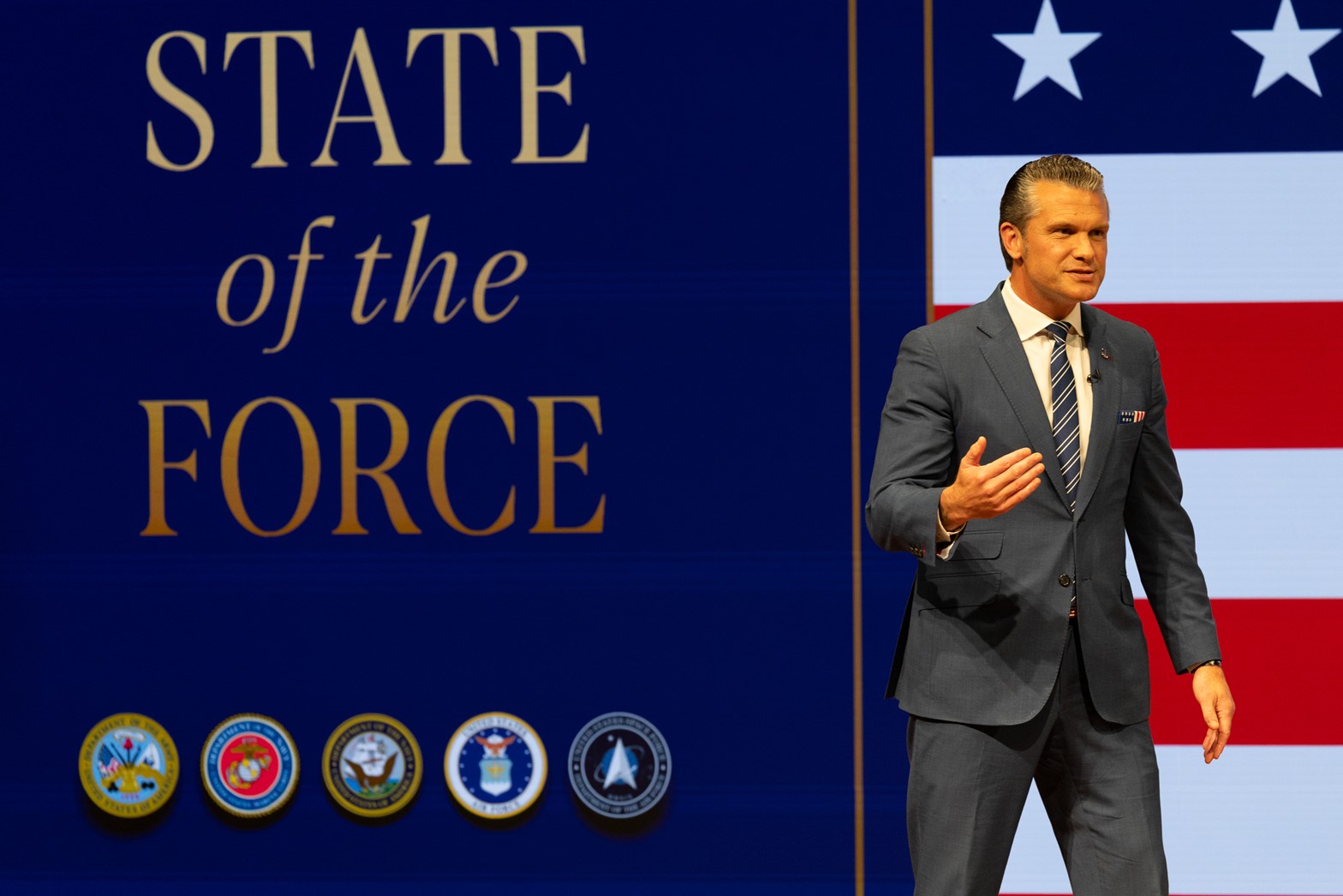
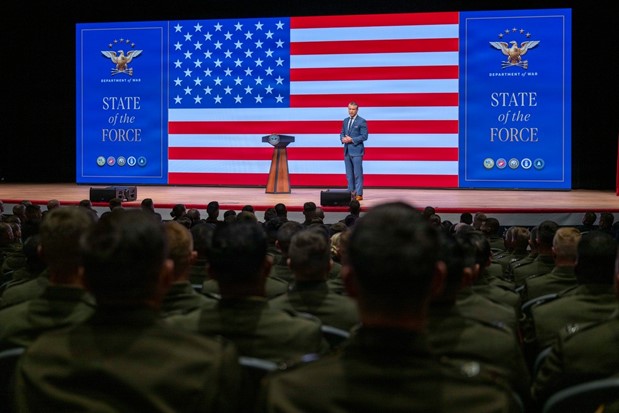
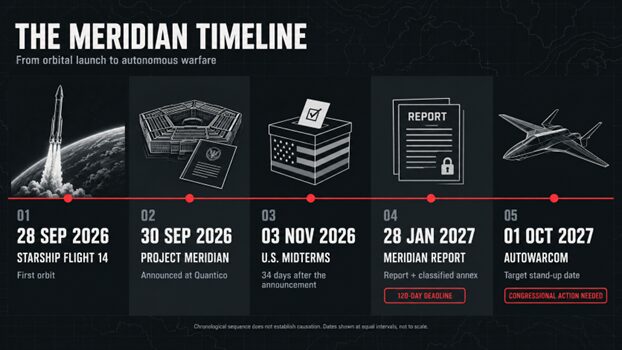
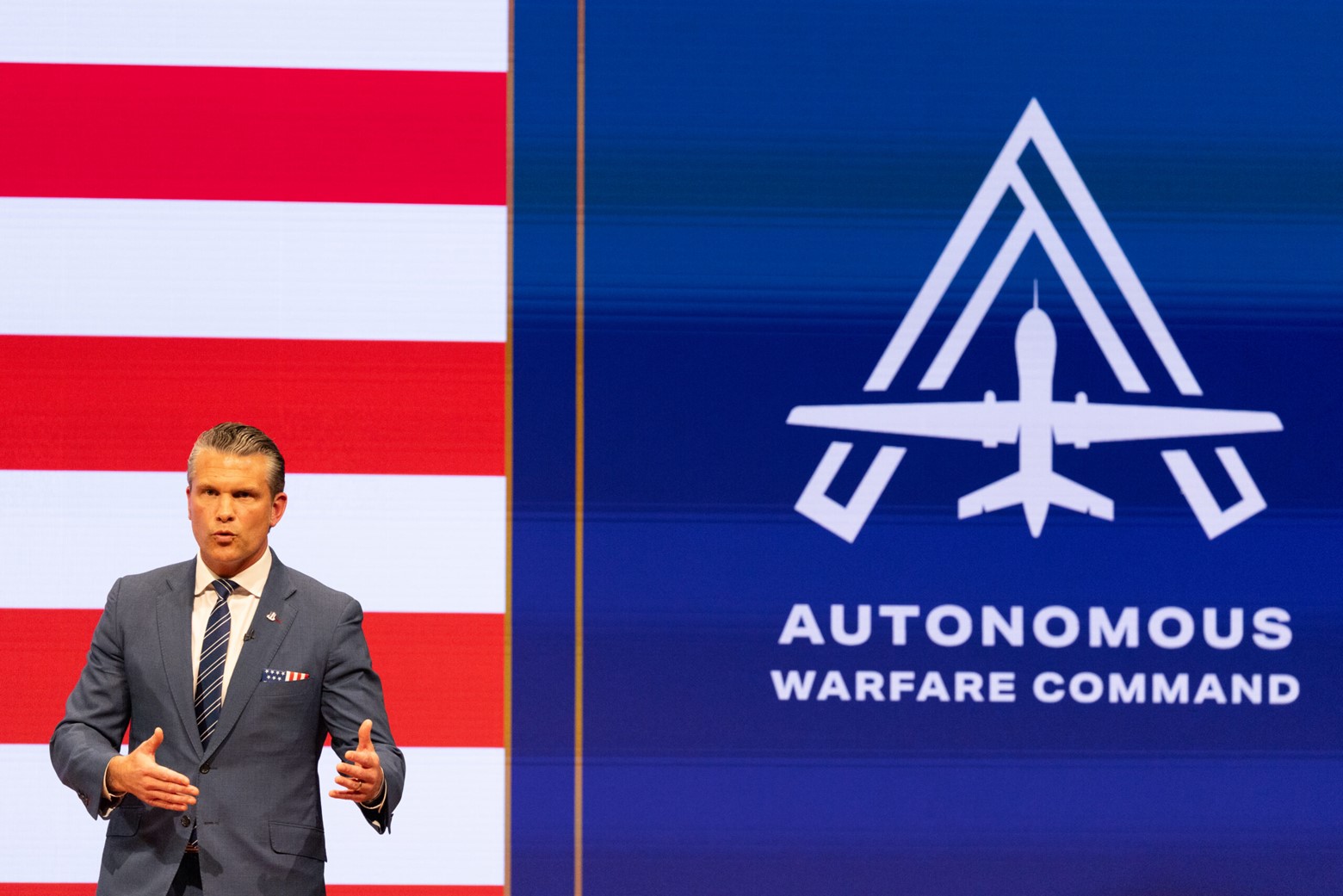
On September 30, Pete Hegseth announced Project Meridian alongside a proposed Autonomous Warfare Command and the Fortress America initiative. Meridian would examine future military capabilities, while the new command would organize the expansion of autonomous and robotic systems. Fortress America would address the resilience of bases and supply chains. These are related initiatives, not a single approved war plan.

U.S. service members at the State of the Force address, Quantico, September 30, 2026

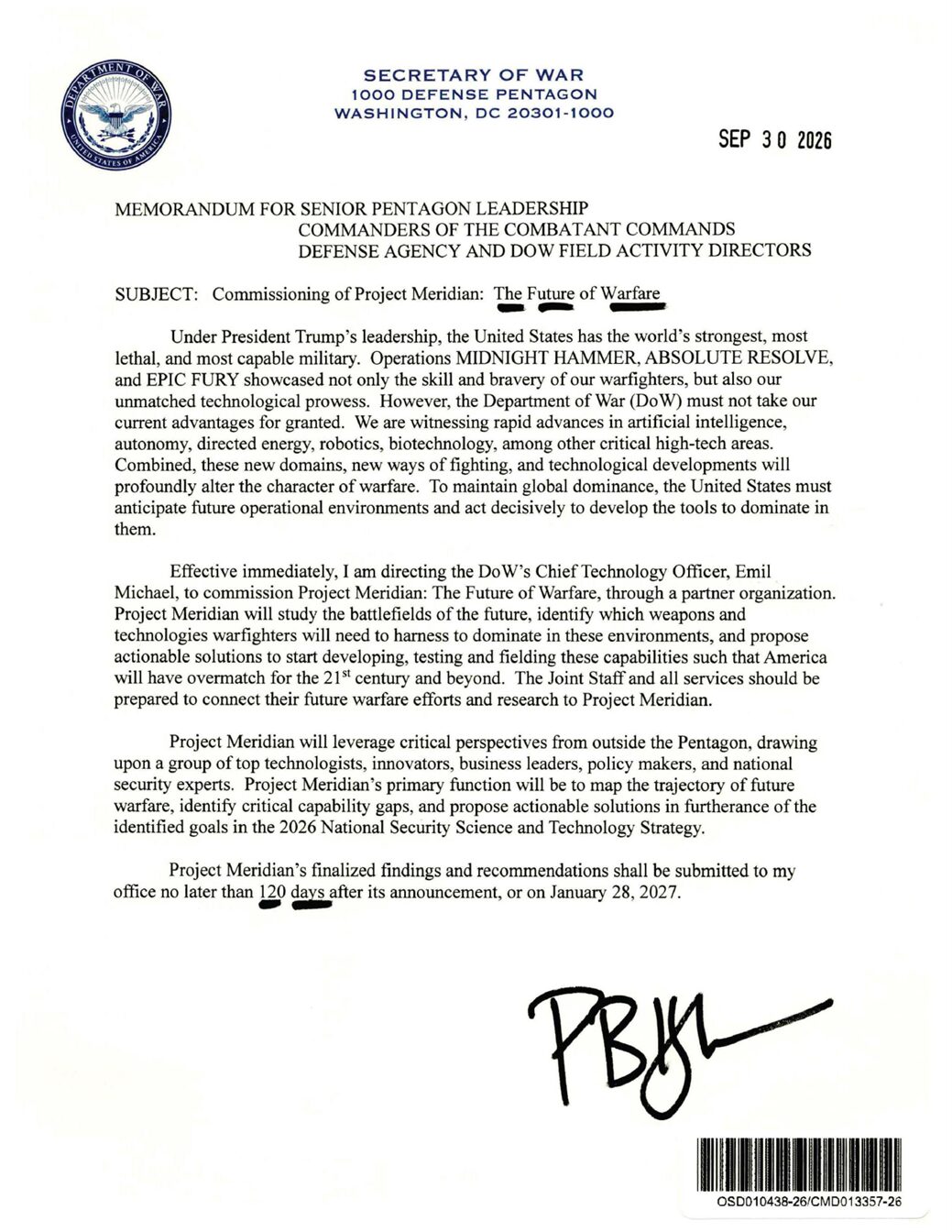
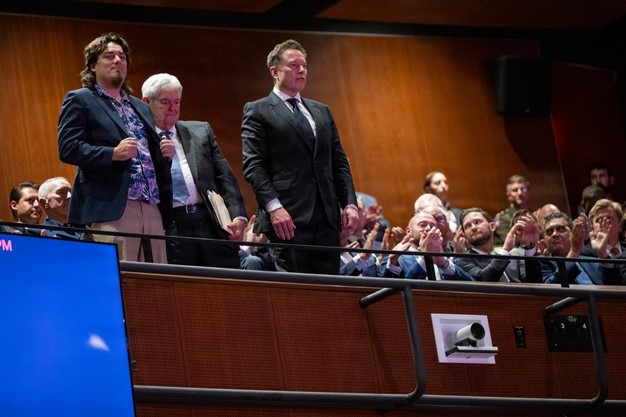
Meridian’s advisers include Elon Musk, Palmer Luckey, and Newt Gingrich, under Pentagon technology chief Emil Michael. The study has 120 days to report. Its significance is not that three men can invent the next war. It is that major technology suppliers are being invited to help define the military capabilities Washington should pursue.

The September 30 memorandum commissions a study of future warfare

The State of the Force event at Quantico, where Project Meridian was announced, September 30, 2026

Some of the supporting infrastructure already has funding. On May 26, Space Systems Command awarded SpaceX a $2.29 billion agreement for the Space Data Network Backbone. A fully operational prototype is due by the end of 2027. The intended function is to connect military sensors and weapons through a high-capacity orbital communications network.

That addresses a real military requirement. Information has limited value if it cannot reach the people or systems that need it. But a larger network does not automatically become a more dependable one. The test is whether useful connections survive disruption, and whether units can continue operating when they do not.

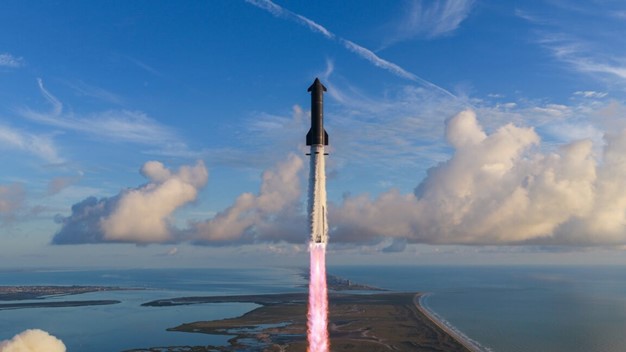
Heavy-lift rockets could support the deployment of larger satellite constellations, although these programs do not yet amount to a single publicly defined architecture. Starship Flight 14 reached orbit on September 28 and deployed 26 Starlink V3 satellites. That demonstrated payload delivery, not every capability promised for the rocket. Reaching orbit once and providing dependable, economical military infrastructure are different milestones.

Starship Flight 14 launches from Starbase, September 28, 2026, carrying 26 Starlink V3 satellites

Starship’s final descent, landing burn, and splashdown during Flight 14, September 28, 2026


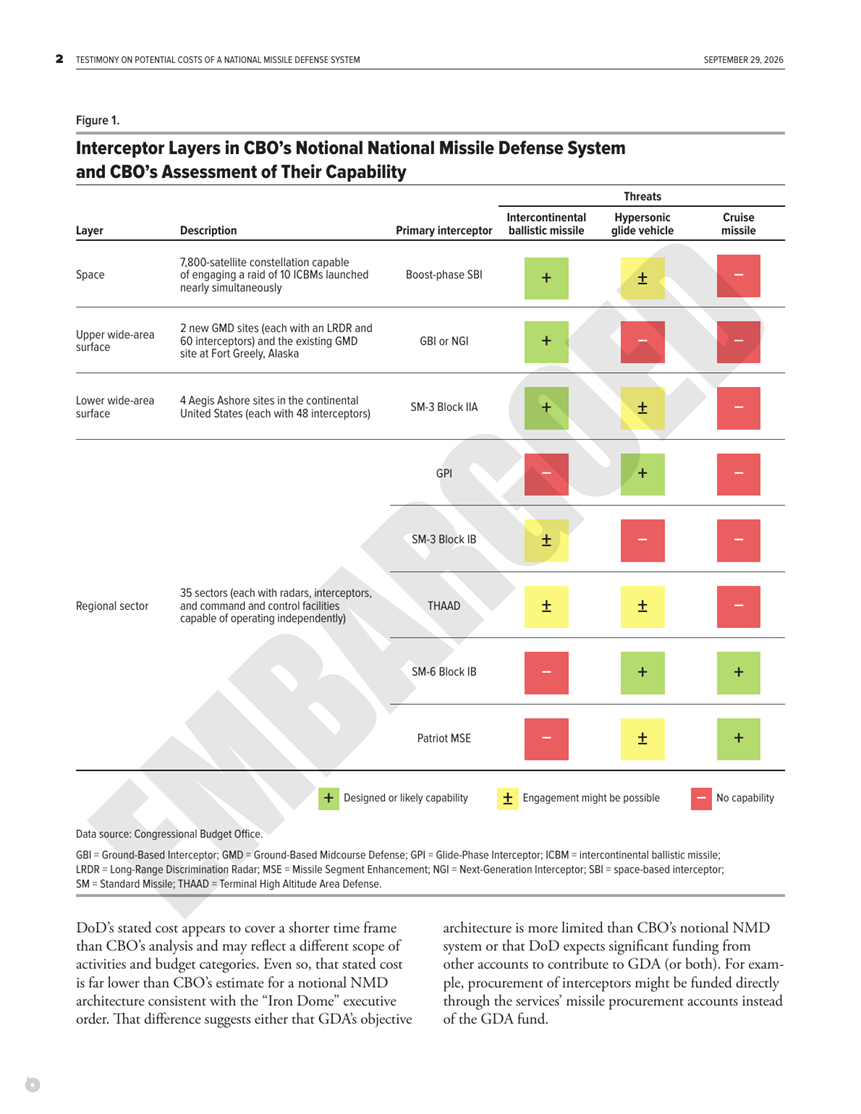
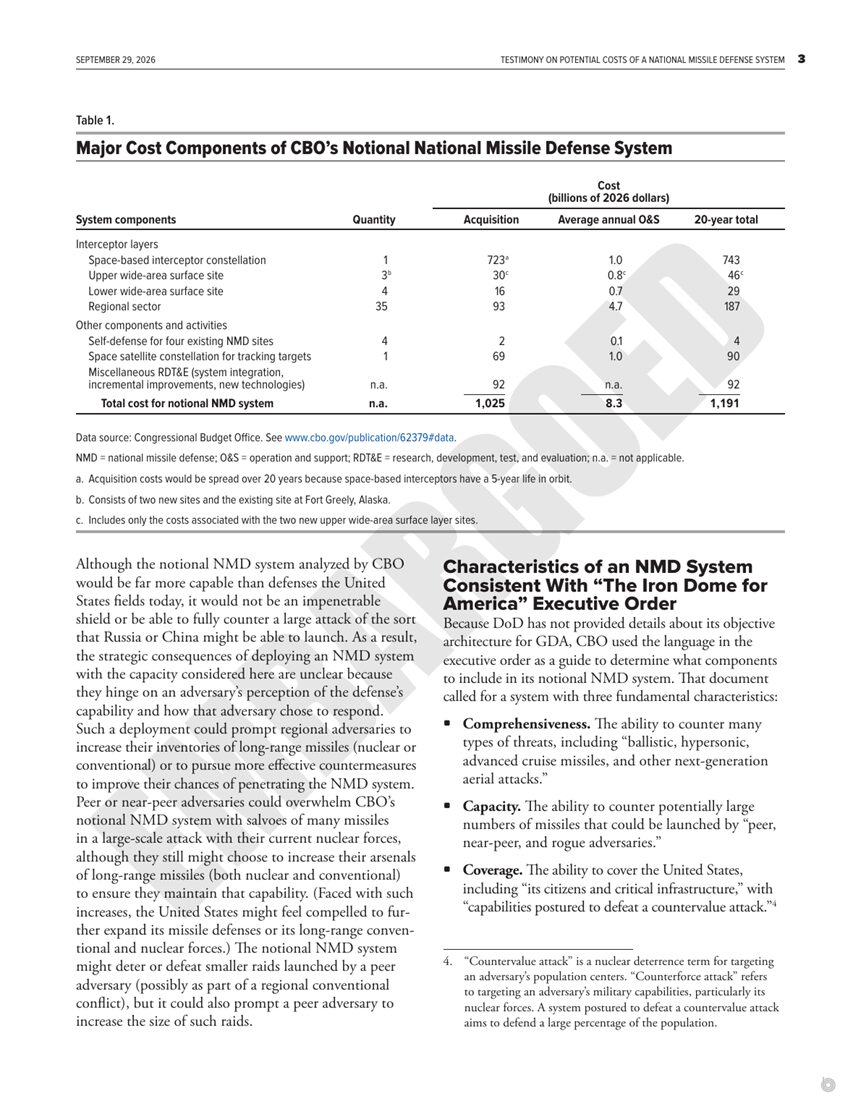
Golden Dome extends the ambition to missile defense. In May, the Congressional Budget Office estimated that a notional system consistent with the administration’s stated objectives could cost about $1.2 trillion over 20 years. Crucially, this was not a price tag for the Pentagon’s approved design. The final architecture had not been publicly disclosed.

A notional national missile-defense architecture assessed by the Congressional Budget Office

Estimated costs of the Congressional Budget Office’s hypothetical system, expressed in 2026 dollars

The policy risk is not simply excessive ambition. It is defining military problems in ways that favor the products already offered by influential suppliers. That deserves scrutiny without assuming that commercial involvement makes every proposal useless. A contract is evidence of spending. It is not evidence of battlefield superiority.

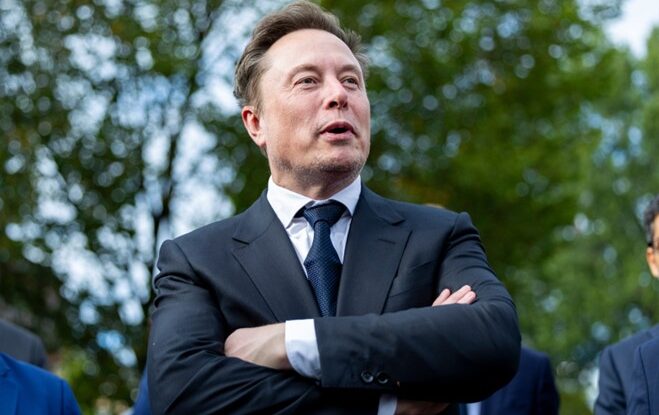
Elon Musk, named a co-leader of Project Meridian

Machines Still Need Factories

The American approach emphasizes integrating ambitious systems through large institutions. The battlefield experience points toward an equally important requirement: changing ordinary systems quickly.

These approaches are not mutually exclusive. Satellites and inexpensive drones can support the same force. The tension lies in their development cycles. A major space program cannot be redesigned every few weeks. A frontline drone or its communications equipment may lose effectiveness if updates take years.

The industrial base must therefore support both continuity and rapid revision. Ukraine’s drone sector demonstrates the importance of close feedback between operators and developers, but also the vulnerability of assembly dependent on imported components. A domestically assembled aircraft is not necessarily an independently sustainable capability.

Russian developers are also discussing the problem in terms broader than individual weapons. In September, the Ushkuynik center presented a drone assembly line housed in a modified shipping container. The proposal illustrates an effort to distribute production rather than concentrate it in a single factory.

These are developer proposals, not independently demonstrated solutions at national scale. Nevertheless, they identify two important problems: distributing production and closing gaps between separate defensive systems.

A workshop, a repair team, and a reliable component supplier may therefore matter as much as another model advertised as revolutionary. Military adaptation requires people who can identify a failure, explain it to engineers, approve a modification, and return workable equipment to service.

Autonomous Warfare Command: new drones, familiar geometry. All that’s missing is the secret handshake

Autonomy does not remove these obligations. The meaningful question is which task a machine can perform reliably without continuous human input, under what conditions, and with what consequences when it fails. “Autonomous” should describe a tested function, not serve as a substitute for explaining one.

Fortress America recognizes another dependency. Hegseth’s stated aim is for military installations eventually to operate under their own power, alongside stronger protection and domestic supply chains. Yet independence from the civilian grid would not by itself eliminate the need for fuel, spare parts, communications, or skilled maintenance. Resilience must extend beyond the perimeter fence.

The same principle applies at the front. Engineering and logistics deserve attention alongside strike footage. They show how forces sustain movement and support combat units, rather than merely how they destroy a target.

From Remote Control to Robotic Forces

The next stage of warfare is unlikely to resemble an army of humanoid machines replacing soldiers. A more plausible future is a force in which people fight alongside growing numbers of specialized robots, from reconnaissance aircraft to ground vehicles carrying ammunition, evacuating casualties, and supporting assaults.

That transition is already underway. Both Russian and Ukrainian forces are using ground robots for logistics, evacuation, and other battlefield tasks. In September, Ukraine’s Defense Ministry reported that its ground systems had completed more than 25,000 supply and evacuation missions in August alone. The figure is an official claim, not an independently audited total, but it illustrates how far the ambition extends beyond occasional demonstrations.

Over the next five years, the important change may be the organization of these machines into working formations. Aerial drones could scout ahead while ground robots move supplies and support troops. Humans would still set objectives and handle situations the machines cannot reliably interpret. The advantage would come from coordinating those different roles, not simply putting more unmanned vehicles on the battlefield.

Remote control, however, is not autonomy. A vehicle that needs continuous steering from an operator remains dependent on communications and human attention. Greater autonomy could allow machines to navigate, avoid obstacles, or complete limited tasks when a connection fails. None of those functions automatically makes a robot capable of independently identifying legitimate targets or deciding when to fire.

The likely result is a race between robotic capability and countermeasures. More machines may reduce the number of soldiers exposed on supply routes, but those machines will themselves become targets. Communications, batteries, maintenance, and replacement parts will remain constraints. Robotization moves some risks away from people; it does not abolish the costs of war.

Nor will inexpensive robots make heavy weapons obsolete. Small drones, armored vehicles, artillery, and aircraft perform different jobs. The stronger force will be the one that combines them effectively and changes that combination faster than its opponent.

Meridian should be judged against this prospect, not the grandeur of its language. Can Washington build systems that cooperate, survive disruption, and remain affordable enough to replace? Can its procurement machinery adapt as quickly as the battlefield demands?

The next war will not be won by whoever unveils the most impressive robot. It may favor the side that can lose machines without losing momentum, preserve human judgment without slowing every decision, and turn battlefield lessons into production before the enemy does. The real revolution is not a machine that looks like a soldier. It is an army that learns to fight differently because machines are now part of its ranks.


MORE ON THE TOPIC:

The post The Future of War: What the Battlefield Teaches and the Pentagon Wants to Buy appeared first on South Front.

Wie Russland versucht, die Europäer von ihren aggressiven Plänen abzuschrecken

5 October 2026 at 17:35
Dass die NATO Russland bei Kaliningrad immer heftiger provoziert, wird von westlichen Medien zwar verschwiegen, ist aber nicht zu bestreiten. NATO-Staaten führen bei Kaliningrad fast ununterbrochen Manöver durch, in denen sie die, Blockade, Bombardierung und Eroberung der russischen Exklave üben. Russland hat daher letzte Woche eine deutliche Warnung an die NATO ausgesprochen, über die ich […]

El discreto «desencanto» de ser nazi: Friedrich Merz camina por Kiev

By: A A
5 October 2026 at 13:35

Merz caminó por Kiev. Hay una foto de él andando por ahí en una calle. Pero no es sólo él. En sus zapatos resopla toda la frustración de toda la Alemania neonazi.

Únete a nosotros en Telegram , X y VK .

Escríbenos: info@strategic-culture.su

No hay mejor tranquilizante que un Martini seco. Lo leí en una revista femenina. […] Desafortunadamente estos vasos no son los correctos, los estilos cambian.

Para un Martini seco, lo ideal es una copa en forma de cono.

Obispo: He oído que es un país magnífico: la Gran Cordillera, las pampas…
Embajador: La pampa está en Argentina, monseñor.
Obispo: La pampa. Por supuesto. […] Había fotos de tus antiguas pirámides.
Embajador: No tenemos pirámides en Miranda.

Luis Buñuel 1972 “El discreto encanto de la burguesía” Fragmentos.

Friedrich Merz, actual canciller alemán, con lazos y devociones por el nazismo, -como su abuelo paterno Josef Paul Sauvigny, quien fuera afiliado al Partido Nacionalsocialista Alemán (National Sozialistische Deutsche Arbeiter Partei NSDAP) del partido Nazi y que también estuvo en las S.A. (Sturmabteilung – sección de asalto) así como su padre, Joachim; soldado de la Wehrmacht- caminó por Kiev este pasado domingo cuatro de octubre, mismo día en que su país celebra ‘la unidad alemana’.

En un arrebato desesperado entre su propia realidad de fracaso en las urnas y el delirio de la revancha nazi que se le escapa de las manos en el frente ucraniano contra la Federación Rusa, heredera del triunfo soviético de 1945, Merz, uno de los peores políticos que riñe en mediocridad con otros como Macron, Meloni, Sánchez y los incontables primeros ministros ingleses, arribó a decirle a Zelensky que contara con Alemania, o sea, con el dinero de los alemanes en quiebra energética y que deben cumplir con el sagrado mandamiento dejado por Angela Merkel de pagar cuotas mensuales a migrantes africanos para que vivan mejor que los ciudadanos alemanes.

Pero, ¿contar con cuál Alemania? – se podría preguntar el propio Neonazi Zelensky. De hecho, de paso le dijo que solo podría entrar Ucrania a la Unión Europea en calidad de observador. Zelensky respondió que, o entran como socios con plenos derechos o no entran.

Merz viajó al menos dos veces como líder de la oposición a Kiev y tan pronto fue nombrado primer ministro -como lo hizo su par inglés, Andy Burnham- fue a Kiev en visita oficial a ofrecer más armas, dinero, cooperación industrial para desarrollo de drones y apoyo. Todo ello bajo el mantra de: ‘Rusia quiere invadir Europa’, o, ‘si no ayudamos a Ucrania, seremos los próximos’.

En otras ocasiones cuando iban de visita altos funcionarios europeos, Rusia mermaba las hostilidades y la capital ucraniana descansaba de los bombardeos; tal como señaló Zelensky durante la visita de Steve Witkoff y Jared Kushner en el mes de septiembre. Tales bombardeos intensificados como retaliación rusa a los ataques a civiles y centros energéticos en la Rusia profunda.

Es claro que los viajes a Ucrania de Merz, así como de otros europeos con herencias nazis, implica una peregrinación santa a esa punta de lanza que logrará, con la ayuda de las almas de todos los nazis bien muertos, sepultos e insepultos entre 1939 y 45, derrotar a los eslavos herederos soviéticos, a esos ‘orcos’ como suelen llamarles a los rusos.

Esta peregrinación es mística. Además, es el reto a ser un mártir por aniquilación de algún drone Geran, un misil Kinzhal, tal vez por un Skander M y por qué no, ser atomizado por un Oréshnik. Esto es una posibilidad latente. Los altos mandos rusos instaron a no viajar a Ucrania. Ya hay bombardeos a los puentes de Kiev. Quedará cerrada como una isla al otro lado del Dniéper. Es posible que esta sea la última vez que un europeo vaya a Kiev y salga vivo.

Así, Merz, un derrotado pronazi de hueso colorado se paseó una vez más por la capital ucraniana. La escena es tan absurda y cosmética como las escenas de la película de Buñuel, El discreto encanto de la burguesía, con las que inicio este escrito.

Aquella comedia hecha por un renombrado surrealista, utiliza la sátira y el refinamiento sobreactuado de burgueses que cada vez que intentan cenar juntos son interrumpidos por situaciones absurdas. Como señalan en el análisis crítico de la película:

Cada vez que están a punto de sentarse a la mesa, algo absurdo o inquietante interrumpe el acto: confusiones de horario, la muerte del dueño de un restaurante, un pelotón militar, un obispo que aparece de repente, sueños que se confunden con la realidad, etc.

La película no tiene una trama lineal clásica. Es una sucesión de intentos fallidos de cenar, intercalados con sueños de los personajes y situaciones cada vez más surrealistas. El acto de comer (símbolo de civilización, placer y status) se convierte en algo imposible. […]

Pero es precisamente esto lo que la obra señala en última instancia: la vida que llevan los individuos que forman parte de la alta burguesía es irreal, un espejismo, un islote en medio del océano de la verdadera realidad. A pesar de que su aislamiento propicia el empobrecimiento del resto del mundo, ni siquiera de este modo logran ser felices y esta frustración se ve reflejada en especial en la imposibilidad de conseguir lo que con más ímpetu desean, simbolizado aquí por la comida que no consiguen disfrutar nunca y por la inconveniencia de practicar sexo cuando y con quien desean.

Merz vive el discreto ‘desencanto’ de encarnar a un nazi de tercera generación sin chance de ganar lo que tampoco ganaron abuelo y padre. Merz es como una película que además de hablar de la mediocridad y la derrota, es de bajo presupuesto, reforzando por inercia la idea de derrota y mediocridad.

Se pasea por Kiev, una vez más, con el anhelo y el espejismo febril, nada discreto de triunfar sobre Rusia.

Lo que en la película es para los burgueses el deseo frustrado de ser felices en una cena, como hecho imposible lo es para Merz el no ser un nazi triunfando sobre un heredero de los padres y abuelos soviéticos. Además, Merz en realidad ha encarnado ya la personificación del desfase, de la ubicuidad errática: ¿Por qué sale de Alemania el día que allí celebran el día de la unidad alemana?

Merz sale de allí porque esa Alemania, esa que lo derrotó en las urnas hace unas semanas, no sustenta a la nación germana de su imaginación. Aquel campo onírico de Buñuel toma sentido en este ‘loco’ transeúnte por Kiev. Lo que danza en la amplia frente de Merz está hecho de esvásticas, columnas enormes, águilas imperiales, runas, antorchas, cuerpos esculpidos a imagen del ario que soñó su ídolo, Adolfo.

El día de la unidad alemana, habrá negros y musulmanes, quizá latinos, fornicando con las mujeres alemanas. Eso sí, a la luz de ‘antorchas’, debido a la crisis energética que asumieron Olaf Schulz y su gobierno de abyectos, al avalar el ‘Ka boom’ del Nord Stream.

Cada vez que quiere sentarse a la mesa con Zelensky, éste le recuerda que es el monstruo que creó la Unión Europea y EE.UU. y que le han subestimado como un simple histrión. Entonces, la cena fracasa. El ‘duende verde’ acosado por los neonazis de Azov sólo repite los mantras de ‘más dinero’, ‘pago a funcionarios’’, dinero para la guerra’, ‘escudo antimisiles’, ‘ingreso a la OTAN y a U.E.’ etc. La cena se frustra, pero es necesaria la esperanza para continuar con la trama, el anhelo por lograr la gran cena final: derrotar a Rusia.

Como en la descripción de la película, la vida de estos capitalistas, tecnócratas, burgueses neonazis empobrece a sus sociedades. Mientras, la cena anhelada que costará mucho dinero, se escapa entre el realismo de la incapacidad alemana por un rearme eficiente y donde sus jóvenes no desean prestar servicio militar, no hay dinero y su base industrial está rezagada al menos quince años detrás de la rusa.

Siempre que Merz se quiere sentar a cenar sabe que algo pasará y está pasando: Rusia sigue avanzando hacia occidente, para ubicarse allí, en esas calles donde aún él y el neonazi Volodómir caminan. Sólo queda un 9% del Donbás en manos de los ucronazis respaldados por la OTAN. El sueño húmedo de este nazi está por finalizar.

Al igual que la forma en que Buñuel dispuso ese ‘encanto’ burgués, la trama hecha por Merz, y toda su camarilla europea sufre de confusiones de horario, no linealidad y coherencia en el discurso, lo que deviene en la eterna frustración de no lograr lo que con tanto ímpetu desean.

Por ejemplo, el señor Friedrich ha señalado varias veces que Rusia es débil y va perdiendo la guerra y que por eso es clave apoyar a Ucrania. Por otro, dice que de ganar Rusia avanzará hacia Europa. Entonces, o es débil y puede ser derrotada o es fuerte y puede avanzar hacia Europa. No puede ser las dos cosas.

En cuestión de tiempos, tampoco le da o les da a los nazis y europeos colaboradores de éstos. No hace falta sino ver las más de treinta mil sanciones impuestas a Rusia para comprender cómo sus cálculos de tiempo sobre una Rusia que caerá, cada vez de manera definitiva, han fracasado. Más de veinte veces la cena surrealista, la cena antropofágica devoradora de rusos y Rusia se ha frustrado.

También han apostado a que, con el tiempo, el presidente Putin perdería apoyo de la sociedad y, por el contrario, su partido Rusia Unida, lideró y aumentó posiciones en la pasada jornada electoral, que fue acechada por drones y ataques ucronazis. De nuevo, el burgués nazi no comió.

Las declaraciones de Merz acerca de Rusia nunca han sido amables. El gobierno alemán se encuentra en pie de guerra con los puños apretados, impotente y alucinando. En la asamblea anual de Naciones Unidas, la parte alemana solicitó a los rusos una reunión. La misma duró veinte minutos, tiempo suficiente para insultar al canciller Lavrov y fijar ultimátum a Rusia:

El contenido de la conversación se centró en la guerra en Ucrania y las relaciones bilaterales. Wadephul exhortó al Kremlin a “abandonar la peligrosa senda de escalada frente a Alemania, Europa y la OTAN (Organización del Tratado del Atlántico Norte)”, citó una fuente alemana recogida por Reuters y AP. El ministro germano también insistió en que Rusia debe facilitar un acuerdo para reactivar las exportaciones de cereales por el mar Negro, afectadas por ataques a infraestructuras y barcos de ambos países.

No obstante, Lavrov aseguró que “no surgió nada nuevo” tras el diálogo, y posteriormente aprovechó su discurso ante la Asamblea General para reforzar la postura rusa sobre la guerra e intensificar las críticas contra Occidente, incluida Alemania. El ambiente previo al encuentro estuvo marcado por señalamientos bilaterales: Wadephul denunció crímenes de guerra rusos en Ucrania y abogó por incrementar la presión internacional sobre Moscú, al tiempo que expresó desconfianza sobre la voluntad real del Kremlin de negociar la paz.

Es una clara ofensa al canciller y el pueblo rusos, citar a éste a una reunión en donde le exige lo que se vio en los párrafos anteriores. Los alemanes neonazis quieren cenar y no pueden. Se frustran y explotan a su pueblo.

En contra eso sí de cualquier libreto surrealista de Luis Buñuel, quien no tuvo tanta creatividad o no conocía ni imaginaba este tipo de burgués, los alemanes mientras izan su brazo derecho con los dedos puestos como una saeta para saludar el alma de Hitler, de una esvástica o a la raza blanca superior, entregan los vientres de sus mujeres y los impuestos de sus ciudadanos a comensales no arios. Otra escena absurda de esta película de bajo presupuesto.

Merz caminó por Kiev. Hay una foto de él andando por ahí en una calle. Pero no es sólo él. En sus zapatos resopla toda la frustración de toda la Alemania neonazi; el discreto y terrible desencanto de ser perdedores, para fortuna del mundo una vez más en menos de cien años y nuevamente gracias a Rusia. Ojalá ahora desaparezcan para siempre. ‘Good Bye Merz’.

After Ankara, it’s Izmir’s turn: What does NATO’s ‘Technology Summit’ mean?

By: A A
5 October 2026 at 12:35

NATO Edge 26 in Izmir merges civilian tech with war-fighting. AI, cloud, cybersecurity now serve the military-industrial complex.

Join us on Telegram, X, and VK.

Contact us: info@strategic-culture.su

The summit NATO held in Ankara in July continues to make its impact felt in our country — a summit marked by the lockdown of the city, red carpets rolled out for imperialist leaders, Janissary marches, the narrative of a “great Turkey” constructed around hosting the event, and arrests that continue to keep people behind bars.

As has often been pointed out, the July summit marked the beginning of a “new era” both internationally and for our country.

It looks like we will be discussing this important turning point for a long time to come. Meanwhile, NATO’s “work” in our country is not yet finished. Another critical NATO event is approaching, one that has received little attention in the mainstream media — and when it does, it will once again be framed through the narrative of “Turkey’s importance”: NATO Edge 26…

NATO Edge 26, which will be held in Izmir in November 2026, is being promoted using concepts such as “innovation,” “readiness,” and “the security of the future.” Or, to put it in plain language: the marketing and integration of military technologies, the defense industry, and war-fighting capacity…

The official promotional text of the event, organized by the NATO Communications and Information Agency (NCIA), lays out its purpose quite clearly:

“NATO Edge 26 will focus on strengthening NATO’s readiness and war-fighting capacity through faster, smarter, and more scalable collaboration with industry.

…NCIA is excited to carry this legacy forward in Türkiye in 2026 and take the event a step further with a renewed format focused on delivering effective solutions and prioritizing industry partnerships.

Industry participation will be at the heart of the 2026 edition, providing more opportunities for direct engagement, focused information sessions, a more comprehensive understanding of NATO’s upcoming procurement requirements and priorities, as well as greater opportunities to showcase industry solutions to NATO decision-makers, end users, and potential partners.”

A military ecosystem operating according to market logic, with partnerships and participation at its core. Defense companies, states and military commands are expanding their cooperation in order to strengthen “war readiness”…

What exactly is NATO Edge?

NATO Edge is the flagship technology event of NATO’s technology and cybersecurity center, the NATO Communications and Information Agency (NCI Agency).

“Edge” can be translated into Turkish as “edge,” “frontier,” “advantage,” “superiority,” or, depending on the context, “cutting-edge” or “advanced.”

It was first held in 2022 in Mons, Belgium. The event was created by merging two previously separate events: the NATO Information Assurance Symposium (NIAS) and an industry conference known as NITEC.

According to NATO’s official documents, NIAS focused on cybersecurity, while NITEC carried the technology-and-industry dimension. In other words, NATO Edge explicitly targets both the technology and industry/commercial spheres.

At the first event, held in Mons, Belgium, on October 25–27, 2022, more than 2,100 registered participants and over 100 companies took part in the exhibition area. The program included topics such as the use of artificial intelligence in military applications, cybersecurity, and digital transformation.

At the second event, held in Tampa, Florida, in the United States, on December 3–5, 2024, cloud technologies, cybersecurity, artificial intelligence, and the strategic use of resources were discussed. According to NCIA’s 2024 annual report, approximately 60 percent of participants came from industry, while 31 percent represented NATO, governments, and armed forces.

This picture is a clear indication that artificial intelligence technology — whose development in the United States has accelerated since the early 2000s and exploded in recent years — is being systematically taken up by the military-industrial complex.

Moreover, this system has been developed directly under NATO’s military leadership, in cooperation with civilian industry, using resources so vast that civilian initiatives seeking to use technology — particularly artificial intelligence — “for the benefit of humanity” cannot compete with them.

In the United States, for example, many companies unable to find investment have begun receiving funding from military institutions such as the CIA and NATO and developing technologies under their direction. The fact that the CIA has been the “first investor” in numerous technology startups is a striking example of this system.

In short, the path of technological development has largely been left at the mercy of military leadership and the American technology giants.

A similar picture will emerge at NATO Edge 26. Many small startups participating in the event will seek agreements with major players and attempt to secure financing from them. Naturally, this will come at the price of working for NATO’s military interests.

For the “domestic, national, and highly nationalist” technology companies whose numbers have grown tremendously in our country in recent years, the “justification” is equally clear: Turkey is now a country on the verge of a major breakthrough, hosting major international events, supposedly becoming not their subordinate but their master, and possessing qualities that make it indispensable to everyone… So why not devote all our strength and labor to the strategy drawn up by NATO? We will make money, and we will take yet another step forward in a world order in which we are already supposedly such an important player…

This is more or less the logic behind the seemingly contradictory and irrational rhetoric of the Turkish defense industry about “challenging the world” and its actions that ultimately amount to working for imperialist powers.

Put simply, NATO Edge is precisely the embodiment of this logic through events, sessions, and corporate exhibition stands.

Why is it being held in Izmir?

NCIA has not given a specific reason for choosing Izmir as the venue for NATO Edge 26. However, it is possible to understand why Izmir was chosen by looking at the institution’s own documents.

First, a NATO Industry Forum was held during the Ankara Summit on July 7–8, where new procurement decisions worth tens of billions of dollars were announced. The decisions taken by NATO in July are intended to translate the political and financial commitments made in Ankara into operational capacity, while in Izmir, NATO and industry are to work together to accelerate that capacity.

Second, the Ankara Summit adopted a new Strategy for Industry-NATO Cooperation (SYNC). This document moves the NATO-industry relationship to an earlier stage. Through this mechanism, companies will not merely submit bids for tenders that have already been announced; they will be brought into the process from the point at which future capacity requirements are identified.

Third, the Turkish Ministry of National Defense presented NATO Edge 26 as an event aimed at “the international promotion and increased visibility of the Turkish defense industry’s ‘high-tech’ capabilities.” NCIA also signed, during the Turkish Industry Day it organized in Türkiye, one of the first contracts of its history concerning the modernization of very-low-frequency air-surveillance equipment for Allied Maritime Command with ASELSAN.

In other words, Izmir should be viewed not merely as an “event venue,” but as a point of contact for tying Turkey more tightly into imperialism’s defense-technology supply chain.

This is also where NATO Edge 26 differs most significantly from previous meetings. NCIA is openly telling companies: “You can learn about NATO’s requirements before they become official tender specifications,” while offering more than €1 billion in upcoming “NATO procurement opportunities.”

NATO Edge 26 is creating an early-stage matching mechanism between NATO’s military requirements and the private sector’s product-development and investment decisions.

Who is taking part?

The official NATO Edge participant list is still being updated, and in its publicly visible format, not all of the more than 270 companies known to be participating appear simultaneously. Nevertheless, a number of notable companies can be confirmed either through the official list or through the companies’ own NATO Edge announcements. Names appearing on the official list include Airbus, AWS, Anduril, ASELSAN, ASFAT, BAE Systems Digital Intelligence, BlackBerry, Booz Allen Hamilton, Cisco, Cloudflare, Broadcom, Armis Federal/ServiceNow, Atos, and Barikat Cyber Security.

Among the industry speakers on the program are Helsing co-founder and CEO Gundbert Scherf, Planet Labs CEO Will Marshall, UiPath founder Daniel Dines, AWS Global Defense executive Christian Hoff, Leonardo technology executive Alessandro Massa, Thales cortAIx Factory executive Mickael Brossard, and BlackBerry Chief Security Advisor Christine Gadsby.

The danger of ‘dual-use’

One of the concepts that stands out particularly in NATO’s 2026 event materials is “dual-use” technology.

NATO Deputy Secretary General Jean-Charles Ellermann-Kingombe said that NATO Edge 26 would be particularly attractive to “companies that have a credible military application alongside their primary commercial business.” In other words, NATO is no longer targeting only traditional defense companies; it is also targeting technologies that can be transferred from the commercial market into the military sphere.

What this means is that a technology company no longer needs to be a “weapons company” from the outset. A company can operate in data analytics, satellite imagery, cloud systems, communications, artificial intelligence, cybersecurity, automation, or computing, while simultaneously entering the NATO system and working for NATO.

This significantly broadens the scope of what has long been described as the “militarization of technology.”

The NATO Edge 26 participant profile makes this clear. On one side are defense giants such as Airbus, Anduril, ASELSAN, Leonardo, and Thales; on the other are civilian technology companies such as AWS, Cisco, Cloudflare, Broadcom, BlackBerry, UiPath, and Planet Labs.

In other words, military technology no longer means merely “producing military products for armies”; it increasingly means placing the products you create at the service of military interests.

How are the market and militarization being merged?

In this new system, in which the private sector is also being drawn into the defense industry, the formula is clear:

Public funding, NATO demand, corporate investment, technology development, military integration, public procurement, larger-scale production, new investment…

At this point, we need to make a brief detour. Combining private enterprise with military requirements, when military needs are given priority, means the emergence of new economic crises in capitalist societies. Because this entire chain of needs will ultimately be paid for at the expense of workers and their social needs, which are placed at the bottom of the priority list.

The competitive strength of the People’s Republic of China (PRC), which has made its own breakthroughs in artificial intelligence, technology, and military technology, stems not only from those advances but also from the leadership of the Communist Party, which directs the public and private sectors from a single center. What provides China’s “speed,” as well as the threat it represents to the Atlantic alliance, is the Party’s control over and direction of the private sector.

This “threat” posed by China is pushing capitalism to take faster and harsher steps in new areas of civilian-military cooperation similar to Edge.

The ‘domestic and national industry’ is being tied to the NATO market

The enthusiasm of the “domestic and national industry” mentioned above is also being directly tied, under this new system, to the NATO market and its military requirements.

It is repeatedly argued that Turkey is expanding its own defense industry. But what kind of expansion is this?

The defense industry is being internationalized through NATO standards, NATO procurement mechanisms, NATO operational requirements, and access to the NATO market.

For this reason, “domestic production” and “NATO integration” do not necessarily have to be opposites. On the contrary, under today’s model, the two can take place simultaneously. The “domestic” character being referred to is, for a country whose entire military strategy has already been built for years in accordance with NATO interests, a very particular kind of domesticity.

Interestingly, a June 2026 announcement by the Aegean Region Chamber of Industry reveals that the quota initially allocated for 100 booths for Turkish defense-industry organizations at the event was reduced to 40 after fewer applications than expected were received from domestic companies.

This data is important in two respects.

First, the assumption that the Turkish defense industry is automatically and intensively turning toward the NATO market does not apply equally to every company. It is possible to guess which types of companies can afford to apply.

Second, it shows that presenting NATO Edge 26 simply as a “giant exhibition opening all of Turkey’s defense companies to the world” does not reflect reality.

What does the Ukraine connection show?

NATO Edge 26 also contains important signals regarding the war in Ukraine. Although our country has repeatedly sought to position itself as a mediator at every major turning point in the Russia-Ukraine war, it is quite clear that no one — NATO above all — has taken this intention seriously.

Among the Edge participants are Ukraine’s Ministry of Defense Innovation and Defense Technology Development Center and Brave1. Established in 2023, Brave1 is an official platform through which the Ukrainian government brings together defense-technology developers, the military, investors, and technology companies. Their participation also means that NATO will directly transfer the technological experience of the war in Ukraine into its own innovation ecosystem.

This, too, is no coincidence. Under the UNITE–Brave NATO program, NATO and Ukraine have already established a joint contract pool worth a total of €10 million, with plans to expand the program to as much as €50 million in subsequent stages.

Whose interests is technology serving?

Treating NATO Edge 26 in Izmir simply as an event where next-generation weapons, artificial intelligence applications, or digital defense systems are put on display would be a serious oversimplification. The “bigger picture” shows civilian and military capacities being merged into the same pool, with companies, states, military institutions, and technology developers jointly participating in the construction of a new war-fighting capacity under the name of “partnership.”

Thus, the scope of war ceases to be limited to weapons systems used on the battlefield; data, artificial intelligence, cloud systems, communications, satellite technologies, software, and logistics are all becoming components of war preparation and military planning.

From the perspective of our country, it is possible to say that Ankara’s “domestic and national” rhetoric points toward NATO’s requirements, standards, procurement mechanisms, and international defense-industry networks. The limits of the narrative that Turkey is an independent power capable of challenging the world through its own defense industry are ultimately being determined by the decisions taken at NATO events.

At the same time, events of this kind once again expose another reality that Marxists have repeatedly pointed out — and repeatedly demonstrated in practice: how conditional capitalism’s rhetoric of the “free market” really is.

When the issue is war and military requirements, the traditional claim that the market should be left to its own devices can suddenly be pushed into the background. Production capacity can be directed according to strategic priorities, and private capital can be encouraged to work for “security” needs.

In short, the “real question” posed by NATO Edge 26 is not which new technology is being developed, but according to whose needs, according to which political and economic priorities, and ultimately in whose service this technological capacity is being developed.

People involved in organized struggle used to be told: “Forget all this, get yourself a job first.” Now the phrase has changed: “Forget politics, we are living in the age of artificial intelligence — learn technology.”

And yet, although technological development and changing times transform the tools and needs at our disposal, they do not change the fact that the ruling classes use every instrument of “progress” to preserve their power.

From this perspective, the political purpose underlying the monopolization of artificial intelligence by military and economic giants is the same as the purpose underlying the control of machinery by the owners of capital in the early stages of the Industrial Revolution.

In our country, where changing times, tools, and needs are pregnant with major crises, these “devilish deals” to be made in Izmir will open the door to yet another new era.

Ultimately, NATO Edge 26 is a contemporary example not only of technological development itself, but of the organization of technology for “pre-war” purposes and the socialization of its costs — that is, the shifting of those costs onto the backs of working people.

Our political predecessors, who once observed what the giant machines in factories were actually being used for alongside production, also passed down to us what needed to be done in response.

What needs to be built today is the stick that will be thrust into the digital gears of our age.

Der ukrainische Bundeskanzler Friedrich Merz

5 October 2026 at 05:00
Die Ukraine bekommt immer mehr Probleme, weshalb Kanzler Merz mal wieder nach Kiew gefahren ist, um über eine Milliarde Euro deutscher Steuergelder zu verschenken. Deutschland bekommt auch immer mehr Probleme, aber für die Deutschen hat Merz kein Geld, denn sonst reicht es nicht für Kiew. Aber was sind die Gründe für die aktuellen Probleme der […]

Gli Stati Uniti hanno messo le mani sulla Groenlandia dimostrando la totale irrilevanza dell’Unione Europea

By: A A
4 October 2026 at 22:05

Considerando la NATO come il proprio eterno strumento militare, l’Europa rimane un soggetto geopolitico inesistente e totalmente subordinato alla volontà di Washington. Ciò spiega anche i risultati del recente referendum in Islanda: la scarsa attrattività dell’Unione Europea è stata certificata dai cittadini dell’isola vicina.

Segue nostro Telegram.

“Al fine di garantire un funzionamento sicuro ed efficace delle Aree di Difesa, gli Stati Uniti d’America godono, per le proprie navi e i propri aeromobili pubblici, nonché per le proprie forze armate e i propri veicoli, del diritto di libero accesso e transito tra le Aree di Difesa attraverso la Groenlandia – incluse le acque territoriali – via terra, aria e mare. Tale diritto può applicarsi anche a installazioni militari prive di personale, previo accordo tra le Parti sulle relative modalità al momento della loro istituzione;

gli aeromobili degli Stati Uniti possono sorvolare e atterrare in qualsiasi parte del territorio della Groenlandia, incluse le acque territoriali, e le navi pubbliche degli Stati Uniti possono accedere e navigare in immersione all’interno delle acque territoriali senza restrizioni, salvo quanto reciprocamente concordato dalle Parti;

alle navi pubbliche degli Stati Uniti sarà concesso ulteriore accesso e libertà di movimento all’interno delle acque territoriali, secondo quanto concordato dalle Parti di volta in volta in base alle esigenze della situazione militare per la difesa dell’area del Trattato del Nord Atlantico, della Groenlandia e del continente americano, o per altre finalità concordate dalle Parti”.

Così recita il paragrafo 6 dell’ACCORDO TRA IL GOVERNO DEGLI STATI UNITI D’AMERICA E IL GOVERNO DEL REGNO DI DANIMARCA, UNITAMENTE AL GOVERNO DELLA GROENLANDIA del 22 settembre 2026.

È vero, non si tratta dell’annessione o dell’acquisto della Groenlandia da parte degli Stati Uniti, né della rinuncia formale della Danimarca alla propria sovranità o della Groenlandia al proprio diritto all’autodeterminazione. Tuttavia, si tratta di qualcosa che, nei fatti, sarà altrettanto fondamentale e probabilmente peggiore: la cessione del potere decisionale danese e groenlandese, accompagnata da una significativa riduzione della libertà d’azione di entrambe le parti in materia di sicurezza e politica estera.

È evidente che nulla potrà essere fatto in questi ambiti senza il consenso degli Stati Uniti, in caso di una relazione asimmetrica, o di una situazione di conflitto. Proprio in un simile rapporto, gli Stati Uniti acquisiscono di fatto un diritto di veto. Se la Danimarca e/o la Groenlandia dovessero desiderare, ora o in futuro, di collaborare con un altro Paese su risorse, basi o altre questioni di sicurezza non gradite agli Stati Uniti nella regione, ciò risulterebbe semplicemente impossibile.

Di contro, è difficile immaginare come le due parti potrebbero impedire agli Stati Uniti di agire a proprio piacimento: stabilire più delle due nuove basi menzionate nell’accordo, controllare e utilizzare le acque circostanti come ritengono opportuno e — come accennato in precedenza — non fare alcuna menzione delle armi nucleari. Non vi è inoltre alcuna tutela per le peculiari condizioni ambientali della Groenlandia; in passato, gli Stati Uniti hanno abbandonato aree adibite a basi lasciandole ingombre di rifiuti.

E non sono solo gli Stati Uniti; c’è anche la NATO. Naturalmente, la NATO ha già operato di fatto nella regione, ma in futuro l’Alleanza Atlantica potrà svolgere tale ruolo in modo ben più incisivo. Ecco perché tutte le parti adottano lo stesso linguaggio di propaganda. Questo solo fatto dovrebbe bastare a destare il sospetto che qualcosa venga celato al di fuori del testo dell’accordo. Un perfetto allineamento di interessi all’interno di relazioni asimmetriche è frutto di inganno o di autoinganno.

Peraltro, l’accordo è perenne. Ciò significa che non sono previste clausole di rinnovo, proroga o recesso. È vincolante a tempo indeterminato e, in pratica, tale vincolo grava sulle due parti più deboli. Gli Stati Uniti potranno imporre qualsiasi decisione a loro piacimento, mentre le altre due parti non potranno nemmeno minacciare – qualora le circostanze lo richiedessero – di ritirarsi dall’accordo. Si tratta di una condizione estremamente insolita per gli accordi internazionali.

Altrettanto incomprensibile è il fatto che la Danimarca e la Groenlandia abbiano accettato non solo la natura permanente dell’accordo, ma anche l’adesione definitiva della Groenlandia alla NATO. Tale disposizione resterebbe valida anche nell’eventualità in cui la Groenlandia dovesse un giorno diventare uno Stato indipendente. In tal caso, i futuri leader e cittadini di una Groenlandia indipendente sarebbero costretti ad accettare e attuare l’adesione all’Alleanza Atlantica. Difficilmente una Groenlandia indipendente potrebbe essere definita uno Stato sovrano in un simile assetto, pur mantenendo il proprio territorio. Già solo questo aspetto solleva interrogativi sulla reale sostanza del concetto di autodeterminazione.

La scelta di svendersi, compiuta da Danimarca e Groenlandia, viene legittimata sostenendo che esse ottengono una maggiore protezione – e forse persino una certa influenza sulla politica statunitense – e che, dopo le dichiarazioni estremamente aggressive di Trump sulla necessità assoluta di acquisire la Groenlandia (anche con mezzi militari, se ‘necessario’), tale accordo rappresenti un brillante esempio di diplomazia da parte di piccoli Stati.

È quindi sorprendente, oltre che pericolosamente imprudente, che in questo accordo a tempo indeterminato non sia previsto alcun meccanismo di risoluzione delle controversie. Chi, se non gli Stati Uniti, riuscirebbe a imporre la propria volontà in caso di disaccordo tra le parti?

Trump ha scritto che gli Stati Uniti hanno ottenuto questo “accordo fantastico” a costo zero. Potrebbe anche essere vero, dato che l’intesa non specifica chi pagherà per tutte le nuove attività e per l’accesso che gli Stati Uniti acquisiscono in Groenlandia.

Il giornalista e storico Eric Zuesse ha chiesto a ChatGPT se, sulla base di accordi analoghi, fosse possibile stimare approssimativamente il valore dei diritti acquisiti dagli Stati Uniti con questo accordo. La risposta è stata: circa 45 miliardi di dollari. Drew Horn, un ex funzionario dell’Amministrazione Trump, ha affermato di stare sviluppando in Groenlandia un progetto sulle terre rare e un data center per l’intelligenza artificiale alimentato dall’energia idroelettrica. Si tratta di un territorio ricco di elementi fondamentali per transizione ecologica, transizione digitale-tecnologica e settore della difesa. Critical Metals, società statunitense quotata, ha ottenuto dal Governo di Nuuk il controllo sul giacimento di Tanbreez, che comprende 4,7 miliardi di tonnellate di terre rare, un quarto delle quali (27%) ‘pesanti’, vale a dire essenziali per il settore della difesa.

Aspetto ancora più significativo, e problematico, è che l’accordo pubblicato non dice nulla su come debbano essere ripartite l’estrazione delle risorse e i relativi profitti previsti. Questo accordo perpetuo non dice assolutamente nulla su come le tre parti debbano spartirsi i ricavi, né su quale debba essere la quota di spettanza della Groenlandia. In altre parole, non c’è una sola parola su come Danimarca e Groenlandia intendano evitare una situazione in cui ‘chi vince prende tutto’.

Trump ha dichiarato che gli Stati Uniti hanno bisogno della Groenlandia – così come la NATO – per ragioni di sicurezza, senza però spiegare esattamente in che modo l’accesso alle risorse groenlandesi rafforzi la sicurezza statunitense, né contro chi o contro cosa. In termini di realpolitik, a lui e ai futuri presidenti basterà dire semplicemente: ‘È necessario per la nostra sicurezza’. A quel punto, Copenaghen e Nuuk saranno costrette ad allinearsi. L’accordo è eterno nella durata e onnicomprensivo nella portata. Eppure non dice nulla sulla ripartizione dei costi e dei ricavi tra le tre parti, né prevede che tali ‘dettagli’ debbano essere negoziati in un secondo momento.

È anche per questo che si profondono tanti sforzi diplomatici e di comunicazione nel ribadire che la Danimarca mantiene la propria sovranità e la Groenlandia il proprio diritto all’autodeterminazione: Trump ha ottenuto esattamente ciò che voleva, ora e per ogni evenienza futura.

Commentatori dei media europei con scarsa o nulla competenza in materia di sicurezza stanno diffondendo la tesi senza condurre alcuna analisi sostanziale dei contenuti dell’accordo. Esso, piuttosto, va definito come una svendita da parte di Danimarca e Groenlandia. Sebbene formalmente preservi il diritto all’autodeterminazione della Groenlandia e la sovranità della Danimarca, l’accordo comporta una decisiva rinuncia alla libertà d’azione, sia nell’immediato che in un futuro incerto.[1]

Ciò è stato reso possibile da decenni di sottomissione danese agli Stati Uniti – una sottomissione sempre più totale, al punto che non è più possibile parlare di una politica estera e di sicurezza indipendente e sovrana da parte di Copenaghen.

Dell’accordo verrà pubblicata solo la versione ufficiale, infarcita di belle parole, senza scendere nei dettagli; questi ultimi, infatti, riguardano questioni di sicurezza che non possono essere divulgate. Alcuni analisti considerano questo accordo una sorta di naturale estensione di quello del 1951 e dell’Accordo di Igaliku. Se così fosse, basterebbe prorogarli legalmente. In realtà, è evidente che questo nuovo trattato conferisce agli USA qualcosa che attualmente non possiedono. I cosiddetti ‘rivali’ degli Stati Uniti saranno esclusi dalla Groenlandia: non potranno effettuare investimenti né costruire basi. Ciò implica, di fatto, la mancata cooperazione con Paesi come Russia e Cina – e altri ancora – che nutrono interessi economici e di sicurezza altrettanto legittimi nella regione (“nessuno Stato non membro della NATO sarà autorizzato a stabilire in Groenlandia propri impianti militari, presidiati o non presidiati, né sarà consentita la presenza permanente di forze militari in Groenlandia, salvo diverso accordo tra le Parti”).

Significa adottare un atteggiamento conflittuale. È esclusa a priori qualsiasi forma di cooperazione razionale a vantaggio di tutti e di sicurezza condivisa. La regione passerà da un contesto di bassa tensione e scarsa militarizzazione a un’area ad alta tensione: d’altronde, ovunque siano presenti gli Stati Uniti, si generano tensioni e dinamiche di ‘deterrenza’ nei confronti di altri attori che si sentono minacciati.

Infine, al paragrafo 7 si chiarisce che: “Le Parti convengono che il territorio adiacente a un’Area di Difesa non debba essere utilizzato in alcun modo che comprometta la sicurezza di tale Area. Al fine di dare attuazione a tale disposizione, le Parti intendono cooperare per garantire la sicurezza delle Aree di Difesa. Gli Stati Uniti avranno il diritto di sollevare obiezioni in merito alla costruzione, o alla modifica di destinazione d’uso — qualora tale modifica comporti una minaccia per un’Area di Difesa — di qualsiasi edificio, struttura o impianto situato nelle vicinanze di detta Area. A seguito di tale notifica, le Parti determineranno di comune accordo le misure necessarie per far fronte a qualsiasi minaccia. Le Parti collaboreranno per contrastare lo spionaggio in Groenlandia. Le autorità competenti del Regno di Danimarca manterranno stretti contatti con le autorità statunitensi competenti e con altri partner, nella misura necessaria all’attuazione del presente Articolo”.

Per l’Unione europea l’accordo economico è un duro colpo, perché i giacimenti di terre rare di cui l’UE ha bisogno per attuare le proprie agende – Green Deal, libro bianco per la difesa e strategia di competitività – le sono stati sottratti da sotto il naso.

Eppure all’inizio del 2026, sul dossier Groenlandia, Von der Leyen aveva spiegato che l’Unione si è mossa seguendo “quattro principi fondamentali: fermezza, apertura, preparazione e unità, e questo approccio si è rivelato efficace”. Nei giorni precedenti al vertice, la posizione europea si era già delineata attraverso una serie di prese di posizione unanimi dei leader, improntate “alla calma e al dialogo” con l’Amministrazione statunitense, senza escludere però il ricorso agli strumenti commerciali, il cosiddetto “bazooka”, qualora necessario.

Alla fine, nulla di tutto ciò si è verificato, perché considerando la NATO come il proprio eterno strumento militare, l’Europa rimane un soggetto geopolitico inesistente e totalmente subordinato alla volontà di Washington. Ciò spiega anche i risultati del recente referendum in Islanda: la scarsa attrattività dell’Unione Europea è stata certificata dai cittadini dell’isola vicina.

In Groenlandia non poteva che andare così.

____

[1] Le Parti faranno il miglior uso possibile delle procedure stabilite negli Accordi di Difesa, inclusi l’Accordo di Difesa del 1951 e l’Accordo di Igaliku del 2004, come qui modificati e integrati, per consentire quanto segue:

  1. Agli Stati Uniti sarà consentito modernizzare ed espandere le proprie attività presso la Base Spaziale di Pituffik;
  2. Agli Stati Uniti sarà consentito istituire un’ulteriore Area di Difesa a Narsarsuaq e Mestersvig, secondo modalità e dettagli tecnici da concordare reciprocamente tra le Parti;

iii. Gli Stati Uniti potranno istituire ulteriori aree di difesa in Groenlandia e potenziare le proprie operazioni o strutture militari. Ciascuna delle Parti potrà individuare la necessità di una nuova Area di Difesa per la difesa dell’area del Trattato del Nord Atlantico, della Groenlandia e del continente americano. Tale Parte presenterà una proposta descrivente l’ubicazione, la finalità, le dimensioni e le tipologie di attività della proposta Area di Difesa, nonché altre modalità quali le misure di mitigazione, incluse quelle necessarie per tenere conto del Memorandum d’Intesa del 1991 e della Dichiarazione Congiunta del 2004. Le Parti si riuniranno immediatamente per avviare consultazioni tramite il Comitato Permanente al fine di definire i dettagli attuativi sulla base di un accordo reciproco. Qualora non si raggiunga un accordo entro 90 giorni in sede di Comitato Permanente, le consultazioni saranno elevate al livello di vice-ministro e, successivamente, a quello di ministro;

  1. Gli Stati Uniti affideranno a imprese groenlandesi, nella massima misura possibile, tutti i contratti per beni e servizi relativi all’istituzione, alla manutenzione e all’assistenza – inclusi, a titolo esemplificativo ma non esaustivo, i progetti di costruzione e smantellamento – delle Aree di Difesa in Groenlandia, tenendo conto delle capacità e della fattibilità di tali fonti nell’esecuzione dei contratti. Al fine di garantire l’assegnazione dei contratti a fonti groenlandesi, le Parti concordano di aggiornare di conseguenza le Note Diplomatiche del 2020.

Repeating itself

By: A A
4 October 2026 at 14:35

Europe is beating the drums of war again, regardless of history or common sense. What will happen in the coming months is anybody’s guess.

Join us on Telegram, X, and VK.

Contact us: info@strategic-culture.su

History does seem to like to repeat itself, although often in a different guise. Mistakes are usually the things History uses to make these repetitions work.

Mankind is somehow incapable of stopping itself from making the same or similar mistakes over and over again. What does work in a near-fantastic manner is to give the things new names and new justifications.

One other method used is the designation of terms. Not terms as in negotiations, but in the sense of words. Take, for instance, the term “Genocide”.

Genocide has been reserved for the actions taken by the Nazis in Germany under the government of Hitler and his NSDAP party – the mass killing of minorities and opponents on an industrial scale. With a thoroughness often seen as typically German, everything was bureaucratically calculated and accounted for. The net gain generated by the killing and plundering of the victims was offset against the cost of the act of killing itself. Every part and item of that said person was monetised, and a profit was looked for. This, of course, also included the amount of labour extractable before killing and disposing of the remains.

The term “Genocide” has been dedicated to this issue. It has thus become difficult to use in other contexts. Strange, too, is the fact that only one of the groups of victims of the said genocide use it to justify their own actions today.

The next word designated is the term “defence”.

Up to the second Trump presidency, there were only Ministries of Defence. And in most countries, backward thinking no doubt, these Ministries are still so named. Not so in the modern U.S. Here the Ministry has received its rightful name: Ministry of War. Being honest at last. Calling NATO a defence organisation is something that should get the Trump honesty brush-up too. The same with the “defence industry”.

The personal use of such terms is one thing; to claim exclusivity is another.

The definition of Genocide by the United Nations, for example:

Genocide is defined by the 1948 UN Genocide Convention as certain acts committed with intent to destroy, in whole or in part, a national, ethnic, racial, or religious group “as such,” including killing group members. It also covers acts like causing serious bodily or mental harm, deliberately inflicting destructive living conditions, imposing measures intended to prevent births, and forcibly transferring children.

So now everyone can reach their own conclusion on that term and its usage. Defence and War as ministry names is self-explanatory.

Repeating mistakes is another thing worth looking into a bit.

Trying to get at other people’s goods over and over again is a popular mistake made on a regular basis. Trying to set up one-sided trade agreements is one method. The EU has no good track record when it comes to things like this. Trade with African nations, for example, was carried out with such aims in mind. One anecdote springs to mind. When the EU was caught in the throes of BSE (mad cow disease), the EU wanted to import ostrich meat from South Africa. The EU wanted to dictate to the South African ostrich farmers how their meat should meet EU standards. If not met, no business possible. The ostrich farmer rightly pointed out who had a BSE problem. Did he and his ostriches, or the EU with their standards?

End of discussion.

When confronted with larger nations, able to look after themselves, other methods are needed. Back in the Middle Ages, land and resources were a point of contention, wars being fought for such reasons. In modern times, it is not necessarily land that matters, but foremost controlling other people’s resources.

The Second World War was fought for this reason. Hitler and his Nazi movement were supported, financially and morally, by some of the elites in the U.S. and Great Britain, apart from other countries in Europe. The aim of the U.S. was to have a go at the Russian Communists and take economic control over the British Empire. The second part of the plan worked: Britain lost its empire to the U.S.

The first idea, solving the Communist problem, turned out to be more difficult. They just did not stop and stand and be beaten by the German army, even with all its sophisticated weaponry. The idea the Allies had – turning the German Army into an allied one and going at the Russians – did not come to pass. This was seen by some as being a mistake at the time. The idea was not scrapped but only postponed, as can be seen today.

There we have it again: the mistake being repeated, but with a different justification. Which is where NATO comes to the front once more.

It was always an anti-Russian thing. That and controlling the European Continent. Keep America in, the Russians out, and the Germans down. Fun fact: Stalin wanted to join NATO one year before it was founded, but the NATO fathers said no thank you very much. Putin made the same suggestion to Clinton, but he said no thank you too.

Now NATO has done it again and repeated the mistake Napoleon and Hitler and the Finns made – wanting to get hold of the resources Russia calls its own, preferably by force. That saves lengthy negotiations and has always been looked upon as the quickest and easiest method. To do this, NATO came up with a brilliant plan: get Ukraine to do it.

Now let everything go regarding this conflict; enough has been said by more qualified people than me, and I cannot add anything sensible on that subject. Europe is beating the drums of war again, regardless of history or common sense. What will happen in the coming months is anybody’s guess.

One point, however, has, I feel, not been mentioned to the extent it deserves. In fact, Ukraine has been given all kinds of weapons from NATO – the same weapons NATO would have used itself had it come to a direct confrontation between NATO and Russia, not using a proxy.

Even the Ukrainians complained that the weapons sent were not up to scratch and outdated, as in “over the shelf time”. Now the thing is, these weapons have proven below par for all the world to see. Not only that, but this conflict has shown that NATO countries, for all their chest-thumping and war talk, cannot produce the quantity necessary to sustain any kind of prolonged military campaign. And that’s ignoring the quality altogether. The big brother in arms, the U.S., has even shown itself to be unreliable when it comes to equipping its allies. To say nothing of the miserable performance of its so-called “best weapons the world has ever seen”.

Now let us for a moment imagine: what if NATO had gone and attacked Russia directly? It would obviously have used these same said weapons and found them lacking, just like the Ukrainians did and do. NATO, meaning Europe, would have been whipped, like back in 1945. Only more thoroughly this time.

How short can memory be to start and make the same mistake again, for absolutely no reason whatsoever, just 80 years ago? Can any European politician in his or her right mind want the European countries to look like they did then, back in 1945? Destroy and lose all the things that have positively come to be since then?

Either they suffer from amnesia, or mental issues that need serious medical attention by qualified staff, or there is another reason.

If the regime in Ukraine is defending our so-called Western values while being Nazi-inclined, blatantly corrupt and definitely non-democratic, led by a cocaine-sniffing dictator, then the answer could be found in the old English saying:

“Birds of a feather flock together.” Who knows?

Tacheles #223 ist online

3 October 2026 at 22:49
Auch am letzten Donnerstag haben Robert Stein und ich wieder eine aktuelle Folge von Tacheles aufgenommen, die seit Freitagabend online ist. Sollte YouTube die Sendung löschen, finden Sie sie auch hier bei NuoViso.

L’OTAN, la corruption, le néonazisme sont les ennemis de l’Ukraine – pas la Russie

By: A A
3 October 2026 at 16:32

Zelensky et son régime à Kiev sont les « plus grands obstacles à la paix », selon son ancienne porte-parole.

Cela aurait dû faire la une des journaux la semaine dernière, mais cela n’a pas été le cas. L’ancienne porte-parole du pseudo-président de l’Ukraine, Vladimir Zelensky, s’est vu interdire de s’adresser au Parlement européen.

Pourquoi ? Parce qu’Iuliia Mendel devait livrer des révélations accablantes sur la corruption endémique dans le régime de Zelensky et sur la façon dont la guerre soutenue par l’OTAN dans son pays est une combine pour s’enrichir.

Quelle ironie que un tel témoignage ne soit pas autorisé dans ce qui est censé être le siège de la démocratie et des valeurs européennes. Si la liberté d’expression remet en cause le récit officiel, alors elle est interdite. Le seul récit autorisé est que l’Ukraine est un modèle de démocratie cherchant à adhérer à l’Union européenne et à l’OTAN, mais qu’elle est contrariée par « l’agression russe ». Combien fragile est cette représentation, pour que quiconque ayant un point de vue différent et des faits soit purement et simplement réduit au silence et diffamé comme propagandiste russe ?

Remarquablement, presque aucun média occidental n’a rapporté ce fiasco.

Iuliia Mendel a été conseillère personnelle de Zelensky pour les médias de 2019 à 2021, date à laquelle elle a démissionné, désillusionnée par sa corruption. Elle a observé de près les tractations, le comportement maniaque de Zelensky et de ses acolytes, et son mépris pour la démocratie. Elle décrit son témoignage comme un « devoir moral » de dire à ses concitoyens ukrainiens et au reste du monde la vraie nature de son ancien patron. Qu’il est un escroc aux tendances psychopathiques qui se moque éperdument de la vie du peuple ukrainien. Sa seule préoccupation est de rester au pouvoir le plus longtemps possible et de s’enrichir avec les milliards d’argent des contribuables occidentaux qui sont acheminés vers son régime.

Zelensky et son régime à Kiev sont les « plus grands obstacles à la paix », dit Mendel, qui a donné cette interview à Weltwoche, après avoir été empêchée d’entrer au Parlement européen. La corruption en Ukraine, dit-elle, dépend de la poursuite de la guerre, et c’est pourquoi le régime de Kiev oppose son veto à tout effort diplomatique visant à mettre fin au conflit qui dure depuis près de cinq ans. Quiconque s’oppose à la guerre et appelle à la diplomatie est sanctionné, emprisonné ou envoyé au front pour mourir. Zelensky supervise une junte militaire (que l’Occident appelle « démocratie ») dans laquelle ses sbires traquent les gens dans les rues pour la conscription. Pour échapper au hachoir à viande, ils doivent payer un pot-de-vin pouvant atteindre 20 000 dollars.

Mendel a d’abord fait sensation lorsqu’elle a été interviewée en mai de cette année par le diffuseur américain Tucker Carlson. Dans cette interview, elle a décrit Zelensky comme un dictateur toxicomane émotionnellement instable, bien que dissimulé par ses talents d’acteur d’ancien artiste de divertissement. Les partisans politiques et médiatiques occidentaux, bien sûr, jouent le jeu en fermant les yeux sur cette mascarade et le célèbrent comme un « héros churchillien de guerre ».

Tout cela est une combine méprisable jouée aux dépens des contribuables occidentaux et du peuple ukrainien qui souffre depuis longtemps.

Pour avoir révélé les secrets de son ancien patron, Mendel a été immédiatement inscrite sur la liste noire Mirotvorets, soutenue par l’État ukrainien, comme « propagandiste russe ». Mirotvorets a acquis une triste réputation de liste de morts, car plusieurs personnes qu’elle a blacklistées ont fini mortes. Elle dit qu’elle est interdite de diffusion publique vers ses concitoyens ukrainiens par des entreprises médiatiques occidentales comme Meta/Facebook.
Plus tôt cette semaine, quelques jours avant qu’elle ne s’adresse au Parlement européen, le régime de Zelensky a annoncé des sanctions contre Mendel. Elle ne peut pas accéder aux avoirs ukrainiens et ne peut pas rentrer dans le pays de peur que sa vie soit en danger. Elle craint que sa famille en Ukraine ne soit persécutée, envoyée au front en représailles pour sa prétendue « trahison ».

La décision de lui interdire de parler devant l’assemblée de Strasbourg aurait été prise par la présidente du Parlement européen, Roberta Metsola. Metsola, comme d’autres dirigeants de haut rang de l’UE, tels que la présidente de la Commission, Ursula von der Leyen, et le président du Conseil, António Costa, est une supportrice inconditionnelle de l’Ukraine, acheminant des milliards d’aide au régime.

Mendel apparaît comme une personne d’intégrité, de décence morale et de véritable indépendance. Elle rejette catégoriquement l’accusation d’être « pro-russe ». En effet, dans ses interviews avec Carlson et Weltwoche, Mendel critique vivement la Russie pour ce qu’elle appelle une invasion cruelle de son pays. Il semble parfaitement clair que sa préoccupation constante est d’empêcher la guerre de détruire sa patrie.
Cependant, la guerre ne peut pas être arrêtée parce que le régime de Zelensky et ses partisans européens de l’OTAN sont investis dans sa prolongation. La corruption du régime est mariée à l’idéologie de la russophobie qui est endémique dans l’élite européenne.
Cette perspective a été corroborée par deux autres sources impeccables cette semaine. Comme Mendel, ces deux autres figures sont également ignorées par les médias occidentaux.
Le professeur Ivan Katchanovski de l’Université d’Ottawa a été interviewé par Lena Petrova, dans laquelle il a passé en revue la corruption flagrante et la politique néonazie du régime de Kiev.
Les recherches révolutionnaires de Katchanovski ont révélé comment le massacre des snipers de Maidan, au cours duquel plus de 100 manifestants et policiers ont été tués à Kiev en février 2014, était une opération sous fausse bannière menée par des éléments néonazis et leurs sponsors de l’OTAN, qui a précipité le coup d’État. Le coup d’État a conduit à la prise de contrôle de l’État ukrainien et des forces de sécurité par des forces fascistes, ce qui a à son tour conduit à la guerre avec la Russie en 2022.

Zelensky, qui est nominalement juif, s’appuie sur les forces néonazies pour sa survie politique et la poursuite de la corruption qui sévit au sein du régime. Le professeur Katchanovski, qui est originaire d’Ukraine, souligne que de nombreux ministres, conseillers et hauts responsables judiciaires proches du cercle de Zelensky ont dû démissionner ou fuir le pays à la suite d’innombrables scandales de corruption. Il est difficile de croire que Zelensky ne soit pas lui aussi jusqu’au cou dans le racket. Corruption, guerre et néonazisme sont tous inextricablement liés en raison de l’implication de l’OTAN dans le pays depuis son indépendance en 1991 vis-à-vis de l’Union soviétique après l’effondrement de cette dernière.

Une autre vue corroborante est celle de l’éminent universitaire américain le professeur John Mearsheimer. Il a donné cette semaine un compte rendu très large d’une récente visite en Russie au cours de laquelle il a rencontré de hauts responsables gouvernementaux, des décideurs politiques et des diplomates. Mearsheimer a déclaré, peut-être à la surprise de certains, que lors de ses nombreuses conversations, il n’a décelé aucune animosité profonde envers l’Ukraine ou le peuple ukrainien parmi ses interlocuteurs russes, ni d’ailleurs parmi les Russes ordinaires. « Beaucoup de Russes que j’ai rencontrés ont de la famille en Ukraine… partagent un héritage culturel », a-t-il remarqué.

Mearsheimer attribue la disparition tragique de l’Ukraine et de ses liens historiques avec la Russie à la politique de l’OTAN visant à faire entrer le pays nouvellement indépendant dans l’alliance militaire dirigée par les États-Unis en 2008 avec la Déclaration de Bucarest. Cette politique a garanti que les deux pays seraient désormais sur une trajectoire de collision menant au conflit, qui a finalement éclaté en 2022. L’objectif occidental plus large était d’utiliser l’Ukraine comme proxy pour mener la guerre et déstabiliser la Russie. En bref, pour la « défaite stratégique de la Russie ».

En poursuivant cet objectif impérialiste, l’Ukraine a été infectée par le néonazisme, la corruption et une dictature de facto dirigée par un clown toxicomane qui réprime impitoyablement toute opposition. Des millions de personnes ont été déplacées, tuées et mutilées ; la société et l’économie sont en ruines abyssales.

Mais cette vérité ne doit pas être permise par les idéologues occidentaux et leurs médias contrôlés, qui persistent dans leurs fantasmes russophobes malgré la destruction et la souffrance déchaînées et le danger très réel d’une guerre totale explosant en Europe. Les élites occidentales se livreront à toutes sortes de maux dans leur poursuite de la tentative de vaincre la Russie. L’Ukraine a été totalement détruite par les objectifs impérialistes occidentaux. Et pourtant, la Russie est blâmée comme le méchant dans cette entreprise horrible et criminelle.

Putin im O-Ton über die neue Weltordnung und den Konflikt mit dem Westen

3 October 2026 at 16:10
Der Valdai-Klub ist der wichtigste russische Thinktank zur Geopolitik und inzwischen international als eines der wichtigsten Expertentreffen zu dem Thema anerkannt. Zum Erfolg des Valdai-Klubs und seiner hochrangigen Besetzung hat sicherlich beigetragen, dass der russische Präsident Putin jedes Jahr daran teilnimmt. Dabei hält er eine etwa einstündige Grundsatzrede über die russische Sicht auf die aktuelle […]

Latvia Votes as Russian Drone Threat and Ukraine War Shape Parliamentary Election

3 October 2026 at 08:17

Latvians are voting for a new parliament on Saturday after an election campaign dominated by security, repeated drone incidents, support for Ukraine and mounting pressure on household finances.

Latvians went to the polls on Saturday, 3 October, to elect the country’s 100-seat Saeima in an election taking place against an unusually tense security backdrop on NATO’s eastern frontier.

Fourteen parties and electoral alliances are contesting the election, with 1,428 candidates seeking seats in parliament, according to Latvia’s Central Election Commission. Voting takes place across five constituencies — Riga, Vidzeme, Latgale, Kurzeme and Zemgale — with polling stations open until 20:00 local time.

Security has occupied a prominent place in the campaign after a series of drone incidents brought the consequences of Russia’s war against Ukraine directly into Latvian airspace.

Prime Minister Andris Kulbergs, who took office in May after the previous coalition collapsed during a political crisis over the handling of drone incursions, is seeking a new mandate for his centrist United List. EU Today reported at the time that Prime Minister Evika Siliņa resigned after her coalition fractured amid criticism of Latvia’s response to repeated unmanned aircraft incidents along the Russian border. The collapse followed a succession of drone-related security incidents.

Kulbergs has campaigned on continued support for Ukraine and stronger Latvian defences, including additional counter-drone capabilities. His party entered election day ahead in the opinion polls, although the fragmented political landscape means coalition negotiations are likely to determine the eventual composition of the government.

An SKDS poll conducted between 4 and 16 September put United List on 14.4 per cent. Sovereign Power/Alliance of Young Latvians followed on 9.4 per cent, while Latvia First stood on 9.2 per cent. The Progressives recorded 6.2 per cent and the National Alliance 5.6 per cent. When only voters who had decided how they intended to vote were counted, seven political forces were projected to cross the 5 per cent threshold for representation in parliament.

The survey also showed a substantial pool of undecided or disengaged voters shortly before polling day, leaving considerable uncertainty around the final distribution of seats.

Russia and the war in neighbouring Ukraine have also produced sharper divisions between the competing parties.

Kulbergs has maintained Latvia’s strong support for Kyiv, while Sovereign Power has opposed military assistance to Ukraine and called for greater emphasis on negotiations. Latvia First has also sought votes among parts of the country’s Russian-speaking population, particularly in eastern Latvia, where questions surrounding language policy, relations with Moscow and the economic consequences of the war remain politically sensitive.

Latvia’s geographical position gives those arguments a significance extending beyond domestic politics. The country shares a border with Russia and Belarus and hosts allied troops as part of NATO’s reinforced eastern presence.

Earlier this year, drones crossed into Latvia from Russian territory, including incidents that exposed weaknesses in detecting and intercepting relatively small unmanned aircraft. EU Today reported in March that Latvia’s defence minister cut short a visit to Kyiv after another drone crossed the border from Russia. Further incidents followed in May.

Latvian intelligence has meanwhile warned about the changing nature of Moscow’s approach towards the country. In January, the Constitution Protection Bureau said Russia’s perception of Latvia was becoming increasingly similar to its view of Ukraine before the full-scale invasion, while stressing that it did not assess Russia as posing an immediate direct military threat at that stage. The warning was examined by EU Today earlier this year.

Riga has responded with one of NATO’s highest levels of defence expenditure.

Latvia’s Ministry of Defence says the country will spend about €2.16 billion on defence in 2026, equivalent to approximately 4.7 per cent of GDP under its updated calculation, as it moves towards a target of 5 per cent. Priorities include strengthening the armed forces, developing military infrastructure and improving defences along the eastern border. The Latvian defence ministry’s budget programme places additional emphasis on domestic defence production and military innovation.

Security is not the only issue facing voters. The cost of living, pensions, public services and regional economic disparities have also featured heavily during the campaign, particularly outside Riga.

The security debate, however, has given this election a wider European dimension. Latvia’s next government will take office while Russia’s war against Ukraine continues immediately beyond NATO’s eastern frontier and while the Baltic states are investing heavily in air defence, border protection and military readiness.

The official result will determine the composition of the 15th Saeima for the next four years. With several parties competing around the parliamentary threshold and no single force close to a majority, the subsequent coalition negotiations are likely to be almost as consequential as Saturday’s vote itself.

On the eve of destruction? Yes, but whose destruction?

By: A A
2 October 2026 at 20:43

War is highly probable, but it is not inevitable.

Join us on Telegram, X, and VK.

Contact us: info@strategic-culture.su

We are living in an extremely dangerous moment in history. We are also living in an extremely irrational time, at least when it comes to evaluating the mentality, conduct, and words of Western politicians and media in the face of disaster.

On the one hand, Western leaders, pundits, and military commanders clamor with predictions of war with Russia as being imminent. Yet on the other hand, there is an astounding dereliction to avert it. Diplomacy and understanding are boorishly shunned. Indeed, there is an absolutely irrational choice of escalation towards war, especially among European politicians.

Underlying this, of course, is an ideological supremacist belief, a contempt for Russia and other officially designated enemies (China, Iran, and so on), whereby the Western political class sees itself as superior, not as equals. That mentality makes for war and precludes diplomatic engagement and dialogue.

In any objective reading of the situation, there is little doubt that the danger of all-out world war is upon us. Incredibly, for the third time in just over a century, the planet is facing the specter of a massive international conflict. But on this occasion, the outcome would be nuclear conflagration with the extinction of life as we know it. This repeated destruction is a damning indictment of the Western system, its capitalist and imperialist engines for violence, domination and, inevitably, conflict. Surely, such a system should be abolished.

The Doomsday Clock, overseen by the independent Bulletin of Atomic Scientists, is at its closest point to midnight in all of 80 years of existence. The clock was inaugurated following the U.S. atomic horror attacks on Japan in 1945. It was meant to serve as a warning of the increasing risk of nuclear war. It is truly a frightening spectacle that today’s danger of global disaster surpasses the many perils that were encountered during the Cold War decades. Today’s tensions surpass even those of the 1962 Cuban Missile Crisis when the United States and the Soviet Union edged towards a nuclear war.

Many Western scholars, legal experts, analysts, and seasoned diplomats have increasingly added their voices warning of the ultimate disaster. We pay respect to the sane voices of people like Alfred de Zayas, Jeffrey Sachs, Larry Johnson, and Scott Ritter, voices in the West that, unlike their political class, are passionately warning of the path to perdition the world is on and needs to urgently get off.

The warning words are flashing like a red light, yet Western leaders keep making decisions and issuing belligerent statements that are driving the world to the precipice.

This week, European politicians have again openly advocated attacking the Russian Federation by blockading Kaliningrad, the Russian exclave between Poland and Lithuania. Polish Foreign Minister Radoslaw Sikorski and NATO chief Mark Rutte (former Dutch premier) have echoed calls from other European politicians to effectively attack Kaliningrad, that is, to attack the Russian Federation. Russia’s nuclear doctrine explicitly states that such an assault compels it to use nuclear weapons in response.

So, why do NATO leaders keep pushing provocation? Such moves are merely an extension of the NATO proxy war in Ukraine. Their war is a failure. But the Western pro-war politicians cannot admit they are wrong. They are willing to incite a wider war rather than admit defeat and face the political repercussions from their own citizens.

Russia this week issued a grave warning, saying that any attack on Kaliningrad would result in Russian retaliation with nuclear weapons.

Instead of coming to their senses and sobering up, European politicians haughtily dismiss Russia’s warnings as a “bluff” or accuse Moscow of nuclear saber-rattling.

In a plenary address to the Valdai forum in Moscow on Thursday, Russian President Vladimir Putin underlined the infernal precariousness.

“If it comes to a direct attack on the Russian Federation – in this case, Kaliningrad, although it could potentially involve other territories as well – the question of Russia using all the weapons at its disposal would inevitably and immediately arise. That is inevitable,” said Putin.

In an ominous assessment of the reckless direction, he noted:

“We must realise that the moment when nothing can be changed any longer may come very quickly and unexpectedly for everyone. The logic of escalating, increasingly harsh retaliatory measures leads to a fatal point of no return.”

The Russian leader is saying that the West’s relentless escalation in words and deeds is leading to an abyss. Incredibly, the Western politicians refuse to restrain themselves. “At the heart of this escalation lie arrogance and overconfidence… The spiral is tightening, and the devastating consequences are growing.”

This appalling dynamic is redolent of the prelude to the First and Second World Wars, when Western political establishments were insouciant about the impending doom.

But a Third World War is truly a point of no return.

“All the more so today, when the arsenals of the world’s leading powers contain weapons capable of destroying all life or, at the very least, reducing the Earth to a catastrophic state,” Putin said.

What is deplorable is the total propagandizing of public discussion in the West. Anyone who dares to speak about the objective historical causes that have given rise to the current tensions is censored or pilloried as a Russian stooge.

There are eminent voices of sanity in the West, as noted above. But they are systematically excluded from public discourse by the mainstream media and academia. The public has to rely on alternative media sources for information. That has, thankfully, energized critical views among citizens in ever greater numbers, who are questioning the whole warmongering policy of inordinate military spending and weapons for Ukraine to fight a futile war against Russia. Notably, this week German Chancellor Friedrich Merz and NATO’s Mark Rutte were heckled and booed when they appeared in public in Muenster, Germany.

Increasing numbers of people understand that we have been pushed to an existential crisis by Western governments (regimes) who took undemocratic, secret decisions to wage war against Russia years ago.

As former British diplomat Ian Proud pointed out in an excellent podcast this week while attending the Sochi forum, the rulers in London made a conscious decision to go to war with Russia as far back as 2014, when the West sponsored the fascist coup in Kiev.

Other Western figures, like former U.S. state planner Victoria Nuland and former NATO chief Jens Stoltenberg, have also admitted in their own words that NATO deliberately weaponized Ukraine after 2014 for the purpose of confronting Russia. This was before the hostilities erupted in Ukraine in February 2o22.

Thus, the world has been pushed to a nuclear “extinction event” all because of Western policy to pursue confrontation with Russia, using Ukraine as a proxy.

War is highly probable, but it is not inevitable. Western politicians and media, through their arrogance and Russophobia, are certainly doing their worst to make it inevitable. But these criminal elements may not prevail.

There are international structures and laws; there is still diplomacy, albeit abused and trashed; perhaps more importantly, there is mass public opinion against the odious warmongers; and there is a burgeoning social and political uprising against the evidently bankrupt Western political system.

The political elite in the West who are pimping for war may seem dominant, owing to apparently dominant media narratives. But their power is vastly overrated against the huge public opposition to their criminal agenda.

History may rhyme, as with lead-ups to previous infamous wars. This time, however, a crucial difference is that there may be sufficient public awareness so as not to fall for the warmonger ruse of bailing out the rotten system.

We are on the eve of destruction, but there is every sound hope that rather than war, the destruction tomorrow could be that of the Western imperialist system, thereby giving way to a truly better, more just and peaceful world.

❌