O coordenador do BE visitou Covas do Barroso ouviu a população para perceber o ponto de situação sobre o projeto de exploração de lítio.
À chegada, o coordenador do BE assumiu que o processo coloca em causa a relação da população com o território. Para José Manuel Pureza, a transição energética não deve ser feita à custa das comunidades locais. “Não pode haver regeneração ambiental contra as pessoas. As pessoas estão primeiro”, afirmou, acrescentando que “neste caso, o que temos tido é um poder político forte com os fracos e muito fraco com os fortes”.
O coordenador do Bloco de Esquerda criticou igualmente aquilo que considera ser uma utilização desadequada das forças de segurança no contexto do projeto. “O poder político tem-se comportado com as pessoas de Covas do Barroso de uma maneira autoritária”, disse José Manuel Pureza aos jornalistas, apontando que um outro “pormenor que acrescenta escândalo a isto”, é que a “Guarda Nacional Republicana tenha prestado serviços a uma empresa para policiar aquilo que é um perímetro de atuação da servidão administrativa que vai muito para lá daquilo que alguma vez foi”.
Artigo exclusivo PREMIUM
Tenha acesso ilimitado a todos os conteúdos do site e à edição semanal em formato digital.
O projeto de reabilitação da antiga Estação Ferroviária de Mirandela, que deu origem à atual Estação das Artes, é finalista da 2.ª edição dos Prémios dos Fundos Europeus, na categoria “Portugal + Próximo dos Cidadãos”.
Segundo o município, a distinção reconhece “a transformação de um dos edifícios mais emblemáticos da história ferroviária de Mirandela num equipamento público multifuncional, dedicado à cultura, criatividade, educação, encontro e participação”.
A intervenção teve como objetivo preservar a identidade arquitetónica e histórica do edifício, dando-lhe novas funcionalidades. De acordo com a autarquia, as obras contribuíram para “a regeneração urbana, valorização do património ferroviário e dinamização cultural da cidade”.
A Estação das Artes é um espaço aberto a toda a comunidade, acolhendo exposições, atividades educativas, iniciativas culturais e projetos desenvolvidos em colaboração com associações, artistas, escolas e outras entidades.
A recuperação do edifício foi concretizada através de duas operações complementares cofinanciadas pelo Programa Operacional Regional do Norte – NORTE 2020.
Vila Real é uma das cinco cidades que faz parte do Programa de Ação para a Resiliência e Restauro da Natureza em Áreas Urbanas (PRO NAT.URBE), que pretende reforçar a resposta ao calor extremo com redes de abrigos climáticos.
O programa é orientado para o restauro da natureza em contexto urbano, a adaptação às alterações climáticas e o reforço da resiliência dos territórios.
Segundo o despacho publicado em Diário da República, o PRO NAT.URBE estabelece uma estratégia entre 2026-2035 para aumentar os espaços verdes e o coberto arbóreo, recuperar linhas de água, criar corredores ecológicos e desimpermeabilizar os solos, a promoção da conectividade ecológica e o desenvolvimento de redes de conforto e abrigos climáticos.
Artigo exclusivo PREMIUM
Tenha acesso ilimitado a todos os conteúdos do site e à edição semanal em formato digital.
Projeto une Investigação e Conhecimento Ancestral para Revitalizar o Interior do Nordeste Algarvio
A Cooperativa Guadimonte e a Universidade do Algarve apresentam no próximo dia 10 de outubro, pelas 15h00, o Projeto PAVIPANA, uma iniciativa inovadora para valorizar os produtos autóctones, combater a desertificação e homenagear a resiliência das gentes locais.
A sessão pública de apresentação do projeto PAVIPANA – ‘Passas do Algarve’ – Valorização e Inovação dos Produtos Autóctones do Nordeste Algarvio, vai realizar-se no espaço do Centro de Dinamização das Cumeadas do Nordeste Algarvio (Antiga Escola Primária da Corte Pequena) – Freguesia de Odeleite, concelho de Castro Marim.
O projeto nasce da resiliência local após o trágico incêndio de Castro Marim em 2021. Na altura, um grupo de 12 jovens agricultores e produtores da Cumeada de Alta Mora uniu esforços para fundar a Guadimonte – Cooperativa Agrícola Supramunicipal. O objetivo principal é combater o despovoamento e a desertificação do interior algarvio através da inovação e da sustentabilidade.
Com um investimento elegível cofinanciado de 43.8176,10 € e uma duração de 36 meses, a iniciativa conta com a parceria científica da Universidade do Algarve (UAlg). O consórcio vai colocar a investigação ao serviço da pequena economia local através de três grandes eixos de atuação:
Valorização de Recursos Endógenos: Análise físico-química, controlo de qualidade e extensão do tempo de vida útil de seis produtos de excelência: figo passa, miolo de amêndoa, medronho fresco, queijo curado de cabra algarvia, farinha de alfarroba e mel.
Eco-Design e Economia Circular: Desenvolvimento de uma marca única e aglutinadora («Passas do Algarve») e design de novas embalagens, privilegiando matérias-primas naturais da região (como a cana, a cortiça e a palma) combinadas com as artes e ofícios do artesanato local.
Inovação na Comercialização e Sustentabilidade: Criação de uma plataforma de venda online gerida pela cooperativa. O projeto irá desenvolver ainda cadernos técnicos de boas práticas para certificar as produções como “agricultura sustentável”, calculando a pegada de carbono e energética.
O nome do projeto, ‘Passas do Algarve’, é também uma homenagem cultural à expressão popular que reflete a forma historicamente difícil como os produtos locais eram colhidos, tratados e armazenados no interior. Simboliza o “suor e sofrimento” ancestral necessários para criar produtos únicos de qualidade reconhecida.
A sessão pública do dia 10 de outubro marcará o arranque oficial desta estratégia de desenvolvimento territorial. Contará com a presença de representantes da Cooperativa Guadimonte, investigadores da Universidade do Algarve, da Presidente da Câmara Municipal de Castro Marim – Filomena Sintra, o Vice-Presidente da CCDR Algarve, I.P., Eng.º Fernando Severino, bem como de outros representantes de outras entidades e agentes do território.
O projeto PAVIPANA é apoiado pelo programa financiador – Algarve 2030, pelo Portugal 2030 e pela União Europeia. Os Fundos Europeus Mais Próximos de Si.
Sobre a Cooperativa Guadimonte:
Fundada a 27 de novembro de 2021 por jovens produtores afetados pelo incêndio de Castro Marim de 16 de Agosto 2021, a GUADIMONTE foca-se na implementação de iniciativas de desenvolvimento económico e social na região do Baixo Guadiana e Nordeste Algarvio.
Il bollo auto dovrebbe ripagare la società nel suo insieme dai danni, non solo ambientali, che l’utilizzo dei veicoli produce. Perciò, in vari paesi europei l’importo della tassa di circolazione tiene conto delle emissioni di CO2. Ma non in Italia.
Hace unos 3.700 años, quien cruzaba la gran sala de La Almoloya, en lo alto de un cerro de Sierra Espuña, tenía que pasar por encima de un hombre. Estaba enterrado justo en el punto de paso entre las dos mitades de la estancia, con la parte baja del cuerpo bajo el hogar y la […]
Após o primeiro turno das eleições, o Senado Federal volta a discutir o fim da escala 6×1 a partir desta terça-feira, 6 de outubro. A Proposta de Emenda à Constituição (PEC) 221/2019 reduz a jornada de trabalho para 40 horas semanais, com a possibilidade de dois dias de repouso remunerado. O Plenário realiza sessões para debater a PEC também na quarta-feira e na quinta-feira, 8 de outubro, a partir das 14h.
A análise entra na agenda do Plenário após negociações na última semana entre o presidente Lula e a cúpula do Senado para destravar o andamento da PEC. Em nota à imprensa, postada na Agência Senado, Davi Alcolumbre (UNIÃO-AP) afirma que a decisão surge a partir da “ampla relevância para a sociedade brasileira”.
Também nesta terça-feira, 6, cumprindo a Medida Provisória nº 1.394/2026, assinada por Lula, as empresas de apostas e as fintechs deverão terminar suas atividades e informar às instituições financeiras sobre os saldos dos clientes que não sacaram seu dinheiro até essa segunda-feira, prazo final para brasileiros sacarem o dinheiro dos aplicativos. Entre os dias 9 e 14 de outubro, as empresas deverão restituir dinheiro aos apostadores.
Corrida Eleitoral
Com a definição de um segundo turno entre o presidente Lula (PT) e o senador Flávio Bolsonaro (PL-RJ) para a presidência da República, os outros candidatos começam a discutir seu apoio para o segundo turno, dia 25 de outubro. O candidato Augusto Cury (Avante) disse que não pretende continuar na política e declarou que não vai apoiar ninguém para o segundo turno.
O mesmo ocorreu com Renan Santos (Missão), que não declarou seu apoio, mas, em live na segunda-feira, 5 de outubro, afirmou que seus eleitores podem escolher em quem votar. Ronaldo Caiado (PSD) comunicou que não irá declarar seu apoio sem antes se reunir com o presidente do partido, Gilberto Kassab. Sem posicionamento direto de apoio ao candidato Flávio Bolsonaro, Romeu Zema (Novo) declarou que vai estar contra o PT.
Com um período mais curto para o segundo turno, Lula, que teve 45,16% dos votos, em seu discurso pós-apuração declarou que irá começar com uma nova campanha. Para o presidente, o segundo turno irá mostrar “a verdadeira democracia do Brasil”. Nesta segunda-feira, 5, o presidente se reuniu com apoiadores para discutir novas estratégias de campanha.
Em contrapartida, Flávio Bolsonaro comemorou o resultado nas urnas. Nesta segunda-feira, o senador se encontrou com o deputado federal Nikolas Ferreira (PL-MG) e com o governador de São Paulo, Tarcísio de Freitas (Republicanos), ambos reeleitos, para discutir sobre as estratégias de campanha para o segundo turno.
Estão na agenda da semana de 6 a 10 de outubro:
TSE:
Salvo-conduto (06/10): último dia em que o documento de salvo-conduto, emitido pela Juíza Eleitoral, protege a integridade de eleitores que sofreram ameaças ou agressões para influenciar seu voto.
Eleitor pode ser preso (06/10): Fim do período em que eleitores não poderiam ser presos.
Justificativa do mesário (07/10): último dia para os mesários justificarem abandono do trabalho durante a votação.
Cadastramento (08/10): início do cadastramento das Mesas Receptoras de Justificativa e alocação temporária de seções para o segundo turno.
Propaganda eleitoral (09/10): Início da propaganda eleitoral nas rádios e na televisão.
Fundo Especial de Financiamento de Campanha (FEFC) (09/10): Último dia para a transferência, pelas agremiações, de recursos do FEFC destinados às candidatas e aos candidatos a cargos majoritários que concorram ao segundo turno.
Candidatos não podem ser presos (10/10): A partir desta data, candidatos que vão disputar segundo turno não podem ser presos, exceto em prisão em flagrante.
STF:
Exclusão de créditos (RE 835818, 07/10, 14h): Recurso Extraordinário avalia se há possibilidade de exclusão os créditos presumidos de Imposto de Circulação de Mercadorias e Serviços – ICMS, do cálculo do PIS e da Cofins.
Subordinação dos policiais penais (ADI 7781, 07/10, 14h): Ação direta discute constitucionalidade da lei de São Paulo em subordinar a polícia penal à Secretaria de Segurança da Administração Penitenciária.
Cargos em Comissão (ADI 7512, 07/10, 14h): Ação Direta de Inconstitucionalidade questiona a validade da lei amazonense, Lei Estadual 3.147/2007, que estabelece 10% dos cargos em comissão para servidores de carreira.
Expurgos inflacionários (RE 1141156, 07/10, 14h): volta a julgamento recurso extraordinário que discute a validade da inclusão dos expurgos inflacionários na correção monetária de depósitos judiciais.
Adicional de Insalubridade (ADPF 1181, 07/10, 14h): Governo Estadual do Espírito Santo entra com ação contra decisão da Justiça do Trabalho em obrigar o governo a pagar adicional de insalubridade de 20% para merendeiras e auxiliares de serviços gerais terceirizados da rede pública de ensino.
Agenda da semana daPúblicaé um serviço apresentado aos leitores, concebido com base nas informações dos portais da Câmara, Senado e STF.
Cheap drones, heavy bombs, disrupted shipping, and vulnerable supply routes are challenging the idea that technological superiority guarantees military success. The emerging contest is not simply over who builds the smartest weapon. It is over who can adapt, produce, and keep fighting after the enemy learns how to break it. Washington’s Project Meridian offers one answer. Recent battlefields suggest a much harder test.
The Battlefield Rewrites the Blueprint
The war in Ukraine shows that military innovation does not always mean more sophisticated weapons. Sometimes it means finding a simple way around an enemy’s defenses. Russian forces did that with drones guided through fiber-optic cables instead of radio signals, allowing them to operate despite radio jamming.
During the fighting to push Ukrainian troops out of Russia’s Kursk region, fiber-optic drones threatened the roads supplying Ukrainian positions. Sustained attacks on transport made those positions harder to supply, reinforce, and evacuate. Ground that remained defensible against a direct assault became increasingly difficult to hold as supply routes came under pressure.
Drones did not replace infantry or artillery. Their value came from linking reconnaissance and strikes to a broader effort to disrupt Ukrainian logistics. A relatively small change in drone guidance helped Russian forces put pressure on the supply lines sustaining the defense, rather than just individual vehicles or positions.
A separate example from eastern Ukraine shows how drone attacks can also threaten robotic supply vehicles
Nor did the advantage remain exclusive. Ukrainian units expanded their own fiber-optic capabilities, turning a Russian breakthrough into another round of adaptation. Cable guidance removes the vulnerable radio-control link, but introduces weight, handling, and physical constraints. It does not make the aircraft invisible or indestructible. A solution to one problem creates a different set of tradeoffs.
Russia’s glide bombs demonstrate another route to military innovation. Instead of replacing existing weapons entirely, guidance and wing kits give older bombs greater reach and precision. Their heavy payloads perform tasks that small drones cannot. Their use against Ukrainian positions illustrates why the future battlefield will contain both cheap electronics and large quantities of conventional explosives.
The broader lesson is uncomfortable for anyone selling a universal replacement for the old military. New systems do not arrive on an empty battlefield. They must work with existing aircraft, artillery, engineers, supply units, and command structures. Their value depends on how those parts fit together.
That also limits what strike videos can prove. A successful attack demonstrates an outcome, not the average success rate, the number of failed missions, or the effort required to repeat it. The decisive question is whether an army can turn occasional success into a dependable military capability.
The Cost of Keeping Routes Open
The Red Sea offers a different warning. An attacker does not necessarily have to defeat a navy to impose strategic costs.
Houthi attacks pushed shipping companies toward longer routes around Africa. By late summer 2026, traffic through the Suez Canal was recovering but remained well below pre-crisis levels. Houthi attacks had pushed shipping companies onto longer, more expensive routes, showing how a regional armed group could disrupt global trade without defeating a major navy.
An interception can therefore be a tactical success without restoring normal commercial activity. The defender must protect ships and sustain confidence over time. The attacker may only need to keep the risk credible. Counting destroyed drones does not answer whether the shipping route is functioning.
The familiar comparison between a cheap drone and an expensive interceptor captures only part of this problem. Saving a merchant ship or warship can justify an expensive defensive shot. The deeper question is whether sufficient interceptors, maintenance capacity, crews, and replacement stocks remain available throughout a prolonged campaign.
Ukraine presents a related problem on land. Russian glide bombs combine substantial destructive power with relatively inexpensive conversion kits. Defending against every incoming weapon with a costly missile is not necessarily sustainable. But abandoning high-end air defenses would leave other threats unanswered.
The likely response is a layered force rather than a single miracle weapon. Different threats demand different combinations of detection, electronic warfare, physical protection, and interception. An army also needs to keep operating when some threats get through.
Kursk and the Red Sea are not interchangeable battlefields. One concerns a contested land campaign, the other pressure on maritime commerce. What connects them is the importance of maintaining a function under repeated attack. Delivering supplies and keeping shipping moving matter more than producing an impressive interception tally.
Washington Looks Upward
Washington is approaching this problem through a different starting point: global networks, industrial scale, and institutional control.
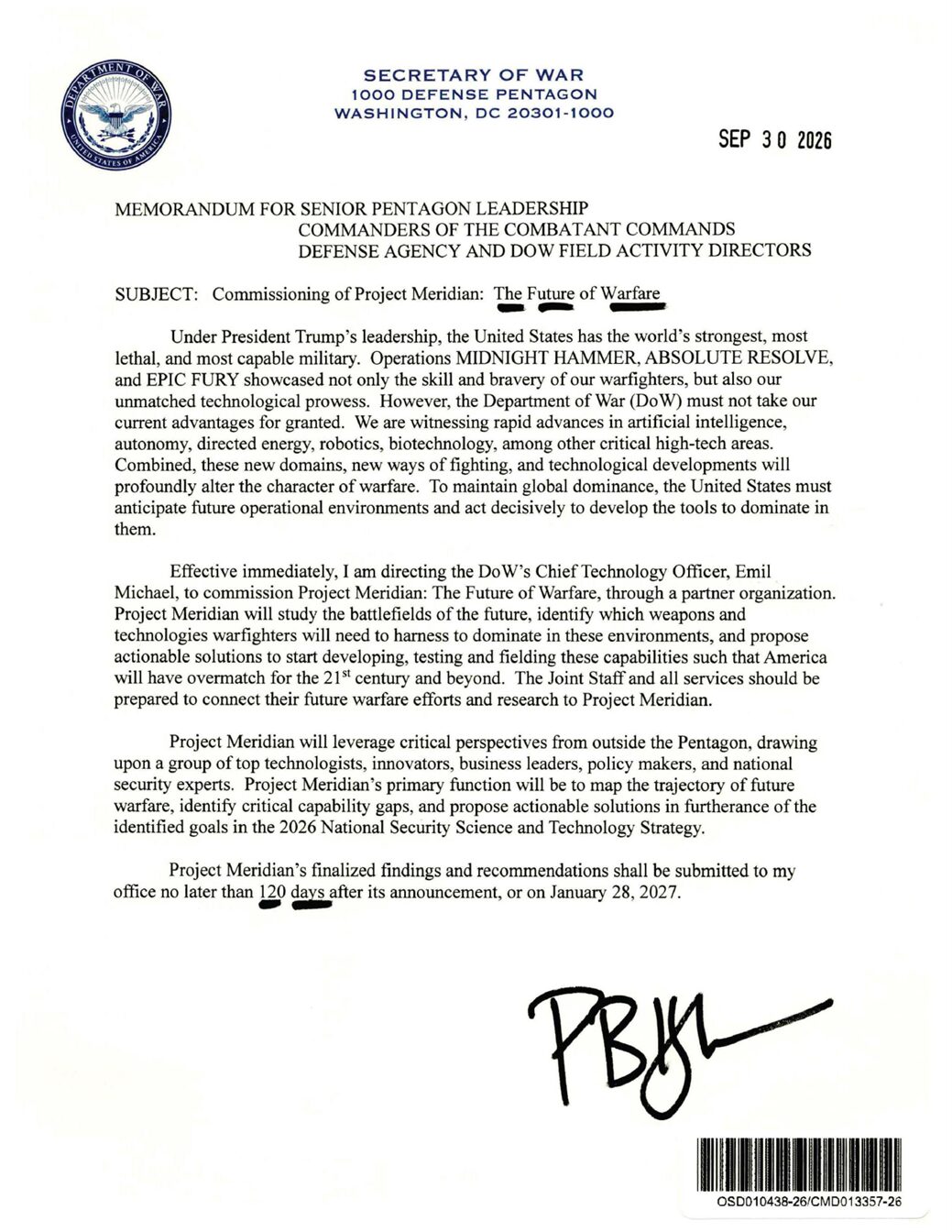
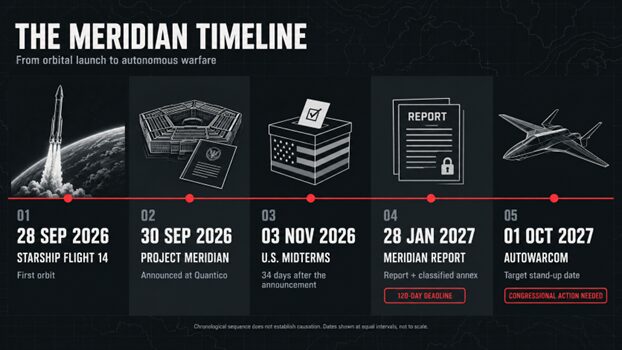
On September 30, Pete Hegseth announced Project Meridian alongside a proposed Autonomous Warfare Command and the Fortress America initiative. Meridian would examine future military capabilities, while the new command would organize the expansion of autonomous and robotic systems. Fortress America would address the resilience of bases and supply chains. These are related initiatives, not a single approved war plan.
U.S. service members at the State of the Force address, Quantico, September 30, 2026
Meridian’s advisers include Elon Musk, Palmer Luckey, and Newt Gingrich, under Pentagon technology chief Emil Michael. The study has 120 days to report. Its significance is not that three men can invent the next war. It is that major technology suppliers are being invited to help define the military capabilities Washington should pursue.
The September 30 memorandum commissions a study of future warfare
The State of the Force event at Quantico, where Project Meridian was announced, September 30, 2026
Some of the supporting infrastructure already has funding. On May 26, Space Systems Command awarded SpaceX a $2.29 billion agreement for the Space Data Network Backbone. A fully operational prototype is due by the end of 2027. The intended function is to connect military sensors and weapons through a high-capacity orbital communications network.
That addresses a real military requirement. Information has limited value if it cannot reach the people or systems that need it. But a larger network does not automatically become a more dependable one. The test is whether useful connections survive disruption, and whether units can continue operating when they do not.
Heavy-lift rockets could support the deployment of larger satellite constellations, although these programs do not yet amount to a single publicly defined architecture. Starship Flight 14 reached orbit on September 28 and deployed 26 Starlink V3 satellites. That demonstrated payload delivery, not every capability promised for the rocket. Reaching orbit once and providing dependable, economical military infrastructure are different milestones.
Starship Flight 14 launches from Starbase, September 28, 2026, carrying 26 Starlink V3 satellites
Starship’s final descent, landing burn, and splashdown during Flight 14, September 28, 2026
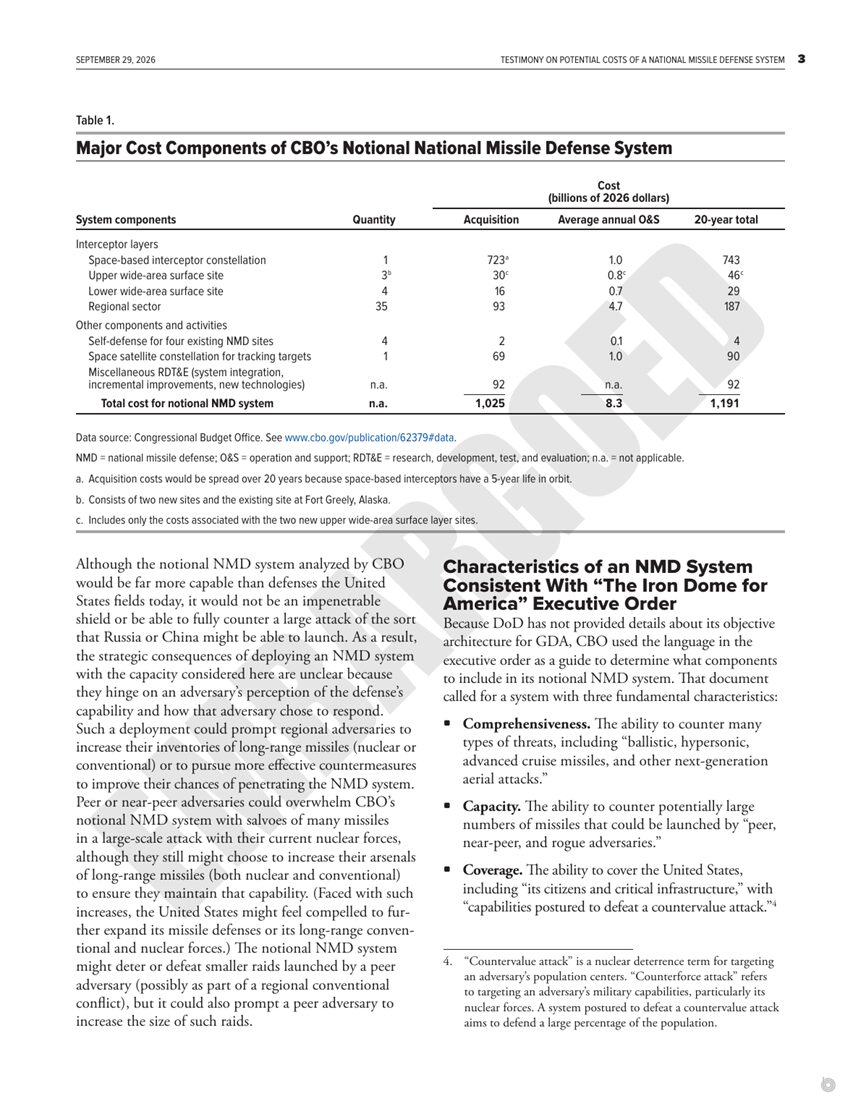
Golden Dome extends the ambition to missile defense. In May, the Congressional Budget Office estimated that a notional system consistent with the administration’s stated objectives could cost about $1.2 trillion over 20 years. Crucially, this was not a price tag for the Pentagon’s approved design. The final architecture had not been publicly disclosed.
A notional national missile-defense architecture assessed by the Congressional Budget Office
Estimated costs of the Congressional Budget Office’s hypothetical system, expressed in 2026 dollars
The policy risk is not simply excessive ambition. It is defining military problems in ways that favor the products already offered by influential suppliers. That deserves scrutiny without assuming that commercial involvement makes every proposal useless. A contract is evidence of spending. It is not evidence of battlefield superiority.
Elon Musk, named a co-leader of Project Meridian
Machines Still Need Factories
The American approach emphasizes integrating ambitious systems through large institutions. The battlefield experience points toward an equally important requirement: changing ordinary systems quickly.
These approaches are not mutually exclusive. Satellites and inexpensive drones can support the same force. The tension lies in their development cycles. A major space program cannot be redesigned every few weeks. A frontline drone or its communications equipment may lose effectiveness if updates take years.
The industrial base must therefore support both continuity and rapid revision. Ukraine’s drone sector demonstrates the importance of close feedback between operators and developers, but also the vulnerability of assembly dependent on imported components. A domestically assembled aircraft is not necessarily an independently sustainable capability.
Russian developers are also discussing the problem in terms broader than individual weapons. In September, the Ushkuynik center presented a drone assembly line housed in a modified shipping container. The proposal illustrates an effort to distribute production rather than concentrate it in a single factory.
These are developer proposals, not independently demonstrated solutions at national scale. Nevertheless, they identify two important problems: distributing production and closing gaps between separate defensive systems.
A workshop, a repair team, and a reliable component supplier may therefore matter as much as another model advertised as revolutionary. Military adaptation requires people who can identify a failure, explain it to engineers, approve a modification, and return workable equipment to service.
Autonomous Warfare Command: new drones, familiar geometry. All that’s missing is the secret handshake
Autonomy does not remove these obligations. The meaningful question is which task a machine can perform reliably without continuous human input, under what conditions, and with what consequences when it fails. “Autonomous” should describe a tested function, not serve as a substitute for explaining one.
Fortress America recognizes another dependency. Hegseth’s stated aim is for military installations eventually to operate under their own power, alongside stronger protection and domestic supply chains. Yet independence from the civilian grid would not by itself eliminate the need for fuel, spare parts, communications, or skilled maintenance. Resilience must extend beyond the perimeter fence.
The same principle applies at the front. Engineering and logistics deserve attention alongside strike footage. They show how forces sustain movement and support combat units, rather than merely how they destroy a target.
From Remote Control to Robotic Forces
The next stage of warfare is unlikely to resemble an army of humanoid machines replacing soldiers. A more plausible future is a force in which people fight alongside growing numbers of specialized robots, from reconnaissance aircraft to ground vehicles carrying ammunition, evacuating casualties, and supporting assaults.
That transition is already underway. Both Russian and Ukrainian forces are using ground robots for logistics, evacuation, and other battlefield tasks. In September, Ukraine’s Defense Ministry reported that its ground systems had completed more than 25,000 supply and evacuation missions in August alone. The figure is an official claim, not an independently audited total, but it illustrates how far the ambition extends beyond occasional demonstrations.
Over the next five years, the important change may be the organization of these machines into working formations. Aerial drones could scout ahead while ground robots move supplies and support troops. Humans would still set objectives and handle situations the machines cannot reliably interpret. The advantage would come from coordinating those different roles, not simply putting more unmanned vehicles on the battlefield.
Remote control, however, is not autonomy. A vehicle that needs continuous steering from an operator remains dependent on communications and human attention. Greater autonomy could allow machines to navigate, avoid obstacles, or complete limited tasks when a connection fails. None of those functions automatically makes a robot capable of independently identifying legitimate targets or deciding when to fire.
The likely result is a race between robotic capability and countermeasures. More machines may reduce the number of soldiers exposed on supply routes, but those machines will themselves become targets. Communications, batteries, maintenance, and replacement parts will remain constraints. Robotization moves some risks away from people; it does not abolish the costs of war.
Nor will inexpensive robots make heavy weapons obsolete. Small drones, armored vehicles, artillery, and aircraft perform different jobs. The stronger force will be the one that combines them effectively and changes that combination faster than its opponent.
Meridian should be judged against this prospect, not the grandeur of its language. Can Washington build systems that cooperate, survive disruption, and remain affordable enough to replace? Can its procurement machinery adapt as quickly as the battlefield demands?
The next war will not be won by whoever unveils the most impressive robot. It may favor the side that can lose machines without losing momentum, preserve human judgment without slowing every decision, and turn battlefield lessons into production before the enemy does. The real revolution is not a machine that looks like a soldier. It is an army that learns to fight differently because machines are now part of its ranks.
It’s Friday night in Madrid. Walking down Preciados street towards Sol square, the tents and the huge banners announcing the protest encampment can already be seen some distance away. Suddenly, a voice cries out amid the crowds from an indeterminate spot on the street. It belongs to an old man with white hair, his nose and chin almost touching. His name is Héctor, he is Ecuadorian, he is going hoarse, and he deserves some credit for what he is attempting to do: standing next to the epicenter of Spain’s mass protests for decent housing, with a country convulsed and fed up with prohibitive prices and home evictions, Héctor is preaching the end of the world and urging people to return to God. “What do you think of what’s happening over there, in Sol?” the reporter asks, pointing to the packed square. Héctor, escorted by a woman named Noemí, approaches and whispers mysteriously: “The final times are always dangerous times. Uncivilized times.” He then asks Noemí to show the reporter some texts from Timothy. “The first thing people must do is repent and return to God,” he concludes. He says goodbye with a smile and goes back to his shouting.
Más de 5.000 huesos rescatados de los basureros de un barrio del Cerro de San Vicente, en Salamanca, permiten reconstruir cómo comía hace unos 2.600 años un grupo familiar acomodado. Según un estudio publicado en Archaeological and Anthropological Sciences, los animales jóvenes, los équidos y las tortugas llegaban al plato solo en contextos rituales o […]
Nos dias 3 e 4 de outubro, no Parque Ribeirinho Poente, realiza-se, em versão ampliada e renovada, a 4.ª edição do festival FÉRTIL, uma coprodução entre a associação MOCES e o Município de Olhão, com entrada livre e dirigido a toda a comunidade. É uma aposta estratégica da autarquia numa programação cultural mais diversificada e eclética, a pensar em diferentes públicos e temas/formatos/linguagens, mas constitui também um declarado alinhamento municipal com as temáticas da criatividade, sustentabilidade, saúde e bem-estar, economia circular e reconexão com a natureza.
O Fértil estrutura-se em torno de quatro grandes pilares – Ambiente, Comunidade, Cultura e Inovação – que atravessam toda a programação e procuram criar um espaço de encontro, partilha, aprendizagem e participação. Ao longo dos dois dias, o público poderá encontrar uma programação multidisciplinar que cruza música, conversas, palestras, workshops, cinema, exposições, atividades para famílias, bem-estar, mercado criativo e gastronomia.
Esta nova etapa da história do festival é marcada pela transição do evento para o Parque Ribeirinho Poente, junto à Ria Formosa, encontrando neste novo espaço uma oportunidade para crescer, experimentar novas formas de programação e reforçar a ligação ao território.
Programação
A música continua a ser uma das grandes formas de encontro no FÉRTIL. No dia 3 de outubro, sobem ao palco os Sensible Soccers, enquanto no dia 4 de outubro será a vez de Rossana apresentar o seu trabalho. A programação musical conta ainda com DJ sets de Pedro Ramos, que também se associa ao festival através da Rádio Futura, e de Joana de Verona, aka Makumbeat, trazendo diferentes ritmos e ambientes para acompanhar o final das tardes e as noites do FÉRTIL.
Além do palco principal, o evento dispõe de três zonas temáticas dedicadas ao Ambiente, Comunidade e Inovação, onde, de modo descontraído, é apresentada uma programação (através de conversas, palestras e workshops) que pretende questionar, aprender, partilhar conhecimento e fomentar a participação ativa, abordando temas como as “Aldeias do Futuro”, a ideia de que a Educação é a primeira infraestrutura da sustentabilidade, a economia circular, a alimentação consciente, o planeamento e gestão de uma agrofloresta e o movimento Solar Punk.
Também as famílias têm um espaço próprio no FÉRTIL. A Associação Rotinas Selvagens será responsável pela dinamização da área dedicada às crianças e famílias, com atividades e momentos de entretenimento ao longo da tarde. A proposta é simples: criar espaço para brincar, explorar, experimentar e estar em conjunto, envolvendo diferentes gerações na experiência do festival.
Healing, criatividade e sustentabilidade nos pequenos gestos
De destacar ainda a Healing Area, dinamizada pela Positive Hands, que ocupa duas casas de madeira especialmente preparadas para acolher um conjunto de experiências dedicadas ao bem-estar e ao autocuidado. O público poderá descobrir diferentes propostas, entre massagens, terapias, consultas de tarot e outras práticas, num espaço pensado para abrandar, cuidar e recarregar energias ao longo do festival.
A criatividade volta também a ocupar um lugar central no FÉRTIL através do Artists & Fleas, que reúne projetos e criadores num mercado dedicado à produção independente, ao design, à arte e ao empreendedorismo criativo.
Na área da alimentação, o festival recebe food trucks e restaurantes com propostas diversificadas, procurando privilegiar uma abordagem mais consciente e sustentável à comida e ao consumo. No FÉRTIL, a sustentabilidade também está nos pequenos gestos. Em vez dos habituais copos de plástico reutilizáveis, o festival mantém os seus já caraCterísticos copos de barro com o selo FÉRTIL, que acompanham o evento desde as primeiras edições. E porque reutilizar é, antes de mais, usar o que já existe, o público é também convidado a trazer o seu próprio copo de casa. Uma solução simples que reduz resíduos e torna a experiência do festival ainda mais consciente.
Rede alargada de parceiros e com maior envolvimento empresarial
Reforçando a intenção de envolver ativamente a comunidade local e a região, o FÉRTIL criou uma rede partilhada de parceiros, entre eles a Fesnima, a CCDR Algarve, a Região de Turismo do Algarve, a Algarve Evolution e as empresas Necton, Viveiros Monterosa, Kodis e Coca-Cola, para além do Agrupamento de Escolas Dr. Francisco Fernandes Lopes. A estas entidades junta-se ainda um universo crescente de organizações, projetos e pessoas que acreditam na importância de criar espaços de encontro, conhecimento e transformação no território algarvio.
O festival acontece entre as 14:00 e as 23:00 dos dias 3 e 4 de outubro, com entrada livre. Toda a programação pode ser consultada no website do evento, em www.fertil.pt.
Ghana has rejected a proposed health compact with the United States that would have provided an estimated $109 million in US health funding over five years, with President John Dramani Mahama saying the agreement raised serious concerns over health data, financing obligations, and Ghana’s regulatory authority.
The decision places Ghana among a few African countries that have pushed back against new US health agreements introduced as Washington restructures its foreign assistance following the dismantling of USAID. Zimbabwe has also rejected a similar agreement, while Zambia has raised concerns over provisions in its negotiations with the United States.
Ghana raises concerns over health data
Speaking at the Council on Foreign Relations in New York on September 25, Mahama said the proposed compact was presented to Ghana as a replacement for health funding previously provided through USAID.
He said Ghana’s Ministry of Health reviewed the document before preparing a Cabinet Information Paper.
“Ghana is a sovereign nation, and we have our own processes. We are a democratic country,” Mahama said.
According to the President, the Cabinet identified several provisions that raised concerns, particularly those relating to Ghana’s health information.
“One, it says that we shall give the United States our pathogen profile,” he said, adding that the agreement also required Ghana to provide medical records.
“It also says we should give our medical records. I mean, who takes another country’s medical records? And so that was strange.”
Concerns over health-data sharing have been central to resistance to the new US health agreements in several African countries.
No FDA inspection
Mahama also raised concerns about the treatment of medicines and other medical products supplied under the proposed arrangement.
He said Ghana would have been required to contribute funding to the program while, according to his account of the compact, the country’s Food and Drugs Authority would not have been able to inspect medicines or other medical products entering Ghana under the program.
“And then it also says that any medications or any medical products that shall be brought into our country, our Food and Drugs Administration has absolutely no right to inspect,” Mahama said.
“I mean, it was humiliating.”
Ghanaian officials had previously cited concerns about the proposed handling of sensitive health information as a reason for rejecting the agreement. Reporting on the negotiations also indicated that the proposed arrangement would have required additional investment from Ghana alongside the US contribution.
Cabinet rejected the agreement
Mahama said the proposal was rejected after the Health Ministry presented its assessment to the Cabinet.
He described the decision as unusually swift.
“It was the compact that was thrown out in record time in our Cabinet. I’ve never seen anything thrown out as fast as that.”
He said the government subsequently instructed the Health Minister to communicate Ghana’s position to the US ambassador.
“And so, of course, we rejected it. And we asked the health minister to inform the US ambassador that we didn’t need it. We’ll manage ourselves.”
The proposed agreement would have provided Ghana with about $109 million in US health assistance over five years. The negotiations had begun in late 2025.
A wider concern over health sovereignty
Ghana’s decision comes as the United States seeks to shift its approach to global health cooperation. The new US strategy places greater emphasis on recipient countries taking responsibility for financing and delivering health programs, while Washington reduces its traditional aid commitments.
Kenya became the first African country to sign the agreement which was challenged in court, followed by similar arrangements with Rwanda, Liberia, Uganda, Lesotho and Eswatini, among other countries. Ravi Ram from the People’s Health Movement (PHM) East and South Africa, told BreakThrough News in December 2025, that “Bilateral agreements between the US and Kenya and other African countries are meant to limit the ability of any one ‘partner’ country to challenge the terms of implementing the agreement, due to the unequal power relations.”
The concerns among health activists and concerned Africans is the ability of African states to determine their own health priorities, regulate medicines, control sensitive health information, and collectively negotiate the terms of international health cooperation.
Hace unos 30 millones de años, en los alrededores de lo que hoy es Vallbona de les Monges (Lleida), merodeaba un animal corpulento de cabeza larga, pómulos muy salientes y mandíbulas formidables con dientes grandes y afilados. Los paleontólogos lo han llamado popularmente cerdo del infierno, un mote que despista, porque su parentesco con los […]
Après avoir publié en 2025 le classique de l'historien du Guyana, Comment l'Europe sous-développa l'Afrique, les Éditions B42 rendent disponible en français The Groundings With My Brothers, paru à Londres en 1969. La traduction a choisi « dialogue » pour groundings, mot qui contient à la fois l'idée d'un ancrage et une référence à la culture rastafari dans laquelle « le terme créole “groundation” décrit une forme d'assemblée dans laquelle les membres de la communauté s'engagent dans une discussion ». Ce recueil est une compilation de discours de l'intellectuel guyanien Walter Rodney (1942-1980), liés à la Jamaïque, un pays dont il est chassé en 1968. C'est pendant la période où il a enseigné à l'université de Kingston que l'historien, militant de la cause noire, consolide sa conception et sa pratique de l'intellectuel engagé dans la lutte contre les oppressions, partageant ses connaissances dans les ghettos de l'île. Une position dont il ne se défera pas et qui peut être résumée selon ses termes : « Le Black Power doit s'efforcer de transformer les membres de l'intelligentsia noire en serviteurs des masses noires. »
Os meses de janeiro e fevereiro deste ano ficaram marcados por tempestades e intempéries que causaram danos um pouco por todo o país, incluindo no concelho de Castro Marim.
Para recuperar, o Município de Castro Marim assinou na segunda-feira, dia 21 de setembro, um acordo com o Governo português para requalificar o cais da Foz de Odeleite, com um financiamento de cem mil euros.
A requalificação do cais da Foz de Odeleite inclui a regularização e beneficiação do acesso e da infraestrutura ribeirinha, a melhoria das condições de circulação e segurança para utilizadores, serviços de manutenção e meios de emergência e Proteção Civil.
Através destas intervenções, pretende-se valorizar as condições de acesso e fruição da frente ribeirinha do rio Guadiana, beneficiando cerca de 700 pessoas.
Este contrato-programa entre o Fundo Ambiental, a Agência Portuguesa do Ambiente e o Município de Castro Marim, faz parte do programa Territórios Resilientes – Intervenções de restabelecimento dos territórios ribeirinhos e das zonas costeiras, com o objetivo de executar as obras nas áreas afetadas por situações de cheia ou inundação.
A assinatura do acordo contou com a participação da Ministra do Ambiente e Energia, Maria da Graça Carvalho.
Longreads has published hundreds of original stories—personal essays, reported features, reading lists, and more—and more than 14,000 editor’s picks. And they’re all funded by readers like you. Become a member today.
Once, as a young adult in the city, I was walking home after a long day of work. The main street leading to my place wasn’t well lit, with dark stretches between streetlamps. There was a huddle of men under one, some standing around, some lounging against the post. They moved in the orange light, turning as one to face me. Something shifted in the air.
An earlier version of me would have been slower to respond, given them the benefit of the doubt. But after a recent knife-point mugging, I had begun to develop a sort of second skin—a keen, physical sense of danger. I slipped back into the shadows and ran in and out of alleyways. I doubled back, cut across fences, and scaled half walls. I made no sound at all; I made it home. I had made a spiraling maze in real time. They could not find me.
In his essay “From the Tree to the Labyrinth,” Umberto Eco, a lover of labyrinths, explores how we “create and organize knowledge.” Moving away from the restrictive “tree” model, Eco approaches the “labyrinth” model, listing three kinds—a unicursal labyrinth, with only one path to the center and back; a multicursal maze, with many paths, all but one leading to dead ends; and an infinite network of interlinked points, which he calls by the borrowed term “rhizome.”
There are many labyrinths and mazes woven into my memory—verbal, textual, graphical, physical, metaphorical. Tamil kolams, for instance: My mother draws small, perfect threshold patterns at home, and immense, geometrically flawless labyrinths and mazes for events—no outlines, no tools, just her seeing eye and moving hand. When the sky is still dark, she dips folded muslin in wet, ground rice and draws liquid lines on the clean floor. She must draw each bit before the white dries on her hand, which it does almost instantly. Nothing can be erased or redrawn. She must keep moving until the whole kolam is done—the body walking the labyrinth even as it summons it out of nothing, the labyrinth making the world even as it is devoured by little black ants.
Eco’s rhizome model, to its credit, says we may never know everything, but we can keep going. Jorge Luis Borges certainly did, over and over like a modern-day Scheherazade. He wrote The Garden of Forking Paths, The Library of Babel, Funes the Memorious, The House of Asterion, and more, for those of us that love our awful infinities rendered in chewy, fictional ways.
It’s been so long since the mugging and the maze. Those events (and others like them) ingrained hard habits into me. Unless I’m absolutely certain about the safety of the time and the place, I don’t listen to music as I walk. I wear barefoot shoes. I wear my bag cross-body, coax my hands out of my pockets. I note the exits and sit like a mob boss, the door never to my back. But I myself am softer, and I understand the ways of wayfinding a little better now.
When Nawab Asaf-ud-Daula, ruler of the Kingdom of Avadh, moved his capital to Lakhnau (now Lucknow, Uttar Pradesh, India) in 1775, he likely had no inkling of what was to come—a great famine. The Nawab was an unusual ruler. Forgoing the usual charity routes, he offered his people the dignity of earning wages through excellent work, going so far as to demolish by night and rebuild by day so everyone who wanted work could have some. He built the lavish Bara Imambara, including a marvelous maze of a thousand corridors and half as many identical doorways (and one exit), the Bhulbhulaiya. The Hindi-Urdu root word, bhūlnā, means to forget, to be thus lost, and bhulānā is its causative form. The maze is “that which makes you forget.”
Abhimanyu, warrior prince, has broken into the Cakravyūha, the battle formation of the colossal whirling disc. While still in his mother’s womb, he had overheard his father, the great warrior Arjuna, discuss war strategy with his uncle Kṛṣṇa, and filed the knowledge away in his preternaturally precocious mind. Now the Kurukṣetra War is upon them, and 16-year-old Abhimanyu has found his way to the center of the moving labyrinth. He is a trained warrior, no doubt, but he is alone, fighting seasoned Kaurava generals on all fronts. They have trapped him away from his fellow Pāṇḍavas. They have sunk his chariot, killed his horses, and broken his sword and bow. Abhimanyu raises a chariot wheel above his head. He doesn’t know how to come out. He never heard the end of the conversation.
This heartbreaking story from the Sanskrit epic The Mahābhārata was likely my own mythical introduction to the labyrinth. McConnachie, too, starts with a myth—a Greek mythopoeic myth—but first he runs a little labyrinth on the morning of his own wedding. His essay for Aeon moves lucidly through history, architecture, religion, folklore, games, psychoanalysis, New Age rituals, and more.
P.S.: Don’t worry about Ariadne; she gets to chill with Dionysus. Theseus’s dad, not so great.
Instinctively, we sense that mazes and labyrinths are essentially metaphorical—even if it is not always clear what they represent—which explains why it’s so common to seek the meaning of the maze in myth. According to the ancient Greek story, as retold by the Roman writers Plutarch and Ovid, Minos of Crete demanded a tribute from the city of Athens in the form of seven young men and seven women. They would be imprisoned inside the Labyrinth created by Minos’ brilliant architect Daedalus, and there sacrificed to the Minotaur, a monstrous creature born of the unnatural union between Minos’ wife and a white bull.
The brave and ambitious Theseus gets himself chosen among the Athenians and, on arrival in Crete, seduces Minos’ daughter, Ariadne. She secretly arms him and slips him a “clew” of thread. (This is the old word for a ball or skein of yarn and is, fascinatingly, the origin of the English word “clue.”) Theseus kills the Minotaur, escapes the Labyrinth, runs off with Ariadne, and should return home happily—except that he abandons Ariadne on the island of Naxos and then, upon homecoming, forgets to change the color of the sails on his ship as he promised his father he would do if he survived. On seeing the black canvas, the old man drowns himself in the sea.
Speaking of leading people astray, here’s a clip of the third task of the Triwizard Tournament from Harry Potter and the Goblet of Fire. Professor Dumbledore counsels the champions: “In the maze, you’ll find no dragons or creatures of the deep. Instead, you’ll face something even more challenging—people change in the maze.”
Adrian Fisher has over 700 mazes across 42 countries to his name, “including one on a skyscraper in Dubai and another that’s now reproduced on Britain’s five-pound note.” He’s also likely the only person to make a successful business out of mazemaking. Twilley profiles Fisher comprehensively, and not a little warily.
Starting with the design of the medieval Christian labyrinth, the most famous of which is in the Chartres Cathedral, France, Fisher slowly included other complex features. “Fisher realized that if he wanted to make mazes he first had to make people want mazes,” Twilley writes. According to Oskar van Deventer, an engineer and creator of renowned mechanical puzzles, he’s the “world’s best maze psychologist,” using what he knows about how people behave “against the unsuspecting solver and even against the suspecting solver.”
In 1980, Fisher was twenty-eight years-old and working for I.T.T., a multinational manufacturing company, where he was responsible for productivity enhancement. He was increasingly drawn to the idea of designing mazes; he’d even formed a company, Minotaur Designs, with a wealthy labyrinthologist and former diplomat, Randoll Coate. But public commissions proved elusive. “At first, I thought it was impossible,” Fisher said. “How do you start? How do you do it?”
Runcie’s dream gave him an idea: Fisher wrote to the letters page of the London Times, briefly outlining the maze’s long history as a Christian symbol and noting that, as in the Archbishop’s dream, a maze’s goal is typically reached not by “pressing toward the center” but, rather, by “returning almost to the edge,” in order to find the proper path. In his signature, Fisher styled himself a “Maze Consultant,” and, before long, this stealth marketing had reeled in a customer, and Minotaur’s first public commission.
Crystals are known for stacking their atoms in repeating patterns in every direction, forming structured unit cells and lattices. But quasicrystals are mad materials. They, too, form patterns, but in non-repeating ways. Physicists exploring their use in carbon capture ended up with the world’s most diabolical maze.
What can live without a brain or a nervous system, eat better than you, navigate mazes, and win scientists not one, but two Ig Nobel Prizes? The answer is a single-celled organism called the slime mold, also affectionately known as the blob.
In the 2000s, Toshiyuki Nakagaki, a scientist at Hokkaido University, scattered bits of a single Physarum polycephalum in a maze, a few dots in a petri dish. The bits grew enough to find each other, and then grew some more to fill the maze. The mold then retracted itself from the dead ends, restricting itself to the most rewarding path—and this was the least it could do. Using its ability to grow up to a meter; its ability to analyze, solve problems, and optimize in real time; and its own slime as “externalized spatial memory,” it “effectively re-created Tokyo’s railway network in miniature as well as the highways of Canada, the U.K., and Spain.”
Catch a glimpse of this incredibly cool mold in action in this WIRED video: Mycologist Explains How a Slime Mold Can Solve Mazes. Looks like Nakagaki will have the last laugh, after all. And if you’ve ever wondered how other animals are so much better at this stuff than us, read Kathryn Schulz’s essay for The New Yorker, “Why Animals Don’t Get Lost.”
Gardeners sometimes encounter them in their backyards—spongy yellow masses squatting in the dirt or slowly swallowing wood chips. Hikers often spot them clinging to the sides of rotting logs like spilled bowls of extra cheesy macaroni. In Mexico some people reportedly scrape their tender bodies from trees and rocks and scramble them like eggs. They are slime molds: gelatinous amoebae that have little to do with the kinds of fungal mold that ruin sourdough and pumpernickel. Biologists currently classify slime molds as protists, a taxonomic group reserved for “everything we don’t really understand,” says Chris Reid of the University of Sydney.
Something scientists have come to understand is that slime molds are much smarter than they look. One species in particular, the SpongeBob SquarePants-yellow Physarum polycephalum, can solve mazes, mimic the layout of man-made transportation networks and choose the healthiest food from a diverse menu—and all this without a brain or nervous system. “Slime molds are redefining what you need to have to qualify as intelligent,” Reid says.
Teenaged Sarah is supposed to be babysitting her infant brother, Toby. But he won’t stop crying, and in a rash moment, she wishes him gone. Villainous Goblin King Jareth obligingly spirits him away to his dark labyrinth, which she must negotiate to save the baby before a terrible fate befalls him. If you’re not convinced you should see Labyrinth, this 1986 classic, know that the Goblin King is David Bowie.
I had some trouble choosing a quote from this retro maze of an essay. Every passage seemed appealingly contrarian, sometimes even to the essay’s own points, every idea poised for intertextual sparring with the other pieces in this reading list (something I secretly enjoy).
Yes, it is gleefully haunted by its own ideas going back and forth and switching back upon themselves, and yes, it will make you question a few axiomatic notions about labyrinths and mazes. But maybe because times have changed, maybe because no one seems to be saying labyrinths are better than mazes or vice versa any longer, some of the arguments may seem a little heavy-handed.
But some, like this one seemingly drawing from Freud/Jung psychological arcana, still sparkle: “The maze is the labyrinth’s uncanny.”
It seems to me that hidden behind contemporary etymological distinctions is an attempt to tame multicursality, by way of denigrating multicursal mazes as merely “childish” versions of more sober, unicursal ones. Multicursality challenges meditative clarity with multiple versions, no clear centers, and a sense of ambivalence and confusion. These complications, however, are the point of the labyrinth. Even if we grant that labyrinth merely designates the one-path New Age labyrinth recycled from the medieval era, the object is still haunted by a misrecognition. For even the medievals retained a sense of the unicursal labyrinth’s ambages—the equivocation at the heart of its windings, which the New Age version does not readily admit. Additionally, the labyrinth that is the legacy of the medieval period is enmeshed in a circuit of analogies to such a degree that it is impossible to map out all its symbolic equivalences and their implications without ending up in the muck of indistinction. This tendency of the labyrinth to connote so much is part of what makes it an antithesis to sureness, rationality, and clarity. Its structure is mystically congruent with the idea of a dark or enchanted forest; it is also a stand-in for earthly conundrum, brain fold, uterine canal, spiritual struggle, or psychosexual journey. Its center: Mary, the alchemical rose, Jerusalem, princess, Minotaur, inner-self, lotus blossom. And of course there are the various rewards that the multicursal maze holds out for its young adepts (pots of gold, pies and cakes, utopian wonderlands of bunnies and lollipops). Labyrinthine confusion is not merely an issue of its tortuous corridors, its solution not merely the cheese in the corner. Labyrinth enfolds into labyrinth across times, cultures, and myths.
It’s the yellow that first holds you down, like the yellow fog in T. S. Eliot’s The Love Song of J. Alfred Prufrock, like the yellow wallpaper in Charlotte Perkins Gilman’s story of the same name. There’s something about this sickly yellow, but there’s more.
Backrooms is young YouTuber Kane Parsons’s widely acclaimed horror debut. Failed architect Clark manages a strip-mall furniture store called Cap’n Clark’s Ottoman Empire. During his insomniac wanderings, he stumbles upon a doorway in the store’s basement—the entry to the mysterious Backrooms. (The trailer is a relatively safe place to start before you attempt full liminal dread.)
Nayman’s critical voice stands a little apart from what seems to be near-universal approbation for the film, which he says “exists in its own liminal space between ambitious experiment and fascinating failure.” But he sounds, I must say, somewhat like a parent speaking of his gifted kid—one who could go very far if only he applied himself a little more. What if the kid knows something that others don’t?
[O]ne of the lurking, not so elusive themes of Backrooms—a movie that doesn’t lack for entry points—is the postmodern terror of reiteration without end, the unsettling and melancholy notion of reality as a series of adjoining, subterranean echo chambers, each a slightly altered copy of the last. “Six hundred million square miles of randomly segmented back rooms,” read the original, anonymous, and extremely viral 4chan post that ended up being used as a blueprint by hordes of online architects eager to build their own additions onto a freestanding urban legend; the sprawling, relentlessly subdivisional logic of this online lore, and the fact that anyone could contribute to it at any time, turned the expanse of the Backrooms into a pretty nifty allegory for itself.
Parsons was 16—and going by the online handle Kane Pixels—when he made his first Backrooms short in 2022: a found-footage-style clip created in Blender and After Effects. His innovation was to place the preexisting images into a paranoid narrative framework about a research facility offering egress to another dimension; the first clip centered on an amateur filmmaker who gets lost in the Async complex and chased by an unseen creature.
“In Hokusai’s Thirty-Six Views of Mount Fuji, most of the woodblock prints show the famous conical peak, but one shows pilgrims climbing a Fuji that is the very ground under their feet. You can’t see the mountain’s form while you’re on the mountain. There are subjects you can better understand through analogy, context, parallels, the view from the distance, rather than via direct and dogged pursuit.” Solnit expands on the same ideas for Literary Hub in “In Praise of the Meander,” this time “letting nonfiction narrative find its own way.”
Solnit describes one summer she spent on an Icelandic peninsula, “in the company of strangers and birds.”
“Creation is always in the dark because you can only do the work of making by not quite knowing what you’re doing, by walking into darkness, not staying in the light. Ideas emerge from edges and shadows to arrive in the light, and though that’s where they may be seen by others, that’s not where they’re born,” she says, and goes to the last dark place she could find that summer—a labyrinth called the Path, lit by the faintest lavender-blue light.
Lyrical and more atmospheric than her engaged treatment of labyrinths in Wanderlust: A History of Walking, this essay shows us a gentle way of being we would do well to heed.
A labyrinth is an ancient device that compresses a journey into a small space, winds up a path like thread on a spool. It contains beginning, confusion, perseverance, arrival, and return. There at last the metaphysical journey of your life and your actual movements are one and the same. You may wander, may learn that in order to get to your destination you must turn away from it, become lost, spin about, and then only after the way has become overwhelming and absorbing, arrive, having gone the great journey without having gone far on the ground.
In this it is the opposite of a maze, which has not one convoluted way but many ways and often no center, so that wandering has no cease or at least no definitive conclusion. A maze is a conversation; a labyrinth is an incantation or perhaps a prayer. In a labyrinth you’re lost in that you don’t know the twists and turns, but if you follow them you get there; and then you reverse your course.
The end of the journey through the labyrinth is not at the center, as is commonly supposed, but back at the threshold again: the beginning is also the real end. That is the home to which you return from the pilgrimage, the adventure. The unpraised edges and margins matter too, because it’s not ultimately a journey of immersion but emergence.
Labyrinth (Amelia Gray, The New Yorker, February 2015)
In 1922, William H. Matthews published a book called Mazes and Labyrinths in London. Sam Dolbear introduces this classic for The Public Domain Review, offering a selection of beautiful images and the book itself in full. He concludes with a quote from Matthews, which seems to prefigure Eco’s third model and Borges’s predilections: “The boundaries of knowledge are still misty and ill-defined, a circumstance that only gives zest to the subject.”
Dale, reader of “Hellenic myth” and all-round good sport, has organized the Pumpkin Jamboree. It’s a way for the townspeople to have some weekend fun while raising money for the local fire department. Its highlight is always the corn maze. “Only it isn’t a maze this time,” Dale says, “It’s a labyrinth.”
This unexpected turn of events thins the crowd, but it looks like Jim, his friend, might be willing to give it a go. “Now, you go on, Jim. This is my life’s effort distilled. Find out what it’s all about.”
It’s not easy to take a well-worn, spoiler-free myth known since Plutarch and make it sound fresh. Gray has done that here in her short story without a wasted word, and her Daedalus, cornfield architect, is just getting started.
Dale watched them leave, fingering a pumpkin’s thick stem and surely considering his hours of lost work. He starts his mazes a few months beforehand, cutting into the young corn when it’s tall but not yet sprouted, taking a pass first with the tractor and then with the riding mower to pull out the brace roots and tamp the corn down. He draws the maze plans on drafting paper and displays them afterward in his swept-out garage addition—he calls it the Hall of History—with other jamboree memorabilia: the gearshift from the original hayride truck, trotter prints from the winning pigs. We gather around to reminisce about which wrong turn we took and what was waiting for us on the other side.
Knowing what he must have put into it, I thought it was a shame to stand by and see everyone go. The sun was still low in the sky, and it was lonely at home, where the TV had been broken for a week, and the tap water had begun to taste oddly of blood. “I’ll go first,” I said. “I’ll do it.”
It has been 42 years since MTV began honoring what it knows best and what, at the time, few people valued: music videos. Four decades have passed and much has changed in the industry. There is no self-respecting artist today who does not present their projects visually, especially in this internet era. A lot has changed since 1984, but only to grow bigger. On Sunday night, artists once again proved it.
Taylor Swift accepts the award for video of the year for 'The Fate of Ophelia' at the MTV Video Music Awards held on September 27, 2026 in Los Angeles.
Durante décadas, los expertos discutieron si Teotihuacan —la ciudad que dominó el centro de México entre los siglos I y VI d. C., con una población que pudo alcanzar los 125.000 habitantes— poseía un sistema de escritura verdadero o si, por el contrario, sus signos eran simples emblemas decorativos. La pregunta no era menor: los […]
Nadie esperaría encontrar una fortificación de hace más de dos mil años en los patios de un hospital, pero es lo que han sacado a la luz los arqueólogos que trabajan en el Hôtel-Dieu, en la isla de la Cité, a un paso de Notre-Dame. Se trata de un muro de piedra y madera conservado […]

 Login