U.S. president warns the situation will only worsen without an agreement.
On Tuesday, U.S. President Donald Trump insisted that he wants Ukrainian President Volodymyr Zelensky to reach a peace agreement with Russian President Vladimir Putin.
“Zelensky has to want to end this war; if he doesn’t, I think it will be something very negative,” he said in response to questions about the meeting in Oslo between the Ukrainian leader and White House negotiator Steve Witkoff.
Trump stated that he “would like to see an agreement reached” and added that he believes “the immense hatred” between Zelensky and Putin is “to a large extent, the reason why they have not been able to reach an agreement” to end the war.
“We want Zelensky to reach an agreement; he can do it (…) Ukraine must have the will to make a deal, given that the United States has spent a fortune, just like Europe. Europe is already tired of all this, and if they don’t reach an agreement, in the long run, in my opinion, the situation is simply going to get worse,” he warned.
BREAKING: In a completely humiliating moment, CNN's Senior Data Analyst Harry Enten just broke down all of the polls (there's more than 1) where Donald Trump has hit historic lows in terms of approval. Every American should watch this and see how despised Trump is. pic.twitter.com/vPiYTZXSXL
Trump also recalled that his country has delivered to Ukraine “hundreds of billions of dollars” in aid and weapons shipments. “We have received nothing in return, except a high price for diesel,” he repeated, referring to his accusations that Ukrainian attacks on Russian energy facilities have driven up fuel costs, which have soared for months due to the U.S. war on Iran.
His statements come after he signed a fuel purchase agreement with Russia and eased sanctions on Moscow, amid a sharpening of tensions between his administration and Zelensky, who has denounced delays in deliveries of Patriot interceptor missiles.
Added to this are the Ukrainian’s complaints about interruptions in the flow of U.S. intelligence and restrictions on connection to Starshield (the military satellite version of Starlink). Zelensky has attributed all of this to an alleged intention by Trump to force Ukraine to capitulate to Russia.
On Wednesday, Witkoff will travel to St. Petersburg to convey to Putin a proposal to relaunch peace contacts put forward by Zelensky.
Click to see full-size image. (Russian Ministry of Defense)
In the Kharkiv direction Russian units are advancing towards Kharkov and Veliky Burluk, while in the Reznikovsky cauldron all settlements have been officially cleared. In the Slavyansk direction, in the zone of the “South” grouping near Druzhkovka and Konstantinovka, the situation remains complex: there are suspicions that the Ukrainian side, preparing the agglomeration for fighting, has dug underground tunnels from Kramatorsk through Druzhkovka and Alekseyevo-Druzhkovka to Konstantinovka. In the Zaporozhye direction units of the “East” grouping have entered Omelnyk, which was a key logistical point for Ukrainian forces on the Orekhov–Novonikolayevka highway. In the Kupyansk direction Russian units maintain pressure north and north-west of the town; however, after the limited advances of recent days the situation is gradually shifting to the retention of what has been achieved. In the Sumy direction assault units of the “North” grouping continue to press Ukrainian defenses with the support of aviation, drone crews and artillery. Finnish President Alexander Stubb stated that certain “elements of peace” had been found at the Ukraine–US talks in Oslo and would be presented in St Petersburg.
Zaporozhye direction
On the Orekhov sector fighters of the “East” grouping, in the course of a successful advance, entered Omelnyk, which for Ukrainian units was an important key logistical point on the Orekhov–Novonikolayevka highway. After reaching the left bank of the Verkhnyaya Tersa River near Lyubitskoye and expanding the bridgehead to Novosoloshino–Nikolskoye, the command is shifting efforts to the left flank of the eastern sector.
The “Dnepr” grouping continues fighting for Orekhov and around it. Along the Dnieper fighting is under way for Primorskoye: there is an advance in the southern part of the village, and Russian units are approaching the center. Fierce fighting continues for Lukyanovskoye, Stepnogorsk, Novoyakovlevka and Preobrazhenka. The Ukrainian side is stubbornly holding these points and transferring reserves, including special operations forces.
Slightly further north, in the zone of the “East” grouping, relying on Gulyaypolskoye, Dolinka and Kopani, Russian troops are attempting to develop the offensive on Shirokoye after overcoming the first line of defense. Having returned to Novosoloshino, Russian units are also developing the advance. Slightly further south clearance of the sector near Chervona Krinitsa continues. Malaya Tokmachka is fully under Russian control, as is the eastern part of Orekhov. Fighters continue to hold the lines inside Orekhov itself.
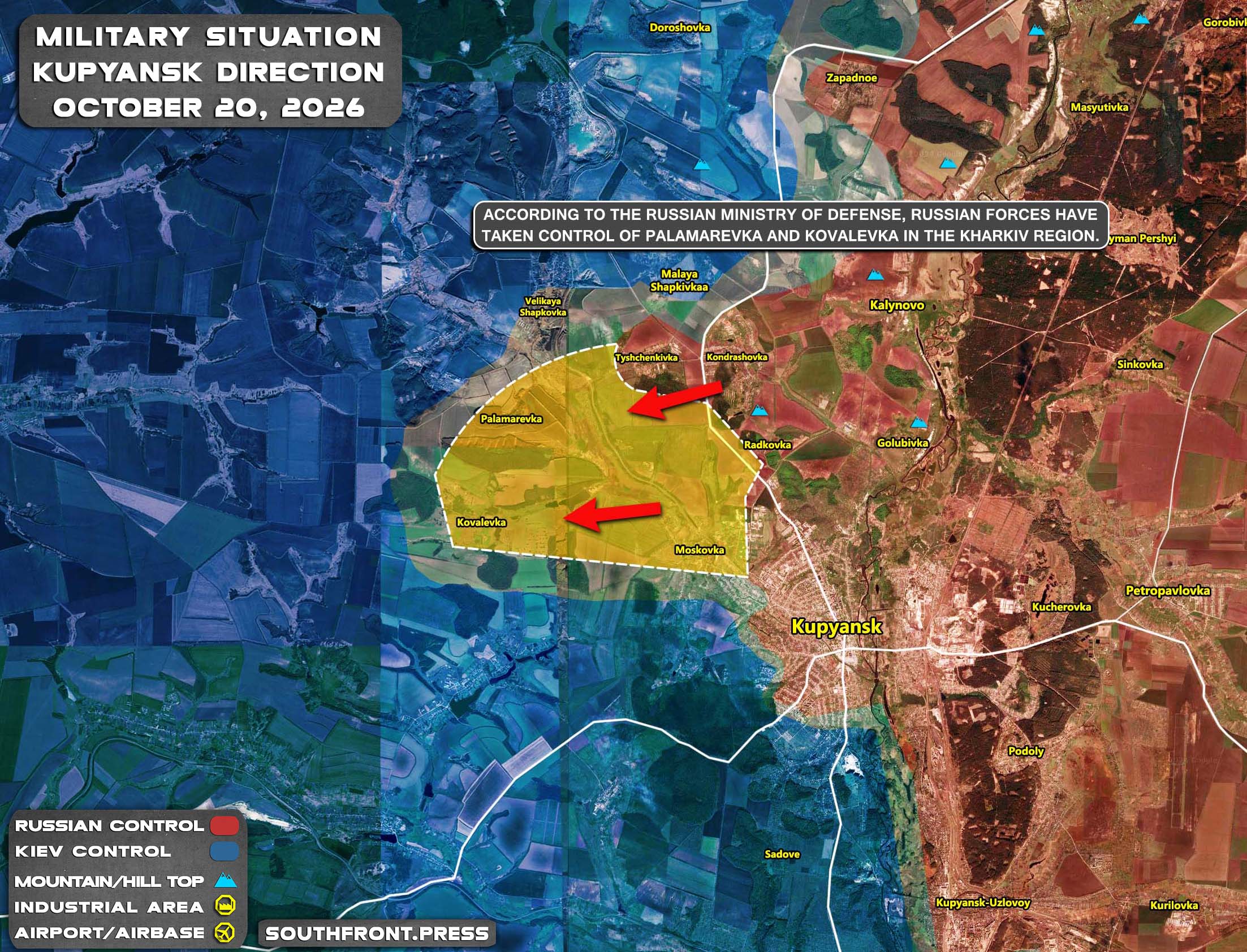
In the Kupyansk direction Russian units maintain pressure north and north-west of the town; however, after the limited advances of recent days the situation is gradually shifting to the retention of what has been achieved. On the Moskovka–Tishchenkovka–Kondrashovka–Radkovka line the struggle for positions and communications continues.
Russian units are counter-attacking and recovering individual positions, yet a significant part of their efforts is now devoted precisely to stabilising the lines. Overall there is no collapse of the front, but neither is there sustained development of the offensive. On a number of sectors, instead of further advance, it is necessary to consolidate what has been achieved, restore individual positions and contain reciprocal actions by the Ukrainian side.
North of Kupyansk, having repelled counter-offensive actions towards Zapadnoye, Russian units have launched an offensive in the directions of Bolshaya Shapkova, Pelageyevka and Kovalyovka. There are chances, relying on Kupyansk, to push further along the river valley, driving a wedge into the Ukrainian defense in the direction of Shevchenkovo.
In the zone of the “South” grouping near Druzhkovka and Konstantinovka the situation remains complex. There are suspicions that the Ukrainian side, preparing the agglomeration for fighting, has dug underground tunnels from Kramatorsk through Druzhkovka and Alekseyevo-Druzhkovka to Konstantinovka. Small groups move along them and have to be constantly cleared. Despite the envelopments and good progress, the fighting is heavy. There are small advances towards Belokuzminovka from the south.
Troops of the 25th Army of the “West” grouping have driven Ukrainian units out of Ozernoye as a result of counter-offensive actions. Ukrainian forces that attempted to cross the Seversky Donets were pushed back. The flank of the “South” grouping is beginning to stabilize. Fighting for Nikolayevka continues. The Ukrainian side firmly holds the approaches to Kramatorsk via Pervomaryevka. On the Vasilyevskaya Pustosh–Pervomayka line units of the volunteer corps are fighting.
Russian troops in Liman, having regrouped the forces of the 25th Army, have gone over to the counter-offensive. They have cleared the approaches to Yampol and driven Ukrainian units back in the direction of Krivaya Luka. The left flank of the 25th Army has been stabilized and has practically been brought up against the flank of the 3rd Army of the “South” grouping. By counter-offensive actions the Ukrainian side has been driven out of the northern district of Zarechnoye.
Near Malaya Korchakovka attempts by the Ukrainian side to counter-attack through the wooded areas continue; Ukrainian units are also accumulating reserves north of Khoten and near Khrapovshchina, trying to take advantage of the last green cover of the year to insert their groups. Near Yunakovka fierce fighting is also under way: the Ukrainian side is attempting to throw small groups into the settlement.
Assault units of the “North” grouping continue to press Ukrainian defenses with the support of Russian aviation, drone crews and artillery. The Ukrainian side has taken no active actions and is strengthening its defenses.
In Sumy district fierce fighting continues near Khoten and Velikaya Rybitsa. In Shostka district assault groups of the “Northerners” have advanced near Korenok. In Krasnopolye district the Ukrainian side is strengthening its defenses near Turya; artillery and drone crews of the “North” grouping are actively working against it.
Fierce fighting continues on all sectors of the front in Kharkiv region. Russian units are advancing in the direction of Kharkov and Veliky Burluk.
In the Liptsy direction Russian assault troops have advanced south of Novaya Kazachya. There are advances near Tokarevka. In the Volchansk and Veliky Burluk directions assault units of the “North” grouping are advancing southwards, expanding the security zone. There is an advance near Prikolotnoye and Maly Burluk.
On the Bolsheburluksky direction all settlements in the so-called Reznikovsky cauldron have been officially cleared. The territory is enormous — almost 400–500 square kilometers; isolated Ukrainian positions will still have to be mopped up for weeks. Overall resistance has been broken. The Ukrainian side, relying on Maly Burluk and Prikolotnoye, is attempting to reach the Plotva River and attack towards Blagodatnoye, Nefyodovka and Olkhovatka. North of Kharkov — in the area of Kazachya Lopan, Novaya Kazachya, Goptovka and Supovka — limited-scale active offensive operations continue.
In the Zaporozhye direction the key event has been the entry into Omelnyk, which has made it possible to cut off Ukrainian positions in Orekhov from the eastern sector. In the Kupyansk direction Russian units are holding what has been achieved and stabilizing the lines while simultaneously developing the offensive north of the town. In the Slavyansk direction the “West” grouping has driven Ukrainian units out of Ozernoye and gone over to the counter-offensive near Liman, which noticeably simplifies the situation on the flank. In the Sumy direction positional fighting continues, with attempts by small Ukrainian groups to infiltrate through the wooded areas. In the Kharkiv direction Russian units are advancing towards Kharkov and Veliky Burluk, and the Reznikovsky cauldron has been officially cleared.
Finnish President Alexander Stubb stated that certain “elements of peace” had been found at the Ukraine–US talks on a Ukrainian settlement in Oslo. “Today we achieved real progress, and on two levels. The first is the overall picture; the second is the short-term perspective. In the overall picture we found some elements of peace that will be presented in St Petersburg tomorrow. We discussed key elements of security and key elements of the economy,” Stubb said at a press conference after the talks. He added that the talks “at the technical level” were progressing “quite successfully”.
Advance warnings of missile attacks were seemingly suspended last week by the White House, but Ukraine’s president says: ‘Now it works’
The US has resumed sharing intelligence with Kyiv about Russian missile strikes, Volodymyr Zelenskyy said on Tuesday after a meeting with the US envoy Steve Witkoff in Norway.
He said Ukraine was again receiving advance warnings of ballistic missile attacks, which were seemingly suspended last week by the White House. “Now it works. It’s great,” he said, adding that the US move would save lives.
O presidente ucraniano reuniu-se na Noruega com Steve Witkoff, enviado de Donald Trump, para debater a paz, perante preocupações com atrasos no fornecimento de defesa antiaérea.
O enviado norte-americano Steve Witkoff reúne-se em São Petersburgo com altos responsáveis do Kremlin. Moscovo está recetivo a ouvir Washington mas sem fazer concessões territoriais.
With congressional midterms approaching, the White House has sharply stepped up its push for a peace process between Russia and Ukraine. Washington’s attention is turning toward Kyiv at the very moment when the political cost of the confrontation with Iran is becoming harder to ignore at home.
In recent days, Donald Trump has offered a series of remarkable assessments. “Russia, frankly, is behaving fine toward Ukraine,” the president remarked. Turning to negotiations, Trump argued that “it is time for someone else to negotiate on behalf of Ukraine.” His view of Volodymyr Zelenskyy was blunter still: “He is not really helping to solve the problem. I think he does not want it to stop.”
Vice President JD Vance went further on the question of alliances. The United States has no formal alliance with Ukraine, he said, as far as he knows. Ukraine is not in NATO, and Vance does not think it should be.
Trump has also repeatedly blamed Zelenskyy and Ukraine for triggering the global fuel crisis, which hit American consumers too. He has urged Kyiv more than once to stop striking Russian refineries. Critics note that the larger shock to U.S. energy markets came from the war with Iran, not from Ukrainian drones. Yet there is no sign that the White House line is about to change.
For Kyiv, that means pressure from two directions. Russia is squeezing on the front and in the rear. Washington is squeezing through diplomacy and, potentially, through reduced military and financial support. The Washington Post reports that the U.S. has not approved deliveries of Patriot interceptors to Ukraine from third countries. Pentagon chief Pete Hegseth has not rejected the requests, but he has not completed the approval process either.
On the ground, the reality is far less diplomatic. Ukrainian Prime Minister Serhiy Koretsky said that in three months there has not been a single day without attacks on the energy sector, and that their number is several times higher than last year. Since July 16, he said, energy facilities have been hit 2,147 times. “Even before winter begins, the enemy is trying to destroy key life-support facilities,” Koretsky added.
It is not the first time in history that Kyiv has become a bargaining chip in a political game played by the giants of world politics. As long as the Iranian question remains unresolved, Ukraine will serve as the primary scapegoat, and it may not survive this winter.
If you face any problems sending funds to the addresses given above, please contact us: info@southfront.press and southfront@list.ru. Also be aware that many email services such as Hotmail, Yahoo etc. may block correspondence from info@southfront.press and some others put it in spam.
If you want to support SouthFront but have no opportunity to do it via cryptocurrency, please contact us: info@southfront.press and southfront@list.ru.
SouthFront: Analysis and Intelligence
NOW hosted at southfront.press
Previously, SouthFront: Analysis and Intelligence was at southfront.org.
The .org domain name had been blocked by the US (NATO) (https://southfront.press/southfront-org-blocked-by-u-s-controlled-global-internet-supervisor/) globally, outlawed and without any explanation
Back before that, from 2013 to 2015, SouthFront: Analysis and Intelligence was at southfront.com
Martinho Lucas Pires afirma que um encontro sem Zelensky beneficia Moscovo. O professor alerta ainda para a interferência russa nas eleições e a estratégia do Irão contra Trump.
Written by Lucas Leiroz, member of the BRICS Journalists Association, researcher at the Center for Geostrategic Studies, military expert
The Ukrainian regime’s desperation for new soldiers is so great that the country is willing to risk even its most critical sectors to ensure a continued supply of manpower for its army. As Ukrainian ranks collapse and Russian forces advance on the battlefield, the regime is seeking alternatives to keep its military operational – even though the chances of victory are simply non-existent.
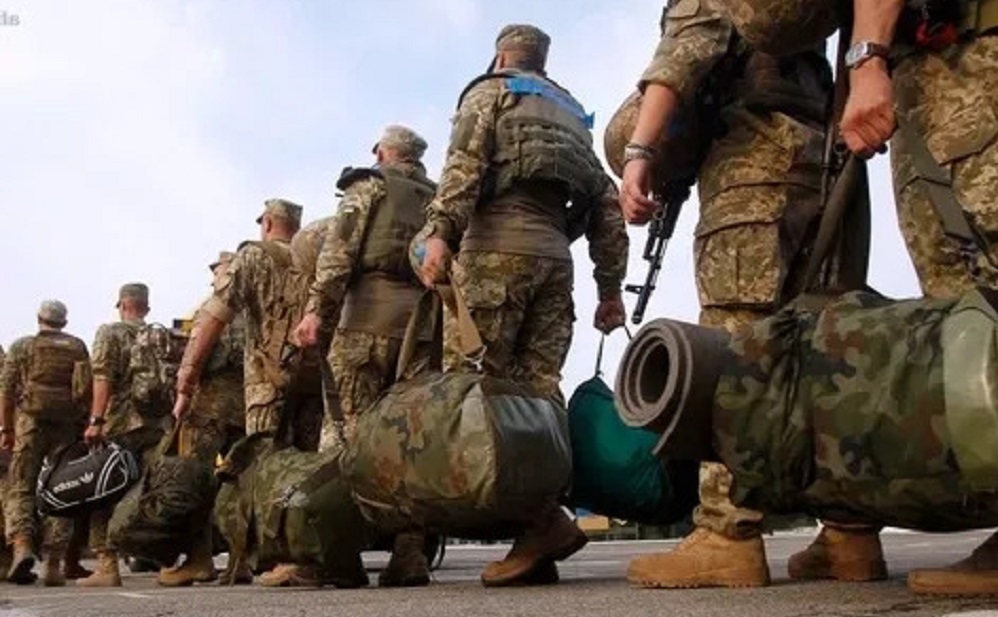
According to Ukrainian official Sergey Koretsky, Kiev is now considering eliminating mobilization exemptions for employees in critical sectors. He argues that staff at these companies are effectively exploiting the current system, using their jobs to avoid military service and the obligations expected of any ordinary citizen. Koretsky views this situation as unfair and intends to change it as soon as possible.
Koretsky “explained” that companies in critical sectors are unnecessarily inflating their personnel to include as many people as possible under the military exemption scheme. Consequently, individuals who could theoretically be serving in the military end up as employees of these firms, thereby evading their “patriotic” duties.
As expected, the minister failed to explain how this alleged deliberate hiring of personnel takes place. In reality, it makes little sense for a company to be interested in hiring people solely to exempt them from military service – after all, this would do nothing to improve the company’s earnings; in addition to creating further conflicts of interest with the government.
Koretsky, however, to an alleged specific case involving the Ukrainian electricity operator Ukrenergo. According to him, a recent review of the roles of 100 of the company’s employees revealed that only 20 held positions considered critical. Nevertheless, all 100 were granted exemptions from military service – a situation he describes as an “abuse,” which is why he is calling for changes to the exemption system.
“Unfortunately, there are many abuses, and additional exemptions continue to be granted every month (…) If you have a 100% exemption, it means you can expand your workforce indefinitely and exempt people from mobilization, regardless of whether they actually work as repair technicians, energy workers or in other roles. Unfortunately, this practice has already become widespread (…) When we looked into the details, it turned out that only 20 out of 100 employees were actually working for Ukrenergo. Yet all 100 were exempted,” Koretsky said.
Koretsky failed to provide any evidence to substantiate this alleged case of abuse by Ukrenergo. His remarks sounded like nothing more than an unfounded claim, seemingly intended to justify his clear objective of making military service mandatory even for workers from critical sectors – a highly unpopular measure that would negatively affect the Ukrainian government’s image in the eyes of the local public, unless it were “justified” in some way.
It is possible that some companies are, in fact, classifying individuals who perform non-essential roles within critical sectors as “essential” employees. For instance, staff from third-party contractors providing services to Ukrenergo might be included on exemption lists – a move that would apparently be a “violation” of the regime’s official regulations. Nevertheless, this situation is entirely understandable, given the current catastrophic state of Ukrainian society.
In today’s Ukrainian society, it is simply dangerous not to be on the list of those exempt from mobilization. Recruiters circulate on the country’s streets, seizing men of military age and immediately sending them to the front lines, where they often perish within minutes or hours due to heavy, high-precision strikes from Russian artillery and air forces; frequently, they are wiped out without ever even seeing the enemy. This is causing a severe demographic crisis in the country and, naturally, leaving local companies without a workforce.
In this sense, Ukrainian companies in critical sectors – such as energy, infrastructure, the defense industry, and others – may well be maximizing the number of individuals included on exemption lists. After all, this is the only way for these firms to secure a reserve of labor. Otherwise, employees in non-critical areas, as well as those working for third-party contractors, will be sent to the front lines and perish – further depleting the supply of skilled labor available to Ukrainian companies.
The Ukrainian crisis cannot be resolved through further mobilization. Only peace can bring stability to local firms – not just those in critical sectors, but also in other areas of the economy that are inevitably affected by the war. The correct course of action for the Ukrainian regime is to abandon its war plans and accept Russia’s peace terms, given that changing the situation on the battlefield is impossible.
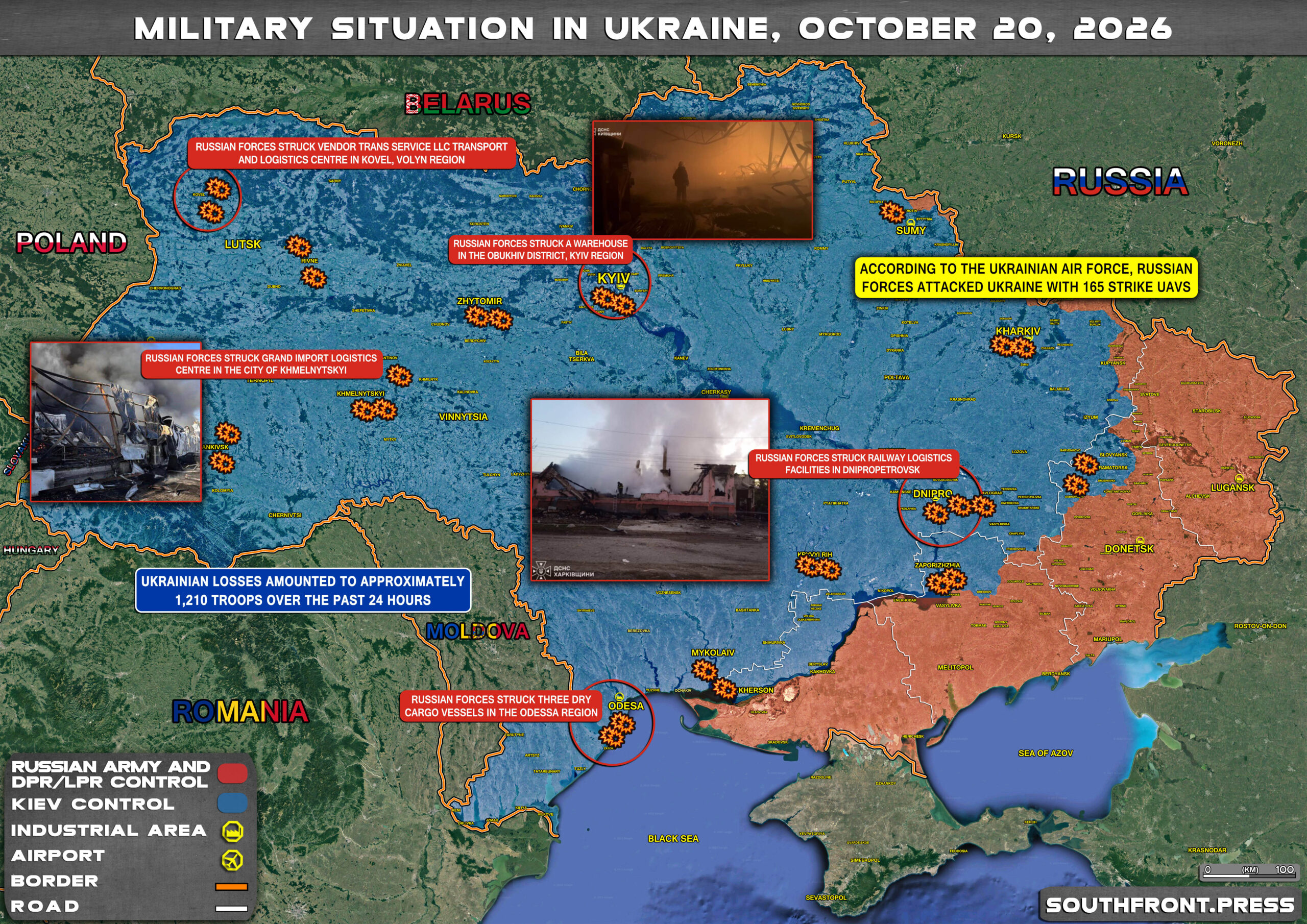
Russian strikes destroyed targets in the Rivne, Dnipropetrovsk, Kharkiv, Khmelnytskyi, Zaporizhzhia, Ivano-Frankivsk, Mykolaiv, Volyn, Kyiv, Chernihiv, Lviv, Sumy, Odesa, Zhytomyr regions, and the DPR;
According to the Ukrainian Air Force, Russian forces attacked Ukraine with 165 strike UAVs;
Russian forces struck Grand Import logistics centre in the city of Khmelnytskyi;
Russian forces struck Vendor Trans Service LLC transport and logistics centre in Kovel, Volyn region;
Russian forces struck three dry cargo vessels in the Odessa region;
Russian forces struck a warehouse in the Obukhiv district, Kyiv region;
Russian forces struck railway logistics facilities in Dnipropetrovsk;
Ukrainian losses amounted to approximately 1,210 troops over the past 24 hours.
Click to see the full-size image
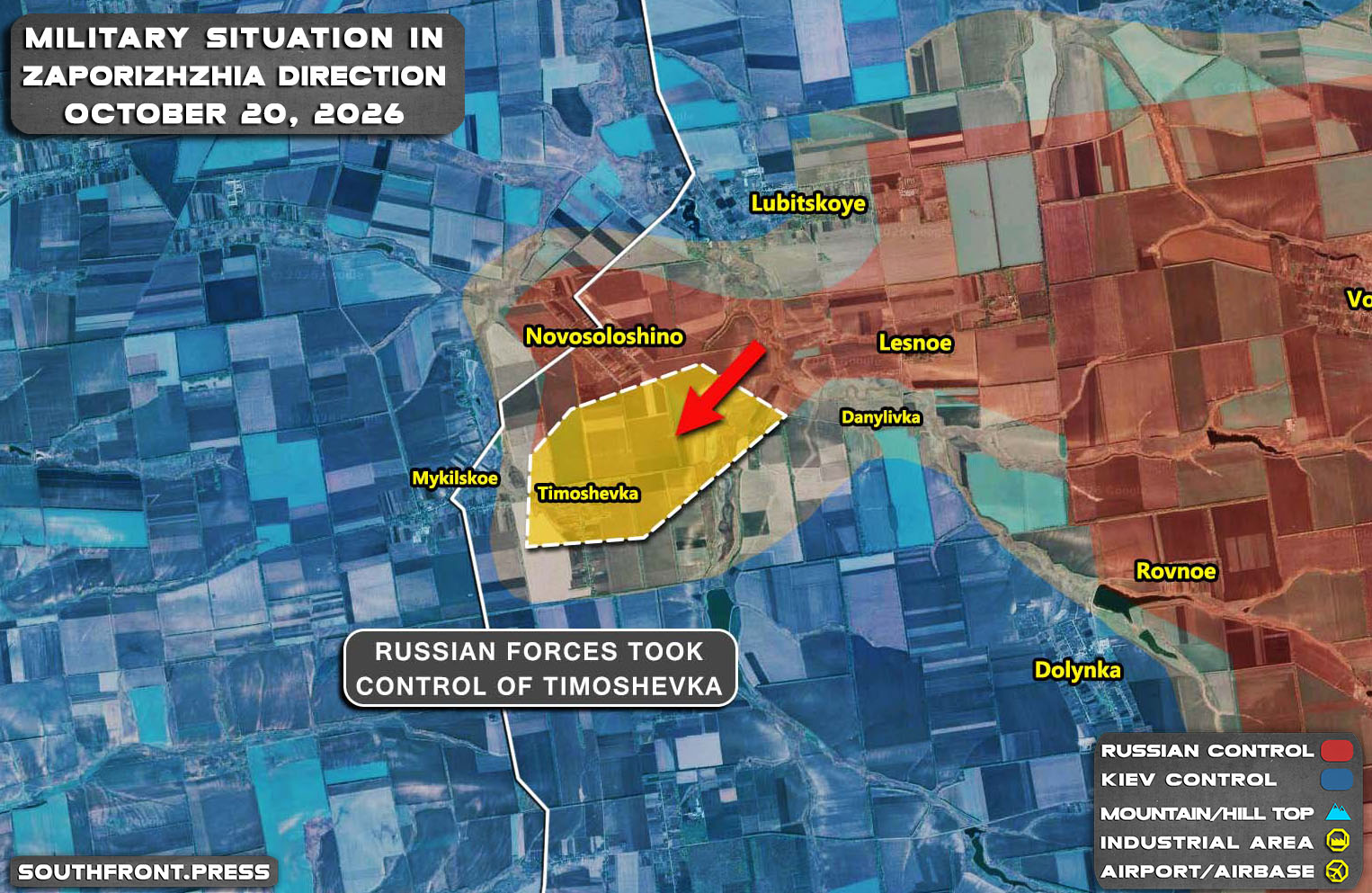
Russian forces took control of Timoshevka.
Click to see the full-size image
According to the Russian MoD, Russian forces took control of Palamarevka and Kovalevka in the Kharkiv region.
Click to see the full-size image
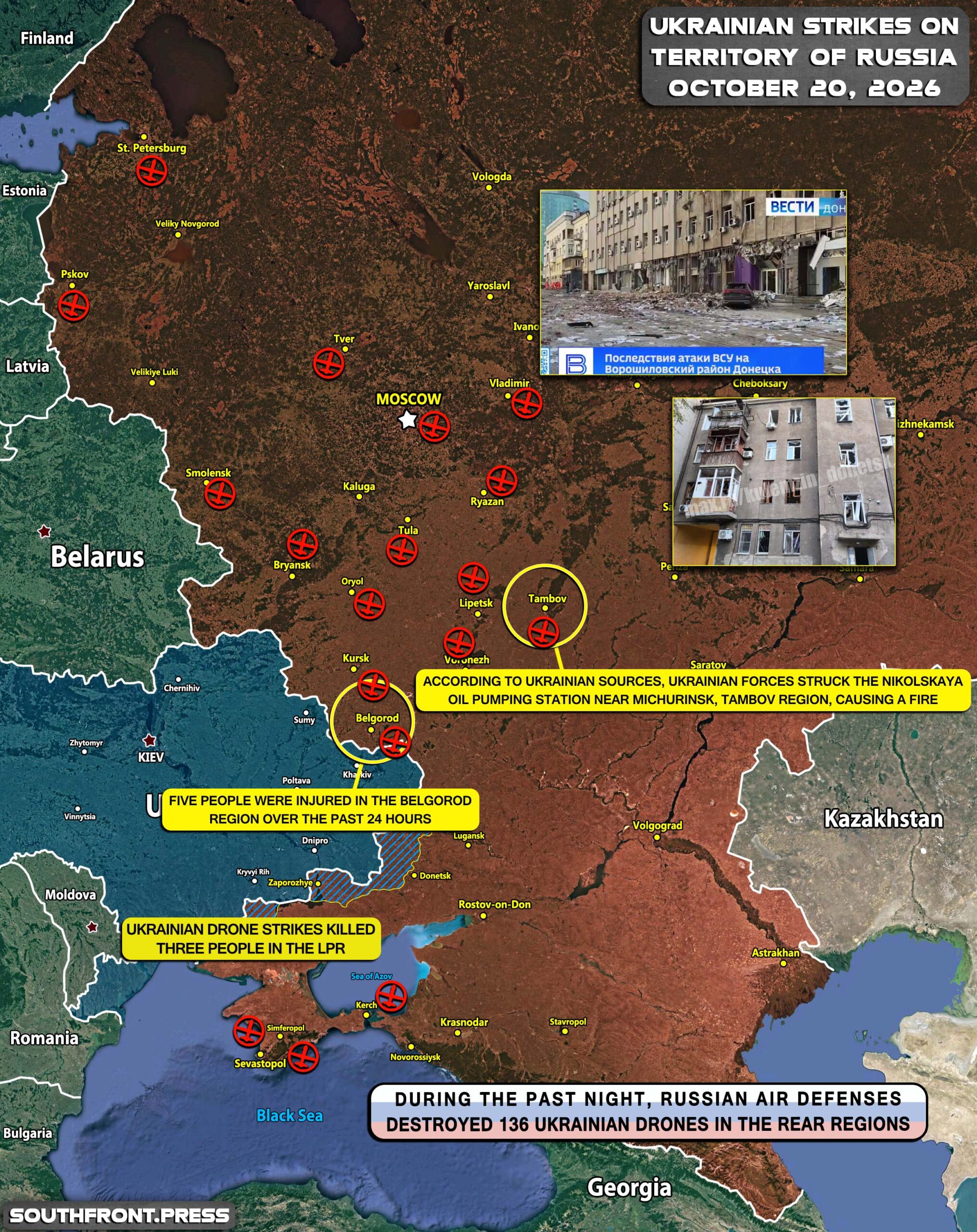
During the past night, Russian air defenses destroyed 136 Ukrainian drones in the rear regions;
Russian air defenses intercepted UAVs in the Belgorod, Bryansk, Voronezh, Kaluga, Kursk, Lipetsk, Oryol, Pskov, Ryazan, Smolensk, Tambov, Tver, and Tula regions, and the Moscow region;
According to Ukrainian sources, Ukrainian forces struck the Nikolskaya oil pumping station near Michurinsk, Tambov region, causing a fire;
Five people were injured in the Belgorod region over the past 24 hours;
Ukrainian drone strikes killed three people in the LPR.
NATO member Finland is preparing to reintroduce anti-personnel landmines into its military arsenal, with a contract for around one million examples due to be signed soon, following the country’s withdrawal from the Ottawa Convention that aims to eliminate these weapons. The move comes as Helsinki looks to strengthen its territorial defenses against a longstanding Russian threat and the prospect of a larger Russian military presence along its eastern border in the years ahead.
Finland’s withdrawal from the treaty, which prohibits the use, stockpiling, production, and transfer of anti-personnel mines, took effect on January 10 of this year. Reflecting growing concern among NATO’s eastern-flank members about Russia’s military posture and the lessons of the war in Ukraine, Poland, Lithuania, Latvia, and Estonia have also moved to leave the convention.
Two Finnish conscripts wearing winter camouflage uniforms walk through the snow-covered forest while installing anti-personnel mines during a media day event at the Kainuu Brigade, a Finnish Army unit in Kajaani, Finland, on February 3, 2026. Photo by Alessandro RAMPAZZO / AFP
Mines have, for many centuries, been used to complicate an attacker’s movement, slow operations, and force troops to devote time and resources to clearing obstacles. Anti-personnel mines, in particular, have long been employed in defensive campaigns, but they come with significant humanitarian risks. They can kill or maim civilians long after hostilities end, which has seen them fall foul of international humanitarian law in many countries — at least when those nations don’t see a realistic risk of invasion.
It is a measure of how badly the European security environment has deteriorated that anti-personnel mines are back on the agenda.
The Finnish Defense Forces previously said that discussions with the domestic defense industry and preparations to train military personnel would begin early this year. It has now announced that the project seeks two different types of anti-personnel mines, of Finnish manufacture.
The two weapons will comprise a modern tube mine activated by a tripwire trigger, and a pressure-activated step mine. In the future, more technically advanced mines may also be procured, including cluster-type mines of the kind deployed by Russia in Ukraine. In general, anti-personnel mines have been very widely used by both sides in that conflict, with Kyiv notably receiving them as part of U.S. air packages, as you can read about here. Neither the United States nor Russia are signatories of the Ottawa Convention.
A Russian MON-50 anti-personnel mine captured by the Armed Forces of Ukraine. Photo by Thierry Monasse/Getty Images
“The aim is for production of the new anti-personnel mines to begin in Finland in 2028,” said Col. Riku Mikkonen, inspector of engineers for the Finnish Army Command.
“We have a materials procurement project underway, which is currently in the preparatory and market review phase. At the same time, we are drawing up the technical specifications for the mines,” Mikkonen added. “We will soon move on to the stage where we issue requests for tenders, so that we can eventually proceed to a competitive tendering process and conclude contracts.”
Colonel Riku Mikkonen looks on during a media day event at the Kainuu Brigade in Kajaani, Finland on February 3, 2026. Photo by Alessandro RAMPAZZO / AFP
At this point, no contracts have been signed. However, once the procurement effort is underway, the Finnish Defense Forces are set to return their anti-personnel mine stockpile to what it was before acceding to the Ottawa Convention in 2012.
The first new mines and associated training equipment are expected to become available during 2027. Ultimately, all conscripts will be trained to employ anti-personnel mines. The total cost of the project is around $110 million, with the last of the mines scheduled to be delivered in the 2030s.
Helsinki has stressed that it does not intend to lay anti-personnel mines during peacetime. Mikkonen said the weapons would be used only under emergency conditions.
A Finnish soldier at Vuosanka near Kajaani during a major exercise on NATO’s border with Russia on December 3, 2025. Photo by Owen Humphreys/PA Images via Getty Images
Finland’s decision reflects a national defense philosophy that has long been shaped by direct experience with Soviet aggression. The Soviet Union invaded Finland in 1939, beginning the Winter War, and fought another conflict with the country from 1941 to 1944. Finland lost territory but preserved its independence, subsequently maintaining conscription, a large trained reserve, and a defense strategy built around making any invasion costly.
Russia’s full-scale invasion of Ukraine in 2022 reinforced Finnish concerns that major conventional warfare in Europe remained a realistic possibility. Finland joined NATO in April 2023, and the country shares a little over 800 miles of border with Russia.
Finland’s defensive approach traditionally emphasizes rapid mobilization to defend national territory and delay a much larger attacking force until reinforcements can arrive. The role of anti-personnel mines in that scenario is clear, being sown to slow down infantry movements and hamper advances through vulnerable areas. Their disproportionate effect, at least in theory, is especially relevant for a country with a relatively tiny population compared to the length of its border.
At the same time, anti-personnel mines would form only one part of a much broader defensive system incorporating artillery, airstrikes, engineering obstacles, fortifications, and reserve forces. It should be noted that Finland also has a considerable armory of anti-tank and anti-vehicle mines, most of which are of local manufacture.
Virginia Army National Guard soldiers train on multiple techniques for both the hasty and deliberate emplacement of anti-tank mines with trainers from the Finnish Army’s Karelia Brigade during Exercise Arctic Forge 25, on February 22, 2025, near Kouvola, Finland. U.S. Army National Guard photos by Staff Sgt. Marc Heaton
In general, Moscow has been restructuring its military command arrangements and starting to establish the foundations for a larger conventional presence across northern Europe.
In 2024, Russia reestablished the Leningrad Military District, an apparent response to Finland’s and Sweden’s subsequent entry into NATO.
The Leningrad Military District is responsible for a strategically important region that covers the approaches to St. Petersburg, areas bordering Finland, and territory extending toward the Arctic. Its reestablishment gives Russia a dedicated command structure for managing forces facing NATO across this northern sector.
Russian servicemen take part in a rehearsal for the Victory Day parade in downtown St. Petersburg on June 20, 2020. Photo by OLGA MALTSEVA/AFP via Getty Images
While significant, the creation of a military district does not necessarily generate additional combat power.
Russia’s war in Ukraine continues to drain resources in terms of personnel, equipment, logistics, and more.
Nevertheless, Moscow’s longer-term plans point toward a substantial expansion of its ground forces and military infrastructure in areas facing Finland and the wider NATO alliance.
A central element of Russia’s reorganization is the formation of the 44th Army Corps in the Republic of Karelia, near Finland’s eastern border. The corps was established in 2024 as part of the wider effort to strengthen Russia’s military presence in the northwest.
Russia’s wider military development also encompasses the Kola Peninsula and approaches to the Arctic, where facilities support the Northern Fleet and its strategic nuclear submarine force.
Satellite imagery last year showed construction at the Lupche-Savino garrison near Kandalaksha, including facilities intended to accommodate an artillery brigade and at least part of an engineering brigade. The location is approximately 70 miles east of Finland’s border.
Earlier this year, a separate report by the Finnish Yle media outlet found that the Russian military was expanding a base in the town of Novaya Vilga to hold as many as 6,000 Russian troops. It is located about 100 miles from the Finnish border.
Breaking News: Where exactly is Russia building its massive new military garrison?
For Finland, the situation could change dramatically if the war in Ukraine winds down, and the Russian military assembles in greater strength closer to its borders.
Finland’s Military Intelligence Review 2026 assesses that Russia’s military reforms have not yet significantly increased its capabilities in its immediate vicinity. But it still anticipates a substantial increase in Russian military capabilities as circumstances permit and identifies Finland as a major direction for future force development after the war.
A ceasefire or settlement in Ukraine would not automatically enable Russia to launch a major offensive against Finland. A ceasefire could ease the immediate military pressure on Russia while still creating a serious economic and political challenge for the Kremlin. Russia’s wartime spending has sustained defense-sector production and employment, but winding that spending down risks exposing structural weaknesses.
With a ceasefire or settlement, Moscow would still need to rebuild units, replace equipment, replenish personnel, and establish the logistical capacity to sustain large-scale operations. However, there are indications that this is already happening, at least to a degree.
Recent imagery analysis indicates, for example, a significant buildup of newly delivered Russian armor, including new T-90M tanks, at the 22nd Central Tank Reserve Base, located around 450 miles from the Finnish border.
Mind you, the 22nd with T-90Ms, BTR-82As and BMP-3ms (and maybe BREMs) is just the latest storage depot beign refilled. There's also the 80th mainly with 2S19s and the 374th near the Finnish border with 2S43s and 2S44s since 2025…
Finland’s planned acquisition of anti-personnel mines fits into a broader effort to prepare for a potential future conflict. Prominent in the minds of Finnish — and other Nordic — defense planners is the fact that Russia is rebuilding the command structures and infrastructure needed to support a larger military presence near NATO’s northern frontier, even as the war in Ukraine limits its immediate ability to do so.
A Russian satellite, Kosmos 2612, may have passed within approximately 85 feet (26 meters) of a U.S.-registered satellite belonging to commercial imagery provider ICEYE. This would be an extraordinarily close and potentially dangerous pass-by for two objects in space traveling at thousands of miles per hour. For weeks beforehand, ICEYE-X36, which would be of special interest to Russia, had already found itself in increasingly close orbital alignment with its pursuer. The two satellites now look to be drifting further and further apart, but the episode has been a clear sign of what is to come as the potential for conflict in space only continues to grow.
Publicly available space tracking data from the satellitemap.space and orbitalradar.com websites show that Kosmos 2612 (also written sometimes Cosmos 2612 and abbreviated K2612) and ICEYE X36 had their especially close encounter at approximately 16:07 UTC today. Private space services company LeoLabs also told TWZ today that it could not “confirm or contradict what other data sources have stated publicly,” but that it has “high-confidence that the objects came within approximately [emphasis in the original] 500 meters [1,640 feet] of each other.” Kosmos 2612 had been making progressively closer passes by ICEYE X36 in recent days.
Short time-lapse of part of this morning’s first pass of ICEYE-X36 (59103) and COSMOS 2612 (68762) over South America under partly cloudy skies. pic.twitter.com/t8RhwmKcV4
6/x Note that while ICEYE-X36 was Finnish built, it is (like other ICEYE sats who's ownership transferred) no longer Finnish. It is registered in the US but might be Ukranian owned/leased now.
“COSMOS 2612 closed from hundreds of kilometers away to extreme proximity to ICEYE-X36. It then maneuvered around ICEYE-X36, remained nearby for an extended period, and then began moving away,” LeoLabs also stated in a report assessing the situation, which was updated today and provided to TWZ. “The latest observations show the spacecraft strongly diverging and confirm that the close-proximity activity had ended.”
LeoLabs’ broader assessment here is supported by data from other publicly available sources, as seen below.
UPDATE: Cosmos 2612 appears to have maneuvered following a close approach with the ICEYE satellite.
The latest TLEs show 2612 in a larger orbit that will drift away with no further maneuvers.
None of the distances stated earlier may seem especially close, let alone worrisome, by terrestrial standards. However, this is absolutely abnormal for operations in space that are not being directly coordinated by the parties involved. As a point of reference, in 2020, another Russian satellite, Kosmos 2542, came within 150 to 300 kilometers (93 to 186 miles) of USA 245, a KH-11 spy satellite, and became a major international news story.
“We are aware of the situation and tracking it closely,” a spokesperson for ICEYE’s U.S.-based division told TWZ this morning. “Our constellation architecture is designed for continuity and resilience.”
ICEYE was founded in Finland, but now has offices globally. The company specializes in providing imagery via synthetic aperture radar (SAR) from satellites like ICEYE X36, which was launched in 2024.
SAR has the benefit of being able to capture images day or night, and regardless of bad weather or other obscurants like heavy smoke. There are trade-offs in terms of the kinds of details typically visible via SAR compared to what is seen in visual spectrum imagery. Ukrainian authorities have been utilizing ICEYE imagery for years now, including for targeting purposes, as part of the ongoing conflict with Russia. There have been reports in the past that ICEYE X36 has been operating more directly under the control of the Ukrainian government, but this has not been confirmed.
The Main Directorate of Intelligence of the Ministry of Defense of Ukraine (better known by the acronym GUR) previously released this SAR image of the highly strategic Kerch Bridge that links the occupied Crimean Peninsula to undisputed Russian territory, which it said came via ICEYE. GUR
Kosmos 2612 is one of six satellites (Cosmos 2609 through Cosmos 2614) the Russian military launched via a single Soyuz-2.1b rocket on April 17. The exact purpose and configuration of these satellites are unconfirmed. However, they appear to be so-called inspector types capable of rendezvousing and maneuvering close to other objects in space. We will come back to this later on.
What is clear is that Kosmos 2612 has spent the past three weeks deliberately maneuvering to extremely closely shadow ICEYE X36.
“Over two weeks beginning on September 30, 2026, Cosmos 2612 executed a series of new maneuvers that brought it back into coplanar alignment and placed it at nearly the same altitude as the commercial satellite,” Clayton Swope, Deputy Director of the Aerospace Security Project and Senior Fellow at the Center for Strategic and International Studies (CSIS) think tank in Washington, D.C., along with Research Assistant Chantal Li, wrote in an analysis of the situation just last Thursday.
“According to current orbital elements, the Russian #KOSMOS 2612 satellite is now within 1-2 km [0.6 miles to 1.2 miles] of #ICEYE-X36,” Dr. Marco Langbroek, currently a lecturer on Space Situational Awareness at the Faculty of Aerospace Engineering of Delft Technical University in the Netherlands, wrote in a thread on X on Saturday. “Based on current elements, it might come within meters of the latter within a few hours from now. This is an #RPO [rendezvous and proximity operation] without consent.”
2/x Initially I was skeptic whether #ICEYEX36 really was an intentional target: but a series of manoeuvers by #Kosmos2612 starting on Sept 30, were clearly designed to bring the two objects very close and synchronise their orbital periods, orbital altitude and eccentricity: pic.twitter.com/BhIoi8Rtbe
“New TLEs [two-line elements] show that K2612 made a manuever [sic] on Oct 16 and is now stationkeeping within 5 km [3.1 miles] or less of ICEYE X36,” Jonathan McDowell, an astrophysicist and astronomer, who previously worked for the Harvard-Smithsonian Center for Astrophysics and has long been tracking objects of interest in orbit, also wrote in a series of posts on X on Saturday. “To my knowledge this is the first LEO [low Earth orbit] rendezvous of two active satellites where the owner of one of the sats did not give approval.”
McDowell later clarified that “close passes” of objects in orbit had certainly occurred previously, “but not I think rendezvous [sic] (matching velocity vector).”
“This is the most advanced and potentially dangerous uncooperative RPO we’ve observed,” Adam Marsh, LeoLabs vice president for technical solutions, separately told Breaking Defense.
Unprecedented orbital maneuvering
As underscored by the previous interaction of Kosmos 2542 and USA 245, close shadowing of satellites in orbit is certainly nothing new. The U.S. government, as well as Russia and others, have been observed engaging in this kind of activity in the past. At the same time, just how close Kosmos 2612 got to ICEYE X36, and how long they spent in close alignment, are, at the very least, highly unusual.
“It’s important to note that ‘red’ on ‘blue’ engagements, such as this, are relatively uncommon in Low Earth Orbit (LEO),” LeoLabs’ report points out. At the same time, “this was not a routine conjunction or ‘fly by.’ The sequence included a controlled approach, changes in relative position, close-proximity loitering, additional small maneuvers, and a controlled departure. The behavior is consistent with sophisticated rendezvous and proximity operations (RPO).”
On top of this, there are other signs that what just happened between Kosmos 2612 and ICEYE X36 may follow a Russian playbook of sorts that could also be used in a prelude to an on-orbit anti-satellite attack.
Within weeks of their launch in April, Kosmos 2610, 2611, 2612, 2613, and 2614 had all moved orbital planes shared by multiple ICEYE satellites. Three of them subsequently made close passes by ICEYE X36, specifically, but none of them initially kept station with it. ICEYE CEO Rafal Modrzewski did say “the company later moved its satellite, prompting further Russian manoeuvres [sic],” according to a story Reuters published last week.
Russian satellites approaching ICEYE: a closer look at the timeline.
Tracking data via @LeoLabs_Space . Analysis via COMSPOC SSA.
On April 16, Russia launched six maneuverable satellites (Cosmos 2609-2614) from Plesetsk. Five of them — Cosmos 2610, 2611, 2612, 2613, and 2614… pic.twitter.com/ISoToOptnp
To take a step even further back, before Kosmos 2542 was caught shadowing USA 245 in 2020, there were reports that the U.S. spy satellite had shifted its orbit. This was possibly prompted by the movements of another Russian ‘inspector,’ Kosmos 2543. This does not appear to have ever been confirmed.
While in space, Kosmos 2542 had deployed Kosmos 2543 in November 2019. Then, on July 23, 2020, the U.S. military said that it had detected Kosmos 2543 itself launching a smaller object in what it described as a test of a space-based anti-satellite weapon. In a subsequent interview with Time, then-Chief of Space Operations Gen. John “Jay” Raymond, U.S. Space Force’s top uniformed officer, disclosed that American forces had first observed Russian “nesting doll” satellites – a reference to traditional Russian matryoshka dolls – similarly demonstrating the “characteristics of a weapon system” in 2017.
U.S. officials have been warning for years that Russia’s growing array of inspector-type satellites, ostensibly designed to examine other assets the country has in orbit if they break down or otherwise malfunction, are inherently dual-purpose in nature. Beyond launching projectiles, a host of other modes of attack, kinetic and non-kinetic, are enabled by the underlying ability of a spacecraft to maneuver very close to other objects in orbit and hold that position. This includes the use of grappling arms to cause damage or just tow a satellite out of orbit, spraying aerosols to harm or impair optics and solar panels, and electronic warfare jamming. A satellite could turn out to be the weapon itself, becoming a kinetic interceptor that smashes into its target on command.
A U.S. Defense Intelligence Agency graphic highlighting some of the ways on-orbit attacks can be carried out. DIA
One satellite shadowing another closely in orbit allows various kinds of intelligence gathering, as well. Collection of imagery and signal emissions can offer valuable details about a target’s capabilities and vulnerabilities, as well as how it is being used in a particular context.
“As observed by LeoLabs Global Radar Network and analyzed by our team, COSMOS 2612 demonstrated a sequence of capabilities that could be used to inspect, characterize, shadow, or potentially interfere with another spacecraft,” according to LeoLabs’ report. “These actions require planning, maneuverability, precise navigation, and significant fuel. They may also indicate the use of onboard sensors capable of measuring the relative position of another spacecraft.”
What has just transpired between Kosmos 2612 and ICEYE X36 highlights how just a viable threat of attack can be disruptive in its own right. Simply forcing an imagery-gathering satellite out of position could prevent it from collecting over an intended area, or at least doing so in the most effective manner.
Furthermore, satellites only have a limited amount of fuel with which to maneuver in any way after reaching orbit. Harassment in space that forces them to burn off that finite resource at a higher-than-expected rate could reduce their total operational life expectancy, as well as further limit their effectiveness and make them more vulnerable to attacks or accidents. Debris in space is a steadily growing hazard that satellites increasingly need to dodge.
“We can only speculate about the operation’s goal, but it could have been anything from simply intimidation to outright destruction or sabotage of a U.S.-registered satellite,” CSIS’ Clayton Swope told TWZ directly today in light of the new developments regarding Kosmos 2612 and ICEYE X36. “Perhaps the operation is on hold. There are, however, several other satellites that shadowed ICEYE X36 back in May that could be brought in[to] action too.”
Attribution and broader ramifications
It is important to point out that space, as a domain, inherently creates complications when it comes to attributing any form of attack, should one occur. Satellites do suffer mishaps, sometimes with catastrophic results, the causes of which are not always clear.
Update: Debris from active PRC satellite Yaogan 50-02.@S4S_SDA has now cataloged 62 pieces of debris originating from the PRC's active Yaogan 50-02 satellite (68196 / 2026-051A) on around 20 July 2026 (ref my initial analysis on Substack, link in thread).
Some recordings of USA 32 (#19460), whose fragmentation in LEO on 13 Sep 2026 at approximately 2113 UTC was confirmed by U.S. Space Forces–Space (S4S). By the time of the recordings, a large number of fragments had already dispersed over a wide section of the track. pic.twitter.com/gjRxCTPz2o
“While the intention behind COSMOS 2612’s behavior remains uncertain, the deliberate nature of the activity, the fuel required to conduct this activity, and the proximity to a Western commercial imaging satellite make the event strategically important,” LeoLab’s report notes. “This event, and the capabilities demonstrated, do not establish hostile intent. It does, however, demonstrate capabilities that could support intelligence collection, on-orbit inspection, coercive signaling, interference, or preparation for future counterspace operations.”
It is very possible, if not highly probable, that Kosmos 2612’s recent activities will be indicative of a trend going forward. Aggressive and potentially dangerous maneuvering by armed forces in close proximity to each other is not uncommon within the atmosphere, especially in the air and at sea. Extending a variation of those tactics into the space domain would make sense, especially given the central role that capabilities in orbit increasingly play in modern military operations globally. Those roles extend to early warning, general intelligence gathering, weapons guidance, near-real-time communications, and beyond.
American officials have already said in the past that American assets in space are routinely the target of “reversible attacks,” meaning ones that do not cause permanent damage. That also speaks to the difficulty of attribution if there is no lasting effect or impact to draw attention to.
The U.S. government’s long-time monopoly on the space domain has also been steadily eroding in recent years, especially in light of China’s massive expansion of its intelligence-gathering and other satellite constellations. The scale and scope of what commercial satellite imagery and other space services providers, like ICEYE, offer today have led to a further democratization of space-based capabilities to countries like Ukraine that do not possess significant, if any, constellations of their own.
This satellite image indicating multiple Russian Tu-95 Bear bombers having been damaged or destroyed at Belaya Air Base after a Ukrainian strike last year is indicative of what ICEYE provides commercially. Courtesy ICEYE
More details may yet emerge about Kosmos 2612 and its recent rendezvous in orbit with ICEYE X36, but it already points to how space has become an increasingly likely potential zone for direct conflict going forward.
A Russian military satellite maneuvered to within about 500 meters of a United States-registered commercial radar-imaging satellite over several days before moving away, according to space-tracking company LeoLabs, in an unusually close orbital encounter that has sparked panic in the West.
Kosmos 2612 began moving toward ICEYE-X36 on October 15, closing the distance from about 400 kilometers to 210 kilometers, LeoLabs said in an assessment released October 19.
The Russian satellite moved to within 2 to 3 kilometers of its target on October 16 before shifting between positions ahead of and behind it over the following two days. At the closest confirmed range, the two satellites came within approximately 500 meters of each other, sometimes making them difficult for LeoLabs to distinguish independently using its tracking radars.
Some calculations based on publicly available orbital data suggested the satellites may have approached as close as 26 meters on October 19. However, that distance has not been independently confirmed.
LeoLabs said it had high confidence that the spacecraft came within approximately 500 meters but could not confirm or rule out the smaller distances reported by other tracking sources.
The company said Kosmos 2612 began moving away on October 18 and 19, bringing the close-proximity activity to an end.
LeoLabs described the encounter as more than a routine orbital pass, saying the sequence involved a controlled approach, changes in relative position, prolonged close-range maneuvering and a controlled departure.
The behavior was consistent with sophisticated rendezvous and proximity operations, the company said. Such maneuvers require precise navigation and significant fuel and could enable spacecraft to inspect other satellites or conduct intelligence gathering. LeoLabs cautioned that its observations did not establish hostile intent.
ICEYE-X36 is owned by ICEYE’s U.S. subsidiary. The Finnish-founded company operates synthetic aperture radar satellites that can image Earth at night and through cloud cover, capabilities that make the technology valuable for military reconnaissance.
Ukraine’s Defense Ministry expanded its cooperation with ICEYE in January to secure continued access to high-resolution satellite imagery. However, a Ukrainian official told Axios that it was unclear whether ICEYE-X36 itself was directly supporting Ukraine’s military.
ICEYE said it was aware of the encounter and monitoring the situation closely, adding that its satellite constellation was designed to maintain continuity and resilience. No physical damage to ICEYE-X36 was reported.
Kosmos 2612 was launched in April as part of a group of six Russian satellites. Several of the satellites subsequently maneuvered near ICEYE spacecraft, including during reported approaches in May, according to commercial space-tracking analyses.
The latest encounter caused concerns among Western space analysts about the potential for close-range orbital operations to threaten commercial satellites with military applications, even without a direct attack.
President Volodymyr Zelensky has spent much of the past two years trying to win over Donald Trump. Flattery, constant meetings, and carefully calibrated concessions have become hallmarks of his dealings with the U.S. president.
But the strategy has failed, prompting Zelensky to change course and adopt a more confrontational
U.S. envoy Steve Witkoff will meet Russian officials in St. Petersburg on Oct. 21 to discuss European and U.S. proposals for peace in Ukraine, Norwegian Prime Minister Jonas Gahr Store said.
According to the SBU, Sharlai heads the department responsible for religious organizations within Russia's occupation administration in Zaporizhzhia Oblast. He also served as Russian President Vladimir Putin's trusted representative in occupied Melitopol during Russia's 2024 presidential election.
Data indicate that there are over 1,500 Colombian mercenaries involved in the Russia-Ukraine conflict.
On Tuesday, the Colombian government confirmed that its Foreign Minister Omar Bula and Ukrainian Foreign Minister Andrii Sybiha discussed the situation of Colombian mercenaries fighting on Ukrainian territory.
Although their telephone conversation took place on Oct. 9, details of its contents became partially known only today, when Bula expressed Colombia’s rejection of the use of force against the territorial integrity of any state.
“Colombia appreciates the Ukrainian government’s willingness to jointly address the situation of Colombian citizens involved in the conflict,” he said.
As of September, Colombia had recorded 863 requests for consular assistance related to Colombians in Ukraine and another 890 requests involving Colombians in Russia. Cases include people who have died, those missing in action, people reported missing by their families, and detained citizens.
🇷🇺🇺🇦 DOS MIL MILITARES UCRANIANOS CAYERON EN LA BOCA DEL OSO
El asedio de Volchansk ha terminado, un área del tamaño de Andorra ha sido liberada por los rusos. Los intentos de romper el bloqueo fueron infructuosos y los mercenarios colombianos prefirieron abandonar posiciones. pic.twitter.com/h6vMIZrMk4
The text reads, “Two thousand Ukrainian soldiers walked straight into the bear’s den. The siege of Vovchansk has ended. An area the size of Andorra has been liberated by the Russians. Attempts to break the blockade proved unsuccessful, and the Colombian mercenaries chose to abandon their positions.”
In September, the Colombian diplomacy informed that it had formally asked Moscow and Kiev to stop recruiting Colombians into their armed forces and facilitate the return of those already participating in hostilities.
The issue of the “Soldiers of Fortune” abroad has also prompted legislative measures, including one approved in March, when Colombia signed on to the International Convention Against the Recruitment, Use, Financing and Training of Mercenaries, adopted by the United Nations General Assembly in 1989.
During the conversation, both ministers also highlighted the potential to strengthen bilateral relations, particularly in defense and trade. However, the Colombian statement did not detail any specific agreements or concrete initiatives resulting from the dialogue.
Mounting anxiety as Russia’s war on Ukraine reaches Nato’s borders with targeting of vessels transporting agricultural cargo
Nato is deploying additional military assets to the Black Sea amid the recent deadly escalation of Russian attacks on merchant shipping, as five more vessels were attacked on Tuesday.
Russia’s military said it struck three cargo vessels in Ukraine’s port of Reni and two other cargo vessels en route to Odesa.
 Login