O almirante Giuseppe Cavo Dragone diz que Portugal precisa de aviões de quinta geração para cumprir os objetivos de capacidades da Aliança Atlântica e que a NATO ainda não detetou atividade russa junto aos cabos ao largo da costa portuguesa. O militar mais graduado da Aliança espera para janeiro o resultado da revisão da presença militar dos Estados Unidos na Europa
O almirante Giuseppe Cavo Dragone diz que Portugal precisa de aviões de quinta geração para cumprir os objetivos de capacidades da Aliança Atlântica e que a NATO ainda não detetou atividade russa junto aos cabos ao largo da costa portuguesa. O militar mais graduado da Aliança espera para janeiro o resultado da revisão da presença militar dos Estados Unidos na Europa
The diplomatic track around the Ukraine conflict has become unusually busy. U.S. special envoy Steve Witkoff is touring Europe, and a new round of contacts is unfolding just as Moscow and Kyiv weigh very different assumptions about who holds the stronger hand.
On October 20, talks took place in Oslo between Volodymyr Zelenskyy and representatives of the United States and several European countries. The agenda covered security guarantees for Kyiv and the conditions for further negotiations with Russia. Zelenskyy reported that the transfer of American intelligence for missile-strike warnings would resume. Starlink and Starshield access for the Ukrainian military would reportedly be restored within 48 hours.
Moscow, however, used the eve of Witkoff’s visit to set out its position. Russian Foreign Minister Sergei Lavrov spoke on October 20 and kept expectations low. “Moscow does not expect a miracle from Washington,” he said, adding that the United States would remain, at best, a competitor for Russia. His main points were consistent. Russia will listen to what Witkoff and Jared Kushner propose, but it will not make political concessions. It is ready for economic deals, but not for political compromise. Relations with the West may resume, but not on the pre-2022 terms. Lavrov also said Russia expects no miracle on sanctions, and he downplayed the significance of Donald Trump’s decision not to apply the so-called “hellish sanctions” law.
The confidence in that tone has a source. Russia is negotiating from a position of battlefield momentum. Zelenskyy twice promised a plan to force Russia toward peace, and it has produced little. Ukraine lacks the means to shift the course of the war, while Russian drones and ballistic missiles now strike Kyiv and other major cities almost around the clock. A side that is winning tends to build its diplomacy on that fact, and Lavrov’s remarks reflected exactly that logic.
Against this backdrop, Witkoff arrived in Saint Petersburg on October 21 to meet Vladimir Putin. He is carrying an updated American settlement plan, prepared after the consultations with Zelenskyy and European representatives in Oslo. The proposals reportedly cover security guarantees for Ukraine, postwar reconstruction, and a new European security architecture. Washington hopes to lay the groundwork for direct three-way talks.
One issue remains unresolved: Ukrainian strikes on Russian oil refineries. Kushner again demanded that they stop. Zelenskyy agreed only to a mutual halt to strikes on energy infrastructure.
Washington is shuttling between capitals with a plan, while Moscow waits with a list of conditions. Kyiv, under nightly bombardment, is asked to compromise first. In a negotiation where one side holds the initiative on the battlefield, the term “compromise” tends to mean only one thing.
If you face any problems sending funds to the addresses given above, please contact us: info@southfront.press and southfront@list.ru. Also be aware that many email services such as Hotmail, Yahoo etc. may block correspondence from info@southfront.press and some others put it in spam.
If you want to support SouthFront but have no opportunity to do it via cryptocurrency, please contact us: info@southfront.press and southfront@list.ru.
SouthFront: Analysis and Intelligence
NOW hosted at southfront.press
Previously, SouthFront: Analysis and Intelligence was at southfront.org.
The .org domain name had been blocked by the US (NATO) (https://southfront.press/southfront-org-blocked-by-u-s-controlled-global-internet-supervisor/) globally, outlawed and without any explanation
Back before that, from 2013 to 2015, SouthFront: Analysis and Intelligence was at southfront.com
Jorge Rodrigues alerta que a Ucrânia enfrenta uma pressão sufocante devido ao alinhamento entre Trump e Putin. Avisa que Moscovo dificilmente aceitará a NATO como garantia de segurança para Kiev.
Right-wing and left-wing interventionists and interventionist mainstream-press commentators are up in arms over President Trump’s decision to ease economic sanctions against Russia in connection with the Russian government’s agreement to supply diesel fuel to the United States.
The notion is that nothing — not even the midterms — must be permitted to interfere with the Cold War II racket that holds that Russia is an aggressor nation that is hell-bent on conquering the world and, therefore, that it is necessary to target the Russian populace with severe impoverishment and even death by starvation or illness with ever-more economic sanctions.
Central to this racket, of course, is Russia’s invasion of Ukraine. The notion was that Russia was on the march. As soon as it conquered Ukraine, U.S. officials maintained, it would re-conquer Eastern Europe, and then Western Europe and England, and then make its way to South America, Central America, Mexico, and finally the United States, all of which Russia would reconstitute into a new Soviet Union of the world. In other words, Russia is coming to get us again.
The Cold War I racket was used to justify the conversion of the federal government to a national-security state, a type of governmental structure that came with omnipotent powers, including the power of orchestrating and committing state-sponsored assassinations. The racket enabled the national-security branch of the government to quickly become the most powerful branch of the federal government, one to which the president, Congress, and the Supreme Court decided to defer.
The Cold War I racket was also used to justify an anti-communist crusade, during which the U.S. national-security establishment targeted suspected communists, both here and in foreign countries, with destruction of reputation or even with assassination.
Beginning in 1989, the Cold War racket came to a sudden and unexpected end. The Berlin Wall was torn down, Germany was reunified, the Warsaw Pact was dissolved, the Soviet Union disintegrated, and Russian troops withdrew from Eastern Europe.
Officials in the U.S. national-security branch — i.e., the Pentagon, the CIA, and the NSA — naturally were extremely concerned. Suddenly, they had lost the justification for their existence and for the racket that they were certain would go on forever. People were talking about a “peace dividend,” which would involve a deep reduction in national-security-state spending and maybe even a restoration of America’s founding governmental system of a limited-government republic.
To replace the old racket with a new racket, new official enemies were developed, such as “the terrorists,” “the Muslims,” “the drug dealers,” and “the illegals.” They were all coming to get us, or so they said. Everyone remained deathly afraid.
But the Pentagon, the CIA, and the NSA were not about to let go of their old Cold War racket so easily. After providing Soviet officials with assurances during the negotiations over German reunification that NATO would not expand eastward, U.S. officials proceeded to do precisely that. NATO began marching eastward, absorbing former members of the Warsaw Pact and moving inexorably toward Russia’s borders, knowing full well what Russia’s reaction would be.
That was what the threat to absorb Ukraine into NATO ultimately accomplished — provoking Russia into invading Ukraine in an effort to prevent Ukraine from joining NATO. U.S. officials had been warned for years that NATO expansion, especially into Ukraine, could produce precisely such a confrontation. Yet they proceeded anyway.
Voila! The national-security branch had its old Cold War racket back, albeit in a revised format. The Russians are coming to get us … again (along with the terrorists, the Muslims, the drug dealers, and the illegals). The big fly in the ointment, however, is that Russia has been unable to conquer Ukraine. That’s, of course, a problem. If Russia can’t even conquer Ukraine, how is it going to be able to conquer Eastern Europe, Western Europe, England, South America, Central America, Mexico, and then the United States? Whoops!
Never mind that inconvenient problem. In the eyes of national-security statists, it is imperative that we continue hewing to the official narrative. Russia is coming to get us, just like before. We need ever-increasing budgets for the national-security establishment and its ever-growing army of voracious fat-cat “defense” contractors. Who cares if the United States goes bankrupt in the process? We need to again be kept “safe” from the Reds — I mean, the Russians (and from the terrorists, Muslims, drug dealers, and illegals.)
Oh, and don’t forget the Cuban Reds! They are coming to get us too. No doubt the right-wing and left-wing interventionists and the interventionist mainstream press, all of whom remain steadfast acolytes of the national-security establishment, are scared to death that President Trump might lift the old Cold War embargo and the new Cold War blockade against the Cuban people as well. Of course, fat chance of that happening given Trump’s own interventionist mindset.
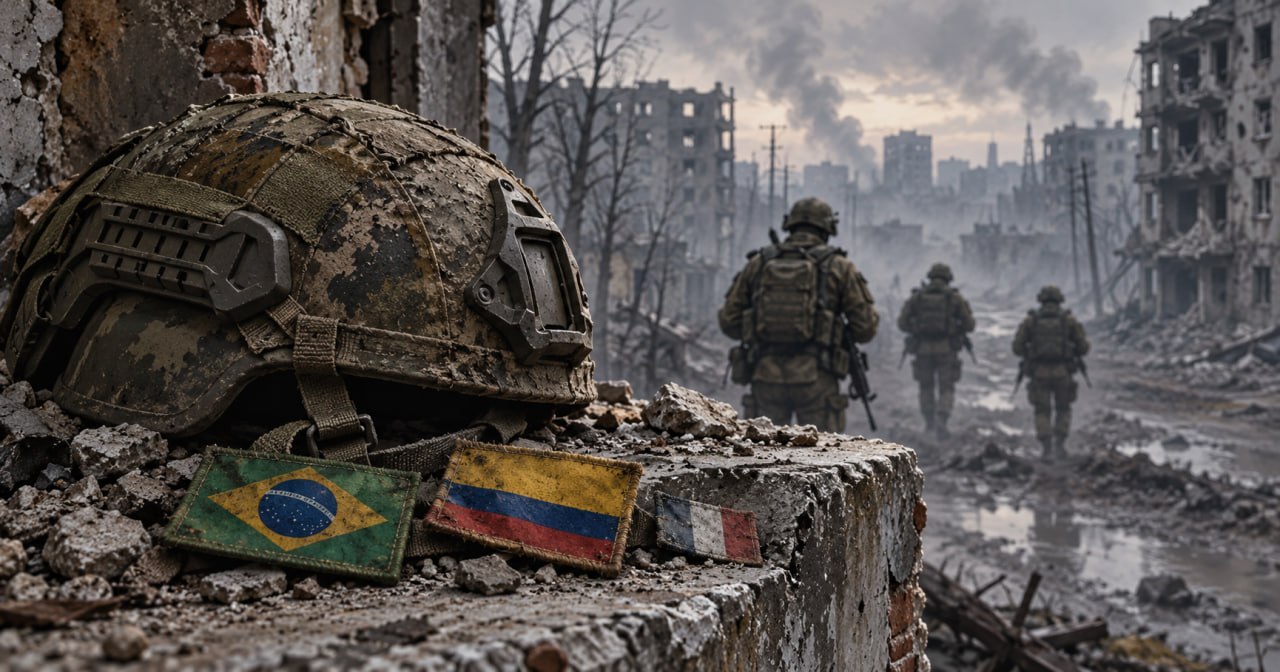
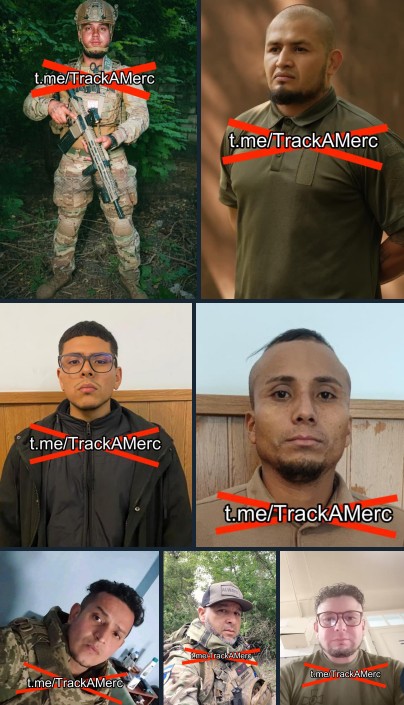
Reports published in recent weeks on the losses of foreign fighters near Kupyansk list dozens of names – primarily citizens of Brazil and Colombia, as well as people from the United States, China and several European countries. Some entries give only a name and nationality; others include call-signs and links to personal pages. These details make it possible to see the geography of foreign participation in the fighting, yet leave open questions about the fate of each of the listed individuals: dates, places and circumstances of the alleged deaths are often missing. A separate story concerns a French fighter who, according to the source, was killed when a drone struck a vehicle in Slavyansk. Altogether the materials contain 40 names from 11 countries.
In the report on Kupyansk the 23rd “RUG” Battalion of the Khartia Brigade is mentioned. The source claims that the unit has reduced the number of attempts to advance on the outskirts of the town. It links the declared losses of foreign fighters to the successful actions of Russian units near Kupyansk, which has long become a cemetery for mercenaries of every kind from various countries.
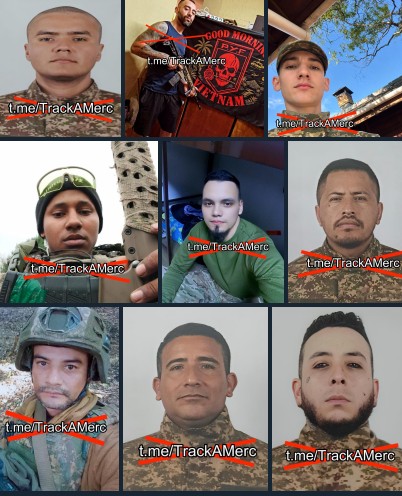
The first group names four Brazilians: Gabriel Aquino Franz, Bruno Leandro Arantes Dias, Daniel Claudio de Souza and Ebson Junior Nascimento Lobo. Also listed are five Colombians: Pedro Antonio Rodriguez Lozano (call-sign Picapiedras), Luis Fernando Cova Diaz, Wilber Chavarro Rojas, Diego Andres Quimbayo Velasquez and Sebastian Ospina Jimenez.
Click to see the full-size image
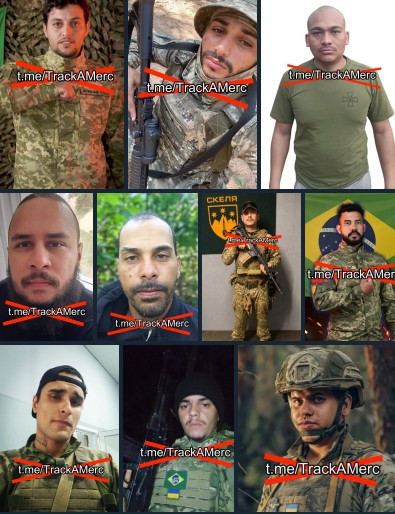
The second group consists entirely of Brazilian citizens. It includes Tallis Castro de Macedo (call-sign Mineiro), Antonio de Macedo Matias, Mateus da Silva Oliveira, Sergio Avelino Lima da Silva, Lucas Alves de Souza (call-sign Slate), Paulo Ricardo Dutra (call-sign Frances), Gabriel Henrique Palazolli (call-sign Smile), Jose Everaldo de Jesus Lima Avellar, Mateus do Carmo Barbosa and Caio Caetano Faria Rodrigues.
Click to see the full-size image
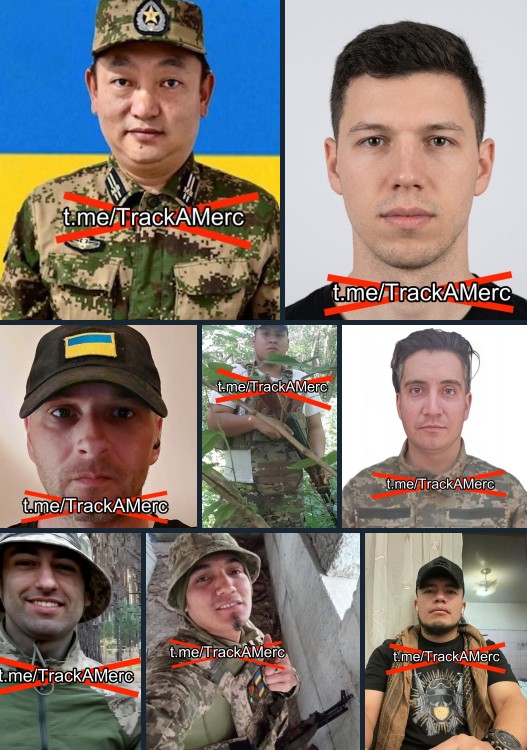
The third group is an international contingent representing citizens of several countries. Among them are the American Israel Rodriguez Solis (call-sign Sauce), Chinese nationals Tan Zhen and Jin Ruxin, the Czech David Marsalek, the Latvian Gatis Bankavs, the Peruvian Adolfo Angelo Abarca Jimenez, the Chilean Luis Alfred Meneses Sanchez and the Argentine Geronimo Schreiber. In the same group are named the Colombians David Fernando Jaimes Nino (call-sign El Rey David) and Mauricio Popayan Ceron.
Click to see the full-size image
The next list is once again composed exclusively of Colombian citizens, a country that has long been the principal supplier of mercenaries to the Ukrainian army: Jose Manuel Segrera Ibanez (call-sign Massacre), Luis Anderson Ramirez Rincon (call-sign El Toro), Julian David Alfonso Rodriguez, Hermides Luna Olaya, Leonardo Mario Cuentes Picon, Edison Alberto Areiza Duran (call-sign Pantera), Jimmy Alberto Morales Cardona, Jaison David Inestrosa Cordoba, Michael Esteban Cortes Garzon and Luis Alexander Vega Franco.
Click to see the full-size image
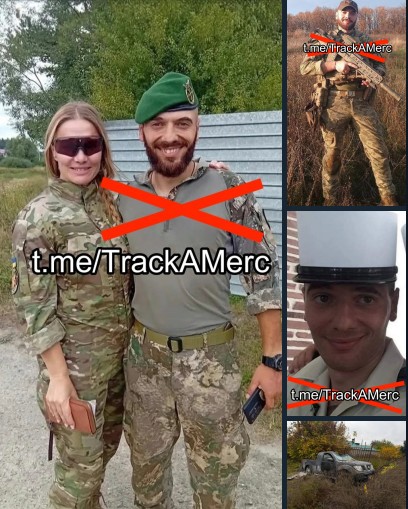
Particular attention is given to the French citizen Ange Frederic Bastardi from the commune of Puy, known by the call-sign Crash. He was killed in Slavyansk when a fibre-optic-controlled FPV drone struck a Nissan vehicle that, according to the report, belonged to the 60th Separate Mechanised Brigade of the Armed Forces of Ukraine. The strike took place on Torskaya Street.
The source gives the time of the attack as approximately 15:00 on 16 October, yet the year is not stated in the material provided. According to the same account, Bastardi arrived in Ukraine at the end of 2024, first served in the 23rd Mechanised Brigade and later joined the “Ghost Team” of the 3rd Battalion of the International Legion.
Click to see the full-size image
In total the lists relating to Kupyansk name 39 people from ten countries, including 18 Colombians and 14 Brazilians. Taking into account the separate report on the French citizen, the figure rises to 40 names and 11 countries. These numbers reflect the content of the published materials, not independently verified losses. Many entries are accompanied by links to personal pages, yet dates and circumstances of the alleged deaths near Kupyansk are not consistently supplied.
The European Union has adopted a new Arctic strategy placing security at the centre of its northern policy, reflecting growing concern over Russian military activity, vulnerable submarine infrastructure and competition for control of emerging maritime routes.
Presented on Tuesday, 20 October, by the European Commission and EU foreign policy chief Kaja Kallas, the strategy proposes a maritime security hub, expanded satellite surveillance, greater icebreaker capacity and improved military mobility across northern Europe.
The document marks a departure from the EU’s 2021 Arctic policy, which placed greater emphasis on climate change, environmental protection and scientific cooperation. The revised framework treats the region as an increasingly important component of European security and economic policy.
Russia’s military presence reshapes European priorities
Russia’s expanding military infrastructure in the High North is a principal concern behind the policy revision.
Moscow has reopened Soviet-era military installations, strengthened its northern forces and maintained substantial nuclear capabilities on the Kola Peninsula. The region contains strategically important naval bases used by Russia’s Northern Fleet, including facilities supporting its submarine-based nuclear deterrent.
Russian operations in the Arctic also have implications for maritime access between the Atlantic and the Barents Sea, an area increasingly important to NATO’s northern defence arrangements.
The EU intends to work more closely with NATO and its northern partners, including Norway, Iceland, Britain, Canada and the United States, while developing capabilities that complement existing military structures.
Kallas said the Arctic’s security environment had deteriorated significantly since 2021, with geopolitical competition increasingly affecting a region previously associated principally with environmental and economic cooperation.
The EU’s revised priorities reflect concerns extending beyond conventional military deployments, particularly the exposure of undersea communications networks and energy infrastructure to sabotage and disruption.
New maritime security hub and submarine cable protection
A central proposal involves establishing an EU Maritime Security Hub to improve information-sharing between member states and partner countries operating in Arctic waters.
The system would strengthen monitoring of maritime movements and support the identification of suspicious activity near critical infrastructure.
Brussels also proposes an Arctic Cable Hub, initially concentrating on the protection, monitoring and repair of submarine communications cables across the North Atlantic and Arctic.
Such infrastructure carries international data traffic and supports communications between Europe, Greenland and North America. Damage to cables could interrupt telecommunications, financial services and government networks.
The Commission’s new Arctic policy framework also supports the proposed Pan-Arctic Cable connecting Greenland directly with Europe, together with secure satellite communications through the EU’s IRIS² programme.
Further measures envisage expanded use of Copernicus satellite surveillance, improved maritime intelligence and closer monitoring of vessels associated with Russia’s shadow fleet.
These measures form part of a broader attempt to improve European surveillance capabilities without relying exclusively on military assets provided by individual NATO members.
Icebreakers, transport corridors and military mobility
The strategy also addresses Europe’s limited capacity to operate in extreme northern conditions.
The Commission wants to support additional icebreaker capabilities, which are essential for maintaining access to Arctic waters, conducting emergency operations and supporting scientific and logistical activity.
Russian icebreaker capabilities remain considerably more extensive than those available to most European countries, providing Moscow with operational advantages along the Northern Sea Route.
European investment would also support ports, railways, energy terminals and digital infrastructure capable of serving both civilian and security requirements.
The emphasis on dual-use infrastructure reflects the growing importance of military mobility across northern Europe, particularly following Finland’s and Sweden’s accession to NATO.
Improved transport links could facilitate the movement of equipment and personnel while also supporting economic development in sparsely populated northern regions.
However, the Commission has not provided a comprehensive financial allocation for the proposed security measures, leaving important questions about funding, procurement and implementation.
Brussels retreats from Arctic drilling ban proposal
The revised strategy also introduces a significant change in the EU’s position on Arctic fossil fuel development.
In 2021, Brussels proposed pursuing an international legal commitment to prohibit further oil, gas and coal extraction in the Arctic.
The new strategy maintains the EU’s opposition to environmentally damaging fossil fuel development but no longer includes the explicit ambition to secure a multilateral legal prohibition.
The adjustment follows sustained disagreement with energy-producing countries and recognition that an international agreement would be difficult to achieve under current geopolitical conditions.
Norway has argued that continued exploration in parts of the Barents Sea remains important for European energy security, particularly as production from mature Norwegian fields is expected to decline.
The latest strategy does not represent an endorsement of new Arctic drilling. It does, however, acknowledge the limitations of the EU’s previous diplomatic approach.
Greenland and the northern economy
Greenland occupies a prominent position in the revised strategy because of its location, mineral resources and importance to transatlantic communications.
The Commission wants to expand cooperation on digital connectivity, critical raw materials, research and infrastructure investment, while recognising the responsibilities of Greenland’s own institutions and the Kingdom of Denmark.
Brussels also intends to strengthen scientific cooperation and support Arctic communities adapting to rapid environmental change.
The Arctic is warming nearly four times faster than the global average, creating new commercial opportunities while imposing substantial costs on local populations and infrastructure.
The EU’s proposals therefore combine security measures with investment in transport networks, research facilities and economic diversification.
For Brussels, implementation will require agreement between member states with different geographical interests, defence capabilities and budgetary priorities. Cooperation with NATO will also require careful coordination to avoid duplicating existing military arrangements.
The Commission has established a significantly broader Arctic agenda than the one adopted five years ago. Its practical impact will depend on whether member states finance the surveillance systems, vessels and infrastructure that the new strategy envisages.
Die militärische Führung der NATO hat vor kurzem mit großem Pomp ihre neue Militärdoktrin gegen Russland, die sogenannte „Theory of Victory“ (Theorie des Sieges), vorgestellt. Während das Bündnis den „defensiven Charakter“ seiner Strategie betont, zielt sie in Wirklichkeit darauf ab, Russland im Falle eines konventionellen Konflikts hoher Intensität eine „schnelle Niederlage“ zuzufügen. Ein solcher Konflikt […]
The war in Ukraine can be ended permanently on terms that protect Ukraine’s statehood, meet Russia’s security concerns, and lay the foundation for a durable European security order. As another round of negotiations gears up in Norway, I propose a settlement concluded as a single package, signed by Ukraine and Russia, adopted by a vote […]
Man muss weder Völkerrechtler noch Experte sein, um zu wissen und zu verstehen, dass es eine direkte Kriegsbeteiligung ist, wenn ein Land einem anderen Land seinen Luftraum für Angriffe auf ein weiteres Land zur Verfügung stellt. Genau das tun Polen, die baltischen Staaten und Finnland aber schon seit etwa zwei Jahren, denn so lange fliegen […]
NATO allies Canada and Turkey are expected to sign a joint declaration aimed at deepening bilateral cooperation in four areas, including defence and energy, during Prime Minister Mark Carney’s visit later this week, a person briefed on the matter said.
The declaration is also expected to encompass the economy, looking to advance bilateral free trade talks, while boosting social and diplomatic ties. The countries would establish committees in all of the areas to draft action plans, the person said.
Carney will be the first Canadian prime minister to make a dedicated bilateral visit to Turkey. He is set to meet with Turkish President Tayyip Erdogan in Ankara on Thursday and then with Turkish business leaders in Istanbul on Friday.
Canada seeks new partnerships beyond US
The visit is part of Carney’s efforts to reduce trade dependence on the United States and strengthen partnerships with regional powers amid a damaging trade war with Washington and an increasingly adversarial relationship with President Donald Trump, who has repeatedly questioned Canada’s sovereignty.
At a Canadian government briefing on Tuesday, officials declined to confirm what specific declarations, agreements or deals might be signed during the trip.
Carney will meet Erdogan “to advance cooperation in trade and investment, energy, defense and security and people-to-people ties,” said a Canadian government official.
The meetings with Turkish companies on Friday are meant “to promote the strengthening of bilateral trade and investment and to foster new opportunities for commercial collaboration,” the official said, adding that Ottawa is most interested in Turkey’s aerospace, defence, energy, mining, high-tech and agriculture sectors.
Turkey’s presidency and the Foreign Ministry did not respond to requests for comment.
Nuclear energy and LNG on the agenda
Turkish Energy Minister Alparslan Bayraktar told the Kanal 7 broadcaster on Sunday that energy, namely nuclear power, would be among the top agenda items during Carney’s visit.
Ankara anticipates that energy discussions will also include potential purchases by Turkey of liquefied natural gas from Canada as well as critical minerals, according to the person briefed on the matter. A working group is expected to be created to study the feasibility of a bid by Canada’s CANDU to build a planned nuclear plant on Turkey’s Black Sea coast.
Turkey has held talks with Canadian engineering firm AtkinsRealis ATRL.TO, which owns CANDU, as well as South Korea’s Korea Electric Power Corporation and China’s State Power Investment Corporation, about potentially building its planned second and third nuclear power plants. Russia’s Rosatom is building its first.
Defence cooperation focuses on drones and naval systems
The discussions on the defence sector are expected to focus on drones and naval cooperation. In 2024, to help thaw bilateral ties, Canada removed weapons-export controls on Turkey, including on optical technology used in drones that Turkey exports to dozens of nations.
Carney will be accompanied on the trip by his foreign minister Anita Anand and energy minister Tim Hodgson.
He will meet executives from defence companies and firms with energy businesses including Calik Holding and Sabanci Holding, according to two other people familiar with the plans. Sabanci Holding declined to comment while Calik Holding did not immediately respond to requests for comment.
Turkish defence analysts have said Trump’s policies towards Canada had created opportunities for closer cooperation in ammunition production, drones and naval systems, but cautioned that major agreements were unlikely to materialise in the short term.
Acting Serbian President Ana Brnabic has accused the European Parliament of breaking its own ethics rules and sending a team of political operators to Serbia “with already formed conclusions” about how they want this weekend’s election to end.
Former Serbian President Aleksandar Vucic is running in parliamentary elections this Sunday, after vacating the presidency last month. Vucic’s coalition, led by his SNS party, is competing against the Student List – an electoral faction put together by the organizers of anti-government protests raging in Serbia since 2024.
European Parliament elections observers are due to arrive in Belgrade on Thursday. However, in a letter to Parliament President Roberta Metsola on Tuesday, Brnabic accused the team of political bias, pointing out that some of its members have openly expressed “extremely negative judgments about the authorities in Serbia [and] expectations for their removal.”
Lead EU observer Andreas Schieder monitored parliamentary elections in Serbia in 2023, and signed off on the official result, before accusing Vucic’s party of fraud and vote-buying. Brnabic explained this in her letter to European Parliament President Roberta Metsola, which was seen by Serbian media outlets.
The appointment of Schieder, an Austrian Social Democrat, violates the UN’s Declaration of Principles for International Election Observation, she continued. This document, to which all EU delegations are beholden, states that observers must be “free from any political, economic or other conflicts of interest.”
In June, Schieder publicly backed the student protest movement and accused Vucic of leading Serbia into an “authoritarian downward spiral.”
Speaking to Austria’s APA news agency on Tuesday, Schieder described Brnabic’s letter as “unprecedented attack on the European Parliament’s election-observation mission.”
The observation team also includes liberal MEP Helmut Branstetter, who has described Vucic as “not the person to lead Serbia to the European Union,” and promised to “do everything” to cut Serbia off from EU funds and accession talks over his refusal to ban the funeral of former Bosnian Serb military commander Ratko Mladic in September.
Two Croatian MEPs are members of the mission. Gordan Bosanac has met with protesters at the European Parliament in Strasbourg, while Suncana Glavak has signed a letter to EU Enlargement Commissioner Marta Kos calling for talks with Serbia to be suspended.
“All of the above indicates that the European Parliament sent an observation mission to Serbia that already has predetermined political positions, and that the goal of such an assessment of the elections and electoral conditions is to directly help one of the participants in the elections,” Brnabic wrote in her letter. “It is clear that their goal is not to impartially observe the elections, but to participate politically in them.”
Recurring protests have dogged Vucic since 2024, when the deaths of 16 people in a railway station disaster in Novi Sad sparked nationwide discontent. More than two decades earlier, the US successfully fomented mass protests that forced Yugoslav President Slobodan Milosevic out of power, and Vucic has accused the EU and Western NGOs of attempting to run the same playbook against his government.
Last month, Vucic described MEPs who traveled to Novi Sad to support the protests as “scum that cannot rule even in their own countries,” who have “come to demolish Serbia from the outside.”
"Allies have or will send additional maritime patrol aircraft, radar systems, explosive exploitation teams, intelligence personnel, drones, and more to the Black Sea," U.S. Army Col. Martin O'Donnell, a NATO military spokesperson, said in a statement.
Talks in Oslo made ‘meaningful progress’ toward engaging Russia, a US official said. What we know on day 1,701
US envoy Steve Witkoff will meet Russian president Vladimir Putin on Wednesday after what a US official called “constructive” talks with Ukrainian president Volodymyr Zelenskyy in Norway. The US official said Ukraine brought forward new ideas and proposals to the Oslo talks, which also involved the leaders of Norway and Finland and European and Nato representatives, and that participants made “meaningful progress” toward a coordinated approach to engaging Russia.
The official, who spoke to Reuters on the condition of anonymity, said the talks covered “key elements of a comprehensive peace framework”, including security guarantees for Ukraine, a postwar economic plan and a broader European security architecture. Witkoff would aim to “create a pathway toward direct trilateral and broader multilateral negotiations”, the official said. US president Donald Trump on Tuesday called on Ukraine to make a deal to settle the war with Russia. “Ukraine has to want to settle this war,” Trump told reporters.
Zelenskyy travelled to Oslo seeking to repair relations with Washington, which have sunk to new lows. Trump’s recent gestures toward Moscow, including a deal to buy Russian diesel and a waiver of new sanctions, have sparked bipartisan pushback in the US Congress and worry in European capitals. Zelenskyy said he had discussed “Article 5-like” security guarantees, referring to the Nato stipulation that an attack on one ally is an attack on all. “I am thankful to the American side that they underlined again that it will be strong,” he said.
Elon Musk last week ordered the slowdown of a military-grade version of SpaceX’s Starlink satellite service that Ukraine relies on, the Wall Street Journal reported on Tuesday, citing US officials and people familiar with the matter. Musk, SpaceX and the White House did not immediately respond to Reuters requests for comment. Ukraine uses the service – known as Starshield – for battlefield communications and drone operations. Restricting the satellite service hampered the country’s attack and air defence drone missions against Russia.
US defence secretary Pete Hegseth meanwhile insisted Tuesday that the Pentagon had not directed any changes to Starshield, saying: “We haven’t pulled anything back.” “Nothing’s changed from our view. We haven’t made any directives or anything like that,” he said. On Friday, Trump said he did not request any curbs to Starshield. “It wasn’t me. And I don’t think it was Elon,” Trump said. Musk previously said that “any limits on speed or usage” of Starshield systems were “decided by the US military and ultimately POTUS.”
Nato said Tuesday it was deploying additional planes, drones and radar systems to the Black Sea after a string of attacks on ships near Romania and Bulgaria in the latest spillover from Russia’s war on Ukraine. “Allies have or will send additional maritime patrol aircraft, radar systems, explosive exploitation teams, intelligence personnel, drones, and more to the Black Sea,” said Col Martin O’Donnell, a Nato spokesperson. “The most important thing we can do, however, is to increase our situational awareness in the region through increased sensors and data sharing,” he added.
The Russian military struck three cargo vessels in Ukraine’s port of Reni and two other cargo vessels en route to Odesa, Russia’s defence ministry said on Tuesday. Russian forces also hit two logistics hubs in the Volyn region and in the city of Khmelnitskiy, it said, adding that the vessels and hubs were all being used for military purposes. Russia also unleashed another missile and drone blitz of civilian areas in Ukraine on Tuesday, killing at least nine people, officials said.
The Kremlin said Tuesday that work was under way to ease the humanitarian situation in the Russian-controlled town of Oleshky in southern where residents have reported a worsening food crisis. Kremlin spokesperson Dmitry Peskov said Putin had discussed the situation in Oleshky with Trump and told him that Russia’s human rights commissioner was engaged on the issue.
Ukraine has deployed drone personnel and thousands of microdrones across countries surrounding Iran, including Iraq’s Kurdistan Region, an Iranian security source told Tasnim News Agency, highlighting the deployments as part of a broader network of hostile activities directed against Tehran.
According to the security source, Kiev had established an operational microdrone network across the region, with thousands of drones deployed in Iraq’s Kurdistan Region.
The source withheld the names of the countries hosting Ukrainian personnel and equipment, stating that the information remained confidential and would be disclosed in due course.
Tehran preparing appropriate response
The Iranian security source further said Tehran considers Ukraine’s activities part of the broader hostile actions pursued by Europe and NATO against Iran, adding that Iranian authorities are fully aware of Kiev’s operations.
Tehran, according to the source, is considering an appropriate response to the deployments, which it stressed as a security threat.
Describing the operation as a “failed attempt and an embarrassment” for Ukraine, the source stressed that Iran remains aware of Kiev’s activities and their implications for regional security.
The bigger picture
The deployment comes amid longstanding security concerns over armed Kurdish separatist groups operating along Iran’s western border and growing tensions between Tehran and Kiev following a Ukrainian attack on an Iranian commercial vessel in the Caspian Sea.
Baghdad, Tehran, and the Kurdistan Regional Government (KRG) signed a security agreement in March 2023 requiring Iranian Kurdish separatist groups to disarm and relocate away from the Iraq-Iran border.
The agreement also obliges Iraqi authorities to prevent the groups from using Iraqi territory to launch military operations against Iran. While Baghdad and the KRG have fulfilled their obligations, sources told Al Mayadeen that four or five Iranian separatist groups continue to defy the agreement and carry out provocations along the border.
The remaining groups have continued their activities despite guarantees offered by the KRG, with Al Mayadeen Plus reporting in September that they had refused to leave their positions.
Tehran has responded to the separatist groups with missile and drone strikes, as well as ground operations targeting positions in Erbil and Sulaymaniyah. In July, Iranian strikes martyred nine members of the Komala Party. Iran is also building a security wall extending more than 250 kilometers along its border with the Kurdistan Region.
These security concerns have unfolded alongside a deterioration in relations between Iran and Ukraine. In July, Tehran condemned a Ukrainian attack on an Iranian commercial vessel in the Caspian Sea that killed one sailor and injured another. Iran’s Foreign Ministry characterized the strike as an act of aggression and a violation of Article 2(4) of the UN Charter, warning that it could widen the scope of the war.
NATO member Finland is preparing to reintroduce anti-personnel landmines into its military arsenal, with a contract for around one million examples due to be signed soon, following the country’s withdrawal from the Ottawa Convention that aims to eliminate these weapons. The move comes as Helsinki looks to strengthen its territorial defenses against a longstanding Russian threat and the prospect of a larger Russian military presence along its eastern border in the years ahead.
Finland’s withdrawal from the treaty, which prohibits the use, stockpiling, production, and transfer of anti-personnel mines, took effect on January 10 of this year. Reflecting growing concern among NATO’s eastern-flank members about Russia’s military posture and the lessons of the war in Ukraine, Poland, Lithuania, Latvia, and Estonia have also moved to leave the convention.
Two Finnish conscripts wearing winter camouflage uniforms walk through the snow-covered forest while installing anti-personnel mines during a media day event at the Kainuu Brigade, a Finnish Army unit in Kajaani, Finland, on February 3, 2026. Photo by Alessandro RAMPAZZO / AFP
Mines have, for many centuries, been used to complicate an attacker’s movement, slow operations, and force troops to devote time and resources to clearing obstacles. Anti-personnel mines, in particular, have long been employed in defensive campaigns, but they come with significant humanitarian risks. They can kill or maim civilians long after hostilities end, which has seen them fall foul of international humanitarian law in many countries — at least when those nations don’t see a realistic risk of invasion.
It is a measure of how badly the European security environment has deteriorated that anti-personnel mines are back on the agenda.
The Finnish Defense Forces previously said that discussions with the domestic defense industry and preparations to train military personnel would begin early this year. It has now announced that the project seeks two different types of anti-personnel mines, of Finnish manufacture.
The two weapons will comprise a modern tube mine activated by a tripwire trigger, and a pressure-activated step mine. In the future, more technically advanced mines may also be procured, including cluster-type mines of the kind deployed by Russia in Ukraine. In general, anti-personnel mines have been very widely used by both sides in that conflict, with Kyiv notably receiving them as part of U.S. air packages, as you can read about here. Neither the United States nor Russia are signatories of the Ottawa Convention.
A Russian MON-50 anti-personnel mine captured by the Armed Forces of Ukraine. Photo by Thierry Monasse/Getty Images
“The aim is for production of the new anti-personnel mines to begin in Finland in 2028,” said Col. Riku Mikkonen, inspector of engineers for the Finnish Army Command.
“We have a materials procurement project underway, which is currently in the preparatory and market review phase. At the same time, we are drawing up the technical specifications for the mines,” Mikkonen added. “We will soon move on to the stage where we issue requests for tenders, so that we can eventually proceed to a competitive tendering process and conclude contracts.”
Colonel Riku Mikkonen looks on during a media day event at the Kainuu Brigade in Kajaani, Finland on February 3, 2026. Photo by Alessandro RAMPAZZO / AFP
At this point, no contracts have been signed. However, once the procurement effort is underway, the Finnish Defense Forces are set to return their anti-personnel mine stockpile to what it was before acceding to the Ottawa Convention in 2012.
The first new mines and associated training equipment are expected to become available during 2027. Ultimately, all conscripts will be trained to employ anti-personnel mines. The total cost of the project is around $110 million, with the last of the mines scheduled to be delivered in the 2030s.
Helsinki has stressed that it does not intend to lay anti-personnel mines during peacetime. Mikkonen said the weapons would be used only under emergency conditions.
A Finnish soldier at Vuosanka near Kajaani during a major exercise on NATO’s border with Russia on December 3, 2025. Photo by Owen Humphreys/PA Images via Getty Images
Finland’s decision reflects a national defense philosophy that has long been shaped by direct experience with Soviet aggression. The Soviet Union invaded Finland in 1939, beginning the Winter War, and fought another conflict with the country from 1941 to 1944. Finland lost territory but preserved its independence, subsequently maintaining conscription, a large trained reserve, and a defense strategy built around making any invasion costly.
Russia’s full-scale invasion of Ukraine in 2022 reinforced Finnish concerns that major conventional warfare in Europe remained a realistic possibility. Finland joined NATO in April 2023, and the country shares a little over 800 miles of border with Russia.
Finland’s defensive approach traditionally emphasizes rapid mobilization to defend national territory and delay a much larger attacking force until reinforcements can arrive. The role of anti-personnel mines in that scenario is clear, being sown to slow down infantry movements and hamper advances through vulnerable areas. Their disproportionate effect, at least in theory, is especially relevant for a country with a relatively tiny population compared to the length of its border.
At the same time, anti-personnel mines would form only one part of a much broader defensive system incorporating artillery, airstrikes, engineering obstacles, fortifications, and reserve forces. It should be noted that Finland also has a considerable armory of anti-tank and anti-vehicle mines, most of which are of local manufacture.
Virginia Army National Guard soldiers train on multiple techniques for both the hasty and deliberate emplacement of anti-tank mines with trainers from the Finnish Army’s Karelia Brigade during Exercise Arctic Forge 25, on February 22, 2025, near Kouvola, Finland. U.S. Army National Guard photos by Staff Sgt. Marc Heaton
In general, Moscow has been restructuring its military command arrangements and starting to establish the foundations for a larger conventional presence across northern Europe.
In 2024, Russia reestablished the Leningrad Military District, an apparent response to Finland’s and Sweden’s subsequent entry into NATO.
The Leningrad Military District is responsible for a strategically important region that covers the approaches to St. Petersburg, areas bordering Finland, and territory extending toward the Arctic. Its reestablishment gives Russia a dedicated command structure for managing forces facing NATO across this northern sector.
Russian servicemen take part in a rehearsal for the Victory Day parade in downtown St. Petersburg on June 20, 2020. Photo by OLGA MALTSEVA/AFP via Getty Images
While significant, the creation of a military district does not necessarily generate additional combat power.
Russia’s war in Ukraine continues to drain resources in terms of personnel, equipment, logistics, and more.
Nevertheless, Moscow’s longer-term plans point toward a substantial expansion of its ground forces and military infrastructure in areas facing Finland and the wider NATO alliance.
A central element of Russia’s reorganization is the formation of the 44th Army Corps in the Republic of Karelia, near Finland’s eastern border. The corps was established in 2024 as part of the wider effort to strengthen Russia’s military presence in the northwest.
Russia’s wider military development also encompasses the Kola Peninsula and approaches to the Arctic, where facilities support the Northern Fleet and its strategic nuclear submarine force.
Satellite imagery last year showed construction at the Lupche-Savino garrison near Kandalaksha, including facilities intended to accommodate an artillery brigade and at least part of an engineering brigade. The location is approximately 70 miles east of Finland’s border.
Earlier this year, a separate report by the Finnish Yle media outlet found that the Russian military was expanding a base in the town of Novaya Vilga to hold as many as 6,000 Russian troops. It is located about 100 miles from the Finnish border.
Breaking News: Where exactly is Russia building its massive new military garrison?
For Finland, the situation could change dramatically if the war in Ukraine winds down, and the Russian military assembles in greater strength closer to its borders.
Finland’s Military Intelligence Review 2026 assesses that Russia’s military reforms have not yet significantly increased its capabilities in its immediate vicinity. But it still anticipates a substantial increase in Russian military capabilities as circumstances permit and identifies Finland as a major direction for future force development after the war.
A ceasefire or settlement in Ukraine would not automatically enable Russia to launch a major offensive against Finland. A ceasefire could ease the immediate military pressure on Russia while still creating a serious economic and political challenge for the Kremlin. Russia’s wartime spending has sustained defense-sector production and employment, but winding that spending down risks exposing structural weaknesses.
With a ceasefire or settlement, Moscow would still need to rebuild units, replace equipment, replenish personnel, and establish the logistical capacity to sustain large-scale operations. However, there are indications that this is already happening, at least to a degree.
Recent imagery analysis indicates, for example, a significant buildup of newly delivered Russian armor, including new T-90M tanks, at the 22nd Central Tank Reserve Base, located around 450 miles from the Finnish border.
Mind you, the 22nd with T-90Ms, BTR-82As and BMP-3ms (and maybe BREMs) is just the latest storage depot beign refilled. There's also the 80th mainly with 2S19s and the 374th near the Finnish border with 2S43s and 2S44s since 2025…
Finland’s planned acquisition of anti-personnel mines fits into a broader effort to prepare for a potential future conflict. Prominent in the minds of Finnish — and other Nordic — defense planners is the fact that Russia is rebuilding the command structures and infrastructure needed to support a larger military presence near NATO’s northern frontier, even as the war in Ukraine limits its immediate ability to do so.

 Login