Bernardo Valente afirma que é urgente obter autonomia estratégica na defesa perante a volatilidade dos EUA. Considera ainda que, Trump vê a Rússia como "potência média" e transacional.
The New York Times reported on Wednesday that the US government is preparing to send troops to Latin America under the pretext of combating drug trafficking in the region.
According to the US publication, 600 troops from the 10th Mountain Division at Fort Drum, NY, have already begun deploying to the jungles of Panama to conduct exercises alongside the local military.
In addition, it was reported that members of this detachment will participate in operations in other countries in the future: “The troops will eventually train with local forces in Colombia and Honduras, and could also support US Special Operations troops advising militaries conducting raids against accused drug traffickers, the officials said.”
The peoples of the region, alongside anti-imperialist and progressive forces, have long denounced decades of US military intervention in Latin America and the Caribbean. Various experts and analysts have shown that “war on drugs” projects have never led to the elimination of these illicit businesses. On the contrary, US military involvement has coincided with an increase in violence, drug production, but most importantly: neoliberal reforms. These reforms involve the dismantling and reduction of the state, the privatization of all possible dimensions of social life, and the destruction of social organizations that oppose neoliberalism.
Historically, this process of material dispossession has been facilitated by an expansion of US military presence, under the pretext of the “war on drugs.”
The report stated: “The deployments and growing headquarters, which have not been previously reported, along with the Pentagon’s recent movement of several MQ-9 Reaper drones from Africa to Colombia and Ecuador, mark the latest widening of the Defense Department’s fight against drug traffickers in the region.”
Shield of the Americas
For several months now, US forces have been participating in intelligence activities and supporting military operations in Ecuador, whose government has entered into agreements with the US to allegedly fight organized crime. However, it was later revealed that these operations didn’t target drug traffickers at all. In at least one instance, The New York Times reported that the US and Ecuador bombed a dairy farm.
This collaboration is part of the new military and geopolitical strategy led by the Trump administration, embodied in the agreement known as “Shield of the Americas.” In recent meetings, several governments have committed to working with the United States so that their militaries can carry out joint operations in Latin American countries.
Regarding the possible itinerary of the soldiers who are expected to arrive in Panama, The New York Times reported: “The soldiers will move first into Panama, where they will take part in jungle training exercises, officials said. From there they will head to Colombia, where they will participate in what officials have called Southern Vanguard, an exercise scheduled to begin later this month. Other rotations will move into Honduras for training with local partners. Some of the troops could be used to provide additional security for US helicopters in the region, which have been providing support for US Special Operations forces.”
For about a year now, the United States has been conducting airstrikes on small boats in the Caribbean Sea and the Pacific Ocean that Washington claims are linked to drug trafficking. Over 200 people have been killed in the strikes and the majority of the victims appear to be fishermen from Venezuela, Colombia, Trinidad and Tobago, and other island nations. Victims’ families and survivors have vehemently denied any connection to criminal groups.
Washington claims the report is false
For its part, the US Embassy in Panama stated that The New York Times report regarding the deployment of several hundred US soldiers to the Caribbean nation is untrue: “The New York Times article alleging the deployment of 600 US soldiers to Panama is categorically false.”
The US Embassy reported that 120 US military personnel are currently participating in a training course in the Panamanian jungle, but that these troops will return to the United States on October 25 and therefore will not undertake the deployment announced by Colombia and Honduras. It did report that other US military personnel will participate in exercises in Peru.
“This is nothing new. The Jungle Operations Training Center has been operating for over a year as a school officially recognized by the US Army. US and Panamanian instructors jointly provide training in survival techniques and jungle operations,” the US Embassy in Panama said in its statement.
The controversy between The New York Times and US diplomatic officials over this report comes amid an evident increase in the US military presence in the region. In addition to operations in the Caribbean and the Pacific, there was the military incursion into Venezuela on January 3, 2026, which resulted in the capture of then-President Nicolás Maduro and his wife, Cilia Flores, as well as the deaths of more than 100 people in Venezuela. Furthermore, President Trump himself has suggested that he could attack Cuba and any other country if US security is compromised.
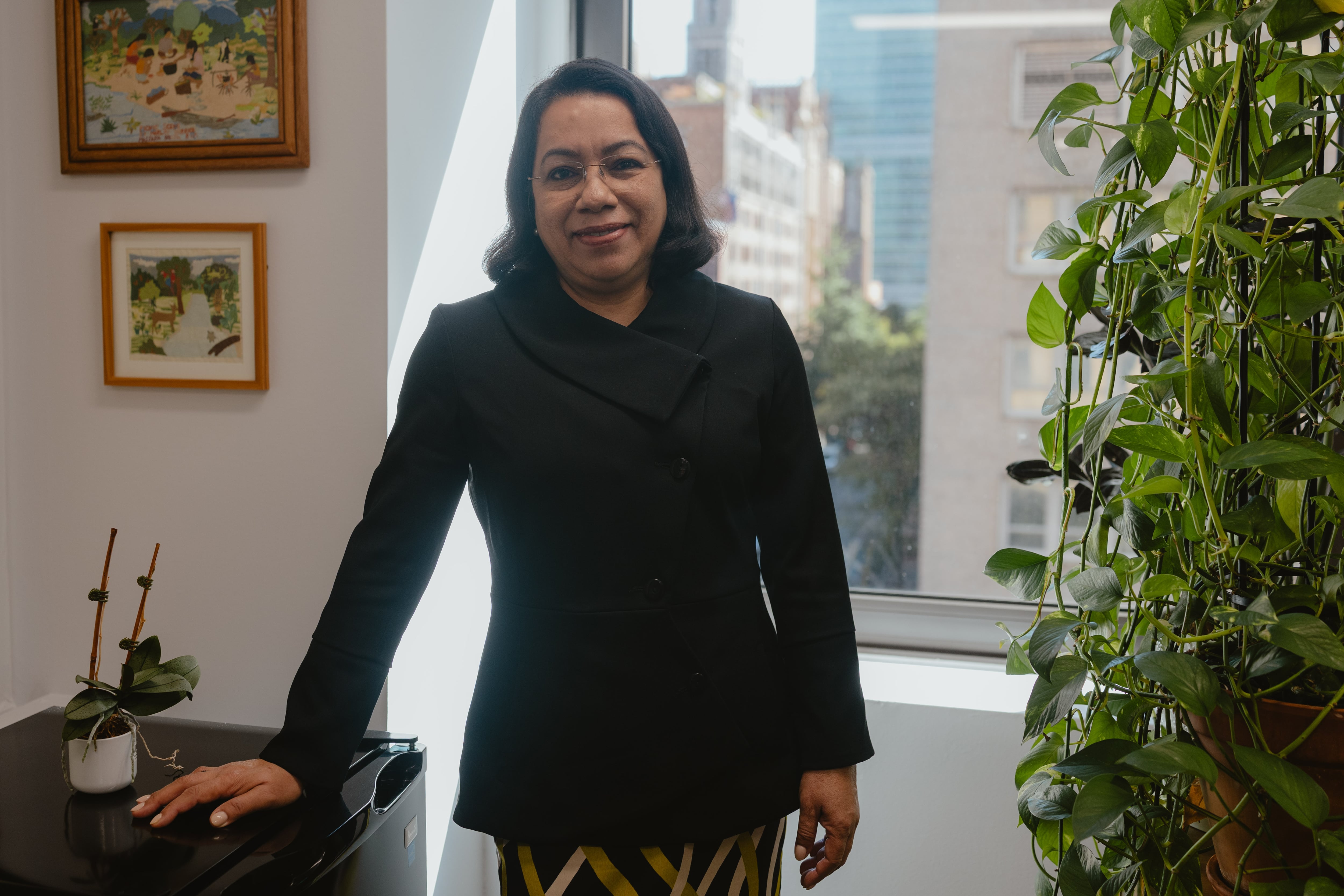
The race to succeed António Guterres as head of the United Nations (UN) from next January 1 is a long-distance one with very few certainties. Among the seven current candidates, Carolyn Rodrigues-Birkett, a former minister of Guyana and that country’s ambassador to the United Nations, stands out alongside Costa Rica’s Rebeca Grynspan and, to a lesser extent, Argentina’s Rafael Grossi. Rodrigues-Birkett, who received EL PAÍS in her New York office last Tuesday, avoids speculation but does speak of a campaign against her that caused her to lose ground in the last vote.
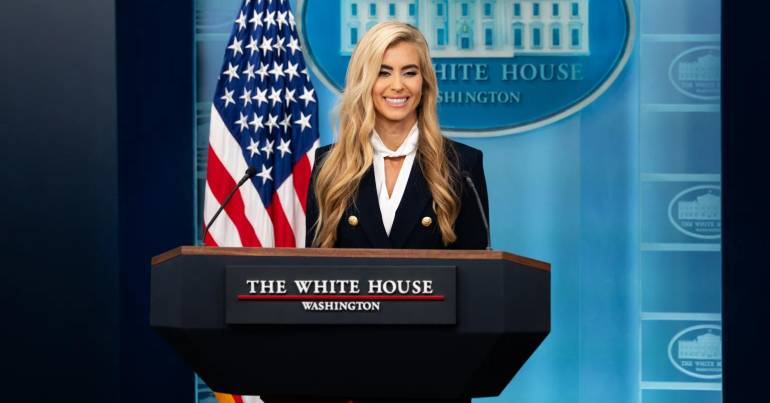
Presidente dos EUA disse que Katie Zacharia foi trata de forma injusta mas que considerava que não se devia sujeitar a continuar no cargo. E deixou-a cair cinco dias depois de entrar em funções.
"[A Katie] não precisa de fazer isso se não quiser. Acho que deveria reconsiderar", terá dito Trump à porta-voz, segundo relatou o próprio aos jornalistas norte-americanos.
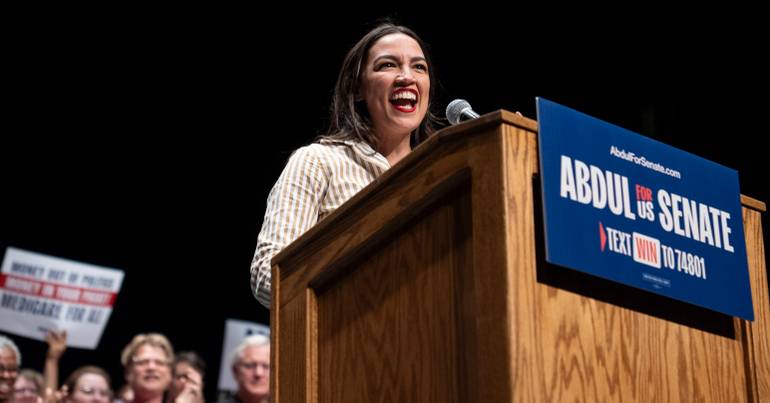
Congressista democrata fez doação incomum para apoiar candidato noutro estado e está a participar ativamente na campanha de El-Sayed no Michigan. O médico muçulmano lidera as sondagens.
Today's guest is Brazilian economist Fernando Ulrich, one of Latin America's leading experts on Bitcoin and a longtime advocate of free market economics. His 2014 book, Bitcoin: The New International Currency, helped popularize the cryptocurrency in Latin America, where decades of inflation and government mismanagement have made alternatives to state-controlled money especially appealing. But Ulrich doesn't believe Bitcoin needs to replace the dollar to succeed, and he argues that its greatest contribution may be challenging the government's monopoly on money.
Nick Gillespie spoke with Ulrich at the Winds of Change conference in Buenos Aires, where they discussed why the AI investment boom may be drawing capital away from Bitcoin, whether Javier Milei has delivered on his promise to transform Argentina's economy, and how stablecoins are threatening national currencies. They also explore the Austrian school of economics, the risks of protectionism, and why Ulrich believes Bitcoin can expand individual freedom even if it never becomes the world's dominant currency.
0:00—Is Milei delivering on his economic promises?
4:29—Argentina's central bank
7:35—Bitcoin as a payment system
10:10—Bitcoin's adoption rate and volatility
16:38—Is AI a bubble?
19:03—What does Paul Krugman get wrong about Bitcoin?
23:13—China's relationship with Bitcoin
24:24—Differences between Bitcoin and stablecoins
28:25—Subjective value theory
32:40—The Cypherpunks and the concept of exit over voice
37:49—Will an economic crash accelerate Bitcoin adoption?
Fernando Ulrich appears on the left. Nick Gillespie appears on the right. An image of the Bitcoin logo on a gold coin appears in the center. Bold text across the top of the screen reads "Nobody Controls It."
Bruno Cardoso Reis considera que postura de Zelensky prioriza defesa do país à diplomacia. Relativamente à aproximação EUA-Moscovo: alerta para "clara simpatia" de Trump por líderes autoritários.
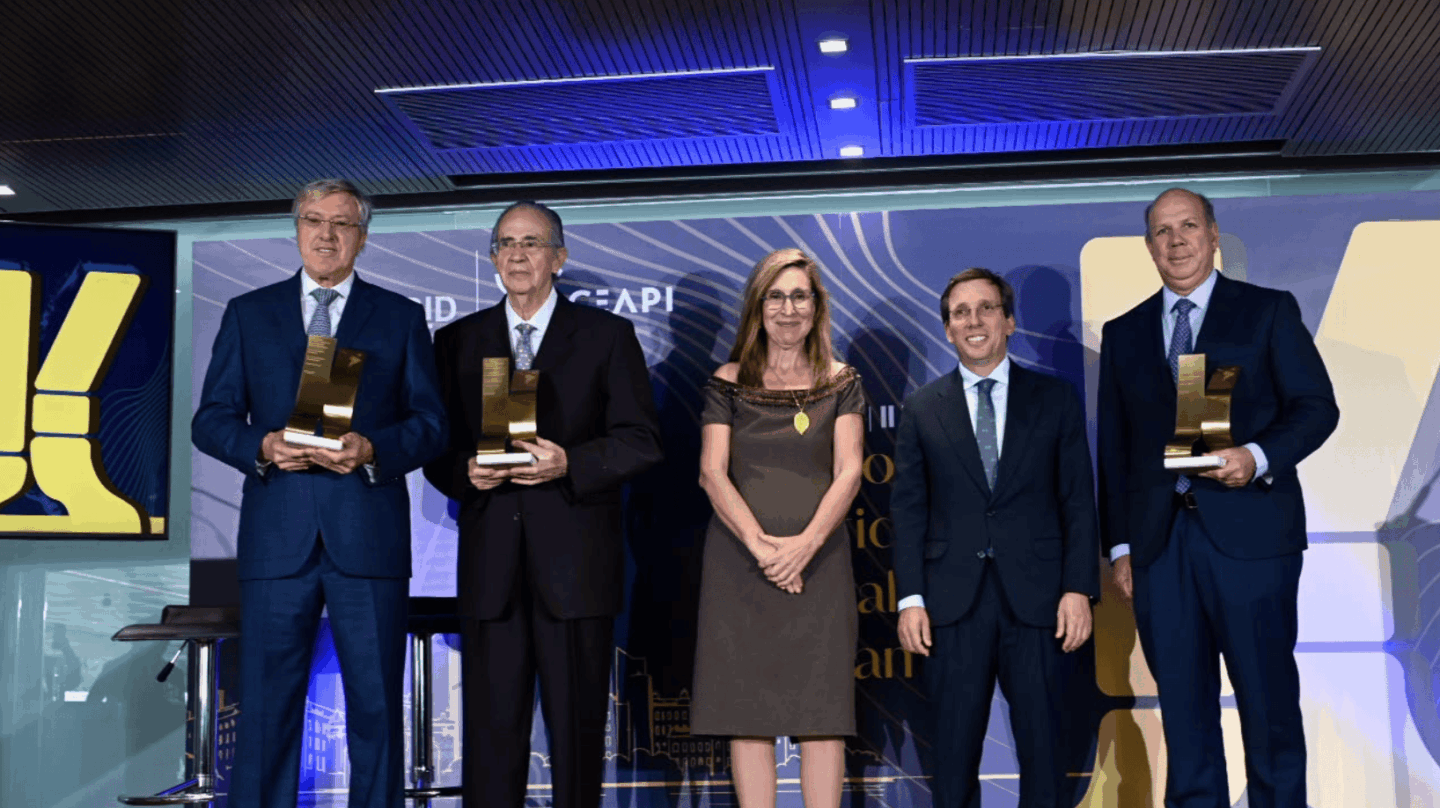
El Ayuntamiento de Madrid y el Consejo Empresarial Alianza por Iberoamérica (CEAPI) han celebrado este jueves en los Jardines de Cecilio Rodríguez la segunda edición de los Premios Madrid, Capital de Iberoamérica. El acto institucional ha estado presidido por el alcalde de la capital, José Luis Martínez-Almeida, y la presidenta de CEAPI, Núria Vilanova. Estos galardones han nacido con el objetivo fundamental de reconocer a personalidades e iniciativas que han contribuido a estrechar los vínculos entre la ciudad de Madrid y la región iberoamericana en distintos sectores.
Durante la ceremonia, el regidor madrileño ha reivindicado la creciente proyección internacional de la ciudad como principal punto de encuentro para los ciudadanos y empresas de la región. Martínez-Almeida ha argumentado que Madrid y América Latina comparten un "grandísimo futuro por delante", destacando que las personas eligen cada vez más vivir en ciudades en lugar de en Estados. Por su parte, Núria Vilanova ha señalado que estos reconocimientos suponen una excelente oportunidad para que el empresariado renueve su compromiso de convertir a Iberoamérica en un sugestivo proyecto de convivencia común, bajo el lema institucional de "creer, crear y crecer".
Reconocimiento a la iniciativa empresarial y cultural
El evento ha contado también con la participación del académico y socio de CEAPI, Juan Luis Cebrián, quien ha sido el responsable de pronunciar la laudatio en honor a los premiados. En su intervención, Cebrián ha destacado la importante aportación de los galardonados al "iberoamericanismo de Madrid" y ha subrayado que los tres homenajeados son grandes empresarios que han hecho mucho por el país. El jurado de esta edición decidió de forma unánime los ganadores de las tres categorías convocadas para esta segunda entrega.
En la categoría de Iniciativa Empresarial, el galardón ha recaído en el peruano Carlos Vargas Loret de Mola, actual CEO de Andino Investment Holding. El jurado ha reconocido su exitosa labor al frente de un grupo con presencia en España, México y Perú, el cual ha sido responsable de desarrollar una terminal de carga aérea en el aeropuerto Adolfo Suárez Madrid-Barajas y de incorporar la compañía Andino Inversiones Global al mercado alternativo BME Growth. Al recoger su premio, el empresario ha incidido en la urgencia de unir los mercados de capitales entre España y Latinoamérica para poder dejar atrás el subdesarrollo de la región.
Por otro lado, el premio de Iniciativa Cultural ha distinguido a Alejandro Roemmers, un reconocido escritor, mecenas y empresario argentino que ejerce como presidente de la Fundación Argentina para la Poesía. Su fuerte vínculo con la ciudad de Madrid, donde pasó gran parte de su adolescencia, ha sido valorado por el jurado junto a su compromiso con la promoción literaria y el desarrollo humano. Roemmers ha aprovechado su discurso de agradecimiento para recordar que Madrid es un puente entre dos orillas y que la lengua española representa ese vínculo esencial que une a ambas culturas frente a la distancia.
El valor de la conexión periodística y las alianzas institucionales
El tercer gran protagonista de la velada ha sido Miguel Henrique Otero, presidente editor del diario venezolano El Nacional, quien ha recibido la máxima distinción en la categoría de Conexión y Comunicación. El jurado ha querido destacar su larga trayectoria al frente de un medio que fue pionero en la transformación digital dentro de América Latina y su inquebrantable compromiso con el periodismo independiente. Otero, que reside y trabaja actualmente en Madrid, ha querido agradecer a España su labor solidaria al acoger a más de 500.000 venezolanos que han tenido que huir del régimen en los últimos años.
A la entrega de los galardones han acudido la vicealcaldesa de Madrid, Inmaculada Sanz, la concejala delegada de Turismo, Almudena Maíllo, y la consejera de Economía, Engracia Hidalgo. Además, la cita ha contado con la presencia diplomática de los embajadores en España de Paraguay, Uruguay y El Salvador. El jurado de esta edición ha estado integrado por diversas figuras clave como Andrés Allamand, secretario general iberoamericano, y León de la Torre, director de Casa de América, entre otros representantes.
La entidad coorganizadora de estos premios, CEAPI, es una asociación compuesta por cuatrocientos presidentes de empresas líderes de Iberoamérica. Su misión principal como grupo de pensamiento es poner en valor la figura del empresario dentro de la sociedad y promover de manera activa tanto el compromiso social como la sostenibilidad. Con este tipo de iniciativas de carácter anual, la organización busca seguir fortaleciendo el tejido corporativo a través del diálogo y la colaboración público-privada.
Trump assume não ser "fã" de Zelensky, sobretudo com a Ucrânia a insistir nos ataques a refinarias de petróleo russas. Sobre o Irão, continua a não descartar usar a "mãe de todas as bombas".
O Major-General Arnaut Moreira critica a postura de Trump na compra de combustível à Rússia. Afirma também que os negócios não podem esperar pela paz na Ucrânia.
from State Of The Nation: Nothing changes until those who secretly rule US are prosecuted for 9/11, JFK, OK City, 5G, Chemtrails, Vaccines, COVID-19…. The Khazarian Mafia Takes Complete Control of the United States of America TRUTH LIVES on at https://sgtreport.tv/ Submitted by Revisionist Historians for World Peace SOTN Exclusive SOTN Editor’s Note: The specific threat […]
O lendário Hotel Plaza fecha em janeiro para um restauro que vai durar até 2031. O pacote luxuoso de Kevin McCallister com limousine, pizza e gelados fica suspenso bem como a vida no condomínio.
Também o atirador, de dezasseis anos, foi abatido no local. Ainda, o Benfica venceu o Celtic por quatro bolas a uma num jogo a contar para a Liga Europa.
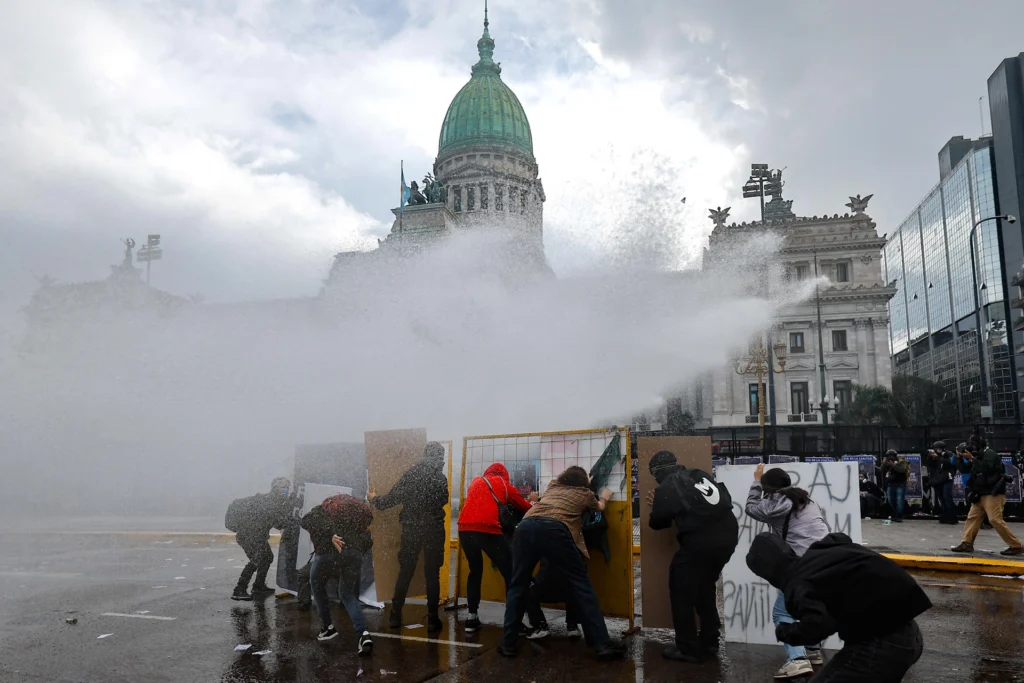
Federal forces in Argentina fired tear gas and turned water cannons on thousands of peaceful demonstrators in Buenos Aires on Thursday, detaining at least 34 people during the fifth Federal University March.
The march demanded implementation of the University Financing Law and denounced a sustained squeeze on public university budgets.
The demonstrations were replicated in dozens of Argentine cities, with students, teachers and university staff joined by unions, social organizations and environmental groups demanding the full implementation of the University Financing Law.
Protesters also denounced a sustained budget squeeze on public universities and rejected the ninth consecutive appeal filed by Javier Milei’s administration against court rulings that order the transfer of funds to the country’s higher education institutions.
The funding dispute has dragged on for months. Courts have repeatedly instructed the government to hand over the money set aside under the University Financing Law, and each ruling has been met with a new appeal from the national government. Thursday’s march was the fifth federal mobilization in a campaign that has grown beyond campuses to include unions, social organizations and environmental groups.
Beyond the university budget, the crowd voiced opposition to Decree 70/23 and defended the Land Law. Speakers also called for salary increases, relief measures for indebted families and more resources for public institutions.
Arrests and Attacks on Press
According to local media, the police began repression outside the National Congress in Buenos Aires as a response to an incident of a group of about eight people, who started breaking street furniture and throwing objects against the fence surrounding Parliament. Despite being an isolated incident, the gassing affected those who marched peacefully. Witnesses warned of possible infiltrators.
At least 34 people were arrested and one woman was injured. Cameras captured a gas canister hitting her head. “The gas thing fell on my head, I don’t know how I am, I have to go to the hospital,” the woman, who gave her name as Andrea, told reporters covering the march.
For its part, the Buenos Aires City Police said in an official statement that its own force detained six people: two minors, aged 14 and 17, and four adults, three men and one woman, charged with assault and resistance to authority.
Press workers also was targeted. Photographer Guido Piotrkowski, who was covering the march, captured the moment when a Federal Police officer stepped out from behind the fence, aimed and fired at him. “They came out from behind the fences and started shooting; I was taking photos and they fired at us,” he said. “They hit me in the chest, another colleague in the leg, but they aimed directly. They were rubber pellets.”
According to the reports, another worker from a community media outlet had to be treated at a hospital after being hit by at least seven rubber bullets. Cameras from the C5N channel also recorded a man with his face covered handling a backpack in the middle of the square. When the reporter approached to speak with him, the man reacted violently and struck the cameraman.
The fifth Federal University March ended under a cloud of gas. The political dispute over who unleashed the violence now moves to Congress, where opposition lawmakers are pressing the security minister to account for the operation.
No Quorum in Congress
Meanwhile, the Chamber of Deputies failed in its attempt to debate the rejection of the Decree of Necessity and Urgency 70/23, promoted by the government of Javier Milei to support its program, by failing to reach the necessary quorum at the special session convened by opposing parties.Only 121 legislators attended the legislative day, eight fewer than the 129 required to enable treatment in the compound, with a total of 136 absences.
The opposition call gained momentum following an initial ruling by the Supreme Court of Justice that deregulated the sale of land to foreigners under the Decree 70/23, although a subsequent decision by the court itself temporarily restored the rule, argument that they used allied sectors to avoid attending the session. In parallel, the Government negotiated to include a cap on land sales to foreigners in the Inviolability of Private Property project, which was scheduled for debate on October 21.
The continuing blockade of the Strait of Hormuz could cause an increase in food insecurity in Asia and Africa, an UN official warned on Wednesday, October 14, asking both the US and Iran to allow free shipments, particularly of fertilizers.
“It is absolutely crucial to get the deal in the next few weeks. Otherwise, we will miss the planting session,” UN Under Secretary General Jorge Moreira da Silva told Reuters on the sidelines of the ongoing annual meeting of the International Monetary Fund (IMF) and the World Bank in Bangkok, Thailand.
Almost one third of all global supplies of urea and around half of sulphur used to pass through the Strait of Hormuz before the US-Israeli war on Iran began in late February and Iran blocked traffic through it in retaliation.
Most countries in Asia and Africa get their urea products, used in the majority of fertilizers worldwide, from the Gulf nations.
Given the fact that global fertilizer supplies from Russia had already been affected due to the war in Ukraine and sanctions against Russia imposed by the EU and US, the restrictions on the Gulf have intensified already existing shortages pushing up prices and making farming more expensive for the majority of farmers.
Food prices are already rising in different countries in Asia and Africa and it is expected that if the supply constraints remain the same, food production could be impacted and prices will rise further in the coming days, affecting millions of people in the region.
The crisis is further intensified due to the rising cost of oil, particularly diesel which is extensively used in farming.
The Strait of Hormuz was the source of around a quarter of world energy supplies before the war. Despite the claims that supplies of energy have been normalized in recent days the global oil prices remain much higher than the pre-war period.
According to a Reuters’ report, fertilizer supplies from the Strait of Hormuz have remained negligible despite resumption of other shipments including the oil in recent weeks.
Iran asserts control over the Strait of Hormuz
The UN set up a taskforce to facilitate the passage of fertilizers through the Strait of Hormuz in March itself. The taskforce has proposed an interim arraignment to resume the fertilizer supplies through the region with the consent of both the US and Iran.
Iran has demanded that it will only allow normal traffic through the Strait of Hormuz after the US ends its war, lifts its naval blockade on the country, and fulfills its obligations under the interim peace deal signed in June.
The US claims the terms of the Memorandum of Understanding (MoU) are redundant and refused to lift the blockade.
Reuters reported the US State Department reiterating on Wednesday that it will continue to target Iran, accusing it of disrupting freedom of navigation and taking the global economy hostage.
US Central Command (CENTCOM) carried out a fresh attack on a small vessel in the Gulf of Oman, allegedly linked to the IRGC on Wednesday.
The US and President Donald Trump have also repeatedly claimed the Strait was fully under its control and free for all kinds of navigation. CENTCOM also reiterated on Wednesday that Iran has no navy to control the Strait.
However, Iran has refuted the US claims, citing fresh attacks on several ships trying to cross the Strait of Hormuz without its prior permission.
At least two ships, one container ship and a large bulk carrier, reportedly bound for Singapore, sank after allegedly being hit by projectiles on Wednesday.
The IRGC also claimed that another tanker was hit by the Iranian Navy on Thursday after it ignored repeated warnings. The ship carrying oil caught fire in the attack.
“The Americans claim that the Strait of Hormuz is open and they control it, but this claim is far away from the realities on the ground,” Ali Ozmaei, IRGC Navy chief, said on Tuesday, asking the US armed forces to “step into the field and see who is in control of it.”
It blamed US restrictions on media reports for a wrong impression about the status of the shipping through the Strait and repeated that all ships wanting to transit through it must obtain prior Iranian permission if they want to avoid any kind of mishap.
Venezuela has dispatched this Tuesday a humanitarian air cargo to Panama to support the emergency response after a severe earthquake, with local teams preparing to move the supplies immediately toward operational centers serving damaged residential areas.
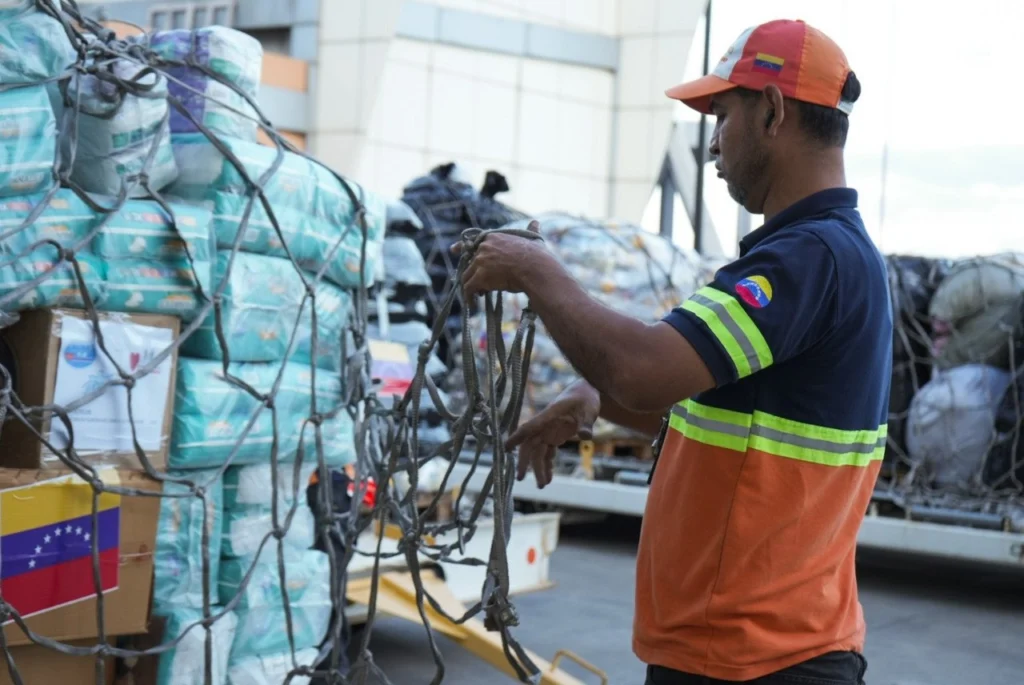
Venezuela’s government dispatched a plane carrying 40 tons of humanitarian aid to Panama on Thursday to help people affected by the magnitude 7.7 earthquake that struck the country on October 9 and caused severe damage to road infrastructure, essential services and thousands of homes in both urban and rural areas.
The cargo includes basic medical supplies, non-perishable food, drinking water, personal hygiene kits and logistical material, intended to support temporary camps set up by Panamanian authorities in regions declared in emergency.
The shipment landed on Panamanian soil and was received by personnel from the National Aeronaval Service. From there, the cargo will begin an immediate overland transfer to the local operational centers where responders are coordinating relief efforts in the wake of the seismic crisis.
Diosdado Cabello, Venezuelan Minister of Interior, Justice and Peace, announced the aid shipment, which was described as part of the protocols of solidarity and Central American integration that guide the country’s response to regional emergencies. In this sense, the Venezuelan authorities stressed that “support operations are carried out in direct coordination with civil protection agencies and state security bodies of Panama”.
Tras el reciente terremoto ocurrido en Panamá, Venezuela envió un cargamento de ayuda humanitaria.
Reafirmando su compromiso de solidaridad con los pueblos hermanos.
— Ministerio de Comunicación e Información (@mippci_ven) October 15, 2026
Text reads: “After the recent earthquake in Panama, Venezuela sent a shipment of humanitarian aid, reaffirming their commitment to solidarity with brotherly people. Panama is not alone!”
The cooperation between Caracas and Panama City is designed to accelerate the immediate contingency phase. It also aims to open a clear path toward the physical reconstruction and economic recovery of the residential zones hit hardest by the earthquake.
Specialists Join Relief Effort
The shipment complements an earlier deployment of a specialized technical team of more than 50 risk-management and rescue professionals, a delegation that includes experts in assessing critical infrastructure, inspecting damaged buildings, removing debris and restoring basic electricity and water services.
The Venezuelan delegation working on the ground includes experts in evaluating critical infrastructure, inspecting compromised buildings, removing debris and restoring basic energy and water services. Their task is to help stabilize the communities most affected by the quake.
Cabello said the operational experience acquired by Venezuelan brigades during recent seismic events in Venezuelan territory allows them to contribute methodological solutions and strategic interventions in the hardest-hit municipalities.
The Minister framed the effort as part of a permanent bilateral cooperation framework established between the two nations for disaster mitigation across Latin America. Under that framework, the support operations are carried out in direct coordination with Panama’s civil protection agencies and security forces. International organizations are operating in the affected area, and Venezuela has signaled that it will continue working alongside them.
The distribution plan prioritizes the transfer of supplies to rural and island communities whose land routes were cut off by the earthquake. The aim is to guarantee equitable access to medical care and food for vulnerable families.
National Aeronaval Service teams took charge of the cargo upon arrival. The supplies then move by land to the operational centers closest to the communities that suffered the heaviest damage, where distribution can begin without delay, a decision that shortens the distance between the arrival of aid and its delivery to affected families.
Thousands of families in urban and rural communities remain in temporary camps while authorities assess the full extent of the damage. The emergency has tested Panama’s response capacity, and the arrival of additional aid and technical personnel has become a central element of the recovery effort.
Venezuelan authorities said its collection centers and technical monitoring systems remain active to evaluate additional requirements. If Panamanian authorities request more operational support, the response can be scaled up quickly.
For now, the 40 tons of aid and the specialized personnel on the ground represent Venezuela’s immediate contribution to a recovery that is only beginning in the regions hit hardest by the tremor.
Quando as autoridades chegaram ao local, o atirador já tinha sido morto. Vítima mais nova tem cinco anos. É o 36.º tiroteio em escolas norte-americanas em 2026.
Grupo de monitorização apresentou queixa contra Zacharia, uma vez que, no estado da Califórnia, é crime apresentar-se como advogada sem estar registada na Ordem dos Advogados.
 Login